EE 40403 – Energy Management
Energy Management
Rantharu Attanayake
BSc. (Eng) , MSc, MBA
Email : rantharu@gmail.com
Mobile : 0773630002
Introduction to Energy
Types and Forms
EE 40403 – Energy Management
Objectives
• Explain what energy enables us to do.
• Differentiate between forms and sources of energy.
• Demonstrate how energy is stored in the major energy sources.
EE 40403 – Energy Management
Energy
• Energy exists in many forms.
• Energy can be moved from one object to
another.
• Energy can be changed from one form to
another.
• Energy cannot be created or destroyed.
Energy in two Forms
Potential Energy and Kinetic Energy
Potential
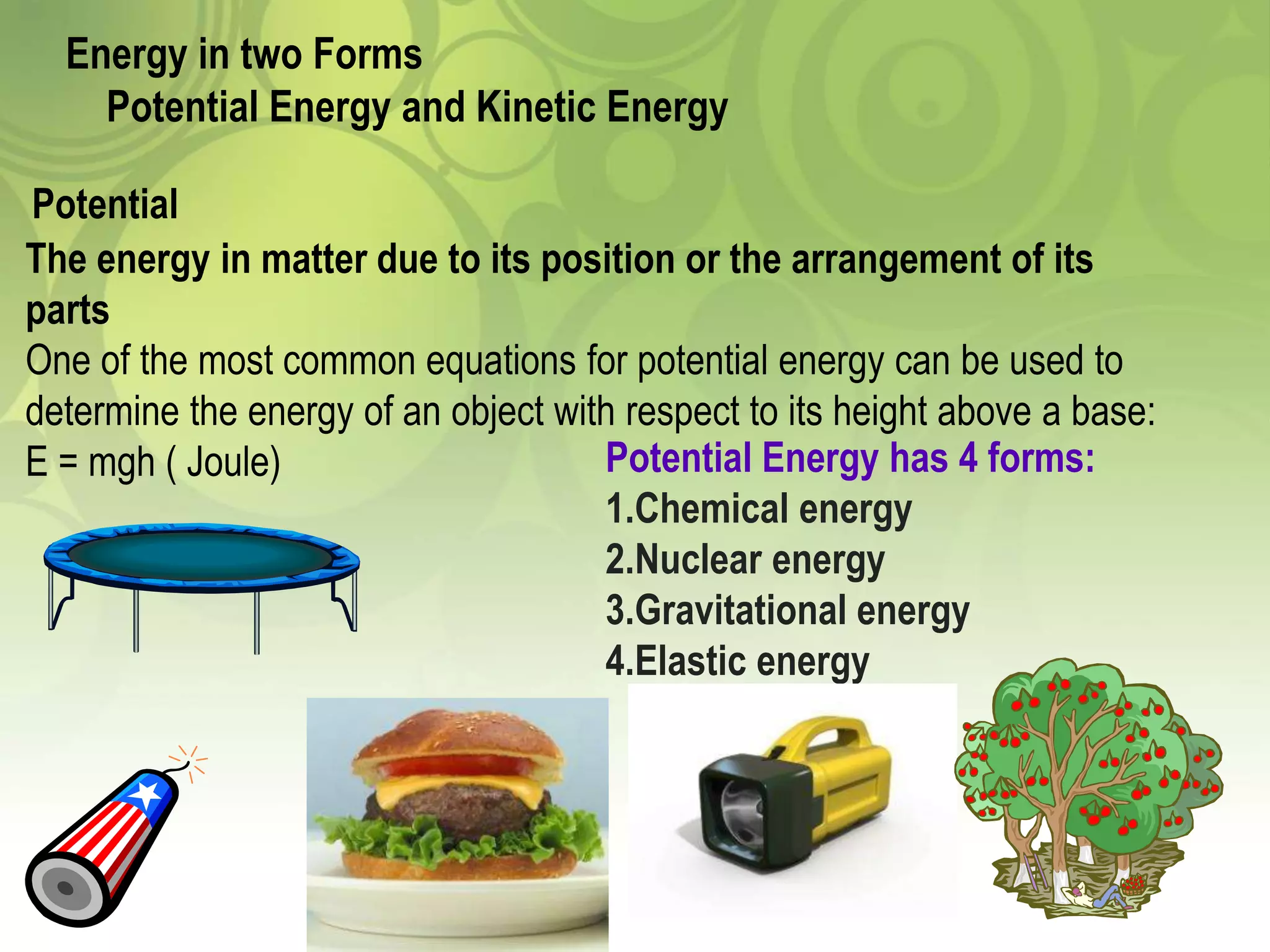
Potential Energy has 4 forms:
1.Chemical energy
2.Nuclear energy
3.Gravitational energy
4.Elastic energy
The energy in matter due to its position or the arrangement of its
parts
One of the most common equations for potential energy can be used to
determine the energy of an object with respect to its height above a base:
E = mgh ( Joule)
Energy in two Forms
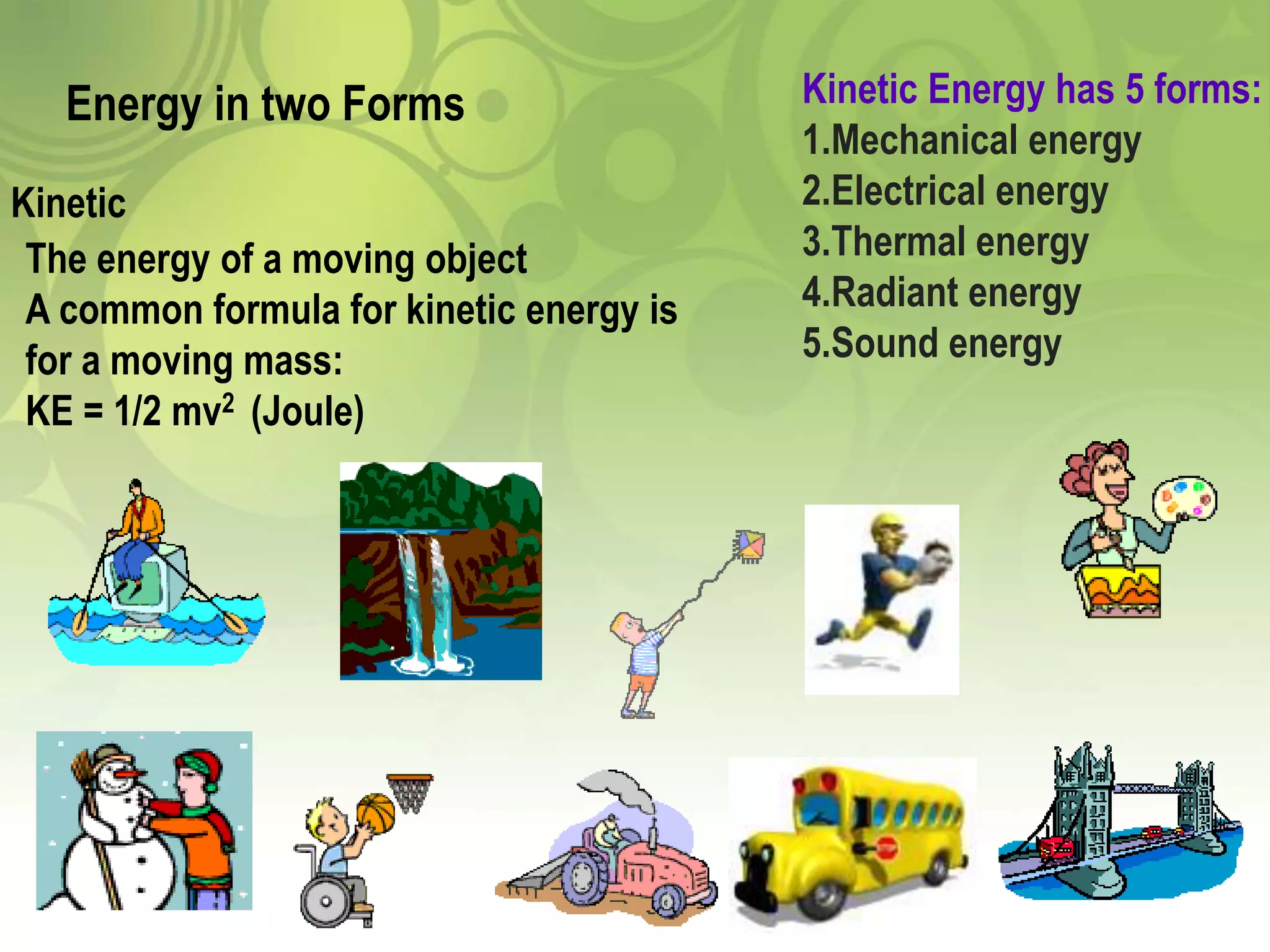
Kinetic
Kinetic Energy has 5 forms:
1.Mechanical energy
2.Electrical energy
3.Thermal energy
4.Radiant energy
5.Sound energy
The energy of a moving object
A common formula for kinetic energy is
for a moving mass:
KE = 1/2 mv2 (Joule)
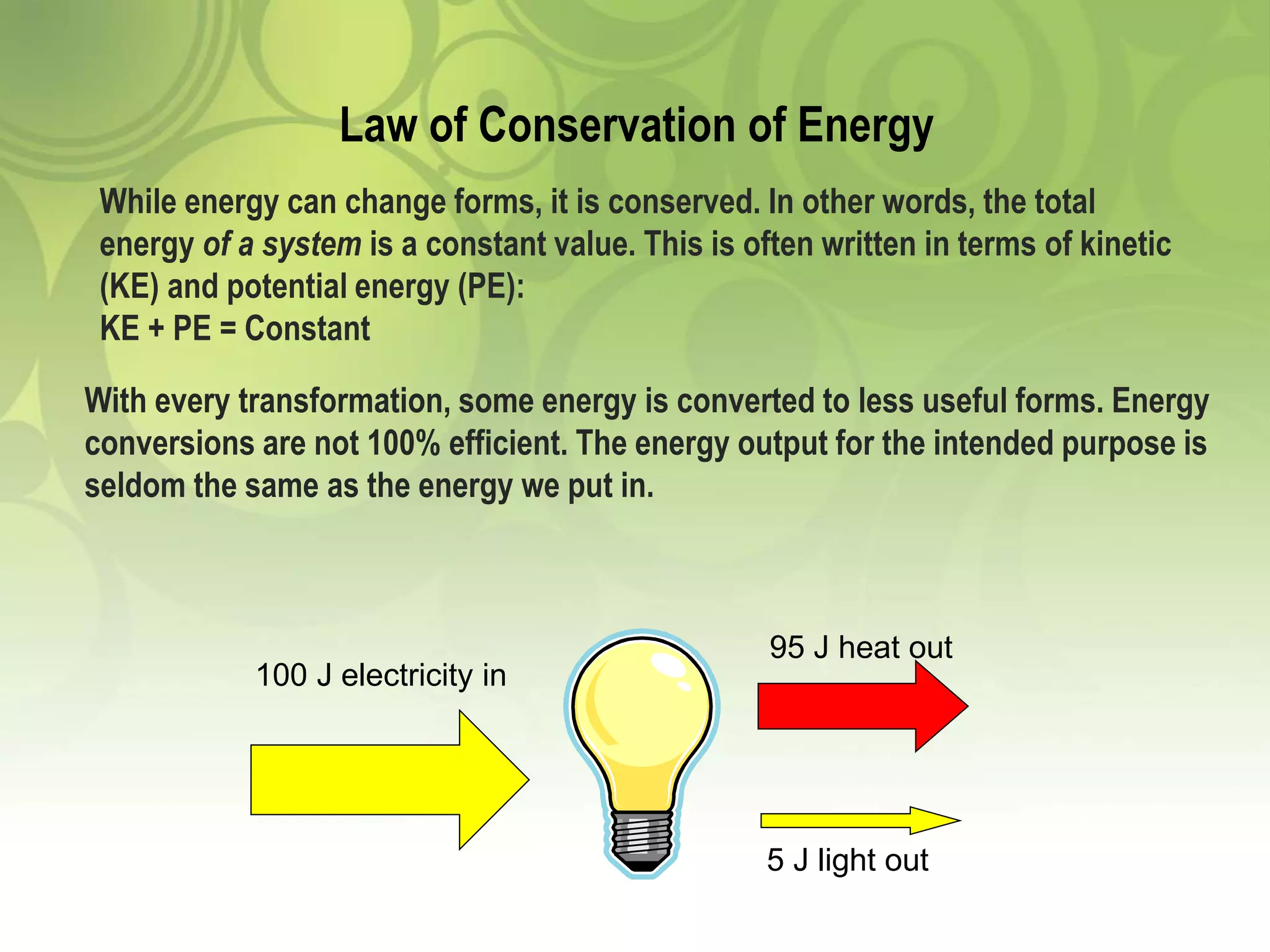
Law of Conservation of Energy
With every transformation, some energy is converted to less useful forms. Energy
conversions are not 100% efficient. The energy output for the intended purpose is
seldom the same as the energy we put in.
100 J electricity in
95 J heat out
5 J light out
While energy can change forms, it is conserved. In other words, the total
energy of a system is a constant value. This is often written in terms of kinetic
(KE) and potential energy (PE):
KE + PE = Constant
Gravitational Energy
The energy an object or
substance has because
of its position; anything
“up high”
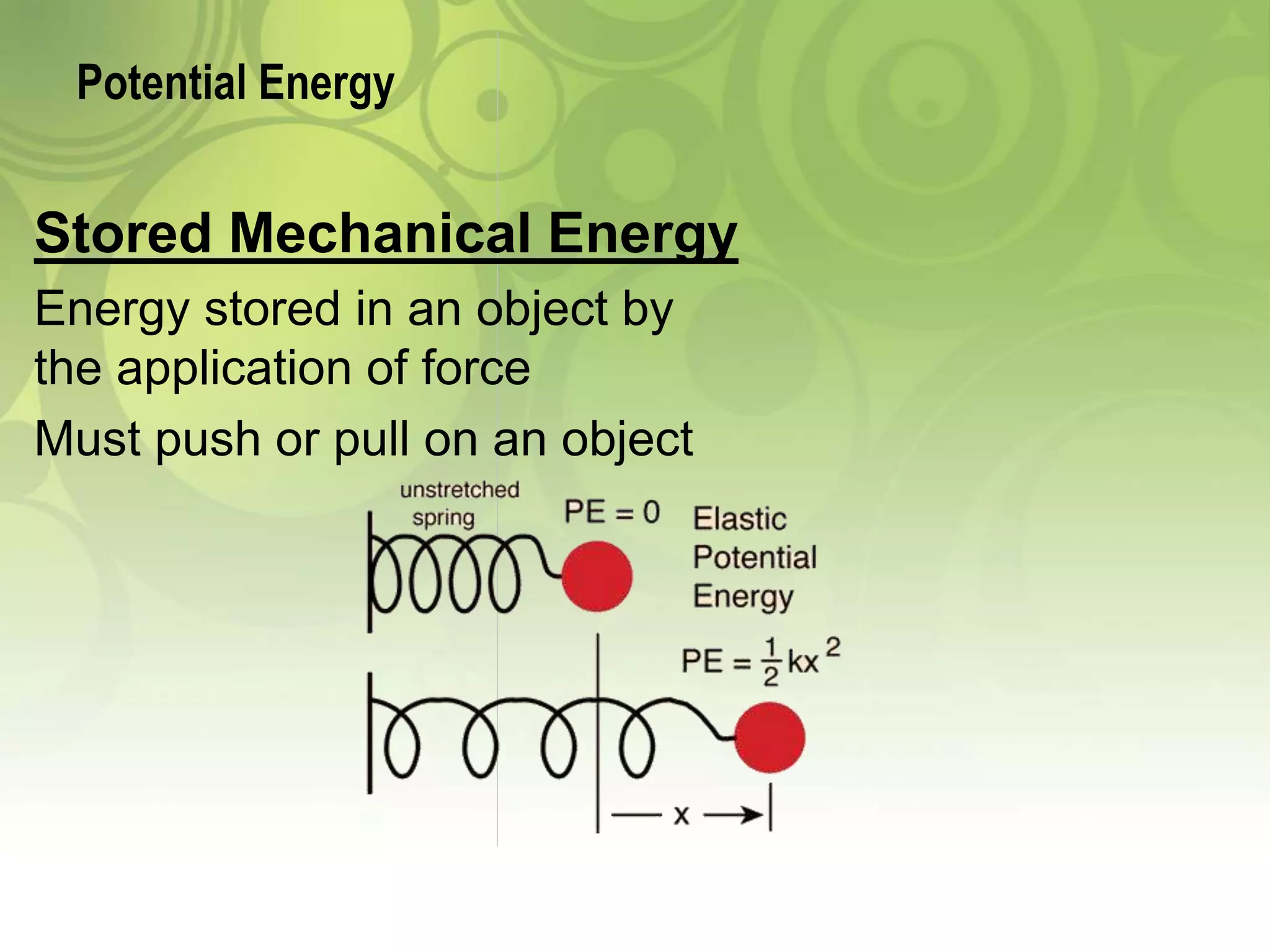
Potential Energy
Stored Mechanical Energy
Energy stored in an object by
the application of force
Must push or pull on an object
Potential Energy
Potential Energy
Nuclear Energy
Energy contained in the
nucleus of an atom
Nuclear energy is
released when nuclei
are split apart into
several pieces, or when
they are combined to
form a single, larger
nucleus
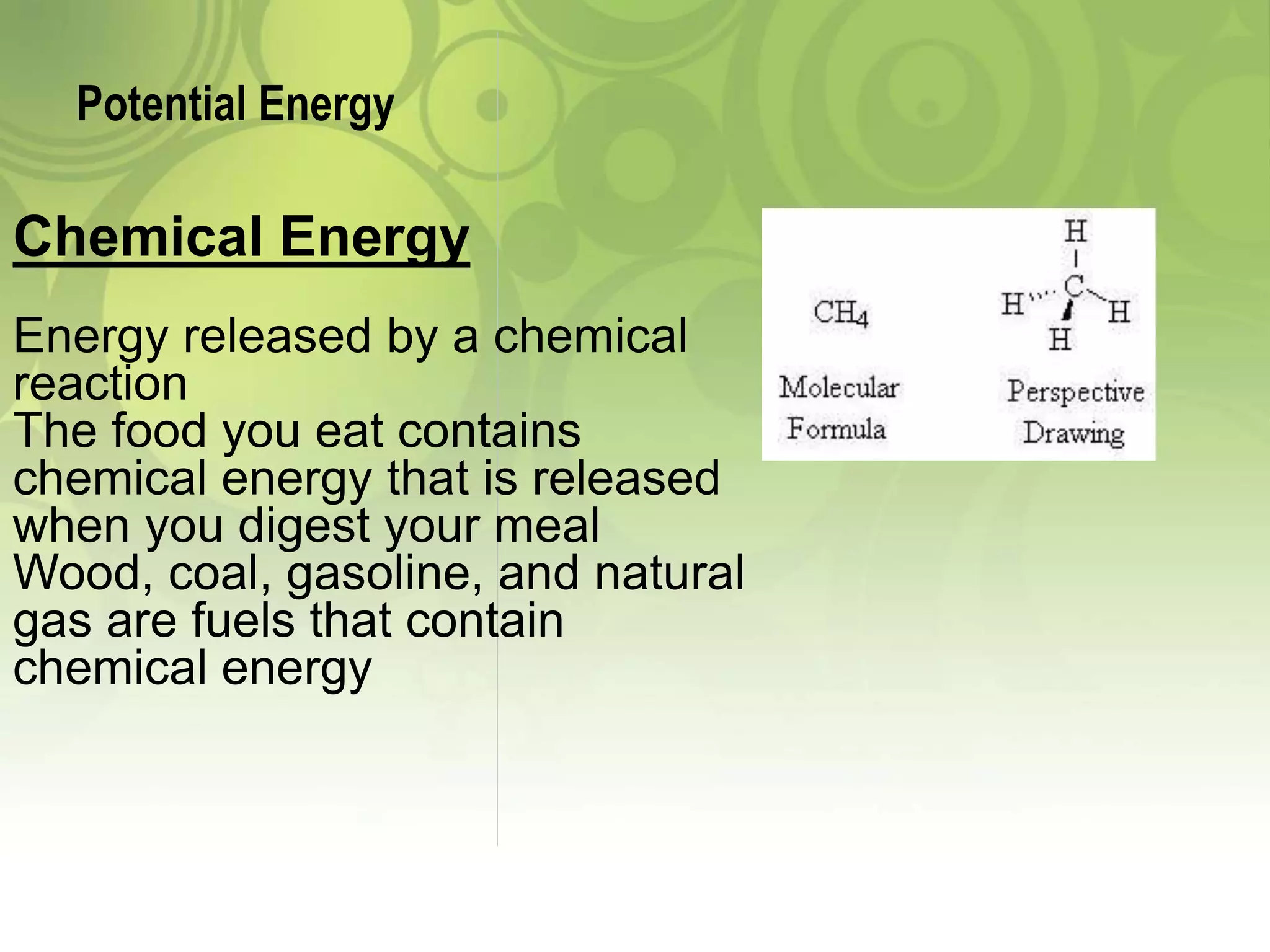
Chemical Energy
Energy released by a chemical
reaction
The food you eat contains
chemical energy that is released
when you digest your meal
Wood, coal, gasoline, and natural
gas are fuels that contain
chemical energy
Potential Energy
Mechanical Energy
(Motion)
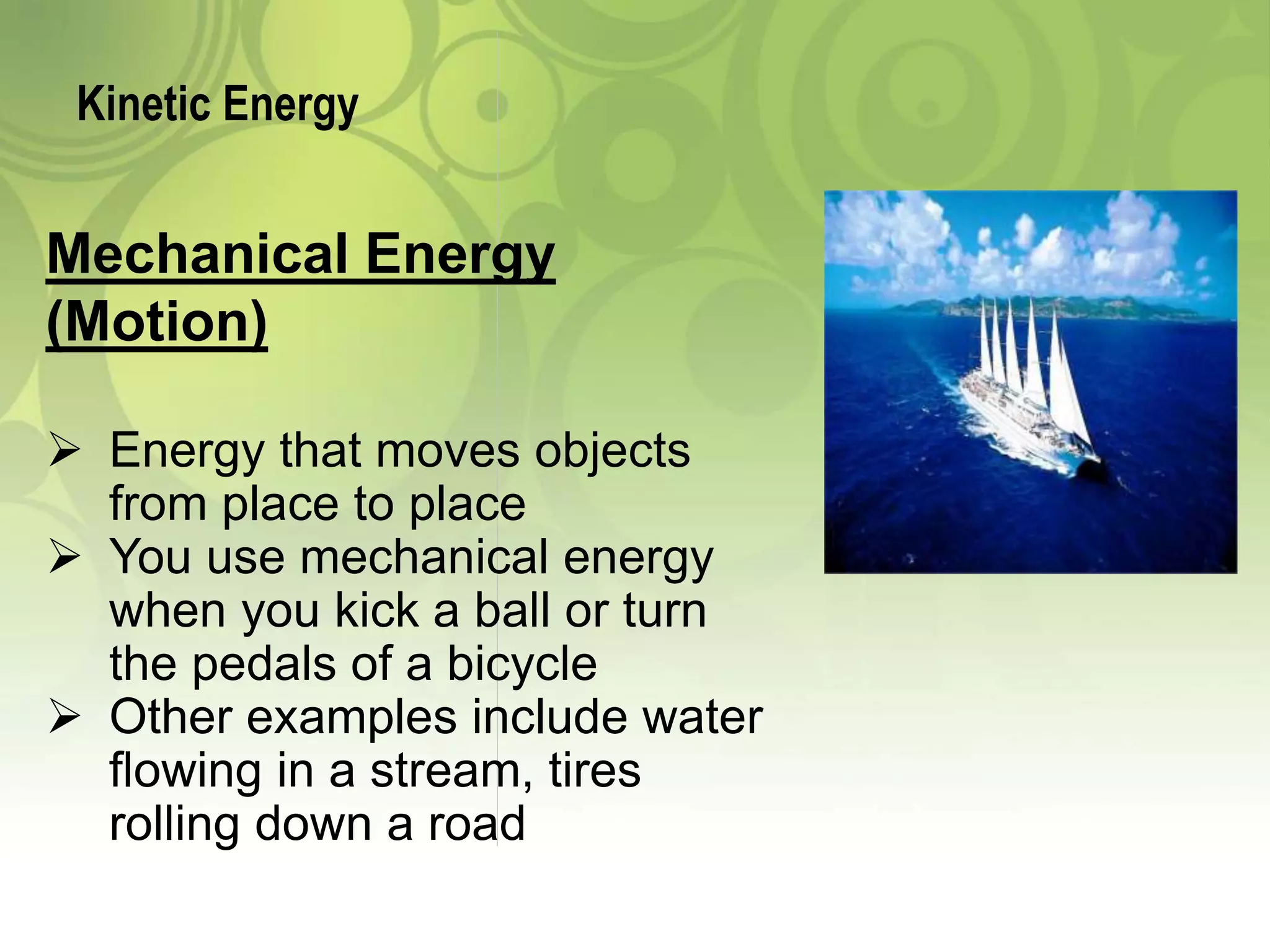
 Energy that moves objects
from place to place
 You use mechanical energy
when you kick a ball or turn
the pedals of a bicycle
 Other examples include water
flowing in a stream, tires
rolling down a road
Kinetic Energy
Electrical Energy
 Energy that comes from the
electrons within atoms
 It can be generated at a power
plant or inside a battery and can
power everything from remote-
controlled cars to refrigerators
 Lightning and static electricity
are also forms of electrical
energy
Kinetic Energy
Sound Energy
Movement of
energy through
substances in the
form of longitudinal
(compression)
waves
Kinetic Energy
Radiant Energy
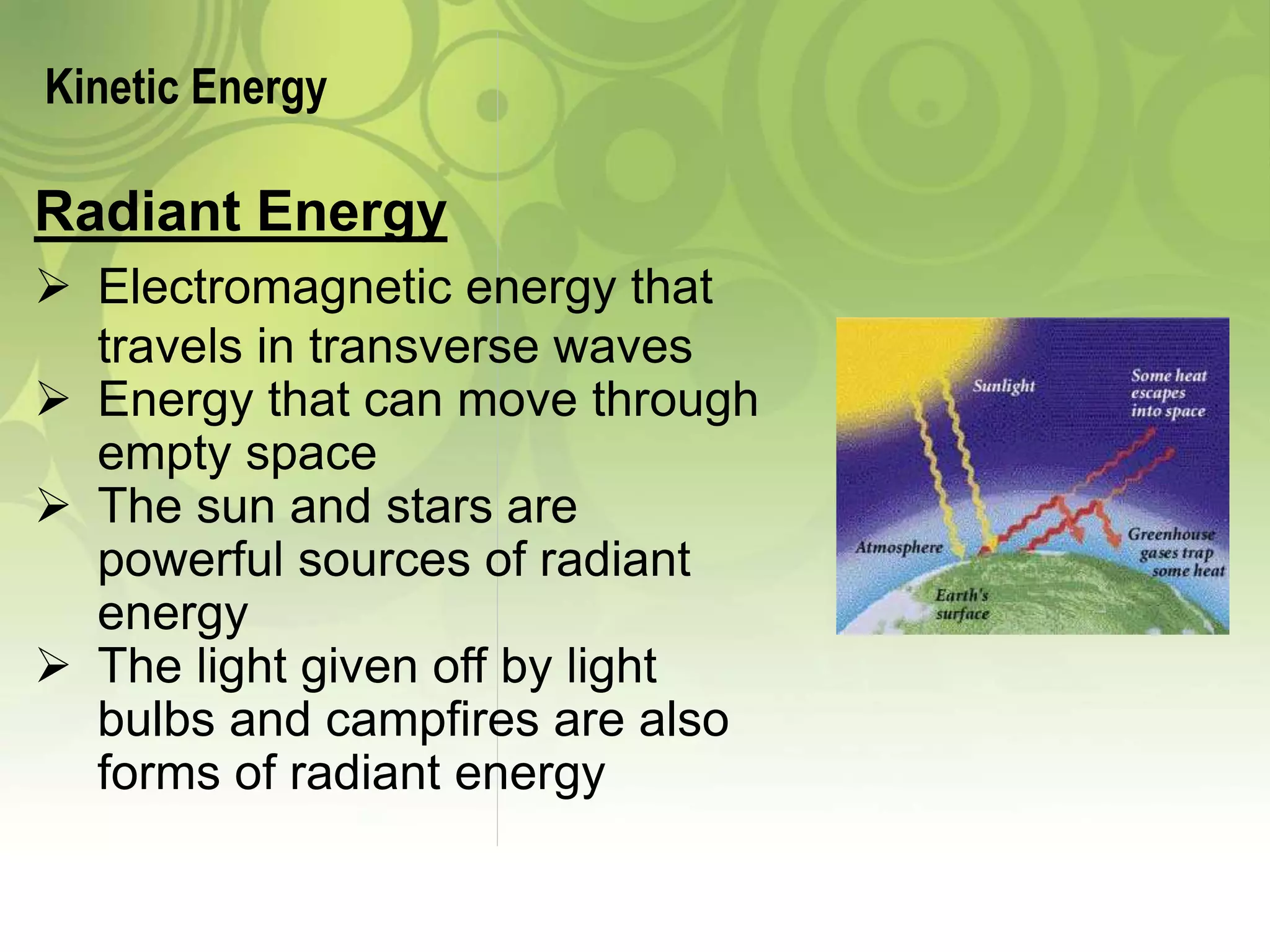
 Electromagnetic energy that
travels in transverse waves
 Energy that can move through
empty space
 The sun and stars are
powerful sources of radiant
energy
 The light given off by light
bulbs and campfires are also
forms of radiant energy
Kinetic Energy
Kinetic Energy
Thermal Energy
Internal energy of a
substance due to the
vibration of atoms and
molecules making up the
substance
Elastic energy
Mechanical energy
• Striking a match
• Photovoltaic cell
• Photosynthesis
• Interior temperature
increase of a car
Describe the
Energy
Transformations
Transition: Forms to Sources
chemical
chemical
chemical
chemical
chemical
nuclear
motion
motion
thermal
radiant
Transition:
Forms to Sources
86%
9%
5%
1%
1%
89%
11%
Potential Energy and Kinetic Energy Examples
PE =m g h
=2 kg × 9.8 m/s2 × 0.4 m
=7.84 kg m2/s2
=7.84 J
Example: This 2 kg hammer is 0.4 m up. What is it's PE?
Potential Energy and Kinetic Energy Examples
KE = ½ m v2
KE = ½ × 1500 kg × (14 m/s)2
KE = 147,000 kg m2/s2
KE = 147 kJ
Example: What is the KE of a 1500 kg car going at suburban speed of 14
m/s (about 50 km/h or 30 mph)?
Potential Energy and Kinetic Energy Examples
KE = ½ m v2
KE = ½ × 1500 kg × (28 m/s)2
KE = 588,000 kg m2/s2
KE = 588 kJ
Example: The same car is now going at highway speed of 28 m/s (about
100 km/h or 60 mph)?
Potential Energy and Kinetic Energy Examples
KE = ½ m v2
KE = ½ × 1 kg × (11,000 m/s)2
KE = 60,500,000 J
KE = 60.5 MJ
A 1 kg meteorite strikes the Moon at 11 km/s. How much KE is that?
Potential Energy and Kinetic Energy Examples
At 1 m above the ground it's Potential Energy is
PE = m g h
PE = 0.1 kg × 9.8 m/s2 × 1 m
PE = 0.98 kg m2/s2
Ignoring air resistance (which is small for this little drop anyway) that PE gets converted into KE:
KE = ½ m v2
Swap sides and rearrange:
½ m v2 = KE
v2 = 2 × KE / m
v = √( 2 × KE / m )
Now put PE into KE and we get:
v = √( 2 × 0.98 kg m2/s2 / 0.1 kg )
v = √( 19.6 m2/s2 )
v = 4.427... m/s
Example: We drop this 0.1 kg apple 1 m. What speed does it hit the
ground with?

1. introduction to energy powerpoint

  • 1.
    EE 40403 –Energy Management Energy Management Rantharu Attanayake BSc. (Eng) , MSc, MBA Email : rantharu@gmail.com Mobile : 0773630002
  • 2.
    Introduction to Energy Typesand Forms EE 40403 – Energy Management
  • 3.
    Objectives • Explain whatenergy enables us to do. • Differentiate between forms and sources of energy. • Demonstrate how energy is stored in the major energy sources. EE 40403 – Energy Management
  • 4.
    Energy • Energy existsin many forms. • Energy can be moved from one object to another. • Energy can be changed from one form to another. • Energy cannot be created or destroyed.
  • 5.
    Energy in twoForms Potential Energy and Kinetic Energy Potential Potential Energy has 4 forms: 1.Chemical energy 2.Nuclear energy 3.Gravitational energy 4.Elastic energy The energy in matter due to its position or the arrangement of its parts One of the most common equations for potential energy can be used to determine the energy of an object with respect to its height above a base: E = mgh ( Joule)
  • 6.
    Energy in twoForms Kinetic Kinetic Energy has 5 forms: 1.Mechanical energy 2.Electrical energy 3.Thermal energy 4.Radiant energy 5.Sound energy The energy of a moving object A common formula for kinetic energy is for a moving mass: KE = 1/2 mv2 (Joule)
  • 7.
    Law of Conservationof Energy With every transformation, some energy is converted to less useful forms. Energy conversions are not 100% efficient. The energy output for the intended purpose is seldom the same as the energy we put in. 100 J electricity in 95 J heat out 5 J light out While energy can change forms, it is conserved. In other words, the total energy of a system is a constant value. This is often written in terms of kinetic (KE) and potential energy (PE): KE + PE = Constant
  • 8.
    Gravitational Energy The energyan object or substance has because of its position; anything “up high” Potential Energy
  • 9.
    Stored Mechanical Energy Energystored in an object by the application of force Must push or pull on an object Potential Energy
  • 10.
    Potential Energy Nuclear Energy Energycontained in the nucleus of an atom Nuclear energy is released when nuclei are split apart into several pieces, or when they are combined to form a single, larger nucleus
  • 11.
    Chemical Energy Energy releasedby a chemical reaction The food you eat contains chemical energy that is released when you digest your meal Wood, coal, gasoline, and natural gas are fuels that contain chemical energy Potential Energy
  • 12.
    Mechanical Energy (Motion)  Energythat moves objects from place to place  You use mechanical energy when you kick a ball or turn the pedals of a bicycle  Other examples include water flowing in a stream, tires rolling down a road Kinetic Energy
  • 13.
    Electrical Energy  Energythat comes from the electrons within atoms  It can be generated at a power plant or inside a battery and can power everything from remote- controlled cars to refrigerators  Lightning and static electricity are also forms of electrical energy Kinetic Energy
  • 14.
    Sound Energy Movement of energythrough substances in the form of longitudinal (compression) waves Kinetic Energy
  • 15.
    Radiant Energy  Electromagneticenergy that travels in transverse waves  Energy that can move through empty space  The sun and stars are powerful sources of radiant energy  The light given off by light bulbs and campfires are also forms of radiant energy Kinetic Energy
  • 16.
    Kinetic Energy Thermal Energy Internalenergy of a substance due to the vibration of atoms and molecules making up the substance
  • 17.
  • 18.
    • Striking amatch • Photovoltaic cell • Photosynthesis • Interior temperature increase of a car Describe the Energy Transformations
  • 19.
    Transition: Forms toSources chemical chemical chemical chemical chemical nuclear motion motion thermal radiant
  • 20.
  • 21.
    Potential Energy andKinetic Energy Examples PE =m g h =2 kg × 9.8 m/s2 × 0.4 m =7.84 kg m2/s2 =7.84 J Example: This 2 kg hammer is 0.4 m up. What is it's PE?
  • 22.
    Potential Energy andKinetic Energy Examples KE = ½ m v2 KE = ½ × 1500 kg × (14 m/s)2 KE = 147,000 kg m2/s2 KE = 147 kJ Example: What is the KE of a 1500 kg car going at suburban speed of 14 m/s (about 50 km/h or 30 mph)?
  • 23.
    Potential Energy andKinetic Energy Examples KE = ½ m v2 KE = ½ × 1500 kg × (28 m/s)2 KE = 588,000 kg m2/s2 KE = 588 kJ Example: The same car is now going at highway speed of 28 m/s (about 100 km/h or 60 mph)?
  • 24.
    Potential Energy andKinetic Energy Examples KE = ½ m v2 KE = ½ × 1 kg × (11,000 m/s)2 KE = 60,500,000 J KE = 60.5 MJ A 1 kg meteorite strikes the Moon at 11 km/s. How much KE is that?
  • 25.
    Potential Energy andKinetic Energy Examples At 1 m above the ground it's Potential Energy is PE = m g h PE = 0.1 kg × 9.8 m/s2 × 1 m PE = 0.98 kg m2/s2 Ignoring air resistance (which is small for this little drop anyway) that PE gets converted into KE: KE = ½ m v2 Swap sides and rearrange: ½ m v2 = KE v2 = 2 × KE / m v = √( 2 × KE / m ) Now put PE into KE and we get: v = √( 2 × 0.98 kg m2/s2 / 0.1 kg ) v = √( 19.6 m2/s2 ) v = 4.427... m/s Example: We drop this 0.1 kg apple 1 m. What speed does it hit the ground with?