Introduction
Energy enters oureveryday lives in many different ways.
The energy in the food we eat maintains our body temperature and lets us walk, talk and
lift things.
The use of energy in food has been essential for the existence of all humankind and
animals throughout our evolution on this planet.
In some developing countries the supplying of food for energy and nutrition is a difficult
task that requires most of the waking hours of the population.
Food acquisition is just as essential in the more developed countries, but because of the
greater mechanization of agricultural production, the effort of only a relatively small
number of persons is devoted to obtaining food. This leaves most of the rest of us free to
pursue other activities throughout our lives.
4.
Energy in formsother than food is also essential for the functioning of a technical
society.
Prodigious amounts of energy are used to power automobiles, heat homes, manufacture
products, generate electricity, and perform various other tasks.
In order for our society to function in its present patterns, vast amounts of coal, natural
gas, and oil are extracted from the earth and burned to provide this energy.
To a lesser energy also derived from hydroelectric plants, nuclear reactors, electric wind
generators, and geothermal plants, and, of course, we all benefit enormously from the
energy obtained directly from the sun.
5.
The fossil fuelsinclude coal, natural gas, and oil.
These resources evolved hundreds of millions of years ago as plant and animal matter
decomposed and was converted under conditions of high temperature and pressure
under the earth’s surface into the hydrocarbon compounds that we now call fossil fuels.
Since the beginning of the machine age, industrial societies have become increasingly
dependent on fossil fuels.
6.
Should we beconcerned that so much of our energy is now
coming from fossil fuels?
Here are two of many factors that should cause concern.
7.
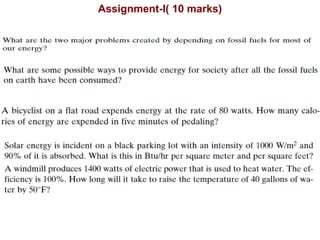
First, the fossilfuel resource is limited in amount.
The fossil fuels were produced by solar energy hundreds of millions of years ago, and
when they are gone, there will be no more.
It is true that the fuels are still being formed, but at an entirely negligible rate compared
to the rate at which we are consuming them.
Consumption of the fossil fuels first began at an appreciable rate only about 150 years
ago.
How long will they last?
On a global scale we will still have some coal for a few centuries, but natural gas and oil
will be in short supply in only a few decades.
8.
Second, unintended environmentalconsequences result from the extensive scale
of our use of the fossil fuels for everything from heating our homes to powering
our automobiles.
When we burn coal, natural gas, or oil to obtain energy, gaseous compounds are formed
and dumped into the atmosphere. This is causing problems we are just beginning to
face.
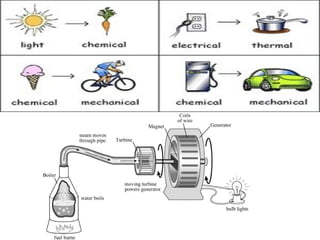
For many years it was felt that the emitted gases were not significant, given the vastness
of the earth’s atmosphere.
But now with increasing world population, and industrialization, this is no longer true. The
atmospheric pollution is producing health problems and even death, and it is now
becoming recognized that carbon dioxide emissions are threatening to produce climate
changes over the entire globe.
9.
Can we findsolutions to these problems of resource depletion and environmental
pollution? Clearly the answers are not simple or the solutions would have been put into
effect by now.
The subject is complex and involves some understanding of topics such as patterns of
resource depletion, the workings of heat engines, solar cells, wind generators, nuclear
reactors, and a myriad of other specialized subjects.
We do not have to become experts on each of these individual topics to be sufficiently
well informed as Environmental Engineers to influence a rational decision-making
process.
Main goal is to gain understanding concerning the essential points.
10.
Energy Basics
Physicists andengineers define energy as the capacity to do work.
Work is a general term to most of us; it signifies everything from shoveling snow off the
driveway to making out an income tax form, studying for an examination, or writing an
essay.
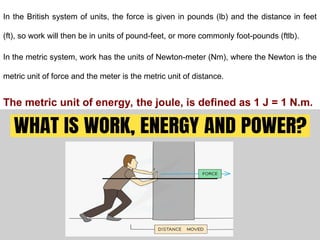
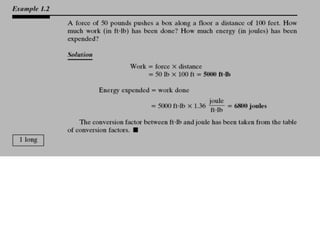
Work is defined to be the product of force times the distance through which the
force acts.
A common example of this definition of work is given by a force pushing an object along
a rough surface.
The force could be exerted by any agent: human, steam engine, sled dog, or electric
motor.
11.
In the Britishsystem of units, the force is given in pounds (lb) and the distance in feet
(ft), so work will then be in units of pound-feet, or more commonly foot-pounds (ftlb).
In the metric system, work has the units of Newton-meter (Nm), where the Newton is the
metric unit of force and the meter is the metric unit of distance.
The metric unit of energy, the joule, is defined as 1 J = 1 N.m.
13.
Forms of Energy
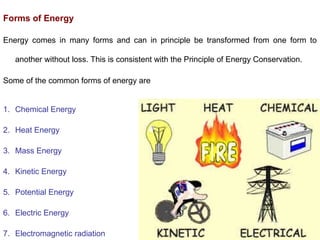
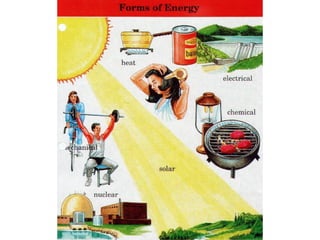
Energycomes in many forms and can in principle be transformed from one form to
another without loss. This is consistent with the Principle of Energy Conservation.
Some of the common forms of energy are
1. Chemical Energy
2. Heat Energy
3. Mass Energy
4. Kinetic Energy
5. Potential Energy
6. Electric Energy
7. Electromagnetic radiation
15.
Chemical Energy
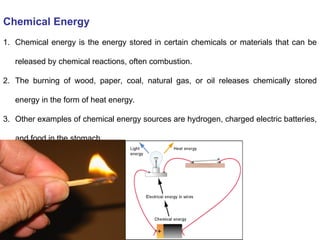
1. Chemicalenergy is the energy stored in certain chemicals or materials that can be
released by chemical reactions, often combustion.
2. The burning of wood, paper, coal, natural gas, or oil releases chemically stored
energy in the form of heat energy.
3. Other examples of chemical energy sources are hydrogen, charged electric batteries,
and food in the stomach.
17.
Heat Energy
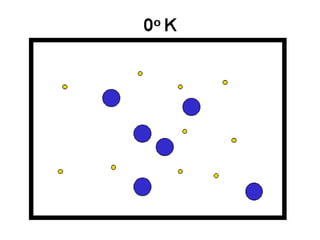
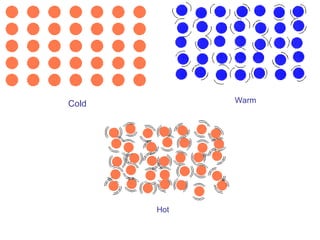
Heat energyis the energy associated with random molecular motions within any
medium. The term thermal energy is interchangeable with heat energy. Heat energy is
related to the concept of temperature.
Increases of heat energy contained in any substance result in a temperature increase
and, conversely, a decrease of heat energy produces a decrease of temperature.
Mass Energy
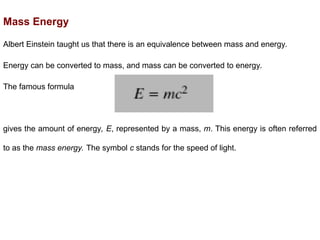
Albert Einsteintaught us that there is an equivalence between mass and energy.
Energy can be converted to mass, and mass can be converted to energy.
The famous formula
gives the amount of energy, E, represented by a mass, m. This energy is often referred
to as the mass energy. The symbol c stands for the speed of light.
21.
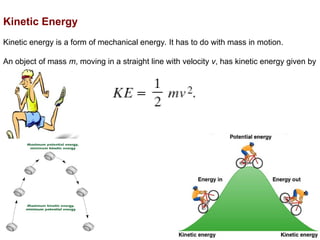
Kinetic Energy
Kinetic energyis a form of mechanical energy. It has to do with mass in motion.
An object of mass m, moving in a straight line with velocity v, has kinetic energy given by
22.
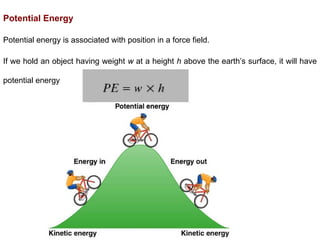
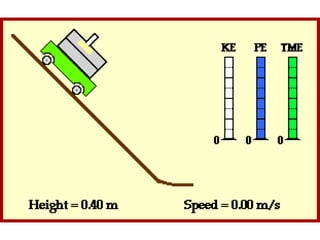
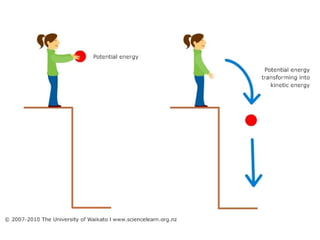
Potential Energy
Potential energyis associated with position in a force field.
If we hold an object having weight w at a height h above the earth’s surface, it will have
potential energy
25.
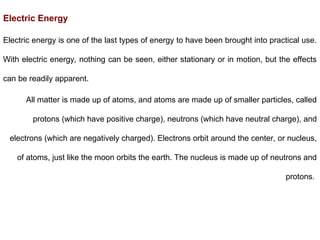
Electric Energy
Electric energyis one of the last types of energy to have been brought into practical use.
With electric energy, nothing can be seen, either stationary or in motion, but the effects
can be readily apparent.
All matter is made up of atoms, and atoms are made up of smaller particles, called
protons (which have positive charge), neutrons (which have neutral charge), and
electrons (which are negatively charged). Electrons orbit around the center, or nucleus,
of atoms, just like the moon orbits the earth. The nucleus is made up of neutrons and
protons.
26.
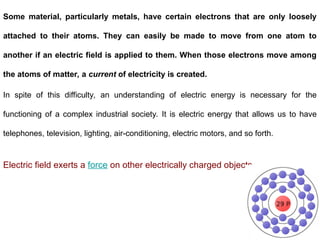
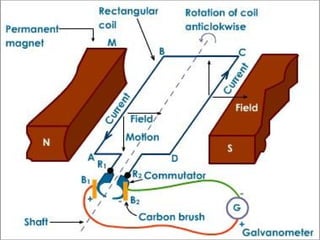
Some material, particularlymetals, have certain electrons that are only loosely
attached to their atoms. They can easily be made to move from one atom to
another if an electric field is applied to them. When those electrons move among
the atoms of matter, a current of electricity is created.
In spite of this difficulty, an understanding of electric energy is necessary for the
functioning of a complex industrial society. It is electric energy that allows us to have
telephones, television, lighting, air-conditioning, electric motors, and so forth.
Electric field exerts a force on other electrically charged objects
28.
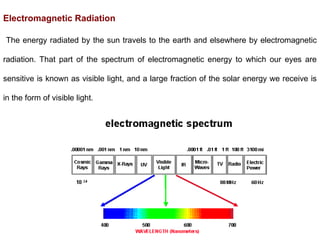
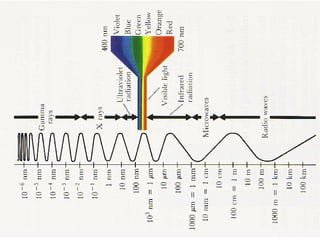
Electromagnetic Radiation
The energyradiated by the sun travels to the earth and elsewhere by electromagnetic
radiation. That part of the spectrum of electromagnetic energy to which our eyes are
sensitive is known as visible light, and a large fraction of the solar energy we receive is
in the form of visible light.
30.
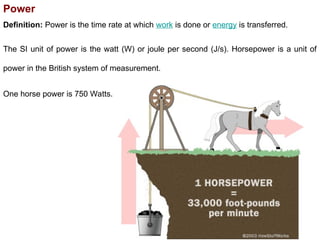
Power
Definition: Power isthe time rate at which work is done or energy is transferred.
The SI unit of power is the watt (W) or joule per second (J/s). Horsepower is a unit of
power in the British system of measurement.
One horse power is 750 Watts.
31.
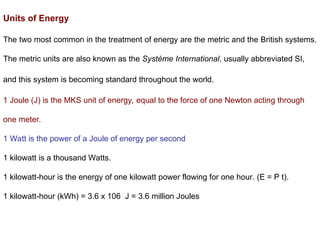
Units of Energy
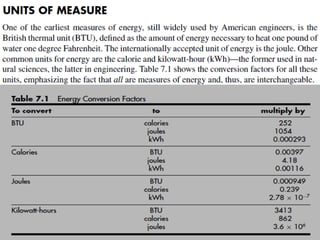
Thetwo most common in the treatment of energy are the metric and the British systems.
The metric units are also known as the Système International, usually abbreviated SI,
and this system is becoming standard throughout the world.
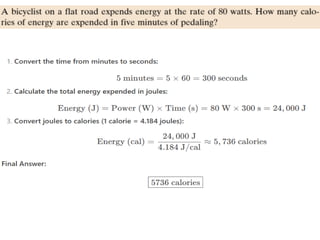
1 Joule (J) is the MKS unit of energy, equal to the force of one Newton acting through
one meter.
1 Watt is the power of a Joule of energy per second
1 kilowatt is a thousand Watts.
1 kilowatt-hour is the energy of one kilowatt power flowing for one hour. (E = P t).
1 kilowatt-hour (kWh) = 3.6 x 10⁶ J = 3.6 million Joules
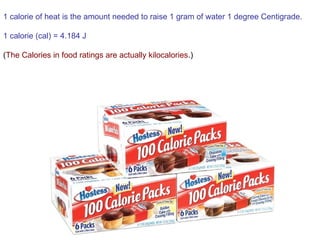
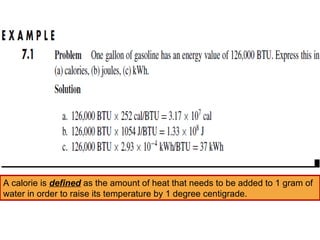
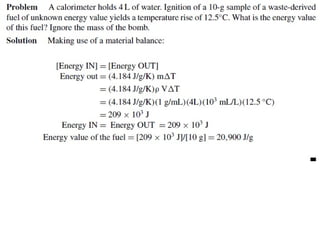
1 calorie ofheat is the amount needed to raise 1 gram of water 1 degree Centigrade.
1 calorie (cal) = 4.184 J
(The Calories in food ratings are actually kilocalories.)
34.
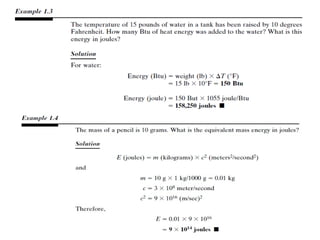
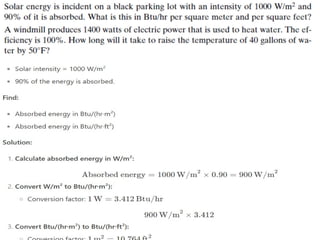
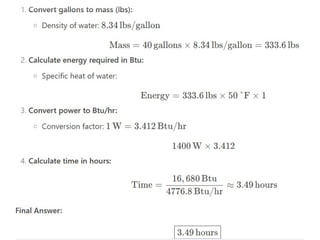
A BTU (BritishThermal Unit) is the amount of heat necessary to raise one pound of
water by 1 degree Farenheit (F).
1 British Thermal Unit (BTU) = 1055 J (The Mechanical Equivalent of Heat Relation)
1 BTU = 252 cal = 1.055 kJ
37.
A calorie isdefined as the amount of heat that needs to be added to 1 gram of
water in order to raise its temperature by 1 degree centigrade.
Energy Consumption
The industrialrevolution has been characterized by very large increases in the amount of
energy available to human societies compared to their predecessors.
In preindustrial economies, only very limited amounts of nonhuman mechanical power
were available, such as that of domesticated animals, the use of wind power to propel
boats and pump water, and the use of water power to grind grain.
Wood was the principal fuel to cook food, to heat dwellings, and to smelt and refine
metals.
Today, in industrial nations, or in the urban-industrial areas of developing nations, the
availability of fossil and nuclear fuels has vastly increased the amount of energy that can
be expended on economic production and personal consumption, helping to make
possible a standard of living that greatly exceeds the subsistence level of preindustrial
times.
43.
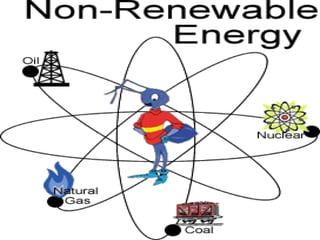
The principal sourcesof energy in present societies are fossil energy (coal, petroleum,
and natural gas), nuclear energy, and hydro energy.
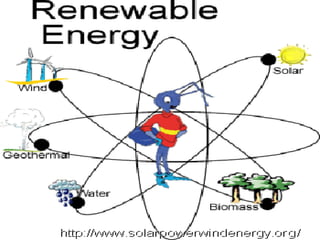
Other energy sources, the so-called renewable, are presently supplying a very small
fraction of the total energy consumption of the world.
The renewable include solar, wind, geothermal, biomass, ocean-thermal, and ocean-
mechanical energy.
44.
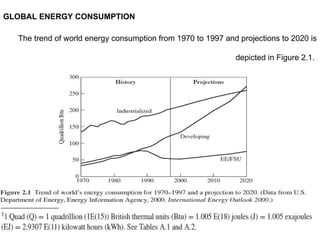
GLOBAL ENERGY CONSUMPTION
Thetrend of world energy consumption from 1970 to 1997 and projections to 2020 is
depicted in Figure 2.1.
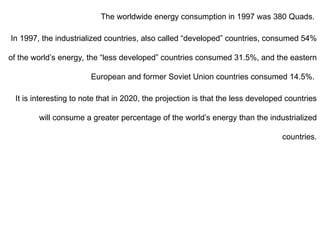
45.
The worldwide energyconsumption in 1997 was 380 Quads.
In 1997, the industrialized countries, also called “developed” countries, consumed 54%
of the world’s energy, the “less developed” countries consumed 31.5%, and the eastern
European and former Soviet Union countries consumed 14.5%.
It is interesting to note that in 2020, the projection is that the less developed countries
will consume a greater percentage of the world’s energy than the industrialized
countries.
46.
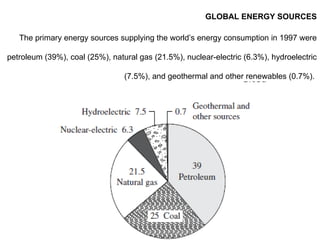
GLOBAL ENERGY SOURCES
Theprimary energy sources supplying the world’s energy consumption in 1997 were
petroleum (39%), coal (25%), natural gas (21.5%), nuclear-electric (6.3%), hydroelectric
(7.5%), and geothermal and other renewables (0.7%).
47.
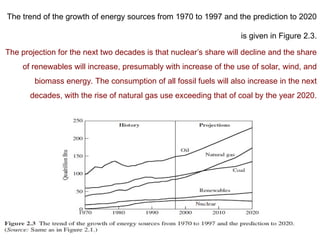
The trend ofthe growth of energy sources from 1970 to 1997 and the prediction to 2020
is given in Figure 2.3.
The projection for the next two decades is that nuclear’s share will decline and the share
of renewables will increase, presumably with increase of the use of solar, wind, and
biomass energy. The consumption of all fossil fuels will also increase in the next
decades, with the rise of natural gas use exceeding that of coal by the year 2020.
48.
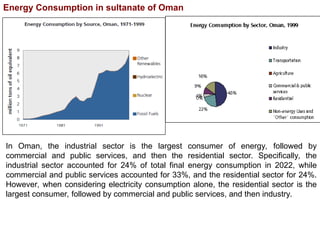
Energy Consumption insultanate of Oman
In Oman, the industrial sector is the largest consumer of energy, followed by
commercial and public services, and then the residential sector. Specifically, the
industrial sector accounted for 24% of total final energy consumption in 2022, while
commercial and public services accounted for 33%, and the residential sector for 24%.
However, when considering electricity consumption alone, the residential sector is the
largest consumer, followed by commercial and public services, and then industry.
49.
The Principle ofEnergy Conservation
The principle of conservation of energy states that energy cannot be created or
destroyed, although it can be changed from one form to another. Thus in any isolated or
closed system, the sum of all forms of energy remains constant.
The energy of the system may be interconverted among many different forms—
mechanical, electrical, magnetic, thermal, chemical, nuclear, and so on—and as time
progresses, it tends to become less and less available; but within the limits of small
experimental uncertainty, no change in total amount of energy has been observed in any
situation in which it has been possible to ensure that energy has not entered or left the
system in the form of work or heat.
50.
Although, according toThe Principle of Energy Conservation the total energy remains
the same, its usefulness for performing tasks has certainly been diminished.
Example:
When the energy was in the form of chemical energy in the battery, it could have been
used for powering a motor, lighting a bulb, sounding a horn, and so forth. None of these
things can be done with the heat energy finally stored in the box, even though the
number of joules is the same.
51.
Energy Conversion orTransformation of Energy
One important property of energy is its ability to change from one form to another form.
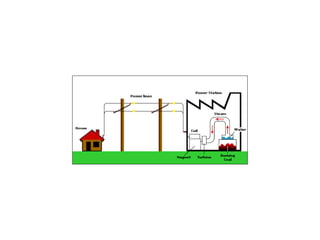
For example, chemical energy from fossil fuels (coal, oil and natural gas) can be
converted into heat energy when burned.
The heat energy may be converted into kinetic energy in a gas turbine and finally into
electrical energy by a generator.
The electric energy may subsequently be converted into light, sound or kinetic energy in
our homes through various household appliances.
53.
During any energyconversion, the amount of energy input is the same as the energy
output. This concept is known as the law of conservation of energy and sometimes
referred to as the First Law of Thermodynamics.
This law states: energy cannot be created nor destroyed but can be transformed from
one form to another. Thus, the total energy of an isolated system is always constant and
when energy of one form is expended an equal amount of energy in another form is
produced.
In every energy conversion, some high-grade energy is converted into low-grade energy
as heat. Thus, the total amount of low-grade energy in the universe is increasing while
high-grade energy is decreasing.
Even though energy is never destroyed, we usually complain that the world is suffering
from an energy shortage. Indeed we are suffering from shortage of high-grade energy
that has the potential of producing useful power! Energy may change form, but the total
amount of energy in the universe stays the same.
54.
Renewable and NonrenewableEnergy Sources
In dealing with energy resources and energy use it is often necessary to distinguish
between renewable and nonrenewable resources.
The nonrenewable resources are those that could be exhausted within a relatively short
time as a result of our exploiting them; renewable resources can never be consumed to
completion.
There is not always complete agreement on the definitions of renewable and
nonrenewable. Some would classify a given category of resource under the heading of
renewable, while others, for equally valid reasons, would consider it nonrenewable.