Chapter 4 
Emotions and Moods 
Presented By 
Group 4
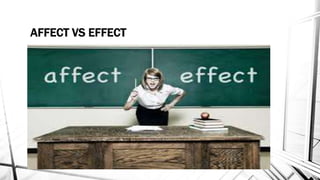
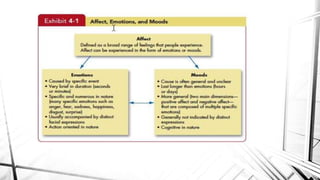
AFFECT VS EFFECT
DEFINITION:AFFECT AND EFFECT 
• Affect is a verb, meaning to cause something to happen. Effect is a noun, 
which is the result of having happened. Here are two sentences that 
illustrate: 
Mary wondered if her tutoring to John would beneficially affect his grades. 
( "Affect" to cause his grades to improve --Verb) 
John got an A on his exam, due to the positive effect of Mary's tutoring. 
("Effect" the positive result of Mary's tutoring -- Noun)
Why Were Emotions Ignored in OB? 
• The “Myth of Rationality” 
• Emotions were seen as irrational 
• Managers worked to make emotion-free environments 
• View of Emotionality 
• Emotions were believed to be disruptive 
• Emotions interfered with productivity 
• Only negative emotions were observed 
• Now we know emotions can’t be separated from the workplace
Discuss Whether Emotions Are Rational 
and What Functions They Serve 
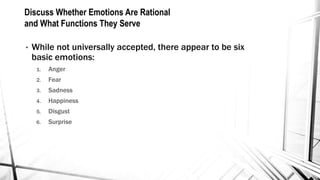
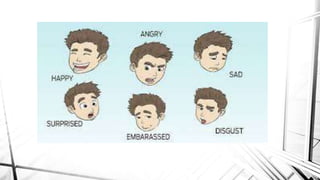
• While not universally accepted, there appear to be six 
basic emotions: 
1. Anger 
2. Fear 
3. Sadness 
4. Happiness 
5. Disgust 
6. Surprise
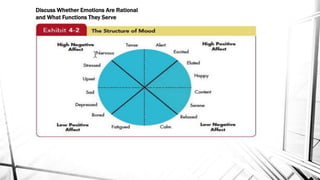
Discuss Whether Emotions Are Rational and What Functions 
They Serve 
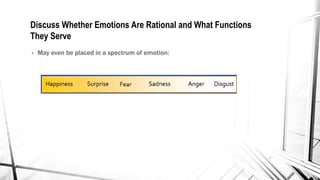
• May even be placed in a spectrum of emotion:
Discuss Whether Emotions Are Rational 
and What Functions They Serve
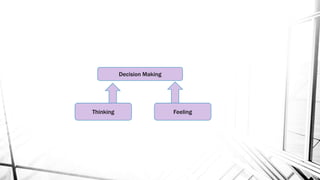
Decision Making 
Thinking Feeling
Identify the Sources of Emotions and Moods 
• Personality 
• There is a trait component – affect intensity 
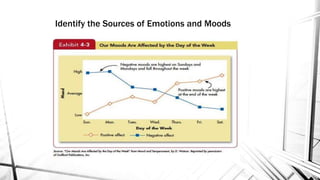
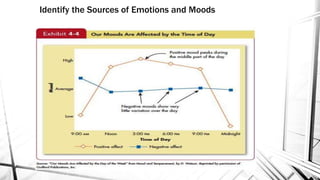
• Day and Time of the Week 
• There is a common pattern for all of us 
• Happier in the midpoint of the daily awake period 
• Happier toward the end of the week
Identify the Sources of Emotions and Moods
Identify the Sources of Emotions and Moods 
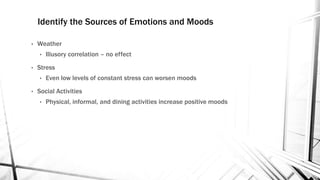
• Weather 
• Illusory correlation – no effect 
• Stress 
• Even low levels of constant stress can worsen moods 
• Social Activities 
• Physical, informal, and dining activities increase positive moods
Identify the Sources of Emotions and Moods 
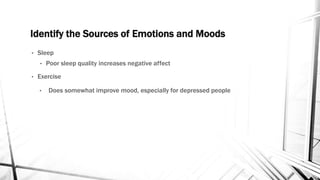
• Sleep 
• Poor sleep quality increases negative affect 
• Exercise 
• Does somewhat improve mood, especially for depressed people
Identify the Sources of Emotions and Moods 
• Age 
• Older folks experience fewer negative emotions. 
• Sex 
• Women tend to be more emotionally expressive, feel emotions more 
intensely, have longer-lasting moods, and express emotions more 
frequently than do men. 
• Due more to socialization than to biology.
Show the Impact Emotional Labor Has on Employees 
Emotional Labor-An employee’s expression of organizationally desired 
emotions during interpersonal transactions at work. 
•Emotional Dissonance: 
• Employees have to project one emotion while simultaneously feeling 
another 
• Can be very damaging and lead to burnout
Show the Impact Emotional Labor Has on Employees 
•Types of Emotions: 
• Felt: the individual’s actual emotions 
• Displayed: required or appropriate emotions 
• Surface Acting: displaying appropriately but not feeling those emotions 
internally 
• Deep Acting: changing internal feelings to match display rules - very 
stressful
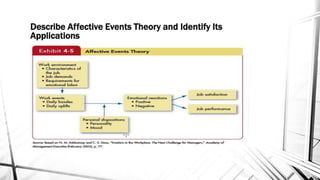
Describe Affective Events Theory and Identify Its 
Applications
Describe Affective Events Theory and Identify Its 
Applications 
• An emotional episode is actually the result of a series of emotional 
experiences triggered by a single event 
• Current and past emotions affect job satisfaction 
• Emotional fluctuations over time create variations in job performance 
• Emotion-driven behaviors are typically brief and variable 
• Both negative and positive emotions can distract workers and reduce job 
performance
Describe Affective Events Theory and Identify Its 
Applications 
• Emotions provide valuable insights about behavior 
• Emotions, and the minor events that cause them, should not be ignored 
at work; they accumulate
Emotional intelligence 
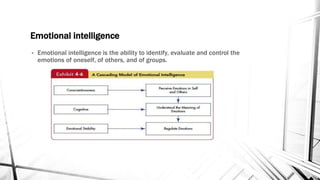
• Emotional intelligence is the ability to identify, evaluate and control the 
emotions of oneself, of others, and of groups.
The Case for Emotional Intelligence. 
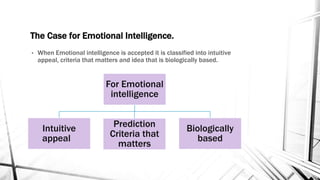
• When Emotional intelligence is accepted it is classified into intuitive 
appeal, criteria that matters and idea that is biologically based. 
For Emotional 
intelligence 
Intuitive 
appeal 
Prediction 
Criteria that 
matters 
Biologically 
based
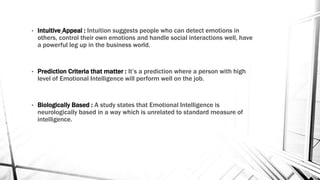
• Intuitive Appeal : Intuition suggests people who can detect emotions in 
others, control their own emotions and handle social interactions well, have 
a powerful leg up in the business world. 
• Prediction Criteria that matter : It’s a prediction where a person with high 
level of Emotional Intelligence will perform well on the job. 
• Biologically Based : A study states that Emotional Intelligence is 
neurologically based in a way which is unrelated to standard measure of 
intelligence.
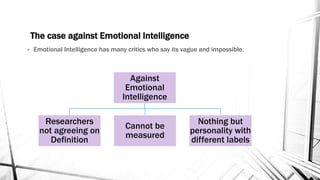
The case against Emotional Intelligence 
• Emotional Intelligence has many critics who say its vague and impossible. 
Against 
Emotional 
Intelligence 
Researchers 
not agreeing on 
Definition 
Cannot be 
measured 
Nothing but 
personality with 
different labels
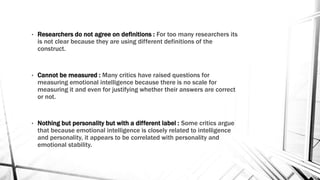
• Researchers do not agree on definitions : For too many researchers its 
is not clear because they are using different definitions of the 
construct. 
• Cannot be measured : Many critics have raised questions for 
measuring emotional intelligence because there is no scale for 
measuring it and even for justifying whether their answers are correct 
or not. 
• Nothing but personality but with a different label : Some critics argue 
that because emotional intelligence is closely related to intelligence 
and personality, it appears to be correlated with personality and 
emotional stability.
Emotion Regulation 
• Emotion regulation is to identify and modify the emotions you feel. 
• Strategies to change your emotions include thinking about more pleasant 
things, suppressing negative thoughts, distracting yourself, reappraising the 
situation, or engaging in relaxation techniques.
Apply Concepts About Emotions and Moods to Specific 
OB Issue 
• Selection 
• EI should be a hiring factor, especially for social jobs. 
• Decision Making 
• Positive emotions can lead to better decisions. 
• Creativity 
• Positive mood increases flexibility, openness, and creativity.
Apply Concepts About Emotions and Moods to Specific 
OB Issue 
• Motivation 
• Positive mood affects expectations of success; feedback amplifies this 
effect. 
• Leadership 
• Emotions are important to acceptance of messages from organizational 
leaders.
Apply Concepts About Emotions and Moods to Specific 
OB Issue 
• Negotiation 
• Emotions, skillfully displayed, can affect negotiations 
• Customer Services 
• Emotions affect service quality delivered to customers which affects 
customer relationships 
• Emotional Contagion: “catching” emotions 
• Job Attitudes 
• Can carry over to home, but dissipate overnight
Apply Concepts About Emotions and Moods to Specific 
OB Issue 
• Deviant Workplace Behaviors 
• Negative emotions lead to employee deviance (actions that violate 
norms and threaten the organization) 
• Safety and Injury at Work 
• Don’t do dangerous work when in a bad mood 
• Manager’s Influence 
• Leaders who are in a good mood, use humor, and praise employees 
increase positive moods.
Managerial Implications 
• Emotions and moods are a natural part of an individual’s makeup. 
• Ignoring co-workers’ and employees’ emotions and assessing others’ 
behavior as if they were completely rational is wrong. 
• “You can’t divorce emotions from the workplace because you can’t divorce 
emotions from people.” 
• Managers who understand the roles of emotions and moods will 
significantly improve their ability to explain co-workers’ and employees’ 
behaviors.
Emotions and moods

Emotions and moods

  • 1.
    Chapter 4 Emotionsand Moods Presented By Group 4
  • 2.
  • 3.
    DEFINITION:AFFECT AND EFFECT • Affect is a verb, meaning to cause something to happen. Effect is a noun, which is the result of having happened. Here are two sentences that illustrate: Mary wondered if her tutoring to John would beneficially affect his grades. ( "Affect" to cause his grades to improve --Verb) John got an A on his exam, due to the positive effect of Mary's tutoring. ("Effect" the positive result of Mary's tutoring -- Noun)
  • 4.
    Why Were EmotionsIgnored in OB? • The “Myth of Rationality” • Emotions were seen as irrational • Managers worked to make emotion-free environments • View of Emotionality • Emotions were believed to be disruptive • Emotions interfered with productivity • Only negative emotions were observed • Now we know emotions can’t be separated from the workplace
  • 6.
    Discuss Whether EmotionsAre Rational and What Functions They Serve • While not universally accepted, there appear to be six basic emotions: 1. Anger 2. Fear 3. Sadness 4. Happiness 5. Disgust 6. Surprise
  • 8.
    Discuss Whether EmotionsAre Rational and What Functions They Serve • May even be placed in a spectrum of emotion:
  • 9.
    Discuss Whether EmotionsAre Rational and What Functions They Serve
  • 10.
  • 11.
    Identify the Sourcesof Emotions and Moods • Personality • There is a trait component – affect intensity • Day and Time of the Week • There is a common pattern for all of us • Happier in the midpoint of the daily awake period • Happier toward the end of the week
  • 12.
    Identify the Sourcesof Emotions and Moods
  • 13.
    Identify the Sourcesof Emotions and Moods
  • 14.
    Identify the Sourcesof Emotions and Moods • Weather • Illusory correlation – no effect • Stress • Even low levels of constant stress can worsen moods • Social Activities • Physical, informal, and dining activities increase positive moods
  • 15.
    Identify the Sourcesof Emotions and Moods • Sleep • Poor sleep quality increases negative affect • Exercise • Does somewhat improve mood, especially for depressed people
  • 16.
    Identify the Sourcesof Emotions and Moods • Age • Older folks experience fewer negative emotions. • Sex • Women tend to be more emotionally expressive, feel emotions more intensely, have longer-lasting moods, and express emotions more frequently than do men. • Due more to socialization than to biology.
  • 17.
    Show the ImpactEmotional Labor Has on Employees Emotional Labor-An employee’s expression of organizationally desired emotions during interpersonal transactions at work. •Emotional Dissonance: • Employees have to project one emotion while simultaneously feeling another • Can be very damaging and lead to burnout
  • 18.
    Show the ImpactEmotional Labor Has on Employees •Types of Emotions: • Felt: the individual’s actual emotions • Displayed: required or appropriate emotions • Surface Acting: displaying appropriately but not feeling those emotions internally • Deep Acting: changing internal feelings to match display rules - very stressful
  • 19.
    Describe Affective EventsTheory and Identify Its Applications
  • 20.
    Describe Affective EventsTheory and Identify Its Applications • An emotional episode is actually the result of a series of emotional experiences triggered by a single event • Current and past emotions affect job satisfaction • Emotional fluctuations over time create variations in job performance • Emotion-driven behaviors are typically brief and variable • Both negative and positive emotions can distract workers and reduce job performance
  • 21.
    Describe Affective EventsTheory and Identify Its Applications • Emotions provide valuable insights about behavior • Emotions, and the minor events that cause them, should not be ignored at work; they accumulate
  • 22.
    Emotional intelligence •Emotional intelligence is the ability to identify, evaluate and control the emotions of oneself, of others, and of groups.
  • 23.
    The Case forEmotional Intelligence. • When Emotional intelligence is accepted it is classified into intuitive appeal, criteria that matters and idea that is biologically based. For Emotional intelligence Intuitive appeal Prediction Criteria that matters Biologically based
  • 24.
    • Intuitive Appeal: Intuition suggests people who can detect emotions in others, control their own emotions and handle social interactions well, have a powerful leg up in the business world. • Prediction Criteria that matter : It’s a prediction where a person with high level of Emotional Intelligence will perform well on the job. • Biologically Based : A study states that Emotional Intelligence is neurologically based in a way which is unrelated to standard measure of intelligence.
  • 25.
    The case againstEmotional Intelligence • Emotional Intelligence has many critics who say its vague and impossible. Against Emotional Intelligence Researchers not agreeing on Definition Cannot be measured Nothing but personality with different labels
  • 26.
    • Researchers donot agree on definitions : For too many researchers its is not clear because they are using different definitions of the construct. • Cannot be measured : Many critics have raised questions for measuring emotional intelligence because there is no scale for measuring it and even for justifying whether their answers are correct or not. • Nothing but personality but with a different label : Some critics argue that because emotional intelligence is closely related to intelligence and personality, it appears to be correlated with personality and emotional stability.
  • 27.
    Emotion Regulation •Emotion regulation is to identify and modify the emotions you feel. • Strategies to change your emotions include thinking about more pleasant things, suppressing negative thoughts, distracting yourself, reappraising the situation, or engaging in relaxation techniques.
  • 28.
    Apply Concepts AboutEmotions and Moods to Specific OB Issue • Selection • EI should be a hiring factor, especially for social jobs. • Decision Making • Positive emotions can lead to better decisions. • Creativity • Positive mood increases flexibility, openness, and creativity.
  • 29.
    Apply Concepts AboutEmotions and Moods to Specific OB Issue • Motivation • Positive mood affects expectations of success; feedback amplifies this effect. • Leadership • Emotions are important to acceptance of messages from organizational leaders.
  • 30.
    Apply Concepts AboutEmotions and Moods to Specific OB Issue • Negotiation • Emotions, skillfully displayed, can affect negotiations • Customer Services • Emotions affect service quality delivered to customers which affects customer relationships • Emotional Contagion: “catching” emotions • Job Attitudes • Can carry over to home, but dissipate overnight
  • 31.
    Apply Concepts AboutEmotions and Moods to Specific OB Issue • Deviant Workplace Behaviors • Negative emotions lead to employee deviance (actions that violate norms and threaten the organization) • Safety and Injury at Work • Don’t do dangerous work when in a bad mood • Manager’s Influence • Leaders who are in a good mood, use humor, and praise employees increase positive moods.
  • 32.
    Managerial Implications •Emotions and moods are a natural part of an individual’s makeup. • Ignoring co-workers’ and employees’ emotions and assessing others’ behavior as if they were completely rational is wrong. • “You can’t divorce emotions from the workplace because you can’t divorce emotions from people.” • Managers who understand the roles of emotions and moods will significantly improve their ability to explain co-workers’ and employees’ behaviors.