Aamir Ansari SMBA13074
Himanshu Saigal SMBA13021
Ahmed Atif Abdullah SMBA13006
CONTENT
 What DEA is
 History of DEA
 How DEA works
 Advantages
 Disadvantages
What is DEA ?
 Data Envelopment Analysis (DEA) is a linear
programming methodology to measure the
efficiency of multiple decision-making units
(DMU) when the production process
presents a structure of multiple inputs and
outputs.
What is DEA ?
 Increasingly popular management tool
 is commonly used to evaluate the efficiency of a
number of producer
 It’s an extreme point method and it compares each
producer with only the "best" producers
 producer is usually referred to as a decision making
unit (DMU)
 DEA has been used for both production and cost data.
Why DEA was created?
 In microeconomic production theory a firm’s input and
output combinations are depicted using a production
function. Using such a function one can show the
maximum output which can be achieved with any possible
combination of inputs, that is, one can construct a
production technology frontier.
 Some 30 yearsago DEA set out to answer the question of
how to use thisprinciple in empirical applications
whileovercoming the problemthat for actualfirms one
cannever observe all the possible input-
outputcombinations.
Why DEA was created?
 Building on the ideas of Farrell (1957), the seminal
work "Measuring the efficiency of decision making
units" by Charnes, Cooper & Rhodes (1978) applies
linear programming to estimate an empirical
production technology frontier for the first time.
 The main developments of DEA in the 1970s and 1980s
are documented by Seiford&Thrall (1990).
How it works?
 Utilizing the selected variables, such as unit cost and
output, DEA software searches for the points with the
lowest unit cost for anygiven output, connectingthose
points to form the efficiencyfrontier
Any company not on the frontier is considered
inefficient.
How it works?
1. Utilising some variable to establish the efficiency
frontier:
1. Number of employees.
2. Service quality.
3. Environmental safety.
4. Fuel consumption.
How it works?
1. Utilising some variable to establish the efficiency
frontier:
1. Number of employees.
2. Service quality.
3. Environmental safety.
4. Fuel consumption.
2. Define the efficiency frontier.
How it works?
1. Utilising some variable to establish the efficiency
frontier:
1. Number of employees.
2. Service quality.
3. Environmental safety.
4. Fuel consumption.
2. Define the efficiency frontier.
3. A numerical coefficient is given to each firm,
defining its relative efficiency.
The advantages of DEA
 no need to explicitly specify a mathematical form for
the production function
 proven to be useful in uncovering relationships that
remain hidden for other methodologies
 capable of handling multiple inputs and outputs
 capable of being used with any input-output
measurement
 the sources of inefficiency can be analyzed and
quantified for every evaluated unit
The disadvantages of DEA
 results are sensitive to the selection of inputs and
outputs
=> we have to choose relevant criteria
 you cannot test for the best specification
 the number of efficient firms on the frontier tends to
increase with the number of inputs and output
variables
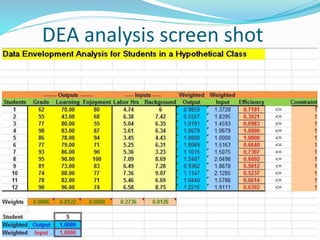
DEA analysis screen shot
Dea analysis

Dea analysis

  • 1.
    Aamir Ansari SMBA13074 HimanshuSaigal SMBA13021 Ahmed Atif Abdullah SMBA13006
  • 2.
    CONTENT  What DEAis  History of DEA  How DEA works  Advantages  Disadvantages
  • 3.
    What is DEA?  Data Envelopment Analysis (DEA) is a linear programming methodology to measure the efficiency of multiple decision-making units (DMU) when the production process presents a structure of multiple inputs and outputs.
  • 4.
    What is DEA?  Increasingly popular management tool  is commonly used to evaluate the efficiency of a number of producer  It’s an extreme point method and it compares each producer with only the "best" producers  producer is usually referred to as a decision making unit (DMU)  DEA has been used for both production and cost data.
  • 5.
    Why DEA wascreated?  In microeconomic production theory a firm’s input and output combinations are depicted using a production function. Using such a function one can show the maximum output which can be achieved with any possible combination of inputs, that is, one can construct a production technology frontier.  Some 30 yearsago DEA set out to answer the question of how to use thisprinciple in empirical applications whileovercoming the problemthat for actualfirms one cannever observe all the possible input- outputcombinations.
  • 6.
    Why DEA wascreated?  Building on the ideas of Farrell (1957), the seminal work "Measuring the efficiency of decision making units" by Charnes, Cooper & Rhodes (1978) applies linear programming to estimate an empirical production technology frontier for the first time.  The main developments of DEA in the 1970s and 1980s are documented by Seiford&Thrall (1990).
  • 7.
    How it works? Utilizing the selected variables, such as unit cost and output, DEA software searches for the points with the lowest unit cost for anygiven output, connectingthose points to form the efficiencyfrontier Any company not on the frontier is considered inefficient.
  • 8.
    How it works? 1.Utilising some variable to establish the efficiency frontier: 1. Number of employees. 2. Service quality. 3. Environmental safety. 4. Fuel consumption.
  • 9.
    How it works? 1.Utilising some variable to establish the efficiency frontier: 1. Number of employees. 2. Service quality. 3. Environmental safety. 4. Fuel consumption. 2. Define the efficiency frontier.
  • 10.
    How it works? 1.Utilising some variable to establish the efficiency frontier: 1. Number of employees. 2. Service quality. 3. Environmental safety. 4. Fuel consumption. 2. Define the efficiency frontier. 3. A numerical coefficient is given to each firm, defining its relative efficiency.
  • 11.
    The advantages ofDEA  no need to explicitly specify a mathematical form for the production function  proven to be useful in uncovering relationships that remain hidden for other methodologies  capable of handling multiple inputs and outputs  capable of being used with any input-output measurement  the sources of inefficiency can be analyzed and quantified for every evaluated unit
  • 12.
    The disadvantages ofDEA  results are sensitive to the selection of inputs and outputs => we have to choose relevant criteria  you cannot test for the best specification  the number of efficient firms on the frontier tends to increase with the number of inputs and output variables
  • 13.