Emotions
and
Moods
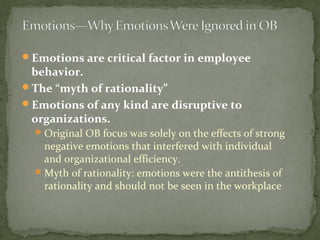
ď‚—Emotions are critical factor in employee
behavior.
The “myth of rationality”
ď‚—Emotions of any kind are disruptive to
organizations.
ď‚—Original OB focus was solely on the effects of strong
negative emotions that interfered with individual
and organizational efficiency.
ď‚—Myth of rationality: emotions were the antithesis of
rationality and should not be seen in the workplace
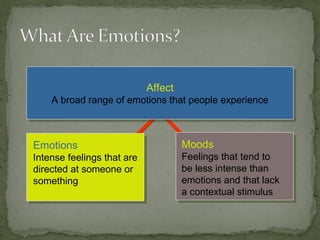
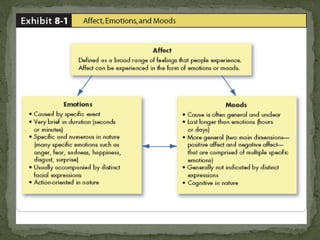
Moods
Feelings that tend to
be less intense than
emotions and that lack
a contextual stimulus
Moods
Feelings that tend to
be less intense than
emotions and that lack
a contextual stimulus
Emotions
Intense feelings that are
directed at someone or
something
Emotions
Intense feelings that are
directed at someone or
something
Affect
A broad range of emotions that people experience
Affect
A broad range of emotions that people experience
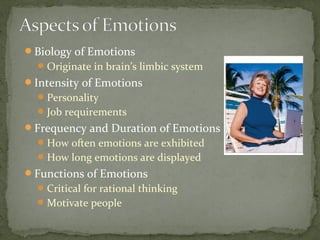
ď‚—Biology of Emotions
Originate in brain’s limbic system
ď‚—Intensity of Emotions
ď‚—Personality
ď‚—Job requirements
ď‚—Frequency and Duration of Emotions
ď‚—How often emotions are exhibited
ď‚—How long emotions are displayed
ď‚—Functions of Emotions
ď‚—Critical for rational thinking
ď‚—Motivate people
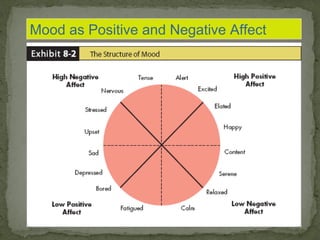
Mood as Positive and Negative AffectMood as Positive and Negative Affect
ď‚—Personality
ď‚—Day and Time of the Week
ď‚—NOT Weather
ď‚—Stress
ď‚—Social Activities
ď‚—Sleep
ď‚—Exercise
ď‚—Age
ď‚—Gender
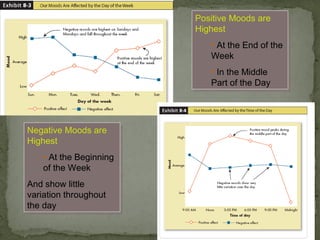
Positive Moods are
Highest
• At the End of the
Week
• In the Middle
Part of the Day
Positive Moods are
Highest
• At the End of the
Week
• In the Middle
Part of the Day
Negative Moods are
Highest
• At the Beginning
of the Week
And show little
variation throughout
the day
Negative Moods are
Highest
• At the Beginning
of the Week
And show little
variation throughout
the day
ď‚—Women
ď‚—Can show greater emotional expression
ď‚—Experience emotions more intensely
ď‚—Display emotions more frequently
ď‚—Are more comfortable in expressing emotions
Are better at reading others’ emotions
ď‚—Men
ď‚—Believe that displaying emotions is inconsistent with
the male image
ď‚—Are innately less able to read and to identify with
others’ emotions
ď‚—Have less need to seek social approval by showing
positive emotions
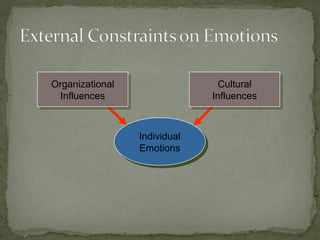
Organizational
Influences
Organizational
Influences
Cultural
Influences
Cultural
Influences
Individual
Emotions
Individual
Emotions
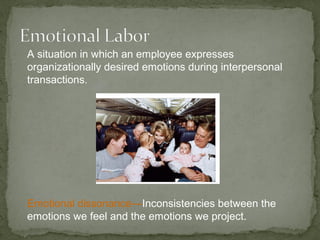
A situation in which an employee expresses
organizationally desired emotions during interpersonal
transactions.
Emotional dissonance—Inconsistencies between the
emotions we feel and the emotions we project.
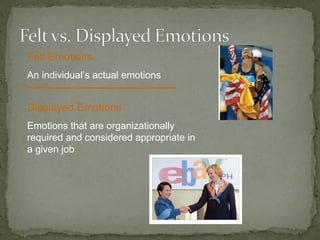
Felt Emotions
An individual’s actual emotions
Displayed Emotions
Emotions that are organizationally
required and considered appropriate in
a given job
•Internals (Internal locus of control)
Individuals who believe that they
control what happens to them.
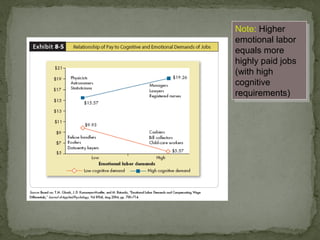
Note: Higher
emotional labor
equals more
highly paid jobs
(with high
cognitive
requirements)
Note: Higher
emotional labor
equals more
highly paid jobs
(with high
cognitive
requirements)
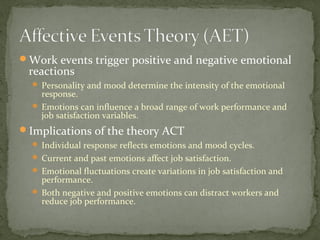
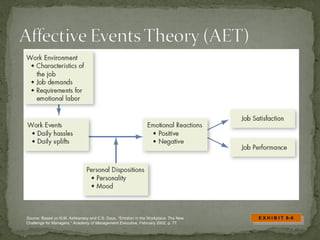
ď‚—Work events trigger positive and negative emotional
reactions
ď‚— Personality and mood determine the intensity of the emotional
response.
ď‚— Emotions can influence a broad range of work performance and
job satisfaction variables.
ď‚—Implications of the theory ACT
ď‚— Individual response reflects emotions and mood cycles.
ď‚— Current and past emotions affect job satisfaction.
ď‚— Emotional fluctuations create variations in job satisfaction and
performance.
ď‚— Both negative and positive emotions can distract workers and
reduce job performance.
E X H I B I T 8–6
E X H I B I T 8–6Source: Based on N.M. Ashkanasy and C.S. Daus, “Emotion in the Workplace: The New
Challenge for Managers,” Academy of Management Executive, February 2002, p. 77.
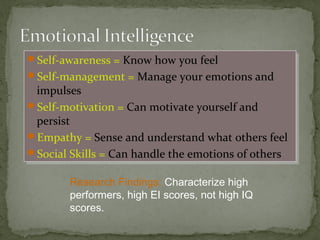
ď‚—Self-awareness = Know how you feel
ď‚—Self-management = Manage your emotions and
impulses
ď‚—Self-motivation = Can motivate yourself and
persist
ď‚—Empathy = Sense and understand what others feel
ď‚—Social Skills = Can handle the emotions of others
ď‚—Self-awareness = Know how you feel
ď‚—Self-management = Manage your emotions and
impulses
ď‚—Self-motivation = Can motivate yourself and
persist
ď‚—Empathy = Sense and understand what others feel
ď‚—Social Skills = Can handle the emotions of others
Research Findings: Characterize high
performers, high EI scores, not high IQ
scores.
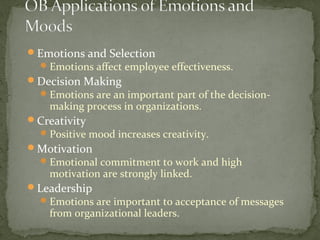
ď‚—Emotions and Selection
ď‚—Emotions affect employee effectiveness.
ď‚—Decision Making
ď‚—Emotions are an important part of the decision-
making process in organizations.
ď‚—Creativity
ď‚—Positive mood increases creativity.
ď‚—Motivation
ď‚—Emotional commitment to work and high
motivation are strongly linked.
ď‚—Leadership
ď‚—Emotions are important to acceptance of messages
from organizational leaders.
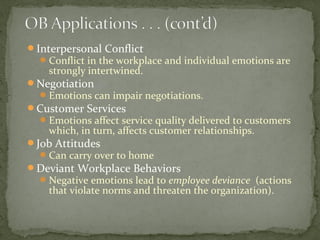
ď‚—Interpersonal Conflict
ď‚—Conflict in the workplace and individual emotions are
strongly intertwined.
ď‚—Negotiation
ď‚—Emotions can impair negotiations.
ď‚—Customer Services
ď‚—Emotions affect service quality delivered to customers
which, in turn, affects customer relationships.
ď‚—Job Attitudes
ď‚—Can carry over to home
ď‚—Deviant Workplace Behaviors
ď‚—Negative emotions lead to employee deviance (actions
that violate norms and threaten the organization).

Emotions and moods

  • 1.
  • 2.
    Emotions are criticalfactor in employee behavior. The “myth of rationality” Emotions of any kind are disruptive to organizations. Original OB focus was solely on the effects of strong negative emotions that interfered with individual and organizational efficiency. Myth of rationality: emotions were the antithesis of rationality and should not be seen in the workplace
  • 3.
    Moods Feelings that tendto be less intense than emotions and that lack a contextual stimulus Moods Feelings that tend to be less intense than emotions and that lack a contextual stimulus Emotions Intense feelings that are directed at someone or something Emotions Intense feelings that are directed at someone or something Affect A broad range of emotions that people experience Affect A broad range of emotions that people experience
  • 5.
    Biology of Emotions Originatein brain’s limbic system Intensity of Emotions Personality Job requirements Frequency and Duration of Emotions How often emotions are exhibited How long emotions are displayed Functions of Emotions Critical for rational thinking Motivate people
  • 6.
    Mood as Positiveand Negative AffectMood as Positive and Negative Affect
  • 7.
    ď‚—Personality ď‚—Day and Timeof the Week ď‚—NOT Weather ď‚—Stress ď‚—Social Activities ď‚—Sleep ď‚—Exercise ď‚—Age ď‚—Gender
  • 8.
    Positive Moods are Highest •At the End of the Week • In the Middle Part of the Day Positive Moods are Highest • At the End of the Week • In the Middle Part of the Day Negative Moods are Highest • At the Beginning of the Week And show little variation throughout the day Negative Moods are Highest • At the Beginning of the Week And show little variation throughout the day
  • 9.
    Women Can show greateremotional expression Experience emotions more intensely Display emotions more frequently Are more comfortable in expressing emotions Are better at reading others’ emotions Men Believe that displaying emotions is inconsistent with the male image Are innately less able to read and to identify with others’ emotions Have less need to seek social approval by showing positive emotions
  • 10.
  • 11.
    A situation inwhich an employee expresses organizationally desired emotions during interpersonal transactions. Emotional dissonance—Inconsistencies between the emotions we feel and the emotions we project.
  • 12.
    Felt Emotions An individual’sactual emotions Displayed Emotions Emotions that are organizationally required and considered appropriate in a given job
  • 13.
    •Internals (Internal locusof control) Individuals who believe that they control what happens to them. Note: Higher emotional labor equals more highly paid jobs (with high cognitive requirements) Note: Higher emotional labor equals more highly paid jobs (with high cognitive requirements)
  • 14.
    ď‚—Work events triggerpositive and negative emotional reactions ď‚— Personality and mood determine the intensity of the emotional response. ď‚— Emotions can influence a broad range of work performance and job satisfaction variables. ď‚—Implications of the theory ACT ď‚— Individual response reflects emotions and mood cycles. ď‚— Current and past emotions affect job satisfaction. ď‚— Emotional fluctuations create variations in job satisfaction and performance. ď‚— Both negative and positive emotions can distract workers and reduce job performance.
  • 15.
    E X HI B I T 8–6 E X H I B I T 8–6Source: Based on N.M. Ashkanasy and C.S. Daus, “Emotion in the Workplace: The New Challenge for Managers,” Academy of Management Executive, February 2002, p. 77.
  • 16.
    ď‚—Self-awareness = Knowhow you feel ď‚—Self-management = Manage your emotions and impulses ď‚—Self-motivation = Can motivate yourself and persist ď‚—Empathy = Sense and understand what others feel ď‚—Social Skills = Can handle the emotions of others ď‚—Self-awareness = Know how you feel ď‚—Self-management = Manage your emotions and impulses ď‚—Self-motivation = Can motivate yourself and persist ď‚—Empathy = Sense and understand what others feel ď‚—Social Skills = Can handle the emotions of others Research Findings: Characterize high performers, high EI scores, not high IQ scores.
  • 17.
    ď‚—Emotions and Selection ď‚—Emotionsaffect employee effectiveness. ď‚—Decision Making ď‚—Emotions are an important part of the decision- making process in organizations. ď‚—Creativity ď‚—Positive mood increases creativity. ď‚—Motivation ď‚—Emotional commitment to work and high motivation are strongly linked. ď‚—Leadership ď‚—Emotions are important to acceptance of messages from organizational leaders.
  • 18.
    ď‚—Interpersonal Conflict ď‚—Conflict inthe workplace and individual emotions are strongly intertwined. ď‚—Negotiation ď‚—Emotions can impair negotiations. ď‚—Customer Services ď‚—Emotions affect service quality delivered to customers which, in turn, affects customer relationships. ď‚—Job Attitudes ď‚—Can carry over to home ď‚—Deviant Workplace Behaviors ď‚—Negative emotions lead to employee deviance (actions that violate norms and threaten the organization).