Carrefour
Carrefour Retail
By: Aamir Ansari
Background
 A French international hypermarket chain
 Headquartered in Levallois-Perret-France
 11,000 stores
 More than 32 countries and areas
 Over 495,000 employees (2009)
 Sales: 112.245 billion euro in 2010
 4 store formats
- Hypermarkets
- Supermarkets
- Convenience
- Cash&carry
History
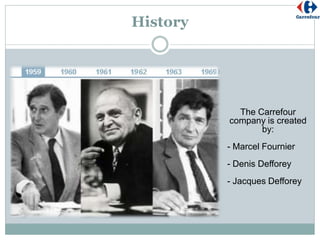
The Carrefour
company is created
by:
- Marcel Fournier
- Denis Defforey
- Jacques Defforey
History
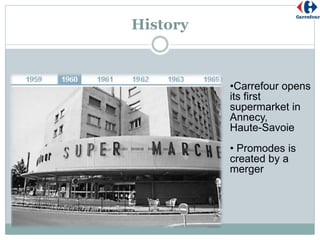
•Carrefour opens
its first
supermarket in
Annecy,
Haute-Savoie
• Promodes is
created by a
merger
History
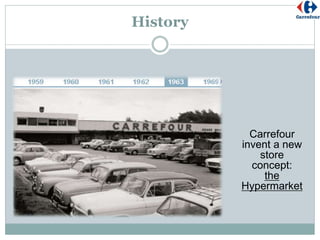
Carrefour
invent a new
store
concept:
the
Hypermarket
History
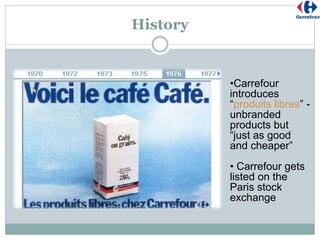
•Carrefour
introduces
“produits libres” -
unbranded
products but
“just as good
and cheaper”
• Carrefour gets
listed on the
Paris stock
exchange
History
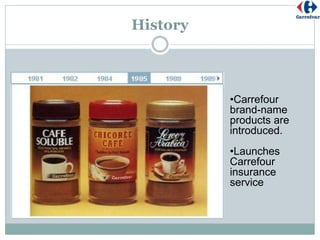
•Carrefour
brand-name
products are
introduced.
•Launches
Carrefour
insurance
service
History
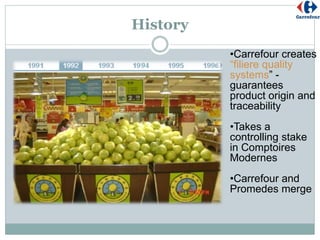
•Carrefour creates
“filiere quality
systems” -
guarantees
product origin and
traceability
•Takes a
controlling stake
in Comptoires
Modernes
•Carrefour and
Promedes merge
History
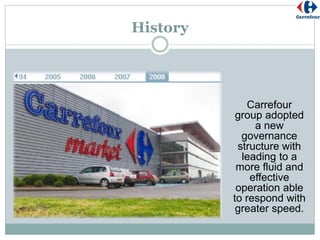
Carrefour
group adopted
a new
governance
structure with
leading to a
more fluid and
effective
operation able
to respond with
greater speed.
History of Global footprint
 1969- the first overseas hypermarket was built in Belgium.
 1973- hypermarket in Spain
 1975- hypermarket in Brazil
 1982- hypermarket in Argentina
 1989- first hypermarket in Asia, in Taiwan
 1990- first hypermarket in Philadelphia, United States
 1991- second hypermarket in New Jersey
 1993- first hypermarkets in Italy and Turkey.
 1994- first hypermarkets in Mexico and Malaysia
 1995- first hypermarket in China mainland
 1996- hypermarkets in Thailand, Korea, and Hong Kong
Corporate Structure
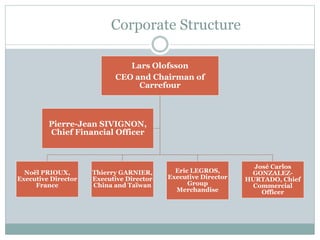
Lars Olofsson
CEO and Chairman of
Carrefour
Noël PRIOUX,
Executive Director
France
Thierry GARNIER,
Executive Director
China and Taïwan
Eric LEGROS,
Executive Director
Group
Merchandise
José Carlos
GONZALEZ-
HURTADO, Chief
Commercial
Officer
Pierre-Jean SIVIGNON,
Chief Financial Officer
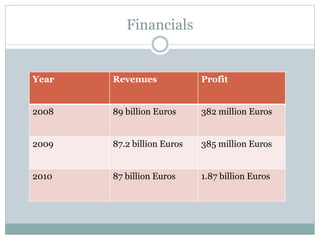
Financials
Year Revenues Profit
2008 89 billion Euros 382 million Euros
2009 87.2 billion Euros 385 million Euros
2010 87 billion Euros 1.87 billion Euros
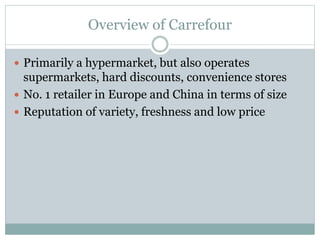
Overview of Carrefour
 Primarily a hypermarket, but also operates
supermarkets, hard discounts, convenience stores
 No. 1 retailer in Europe and China in terms of size
 Reputation of variety, freshness and low price
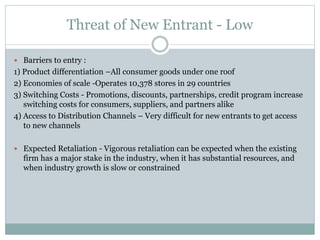
Threat of New Entrant - Low
 Barriers to entry :
1) Product differentiation –All consumer goods under one roof
2) Economies of scale -Operates 10,378 stores in 29 countries
3) Switching Costs - Promotions, discounts, partnerships, credit program increase
switching costs for consumers, suppliers, and partners alike
4) Access to Distribution Channels – Very difficult for new entrants to get access
to new channels
 Expected Retaliation - Vigorous retaliation can be expected when the existing
firm has a major stake in the industry, when it has substantial resources, and
when industry growth is slow or constrained
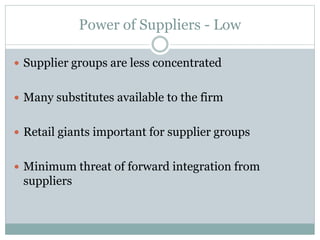
Power of Suppliers - Low
 Supplier groups are less concentrated
 Many substitutes available to the firm
 Retail giants important for supplier groups
 Minimum threat of forward integration from
suppliers
Power of Buyers - Average
 Buyer’s are very important to the retail industry
 But no single buyer purchases enough to impact the
industry
 Important to know buyer’s taste and preferences
 Special promotions and discount decrease buyer’s
power
Threat of substitutes
 This depends on region or country of operation
 Generally low – promotion and services increases
switching costs – tailoring to local needs
 Culture dependent – Mom and Pop store more
popular in Asian countries
Intensity of Rivalry -High
 Numerous or equally balanced players
 Rapid Industry Growth
 Storage Costs and Fixed Costs
 High Strategic Stakes
 High Exit Barriers
Key Success factors
A hit with customers:
 One-stop shopping
 Extremely low prices
 Full range of choices
 High quality of products
From a business perspective:
 Seamless capture of international markets
 Resource integration
 High level of local sourcing
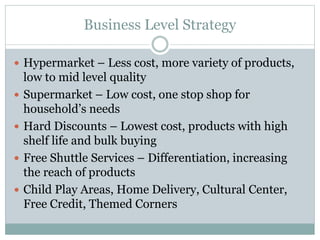
Business Level Strategy
 Hypermarket – Less cost, more variety of products,
low to mid level quality
 Supermarket – Low cost, one stop shop for
household’s needs
 Hard Discounts – Lowest cost, products with high
shelf life and bulk buying
 Free Shuttle Services – Differentiation, increasing
the reach of products
 Child Play Areas, Home Delivery, Cultural Center,
Free Credit, Themed Corners
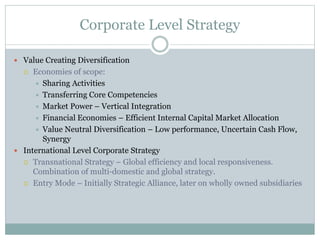
Corporate Level Strategy
 Value Creating Diversification
 Economies of scope:
 Sharing Activities
 Transferring Core Competencies
 Market Power – Vertical Integration
 Financial Economies – Efficient Internal Capital Market Allocation
 Value Neutral Diversification – Low performance, Uncertain Cash Flow,
Synergy
 International Level Corporate Strategy
 Transnational Strategy – Global efficiency and local responsiveness.
Combination of multi-domestic and global strategy.
 Entry Mode – Initially Strategic Alliance, later on wholly owned subsidiaries
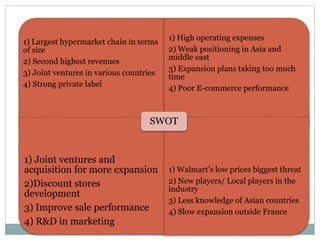
1) Largest hypermarket chain in terms
of size
2) Second highest revenues
3) Joint ventures in various countries
4) Strong private label
1) High operating expenses
2) Weak positioning in Asia and
middle east
3) Expansion plans taking too much
time
4) Poor E-commerce performance
1) Joint ventures and
acquisition for more expansion
2)Discount stores
development
3) Improve sale performance
4) R&D in marketing
1) Walmart’s low prices biggest threat
2) New players/ Local players in the
industry
3) Less knowledge of Asian countries
4) Slow expansion outside France
SWOT
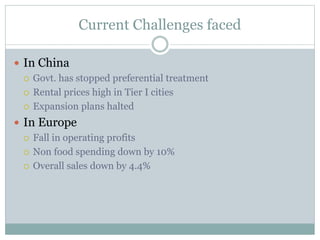
Current Challenges faced
 In China
 Govt. has stopped preferential treatment
 Rental prices high in Tier I cities
 Expansion plans halted
 In Europe
 Fall in operating profits
 Non food spending down by 10%
 Overall sales down by 4.4%
Recommendations
 Continue the practices that have been successful
 Leverage knowledge of international market and
expand into emerging economies
 Find innovative ways to improve products and
services
 Be vigilant about threats to its operations

Carrefour history and retail

  • 1.
  • 2.
    Background  A Frenchinternational hypermarket chain  Headquartered in Levallois-Perret-France  11,000 stores  More than 32 countries and areas  Over 495,000 employees (2009)  Sales: 112.245 billion euro in 2010  4 store formats - Hypermarkets - Supermarkets - Convenience - Cash&carry
  • 3.
    History The Carrefour company iscreated by: - Marcel Fournier - Denis Defforey - Jacques Defforey
  • 4.
    History •Carrefour opens its first supermarketin Annecy, Haute-Savoie • Promodes is created by a merger
  • 5.
  • 6.
    History •Carrefour introduces “produits libres” - unbranded productsbut “just as good and cheaper” • Carrefour gets listed on the Paris stock exchange
  • 7.
  • 8.
    History •Carrefour creates “filiere quality systems”- guarantees product origin and traceability •Takes a controlling stake in Comptoires Modernes •Carrefour and Promedes merge
  • 9.
    History Carrefour group adopted a new governance structurewith leading to a more fluid and effective operation able to respond with greater speed.
  • 10.
    History of Globalfootprint  1969- the first overseas hypermarket was built in Belgium.  1973- hypermarket in Spain  1975- hypermarket in Brazil  1982- hypermarket in Argentina  1989- first hypermarket in Asia, in Taiwan  1990- first hypermarket in Philadelphia, United States  1991- second hypermarket in New Jersey  1993- first hypermarkets in Italy and Turkey.  1994- first hypermarkets in Mexico and Malaysia  1995- first hypermarket in China mainland  1996- hypermarkets in Thailand, Korea, and Hong Kong
  • 11.
    Corporate Structure Lars Olofsson CEOand Chairman of Carrefour Noël PRIOUX, Executive Director France Thierry GARNIER, Executive Director China and Taïwan Eric LEGROS, Executive Director Group Merchandise José Carlos GONZALEZ- HURTADO, Chief Commercial Officer Pierre-Jean SIVIGNON, Chief Financial Officer
  • 12.
    Financials Year Revenues Profit 200889 billion Euros 382 million Euros 2009 87.2 billion Euros 385 million Euros 2010 87 billion Euros 1.87 billion Euros
  • 13.
    Overview of Carrefour Primarily a hypermarket, but also operates supermarkets, hard discounts, convenience stores  No. 1 retailer in Europe and China in terms of size  Reputation of variety, freshness and low price
  • 14.
    Threat of NewEntrant - Low  Barriers to entry : 1) Product differentiation –All consumer goods under one roof 2) Economies of scale -Operates 10,378 stores in 29 countries 3) Switching Costs - Promotions, discounts, partnerships, credit program increase switching costs for consumers, suppliers, and partners alike 4) Access to Distribution Channels – Very difficult for new entrants to get access to new channels  Expected Retaliation - Vigorous retaliation can be expected when the existing firm has a major stake in the industry, when it has substantial resources, and when industry growth is slow or constrained
  • 15.
    Power of Suppliers- Low  Supplier groups are less concentrated  Many substitutes available to the firm  Retail giants important for supplier groups  Minimum threat of forward integration from suppliers
  • 16.
    Power of Buyers- Average  Buyer’s are very important to the retail industry  But no single buyer purchases enough to impact the industry  Important to know buyer’s taste and preferences  Special promotions and discount decrease buyer’s power
  • 17.
    Threat of substitutes This depends on region or country of operation  Generally low – promotion and services increases switching costs – tailoring to local needs  Culture dependent – Mom and Pop store more popular in Asian countries
  • 18.
    Intensity of Rivalry-High  Numerous or equally balanced players  Rapid Industry Growth  Storage Costs and Fixed Costs  High Strategic Stakes  High Exit Barriers
  • 19.
    Key Success factors Ahit with customers:  One-stop shopping  Extremely low prices  Full range of choices  High quality of products From a business perspective:  Seamless capture of international markets  Resource integration  High level of local sourcing
  • 20.
    Business Level Strategy Hypermarket – Less cost, more variety of products, low to mid level quality  Supermarket – Low cost, one stop shop for household’s needs  Hard Discounts – Lowest cost, products with high shelf life and bulk buying  Free Shuttle Services – Differentiation, increasing the reach of products  Child Play Areas, Home Delivery, Cultural Center, Free Credit, Themed Corners
  • 21.
    Corporate Level Strategy Value Creating Diversification  Economies of scope:  Sharing Activities  Transferring Core Competencies  Market Power – Vertical Integration  Financial Economies – Efficient Internal Capital Market Allocation  Value Neutral Diversification – Low performance, Uncertain Cash Flow, Synergy  International Level Corporate Strategy  Transnational Strategy – Global efficiency and local responsiveness. Combination of multi-domestic and global strategy.  Entry Mode – Initially Strategic Alliance, later on wholly owned subsidiaries
  • 22.
    1) Largest hypermarketchain in terms of size 2) Second highest revenues 3) Joint ventures in various countries 4) Strong private label 1) High operating expenses 2) Weak positioning in Asia and middle east 3) Expansion plans taking too much time 4) Poor E-commerce performance 1) Joint ventures and acquisition for more expansion 2)Discount stores development 3) Improve sale performance 4) R&D in marketing 1) Walmart’s low prices biggest threat 2) New players/ Local players in the industry 3) Less knowledge of Asian countries 4) Slow expansion outside France SWOT
  • 23.
    Current Challenges faced In China  Govt. has stopped preferential treatment  Rental prices high in Tier I cities  Expansion plans halted  In Europe  Fall in operating profits  Non food spending down by 10%  Overall sales down by 4.4%
  • 24.
    Recommendations  Continue thepractices that have been successful  Leverage knowledge of international market and expand into emerging economies  Find innovative ways to improve products and services  Be vigilant about threats to its operations

Editor's Notes

  • #3 Headquartered in Levallois-Perret, France It is located 6.4 km (4.0 mi) from the center of Paris, Carrefour means "crossroads" in French. Carrefour is the largest hypermarket chain in the world in terms of size, the second largest retail group in the world in terms of revenue and third largest in profit after Wal-Mart and Tesco. Also have E Commerce for select countries
  • #6 In commerce, a hypermarket (from the French hypermarché) is a store which combines a supermarket and a department store. The result is a gigantic retail facility which carries an enormous range of products under one roof, including full lines of fresh groceries and apparel. When they are planned, constructed, and executed correctly, a consumer can ideally satisfy all of their routine weekly shopping needs in one trip to the hypermarket. outlet that combines the features of a supermarket, department store, discount store, and specialty store in one location. Also called hypermart.