Emotions and Moods
Student: Amrita Gandikota
Subject: Introduction to Business Psychology
Lecturer: Angela Field
Date: 19/10/2014
Contents
• Definitions
• Relationship – Affect, Moods, Emotions
• Basic Emotions
• Aspects of Emotions
• Structure of Moods
• Sources of Emotions and Moods
• External Constraints on Moods
• Emotional Labor
• Emotions – Jobs – Payment
• Affective Events Theory (AEI)
• Emotional Intelligence (EI)
• Dimensions of EI
• Team Activity
• EI – For or Against?
• OB Applications
• Conclusion
Definitions
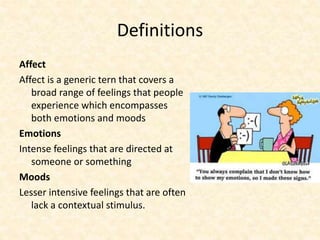
Affect
Affect is a generic tern that covers a
broad range of feelings that people
experience which encompasses
both emotions and moods
Emotions
Intense feelings that are directed at
someone or something
Moods
Lesser intensive feelings that are often
lack a contextual stimulus.
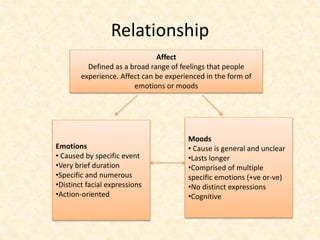
Relationship
Affect
Defined as a broad range of feelings that people
experience. Affect can be experienced in the form of
emotions or moods
Emotions
• Caused by specific event
•Very brief duration
•Specific and numerous
•Distinct facial expressions
•Action-oriented
Moods
• Cause is general and unclear
•Lasts longer
•Comprised of multiple
specific emotions (+ve or-ve)
•No distinct expressions
•Cognitive
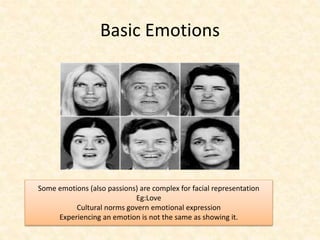
Basic Emotions
Some emotions (also passions) are complex for facial representation
Eg:Love
Cultural norms govern emotional expression
Experiencing an emotion is not the same as showing it.
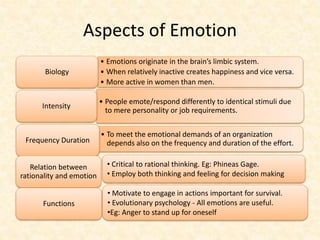
Aspects of Emotion
• Emotions originate in the brain’s limbic system.
• When relatively inactive creates happiness and vice versa.
• More active in women than men.
Biology
• People emote/respond differently to identical stimuli due
to mere personality or job requirements.
Intensity
• To meet the emotional demands of an organization
depends also on the frequency and duration of the effort.Frequency Duration
Relation between
rationality and emotion
Functions
• Critical to rational thinking. Eg: Phineas Gage.
• Employ both thinking and feeling for decision making
• Motivate to engage in actions important for survival.
• Evolutionary psychology - All emotions are useful.
•Eg: Anger to stand up for oneself
Structure of moods
Positivity Offset: When at zero input, most individuals experience
mildly positive mood.
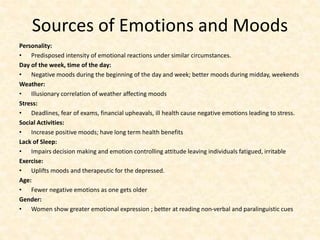
Sources of Emotions and Moods
Personality:
• Predisposed intensity of emotional reactions under similar circumstances.
Day of the week, time of the day:
• Negative moods during the beginning of the day and week; better moods during midday, weekends
Weather:
• Illusionary correlation of weather affecting moods
Stress:
• Deadlines, fear of exams, financial upheavals, ill health cause negative emotions leading to stress.
Social Activities:
• Increase positive moods; have long term health benefits
Lack of Sleep:
• Impairs decision making and emotion controlling attitude leaving individuals fatigued, irritable
Exercise:
• Uplifts moods and therapeutic for the depressed.
Age:
• Fewer negative emotions as one gets older
Gender:
• Women show greater emotional expression ; better at reading non-verbal and paralinguistic cues
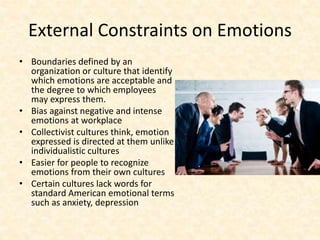
External Constraints on Emotions
• Boundaries defined by an
organization or culture that identify
which emotions are acceptable and
the degree to which employees
may express them.
• Bias against negative and intense
emotions at workplace
• Collectivist cultures think, emotion
expressed is directed at them unlike
individualistic cultures
• Easier for people to recognize
emotions from their own cultures
• Certain cultures lack words for
standard American emotional terms
such as anxiety, depression
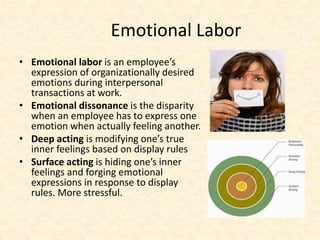
Emotional Labor
• Emotional labor is an employee’s
expression of organizationally desired
emotions during interpersonal
transactions at work.
• Emotional dissonance is the disparity
when an employee has to express one
emotion when actually feeling another.
• Deep acting is modifying one’s true
inner feelings based on display rules
• Surface acting is hiding one’s inner
feelings and forging emotional
expressions in response to display
rules. More stressful.
Emotions – Jobs – Payment
• Strong relationship between cognitive demands and pay
• Lower pay for emotionally demanding jobs.
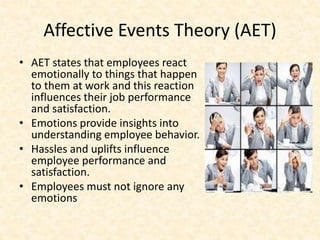
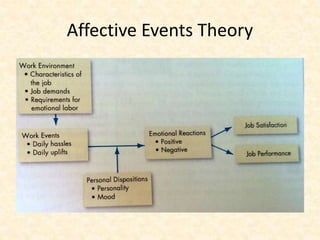
Affective Events Theory (AET)
• AET states that employees react
emotionally to things that happen
to them at work and this reaction
influences their job performance
and satisfaction.
• Emotions provide insights into
understanding employee behavior.
• Hassles and uplifts influence
employee performance and
satisfaction.
• Employees must not ignore any
emotions
Affective Events Theory
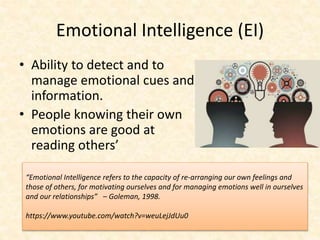
Emotional Intelligence (EI)
• Ability to detect and to
manage emotional cues and
information.
• People knowing their own
emotions are good at
reading others’
“Emotional Intelligence refers to the capacity of re-arranging our own feelings and
those of others, for motivating ourselves and for managing emotions well in ourselves
and our relationships” – Goleman, 1998.
https://www.youtube.com/watch?v=weuLejJdUu0
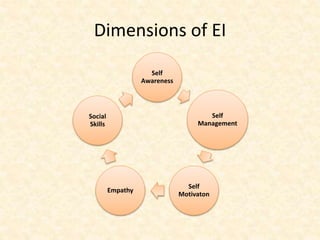
Dimensions of EI
Self
Awareness
Self
Management
Self
Motivaton
Empathy
Social
Skills
Team Activity
EI – For or Against?
For
• Intuitive Appeal: People who detect others emotions are
better at handling their own emotions
• EI predicts criteria that matter: High level of EI means better
performance
• EI is biological: People who suffer neurological damage
score lower EI and make poorer decisions
Against
• Too vague: “too broad and variegated…not intelligible”
• Cannot be measured: Too diverse components
• Suspicious validity: EI is no more unique once intelligence
and personality are controlled.
Whatever the perspective is – the concept is here to stay!
OB Applications of
Emotions and Moods
• Selection
• Decision Making
• Creativity
• Motivation
• Leadership
• Interpersonal Conflict
• Negotiation
• Customer Service
• Job Attitudes
• Deviant Workplace Behaviors
• Managers influence on Moods
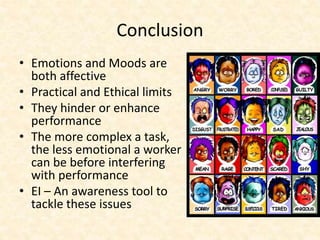
Conclusion
• Emotions and Moods are
both affective
• Practical and Ethical limits
• They hinder or enhance
performance
• The more complex a task,
the less emotional a worker
can be before interfering
with performance
• EI – An awareness tool to
tackle these issues
Questions Please!
Thank you!

Emotions and Moods

  • 1.
    Emotions and Moods Student:Amrita Gandikota Subject: Introduction to Business Psychology Lecturer: Angela Field Date: 19/10/2014
  • 2.
    Contents • Definitions • Relationship– Affect, Moods, Emotions • Basic Emotions • Aspects of Emotions • Structure of Moods • Sources of Emotions and Moods • External Constraints on Moods • Emotional Labor • Emotions – Jobs – Payment • Affective Events Theory (AEI) • Emotional Intelligence (EI) • Dimensions of EI • Team Activity • EI – For or Against? • OB Applications • Conclusion
  • 3.
    Definitions Affect Affect is ageneric tern that covers a broad range of feelings that people experience which encompasses both emotions and moods Emotions Intense feelings that are directed at someone or something Moods Lesser intensive feelings that are often lack a contextual stimulus.
  • 4.
    Relationship Affect Defined as abroad range of feelings that people experience. Affect can be experienced in the form of emotions or moods Emotions • Caused by specific event •Very brief duration •Specific and numerous •Distinct facial expressions •Action-oriented Moods • Cause is general and unclear •Lasts longer •Comprised of multiple specific emotions (+ve or-ve) •No distinct expressions •Cognitive
  • 5.
    Basic Emotions Some emotions(also passions) are complex for facial representation Eg:Love Cultural norms govern emotional expression Experiencing an emotion is not the same as showing it.
  • 6.
    Aspects of Emotion •Emotions originate in the brain’s limbic system. • When relatively inactive creates happiness and vice versa. • More active in women than men. Biology • People emote/respond differently to identical stimuli due to mere personality or job requirements. Intensity • To meet the emotional demands of an organization depends also on the frequency and duration of the effort.Frequency Duration Relation between rationality and emotion Functions • Critical to rational thinking. Eg: Phineas Gage. • Employ both thinking and feeling for decision making • Motivate to engage in actions important for survival. • Evolutionary psychology - All emotions are useful. •Eg: Anger to stand up for oneself
  • 7.
    Structure of moods PositivityOffset: When at zero input, most individuals experience mildly positive mood.
  • 8.
    Sources of Emotionsand Moods Personality: • Predisposed intensity of emotional reactions under similar circumstances. Day of the week, time of the day: • Negative moods during the beginning of the day and week; better moods during midday, weekends Weather: • Illusionary correlation of weather affecting moods Stress: • Deadlines, fear of exams, financial upheavals, ill health cause negative emotions leading to stress. Social Activities: • Increase positive moods; have long term health benefits Lack of Sleep: • Impairs decision making and emotion controlling attitude leaving individuals fatigued, irritable Exercise: • Uplifts moods and therapeutic for the depressed. Age: • Fewer negative emotions as one gets older Gender: • Women show greater emotional expression ; better at reading non-verbal and paralinguistic cues
  • 9.
    External Constraints onEmotions • Boundaries defined by an organization or culture that identify which emotions are acceptable and the degree to which employees may express them. • Bias against negative and intense emotions at workplace • Collectivist cultures think, emotion expressed is directed at them unlike individualistic cultures • Easier for people to recognize emotions from their own cultures • Certain cultures lack words for standard American emotional terms such as anxiety, depression
  • 10.
    Emotional Labor • Emotionallabor is an employee’s expression of organizationally desired emotions during interpersonal transactions at work. • Emotional dissonance is the disparity when an employee has to express one emotion when actually feeling another. • Deep acting is modifying one’s true inner feelings based on display rules • Surface acting is hiding one’s inner feelings and forging emotional expressions in response to display rules. More stressful.
  • 11.
    Emotions – Jobs– Payment • Strong relationship between cognitive demands and pay • Lower pay for emotionally demanding jobs.
  • 12.
    Affective Events Theory(AET) • AET states that employees react emotionally to things that happen to them at work and this reaction influences their job performance and satisfaction. • Emotions provide insights into understanding employee behavior. • Hassles and uplifts influence employee performance and satisfaction. • Employees must not ignore any emotions
  • 13.
  • 14.
    Emotional Intelligence (EI) •Ability to detect and to manage emotional cues and information. • People knowing their own emotions are good at reading others’ “Emotional Intelligence refers to the capacity of re-arranging our own feelings and those of others, for motivating ourselves and for managing emotions well in ourselves and our relationships” – Goleman, 1998. https://www.youtube.com/watch?v=weuLejJdUu0
  • 15.
  • 16.
  • 17.
    EI – Foror Against? For • Intuitive Appeal: People who detect others emotions are better at handling their own emotions • EI predicts criteria that matter: High level of EI means better performance • EI is biological: People who suffer neurological damage score lower EI and make poorer decisions Against • Too vague: “too broad and variegated…not intelligible” • Cannot be measured: Too diverse components • Suspicious validity: EI is no more unique once intelligence and personality are controlled. Whatever the perspective is – the concept is here to stay!
  • 18.
    OB Applications of Emotionsand Moods • Selection • Decision Making • Creativity • Motivation • Leadership • Interpersonal Conflict • Negotiation • Customer Service • Job Attitudes • Deviant Workplace Behaviors • Managers influence on Moods
  • 19.
    Conclusion • Emotions andMoods are both affective • Practical and Ethical limits • They hinder or enhance performance • The more complex a task, the less emotional a worker can be before interfering with performance • EI – An awareness tool to tackle these issues
  • 20.

Editor's Notes

  • #12 Emotional demands rewarded only in cognitively complex jobs because its hard to find people who are willing to work in those jobs.