Copyright ©2014 Pearson Education, Inc.
3-1
Chapter 2
Attitudes & Job Satisfaction
Essentials of
Organizational Behavior
12e
Stephen P. Robbins & Timothy A. Judge
Copyright ©2014 Pearson Education, Inc
After reading this chapter,
you should be able to:
 Contrast the three components of an attitude.
 Summarize the relationship between attitudes and
behavior.
 Compare and contrast the major job attitudes.
 Define job satisfaction and show how we can
measure it.
 Summarize the main causes of job satisfaction.
 Show whether job satisfaction is a relevant concept
in countries other than the United States.
3-2
Copyright ©2014 Pearson Education, Inc
Attitudes
 Attitudes: Evaluative
statements – either favorable
or unfavorable – concerning
objects, people or events
 Reflect how one feels about
something
3-3
Copyright ©2014 Pearson Education, Inc
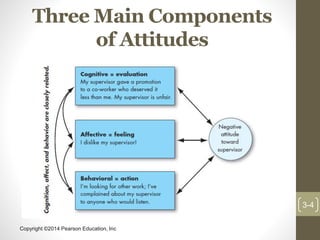
Three Main Components
of Attitudes
3-4
Copyright ©2014 Pearson Education, Inc
Attitudes Follow Behavior:
Cognitive Dissonance
Cognitive dissonance: any inconsistency
between two or more attitudes, or between
behavior and attitudes
 Individuals seek to minimize dissonance
Desire to reduce dissonance is determined by:
 The importance of the elements creating the
dissonance
 The degree of influence the individual believes he
or she has over the elements
 The rewards that may be involved in dissonance
3-5
Copyright ©2014 Pearson Education, Inc
Behavior Follows Attitudes:
Moderating Variables
The most powerful moderators of the attitude-
behavior relationships are:
 Importance
 Correspondence to behavior
 Accessibility
 Social pressures
 Direct personal experience
Knowing attitudes helps predict behavior
3-6
Copyright ©2014 Pearson Education, Inc
Major Job Attitudes
Job satisfaction
Job involvement
Psychological empowerment
Organizational commitment
Affective commitment
Continuance commitment
Normative commitment
Perceived organizational support
Employee engagement 3-7
Copyright ©2014 Pearson Education, Inc
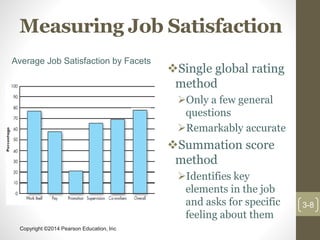
Measuring Job Satisfaction
Single global rating
method
Only a few general
questions
Remarkably accurate
Summation score
method
Identifies key
elements in the job
and asks for specific
feeling about them
3-8
Average Job Satisfaction by Facets
Copyright ©2014 Pearson Education, Inc
Global Implications
 Is job satisfaction a U.S. concept?
Cross-cultural differences do exist but job satisfaction
seems to be a global concern
 Are employees in Western cultures more satisfied with
their jobs?
Yes, but that may be due to the greater value Westerners put on
positive emotions and happiness
3-9
Copyright ©2014 Pearson Education, Inc
What Causes
Job Satisfaction?
The Work Itself – the strongest correlation
with overall satisfaction
Social Component – there is a strong
correlation with how people view the social
context of their work
Pay – not correlated after
individual reaches a level of
comfortable living
 Advancement
 Supervision
 Coworkers 3-10
Copyright ©2014 Pearson Education, Inc
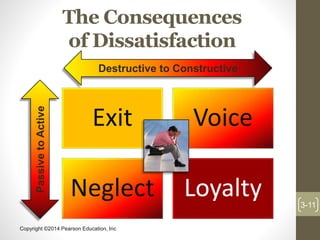
The Consequences
of Dissatisfaction
Exit Voice
Neglect Loyalty 3-11
PassivetoActive
Destructive to Constructive
Copyright ©2014 Pearson Education, Inc
The Benefits of Satisfaction
Better job and organizational performance
Better organizational citizenship behaviors
(OCB – Discretionary behaviors that
contribute to organizational effectiveness
but are not part of employees’ formal job
description)
Greater levels of customer satisfaction
Generally lower absenteeism and turnover
Decreased instances of workplace deviance
3-12
Copyright ©2014 Pearson Education, Inc
Implications for Managers
 Employee attitudes give warnings of potential
problems and influence behavior
 Satisfied and committed employees exhibit
behaviors that increase organizational outcomes
 Managers must measure job attitudes in order to
improve them
 Most important elements a manager can focus on
are the intrinsic parts of the job: making the work
challenging and interesting
 High pay is not enough to create satisfaction 3-13
Copyright ©2014 Pearson Education, Inc
Keep in Mind…
 Individuals have many kinds of attitudes
about their job
 Most employees are satisfied with their jobs,
but when they are not, a host of actions in
response to the satisfaction might be expected
 Job satisfaction is related to organizational
effectiveness
3-14

Organizational behavior chapter 2

  • 1.
    Copyright ©2014 PearsonEducation, Inc. 3-1 Chapter 2 Attitudes & Job Satisfaction Essentials of Organizational Behavior 12e Stephen P. Robbins & Timothy A. Judge
  • 2.
    Copyright ©2014 PearsonEducation, Inc After reading this chapter, you should be able to:  Contrast the three components of an attitude.  Summarize the relationship between attitudes and behavior.  Compare and contrast the major job attitudes.  Define job satisfaction and show how we can measure it.  Summarize the main causes of job satisfaction.  Show whether job satisfaction is a relevant concept in countries other than the United States. 3-2
  • 3.
    Copyright ©2014 PearsonEducation, Inc Attitudes  Attitudes: Evaluative statements – either favorable or unfavorable – concerning objects, people or events  Reflect how one feels about something 3-3
  • 4.
    Copyright ©2014 PearsonEducation, Inc Three Main Components of Attitudes 3-4
  • 5.
    Copyright ©2014 PearsonEducation, Inc Attitudes Follow Behavior: Cognitive Dissonance Cognitive dissonance: any inconsistency between two or more attitudes, or between behavior and attitudes  Individuals seek to minimize dissonance Desire to reduce dissonance is determined by:  The importance of the elements creating the dissonance  The degree of influence the individual believes he or she has over the elements  The rewards that may be involved in dissonance 3-5
  • 6.
    Copyright ©2014 PearsonEducation, Inc Behavior Follows Attitudes: Moderating Variables The most powerful moderators of the attitude- behavior relationships are:  Importance  Correspondence to behavior  Accessibility  Social pressures  Direct personal experience Knowing attitudes helps predict behavior 3-6
  • 7.
    Copyright ©2014 PearsonEducation, Inc Major Job Attitudes Job satisfaction Job involvement Psychological empowerment Organizational commitment Affective commitment Continuance commitment Normative commitment Perceived organizational support Employee engagement 3-7
  • 8.
    Copyright ©2014 PearsonEducation, Inc Measuring Job Satisfaction Single global rating method Only a few general questions Remarkably accurate Summation score method Identifies key elements in the job and asks for specific feeling about them 3-8 Average Job Satisfaction by Facets
  • 9.
    Copyright ©2014 PearsonEducation, Inc Global Implications  Is job satisfaction a U.S. concept? Cross-cultural differences do exist but job satisfaction seems to be a global concern  Are employees in Western cultures more satisfied with their jobs? Yes, but that may be due to the greater value Westerners put on positive emotions and happiness 3-9
  • 10.
    Copyright ©2014 PearsonEducation, Inc What Causes Job Satisfaction? The Work Itself – the strongest correlation with overall satisfaction Social Component – there is a strong correlation with how people view the social context of their work Pay – not correlated after individual reaches a level of comfortable living  Advancement  Supervision  Coworkers 3-10
  • 11.
    Copyright ©2014 PearsonEducation, Inc The Consequences of Dissatisfaction Exit Voice Neglect Loyalty 3-11 PassivetoActive Destructive to Constructive
  • 12.
    Copyright ©2014 PearsonEducation, Inc The Benefits of Satisfaction Better job and organizational performance Better organizational citizenship behaviors (OCB – Discretionary behaviors that contribute to organizational effectiveness but are not part of employees’ formal job description) Greater levels of customer satisfaction Generally lower absenteeism and turnover Decreased instances of workplace deviance 3-12
  • 13.
    Copyright ©2014 PearsonEducation, Inc Implications for Managers  Employee attitudes give warnings of potential problems and influence behavior  Satisfied and committed employees exhibit behaviors that increase organizational outcomes  Managers must measure job attitudes in order to improve them  Most important elements a manager can focus on are the intrinsic parts of the job: making the work challenging and interesting  High pay is not enough to create satisfaction 3-13
  • 14.
    Copyright ©2014 PearsonEducation, Inc Keep in Mind…  Individuals have many kinds of attitudes about their job  Most employees are satisfied with their jobs, but when they are not, a host of actions in response to the satisfaction might be expected  Job satisfaction is related to organizational effectiveness 3-14

Editor's Notes

  • #4 Attitudes are statements that make an evaluation about objects, people or events. They offer a favorable or unfavorable view that reflect how one feels about something.
  • #5 Attitudes are made up of three components. The cognitive component is composed of the belief in the way things are. The affective component is the more critical part of the attitude as it is calls upon the emotions or feelings. The behavioral component describes the intention to behave in a certain way toward someone or something. These three components work together to aid in our understanding of the complexity of an attitude.
  • #6 Sometimes we observe people who will change what they say so it doesn’t contradict their behavior. When attitudes and behaviors don’t line up, individuals will experience cognitive dissonance. This incongruity is uncomfortable, and individuals will seek to reduce the dissonance to find consistency. People are willing to live with some discomfort, but the degree to which this is true depends upon the importance of the elements, how much influence the individual has in the situation and the rewards that are available.
  • #7 Some variables do moderate the relationship between attitude and behavior. These factors include the importance of the attitude, the correspondence of the attitude to the behavior, the accessibility of the attitude, the existence of social pressures on behavior and the personal and direct experience of the attitude. These variables will impact the ability to estimate how a certain attitude will predict behavior.
  • #8 The field of organizational behavior focuses on how attitudes will influence the work place. There are several major job attitudes we will look at throughout the book. The first is job satisfaction, which is the positive feeling about the job resulting from an evaluation of its characteristics. The second is job involvement. Job involvement looks at the degree of psychological identification with the job. An additional job attitude is psychological empowerment, the belief in the degree of influence over the job, competence in the job and job meaningfulness. A very important job attitude is organizational commitment or identifying with a particular organization and its goals. There are three dimensions to this job attitude – affective, continuance, and normative. Organizational commitment has been found to have some relationship to performance and in particular for new employees. Over the years this may be losing importance as people are tending to be more loyal to their profession than to a given employer. Employees also respond to how they perceive the organization supports them or POS. The more support they believe they are receiving the more positive their job attitude will be. An emerging concept is employee engagement, an individual’s involvement with, satisfaction with, and enthusiasm for, the work she does. Engagement is beginning to be linked to many positive work outcomes.
  • #9 Discussing job satisfaction is intuitively a good thing in an organization as it is a concept people understand, and it is important to recognize because of its bottom line impact. However, job satisfaction is something that is not easy to measure. One method for measure is the Single Global Rating method. This method asks one question such as “How satisfied are you with your job?” and gives options such as extremely satisfied to extremely dissatisfied. It does not go into the many facets of a job, so it does not help the organization break down where the problems are. The Summation Score Method is more sophisticated in that it asks about the various job components and breaks down how employees are specifically feeling about the different aspects of the job, thus it offers a more comprehensive look at job satisfaction.
  • #10 Job satisfaction is not solely a U.S. concept, but much of the research has been done in the U.S. so more research is needed to effectively expand these theories to other cultures. Workers in western cultures do tend to be more satisfied in their jobs, but this could be due to the fact that western cultures put greater emphasis on emotions and individual happiness than other cultures do.
  • #11 The type of work people do and their desire to do that type of work has the strongest correlation with job satisfaction. There is also a strong link between the social context of the work place and how people view their work. The more they enjoy the social aspects of their job the more satisfied they are with the job. Pay has an influence on job satisfaction but not as much as one might think. Typically, once a worker exceeds $40,000 a year pay has limited impact on the level of satisfied workers.
  • #12 When employees are dissatisfied with their jobs they have four basic responses they can utilize. These options are divided into active and passive choices. The active options are exit and voice. If employees select to exit they choose to leave or move in a direction of leaving the organization. In voice, the employees will work towards active and constructive attempts to improve conditions. The passive options are neglect and loyalty. Employees may choose to neglect their work and just allow conditions to worsen, or they may choose to remain loyal to the organization and just wait for change.
  • #13 When employees are satisfied with their work there are many positive outcomes in the workplace. However, the inverse is true as well, if employees are dissatisfied in their work these same job outcomes will be negatively impacted. Satisfied workers tend to have stronger performance and are more in tune with the organizations mission and goals. As a result of that they tend to serve customers better which translates into strong customer satisfaction. Satisfied workers remain in the job for a longer period of time than dissatisfied workers. However, as we have seen recently, workers are willing to stay in jobs where they are not satisfied because the job market is tight due to tough economic conditions. Dissatisfied workers are more likely to cause problems in the workplace by stealing, absenteeism, limiting productivity and other negative work outcomes.
  • #14 Attitudes are important components of the workplace and definitely influence behaviors. Managers should be aware of job attitudes and their influence on job satisfaction. The most effective way to do this is to focus on making work challenging and interesting especially at higher level jobs where pay is not enough to satisfy workers.
  • #15 It is important that there are a number of different attitudes about jobs that workers bring to the workplace. Awareness of these attitudes will be helpful in connecting workers to their job and increasing job satisfaction. Most employees are satisfied with their jobs in general, but when they are not negative actions can be a result.