Positioning of Marketing of
Services
Why integration of marketing and
operations?
In a goods mfg. company
• Operations designs, manufactures and
ships to warehouses or retails
• Marketing takes over to carry out sales,
collections, promotion and advertisement.
Marketing becomes a link between the
Operations and the customers
Operations and Marketing well defined
functions. Both do not interact frequently
and seldom before customers
In Services
• Operations carry out service design,
processes, delivers.
• Marketing is limited to promotion and
advertising
Operations is core function. There is heavy
overlap and a high need of coordination
and cooperation and hence integration
Basic difference
• Most Goods are first produced, then sold
and then consumed
• Most services are first sold, then produced
and consumed simultaneously
Production of service (operations issue),
consumption (marketing issue) are
inseparable, are integrated and change
the role of marketing in a firm
Five major differences in Goods
and Services Marketing
1. Output Tangibility:
• In goods marketing attempts to enhance
abstract association (youth for coke,
nutritious food)
• In services opposite strategy is needed
(umbrella for insurance, blanket
protection)
Five major differences in Goods and
Services Marketing
2. Organizational features: Services marketing
has two components:
• Service interface marketing: It is predominant in
personal services. These are small, high contact
firms that is impersonal or mass service.
Marketing is small or non-existent
• Functional marketing: It is predominant for
impersonal services as also for manufacturing
firms where large, low contact is needed.
Marketing is formal and well established
Five major differences in Goods and
Services Marketing
3. Ownership, Use and Consumption:
• As against goods, services are not
owned; services are used/consumed for
limited time.
• Focus of marketing is on service itself ( not
on selling of perfume but on fantasy)
Five major differences in Goods and
Services Marketing
4. Scope of marketing activities:
• Traditionally, 4 P’s of Product, Price, Place
and Promotion are considered in goods
oriented marketing
• Services marketing includes additionally
Participants (employees and customers)
Physical evidence (building, uniforms)
Processes (procedures, flow of activities in
providing service)
Five major differences in Goods and
Services Marketing
5 The Consumers’ Role:
• Consumer behavior for services is more
difficult subject of study as he might be
involved in design and delivery of service
• Purchase and consumption are simultaneous,
therefore his behavior during encounter must
be also considered
• Most services are evaluated on quality and
performance after experience
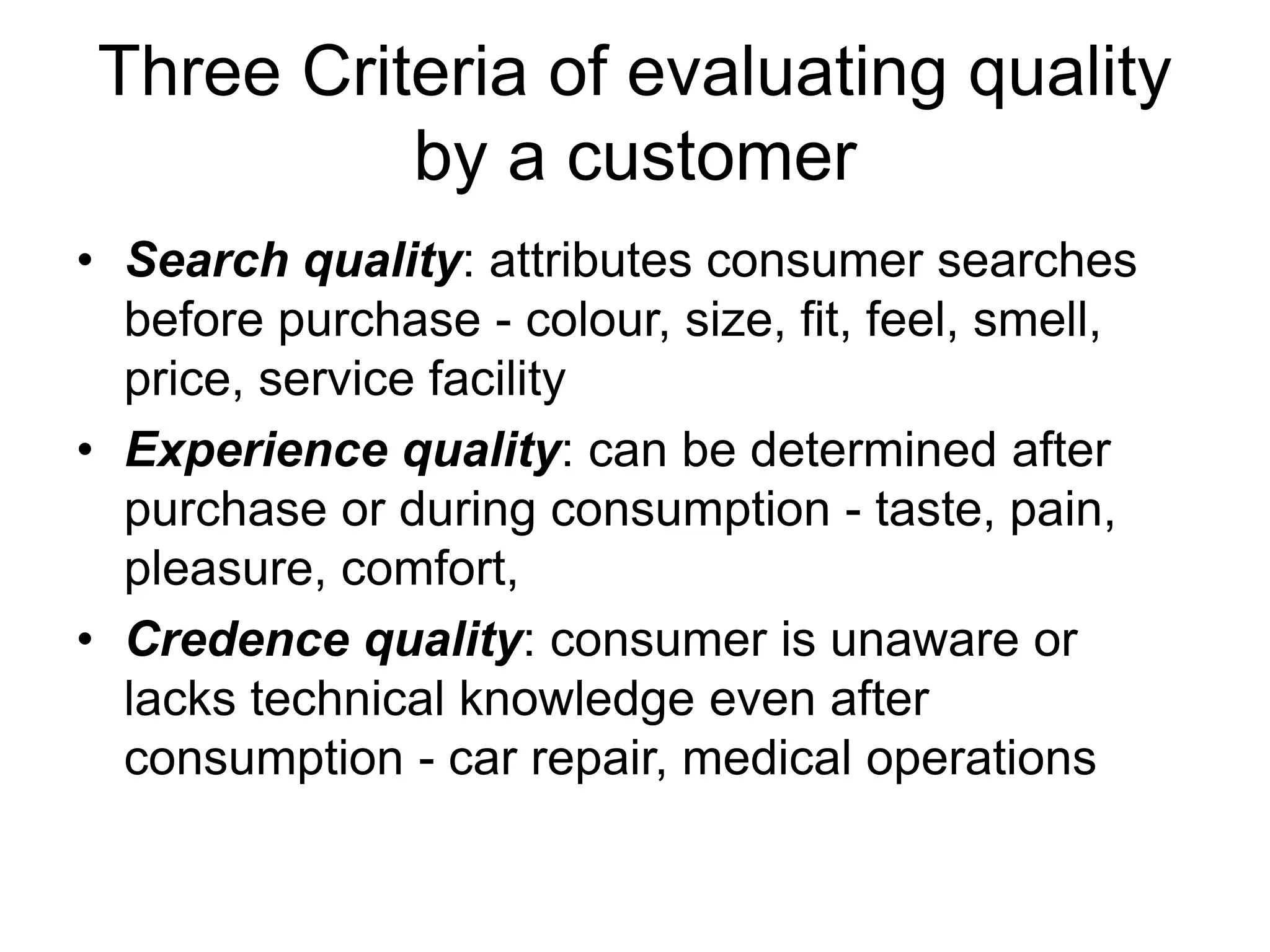
Three Criteria of evaluating quality
by a customer
• Search quality: attributes consumer searches
before purchase - colour, size, fit, feel, smell,
price, service facility
• Experience quality: can be determined after
purchase or during consumption - taste, pain,
pleasure, comfort,
• Credence quality: consumer is unaware or
lacks technical knowledge even after
consumption - car repair, medical operations
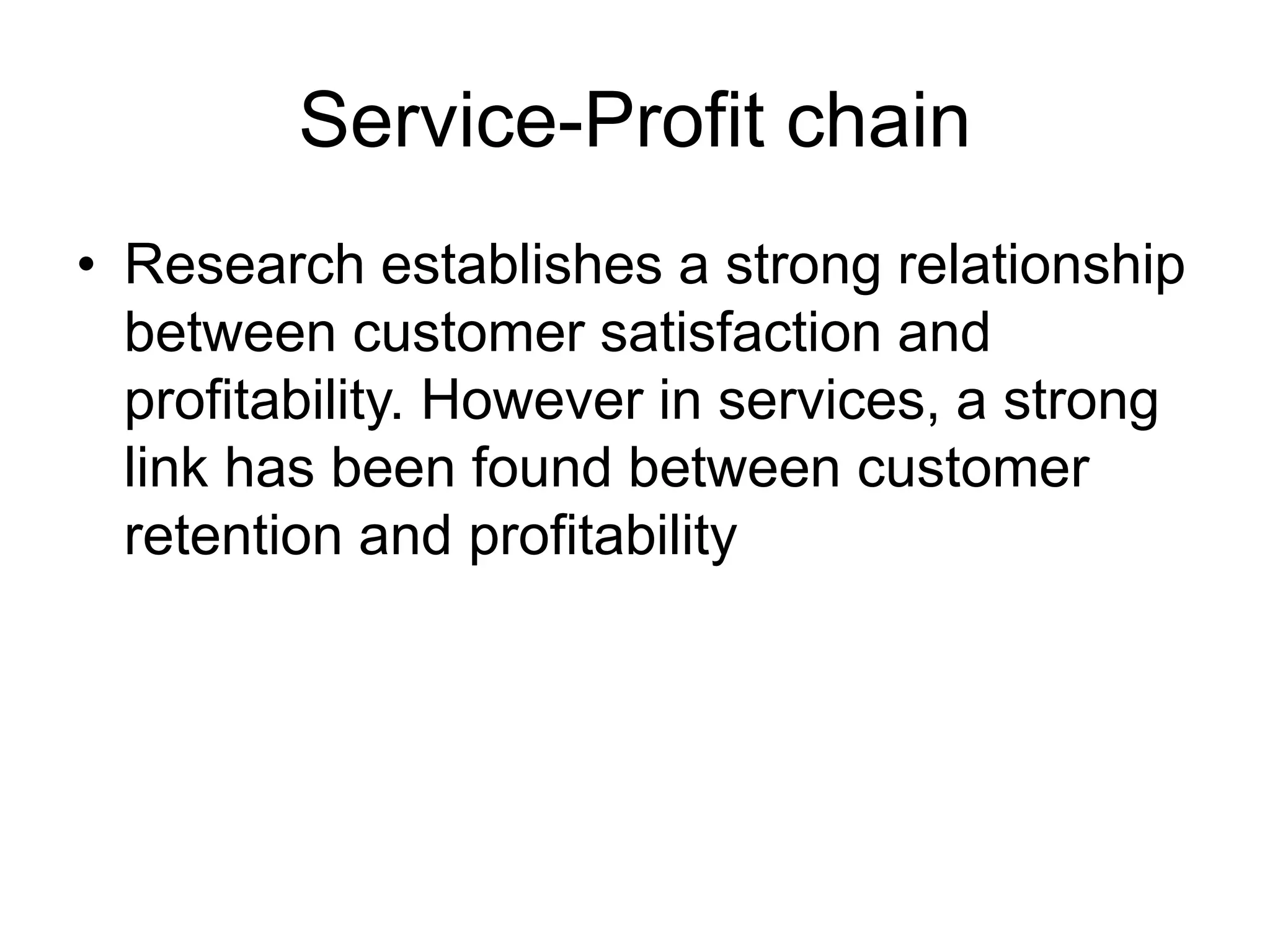
Service-Profit chain
• Research establishes a strong relationship
between customer satisfaction and
profitability. However in services, a strong
link has been found between customer
retention and profitability
Hesket’s 7 propositions on ‘Service
profit chain’
1. Profit and growth are linked to customer loyalty
2. Customer loyalty is linked to customer
satisfaction
3. Customer satisfaction is linked to service value
4. Service value is linked to employee
productivity
5. Employee productivity is linked to loyalty
6. Employee loyalty is linked to employee
satisfaction
7. Employee satisfaction is linked to internal
quality of work life
Internal Quality of life
• Workplace design
• Job design
• Decision making latitude
• Selection and development
• Rewards and recognition
• Information and communication
• Adequate ‘tools’ to serve customers
Why customers switch
1. Pricing
• High price
• Price increases
• Unfair pricing
• Deceptive pricing
2. Inconvenience
• Location/hours
• Wait for appointment
• Wait for service
Why customers switch
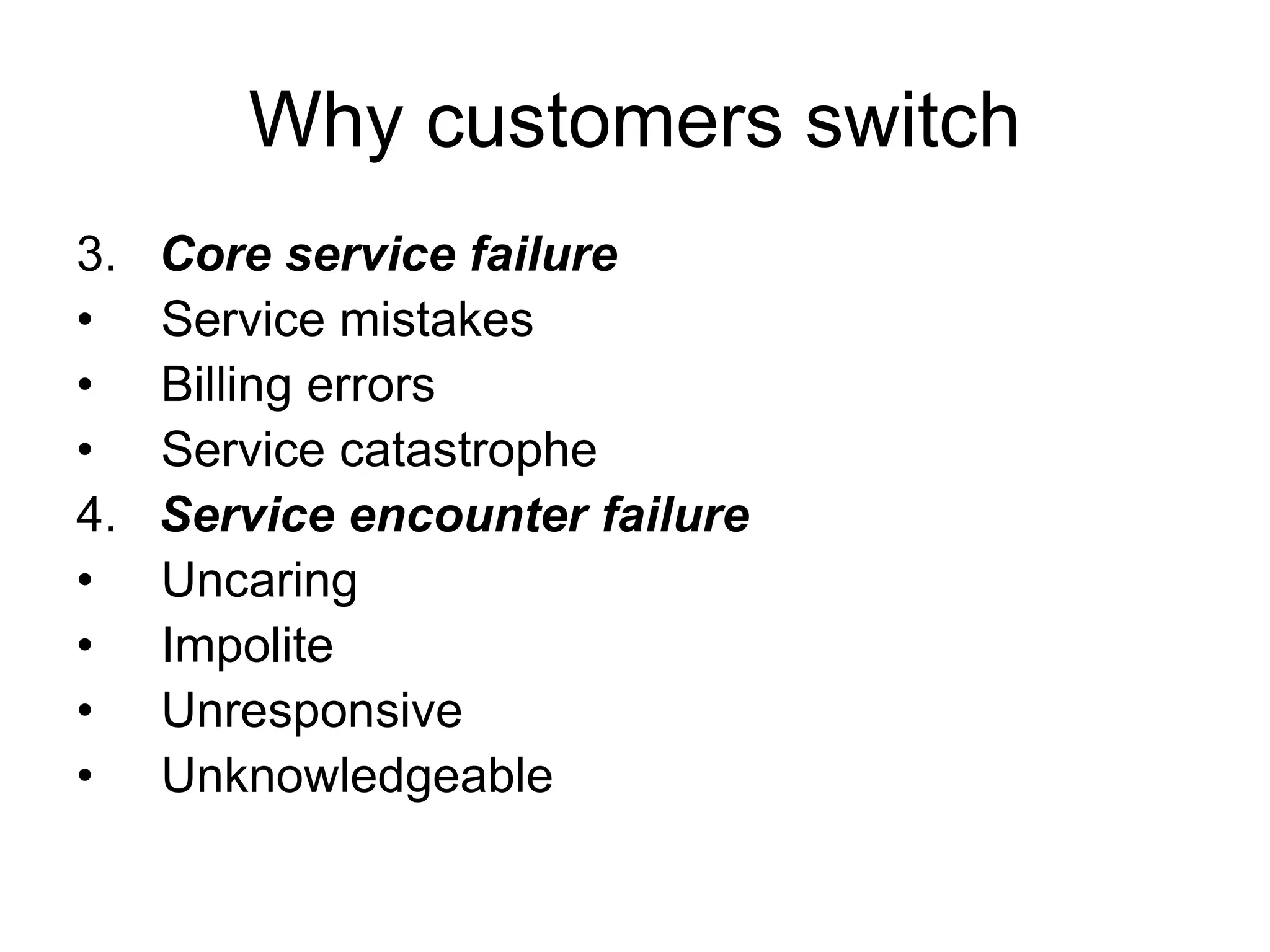
3. Core service failure
• Service mistakes
• Billing errors
• Service catastrophe
4. Service encounter failure
• Uncaring
• Impolite
• Unresponsive
• Unknowledgeable
Why customers switch
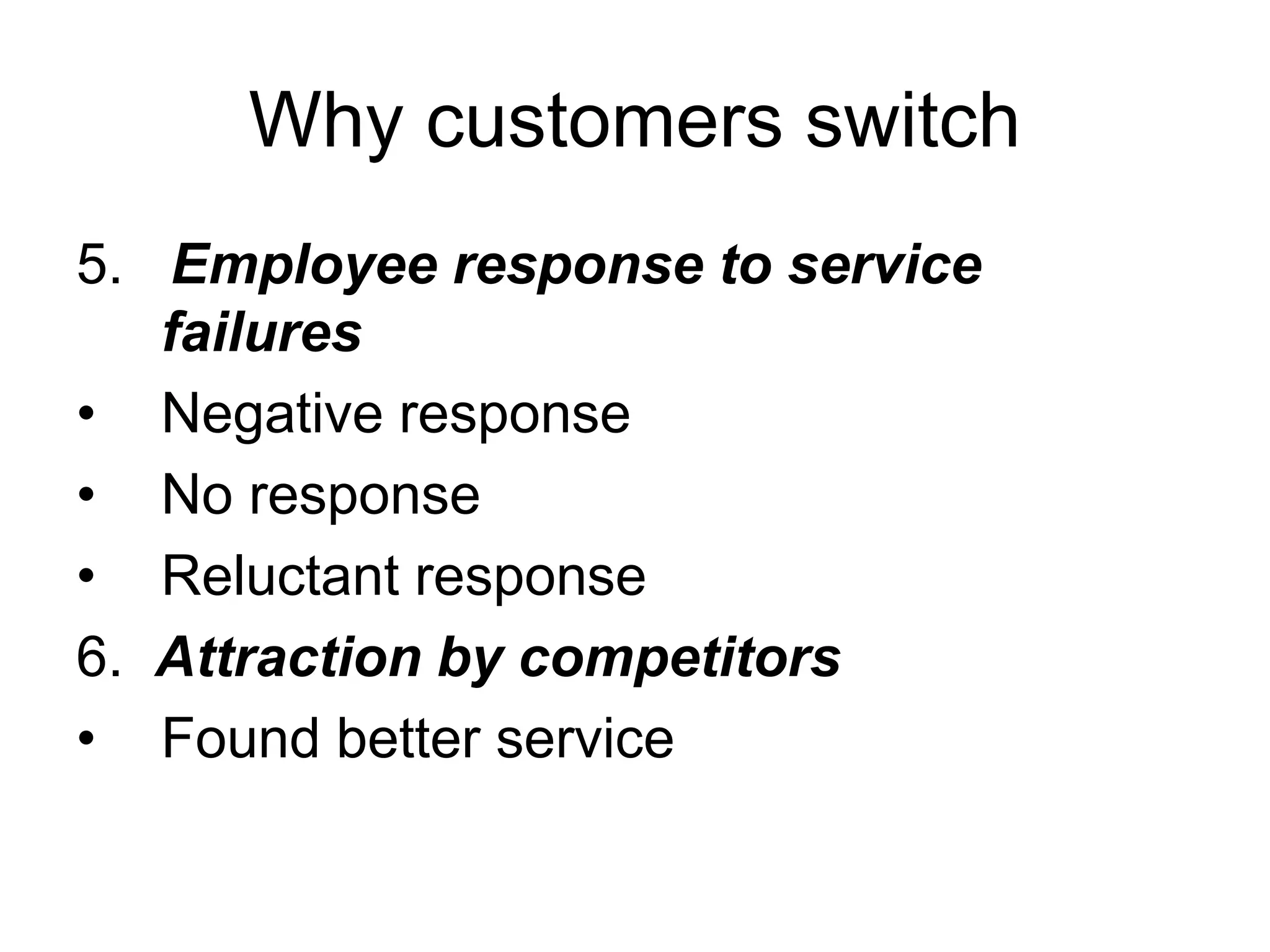
5. Employee response to service
failures
• Negative response
• No response
• Reluctant response
6. Attraction by competitors
• Found better service
Why customers switch
7.Ethical problems
• Cheat
• Hard sell
• Unsafe
• Conflict of interest
8.Involuntary switching
• Customer moved
• Provider closed

Positioning of marketing of services

  • 1.
    Positioning of Marketingof Services Why integration of marketing and operations?
  • 2.
    In a goodsmfg. company • Operations designs, manufactures and ships to warehouses or retails • Marketing takes over to carry out sales, collections, promotion and advertisement. Marketing becomes a link between the Operations and the customers Operations and Marketing well defined functions. Both do not interact frequently and seldom before customers
  • 3.
    In Services • Operationscarry out service design, processes, delivers. • Marketing is limited to promotion and advertising Operations is core function. There is heavy overlap and a high need of coordination and cooperation and hence integration
  • 4.
    Basic difference • MostGoods are first produced, then sold and then consumed • Most services are first sold, then produced and consumed simultaneously Production of service (operations issue), consumption (marketing issue) are inseparable, are integrated and change the role of marketing in a firm
  • 5.
    Five major differencesin Goods and Services Marketing 1. Output Tangibility: • In goods marketing attempts to enhance abstract association (youth for coke, nutritious food) • In services opposite strategy is needed (umbrella for insurance, blanket protection)
  • 6.
    Five major differencesin Goods and Services Marketing 2. Organizational features: Services marketing has two components: • Service interface marketing: It is predominant in personal services. These are small, high contact firms that is impersonal or mass service. Marketing is small or non-existent • Functional marketing: It is predominant for impersonal services as also for manufacturing firms where large, low contact is needed. Marketing is formal and well established
  • 7.
    Five major differencesin Goods and Services Marketing 3. Ownership, Use and Consumption: • As against goods, services are not owned; services are used/consumed for limited time. • Focus of marketing is on service itself ( not on selling of perfume but on fantasy)
  • 8.
    Five major differencesin Goods and Services Marketing 4. Scope of marketing activities: • Traditionally, 4 P’s of Product, Price, Place and Promotion are considered in goods oriented marketing • Services marketing includes additionally Participants (employees and customers) Physical evidence (building, uniforms) Processes (procedures, flow of activities in providing service)
  • 9.
    Five major differencesin Goods and Services Marketing 5 The Consumers’ Role: • Consumer behavior for services is more difficult subject of study as he might be involved in design and delivery of service • Purchase and consumption are simultaneous, therefore his behavior during encounter must be also considered • Most services are evaluated on quality and performance after experience
  • 10.
    Three Criteria ofevaluating quality by a customer • Search quality: attributes consumer searches before purchase - colour, size, fit, feel, smell, price, service facility • Experience quality: can be determined after purchase or during consumption - taste, pain, pleasure, comfort, • Credence quality: consumer is unaware or lacks technical knowledge even after consumption - car repair, medical operations
  • 11.
    Service-Profit chain • Researchestablishes a strong relationship between customer satisfaction and profitability. However in services, a strong link has been found between customer retention and profitability
  • 12.
    Hesket’s 7 propositionson ‘Service profit chain’ 1. Profit and growth are linked to customer loyalty 2. Customer loyalty is linked to customer satisfaction 3. Customer satisfaction is linked to service value 4. Service value is linked to employee productivity 5. Employee productivity is linked to loyalty 6. Employee loyalty is linked to employee satisfaction 7. Employee satisfaction is linked to internal quality of work life
  • 13.
    Internal Quality oflife • Workplace design • Job design • Decision making latitude • Selection and development • Rewards and recognition • Information and communication • Adequate ‘tools’ to serve customers
  • 14.
    Why customers switch 1.Pricing • High price • Price increases • Unfair pricing • Deceptive pricing 2. Inconvenience • Location/hours • Wait for appointment • Wait for service
  • 15.
    Why customers switch 3.Core service failure • Service mistakes • Billing errors • Service catastrophe 4. Service encounter failure • Uncaring • Impolite • Unresponsive • Unknowledgeable
  • 16.
    Why customers switch 5.Employee response to service failures • Negative response • No response • Reluctant response 6. Attraction by competitors • Found better service
  • 17.
    Why customers switch 7.Ethicalproblems • Cheat • Hard sell • Unsafe • Conflict of interest 8.Involuntary switching • Customer moved • Provider closed