Copyright © 2014 Pearson Education, Inc.
6-1
Chapter 5
Perception and Individual
Decision Making
Essentials of
Organizational Behavior
12e
Stephen P. Robbins & Timothy A. Judge
Copyright © 2014 Pearson Education, Inc.
After studying this chapter,
you should be able to:
1. Define perception, and explain the factors that
influence it.
2. Identify the shortcuts individuals use in making
judgments about others.
3. Explain the link between perception and decision
making.
4. List and explain the common decision biases or
errors.
5. Contrast the three ethical decision criteria.
6. Define creativity, and discuss the three-component
model of creativity. 6-2
Copyright © 2014 Pearson Education, Inc.
Perception
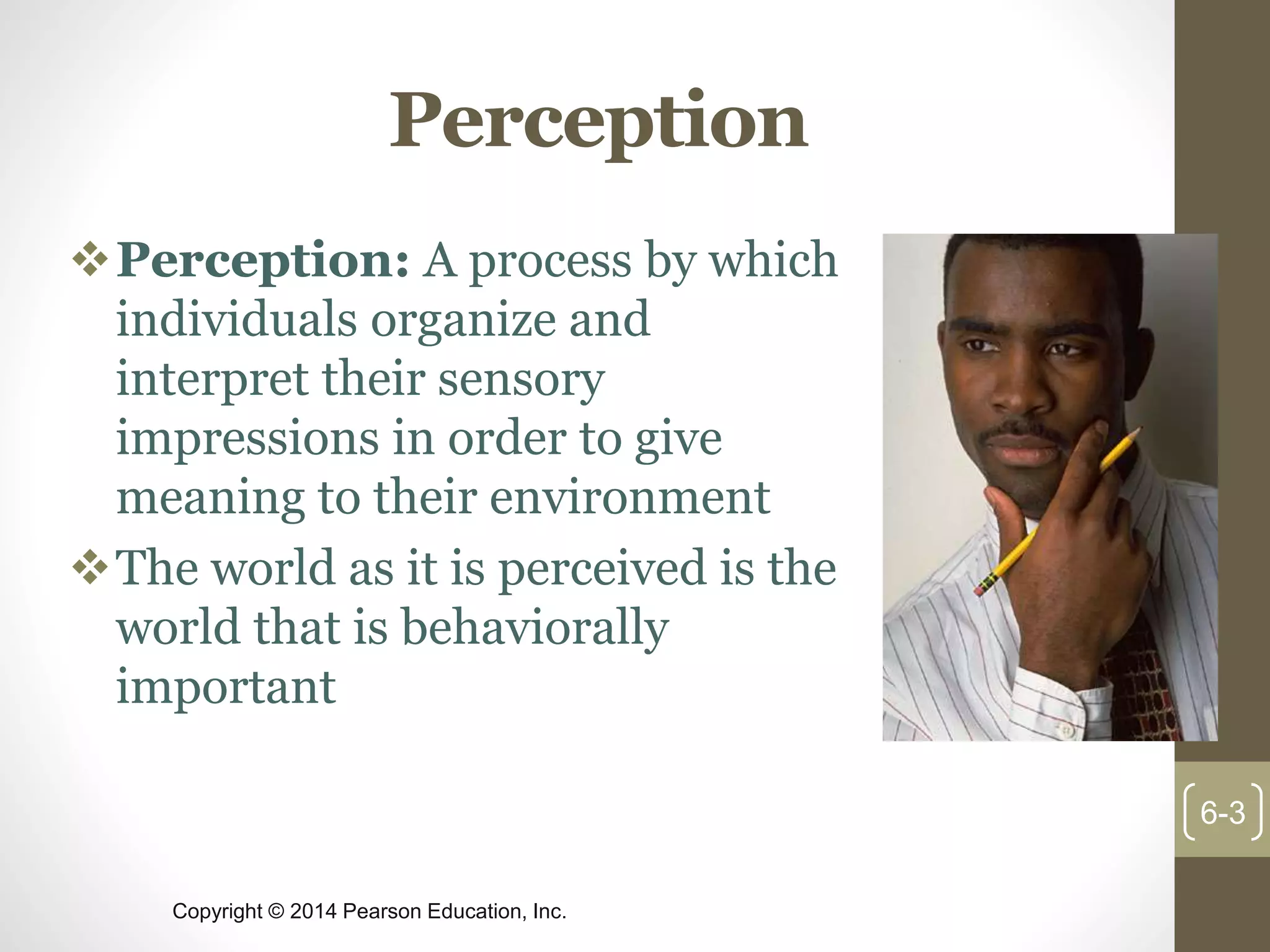
Perception: A process by which
individuals organize and
interpret their sensory
impressions in order to give
meaning to their environment
The world as it is perceived is the
world that is behaviorally
important
6-3
Copyright © 2014 Pearson Education, Inc.
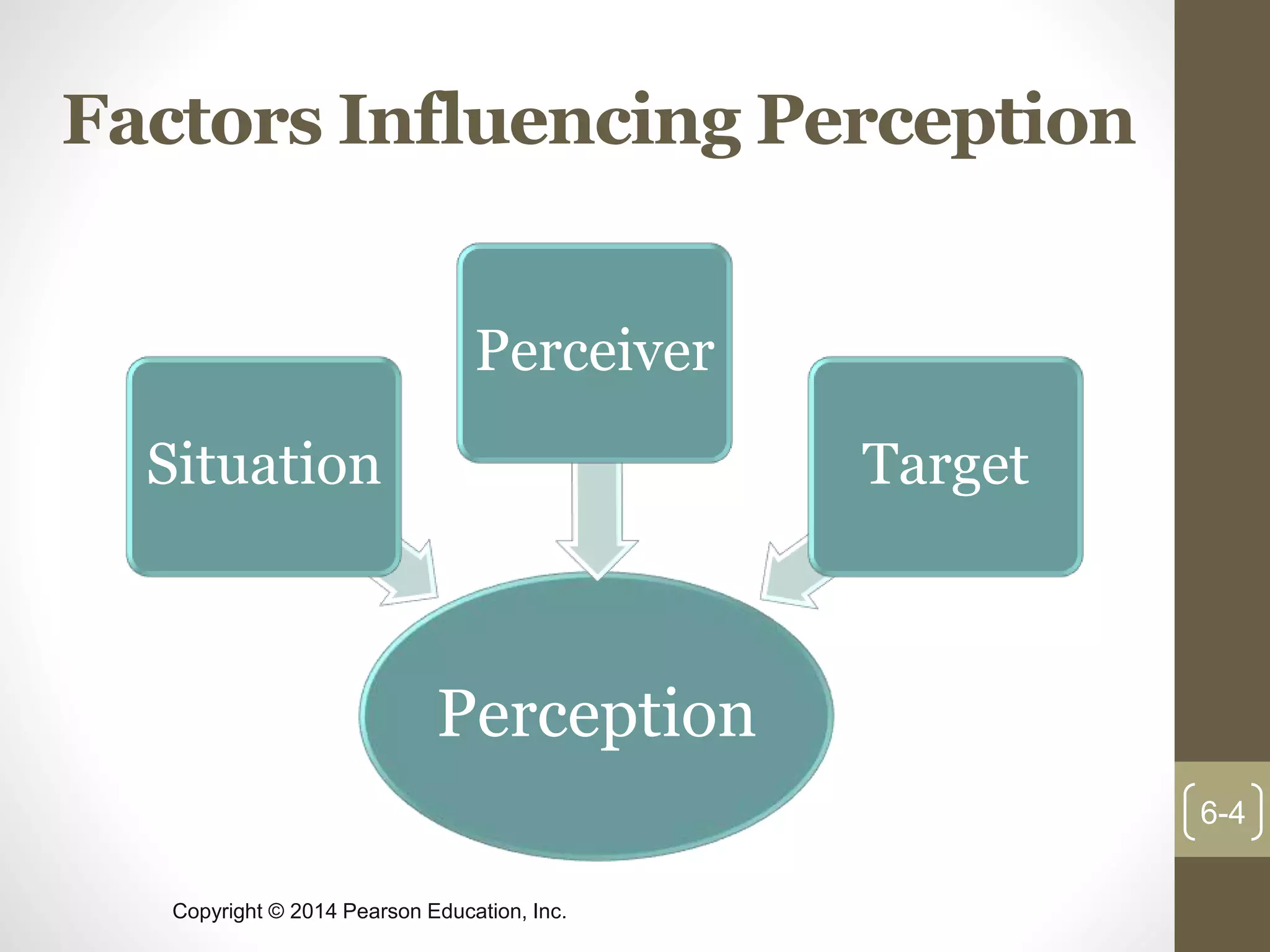
Factors Influencing Perception
6-4
Perception
Situation
Perceiver
Target
Copyright © 2014 Pearson Education, Inc.
Person Perception:
Attribution Theory
Attribution Theory: Suggests that
perceivers try to “attribute” the observed
behavior to a type of cause:
 Internal – behavior is believed to be under
the personal control of the individual
 External – the person is forced into the
behavior by outside events/causes
6-5
Copyright © 2014 Pearson Education, Inc.
Determinants of Attribution
 Distinctiveness – whether an individual
displays different behaviors in different
situations (the uniqueness of the act)
 Consensus – does everyone who faces a
similar situation respond in the same way as
the individual did
 Consistency – does the person respond the
same way over time
6-6
Copyright © 2014 Pearson Education, Inc.
Attribution Errors
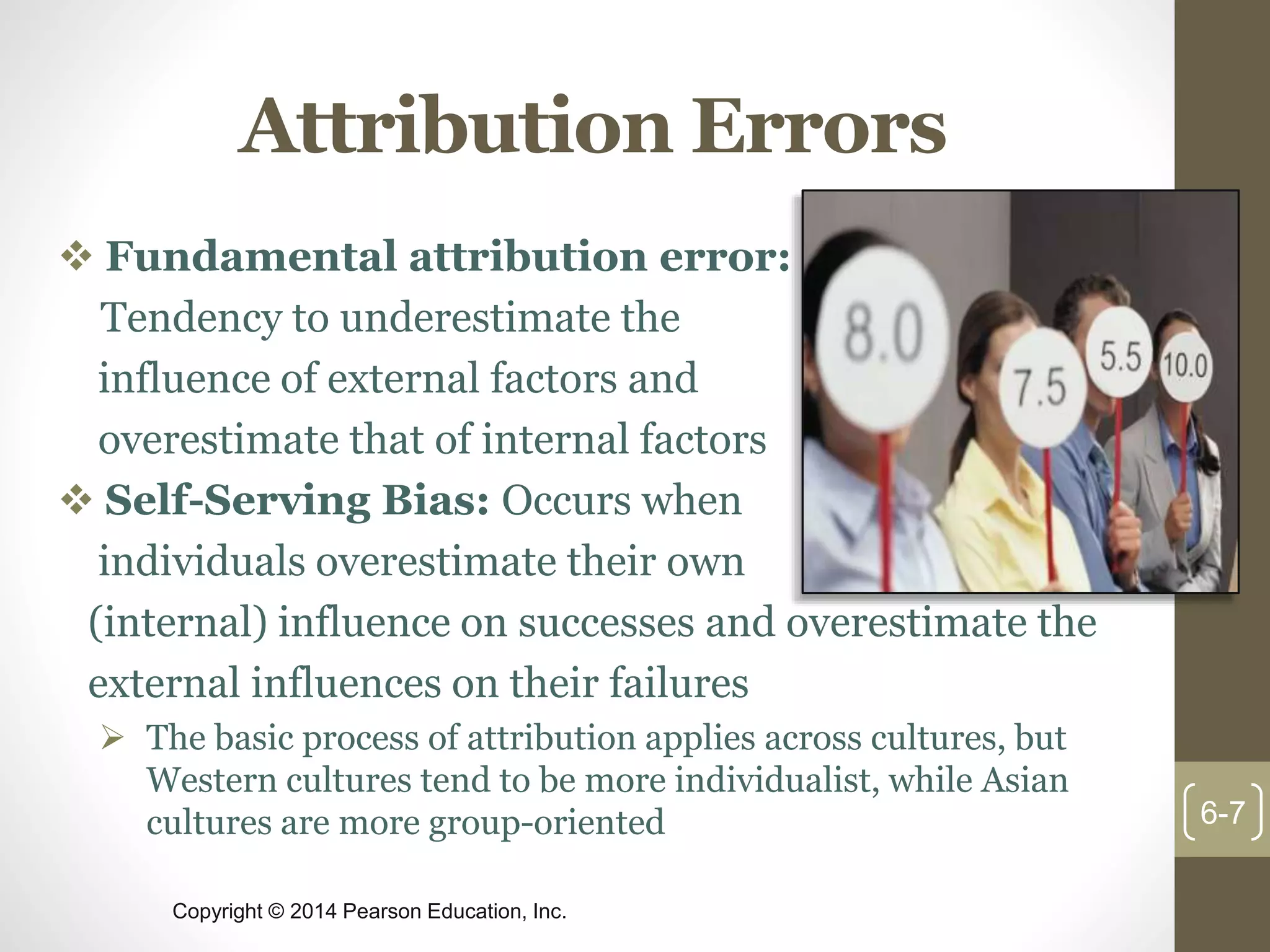
 Fundamental attribution error:
Tendency to underestimate the
influence of external factors and
overestimate that of internal factors
 Self-Serving Bias: Occurs when
individuals overestimate their own
(internal) influence on successes and overestimate the
external influences on their failures
 The basic process of attribution applies across cultures, but
Western cultures tend to be more individualist, while Asian
cultures are more group-oriented 6-7
Copyright © 2014 Pearson Education, Inc.
Shortcuts Used
in Judging Others
 Selective Perception: A perceptual filtering process
based on interests, background, and attitude
 May allow observers to draw unwarranted conclusions from an
ambiguous situation
 Halo Effect: Drawing a general impression based on a
single characteristic such intelligence, skillful
 Contrast Effects: Our reaction is influenced by others
we have recently encountered (the context of the
observation) - comparison
 Stereotyping: Judging someone on the basis of the
perception of the group to which they belong 6-8
Copyright © 2014 Pearson Education, Inc.
The Link Between Perception
and Decision Making
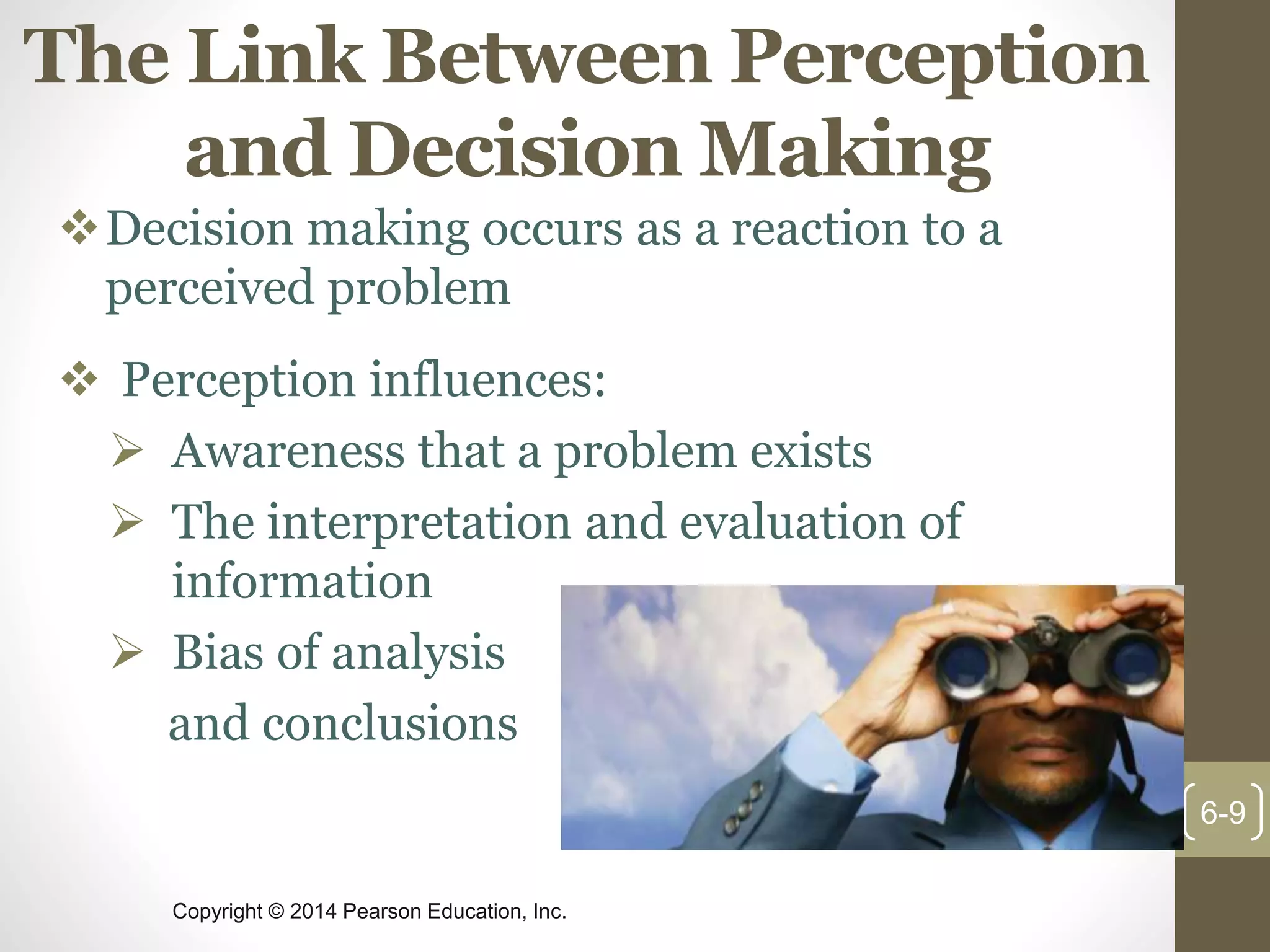
Decision making occurs as a reaction to a
perceived problem
 Perception influences:
 Awareness that a problem exists
 The interpretation and evaluation of
information
 Bias of analysis
and conclusions
6-9
Copyright © 2014 Pearson Education, Inc.
Rational Decision-Making
Model
1. Define the problem
2. Identify the decision criteria
3. Allocate weights to the criteria
4. Develop the alternatives
5. Evaluate the alternatives
6. Select the best alternative
6-10
 This model is seldom actually used: it’s more of a goal
than a practical method
Copyright © 2014 Pearson Education, Inc.
Bounded Rationality
 The limited information-processing capability
of human beings makes it impossible to
assimilate and understand all the information
necessary to optimize
 People seek solutions that are satisfactory and
sufficient, rather than optimal (they “satisfice”)
 Bounded rationality is constructing simplified
models that extract the essential features from
problems without capturing all their
complexity 6-11
Copyright © 2014 Pearson Education, Inc.
Intuitive Decision Making
Intuitive decision making :
A non-conscious process created
out of distilled experience
 Increases with experience
 Can be a powerful complement
to rational analysis in decision
making
6-12
Copyright © 2014 Pearson Education, Inc.
Common Biases and Errors
 Overconfidence Bias
As managers and employees become more
knowledgeable about an issue, the less likely they are to
display overconfidence
 Anchoring Bias
A tendency to fixate on initial information and fail to
adequately adjust for subsequent information
 Confirmation Bias
Seeking out information that reaffirms our past choices
and discounting information that contradicts past
judgments 6-13
Copyright © 2014 Pearson Education, Inc.
Common Biases and Errors
 Randomness Error
Believing that we can predict the outcome of random events
 Availability Bias
Basing judgments on information that is readily available
 Escalation of Commitment
Staying with a decision even when there is clear evidence that it
is wrong
 Risk Aversion
Preferring a sure thing over a risky outcome
 Hindsight Bias
Believing falsely that we could have predicted the outcome of
an event after that outcome is already known
6-14
Copyright © 2014 Pearson Education, Inc.
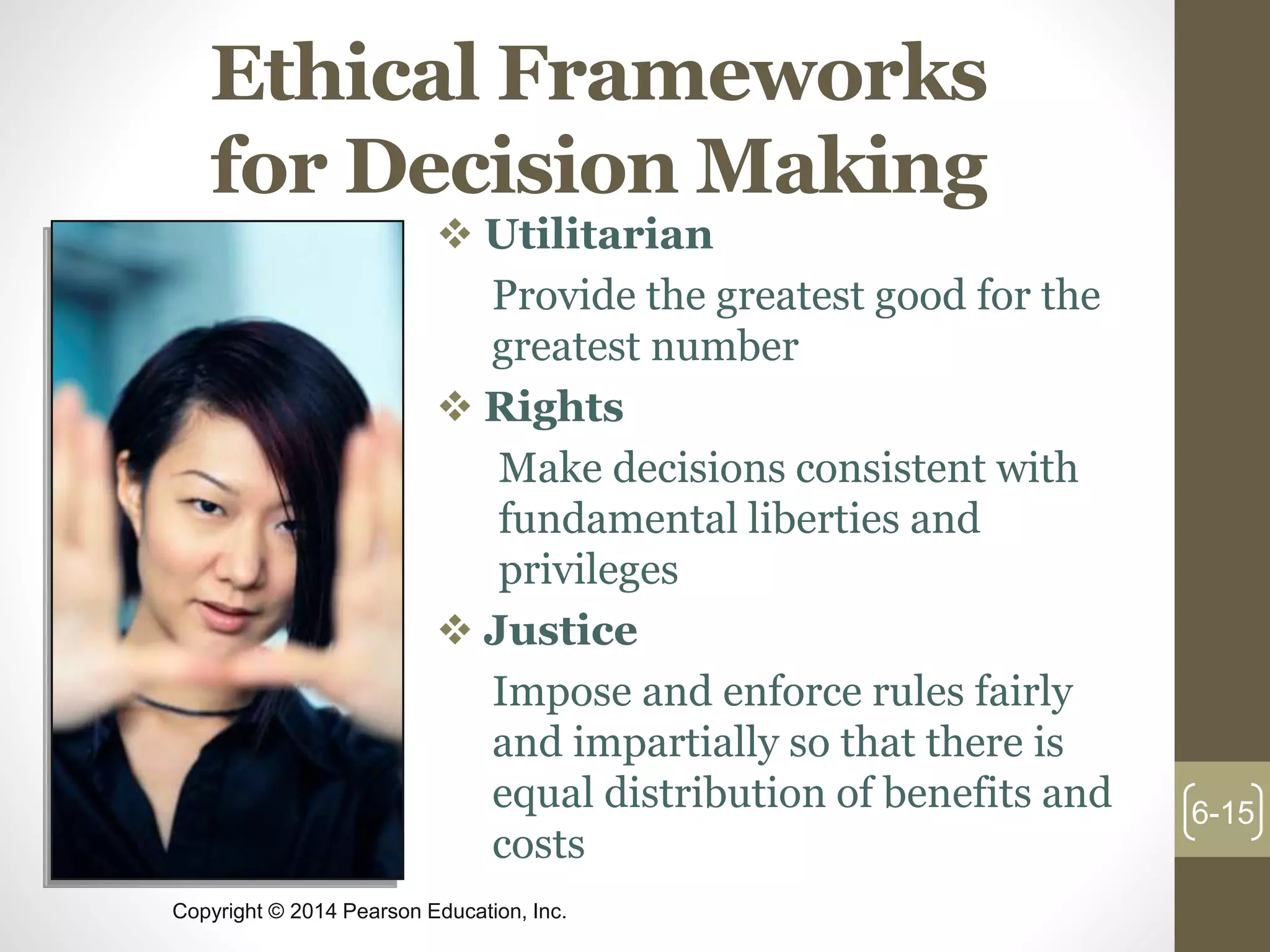
Ethical Frameworks
for Decision Making
 Utilitarian
Provide the greatest good for the
greatest number
 Rights
Make decisions consistent with
fundamental liberties and
privileges
 Justice
Impose and enforce rules fairly
and impartially so that there is
equal distribution of benefits and
costs
6-15
Copyright © 2014 Pearson Education, Inc.
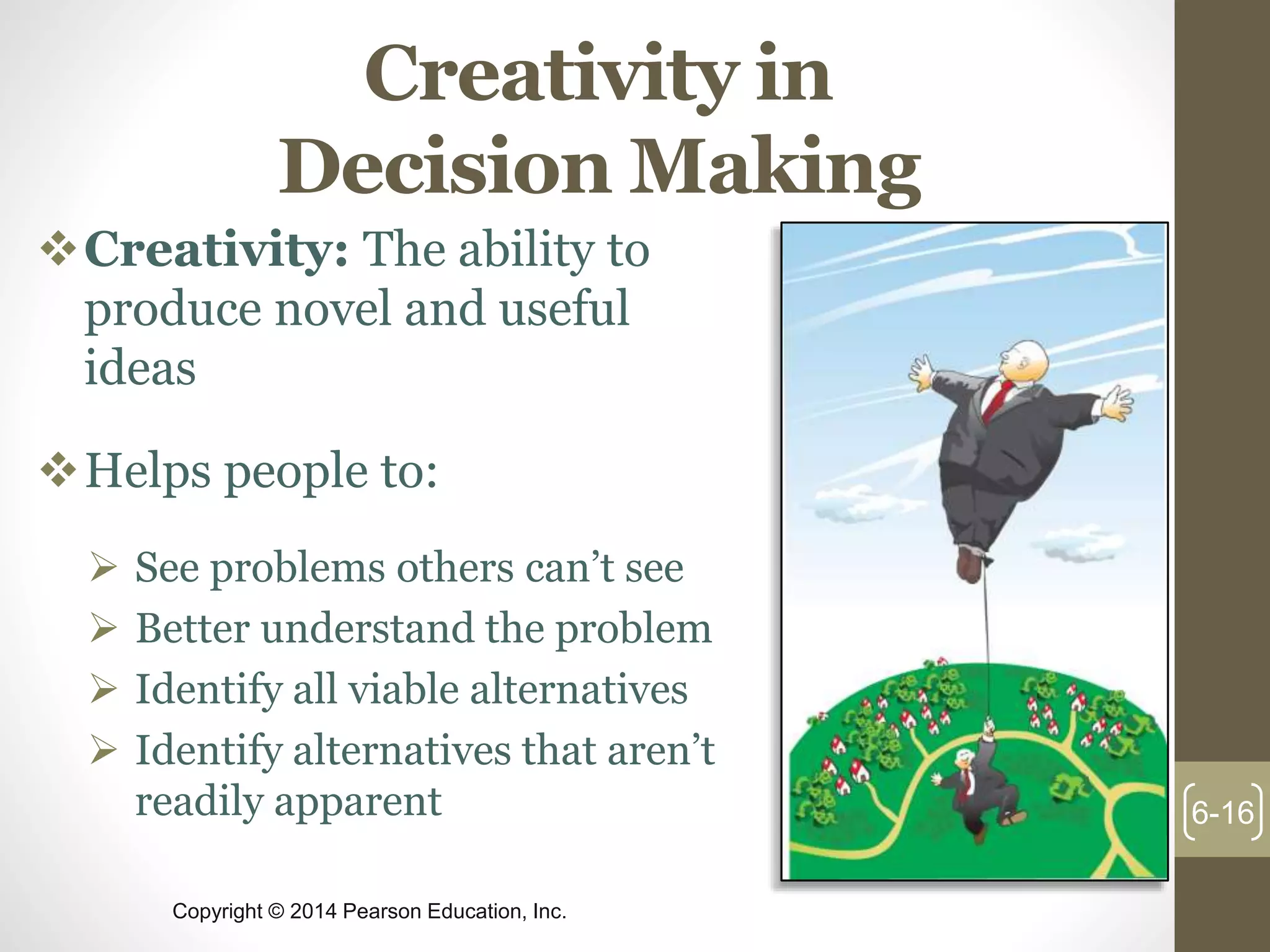
Creativity in
Decision Making
Creativity: The ability to
produce novel and useful
ideas
Helps people to:
 See problems others can’t see
 Better understand the problem
 Identify all viable alternatives
 Identify alternatives that aren’t
readily apparent 6-16
Copyright © 2014 Pearson Education, Inc.
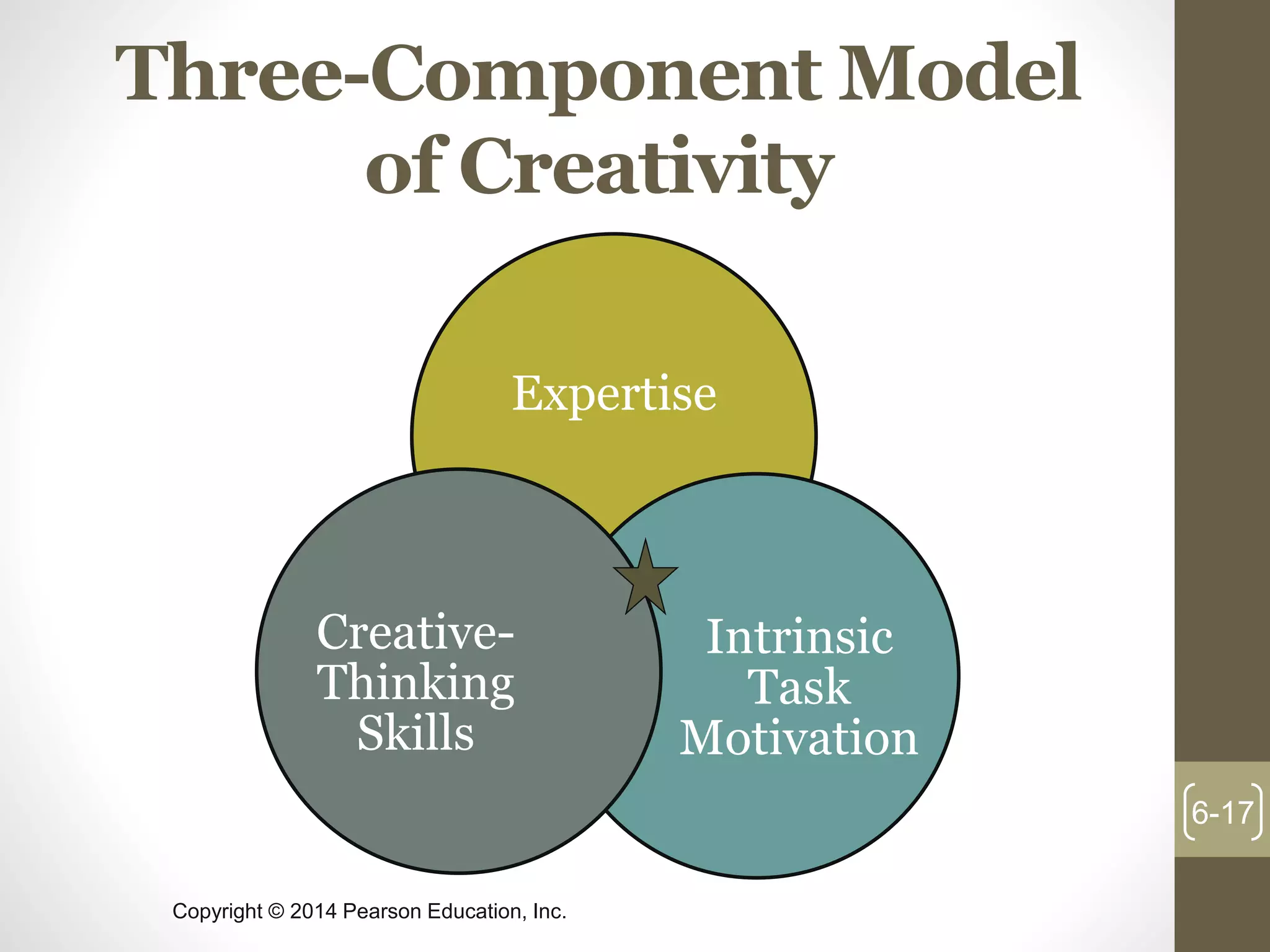
Three-Component Model
of Creativity
6-17
Expertise
Intrinsic
Task
Motivation
Creative-
Thinking
Skills
Copyright © 2014 Pearson Education, Inc.
International Differences
 Ethics
 No global ethical standards exist
 Need organizational-level guidance
 Establish ethical principles to follow
that are modified to reflect local
cultural norms
6-18

Organizational Behavior Chapter 5 Perception and Individual Decision Making

  • 1.
    Copyright © 2014Pearson Education, Inc. 6-1 Chapter 5 Perception and Individual Decision Making Essentials of Organizational Behavior 12e Stephen P. Robbins & Timothy A. Judge
  • 2.
    Copyright © 2014Pearson Education, Inc. After studying this chapter, you should be able to: 1. Define perception, and explain the factors that influence it. 2. Identify the shortcuts individuals use in making judgments about others. 3. Explain the link between perception and decision making. 4. List and explain the common decision biases or errors. 5. Contrast the three ethical decision criteria. 6. Define creativity, and discuss the three-component model of creativity. 6-2
  • 3.
    Copyright © 2014Pearson Education, Inc. Perception Perception: A process by which individuals organize and interpret their sensory impressions in order to give meaning to their environment The world as it is perceived is the world that is behaviorally important 6-3
  • 4.
    Copyright © 2014Pearson Education, Inc. Factors Influencing Perception 6-4 Perception Situation Perceiver Target
  • 5.
    Copyright © 2014Pearson Education, Inc. Person Perception: Attribution Theory Attribution Theory: Suggests that perceivers try to “attribute” the observed behavior to a type of cause:  Internal – behavior is believed to be under the personal control of the individual  External – the person is forced into the behavior by outside events/causes 6-5
  • 6.
    Copyright © 2014Pearson Education, Inc. Determinants of Attribution  Distinctiveness – whether an individual displays different behaviors in different situations (the uniqueness of the act)  Consensus – does everyone who faces a similar situation respond in the same way as the individual did  Consistency – does the person respond the same way over time 6-6
  • 7.
    Copyright © 2014Pearson Education, Inc. Attribution Errors  Fundamental attribution error: Tendency to underestimate the influence of external factors and overestimate that of internal factors  Self-Serving Bias: Occurs when individuals overestimate their own (internal) influence on successes and overestimate the external influences on their failures  The basic process of attribution applies across cultures, but Western cultures tend to be more individualist, while Asian cultures are more group-oriented 6-7
  • 8.
    Copyright © 2014Pearson Education, Inc. Shortcuts Used in Judging Others  Selective Perception: A perceptual filtering process based on interests, background, and attitude  May allow observers to draw unwarranted conclusions from an ambiguous situation  Halo Effect: Drawing a general impression based on a single characteristic such intelligence, skillful  Contrast Effects: Our reaction is influenced by others we have recently encountered (the context of the observation) - comparison  Stereotyping: Judging someone on the basis of the perception of the group to which they belong 6-8
  • 9.
    Copyright © 2014Pearson Education, Inc. The Link Between Perception and Decision Making Decision making occurs as a reaction to a perceived problem  Perception influences:  Awareness that a problem exists  The interpretation and evaluation of information  Bias of analysis and conclusions 6-9
  • 10.
    Copyright © 2014Pearson Education, Inc. Rational Decision-Making Model 1. Define the problem 2. Identify the decision criteria 3. Allocate weights to the criteria 4. Develop the alternatives 5. Evaluate the alternatives 6. Select the best alternative 6-10  This model is seldom actually used: it’s more of a goal than a practical method
  • 11.
    Copyright © 2014Pearson Education, Inc. Bounded Rationality  The limited information-processing capability of human beings makes it impossible to assimilate and understand all the information necessary to optimize  People seek solutions that are satisfactory and sufficient, rather than optimal (they “satisfice”)  Bounded rationality is constructing simplified models that extract the essential features from problems without capturing all their complexity 6-11
  • 12.
    Copyright © 2014Pearson Education, Inc. Intuitive Decision Making Intuitive decision making : A non-conscious process created out of distilled experience  Increases with experience  Can be a powerful complement to rational analysis in decision making 6-12
  • 13.
    Copyright © 2014Pearson Education, Inc. Common Biases and Errors  Overconfidence Bias As managers and employees become more knowledgeable about an issue, the less likely they are to display overconfidence  Anchoring Bias A tendency to fixate on initial information and fail to adequately adjust for subsequent information  Confirmation Bias Seeking out information that reaffirms our past choices and discounting information that contradicts past judgments 6-13
  • 14.
    Copyright © 2014Pearson Education, Inc. Common Biases and Errors  Randomness Error Believing that we can predict the outcome of random events  Availability Bias Basing judgments on information that is readily available  Escalation of Commitment Staying with a decision even when there is clear evidence that it is wrong  Risk Aversion Preferring a sure thing over a risky outcome  Hindsight Bias Believing falsely that we could have predicted the outcome of an event after that outcome is already known 6-14
  • 15.
    Copyright © 2014Pearson Education, Inc. Ethical Frameworks for Decision Making  Utilitarian Provide the greatest good for the greatest number  Rights Make decisions consistent with fundamental liberties and privileges  Justice Impose and enforce rules fairly and impartially so that there is equal distribution of benefits and costs 6-15
  • 16.
    Copyright © 2014Pearson Education, Inc. Creativity in Decision Making Creativity: The ability to produce novel and useful ideas Helps people to:  See problems others can’t see  Better understand the problem  Identify all viable alternatives  Identify alternatives that aren’t readily apparent 6-16
  • 17.
    Copyright © 2014Pearson Education, Inc. Three-Component Model of Creativity 6-17 Expertise Intrinsic Task Motivation Creative- Thinking Skills
  • 18.
    Copyright © 2014Pearson Education, Inc. International Differences  Ethics  No global ethical standards exist  Need organizational-level guidance  Establish ethical principles to follow that are modified to reflect local cultural norms 6-18

Editor's Notes

  • #4 Perception is the way people organize the massive amounts of information they receive into patterns that give it meaning. People will use their perceptions of reality, not reality itself, to decide how to behave.
  • #5 There are many factors that influence people’s perceptions. The factors are either in the perceiver such as attitudes and experience; in the situation such as social setting and time; or in the target such as sounds, size or background.
  • #6 The attribution theory helps us to understand our perceptions about others. Research has shown that our perceptions about others are based upon the assumptions we make about them. The attribution theory says that when we observe behavior we try to determine if it is internally or externally driven. If it is internally driven it is under the person’s control whereas external causes are not under the individual’s control.
  • #7 We can use three factors to help us decide if behavior is internally or externally controlled: distinctiveness, consensus, consistency. Distinctiveness shows different behaviors in different situations. Consensus looks at the response and compares it to others in the same situation to see if it is consistent with the behaviors of others. Consistency looks to see if the response is the same over time.
  • #8 There are errors and biases in the attributions we make. First we often tend to underestimate the influence of external factors and overestimate the influence of internal factors. This is called the fundamental attribution error. The next common error is the self-serving bias. This bias exists when individuals attribute their own successes to internal factors and blame external factors when they don’t have success. Culture plays a role in the attributions people make. Western cultures tend to focus on the individual, while Asian cultures are more group-oriented.
  • #9 There are some frequently used shortcuts in judging others. People will utilize past experience, their attitudes, and their interests to interpret information on their own biases, often misperceiving the situation. Judgment can also utilize the halo effect where individuals draw generally favorable impressions about an individual using a single characteristic. The opposite is true when people draw unfavorable impressions about an individual based on a single negative characteristic, this is called the horn effect. Contrast effects occur when we are making judgments about an individual and comparing them to other individuals we have recently encountered. Stereotyping is when we judge someone on the basis of perception of the group to which he or she belongs.
  • #10 In organizational behavior we are concerned with how decisions are made and perceptions play a significant role in that process. Often decision-making occurs as a reaction to a problem or a perceived discrepancy between the way things are and they way we would like them to be. A decision is then made based on various alternatives that have been developed from the data collected. Perception influences this entire process from problem recognition to data selection to alternative chosen.
  • #11 Decision-making is done by individuals but occurs in organizations. There are some models that can help us in thinking through decision-making in organizations. The first is the rational decision-making model. The steps are outlined in this slide. Although this is a good model it is more of a goal than a practical method.
  • #12 The second, bounded reality, represents more of the real world where it seeks solutions that are the best given the information that is available. Basically bounded rationality constructs simplified models that identify the essential features from problems without getting into all their complexity.
  • #13 The third model is based on intuition. This is the non-conscious process that occurs as result of experiences that result in quick decisions.
  • #14 There are many biases and errors that occur in the decision-making process. The overconfidence bias is when an individual believes too much in his own ability to make good decisions. The anchoring bias is when an individual makes decisions based on the information received first and not on the new information received. The next error often made is with the confirmation bias where, during the decision-making process, the individual uses only facts that support his decision.
  • #15 Some additional decision-making errors include the randomness error which involves believing that we can predict the outcome of random events. The availability bias which involves emphasizing information that is more readily at hand, information that is recent and vivid. The escalation of commitment error occurs when there is an increasing commitment to a decision in spite of evidence that it is the wrong decision. Risk aversion is when the decision maker has a tendency to prefer a sure thing over a risky outcome. The hindsight bias occurs after an outcome is already known and then believing it could have been accurately predicted beforehand.
  • #16 Ethics should play a role in decision-making. There are three ethical criteria that influence decisions. The first is utilitarianism where the decisions are based on the outcome of the solution. The outcome is analyzed based on seeking the greatest good for the greatest number of people and is the dominant method for businesspeople. The second criterion is rights where decisions are based on fundamental liberties and privileges in an attempt to protect the basic rights of individuals. The final criterion is justice where the decision imposes rules in a fair and impartial manner and equitably distributes benefits and costs.
  • #17 Better decisions are those that incorporate novel and useful ideas, or creativity. An organization will tend to make better decisions when creative people are involved in the process. So it is important to identify people who have that creative potential. Some of the methods and theories identified in earlier chapters can help in this process. For example, those who score high in openness to experience tend to be more creative.
  • #18 The three component model of creativity proposes that individual creativity results from a mixture of three components, expertise, creative-thinking skills and intrinsic task motivation. Expertise is the foundation and is based on the knowledge and experience of the individual. Creative-thinking skills are the personality characteristics associated with creativity such as the ability to use analogies and the talent to see things differently. Intrinsic task motivation is the desire to do the job because of the characteristics associated with the job.
  • #19 Global ethics standards have not presented themselves. Some cultures do tend to see things in gray and others in black and white, but this has not been studied systematically. Companies that interact on a global basis need to set up global standards for managers.