Organizational
Behavior
15th Ed
Emotions and Moods
Copyright © 2013 Pearson Education, Inc. publishing as Prentice Hall 4-1
Robbins and JudgeChapter 4
Chapter 4 Learning Objectives
After studying this chapter you should be able to:
 Differentiate emotions from moods and list the basic emotions and moods.
 Discuss whether emotions are rational and what functions they serve.
 Identify the sources of emotions and moods.
 Show the impact emotional labor has on employees.
 Describe affective events theory and identify its applications.
 Contrast the evidence for and against the existence of emotional intelligence.
 Be able to identify strategies for emotion regulation and their likely effects.
 Apply concepts about emotions and moods to specific OB issues.
Copyright © 2013 Pearson Education, Inc. publishing as Prentice Hall 4-2
Differentiate Emotions from Moods,
List the Basic Emotions and Moods
Copyright © 2013 Pearson Education, Inc. publishing as Prentice Hall
4-3
LO 1
 The “Myth of Rationality”
 Emotions were seen as irrational
 Managers worked to make emotion-free environments
 View of Emotionality
 Emotions were believed to be disruptive
 Emotions interfered with productivity
 Only negative emotions were observed
 Now we know emotions can’t be separated from the
workplace
Why Were Emotions Ignored in OB?
Differentiate Emotions from Moods,
List the Basic Emotions and Moods
Copyright © 2013 Pearson Education, Inc. publishing as Prentice Hall
4-4
LO 1
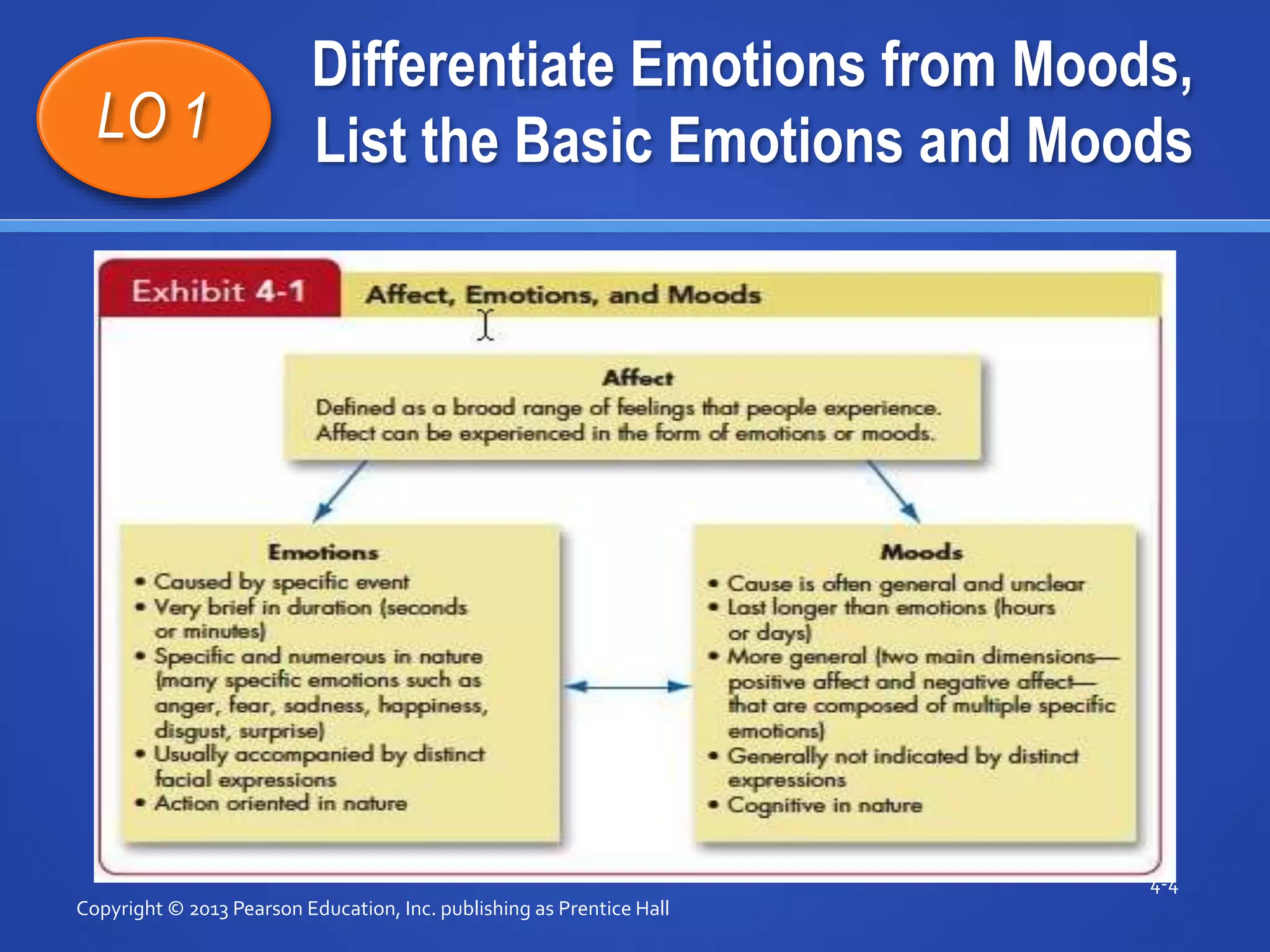
Insert Exhibit 4-1
Differentiate Emotions from Moods,
List the Basic Emotions and Moods
Copyright © 2013 Pearson Education, Inc. publishing as Prentice Hall
4-5
LO 1
 While not universally accepted, there appear
to be six basic emotions:
1. Anger
2. Fear
3. Sadness
4. Happiness
5. Disgust
6. Surprise
Differentiate Emotions from Moods,
List the Basic Emotions and Moods
Copyright © 2013 Pearson Education, Inc. publishing as Prentice Hall
4-6
LO 1
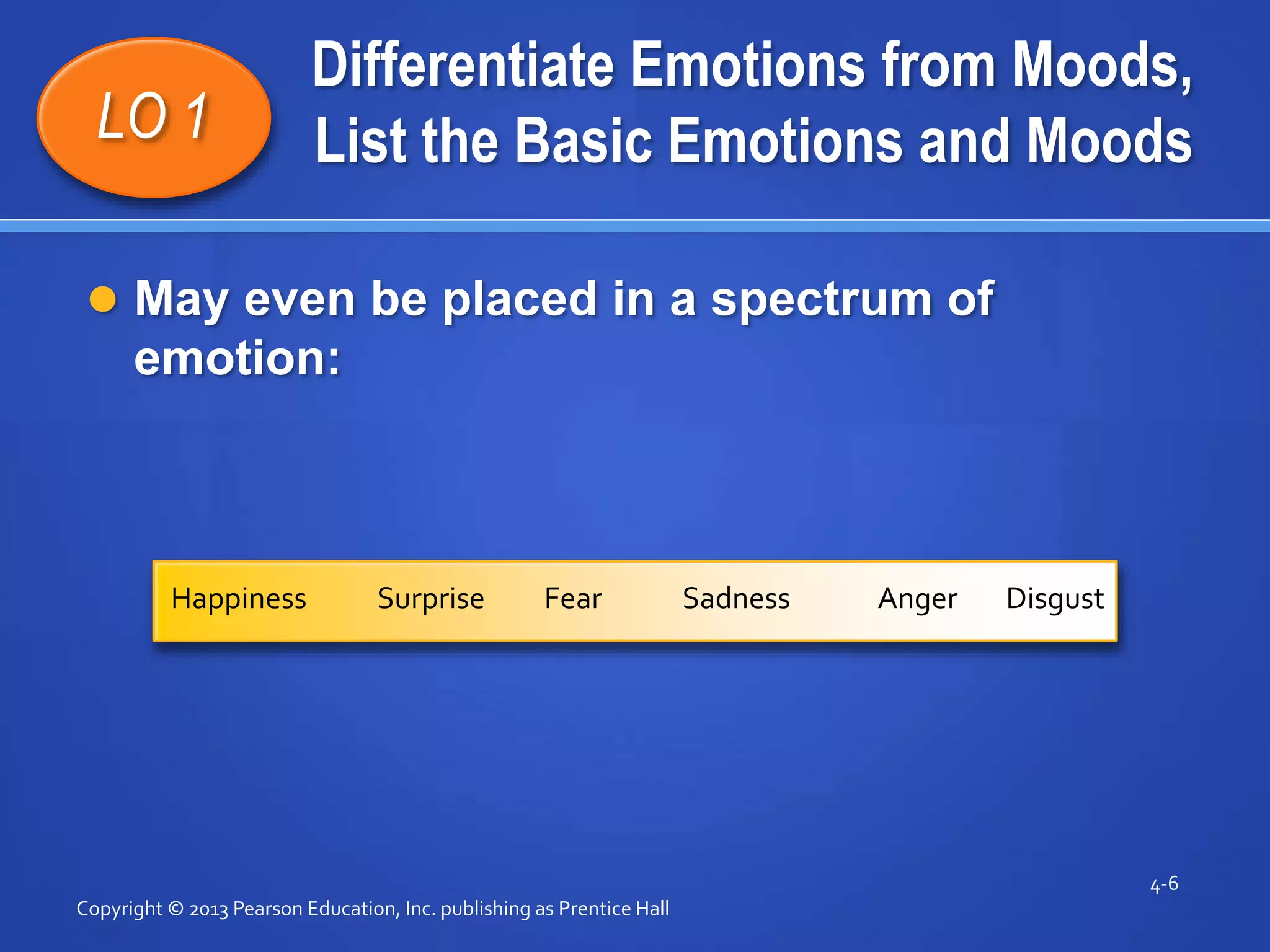
 May even be placed in a spectrum of
emotion:
Happiness Surprise Fear Sadness Anger Disgust
Copyright © 2013 Pearson Education, Inc. publishing as Prentice Hall
4-7
LO 2
Insert Exhibit 4-2
Discuss Whether Emotions Are Rational
and What Functions They Serve
Copyright © 2013 Pearson Education, Inc. publishing as Prentice Hall
4-8
LO 2
Discuss Whether Emotions Are Rational
and What Functions They Serve
Decision-Making
Thinking Feeling
Copyright © 2013 Pearson Education, Inc. publishing as Prentice Hall
4-9
LO 3
 Personality
 There is a trait component – affect
intensity
 Day and Time of the Week
 There is a common pattern for all of us
 Happier in the midpoint of the daily
awake period
 Happier toward the end of the week
Identify the Sources of
Emotions and Moods
Copyright © 2013 Pearson Education, Inc. publishing as Prentice Hall
4-10
LO 3
Identify the Sources of
Emotions and Moods
Insert Exhibit 4-3
Copyright © 2013 Pearson Education, Inc. publishing as Prentice Hall
4-11
LO 3
Identify the Sources of
Emotions and Moods
Insert Exhibit 4-4
Copyright © 2013 Pearson Education, Inc. publishing as Prentice Hall
4-12
LO 3
 Weather
 Illusory correlation – no effect
 Stress
 Even low levels of constant stress can
worsen moods
 Social Activities
 Physical, informal, and dining activities
increase positive moods
Identify the Sources of
Emotions and Moods
Copyright © 2013 Pearson Education, Inc. publishing as Prentice Hall
4-13
LO 3
 Sleep
 Poor sleep quality increases negative
affect
 Exercise
 Does somewhat improve mood, especially
for depressed people
Identify the Sources of
Emotions and Moods
Copyright © 2013 Pearson Education, Inc. publishing as Prentice Hall
4-14
LO 3
 Age
 Older folks experience fewer negative
emotions
 Sex
 Women tend to be more emotionally
expressive, feel emotions more intensely,
have longer-lasting moods, and express
emotions more frequently than do men
 Due more to socialization than to biology
Identify the Sources of
Emotions and Moods
Copyright © 2013 Pearson Education, Inc. publishing as Prentice Hall
4-15
LO 4
Emotional Labor-An employee’s expression of
organizationally desired emotions during
interpersonal transactions at work.
Emotional Dissonance:
 Employees have to project one emotion
while simultaneously feeling another
 Can be very damaging and lead to burnout
Show the Impact Emotional Labor
Has on Employees
Copyright © 2013 Pearson Education, Inc. publishing as Prentice Hall
4-16
LO 4
Types of Emotions:
 Felt: the individual’s actual emotions
 Displayed: required or appropriate
emotions
 Surface Acting: displaying appropriately
but not feeling those emotions internally
 Deep Acting: changing internal feelings
to match display rules - very stressful
Show the Impact Emotional Labor
Has on Employees
Copyright © 2013 Pearson Education, Inc. publishing as Prentice Hall
4-17
LO 5
Describe Affective Events Theory
and Identify Its Applications
Insert Exhibit 4-5
Describe Affective Events Theory
and Identify Its Applications
 An emotional episode is actually the result of a
series of emotional experiences triggered by a
single event
 Current and past emotions affect job satisfaction
 Emotional fluctuations over time create variations in
job performance
 Emotion-driven behaviors are typically brief and
variable
 Both negative and positive emotions can distract
workers and reduce job performance
Copyright © 2013 Pearson Education, Inc. publishing as Prentice Hall 4-18
LO 5
Describe Affective Events Theory
and Identify Its Applications
 Emotions provide valuable insights
about behavior
 Emotions, and the minor events that
cause them, should not be ignored at
work; they accumulate
Copyright © 2013 Pearson Education, Inc. publishing as Prentice Hall 4-19
LO 5
Contrast the Evidence
For and Against the Existence
of Emotional Intelligence
 Emotional Intelligence is a person’s ability
to:
 Be self-aware
 Recognizing own emotions when
experienced
 Detect emotions in others
 Manage emotional cues and information
Copyright © 2013 Pearson Education, Inc. publishing as Prentice Hall 4-20
LO 6
Contrast the Evidence
For and Against the Existence
of Emotional Intelligence
Copyright © 2013 Pearson Education, Inc. publishing as Prentice Hall 4-21
LO 6
Insert Exhibit 4-6
Contrast the Evidence
For and Against the Existence
of Emotional Intelligence
 EI is controversial and not wholly accepted
 Case for EI:
 Intuitive appeal;
 Predicts criteria that matter;
 Is biologically-based.
Copyright © 2013 Pearson Education, Inc. publishing as Prentice Hall 4-22
LO 6
Contrast the Evidence
For and Against the Existence
of Emotional Intelligence
 EI is controversial and not wholly accepted
 Case against EI:
 Too vague a concept;
 Can’t be measured;
 Its personality by a different name.
Copyright © 2013 Pearson Education, Inc. publishing as Prentice Hall 4-23
LO 6
Be Able to Identify Strategies
for Emotion Regulation
and Their Likely Effects
 Emotion regulation is to identify and modify
the emotions you feel.
 Strategies to change your emotions include
thinking about more pleasant things,
suppressing negative thoughts, distracting
yourself, reappraising the situation, or
engaging in relaxation techniques.
Copyright © 2013 Pearson Education, Inc. publishing as Prentice Hall 4-24
LO 6
Apply Concepts About Emotions
and Moods to Specific OB Issue
 Selection
 EI should be a hiring factor, especially for
social jobs.
 Decision Making
 Positive emotions can lead to better
decisions.
 Creativity
 Positive mood increases flexibility,
openness, and creativity.
Copyright © 2013 Pearson Education, Inc. publishing as Prentice Hall 4-25
LO 7
Apply Concepts About Emotions
and Moods to Specific OB Issue
 Motivation
 Positive mood affects expectations of
success; feedback amplifies this effect.
 Leadership
 Emotions are important to acceptance of
messages from organizational leaders.
Copyright © 2013 Pearson Education, Inc. publishing as Prentice Hall 4-26
LO 7
Apply Concepts About Emotions
and Moods to Specific OB Issue
 Negotiation
 Emotions, skillfully displayed, can
affect negotiations
 Customer Services
 Emotions affect service quality delivered to
customers which affects customer relationships
 Emotional Contagion: “catching” emotions
 Job Attitudes
 Can carry over to home, but dissipate overnight
Copyright © 2013 Pearson Education, Inc. publishing as Prentice Hall 4-27
LO 7
Apply Concepts About Emotions
and Moods to Specific OB Issue
 Deviant Workplace Behaviors
 Negative emotions lead to employee deviance
(actions that violate norms and
threaten the organization)
 Safety and Injury at Work
 Don’t do dangerous work when in a bad mood
 Manager’s Influence
 Leaders who are in a good mood, use humor, and
praise employees increase positive moods
Copyright © 2013 Pearson Education, Inc. publishing as Prentice Hall 4-28
LO 7
Managerial Implications
 Emotions and moods are a natural part of an
individual’s makeup.
 Ignoring co-workers’ and employees’ emotions and
assessing others’ behavior as if they were
completely rational is wrong.
 “You can’t divorce emotions from the workplace
because you can’t divorce emotions from people.”
 Managers who understand the roles of emotions and
moods will significantly improve their ability
to explain co-workers’ and employees’ behaviors.
Copyright © 2013 Pearson Education, Inc. publishing as Prentice Hall 4-29
Copyright © 2013 Pearson Education, Inc. publishing as Prentice Hall
All rights reserved. No part of this publication may be reproduced,
stored in a retrieval system, or transmitted, in any form or by any
means, electronic, mechanical, photocopying, recording, or otherwise,
without the prior written permission of the publisher. Printed in the
United States of America.
Copyright © 2013 Pearson Education, Inc.
publishing as Prentice Hall
4-30

Chapter 4 emotions and Moods

  • 1.
    Organizational Behavior 15th Ed Emotions andMoods Copyright © 2013 Pearson Education, Inc. publishing as Prentice Hall 4-1 Robbins and JudgeChapter 4
  • 2.
    Chapter 4 LearningObjectives After studying this chapter you should be able to:  Differentiate emotions from moods and list the basic emotions and moods.  Discuss whether emotions are rational and what functions they serve.  Identify the sources of emotions and moods.  Show the impact emotional labor has on employees.  Describe affective events theory and identify its applications.  Contrast the evidence for and against the existence of emotional intelligence.  Be able to identify strategies for emotion regulation and their likely effects.  Apply concepts about emotions and moods to specific OB issues. Copyright © 2013 Pearson Education, Inc. publishing as Prentice Hall 4-2
  • 3.
    Differentiate Emotions fromMoods, List the Basic Emotions and Moods Copyright © 2013 Pearson Education, Inc. publishing as Prentice Hall 4-3 LO 1  The “Myth of Rationality”  Emotions were seen as irrational  Managers worked to make emotion-free environments  View of Emotionality  Emotions were believed to be disruptive  Emotions interfered with productivity  Only negative emotions were observed  Now we know emotions can’t be separated from the workplace Why Were Emotions Ignored in OB?
  • 4.
    Differentiate Emotions fromMoods, List the Basic Emotions and Moods Copyright © 2013 Pearson Education, Inc. publishing as Prentice Hall 4-4 LO 1 Insert Exhibit 4-1
  • 5.
    Differentiate Emotions fromMoods, List the Basic Emotions and Moods Copyright © 2013 Pearson Education, Inc. publishing as Prentice Hall 4-5 LO 1  While not universally accepted, there appear to be six basic emotions: 1. Anger 2. Fear 3. Sadness 4. Happiness 5. Disgust 6. Surprise
  • 6.
    Differentiate Emotions fromMoods, List the Basic Emotions and Moods Copyright © 2013 Pearson Education, Inc. publishing as Prentice Hall 4-6 LO 1  May even be placed in a spectrum of emotion: Happiness Surprise Fear Sadness Anger Disgust
  • 7.
    Copyright © 2013Pearson Education, Inc. publishing as Prentice Hall 4-7 LO 2 Insert Exhibit 4-2 Discuss Whether Emotions Are Rational and What Functions They Serve
  • 8.
    Copyright © 2013Pearson Education, Inc. publishing as Prentice Hall 4-8 LO 2 Discuss Whether Emotions Are Rational and What Functions They Serve Decision-Making Thinking Feeling
  • 9.
    Copyright © 2013Pearson Education, Inc. publishing as Prentice Hall 4-9 LO 3  Personality  There is a trait component – affect intensity  Day and Time of the Week  There is a common pattern for all of us  Happier in the midpoint of the daily awake period  Happier toward the end of the week Identify the Sources of Emotions and Moods
  • 10.
    Copyright © 2013Pearson Education, Inc. publishing as Prentice Hall 4-10 LO 3 Identify the Sources of Emotions and Moods Insert Exhibit 4-3
  • 11.
    Copyright © 2013Pearson Education, Inc. publishing as Prentice Hall 4-11 LO 3 Identify the Sources of Emotions and Moods Insert Exhibit 4-4
  • 12.
    Copyright © 2013Pearson Education, Inc. publishing as Prentice Hall 4-12 LO 3  Weather  Illusory correlation – no effect  Stress  Even low levels of constant stress can worsen moods  Social Activities  Physical, informal, and dining activities increase positive moods Identify the Sources of Emotions and Moods
  • 13.
    Copyright © 2013Pearson Education, Inc. publishing as Prentice Hall 4-13 LO 3  Sleep  Poor sleep quality increases negative affect  Exercise  Does somewhat improve mood, especially for depressed people Identify the Sources of Emotions and Moods
  • 14.
    Copyright © 2013Pearson Education, Inc. publishing as Prentice Hall 4-14 LO 3  Age  Older folks experience fewer negative emotions  Sex  Women tend to be more emotionally expressive, feel emotions more intensely, have longer-lasting moods, and express emotions more frequently than do men  Due more to socialization than to biology Identify the Sources of Emotions and Moods
  • 15.
    Copyright © 2013Pearson Education, Inc. publishing as Prentice Hall 4-15 LO 4 Emotional Labor-An employee’s expression of organizationally desired emotions during interpersonal transactions at work. Emotional Dissonance:  Employees have to project one emotion while simultaneously feeling another  Can be very damaging and lead to burnout Show the Impact Emotional Labor Has on Employees
  • 16.
    Copyright © 2013Pearson Education, Inc. publishing as Prentice Hall 4-16 LO 4 Types of Emotions:  Felt: the individual’s actual emotions  Displayed: required or appropriate emotions  Surface Acting: displaying appropriately but not feeling those emotions internally  Deep Acting: changing internal feelings to match display rules - very stressful Show the Impact Emotional Labor Has on Employees
  • 17.
    Copyright © 2013Pearson Education, Inc. publishing as Prentice Hall 4-17 LO 5 Describe Affective Events Theory and Identify Its Applications Insert Exhibit 4-5
  • 18.
    Describe Affective EventsTheory and Identify Its Applications  An emotional episode is actually the result of a series of emotional experiences triggered by a single event  Current and past emotions affect job satisfaction  Emotional fluctuations over time create variations in job performance  Emotion-driven behaviors are typically brief and variable  Both negative and positive emotions can distract workers and reduce job performance Copyright © 2013 Pearson Education, Inc. publishing as Prentice Hall 4-18 LO 5
  • 19.
    Describe Affective EventsTheory and Identify Its Applications  Emotions provide valuable insights about behavior  Emotions, and the minor events that cause them, should not be ignored at work; they accumulate Copyright © 2013 Pearson Education, Inc. publishing as Prentice Hall 4-19 LO 5
  • 20.
    Contrast the Evidence Forand Against the Existence of Emotional Intelligence  Emotional Intelligence is a person’s ability to:  Be self-aware  Recognizing own emotions when experienced  Detect emotions in others  Manage emotional cues and information Copyright © 2013 Pearson Education, Inc. publishing as Prentice Hall 4-20 LO 6
  • 21.
    Contrast the Evidence Forand Against the Existence of Emotional Intelligence Copyright © 2013 Pearson Education, Inc. publishing as Prentice Hall 4-21 LO 6 Insert Exhibit 4-6
  • 22.
    Contrast the Evidence Forand Against the Existence of Emotional Intelligence  EI is controversial and not wholly accepted  Case for EI:  Intuitive appeal;  Predicts criteria that matter;  Is biologically-based. Copyright © 2013 Pearson Education, Inc. publishing as Prentice Hall 4-22 LO 6
  • 23.
    Contrast the Evidence Forand Against the Existence of Emotional Intelligence  EI is controversial and not wholly accepted  Case against EI:  Too vague a concept;  Can’t be measured;  Its personality by a different name. Copyright © 2013 Pearson Education, Inc. publishing as Prentice Hall 4-23 LO 6
  • 24.
    Be Able toIdentify Strategies for Emotion Regulation and Their Likely Effects  Emotion regulation is to identify and modify the emotions you feel.  Strategies to change your emotions include thinking about more pleasant things, suppressing negative thoughts, distracting yourself, reappraising the situation, or engaging in relaxation techniques. Copyright © 2013 Pearson Education, Inc. publishing as Prentice Hall 4-24 LO 6
  • 25.
    Apply Concepts AboutEmotions and Moods to Specific OB Issue  Selection  EI should be a hiring factor, especially for social jobs.  Decision Making  Positive emotions can lead to better decisions.  Creativity  Positive mood increases flexibility, openness, and creativity. Copyright © 2013 Pearson Education, Inc. publishing as Prentice Hall 4-25 LO 7
  • 26.
    Apply Concepts AboutEmotions and Moods to Specific OB Issue  Motivation  Positive mood affects expectations of success; feedback amplifies this effect.  Leadership  Emotions are important to acceptance of messages from organizational leaders. Copyright © 2013 Pearson Education, Inc. publishing as Prentice Hall 4-26 LO 7
  • 27.
    Apply Concepts AboutEmotions and Moods to Specific OB Issue  Negotiation  Emotions, skillfully displayed, can affect negotiations  Customer Services  Emotions affect service quality delivered to customers which affects customer relationships  Emotional Contagion: “catching” emotions  Job Attitudes  Can carry over to home, but dissipate overnight Copyright © 2013 Pearson Education, Inc. publishing as Prentice Hall 4-27 LO 7
  • 28.
    Apply Concepts AboutEmotions and Moods to Specific OB Issue  Deviant Workplace Behaviors  Negative emotions lead to employee deviance (actions that violate norms and threaten the organization)  Safety and Injury at Work  Don’t do dangerous work when in a bad mood  Manager’s Influence  Leaders who are in a good mood, use humor, and praise employees increase positive moods Copyright © 2013 Pearson Education, Inc. publishing as Prentice Hall 4-28 LO 7
  • 29.
    Managerial Implications  Emotionsand moods are a natural part of an individual’s makeup.  Ignoring co-workers’ and employees’ emotions and assessing others’ behavior as if they were completely rational is wrong.  “You can’t divorce emotions from the workplace because you can’t divorce emotions from people.”  Managers who understand the roles of emotions and moods will significantly improve their ability to explain co-workers’ and employees’ behaviors. Copyright © 2013 Pearson Education, Inc. publishing as Prentice Hall 4-29
  • 30.
    Copyright © 2013Pearson Education, Inc. publishing as Prentice Hall All rights reserved. No part of this publication may be reproduced, stored in a retrieval system, or transmitted, in any form or by any means, electronic, mechanical, photocopying, recording, or otherwise, without the prior written permission of the publisher. Printed in the United States of America. Copyright © 2013 Pearson Education, Inc. publishing as Prentice Hall 4-30

Editor's Notes

  • #2 Chapter 4 introduces us the the concepts of emotions and moods and their effects on Organizational Behavior. These are concepts that have only recently received increased attention in research and practice. Here we will see the results of study and new applications to help make the work place more successful.
  • #3 We begin this chapter with a definition of the seven learning objectives defined for chapter’s contents. We will discuss each of these in some detail.
  • #4 As mentioned, emotions and moods were dismissed by OB for a long time. One of the primary reasons was the “Myth of Rationality” that suggested that OB comprised rational concepts and applications and emotions and moods were seen as highly irrational. Emotions were thought to be disruptive of organizational activity and decreased productivity. Because they were perceived as irrational the belief was that they were unpredictable and therefore not easily influenced. We now know this is untrue.
  • #5 Affect is a generic term that covers a broad range of feelings people experience. This includes both emotions and moods. Emotions are intense feelings that are directed at someone or something. Moods are the feelings that tend to be less intense than emotions and that lack a contextual stimulus.
  • #6 Not all psychologists agree; however, there do seem to be six basic emotions that emerge in studies: anger, fear, sadness, happiness, disgust, surprise. All other emotions fall under these six. So, sometimes as many as twelve emotions are identified.
  • #7 Some psychologists even place these basic six on a spectrum of emotion. These range from Happiness to Surprise to Fear to Sadness to Anger and to Disgust. This continuum suggests that a person moves from left to right and back as he or she experiences emotions during the day. And the emotions transition from one to the next. For example, a person can feel Happiness. Or may feel Surprise/Happiness or may be merely Surprised.
  • #8 Our basic moods carry positive and negative affects, they cannot be neutral. Emotions are grouped into general mood states. These states impact how employees perceive reality and thereby the moods can impact the work of employees.
  • #9 There are some who think that emotions are linked to irrationality and that expressing emotions in public may be damaging to your career or status. However, research has shown that emotions are necessary for rational thinking. They help us make better decisions and help us understand the world around us. If we are going to make decisions, we need to incorporate both thinking and feeling.
  • #10 There are many things that impact our mood and emotions. Personality is a key component and will definitely impact the intensity of the emotions we feel. The day and time of the week is a common pattern for all of us. Many are happier toward the end of the week.
  • #11 In Exhibit 4-3 we can see what research has found as the effect of the day of the week on emotions. As the day week progresses, positive affects of emotions increases while negative affects decrease. So positive emotions are considerable higher toward the end of the week than they are at the beginning.
  • #12 Exhibit 4-4 shows the results of research that has found patters in the daily experience in emotional changes. Positive emotions have their greatest affect during the afternoon before decreasing into the evening. This suggests that afternoon activity can be the most productive as affected by emotions.
  • #13 Weather is thought to have an impact on our emotions, but there is no proven effect. Stress is an important factor and even at low levels it can cause our mood to change. It is important to maintain a low level of stress to help us control our psychological as well as our physical health. Social activities have been shown to have a positive impact on our moods. This could be physical outlets such as playing in a basketball league or it can be going out to dinner with friends. These types of activities are found to have a positive impact on our mood.
  • #14 Some additional sources of emotion and mood include such factors as sleep and exercise. It is important to get enough and high-quality levels of sleep. Physical activity can also aid in keeping our moods upbeat.
  • #15  Some characteristics that are beyond our control can impact our moods, such as age and sex. Elderly people tend to have fewer negative emotions. And, women tend to express their emotions readily and their moods tend to last longer. Research has shown that this is due more to cultural socialization than to biology.
  • #16 In many jobs there is an implied agreement on the types of emotions that should be expressed. For example, waitresses are supposed to be friendly and cheerful, whether they are currently feeling that emotion or not. When employees don’t feel the emotion they are required to express, they may experience emotional dissonance. This can lead to burnout and frustration with the job.
  • #17  An employee’s actual emotions are their felt emotions and this is in contrast to the emotions that are required or deemed appropriate, which are called displayed emotions. There are two levels of displayed emotions that can be expressed. They are both appropriately called acting. Surface acting is when an employee displays the appropriate emotions even when they don’t feel those emotions. Deep acting is when the employee actually changes their internal feelings to match displayed rules; this level of acting can be very stressful.
  • #18 Affective Events Theory demonstrates that employees react emotionally to things that happen to them at work and this can influence their job performance and job satisfaction. The intensity of these responses will be based on emotion and mood.
  • #19 AET has a number of implications. When an employee has an emotional episode, it is actually the result of a series of emotional experiences that are triggered by a single event. Your job satisfaction is impacted by current and past emotions. As your emotions fluctuate over time, it will create variations in job performance. Behaviors that are driven by emotions are typically brief and variable. Both positive and negative emotions can distract workers and reduce job performance.
  • #20 In summary, emotions do provide very valuable information and predict factors about behavior. In addition, it is important not to ignore minor events as they will accumulate over time.
  • #21 Emotional Intelligence is a person’s ability to be self–aware, that is, recognizing his or her own experienced emotions and to understand them. More significantly is the ability to observe and detect emotion in others. And to regulate the emotions in a cascading relationship.
  • #22 Exhibit 4-6 illustrates the “Cascading Model of Emotional Intelligence.” Here we see the suggested relationship between Conscientiousness. Cognitive, and Emotional Affects and the outcomes of detecting others’ emotions, understanding what they mean, and regulating the emotions successfully.
  • #23 Although Emotional Intelligence (EI) is a growing area of study and is becoming increasingly important in the understanding of individual behavior, it remains controversial. In a case For EI and its importance can be summarized as having intuitive appeal for its significance, that it and predict behavior, and that it is biologically-based.
  • #24 On the other hand, the case against EI as a distinct area of study includes the vagueness as a concept, the difficulty in find direct measures or adequate surrogates to define it, and that to many detractors, it appears that EI is merely personality characteristics by a different name.
  • #25 A newly defined process is Emotional Regulation. This is described as the process of indentifying and modifying emotions you feel. Strategies to change your emotions include trying to think about more pleasant things different from the situation, distracting yourself with some other activity. Consciously reappraising the situation or engaging in relaxation techniques, such a yoga or exercise.
  • #26 One of the reasons that the study of emotions and moods is its applications to specific OB issues. These include the personnel selection processes where EI should be a hiring factor to ensure employee fit. EI and its control can lead to better decisions for the organization. And positive Emotions can open up innovation and creativity in applications for organizational productivity.
  • #27 Positive mood affects expectations of success by all people which contributes to their motivation for performance. Leadership is affected by mood and emotion as those in positive emotional state are found to be more receptive of messages from leaders.
  • #28 Emotions, both those held and those displayed, are effective contributors to negotiation as the potential impact of displayed emotion on negotiation is large. Emotions affect customer service in a number of ways ranging from attitude of employee, communication effectiveness with customer, to overall feeling about the outcome. Research has found that people who are on an emotional high at the end of a day take the positive feelings home with them.
  • #29 Negative emotions can lead to Deviant Workplace Behaviors. These are actions that violate norms and threaten the organization. In addition, research has found that workers asked to do dangerous work while in negative emotional states are more likely to have accidents. And lastly, managers who are in a good mood tend to use humor and praise to employees that results in increased positive mood among employees.
  • #30 To summarize the managerial implications of this chapter, we can say that emotions and moods are a natural part of an individual’s makeup. Managers who ignore some workers’ emotions while addressing others creates a sense of unfair treatment that has implications for job productivity. One observer said, “You can’t divorce emotions from the workplace because you can’t divorce emotions from people.” So, managers who understand the roles of emotions and moods will find their abilities to explain and predict coworker behaviors more effectively.
  • #31 All rights reserved. No part of this publication may be reproduced, stored in a retrieval system, or transmitted, in any form or by any means, electronic, mechanical, photocopying, recording, or otherwise, without the prior written permission of the publisher. Printed in the United States of America.