Chapter 4Chapter 4
Personality and Emotions
– Author Stephen Robbins
Prof. Shrinivas V K
Prof. SVK
Prof. SVK
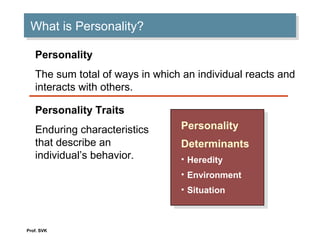
What is Personality?What is Personality?
Personality
The sum total of ways in which an individual reacts and
interacts with others.
Personality Traits
Enduring characteristics
that describe an
individual’s behavior.
Personality
Determinants
• Heredity
• Environment
• Situation
Personality
Determinants
• Heredity
• Environment
• Situation
Prof. SVK
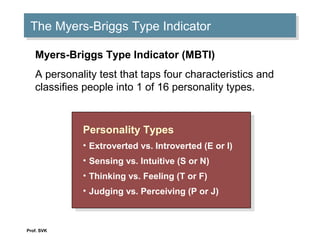
The Myers-Briggs Type IndicatorThe Myers-Briggs Type Indicator
Personality Types
• Extroverted vs. Introverted (E or I)
• Sensing vs. Intuitive (S or N)
• Thinking vs. Feeling (T or F)
• Judging vs. Perceiving (P or J)
Personality Types
• Extroverted vs. Introverted (E or I)
• Sensing vs. Intuitive (S or N)
• Thinking vs. Feeling (T or F)
• Judging vs. Perceiving (P or J)
Myers-Briggs Type Indicator (MBTI)
A personality test that taps four characteristics and
classifies people into 1 of 16 personality types.
Prof. SVK
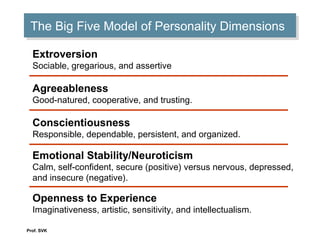
The Big Five Model of Personality DimensionsThe Big Five Model of Personality Dimensions
Extroversion
Sociable, gregarious, and assertive
Agreeableness
Good-natured, cooperative, and trusting.
Conscientiousness
Responsible, dependable, persistent, and organized.
Openness to Experience
Imaginativeness, artistic, sensitivity, and intellectualism.
Emotional Stability/Neuroticism
Calm, self-confident, secure (positive) versus nervous, depressed,
and insecure (negative).
Prof. SVK
Prof. SVK
Major Personality Attributes Influencing OBMajor Personality Attributes Influencing OB
 Locus of control
 Machiavellianism
 Self-esteem
 Self-monitoring
 Risk taking
 Type A personality
Prof. SVK
Locus of ControlLocus of Control
Locus of Control
The degree to which people believe they are
masters of their own fate.
Internals
Individuals who believe that they control what happens to
them.
Externals
Individuals who believe that what happens to them is
controlled by outside forces such as luck or chance.
Prof. SVK
MachiavellianismMachiavellianism
Conditions Favoring High Machs
• Direct interaction
• Minimal rules and regulations
• Emotions distract for others
Conditions Favoring High Machs
• Direct interaction
• Minimal rules and regulations
• Emotions distract for others
Machiavellianism (Mach)
Degree to which an individual is pragmatic,
maintains emotional distance, and believes that
ends can justify means.
Prof. SVK
Self-Esteem and Self-MonitoringSelf-Esteem and Self-Monitoring
Self-Esteem (SE)
Individuals’ degree of liking or disliking themselves.
Self-Monitoring
A personality trait that measures an individuals
ability to adjust his or her behavior to external,
situational factors.
Prof. SVK
Risk-TakingRisk-Taking
 High Risk-taking Managers
– Make quicker decisions
– Use less information to make decisions
– Operate in smaller and more entrepreneurial
organizations
 Low Risk-taking Managers
– Are slower to make decisions
– Require more information before making decisions
– Exist in larger organizations with stable environments
 Risk Propensity
– Aligning managers’ risk-taking propensity to job
requirements should be beneficial to organizations.
Type A PersonalityType A Personality
 The theory describes Type A individuals as
ambitious, rigidly organized, highly status-
conscious, sensitive, impatient, take on more
than they can handle, want other people to get to
the point, anxious, proactive, and concerned with
time management.
 People with Type A personalities are often high-
achieving "workaholics", push themselves with
deadlines, and hate both delays and ambivalence.
Prof. SVK
Type B personalityType B personality
 They typically work steadily, and may enjoy
achievement, although they have a greater
tendency to disregard physical or mental stress
when they do not achieve.
 When faced with competition, they may focus
less on winning or losing than their Type A
counterparts, and more on enjoying the game
regardless of winning or losing.
 Unlike the Type A personality's rhythm of multi-
tasked careers, Type B individuals are sometimes
attracted to careers of creativity: writer,
counsellor, therapist, actor or actress.
Prof. SVK
Psychoanalytic TheoryPsychoanalytic Theory
 Structure of Personality( Id, Ego and
Super Ego)
Prof. SVK
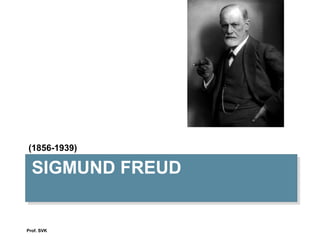
SIGMUND FREUDSIGMUND FREUD
(1856-1939)
Prof. SVK
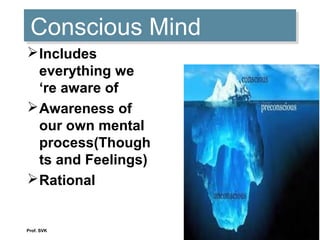
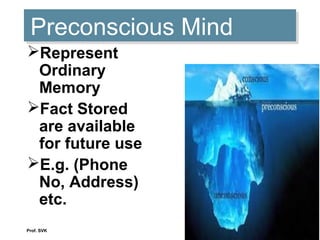
LAYERS OF MINDLAYERS OF MIND
Conscious, Preconscious and Unconscious
Prof. SVK
Prof. SVK
Conscious MindConscious Mind
Includes
everything we
‘re aware of
Awareness of
our own mental
process(Though
ts and Feelings)
Rational
Prof. SVK
Preconscious MindPreconscious Mind
Represent
Ordinary
Memory
Fact Stored
are available
for future use
E.g. (Phone
No, Address)
etc.
Prof. SVK
Unconscious MindUnconscious Mind
 Contains feelings,
thoughts and
memories beyond
our Awareness
 Continuous
Influence on our
Behavior and
Action
 (Dreams and
wishes)
Prof. SVK
ExampleExample
Prof. SVK
STRUCTURE OF
PERSONALITY
STRUCTURE OF
PERSONALITY
Id, Ego And Super Ego
Prof. SVK
IDID
 Present from Birth
 Animalistic and
Childish Desires and
no values
 Operates on Pleasure
Principle, to gain
Pleasure and avoid
pain
 Immediate
Satisfaction
 I Want it and want it
right now
 Exists in Unconscious
mindProf. SVK
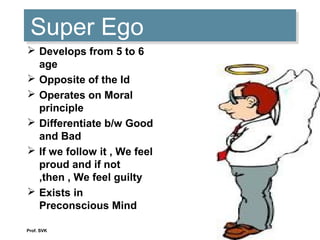
Super EgoSuper Ego
 Develops from 5 to 6
age
 Opposite of the Id
 Operates on Moral
principle
 Differentiate b/w Good
and Bad
 If we follow it , We feel
proud and if not
,then , We feel guilty
 Exists in
Preconscious Mind
Prof. SVK
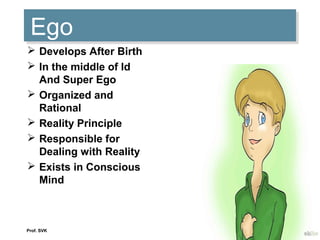
EgoEgo
 Develops After Birth
 In the middle of Id
And Super Ego
 Organized and
Rational
 Reality Principle
 Responsible for
Dealing with Reality
 Exists in Conscious
Mind
Prof. SVK
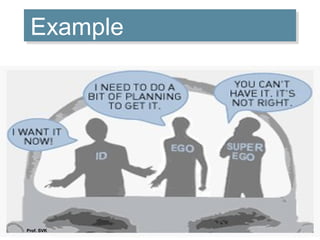
ExampleExample
Prof. SVK
Erikson’s personalityErikson’s personality
Erikson suggested that there are
8 developmental stages as we
grow from childhood to
adulthood and at each of these
stages we face the trauma of
resolving certain critical
conflicts
Prof. SVK
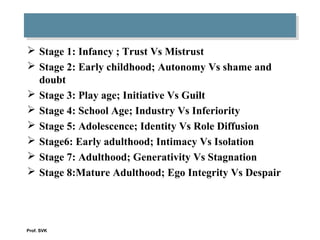
 Stage 1: Infancy ; Trust Vs Mistrust
 Stage 2: Early childhood; Autonomy Vs shame and
doubt
 Stage 3: Play age; Initiative Vs Guilt
 Stage 4: School Age; Industry Vs Inferiority
 Stage 5: Adolescence; Identity Vs Role Diffusion
 Stage6: Early adulthood; Intimacy Vs Isolation
 Stage 7: Adulthood; Generativity Vs Stagnation
 Stage 8:Mature Adulthood; Ego Integrity Vs Despair
Prof. SVK
Prof. SVK
Prof. SVK

Personality - Organisational Behavior

  • 1.
    Chapter 4Chapter 4 Personalityand Emotions – Author Stephen Robbins Prof. Shrinivas V K Prof. SVK
  • 2.
    Prof. SVK What isPersonality?What is Personality? Personality The sum total of ways in which an individual reacts and interacts with others. Personality Traits Enduring characteristics that describe an individual’s behavior. Personality Determinants • Heredity • Environment • Situation Personality Determinants • Heredity • Environment • Situation
  • 3.
    Prof. SVK The Myers-BriggsType IndicatorThe Myers-Briggs Type Indicator Personality Types • Extroverted vs. Introverted (E or I) • Sensing vs. Intuitive (S or N) • Thinking vs. Feeling (T or F) • Judging vs. Perceiving (P or J) Personality Types • Extroverted vs. Introverted (E or I) • Sensing vs. Intuitive (S or N) • Thinking vs. Feeling (T or F) • Judging vs. Perceiving (P or J) Myers-Briggs Type Indicator (MBTI) A personality test that taps four characteristics and classifies people into 1 of 16 personality types.
  • 4.
    Prof. SVK The BigFive Model of Personality DimensionsThe Big Five Model of Personality Dimensions Extroversion Sociable, gregarious, and assertive Agreeableness Good-natured, cooperative, and trusting. Conscientiousness Responsible, dependable, persistent, and organized. Openness to Experience Imaginativeness, artistic, sensitivity, and intellectualism. Emotional Stability/Neuroticism Calm, self-confident, secure (positive) versus nervous, depressed, and insecure (negative).
  • 5.
  • 6.
    Prof. SVK Major PersonalityAttributes Influencing OBMajor Personality Attributes Influencing OB  Locus of control  Machiavellianism  Self-esteem  Self-monitoring  Risk taking  Type A personality
  • 7.
    Prof. SVK Locus ofControlLocus of Control Locus of Control The degree to which people believe they are masters of their own fate. Internals Individuals who believe that they control what happens to them. Externals Individuals who believe that what happens to them is controlled by outside forces such as luck or chance.
  • 8.
    Prof. SVK MachiavellianismMachiavellianism Conditions FavoringHigh Machs • Direct interaction • Minimal rules and regulations • Emotions distract for others Conditions Favoring High Machs • Direct interaction • Minimal rules and regulations • Emotions distract for others Machiavellianism (Mach) Degree to which an individual is pragmatic, maintains emotional distance, and believes that ends can justify means.
  • 9.
    Prof. SVK Self-Esteem andSelf-MonitoringSelf-Esteem and Self-Monitoring Self-Esteem (SE) Individuals’ degree of liking or disliking themselves. Self-Monitoring A personality trait that measures an individuals ability to adjust his or her behavior to external, situational factors.
  • 10.
    Prof. SVK Risk-TakingRisk-Taking  HighRisk-taking Managers – Make quicker decisions – Use less information to make decisions – Operate in smaller and more entrepreneurial organizations  Low Risk-taking Managers – Are slower to make decisions – Require more information before making decisions – Exist in larger organizations with stable environments  Risk Propensity – Aligning managers’ risk-taking propensity to job requirements should be beneficial to organizations.
  • 11.
    Type A PersonalityTypeA Personality  The theory describes Type A individuals as ambitious, rigidly organized, highly status- conscious, sensitive, impatient, take on more than they can handle, want other people to get to the point, anxious, proactive, and concerned with time management.  People with Type A personalities are often high- achieving "workaholics", push themselves with deadlines, and hate both delays and ambivalence. Prof. SVK
  • 12.
    Type B personalityTypeB personality  They typically work steadily, and may enjoy achievement, although they have a greater tendency to disregard physical or mental stress when they do not achieve.  When faced with competition, they may focus less on winning or losing than their Type A counterparts, and more on enjoying the game regardless of winning or losing.  Unlike the Type A personality's rhythm of multi- tasked careers, Type B individuals are sometimes attracted to careers of creativity: writer, counsellor, therapist, actor or actress. Prof. SVK
  • 13.
    Psychoanalytic TheoryPsychoanalytic Theory Structure of Personality( Id, Ego and Super Ego) Prof. SVK
  • 14.
  • 15.
    LAYERS OF MINDLAYERSOF MIND Conscious, Preconscious and Unconscious Prof. SVK
  • 16.
  • 17.
    Conscious MindConscious Mind Includes everythingwe ‘re aware of Awareness of our own mental process(Though ts and Feelings) Rational Prof. SVK
  • 18.
    Preconscious MindPreconscious Mind Represent Ordinary Memory FactStored are available for future use E.g. (Phone No, Address) etc. Prof. SVK
  • 19.
    Unconscious MindUnconscious Mind Contains feelings, thoughts and memories beyond our Awareness  Continuous Influence on our Behavior and Action  (Dreams and wishes) Prof. SVK
  • 20.
  • 21.
  • 22.
    IDID  Present fromBirth  Animalistic and Childish Desires and no values  Operates on Pleasure Principle, to gain Pleasure and avoid pain  Immediate Satisfaction  I Want it and want it right now  Exists in Unconscious mindProf. SVK
  • 23.
    Super EgoSuper Ego Develops from 5 to 6 age  Opposite of the Id  Operates on Moral principle  Differentiate b/w Good and Bad  If we follow it , We feel proud and if not ,then , We feel guilty  Exists in Preconscious Mind Prof. SVK
  • 24.
    EgoEgo  Develops AfterBirth  In the middle of Id And Super Ego  Organized and Rational  Reality Principle  Responsible for Dealing with Reality  Exists in Conscious Mind Prof. SVK
  • 25.
  • 26.
    Erikson’s personalityErikson’s personality Eriksonsuggested that there are 8 developmental stages as we grow from childhood to adulthood and at each of these stages we face the trauma of resolving certain critical conflicts Prof. SVK
  • 27.
     Stage 1:Infancy ; Trust Vs Mistrust  Stage 2: Early childhood; Autonomy Vs shame and doubt  Stage 3: Play age; Initiative Vs Guilt  Stage 4: School Age; Industry Vs Inferiority  Stage 5: Adolescence; Identity Vs Role Diffusion  Stage6: Early adulthood; Intimacy Vs Isolation  Stage 7: Adulthood; Generativity Vs Stagnation  Stage 8:Mature Adulthood; Ego Integrity Vs Despair Prof. SVK
  • 28.
  • 29.