Service Strategy
Strategic Service Vision
Target Market Segments
What are common characteristics of important market segments?
What dimensions can be used to segment the market, demographic,
psychographic?
How important are various segments?
What needs does each have?
How well are these needs being served, in what manner, by whom?
Strategic Service Vision
Service Concept
What are important elements of the service to be provided, stated in
terms of results produced for customers?
How are these elements supposed to be perceived by the target market
segment, by the market in general, by employees, by others?
How do customers perceive the service concept?
What efforts does this suggest in terms of the manner in which the
service is designed, delivered, marketed?
Strategic Service Vision
Operating Strategy
What are important elements of the strategy: operations, financing,
marketing, organization, human resources, control?
On which will the most effort be concentrated?
Where will investments be made?
How will quality and cost be controlled: measures, incentives, rewards?
What results will be expected versus competition in terms of, quality of
service, cost profile, productivity, morale/loyalty of servers?
Strategic Service Vision
Service Delivery System
What are important features of the service delivery system including:
role of people, technology, equipment, layout, procedures?
What capacity does it provide, normally, at peak levels?
To what extent does it, help insure quality standards, differentiate the
service from competition, provide barriers to entry by competitors?
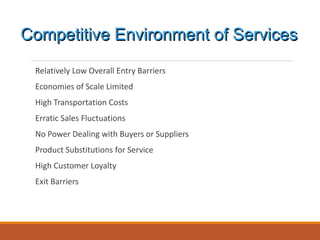
Relatively Low Overall Entry Barriers
Economies of Scale Limited
High Transportation Costs
Erratic Sales Fluctuations
No Power Dealing with Buyers or Suppliers
Product Substitutions for Service
High Customer Loyalty
Exit Barriers
Competitive Environment of Services
Competitive Service Strategies
(Overall Cost Leadership)
Seeking Out Low-cost Customers
Standardizing a Custom Service
Reducing the Personal Element in Service Delivery (promote self-
service)
Reducing Network Costs (hub and spoke)
Taking Service Operations Off-line
Competitive Service Strategies
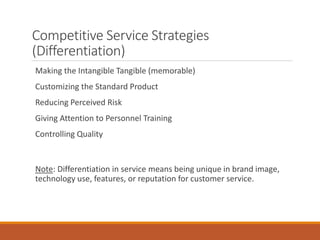
(Differentiation)
Making the Intangible Tangible (memorable)
Customizing the Standard Product
Reducing Perceived Risk
Giving Attention to Personnel Training
Controlling Quality
Note: Differentiation in service means being unique in brand image,
technology use, features, or reputation for customer service.
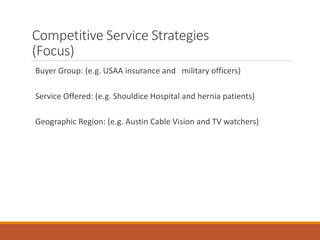
Competitive Service Strategies
(Focus)
Buyer Group: (e.g. USAA insurance and military officers)
Service Offered: (e.g. Shouldice Hospital and hernia patients)
Geographic Region: (e.g. Austin Cable Vision and TV watchers)
Customer Criteria for Selecting
a Service Provider
Availability (24 hour ATM)
Convenience (Site location)
Dependability (On-time performance)
Personalization (Know customer’s name)
Price (Quality surrogate)
Quality (Perceptions important)
Reputation (Word-of-mouth)
Safety (Customer well-being)
Speed (Avoid excessive waiting)
Service Purchase Decision
Service Qualifier: To be taken seriously a certain level must be
attained on the competitive dimension, as defined by other market
players. Examples are cleanliness for a fast food restaurant or safe
aircraft for an airline.
Service Winner: The competitive dimension used to make the final
choice among competitors. Example is price.
Service Purchase Decision
(cont.)
Service Loser: Failure to deliver at or above the expected level for a
competitive dimension. Examples are failure to repair auto
(dependability), rude treatment (personalization) or late delivery of
package (speed).
Competitive Role of Information in Services
Strategic Focus Competitive Use of Information
On-line Off-line
(Real time) (Analysis)
External
(Customer)
Creation of barriers to entry:
Reservation system
Frequent user club
Switching costs
Data base asset:
Selling information
Development of services
Micro-marketing
Internal
(Operations)
Revenue generation:
Yield management
Point of sale
Expert systems
Productivity enhancement:
Inventory status
Data envelopment
analysis (DEA)
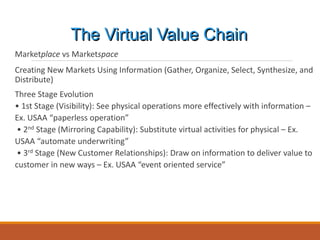
Marketplace vs Marketspace
Creating New Markets Using Information (Gather, Organize, Select, Synthesize, and
Distribute)
Three Stage Evolution
• 1st Stage (Visibility): See physical operations more effectively with information –
Ex. USAA “paperless operation”
• 2nd Stage (Mirroring Capability): Substitute virtual activities for physical – Ex.
USAA “automate underwriting”
• 3rd Stage (New Customer Relationships): Draw on information to deliver value to
customer in new ways – Ex. USAA “event oriented service”
The Virtual Value Chain
Anti-competitive (Barrier to entry)
Fairness (Yield management)
Invasion of Privacy (Micro-marketing)
Data Security (Medical records)
Reliability (Credit report)
Limits in the Use of Information
Using Information to Categorize Customers
Coding grades customers on how profitable their business is.
Routing is used by call centers to place customers in different queues based on
customer code.
Targeting allows choice customers to have fees waived and get other hidden
discounts.
Sharing data about your transaction history with other firms is a source of revenue.
Chase and Hayes’ Framework for Service
Firm Competitiveness
1. Available for service 2. Journeyman 3. Distinctive competence 4. World-class service delivery
Customers patronize
service firm for reasons
other than performance.
Customers neither seek
out nor avoid the firm.
Customers seek out the firm
on the basis of its sustained
reputation for meeting
customer expectations
The company’s name is
synonymous with service
excellence. Its service doesn’t just
satisfy customers; it delights them
and thereby expands customer
expectations to levels its
competitors are unable to fulfill.
Operations is reactive, at
best.
Operations functions in
a mediocre, uninspired
fashion.
Operations continually
excels, reinforced by
personnel management and
systems that support an
intense customer focus.
Operations is a quick learner and
fast innovator; it masters every
step of the service delivery
process and provides capabilities
that are superior to competitors.
SERVICE QUALITY
Is subsidiary to cost,
highly variable.
Meets some customer
expectations; consistent
on one or two key
dimensions.
Exceeds customer
expectations; consistent on
multiple dimensions.
Raises customer expectations and
seeks challenge; improves
continuously.
Stages in Service Firm Competitiveness
1. Available for service 2. Journeyman 3. Distinctive competence 4. World-class service delivery
BACK OFFICE
Counting room. Contributes to service, plays
an important role in the total
service, is given attention, but
is still a separate role.
Is equally valued with front
office; plays integral role.
Is proactive, develops its own
capabilities, and generates
opportunities.
CUSTOMER
Unspecified, to be
satisfied at minimum cost.
A market segment whose
basic needs are understood.
A collection of individuals
whose variation in needs is
understood.
A source of stimulation, ideas,
and opportunity.
INTRODUCTION OF NEW TECHNOLOGY
When necessary for
survival, under duress.
When justified by cost savings. When promises to enhance
service.
Source of first-mover
advantages, creating ability to do
things your competitors can’t do.
WORKFORCE
Negative constraint. Efficient resource; disciplined;
follows procedures.
Permitted to select among
alternative procedures.
Innovative; creates procedures.
FRONT-LINE MANAGEMENT
Controls workers. Controls the process. Listens to customers;
coaches and facilitates
workers. Works to enhance
their career.
Is listened to by top management
as a source of new ideas.
Mentors
Stages in Service Firm Competitiveness
America West Airlines
Target Strategic Advantage
Low cost Uniqueness
Entire
Market
Overall cost
leadership
Differentiation
Market
Segment
Focus
America West Airlines Strategy
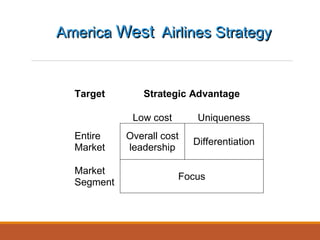
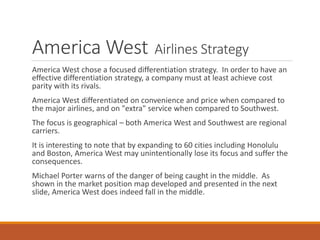
America West chose a focused differentiation strategy. In order to have an
effective differentiation strategy, a company must at least achieve cost
parity with its rivals.
America West differentiated on convenience and price when compared to
the major airlines, and on "extra" service when compared to Southwest.
The focus is geographical – both America West and Southwest are regional
carriers.
It is interesting to note that by expanding to 60 cities including Honolulu
and Boston, America West may unintentionally lose its focus and suffer the
consequences.
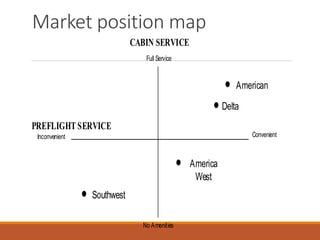
Michael Porter warns of the danger of being caught in the middle. As
shown in the market position map developed and presented in the next
slide, America West does indeed fall in the middle.
Market position map
Inconvenient
Full Service
No Amenities
Convenient
American
Delta
America
West
Southwest
PREFLIGHT SERVICE
CABIN SERVICE
America West Winning
Customers
Service Qualifiers:
The ability to make reservations using the SABRE
system could be an important qualifier for the
business traveler. Air safety is an obvious qualifier
that is sometimes in question for small commuter
airlines flying twin engine light aircraft with
inexperienced pilots.
Service Winners:
With respect to the major airlines America West could
win customers based on ticket price and convenience
for travel in the southwest. With respect to
Southwest airlines, winning customers for itself would
be based on perceived higher in-flight quality, more
pleasant terminal waiting areas, and newer aircraft
with 5-across seating versus 6-across seating.
America West Winning Customers
America West Winning
Customers
Service Losers:
Potential service losers include dependability of on-
time arrivals and avoidance of lost luggage. A
perception of declining in-flight service quality
owing to poor meals, discontinuing the free papers,
or rushed cabin service could be service losers.
Target market segments
Service concept
Operating strategy
Service delivery system
America West Strategic Service Vision
The Best Little Cookie House
Around
Mrs. Fields Strategic Use of Information
One of the main reasons for Mrs. Fields's
success is her implementation of a
sophisticated management information
system that she has used to position herself
one step ahead of her competition.
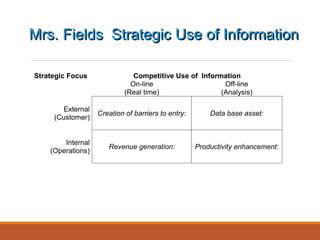
Competitive Use of InformationStrategic Focus
On-line
(Real time)
Off-line
(Analysis)
External
(Customer)
Creation of barriers to entry: Data base asset:
Internal
(Operations)
Revenue generation: Productivity enhancement:
Mrs. Fields Strategic Use of Information
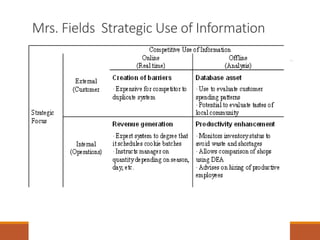
Mrs. Fields creates a barrier to entry by installing and implementing a
personal computer in each store. A sophisticated information system
can create a barrier also because competitors must incur great expense
to assemble and maintain their own databases.
The second strategic role of information, that is, revenue generation,
can be seen in Mrs. Fields's operation. Her expert system considers the
factors that will influence the day's sales and then instructs employees
on which cookies to make and when to make them. This kind of control
ensures the quality of the cookies that translates directly into
generation of revenue.
Mrs. Fields Strategic Use of Information
Mrs. Fields could use her database asset, which is the third role of
information, as a micromarketing tool to evaluate the spending patterns
as well as the cookie preferences of her customers. A final role of
information is productivity enhancement. Cookies are a perishable
product and the information system can be used to monitor the status
of the cookie inventory. A system that coordinates cookie production
closely with cookie consumption ensures a fresh supply of cookies at all
times while it avoids the waste of having to discard unsold stale cookies
(or selling them at reduced prices).
The information system at Mrs. Fields improves the productivity of the
managers by providing them with daily reports that allow them to spot
and resolve problems and also to identify strategies that are successful
at different stores.
How might the management information system contribute to a
reported 100% turnover of store managers?
Will the management information system support or inhibit the
expansion of Mrs. Field’s outlets? Why?
Mrs. Fields Management Information System
How might the management information system contribute to
a reported 100% turnover of store managers?
Will the management information system support or inhibit the
expansion of Mrs. Field’s outlets? Why?
We believe that a management information system is essential to the
expansion of Mrs. Fields Cookies. But, we also recognize the potential for
problems when a sophisticated system is not used carefully. Therefore we
make the following suggestions:
Provide managers with incentives to make decisions and give them an
opportunity to feel that they are more than button-pushers. If the
computer makes all decisions, there is no need for managers. Also, a
completely computerized operation may lose a "personal" appeal that
attracts customers.
Use micromarketing to create a database that will give Mrs. Fields another
competitive advantage. Such a database would allow Mrs. Fields to adapt
to the tastes and preferences of local communities.
Implement a program to eliminate or prevent abuses of the system. The
abuses could include invasion of privacy and manipulation of the system by
applicants who respond according to their perceptions of what would be
"politically correct."
Alamo Drafthouse
Market position map
Marketing analysts use market position maps to
display visually the customers’ perceptions of a
firm in relation to its competitors regarding two
attributes.
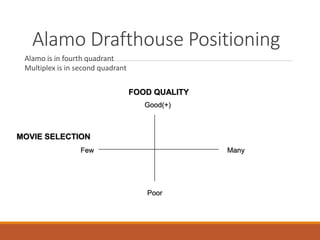
A market position map for Alamo Drafthouse is
prepared using “food quality” and “movie
selection” as axes.
Alamo Drafthouse Positioning
Alamo is in fourth quadrant
Multiplex is in second quadrant
MOVIE SELECTION
FOOD QUALITY
ManyFew
Poor
Good(+)
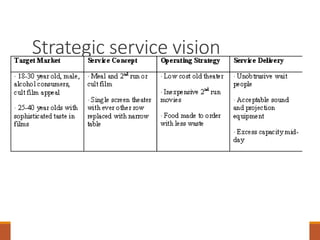
Alamo Drafthouse Strategic Service Vision
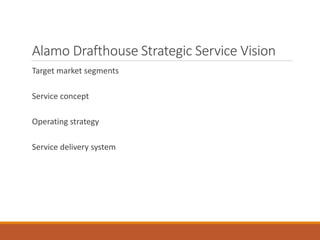
Target market segments
Service concept
Operating strategy
Service delivery system
Strategic service vision
Alamo Drafthouse Winning Customers
Qualifiers
Service winners
Service losers
Qualifiers, service winners and service losers
Qualifiers include good sound system, reasonable prices for the meals,
availability of beer and wine, and menu selection.
A service winner is the unique “date” experience including the special
events and film showing.
Service losers include a poor meal value and movie projection and
sound that does not meet minimal standards.
For the multiplex movie theater market the qualifier is the desired
movie showing, a winner would be convenient location and available
time of showing, and the loser would be a long waiting line at the box
office.
The difference in the criteria would lead us to conclude that Alamo does
not compete in the multiplex movie market.

Service strategy

  • 1.
  • 2.
    Strategic Service Vision TargetMarket Segments What are common characteristics of important market segments? What dimensions can be used to segment the market, demographic, psychographic? How important are various segments? What needs does each have? How well are these needs being served, in what manner, by whom?
  • 3.
    Strategic Service Vision ServiceConcept What are important elements of the service to be provided, stated in terms of results produced for customers? How are these elements supposed to be perceived by the target market segment, by the market in general, by employees, by others? How do customers perceive the service concept? What efforts does this suggest in terms of the manner in which the service is designed, delivered, marketed?
  • 4.
    Strategic Service Vision OperatingStrategy What are important elements of the strategy: operations, financing, marketing, organization, human resources, control? On which will the most effort be concentrated? Where will investments be made? How will quality and cost be controlled: measures, incentives, rewards? What results will be expected versus competition in terms of, quality of service, cost profile, productivity, morale/loyalty of servers?
  • 5.
    Strategic Service Vision ServiceDelivery System What are important features of the service delivery system including: role of people, technology, equipment, layout, procedures? What capacity does it provide, normally, at peak levels? To what extent does it, help insure quality standards, differentiate the service from competition, provide barriers to entry by competitors?
  • 6.
    Relatively Low OverallEntry Barriers Economies of Scale Limited High Transportation Costs Erratic Sales Fluctuations No Power Dealing with Buyers or Suppliers Product Substitutions for Service High Customer Loyalty Exit Barriers Competitive Environment of Services
  • 7.
    Competitive Service Strategies (OverallCost Leadership) Seeking Out Low-cost Customers Standardizing a Custom Service Reducing the Personal Element in Service Delivery (promote self- service) Reducing Network Costs (hub and spoke) Taking Service Operations Off-line
  • 8.
    Competitive Service Strategies (Differentiation) Makingthe Intangible Tangible (memorable) Customizing the Standard Product Reducing Perceived Risk Giving Attention to Personnel Training Controlling Quality Note: Differentiation in service means being unique in brand image, technology use, features, or reputation for customer service.
  • 9.
    Competitive Service Strategies (Focus) BuyerGroup: (e.g. USAA insurance and military officers) Service Offered: (e.g. Shouldice Hospital and hernia patients) Geographic Region: (e.g. Austin Cable Vision and TV watchers)
  • 10.
    Customer Criteria forSelecting a Service Provider Availability (24 hour ATM) Convenience (Site location) Dependability (On-time performance) Personalization (Know customer’s name) Price (Quality surrogate) Quality (Perceptions important) Reputation (Word-of-mouth) Safety (Customer well-being) Speed (Avoid excessive waiting)
  • 11.
    Service Purchase Decision ServiceQualifier: To be taken seriously a certain level must be attained on the competitive dimension, as defined by other market players. Examples are cleanliness for a fast food restaurant or safe aircraft for an airline. Service Winner: The competitive dimension used to make the final choice among competitors. Example is price.
  • 12.
    Service Purchase Decision (cont.) ServiceLoser: Failure to deliver at or above the expected level for a competitive dimension. Examples are failure to repair auto (dependability), rude treatment (personalization) or late delivery of package (speed).
  • 13.
    Competitive Role ofInformation in Services Strategic Focus Competitive Use of Information On-line Off-line (Real time) (Analysis) External (Customer) Creation of barriers to entry: Reservation system Frequent user club Switching costs Data base asset: Selling information Development of services Micro-marketing Internal (Operations) Revenue generation: Yield management Point of sale Expert systems Productivity enhancement: Inventory status Data envelopment analysis (DEA)
  • 14.
    Marketplace vs Marketspace CreatingNew Markets Using Information (Gather, Organize, Select, Synthesize, and Distribute) Three Stage Evolution • 1st Stage (Visibility): See physical operations more effectively with information – Ex. USAA “paperless operation” • 2nd Stage (Mirroring Capability): Substitute virtual activities for physical – Ex. USAA “automate underwriting” • 3rd Stage (New Customer Relationships): Draw on information to deliver value to customer in new ways – Ex. USAA “event oriented service” The Virtual Value Chain
  • 15.
    Anti-competitive (Barrier toentry) Fairness (Yield management) Invasion of Privacy (Micro-marketing) Data Security (Medical records) Reliability (Credit report) Limits in the Use of Information
  • 16.
    Using Information toCategorize Customers Coding grades customers on how profitable their business is. Routing is used by call centers to place customers in different queues based on customer code. Targeting allows choice customers to have fees waived and get other hidden discounts. Sharing data about your transaction history with other firms is a source of revenue.
  • 17.
    Chase and Hayes’Framework for Service Firm Competitiveness
  • 18.
    1. Available forservice 2. Journeyman 3. Distinctive competence 4. World-class service delivery Customers patronize service firm for reasons other than performance. Customers neither seek out nor avoid the firm. Customers seek out the firm on the basis of its sustained reputation for meeting customer expectations The company’s name is synonymous with service excellence. Its service doesn’t just satisfy customers; it delights them and thereby expands customer expectations to levels its competitors are unable to fulfill. Operations is reactive, at best. Operations functions in a mediocre, uninspired fashion. Operations continually excels, reinforced by personnel management and systems that support an intense customer focus. Operations is a quick learner and fast innovator; it masters every step of the service delivery process and provides capabilities that are superior to competitors. SERVICE QUALITY Is subsidiary to cost, highly variable. Meets some customer expectations; consistent on one or two key dimensions. Exceeds customer expectations; consistent on multiple dimensions. Raises customer expectations and seeks challenge; improves continuously. Stages in Service Firm Competitiveness
  • 19.
    1. Available forservice 2. Journeyman 3. Distinctive competence 4. World-class service delivery BACK OFFICE Counting room. Contributes to service, plays an important role in the total service, is given attention, but is still a separate role. Is equally valued with front office; plays integral role. Is proactive, develops its own capabilities, and generates opportunities. CUSTOMER Unspecified, to be satisfied at minimum cost. A market segment whose basic needs are understood. A collection of individuals whose variation in needs is understood. A source of stimulation, ideas, and opportunity. INTRODUCTION OF NEW TECHNOLOGY When necessary for survival, under duress. When justified by cost savings. When promises to enhance service. Source of first-mover advantages, creating ability to do things your competitors can’t do. WORKFORCE Negative constraint. Efficient resource; disciplined; follows procedures. Permitted to select among alternative procedures. Innovative; creates procedures. FRONT-LINE MANAGEMENT Controls workers. Controls the process. Listens to customers; coaches and facilitates workers. Works to enhance their career. Is listened to by top management as a source of new ideas. Mentors Stages in Service Firm Competitiveness
  • 20.
  • 21.
    Target Strategic Advantage Lowcost Uniqueness Entire Market Overall cost leadership Differentiation Market Segment Focus America West Airlines Strategy
  • 22.
    America West AirlinesStrategy America West chose a focused differentiation strategy. In order to have an effective differentiation strategy, a company must at least achieve cost parity with its rivals. America West differentiated on convenience and price when compared to the major airlines, and on "extra" service when compared to Southwest. The focus is geographical – both America West and Southwest are regional carriers. It is interesting to note that by expanding to 60 cities including Honolulu and Boston, America West may unintentionally lose its focus and suffer the consequences. Michael Porter warns of the danger of being caught in the middle. As shown in the market position map developed and presented in the next slide, America West does indeed fall in the middle.
  • 23.
    Market position map Inconvenient FullService No Amenities Convenient American Delta America West Southwest PREFLIGHT SERVICE CABIN SERVICE
  • 24.
    America West Winning Customers ServiceQualifiers: The ability to make reservations using the SABRE system could be an important qualifier for the business traveler. Air safety is an obvious qualifier that is sometimes in question for small commuter airlines flying twin engine light aircraft with inexperienced pilots.
  • 25.
    Service Winners: With respectto the major airlines America West could win customers based on ticket price and convenience for travel in the southwest. With respect to Southwest airlines, winning customers for itself would be based on perceived higher in-flight quality, more pleasant terminal waiting areas, and newer aircraft with 5-across seating versus 6-across seating. America West Winning Customers
  • 26.
    America West Winning Customers ServiceLosers: Potential service losers include dependability of on- time arrivals and avoidance of lost luggage. A perception of declining in-flight service quality owing to poor meals, discontinuing the free papers, or rushed cabin service could be service losers.
  • 27.
    Target market segments Serviceconcept Operating strategy Service delivery system America West Strategic Service Vision
  • 28.
    America West StrategicService Vision
  • 29.
    The Best LittleCookie House Around
  • 30.
    Mrs. Fields StrategicUse of Information One of the main reasons for Mrs. Fields's success is her implementation of a sophisticated management information system that she has used to position herself one step ahead of her competition.
  • 31.
    Competitive Use ofInformationStrategic Focus On-line (Real time) Off-line (Analysis) External (Customer) Creation of barriers to entry: Data base asset: Internal (Operations) Revenue generation: Productivity enhancement: Mrs. Fields Strategic Use of Information
  • 32.
    Mrs. Fields StrategicUse of Information
  • 33.
    Mrs. Fields StrategicUse of Information Mrs. Fields creates a barrier to entry by installing and implementing a personal computer in each store. A sophisticated information system can create a barrier also because competitors must incur great expense to assemble and maintain their own databases. The second strategic role of information, that is, revenue generation, can be seen in Mrs. Fields's operation. Her expert system considers the factors that will influence the day's sales and then instructs employees on which cookies to make and when to make them. This kind of control ensures the quality of the cookies that translates directly into generation of revenue.
  • 34.
    Mrs. Fields StrategicUse of Information Mrs. Fields could use her database asset, which is the third role of information, as a micromarketing tool to evaluate the spending patterns as well as the cookie preferences of her customers. A final role of information is productivity enhancement. Cookies are a perishable product and the information system can be used to monitor the status of the cookie inventory. A system that coordinates cookie production closely with cookie consumption ensures a fresh supply of cookies at all times while it avoids the waste of having to discard unsold stale cookies (or selling them at reduced prices). The information system at Mrs. Fields improves the productivity of the managers by providing them with daily reports that allow them to spot and resolve problems and also to identify strategies that are successful at different stores.
  • 35.
    How might themanagement information system contribute to a reported 100% turnover of store managers? Will the management information system support or inhibit the expansion of Mrs. Field’s outlets? Why? Mrs. Fields Management Information System
  • 36.
    How might themanagement information system contribute to a reported 100% turnover of store managers?
  • 37.
    Will the managementinformation system support or inhibit the expansion of Mrs. Field’s outlets? Why? We believe that a management information system is essential to the expansion of Mrs. Fields Cookies. But, we also recognize the potential for problems when a sophisticated system is not used carefully. Therefore we make the following suggestions: Provide managers with incentives to make decisions and give them an opportunity to feel that they are more than button-pushers. If the computer makes all decisions, there is no need for managers. Also, a completely computerized operation may lose a "personal" appeal that attracts customers. Use micromarketing to create a database that will give Mrs. Fields another competitive advantage. Such a database would allow Mrs. Fields to adapt to the tastes and preferences of local communities. Implement a program to eliminate or prevent abuses of the system. The abuses could include invasion of privacy and manipulation of the system by applicants who respond according to their perceptions of what would be "politically correct."
  • 38.
  • 39.
    Market position map Marketinganalysts use market position maps to display visually the customers’ perceptions of a firm in relation to its competitors regarding two attributes. A market position map for Alamo Drafthouse is prepared using “food quality” and “movie selection” as axes.
  • 40.
    Alamo Drafthouse Positioning Alamois in fourth quadrant Multiplex is in second quadrant MOVIE SELECTION FOOD QUALITY ManyFew Poor Good(+)
  • 41.
    Alamo Drafthouse StrategicService Vision Target market segments Service concept Operating strategy Service delivery system
  • 42.
  • 43.
    Alamo Drafthouse WinningCustomers Qualifiers Service winners Service losers
  • 44.
    Qualifiers, service winnersand service losers Qualifiers include good sound system, reasonable prices for the meals, availability of beer and wine, and menu selection. A service winner is the unique “date” experience including the special events and film showing. Service losers include a poor meal value and movie projection and sound that does not meet minimal standards. For the multiplex movie theater market the qualifier is the desired movie showing, a winner would be convenient location and available time of showing, and the loser would be a long waiting line at the box office. The difference in the criteria would lead us to conclude that Alamo does not compete in the multiplex movie market.