Copyright ©2014 Pearson Education, Inc.
8-1
Chapter 7
Motivation: From Concepts
to Application
Essentials of
Organizational Behavior
12e
Stephen P. Robbins & Timothy A. Judge
Copyright ©2014 Pearson Education, Inc.
After studying this chapter,
you should be able to:
1. Describe the job characteristics model and evaluate
the way it motivates by changing the work
environment.
2. Compare and contrast the main ways jobs can be
redesigned.
3. Give examples of employee involvement measures
and show how they can motivate employees.
4. Demonstrate how the different types of variable-pay
programs can increase employee motivation.
5. Show how flexible benefits turn benefits into
motivators.
6. Identify the motivational benefits of intrinsic
rewards. 8-2
Copyright ©2014 Pearson Education, Inc.
Motivating by Changing the
Work Environment: JCM
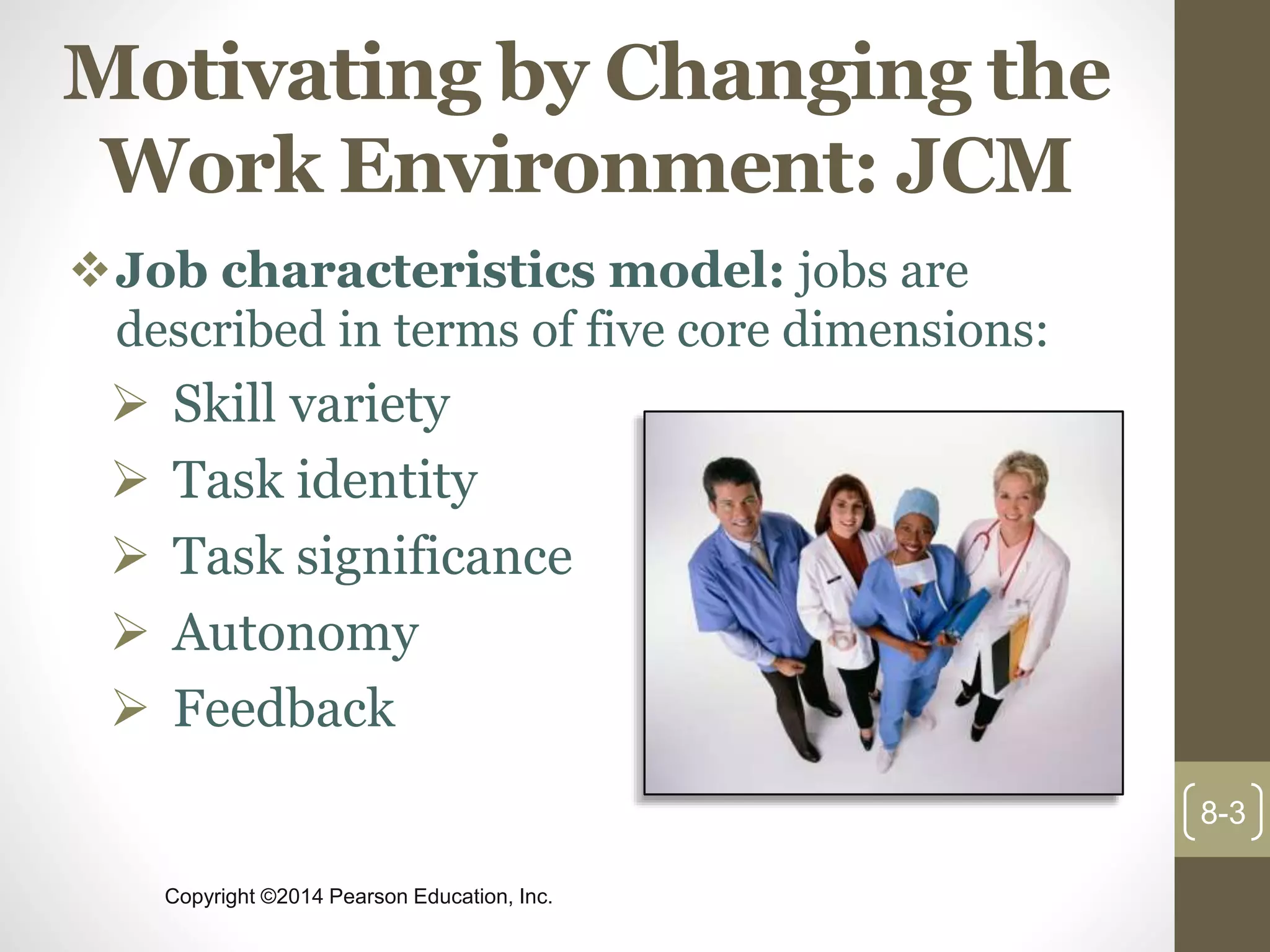
Job characteristics model: jobs are
described in terms of five core dimensions:
 Skill variety
 Task identity
 Task significance
 Autonomy
 Feedback
8-3
Copyright ©2014 Pearson Education, Inc.
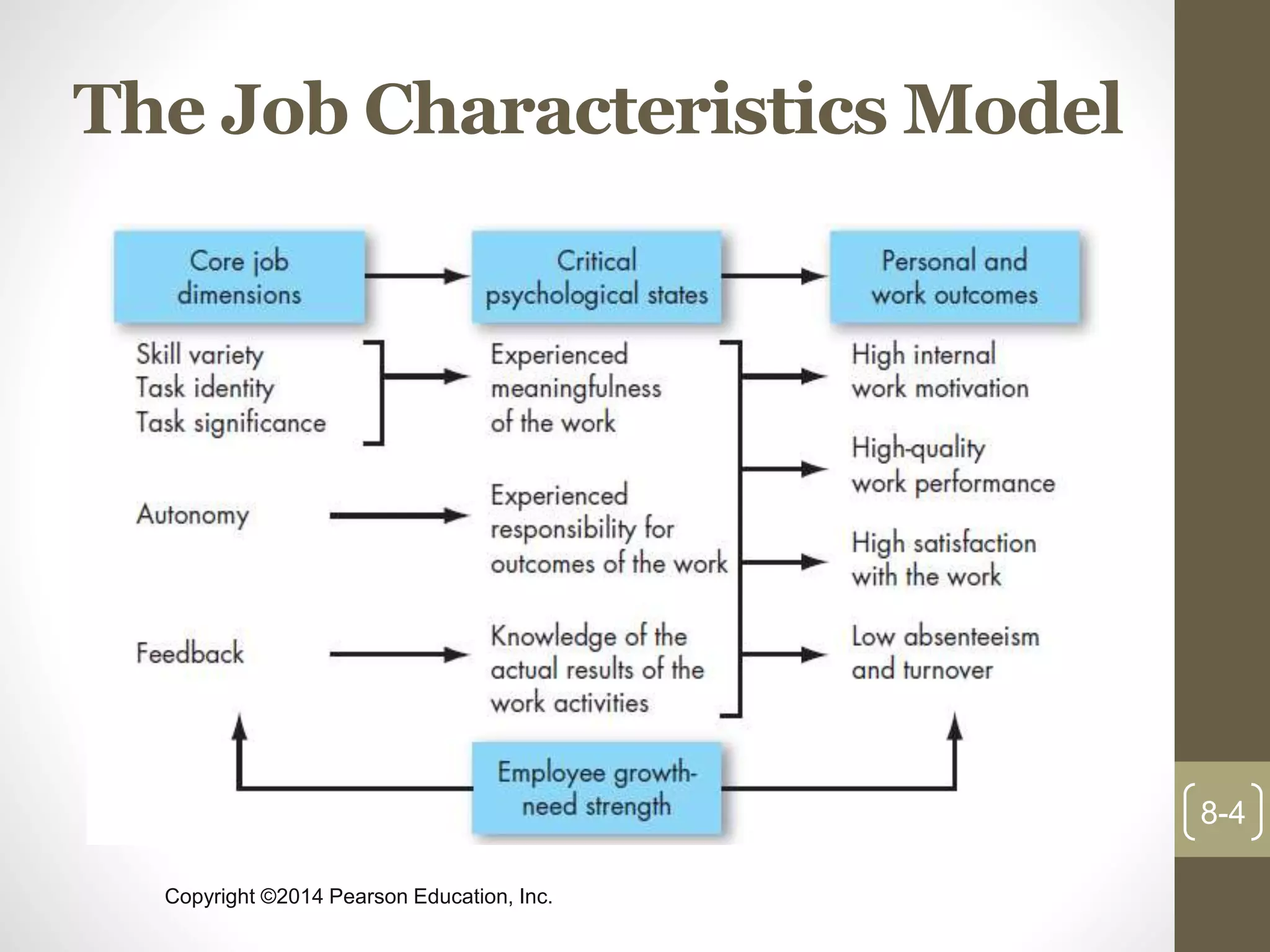
The Job Characteristics Model
8-4
Copyright ©2014 Pearson Education, Inc.
JCM: Designing
Motivational Jobs
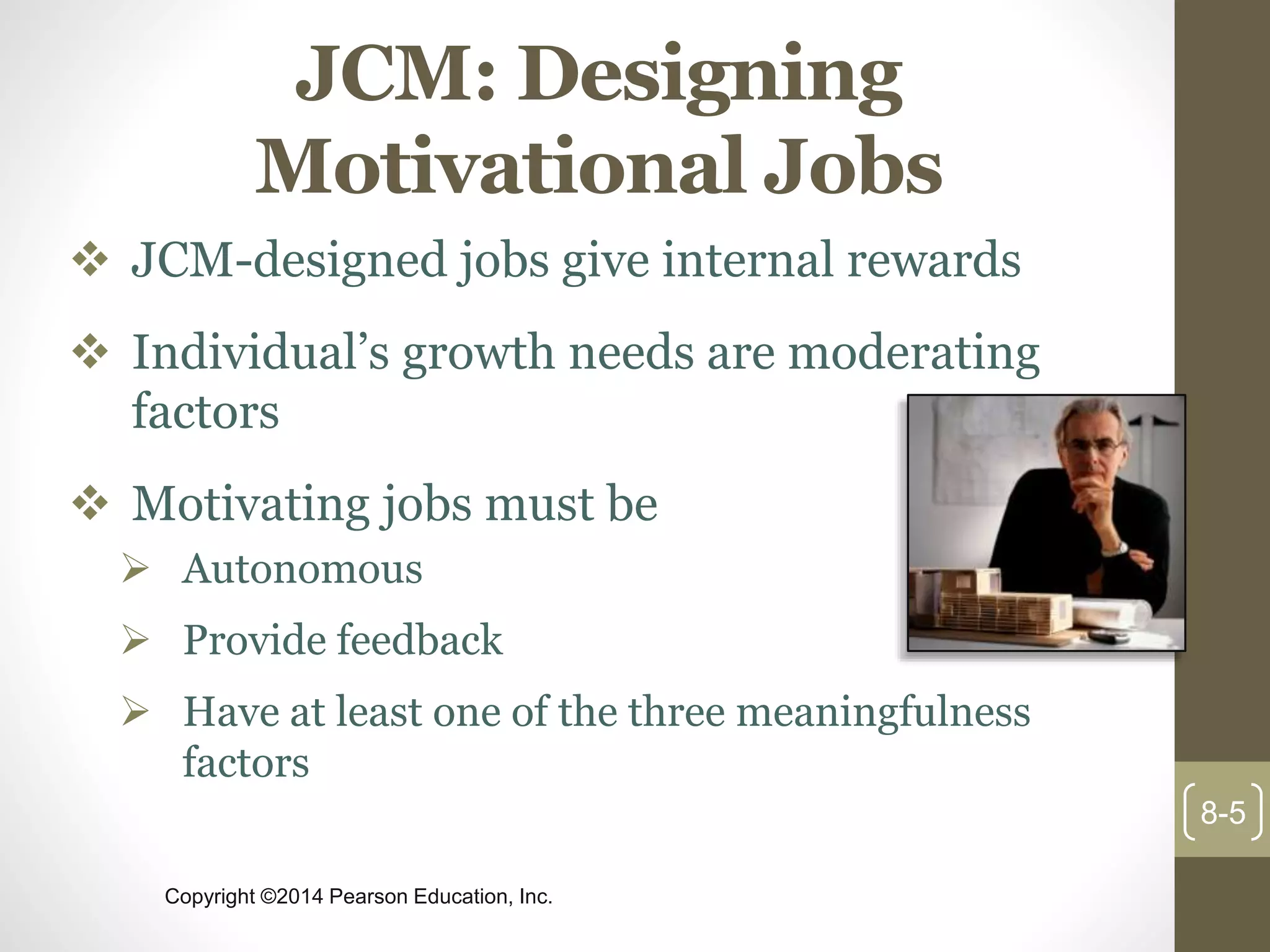
 JCM-designed jobs give internal rewards
 Individual’s growth needs are moderating
factors
 Motivating jobs must be
 Autonomous
 Provide feedback
 Have at least one of the three meaningfulness
factors
8-5
Copyright ©2014 Pearson Education, Inc.
How Can Jobs Be Redesigned?
 Job Rotation
The periodic shifting of an employee from one
task to another
 Job Enrichment
Increasing the degree to which the worker
controls the planning, execution and
evaluation of the work
8-6
Copyright ©2014 Pearson Education, Inc.
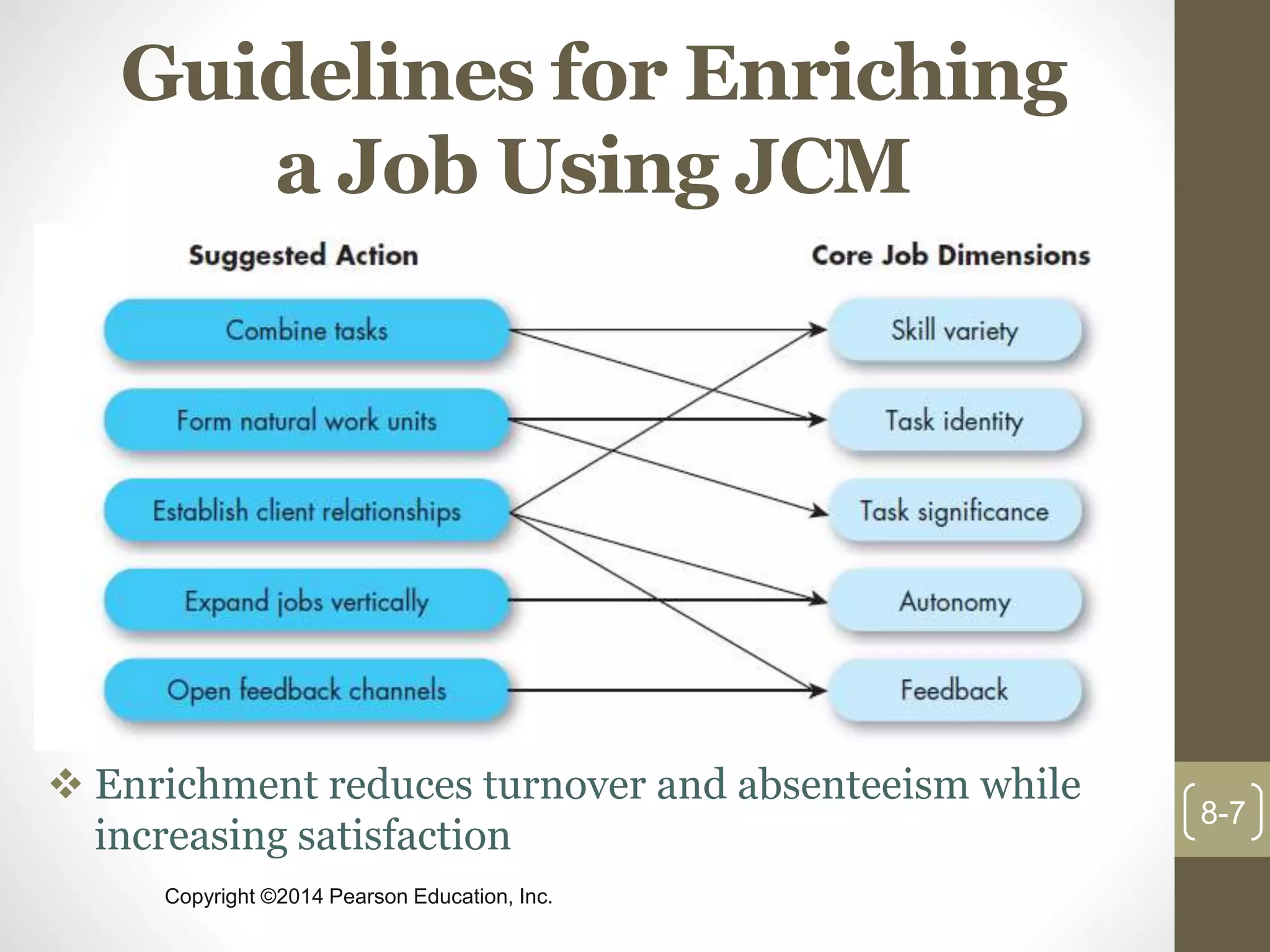
Guidelines for Enriching
a Job Using JCM
8-7
 Enrichment reduces turnover and absenteeism while
increasing satisfaction
Copyright ©2014 Pearson Education, Inc.
Alternative Work
Arrangements
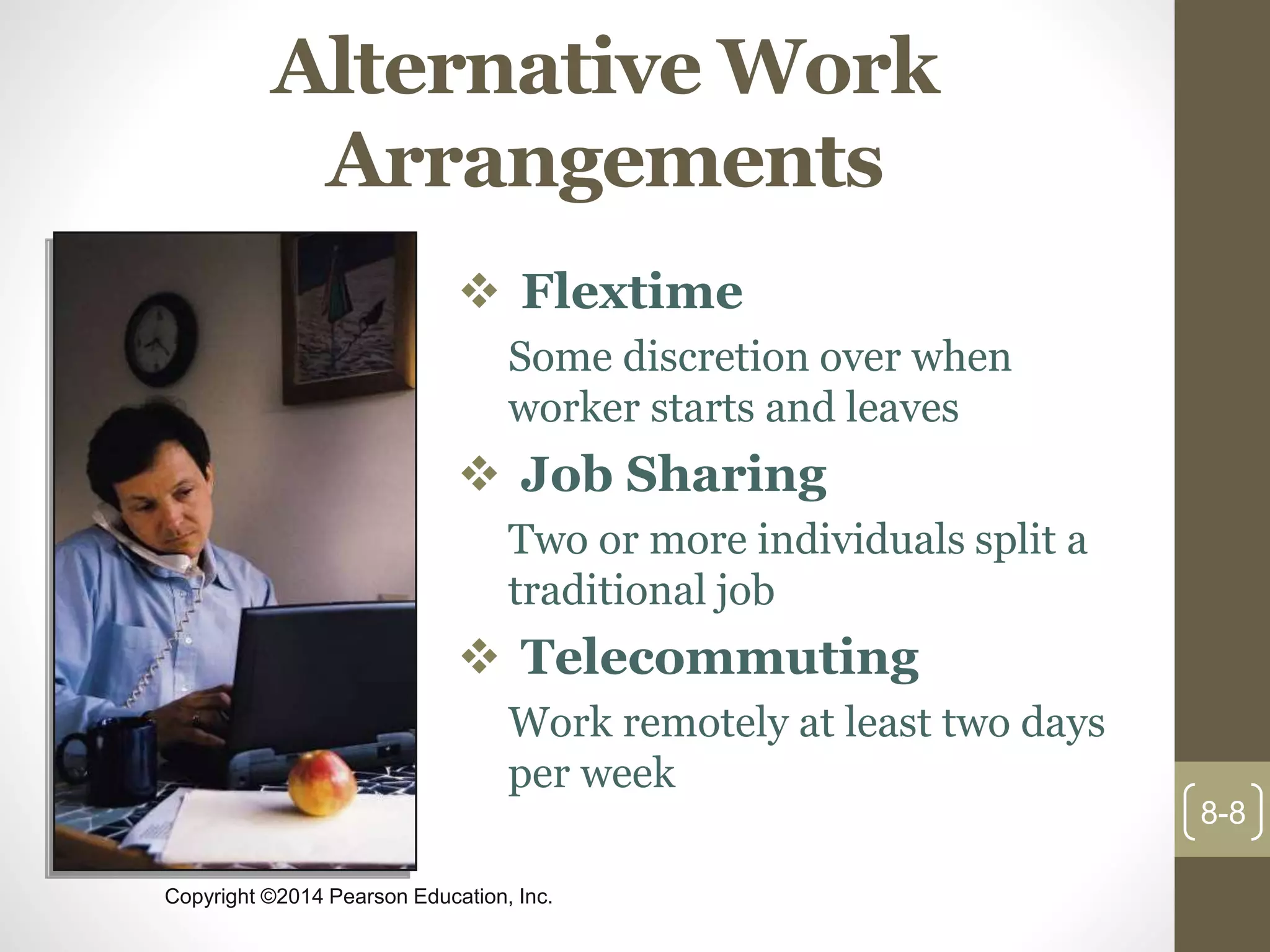
 Flextime
Some discretion over when
worker starts and leaves
 Job Sharing
Two or more individuals split a
traditional job
 Telecommuting
Work remotely at least two days
per week
8-8
Copyright ©2014 Pearson Education, Inc.
The Social and Physical
Context of Work
 Social characteristics that improve job
performance
 Interdependence
 Social support
 Interactions with people outside the workplace
 Work context also affects performance
 Temperature
 Noise level
 Safety
8-9
Copyright ©2014 Pearson Education, Inc.
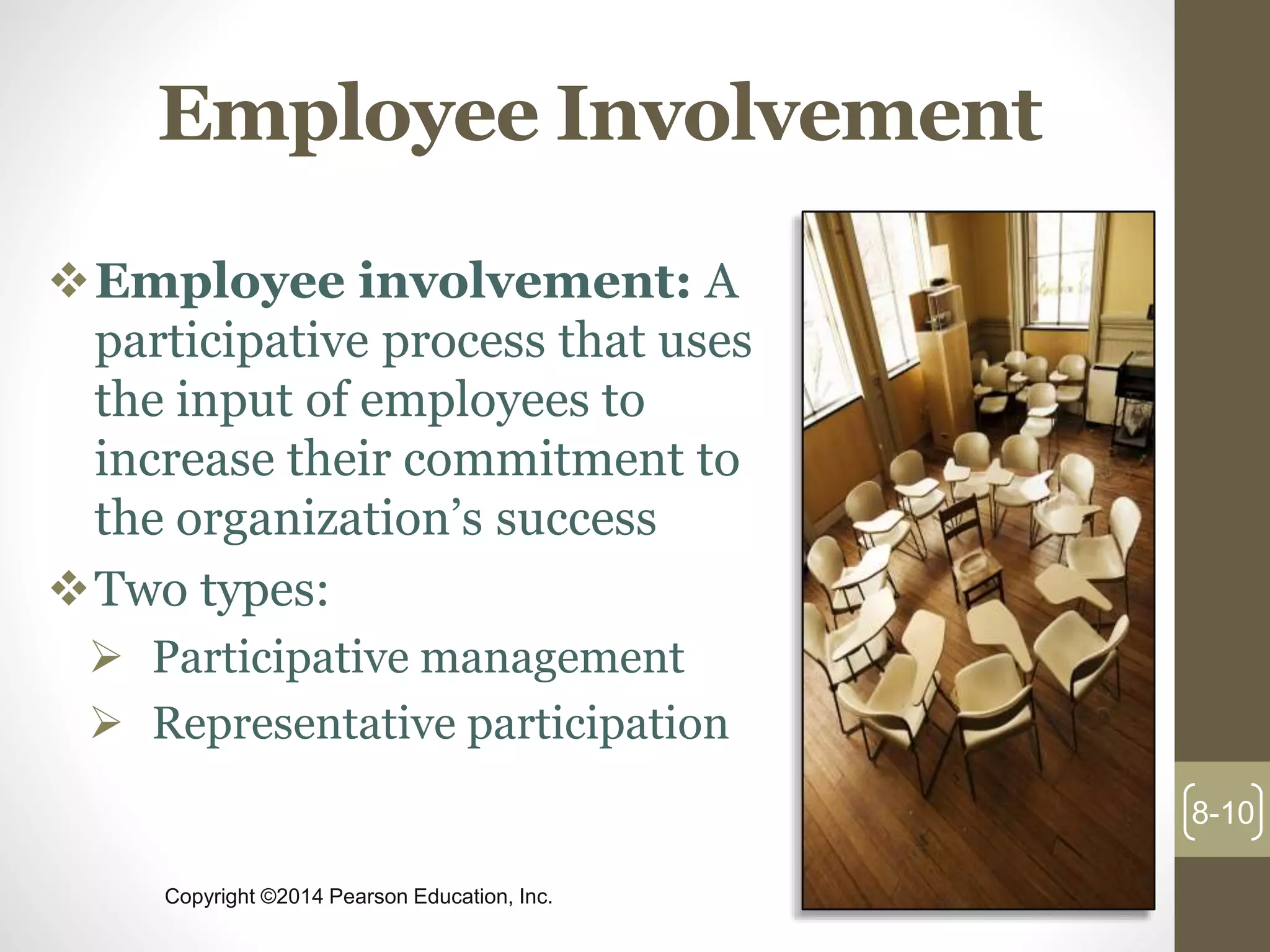
Employee Involvement
Employee involvement: A
participative process that uses
the input of employees to
increase their commitment to
the organization’s success
Two types:
 Participative management
 Representative participation
8-10
Copyright ©2014 Pearson Education, Inc.
Participative Management
 Participative management: Subordinates
share a significant degree of decision-making
power with superiors
 Required conditions:
 Issues must be relevant
 Employees must be competent and knowledgeable
 All parties must act in good faith
 Only a modest influence on productivity,
motivation, and job satisfaction 8-11
Copyright ©2014 Pearson Education, Inc.
Representative Participation
 Representative participation: Workers
are represented by a small group of
employees who participate in decisions
affecting personnel
 Works councils
 Board membership
 Redistribute power within an organization
 Does not appear to be very motivational
8-12
Copyright ©2014 Pearson Education, Inc.
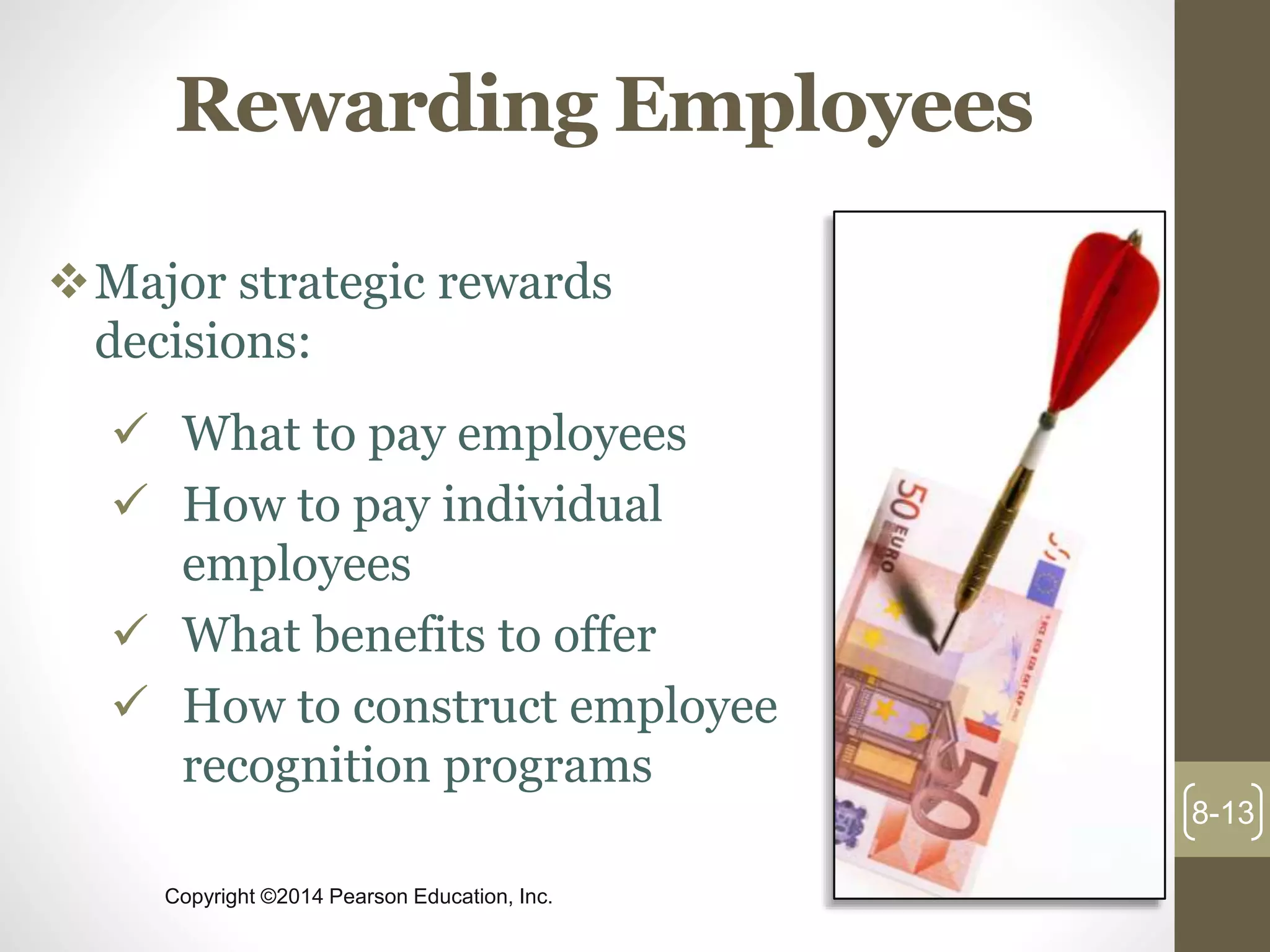
Rewarding Employees
Major strategic rewards
decisions:
 What to pay employees
 How to pay individual
employees
 What benefits to offer
 How to construct employee
recognition programs
8-13
Copyright ©2014 Pearson Education, Inc.
What to Pay
 Need to establish a pay structure
 Balance between:
 Internal equity – the worth of the job to the
organization
 External equity – the external competitiveness of
an organization’s pay relative to pay elsewhere in
its industry
 A strategic decision with trade-offs
8-14
Copyright ©2014 Pearson Education, Inc.
How to Pay:
Variable-Pay Programs
 Bases a portion of the pay on a given measure
of performance
 Piece-Rate Pay – workers are paid a fixed sum for
each unit of production completed
 Merit-Based Pay – pay is based on individual
performance appraisal ratings
 Bonuses – rewards employees for recent
performance
 Skill-Based Pay – pay is based on skills acquired
instead of job title or rank – doesn’t address the
level of performance 8-15
Copyright ©2014 Pearson Education, Inc.
More Variable Pay Programs
 Profit-Sharing Plans – organization-wide programs
that distribute compensation based on an established
formula designed around profitability
 Gainsharing – compensation based on sharing of
gains from improved productivity
 Employee Stock Ownership Plans (ESOPs) –
plans in which employees acquire stock, often at below-
market prices
8-16
 While it appears that pay does increase productivity, it
seems that not everyone responds positively to variable-
pay plans
Copyright ©2014 Pearson Education, Inc.
What Benefit to Offer:
Flexible Benefits
 Each employee creates a benefit
package tailored to their own
needs and situation
 Modular plans –
predesigned packages to meet
the needs of a specific group
 Core-plus plans – core of
essential benefits and menu of
options to choose from
 Flexible spending plans –
full choice from menu of
options
8-17
Copyright ©2014 Pearson Education, Inc.
How to Recognize Them:
Employee Recognition Programs
In addition to pay there are intrinsic rewards
 Can be as simple as a spontaneous comment
 Can be formalized in a program
Recognition is the most powerful workplace
motivator – and the least expensive
8-18

Organizational Behavior Chapter 7 Motivation - From Concepts to Application

  • 1.
    Copyright ©2014 PearsonEducation, Inc. 8-1 Chapter 7 Motivation: From Concepts to Application Essentials of Organizational Behavior 12e Stephen P. Robbins & Timothy A. Judge
  • 2.
    Copyright ©2014 PearsonEducation, Inc. After studying this chapter, you should be able to: 1. Describe the job characteristics model and evaluate the way it motivates by changing the work environment. 2. Compare and contrast the main ways jobs can be redesigned. 3. Give examples of employee involvement measures and show how they can motivate employees. 4. Demonstrate how the different types of variable-pay programs can increase employee motivation. 5. Show how flexible benefits turn benefits into motivators. 6. Identify the motivational benefits of intrinsic rewards. 8-2
  • 3.
    Copyright ©2014 PearsonEducation, Inc. Motivating by Changing the Work Environment: JCM Job characteristics model: jobs are described in terms of five core dimensions:  Skill variety  Task identity  Task significance  Autonomy  Feedback 8-3
  • 4.
    Copyright ©2014 PearsonEducation, Inc. The Job Characteristics Model 8-4
  • 5.
    Copyright ©2014 PearsonEducation, Inc. JCM: Designing Motivational Jobs  JCM-designed jobs give internal rewards  Individual’s growth needs are moderating factors  Motivating jobs must be  Autonomous  Provide feedback  Have at least one of the three meaningfulness factors 8-5
  • 6.
    Copyright ©2014 PearsonEducation, Inc. How Can Jobs Be Redesigned?  Job Rotation The periodic shifting of an employee from one task to another  Job Enrichment Increasing the degree to which the worker controls the planning, execution and evaluation of the work 8-6
  • 7.
    Copyright ©2014 PearsonEducation, Inc. Guidelines for Enriching a Job Using JCM 8-7  Enrichment reduces turnover and absenteeism while increasing satisfaction
  • 8.
    Copyright ©2014 PearsonEducation, Inc. Alternative Work Arrangements  Flextime Some discretion over when worker starts and leaves  Job Sharing Two or more individuals split a traditional job  Telecommuting Work remotely at least two days per week 8-8
  • 9.
    Copyright ©2014 PearsonEducation, Inc. The Social and Physical Context of Work  Social characteristics that improve job performance  Interdependence  Social support  Interactions with people outside the workplace  Work context also affects performance  Temperature  Noise level  Safety 8-9
  • 10.
    Copyright ©2014 PearsonEducation, Inc. Employee Involvement Employee involvement: A participative process that uses the input of employees to increase their commitment to the organization’s success Two types:  Participative management  Representative participation 8-10
  • 11.
    Copyright ©2014 PearsonEducation, Inc. Participative Management  Participative management: Subordinates share a significant degree of decision-making power with superiors  Required conditions:  Issues must be relevant  Employees must be competent and knowledgeable  All parties must act in good faith  Only a modest influence on productivity, motivation, and job satisfaction 8-11
  • 12.
    Copyright ©2014 PearsonEducation, Inc. Representative Participation  Representative participation: Workers are represented by a small group of employees who participate in decisions affecting personnel  Works councils  Board membership  Redistribute power within an organization  Does not appear to be very motivational 8-12
  • 13.
    Copyright ©2014 PearsonEducation, Inc. Rewarding Employees Major strategic rewards decisions:  What to pay employees  How to pay individual employees  What benefits to offer  How to construct employee recognition programs 8-13
  • 14.
    Copyright ©2014 PearsonEducation, Inc. What to Pay  Need to establish a pay structure  Balance between:  Internal equity – the worth of the job to the organization  External equity – the external competitiveness of an organization’s pay relative to pay elsewhere in its industry  A strategic decision with trade-offs 8-14
  • 15.
    Copyright ©2014 PearsonEducation, Inc. How to Pay: Variable-Pay Programs  Bases a portion of the pay on a given measure of performance  Piece-Rate Pay – workers are paid a fixed sum for each unit of production completed  Merit-Based Pay – pay is based on individual performance appraisal ratings  Bonuses – rewards employees for recent performance  Skill-Based Pay – pay is based on skills acquired instead of job title or rank – doesn’t address the level of performance 8-15
  • 16.
    Copyright ©2014 PearsonEducation, Inc. More Variable Pay Programs  Profit-Sharing Plans – organization-wide programs that distribute compensation based on an established formula designed around profitability  Gainsharing – compensation based on sharing of gains from improved productivity  Employee Stock Ownership Plans (ESOPs) – plans in which employees acquire stock, often at below- market prices 8-16  While it appears that pay does increase productivity, it seems that not everyone responds positively to variable- pay plans
  • 17.
    Copyright ©2014 PearsonEducation, Inc. What Benefit to Offer: Flexible Benefits  Each employee creates a benefit package tailored to their own needs and situation  Modular plans – predesigned packages to meet the needs of a specific group  Core-plus plans – core of essential benefits and menu of options to choose from  Flexible spending plans – full choice from menu of options 8-17
  • 18.
    Copyright ©2014 PearsonEducation, Inc. How to Recognize Them: Employee Recognition Programs In addition to pay there are intrinsic rewards  Can be as simple as a spontaneous comment  Can be formalized in a program Recognition is the most powerful workplace motivator – and the least expensive 8-18

Editor's Notes

  • #4 The job characteristics model looks at describing any job in terms of five core job dimensions. These job dimensions include skill variety which is the degree to which the job incorporates a number of different skills and talents. Task identity is another dimension that looks at the degree to which the job requires a completion of whole and identifiable piece of work. Task significance is included and looks at how the job impacts the lives of others. Autonomy, the fourth dimension, identifies how much freedom and independence workers have over their jobs. And finally, feedback is how much the job generates direct and clear information about the worker’s performance.
  • #5 Much evidence supports the JCM concept that the presence of a set of job characteristics—variety, identity, significance, autonomy, and feedback—does generate higher and more satisfying job performance
  • #6 JCM creates motivational jobs as they are designed to give internal rewards. Positive outcomes are moderated by individual growth needs as each individual will respond differently. In order for the jobs to increase motivation there should be a high degree of autonomy, feedback and a least one meaningfulness factor such as significance, identity or variety. Note that because the JCM is relatively individualistic, job enrichment strategies might not have the same effect in collectivistic cultures as they do in individualistic cultures like the United States.
  • #7 There are some helpful ways to redesign a job to increase the motivation of the employees. Two common practices are job rotation and job enrichment. In job rotation an organization will shift the employee to different tasks with similar skill requirements but all in the same organizational level. In job enrichment a manager will expand an employee’s job by increasing the level of control the worker has in planning the job, executing it, or evaluating the work.
  • #8 Job enrichment is helpful in keeping the worker engaged in their work. There are many actions a manager can take to help the worker. These actions help to achieve core job dimensions. For example if the manager combines tasks for the worker it can help the worker increase the amount of skills that are utilizing and help the worker to identify tasks that need to be completed. This action can help the worker have a better understanding of the job and how it helps the organization complete its goals as well as help the worker enjoy his work more because he is using more of his skill set.
  • #9 There are some alternative work arrangements that have been successful in helping increase the motivation of workers. These arrangements give workers more control over their work and thereby can increase their level of motivation. An example of this is Flextime. Flextime is short for flexible work hours and allows workers to choose what hours they work within a set time period. So for example, if the worker needs to work 8 hours a day the manager may say you can choose 8 hours between 6am and 8pm. That flexibility may allow a mom to be home when her kids are coming home from school. Flextime has become popular both within and outside the United States. Another alternative work arrangement is job sharing where two workers split a job and each work part-time. This is becoming more popular in Japan where it allows employers to avoid layoffs due to overstaffing. Telecommuting is another alternative work arrangement that has been utilized. This allows employees to work from home at least 2 days a week.
  • #10 There is both a social and a physical context to work. The social context can help to improve job performance by creating a sense of interdependence, social support and interactions with people outside of work. The physical context can also impact job satisfaction by creating a pleasant and safe environment.
  • #11 Employee involvement is defined as a participative process that uses employees’ input to increase their commitment to the overall success of the organization. Depending on the country involved, it may be necessary to modify employee involvement programs to reflect the local culture. Some examples of programs that help with employee involvement are participative management and representative participation.
  • #12 Participative management occurs when managers include employees in the decision-making process. In order for participative management to be successful there must be issues that are relevant, employees who are knowledgeable and competent, and all parties must be acting in good faith. This type of employee involvement program has shown to have limited impact on productivity, motivation and job satisfaction.
  • #13 Representative participation tries to redistribute power by putting labor on a more equal footing with the interests of managers and stockholders. This is achieved by letting workers be represented by small groups of employees who participate in decisions. Nearly every country in Western Europe requires companies to practice representative participation.
  • #14 As we saw in previous chapters money is not the primary driver for job satisfaction. However, it does motivate individuals and companies often underestimate its impact in keeping top talent. It is critical to figure out what to pay and to establish a pay structure that makes sense for your industry and organization. Then it is imperative that the organization utilizes this pay system and applies it to the pay of individual employees.
  • #15 Setting pay levels can be complex and requires a balance of internal and external pay equity. Internal equity looks at the worth of the job to the organization and compares it with what others are making within the organization. External equity looks at external competitiveness of an organization’s pay relative to pay elsewhere.
  • #16 Some types of variable-pay programs include piece-rate, merit- based, bonuses and skill-based pay. Piece-rate pay plans pay a fixed amount of money for each unit of production. Merit-based pay plans are similar where they pay based on performance. However, it is not necessarily tied to production because in some jobs output is not as easy to measure. Bonuses are another method that is becoming increasingly popular. Bonuses are a lump sum at the end of a set period of time. The amount of the bonus is typically dependent upon the performance of the individual or the organization or some combination of both. Skill-based pay will add compensation to workers as they gain more skills and the ability to do additional jobs. It rewards the employees for continuous improvement.
  • #17 Other types of variable pay programs include: profit-sharing plans, gainsharing and employee stock ownership plans. Profit-sharing plans are organizational wide programs where some of the profits of the company are shared with all workers. Gainsharing is a group incentive where a department or unit will earn additional income if it improves group productivity from the previous period. ESOPs are a method used to motivate the employees towards the organizational goals. As part of their benefit package they are able to earn or purchase company’s stock, often at below-market rates. This encourages them to work towards the overall profitability of the organization as they have ownership in it and will gain as the company gains. It is important to remember that while it is often thought that pay does increase productivity it is not true that everyone responds positively to variable-pay plans.
  • #18 Flexible benefits allow employees choices between different benefits. This allows them to customize their options and create a plan that best meets their needs and situation. This increases their motivation because they realize the organization has their best interest in mind. Some types included modular plans, packaged plans that meet the needs of the group, care-plus plans, a set of core benefits that most need and then some additional options to choose from and flexible spending plans where there is a menu of options to choose from.
  • #19 A method of motivation that has been highly successful is employee recognition programs. This idea recognizes the importance of coupling extrinsic and intrinsic methods to help motivate employees. Recognition is an intrinsic motivation technique that can range from giving an employee the proverbial pat on the back to a more public recognition ceremony. Recognition programs are highly effective and cost very little to administer. There are critics of such programs, however, who say that they can be politically motivated and if the perception is that they are applied unfairly they can cause more harm than good.