Emo
ottions and Moods
Wh
hy Were Emottiio
ons Ignore
ed
din OB?
▪ The “Myth of Rationality”
– Organizations are not emotion-free.
– Emotions were seen as irrational
– Managers worked to make emotion-free
environments
View of Emotionality
– Emotions were believed to be disruptive
– Emotions interfered with productivity
▪
▪ Now we know emotions can’t be separated from
the workplace
The Basic Emottiioons
▪ While not universally accepted, there appear to be six
basic emotions:
1. Fear
2. Anger
3. Disgust
4. Surprise
5. Sadness
6. Happiness
▪
▪
▪
▪
▪
▪
▪
Anger: fury, resentment, annoyance, hostility.
Love: acceptance, friendliness, trust, kindness, obsession.
Shame: guilt, repentance, humiliation, regret.
Fear: anxiety, nervousness, apprehension, terror.
Enjoyment: happiness, joy, relief, contentment, pleasure.
Sadness: Grief, sorrow, cheerlessness, gloom.
Surprise: Shock, astonishment, amazement wonder.
Emotions and their Blendss:
Wh
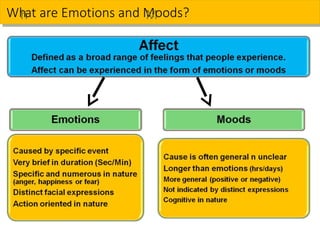
hat are Emotions and M
Moods?
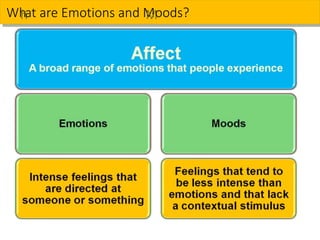
Wh
hat are Emotions and M
Moods?
Wh
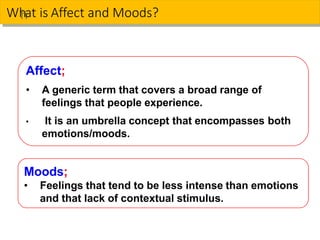
hat is Affect and Moods?
Affect;
• A generic term that covers a broad range of
feelings that people experience.
• It is an umbrella concept that encompasses both
emotions/moods.
Moods;
• Feelings that tend to be less intense than emotions
and that lack of contextual stimulus.
R
E
E
M
M
E
E
M
M
B
B
E
E
R
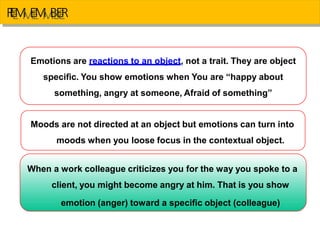
Emotions are reactions to an object, not a trait. They are object
specific. You show emotions when You are “happy about
something, angry at someone, Afraid of something”
Moods are not directed at an object but emotions can turn into
moods when you loose focus in the contextual object.
When a work colleague criticizes you for the way you spoke to a
client, you might become angry at him. That is you show
emotion (anger) toward a specific object (colleague)
Emotion Dimensions;
▪ Variety of emotions
▪
▪
Positive (joy and gratitude)
Negative (anger and guilt)
▪ Intensity of emotions
▪
▪
Personality
Job Requirements
▪ Frequency and duration of emotions
▪
▪
How often emotions are exhibited.
How long emotions are displayed.
Wh
hat Is the Function of Emottiio
on?
Copyright © 2011 Pearson Education, Inc. publishing as Prentice Hall
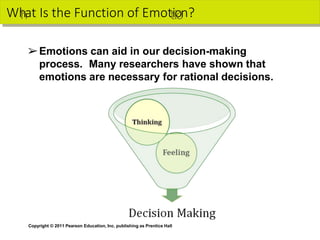
➢Emotions can aid in our decision-making
process. Many researchers have shown that
emotions are necessary for rational decisions.
Basic Mo
o
o
o
ds: Positive a
a
n
n
d
dNegativ
v
e
eAffe
e
c
c
tt
Basic Mo
o
o
o
ds: Positive a
a
n
n
d
dNegativ
v
e
eAffe
e
c
c
tt
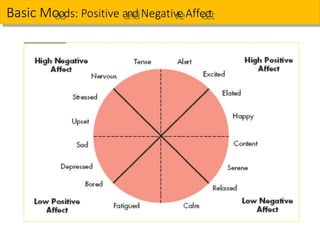
Positive Affect
▪
▪
▪
A mood dimension that consists of specific positive emotions;
Excitement , self-assurance and cheerfulness at the high end
Boredom, sluggishness and tiredness at the lower end
Negative Affect
▪
▪
▪
A mood dimension that consists of emotions;
Nervousness, stress and anxiety at the high end
Relaxation, tranquility (calm) and poise at the lower end
Positive offset
▪ The tendency of most individuals to experience a mildly positive
mood at zero input. (when nothing in particular is going on)
Wh
hat Is the Function of Emottiio
on?
▪ Do Emotions Make Us Irrational?
– Expressing emotions publicly may be damaging to
social status
– Emotions are critical to rational decision-making
– Emotions help us understand the world around us
▪ What Functions Do Emotions Serve?
– Darwin argued they help in survival problem-solving
– Evolutionary psychology: people must experience
emotions as there is a purpose behind them
– Not all researchers agree with this assessment
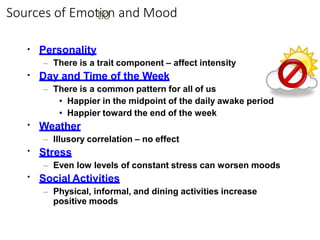
Sources of Emottiio
on and Mood
▪ Personality
– There is a trait component – affect intensity
Day and Time of the Week
– There is a common pattern for all of us
• Happier in the midpoint of the daily awake period
• Happier toward the end of the week
Weather
– Illusory correlation – no effect
Stress
– Even low levels of constant stress can worsen moods
Social Activities
– Physical, informal, and dining activities increase
positive moods
▪
▪
▪
▪
M
Mo
ore Sources of Emotion and M
Mood
▪
▪
▪
▪ Sleep
– Poor sleep quality increases negative affect
Exercise
– Does somewhat improve mood, especially for
depressed people
Age
– Older folks experience fewer negative emotions
Gender
– Women tend to be more emotionally expressive, feel
emotions more intensely, have longer-lasting moods,
and express emotions more frequently than do men
– Due more to socialization than to biology
Emotiona
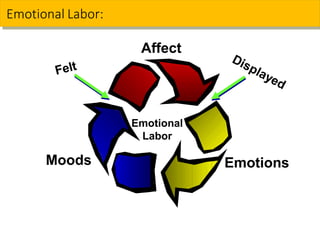
allLabor:
▪ Emotional Labor
– A situation in which an employee expresses
organizationally desired emotions during
interpersonal transactions at work.
Emotional Dissonance
– Inconsistencies between the emotions people feel
and the emotions they project.
– A situation in which an employee must project one
emotion while simultaneously feeling another.
▪
Affect
Emotional
Labor
Moods Emotions
Emotional Labor:
Emotional Labor:
Fe
ellt versus Diis
sp
played Emottiio
ons
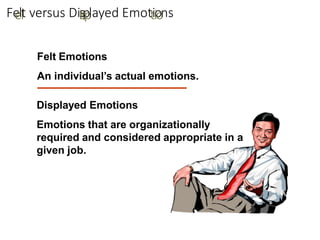
Felt Emotions
An individual’s actual emotions.
Displayed Emotions
Emotions that are organizationally
required and considered appropriate in a
given job.
Emotiona
allLabor
An employee’s expression of organizationally desired
emotions during interpersonal transactions at work.
▪ Types of Emotions:
• Felt: the individual’s actual emotions
• Displayed: required or appropriate emotions
– Surface Acting:
» displaying appropriately but not feeling those
emotions internally
– Deep Acting:
» changing internal feelings to match display rules -
very stressful
A
Afffective Eventts Theory (AET)
▪ How do emotions and moods influence our job
performance and satisfaction?
▪ An event in the work environment triggers positive
or negative emotional reactions
– Personality and mood determine response intensity
– Emotions can influence a broad range of work
variables
Emotions are negative or positive responses to a work
environment event.
– Personality and mood determine the intensity of the
emotional response.
– Emotions can influence a broad range of work performance
and job satisfaction variables.
Implications of the theory:
– Individual response reflects emotions and mood cycles.
– Current and past emotions affect job satisfaction.
– Emotional fluctuations create variations in job satisfaction.
– Emotions have only short-term effects on job performance.
– Both negative and positive emotions can distract workers
and reduce job performance.
A
Afffective Eventts Theory (AET)
▪
▪
A
Afffective Eventts Theory (AET)
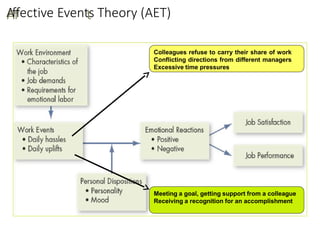
Colleagues refuse to carry their share of work
Conflicting directions from different managers
Excessive time pressures
Meeting a goal, getting support from a colleague
Receiving a recognition for an accomplishment
▪ Ms. Geeta is an office manager and her awareness of her own and
other’s emotions is almost nil.
She is moody and unable to generate much enthusiasm or interest in
her employees
She doesn’t understand why employees get upset with her.
She over reacts to problems and chooses the most unsuccessful
response to emotional situations
Does Geeta has low emotional intelligence?
▪
▪
▪
▪
EmotionaallIntelllliigence (EI)
▪ Emotional Intelligence is a person’s ability to
1) Be self aware (to recognize her own emotions when she experiences them)
2) Detect emotions in others
3) Manage emotional cues and information
▪ People who know their own emotions and are
good at reading emotion cues – i.e – knowing why
they are angry and how to express themselves
with out violating norms are most likely to be
effective
EmotionaallIntelllliigence (EI)
▪ Emotional Intelligence is “the capacity for
recognizing our own feelings and those of others, for
motivating ourselves, and for managing emotions
well in ourselves and in our relationships.
Emotional intelligence describes abilities distinct
from, but complementary to, academic intelligence.”
Daniel Goleman (1998)
▪
EmotionaallIntelllliigence (EI)
▪ How an understanding of emotions and moods can
improve our ability to explain and predict the
selection process in organizations, decision
making, creativity, motivation, leadership,
interpersonal conflict, negotiation, customer
service, job attitudes, and deviant workplace
behaviors.
OB App
p
ll
ica
a
tt
ions of Un
n
d
d
ers
s
tt
anding Emo
o
tt
ions
OB App
p
ll
ica
a
tt
ions of Un
n
d
d
ers
s
tt
anding Emo
o
tt
ions
▪
▪
▪
▪
▪ Ability and Selection
– Emotions affect employee effectiveness.
Decision Making
– Emotions are an important part of the decision-making
process in organizations.
Motivation
– Positive mood affects expectations of success;
– Feedback amplifies this effect.
Leadership
– Emotions are important to acceptance of messages
from organizational leaders.
Creativity
– Positive mood increases flexibility, openness & creativity
OB Applliications… (cont’d)
▪
▪
▪ Interpersonal Conflict
– Conflict in the workplace and individual emotions are
strongly knotted.
Customer Services
– Emotions affect service quality delivered to customers
which, in turn, affects customer relationships
Deviant Workplace Behaviors
– Negative emotions lead to employee deviance (actions
that violate norms and threaten the organization).
• Productivity failures
• Property theft and destruction
• Political actions
• Personal aggression
M
M
ore OB Appll
ii
catt
ii
ons of Emotions and Moods
▪
▪
▪
▪ Negotiation
– Emotions, skillfully displayed, can affect negotiations
Customer Services
– Emotions affect service quality delivered to customers
which, in turn, affects customer relationships
– Emotional Contagion: “catching” emotions from others
Job Attitudes
– Can carry over to home, but dissipate overnight
Manager’s Influence
– Leaders who are in a good mood, use humor / praise
employees increase positive moods in the workplace.
Gllo
obal Implications
▪ Do people experience emotions equally?
– No. Culture can determine type, frequency, and
depth of experienced emotions
• Do people interpret emotions the same way?
– Yes. Negative emotions are seen as undesirable
and positive emotions are desirable
– However, value of each emotion varies across
cultures
• Do norms of emotional expression vary?
– Yes. Some cultures have a bias against emotional
expression; others demand some display of
emotion
– How the emotions are expressed may make
interpretation outside of one’s culture
difficult
▪
▪
Summary and Manageriia
allIIm
mplliic
cattiio
ons
▪ Moods are more general than emotions and less
contextual
Emotions and moods impact all areas of OB
Managers cannot and should not attempt to completely
control the emotions of their employees
Managers must not ignore the emotions of their co-
workers and employees
Behavior predictions will be less accurate if emotions
are not taken into account
▪
▪
▪
▪

Emotions.HRM.pptx

  • 1.
  • 2.
    Wh hy Were Emottiio onsIgnore ed din OB? ▪ The “Myth of Rationality” – Organizations are not emotion-free. – Emotions were seen as irrational – Managers worked to make emotion-free environments View of Emotionality – Emotions were believed to be disruptive – Emotions interfered with productivity ▪ ▪ Now we know emotions can’t be separated from the workplace
  • 3.
    The Basic Emottiioons ▪While not universally accepted, there appear to be six basic emotions: 1. Fear 2. Anger 3. Disgust 4. Surprise 5. Sadness 6. Happiness
  • 4.
    ▪ ▪ ▪ ▪ ▪ ▪ ▪ Anger: fury, resentment,annoyance, hostility. Love: acceptance, friendliness, trust, kindness, obsession. Shame: guilt, repentance, humiliation, regret. Fear: anxiety, nervousness, apprehension, terror. Enjoyment: happiness, joy, relief, contentment, pleasure. Sadness: Grief, sorrow, cheerlessness, gloom. Surprise: Shock, astonishment, amazement wonder. Emotions and their Blendss:
  • 5.
    Wh hat are Emotionsand M Moods?
  • 6.
    Wh hat are Emotionsand M Moods?
  • 7.
    Wh hat is Affectand Moods? Affect; • A generic term that covers a broad range of feelings that people experience. • It is an umbrella concept that encompasses both emotions/moods. Moods; • Feelings that tend to be less intense than emotions and that lack of contextual stimulus.
  • 8.
    R E E M M E E M M B B E E R Emotions are reactionsto an object, not a trait. They are object specific. You show emotions when You are “happy about something, angry at someone, Afraid of something” Moods are not directed at an object but emotions can turn into moods when you loose focus in the contextual object. When a work colleague criticizes you for the way you spoke to a client, you might become angry at him. That is you show emotion (anger) toward a specific object (colleague)
  • 9.
    Emotion Dimensions; ▪ Varietyof emotions ▪ ▪ Positive (joy and gratitude) Negative (anger and guilt) ▪ Intensity of emotions ▪ ▪ Personality Job Requirements ▪ Frequency and duration of emotions ▪ ▪ How often emotions are exhibited. How long emotions are displayed.
  • 10.
    Wh hat Is theFunction of Emottiio on? Copyright © 2011 Pearson Education, Inc. publishing as Prentice Hall ➢Emotions can aid in our decision-making process. Many researchers have shown that emotions are necessary for rational decisions.
  • 11.
    Basic Mo o o o ds: Positivea a n n d dNegativ v e eAffe e c c tt
  • 12.
    Basic Mo o o o ds: Positivea a n n d dNegativ v e eAffe e c c tt Positive Affect ▪ ▪ ▪ A mood dimension that consists of specific positive emotions; Excitement , self-assurance and cheerfulness at the high end Boredom, sluggishness and tiredness at the lower end Negative Affect ▪ ▪ ▪ A mood dimension that consists of emotions; Nervousness, stress and anxiety at the high end Relaxation, tranquility (calm) and poise at the lower end Positive offset ▪ The tendency of most individuals to experience a mildly positive mood at zero input. (when nothing in particular is going on)
  • 13.
    Wh hat Is theFunction of Emottiio on? ▪ Do Emotions Make Us Irrational? – Expressing emotions publicly may be damaging to social status – Emotions are critical to rational decision-making – Emotions help us understand the world around us ▪ What Functions Do Emotions Serve? – Darwin argued they help in survival problem-solving – Evolutionary psychology: people must experience emotions as there is a purpose behind them – Not all researchers agree with this assessment
  • 14.
    Sources of Emottiio onand Mood ▪ Personality – There is a trait component – affect intensity Day and Time of the Week – There is a common pattern for all of us • Happier in the midpoint of the daily awake period • Happier toward the end of the week Weather – Illusory correlation – no effect Stress – Even low levels of constant stress can worsen moods Social Activities – Physical, informal, and dining activities increase positive moods ▪ ▪ ▪ ▪
  • 15.
    M Mo ore Sources ofEmotion and M Mood ▪ ▪ ▪ ▪ Sleep – Poor sleep quality increases negative affect Exercise – Does somewhat improve mood, especially for depressed people Age – Older folks experience fewer negative emotions Gender – Women tend to be more emotionally expressive, feel emotions more intensely, have longer-lasting moods, and express emotions more frequently than do men – Due more to socialization than to biology
  • 16.
    Emotiona allLabor: ▪ Emotional Labor –A situation in which an employee expresses organizationally desired emotions during interpersonal transactions at work. Emotional Dissonance – Inconsistencies between the emotions people feel and the emotions they project. – A situation in which an employee must project one emotion while simultaneously feeling another. ▪
  • 17.
  • 18.
    Fe ellt versus Diis sp playedEmottiio ons Felt Emotions An individual’s actual emotions. Displayed Emotions Emotions that are organizationally required and considered appropriate in a given job.
  • 19.
    Emotiona allLabor An employee’s expressionof organizationally desired emotions during interpersonal transactions at work. ▪ Types of Emotions: • Felt: the individual’s actual emotions • Displayed: required or appropriate emotions – Surface Acting: » displaying appropriately but not feeling those emotions internally – Deep Acting: » changing internal feelings to match display rules - very stressful
  • 20.
    A Afffective Eventts Theory(AET) ▪ How do emotions and moods influence our job performance and satisfaction? ▪ An event in the work environment triggers positive or negative emotional reactions – Personality and mood determine response intensity – Emotions can influence a broad range of work variables
  • 21.
    Emotions are negativeor positive responses to a work environment event. – Personality and mood determine the intensity of the emotional response. – Emotions can influence a broad range of work performance and job satisfaction variables. Implications of the theory: – Individual response reflects emotions and mood cycles. – Current and past emotions affect job satisfaction. – Emotional fluctuations create variations in job satisfaction. – Emotions have only short-term effects on job performance. – Both negative and positive emotions can distract workers and reduce job performance. A Afffective Eventts Theory (AET) ▪ ▪
  • 22.
    A Afffective Eventts Theory(AET) Colleagues refuse to carry their share of work Conflicting directions from different managers Excessive time pressures Meeting a goal, getting support from a colleague Receiving a recognition for an accomplishment
  • 23.
    ▪ Ms. Geetais an office manager and her awareness of her own and other’s emotions is almost nil. She is moody and unable to generate much enthusiasm or interest in her employees She doesn’t understand why employees get upset with her. She over reacts to problems and chooses the most unsuccessful response to emotional situations Does Geeta has low emotional intelligence? ▪ ▪ ▪ ▪ EmotionaallIntelllliigence (EI)
  • 24.
    ▪ Emotional Intelligenceis a person’s ability to 1) Be self aware (to recognize her own emotions when she experiences them) 2) Detect emotions in others 3) Manage emotional cues and information ▪ People who know their own emotions and are good at reading emotion cues – i.e – knowing why they are angry and how to express themselves with out violating norms are most likely to be effective EmotionaallIntelllliigence (EI)
  • 25.
    ▪ Emotional Intelligenceis “the capacity for recognizing our own feelings and those of others, for motivating ourselves, and for managing emotions well in ourselves and in our relationships. Emotional intelligence describes abilities distinct from, but complementary to, academic intelligence.” Daniel Goleman (1998) ▪ EmotionaallIntelllliigence (EI)
  • 26.
    ▪ How anunderstanding of emotions and moods can improve our ability to explain and predict the selection process in organizations, decision making, creativity, motivation, leadership, interpersonal conflict, negotiation, customer service, job attitudes, and deviant workplace behaviors. OB App p ll ica a tt ions of Un n d d ers s tt anding Emo o tt ions
  • 27.
    OB App p ll ica a tt ions ofUn n d d ers s tt anding Emo o tt ions ▪ ▪ ▪ ▪ ▪ Ability and Selection – Emotions affect employee effectiveness. Decision Making – Emotions are an important part of the decision-making process in organizations. Motivation – Positive mood affects expectations of success; – Feedback amplifies this effect. Leadership – Emotions are important to acceptance of messages from organizational leaders. Creativity – Positive mood increases flexibility, openness & creativity
  • 28.
    OB Applliications… (cont’d) ▪ ▪ ▪Interpersonal Conflict – Conflict in the workplace and individual emotions are strongly knotted. Customer Services – Emotions affect service quality delivered to customers which, in turn, affects customer relationships Deviant Workplace Behaviors – Negative emotions lead to employee deviance (actions that violate norms and threaten the organization). • Productivity failures • Property theft and destruction • Political actions • Personal aggression
  • 29.
    M M ore OB Appll ii catt ii onsof Emotions and Moods ▪ ▪ ▪ ▪ Negotiation – Emotions, skillfully displayed, can affect negotiations Customer Services – Emotions affect service quality delivered to customers which, in turn, affects customer relationships – Emotional Contagion: “catching” emotions from others Job Attitudes – Can carry over to home, but dissipate overnight Manager’s Influence – Leaders who are in a good mood, use humor / praise employees increase positive moods in the workplace.
  • 30.
    Gllo obal Implications ▪ Dopeople experience emotions equally? – No. Culture can determine type, frequency, and depth of experienced emotions • Do people interpret emotions the same way? – Yes. Negative emotions are seen as undesirable and positive emotions are desirable – However, value of each emotion varies across cultures • Do norms of emotional expression vary? – Yes. Some cultures have a bias against emotional expression; others demand some display of emotion – How the emotions are expressed may make interpretation outside of one’s culture difficult ▪ ▪
  • 31.
    Summary and Manageriia allIIm mplliic cattiio ons ▪Moods are more general than emotions and less contextual Emotions and moods impact all areas of OB Managers cannot and should not attempt to completely control the emotions of their employees Managers must not ignore the emotions of their co- workers and employees Behavior predictions will be less accurate if emotions are not taken into account ▪ ▪ ▪ ▪