Copyright ©2014 Pearson Education, Inc.
9-1
Chapter 8
Foundations of Group Behavior
Essentials of
Organizational Behavior
12e
Stephen P. Robbins & Timothy A. Judge
Copyright ©2014 Pearson Education, Inc.
After studying this chapter,
you should be able to:
1. Define group and distinguish the different
types of groups.
2. Identify the five stages of group
development.
3. Show how role requirements change in
different situations.
4. Demonstrate how norms and status exert
influence on an individual’s behavior.
5. Contrast the strengths and weaknesses of
group decision making.
9-2
Copyright ©2014 Pearson Education, Inc.
Groups
Group: Two or more
individuals, interacting
and interdependent, who
come together to achieve
particular objectives
9-3
 Formal: Defined by the
organization’s structure
 Informal: Neither formally
structured nor organizationally
determined
Copyright ©2014 Pearson Education, Inc.
Four Types of Groups
Formal Groups
 Command – determined
by the organization chart
 Task – working together
to complete a job task
Informal Groups
 Interest – affiliate
to attain a specific
objective of shared
interest
 Friendship –
members have one
or more common
characteristics
9-4
Copyright ©2014 Pearson Education, Inc.
Why Do People Join Groups?
 Security
 Status
 Self-esteem
 Affiliation
 Power
 Goal achievement
9-5
Copyright ©2014 Pearson Education, Inc.
Group Properties
 Roles
 Norms
 Status
 Size
 Cohesiveness
9-6
Copyright ©2014 Pearson Education, Inc.
Group Property 1: Roles
Role: The set of expected behavior patterns
that are attributed to occupying a given
position in a social unit
 Role perception – our view of how we’re
supposed to act in a given situation
 Role expectations – how others believe you
should act in a given situation
 Role conflict – conflict experienced when
multiple roles are incompatible
9-7
Copyright ©2014 Pearson Education, Inc.
Group Property 2: Norms
Acceptable standards of behavior within a
group that are shared by the group’s members
9-8
Powerful means of
influencing behavior
 Performance norms
 Appearance norms
 Social arrangement
norms
 Resource allocation
norms
Copyright ©2014 Pearson Education, Inc.
Group Property 3: Status
 Status: A socially defined position or rank
given to groups or group members by others
 Determined by
 The power a person wields over others
 A person’s ability to contribute to a group’s goals
 An individual’s personal characteristics
9-9
Copyright ©2014 Pearson Education, Inc.
Group Property 4: Size
Smaller groups are faster
at completing tasks –
members perform better
Large groups are
consistently better at
problem solving
9-10
Copyright ©2014 Pearson Education, Inc.
Social Loafing
Causes:
 Equity theory – unequal
distribution of work
 Dispersion of
responsibility – clouds
the relationship between
individual inputs and
group output
Prevention:
 Set group goals
 Increase inter-group
competition
 Engage in peer evaluation
 Select members who have
high motivation and like to
work in groups
 Distribute group rewards
based on members’
individual contributions
9-11
Copyright ©2014 Pearson Education, Inc.
Group Property 5:
Cohesiveness
Cohesiveness: The degree to which members
of the group are attracted to each other and
motivated to stay in the group
 Performance-related norms are the moderating
variable for productivity and cohesiveness
 High cohesiveness with high norms gives higher
productivity
9-12
Copyright ©2014 Pearson Education, Inc.
Group Property 6:
Diversity
Diversity: the degree to which members of
the group are similar to, or different from,
one another
 Cultural
 Demographic
Racial
Gender
Diversity increases group conflict, but may
improve group performance in the long term 9-13
Copyright ©2014 Pearson Education, Inc.
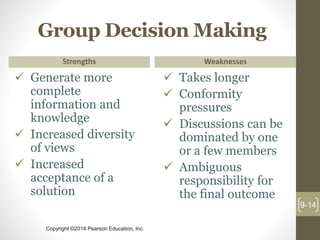
Group Decision Making
Strengths
 Generate more
complete
information and
knowledge
 Increased diversity
of views
 Increased
acceptance of a
solution
Weaknesses
 Takes longer
 Conformity
pressures
 Discussions can be
dominated by one
or a few members
 Ambiguous
responsibility for
the final outcome
9-14
Copyright ©2014 Pearson Education, Inc.
Effectiveness & Efficiency
 Effectiveness
 Accuracy – group is better than average individual
but worse than most accurate group member
 Speed – individuals are faster
 Creativity – groups are better
 Degree of Acceptance – groups are better
Efficiency
 Groups are generally less efficient
9-15
Copyright ©2014 Pearson Education, Inc.
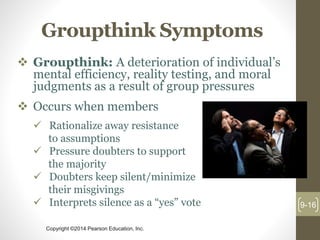
Groupthink Symptoms
 Groupthink: A deterioration of individual’s
mental efficiency, reality testing, and moral
judgments as a result of group pressures
 Occurs when members
 Rationalize away resistance
to assumptions
 Pressure doubters to support
the majority
 Doubters keep silent/minimize
their misgivings
 Interprets silence as a “yes” vote 9-16
Copyright ©2014 Pearson Education, Inc.
Groupshift or
Group Polarization
 Groupshift: Group
discussions lead
members to assume new,
more extreme, positions
 Groups often take
positions of greater risk
 May be due to diffused
responsibility
9-17
Copyright ©2014 Pearson Education, Inc.
Group Decision Making
Techniques
Interacting groups meet face-to-face and
rely on verbal and non-verbal interactions to
communicate
Brainstorming
Generates a list of creative alternatives
 Problem: production blocking
Nominal Group Technique (NGT)
Restricts discussion during the decision-
making process to encourage independent
thinking 9-18

Organizational behavior chapter 8

  • 1.
    Copyright ©2014 PearsonEducation, Inc. 9-1 Chapter 8 Foundations of Group Behavior Essentials of Organizational Behavior 12e Stephen P. Robbins & Timothy A. Judge
  • 2.
    Copyright ©2014 PearsonEducation, Inc. After studying this chapter, you should be able to: 1. Define group and distinguish the different types of groups. 2. Identify the five stages of group development. 3. Show how role requirements change in different situations. 4. Demonstrate how norms and status exert influence on an individual’s behavior. 5. Contrast the strengths and weaknesses of group decision making. 9-2
  • 3.
    Copyright ©2014 PearsonEducation, Inc. Groups Group: Two or more individuals, interacting and interdependent, who come together to achieve particular objectives 9-3  Formal: Defined by the organization’s structure  Informal: Neither formally structured nor organizationally determined
  • 4.
    Copyright ©2014 PearsonEducation, Inc. Four Types of Groups Formal Groups  Command – determined by the organization chart  Task – working together to complete a job task Informal Groups  Interest – affiliate to attain a specific objective of shared interest  Friendship – members have one or more common characteristics 9-4
  • 5.
    Copyright ©2014 PearsonEducation, Inc. Why Do People Join Groups?  Security  Status  Self-esteem  Affiliation  Power  Goal achievement 9-5
  • 6.
    Copyright ©2014 PearsonEducation, Inc. Group Properties  Roles  Norms  Status  Size  Cohesiveness 9-6
  • 7.
    Copyright ©2014 PearsonEducation, Inc. Group Property 1: Roles Role: The set of expected behavior patterns that are attributed to occupying a given position in a social unit  Role perception – our view of how we’re supposed to act in a given situation  Role expectations – how others believe you should act in a given situation  Role conflict – conflict experienced when multiple roles are incompatible 9-7
  • 8.
    Copyright ©2014 PearsonEducation, Inc. Group Property 2: Norms Acceptable standards of behavior within a group that are shared by the group’s members 9-8 Powerful means of influencing behavior  Performance norms  Appearance norms  Social arrangement norms  Resource allocation norms
  • 9.
    Copyright ©2014 PearsonEducation, Inc. Group Property 3: Status  Status: A socially defined position or rank given to groups or group members by others  Determined by  The power a person wields over others  A person’s ability to contribute to a group’s goals  An individual’s personal characteristics 9-9
  • 10.
    Copyright ©2014 PearsonEducation, Inc. Group Property 4: Size Smaller groups are faster at completing tasks – members perform better Large groups are consistently better at problem solving 9-10
  • 11.
    Copyright ©2014 PearsonEducation, Inc. Social Loafing Causes:  Equity theory – unequal distribution of work  Dispersion of responsibility – clouds the relationship between individual inputs and group output Prevention:  Set group goals  Increase inter-group competition  Engage in peer evaluation  Select members who have high motivation and like to work in groups  Distribute group rewards based on members’ individual contributions 9-11
  • 12.
    Copyright ©2014 PearsonEducation, Inc. Group Property 5: Cohesiveness Cohesiveness: The degree to which members of the group are attracted to each other and motivated to stay in the group  Performance-related norms are the moderating variable for productivity and cohesiveness  High cohesiveness with high norms gives higher productivity 9-12
  • 13.
    Copyright ©2014 PearsonEducation, Inc. Group Property 6: Diversity Diversity: the degree to which members of the group are similar to, or different from, one another  Cultural  Demographic Racial Gender Diversity increases group conflict, but may improve group performance in the long term 9-13
  • 14.
    Copyright ©2014 PearsonEducation, Inc. Group Decision Making Strengths  Generate more complete information and knowledge  Increased diversity of views  Increased acceptance of a solution Weaknesses  Takes longer  Conformity pressures  Discussions can be dominated by one or a few members  Ambiguous responsibility for the final outcome 9-14
  • 15.
    Copyright ©2014 PearsonEducation, Inc. Effectiveness & Efficiency  Effectiveness  Accuracy – group is better than average individual but worse than most accurate group member  Speed – individuals are faster  Creativity – groups are better  Degree of Acceptance – groups are better Efficiency  Groups are generally less efficient 9-15
  • 16.
    Copyright ©2014 PearsonEducation, Inc. Groupthink Symptoms  Groupthink: A deterioration of individual’s mental efficiency, reality testing, and moral judgments as a result of group pressures  Occurs when members  Rationalize away resistance to assumptions  Pressure doubters to support the majority  Doubters keep silent/minimize their misgivings  Interprets silence as a “yes” vote 9-16
  • 17.
    Copyright ©2014 PearsonEducation, Inc. Groupshift or Group Polarization  Groupshift: Group discussions lead members to assume new, more extreme, positions  Groups often take positions of greater risk  May be due to diffused responsibility 9-17
  • 18.
    Copyright ©2014 PearsonEducation, Inc. Group Decision Making Techniques Interacting groups meet face-to-face and rely on verbal and non-verbal interactions to communicate Brainstorming Generates a list of creative alternatives  Problem: production blocking Nominal Group Technique (NGT) Restricts discussion during the decision- making process to encourage independent thinking 9-18

Editor's Notes

  • #4 Groups are defined as two or more individuals who come together to achieve a set goal. There are two main types of groups. The first is a formal group where the organization establishes the group with defined work tasks and outcomes. The second group is an informal group that is not part of the organizational structure. They are often established in reaction to a need for social interaction and form naturally. Informal groups can have a significant influence on behavior and performance.
  • #5 Within the category of formal groups there are two main types. The command group is one that reports directly to a given manager such as a department or unit. A task group is formed to accomplish a particular objective but is not limited by the structure or departments of the organization. Informal groups also have subgroups. They are typically formed around a common interest such as an interest group or around common characteristics such as a friendship group.
  • #6 There are many reasons that people will join groups. However, the social identity theory suggests that people have emotional reactions to the failures or successes of a group because their self-esteem gets tied into the performance of the group. Social identity is developed when the characteristics of similarity, distinctiveness, status and uncertainty reduction are present. Members of group often join groups of people who are similar to them, however, they want the group to be distinct. Since people define themselves by groups they are connected to, they will tend to want to be a part of high-status groups. People also join groups to reduce uncertainty as a way to maintain a sense of who they are and how they fit into this world.
  • #7 Work groups have properties including roles, norms, status, size, and cohesiveness, that shape the behavior of members. These properties can help explain and predict behavior within the group and the performance of the group itself.
  • #8 Roles are the expected behavior individuals will take on in a group such as the leader or the task master. Each role is assigned a certain identity that explains expected attitudes and behaviors that correspond with the role identity. Each individual has their own point of view of how they are supposed to act in the context of the group, this is called role perception. Role expectations looks at how others believe a person should act in given situation. Role conflict occurs when the expected behaviors don’t match up with the behaviors being exhibited.
  • #9 Norms are standards of behavior that are acceptable by group members. There are different types of norms such as performance norms that look at an acceptable work level or quality or appearance norms about what to wear. Social arrangement norms look at acceptable relationships and allocation of resources norms look at how things are distributed.
  • #10 Status is another group property and refers to the position or rank given to groups or their members as a way to differentiate members. Status can influence behavior and has been found to be a significant motivator. The status characteristics theory suggest that status is derived by one of three sources; the power a person has over others; the ability to contribute to group goals; or personal characteristics.
  • #11 Size is important factor in group behavior as well and impacts the behavior in groups. The larger the group the harder it is to get contributions from all members in a timely manner. In contrast, small groups can be limited in their problem-solving ability and the availability of resources could be limited. There are some detrimental behaviors that can occur around group size. For example as groups get larger social loafing can occur. Some individuals may put in less effort because they think others in the group will make up for them.
  • #12 Social loafing occurs when individuals don’t work as hard in groups as they would on an individual basis. This is exhibited in Ringelmann’s rope pull example which is discussed in the book. Initially the group increased productivity, but as the group grew larger each individual contributed less to the group. This could be due to the fact that some members felt that individual inputs were not equitable, or because they let others take responsibility for the outcome. This is often referred to as free riding. When working with groups managers one must be sure to build in individual accountability. Social loafing can be prevented by setting up goals, encouraging intergroup competition, using peer evaluation as part of the feedback process and linking group rewards to individual behavior.
  • #13 The final property of groups is group cohesiveness or the degree to which group members want to stay together and are motivated to work together as a group. Managers can do a lot to encourage group cohesiveness. If performance norms are high then a more cohesive group will rise to the occasion and will achieve a high level of productivity.
  • #14 Diversity refers to the degree to which members of a group are similar or different from one another. These differences, which may be cultural or demographic, can increase group conflict in the short term, but once the conflicts are resolved, the group may actually perform better than a non-diverse group.
  • #15 Group decision making can be beneficial, but it also has its disadvantages. Groups do tend to generate more complete information and knowledge as well as offer a greater diversity of views and increased creativity, but since more people are involved in the decision there is a risk of conformity, and no clear responsibility for outcomes. Moreover, discussions can be dominated by a few members.
  • #16 In some situations groups are more effective or efficient, and in other situations, individuals are. When it comes to accuracy, groups tend to perform better, but they are not as fast. Groups can be more creative and their decisions may be better accepted because of multi-person buy in.
  • #17 A common problem with groups is groupthink. This occurs when the group is seeking conformity and there is pressure to come to a conclusion without critically appraising alternative viewpoints. Members are more likely to engage in groupthink when they tend to rationalize away any resistance to assumptions, and they feel pressure to support the majority. Doubters tend to keep silent and minimize their thoughts on what might be wrong with a proposed solution, and the rest of the group interprets this to be a yes vote.
  • #18 Another phenomenon in the group decision making process is groupshift where once a solution is selected group members tend to exaggerate the initial positions that they hold. This can cause a shift to a more conservative or risky decision.
  • #19 Some group techniques can assist in the decision-making process. The first technique that can help is brainstorming. This is a process that is aimed at generating ideas where all ideas are welcomed and the group tries to create an environment that overcomes pressure for conformity. The nominal group technique works by restricting discussion during the decision-making process to help participants to operate independently.