Service Focus, Encounters
Why focus? Types of Encounters,
Characteristics, Perspectives of
Encounters
Service Focus
• Skinner (1974): ‘A factory that focuses on a
narrow product mix for a particular market niche
will outperform the conventional plant which
attempts a broader mission’
This philosophy applies equally well to service
industries
You cannot provide a great service unless your
business system is optimized to the needs of a
certain segment
The benefits of focus-
to organization
• Simplified operation
• Predetermined service
• Dedicated operation
• Dedicated facilities
• Tight process control
• Ease of training
• Lower costs
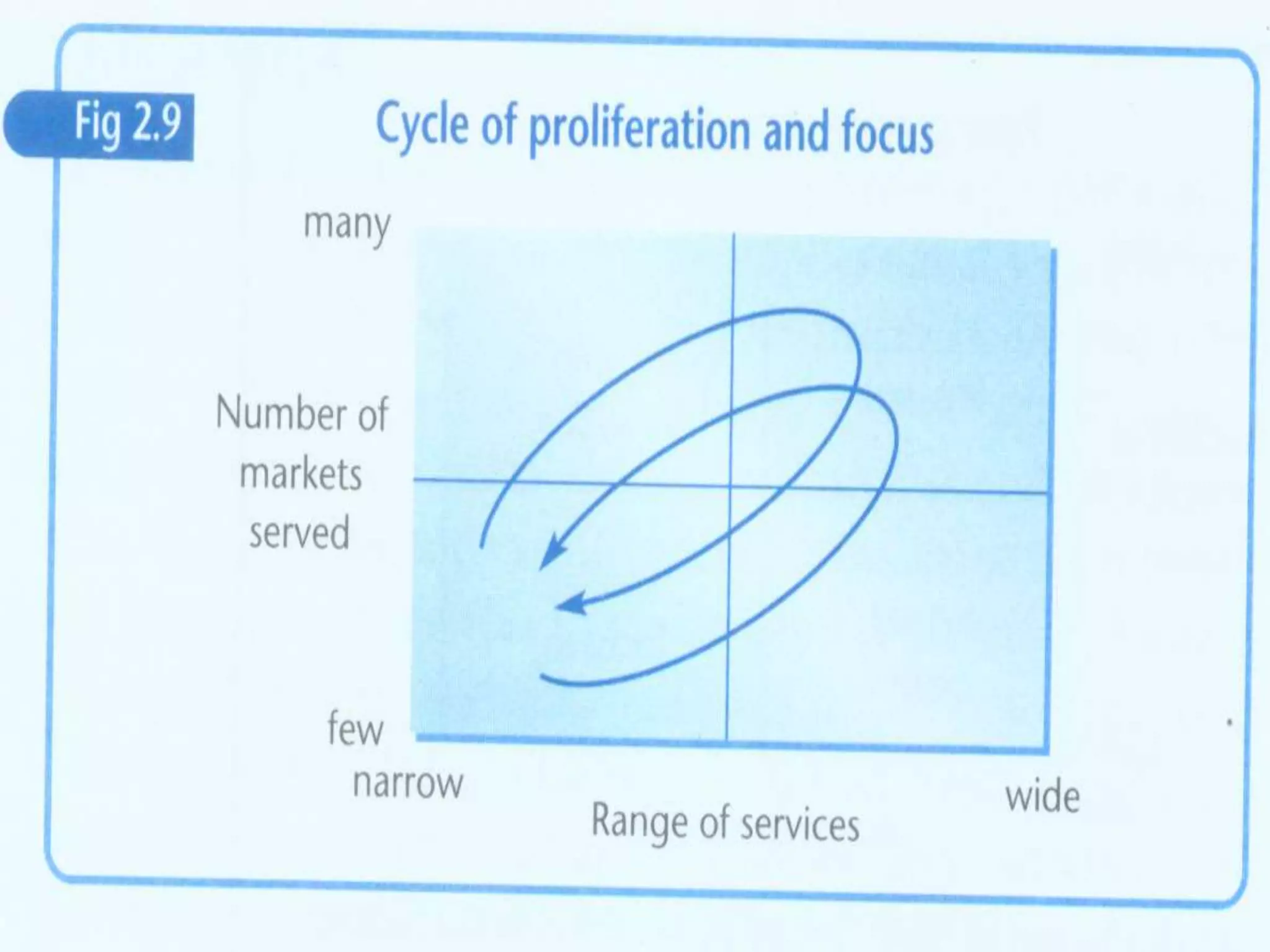
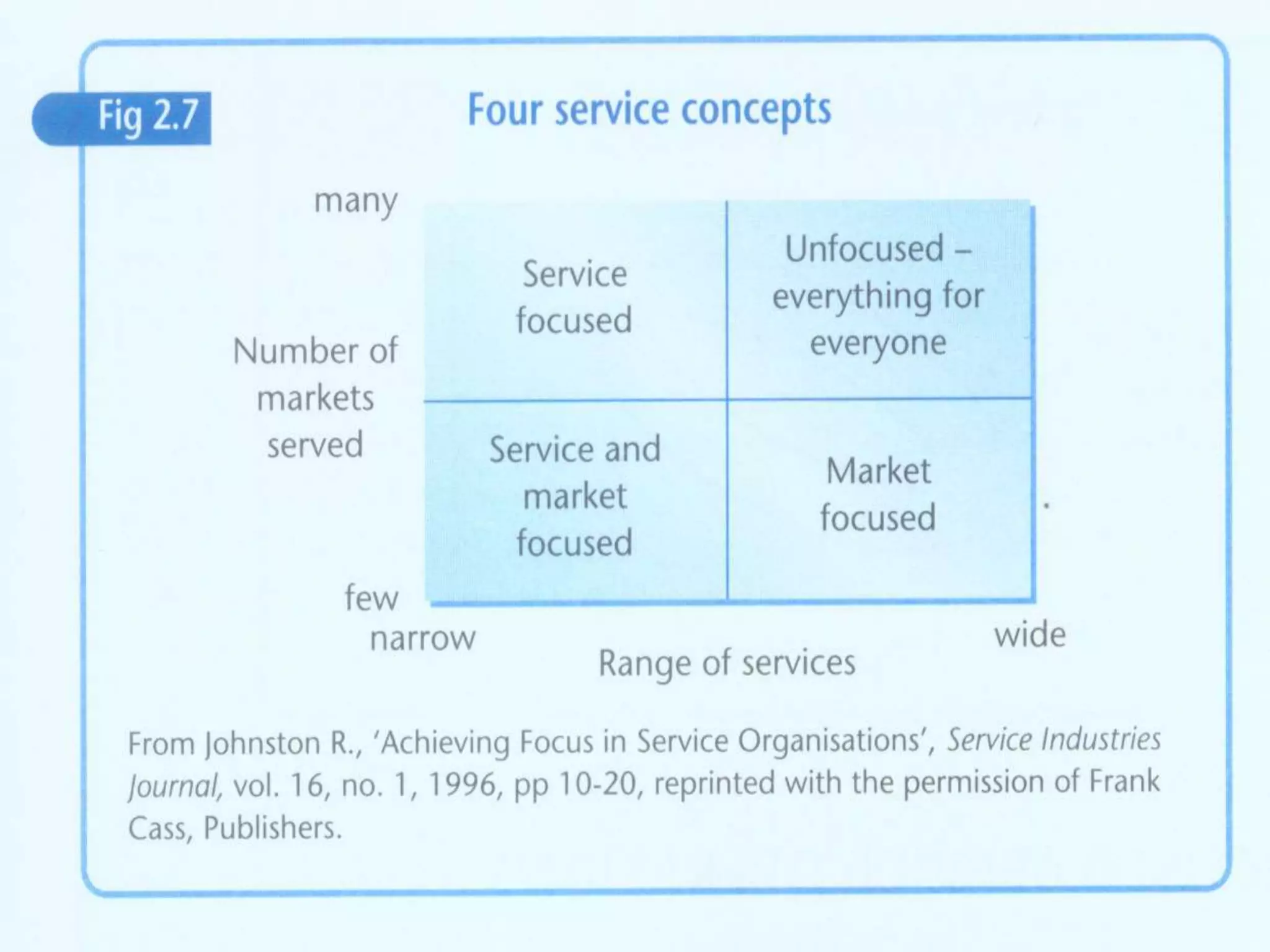
Four service focuses
1 Service focused: limit the services provided,
Ex. Credit card world wide
2 Market focused: limit the markets served,
Ex. Rural banks
3 Service and market focused: provide a narrow range of
services to a niche market,
Ex. Credit cards and service for high-wealth individuals
4 Unfocused: provide a wide range of services for a wide
range of people, that everything for everyone,
Ex. Internet, Disneyland, supermarkets, police services
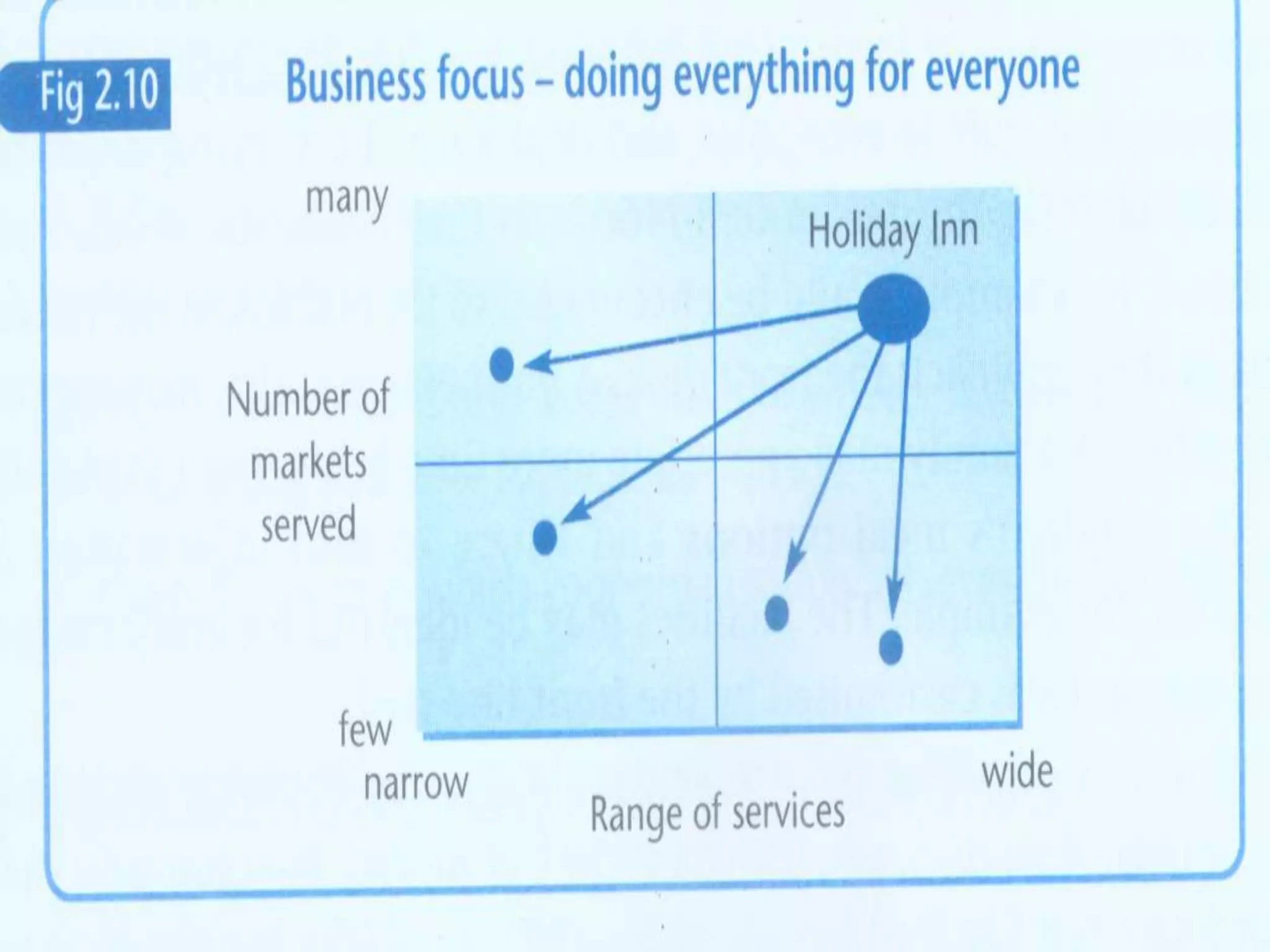
Unfocused service operations
How to get benefit of focus
• Business focus: Split business to deal
with different types of customers
Ex. Holiday Inn,
1. Express hotels focus on value for money,
offer competitive rates
2. Crowne Plaza Hotels provide upscale
lodging to discerning travelers
3. Inter-continental Hotels provide five-star
service
Operational Focus
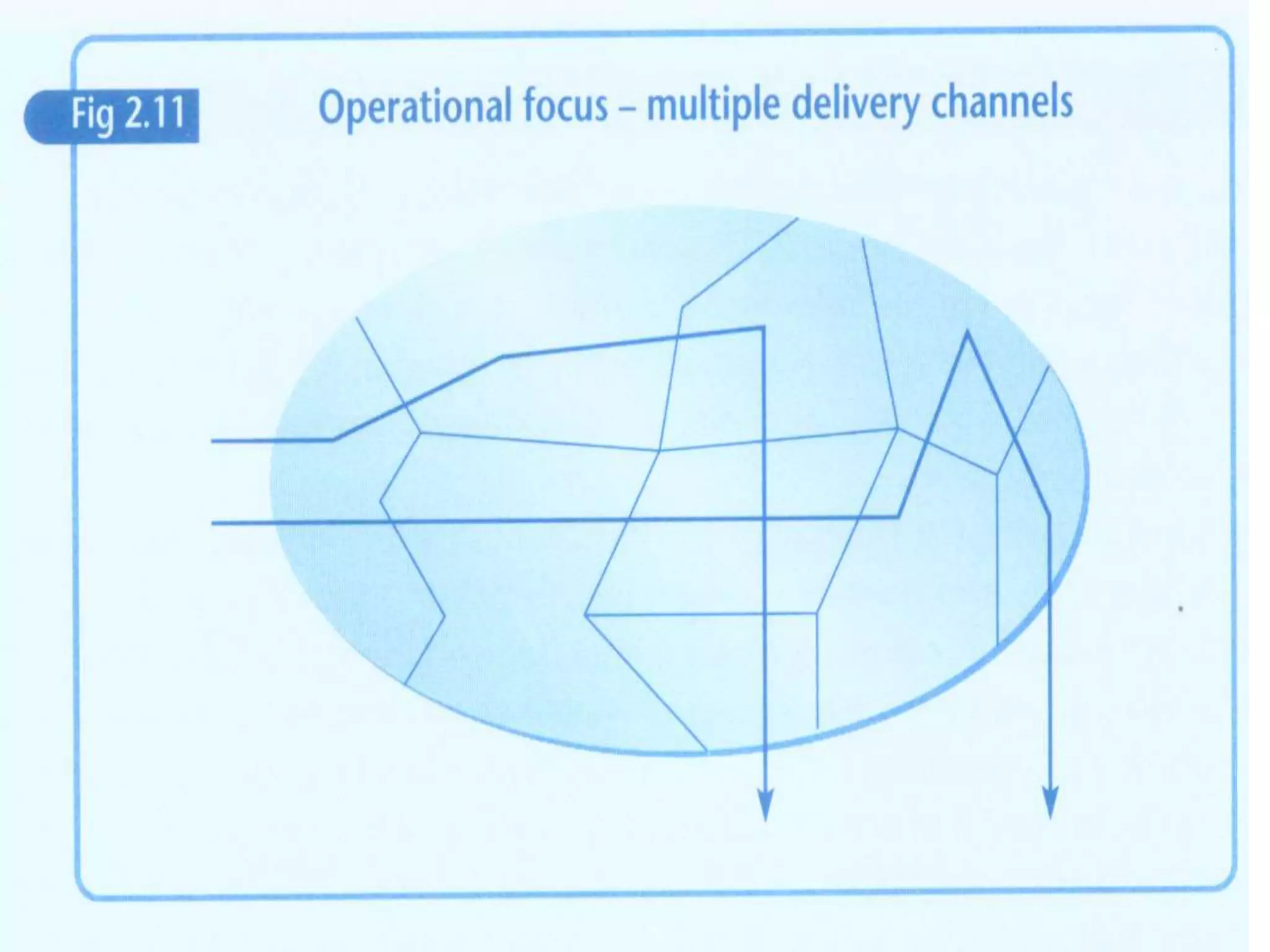
• Operational focus: Split operations into several
parts so that each caters for a set of needs
Example: Malls (or Hypermarkets) provide different
types of shops, retailers, cinemas, a variety of
eating places, thus allowing customers to
choose their own service experience
Some hotels escort their premium customers to
their rooms
Dedicated lounges or channels are other examples
Encounter focused
• Encounter focused: Through recognizing
and dealing with the varying needs of
customers by adapting the encounter to
focus on their particular needs.
The staff assesses the needs of the
customers as they approach and
explain/provide information
Encounter gets customized.
Service Encounters
Moment of Truth
Acid test of many service operations is at
the point of delivery
Any episode in which the customer comes
into contact with any aspect of the
organization and gets an impression of the
quality of its service
Any point of contact between the customer
and service operation
Types of encounters
• Remote encounters: No direct human contact
is involved. Ex. Letters, ATM’s, Internet based
services
• Phone encounters: Common in retail and
financial services; call centers, order taking,
handling billing queries
• Face-to-face encounters: Most complex and
most intense. Some services, as meals in a
restaurant, are linked directly to the ‘get on with’
people serving
Intensity of service encounters
Intensity refers to the extent of some degree of risk or
uncertainty as perceived by the customer. There is
variability in intensity.
• Financial risk: Customer has no knowledge about the
reliability of service. Purchase of a second hand car or
insurance policies
• Physical risk: Example: Flying in an airline; adventure
holiday, skiing
• Psychological risk: Arises from customer’s lack of
confidence. No one likes to feel inferior or incompetent.
Some ;private’ people find any form of a social encounter
in a large gathering painful
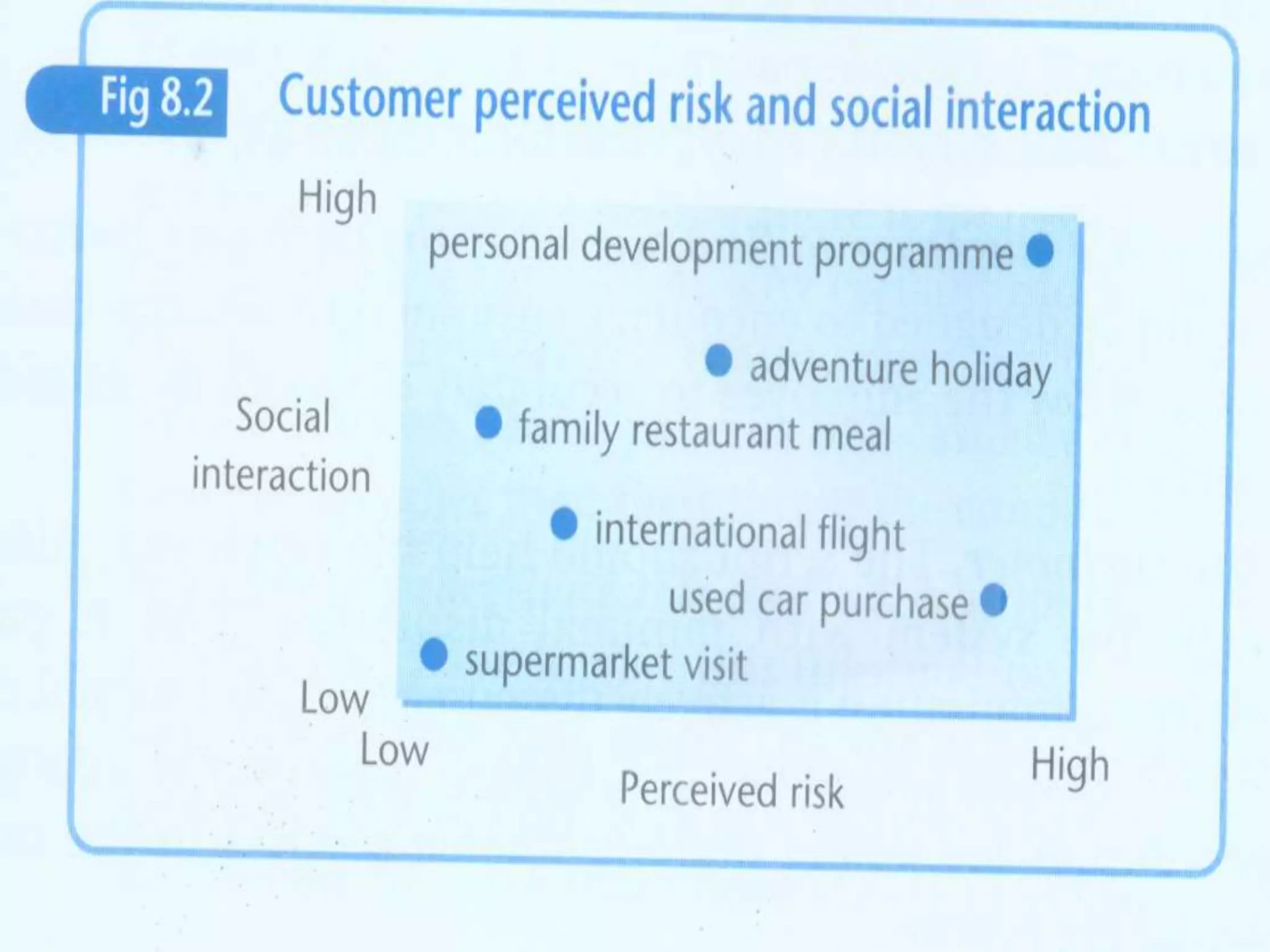
Social interaction and Customer
perceived risk
• Mall: superficial interaction
• Restaurant: limited to service of food
• Flight: passengers and staff
• Holiday plans: more unknown persons
• Used car: lack of knowledge
• Development programmes: fear of
exposure before others
Variables that complicate service
encounter
• Customer mind-set: Predisposition to
family entertainment can distract any
service
• Customer mood: same customer in a
different mood can bring business
• Personality Clashes: instant dislikes of
service provider
Characteristics of Encounters
• Service encounters are purposeful:
These have goals
• Service providers are not altruistic: It is
gainful duty of the service providers
• Prior acquaintance is not required: Are
strangers and need information
• Service encounters are limited in
scope: Limited to service needed
Characteristics of Encounters
• Task related information exchange
dominates: Service depends on the information
exchanged-travel, finance
• Client and service provider roles are well
defined: customer asks for services; a patient
answers questions
• A temporary status differential may occur:
lawyer may deal with a criminal; a doctor treats a
poor person
Perspectives of Encounters
• Social Encounters: Imply interaction at equal
levels and understanding
• Economic Exchange: services in exchange of
monetary benefits
• Production process: Transformation of inputs
(sometimes of customers) to outputs
• Contract: Both parties operate in a contract;
Such as surgery on permission from patient
• Partial employment: Customer aids in the
process
Four elements of
Service Encounter
1. Customer
2. Service Provider
3. Delivery System: Comprises of equipment,
supplies, rules, regulations, organizational
culture. Core service delivery has to be
flawless. Supplementary services add to the
support and enhance the core service
4. Physical Evidence: Includes physical facilities,
building, furniture, tidiness, signage to reach
Fifth Element
Other customers have a role to play when
proximity to groups exist- travel, restaurant
• Select the right customer:
age limits, dress code, pricing,
• Establish rules of behaviour:
no smoking, no diving, no drunkenness
• Facilitate positive customer -customer
relationship:
shared enjoyment on ships, new year gathering
in hotels
Script
• Scripts are just like scripts for a play.
• These outline, in the customers’ mind, just what
is likely to happen during the provision of a
service.
• If there are then differences between the script
and what actually happens, dissatisfaction or
delight may result.
• Scripts are also used to identify gaps between
what the customer expects from a service and
how the provider of the service views the
encounter
Script for Provider
• Provider of service can also have a script
for the service encounter.
• It is likely to be more elaborate than the
customer’ script, because that particular
type of encounter is being repeated over
and over again, every day, with many
different customers. The provider’s script,
therefore has to allow for many variants.
Scripts lead to:
• A sense of security for customers and
service-providers alike; a familiar script
allows customers to relax because they
understand the rules by which the
encounter will be played out
• It is a technique used in operations to
provide consistency and efficiency
• To assess performance and to improve
quality by bridging the gaps
Functions of Scripting,
Tansik and Smith( 2000)
1. To assist the service provider to find out
what the customer wants or needs: provider
script should encourage customers to specify
their needs in an encounter
2. To control the customer:- suggestions to
enable a rapid decision– ‘can we suggest-----’
3. To establish historical routines that may be
relevant to the service encounter: so that
customers move into unconscious routines and
get involved in the service delivery process
Functions of Scripting,
Tansik and Smith( 2000)
4. To facilitate control of providers: consistency
at multi-server points; as also in cross-selling
through sub-scripts
5. To legitimize organizational actions: fast food
(speed) and gourmet restaurants (relaxed
service)
6. To serve as analogies: Script learned by an
employee in previous employment can be
used for developing new script
Functions of Scripting,
Tansik and Smith( 2000)
7. To facilitate organized behaviour: In surgery,
the actions of team members are
choreographed and rehearsed beforehand to
allow for smooth running. It helps in
interchangeability, if a member is absent
8. To provide a guide to behaviour: scripts set
expectations as to what will happen in a next
encounter. Patients in a clinic will accept an out
of turn patient if his condition is life threatening
Functions of Scripting,
Tansik and Smith( 2000)
9. To buffer role conflict: Scripts help to provide
unwelcome or unpopular information to
customers—as ‘Regulations require us to inform
you----’ or ‘I am sorry, the company’s policy is—’
10. To provide a basis for evaluating
behaviour: Used to evaluate an employee’s
behaviour. Relevant in a call center.
11. To conserve cognitive capacity: Scripts allow
employee to work on a number of activities
simultaneously
Problems with Scripting
1. Inflexibility: Absence of an expected
response from customer can create
problems
2. Customer perception of a robot-like
behaviour: A repeat customer expects
what is coming next; no innovatory
approach
3. Defensive behaviour: against similar
complaints from customers

Service focus and service encounters

  • 1.
    Service Focus, Encounters Whyfocus? Types of Encounters, Characteristics, Perspectives of Encounters
  • 2.
    Service Focus • Skinner(1974): ‘A factory that focuses on a narrow product mix for a particular market niche will outperform the conventional plant which attempts a broader mission’ This philosophy applies equally well to service industries You cannot provide a great service unless your business system is optimized to the needs of a certain segment
  • 3.
    The benefits offocus- to organization • Simplified operation • Predetermined service • Dedicated operation • Dedicated facilities • Tight process control • Ease of training • Lower costs
  • 5.
    Four service focuses 1Service focused: limit the services provided, Ex. Credit card world wide 2 Market focused: limit the markets served, Ex. Rural banks 3 Service and market focused: provide a narrow range of services to a niche market, Ex. Credit cards and service for high-wealth individuals 4 Unfocused: provide a wide range of services for a wide range of people, that everything for everyone, Ex. Internet, Disneyland, supermarkets, police services
  • 7.
    Unfocused service operations Howto get benefit of focus • Business focus: Split business to deal with different types of customers Ex. Holiday Inn, 1. Express hotels focus on value for money, offer competitive rates 2. Crowne Plaza Hotels provide upscale lodging to discerning travelers 3. Inter-continental Hotels provide five-star service
  • 9.
    Operational Focus • Operationalfocus: Split operations into several parts so that each caters for a set of needs Example: Malls (or Hypermarkets) provide different types of shops, retailers, cinemas, a variety of eating places, thus allowing customers to choose their own service experience Some hotels escort their premium customers to their rooms Dedicated lounges or channels are other examples
  • 11.
    Encounter focused • Encounterfocused: Through recognizing and dealing with the varying needs of customers by adapting the encounter to focus on their particular needs. The staff assesses the needs of the customers as they approach and explain/provide information Encounter gets customized.
  • 12.
    Service Encounters Moment ofTruth Acid test of many service operations is at the point of delivery Any episode in which the customer comes into contact with any aspect of the organization and gets an impression of the quality of its service Any point of contact between the customer and service operation
  • 13.
    Types of encounters •Remote encounters: No direct human contact is involved. Ex. Letters, ATM’s, Internet based services • Phone encounters: Common in retail and financial services; call centers, order taking, handling billing queries • Face-to-face encounters: Most complex and most intense. Some services, as meals in a restaurant, are linked directly to the ‘get on with’ people serving
  • 14.
    Intensity of serviceencounters Intensity refers to the extent of some degree of risk or uncertainty as perceived by the customer. There is variability in intensity. • Financial risk: Customer has no knowledge about the reliability of service. Purchase of a second hand car or insurance policies • Physical risk: Example: Flying in an airline; adventure holiday, skiing • Psychological risk: Arises from customer’s lack of confidence. No one likes to feel inferior or incompetent. Some ;private’ people find any form of a social encounter in a large gathering painful
  • 15.
    Social interaction andCustomer perceived risk • Mall: superficial interaction • Restaurant: limited to service of food • Flight: passengers and staff • Holiday plans: more unknown persons • Used car: lack of knowledge • Development programmes: fear of exposure before others
  • 17.
    Variables that complicateservice encounter • Customer mind-set: Predisposition to family entertainment can distract any service • Customer mood: same customer in a different mood can bring business • Personality Clashes: instant dislikes of service provider
  • 18.
    Characteristics of Encounters •Service encounters are purposeful: These have goals • Service providers are not altruistic: It is gainful duty of the service providers • Prior acquaintance is not required: Are strangers and need information • Service encounters are limited in scope: Limited to service needed
  • 19.
    Characteristics of Encounters •Task related information exchange dominates: Service depends on the information exchanged-travel, finance • Client and service provider roles are well defined: customer asks for services; a patient answers questions • A temporary status differential may occur: lawyer may deal with a criminal; a doctor treats a poor person
  • 20.
    Perspectives of Encounters •Social Encounters: Imply interaction at equal levels and understanding • Economic Exchange: services in exchange of monetary benefits • Production process: Transformation of inputs (sometimes of customers) to outputs • Contract: Both parties operate in a contract; Such as surgery on permission from patient • Partial employment: Customer aids in the process
  • 21.
    Four elements of ServiceEncounter 1. Customer 2. Service Provider 3. Delivery System: Comprises of equipment, supplies, rules, regulations, organizational culture. Core service delivery has to be flawless. Supplementary services add to the support and enhance the core service 4. Physical Evidence: Includes physical facilities, building, furniture, tidiness, signage to reach
  • 22.
    Fifth Element Other customershave a role to play when proximity to groups exist- travel, restaurant • Select the right customer: age limits, dress code, pricing, • Establish rules of behaviour: no smoking, no diving, no drunkenness • Facilitate positive customer -customer relationship: shared enjoyment on ships, new year gathering in hotels
  • 23.
    Script • Scripts arejust like scripts for a play. • These outline, in the customers’ mind, just what is likely to happen during the provision of a service. • If there are then differences between the script and what actually happens, dissatisfaction or delight may result. • Scripts are also used to identify gaps between what the customer expects from a service and how the provider of the service views the encounter
  • 24.
    Script for Provider •Provider of service can also have a script for the service encounter. • It is likely to be more elaborate than the customer’ script, because that particular type of encounter is being repeated over and over again, every day, with many different customers. The provider’s script, therefore has to allow for many variants.
  • 25.
    Scripts lead to: •A sense of security for customers and service-providers alike; a familiar script allows customers to relax because they understand the rules by which the encounter will be played out • It is a technique used in operations to provide consistency and efficiency • To assess performance and to improve quality by bridging the gaps
  • 26.
    Functions of Scripting, Tansikand Smith( 2000) 1. To assist the service provider to find out what the customer wants or needs: provider script should encourage customers to specify their needs in an encounter 2. To control the customer:- suggestions to enable a rapid decision– ‘can we suggest-----’ 3. To establish historical routines that may be relevant to the service encounter: so that customers move into unconscious routines and get involved in the service delivery process
  • 27.
    Functions of Scripting, Tansikand Smith( 2000) 4. To facilitate control of providers: consistency at multi-server points; as also in cross-selling through sub-scripts 5. To legitimize organizational actions: fast food (speed) and gourmet restaurants (relaxed service) 6. To serve as analogies: Script learned by an employee in previous employment can be used for developing new script
  • 28.
    Functions of Scripting, Tansikand Smith( 2000) 7. To facilitate organized behaviour: In surgery, the actions of team members are choreographed and rehearsed beforehand to allow for smooth running. It helps in interchangeability, if a member is absent 8. To provide a guide to behaviour: scripts set expectations as to what will happen in a next encounter. Patients in a clinic will accept an out of turn patient if his condition is life threatening
  • 29.
    Functions of Scripting, Tansikand Smith( 2000) 9. To buffer role conflict: Scripts help to provide unwelcome or unpopular information to customers—as ‘Regulations require us to inform you----’ or ‘I am sorry, the company’s policy is—’ 10. To provide a basis for evaluating behaviour: Used to evaluate an employee’s behaviour. Relevant in a call center. 11. To conserve cognitive capacity: Scripts allow employee to work on a number of activities simultaneously
  • 30.
    Problems with Scripting 1.Inflexibility: Absence of an expected response from customer can create problems 2. Customer perception of a robot-like behaviour: A repeat customer expects what is coming next; no innovatory approach 3. Defensive behaviour: against similar complaints from customers