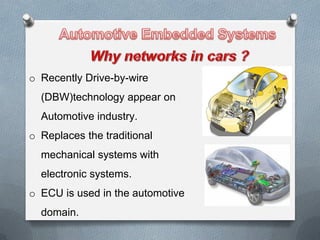
o Recently Drive-by-wire
(DBW)technology appear on
Automotive industry.
o Replaces the traditional
mechanical systems with
electronic systems.
o ECU is used in the automotive
domain.
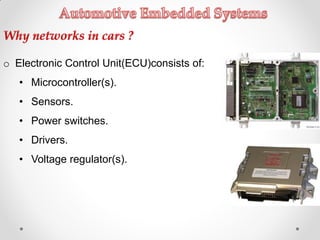
o Electronic Control Unit(ECU)consists of:
• Microcontroller(s).
• Sensors.
• Power switches.
• Drivers.
• Voltage regulator(s).
o Connect the sensors and actuators
directly to central ECU.
o Its disadvantage:
1-Very high number of connectors.
2-High length network cable.
Point to Point Network
Single Bus Network
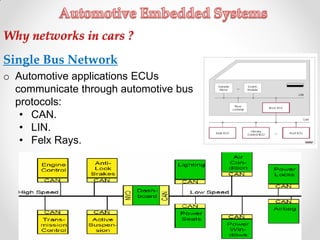
o Automotive applications ECUs
communicate through automotive bus
protocols:
• CAN.
• LIN.
• Felx Rays.
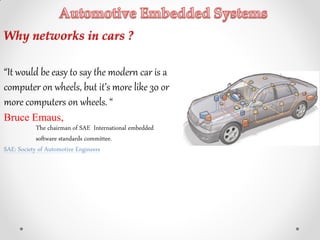
“It would be easy to say the modern car is a
computer on wheels, but it’s more like 30 or
more computers on wheels. “
Bruce Emaus,
The chairman of SAE International embedded
software standards committee.
SAE: Society of Automotive Engineers
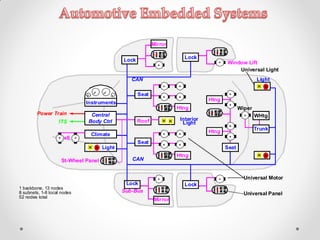
CAN
CAN
Power Train
Light
Sub-Bus
ITS
Window Lift
Interior
Light
Lock
Mirror
Lock
Mirror
Lock
Lock
Seat
Htng
Seat
Htng
Instruments
Central
Body Ctrl
Climate
Universal Motor
Universal Panel
Light
Roof
1 backbone, 13 nodes
8 subnets, 1-8 local nodes
52 nodes total
St-Wheel Panel
x6
Htng
Htng
Seat
Wiper
Trunk
WHtg
Universal Light
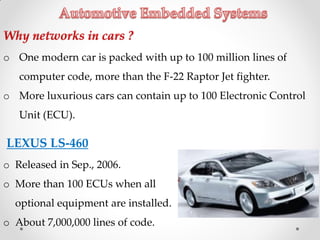
LEXUS LS-460
o Released in Sep., 2006.
o More than 100 ECUs when all
optional equipment are installed.
o About 7,000,000 lines of code.
o One modern car is packed with up to 100 million lines of
computer code, more than the F-22 Raptor Jet fighter.
o More luxurious cars can contain up to 100 Electronic Control
Unit (ECU).
•Door/window/seat:
Mirror,Central ECU,
Mirror, Switch, Window
Lift,
Seat Control Switch,
Door Lock, etc.
Roof:
(high amount of wiring)
Rain Sensor, Light Sensor,
Light Control, Sun Roof
…
(Rain Sensor needs to be
interrogated every 10-20ms)
Seat:
many Seat Position Motors,
Occupancy Sensor,
Control Panel
Steering Wheel:
(very many controls are going to be
positioned on the steering wheel)
Cruise Control, Wiper,
Turning Light, …
Optional: Climate Control,
Radio, Telephone, etc.
Climate:
many Small Motors
Control Panel
Features of Automotive Embedded Systems
o ECUs are used for :
• energy saving & low emission
• safety (active & passive)
• comfortableness, convenience, entertainment
• cost & weight reduction
o ECUs are connected with several in-vehicle networks.
o High reliability and safety requirements
o Strict real-time property required
o Severe environmental conditions (temperature, EMC)
o Severe production cost restriction
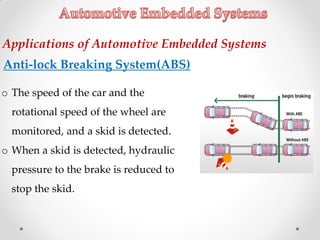
o The speed of the car and the
rotational speed of the wheel are
monitored, and a skid is detected.
o When a skid is detected, hydraulic
pressure to the brake is reduced to
stop the skid.
Applications of Automotive Embedded Systems
Anti-lock Breaking System(ABS)
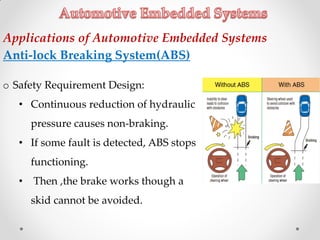
o Safety Requirement Design:
• Continuous reduction of hydraulic
pressure causes non-braking.
• If some fault is detected, ABS stops
functioning.
• Then ,the brake works though a
skid cannot be avoided.
Applications of Automotive Embedded Systems
Anti-lock Breaking System(ABS)
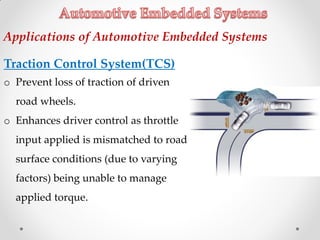
Traction Control System(TCS)
o Prevent loss of traction of driven
road wheels.
o Enhances driver control as throttle
input applied is mismatched to road
surface conditions (due to varying
factors) being unable to manage
applied torque.
Applications of Automotive Embedded Systems
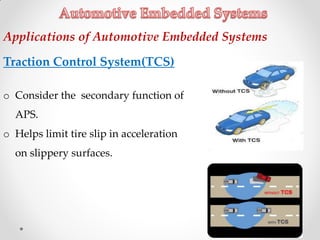
o Consider the secondary function of
APS.
o Helps limit tire slip in acceleration
on slippery surfaces.
Applications of Automotive Embedded Systems
Traction Control System(TCS)
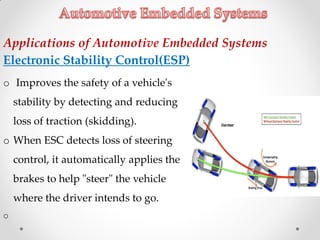
o Improves the safety of a vehicle's
stability by detecting and reducing
loss of traction (skidding).
o When ESC detects loss of steering
control, it automatically applies the
brakes to help "steer" the vehicle
where the driver intends to go.
o
Applications of Automotive Embedded Systems
Electronic Stability Control(ESP)
Applications of Automotive Embedded Systems
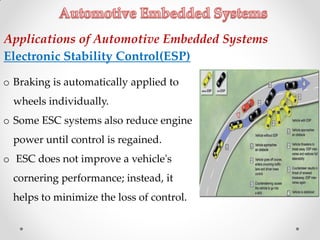
Electronic Stability Control(ESP)
o Braking is automatically applied to
wheels individually.
o Some ESC systems also reduce engine
power until control is regained.
o ESC does not improve a vehicle's
cornering performance; instead, it
helps to minimize the loss of control.
Airbag
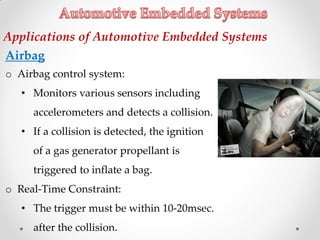
o Airbag control system:
• Monitors various sensors including
accelerometers and detects a collision.
• If a collision is detected, the ignition
of a gas generator propellant is
triggered to inflate a bag.
o Real-Time Constraint:
• The trigger must be within 10-20msec.
after the collision.
Applications of Automotive Embedded Systems
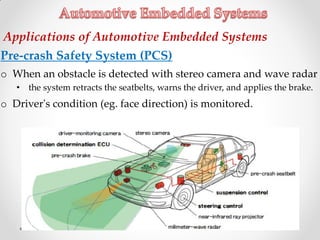
Pre-crash Safety System (PCS)
o When an obstacle is detected with stereo camera and wave radar
• the system retracts the seatbelts, warns the driver, and applies the brake.
o Driver's condition (eg. face direction) is monitored.
Applications of Automotive Embedded Systems
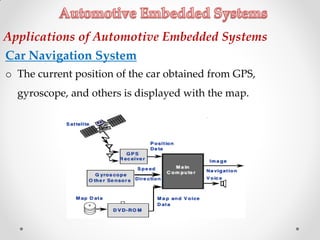
Car Navigation System
o The current position of the car obtained from GPS,
gyroscope, and others is displayed with the map.
Applications of Automotive Embedded Systems
Classification of Automotive Embedded Systems
o Powertrain and Control
▶ Engine, automatic transmission, hybrid control, ...
▶ Steering, brake, suspension, ...
o Body Electronics
▶ Instrument panel, key, door, window, lighting, …
▶ Air bag, seat belt, ...
o Multimedia Applications
▶ Car audio, car navigation, traffic information, ...
▶ Electronic toll collection (ETC), backguide monitor, ...
o Integrated Systems/Services
▶ Electronic stability control, pre-crash safety, …
▶ Parking assistance, lane keeping assistance, ...
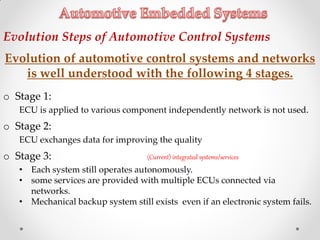
o Stage 1:
ECU is applied to various component independently network is not used.
o Stage 2:
ECU exchanges data for improving the quality
o Stage 3:
• Each system still operates autonomously.
• some services are provided with multiple ECUs connected via
networks.
• Mechanical backup system still exists even if an electronic system fails.
Evolution Steps of Automotive Control Systems
Evolution of automotive control systems and networks
is well understood with the following 4 stages.
(Current) integrated systems/services
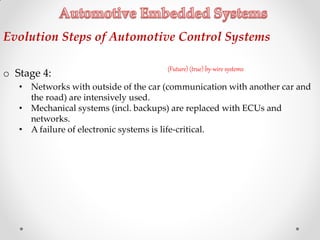
o Stage 4:
• Networks with outside of the car (communication with another car and
the road) are intensively used.
• Mechanical systems (incl. backups) are replaced with ECUs and
networks.
• A failure of electronic systems is life-critical.
Evolution Steps of Automotive Control Systems
(Future) (true) by-wire systems
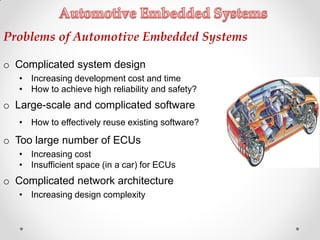
Problems of Automotive Embedded Systems
o Complicated system design
• Increasing development cost and time
• How to achieve high reliability and safety?
o Large-scale and complicated software
• How to effectively reuse existing software?
o Too large number of ECUs
• Increasing cost
• Insufficient space (in a car) for ECUs
o Complicated network architecture
• Increasing design complexity
Platform-base Development
Conventional Component-base Development
o Each ECU (component) is developed independently.
o Automotive component supplier develops both of the hardware and
software of ECU.
o Car (system) is designed by integrating the ECUs developed by different
suppliers.
Platform-base Development
o Platform should be developed at first.
o Platform = Hardware + Software + Network
o Application software should be developed on the Platform .
Automotive Architecture
AUTOSAR (Automotive Open System Architecture)
o global partnership of carmakers, car component ,electronics,
semiconductor, software industries
o founded in 2003.
o defines a methodology that supports a distributed, function-
driven development process.
o standardizes the software-architecture for ECU.
o Core partners:
▶ BMW ▶ Daimler ▶ PSA Peugeot Citroen
▶ Bosch ▶ Ford ▶ Toyota Motor
▶ Continental ▶ GM ▶ Volkswagen
Automotive Architecture
JASPAR (Japan Automotive Software Platform Architecture)
o Car makers and other companies develop network technology,
middleware, software platform for automotive control systems.
o founded in 2004.
o Board Members
▶ Toyota Motor ▶ Honda ▶ DENSO
▶ Nissan ▶ Toyota Tsusho Electronics
o Members
about 100 carmakers, car component suppliers, semiconductor companies,
and software companies
o Major Activities and Results
▶ Standardization related to FlexRay (wiring rule, ...)
▶ Development of software platform based on AUTOSAR Standard.
▶ Development of design guidelines for ISO 26262.
Automotive Network protocol
Speed[bit/s]
Byteflight
optical bus
LIN
master-slave
single wire bus
no quartz
CAN-B
event triggered
fault tolerant
dual wire
CAN-C
event triggered
dual wire
Flex Ray
25.6M
20K
10M
1M
125K
incremental cost per node [$]
D2B, MOST
token ring
optical bus
1 2 4.5 10
Automotive Network dominos
o Class A:
• low cost and data rate lower than 10 kbps
• Example: LIN
• used for body domain light functions.
o Class B:
• data rate (10‐125 kbps)
• Example : low‐rate CAN
• used for data exchange between ECUs to reduce the number of sensors
by sharing information.
Automotive Network dominos
o Class C:
• data rate (125kbps‐1Mbps)
• Example : high‐speed CAN
• used for power train and chassis domain functions (ABS & EPS)
o Class D:
• data rate (over 1Mbps)
• Example : MOST (media‐oriented system transport)
• multimedia data and safety critical applications .
Automotive Network Triggered
Event Triggered:
o Messages are transmitted due to occurrence of significant events
o Example :a door has been closed.
o No detection of node failure, no grantee for certain constrains.
Time Triggered:
o Frames are transmitted at predetermined points in time .
o Example: TDMA.
o Behavior is fully predictable, detection of failure. but, inefficient
utilization, not extendable.

Embedded Systems in Automotive

  • 2.
    o Recently Drive-by-wire (DBW)technologyappear on Automotive industry. o Replaces the traditional mechanical systems with electronic systems. o ECU is used in the automotive domain.
  • 3.
    o Electronic ControlUnit(ECU)consists of: • Microcontroller(s). • Sensors. • Power switches. • Drivers. • Voltage regulator(s).
  • 4.
    o Connect thesensors and actuators directly to central ECU. o Its disadvantage: 1-Very high number of connectors. 2-High length network cable. Point to Point Network
  • 5.
    Single Bus Network oAutomotive applications ECUs communicate through automotive bus protocols: • CAN. • LIN. • Felx Rays.
  • 6.
    “It would beeasy to say the modern car is a computer on wheels, but it’s more like 30 or more computers on wheels. “ Bruce Emaus, The chairman of SAE International embedded software standards committee. SAE: Society of Automotive Engineers
  • 7.
    CAN CAN Power Train Light Sub-Bus ITS Window Lift Interior Light Lock Mirror Lock Mirror Lock Lock Seat Htng Seat Htng Instruments Central BodyCtrl Climate Universal Motor Universal Panel Light Roof 1 backbone, 13 nodes 8 subnets, 1-8 local nodes 52 nodes total St-Wheel Panel x6 Htng Htng Seat Wiper Trunk WHtg Universal Light
  • 8.
    LEXUS LS-460 o Releasedin Sep., 2006. o More than 100 ECUs when all optional equipment are installed. o About 7,000,000 lines of code. o One modern car is packed with up to 100 million lines of computer code, more than the F-22 Raptor Jet fighter. o More luxurious cars can contain up to 100 Electronic Control Unit (ECU).
  • 9.
    •Door/window/seat: Mirror,Central ECU, Mirror, Switch,Window Lift, Seat Control Switch, Door Lock, etc. Roof: (high amount of wiring) Rain Sensor, Light Sensor, Light Control, Sun Roof … (Rain Sensor needs to be interrogated every 10-20ms) Seat: many Seat Position Motors, Occupancy Sensor, Control Panel Steering Wheel: (very many controls are going to be positioned on the steering wheel) Cruise Control, Wiper, Turning Light, … Optional: Climate Control, Radio, Telephone, etc. Climate: many Small Motors Control Panel
  • 10.
    Features of AutomotiveEmbedded Systems o ECUs are used for : • energy saving & low emission • safety (active & passive) • comfortableness, convenience, entertainment • cost & weight reduction o ECUs are connected with several in-vehicle networks. o High reliability and safety requirements o Strict real-time property required o Severe environmental conditions (temperature, EMC) o Severe production cost restriction
  • 11.
    o The speedof the car and the rotational speed of the wheel are monitored, and a skid is detected. o When a skid is detected, hydraulic pressure to the brake is reduced to stop the skid. Applications of Automotive Embedded Systems Anti-lock Breaking System(ABS)
  • 12.
    o Safety RequirementDesign: • Continuous reduction of hydraulic pressure causes non-braking. • If some fault is detected, ABS stops functioning. • Then ,the brake works though a skid cannot be avoided. Applications of Automotive Embedded Systems Anti-lock Breaking System(ABS)
  • 13.
    Traction Control System(TCS) oPrevent loss of traction of driven road wheels. o Enhances driver control as throttle input applied is mismatched to road surface conditions (due to varying factors) being unable to manage applied torque. Applications of Automotive Embedded Systems
  • 14.
    o Consider thesecondary function of APS. o Helps limit tire slip in acceleration on slippery surfaces. Applications of Automotive Embedded Systems Traction Control System(TCS)
  • 15.
    o Improves thesafety of a vehicle's stability by detecting and reducing loss of traction (skidding). o When ESC detects loss of steering control, it automatically applies the brakes to help "steer" the vehicle where the driver intends to go. o Applications of Automotive Embedded Systems Electronic Stability Control(ESP)
  • 16.
    Applications of AutomotiveEmbedded Systems Electronic Stability Control(ESP) o Braking is automatically applied to wheels individually. o Some ESC systems also reduce engine power until control is regained. o ESC does not improve a vehicle's cornering performance; instead, it helps to minimize the loss of control.
  • 17.
    Airbag o Airbag controlsystem: • Monitors various sensors including accelerometers and detects a collision. • If a collision is detected, the ignition of a gas generator propellant is triggered to inflate a bag. o Real-Time Constraint: • The trigger must be within 10-20msec. after the collision. Applications of Automotive Embedded Systems
  • 18.
    Pre-crash Safety System(PCS) o When an obstacle is detected with stereo camera and wave radar • the system retracts the seatbelts, warns the driver, and applies the brake. o Driver's condition (eg. face direction) is monitored. Applications of Automotive Embedded Systems
  • 19.
    Car Navigation System oThe current position of the car obtained from GPS, gyroscope, and others is displayed with the map. Applications of Automotive Embedded Systems
  • 20.
    Classification of AutomotiveEmbedded Systems o Powertrain and Control ▶ Engine, automatic transmission, hybrid control, ... ▶ Steering, brake, suspension, ... o Body Electronics ▶ Instrument panel, key, door, window, lighting, … ▶ Air bag, seat belt, ... o Multimedia Applications ▶ Car audio, car navigation, traffic information, ... ▶ Electronic toll collection (ETC), backguide monitor, ... o Integrated Systems/Services ▶ Electronic stability control, pre-crash safety, … ▶ Parking assistance, lane keeping assistance, ...
  • 21.
    o Stage 1: ECUis applied to various component independently network is not used. o Stage 2: ECU exchanges data for improving the quality o Stage 3: • Each system still operates autonomously. • some services are provided with multiple ECUs connected via networks. • Mechanical backup system still exists even if an electronic system fails. Evolution Steps of Automotive Control Systems Evolution of automotive control systems and networks is well understood with the following 4 stages. (Current) integrated systems/services
  • 22.
    o Stage 4: •Networks with outside of the car (communication with another car and the road) are intensively used. • Mechanical systems (incl. backups) are replaced with ECUs and networks. • A failure of electronic systems is life-critical. Evolution Steps of Automotive Control Systems (Future) (true) by-wire systems
  • 23.
    Problems of AutomotiveEmbedded Systems o Complicated system design • Increasing development cost and time • How to achieve high reliability and safety? o Large-scale and complicated software • How to effectively reuse existing software? o Too large number of ECUs • Increasing cost • Insufficient space (in a car) for ECUs o Complicated network architecture • Increasing design complexity
  • 24.
    Platform-base Development Conventional Component-baseDevelopment o Each ECU (component) is developed independently. o Automotive component supplier develops both of the hardware and software of ECU. o Car (system) is designed by integrating the ECUs developed by different suppliers. Platform-base Development o Platform should be developed at first. o Platform = Hardware + Software + Network o Application software should be developed on the Platform .
  • 25.
    Automotive Architecture AUTOSAR (AutomotiveOpen System Architecture) o global partnership of carmakers, car component ,electronics, semiconductor, software industries o founded in 2003. o defines a methodology that supports a distributed, function- driven development process. o standardizes the software-architecture for ECU. o Core partners: ▶ BMW ▶ Daimler ▶ PSA Peugeot Citroen ▶ Bosch ▶ Ford ▶ Toyota Motor ▶ Continental ▶ GM ▶ Volkswagen
  • 26.
    Automotive Architecture JASPAR (JapanAutomotive Software Platform Architecture) o Car makers and other companies develop network technology, middleware, software platform for automotive control systems. o founded in 2004. o Board Members ▶ Toyota Motor ▶ Honda ▶ DENSO ▶ Nissan ▶ Toyota Tsusho Electronics o Members about 100 carmakers, car component suppliers, semiconductor companies, and software companies o Major Activities and Results ▶ Standardization related to FlexRay (wiring rule, ...) ▶ Development of software platform based on AUTOSAR Standard. ▶ Development of design guidelines for ISO 26262.
  • 27.
    Automotive Network protocol Speed[bit/s] Byteflight opticalbus LIN master-slave single wire bus no quartz CAN-B event triggered fault tolerant dual wire CAN-C event triggered dual wire Flex Ray 25.6M 20K 10M 1M 125K incremental cost per node [$] D2B, MOST token ring optical bus 1 2 4.5 10
  • 28.
    Automotive Network dominos oClass A: • low cost and data rate lower than 10 kbps • Example: LIN • used for body domain light functions. o Class B: • data rate (10‐125 kbps) • Example : low‐rate CAN • used for data exchange between ECUs to reduce the number of sensors by sharing information.
  • 29.
    Automotive Network dominos oClass C: • data rate (125kbps‐1Mbps) • Example : high‐speed CAN • used for power train and chassis domain functions (ABS & EPS) o Class D: • data rate (over 1Mbps) • Example : MOST (media‐oriented system transport) • multimedia data and safety critical applications .
  • 30.
    Automotive Network Triggered EventTriggered: o Messages are transmitted due to occurrence of significant events o Example :a door has been closed. o No detection of node failure, no grantee for certain constrains. Time Triggered: o Frames are transmitted at predetermined points in time . o Example: TDMA. o Behavior is fully predictable, detection of failure. but, inefficient utilization, not extendable.