A SEMINAR ON
BY
VAIBHAV VATSA
EC 32
UNIVERSITY ROLL NO. -
1005431115
Contents
 What are embedded systems ?
 Why.. ..for automobiles ?
 Embedded Development
 Applications
 Anti-lock Braking System
 Adaptive Cruise Control
 Tire Pressure Monitoring System
 Satellite Radio- XM
Conclusion
What are embedded systems ?
• A combination of hardware and software ,
which creates a dedicated computer system, to
perform specific pre-defined tasks.
• They are usually controlled by a micro
processor that executes the instructions stored
on a ROM chip.
• Specifically designed codes using embedded C
, bring about “Artificial Intelligence” in the
device.
 Sophisticated functionality (operate on multiple
algorithms simultaneously )
 Multi-rate systems (operations handled at
widely –varying rates )
 Real-time operation (perform the operation
within the deadline)
 Low manufacturing cost
 Low power
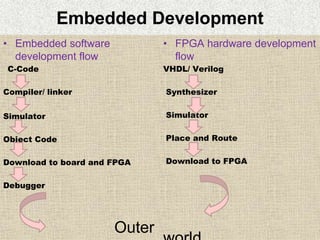
Embedded Development
• Embedded software
development flow
C-Code
Compiler/ linker
Simulator
Object Code
Download to board and FPGA
Debugger
Outer
• FPGA hardware development
flow
VHDL/ Verilog
Synthesizer
Simulator
Place and Route
Download to FPGA
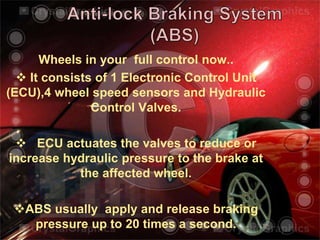
Wheels in your full control now..
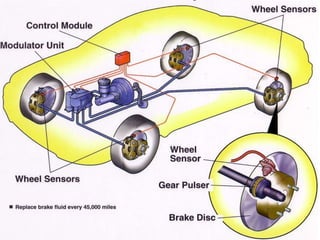
 It consists of 1 Electronic Control Unit
(ECU),4 wheel speed sensors and Hydraulic
Control Valves.
 ECU actuates the valves to reduce or
increase hydraulic pressure to the brake at
the affected wheel.
ABS usually apply and release braking
pressure up to 20 times a second.
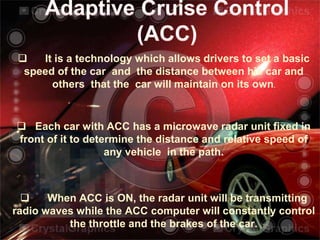
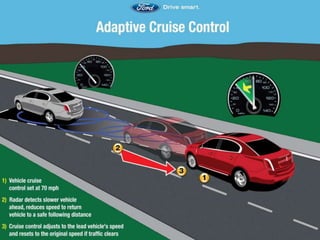
 It is a technology which allows drivers to set a basic
speed of the car and the distance between his car and
others that the car will maintain on its own.
 Each car with ACC has a microwave radar unit fixed in
front of it to determine the distance and relative speed of
any vehicle in the path.
 When ACC is ON, the radar unit will be transmitting
radio waves while the ACC computer will constantly control
the throttle and the brakes of the car.
 Doppler Effect :
It refers to the change in frequency of the waves
when there is a relative motion between the
transmitting and receiving units.
 For example… when the separation in between,
decreases below the specified value, the reflected
waves received by the radar unit ,will have higher
frequency than the waves transmitted by it.
 The embedded systems connected to the radar unit
give output to the braking units ,which apply the
brakes moderately and a constant distance is
maintained.
Main objectives are :
 Reducing CO2 emission
 Avoiding traffic accidents due to under-inflated tires
 Reducing tire abrasion
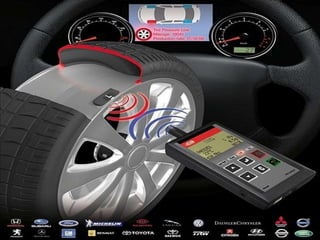
The main components of a typical TPMS sensor are:
 Pressure sensor
 Temperature sensor
 Signal processer (C to V Convertor)
 Analog to Digital Convertor (ADC)
 Microcontroller
 RF Transmitter
 Reference Quartz Oscillator
• The pressure –sensing cell is capacitive and
requires a ‘ C to V’ conversion stage.
• In read mode, the A to D convertor converts the
analog voltage on capacitor in it’s digital form and the
microcontroller reads the data serially.
• The RF transmitter connected to it ,uses this serial
data to modulate a reference oscillator of 13 .56 MHz
(using both ASK and FSK) and generates 315, 433
and 868 MHz waves of ISM BAND for RF
communication.
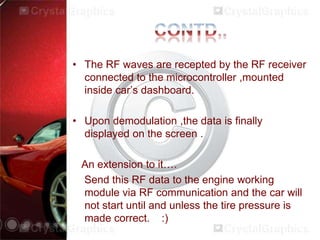
• The RF waves are recepted by the RF receiver
connected to the microcontroller ,mounted
inside car’s dashboard.
• Upon demodulation ,the data is finally
displayed on the screen .
An extension to it….
Send this RF data to the engine working
module via RF communication and the car will
not start until and unless the tire pressure is
made correct. :)
XM radio service adopts communication satellite
broadcasting technology and is
an emerging satellite digital audio radio service
suitable for automotive environment.
 XM service, on account of its better signal
coverage , surpasses existing radio services like
FM and AM both in terms of sound quality and
geographic coverage.
Block Diagram
Video-audio
microcontroller
Main
microcontroller
Key control
panel
Touch panel
display
XM Tuner
From
satellite
DSP
Speaker
• f
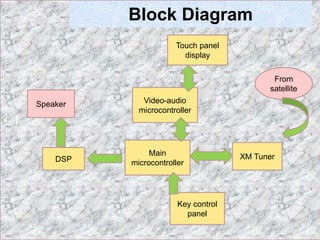
• The XM tuner receives radio program signal from
the satellites, and a serial bus named IEBUS
connects it to the main microcontroller in the
head unit of the digital car audio system.
• The main uC forwards audio signal output to
DSP chips for sound output and also monitors
data exchange with external devices via
different kinds of serial data buses.
• The video-audio micro controller is meant for
effective human- machine interface via touch panel
display.
• The main microcontroller used here is
V850ES/SJ3 , manufactured by NEC company ,
which has a high working frequency of 32 MHz and
is compatible with serial buses like CAN bus, I2C,
UART, IEBUS and CSI for communication.
• The embedded systems work upon carefully
designed software and their proper
implementation .Still , the main concerns are :
 Meeting the real time constraints more
effectively
 Validation of real time software (testing of large
data may be critical to safety)
With fast expanding autonomous market and
luxury getting over the human mind, embedded
systems have got a bright future ahead.
Thanks .. !!
Querries ??

EMBEDDED SYSTEMS IN AUTOMOBILES .PPT.pptx

  • 1.
    A SEMINAR ON BY VAIBHAVVATSA EC 32 UNIVERSITY ROLL NO. - 1005431115
  • 2.
    Contents  What areembedded systems ?  Why.. ..for automobiles ?  Embedded Development  Applications  Anti-lock Braking System  Adaptive Cruise Control  Tire Pressure Monitoring System  Satellite Radio- XM Conclusion
  • 3.
    What are embeddedsystems ? • A combination of hardware and software , which creates a dedicated computer system, to perform specific pre-defined tasks. • They are usually controlled by a micro processor that executes the instructions stored on a ROM chip. • Specifically designed codes using embedded C , bring about “Artificial Intelligence” in the device.
  • 4.
     Sophisticated functionality(operate on multiple algorithms simultaneously )  Multi-rate systems (operations handled at widely –varying rates )  Real-time operation (perform the operation within the deadline)  Low manufacturing cost  Low power
  • 5.
    Embedded Development • Embeddedsoftware development flow C-Code Compiler/ linker Simulator Object Code Download to board and FPGA Debugger Outer • FPGA hardware development flow VHDL/ Verilog Synthesizer Simulator Place and Route Download to FPGA
  • 6.
    Wheels in yourfull control now..  It consists of 1 Electronic Control Unit (ECU),4 wheel speed sensors and Hydraulic Control Valves.  ECU actuates the valves to reduce or increase hydraulic pressure to the brake at the affected wheel. ABS usually apply and release braking pressure up to 20 times a second.
  • 8.
     It isa technology which allows drivers to set a basic speed of the car and the distance between his car and others that the car will maintain on its own.  Each car with ACC has a microwave radar unit fixed in front of it to determine the distance and relative speed of any vehicle in the path.  When ACC is ON, the radar unit will be transmitting radio waves while the ACC computer will constantly control the throttle and the brakes of the car.
  • 10.
     Doppler Effect: It refers to the change in frequency of the waves when there is a relative motion between the transmitting and receiving units.  For example… when the separation in between, decreases below the specified value, the reflected waves received by the radar unit ,will have higher frequency than the waves transmitted by it.  The embedded systems connected to the radar unit give output to the braking units ,which apply the brakes moderately and a constant distance is maintained.
  • 11.
    Main objectives are:  Reducing CO2 emission  Avoiding traffic accidents due to under-inflated tires  Reducing tire abrasion The main components of a typical TPMS sensor are:  Pressure sensor  Temperature sensor  Signal processer (C to V Convertor)  Analog to Digital Convertor (ADC)  Microcontroller  RF Transmitter  Reference Quartz Oscillator
  • 12.
    • The pressure–sensing cell is capacitive and requires a ‘ C to V’ conversion stage. • In read mode, the A to D convertor converts the analog voltage on capacitor in it’s digital form and the microcontroller reads the data serially. • The RF transmitter connected to it ,uses this serial data to modulate a reference oscillator of 13 .56 MHz (using both ASK and FSK) and generates 315, 433 and 868 MHz waves of ISM BAND for RF communication.
  • 14.
    • The RFwaves are recepted by the RF receiver connected to the microcontroller ,mounted inside car’s dashboard. • Upon demodulation ,the data is finally displayed on the screen . An extension to it…. Send this RF data to the engine working module via RF communication and the car will not start until and unless the tire pressure is made correct. :)
  • 15.
    XM radio serviceadopts communication satellite broadcasting technology and is an emerging satellite digital audio radio service suitable for automotive environment.  XM service, on account of its better signal coverage , surpasses existing radio services like FM and AM both in terms of sound quality and geographic coverage.
  • 16.
  • 17.
    • The XMtuner receives radio program signal from the satellites, and a serial bus named IEBUS connects it to the main microcontroller in the head unit of the digital car audio system. • The main uC forwards audio signal output to DSP chips for sound output and also monitors data exchange with external devices via different kinds of serial data buses.
  • 18.
    • The video-audiomicro controller is meant for effective human- machine interface via touch panel display. • The main microcontroller used here is V850ES/SJ3 , manufactured by NEC company , which has a high working frequency of 32 MHz and is compatible with serial buses like CAN bus, I2C, UART, IEBUS and CSI for communication.
  • 19.
    • The embeddedsystems work upon carefully designed software and their proper implementation .Still , the main concerns are :  Meeting the real time constraints more effectively  Validation of real time software (testing of large data may be critical to safety) With fast expanding autonomous market and luxury getting over the human mind, embedded systems have got a bright future ahead.
  • 20.