TOPIC -:
EMBEDDED SYSTEM IN AUTOMOBILE -:
BY- SWARAJ NAYAK
ROLL NO.===38
DIM 3RD YEAR
1. About Embedded system
2. Embedded system components
3. Characteristics of embedded systems
4. Automotive Systems: Technology in today's vehicle
a) Air Bags : Principle of function
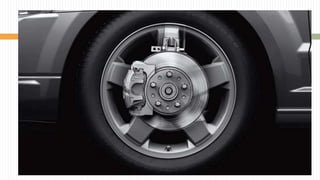
b) Anti-lock Braking System(ABS)
c) Dynamic Traction & Stability Control
d) Adaptive Cruise Control
e) Drive by wire
5. Conclusion
About EMBEDDED SYSTEMS
 • System is the collecting of entities (people, machine )that are work
together and interact towards some end. This is called system.
Embedded systems is nothing but the combination of both hardware
and software.
 • It not only deals with the combination rather we can say as
synchronization of both hardware and software
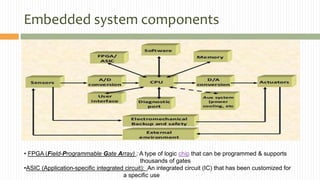
Embedded system components
• FPGA (Field-Programmable Gate Array) : A type of logic chip that can be programmed & supports
thousands of gates
•ASIC (Application-specific integrated circuit): An integrated circuit (IC) that has been customized for
a specific use
 Sophisticated functionality.
◦ Often have to run sophisticated algorithms or multiple algorithms.
◦ Often provide sophisticated user interfaces..
 Must finish operations by deadlines
 Many systems are multi-rate must handle operations at widely
varying rates
 Low manufacturing cost.
 Low power.
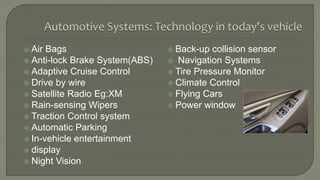
 Air Bags
 Anti-lock Brake System(ABS)
 Adaptive Cruise Control
 Drive by wire
 Satellite Radio Eg:XM
 Rain-sensing Wipers
 Traction Control system
 Automatic Parking
 In-vehicle entertainment
 display
 Night Vision
 Back-up collision sensor
 Navigation Systems
 Tire Pressure Monitor
 Climate Control
 Flying Cars
 Power window
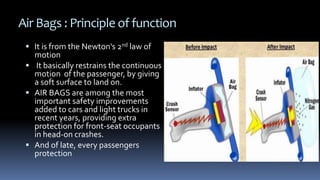
Air Bags : Principle of function
 It is from the Newton's 2nd law of
motion
 It basically restrains the continuous
motion of the passenger, by giving
a soft surface to land on.
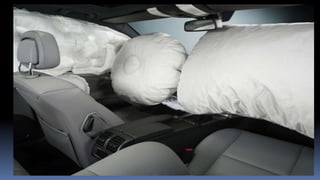
 AIR BAGS are among the most
important safety improvements
added to cars and light trucks in
recent years, providing extra
protection for front-seat occupants
in head-on crashes.
 And of late, every passengers
protection
Anti-lock Braking System(ABS)
 Up until the seventies speed, hitting the
brakes too hard could lead to an accident.
 The reason: When the coefficient of slip
between tires and road surface is too low,
hitting the brakes can cause wheel lock-up.
The vehicle is no longer steerable and goes
into a skid.
 In particular, this danger is present
 On wet or slippery road surfaces with different
levels of grip between tires and road
 On preventing wheel lock-up:
 Reduces the total braking distance as far
as possible
 Increase vehicle stability
 Maintains steer ability even in case of all-out
braking
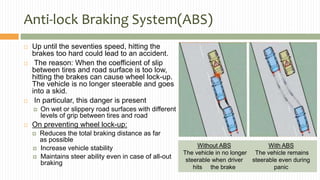
Without ABS
The vehicle in no longer
steerable when driver
hits the brake
With ABS
The vehicle remains
steerable even during
panic
 Wheel-speed sensors detect whether a wheel is showing a
tendency to lock-up
 In case of a lock-up tendency, the electronic control unit
reduces the braking pressure individually at the wheel concerned
 High-speed correction of the braking pressure up to shortly
before the lock-up threshold
 The brake-fluid return together with the closed-loop brake
circuits makes this a safe, reliable, and cost-effective system
Advantage
 A gain for driving safety
◦ The vehicle remains steerable, even in case of panic braking
◦ Shorter stopping distances on practically all road surfaces
 Many accidents are avoided
Dynamic Traction & Stability Control
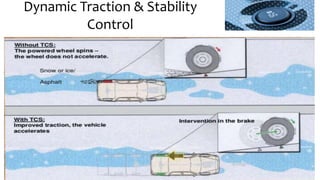
 The traction control system is required to prevent driver error
from overloading any of the four wheels and causing slip,
through either throttle or brake application
 Drastically improve vehicle performance and safety by
maintaining optimal wheel traction in all road conditions
 The basic principle is always the adaptation of the wheel torque
to the coefficient of friction between the wheel and the road
surface.
 However the means, a wheel spinning out of control is
quicklybrought in line with the rest of the car wheels.
Dynamic Traction & Stability
Control
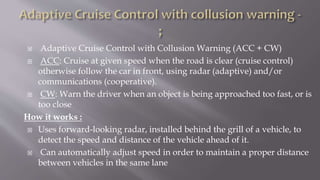
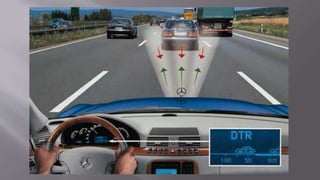
 Adaptive Cruise Control with Collusion Warning (ACC + CW)
 ACC: Cruise at given speed when the road is clear (cruise control)
otherwise follow the car in front, using radar (adaptive) and/or
communications (cooperative).
 CW: Warn the driver when an object is being approached too fast, or is
too close
How it works :
 Uses forward-looking radar, installed behind the grill of a vehicle, to
detect the speed and distance of the vehicle ahead of it.
 Can automatically adjust speed in order to maintain a proper distance
between vehicles in the same lane
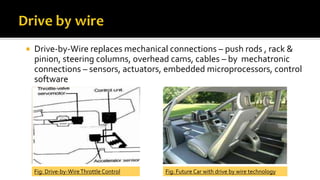
 Drive-by-Wire replaces mechanical connections – push rods , rack &
pinion, steering columns, overhead cams, cables – by mechatronic
connections – sensors, actuators, embedded microprocessors, control
software
Fig: Drive-by-WireThrottle Control Fig: Future Car with drive by wire technology
Embedded system in automobile

Embedded system in automobile

  • 1.
    TOPIC -: EMBEDDED SYSTEMIN AUTOMOBILE -: BY- SWARAJ NAYAK ROLL NO.===38 DIM 3RD YEAR
  • 2.
    1. About Embeddedsystem 2. Embedded system components 3. Characteristics of embedded systems 4. Automotive Systems: Technology in today's vehicle a) Air Bags : Principle of function b) Anti-lock Braking System(ABS) c) Dynamic Traction & Stability Control d) Adaptive Cruise Control e) Drive by wire 5. Conclusion
  • 3.
    About EMBEDDED SYSTEMS • System is the collecting of entities (people, machine )that are work together and interact towards some end. This is called system. Embedded systems is nothing but the combination of both hardware and software.  • It not only deals with the combination rather we can say as synchronization of both hardware and software
  • 4.
    Embedded system components •FPGA (Field-Programmable Gate Array) : A type of logic chip that can be programmed & supports thousands of gates •ASIC (Application-specific integrated circuit): An integrated circuit (IC) that has been customized for a specific use
  • 5.
     Sophisticated functionality. ◦Often have to run sophisticated algorithms or multiple algorithms. ◦ Often provide sophisticated user interfaces..  Must finish operations by deadlines  Many systems are multi-rate must handle operations at widely varying rates  Low manufacturing cost.  Low power.
  • 6.
     Air Bags Anti-lock Brake System(ABS)  Adaptive Cruise Control  Drive by wire  Satellite Radio Eg:XM  Rain-sensing Wipers  Traction Control system  Automatic Parking  In-vehicle entertainment  display  Night Vision  Back-up collision sensor  Navigation Systems  Tire Pressure Monitor  Climate Control  Flying Cars  Power window
  • 7.
    Air Bags :Principle of function  It is from the Newton's 2nd law of motion  It basically restrains the continuous motion of the passenger, by giving a soft surface to land on.  AIR BAGS are among the most important safety improvements added to cars and light trucks in recent years, providing extra protection for front-seat occupants in head-on crashes.  And of late, every passengers protection
  • 9.
    Anti-lock Braking System(ABS) Up until the seventies speed, hitting the brakes too hard could lead to an accident.  The reason: When the coefficient of slip between tires and road surface is too low, hitting the brakes can cause wheel lock-up. The vehicle is no longer steerable and goes into a skid.  In particular, this danger is present  On wet or slippery road surfaces with different levels of grip between tires and road  On preventing wheel lock-up:  Reduces the total braking distance as far as possible  Increase vehicle stability  Maintains steer ability even in case of all-out braking Without ABS The vehicle in no longer steerable when driver hits the brake With ABS The vehicle remains steerable even during panic
  • 11.
     Wheel-speed sensorsdetect whether a wheel is showing a tendency to lock-up  In case of a lock-up tendency, the electronic control unit reduces the braking pressure individually at the wheel concerned  High-speed correction of the braking pressure up to shortly before the lock-up threshold  The brake-fluid return together with the closed-loop brake circuits makes this a safe, reliable, and cost-effective system Advantage  A gain for driving safety ◦ The vehicle remains steerable, even in case of panic braking ◦ Shorter stopping distances on practically all road surfaces  Many accidents are avoided
  • 12.
    Dynamic Traction &Stability Control  The traction control system is required to prevent driver error from overloading any of the four wheels and causing slip, through either throttle or brake application  Drastically improve vehicle performance and safety by maintaining optimal wheel traction in all road conditions  The basic principle is always the adaptation of the wheel torque to the coefficient of friction between the wheel and the road surface.  However the means, a wheel spinning out of control is quicklybrought in line with the rest of the car wheels.
  • 13.
    Dynamic Traction &Stability Control
  • 14.
     Adaptive CruiseControl with Collusion Warning (ACC + CW)  ACC: Cruise at given speed when the road is clear (cruise control) otherwise follow the car in front, using radar (adaptive) and/or communications (cooperative).  CW: Warn the driver when an object is being approached too fast, or is too close How it works :  Uses forward-looking radar, installed behind the grill of a vehicle, to detect the speed and distance of the vehicle ahead of it.  Can automatically adjust speed in order to maintain a proper distance between vehicles in the same lane
  • 16.
     Drive-by-Wire replacesmechanical connections – push rods , rack & pinion, steering columns, overhead cams, cables – by mechatronic connections – sensors, actuators, embedded microprocessors, control software Fig: Drive-by-WireThrottle Control Fig: Future Car with drive by wire technology

Editor's Notes

  • #5 Beginning course details and/or books/materials needed for a class/project.
  • #6 Beginning course details and/or books/materials needed for a class/project.
  • #7 Beginning course details and/or books/materials needed for a class/project.
  • #8 Beginning course details and/or books/materials needed for a class/project.
  • #10 Wheel-speed sensors detect whether a wheel is showing a tendency to lock-up In case of a lock-up tendency, the electronic control unit reduces the braking pressure individually at the wheel concerned High-speed correction of the braking pressure up to shortly before the lock-up threshold The brake-fluid return together with the closed-loop brake circuits makes this a safe, reliable, and cost-effective system Advantage A gain for driving safety The vehicle remains steerable, even in case of panic braking Shorter stopping distances on practically all road surfaces Many accidents are avoided
  • #12 Beginning course details and/or books/materials needed for a class/project.
  • #13 Beginning course details and/or books/materials needed for a class/project.
  • #14 The traction control system is required to prevent driver error from overloading any of the four wheels and causing slip, through either throttle or brake application Drastically improve vehicle performance and safety by maintaining optimal wheel traction in all road conditions The basic principle is always the adaptation of the wheel torque to the coefficient of friction between the wheel and the road surface. However the means, a wheel spinning out of control is quicklybrought in line with the rest of the car wheels.
  • #15 Beginning course details and/or books/materials needed for a class/project.
  • #17 Beginning course details and/or books/materials needed for a class/project.
  • #18 swaraj