By Yusha Patel
(TYME-A)
Cruise control is a new technological development which
incorporates a factor of comfort in driving.
Safety is only a small benefit of this system.
In short, cruise control can be said to be a system which
uses the principles of radar to determine the distances
between two consecutive moving vehicles in which either
one or both of them is incorporated with this system.
*
*
*INTRODUCTION
*WHAT IS CRUISE CONTROL ?
*BASIC OPERATION
*HOW TO SET CRUISE CONTROL?
*ADAPTIVE CRUISE CONTROL
*PARTS AND WORKING
*DANGERS OF CRUISE CONTROL
*FUTURE ASPECTS
*CONCLUSION
*
*Every minute, on average, at least one person dies in a crash.
*Air bags and seat belts save tens of thousands of people a year.
*But the ultimate solution and the only thing that will save far more lives,
limbs and money is ? till 1958.
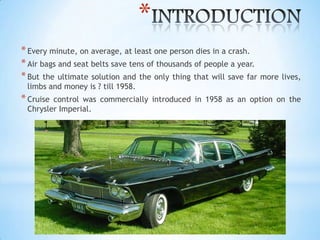
*Cruise control was commercially introduced in 1958 as an option on the
Chrysler Imperial.
*
 Cruise control is a system, which automatically controls the speed
of an automobile.
 The system takes over the throttle of the car to maintain a steady
speed as set by the driver.
 Most cruise control systems don’t allow the use of cruise control
below a certain speed.
 Blind inventor and mechanical engineer Ralph teetor invented
cruise control in 1945.
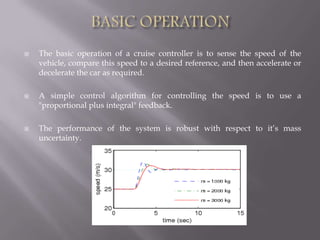
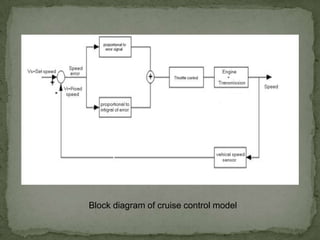
 The basic operation of a cruise controller is to sense the speed of the
vehicle, compare this speed to a desired reference, and then accelerate or
decelerate the car as required.
 A simple control algorithm for controlling the speed is to use a
"proportional plus integral" feedback.
 The performance of the system is robust with respect to it’s mass
uncertainty.
Block diagram of cruise control model
*
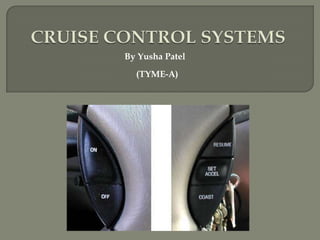
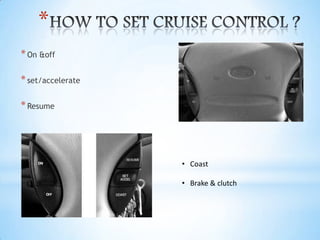
*On &off
*set/accelerate
*Resume
• Coast
• Brake & clutch
*
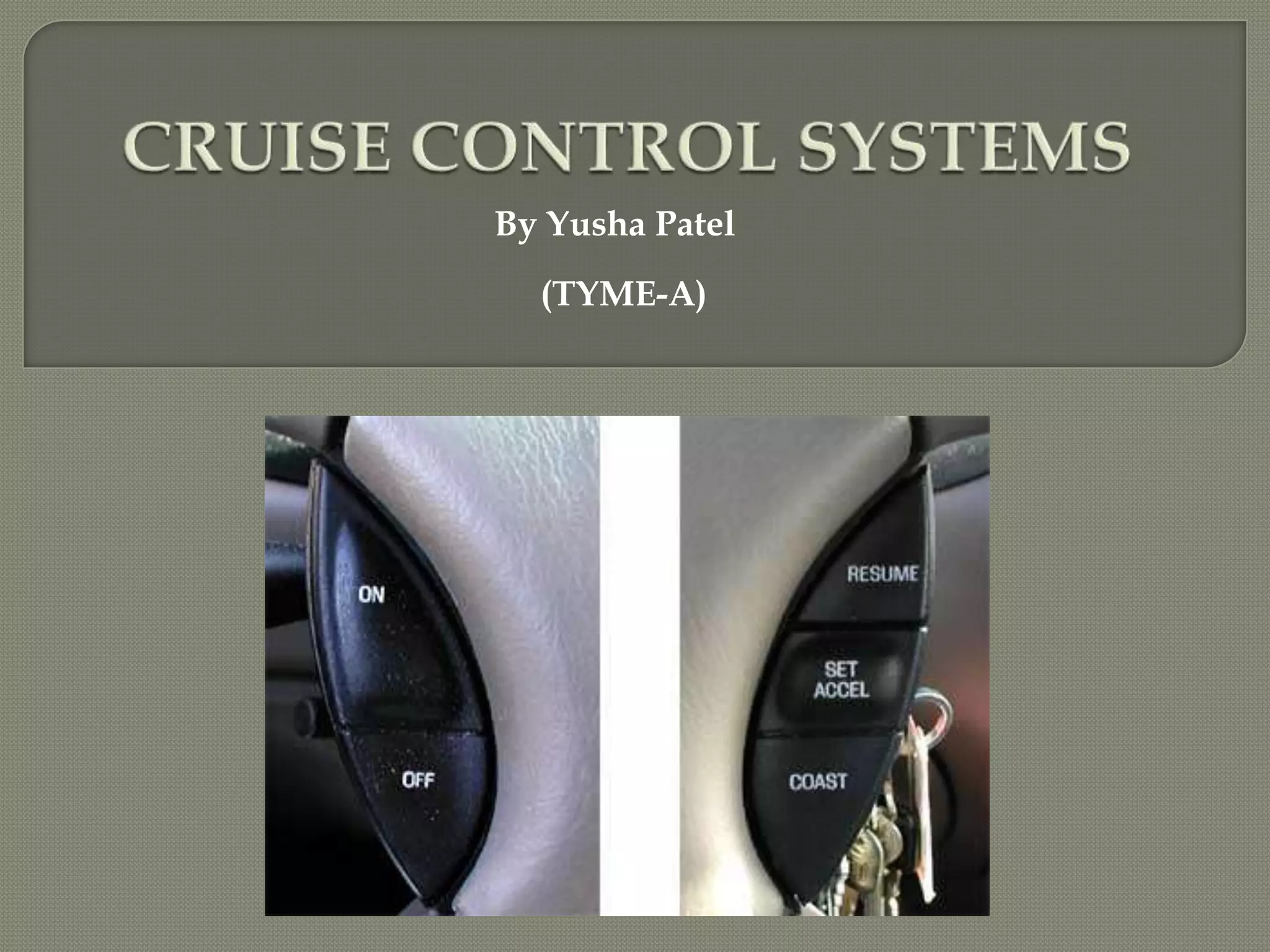
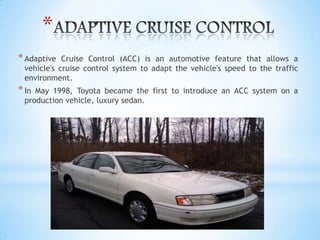
*Adaptive Cruise Control (ACC) is an automotive feature that allows a
vehicle's cruise control system to adapt the vehicle's speed to the traffic
environment.
*In May 1998, Toyota became the first to introduce an ACC system on a
production vehicle, luxury sedan.
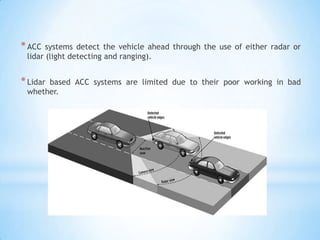
*ACC systems detect the vehicle ahead through the use of either radar or
lidar (light detecting and ranging).
*Lidar based ACC systems are limited due to their poor working in bad
whether.
*
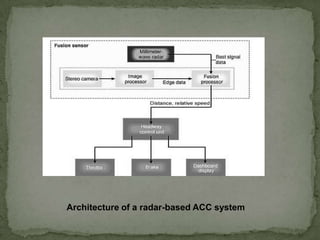
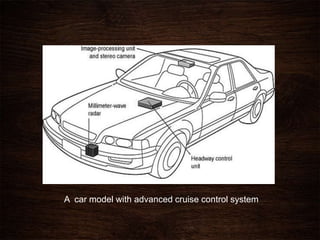
The main components of a typical radar-based ACC system are
*Fusion sensor
*Headway control unit
*Throttle
*Brake
*Dashboard display
Fusion sensor: It is a combination of sensors and processors. They are
*Millimeter-wave radar
*Stereo camera
*Image processor
*Fusion processor
Architecture of a radar-based ACC system
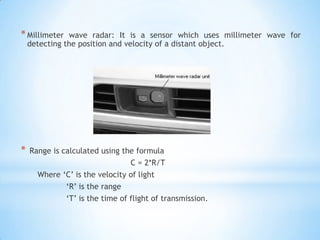
*Millimeter wave radar: It is a sensor which uses millimeter wave for
detecting the position and velocity of a distant object.
* Range is calculated using the formula
C = 2*R/T
Where ‘C’ is the velocity of light
‘R’ is the range
‘T’ is the time of flight of transmission.
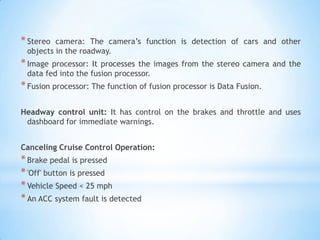
*Stereo camera: The camera’s function is detection of cars and other
objects in the roadway.
*Image processor: It processes the images from the stereo camera and the
data fed into the fusion processor.
*Fusion processor: The function of fusion processor is Data Fusion.
Headway control unit: It has control on the brakes and throttle and uses
dashboard for immediate warnings.
Canceling Cruise Control Operation:
*Brake pedal is pressed
*'Off' button is pressed
*Vehicle Speed < 25 mph
*An ACC system fault is detected
A car model with advanced cruise control system
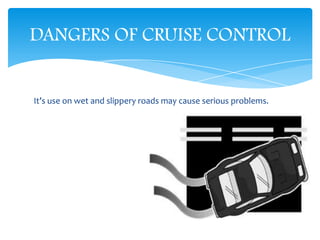
It’s use on wet and slippery roads may cause serious problems.
DANGERS OF CRUISE CONTROL
*
*CACC(co-operative adaptive cruise control) tested in California.
*At 100 km/hr, that would amount to a distance between cars of less than
14 meters (roughly two car lengths).
*Fujitsu Ten has demonstrated a prototype system for so called
stop-and-go adaptive cruise control.
*
*Fully autonomous car is probably not viable in the
foreseen future.
*Near by vehicles would be in constant communication
with each other and act co-operatively.
*It will probably take decades, but car accidents may
eventually become almost as rare as plane crashes are
now.
 www.howstuffworks.com
 www.cars.com/features/adaptivecruisecontrol
 www.autorepair.com
 http://en.wikipedia.org/wiki/Cruise_control

Cruise control systems

  • 1.
  • 4.
    Cruise control isa new technological development which incorporates a factor of comfort in driving. Safety is only a small benefit of this system. In short, cruise control can be said to be a system which uses the principles of radar to determine the distances between two consecutive moving vehicles in which either one or both of them is incorporated with this system. *
  • 5.
    * *INTRODUCTION *WHAT IS CRUISECONTROL ? *BASIC OPERATION *HOW TO SET CRUISE CONTROL? *ADAPTIVE CRUISE CONTROL *PARTS AND WORKING *DANGERS OF CRUISE CONTROL *FUTURE ASPECTS *CONCLUSION
  • 6.
    * *Every minute, onaverage, at least one person dies in a crash. *Air bags and seat belts save tens of thousands of people a year. *But the ultimate solution and the only thing that will save far more lives, limbs and money is ? till 1958. *Cruise control was commercially introduced in 1958 as an option on the Chrysler Imperial.
  • 7.
    *  Cruise controlis a system, which automatically controls the speed of an automobile.  The system takes over the throttle of the car to maintain a steady speed as set by the driver.  Most cruise control systems don’t allow the use of cruise control below a certain speed.  Blind inventor and mechanical engineer Ralph teetor invented cruise control in 1945.
  • 8.
     The basicoperation of a cruise controller is to sense the speed of the vehicle, compare this speed to a desired reference, and then accelerate or decelerate the car as required.  A simple control algorithm for controlling the speed is to use a "proportional plus integral" feedback.  The performance of the system is robust with respect to it’s mass uncertainty.
  • 9.
    Block diagram ofcruise control model
  • 10.
  • 11.
    * *Adaptive Cruise Control(ACC) is an automotive feature that allows a vehicle's cruise control system to adapt the vehicle's speed to the traffic environment. *In May 1998, Toyota became the first to introduce an ACC system on a production vehicle, luxury sedan.
  • 12.
    *ACC systems detectthe vehicle ahead through the use of either radar or lidar (light detecting and ranging). *Lidar based ACC systems are limited due to their poor working in bad whether.
  • 13.
    * The main componentsof a typical radar-based ACC system are *Fusion sensor *Headway control unit *Throttle *Brake *Dashboard display Fusion sensor: It is a combination of sensors and processors. They are *Millimeter-wave radar *Stereo camera *Image processor *Fusion processor
  • 14.
    Architecture of aradar-based ACC system
  • 15.
    *Millimeter wave radar:It is a sensor which uses millimeter wave for detecting the position and velocity of a distant object. * Range is calculated using the formula C = 2*R/T Where ‘C’ is the velocity of light ‘R’ is the range ‘T’ is the time of flight of transmission.
  • 16.
    *Stereo camera: Thecamera’s function is detection of cars and other objects in the roadway. *Image processor: It processes the images from the stereo camera and the data fed into the fusion processor. *Fusion processor: The function of fusion processor is Data Fusion. Headway control unit: It has control on the brakes and throttle and uses dashboard for immediate warnings. Canceling Cruise Control Operation: *Brake pedal is pressed *'Off' button is pressed *Vehicle Speed < 25 mph *An ACC system fault is detected
  • 17.
    A car modelwith advanced cruise control system
  • 18.
    It’s use onwet and slippery roads may cause serious problems. DANGERS OF CRUISE CONTROL
  • 19.
    * *CACC(co-operative adaptive cruisecontrol) tested in California. *At 100 km/hr, that would amount to a distance between cars of less than 14 meters (roughly two car lengths). *Fujitsu Ten has demonstrated a prototype system for so called stop-and-go adaptive cruise control.
  • 20.
    * *Fully autonomous caris probably not viable in the foreseen future. *Near by vehicles would be in constant communication with each other and act co-operatively. *It will probably take decades, but car accidents may eventually become almost as rare as plane crashes are now.
  • 21.
     www.howstuffworks.com  www.cars.com/features/adaptivecruisecontrol www.autorepair.com  http://en.wikipedia.org/wiki/Cruise_control