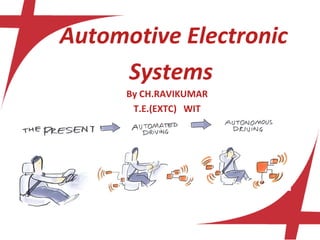
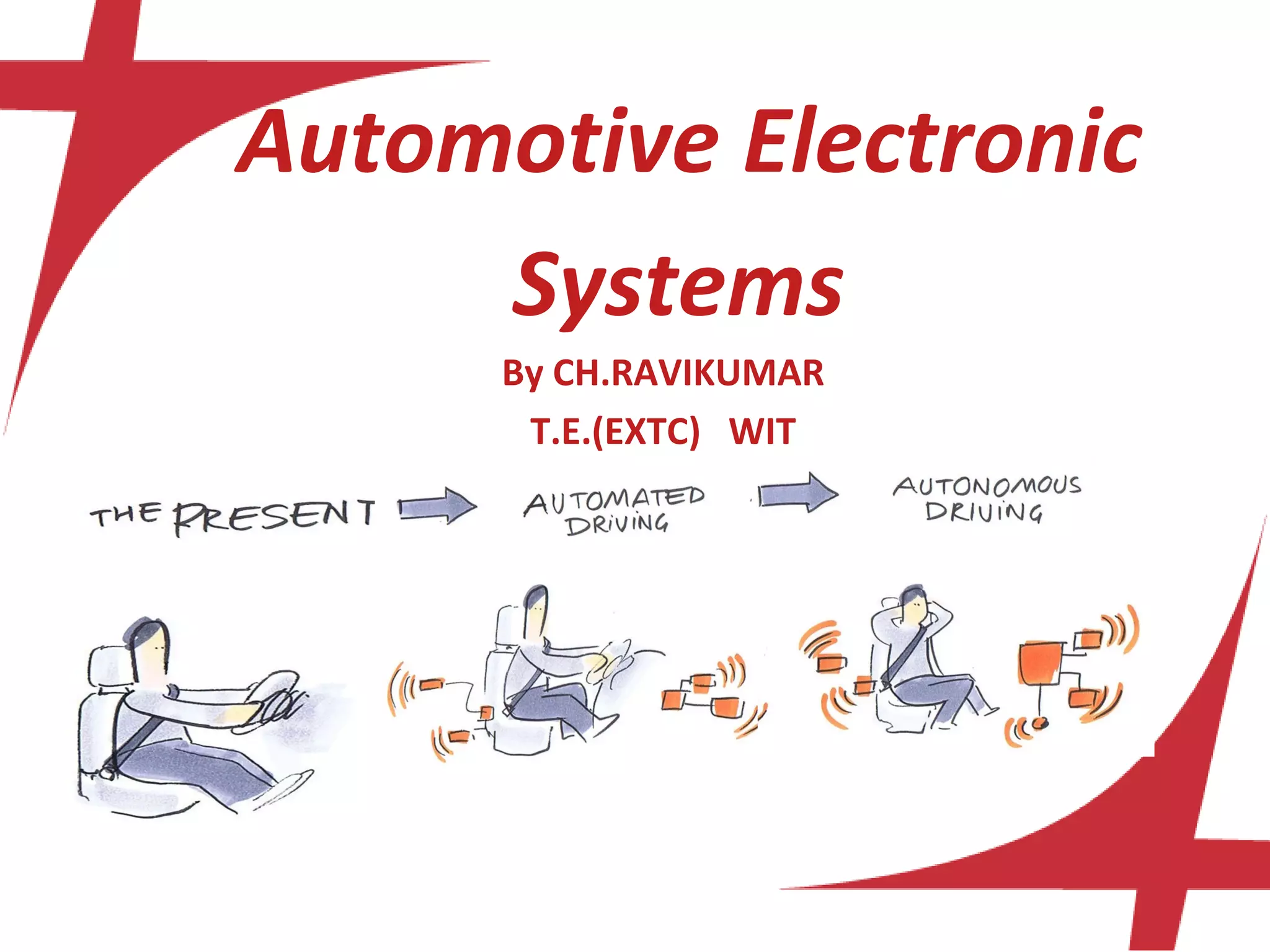
Automotive Electronic
Systems
By CH.RAVIKUMAR
T.E.(EXTC) WIT
Disciplines in Automotive Engineer
 Safety Engineering
 Fuel Economy/Emissions
 Vehicle Dynamics
 Vehicle Electronics
 Performance
 Shift Quality
 Durability / Corrosion engineering
 Package / Ergonomics Engineering etc
Safety Engineering
 Assessment of various crash scenarios and their
impact on the vehicle occupants
 Requirements Include:
— Seat belt and air bag functionality
— Front and side impact testing
— Full vehicle crashes
 Assessments are done with various methods and tools:
— Computer crash simulation
— Crash test dummies
Fuel Economy/Emissions
 It is the measured fuel efficiency of the vehicle in miles
per gallon or litres per 100 kilometers.
 Emissions testing the measurement of the vehicles
emissions:
— hydrocarbons
— nitrogen oxides (NOx)
— carbon monoxide (CO)
— carbon dioxide (CO2), and
— evaporative emissions
Vehicle Dynamics
 It is the vehicle's response of the following attributes:
— ride, handling, steering,
braking, comfort and traction
 Design of the chassis systems:
— suspension, steering, braking, structure
(frame), wheels and tires,
and traction control
 Dynamics engineer to deliver the Vehicle Dynamics
qualities desired
 Automotive electronics is an increasingly important
aspect of automotive engineering
Responsible for operational controls
— throttle, brake and steering controls
— comfort and convenience systems
— infotainment and lighting systems
It would not be possible for automobiles to meet
modern safety and fuel economy requirements
without electronic controls
Vehicle Electronics
 Performance is a measurable and testable value of a
vehicles ability to perform in various conditions
— how quickly a car can accelerate (e.g.
standing start 1/4 mile elapsed time,
(0- 60 mph, etc.)
 Generate without losing grip, recorded lap times,
cornering speed, brake fade, etc
 Performance can also reflect the amount of control in
inclement weather (snow, ice, rain)
Performance
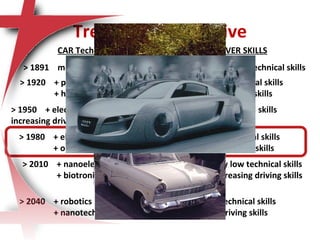
Trends in automotive
> 1920 + pneumatic systems low high technical skills
+ hydraulic systems low driving skills
> 1950 + electric systems increasing good technical skills
increasing driving skills
> 1980 + electronic systems congestion low technical skills
+ optronic systems starts high driving skills
> 2010 + nanoelectronics congested very low technical skills
+ biotronic systems optimization decreasing driving skills
starts
> 2040 + robotics maximal and no technical skills
+ nanotechnology optimized no driving skills
CAR Technology TRAFFIC DRIVER SKILLS
> 1891 mechanical system very low very high technical skills
Automotive Electronics
Phase 1: Introduction of Electronics
in non-critical applications
 Driver information and entertainment
e.g. radio,
 Comfort and convenience
e.g. electric windows, wiper/washer, seat heating, central
locking, interior light control …
 Low intelligence electronic systems
 Minor communication between systems
(pushbutton control)
 No impact on engine performance
 No impact on driving & driver skills
Automotive Electronics
Phase 2: Electronics support critical applications
– Engine optimization:
e.g. efficiency improvement & pollution control
– Active and Passive Safety
e.g. ABS, ESP, airbags, tire pressure, Xenon lamps …
– Driver information and entertainment
e.g. radio-CD-GPS, parking radar, service warnings …
– Comfort, convenience and security:
e.g. airco, cruise control, keyless entry, transponders …
 Increasingly complex and intelligent electronic systems
 Communication between electronic systems within the car
 Full control of engine performance
 No control of driving & driver skills
But reactive correction of driver errors.
 Electronics impact remains within the car
Automotive Electronics
Phase 3: Electronics control critical applications
– Full Engine control
e.g. start/stop cycles, hybrid vehicles …
– Active and Passive Safety
e.g. X by wire, anti-collision radar, dead-angle radar …
– Driver information and entertainment
e.g. traffic congestion warning, weather and road conditions …
– Comfort and convenience
 Very intelligent and robust electronics
 Communication between internal and external systems
Information exchange with traffic network
 Full control of engine performance
 Control of driving and (decreasing) driving skills
Proactive prevention of dangerous situations inside
and around the car
 Full control of car and immediate surroundings
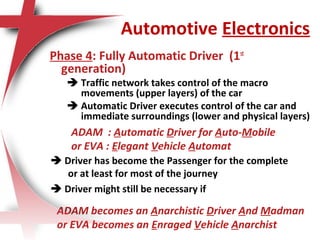
Automotive Electronics
Phase 4: Fully Automatic Driver (1st
generation)
 Traffic network takes control of the macro
movements (upper layers) of the car
 Automatic Driver executes control of the car and
immediate surroundings (lower and physical layers)
ADAM : Automatic Driver for Auto-Mobile
or EVA : Elegant Vehicle Automat
 Driver has become the Passenger for the complete
or at least for most of the journey
 Driver might still be necessary if
ADAM becomes an Anarchistic Driver And Madman
or EVA becomes an Enraged Vehicle Anarchist
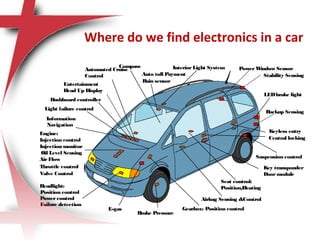
InteriorLight System
Auto toll Payment
Rain sensor
Dashboard controller
Automated Cruise
Control
Light failure control
Information
Navigation
Entertainment
Head Up Display
Engine:
Injection control
Injection monitor
Oil Level Sensing
Air Flow
Headlight:
Position control
Power control
Failure detection
Brake Pressure
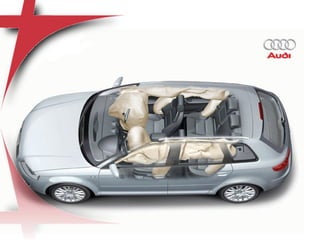
Airbag Sensing &Control
Seat control:
Position/Heating
Key transponder
Doormodule
Keyless entry
Central locking
Throttle control
Valve Control
E-gas
Suspension control
LEDbrake light
Compass
Stability Sensing
Power Window Sensor
Backup Sensing
Gearbox: Position control
Where do we find electronics in a car
Emerging In-Vehicle Networks
Introduction
In-vehicle networks
– Connect the vehicle's electronic equipments
– Facilitate the sharing of information and resources
among the distributed applications
– These control and communications networks are
based on serial protocols, replacing wire
harnesses with in-vehicle networks
– Change the point-to-point wiring of centralized
ECUs to the in-vehicle networking of distributed
ECUs
Introduction
Aims of In-Vehicle Network
– Open Standard
– Ease to Use
– Cost Reduction
– Improved Quality
Benefits of In-Vehicle Network
– More reliable cars
– More functionality at lower price
– Standardization of interfaces and components
– Faster introduction of new technologies
– Functional Extendibility
Introduction
– Decreasing wiring harness weight and complexity
– Electronic Control Units are shrinking and are
directly applied to actuators and sensors
Introduction
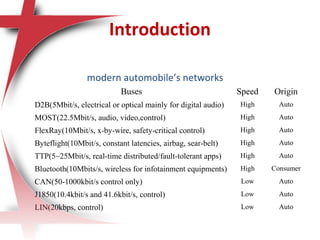
modern automobile’s networks
Buses Speed Origin
D2B(5Mbit/s, electrical or optical mainly for digital audio) High Auto
MOST(22.5Mbit/s, audio, video,control) High Auto
FlexRay(10Mbit/s, x-by-wire, safety-critical control) High Auto
Byteflight(10Mbit/s, constant latencies, airbag, sear-belt) High Auto
TTP(5~25Mbit/s, real-time distributed/fault-tolerant apps) High Auto
Bluetooth(10Mbits/s, wireless for infotainment equipments) High Consumer
CAN(50-1000kbit/s control only) Low Auto
J1850(10.4kbit/s and 41.6kbit/s, control) Low Auto
LIN(20kbps, control) Low Auto
Introduction
Overview of In-Vehicle Networks
D2B (Domestic Data Bus )
– Matsushita and Philips jointly developed
– Has promoted since 1992
– D2B was designed for audio-video
communications, computer peripherals, and
automotive media applications
• The Mercedes-Benz S-class vehicle uses the D2B optical
bus to network the car radio, autopilot and CD systems
• The Tele-Aid connection, cellular phone, and
Linguatronic voice-recognition application
Media-Oriented Systems Transport (MOST)
– It was initiated in 1997
– Supports both time-triggered and event-triggered
traffic with predictable frame transmission at
speeds of 25Mbps
– Using plastic optic fiber as communication
medium
Overview of In-Vehicle Networks
– The interconnection of telematics and
infotainment such as video displays, GPS
navigation systems, active speaker and digital
radio
– More than 50 firms—including Audi, BMW,
Daimler-Chrysler, Becker Automotive, and Oasis
Silicon Systems—developed the protocol under
the MOST Cooperative
Overview of In-Vehicle Networks
Time-triggered protocol (TTP)
– It was released in 1998
– It is a pure time-triggered TDMA protocol
– Frames are sent at speeds of 5-25Mbps depending
on the physical medium
– Designed for real-time distributed systems that
are hard and fault tolerant
– It is going on to reach speeds of 1Gbps using an
Ethernet based star architecture
Overview of In-Vehicle Networks
FlexRay
– FlexRay is a fault-tolerant protocol designed for
high-data-rate, advanced-control applications,
such as X-by-wire systems (high-speed safety-
critical automotive systems)
– Provides both time-triggered and event-triggered
message transmission
– Messages are sent at 10Mbps
Overview of In-Vehicle Networks
– Both electrical and optical solutions are adopted
for the physical layer
– The ECUs are interconnected using either a
passive bus topology or an active star topology
– FlexRay complements CAN and LIN being suitable
for both powertrain systems and XBW systems
Overview of In-Vehicle Networks
Byteflight
– Developed from 1996 by BMW
– A flexible time-division multiple access (TDMA)
protocol using a star topology for safety-related
applications
– Messages are sent in frames at 10Mbps support
for event-triggered message transmission
Overview of In-Vehicle Networks
– Guarantees deterministic (constant) latencies for
a bounded number of high priority real-time
message
– The physical medium used is plastic optical fiber
– Byteflight can be used with devices such as air
bags and sear-belt tensioners
– Byteflight is a very high performance network
with many of the features necessary for X-by-wire
Overview of In-Vehicle Networks
Bluetooth
– An open specification for an inexpensive, short-
range (10-100 meters), low power, miniature
radio network.
– Easy and instantaneous connections between
Bluetooth-enabled devices without the need for
cables
• vehicular uses for Bluetooth include hands-free phone
sets; portable DVD, CD, and MP3 drives; diagnostic
equipment; and handheld computers
Overview of In-Vehicle Networks
Controller area network (CAN)
– Was initiated in 1981 and developed by Bosch
developed the controller
– Message frames are transmitted in an event-
triggered fashion
– Up to 1Mbps transmission speed
– It is a robust, cost-effective general control
network, but certain niche applications demand
more specialized control networks.
Overview of In-Vehicle Networks
Local interconnect network (LIN)
– A master-slave, time-triggered protocol
– As a low-speed (20kbps), single-wire
– LIN is meant to link to relatively higher-speed
networks like CAN
– LIN reveals the security of serial networks in cars
Overview of In-Vehicle Networks
– network is used in on-off devices such as car
seats, door locks, sunroofs, rain sensors, and door
mirrors
Overview of In-Vehicle Networks
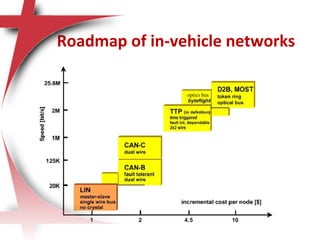
Roadmap of in-vehicle networks
optics bus
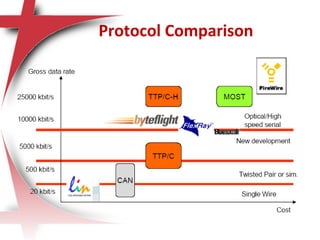
Protocol Comparison
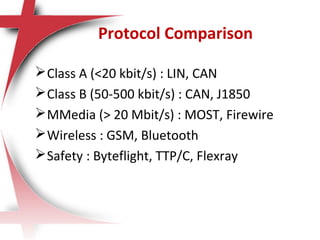
Protocol Comparison
Class A (<20 kbit/s) : LIN, CAN
Class B (50-500 kbit/s) : CAN, J1850
MMedia (> 20 Mbit/s) : MOST, Firewire
Wireless : GSM, Bluetooth
Safety : Byteflight, TTP/C, Flexray
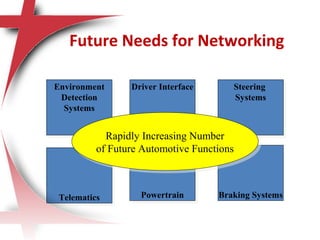
Future Needs for Networking
Environment
Detection
Systems
Environment
Detection
Systems
TelematicsTelematics
Driver InterfaceDriver Interface
PowertrainPowertrain
Steering
Systems
Steering
Systems
Braking Systems
Rapidly Increasing Number
of Future Automotive Functions
Rapidly Increasing Number
of Future Automotive Functions
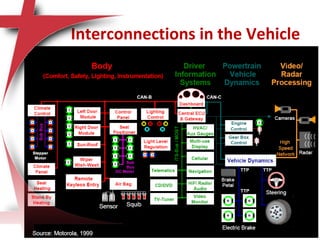
Interconnections in the Vehicle
Multimedia
Consumer
Interface
Infotainment-
Control
Powertrain and
Vehicle Dynamics
Body
Electronics
Sub-Bus
X-by-wire
Safety Bus
Safety/Reliability
Data Rate
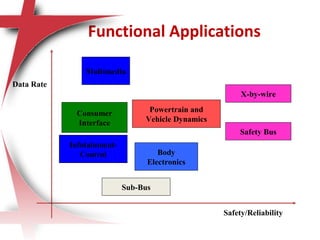
Functional Applications
FlexRay
CAN
LIN
MOST
Close-loop Control Systems
Telematics Applications
Requirements
1 Mbits/s
20 Kbits/s
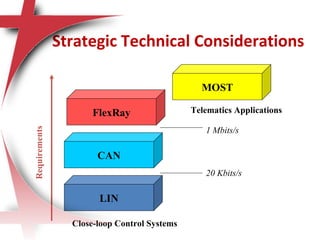
Strategic Technical Considerations
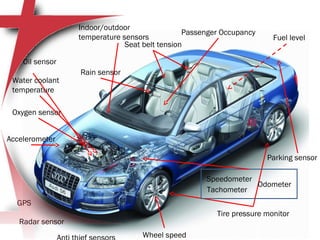
AUTOMOTIVE SENSORS
Oil sensor
Oxygen sensor
Fuel level
Accelerometer
Seat belt tension
Passenger Occupancy
Wheel speed
Tire pressure monitor
Radar sensor
Rain sensor
Parking sensor
Indoor/outdoor
temperature sensors
GPS
Water coolant
temperature
Tachometer
Speedometer
Odometer
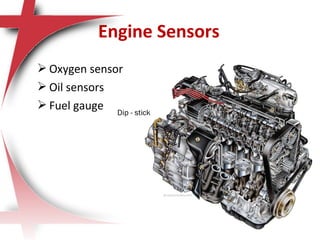
Engine Sensors
 Oxygen sensor
 Oil sensors
 Fuel gauge Dip - stick
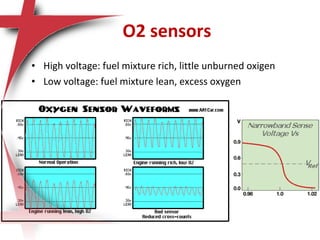
• High voltage: fuel mixture rich, little unburned oxigen
• Low voltage: fuel mixture lean, excess oxygen
O2 sensors
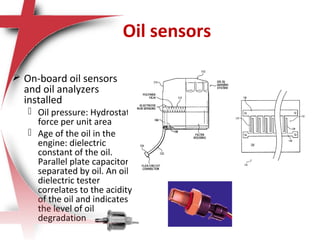
Oil sensors
 On-board oil sensors
and oil analyzers
installed
 Oil pressure: Hydrostatic
force per unit area
 Age of the oil in the
engine: dielectric
constant of the oil.
Parallel plate capacitor
separated by oil. An oil
dielectric tester
correlates to the acidity
of the oil and indicates
the level of oil
degradation
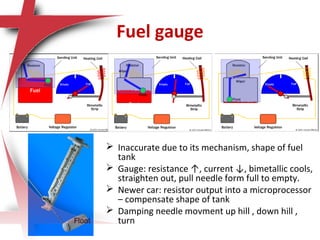
Fuel gauge
 Inaccurate due to its mechanism, shape of fuel
tank
 Gauge: resistance ↑, current ↓, bimetallic cools,
straighten out, pull needle form full to empty.
 Newer car: resistor output into a microprocessor
– compensate shape of tank
 Damping needle movment up hill , down hill ,
turnFloat
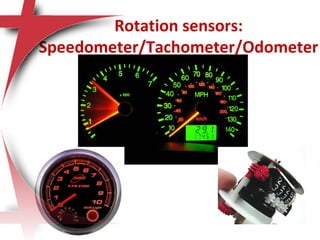
Rotation sensors:
Speedometer/Tachometer/Odometer
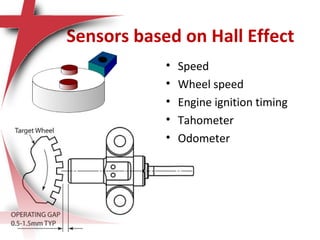
Sensors based on Hall Effect
• Speed
• Wheel speed
• Engine ignition timing
• Tahometer
• Odometer
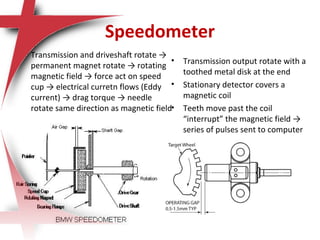
Speedometer
 Transmission and driveshaft rotate →
permanent magnet rotate → rotating
magnetic field → force act on speed
cup → electrical curretn flows (Eddy
current) → drag torque → needle
rotate same direction as magnetic field
• Transmission output rotate with a
toothed metal disk at the end
• Stationary detector covers a
magnetic coil
• Teeth move past the coil
“interrupt” the magnetic field →
series of pulses sent to computer
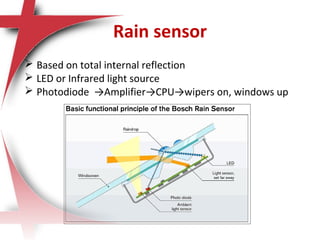
Rain sensor
 Based on total internal reflection
 LED or Infrared light source
 Photodiode →Amplifier→CPU→wipers on, windows up
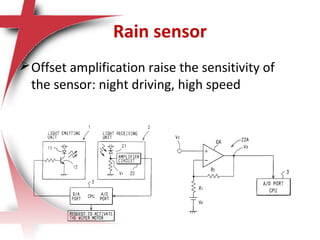
Rain sensor
Offset amplification raise the sensitivity of
the sensor: night driving, high speed
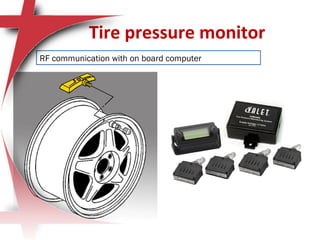
Tire pressure monitor
RF communication with on board computer
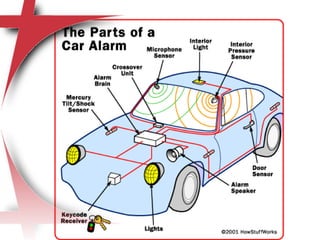
Car alarm system
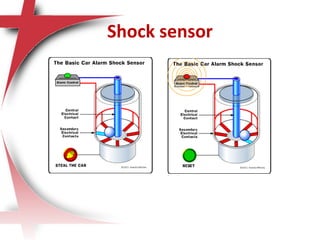
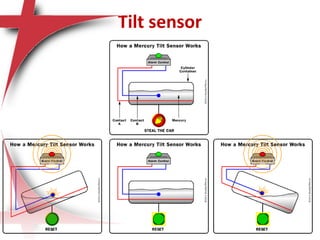
Simplest form, it is nothing but one or more sensors
connected to some sort of siren
Most modern car alarm systems:
 An array of sensors that can include switches, pressure
sensors and motion detectors
 A siren, often able to create a variety of sounds so that you
can pick a distinct sound for your car
 A radio receiver to allow wireless control from a key fob
 An auxiliary battery so that the alarm can operate even if
the main battery gets disconnected
 A computer control unit that monitors everything and
sounds the alarm -- the "brain" of the system
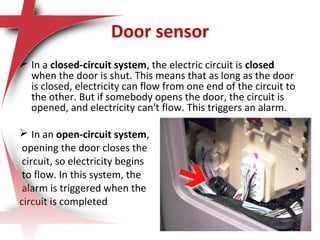
Door sensor
 In a closed-circuit system, the electric circuit is closed
when the door is shut. This means that as long as the door
is closed, electricity can flow from one end of the circuit to
the other. But if somebody opens the door, the circuit is
opened, and electricity can't flow. This triggers an alarm.
 In an open-circuit system,
opening the door closes the
circuit, so electricity begins
to flow. In this system, the
alarm is triggered when the
circuit is completed
Shock sensor
Tilt sensor
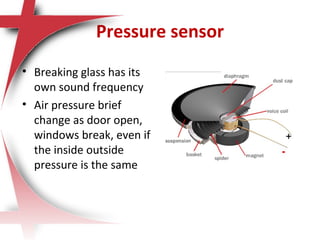
Pressure sensor
• Breaking glass has its
own sound frequency
• Air pressure brief
change as door open,
windows break, even if
the inside outside
pressure is the same
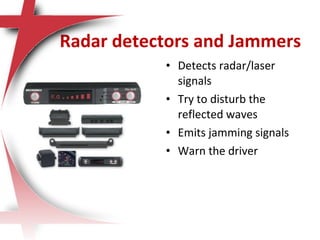
Radar detectors and Jammers
• Detects radar/laser
signals
• Try to disturb the
reflected waves
• Emits jamming signals
• Warn the driver
THANK YOU

Automotive electronics Systems by Ravikumar Chilmula

  • 1.
  • 2.
    Disciplines in AutomotiveEngineer  Safety Engineering  Fuel Economy/Emissions  Vehicle Dynamics  Vehicle Electronics  Performance  Shift Quality  Durability / Corrosion engineering  Package / Ergonomics Engineering etc
  • 3.
    Safety Engineering  Assessmentof various crash scenarios and their impact on the vehicle occupants  Requirements Include: — Seat belt and air bag functionality — Front and side impact testing — Full vehicle crashes  Assessments are done with various methods and tools: — Computer crash simulation — Crash test dummies
  • 4.
    Fuel Economy/Emissions  Itis the measured fuel efficiency of the vehicle in miles per gallon or litres per 100 kilometers.  Emissions testing the measurement of the vehicles emissions: — hydrocarbons — nitrogen oxides (NOx) — carbon monoxide (CO) — carbon dioxide (CO2), and — evaporative emissions
  • 5.
    Vehicle Dynamics  Itis the vehicle's response of the following attributes: — ride, handling, steering, braking, comfort and traction  Design of the chassis systems: — suspension, steering, braking, structure (frame), wheels and tires, and traction control  Dynamics engineer to deliver the Vehicle Dynamics qualities desired
  • 6.
     Automotive electronicsis an increasingly important aspect of automotive engineering Responsible for operational controls — throttle, brake and steering controls — comfort and convenience systems — infotainment and lighting systems It would not be possible for automobiles to meet modern safety and fuel economy requirements without electronic controls Vehicle Electronics
  • 7.
     Performance isa measurable and testable value of a vehicles ability to perform in various conditions — how quickly a car can accelerate (e.g. standing start 1/4 mile elapsed time, (0- 60 mph, etc.)  Generate without losing grip, recorded lap times, cornering speed, brake fade, etc  Performance can also reflect the amount of control in inclement weather (snow, ice, rain) Performance
  • 8.
    Trends in automotive >1920 + pneumatic systems low high technical skills + hydraulic systems low driving skills > 1950 + electric systems increasing good technical skills increasing driving skills > 1980 + electronic systems congestion low technical skills + optronic systems starts high driving skills > 2010 + nanoelectronics congested very low technical skills + biotronic systems optimization decreasing driving skills starts > 2040 + robotics maximal and no technical skills + nanotechnology optimized no driving skills CAR Technology TRAFFIC DRIVER SKILLS > 1891 mechanical system very low very high technical skills
  • 9.
    Automotive Electronics Phase 1:Introduction of Electronics in non-critical applications  Driver information and entertainment e.g. radio,  Comfort and convenience e.g. electric windows, wiper/washer, seat heating, central locking, interior light control …  Low intelligence electronic systems  Minor communication between systems (pushbutton control)  No impact on engine performance  No impact on driving & driver skills
  • 10.
    Automotive Electronics Phase 2:Electronics support critical applications – Engine optimization: e.g. efficiency improvement & pollution control – Active and Passive Safety e.g. ABS, ESP, airbags, tire pressure, Xenon lamps … – Driver information and entertainment e.g. radio-CD-GPS, parking radar, service warnings … – Comfort, convenience and security: e.g. airco, cruise control, keyless entry, transponders …  Increasingly complex and intelligent electronic systems  Communication between electronic systems within the car  Full control of engine performance  No control of driving & driver skills But reactive correction of driver errors.  Electronics impact remains within the car
  • 11.
    Automotive Electronics Phase 3:Electronics control critical applications – Full Engine control e.g. start/stop cycles, hybrid vehicles … – Active and Passive Safety e.g. X by wire, anti-collision radar, dead-angle radar … – Driver information and entertainment e.g. traffic congestion warning, weather and road conditions … – Comfort and convenience  Very intelligent and robust electronics  Communication between internal and external systems Information exchange with traffic network  Full control of engine performance  Control of driving and (decreasing) driving skills Proactive prevention of dangerous situations inside and around the car  Full control of car and immediate surroundings
  • 12.
    Automotive Electronics Phase 4:Fully Automatic Driver (1st generation)  Traffic network takes control of the macro movements (upper layers) of the car  Automatic Driver executes control of the car and immediate surroundings (lower and physical layers) ADAM : Automatic Driver for Auto-Mobile or EVA : Elegant Vehicle Automat  Driver has become the Passenger for the complete or at least for most of the journey  Driver might still be necessary if ADAM becomes an Anarchistic Driver And Madman or EVA becomes an Enraged Vehicle Anarchist
  • 13.
    InteriorLight System Auto tollPayment Rain sensor Dashboard controller Automated Cruise Control Light failure control Information Navigation Entertainment Head Up Display Engine: Injection control Injection monitor Oil Level Sensing Air Flow Headlight: Position control Power control Failure detection Brake Pressure Airbag Sensing &Control Seat control: Position/Heating Key transponder Doormodule Keyless entry Central locking Throttle control Valve Control E-gas Suspension control LEDbrake light Compass Stability Sensing Power Window Sensor Backup Sensing Gearbox: Position control Where do we find electronics in a car
  • 14.
  • 15.
    Introduction In-vehicle networks – Connectthe vehicle's electronic equipments – Facilitate the sharing of information and resources among the distributed applications – These control and communications networks are based on serial protocols, replacing wire harnesses with in-vehicle networks – Change the point-to-point wiring of centralized ECUs to the in-vehicle networking of distributed ECUs
  • 16.
    Introduction Aims of In-VehicleNetwork – Open Standard – Ease to Use – Cost Reduction – Improved Quality
  • 17.
    Benefits of In-VehicleNetwork – More reliable cars – More functionality at lower price – Standardization of interfaces and components – Faster introduction of new technologies – Functional Extendibility Introduction
  • 18.
    – Decreasing wiringharness weight and complexity – Electronic Control Units are shrinking and are directly applied to actuators and sensors Introduction
  • 19.
    modern automobile’s networks BusesSpeed Origin D2B(5Mbit/s, electrical or optical mainly for digital audio) High Auto MOST(22.5Mbit/s, audio, video,control) High Auto FlexRay(10Mbit/s, x-by-wire, safety-critical control) High Auto Byteflight(10Mbit/s, constant latencies, airbag, sear-belt) High Auto TTP(5~25Mbit/s, real-time distributed/fault-tolerant apps) High Auto Bluetooth(10Mbits/s, wireless for infotainment equipments) High Consumer CAN(50-1000kbit/s control only) Low Auto J1850(10.4kbit/s and 41.6kbit/s, control) Low Auto LIN(20kbps, control) Low Auto Introduction
  • 20.
    Overview of In-VehicleNetworks D2B (Domestic Data Bus ) – Matsushita and Philips jointly developed – Has promoted since 1992 – D2B was designed for audio-video communications, computer peripherals, and automotive media applications • The Mercedes-Benz S-class vehicle uses the D2B optical bus to network the car radio, autopilot and CD systems • The Tele-Aid connection, cellular phone, and Linguatronic voice-recognition application
  • 21.
    Media-Oriented Systems Transport(MOST) – It was initiated in 1997 – Supports both time-triggered and event-triggered traffic with predictable frame transmission at speeds of 25Mbps – Using plastic optic fiber as communication medium Overview of In-Vehicle Networks
  • 22.
    – The interconnectionof telematics and infotainment such as video displays, GPS navigation systems, active speaker and digital radio – More than 50 firms—including Audi, BMW, Daimler-Chrysler, Becker Automotive, and Oasis Silicon Systems—developed the protocol under the MOST Cooperative Overview of In-Vehicle Networks
  • 23.
    Time-triggered protocol (TTP) –It was released in 1998 – It is a pure time-triggered TDMA protocol – Frames are sent at speeds of 5-25Mbps depending on the physical medium – Designed for real-time distributed systems that are hard and fault tolerant – It is going on to reach speeds of 1Gbps using an Ethernet based star architecture Overview of In-Vehicle Networks
  • 24.
    FlexRay – FlexRay isa fault-tolerant protocol designed for high-data-rate, advanced-control applications, such as X-by-wire systems (high-speed safety- critical automotive systems) – Provides both time-triggered and event-triggered message transmission – Messages are sent at 10Mbps Overview of In-Vehicle Networks
  • 25.
    – Both electricaland optical solutions are adopted for the physical layer – The ECUs are interconnected using either a passive bus topology or an active star topology – FlexRay complements CAN and LIN being suitable for both powertrain systems and XBW systems Overview of In-Vehicle Networks
  • 26.
    Byteflight – Developed from1996 by BMW – A flexible time-division multiple access (TDMA) protocol using a star topology for safety-related applications – Messages are sent in frames at 10Mbps support for event-triggered message transmission Overview of In-Vehicle Networks
  • 27.
    – Guarantees deterministic(constant) latencies for a bounded number of high priority real-time message – The physical medium used is plastic optical fiber – Byteflight can be used with devices such as air bags and sear-belt tensioners – Byteflight is a very high performance network with many of the features necessary for X-by-wire Overview of In-Vehicle Networks
  • 28.
    Bluetooth – An openspecification for an inexpensive, short- range (10-100 meters), low power, miniature radio network. – Easy and instantaneous connections between Bluetooth-enabled devices without the need for cables • vehicular uses for Bluetooth include hands-free phone sets; portable DVD, CD, and MP3 drives; diagnostic equipment; and handheld computers Overview of In-Vehicle Networks
  • 29.
    Controller area network(CAN) – Was initiated in 1981 and developed by Bosch developed the controller – Message frames are transmitted in an event- triggered fashion – Up to 1Mbps transmission speed – It is a robust, cost-effective general control network, but certain niche applications demand more specialized control networks. Overview of In-Vehicle Networks
  • 30.
    Local interconnect network(LIN) – A master-slave, time-triggered protocol – As a low-speed (20kbps), single-wire – LIN is meant to link to relatively higher-speed networks like CAN – LIN reveals the security of serial networks in cars Overview of In-Vehicle Networks
  • 31.
    – network isused in on-off devices such as car seats, door locks, sunroofs, rain sensors, and door mirrors Overview of In-Vehicle Networks
  • 32.
    Roadmap of in-vehiclenetworks optics bus
  • 33.
  • 34.
    Protocol Comparison Class A(<20 kbit/s) : LIN, CAN Class B (50-500 kbit/s) : CAN, J1850 MMedia (> 20 Mbit/s) : MOST, Firewire Wireless : GSM, Bluetooth Safety : Byteflight, TTP/C, Flexray
  • 35.
    Future Needs forNetworking Environment Detection Systems Environment Detection Systems TelematicsTelematics Driver InterfaceDriver Interface PowertrainPowertrain Steering Systems Steering Systems Braking Systems Rapidly Increasing Number of Future Automotive Functions Rapidly Increasing Number of Future Automotive Functions
  • 36.
  • 37.
  • 38.
    FlexRay CAN LIN MOST Close-loop Control Systems TelematicsApplications Requirements 1 Mbits/s 20 Kbits/s Strategic Technical Considerations
  • 39.
  • 40.
    Oil sensor Oxygen sensor Fuellevel Accelerometer Seat belt tension Passenger Occupancy Wheel speed Tire pressure monitor Radar sensor Rain sensor Parking sensor Indoor/outdoor temperature sensors GPS Water coolant temperature Tachometer Speedometer Odometer
  • 41.
    Engine Sensors  Oxygensensor  Oil sensors  Fuel gauge Dip - stick
  • 42.
    • High voltage:fuel mixture rich, little unburned oxigen • Low voltage: fuel mixture lean, excess oxygen O2 sensors
  • 43.
    Oil sensors  On-boardoil sensors and oil analyzers installed  Oil pressure: Hydrostatic force per unit area  Age of the oil in the engine: dielectric constant of the oil. Parallel plate capacitor separated by oil. An oil dielectric tester correlates to the acidity of the oil and indicates the level of oil degradation
  • 44.
    Fuel gauge  Inaccuratedue to its mechanism, shape of fuel tank  Gauge: resistance ↑, current ↓, bimetallic cools, straighten out, pull needle form full to empty.  Newer car: resistor output into a microprocessor – compensate shape of tank  Damping needle movment up hill , down hill , turnFloat
  • 45.
  • 46.
    Sensors based onHall Effect • Speed • Wheel speed • Engine ignition timing • Tahometer • Odometer
  • 47.
    Speedometer  Transmission anddriveshaft rotate → permanent magnet rotate → rotating magnetic field → force act on speed cup → electrical curretn flows (Eddy current) → drag torque → needle rotate same direction as magnetic field • Transmission output rotate with a toothed metal disk at the end • Stationary detector covers a magnetic coil • Teeth move past the coil “interrupt” the magnetic field → series of pulses sent to computer
  • 49.
    Rain sensor  Basedon total internal reflection  LED or Infrared light source  Photodiode →Amplifier→CPU→wipers on, windows up
  • 50.
    Rain sensor Offset amplificationraise the sensitivity of the sensor: night driving, high speed
  • 51.
    Tire pressure monitor RFcommunication with on board computer
  • 52.
    Car alarm system Simplestform, it is nothing but one or more sensors connected to some sort of siren Most modern car alarm systems:  An array of sensors that can include switches, pressure sensors and motion detectors  A siren, often able to create a variety of sounds so that you can pick a distinct sound for your car  A radio receiver to allow wireless control from a key fob  An auxiliary battery so that the alarm can operate even if the main battery gets disconnected  A computer control unit that monitors everything and sounds the alarm -- the "brain" of the system
  • 54.
    Door sensor  Ina closed-circuit system, the electric circuit is closed when the door is shut. This means that as long as the door is closed, electricity can flow from one end of the circuit to the other. But if somebody opens the door, the circuit is opened, and electricity can't flow. This triggers an alarm.  In an open-circuit system, opening the door closes the circuit, so electricity begins to flow. In this system, the alarm is triggered when the circuit is completed
  • 55.
  • 56.
  • 57.
    Pressure sensor • Breakingglass has its own sound frequency • Air pressure brief change as door open, windows break, even if the inside outside pressure is the same
  • 58.
    Radar detectors andJammers • Detects radar/laser signals • Try to disturb the reflected waves • Emits jamming signals • Warn the driver
  • 59.