Embedded System in Automobile
By : Amit Kumar Sah
Roll No: 09/ECE/73
NIT Durgapur
Embedded System- Definition?
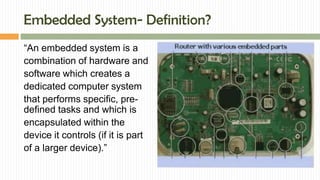
“An embedded system is a
combination of hardware and
software which creates a
dedicated computer system
that performs specific, pre-
defined tasks and which is
encapsulated within the
device it controls (if it is part
of a larger device).”
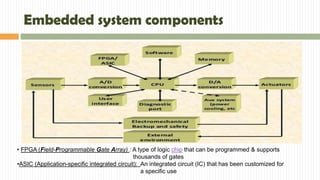
• FPGA (Field-Programmable Gate Array) : A type of logic chip that can be programmed & supports
thousands of gates
•ASIC (Application-specific integrated circuit): An integrated circuit (IC) that has been customized for
a specific use
Embedded system components
Characteristics of embedded systems
 Sophisticated functionality.
 Often have to run sophisticated algorithms or multiple algorithms.
 Often provide sophisticated user interfaces.
 Real-time operation .
 Must finish operations by deadlines
 Many systems are multi-rate must handle operations at widely varying
rates
 Low manufacturing cost.
 Low power.
 Designed to tight deadlines by small teams.
Automotive Systems: Technology in today's vehicle
 Air Bags
 The Black Box
 Anti-lock Brake System(ABS)
 Adaptive Cruise Control
 Drive by wire
 Satellite Radio Eg:XM
 Telematics Eg:OnStar
 Rain-sensing Wipers
 Emission Control
 Traction Control
 Automatic Parking
 In-vehicle entertainment
 Heads-up display
 Night Vision
 Back-up collision sensor
 Navigation Systems
 Tire Pressure Monitor
 Climate Control
Air Bags : Principle of function
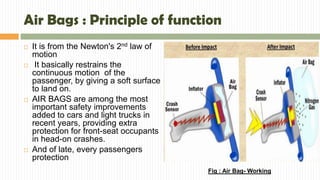
 It is from the Newton's 2nd law of
motion
 It basically restrains the
continuous motion of the
passenger, by giving a soft surface
to land on.
 AIR BAGS are among the most
important safety improvements
added to cars and light trucks in
recent years, providing extra
protection for front-seat occupants
in head-on crashes.
 And of late, every passengers
protection
Fig : Air Bag- Working
Event Data Recorder-EDR or the The "Black Box"
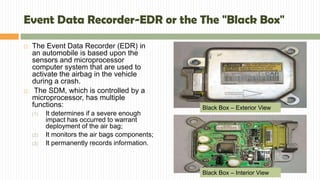
 The Event Data Recorder (EDR) in
an automobile is based upon the
sensors and microprocessor
computer system that are used to
activate the airbag in the vehicle
during a crash.
 The SDM, which is controlled by a
microprocessor, has multiple
functions:
(1) It determines if a severe enough
impact has occurred to warrant
deployment of the air bag;
(2) It monitors the air bags components;
(3) It permanently records information.
Black Box – Exterior View
Black Box – Interior View
Anti-lock Braking System(ABS)
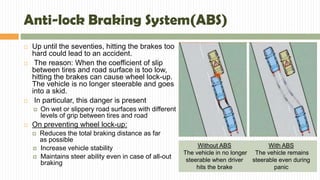
 Up until the seventies, hitting the brakes too
hard could lead to an accident.
 The reason: When the coefficient of slip
between tires and road surface is too low,
hitting the brakes can cause wheel lock-up.
The vehicle is no longer steerable and goes
into a skid.
 In particular, this danger is present
 On wet or slippery road surfaces with different
levels of grip between tires and road
 On preventing wheel lock-up:
 Reduces the total braking distance as far
as possible
 Increase vehicle stability
 Maintains steer ability even in case of all-out
braking
Without ABS
The vehicle in no longer
steerable when driver
hits the brake
With ABS
The vehicle remains
steerable even during
panic
Principle of functioning
 Wheel-speed sensors detect whether a wheel is showing a tendency to
lock-up
 In case of a lock-up tendency, the electronic control unit reduces the
braking pressure individually at the wheel concerned
 High-speed correction of the braking pressure up to shortly before the
lock-up threshold
 The brake-fluid return together with the closed-loop brake circuits makes
this a safe, reliable, and cost-effective system
Advantage
 A gain for driving safety
 The vehicle remains steerable, even in case of panic braking
 Shorter stopping distances on practically all road surfaces
 Many accidents are avoided
Dynamic Traction & Stability Control
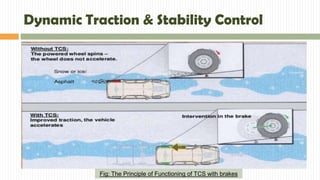
 The traction control system is required to prevent driver error from
overloading any of the four wheels and causing slip, through either
throttle or brake application
 Drastically improve vehicle performance and safety by maintaining
optimal wheel traction in all road conditions
 The basic principle is always the adaptation of the wheel torque to the
coefficient of friction between the wheel and the road surface.
 To this end, the systems make use of different intervention methods
 In the wheel brakes
 In the drivetrain control
Dynamic Traction & Stability Control
Fig: The Principle of Functioning of TCS with brakes
Intelligent Cruise Control
 Cooperative Adaptive Cruise Control with Collision Warning (CACC +
CW)
 CACC: Cruise at given speed when the road is clear (cruise control)
otherwise follow the car in front, using radar (adaptive) and/or
communications (cooperative).
 CW: Warn the driver when an object is being approached too fast, or
is too close
How it works :
 Uses forward-looking radar, installed behind the grill of a vehicle, to
detect the speed and distance of the vehicle ahead of it.
 Can automatically adjust speed in order to maintain a proper distance
between vehicles in the same lane
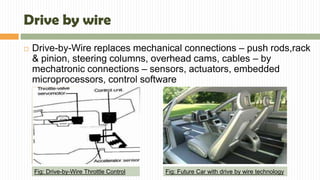
Drive by wire
 Drive-by-Wire replaces mechanical connections – push rods,rack
& pinion, steering columns, overhead cams, cables – by
mechatronic connections – sensors, actuators, embedded
microprocessors, control software
Fig: Drive-by-Wire Throttle Control Fig: Future Car with drive by wire technology
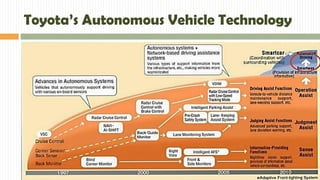
Toyota’s Autonomous Vehicle Technology
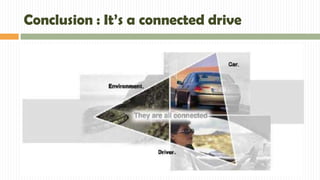
Conclusion : It’s a connected drive
THANK YOU

Embedded system in automobile

  • 1.
    Embedded System inAutomobile By : Amit Kumar Sah Roll No: 09/ECE/73 NIT Durgapur
  • 2.
    Embedded System- Definition? “Anembedded system is a combination of hardware and software which creates a dedicated computer system that performs specific, pre- defined tasks and which is encapsulated within the device it controls (if it is part of a larger device).”
  • 3.
    • FPGA (Field-ProgrammableGate Array) : A type of logic chip that can be programmed & supports thousands of gates •ASIC (Application-specific integrated circuit): An integrated circuit (IC) that has been customized for a specific use Embedded system components
  • 4.
    Characteristics of embeddedsystems  Sophisticated functionality.  Often have to run sophisticated algorithms or multiple algorithms.  Often provide sophisticated user interfaces.  Real-time operation .  Must finish operations by deadlines  Many systems are multi-rate must handle operations at widely varying rates  Low manufacturing cost.  Low power.  Designed to tight deadlines by small teams.
  • 5.
    Automotive Systems: Technologyin today's vehicle  Air Bags  The Black Box  Anti-lock Brake System(ABS)  Adaptive Cruise Control  Drive by wire  Satellite Radio Eg:XM  Telematics Eg:OnStar  Rain-sensing Wipers  Emission Control  Traction Control  Automatic Parking  In-vehicle entertainment  Heads-up display  Night Vision  Back-up collision sensor  Navigation Systems  Tire Pressure Monitor  Climate Control
  • 6.
    Air Bags :Principle of function  It is from the Newton's 2nd law of motion  It basically restrains the continuous motion of the passenger, by giving a soft surface to land on.  AIR BAGS are among the most important safety improvements added to cars and light trucks in recent years, providing extra protection for front-seat occupants in head-on crashes.  And of late, every passengers protection Fig : Air Bag- Working
  • 7.
    Event Data Recorder-EDRor the The "Black Box"  The Event Data Recorder (EDR) in an automobile is based upon the sensors and microprocessor computer system that are used to activate the airbag in the vehicle during a crash.  The SDM, which is controlled by a microprocessor, has multiple functions: (1) It determines if a severe enough impact has occurred to warrant deployment of the air bag; (2) It monitors the air bags components; (3) It permanently records information. Black Box – Exterior View Black Box – Interior View
  • 8.
    Anti-lock Braking System(ABS) Up until the seventies, hitting the brakes too hard could lead to an accident.  The reason: When the coefficient of slip between tires and road surface is too low, hitting the brakes can cause wheel lock-up. The vehicle is no longer steerable and goes into a skid.  In particular, this danger is present  On wet or slippery road surfaces with different levels of grip between tires and road  On preventing wheel lock-up:  Reduces the total braking distance as far as possible  Increase vehicle stability  Maintains steer ability even in case of all-out braking Without ABS The vehicle in no longer steerable when driver hits the brake With ABS The vehicle remains steerable even during panic
  • 9.
    Principle of functioning Wheel-speed sensors detect whether a wheel is showing a tendency to lock-up  In case of a lock-up tendency, the electronic control unit reduces the braking pressure individually at the wheel concerned  High-speed correction of the braking pressure up to shortly before the lock-up threshold  The brake-fluid return together with the closed-loop brake circuits makes this a safe, reliable, and cost-effective system Advantage  A gain for driving safety  The vehicle remains steerable, even in case of panic braking  Shorter stopping distances on practically all road surfaces  Many accidents are avoided
  • 10.
    Dynamic Traction &Stability Control  The traction control system is required to prevent driver error from overloading any of the four wheels and causing slip, through either throttle or brake application  Drastically improve vehicle performance and safety by maintaining optimal wheel traction in all road conditions  The basic principle is always the adaptation of the wheel torque to the coefficient of friction between the wheel and the road surface.  To this end, the systems make use of different intervention methods  In the wheel brakes  In the drivetrain control
  • 11.
    Dynamic Traction &Stability Control Fig: The Principle of Functioning of TCS with brakes
  • 12.
    Intelligent Cruise Control Cooperative Adaptive Cruise Control with Collision Warning (CACC + CW)  CACC: Cruise at given speed when the road is clear (cruise control) otherwise follow the car in front, using radar (adaptive) and/or communications (cooperative).  CW: Warn the driver when an object is being approached too fast, or is too close How it works :  Uses forward-looking radar, installed behind the grill of a vehicle, to detect the speed and distance of the vehicle ahead of it.  Can automatically adjust speed in order to maintain a proper distance between vehicles in the same lane
  • 13.
    Drive by wire Drive-by-Wire replaces mechanical connections – push rods,rack & pinion, steering columns, overhead cams, cables – by mechatronic connections – sensors, actuators, embedded microprocessors, control software Fig: Drive-by-Wire Throttle Control Fig: Future Car with drive by wire technology
  • 14.
  • 15.
    Conclusion : It’sa connected drive
  • 16.

Editor's Notes

  • #3 Beginning course details and/or books/materials needed for a class/project.
  • #4 Beginning course details and/or books/materials needed for a class/project.
  • #5 Beginning course details and/or books/materials needed for a class/project.
  • #6 Beginning course details and/or books/materials needed for a class/project.
  • #7 Beginning course details and/or books/materials needed for a class/project.
  • #8 Beginning course details and/or books/materials needed for a class/project.
  • #9 Beginning course details and/or books/materials needed for a class/project.
  • #10 Beginning course details and/or books/materials needed for a class/project.
  • #11 Beginning course details and/or books/materials needed for a class/project.
  • #12 Beginning course details and/or books/materials needed for a class/project.
  • #13 Beginning course details and/or books/materials needed for a class/project.
  • #14 Beginning course details and/or books/materials needed for a class/project.
  • #15 Beginning course details and/or books/materials needed for a class/project.
  • #16 Beginning course details and/or books/materials needed for a class/project.