OXYGEN THERAPY
ANAZHAGAN.V
13PPH120
II M.Sc., (PHY)
Oxygen therapy
Definition:
 Oxygen is a colorless, odorless, tasteless gas
that is essential for the body to function
properly and to survive.
What is meaning of O2 therapy
Oxygen therapy is the administration of oxygen
at a concentration of pressure greater than that
found in the environmental atmosphere
The air that we breathe contain approximately
21% oxygen
the heart relies on oxygen to pump blood.
What is meaning of O2 therapy
If not enough oxygen circulating in the blood,
it’s difficult for the tissues of the heart to keep
pumping.
Supplemental oxygen is used to treat medical
conditions in which the tissues of the body do
not have enough oxygen.
Purpose
The body is constantly taking in oxygen
and releasing carbon dioxide.
 If this process is inadequate, oxygen
levels in the blood decrease, and the
patient may need supplemental
oxygen.
Purpose
Oxygen therapy is a key treatment in
respiratory care.
The purpose is to increase oxygen
saturation in tissues where the
saturation levels are too low due to
illness or injury.
oxygen therapy is used to treat
Example in case :-
• Documented hypoxemia
• Severe respiratory distress (acute asthma or
pneumonia)
• Severe trauma
• Chronic obstructive pulmonary disease (COPD,
including chronic bronchitis, emphysema, and
chronic asthma)
oxygen therapy is used to treat
• Pulmonary hypertension
• Acute myocardial infarction (heart attack)
• Short-term therapy, such as post-anesthesia
recovery
• Oxygen may also be used to treat chronic lung
disease patients during exercise .
Classification of Oxygen Delivery
Systems
• Low flow systems
– contribute partially to inspired gas client breathes
– do not provide constant FIO2
– Ex: nasal cannula, simple mask , non-re breather
mask , Partial rebreather mask
• High flow systems
– deliver specific and constant percent of oxygen
independent of client’s breathing
– Ex: Venturi mask,, trach collar, T-piece
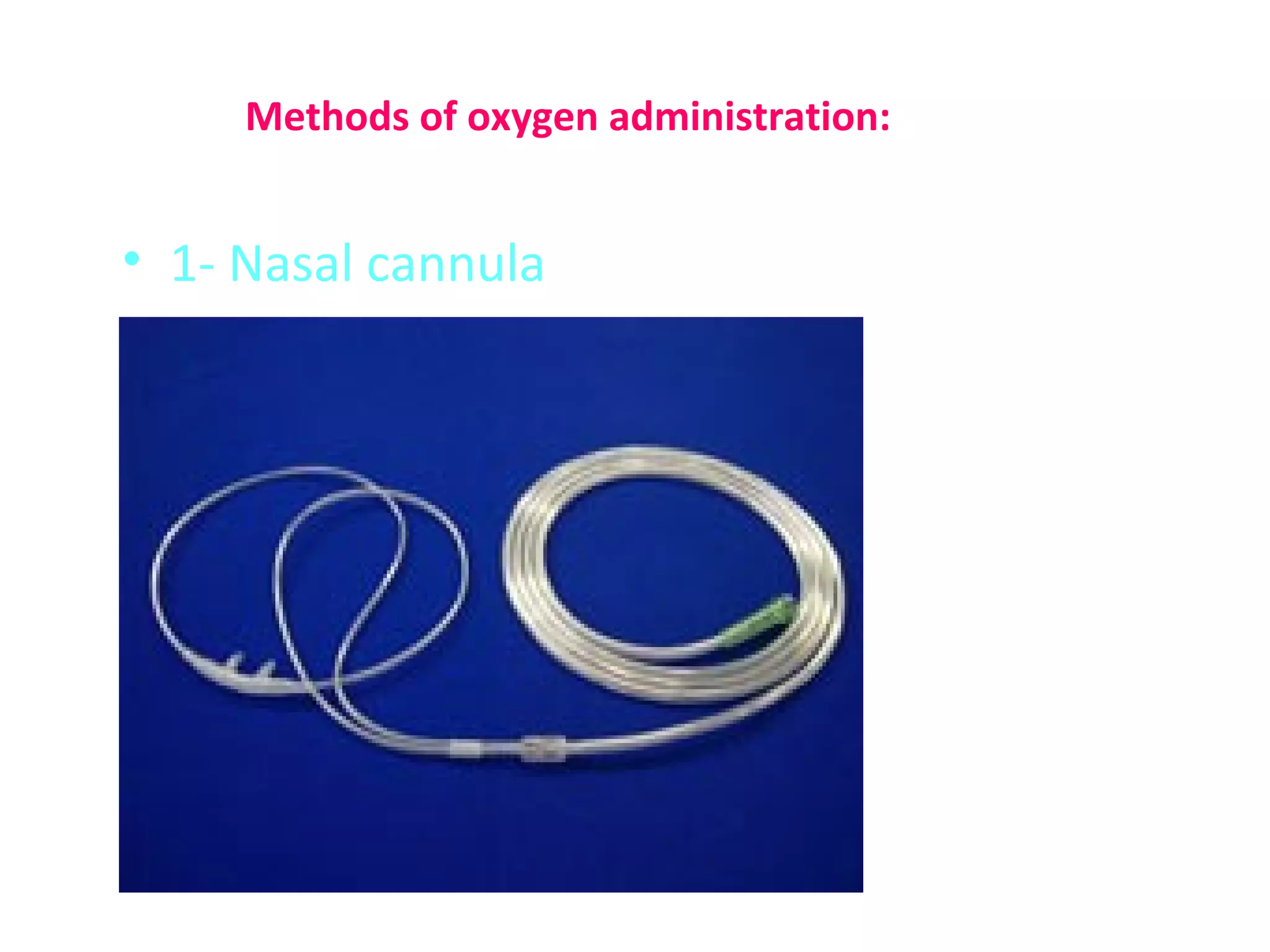
Methods of oxygen administration:
• 1- Nasal cannula
Nasal cannula (prongs):
 It is a disposable.
plastic devise with two protruding prongs for
insertion into the nostrils, connected to an
oxygen source.
Used for low-medium concentrations of
Oxygen (24-44%).
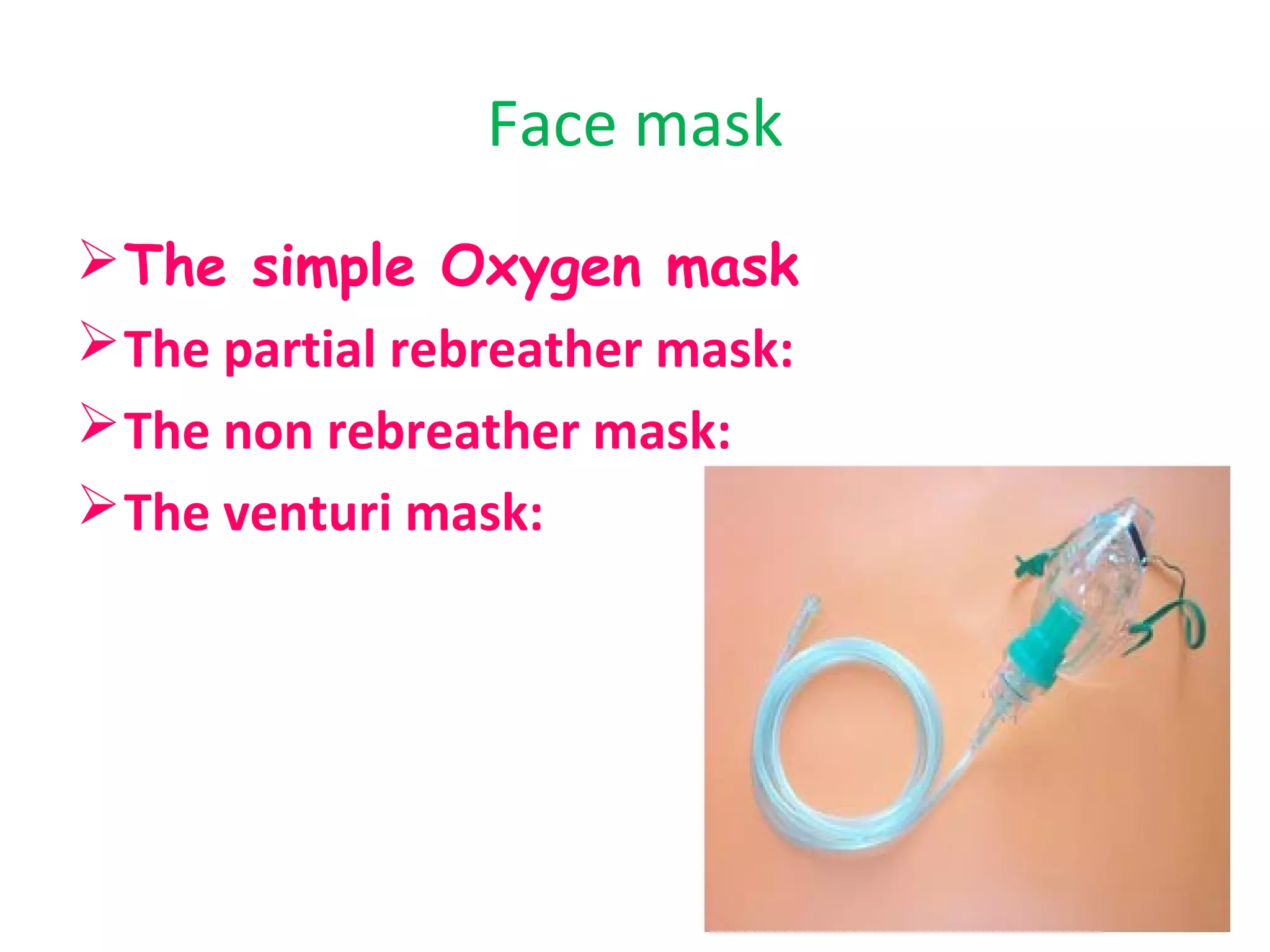
Face mask
The simple Oxygen mask
The partial rebreather mask:
The non rebreather mask:
The venturi mask:
The simple Oxygen mask
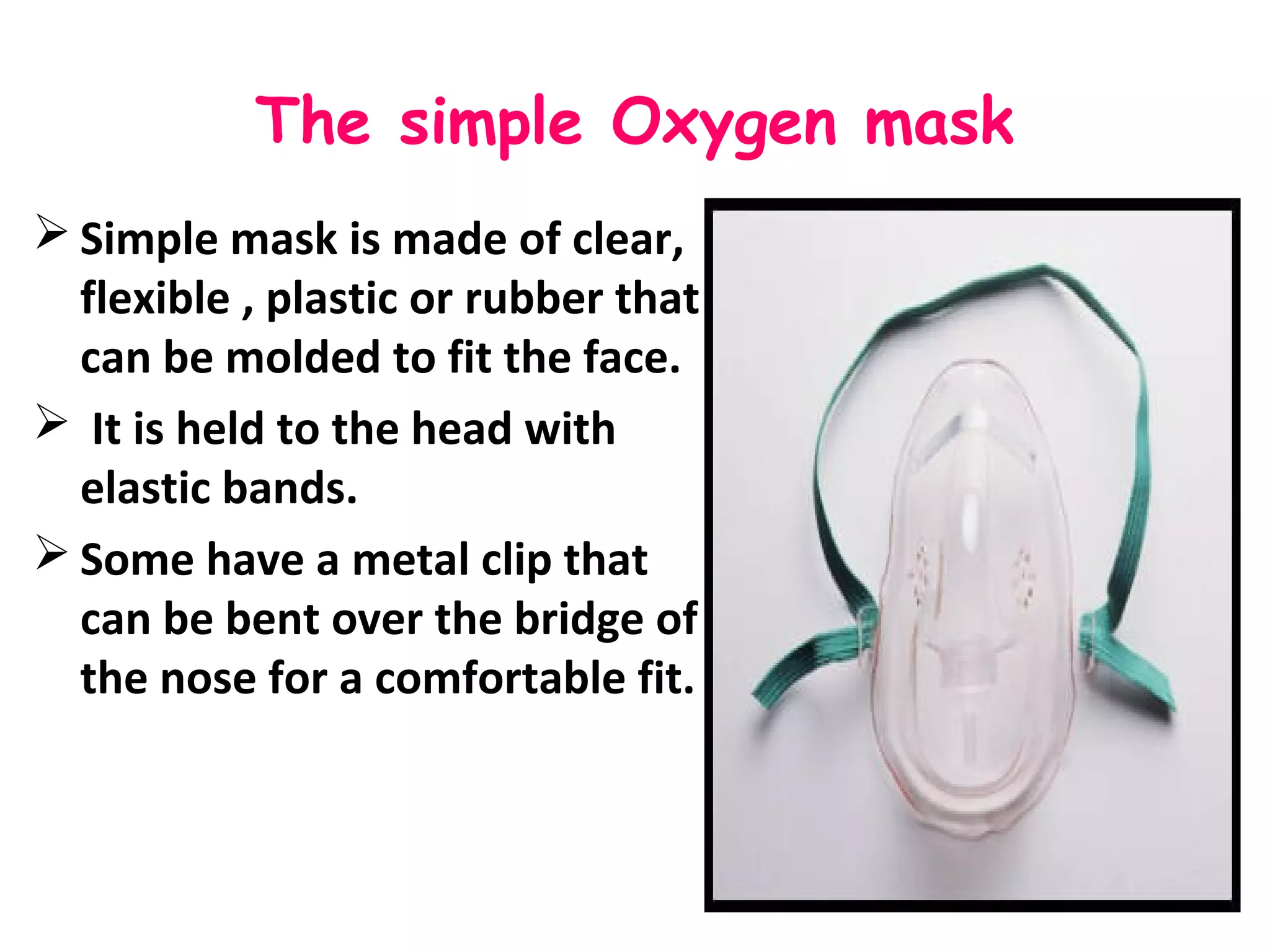
 Simple mask is made of clear,
flexible , plastic or rubber that
can be molded to fit the face.
 It is held to the head with
elastic bands.
 Some have a metal clip that
can be bent over the bridge of
the nose for a comfortable fit.
The simple Oxygen mask
It delivers 35% to 60% oxygen .
A flow rate of 6 to 10 liters per minute.
 It has vents on its sides which allow
room air to leak in at many places,
thereby diluting the source oxygen.
Often it is used when an increased
delivery of oxygen is needed for short
periods
(i.e., less than 12 hours).
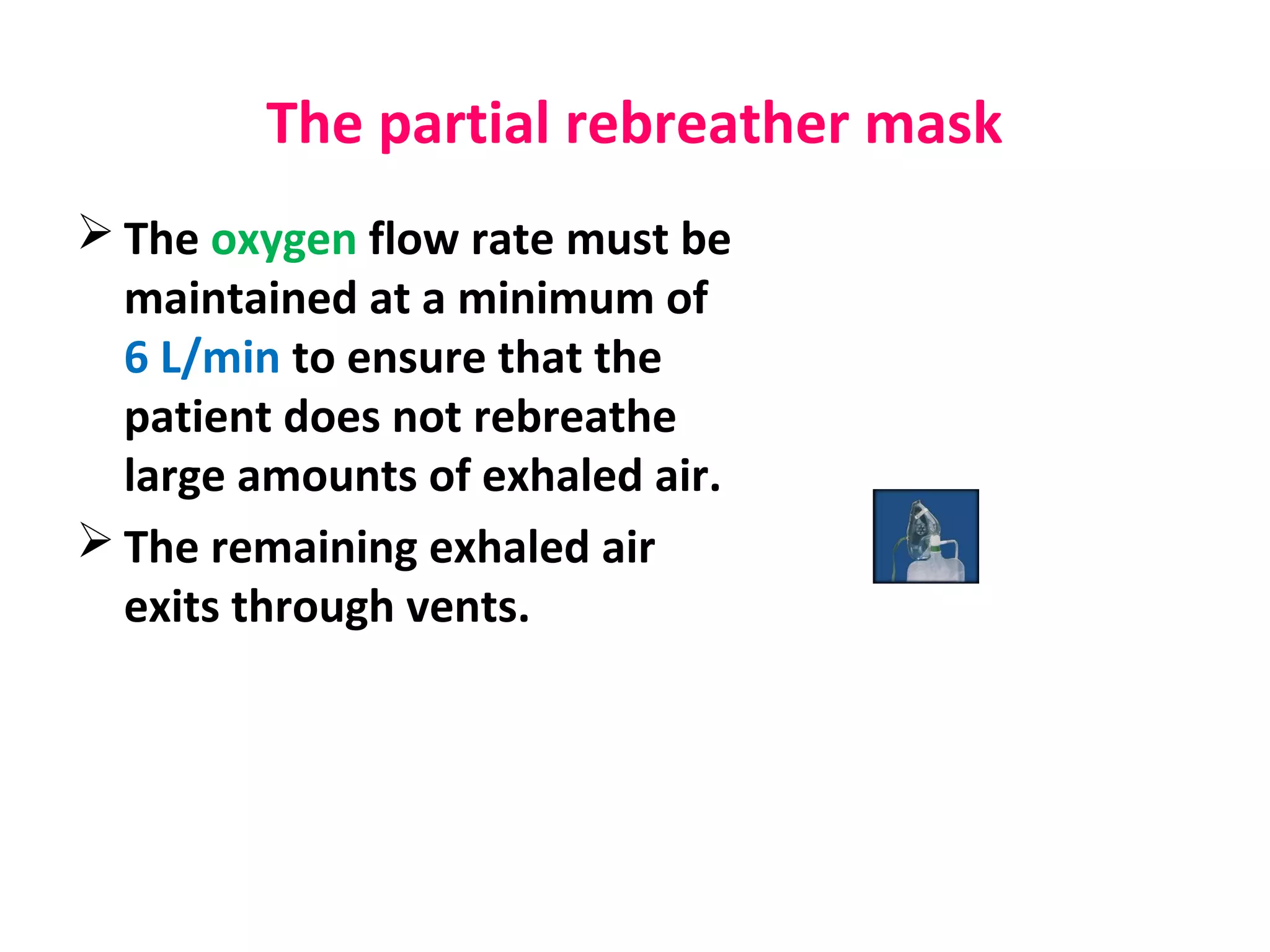
The partial rebreather mask:
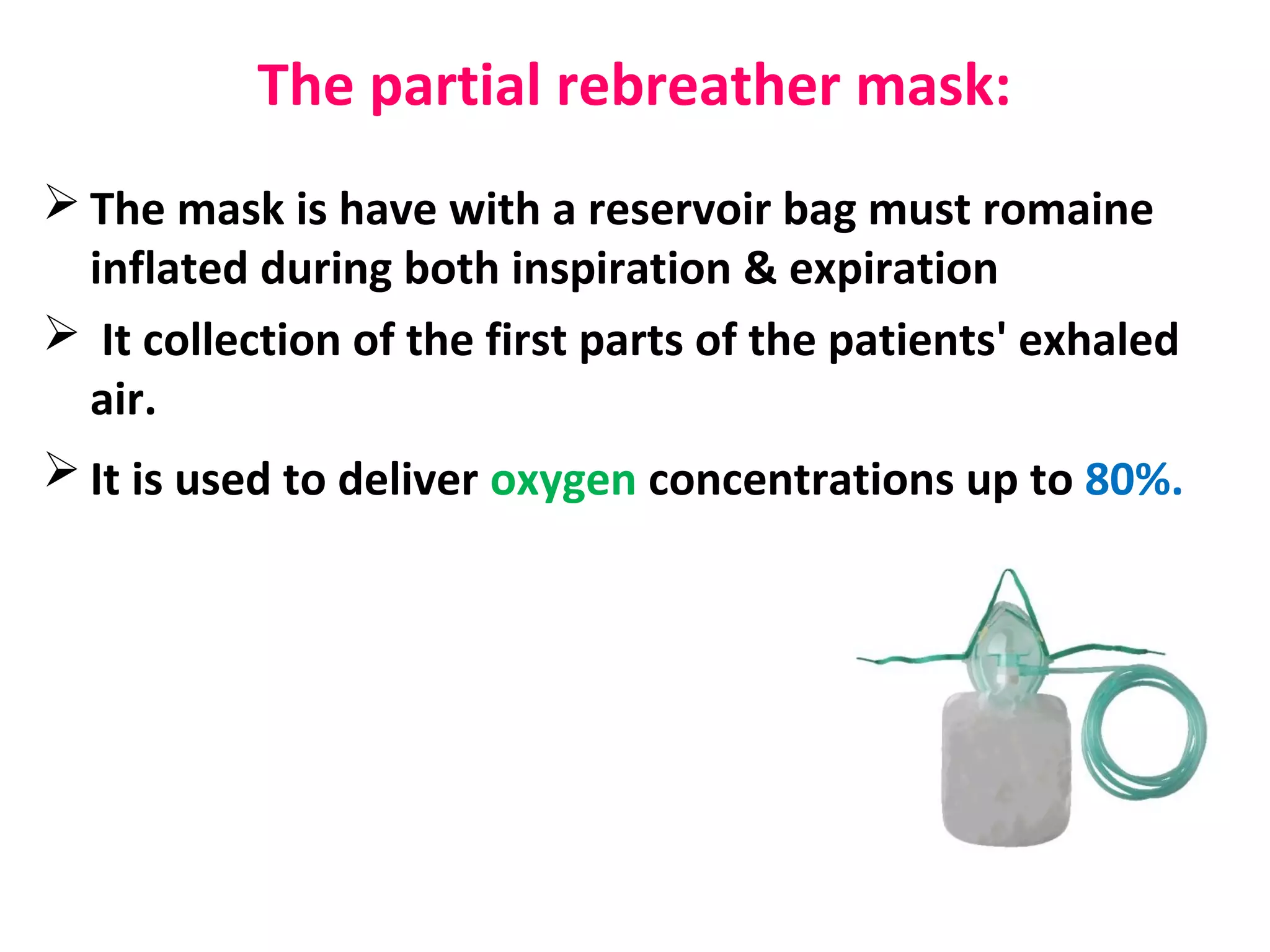
 The mask is have with a reservoir bag must romaine
inflated during both inspiration & expiration
 It collection of the first parts of the patients' exhaled
air.
 It is used to deliver oxygen concentrations up to 80%.
The partial rebreather mask
 The oxygen flow rate must be
maintained at a minimum of
6 L/min to ensure that the
patient does not rebreathe
large amounts of exhaled air.
 The remaining exhaled air
exits through vents.
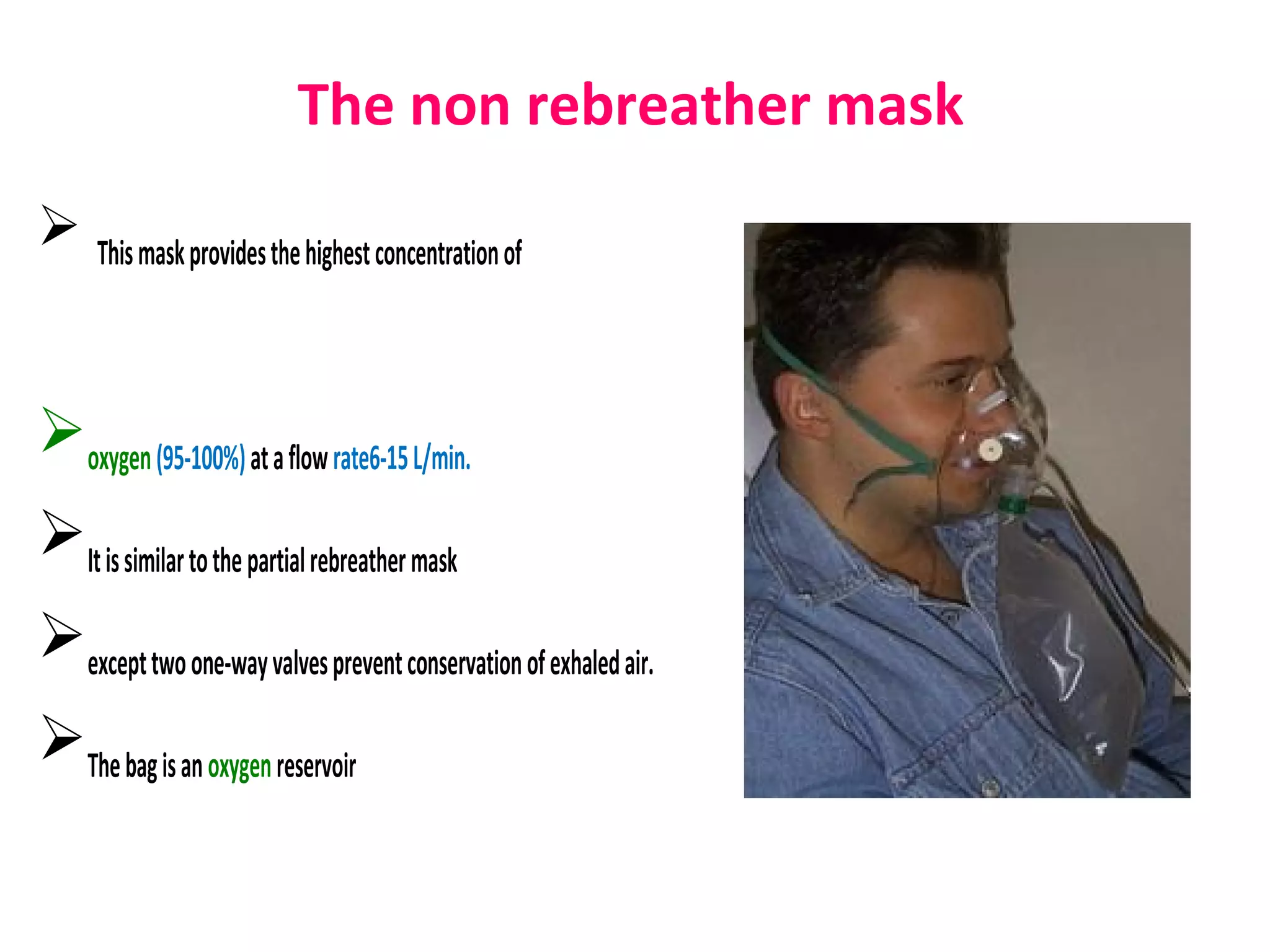
The non rebreather mask
 Thismaskprovidesthehighestconcentrationof
oxygen(95-100%)ataflowrate6-15L/min.
Itissimilartothepartialrebreathermask
excepttwoone-wayvalvespreventconservationofexhaledair.
Thebagisanoxygenreservoir
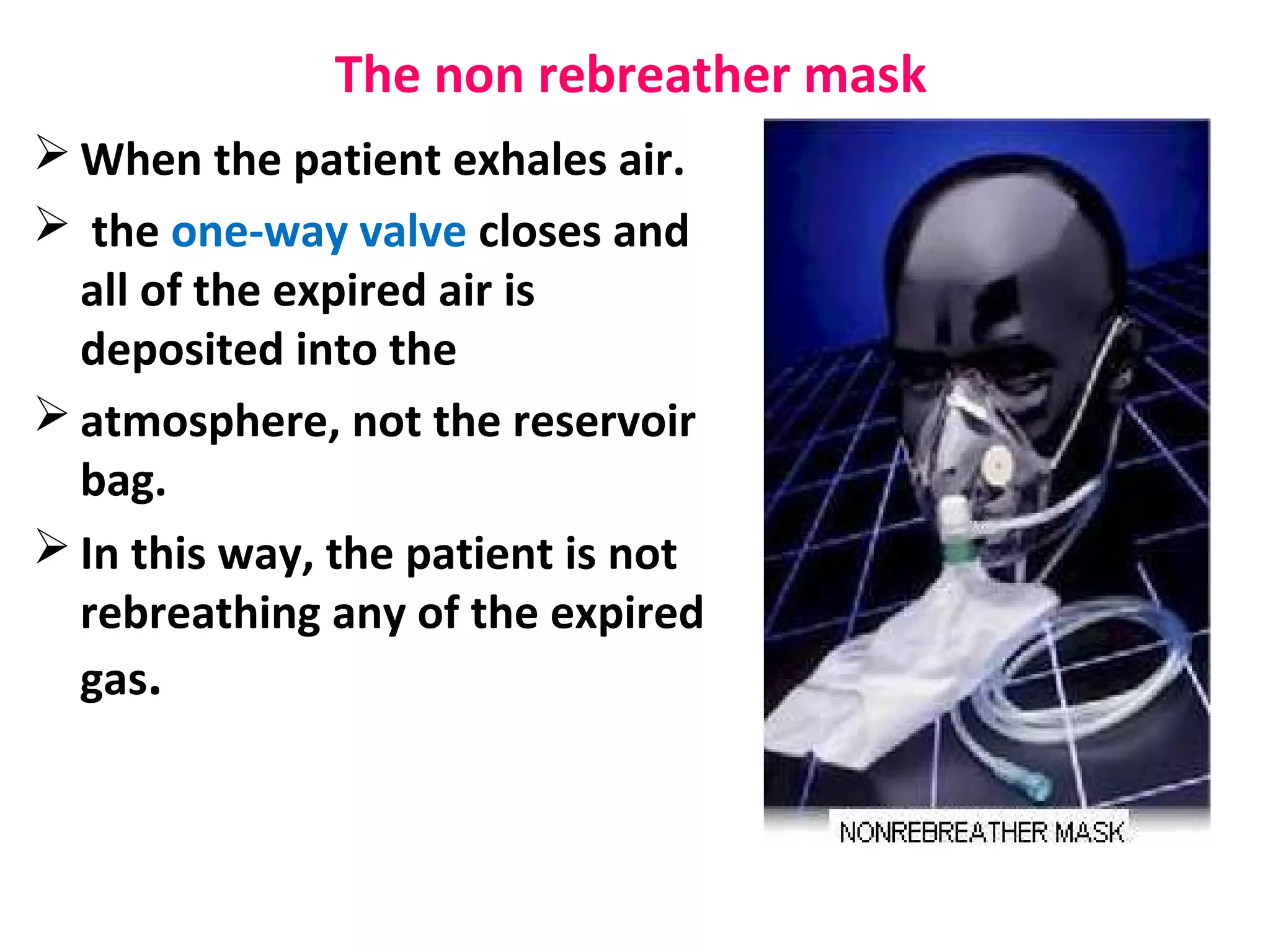
The non rebreather mask
 When the patient exhales air.
 the one-way valve closes and
all of the expired air is
deposited into the
 atmosphere, not the reservoir
bag.
 In this way, the patient is not
rebreathing any of the expired
gas.
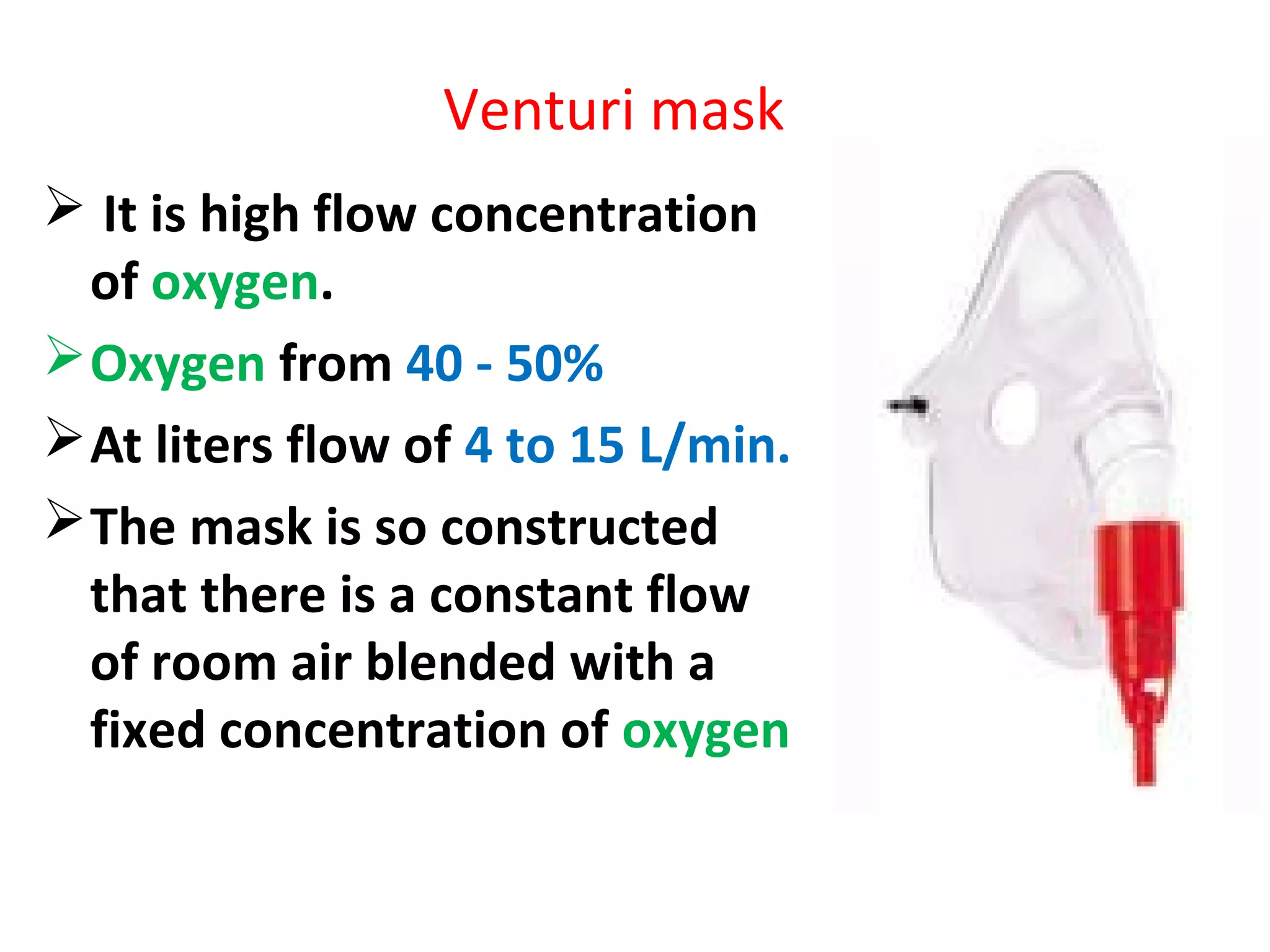
Venturi mask
 It is high flow concentration
of oxygen.
Oxygen from 40 - 50%
At liters flow of 4 to 15 L/min.
The mask is so constructed
that there is a constant flow
of room air blended with a
fixed concentration of oxygen
The venturi mask
is designed with wide- bore tubing and various
color - coded jet adapters.
Each color code corresponds to a precise
oxygen concentration and a specific liter flow.
The venturi system,
Room air dilutes the oxygen entering the
tubing to a certain concentration
The amount of air drawn in is determined by
the size of the orifice (jet adapter).
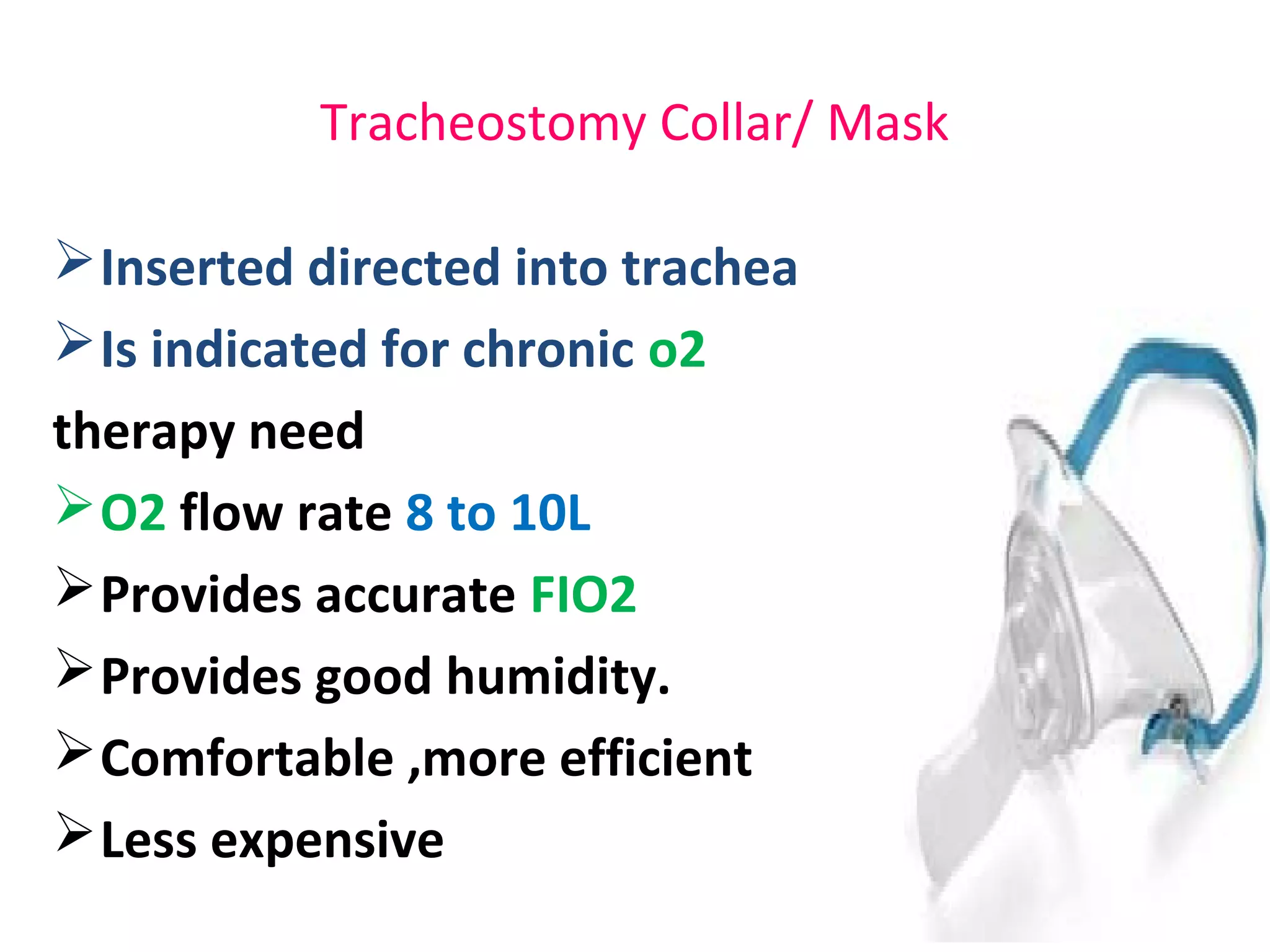
Tracheostomy Collar/ Mask
Inserted directed into trachea
Is indicated for chronic o2
therapy need
O2 flow rate 8 to 10L
Provides accurate FIO2
Provides good humidity.
Comfortable ,more efficient
Less expensive
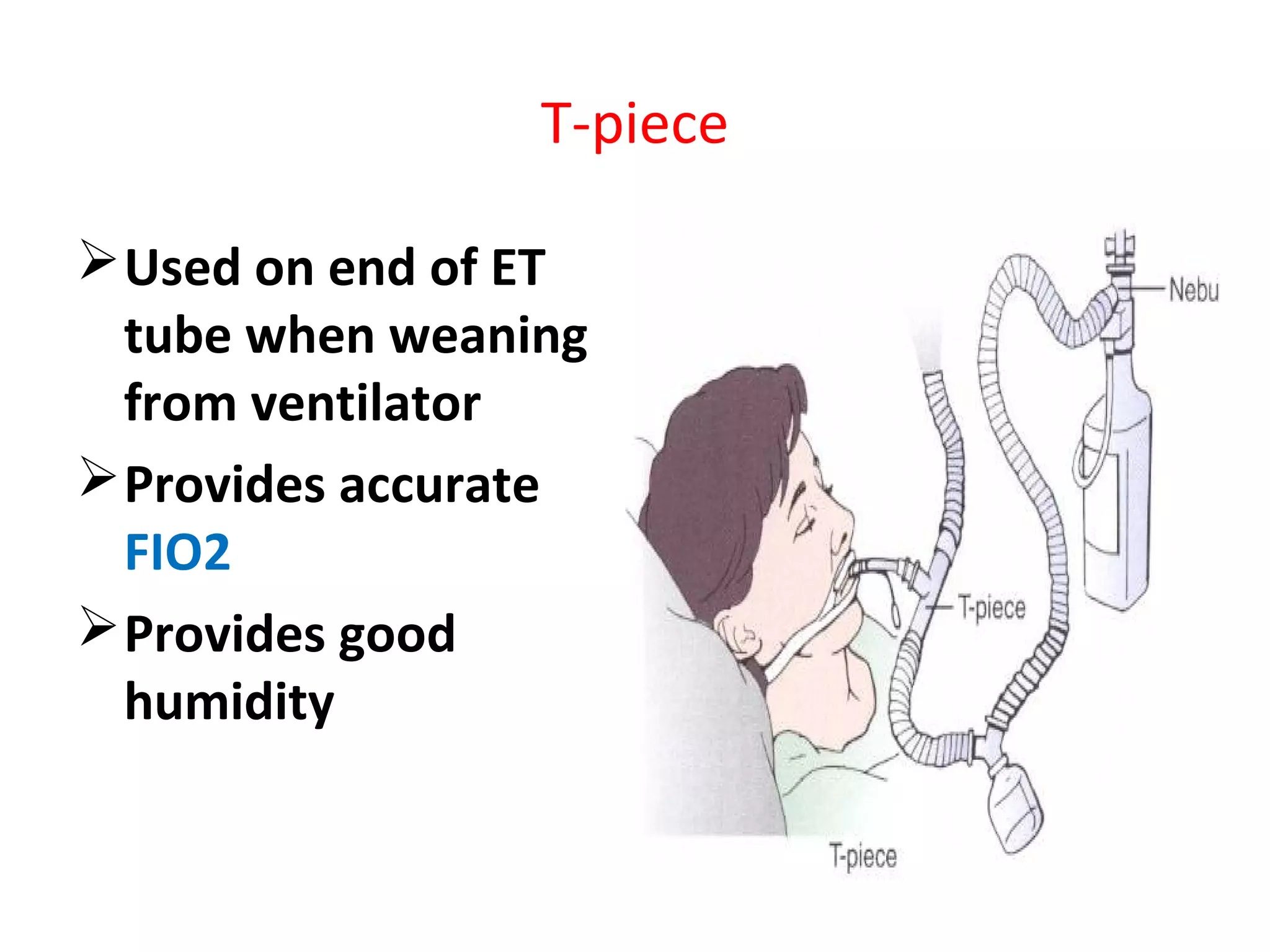
T-piece
Used on end of ET
tube when weaning
from ventilator
Provides accurate
FIO2
Provides good
humidity
Signs and symptoms of oxygen toxicity:
•Non-productive cough.
•Nausea and vomiting.
•Substernal chest pain.
•Fatigue.
•Nasal stuffiness.
•Headache.
•Sore throat.
•Hypoventilation.
.Nasal congestion.
.Dyspnea.
.Inspiration pain.
Thank U for Ur
aTTenTion

Edited ppt

  • 1.
  • 2.
    Oxygen therapy Definition:  Oxygenis a colorless, odorless, tasteless gas that is essential for the body to function properly and to survive.
  • 3.
    What is meaningof O2 therapy Oxygen therapy is the administration of oxygen at a concentration of pressure greater than that found in the environmental atmosphere The air that we breathe contain approximately 21% oxygen the heart relies on oxygen to pump blood.
  • 4.
    What is meaningof O2 therapy If not enough oxygen circulating in the blood, it’s difficult for the tissues of the heart to keep pumping. Supplemental oxygen is used to treat medical conditions in which the tissues of the body do not have enough oxygen.
  • 5.
    Purpose The body isconstantly taking in oxygen and releasing carbon dioxide.  If this process is inadequate, oxygen levels in the blood decrease, and the patient may need supplemental oxygen.
  • 6.
    Purpose Oxygen therapy isa key treatment in respiratory care. The purpose is to increase oxygen saturation in tissues where the saturation levels are too low due to illness or injury.
  • 7.
    oxygen therapy isused to treat Example in case :- • Documented hypoxemia • Severe respiratory distress (acute asthma or pneumonia) • Severe trauma • Chronic obstructive pulmonary disease (COPD, including chronic bronchitis, emphysema, and chronic asthma)
  • 8.
    oxygen therapy isused to treat • Pulmonary hypertension • Acute myocardial infarction (heart attack) • Short-term therapy, such as post-anesthesia recovery • Oxygen may also be used to treat chronic lung disease patients during exercise .
  • 10.
    Classification of OxygenDelivery Systems • Low flow systems – contribute partially to inspired gas client breathes – do not provide constant FIO2 – Ex: nasal cannula, simple mask , non-re breather mask , Partial rebreather mask • High flow systems – deliver specific and constant percent of oxygen independent of client’s breathing – Ex: Venturi mask,, trach collar, T-piece
  • 11.
    Methods of oxygenadministration: • 1- Nasal cannula
  • 12.
    Nasal cannula (prongs): It is a disposable. plastic devise with two protruding prongs for insertion into the nostrils, connected to an oxygen source. Used for low-medium concentrations of Oxygen (24-44%).
  • 13.
    Face mask The simpleOxygen mask The partial rebreather mask: The non rebreather mask: The venturi mask:
  • 14.
    The simple Oxygenmask  Simple mask is made of clear, flexible , plastic or rubber that can be molded to fit the face.  It is held to the head with elastic bands.  Some have a metal clip that can be bent over the bridge of the nose for a comfortable fit.
  • 15.
    The simple Oxygenmask It delivers 35% to 60% oxygen . A flow rate of 6 to 10 liters per minute.  It has vents on its sides which allow room air to leak in at many places, thereby diluting the source oxygen. Often it is used when an increased delivery of oxygen is needed for short periods (i.e., less than 12 hours).
  • 16.
    The partial rebreathermask:  The mask is have with a reservoir bag must romaine inflated during both inspiration & expiration  It collection of the first parts of the patients' exhaled air.  It is used to deliver oxygen concentrations up to 80%.
  • 17.
    The partial rebreathermask  The oxygen flow rate must be maintained at a minimum of 6 L/min to ensure that the patient does not rebreathe large amounts of exhaled air.  The remaining exhaled air exits through vents.
  • 18.
    The non rebreathermask  Thismaskprovidesthehighestconcentrationof oxygen(95-100%)ataflowrate6-15L/min. Itissimilartothepartialrebreathermask excepttwoone-wayvalvespreventconservationofexhaledair. Thebagisanoxygenreservoir
  • 19.
    The non rebreathermask  When the patient exhales air.  the one-way valve closes and all of the expired air is deposited into the  atmosphere, not the reservoir bag.  In this way, the patient is not rebreathing any of the expired gas.
  • 20.
    Venturi mask  Itis high flow concentration of oxygen. Oxygen from 40 - 50% At liters flow of 4 to 15 L/min. The mask is so constructed that there is a constant flow of room air blended with a fixed concentration of oxygen
  • 21.
    The venturi mask isdesigned with wide- bore tubing and various color - coded jet adapters. Each color code corresponds to a precise oxygen concentration and a specific liter flow. The venturi system, Room air dilutes the oxygen entering the tubing to a certain concentration The amount of air drawn in is determined by the size of the orifice (jet adapter).
  • 22.
    Tracheostomy Collar/ Mask Inserteddirected into trachea Is indicated for chronic o2 therapy need O2 flow rate 8 to 10L Provides accurate FIO2 Provides good humidity. Comfortable ,more efficient Less expensive
  • 23.
    T-piece Used on endof ET tube when weaning from ventilator Provides accurate FIO2 Provides good humidity
  • 24.
    Signs and symptomsof oxygen toxicity: •Non-productive cough. •Nausea and vomiting. •Substernal chest pain. •Fatigue. •Nasal stuffiness. •Headache. •Sore throat. •Hypoventilation. .Nasal congestion. .Dyspnea. .Inspiration pain.

  • 25.
    Thank U forUr aTTenTion