Retinoblastoma
Retinoblastoma has a history dating back to
1597. In 1597 it starts with a man named Pieter Pauw
and his autopsy findings of cancerous tumor originating
in a 3 year-old eye. The results of the autopsy were
later found by Edwin B. Dunphy who suggested
Retinoblastoma. In 1986 Dr. Knudson discovered the
retinoblastoma gene and then a year later he isolated
the gene making it the first ever tumor suppressor to be
identified. In one of Kudsten’s cases he found that one
family had a genetic past of the disease and found that
the gene causing the disorder is located in Chr No-13
that has been mutated.
.
This disease is very curable if found quickly, but the group of
people mostly effected by retinoblastoma are to be the infants
to 6 year-olds age group. If not noticed at an early stage, the
cancerous tumor can spread to other parts of the body.
Cause
. The causes of retinoblastoma are mostly genetic with the
exception of a rare case of a new case mutation. In fact,
the children of a person with the illness has a 50%
chance of inheriting the disorder whole disease of
retinoblastoma is caused by a mutation that occurs
because of a cell in the retina that is duplicating
numerously and therefore turning cancerous. The
retinoblastoma gene copies in a autosomal dominant
pattern, the child will have 50% chance of inheriting
retinoblastoma. Even if the gene is given to a child, it
does not necessarily mean that cancer is for sure. As
shown in the punnett square (Figure 3), there is a 50%
chance of retinoblastoma assuming the heterozygous is
the retinoblastoma gene.
A a
a Aa aa
a Aa aa
Figure 3
Diagnosis
If you have retinoblastoma, your Ophthalmologist
might do several different procedures that are
normally done at any regular check-up. One of
the regular procedures is the checking of the eye
for dilation of the pupil. Even looking at an eye,
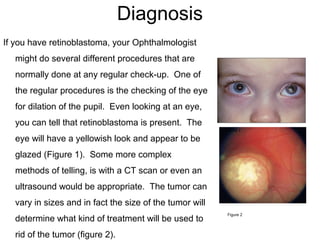
you can tell that retinoblastoma is present. The
eye will have a yellowish look and appear to be
glazed (Figure 1). Some more complex
methods of telling, is with a CT scan or even an
ultrasound would be appropriate. The tumor can
vary in sizes and in fact the size of the tumor will
determine what kind of treatment will be used to
rid of the tumor (figure 2).
Figure 1
Figure 2
Signs/Symptoms
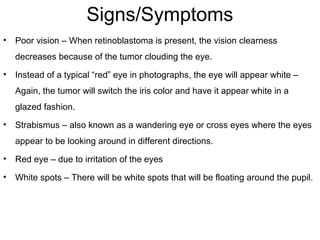
• Poor vision – When retinoblastoma is present, the vision clearness
decreases because of the tumor clouding the eye.
• Instead of a typical “red” eye in photographs, the eye will appear white –
Again, the tumor will switch the iris color and have it appear white in a
glazed fashion.
• Strabismus – also known as a wandering eye or cross eyes where the eyes
appear to be looking around in different directions.
• Red eye – due to irritation of the eyes
• White spots – There will be white spots that will be floating around the pupil.
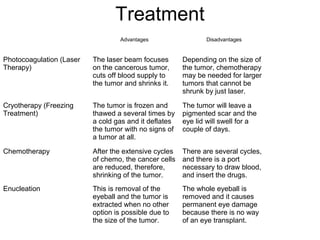
Treatment
Advantages Disadvantages
Photocoagulation (Laser
Therapy)
The laser beam focuses
on the cancerous tumor,
cuts off blood supply to
the tumor and shrinks it.
Depending on the size of
the tumor, chemotherapy
may be needed for larger
tumors that cannot be
shrunk by just laser.
Cryotherapy (Freezing
Treatment)
The tumor is frozen and
thawed a several times by
a cold gas and it deflates
the tumor with no signs of
a tumor at all.
The tumor will leave a
pigmented scar and the
eye lid will swell for a
couple of days.
Chemotherapy After the extensive cycles
of chemo, the cancer cells
are reduced, therefore,
shrinking of the tumor.
There are several cycles,
and there is a port
necessary to draw blood,
and insert the drugs.
Enucleation This is removal of the
eyeball and the tumor is
extracted when no other
option is possible due to
the size of the tumor.
The whole eyeball is
removed and it causes
permanent eye damage
because there is no way
of an eye transplant.
Treatment
Advantages Disadvantages
Photocoagulation (Laser
Therapy)
The laser beam focuses
on the cancerous tumor,
cuts off blood supply to
the tumor and shrinks it.
Depending on the size of
the tumor, chemotherapy
may be needed for larger
tumors that cannot be
shrunk by just laser.
Cryotherapy (Freezing
Treatment)
The tumor is frozen and
thawed a several times by
a cold gas and it deflates
the tumor with no signs of
a tumor at all.
The tumor will leave a
pigmented scar and the
eye lid will swell for a
couple of days.
Chemotherapy After the extensive cycles
of chemo, the cancer cells
are reduced, therefore,
shrinking of the tumor.
There are several cycles,
and there is a port
necessary to draw blood,
and insert the drugs.
Enucleation This is removal of the
eyeball and the tumor is
extracted when no other
option is possible due to
the size of the tumor.
The whole eyeball is
removed and it causes
permanent eye damage
because there is no way
of an eye transplant.

Retinoblastomappt

  • 1.
    Retinoblastoma Retinoblastoma has ahistory dating back to 1597. In 1597 it starts with a man named Pieter Pauw and his autopsy findings of cancerous tumor originating in a 3 year-old eye. The results of the autopsy were later found by Edwin B. Dunphy who suggested Retinoblastoma. In 1986 Dr. Knudson discovered the retinoblastoma gene and then a year later he isolated the gene making it the first ever tumor suppressor to be identified. In one of Kudsten’s cases he found that one family had a genetic past of the disease and found that the gene causing the disorder is located in Chr No-13 that has been mutated.
  • 2.
    . This disease isvery curable if found quickly, but the group of people mostly effected by retinoblastoma are to be the infants to 6 year-olds age group. If not noticed at an early stage, the cancerous tumor can spread to other parts of the body.
  • 3.
    Cause . The causesof retinoblastoma are mostly genetic with the exception of a rare case of a new case mutation. In fact, the children of a person with the illness has a 50% chance of inheriting the disorder whole disease of retinoblastoma is caused by a mutation that occurs because of a cell in the retina that is duplicating numerously and therefore turning cancerous. The retinoblastoma gene copies in a autosomal dominant pattern, the child will have 50% chance of inheriting retinoblastoma. Even if the gene is given to a child, it does not necessarily mean that cancer is for sure. As shown in the punnett square (Figure 3), there is a 50% chance of retinoblastoma assuming the heterozygous is the retinoblastoma gene. A a a Aa aa a Aa aa Figure 3
  • 4.
    Diagnosis If you haveretinoblastoma, your Ophthalmologist might do several different procedures that are normally done at any regular check-up. One of the regular procedures is the checking of the eye for dilation of the pupil. Even looking at an eye, you can tell that retinoblastoma is present. The eye will have a yellowish look and appear to be glazed (Figure 1). Some more complex methods of telling, is with a CT scan or even an ultrasound would be appropriate. The tumor can vary in sizes and in fact the size of the tumor will determine what kind of treatment will be used to rid of the tumor (figure 2). Figure 1 Figure 2
  • 5.
    Signs/Symptoms • Poor vision– When retinoblastoma is present, the vision clearness decreases because of the tumor clouding the eye. • Instead of a typical “red” eye in photographs, the eye will appear white – Again, the tumor will switch the iris color and have it appear white in a glazed fashion. • Strabismus – also known as a wandering eye or cross eyes where the eyes appear to be looking around in different directions. • Red eye – due to irritation of the eyes • White spots – There will be white spots that will be floating around the pupil.
  • 6.
    Treatment Advantages Disadvantages Photocoagulation (Laser Therapy) Thelaser beam focuses on the cancerous tumor, cuts off blood supply to the tumor and shrinks it. Depending on the size of the tumor, chemotherapy may be needed for larger tumors that cannot be shrunk by just laser. Cryotherapy (Freezing Treatment) The tumor is frozen and thawed a several times by a cold gas and it deflates the tumor with no signs of a tumor at all. The tumor will leave a pigmented scar and the eye lid will swell for a couple of days. Chemotherapy After the extensive cycles of chemo, the cancer cells are reduced, therefore, shrinking of the tumor. There are several cycles, and there is a port necessary to draw blood, and insert the drugs. Enucleation This is removal of the eyeball and the tumor is extracted when no other option is possible due to the size of the tumor. The whole eyeball is removed and it causes permanent eye damage because there is no way of an eye transplant.
  • 7.
    Treatment Advantages Disadvantages Photocoagulation (Laser Therapy) Thelaser beam focuses on the cancerous tumor, cuts off blood supply to the tumor and shrinks it. Depending on the size of the tumor, chemotherapy may be needed for larger tumors that cannot be shrunk by just laser. Cryotherapy (Freezing Treatment) The tumor is frozen and thawed a several times by a cold gas and it deflates the tumor with no signs of a tumor at all. The tumor will leave a pigmented scar and the eye lid will swell for a couple of days. Chemotherapy After the extensive cycles of chemo, the cancer cells are reduced, therefore, shrinking of the tumor. There are several cycles, and there is a port necessary to draw blood, and insert the drugs. Enucleation This is removal of the eyeball and the tumor is extracted when no other option is possible due to the size of the tumor. The whole eyeball is removed and it causes permanent eye damage because there is no way of an eye transplant.