OXYGEN THERAPY
Dr. Tejasree
 What is oxygen?
 Why do we need oxygen?
 What is oxygen therapy?
 When do we need oxygen therapy?
 How to give oxygen therapy?
WHAT IS OXYGEN?
 In 1775 by joseph priestley an english
scientist.
 Oxygen is a chemical element with
symbol O and atomic number 8.
 Highly reactive nonmetallic element
and oxidizing agent that readily
forms compounds.
 3rd most abundant element in the universe.
 Colorless, odorless, and tasteless
WHY DO WE NEED OXYGEN?
 Cellular respiration.
 Biochemical energy from nutrients to ATP.
 Aerobic respiration.
 Anaerobic respiration.
AEROBIC RESPIRATION
Pyruvate from glycolysis.
Kreb’s cycle
Electron transport chain
WHAT IS OXYGEN THERAPY?
 Oxygen therapy is administration of oxygen
in concentration more than in ambient air as
a medical intervention.
 Thus providing adequate oxygen in the
blood, while decreasing the work of breathing
and reducing the stress on the myocardium.
7
INDICATIONS FOR OXYGEN THERAPY
 Hypoxemia
 Inadequate amount of oxygen in the blood
 SPO2 < 90%
 PaO2 < 60 mmHg
 Excessive work of breathing
 Excessive myocardial workload
FACTORS INFLUENCING OXYGEN
TRANSPORT
 Cardiac output
 Arterial oxygen content
 Concentration of Hb
 Metabolic requirements
 Hypoxemia
 decrease in the arterial oxygen content in
the blood
 Hypoxia
 decreased oxygen supply to the tissues.
10
CAUSES OF HYPOXEMIA
 Shunt
 Hypoventilation
 As carbon dioxide increases oxygen falls
 V/Q mismatching (ventilation/perfusion)
 Pneumonia
 Pulmonary edema
 ARDS
 Increased diffusion gradient
 asbestosis
 Early pulmonary edema
CLINICAL MANIFESTATIONS OF
HYPOXIA
 Impaired judgment, agitation (restlessness),
disorientation, confusion, lethargy, coma
 Dyspnea
 Tachypnea
 Tachycardia, dysrhythmias
 Elevated BP
 Diaphoresis
 Central cyanosis
CAUSES OF HYPOXIA
 Hypoxic hypoxia
 Anemic hypoxia
 Ischemic or stagnant hypoxia
 Histotoxic hypoxia
NEED FOR OXYGEN IS ASSESSED BY
 Clinical evaluation
 Pulse oximetry
 ABG
14
OXYGEN THERAPY
 Goal of therapy is an SPO2 of >90% or for documented
COPD patients(Spo2 88–92%)-(Pao2=55-60)
 As SPO2 normalizes the patients vital signs should
improve”
 Heart rate should return to normal for patient
 Respiratory rate should decrease to normal for patient
 Blood pressure should normalize for patient
CAUTIONS FOR OXYGEN THERAPY
 Oxygen toxicity – can occur with
Fio2 > 60% longer than 36 hrs
 Fio2>80%longer than 24 hrs
Fio2>100%longer than 12hrs
 Suppression of ventilation – will
lead to increased CO2 and carbon
dioxide narcosis
 Danger of fire
 Absorbtion Atelectasia
 Premature retrolental fibroplasia
OXYGEN DELIVERY DEVICES
 1. High flow (fixed performance) delivery
systems.
2. Low flow (variable performance) delivery
systems.
 Low flow systems
 contribute partially to inspired gas client breathes
 do not provide constant FIO2
 Ex: nasal cannula, simple mask
 High flow systems
 deliver specific and constant percent of oxygen
independent of client’s breathing
 Ex: Venturi mask, non-rebreather mask, trach collar, T-
piece
 Low Flow Oxygen Delivery Devices :
 These include:
i. Nasal cannula.
ii. Simple mask / Mary Carterall mask.
iii. Oxygen tents.
iv. Non rebreathing mask.
v. Rebreathing mask.
vi. Polymask.
 High flow oxygen delivery devices:
i. Venturi mask
ii. Air entertainment nebulizers.
iii. High flow air-oxygen blenders.
iv. Bag & mask ventilation
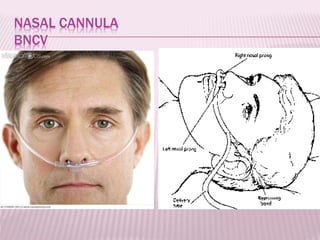
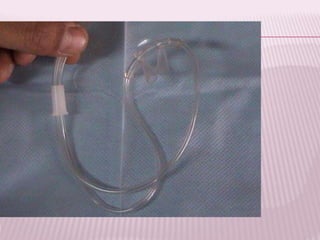
NASAL CANNULA
BNCV
NASAL CANNULA
MERITS DEMERITS
 Easy to fix
 Keeps hands free
 Not much interference
with further airway care
 Low cost
 Compliant
 Unstable
 Easily dislodged
 High flow uncomfortable
 Nasal trauma – drying and
crusting
 Mucosal irritation
 FiO2 can be inaccurate and
inconsistent
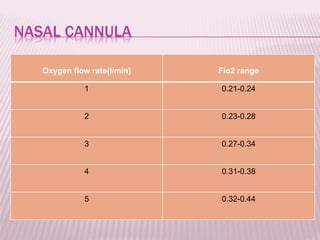
NASAL CANNULA
Oxygen flow rate(l/min) Fio2 range
1 0.21-0.24
2 0.23-0.28
3 0.27-0.34
4 0.31-0.38
5 0.32-0.44
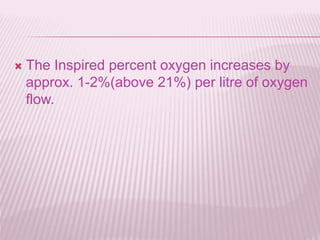
 The Inspired percent oxygen increases by
approx. 1-2%(above 21%) per litre of oxygen
flow.
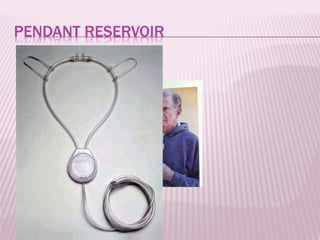
PENDANT RESERVOIR
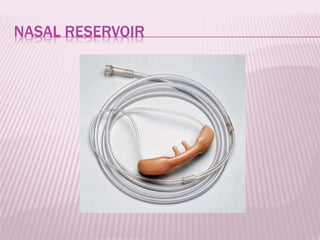
NASAL RESERVOIR
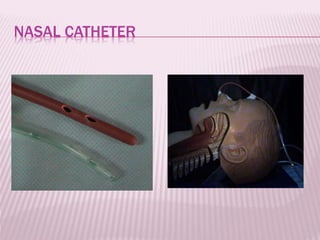
NASAL CATHETER
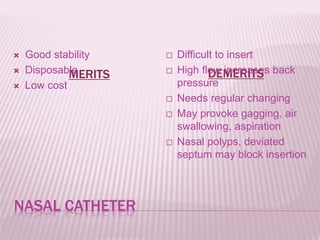
NASAL CATHETER
MERITS DEMERITS
 Good stability
 Disposable
 Low cost
 Difficult to insert
 High flow increases back
pressure
 Needs regular changing
 May provoke gagging, air
swallowing, aspiration
 Nasal polyps, deviated
septum may block insertion
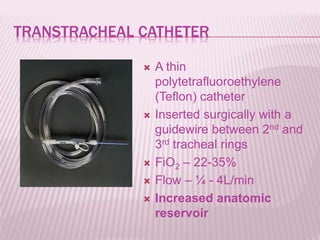
TRANSTRACHEAL CATHETER
 A thin
polytetrafluoroethylene
(Teflon) catheter
 Inserted surgically with a
guidewire between 2nd and
3rd tracheal rings
 FiO2 – 22-35%
 Flow – ¼ - 4L/min
 Increased anatomic
reservoir
TRANSTRACHEAL CATHETER
MERITS DEMERITS
 Lower O2 use and cost
 Eliminates nasal and skin
irritation
 Better compliance
 Increased exercise
tolerance
 Increased mobility
 High cost
 Surgical complications
 Infection
 Mucus plugging
 Lost tract
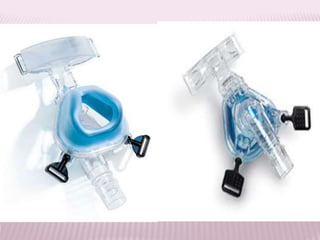
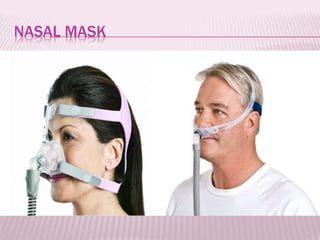
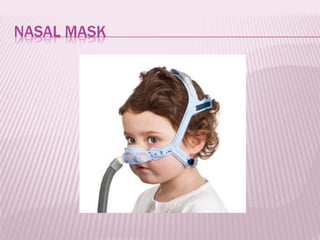
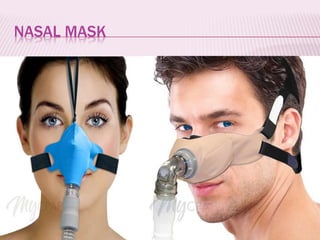
NASAL MASK
 Hybrid of nasal cannula and face mask.
 Supplemental oxygen equivalent to nasal
cannula under low flow conditions for adult
patients.
 Advantage – patient comfort.
does not produce sores around nares
Dry oxygen is not jetted into nasal cavity.
NASAL MASK
NASAL MASK
NASAL MASK
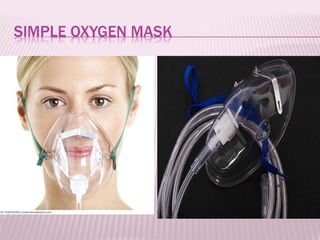
SIMPLE OXYGEN MASK
SIMPLE OXYGEN MASK
MERITS DEMERITS
 Disposable
 Light weight
 Covers both nose and
mouth
 Elastic headband
 No reservoir bag
 Maleable metal nose bridge
 Incomplete seal
 Inboard leaking
 Mixture of oxygen and
entrained room air
 Uncomfortable
 Speech is muffles
 Drinking and eating are
difficult
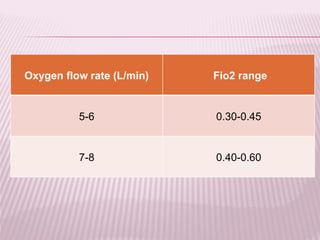
Oxygen flow rate (L/min) Fio2 range
5-6 0.30-0.45
7-8 0.40-0.60
 Masks lacking oxygen reservoirs best for
 Patients who require concentrations of
oxygen greater than cannulas provide
 Need oxygen therapy for fairly short
periods of time
 Example: medical transport or therapy,
PACU, ER
 not for patients with severe respiratory
disease who are hypoxemic, tachypneic or
unable to protect their airway from
aspiration.
MASK WITH RESERVOIRS
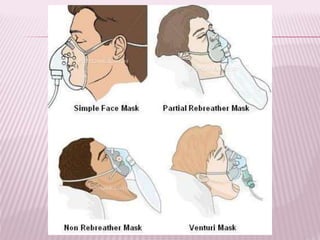
 Partial rebreathing mask
 Non rebreathing mask
PARTIAL REBREATHING MASK
 Consists of mask with exhalation ports and
reservoir bag
 Reservoir bag must remain inflated
 O2 flow rate - 6 to 10L
FIO2=60%-80%
 Client can inhale gas from mask, bag,
exhalation ports
 Poorly fitting; must remove to eat
PARTIAL REBREATHING MASK
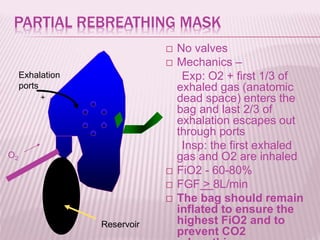
 No valves
 Mechanics –
Exp: O2 + first 1/3 of
exhaled gas (anatomic
dead space) enters the
bag and last 2/3 of
exhalation escapes out
through ports
Insp: the first exhaled
gas and O2 are inhaled
 FiO2 - 60-80%
 FGF > 8L/min
 The bag should remain
inflated to ensure the
highest FiO2 and to
prevent CO2
Exhalation
ports
O2
Reservoir
+
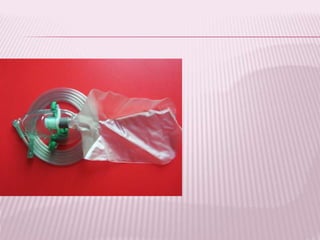
NON-REBREATHING MASK
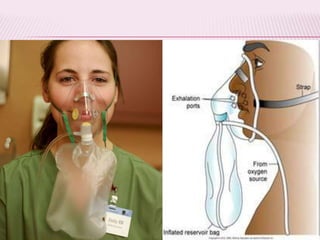
 Consists of mask, reservoir bag, 2 one-way valves
at exhalation ports and bag
 Client can only inhale from reservoir bag
 Bag must remain inflated at all times
 O2 flow rate- 10 to 15L
Fio2= 95-100%
 Poorly fitting; must remove to eat
NON-REBREATHING MASK
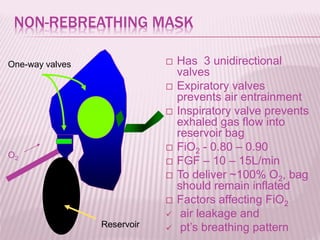
 Has 3 unidirectional
valves
 Expiratory valves
prevents air entrainment
 Inspiratory valve prevents
exhaled gas flow into
reservoir bag
 FiO2 - 0.80 – 0.90
 FGF – 10 – 15L/min
 To deliver ~100% O2, bag
should remain inflated
 Factors affecting FiO2
 air leakage and
 pt’s breathing pattern
O2
Reservoir
One-way valves
Fixed performance
(High – Flow) equipment
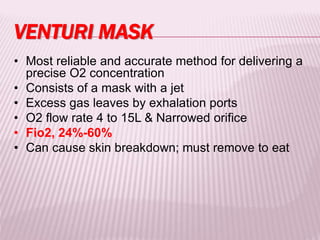
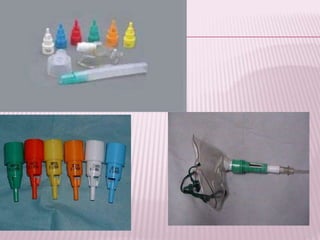
VENTURI MASK
• Most reliable and accurate method for delivering a
precise O2 concentration
• Consists of a mask with a jet
• Excess gas leaves by exhalation ports
• O2 flow rate 4 to 15L & Narrowed orifice
• Fio2, 24%-60%
• Can cause skin breakdown; must remove to eat
AIR ENTRAINMENT NEBULIZER
 Have a fixed orifice, thus, air-to-O2 ratio
can be altered by varying entrainment port
size.
 Fixed performance device
 Deliver FiO2 from 28-100%
 Max. gas flows – 14-16L/min
 Device of choice for delivering O2 to
patients with artificial tracheal airways.
 Provides humidity and temperature control
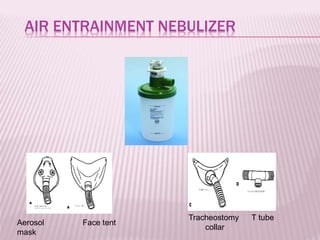
AIR ENTRAINMENT NEBULIZER
Aerosol
mask
Face tent
Tracheostomy
collar
T tube
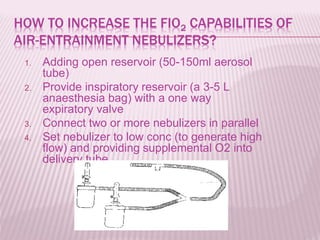
HOW TO INCREASE THE FIO2 CAPABILITIES OF
AIR-ENTRAINMENT NEBULIZERS?
1. Adding open reservoir (50-150ml aerosol
tube)
2. Provide inspiratory reservoir (a 3-5 L
anaesthesia bag) with a one way
expiratory valve
3. Connect two or more nebulizers in parallel
4. Set nebulizer to low conc (to generate high
flow) and providing supplemental O2 into
delivery tube
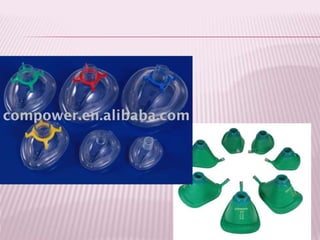
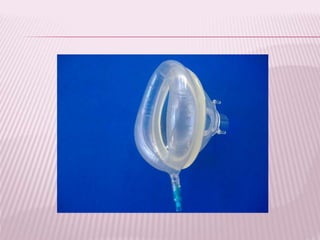
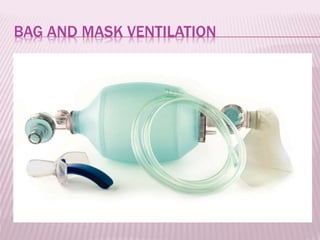
BAG AND MASK VENTILATION
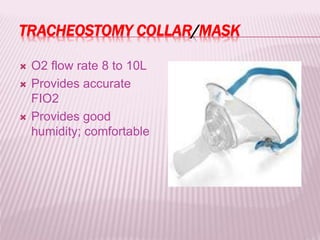
TRACHEOSTOMY COLLAR/MASK
 O2 flow rate 8 to 10L
 Provides accurate
FIO2
 Provides good
humidity; comfortable
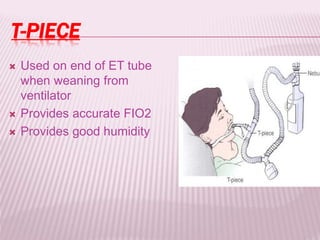
T-PIECE
 Used on end of ET tube
when weaning from
ventilator
 Provides accurate FIO2
 Provides good humidity
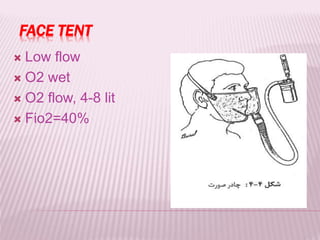
FACE TENT
 Low flow
 O2 wet
 O2 flow, 4-8 lit
 Fio2=40%
 Oxygen tent
 Hood
 Incubator
ENCLOSURES
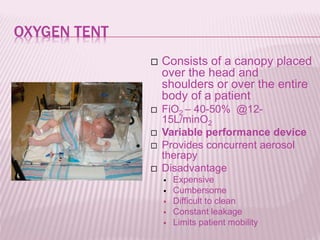
OXYGEN TENT
 Consists of a canopy placed
over the head and
shoulders or over the entire
body of a patient
 FiO2 – 40-50% @12-
15L/minO2
 Variable performance device
 Provides concurrent aerosol
therapy
 Disadvantage
 Expensive
 Cumbersome
 Difficult to clean
 Constant leakage
 Limits patient mobility
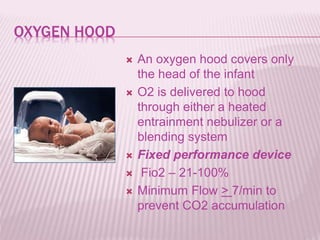
OXYGEN HOOD
 An oxygen hood covers only
the head of the infant
 O2 is delivered to hood
through either a heated
entrainment nebulizer or a
blending system
 Fixed performance device
 Fio2 – 21-100%
 Minimum Flow > 7/min to
prevent CO2 accumulation
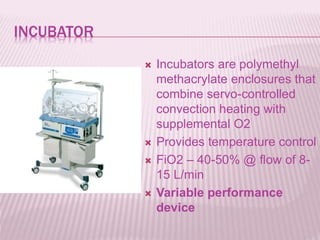
INCUBATOR
 Incubators are polymethyl
methacrylate enclosures that
combine servo-controlled
convection heating with
supplemental O2
 Provides temperature control
 FiO2 – 40-50% @ flow of 8-
15 L/min
 Variable performance
device
HYPERBARIC O2 THERAPY (HBOT)
DEFINITION
 A mode of medical treatment wherein
the patient breathes 100% oxygen at a
pressure greater than one Atmosphere
Absolute (1 ATA)
 1 ATA is equal to 760 mm Hg at sea level
PHYSIOLOGICAL EFFECTS OF HBO
 Bubble reduction ( boyle’s law)
 Hyperoxia of blood
 Enhanced host immune function
 Neovascularization
 Vasoconstriction
INDICATIONS OF HBOT
ACUTE CONDITIONS CHRONIC CONDITIONS
 Decompression sickness
 Air embolism
 Carbon monoxide
poisoning
 Severe crush injuries
 Thermal burns
 Acute arterial
insufficiency
 Clostridial gangrene
 Necrotizing soft-tissue
infection
 Radiation necrosis
 Diabetic wounds of lower
limbs
 Refratory osteomyelitis
 Actinomycosis (chronic
systemic abscesses)
METHODS OF ADMINISTRATION OF
HBOT
PROBLEMS WITH HBOT
 Barotrauma
 Ear/ sinus trauma
 Tympanic membrane rupture
 Pneumothorax
 Oxygen toxicity
 Fire hazards
 Clautrophobia
 Sudden decompression
COMPLICATIONS OF OXYGEN
THERAPY
COMPLICATIONS OF OXYGEN THERAPY
1. Oxygen toxicity
2. Depression of ventilation
3. Retinopathy of Prematurity
4. Absorption atelectasis
5. Fire hazard
1. O2 TOXICITY
 Primarily affects lung and CNS.
 2 factors: PaO2 & exposure time
 CNS O2 toxicity (Paul Bert effect)
 occurs on breathing O2 at pressure > 1 atm
 tremors, twitching, convulsions
PULMONARY OXYGEN TOXICITY
C/F
 acute tracheobronchitis
 Cough and substernal pain
 ARDS like state
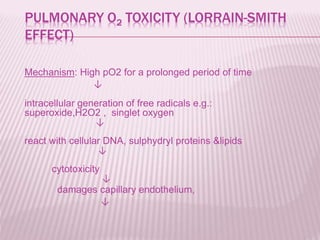
PULMONARY O2 TOXICITY (LORRAIN-SMITH
EFFECT)
Mechanism: High pO2 for a prolonged period of time
↓
intracellular generation of free radicals e.g.:
superoxide,H2O2 , singlet oxygen
↓
react with cellular DNA, sulphydryl proteins &lipids
↓
cytotoxicity
↓
damages capillary endothelium,
↓
Interstitial edema
Thickened alveolar capillary membrane.
↓
Pulmonary fibrosis and hypertension
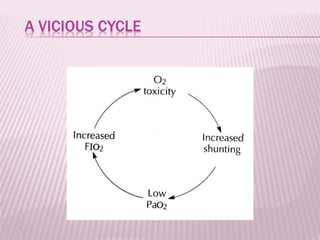
A VICIOUS CYCLE
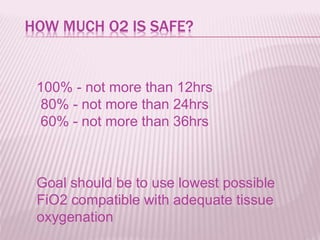
HOW MUCH O2 IS SAFE?
100% - not more than 12hrs
80% - not more than 24hrs
60% - not more than 36hrs
Goal should be to use lowest possible
FiO2 compatible with adequate tissue
oxygenation
INDICATIONS FOR 70% - 100% OXYGEN
THERAPY
1. Resuscitation
2. Periods of acute cardiopulmonary
instability
3. Patient transport
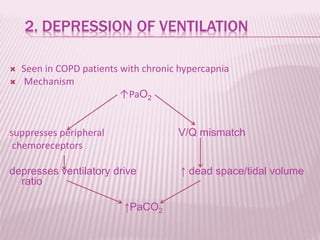
2. DEPRESSION OF VENTILATION
 Seen in COPD patients with chronic hypercapnia
 Mechanism
↑PaO2
suppresses peripheral V/Q mismatch
chemoreceptors
depresses ventilatory drive ↑ dead space/tidal volume
ratio
↑PaCO2
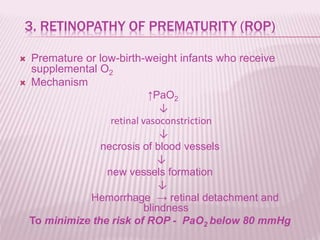
3. RETINOPATHY OF PREMATURITY (ROP)
 Premature or low-birth-weight infants who receive
supplemental O2
 Mechanism
↑PaO2
↓
retinal vasoconstriction
↓
necrosis of blood vessels
↓
new vessels formation
↓
Hemorrhage → retinal detachment and
blindness
To minimize the risk of ROP - PaO2 below 80 mmHg
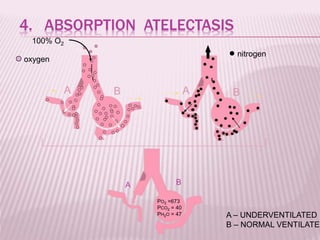
4. ABSORPTION ATELECTASIS
100% O2
oxygen
nitrogen
PO2 =673
PCO2 = 40
PH2O = 47
A B
A – UNDERVENTILATED
B – NORMAL VENTILATED
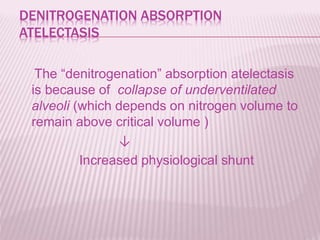
DENITROGENATION ABSORPTION
ATELECTASIS
The “denitrogenation” absorption atelectasis
is because of collapse of underventilated
alveoli (which depends on nitrogen volume to
remain above critical volume )
↓
Increased physiological shunt
5. FIRE HAZARD
 High FiO2 increases the risk of fire
 Preventive measures
 Lowest effective FiO2 should be used
 Use of scavenging systems
 Avoid use of outdated equipment such as
aluminium gas regulators
 Fire prevention protocols should be followed
for hyperbaric O2 therapy

Oxygen therapy

  • 1.
  • 2.
     What isoxygen?  Why do we need oxygen?  What is oxygen therapy?  When do we need oxygen therapy?  How to give oxygen therapy?
  • 3.
    WHAT IS OXYGEN? In 1775 by joseph priestley an english scientist.  Oxygen is a chemical element with symbol O and atomic number 8.  Highly reactive nonmetallic element and oxidizing agent that readily forms compounds.  3rd most abundant element in the universe.  Colorless, odorless, and tasteless
  • 4.
    WHY DO WENEED OXYGEN?  Cellular respiration.  Biochemical energy from nutrients to ATP.  Aerobic respiration.  Anaerobic respiration.
  • 5.
    AEROBIC RESPIRATION Pyruvate fromglycolysis. Kreb’s cycle Electron transport chain
  • 6.
    WHAT IS OXYGENTHERAPY?  Oxygen therapy is administration of oxygen in concentration more than in ambient air as a medical intervention.  Thus providing adequate oxygen in the blood, while decreasing the work of breathing and reducing the stress on the myocardium.
  • 7.
    7 INDICATIONS FOR OXYGENTHERAPY  Hypoxemia  Inadequate amount of oxygen in the blood  SPO2 < 90%  PaO2 < 60 mmHg  Excessive work of breathing  Excessive myocardial workload
  • 8.
    FACTORS INFLUENCING OXYGEN TRANSPORT Cardiac output  Arterial oxygen content  Concentration of Hb  Metabolic requirements
  • 9.
     Hypoxemia  decreasein the arterial oxygen content in the blood  Hypoxia  decreased oxygen supply to the tissues.
  • 10.
    10 CAUSES OF HYPOXEMIA Shunt  Hypoventilation  As carbon dioxide increases oxygen falls  V/Q mismatching (ventilation/perfusion)  Pneumonia  Pulmonary edema  ARDS  Increased diffusion gradient  asbestosis  Early pulmonary edema
  • 11.
    CLINICAL MANIFESTATIONS OF HYPOXIA Impaired judgment, agitation (restlessness), disorientation, confusion, lethargy, coma  Dyspnea  Tachypnea  Tachycardia, dysrhythmias  Elevated BP  Diaphoresis  Central cyanosis
  • 12.
    CAUSES OF HYPOXIA Hypoxic hypoxia  Anemic hypoxia  Ischemic or stagnant hypoxia  Histotoxic hypoxia
  • 13.
    NEED FOR OXYGENIS ASSESSED BY  Clinical evaluation  Pulse oximetry  ABG
  • 14.
    14 OXYGEN THERAPY  Goalof therapy is an SPO2 of >90% or for documented COPD patients(Spo2 88–92%)-(Pao2=55-60)  As SPO2 normalizes the patients vital signs should improve”  Heart rate should return to normal for patient  Respiratory rate should decrease to normal for patient  Blood pressure should normalize for patient
  • 15.
    CAUTIONS FOR OXYGENTHERAPY  Oxygen toxicity – can occur with Fio2 > 60% longer than 36 hrs  Fio2>80%longer than 24 hrs Fio2>100%longer than 12hrs  Suppression of ventilation – will lead to increased CO2 and carbon dioxide narcosis  Danger of fire  Absorbtion Atelectasia  Premature retrolental fibroplasia
  • 16.
    OXYGEN DELIVERY DEVICES 1. High flow (fixed performance) delivery systems. 2. Low flow (variable performance) delivery systems.
  • 17.
     Low flowsystems  contribute partially to inspired gas client breathes  do not provide constant FIO2  Ex: nasal cannula, simple mask  High flow systems  deliver specific and constant percent of oxygen independent of client’s breathing  Ex: Venturi mask, non-rebreather mask, trach collar, T- piece
  • 18.
     Low FlowOxygen Delivery Devices :  These include: i. Nasal cannula. ii. Simple mask / Mary Carterall mask. iii. Oxygen tents. iv. Non rebreathing mask. v. Rebreathing mask. vi. Polymask.
  • 19.
     High flowoxygen delivery devices: i. Venturi mask ii. Air entertainment nebulizers. iii. High flow air-oxygen blenders. iv. Bag & mask ventilation
  • 20.
  • 21.
    NASAL CANNULA MERITS DEMERITS Easy to fix  Keeps hands free  Not much interference with further airway care  Low cost  Compliant  Unstable  Easily dislodged  High flow uncomfortable  Nasal trauma – drying and crusting  Mucosal irritation  FiO2 can be inaccurate and inconsistent
  • 22.
    NASAL CANNULA Oxygen flowrate(l/min) Fio2 range 1 0.21-0.24 2 0.23-0.28 3 0.27-0.34 4 0.31-0.38 5 0.32-0.44
  • 23.
     The Inspiredpercent oxygen increases by approx. 1-2%(above 21%) per litre of oxygen flow.
  • 26.
  • 27.
  • 28.
  • 29.
    NASAL CATHETER MERITS DEMERITS Good stability  Disposable  Low cost  Difficult to insert  High flow increases back pressure  Needs regular changing  May provoke gagging, air swallowing, aspiration  Nasal polyps, deviated septum may block insertion
  • 30.
    TRANSTRACHEAL CATHETER  Athin polytetrafluoroethylene (Teflon) catheter  Inserted surgically with a guidewire between 2nd and 3rd tracheal rings  FiO2 – 22-35%  Flow – ¼ - 4L/min  Increased anatomic reservoir
  • 31.
    TRANSTRACHEAL CATHETER MERITS DEMERITS Lower O2 use and cost  Eliminates nasal and skin irritation  Better compliance  Increased exercise tolerance  Increased mobility  High cost  Surgical complications  Infection  Mucus plugging  Lost tract
  • 32.
    NASAL MASK  Hybridof nasal cannula and face mask.  Supplemental oxygen equivalent to nasal cannula under low flow conditions for adult patients.  Advantage – patient comfort. does not produce sores around nares Dry oxygen is not jetted into nasal cavity.
  • 34.
  • 35.
  • 36.
  • 37.
  • 38.
    SIMPLE OXYGEN MASK MERITSDEMERITS  Disposable  Light weight  Covers both nose and mouth  Elastic headband  No reservoir bag  Maleable metal nose bridge  Incomplete seal  Inboard leaking  Mixture of oxygen and entrained room air  Uncomfortable  Speech is muffles  Drinking and eating are difficult
  • 39.
    Oxygen flow rate(L/min) Fio2 range 5-6 0.30-0.45 7-8 0.40-0.60
  • 40.
     Masks lackingoxygen reservoirs best for  Patients who require concentrations of oxygen greater than cannulas provide  Need oxygen therapy for fairly short periods of time  Example: medical transport or therapy, PACU, ER  not for patients with severe respiratory disease who are hypoxemic, tachypneic or unable to protect their airway from aspiration.
  • 41.
    MASK WITH RESERVOIRS Partial rebreathing mask  Non rebreathing mask
  • 42.
    PARTIAL REBREATHING MASK Consists of mask with exhalation ports and reservoir bag  Reservoir bag must remain inflated  O2 flow rate - 6 to 10L FIO2=60%-80%  Client can inhale gas from mask, bag, exhalation ports  Poorly fitting; must remove to eat
  • 43.
    PARTIAL REBREATHING MASK No valves  Mechanics – Exp: O2 + first 1/3 of exhaled gas (anatomic dead space) enters the bag and last 2/3 of exhalation escapes out through ports Insp: the first exhaled gas and O2 are inhaled  FiO2 - 60-80%  FGF > 8L/min  The bag should remain inflated to ensure the highest FiO2 and to prevent CO2 Exhalation ports O2 Reservoir +
  • 45.
    NON-REBREATHING MASK  Consistsof mask, reservoir bag, 2 one-way valves at exhalation ports and bag  Client can only inhale from reservoir bag  Bag must remain inflated at all times  O2 flow rate- 10 to 15L Fio2= 95-100%  Poorly fitting; must remove to eat
  • 46.
    NON-REBREATHING MASK  Has3 unidirectional valves  Expiratory valves prevents air entrainment  Inspiratory valve prevents exhaled gas flow into reservoir bag  FiO2 - 0.80 – 0.90  FGF – 10 – 15L/min  To deliver ~100% O2, bag should remain inflated  Factors affecting FiO2  air leakage and  pt’s breathing pattern O2 Reservoir One-way valves
  • 49.
  • 52.
    VENTURI MASK • Mostreliable and accurate method for delivering a precise O2 concentration • Consists of a mask with a jet • Excess gas leaves by exhalation ports • O2 flow rate 4 to 15L & Narrowed orifice • Fio2, 24%-60% • Can cause skin breakdown; must remove to eat
  • 54.
    AIR ENTRAINMENT NEBULIZER Have a fixed orifice, thus, air-to-O2 ratio can be altered by varying entrainment port size.  Fixed performance device  Deliver FiO2 from 28-100%  Max. gas flows – 14-16L/min  Device of choice for delivering O2 to patients with artificial tracheal airways.  Provides humidity and temperature control
  • 55.
    AIR ENTRAINMENT NEBULIZER Aerosol mask Facetent Tracheostomy collar T tube
  • 56.
    HOW TO INCREASETHE FIO2 CAPABILITIES OF AIR-ENTRAINMENT NEBULIZERS? 1. Adding open reservoir (50-150ml aerosol tube) 2. Provide inspiratory reservoir (a 3-5 L anaesthesia bag) with a one way expiratory valve 3. Connect two or more nebulizers in parallel 4. Set nebulizer to low conc (to generate high flow) and providing supplemental O2 into delivery tube
  • 57.
    BAG AND MASKVENTILATION
  • 58.
    TRACHEOSTOMY COLLAR/MASK  O2flow rate 8 to 10L  Provides accurate FIO2  Provides good humidity; comfortable
  • 59.
    T-PIECE  Used onend of ET tube when weaning from ventilator  Provides accurate FIO2  Provides good humidity
  • 60.
    FACE TENT  Lowflow  O2 wet  O2 flow, 4-8 lit  Fio2=40%
  • 61.
     Oxygen tent Hood  Incubator ENCLOSURES
  • 62.
    OXYGEN TENT  Consistsof a canopy placed over the head and shoulders or over the entire body of a patient  FiO2 – 40-50% @12- 15L/minO2  Variable performance device  Provides concurrent aerosol therapy  Disadvantage  Expensive  Cumbersome  Difficult to clean  Constant leakage  Limits patient mobility
  • 63.
    OXYGEN HOOD  Anoxygen hood covers only the head of the infant  O2 is delivered to hood through either a heated entrainment nebulizer or a blending system  Fixed performance device  Fio2 – 21-100%  Minimum Flow > 7/min to prevent CO2 accumulation
  • 64.
    INCUBATOR  Incubators arepolymethyl methacrylate enclosures that combine servo-controlled convection heating with supplemental O2  Provides temperature control  FiO2 – 40-50% @ flow of 8- 15 L/min  Variable performance device
  • 65.
  • 66.
    DEFINITION  A modeof medical treatment wherein the patient breathes 100% oxygen at a pressure greater than one Atmosphere Absolute (1 ATA)  1 ATA is equal to 760 mm Hg at sea level
  • 67.
    PHYSIOLOGICAL EFFECTS OFHBO  Bubble reduction ( boyle’s law)  Hyperoxia of blood  Enhanced host immune function  Neovascularization  Vasoconstriction
  • 68.
    INDICATIONS OF HBOT ACUTECONDITIONS CHRONIC CONDITIONS  Decompression sickness  Air embolism  Carbon monoxide poisoning  Severe crush injuries  Thermal burns  Acute arterial insufficiency  Clostridial gangrene  Necrotizing soft-tissue infection  Radiation necrosis  Diabetic wounds of lower limbs  Refratory osteomyelitis  Actinomycosis (chronic systemic abscesses)
  • 69.
  • 70.
    PROBLEMS WITH HBOT Barotrauma  Ear/ sinus trauma  Tympanic membrane rupture  Pneumothorax  Oxygen toxicity  Fire hazards  Clautrophobia  Sudden decompression
  • 71.
  • 72.
    COMPLICATIONS OF OXYGENTHERAPY 1. Oxygen toxicity 2. Depression of ventilation 3. Retinopathy of Prematurity 4. Absorption atelectasis 5. Fire hazard
  • 73.
    1. O2 TOXICITY Primarily affects lung and CNS.  2 factors: PaO2 & exposure time  CNS O2 toxicity (Paul Bert effect)  occurs on breathing O2 at pressure > 1 atm  tremors, twitching, convulsions
  • 74.
    PULMONARY OXYGEN TOXICITY C/F acute tracheobronchitis  Cough and substernal pain  ARDS like state
  • 75.
    PULMONARY O2 TOXICITY(LORRAIN-SMITH EFFECT) Mechanism: High pO2 for a prolonged period of time ↓ intracellular generation of free radicals e.g.: superoxide,H2O2 , singlet oxygen ↓ react with cellular DNA, sulphydryl proteins &lipids ↓ cytotoxicity ↓ damages capillary endothelium, ↓
  • 76.
    Interstitial edema Thickened alveolarcapillary membrane. ↓ Pulmonary fibrosis and hypertension
  • 77.
  • 78.
    HOW MUCH O2IS SAFE? 100% - not more than 12hrs 80% - not more than 24hrs 60% - not more than 36hrs Goal should be to use lowest possible FiO2 compatible with adequate tissue oxygenation
  • 79.
    INDICATIONS FOR 70%- 100% OXYGEN THERAPY 1. Resuscitation 2. Periods of acute cardiopulmonary instability 3. Patient transport
  • 80.
    2. DEPRESSION OFVENTILATION  Seen in COPD patients with chronic hypercapnia  Mechanism ↑PaO2 suppresses peripheral V/Q mismatch chemoreceptors depresses ventilatory drive ↑ dead space/tidal volume ratio ↑PaCO2
  • 81.
    3. RETINOPATHY OFPREMATURITY (ROP)  Premature or low-birth-weight infants who receive supplemental O2  Mechanism ↑PaO2 ↓ retinal vasoconstriction ↓ necrosis of blood vessels ↓ new vessels formation ↓ Hemorrhage → retinal detachment and blindness To minimize the risk of ROP - PaO2 below 80 mmHg
  • 82.
    4. ABSORPTION ATELECTASIS 100%O2 oxygen nitrogen PO2 =673 PCO2 = 40 PH2O = 47 A B A – UNDERVENTILATED B – NORMAL VENTILATED
  • 83.
    DENITROGENATION ABSORPTION ATELECTASIS The “denitrogenation”absorption atelectasis is because of collapse of underventilated alveoli (which depends on nitrogen volume to remain above critical volume ) ↓ Increased physiological shunt
  • 84.
    5. FIRE HAZARD High FiO2 increases the risk of fire  Preventive measures  Lowest effective FiO2 should be used  Use of scavenging systems  Avoid use of outdated equipment such as aluminium gas regulators  Fire prevention protocols should be followed for hyperbaric O2 therapy