presented by
Dr sapan kumar jena
2nd yr p.g
Guided by
Dr. C.R.Panigrahi
Asst Professor
Dept of Anaesthesiology & critical
care ,VIMSAR
Oxygen therapy
 “Oxygen Therapy is usually defined as
the administration of oxygen at
concentrations greater than those found
in ambient air”
Goal
 “To treat or prevent hypoxemia thereby
preventing tissue hypoxia which may result
in tissue injury or even cell death”
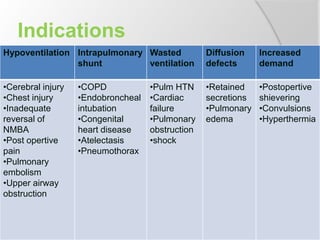
Indications
Hypoventilation Intrapulmonary
shunt
Wasted
ventilation
Diffusion
defects
Increased
demand
•Cerebral injury
•Chest injury
•Inadequate
reversal of
NMBA
•Post opertive
pain
•Pulmonary
embolism
•Upper airway
obstruction
•COPD
•Endobroncheal
intubation
•Congenital
heart disease
•Atelectasis
•Pneumothorax
•Pulm HTN
•Cardiac
failure
•Pulmonary
obstruction
•shock
•Retained
secretions
•Pulmonary
edema
•Postopertive
shievering
•Convulsions
•Hyperthermia
Absolute Contraindications &
Possible Adverse Effects
 Absolute Contraindications
• Patient/Client does not consent to receiving the
oxygen
• The use of some O2 delivery devices (e.g., nasal
cannulas and nasopharyngeal catheters in neonates
and pediatric patients that have nasal obstructions)
 Potential Adverse Effects
• Oxygen toxicity
• Oxidative stress
• Depression of ventilation in a select population with
chronic hypercarbia
• Retinopathy of prematurity
• Absorption atelectasis
Physical properties of
oxygen Oxygen (O2) is the eighth element on the periodic table.
 Molecular weight 32 & specific gravity 1.105
 Makes up 20.9% of air by volume and 23% air by weight.
 Can combine with all other elements except other inert gases
to form oxides.
 Oxygen is therefore characterized as an oxidizer.
 Is a colourless,odourless non-flammable gas.
 Accelerates combustion.
 Its critical temperature is -118.4 C (above this critical
temperature oxygen can only exist as a gas regardless of the
pressure).
 An oxygen enriched environment is considered to have 23%
oxygen in the air and is a fire hazard.
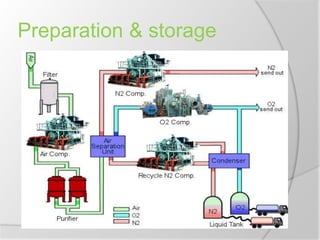
Preparation & storage
 O2 manufactured by fractional distillation of
liquid air .
 Before liquefaction ,co2 removed by filter.
 O2 & N2 separated by means of their
boiling points. O2 = -183 C, N2= -195 C
Types of Oxygen Delivery
Systems
 There are three main types of oxygen
delivery systems:
 • Compressed gas cylinders;
 • Liquid oxygen in cryogenic containers;
and
 • Oxygen concentrators for medical use.
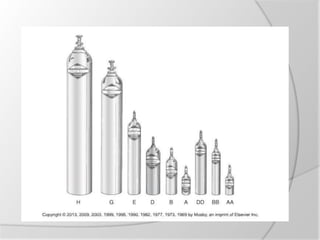
Compressed Gas
Cylinders
 Black with white shoulders in india
 Pin index = 2,5
 Capacity
 E cylinder =660L/1900 psi
 M cylinder = 3450L/2200psi
 H cyinder= 6900L/2200 psi
Calculation of duration of
flow
 To calculate how long a cylinder will last based
on the size of the cylinder and continuous flow
rate, the following formula can be used:
 Duration of Flow in minutes =
[current gauge pressure in psi x cylinder
factor]/ Flow rate in liters per minute
 Some examples of cylinder factors for different
sized cylinders are:
 D cylinder 0.16
 E cylinder 0.28
 M cylinder 1.56
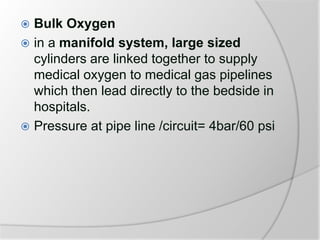
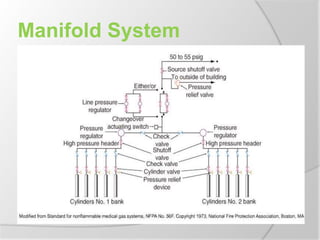
 Bulk Oxygen
 in a manifold system, large sized
cylinders are linked together to supply
medical oxygen to medical gas pipelines
which then lead directly to the bedside in
hospitals.
 Pressure at pipe line /circuit= 4bar/60 psi
Manifold System
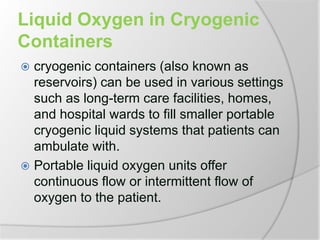
Liquid Oxygen in Cryogenic
Containers
 cryogenic containers (also known as
reservoirs) can be used in various settings
such as long-term care facilities, homes,
and hospital wards to fill smaller portable
cryogenic liquid systems that patients can
ambulate with.
 Portable liquid oxygen units offer
continuous flow or intermittent flow of
oxygen to the patient.
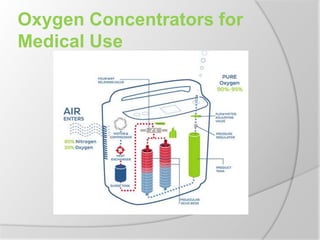
Oxygen Concentrators for
Medical Use
 A concentrator is an electrically
powered, electronically controlled device
that does not store oxygen when not in
operation.
 It produces oxygen from ambient air by
absorption of nitrogen onto some type of
alumina silicates.
How Does Oxygen Therapy
Work?
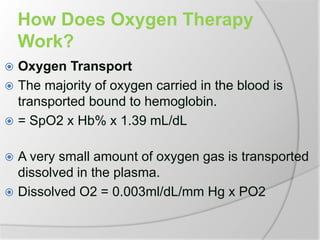
 Oxygen Transport
 The majority of oxygen carried in the blood is
transported bound to hemoglobin.
 = SpO2 x Hb% x 1.39 mL/dL
 A very small amount of oxygen gas is transported
dissolved in the plasma.
 Dissolved O2 = 0.003ml/dL/mm Hg x PO2
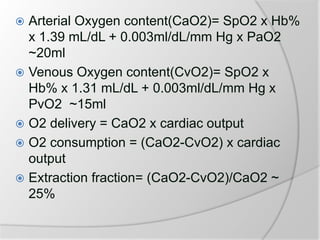
 Arterial Oxygen content(CaO2)= SpO2 x Hb%
x 1.39 mL/dL + 0.003ml/dL/mm Hg x PaO2
~20ml
 Venous Oxygen content(CvO2)= SpO2 x
Hb% x 1.31 mL/dL + 0.003ml/dL/mm Hg x
PvO2 ~15ml
 O2 delivery = CaO2 x cardiac output
 O2 consumption = (CaO2-CvO2) x cardiac
output
 Extraction fraction= (CaO2-CvO2)/CaO2 ~
25%
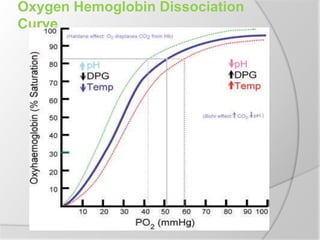
Oxygen Hemoglobin Dissociation
Curve
Gas exchange
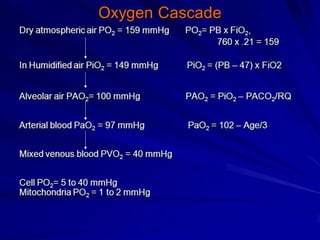
 Oxygen cascade: steps by which partial
pressure of O2 decreases from higher level
in inspired gas to a lower level in
mitochondria.
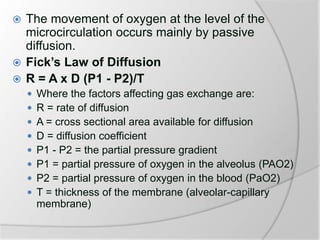
 The movement of oxygen at the level of the
microcirculation occurs mainly by passive
diffusion.
 Fick’s Law of Diffusion
 R = A x D (P1 - P2)/T
 Where the factors affecting gas exchange are:
 R = rate of diffusion
 A = cross sectional area available for diffusion
 D = diffusion coefficient
 P1 - P2 = the partial pressure gradient
 P1 = partial pressure of oxygen in the alveolus (PAO2)
 P2 = partial pressure of oxygen in the blood (PaO2)
 T = thickness of the membrane (alveolar-capillary
membrane)
Oxygen Therapy Equipment
and Adjuncts
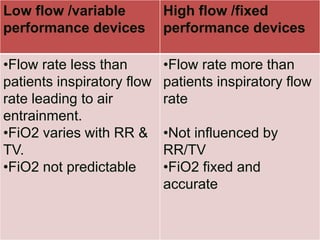
Low flow /variable
performance devices
High flow /fixed
performance devices
•Flow rate less than
patients inspiratory flow
rate leading to air
entrainment.
•FiO2 varies with RR &
TV.
•FiO2 not predictable
•Flow rate more than
patients inspiratory flow
rate
•Not influenced by
RR/TV
•FiO2 fixed and
accurate
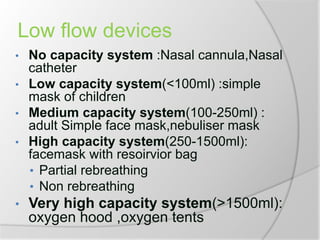
Low flow devices
• No capacity system :Nasal cannula,Nasal
catheter
• Low capacity system(<100ml) :simple
mask of children
• Medium capacity system(100-250ml) :
adult Simple face mask,nebuliser mask
• High capacity system(250-1500ml):
facemask with resoirvior bag
• Partial rebreathing
• Non rebreathing
• Very high capacity system(>1500ml):
oxygen hood ,oxygen tents
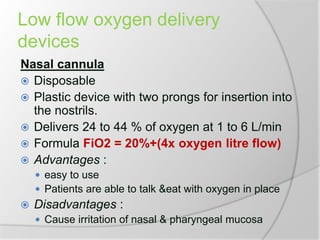
Low flow oxygen delivery
devices
Nasal cannula
 Disposable
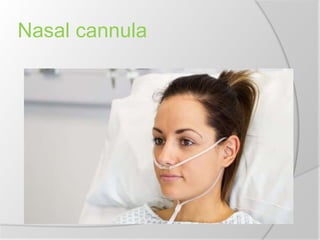
 Plastic device with two prongs for insertion into
the nostrils.
 Delivers 24 to 44 % of oxygen at 1 to 6 L/min
 Formula FiO2 = 20%+(4x oxygen litre flow)
 Advantages :
 easy to use
 Patients are able to talk &eat with oxygen in place
 Disadvantages :
 Cause irritation of nasal & pharyngeal mucosa
Nasal cannula
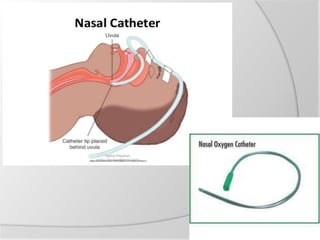
Nasopharyngeal catheter
 Like suction catheter with multiple openings
 Size 8-14 Fr
 Inserted upto fold of soft palate
 Need to be changed from 1 nostril to other
every 8 hrly.
 Upto 40 % FiO2 delivered
 Advantages : gas flow does not impinge on
one area
 Disadvanages : nasal irritation,drying of
mucasa
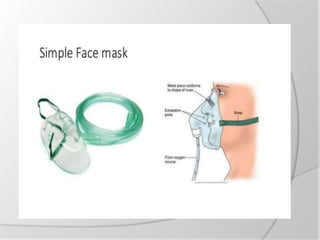
Face mask
 Simple face mask
 Made up of clear ,flexible plastic
 Held to head with elastic bands
 Has metal clip that can be bent over bridge of nose
for a comfortable fit
 Open ports for exhaled gas
 Minimum flow rate of 4l/min to avoid rebreathing
 Usual flow rate -6-10 l/min
 Fio2 : 35-65 % depnding on flow rate , mask size,
breathing pattern
 Advantages :
 Provide increased delivery of oxygen for short
period of time
 Useful for strict mouth breathers
 Disadvantages :
 Has to be removed while eating &drinking
 Muffles communication, obstruct coughing
 Uncomfortable & can’t be used for prolong time
PARTIAL REBREATHING
MASK
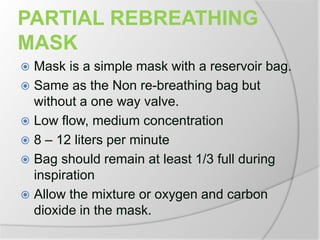
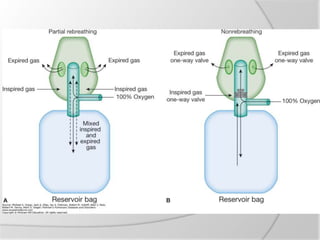
 Mask is a simple mask with a reservoir bag.
 Same as the Non re-breathing bag but
without a one way valve.
 Low flow, medium concentration
 8 – 12 liters per minute
 Bag should remain at least 1/3 full during
inspiration
 Allow the mixture or oxygen and carbon
dioxide in the mask.
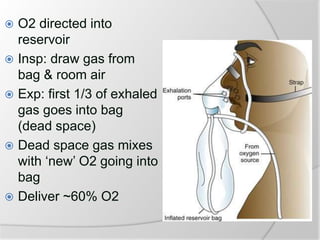
 O2 directed into
reservoir
 Insp: draw gas from
bag & room air
 Exp: first 1/3 of exhaled
gas goes into bag
(dead space)
 Dead space gas mixes
with ‘new’ O2 going into
bag
 Deliver ~60% O2
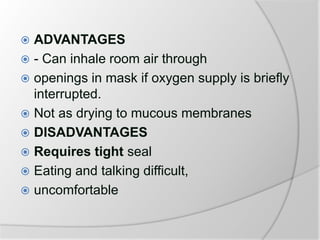
 ADVANTAGES
 - Can inhale room air through
 openings in mask if oxygen supply is briefly
interrupted.
 Not as drying to mucous membranes
 DISADVANTAGES
 Requires tight seal
 Eating and talking difficult,
 uncomfortable
 Caution:
 Set flow rate so mask remains twothirds
full during inspiration
 Keep reservoir bag free of twists or kinks
 Prevents the reservoir bag to collapse or
be empty
 Prevents anyone to squeeze the bag while
on the patient.
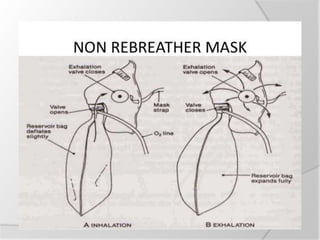
NON REBREATHING
MASK
 It is similar to the partial rebreather
mask except two one-way valves
prevent conservation of exhaled air.
 the one-way valve closes and all of the
expired air is deposited into the
atmosphere, not the reservoir bag.
 This mask provides the highest
concentration of oxygen(95-100%) at a
flow rate 8-15 L/min.
 Valve prevents exhaled gas flow into
reservoir Bag
 Valve over exhalation ports prevents air
entrainment
 Delivers ~100% O2, if bag does not
completely collapse during inhalation
 Maintain flow rate so reservoir bag
collapses only slightly during inspiration
 ADVANTAGES
 Delivers the highest possible oxygen
Concentration
 Suitable for pt breathing spontaneous with
severe hypoxemia
 DISADVANTAGES
 Impractical for long term Therapy
 Malfunction can cause CO2 buildup suffocation
 Expensive
 Feeling of suffocation
 Uncomfortable
Calculation of FiO2 in variable
performance devices
 Flow = 6L/min
 RR= 20 /min
 TV =500 ml
Special consideration in
paediatric patients
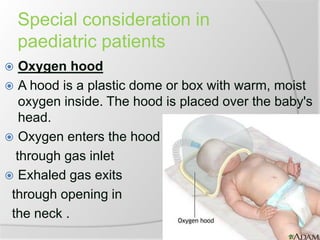
 Oxygen hood
 A hood is a plastic dome or box with warm, moist
oxygen inside. The hood is placed over the baby's
head.
 Oxygen enters the hood
through gas inlet
 Exhaled gas exits
through opening in
the neck .
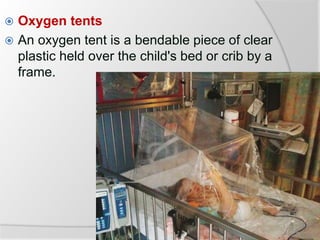
 Oxygen tents
 An oxygen tent is a bendable piece of clear
plastic held over the child's bed or crib by a
frame.
HIGH FLOW Or FIXED DELIVERY
SYSTEMS
 provide a fixed FiO2 (0.24 - 1.0) regardless
of the patient’s/client’s inspiratory demands.
 Air Entrainment Mask (Venturi);
 Air Entrainment Nebulizer;
 Nasal High Flow Oxygen Therapy;
 Mechanical Ventilators (invasive Non-
invasive);
 CPAP Machines;
 Resuscitation Bags; and
 Hyperbaric Oxygen Chambers.
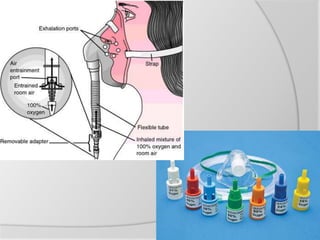
The Venturi System
 Room air dilutes the oxygen entering the
tubing to a certain concentration
 The amount of air drawn in is
determined by the size of the orifice (jet
adapter).
 Applying the Bernoulli principle
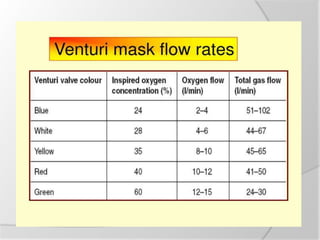
 Oxygen from 24 - 50%
 At liters flow of 4 to 15 L/min.
 The mask is so constructed that there is a
 constant flow of room air blended with a
fixed concentration of oxygen
 Is designed with wide- bore tubing and
 various color - coded jet adapters.
 Each color code corresponds to a precise
Oxygen concentration and a specific liter
flow.
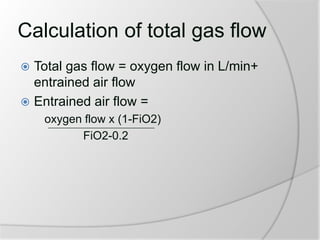
Calculation of total gas flow
 Total gas flow = oxygen flow in L/min+
entrained air flow
 Entrained air flow =
oxygen flow x (1-FiO2)
FiO2-0.2
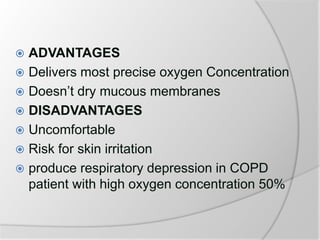
 ADVANTAGES
 Delivers most precise oxygen Concentration
 Doesn’t dry mucous membranes
 DISADVANTAGES
 Uncomfortable
 Risk for skin irritation
 produce respiratory depression in COPD
patient with high oxygen concentration 50%
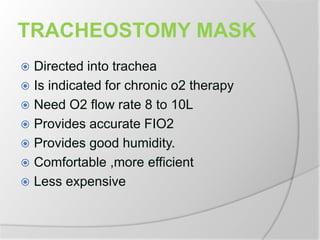
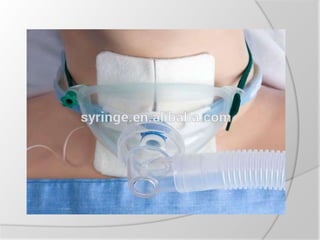
TRACHEOSTOMY MASK
 Directed into trachea
 Is indicated for chronic o2 therapy
 Need O2 flow rate 8 to 10L
 Provides accurate FIO2
 Provides good humidity.
 Comfortable ,more efficient
 Less expensive
 ADVANTAGES
 Delivers high concentrations of oxygen
directly to the lungs.
 Stable and not moved when the patient is
moved or cleaned.
 Maintains saturation levels.
 DISADVANTAGES
 uncomfortable
 Nasal High Flow Oxygen Therapy (NHF)
 alternative to standard high-flow face mask
(HFFM)oxygen therapy.
 It provides delivery of up to 60 L/min of
heated and humidified, blended air and
oxygen via wide-bore nasal cannula
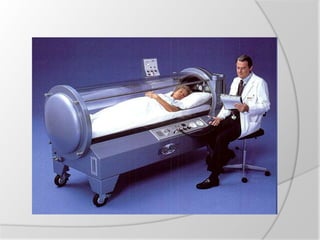
Hyperbaric Oxygen Therapy
(HBOT)
 The Basic Principles of Operation of
Hyperbaric Chambers
 The increased pressure inside the
chamber, combined with the delivery of
100% oxygen (FiO2 = 1.0), drives the
diffusion of oxygen into the blood
plasma at up to 10 times normal
concentration. Patients are monitored at
all times during HBOT
Indications of HBOT
 1. Air or Gas Embolism
 2. Carbon Monoxide Poisoning
 3. Gas Gangrene
 4. Crush Injury, Compartment Syndrome and Other Acute
Traumatic Ischemias
 5. Decompression Sickness
 6. Arterial Insufficiencies:• Central Retinal Artery Occlusion
 7. Severe Anemia
 8. Intracranial Abscess
 9. Necrotizing Soft Tissue Infections
 10. Delayed Radiation Injury (Soft Tissue and Bony
Necrosis)
 11. Compromised Grafts and Flaps
 12. Acute Thermal Burn Injury
Assessment of Oxygen
Therapy
 Hemoximetry (also called CO-oximetry)
– performed in arterial blood gas
analysis.
 Pulse Oximetry - portable, noninvasive
monitoring technique
Complications
 Drying of mucus membrane
 Oxygen induced hypoventilation
 Absorption atelectasis
 Oxygen toxicity/narcosis
 Retinopathy
 Myocardial depression( hyperbaric O2)
 Depression of hematopoesis
 Fire hazards
Oxygen induced hypoventilation
 Occures if respirtory drive is dependent
on hypoxic stimulus
 Inhaling high FiO2 causes
hypoventilation and hypercarbia
 Common in COPD patients
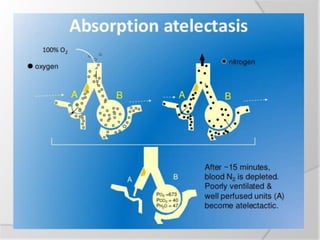
 O2 displaces all the N2 in airway
 Due solubility, gets absorbed causing
alveolar collapse in highly perfused and
poorly ventilated alveoli.
 Seen in COPD patients
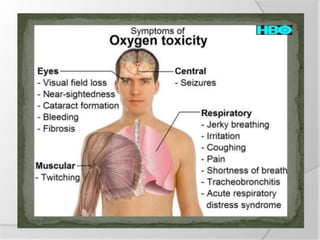
Oxygen toxicity
 Due to overproduction of free radicals
from oxygen molecule
 Superoxide ion
 Hydrogen peroxide
 Singlet oxygen
Prevention of o2 toxicity
 Use lowest FiO2 for shortest time
 Air break- intermittent air breathing
periods
 Early use of PEEP to reduce shunts
 Maintain acid base balance
 Antioxydants like vitamin C & E
References
 Smith & aitkinhead test book of anaesthesia 6th
edition page no 33-35
 Wiley text book of anaesthesia p53-54,94-
96,168-175
 Miller anaesthesia
 Morgan clinical anaesthesiology p 511-519
 American Association of Respiratory Care.
(2002). AARC Guideline: Oxygen therapy for
adults in the acute care facility. Respiratory
Care, 47(6). Retrieved from:
www.rcjournal.com/cpgs/pdf/06.02.717.pdf
 Internet sources

Oxygen therapy

  • 1.
    presented by Dr sapankumar jena 2nd yr p.g Guided by Dr. C.R.Panigrahi Asst Professor Dept of Anaesthesiology & critical care ,VIMSAR
  • 2.
    Oxygen therapy  “OxygenTherapy is usually defined as the administration of oxygen at concentrations greater than those found in ambient air”
  • 3.
    Goal  “To treator prevent hypoxemia thereby preventing tissue hypoxia which may result in tissue injury or even cell death”
  • 4.
    Indications Hypoventilation Intrapulmonary shunt Wasted ventilation Diffusion defects Increased demand •Cerebral injury •Chestinjury •Inadequate reversal of NMBA •Post opertive pain •Pulmonary embolism •Upper airway obstruction •COPD •Endobroncheal intubation •Congenital heart disease •Atelectasis •Pneumothorax •Pulm HTN •Cardiac failure •Pulmonary obstruction •shock •Retained secretions •Pulmonary edema •Postopertive shievering •Convulsions •Hyperthermia
  • 5.
    Absolute Contraindications & PossibleAdverse Effects  Absolute Contraindications • Patient/Client does not consent to receiving the oxygen • The use of some O2 delivery devices (e.g., nasal cannulas and nasopharyngeal catheters in neonates and pediatric patients that have nasal obstructions)  Potential Adverse Effects • Oxygen toxicity • Oxidative stress • Depression of ventilation in a select population with chronic hypercarbia • Retinopathy of prematurity • Absorption atelectasis
  • 7.
    Physical properties of oxygenOxygen (O2) is the eighth element on the periodic table.  Molecular weight 32 & specific gravity 1.105  Makes up 20.9% of air by volume and 23% air by weight.  Can combine with all other elements except other inert gases to form oxides.  Oxygen is therefore characterized as an oxidizer.  Is a colourless,odourless non-flammable gas.  Accelerates combustion.  Its critical temperature is -118.4 C (above this critical temperature oxygen can only exist as a gas regardless of the pressure).  An oxygen enriched environment is considered to have 23% oxygen in the air and is a fire hazard.
  • 8.
  • 9.
     O2 manufacturedby fractional distillation of liquid air .  Before liquefaction ,co2 removed by filter.  O2 & N2 separated by means of their boiling points. O2 = -183 C, N2= -195 C
  • 10.
    Types of OxygenDelivery Systems  There are three main types of oxygen delivery systems:  • Compressed gas cylinders;  • Liquid oxygen in cryogenic containers; and  • Oxygen concentrators for medical use.
  • 11.
    Compressed Gas Cylinders  Blackwith white shoulders in india  Pin index = 2,5  Capacity  E cylinder =660L/1900 psi  M cylinder = 3450L/2200psi  H cyinder= 6900L/2200 psi
  • 13.
    Calculation of durationof flow  To calculate how long a cylinder will last based on the size of the cylinder and continuous flow rate, the following formula can be used:  Duration of Flow in minutes = [current gauge pressure in psi x cylinder factor]/ Flow rate in liters per minute  Some examples of cylinder factors for different sized cylinders are:  D cylinder 0.16  E cylinder 0.28  M cylinder 1.56
  • 14.
     Bulk Oxygen in a manifold system, large sized cylinders are linked together to supply medical oxygen to medical gas pipelines which then lead directly to the bedside in hospitals.  Pressure at pipe line /circuit= 4bar/60 psi
  • 15.
  • 16.
    Liquid Oxygen inCryogenic Containers  cryogenic containers (also known as reservoirs) can be used in various settings such as long-term care facilities, homes, and hospital wards to fill smaller portable cryogenic liquid systems that patients can ambulate with.  Portable liquid oxygen units offer continuous flow or intermittent flow of oxygen to the patient.
  • 17.
  • 18.
     A concentratoris an electrically powered, electronically controlled device that does not store oxygen when not in operation.  It produces oxygen from ambient air by absorption of nitrogen onto some type of alumina silicates.
  • 19.
    How Does OxygenTherapy Work?  Oxygen Transport  The majority of oxygen carried in the blood is transported bound to hemoglobin.  = SpO2 x Hb% x 1.39 mL/dL  A very small amount of oxygen gas is transported dissolved in the plasma.  Dissolved O2 = 0.003ml/dL/mm Hg x PO2
  • 20.
     Arterial Oxygencontent(CaO2)= SpO2 x Hb% x 1.39 mL/dL + 0.003ml/dL/mm Hg x PaO2 ~20ml  Venous Oxygen content(CvO2)= SpO2 x Hb% x 1.31 mL/dL + 0.003ml/dL/mm Hg x PvO2 ~15ml  O2 delivery = CaO2 x cardiac output  O2 consumption = (CaO2-CvO2) x cardiac output  Extraction fraction= (CaO2-CvO2)/CaO2 ~ 25%
  • 21.
  • 22.
    Gas exchange  Oxygencascade: steps by which partial pressure of O2 decreases from higher level in inspired gas to a lower level in mitochondria.
  • 24.
     The movementof oxygen at the level of the microcirculation occurs mainly by passive diffusion.  Fick’s Law of Diffusion  R = A x D (P1 - P2)/T  Where the factors affecting gas exchange are:  R = rate of diffusion  A = cross sectional area available for diffusion  D = diffusion coefficient  P1 - P2 = the partial pressure gradient  P1 = partial pressure of oxygen in the alveolus (PAO2)  P2 = partial pressure of oxygen in the blood (PaO2)  T = thickness of the membrane (alveolar-capillary membrane)
  • 25.
  • 26.
    Low flow /variable performancedevices High flow /fixed performance devices •Flow rate less than patients inspiratory flow rate leading to air entrainment. •FiO2 varies with RR & TV. •FiO2 not predictable •Flow rate more than patients inspiratory flow rate •Not influenced by RR/TV •FiO2 fixed and accurate
  • 27.
    Low flow devices •No capacity system :Nasal cannula,Nasal catheter • Low capacity system(<100ml) :simple mask of children • Medium capacity system(100-250ml) : adult Simple face mask,nebuliser mask • High capacity system(250-1500ml): facemask with resoirvior bag • Partial rebreathing • Non rebreathing • Very high capacity system(>1500ml): oxygen hood ,oxygen tents
  • 28.
    Low flow oxygendelivery devices Nasal cannula  Disposable  Plastic device with two prongs for insertion into the nostrils.  Delivers 24 to 44 % of oxygen at 1 to 6 L/min  Formula FiO2 = 20%+(4x oxygen litre flow)  Advantages :  easy to use  Patients are able to talk &eat with oxygen in place  Disadvantages :  Cause irritation of nasal & pharyngeal mucosa
  • 29.
  • 30.
    Nasopharyngeal catheter  Likesuction catheter with multiple openings  Size 8-14 Fr  Inserted upto fold of soft palate  Need to be changed from 1 nostril to other every 8 hrly.  Upto 40 % FiO2 delivered  Advantages : gas flow does not impinge on one area  Disadvanages : nasal irritation,drying of mucasa
  • 32.
    Face mask  Simpleface mask  Made up of clear ,flexible plastic  Held to head with elastic bands  Has metal clip that can be bent over bridge of nose for a comfortable fit  Open ports for exhaled gas  Minimum flow rate of 4l/min to avoid rebreathing  Usual flow rate -6-10 l/min  Fio2 : 35-65 % depnding on flow rate , mask size, breathing pattern
  • 33.
     Advantages : Provide increased delivery of oxygen for short period of time  Useful for strict mouth breathers  Disadvantages :  Has to be removed while eating &drinking  Muffles communication, obstruct coughing  Uncomfortable & can’t be used for prolong time
  • 35.
    PARTIAL REBREATHING MASK  Maskis a simple mask with a reservoir bag.  Same as the Non re-breathing bag but without a one way valve.  Low flow, medium concentration  8 – 12 liters per minute  Bag should remain at least 1/3 full during inspiration  Allow the mixture or oxygen and carbon dioxide in the mask.
  • 36.
     O2 directedinto reservoir  Insp: draw gas from bag & room air  Exp: first 1/3 of exhaled gas goes into bag (dead space)  Dead space gas mixes with ‘new’ O2 going into bag  Deliver ~60% O2
  • 37.
     ADVANTAGES  -Can inhale room air through  openings in mask if oxygen supply is briefly interrupted.  Not as drying to mucous membranes  DISADVANTAGES  Requires tight seal  Eating and talking difficult,  uncomfortable
  • 38.
     Caution:  Setflow rate so mask remains twothirds full during inspiration  Keep reservoir bag free of twists or kinks  Prevents the reservoir bag to collapse or be empty  Prevents anyone to squeeze the bag while on the patient.
  • 39.
    NON REBREATHING MASK  Itis similar to the partial rebreather mask except two one-way valves prevent conservation of exhaled air.  the one-way valve closes and all of the expired air is deposited into the atmosphere, not the reservoir bag.  This mask provides the highest concentration of oxygen(95-100%) at a flow rate 8-15 L/min.
  • 41.
     Valve preventsexhaled gas flow into reservoir Bag  Valve over exhalation ports prevents air entrainment  Delivers ~100% O2, if bag does not completely collapse during inhalation  Maintain flow rate so reservoir bag collapses only slightly during inspiration
  • 42.
     ADVANTAGES  Deliversthe highest possible oxygen Concentration  Suitable for pt breathing spontaneous with severe hypoxemia  DISADVANTAGES  Impractical for long term Therapy  Malfunction can cause CO2 buildup suffocation  Expensive  Feeling of suffocation  Uncomfortable
  • 44.
    Calculation of FiO2in variable performance devices  Flow = 6L/min  RR= 20 /min  TV =500 ml
  • 45.
    Special consideration in paediatricpatients  Oxygen hood  A hood is a plastic dome or box with warm, moist oxygen inside. The hood is placed over the baby's head.  Oxygen enters the hood through gas inlet  Exhaled gas exits through opening in the neck .
  • 46.
     Oxygen tents An oxygen tent is a bendable piece of clear plastic held over the child's bed or crib by a frame.
  • 47.
    HIGH FLOW OrFIXED DELIVERY SYSTEMS  provide a fixed FiO2 (0.24 - 1.0) regardless of the patient’s/client’s inspiratory demands.  Air Entrainment Mask (Venturi);  Air Entrainment Nebulizer;  Nasal High Flow Oxygen Therapy;  Mechanical Ventilators (invasive Non- invasive);  CPAP Machines;  Resuscitation Bags; and  Hyperbaric Oxygen Chambers.
  • 48.
    The Venturi System Room air dilutes the oxygen entering the tubing to a certain concentration  The amount of air drawn in is determined by the size of the orifice (jet adapter).  Applying the Bernoulli principle
  • 49.
     Oxygen from24 - 50%  At liters flow of 4 to 15 L/min.  The mask is so constructed that there is a  constant flow of room air blended with a fixed concentration of oxygen  Is designed with wide- bore tubing and  various color - coded jet adapters.  Each color code corresponds to a precise Oxygen concentration and a specific liter flow.
  • 52.
    Calculation of totalgas flow  Total gas flow = oxygen flow in L/min+ entrained air flow  Entrained air flow = oxygen flow x (1-FiO2) FiO2-0.2
  • 53.
     ADVANTAGES  Deliversmost precise oxygen Concentration  Doesn’t dry mucous membranes  DISADVANTAGES  Uncomfortable  Risk for skin irritation  produce respiratory depression in COPD patient with high oxygen concentration 50%
  • 54.
    TRACHEOSTOMY MASK  Directedinto trachea  Is indicated for chronic o2 therapy  Need O2 flow rate 8 to 10L  Provides accurate FIO2  Provides good humidity.  Comfortable ,more efficient  Less expensive
  • 56.
     ADVANTAGES  Delivershigh concentrations of oxygen directly to the lungs.  Stable and not moved when the patient is moved or cleaned.  Maintains saturation levels.  DISADVANTAGES  uncomfortable
  • 57.
     Nasal HighFlow Oxygen Therapy (NHF)  alternative to standard high-flow face mask (HFFM)oxygen therapy.  It provides delivery of up to 60 L/min of heated and humidified, blended air and oxygen via wide-bore nasal cannula
  • 58.
    Hyperbaric Oxygen Therapy (HBOT) The Basic Principles of Operation of Hyperbaric Chambers  The increased pressure inside the chamber, combined with the delivery of 100% oxygen (FiO2 = 1.0), drives the diffusion of oxygen into the blood plasma at up to 10 times normal concentration. Patients are monitored at all times during HBOT
  • 60.
    Indications of HBOT 1. Air or Gas Embolism  2. Carbon Monoxide Poisoning  3. Gas Gangrene  4. Crush Injury, Compartment Syndrome and Other Acute Traumatic Ischemias  5. Decompression Sickness  6. Arterial Insufficiencies:• Central Retinal Artery Occlusion  7. Severe Anemia  8. Intracranial Abscess  9. Necrotizing Soft Tissue Infections  10. Delayed Radiation Injury (Soft Tissue and Bony Necrosis)  11. Compromised Grafts and Flaps  12. Acute Thermal Burn Injury
  • 61.
    Assessment of Oxygen Therapy Hemoximetry (also called CO-oximetry) – performed in arterial blood gas analysis.  Pulse Oximetry - portable, noninvasive monitoring technique
  • 62.
    Complications  Drying ofmucus membrane  Oxygen induced hypoventilation  Absorption atelectasis  Oxygen toxicity/narcosis  Retinopathy  Myocardial depression( hyperbaric O2)  Depression of hematopoesis  Fire hazards
  • 63.
    Oxygen induced hypoventilation Occures if respirtory drive is dependent on hypoxic stimulus  Inhaling high FiO2 causes hypoventilation and hypercarbia  Common in COPD patients
  • 65.
     O2 displacesall the N2 in airway  Due solubility, gets absorbed causing alveolar collapse in highly perfused and poorly ventilated alveoli.  Seen in COPD patients
  • 66.
    Oxygen toxicity  Dueto overproduction of free radicals from oxygen molecule  Superoxide ion  Hydrogen peroxide  Singlet oxygen
  • 68.
    Prevention of o2toxicity  Use lowest FiO2 for shortest time  Air break- intermittent air breathing periods  Early use of PEEP to reduce shunts  Maintain acid base balance  Antioxydants like vitamin C & E
  • 70.
    References  Smith &aitkinhead test book of anaesthesia 6th edition page no 33-35  Wiley text book of anaesthesia p53-54,94- 96,168-175  Miller anaesthesia  Morgan clinical anaesthesiology p 511-519  American Association of Respiratory Care. (2002). AARC Guideline: Oxygen therapy for adults in the acute care facility. Respiratory Care, 47(6). Retrieved from: www.rcjournal.com/cpgs/pdf/06.02.717.pdf  Internet sources

Editor's Notes

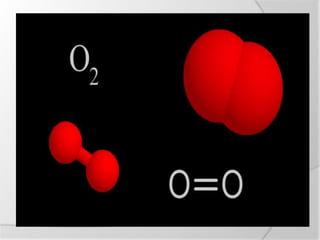
  • #7 Oxygen is a Diatomic molecule held together by covalent bonds.