PV curve and lung recruitmentDr Jean-Michel ArnalIntensive Care Unit. Hôpital Font PréToulon Francejean-michel@arnal.org
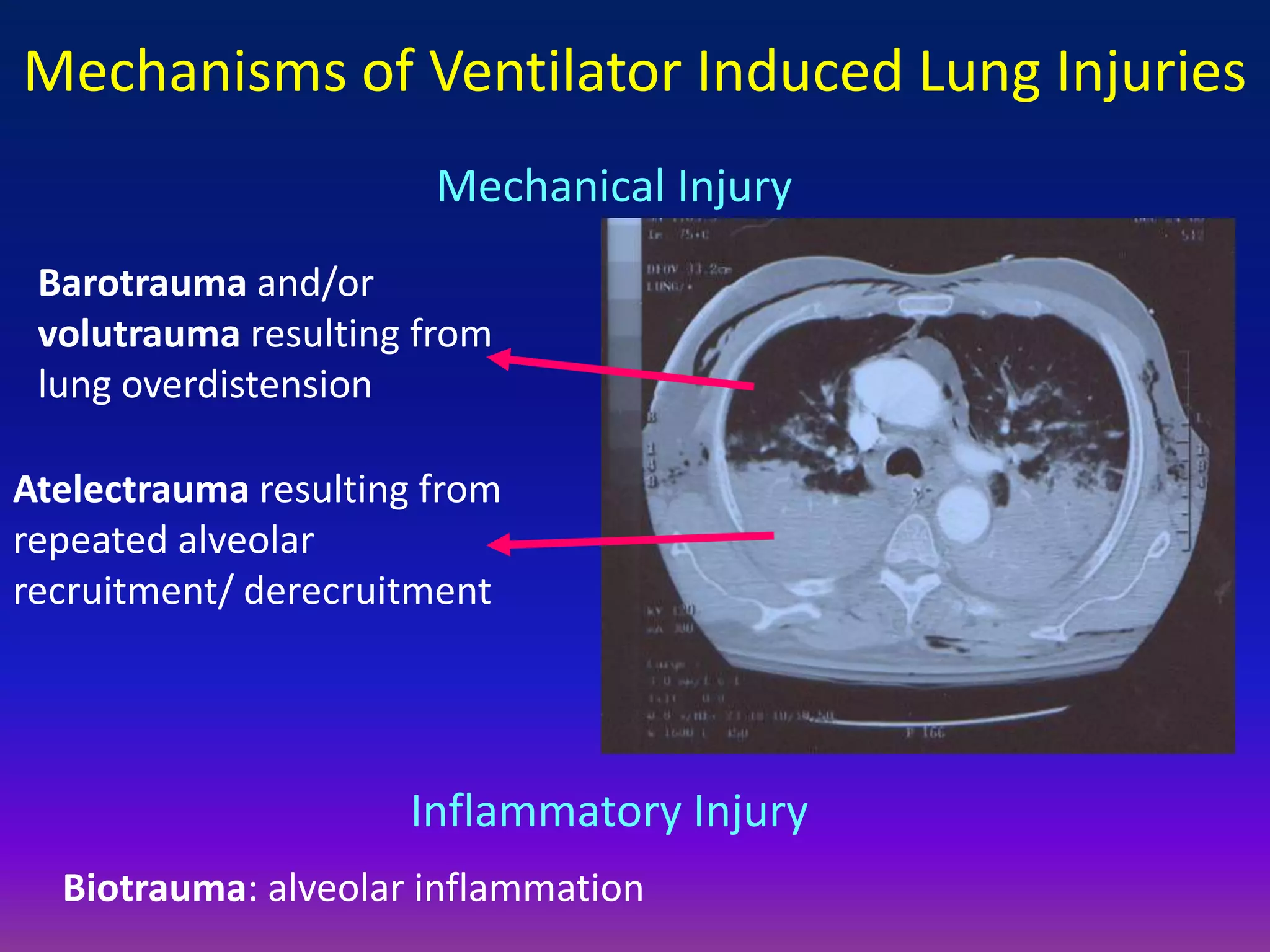
Mechanisms of Ventilator Induced Lung InjuriesMechanical InjuryBarotrauma and/or volutraumaresulting from lung overdistension Atelectraumaresulting from repeated alveolar recruitment/ derecruitmentInflammatory InjuryBiotrauma: alveolar inflammation
Prevention of VILIReduced tidal volume and airway pressure limitation strategyRecruitment strategy: recruitment maneuver         + PEEP to avoid derecruitment
What do we know about ARDS?Lower tidal volume and airway pressure limitation decreases mortalityNo effect of PEEP on mortalityARDS network. N Engl J Med 2000ALVEOLI. Brower. N Engl J Med 2004EXPRESS. Mercat JAMA 2008LOVS. Meade. JAMA 2008
Effect of PEEP on mortality in ARDSBriel. JAMA 2010
What do we know about PEEP?PEEP does not recruitCollapse / re-expansion occurs during tidal volumeRecruitment of previously collapsed lung with a recruitment maneuverPEEP may avoid collapse and derecruitment  in a lung previously expanded/recruited
RecruitmentCollapsed compliant airways/ alveoliFluid occlusion of non collapsed airways
Am J Respir Crit Care Med  2006
24 sur 26 patientsAm J Respir Crit Care Med  2006
n = 68
Recruitability depends onType of ARDSTime from the beginning of the diseasePressureChest wall compliance
Type of ARDSMechanism: extra pulmonary > pulmonaryLocalization: diffuse > lobarRiva.  Crit Care Med 2008Puybasset. Intensive Care Med 2000
Time from the beginning of the diseaseEarly phaseProtein rich edema fluids and polyneutrophilsLate phaseFibrosing alveolitis
Pressure24 on 26 patientsBorges. Am J Resp Crit Care Med 2006
Chest wall compliance
Chest wall complianceAirway pressure is a rough estimate of transpulmonary pressureTalmor. Crit Care Med 2006
Assessment of recruitabilityEarly in the management of ARDSWhen hemodynamic condition is controlledLow flow inflation and deflation PV curve from 0 to 40 cmH2O
Assessment of recruitability
Assessment of recruitabilityShape of the curveGrasso. AJRCCM 2005
Assessment of recruitabilityLinear complianceMaggiore. AJRCCM 2001
Assessment of recruitabilityLinear complianceCLIN = 37 mL/cmH2OCLIN = 83 mL/cmH2O
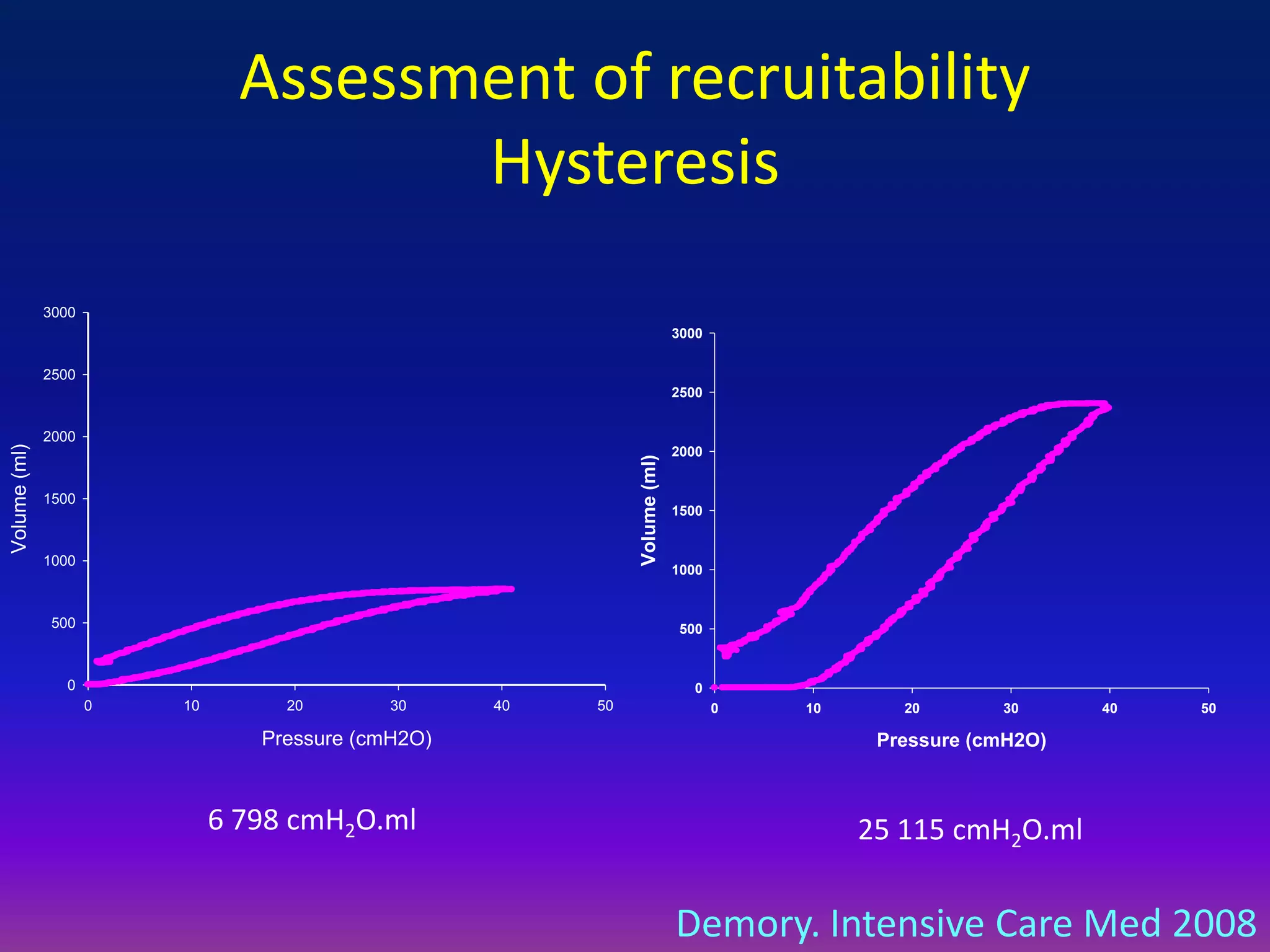
Assessment of recruitabilityHysteresisDemory.Intensive Care Med 2008
Assessment of recruitabilityHysteresis6 798 cmH2O.ml25 115 cmH2O.mlDemory. Intensive Care Med 2008
Assessment of recruitabilityHysteresis and volume difference at 20 cmH2Or2 = 0.97Demory.Intensive Care Med 2008
Decision at the bedside
Decision at the bedsideNo recruitment maneuverLow PEEP: 5 – 10 cmH2ORecruitment maneuverHigh PEEP: > 10 cmH2O
Definition of a recruitment maneuverUse of a transient increase in transpulmonary pressure to reopen previously collapsed or non aerated lung units.
Volume recruited depends onPrevious recruitmentTranspulmonary inflation pressureDurationPEEP setting after the RM
Pressure and timeAlbert.J Appl Physiol 2009
Time = 2,6  sRothen.BJA 199912 anaesthetized patients with healthy lung
Optimal duration of the recruitment maneuver = 2,3 ± 1,3  sn = 50Arnal. Intensive Care Med [submitted]
Optimal duration of the recruitment maneuver**Recruitment maneuvern = 50Arnal. Intensive Care Med [submitted]
Recruitment maneuver at the bedsideConditionsPassive patient: deep sedation ± paralysisStable hemodynamic condition: ΔPP < 13%Cuff over inflated to avoid leaksNo contraindications
Recruitment maneuver at the bedsideContraindicationsHigh intracranial pressureEmphysemaBronchopleural fistulaPregnancyRight heart failure
Recruitment maneuver at the bedsideSettings
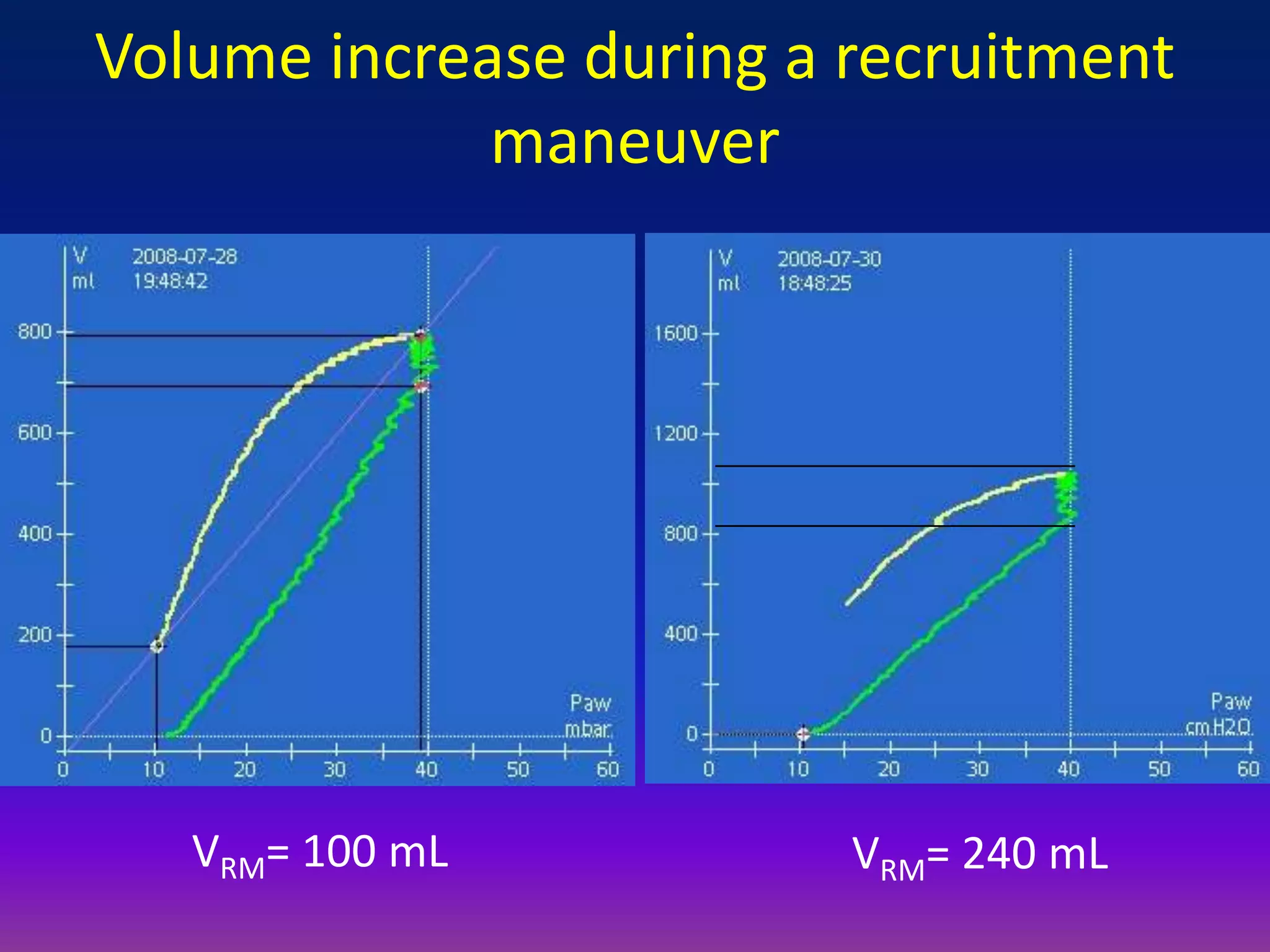
Volume increase during a recruitment maneuverVRM= 100 mLVRM= 240 mL
How to set PEEP after recruitment maneuver?Low inflection point on PV curveDeflection point on PV curveMaximum PEEP while limiting Pplat around 28 cmH2OPEEP setting guided by esophageal measurementPEEP setting guided by SpO2Hickling. AJRCCM 1998Hickling. AJRCCM 2001EXPRESS. Mercat JAMA 2008Talmor. N Engl J Med 2009Lapinski. Intensive Care Med 1999
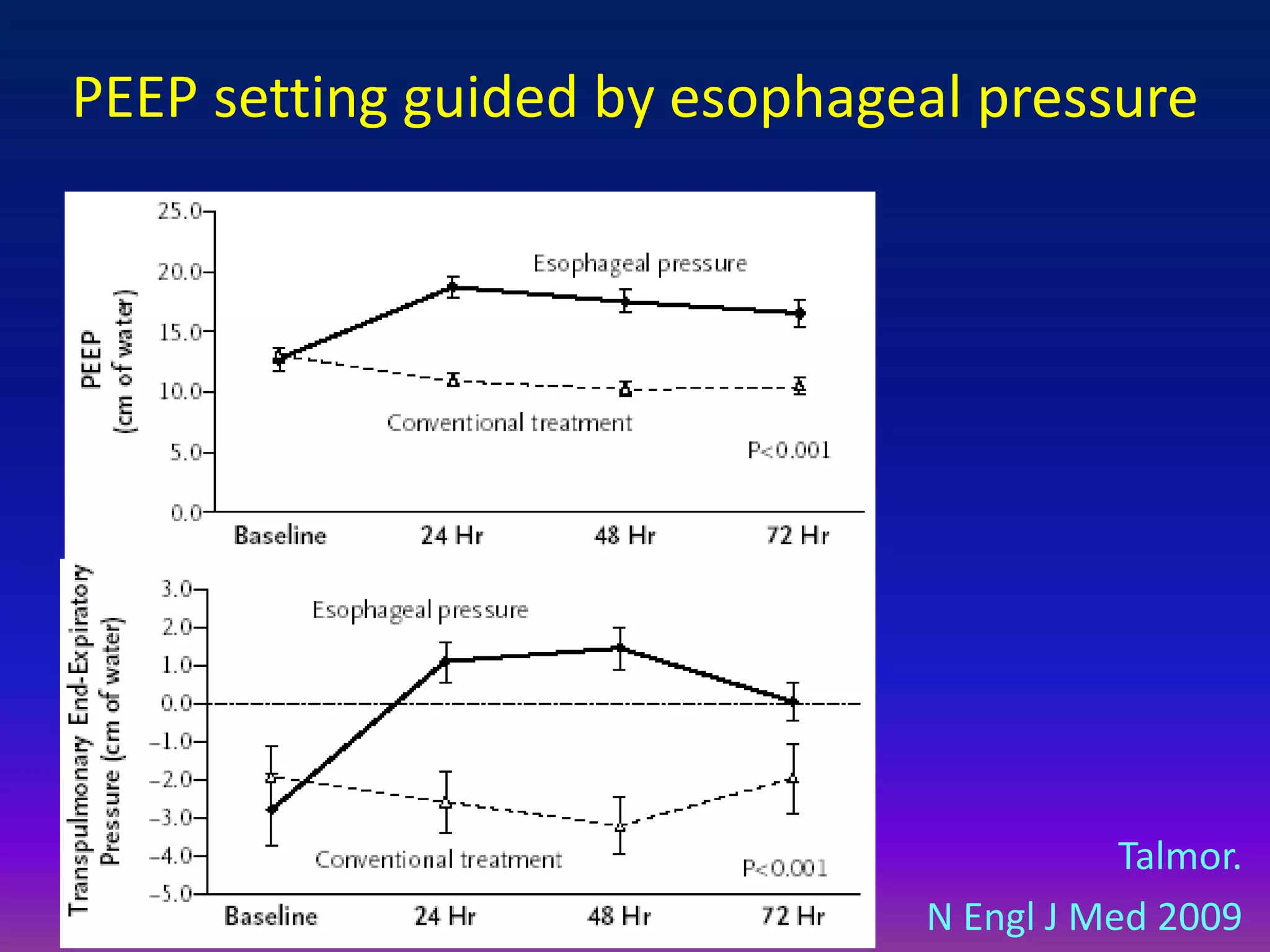
PEEP setting guided by esophageal pressureRandomized controlled trial61 ARDS patientsControl: ARDSnet PEEP/FiO2 tableIntervention: PEEP  end-expiration Ppulm 0 - 10 cmH2OTalmor. N Engl J Med 2009
PEEP setting guided by esophageal pressureVT = 400PEEP= 12FiO2= 60%Ppulmins= 3Ppulmexp= -6Talmor. N Engl J Med 2009
PEEP setting guided by esophageal pressureVT = 320PEEP= 24FiO2= 60%Ppulmins= 12Ppulmexp= 4Talmor. N Engl J Med 2009
PEEP setting guided by esophageal pressureTalmor. N Engl J Med 2009
PEEP setting guided by esophageal pressure65 years old woman, BMI = 32Community acquired pneumonia
PEEP setting guided by SpO2n = 14Lapinski. Intensive Care Med 1999
PEEP setting guided by SpO2Lapinski. Intensive Care Med 1999
Conclusions Recruitment strategy is part of protective ventilation in ARDS

PV Curve and Lung Recruitment