




Breathing Circuits
BY DR NEELUM HALEEMI
Contents
 Definition
 Basic Principle
 Essentials for all breathing system
 Components of breathing system
 Reservoir bag
 Breathing Tube
 APL Valve
 Classification of breathing system
 Mepleson Breathing system
 Circle system
Definition
 A breathing system is defined as an assembly of
components which connects the patient’s airway to
the anesthesia machine.
Basic Principle
All anesthesia breathing systems have 2 fundamental
purposes
1. Delivery of O2/Anesthetic gases
2. Elimination of CO2 (either by washout with adequate
fresh gas flow (FGF) or by soda lime absorption)
Essentials for all breathing systems
The breathing system must
1. Deliver the gases from the machine to the alveoli in the
same concentration as set and in the shortest possible
time.
2. Effectively eliminate carbon-dioxide.
3. Have minimal apparatus dead space.
4. Have low resistance.
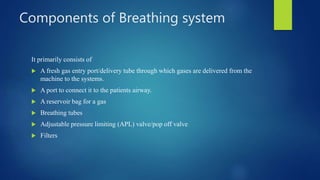
Components of Breathing system
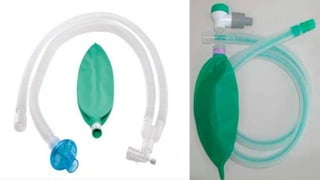
It primarily consists of
 A fresh gas entry port/delivery tube through which gases are delivered from the
machine to the systems.
 A port to connect it to the patients airway.
 A reservoir bag for a gas
 Breathing tubes
 Adjustable pressure limiting (APL) valve/pop off valve
 Filters
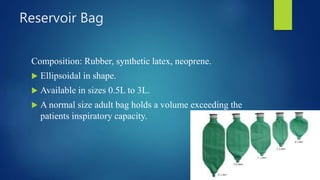
Reservoir Bag
Composition: Rubber, synthetic latex, neoprene.
 Ellipsoidal in shape.
 Available in sizes 0.5L to 3L.
 A normal size adult bag holds a volume exceeding the
patients inspiratory capacity.
Functions of reservoir bag
Functions :
 Reservoir
 Provides PIP (peak inspiratory pressure).
 It provides a means whereby ventilation may be assisted or controlled.
 It protects the patient from excessive pressure in the breathing system.
 It can serve through visual & tactile observation as a monitor of patients
spontaneous respiration.
Breathing Tube
 Made of rubber or plastic or silicone.
 It may be coaxial or side by side.
 Can be impregnated with silver to add antimicrobial effect.
 Length is variable.
 Internal diameter
Adults – 22mm.
Pediatric – 15mm.
 Internal volume : 400-500ml/metre.
 Distensibility : 0-5ml/metre/mmHg
 Resistance to gas flow : <1mm of H₂O/liter/min of flow
 Corrugations prevent kinking & increased flexibility.
Functions
 Act as reservoir in certain systems.
 They provide connection from 1 part of system to another.
 Backlash : seen during spontaneous breathing. Breathing tubes tend to
collapse during inspiration and bulge during expiration. This may cause
rebreathing.
 Wasted ventilation : seen during controlled breathing. The tubes tend to
bulge on positive pressure breath (inspiration) and return to resting
position on exhalation. This results in less volume entering the patient
the one leaving the reservoir bag or a ventilator
Adjusted Pressure Limiting Valve (APL
Valve)
 Also called as expiratory valve, pressure relief valve, pop off valve,
Heidbrink valve, Dump valve, Exhaust valve, Spill valve.
 Ex:- Spring loaded disc and Stem and seat type of valve
Spring Loaded Disc
 Most commonly used type.
 Has 3 ports –Inlet,
 The Patient & Exhaust Port.
 Exhaust port may be open to atmosphere or scavenging system
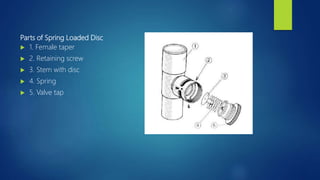
Parts of Spring Loaded Disc
 1. Female taper
 2. Retaining screw
 3. Stem with disc
 4. Spring
 5. Valve tap
Uses of APL valves in spontaneous &
controlled ventilation
Spontaneous
 Valve is kept fully opened.
 Partial closing will result in CPAP (Continuous Positive Airway Pressure.
 Pressure <1cm H₂O needed to open valve.
Controlled
 • Valve is partially left open.
Classification of Breathing Circuit
Dripps et al classified them as Insufflation , open , semi open , semi closed
and closed taking into account the presence or absence of
 Reservoir
 Rebreathing
 Co2 absorption
 Directional valves
Collins divided breathing system into four broad groups depending on
whether
 the ambient (atmosphere) air is allowed to enter the system -open or semi
open
 and/or the system allows gases from it to enter the ambient (atmosphere)-
semi open or semi closed.
Conway classified the breathing system functionally according to method
used for CO2 elimination
 Breathing system with CO2 absorber
 Breathing system without CO2 absorber
 Open - FGF from atmosphere alone (no circuit).
 Semi-open - Fresh gas from atmosphere, some apparatus e.g.
Schimmelbusch mask, hand cupping gas from T-piece +/- added O2 etc.
 Closed - Closed to atmosphere; FGF = uptake, CO2 removed.
 Semi-Closed - Closed to atmosphere; FGF > uptake; excess scavenged;
can be
 Semi-Closed Non-Rebreathing (typical ICU ventilator) or
 Semi-Closed Rebreathing (e.g.. typical circle circuit);CO2 removal by absorber
or FGF
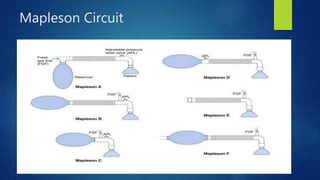
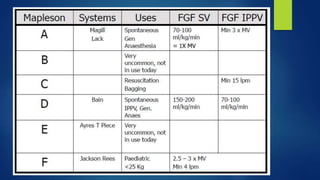
Mapleson Circuit
Mapleson A (Magill‘s) System
The Mapleson A or Magill system is good for spontaneous breathing patients,
so the fresh gas flow can be lower. However as the APL valve is close to the
patient, it is regarded by many as difficult to use.
 Inspiration - The valve closes and the patient inspires fresh gas from the
reservoir tube. Fresh gas flushes the dead space gas toward the patient.
 Expiration - The patient expires into the reservoir tube. Towards the end of
expiration, the bag fills and positive pressure opens the valve, allowing
expired gas to escape.
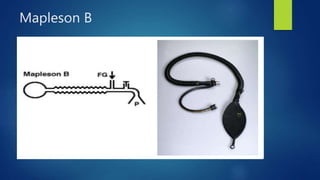
Mapleson B
 The expiratory valve opens when pressure in the circuit increases, and a
mixture of alveolar gas and fresh gas is discharged.
 During the next inspiration, a mixture of retained fresh gas and alveolar
gas is inhaled.
 Rebreathing is avoided with fresh gas flow rates of greater than twice the
minute ventilation for both spontaneous and controlled ventilation.
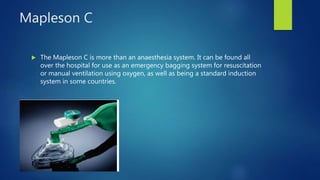
Mapleson C
 The Mapleson C is more than an anaesthesia system. It can be found all
over the hospital for use as an emergency bagging system for resuscitation
or manual ventilation using oxygen, as well as being a standard induction
system in some countries.
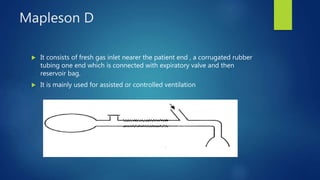
Mapleson D
 It consists of fresh gas inlet nearer the patient end , a corrugated rubber
tubing one end which is connected with expiratory valve and then
reservoir bag.
 It is mainly used for assisted or controlled ventilation
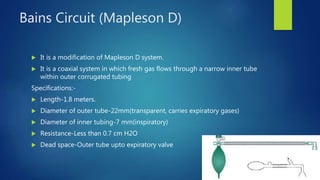
Bains Circuit (Mapleson D)
 It is a modification of Mapleson D system.
 It is a coaxial system in which fresh gas flows through a narrow inner tube
within outer corrugated tubing
Specifications:-
 Length-1.8 meters.
 Diameter of outer tube-22mm(transparent, carries expiratory gases)
 Diameter of inner tubing-7 mm(inspiratory)
 Resistance-Less than 0.7 cm H2O
 Dead space-Outer tube upto expiratory valve
Spontaneous ventilation
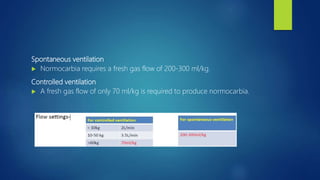
 Normocarbia requires a fresh gas flow of 200-300 ml/kg.
Controlled ventilation
 A fresh gas flow of only 70 ml/kg is required to produce normocarbia.
ADVANTAGES OF BAIN'S SYSTEM
 Light weight.
 Minimal drag on ETT as compared to Magill's circuit.
 Low resistance.
 As the outer tube is transparent, it is easy to detect any kinking or disconnection of the
inner fresh gas flow tube.
 It can be used both during assist and controlled ventilation .
 It is useful where patient is not accessible as in MRI suites.
 Exhaled gases do not accumulate near surgical field, so risk of flash fires is abolished.
 Easy for scavenging of gases as scavenging valve is at machine end of the circuit.
 Easy to connect to ventilator.
 There is some warming and humidification of the inspired fresh gas by the exhaled gas
present in outer tubing.
The Pethick Test for the Bain Circuit
A unique hazard of the use of the Bain circuit is occult disconnection or
kinking of the inner, fresh gas delivery hose. If this occurs, the entire
corrugated limb becomes dead space. This results in respiratory acidosis
which is unresponsive to increased minute ventilation. To perform the
Pethick test, use the following steps:
 Occlude the patient's end of the circuit (at the elbow).
 Close the APL valve.
 Fill the circuit, using the oxygen flush valve.
 Release the occlusion at the elbow and flush. A Venturi effect flattens the
reservoir bag if the inner tube is patent.
DISADVANTAGES OF BAIN'S SYSTEM
 Due to multiple connections in the circuit there is a risk of disconnections.
 Wrong assembling of the parts can lead to malfunction of the circuit.
 Theatre pollution occurs due to high fresh gas flow. However, it can be
prevented by using scavenging system.
 Increases the cost due to high fresh gas flows.
 There can be kinking of the inner tube blocking the fresh gas supply
leading to hypoxia
 There can be crack in the inner tube causing leakage
 It cannot be used in paediatric patients with weight less than 20 kg.
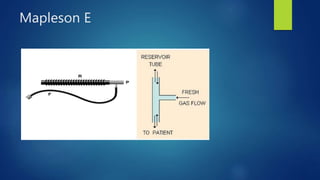
Mapleson E
 This system is suited in neonates and infants in whom expiratory valve
would produce significant resistance
ADVANTAGES
 Low resistance
 Low dead space
 No valves so easy to use
DISDADVANTAGES
 Barotrauma
 No feel of the bag
 No APL valve so no pressure buffering effect of the bag
 Difficult to scavenge
Mapleson F OR Jackson-Rees
Modification
Advantages of T-piece systems
 Compact
 Inexpensive
 No valves
 Minimal dead space
 Minimal resistance to breathing
 Economical for controlled ventilation
Disadvantages
 The bag may get twisted and impede breathing
 High gas flow requirement
 Uses
 Children under 20 kg weight
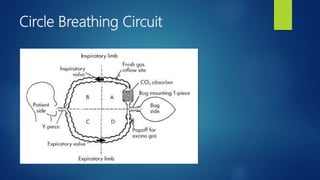
Circle Breathing Circuit
Circle system advantages and
disadvantages
Circle advantages:
 constant inspired concentrations
 conserve respiratory heat and humidity
 useful for all ages (may use down to 10 kg, about one year of age, or less
with a pediatric disposable circuit)
 useful for closed system or low-flow
 low resistance (less than tracheal tube, but more than a NRB circuit)
Circle disadvantages:
 increased dead space
 malfunctions of unidirectional valves
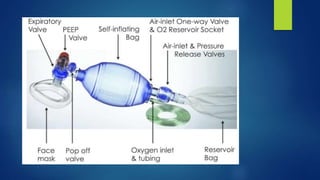
Resuscitation Breathing Systems
 Commonly used for emergency ventilation because of its ability to deliver
100% oxygen
 It contains a non rebreathing valve
 It has a high fresh gas flow inlet
 Rebreathing is prevented due to venting of exhaled gas to atmosphere
through exhalation port in the valve
 Bag is self refilled by flow through the fresh gas inlet
 Disadvantage is they require high fresh gas flow to achieve a high Fi02.
Thank You

Breathing circuit

  • 1.
  • 2.
    Contents  Definition  BasicPrinciple  Essentials for all breathing system  Components of breathing system  Reservoir bag  Breathing Tube  APL Valve  Classification of breathing system  Mepleson Breathing system  Circle system
  • 3.
    Definition  A breathingsystem is defined as an assembly of components which connects the patient’s airway to the anesthesia machine.
  • 4.
    Basic Principle All anesthesiabreathing systems have 2 fundamental purposes 1. Delivery of O2/Anesthetic gases 2. Elimination of CO2 (either by washout with adequate fresh gas flow (FGF) or by soda lime absorption)
  • 5.
    Essentials for allbreathing systems The breathing system must 1. Deliver the gases from the machine to the alveoli in the same concentration as set and in the shortest possible time. 2. Effectively eliminate carbon-dioxide. 3. Have minimal apparatus dead space. 4. Have low resistance.
  • 6.
    Components of Breathingsystem It primarily consists of  A fresh gas entry port/delivery tube through which gases are delivered from the machine to the systems.  A port to connect it to the patients airway.  A reservoir bag for a gas  Breathing tubes  Adjustable pressure limiting (APL) valve/pop off valve  Filters
  • 8.
    Reservoir Bag Composition: Rubber,synthetic latex, neoprene.  Ellipsoidal in shape.  Available in sizes 0.5L to 3L.  A normal size adult bag holds a volume exceeding the patients inspiratory capacity.
  • 9.
    Functions of reservoirbag Functions :  Reservoir  Provides PIP (peak inspiratory pressure).  It provides a means whereby ventilation may be assisted or controlled.  It protects the patient from excessive pressure in the breathing system.  It can serve through visual & tactile observation as a monitor of patients spontaneous respiration.
  • 10.
    Breathing Tube  Madeof rubber or plastic or silicone.  It may be coaxial or side by side.  Can be impregnated with silver to add antimicrobial effect.  Length is variable.  Internal diameter Adults – 22mm. Pediatric – 15mm.  Internal volume : 400-500ml/metre.  Distensibility : 0-5ml/metre/mmHg  Resistance to gas flow : <1mm of H₂O/liter/min of flow  Corrugations prevent kinking & increased flexibility.
  • 11.
    Functions  Act asreservoir in certain systems.  They provide connection from 1 part of system to another.
  • 12.
     Backlash :seen during spontaneous breathing. Breathing tubes tend to collapse during inspiration and bulge during expiration. This may cause rebreathing.  Wasted ventilation : seen during controlled breathing. The tubes tend to bulge on positive pressure breath (inspiration) and return to resting position on exhalation. This results in less volume entering the patient the one leaving the reservoir bag or a ventilator
  • 13.
    Adjusted Pressure LimitingValve (APL Valve)  Also called as expiratory valve, pressure relief valve, pop off valve, Heidbrink valve, Dump valve, Exhaust valve, Spill valve.  Ex:- Spring loaded disc and Stem and seat type of valve Spring Loaded Disc  Most commonly used type.  Has 3 ports –Inlet,  The Patient & Exhaust Port.  Exhaust port may be open to atmosphere or scavenging system
  • 14.
    Parts of SpringLoaded Disc  1. Female taper  2. Retaining screw  3. Stem with disc  4. Spring  5. Valve tap
  • 15.
    Uses of APLvalves in spontaneous & controlled ventilation Spontaneous  Valve is kept fully opened.  Partial closing will result in CPAP (Continuous Positive Airway Pressure.  Pressure <1cm H₂O needed to open valve. Controlled  • Valve is partially left open.
  • 16.
    Classification of BreathingCircuit Dripps et al classified them as Insufflation , open , semi open , semi closed and closed taking into account the presence or absence of  Reservoir  Rebreathing  Co2 absorption  Directional valves
  • 17.
    Collins divided breathingsystem into four broad groups depending on whether  the ambient (atmosphere) air is allowed to enter the system -open or semi open  and/or the system allows gases from it to enter the ambient (atmosphere)- semi open or semi closed.
  • 18.
    Conway classified thebreathing system functionally according to method used for CO2 elimination  Breathing system with CO2 absorber  Breathing system without CO2 absorber
  • 19.
     Open -FGF from atmosphere alone (no circuit).  Semi-open - Fresh gas from atmosphere, some apparatus e.g. Schimmelbusch mask, hand cupping gas from T-piece +/- added O2 etc.  Closed - Closed to atmosphere; FGF = uptake, CO2 removed.  Semi-Closed - Closed to atmosphere; FGF > uptake; excess scavenged; can be  Semi-Closed Non-Rebreathing (typical ICU ventilator) or  Semi-Closed Rebreathing (e.g.. typical circle circuit);CO2 removal by absorber or FGF
  • 20.
  • 22.
    Mapleson A (Magill‘s)System The Mapleson A or Magill system is good for spontaneous breathing patients, so the fresh gas flow can be lower. However as the APL valve is close to the patient, it is regarded by many as difficult to use.  Inspiration - The valve closes and the patient inspires fresh gas from the reservoir tube. Fresh gas flushes the dead space gas toward the patient.  Expiration - The patient expires into the reservoir tube. Towards the end of expiration, the bag fills and positive pressure opens the valve, allowing expired gas to escape.
  • 23.
  • 24.
     The expiratoryvalve opens when pressure in the circuit increases, and a mixture of alveolar gas and fresh gas is discharged.  During the next inspiration, a mixture of retained fresh gas and alveolar gas is inhaled.  Rebreathing is avoided with fresh gas flow rates of greater than twice the minute ventilation for both spontaneous and controlled ventilation.
  • 25.
    Mapleson C  TheMapleson C is more than an anaesthesia system. It can be found all over the hospital for use as an emergency bagging system for resuscitation or manual ventilation using oxygen, as well as being a standard induction system in some countries.
  • 26.
    Mapleson D  Itconsists of fresh gas inlet nearer the patient end , a corrugated rubber tubing one end which is connected with expiratory valve and then reservoir bag.  It is mainly used for assisted or controlled ventilation
  • 27.
    Bains Circuit (MaplesonD)  It is a modification of Mapleson D system.  It is a coaxial system in which fresh gas flows through a narrow inner tube within outer corrugated tubing Specifications:-  Length-1.8 meters.  Diameter of outer tube-22mm(transparent, carries expiratory gases)  Diameter of inner tubing-7 mm(inspiratory)  Resistance-Less than 0.7 cm H2O  Dead space-Outer tube upto expiratory valve
  • 28.
    Spontaneous ventilation  Normocarbiarequires a fresh gas flow of 200-300 ml/kg. Controlled ventilation  A fresh gas flow of only 70 ml/kg is required to produce normocarbia.
  • 29.
    ADVANTAGES OF BAIN'SSYSTEM  Light weight.  Minimal drag on ETT as compared to Magill's circuit.  Low resistance.  As the outer tube is transparent, it is easy to detect any kinking or disconnection of the inner fresh gas flow tube.  It can be used both during assist and controlled ventilation .  It is useful where patient is not accessible as in MRI suites.  Exhaled gases do not accumulate near surgical field, so risk of flash fires is abolished.  Easy for scavenging of gases as scavenging valve is at machine end of the circuit.  Easy to connect to ventilator.  There is some warming and humidification of the inspired fresh gas by the exhaled gas present in outer tubing.
  • 30.
    The Pethick Testfor the Bain Circuit A unique hazard of the use of the Bain circuit is occult disconnection or kinking of the inner, fresh gas delivery hose. If this occurs, the entire corrugated limb becomes dead space. This results in respiratory acidosis which is unresponsive to increased minute ventilation. To perform the Pethick test, use the following steps:  Occlude the patient's end of the circuit (at the elbow).  Close the APL valve.  Fill the circuit, using the oxygen flush valve.  Release the occlusion at the elbow and flush. A Venturi effect flattens the reservoir bag if the inner tube is patent.
  • 31.
    DISADVANTAGES OF BAIN'SSYSTEM  Due to multiple connections in the circuit there is a risk of disconnections.  Wrong assembling of the parts can lead to malfunction of the circuit.  Theatre pollution occurs due to high fresh gas flow. However, it can be prevented by using scavenging system.  Increases the cost due to high fresh gas flows.  There can be kinking of the inner tube blocking the fresh gas supply leading to hypoxia  There can be crack in the inner tube causing leakage  It cannot be used in paediatric patients with weight less than 20 kg.
  • 32.
  • 33.
     This systemis suited in neonates and infants in whom expiratory valve would produce significant resistance ADVANTAGES  Low resistance  Low dead space  No valves so easy to use DISDADVANTAGES  Barotrauma  No feel of the bag  No APL valve so no pressure buffering effect of the bag  Difficult to scavenge
  • 34.
    Mapleson F ORJackson-Rees Modification
  • 35.
    Advantages of T-piecesystems  Compact  Inexpensive  No valves  Minimal dead space  Minimal resistance to breathing  Economical for controlled ventilation Disadvantages  The bag may get twisted and impede breathing  High gas flow requirement  Uses  Children under 20 kg weight
  • 36.
  • 37.
    Circle system advantagesand disadvantages Circle advantages:  constant inspired concentrations  conserve respiratory heat and humidity  useful for all ages (may use down to 10 kg, about one year of age, or less with a pediatric disposable circuit)  useful for closed system or low-flow  low resistance (less than tracheal tube, but more than a NRB circuit) Circle disadvantages:  increased dead space  malfunctions of unidirectional valves
  • 38.
    Resuscitation Breathing Systems Commonly used for emergency ventilation because of its ability to deliver 100% oxygen  It contains a non rebreathing valve  It has a high fresh gas flow inlet  Rebreathing is prevented due to venting of exhaled gas to atmosphere through exhalation port in the valve  Bag is self refilled by flow through the fresh gas inlet  Disadvantage is they require high fresh gas flow to achieve a high Fi02.
  • 40.