Advancement in Supraglottic
Airways
Speaker- Dr Mohammed zahid yergatti,
DA(DNB)
Moderator- Dr Madhavi singh, MD
Definition
• These are airway devices that facilitate
oxygenation and ventilation without
endotracheal intubation. Some also refer
them as extraglottic
Classification
Based on sealing mechanism
• Perilaryngeal sealers-
• All LMAs
• I-Gel
• Air- Q Intubating laryngeal airway
• Pharyngeal sealers-
• Combitube
• Streamlined liner of pharynx airway(SLIPA)
• Laryngeal tube
• Both
• Cobra perilaryngeal airway(cobra PLA)
Based on evolution
• First generation devices- simple airway tubes
• Classic LMA
• Flexible LMA
• CobraPLA
• Second generation- with addition of drainage
tubes
• Proseal LMA
• I-Gel
• LMA supreme
• SLIPA
• Third generation- cuffless, two drain tubes, small
bowl
• Baska mask.
Timeline- few out of 17 variants
• Classic laryngeal mask airway(cLMA)- 1988
• Esophagael tracheal combitube- 1988
• LMA fastrach- 1995
• LMA Proseal- 2000
• Laryngeal tube- 2003
• I-Gel- 2003
• Air-Q- 2004
• LMA supreme- 2007
• Baska mask ~2012
LMA- laryngeal mask airway
• Dr archie brain is first credited with invention and
development of LMA
• He first used a goldmans mask and attached it a obliquely cut
endotracheal tube.
• It was introduced in 1988.
Classic LMA
Main shortcomings-
• Bending of tip, if we keep pushing during insertion it can
push the epiglottis over larynx and cause obstruction of
airway
• Rotation and dislodgment of the bowl,
• lesser sealing pressure, more risk of aspiration, inaccurate
placement
Esophageal- tracheal combitube
• PVC double lumen with two inflatable cuffs
• Ventilation either through tracheal or
oesophageal port
• Distal ballon either seals trachea or
oesophageous.
advantages
• Requires minimal training and minimal mouth opening
• Useful in non fasted pts during emergency
disadvantages
• Only adult and small adult sizes available
• Oesophagel trauma
• Problems in maintaing seal with movement.
Porseal LMA
Developed basically for more better sealing pressure and
acsess to oesophaeous.
Modifications over classic LMA-
Larger and deeper bowl with no grille
Darinage tube running parallel to airway
Larger deeper bowl and dorsal exension of cuff
Advantages over classic LMA
• Gastric tube port- for gastric access, checking
correct positioning, bougie guided insertion.
• Dorsal cuff- better seal and airway pressure-
not present in 2 ½ & below.
– with drain tube occluded it prtected airway to
soiling pressures of 68cm of H20*
• Bite block
• Strap/Hinge for hooking the
bougie/introducer.
*Evans NR, Gardner SV, James MF. ProSeal laryngeal mask protects against
aspiration of fluid in the pharynx. Br J Anaesth 2002; 88: 584–7
Disadvantages over cLMA
• More incidence of trauma, equivocal
incidence of sore throat*
• Slightly longer insertion time compared to
cLMA.
• 20% more airway resistance than cllasic
airway.
*Brimacombe J, Keller C, Fullekrug B, et al. A multicenter study comparing the ProSeal™
and Classic™laryngeal mask airway in anesthetized, nonparalyzed patients.
Anesthesiology 2002; 96: 289–95.
Comparison of PLMA with cLMA
Performance of proseal
Laryngeal tube
• Multi use , single lumen
• Two low pressure cuffs- distal and proximal
• Two anterior oval ventilating ports between the cuffs.
advantages
Easy insertion
Minimal mouth opening required.
High ventilation pressure can be used
Can be used to intubate trachea
disadvantages
Airway obstruction- narrowing
Trauma to pharynx
Cuff rupture
I-Geltm
• Single-use non-inflatable mask made of a gel-like
thermoplastic elastomer.
• Epiglottic rest to prevent epiglottic downfolding
• Gastric access channel (not present in size 1)
• Built-in bite block
• Buccal cavity stabiliser
Lisa Sohn • Razan Nour • Narasimhan Jagannathan-Update on Airway Devices
Curr Anesthesiol Rep (2015) 5:147–155 DOI 10.1007/s40140-015-0100-2
• Advantages-
– It has better anatomical fit and improves its
airway seal as it approaches body temperature.
– Less risk for injuries related to cuff hyperinflation
and decreases the time for successful insertion.
– i-gel in meta analysis has been found to be having
greater airway leak pressures and superior
fibreoptic views compared to other SGAs.
– Wide lumen allows for airway rescue and assisted
intubation.
– Effective in prone position rescue.
video
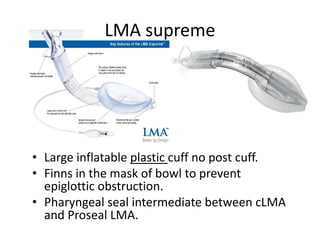
• Large inflatable plastic cuff no post cuff.
• Finns in the mask of bowl to prevent
epiglottic obstruction.
• Pharyngeal seal intermediate between cLMA
and Proseal LMA.
LMA supreme
Advantages
• Reinforced tip- less chance of folding.
• Anatomic curve facilitates insertion
• Oval cross section for improved stability.
disadvantages
• Drain tube runs through the middle of airway
dividing it into narrow two lumens- limiting its
use for intubation, airway inspection.
• PVC is more harder and more traumatic than
silicone.
SLIPA-Streamlined Liner of the Pharynx Airway
• Plastic uncuffed disposable
• Hollow boot shaped distal part
• Anatomically fits pharynx
– Toe rests in oseophageal entrance
– Bridge fits in pyriform fossa
– Heel – anchors to softpalate
– Large size prevents aspiration of regurgitated fluid
advantges
• Greater airway sealing pressue for PPV
• cuffless
disadvantages
• More trauma
• Prone to airway variability as occupies pace
upto softpalate.
Baska mask
• 3rd generation supraglottic irway
• Smaller bowel compared to other LMAs- less
risk of including oesophageal opening
• Adjustable tab in shaft to increase angulation
to allow easy negotiation of oropharyngeal
curve
• Double gastric channel- one channel is open
to air so less chance of oesophageal wall
impinging the gastric opening during suction
• Bigger distal gastric channel opening so more
larger particulate can be sucked out
• During extubation – if pt bites the bowl the
gastric channels can be opened for airway.
• Cuffless- membranous bowl which inflates
during each positive pressure.
video
• The mean insertion time was lesser than
PLMA*
• It had higher sealing pressures than PLMA-
29.98+- 8.51 vs 24.5+-6.19 cm of H2O*
*Sharifa Ali Sabeeh Al-Rawahi et al- ORIGINAL ARTICLE – A comparative analysis of the
Baska® Mask vs. Proseal® laryngeal mask for general anesthesia with IPPV-
Anaesthesia, Pain & Intensive Care-ISSN 1607-8322, ISSN (Online) 2220-5799
Role in difficult airway algorithm
• Clear recommendation by Difficult airway society
2015 guidelines in both anticipated and
unanticipaed difficult airway.
• Specially important in can’t intubate, can’t
ventilate situations
• Laryngeal mask exchange recommended in at
risk extubations*
*DAS 2015 guidelines
Airway rescue with proseal LMA case
reports
Airway rescue with i-gel
• i-gel is established in emergency airway
control. Case reports are present where it has
been used for airway rescue when cLMA and
PLMA have failed*
• I-gel has been used for airway rescue in prone
position**
*Anaesthesia, 2008, 63, pages 1010–1026- Use of an i-gelTM for airway rescue
**The use of a laryngeal mask airway for emergent airway management in a prone child.
Dingeman RS, Goumnerova LC, Goobie SM Anesth Analg. 2005 Mar; 100(3):670-1
Supraglottic airway guided ET intubation
and fibre optic laryngoscopy
• LMA fastrach
• LMA proseal
• LMA supreme
• I-gel
• Air q
• Ambu aura
• Slipa
Comparing fibreoptic views through
supraglottic airways*
(1) full view of glottis (2) vocal cords, arytenoids, and inferior surface of epiglottis visible
(3) only superior surface of epiglottis visible (4) no part of epiglottis or larynx visible
*BioMed Research International Volume 2015 (2015), Article ID 201898, 8 pages
http://dx.doi.org/10.1155/2015/201898Comparison of Five 2nd-Generation Supraglottic Airway
Devices for Airway Management Performed by Novice Military Operators
DAS guidelines for fibreoptic intubation with
Supraglottic airway
video
Supraglottic airways

Supraglottic airways

  • 1.
    Advancement in Supraglottic Airways Speaker-Dr Mohammed zahid yergatti, DA(DNB) Moderator- Dr Madhavi singh, MD
  • 2.
    Definition • These areairway devices that facilitate oxygenation and ventilation without endotracheal intubation. Some also refer them as extraglottic
  • 3.
    Classification Based on sealingmechanism • Perilaryngeal sealers- • All LMAs • I-Gel • Air- Q Intubating laryngeal airway • Pharyngeal sealers- • Combitube • Streamlined liner of pharynx airway(SLIPA) • Laryngeal tube • Both • Cobra perilaryngeal airway(cobra PLA)
  • 4.
    Based on evolution •First generation devices- simple airway tubes • Classic LMA • Flexible LMA • CobraPLA • Second generation- with addition of drainage tubes • Proseal LMA • I-Gel • LMA supreme • SLIPA • Third generation- cuffless, two drain tubes, small bowl • Baska mask.
  • 5.
    Timeline- few outof 17 variants • Classic laryngeal mask airway(cLMA)- 1988 • Esophagael tracheal combitube- 1988 • LMA fastrach- 1995 • LMA Proseal- 2000 • Laryngeal tube- 2003 • I-Gel- 2003 • Air-Q- 2004 • LMA supreme- 2007 • Baska mask ~2012
  • 6.
    LMA- laryngeal maskairway • Dr archie brain is first credited with invention and development of LMA • He first used a goldmans mask and attached it a obliquely cut endotracheal tube. • It was introduced in 1988.
  • 7.
    Classic LMA Main shortcomings- •Bending of tip, if we keep pushing during insertion it can push the epiglottis over larynx and cause obstruction of airway • Rotation and dislodgment of the bowl, • lesser sealing pressure, more risk of aspiration, inaccurate placement
  • 8.
    Esophageal- tracheal combitube •PVC double lumen with two inflatable cuffs
  • 9.
    • Ventilation eitherthrough tracheal or oesophageal port • Distal ballon either seals trachea or oesophageous.
  • 10.
    advantages • Requires minimaltraining and minimal mouth opening • Useful in non fasted pts during emergency disadvantages • Only adult and small adult sizes available • Oesophagel trauma • Problems in maintaing seal with movement.
  • 11.
    Porseal LMA Developed basicallyfor more better sealing pressure and acsess to oesophaeous. Modifications over classic LMA- Larger and deeper bowl with no grille Darinage tube running parallel to airway Larger deeper bowl and dorsal exension of cuff
  • 12.
    Advantages over classicLMA • Gastric tube port- for gastric access, checking correct positioning, bougie guided insertion. • Dorsal cuff- better seal and airway pressure- not present in 2 ½ & below. – with drain tube occluded it prtected airway to soiling pressures of 68cm of H20* • Bite block • Strap/Hinge for hooking the bougie/introducer. *Evans NR, Gardner SV, James MF. ProSeal laryngeal mask protects against aspiration of fluid in the pharynx. Br J Anaesth 2002; 88: 584–7
  • 13.
    Disadvantages over cLMA •More incidence of trauma, equivocal incidence of sore throat* • Slightly longer insertion time compared to cLMA. • 20% more airway resistance than cllasic airway. *Brimacombe J, Keller C, Fullekrug B, et al. A multicenter study comparing the ProSeal™ and Classic™laryngeal mask airway in anesthetized, nonparalyzed patients. Anesthesiology 2002; 96: 289–95.
  • 14.
  • 15.
  • 16.
    Laryngeal tube • Multiuse , single lumen • Two low pressure cuffs- distal and proximal • Two anterior oval ventilating ports between the cuffs.
  • 17.
    advantages Easy insertion Minimal mouthopening required. High ventilation pressure can be used Can be used to intubate trachea disadvantages Airway obstruction- narrowing Trauma to pharynx Cuff rupture
  • 18.
    I-Geltm • Single-use non-inflatablemask made of a gel-like thermoplastic elastomer. • Epiglottic rest to prevent epiglottic downfolding
  • 19.
    • Gastric accesschannel (not present in size 1) • Built-in bite block • Buccal cavity stabiliser
  • 20.
    Lisa Sohn •Razan Nour • Narasimhan Jagannathan-Update on Airway Devices Curr Anesthesiol Rep (2015) 5:147–155 DOI 10.1007/s40140-015-0100-2 • Advantages- – It has better anatomical fit and improves its airway seal as it approaches body temperature. – Less risk for injuries related to cuff hyperinflation and decreases the time for successful insertion. – i-gel in meta analysis has been found to be having greater airway leak pressures and superior fibreoptic views compared to other SGAs. – Wide lumen allows for airway rescue and assisted intubation. – Effective in prone position rescue.
  • 21.
  • 22.
    • Large inflatableplastic cuff no post cuff. • Finns in the mask of bowl to prevent epiglottic obstruction. • Pharyngeal seal intermediate between cLMA and Proseal LMA. LMA supreme
  • 23.
    Advantages • Reinforced tip-less chance of folding. • Anatomic curve facilitates insertion • Oval cross section for improved stability. disadvantages • Drain tube runs through the middle of airway dividing it into narrow two lumens- limiting its use for intubation, airway inspection. • PVC is more harder and more traumatic than silicone.
  • 24.
    SLIPA-Streamlined Liner ofthe Pharynx Airway • Plastic uncuffed disposable • Hollow boot shaped distal part • Anatomically fits pharynx – Toe rests in oseophageal entrance – Bridge fits in pyriform fossa – Heel – anchors to softpalate – Large size prevents aspiration of regurgitated fluid
  • 25.
    advantges • Greater airwaysealing pressue for PPV • cuffless disadvantages • More trauma • Prone to airway variability as occupies pace upto softpalate.
  • 26.
    Baska mask • 3rdgeneration supraglottic irway • Smaller bowel compared to other LMAs- less risk of including oesophageal opening • Adjustable tab in shaft to increase angulation to allow easy negotiation of oropharyngeal curve • Double gastric channel- one channel is open to air so less chance of oesophageal wall impinging the gastric opening during suction
  • 29.
    • Bigger distalgastric channel opening so more larger particulate can be sucked out • During extubation – if pt bites the bowl the gastric channels can be opened for airway. • Cuffless- membranous bowl which inflates during each positive pressure.
  • 30.
  • 31.
    • The meaninsertion time was lesser than PLMA* • It had higher sealing pressures than PLMA- 29.98+- 8.51 vs 24.5+-6.19 cm of H2O* *Sharifa Ali Sabeeh Al-Rawahi et al- ORIGINAL ARTICLE – A comparative analysis of the Baska® Mask vs. Proseal® laryngeal mask for general anesthesia with IPPV- Anaesthesia, Pain & Intensive Care-ISSN 1607-8322, ISSN (Online) 2220-5799
  • 32.
    Role in difficultairway algorithm • Clear recommendation by Difficult airway society 2015 guidelines in both anticipated and unanticipaed difficult airway.
  • 33.
    • Specially importantin can’t intubate, can’t ventilate situations • Laryngeal mask exchange recommended in at risk extubations* *DAS 2015 guidelines
  • 34.
    Airway rescue withproseal LMA case reports
  • 35.
    Airway rescue withi-gel • i-gel is established in emergency airway control. Case reports are present where it has been used for airway rescue when cLMA and PLMA have failed* • I-gel has been used for airway rescue in prone position** *Anaesthesia, 2008, 63, pages 1010–1026- Use of an i-gelTM for airway rescue **The use of a laryngeal mask airway for emergent airway management in a prone child. Dingeman RS, Goumnerova LC, Goobie SM Anesth Analg. 2005 Mar; 100(3):670-1
  • 36.
    Supraglottic airway guidedET intubation and fibre optic laryngoscopy • LMA fastrach • LMA proseal • LMA supreme • I-gel • Air q • Ambu aura • Slipa
  • 37.
    Comparing fibreoptic viewsthrough supraglottic airways* (1) full view of glottis (2) vocal cords, arytenoids, and inferior surface of epiglottis visible (3) only superior surface of epiglottis visible (4) no part of epiglottis or larynx visible *BioMed Research International Volume 2015 (2015), Article ID 201898, 8 pages http://dx.doi.org/10.1155/2015/201898Comparison of Five 2nd-Generation Supraglottic Airway Devices for Airway Management Performed by Novice Military Operators
  • 38.
    DAS guidelines forfibreoptic intubation with Supraglottic airway video