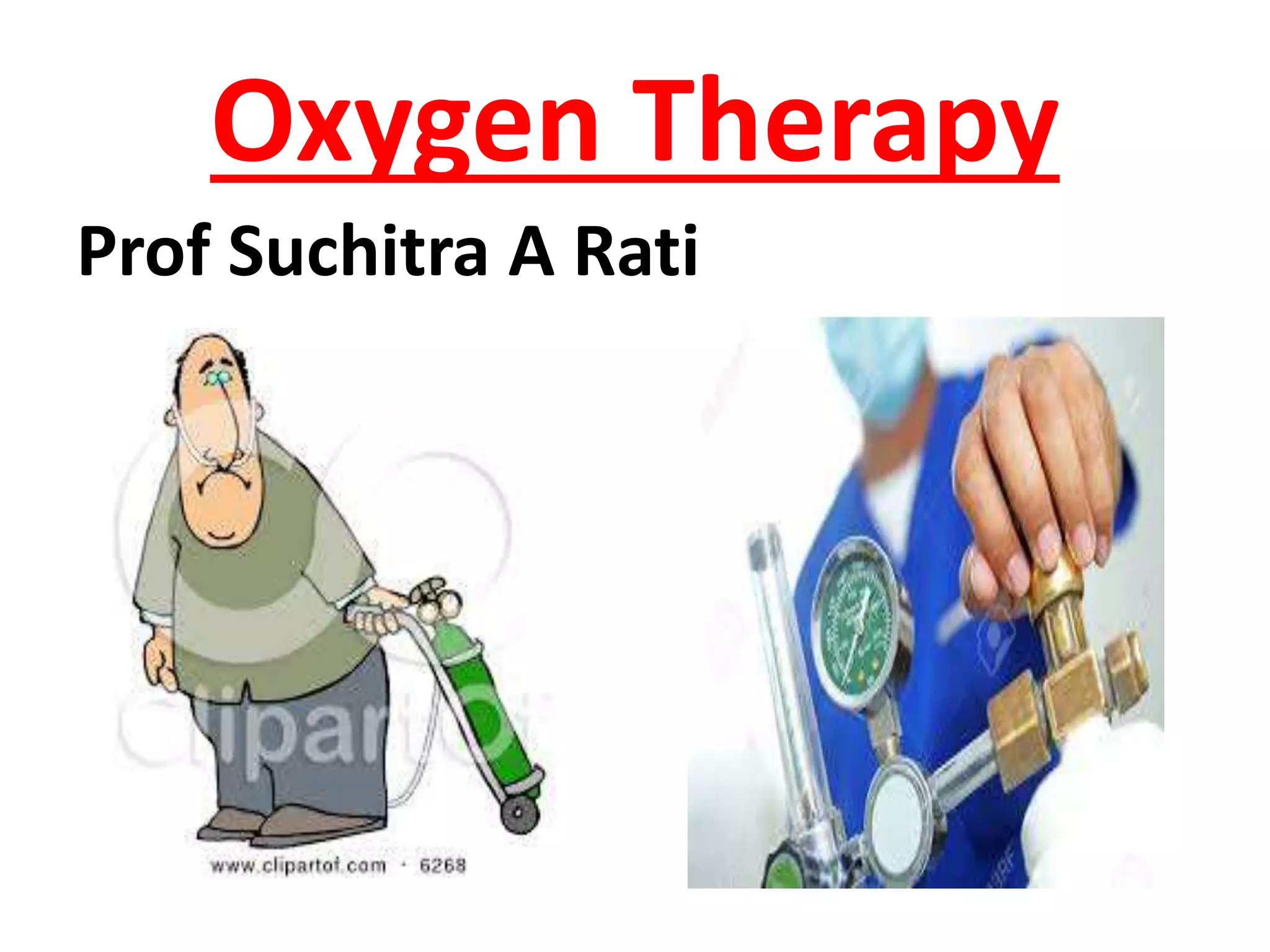
Oxygen Therapy
Prof Suchitra A Rati
Out line
 Definition of the oxygen therapy
 Types of oxygen therapy
 purposes of using the oxygen therapy
 Administration of oxygen therapy
 Complication of oxygen therapy
Learning objectives:
 Define the oxygen therapy
 Discuss the type of oxygen therapy
 List the purpose of using the oxygen therapy
 Explain the procedure
 Demonstrate the procedure
 List Complication of oxygen therapy
Terminology
• Fio2-Fraction /percentage of inspired oxygen
• ABGs - Aterial Blood Gas measurements- test measures the acidity (pH)
and the levels of oxygen and carbon dioxide in the blood from an artery. This
test is used to check how well your lungs are able to move oxygen into the
blood and remove carbon dioxide from the blood.
An ABG measures
Partial pressure of oxygen (PaO2).
 80 -100 mmHg - children/adults
 50 - 80 mmHg - neonates
Partial pressure of carbon dioxide (PaCO2).
 35 - 45 mmHg children/adults
pH.
 between 7.35 and 7.45. A pH of less than 7.0 is called acid and a pH greater
than 7.0 is called basic (alkaline). So blood is slightly basic.
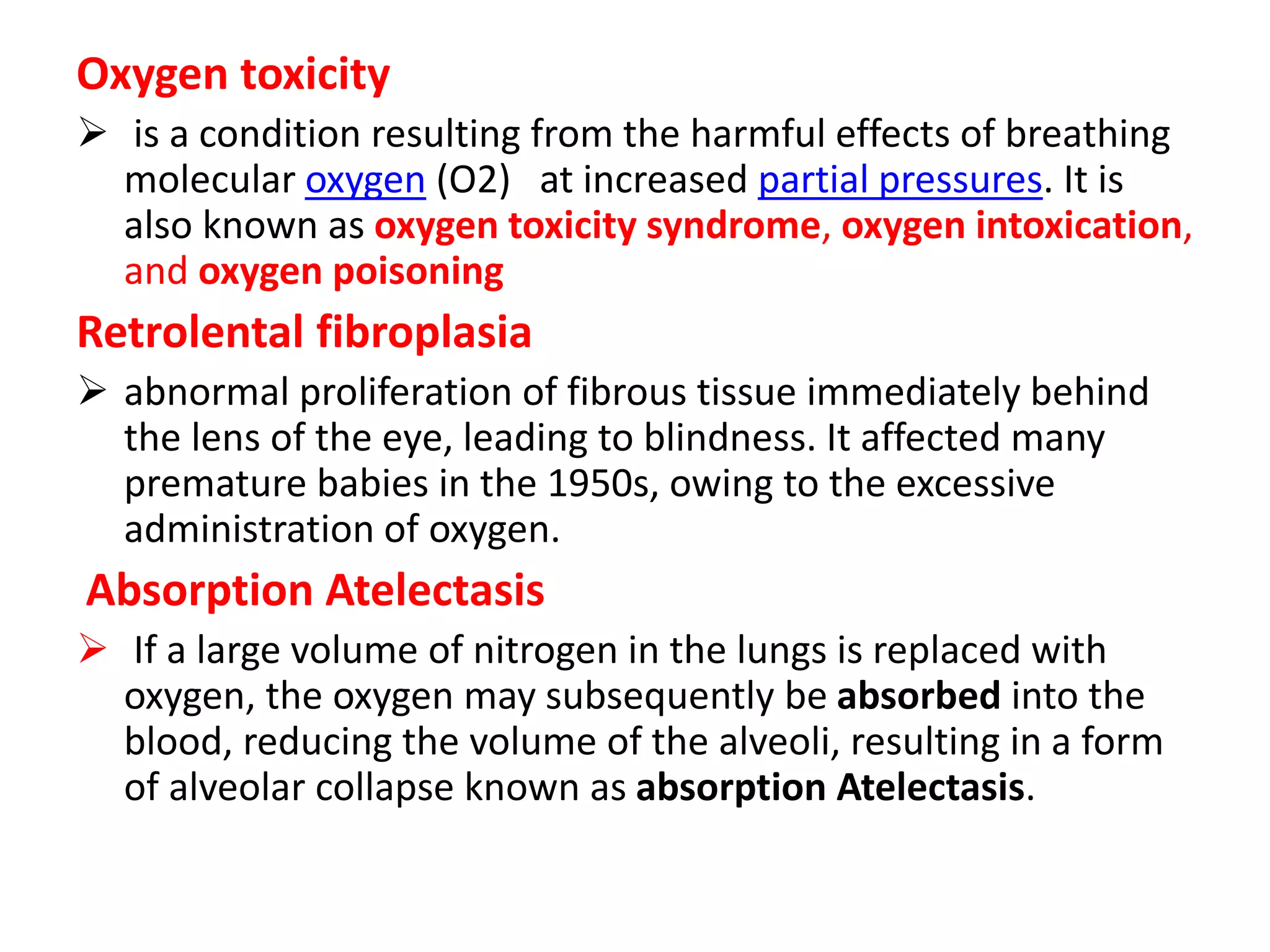
Oxygen toxicity
 is a condition resulting from the harmful effects of breathing
molecular oxygen (O2) at increased partial pressures. It is
also known as oxygen toxicity syndrome, oxygen intoxication,
and oxygen poisoning
Retrolental fibroplasia
 abnormal proliferation of fibrous tissue immediately behind
the lens of the eye, leading to blindness. It affected many
premature babies in the 1950s, owing to the excessive
administration of oxygen.
Absorption Atelectasis
 If a large volume of nitrogen in the lungs is replaced with
oxygen, the oxygen may subsequently be absorbed into the
blood, reducing the volume of the alveoli, resulting in a form
of alveolar collapse known as absorption Atelectasis.
Oxygen
Oxygen is a colorless, odorless, tasteless gas that
is essential for the body to function properly and
to survive.
The air that we breathe contain approximately
21% oxygen
The heart relies on oxygen to pump blood. If not
enough oxygen is circulating in the blood, it’s
difficult for the tissues of the heart to keep
pumping.
Supplemental oxygen is used to treat medical
conditions in which the tissues of the body do
not have enough oxygen.
Oxygen therapy
• Oxygen therapy is the administration of
oxygen at a concentration of pressure greater
than that found in the environmental
atmosphere
• It is the administration of oxygen as a
medical intervention, which can be for a
variety of purposes in both chronic and acute
patient care
• Oxygen therapy is a key treatment in
respiratory care
Oxygen therapy
• Oxygen is often prescribed for people to prevent
hypoxia because of the following conditions:
1.difficulty ventilating all areas of their lungs
2.Impaired gas exchange
3.Heart failure
• Prescribed by the physician who specifies the
following:
1.Concentration
2. liter per minute
3.Method of delivery
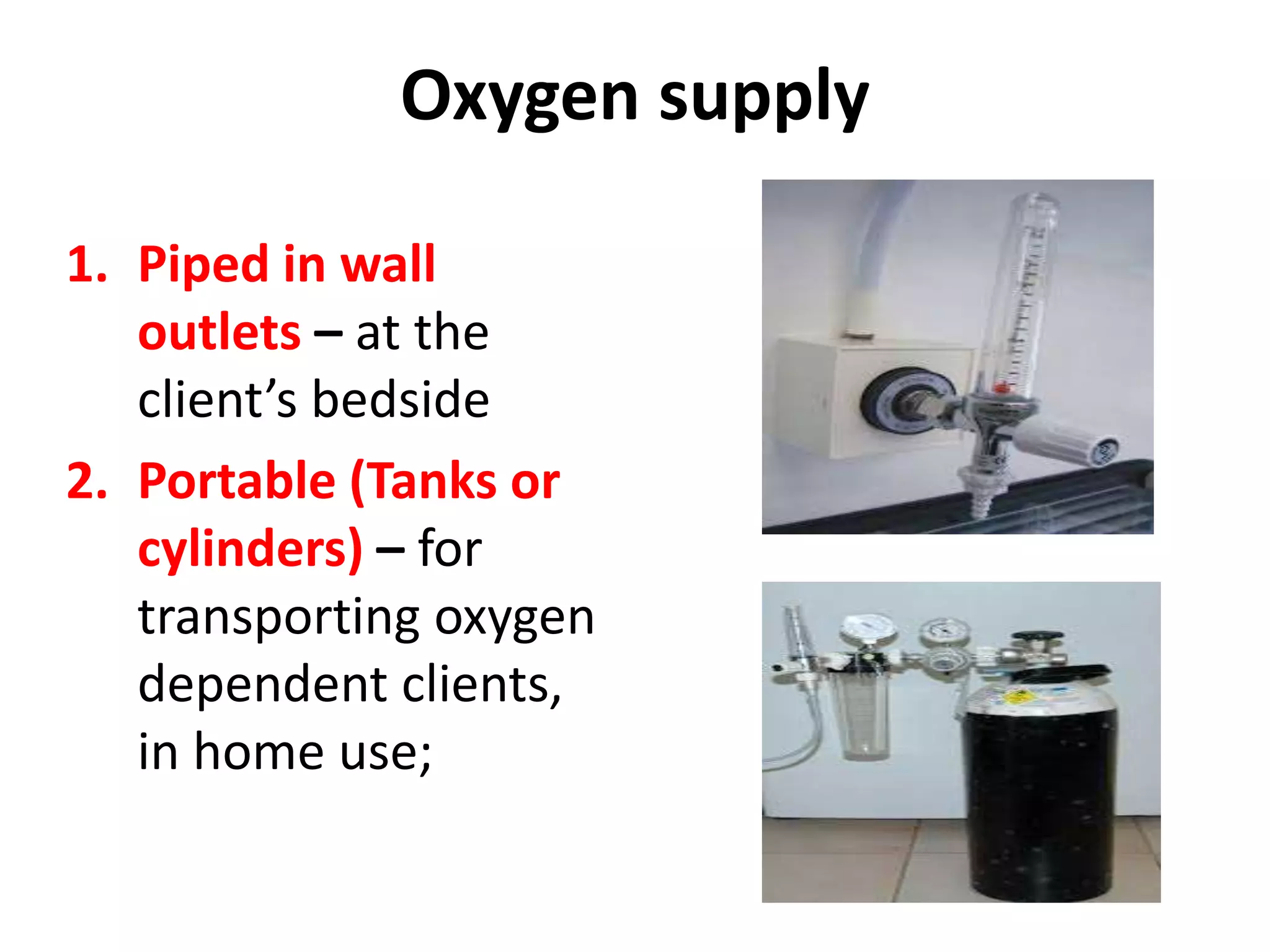
Oxygen supply
1. Piped in wall
outlets – at the
client’s bedside
2. Portable (Tanks or
cylinders) – for
transporting oxygen
dependent clients,
in home use;
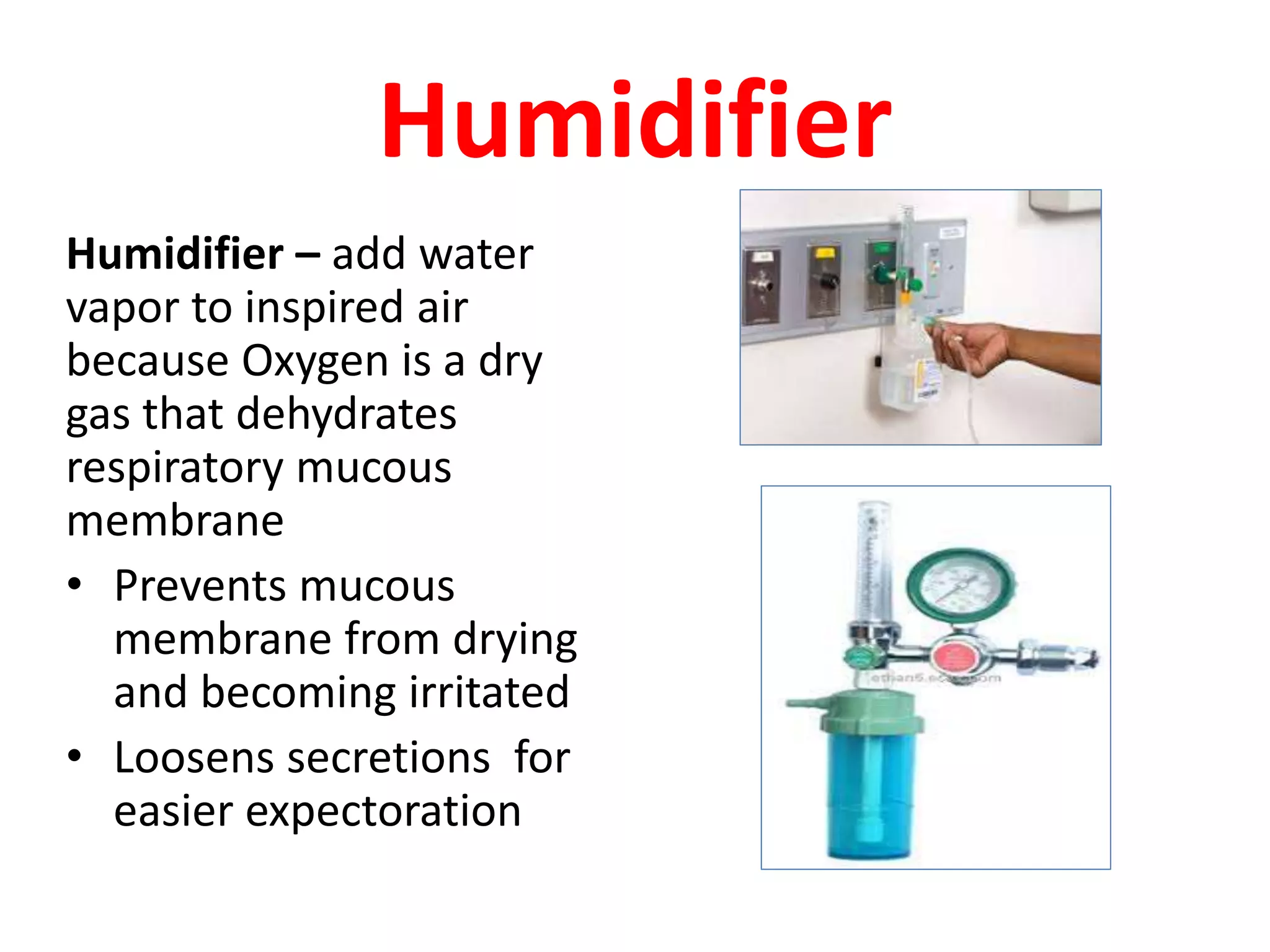
Humidifier
Humidifier – add water
vapor to inspired air
because Oxygen is a dry
gas that dehydrates
respiratory mucous
membrane
• Prevents mucous
membrane from drying
and becoming irritated
• Loosens secretions for
easier expectoration
Safety Precautions for Oxygen
Administration
 Oxygen is a highly combustible gas.
 Oxygen is a therapeutic gas and must be prescribed and
adjusted only with a health care provider’s order
 Keep oxygen deliver systems 10 feet away from any
open flames.
 Keep cylinder always upright position, while
administering secure them to avoid falling.
 Check the cylinder for sufficient to administer client
 Teach family members to smoke only outside away
from the client and oxygen equipment.
 Set up “No Smoking: and “oxygen in Use” signs at the
site of administration and at the door,[ even in home]
according to agency policy.
Safety Precautions for Oxygen
Administration
 Instruct the client and visitors about the hazard of
smoking with oxygen in use
 Provide cotton gown and blankets . Synthetics and
wool may generate sparks of static electricity
• Avoid the use of volatile, flammable materials such as
oils, greases, alcohol, ether and acetone near clients
receiving oxygen
• Remove matches, lighters, ashtrays, and any friction-
type or battery operated toys or devices from bedside
• Be sure that electric monitoring equipment , suction
machines, and portable diagnostic machines are
electrically grounded.
• Locate fire extinguishers and oxygen meter turn-off
lever.
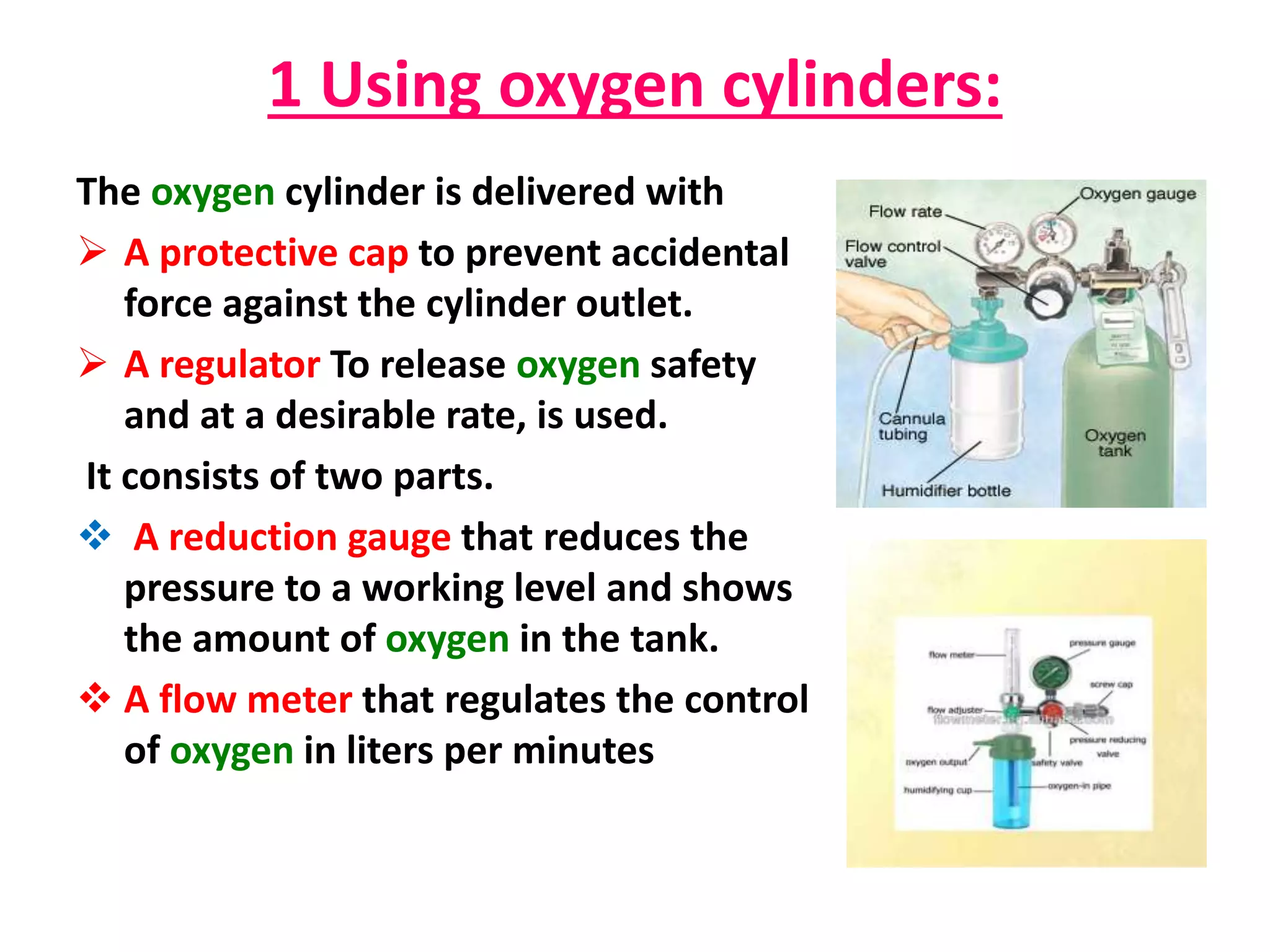
1 Using oxygen cylinders:
The oxygen cylinder is delivered with
 A protective cap to prevent accidental
force against the cylinder outlet.
 A regulator To release oxygen safety
and at a desirable rate, is used.
It consists of two parts.
 A reduction gauge that reduces the
pressure to a working level and shows
the amount of oxygen in the tank.
 A flow meter that regulates the control
of oxygen in liters per minutes
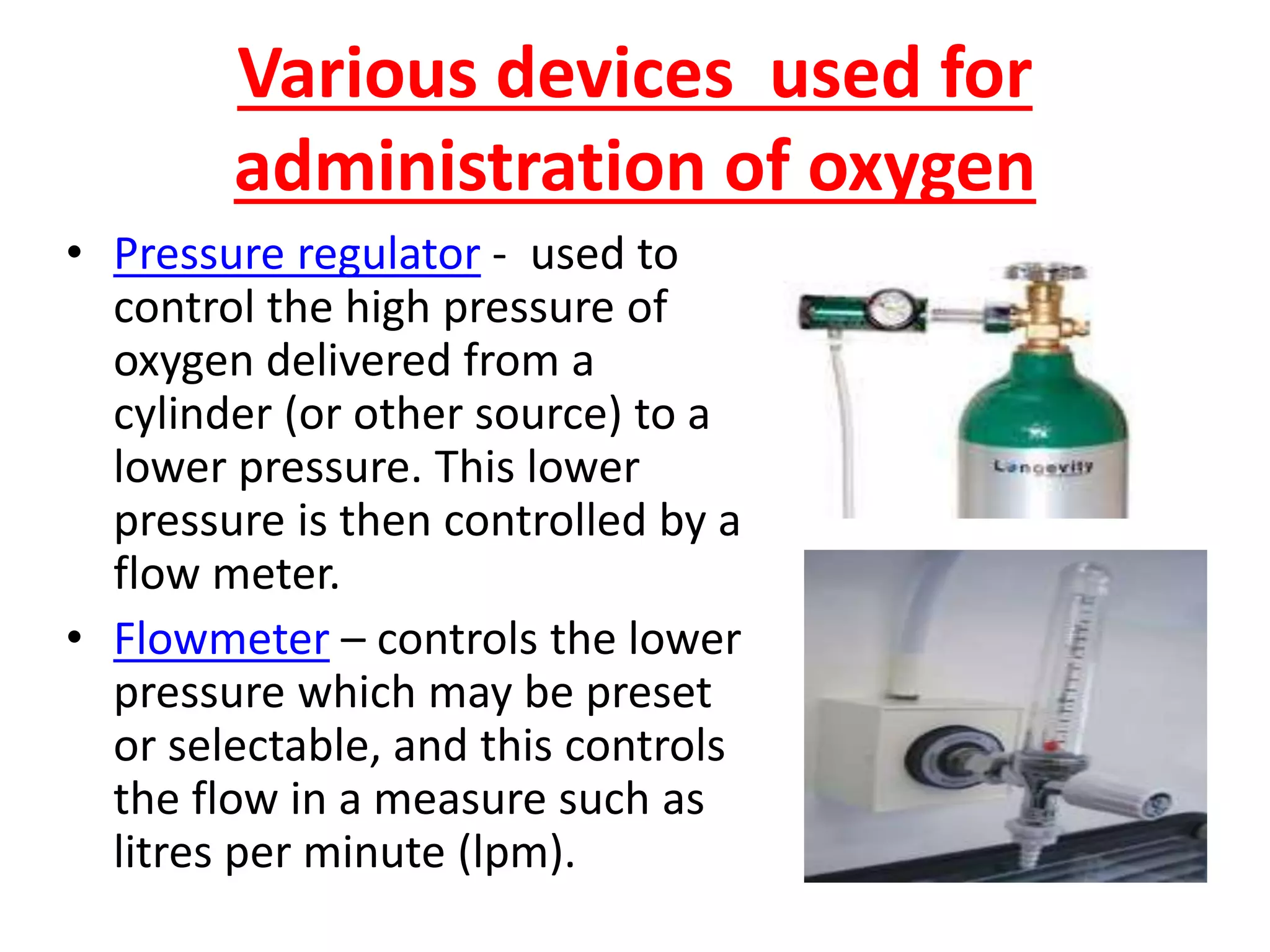
Various devices used for
administration of oxygen
• Pressure regulator - used to
control the high pressure of
oxygen delivered from a
cylinder (or other source) to a
lower pressure. This lower
pressure is then controlled by a
flow meter.
• Flowmeter – controls the lower
pressure which may be preset
or selectable, and this controls
the flow in a measure such as
litres per minute (lpm).
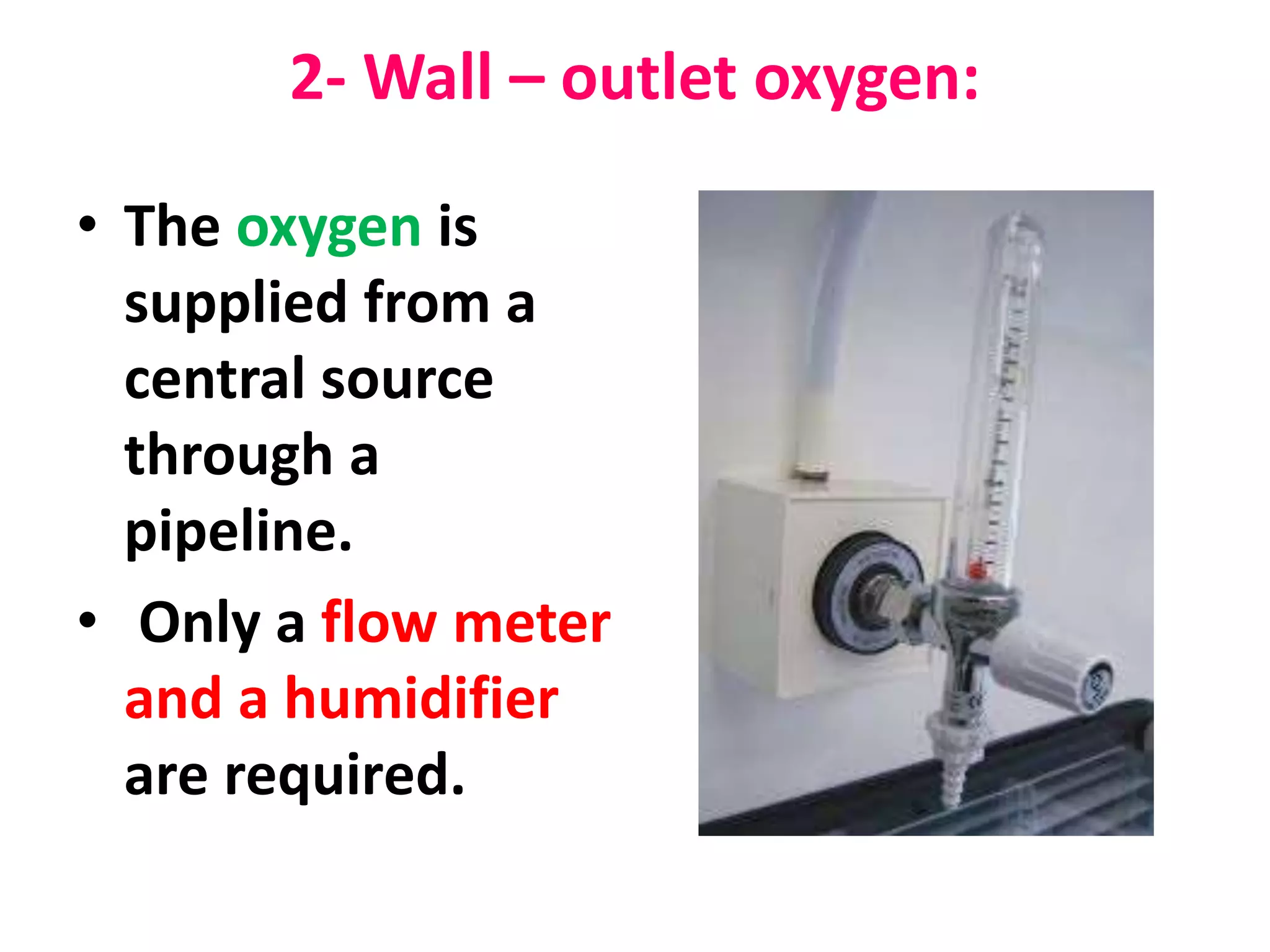
2- Wall – outlet oxygen:
• The oxygen is
supplied from a
central source
through a
pipeline.
• Only a flow meter
and a humidifier
are required.
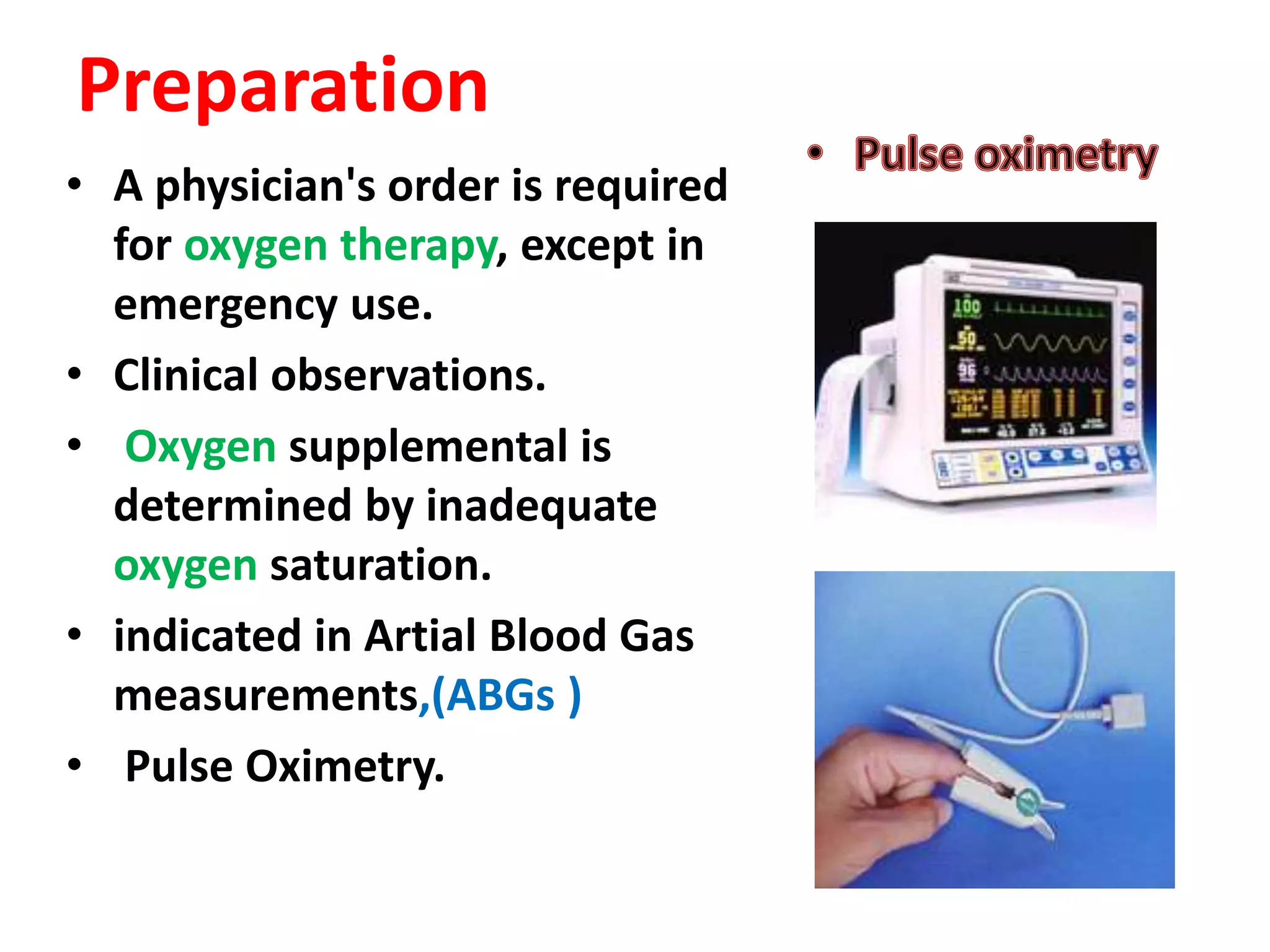
Preparation
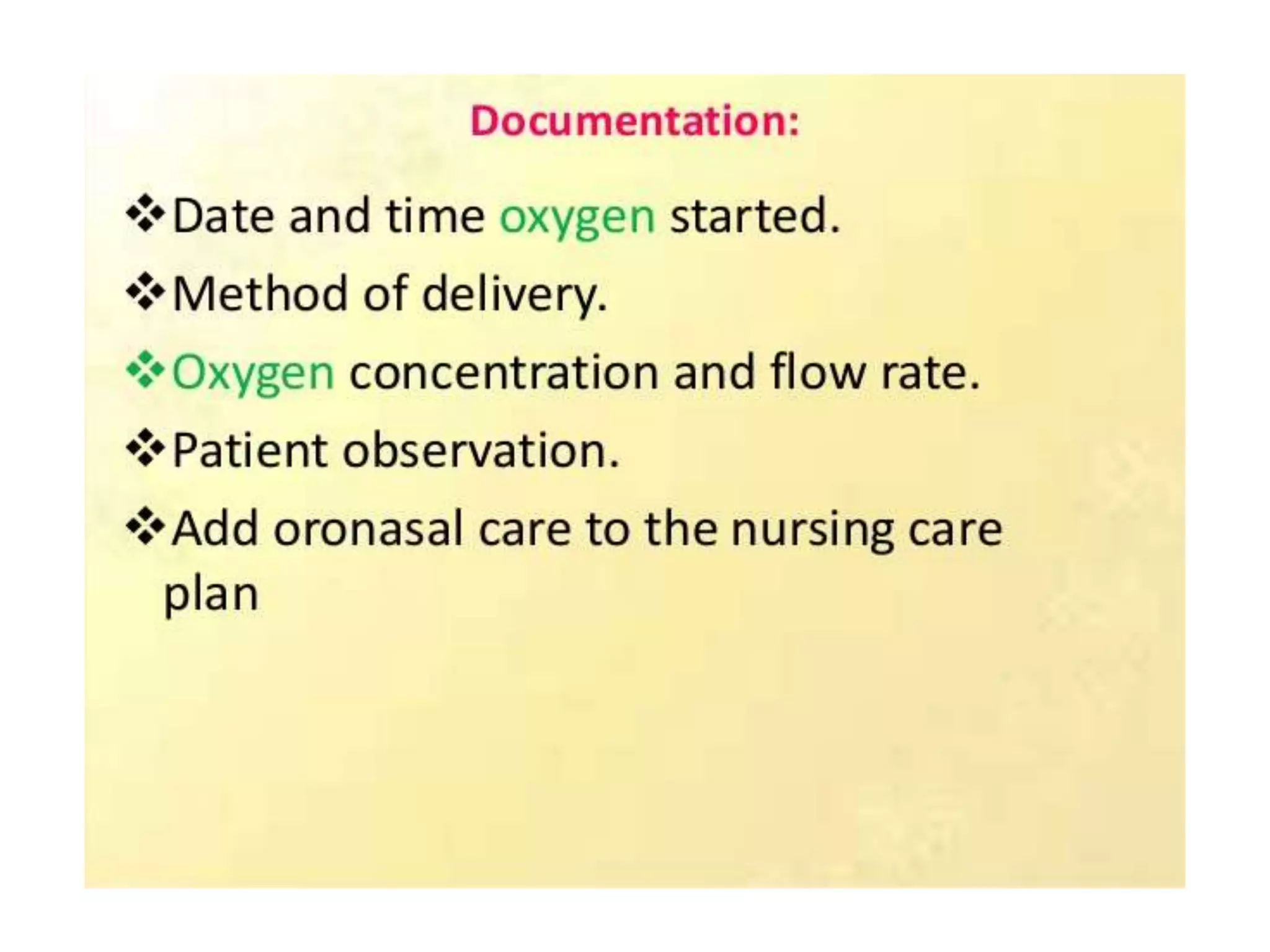
• A physician's order is required
for oxygen therapy, except in
emergency use.
• Clinical observations.
• Oxygen supplemental is
determined by inadequate
oxygen saturation.
• indicated in Artial Blood Gas
measurements,(ABGs )
• Pulse Oximetry.
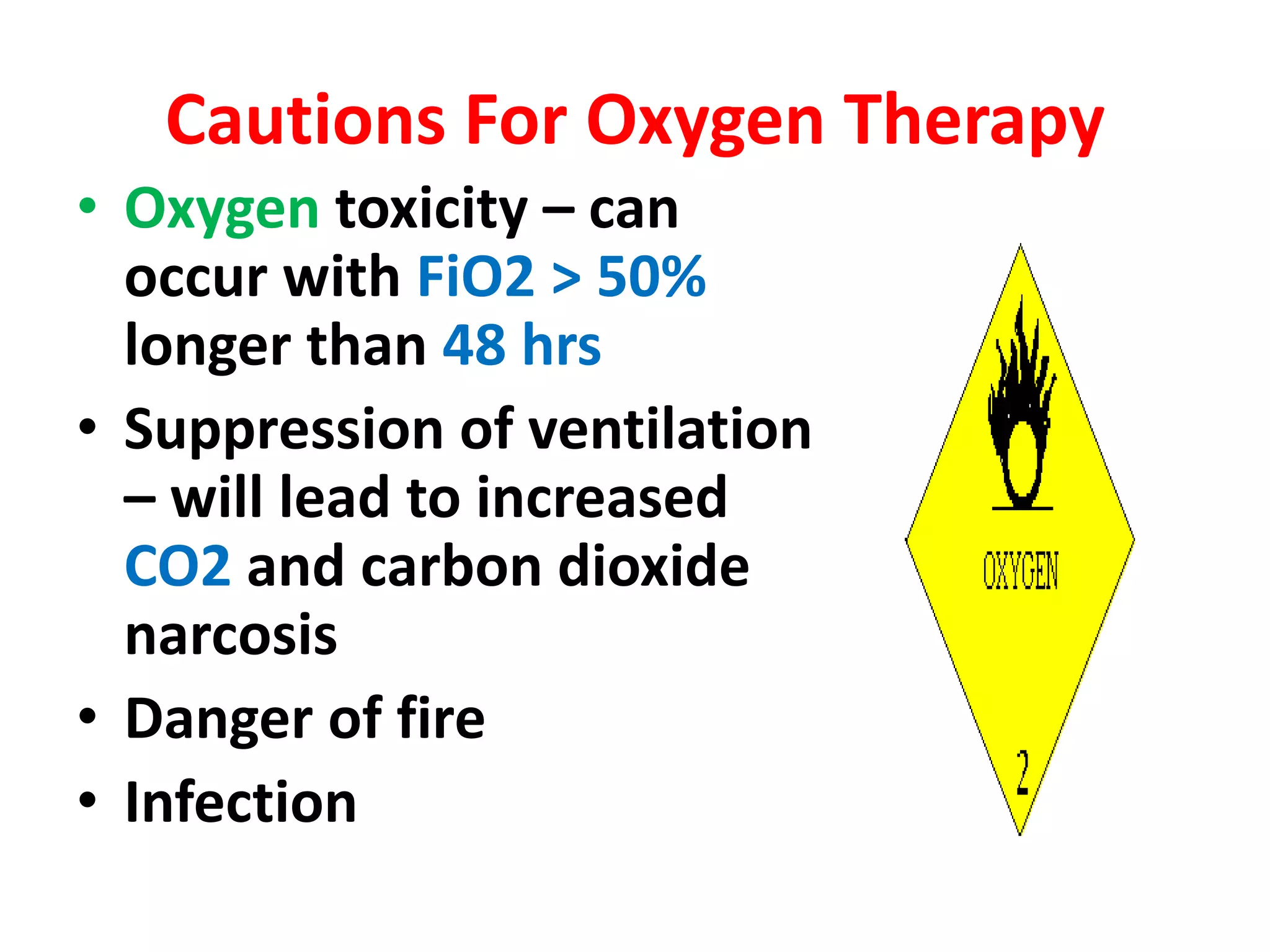
Cautions For Oxygen Therapy
• Oxygen toxicity – can
occur with FiO2 > 50%
longer than 48 hrs
• Suppression of ventilation
– will lead to increased
CO2 and carbon dioxide
narcosis
• Danger of fire
• Infection
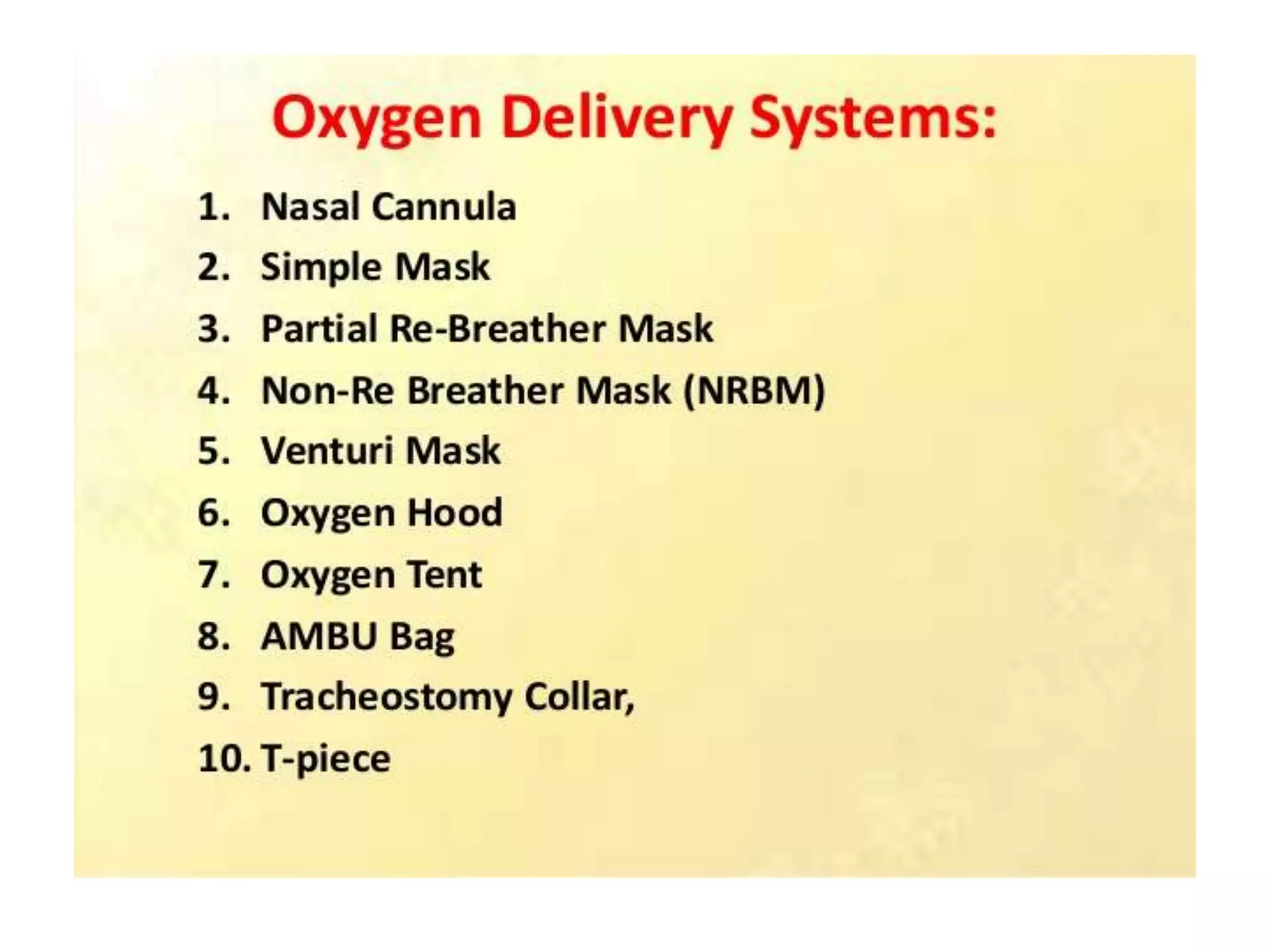
Classification of Oxygen
Delivery Systems
• Low flow systems
– Contribute partially to inspired gas client breathes
– Do not provide constant Fio2[fraction /percentage
of inspired oxygen]
– Ex: nasal cannula, simple mask , non-re breather
mask , Partial rebreather mask
• High flow systems
– Deliver specific and constant percent of oxygen
independent of client’s breathing
– Ex: Venturi mask,, trach collar, T-piece
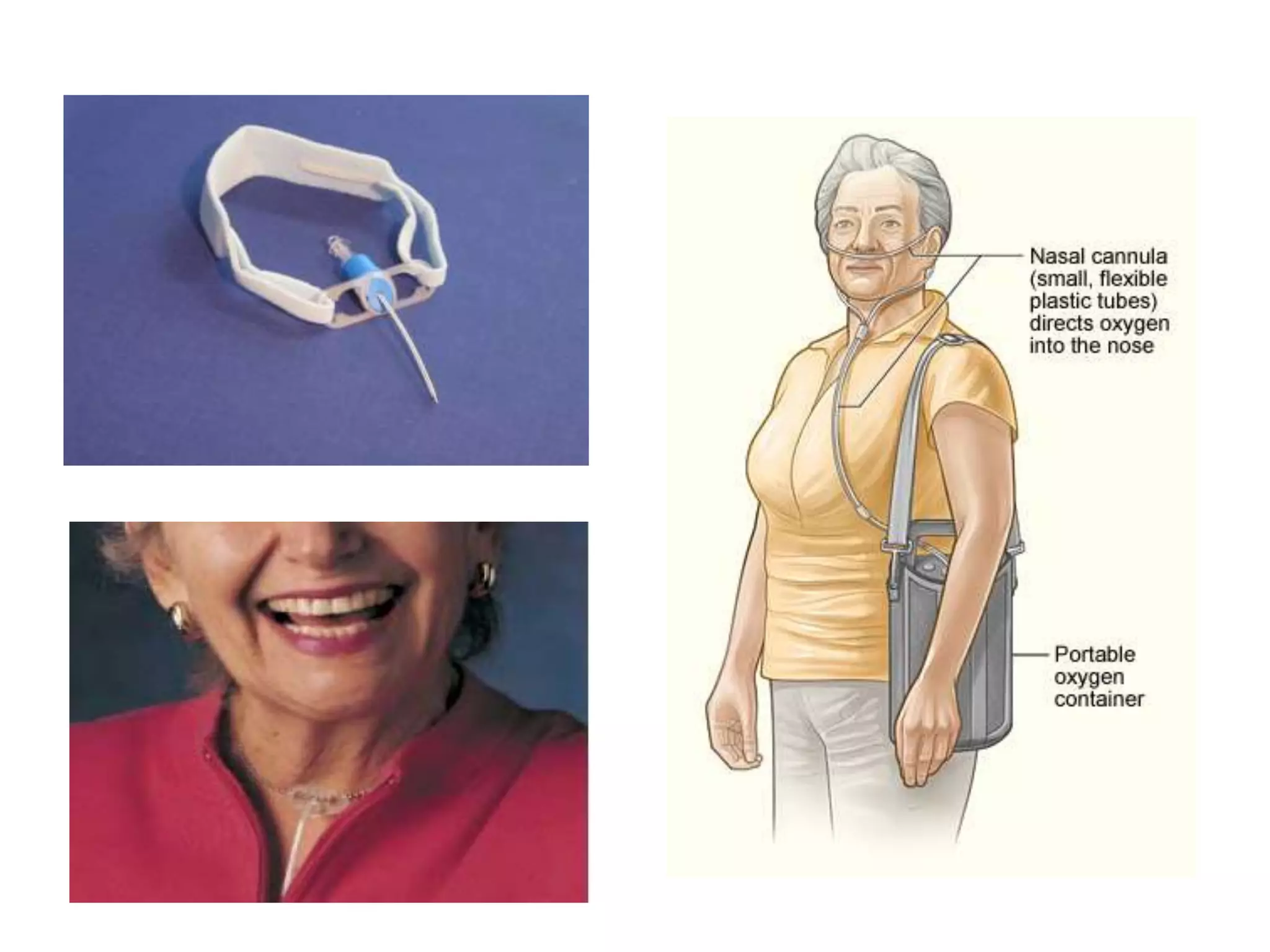
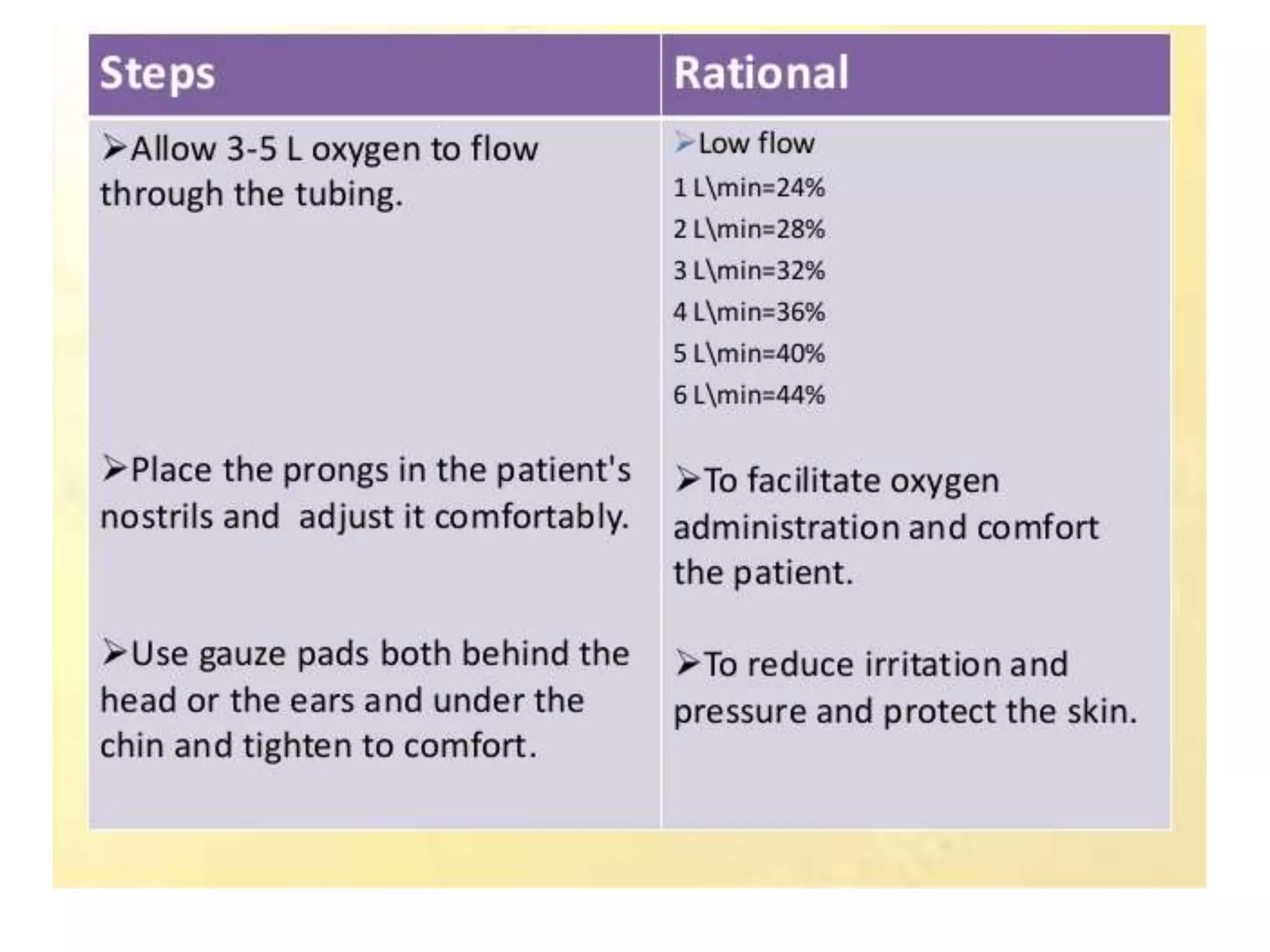
Nasal cannula(NC)
• is a thin tube with two small nozzles that
protrude into the patient's nostrils.
• Most common and inexpensive device
• provides oxygen at low flow rates, 2–6
liters per minute (LPM), delivering a
concentration of 24–45%.
• allows the patient to continue to talk, eat
and drink while still receiving the
therapy. [home set up]
• associated with greater overall safe ,
comfort, and improved oxygenation and
respiratory rates than with face mask
oxygen.
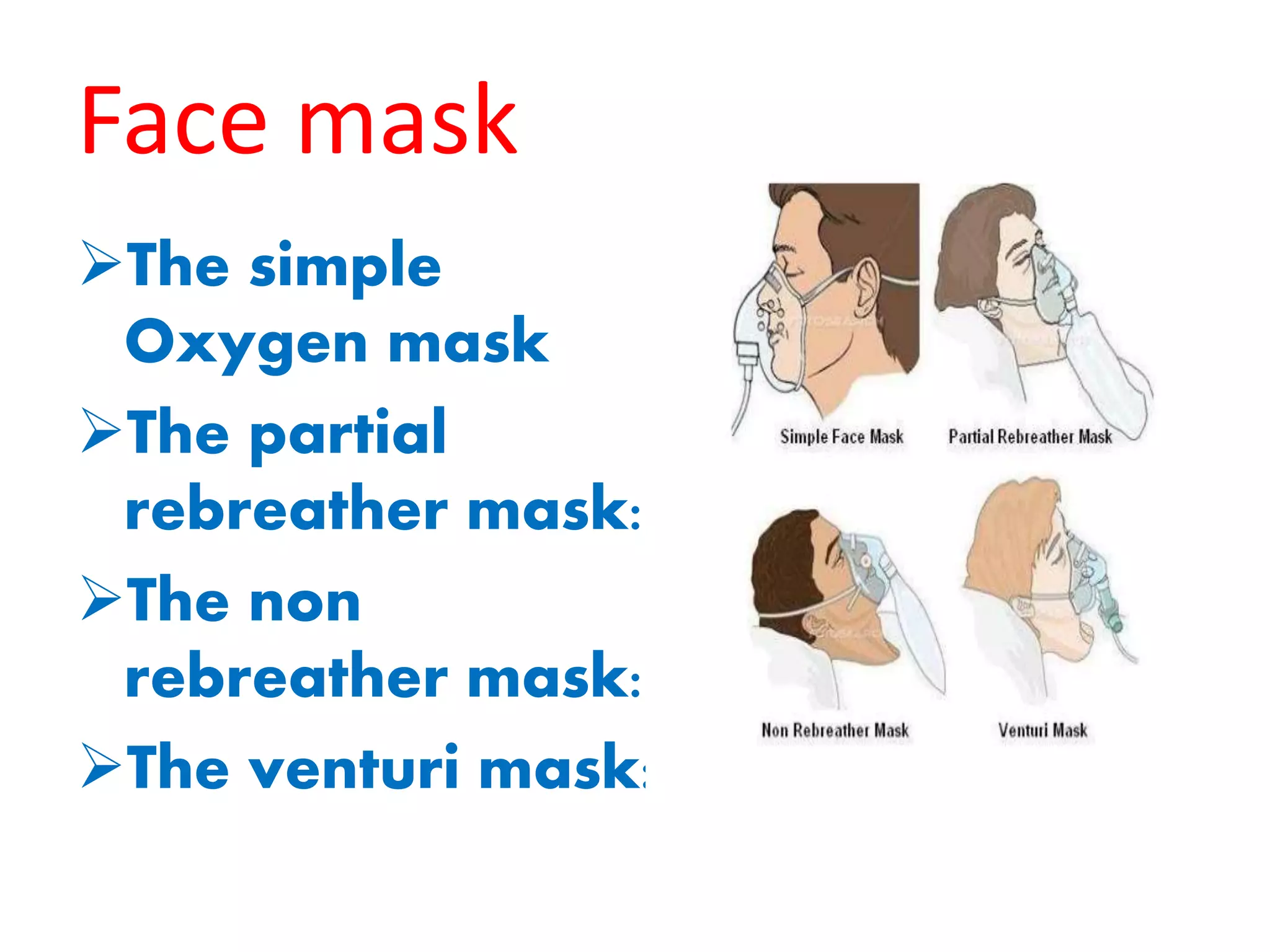
Face mask
The simple
Oxygen mask
The partial
rebreather mask:
The non
rebreather mask:
The venturi mask:
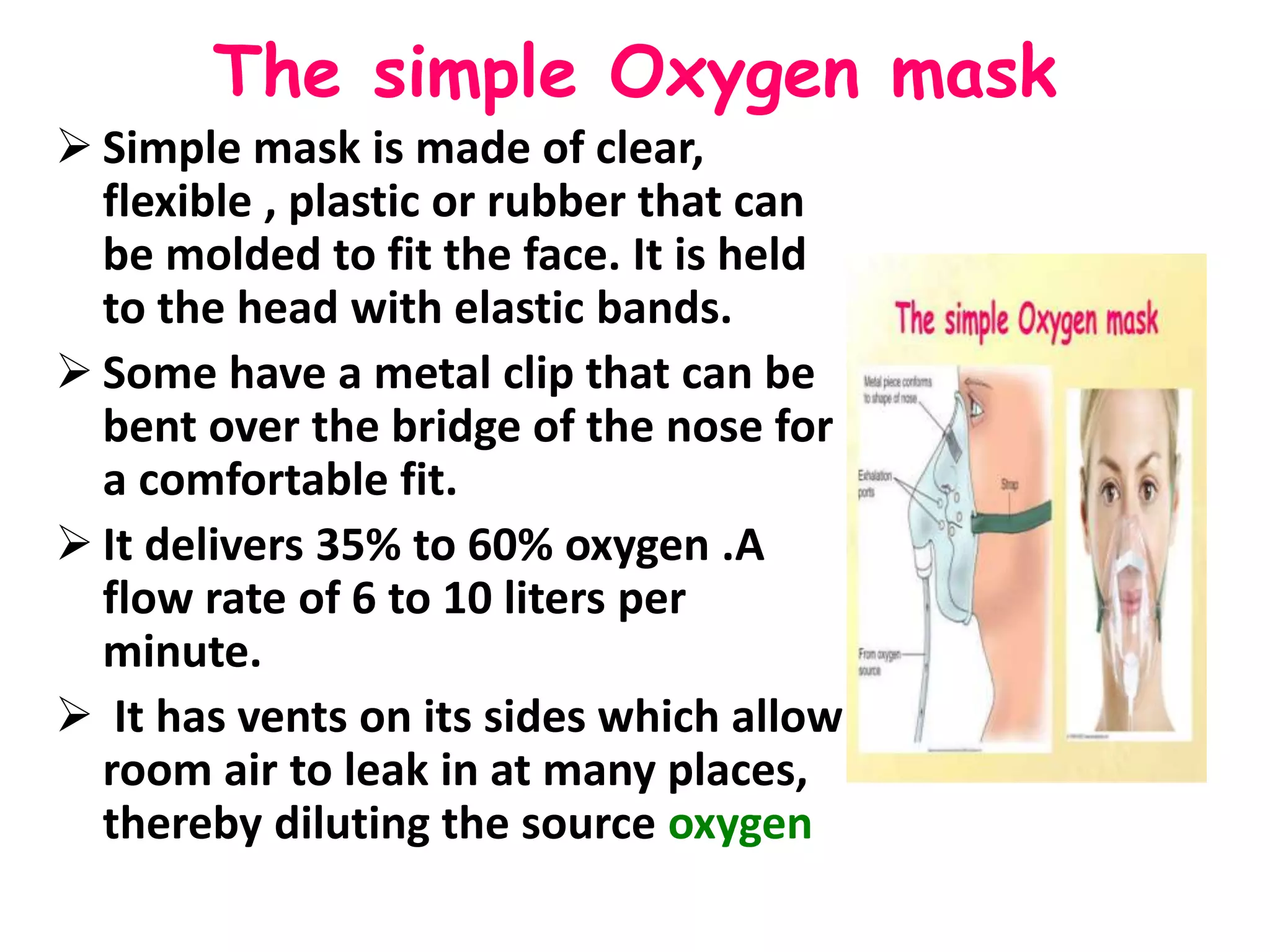
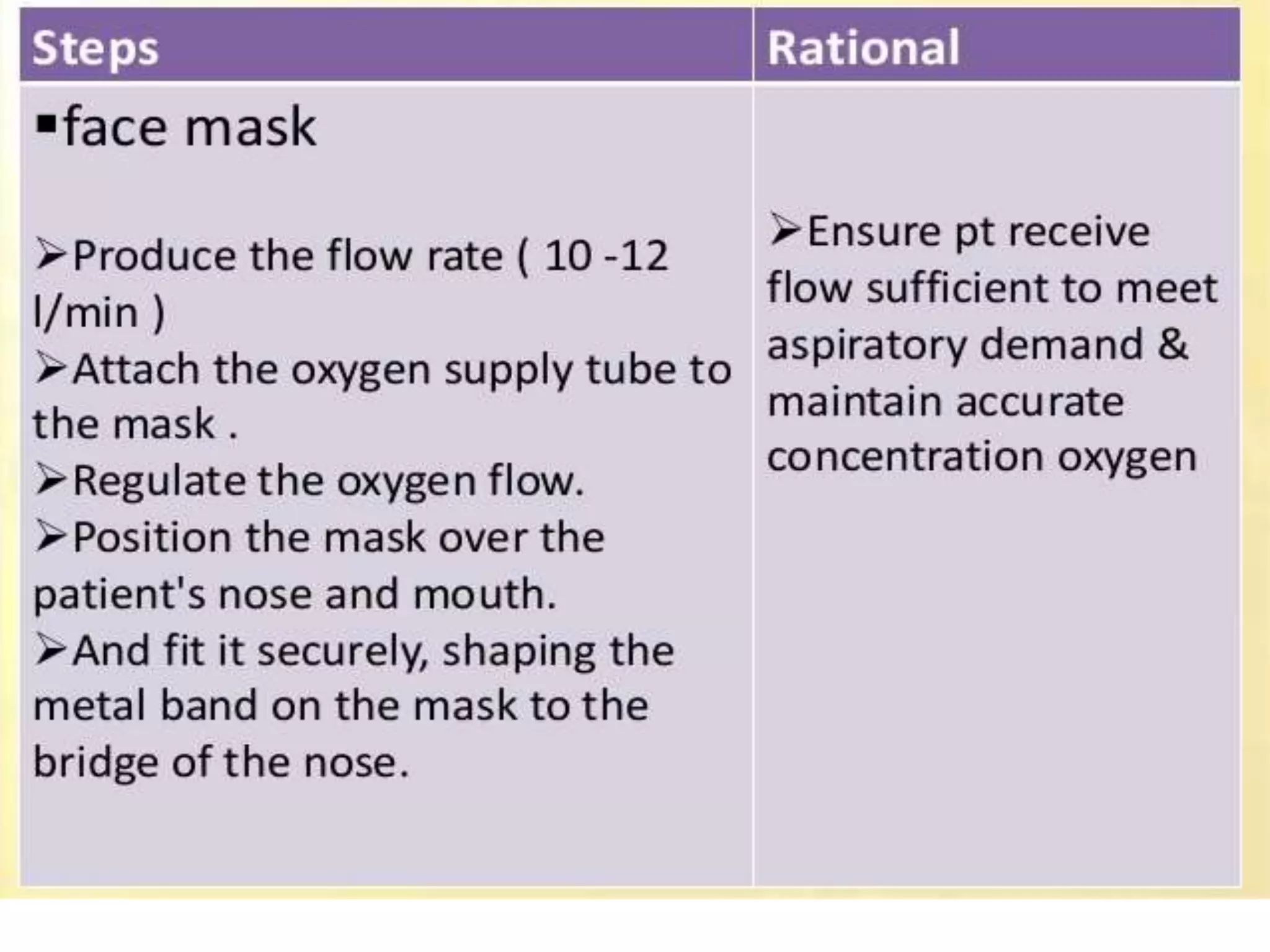
The simple Oxygen mask
 Simple mask is made of clear,
flexible , plastic or rubber that can
be molded to fit the face. It is held
to the head with elastic bands.
 Some have a metal clip that can be
bent over the bridge of the nose for
a comfortable fit.
 It delivers 35% to 60% oxygen .A
flow rate of 6 to 10 liters per
minute.
 It has vents on its sides which allow
room air to leak in at many places,
thereby diluting the source oxygen
Nursing intervetion
Monitor client frequently to check placement
of the mask.
Support client if claustrophobia is concern
Secure physician's order to replace mask
with nasal cannula during meal time
Often it is used when an increased delivery of
oxygen is needed for short periods
(i.e., less than 12 hours)
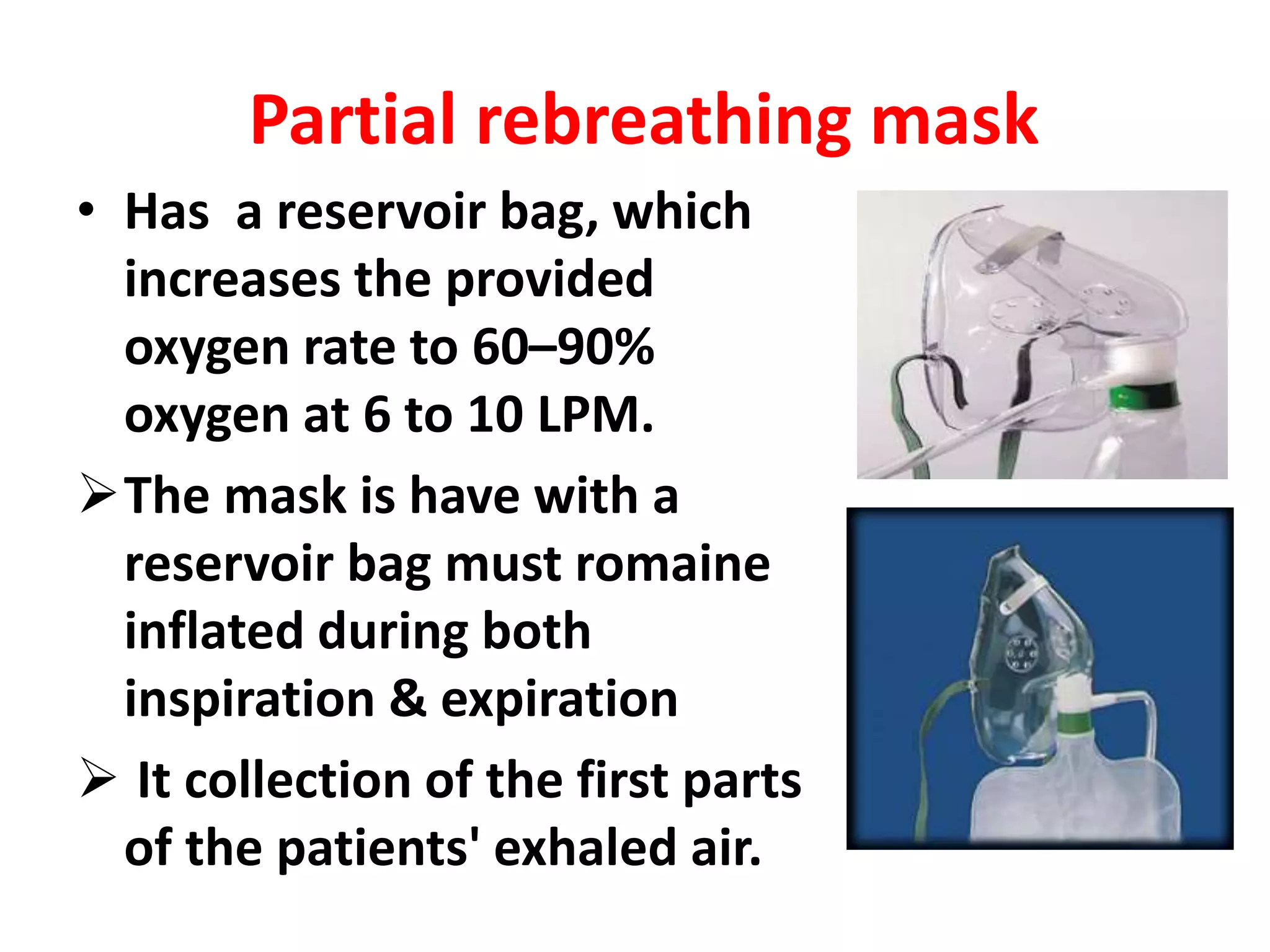
Partial rebreathing mask
• Has a reservoir bag, which
increases the provided
oxygen rate to 60–90%
oxygen at 6 to 10 LPM.
The mask is have with a
reservoir bag must romaine
inflated during both
inspiration & expiration
 It collection of the first parts
of the patients' exhaled air.
The non rebreather mask
 It is similar to the partial
rebreather mask except two, one
way valve present.
 When the patient exhales air. the
one-way valve closes and all of the
expired air is deposited into the
atmosphere, not the reservoir bag.
 In this way, the patient is not
rebreathing any of the expired gas.
 This mask provides the highest
concentration of oxygen [95-100%]
at a flow rate 6-15 L/min
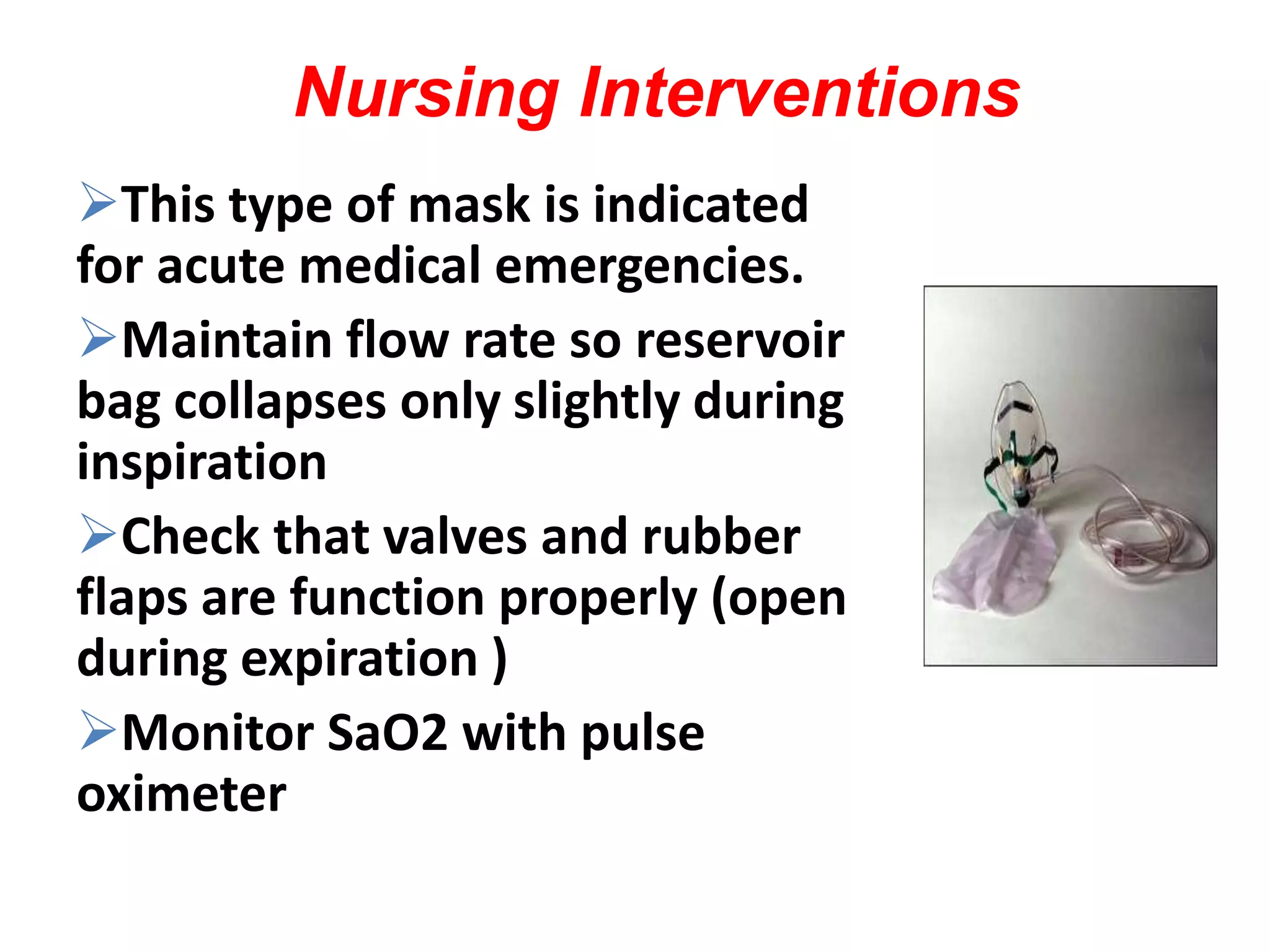
Nursing Interventions
This type of mask is indicated
for acute medical emergencies.
Maintain flow rate so reservoir
bag collapses only slightly during
inspiration
Check that valves and rubber
flaps are function properly (open
during expiration )
Monitor SaO2 with pulse
oximeter
Venturi masks [Air-entrainment masks]
 Has a wide bore tubing and color
coded jet adapters ( blue adapter –
24% at 4-10 L/ m; green adapter –
35% at 8 lpm)
 The mask is so constructed that there
is a constant flow of room air blended
with a fixed concentration of oxygen
 can accurately deliver a
predetermined oxygen concentration
to the trachea up to 24 - 50% at 4- 10
L/m .
 Each color code corresponds to a
precise oxygen concentration and a
specific liter flow.
Nursing intervention
Requires careful monitoring to verify FiO2 at
flow rate ordered
Check that air intake valves are not blocked
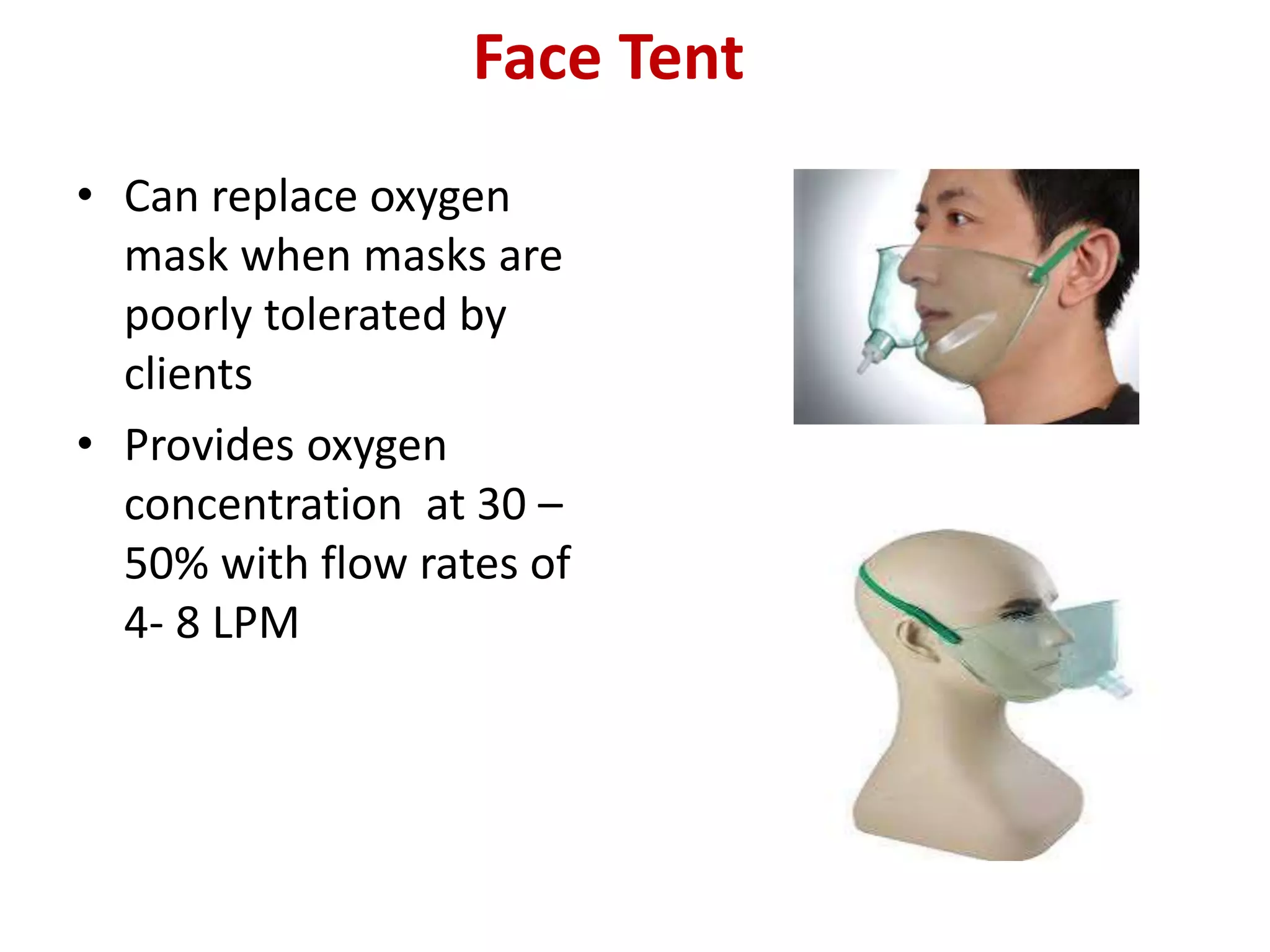
Face Tent
• Can replace oxygen
mask when masks are
poorly tolerated by
clients
• Provides oxygen
concentration at 30 –
50% with flow rates of
4- 8 LPM
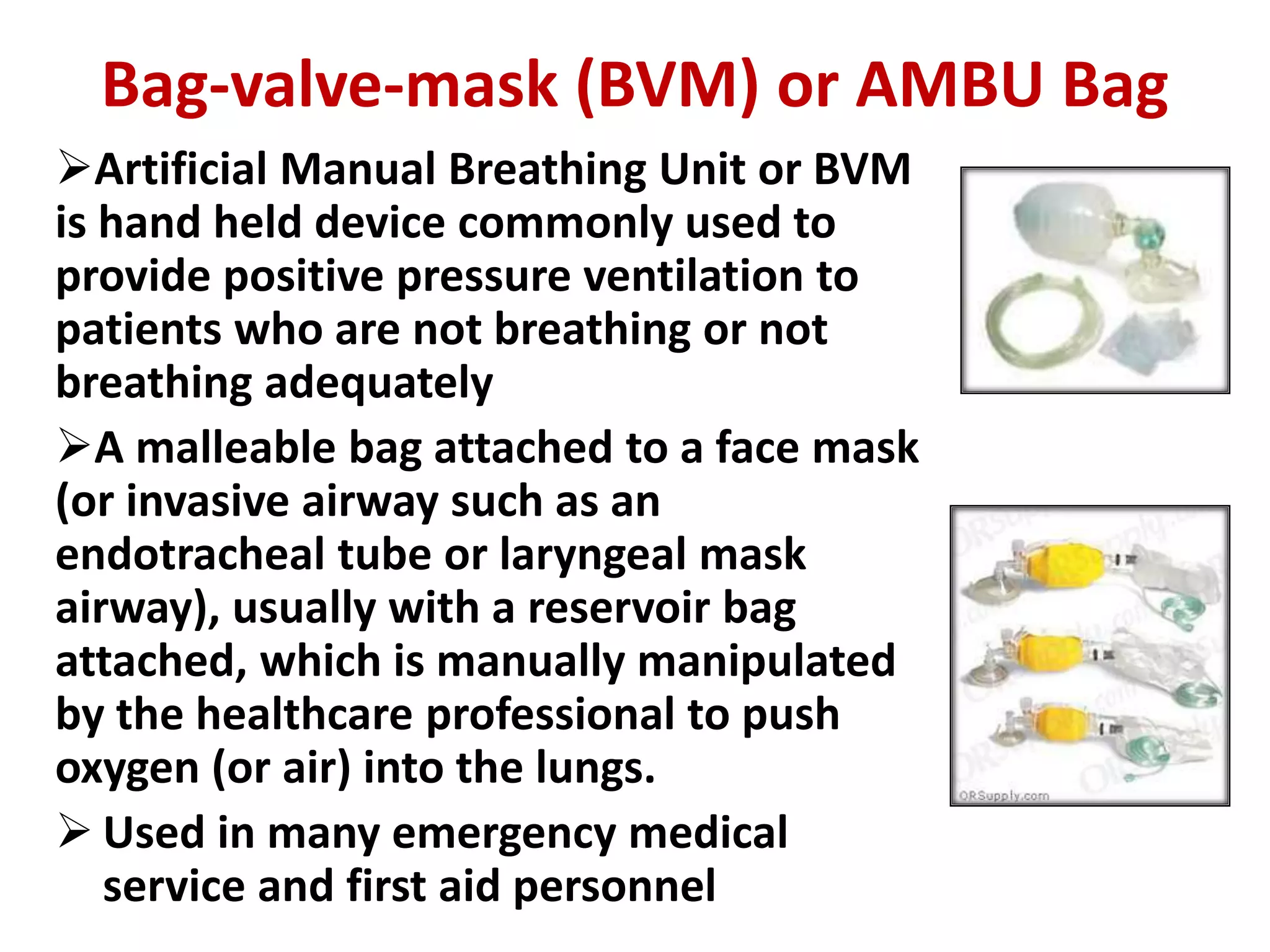
Bag-valve-mask (BVM) or AMBU Bag
Artificial Manual Breathing Unit or BVM
is hand held device commonly used to
provide positive pressure ventilation to
patients who are not breathing or not
breathing adequately
A malleable bag attached to a face mask
(or invasive airway such as an
endotracheal tube or laryngeal mask
airway), usually with a reservoir bag
attached, which is manually manipulated
by the healthcare professional to push
oxygen (or air) into the lungs.
 Used in many emergency medical
service and first aid personnel
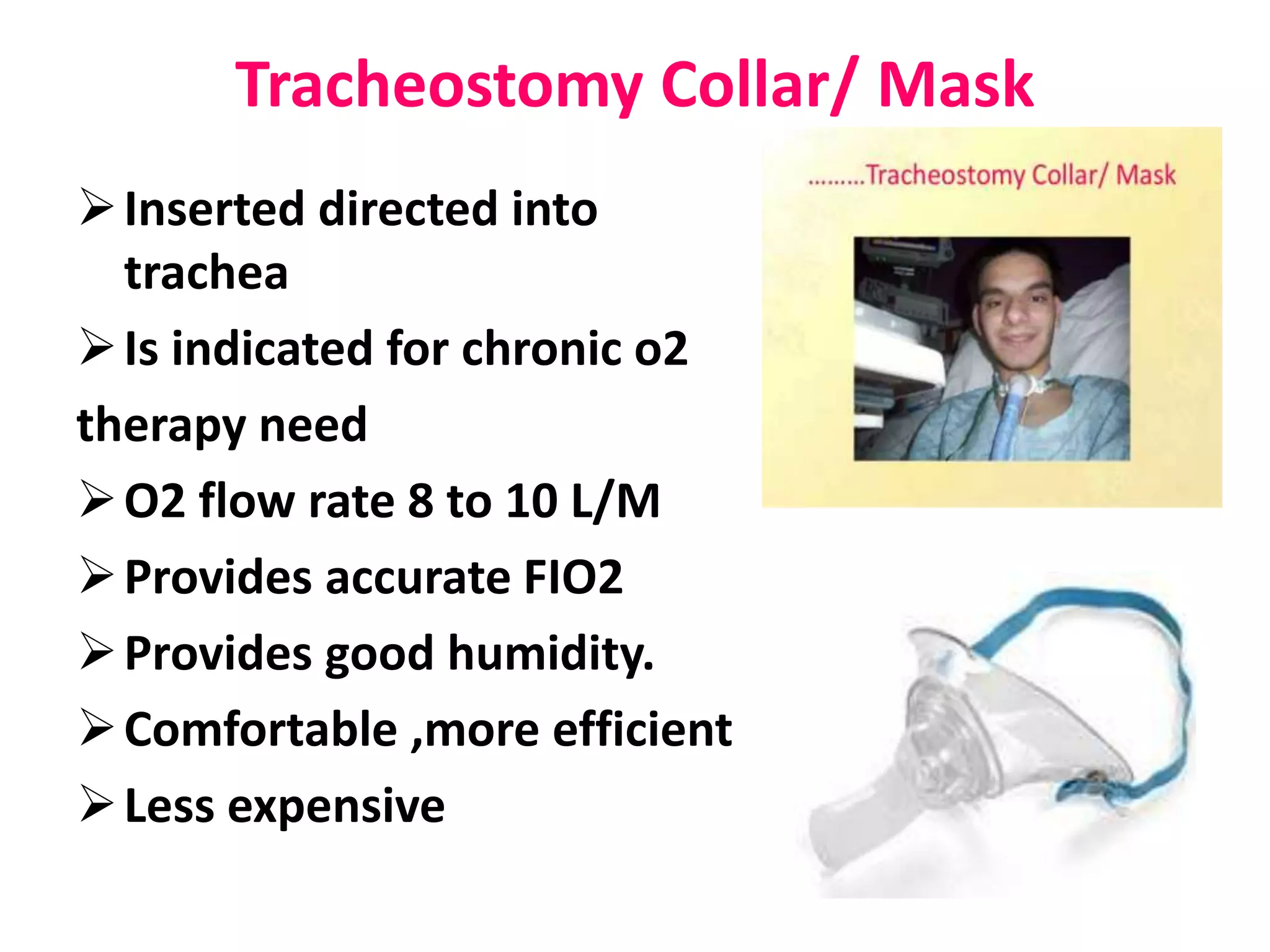
Tracheostomy Collar/ Mask
Inserted directed into
trachea
Is indicated for chronic o2
therapy need
O2 flow rate 8 to 10 L/M
Provides accurate FIO2
Provides good humidity.
Comfortable ,more efficient
Less expensive
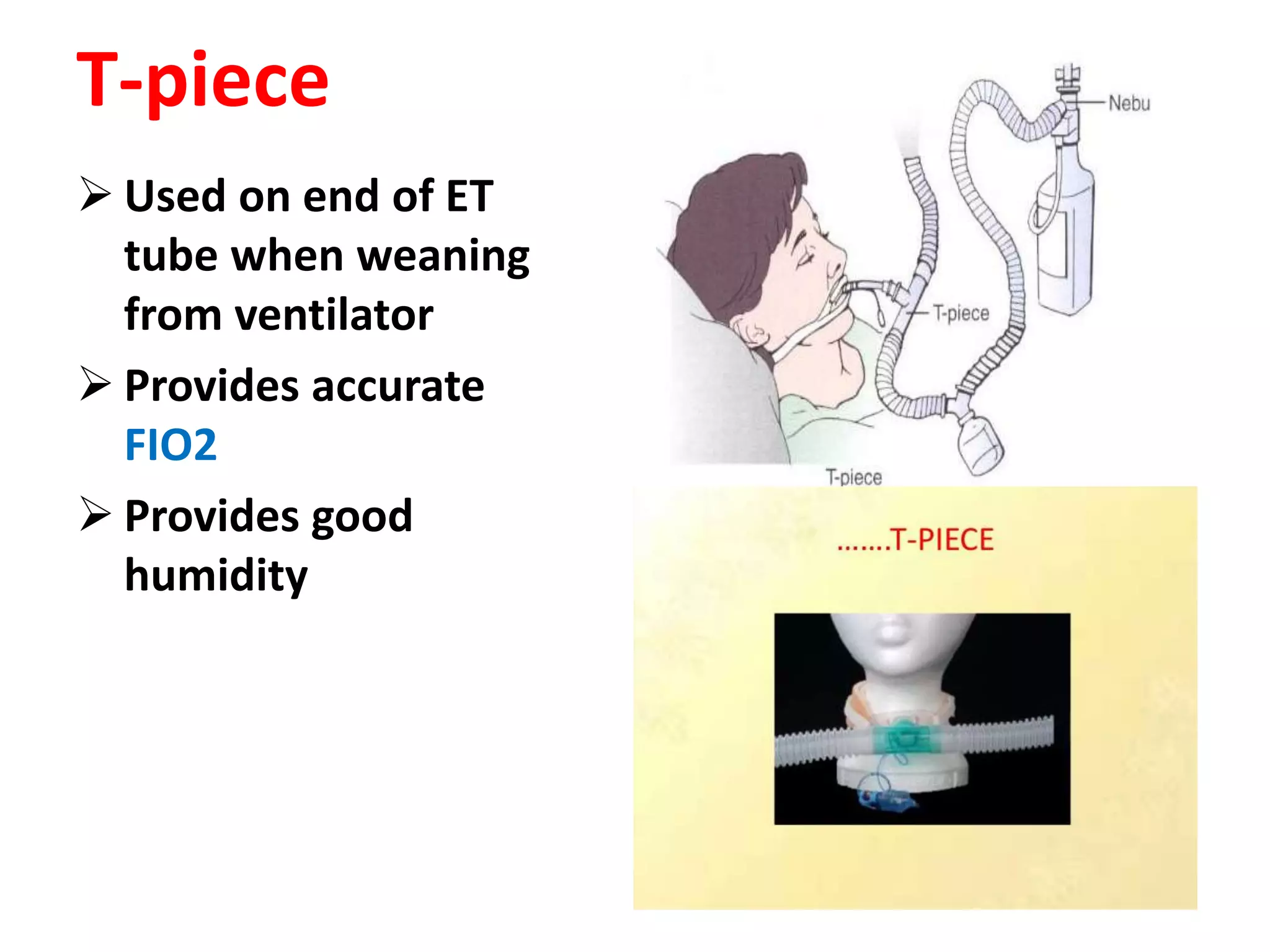
T-piece
 Used on end of ET
tube when weaning
from ventilator
 Provides accurate
FIO2
 Provides good
humidity
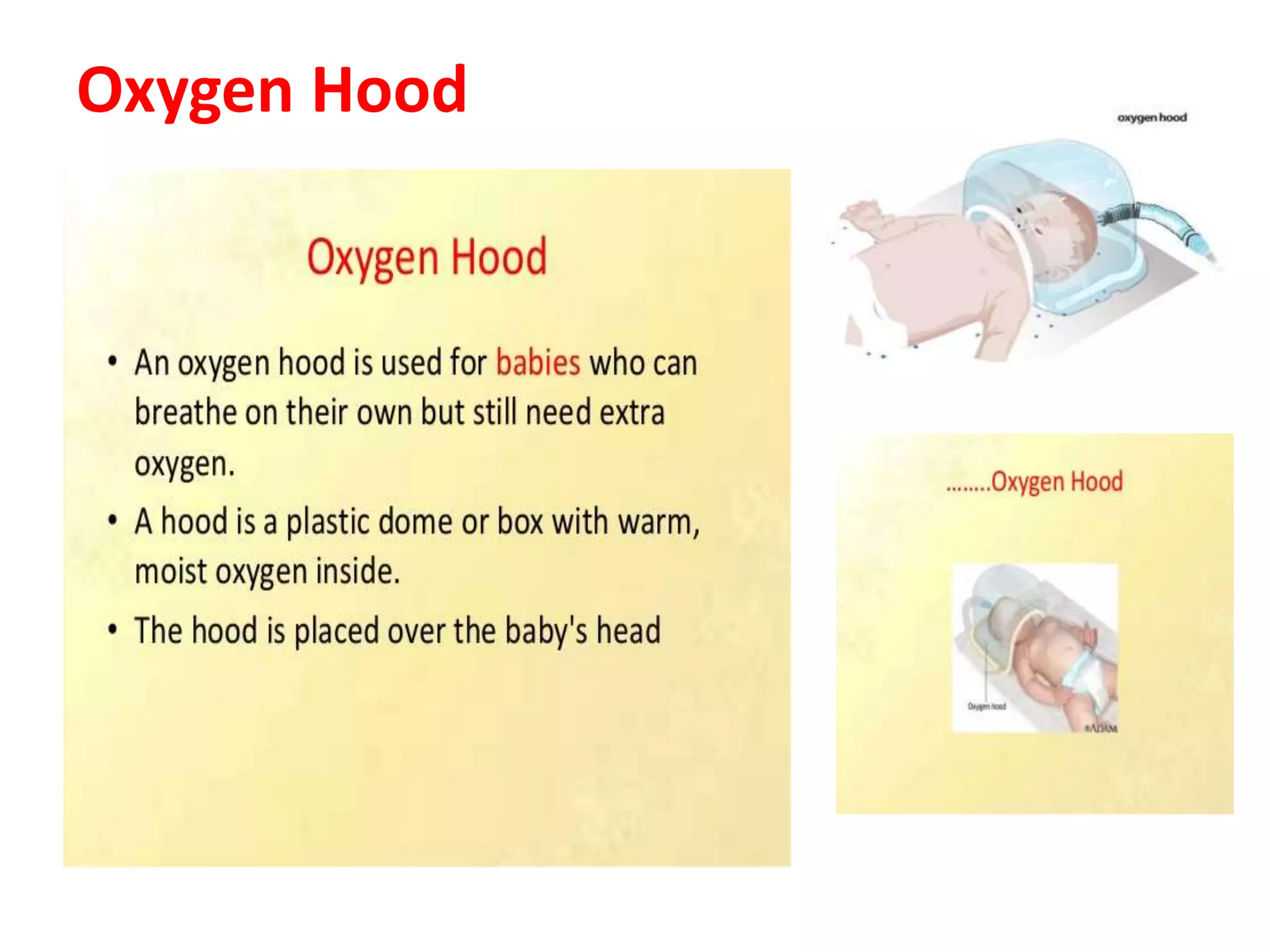
Oxygen Hood
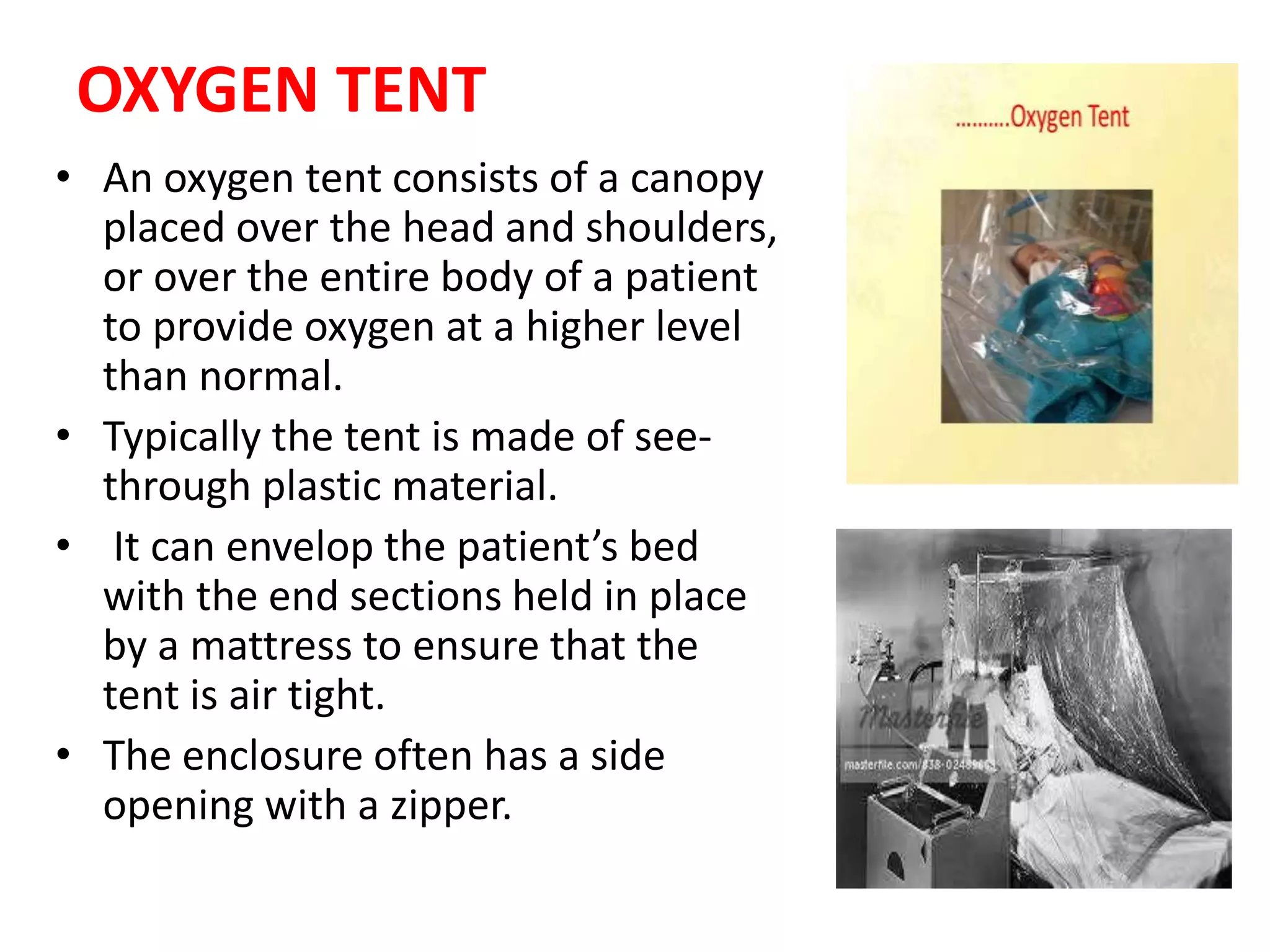
OXYGEN TENT
• An oxygen tent consists of a canopy
placed over the head and shoulders,
or over the entire body of a patient
to provide oxygen at a higher level
than normal.
• Typically the tent is made of see-
through plastic material.
• It can envelop the patient’s bed
with the end sections held in place
by a mattress to ensure that the
tent is air tight.
• The enclosure often has a side
opening with a zipper.
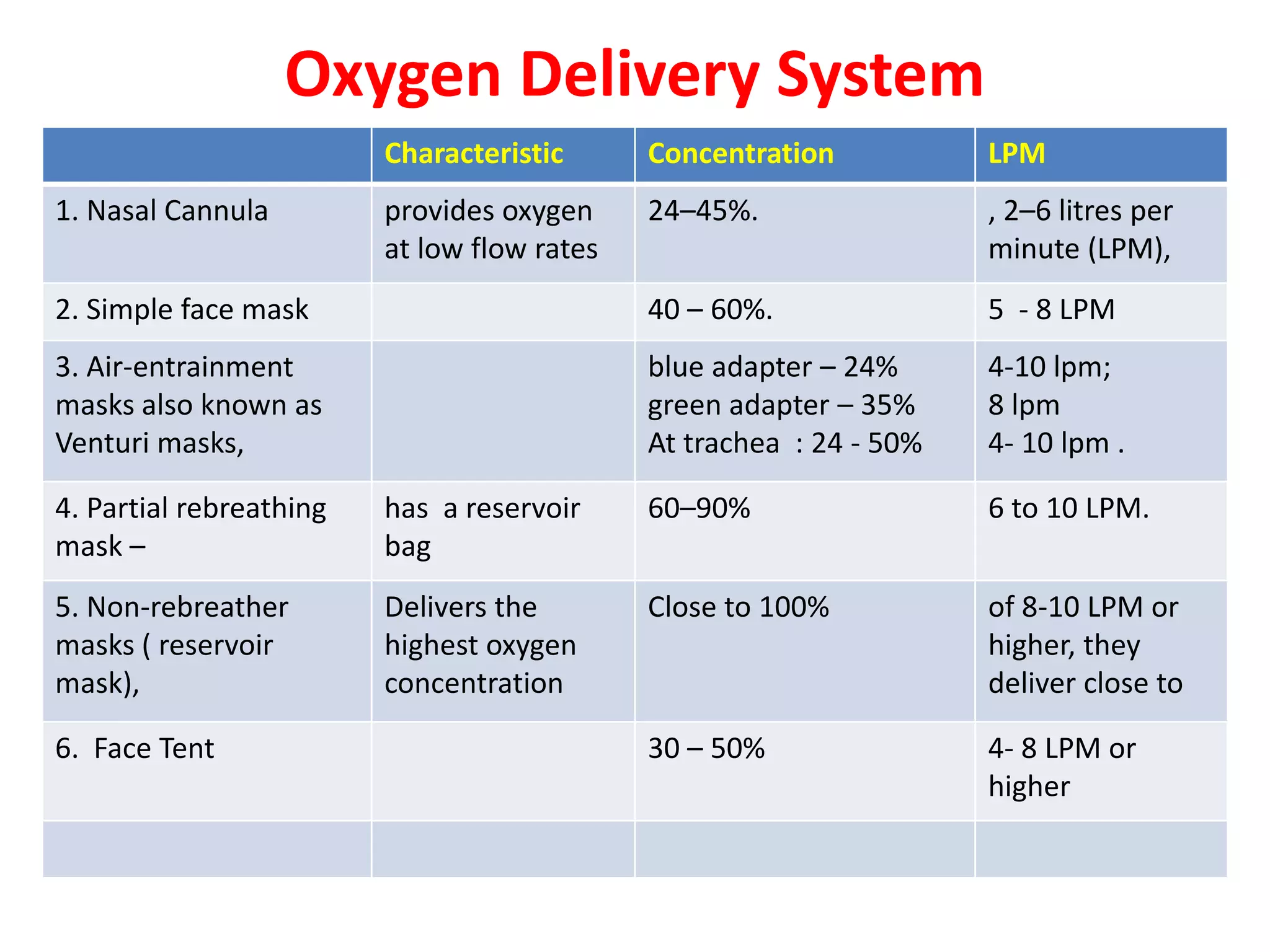
Oxygen Delivery System
Characteristic Concentration LPM
1. Nasal Cannula provides oxygen
at low flow rates
24–45%. , 2–6 litres per
minute (LPM),
2. Simple face mask 40 – 60%. 5 - 8 LPM
3. Air-entrainment
masks also known as
Venturi masks,
blue adapter – 24%
green adapter – 35%
At trachea : 24 - 50%
4-10 lpm;
8 lpm
4- 10 lpm .
4. Partial rebreathing
mask –
has a reservoir
bag
60–90% 6 to 10 LPM.
5. Non-rebreather
masks ( reservoir
mask),
Delivers the
highest oxygen
concentration
Close to 100% of 8-10 LPM or
higher, they
deliver close to
6. Face Tent 30 – 50% 4- 8 LPM or
higher
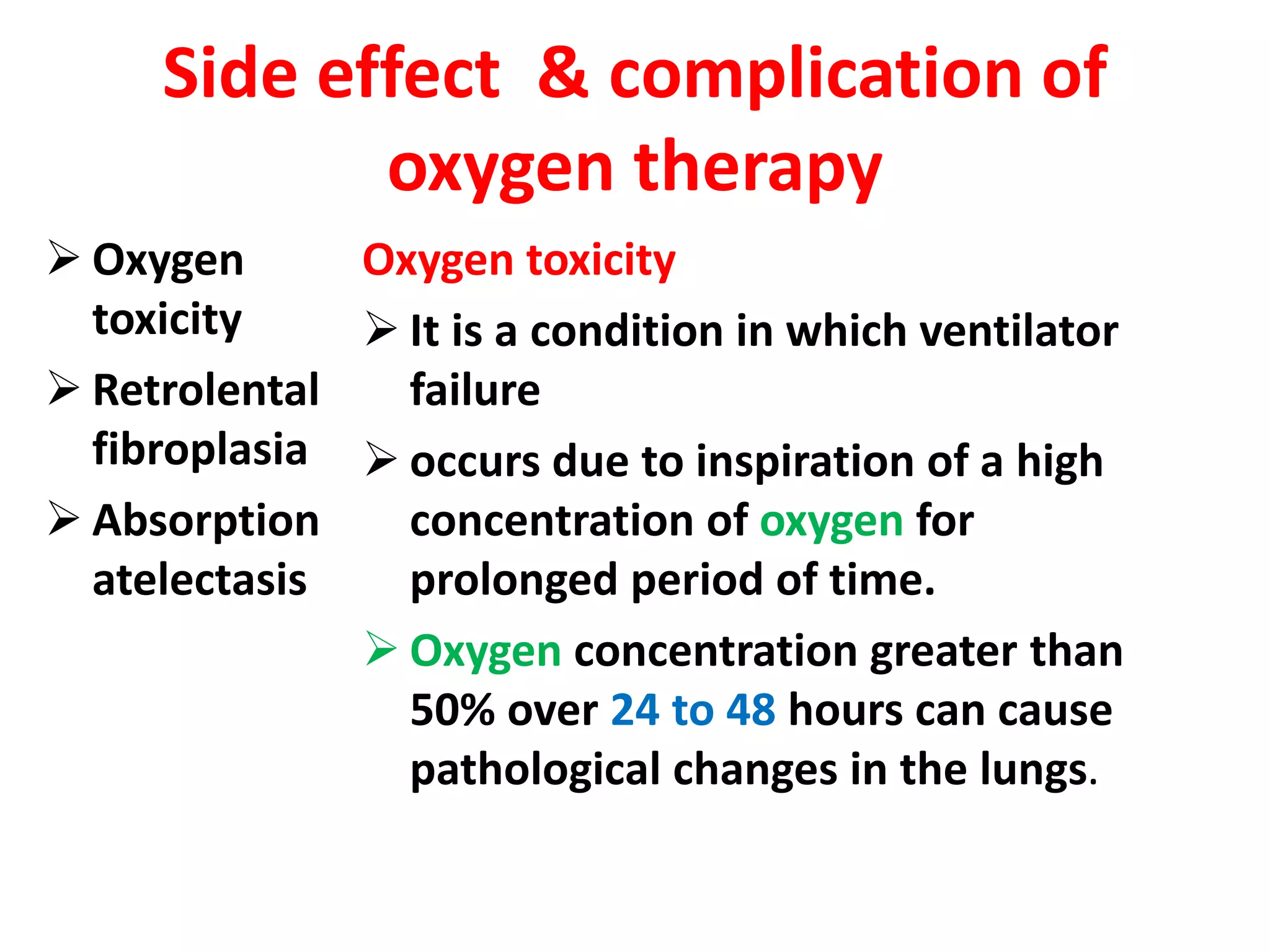
Side effect & complication of
oxygen therapy
 Oxygen
toxicity
 Retrolental
fibroplasia
 Absorption
atelectasis
Oxygen toxicity
 It is a condition in which ventilator
failure
 occurs due to inspiration of a high
concentration of oxygen for
prolonged period of time.
 Oxygen concentration greater than
50% over 24 to 48 hours can cause
pathological changes in the lungs.
• Signs and symptoms of oxygen toxicity:
• • Non-productive cough.
• • Nausea and vomiting.
• • Substernal chest pain.
• • Fatigue.
• • Nasal stuffiness.
• • Headache.
• • Sore throat.
• • Hypoventilation.
• . Nasal congestion.
• . Dyspnea.
• . Inspiration pain.
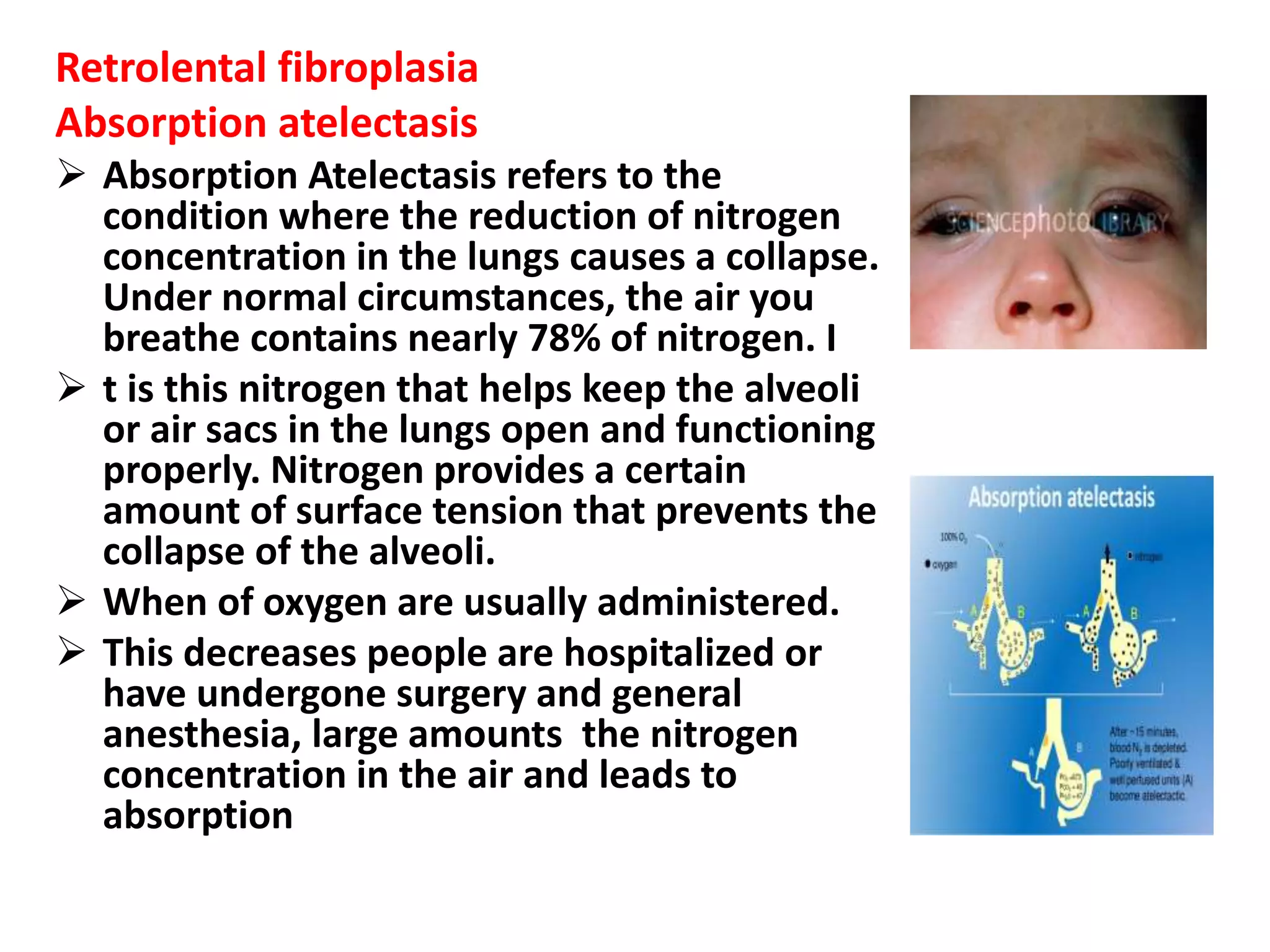
Retrolental fibroplasia
Absorption atelectasis
 Absorption Atelectasis refers to the
condition where the reduction of nitrogen
concentration in the lungs causes a collapse.
Under normal circumstances, the air you
breathe contains nearly 78% of nitrogen. I
 t is this nitrogen that helps keep the alveoli
or air sacs in the lungs open and functioning
properly. Nitrogen provides a certain
amount of surface tension that prevents the
collapse of the alveoli.
 When of oxygen are usually administered.
 This decreases people are hospitalized or
have undergone surgery and general
anesthesia, large amounts the nitrogen
concentration in the air and leads to
absorption
References:
• Kozier & Erb’s Fundamentals of Nursing .
Eighth Edition
• Inter net information

Ppt on oxygen administration

  • 1.
  • 2.
    Out line  Definitionof the oxygen therapy  Types of oxygen therapy  purposes of using the oxygen therapy  Administration of oxygen therapy  Complication of oxygen therapy
  • 3.
    Learning objectives:  Definethe oxygen therapy  Discuss the type of oxygen therapy  List the purpose of using the oxygen therapy  Explain the procedure  Demonstrate the procedure  List Complication of oxygen therapy
  • 4.
    Terminology • Fio2-Fraction /percentageof inspired oxygen • ABGs - Aterial Blood Gas measurements- test measures the acidity (pH) and the levels of oxygen and carbon dioxide in the blood from an artery. This test is used to check how well your lungs are able to move oxygen into the blood and remove carbon dioxide from the blood. An ABG measures Partial pressure of oxygen (PaO2).  80 -100 mmHg - children/adults  50 - 80 mmHg - neonates Partial pressure of carbon dioxide (PaCO2).  35 - 45 mmHg children/adults pH.  between 7.35 and 7.45. A pH of less than 7.0 is called acid and a pH greater than 7.0 is called basic (alkaline). So blood is slightly basic.
  • 5.
    Oxygen toxicity  isa condition resulting from the harmful effects of breathing molecular oxygen (O2) at increased partial pressures. It is also known as oxygen toxicity syndrome, oxygen intoxication, and oxygen poisoning Retrolental fibroplasia  abnormal proliferation of fibrous tissue immediately behind the lens of the eye, leading to blindness. It affected many premature babies in the 1950s, owing to the excessive administration of oxygen. Absorption Atelectasis  If a large volume of nitrogen in the lungs is replaced with oxygen, the oxygen may subsequently be absorbed into the blood, reducing the volume of the alveoli, resulting in a form of alveolar collapse known as absorption Atelectasis.
  • 6.
    Oxygen Oxygen is acolorless, odorless, tasteless gas that is essential for the body to function properly and to survive. The air that we breathe contain approximately 21% oxygen The heart relies on oxygen to pump blood. If not enough oxygen is circulating in the blood, it’s difficult for the tissues of the heart to keep pumping. Supplemental oxygen is used to treat medical conditions in which the tissues of the body do not have enough oxygen.
  • 7.
    Oxygen therapy • Oxygentherapy is the administration of oxygen at a concentration of pressure greater than that found in the environmental atmosphere • It is the administration of oxygen as a medical intervention, which can be for a variety of purposes in both chronic and acute patient care • Oxygen therapy is a key treatment in respiratory care
  • 8.
    Oxygen therapy • Oxygenis often prescribed for people to prevent hypoxia because of the following conditions: 1.difficulty ventilating all areas of their lungs 2.Impaired gas exchange 3.Heart failure • Prescribed by the physician who specifies the following: 1.Concentration 2. liter per minute 3.Method of delivery
  • 11.
    Oxygen supply 1. Pipedin wall outlets – at the client’s bedside 2. Portable (Tanks or cylinders) – for transporting oxygen dependent clients, in home use;
  • 12.
    Humidifier Humidifier – addwater vapor to inspired air because Oxygen is a dry gas that dehydrates respiratory mucous membrane • Prevents mucous membrane from drying and becoming irritated • Loosens secretions for easier expectoration
  • 13.
    Safety Precautions forOxygen Administration  Oxygen is a highly combustible gas.  Oxygen is a therapeutic gas and must be prescribed and adjusted only with a health care provider’s order  Keep oxygen deliver systems 10 feet away from any open flames.  Keep cylinder always upright position, while administering secure them to avoid falling.  Check the cylinder for sufficient to administer client  Teach family members to smoke only outside away from the client and oxygen equipment.  Set up “No Smoking: and “oxygen in Use” signs at the site of administration and at the door,[ even in home] according to agency policy.
  • 14.
    Safety Precautions forOxygen Administration  Instruct the client and visitors about the hazard of smoking with oxygen in use  Provide cotton gown and blankets . Synthetics and wool may generate sparks of static electricity • Avoid the use of volatile, flammable materials such as oils, greases, alcohol, ether and acetone near clients receiving oxygen • Remove matches, lighters, ashtrays, and any friction- type or battery operated toys or devices from bedside • Be sure that electric monitoring equipment , suction machines, and portable diagnostic machines are electrically grounded. • Locate fire extinguishers and oxygen meter turn-off lever.
  • 15.
    1 Using oxygencylinders: The oxygen cylinder is delivered with  A protective cap to prevent accidental force against the cylinder outlet.  A regulator To release oxygen safety and at a desirable rate, is used. It consists of two parts.  A reduction gauge that reduces the pressure to a working level and shows the amount of oxygen in the tank.  A flow meter that regulates the control of oxygen in liters per minutes
  • 16.
    Various devices usedfor administration of oxygen • Pressure regulator - used to control the high pressure of oxygen delivered from a cylinder (or other source) to a lower pressure. This lower pressure is then controlled by a flow meter. • Flowmeter – controls the lower pressure which may be preset or selectable, and this controls the flow in a measure such as litres per minute (lpm).
  • 17.
    2- Wall –outlet oxygen: • The oxygen is supplied from a central source through a pipeline. • Only a flow meter and a humidifier are required.
  • 18.
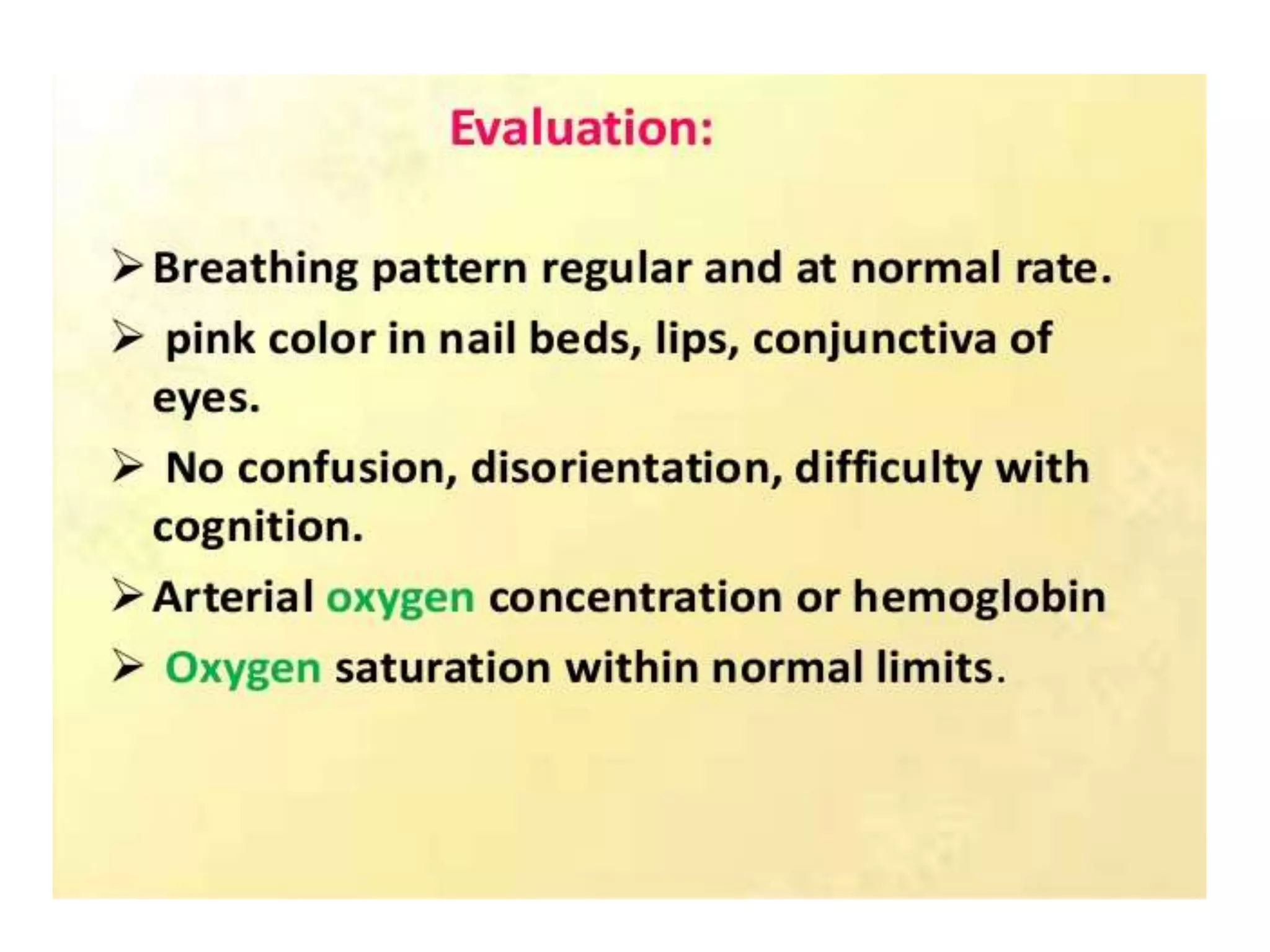
    Preparation • A physician'sorder is required for oxygen therapy, except in emergency use. • Clinical observations. • Oxygen supplemental is determined by inadequate oxygen saturation. • indicated in Artial Blood Gas measurements,(ABGs ) • Pulse Oximetry.
  • 19.
    Cautions For OxygenTherapy • Oxygen toxicity – can occur with FiO2 > 50% longer than 48 hrs • Suppression of ventilation – will lead to increased CO2 and carbon dioxide narcosis • Danger of fire • Infection
  • 21.
    Classification of Oxygen DeliverySystems • Low flow systems – Contribute partially to inspired gas client breathes – Do not provide constant Fio2[fraction /percentage of inspired oxygen] – Ex: nasal cannula, simple mask , non-re breather mask , Partial rebreather mask • High flow systems – Deliver specific and constant percent of oxygen independent of client’s breathing – Ex: Venturi mask,, trach collar, T-piece
  • 22.
    Nasal cannula(NC) • isa thin tube with two small nozzles that protrude into the patient's nostrils. • Most common and inexpensive device • provides oxygen at low flow rates, 2–6 liters per minute (LPM), delivering a concentration of 24–45%. • allows the patient to continue to talk, eat and drink while still receiving the therapy. [home set up] • associated with greater overall safe , comfort, and improved oxygenation and respiratory rates than with face mask oxygen.
  • 24.
    Face mask The simple Oxygenmask The partial rebreather mask: The non rebreather mask: The venturi mask:
  • 25.
    The simple Oxygenmask  Simple mask is made of clear, flexible , plastic or rubber that can be molded to fit the face. It is held to the head with elastic bands.  Some have a metal clip that can be bent over the bridge of the nose for a comfortable fit.  It delivers 35% to 60% oxygen .A flow rate of 6 to 10 liters per minute.  It has vents on its sides which allow room air to leak in at many places, thereby diluting the source oxygen
  • 26.
    Nursing intervetion Monitor clientfrequently to check placement of the mask. Support client if claustrophobia is concern Secure physician's order to replace mask with nasal cannula during meal time Often it is used when an increased delivery of oxygen is needed for short periods (i.e., less than 12 hours)
  • 27.
    Partial rebreathing mask •Has a reservoir bag, which increases the provided oxygen rate to 60–90% oxygen at 6 to 10 LPM. The mask is have with a reservoir bag must romaine inflated during both inspiration & expiration  It collection of the first parts of the patients' exhaled air.
  • 29.
    The non rebreathermask  It is similar to the partial rebreather mask except two, one way valve present.  When the patient exhales air. the one-way valve closes and all of the expired air is deposited into the atmosphere, not the reservoir bag.  In this way, the patient is not rebreathing any of the expired gas.  This mask provides the highest concentration of oxygen [95-100%] at a flow rate 6-15 L/min
  • 30.
    Nursing Interventions This typeof mask is indicated for acute medical emergencies. Maintain flow rate so reservoir bag collapses only slightly during inspiration Check that valves and rubber flaps are function properly (open during expiration ) Monitor SaO2 with pulse oximeter
  • 31.
    Venturi masks [Air-entrainmentmasks]  Has a wide bore tubing and color coded jet adapters ( blue adapter – 24% at 4-10 L/ m; green adapter – 35% at 8 lpm)  The mask is so constructed that there is a constant flow of room air blended with a fixed concentration of oxygen  can accurately deliver a predetermined oxygen concentration to the trachea up to 24 - 50% at 4- 10 L/m .  Each color code corresponds to a precise oxygen concentration and a specific liter flow.
  • 32.
    Nursing intervention Requires carefulmonitoring to verify FiO2 at flow rate ordered Check that air intake valves are not blocked
  • 33.
    Face Tent • Canreplace oxygen mask when masks are poorly tolerated by clients • Provides oxygen concentration at 30 – 50% with flow rates of 4- 8 LPM
  • 34.
    Bag-valve-mask (BVM) orAMBU Bag Artificial Manual Breathing Unit or BVM is hand held device commonly used to provide positive pressure ventilation to patients who are not breathing or not breathing adequately A malleable bag attached to a face mask (or invasive airway such as an endotracheal tube or laryngeal mask airway), usually with a reservoir bag attached, which is manually manipulated by the healthcare professional to push oxygen (or air) into the lungs.  Used in many emergency medical service and first aid personnel
  • 35.
    Tracheostomy Collar/ Mask Inserteddirected into trachea Is indicated for chronic o2 therapy need O2 flow rate 8 to 10 L/M Provides accurate FIO2 Provides good humidity. Comfortable ,more efficient Less expensive
  • 37.
    T-piece  Used onend of ET tube when weaning from ventilator  Provides accurate FIO2  Provides good humidity
  • 38.
  • 39.
    OXYGEN TENT • Anoxygen tent consists of a canopy placed over the head and shoulders, or over the entire body of a patient to provide oxygen at a higher level than normal. • Typically the tent is made of see- through plastic material. • It can envelop the patient’s bed with the end sections held in place by a mattress to ensure that the tent is air tight. • The enclosure often has a side opening with a zipper.
  • 40.
    Oxygen Delivery System CharacteristicConcentration LPM 1. Nasal Cannula provides oxygen at low flow rates 24–45%. , 2–6 litres per minute (LPM), 2. Simple face mask 40 – 60%. 5 - 8 LPM 3. Air-entrainment masks also known as Venturi masks, blue adapter – 24% green adapter – 35% At trachea : 24 - 50% 4-10 lpm; 8 lpm 4- 10 lpm . 4. Partial rebreathing mask – has a reservoir bag 60–90% 6 to 10 LPM. 5. Non-rebreather masks ( reservoir mask), Delivers the highest oxygen concentration Close to 100% of 8-10 LPM or higher, they deliver close to 6. Face Tent 30 – 50% 4- 8 LPM or higher
  • 41.
    Side effect &complication of oxygen therapy  Oxygen toxicity  Retrolental fibroplasia  Absorption atelectasis Oxygen toxicity  It is a condition in which ventilator failure  occurs due to inspiration of a high concentration of oxygen for prolonged period of time.  Oxygen concentration greater than 50% over 24 to 48 hours can cause pathological changes in the lungs.
  • 42.
    • Signs andsymptoms of oxygen toxicity: • • Non-productive cough. • • Nausea and vomiting. • • Substernal chest pain. • • Fatigue. • • Nasal stuffiness. • • Headache. • • Sore throat. • • Hypoventilation. • . Nasal congestion. • . Dyspnea. • . Inspiration pain.
  • 43.
    Retrolental fibroplasia Absorption atelectasis Absorption Atelectasis refers to the condition where the reduction of nitrogen concentration in the lungs causes a collapse. Under normal circumstances, the air you breathe contains nearly 78% of nitrogen. I  t is this nitrogen that helps keep the alveoli or air sacs in the lungs open and functioning properly. Nitrogen provides a certain amount of surface tension that prevents the collapse of the alveoli.  When of oxygen are usually administered.  This decreases people are hospitalized or have undergone surgery and general anesthesia, large amounts the nitrogen concentration in the air and leads to absorption
  • 54.
    References: • Kozier &Erb’s Fundamentals of Nursing . Eighth Edition • Inter net information