Heated Humidified High-
Flow Nasal Cannula
By
Dr. Asmaa Abd El wakeel I brahim
Lecturer of Pediatrics/Neonatology
Al-Azhar Faculty of Medicine for Girls
• Respiratory failure remains a common problem in the
NICU. Concerns with ventilator-induced lung injury
have led to a concerted effort in many NICUs to avoid
prolonged ventilator support through early
application of noninvasive modes of respiratory
support. Heated, humidified high-flow nasal cannula
(HHHFNC) is commonly used as a noninvasive mode
of respiratory support in the NICU
• The use of increased nasal cannula (NC) flow to
deliver positive airway pressure was initially
described by Locke et al. in 1991 in 13 preterm
infants. They reported the potential to deliver
positive pressure with NC flows up to 2 L per minute
(lpm), given a large NC diameter (3 mm). They
cautioned about indiscriminate use of higher flow
rates via NC due to potential for unregulated pressure
delivery.
• Ten years later Sreenan et al used the term “high-
flow nasal cannula” in reporting that NC flows up to
2.5 lpm could be as effective as nCPAP for treating
apnea of prematurity.
• High flow nasal cannula (HFNC) refers to the delivery
of humidified heated and blended oxygen/air at flow
rates greater than 1L/min via nasal cannula.
• HFNC can be used for
• Non-invasive ventilation of extremely preterm /
preterm infants
• Non-invasive ventilation for infants with
parenchymal lung disease (HMD/pneumonia/CLD/
MAS/ pulmonary hypoplasia/ bronchiolitis)
• Treatment/prevention of apnoea of prematurity .
• How does HF work?
• The mechanisms of how High Flow works are
multiple and probably have differential contributions
at different gestations and disease cycles.
• Flush is an important and novel concept, and flush is
improved by having small nasal prongs to allow leak.
• How does HF work?
• Gas conditioning – the evidence is that unconditioned
(i.e. gas that is not fully humidified or at 37 degrees)
causes adverse compliance changes in lung tissue
• HFNC provides some PEEP – the evidence is about 4
cm H2O up to 8 litres/min. However this is not a CPAP
device, and we are not controlling nor weaning PEEP.
Benefits include
•Babies on HFNC appear to be well settled and more
comfortable than babies on CPAP.
•Less abdominal gaseous distension than CPAP
•Babies do not require “time off” for nose breaks or
changes between nasal prongs / masks,
reducing the amount of handling.
Benefits include
•Some evidence for better weight gain and improved
feed tolerance.
•Parents have reported preferring being able to see
more of their babies face.
•Easier access for cranial ultrasound scans and head
circumference measurements.
When to decide HHHFNC is not providing sufficient
support:
•Recurrent / persistent apnoea
•Increasing FiO2
•Increasing work of breathing
•Increasing pCO2 / TcCO2 causing acidosis
may indicate that the baby is not responding well to
Vapotherm treatment
.
Setting up the Vapotherm:
• Attach appropriate sized nasal cannula. Cannula
should not obstruct or be larger than ½ the diameter of
the nares.
•Adjust the flow to the desired rate and place the
cannula on the patient. Operational flow ratesrange
from 1-8 L/min
•Start at flow rate of 7 L/min.
Setting up the Vapotherm:
• Increasing flow (maximum 8L/min): flow can be
increased in increments of 0.5-1 L/min to try to treat
increasing oxygen requirements or apnoea of
prematurity. However other causes(sepsis, worsening
RDS, pneumothorax, exhaustion etc should be
considered) .
• If the baby is requiring FiO2>60%, or has significant
persisting respiratory acidosis (pH<7.2) or apnoea s/he
is likely to need alternative support.
Nursing:
• Minimal handling, quiet and dark appropriately
humidified environment
• Monitoring of heart rate, respiratory rate and SaO2 as
a minimum
• Blood pressure monitoring intermittently unless
UAC/arterial line in place
• Prone position, tilted head up to minimize work of
• breathing
• Nasogastric tube should ensure that nostril not
occluded and than tube does not ‘pull’ nares towards
cheek.
1. Bhandari V et al. Synchronized nasal intermittent
positive-pressure ventilation and neonatal outcomes.
Pediatrics. 2009 Aug;124(2):517-26.
2. Wilkinson D J. Pharyngeal pressure with high-flow
nasal cannula Perinatol 2008;28(1):42-47
3. Saslow JG et al Work of breathing using high-flow
nasal cannula in preterm infants. J. Perinatol
2006;26(8):476-480
4. personal communication (Dr. K Ives, Neonatal
Consultant, Oxford John Radcliffe)
5. Spence KL et al. High flow nasal cannula as a device
to provide continuous positive airway pressure in
infants. J Perinatol 2007;27(12):772-77
!! THANK YOU !!

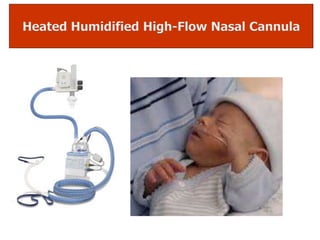
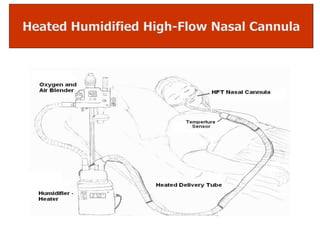
Humidfied nasal cannula

  • 1.
    Heated Humidified High- FlowNasal Cannula By Dr. Asmaa Abd El wakeel I brahim Lecturer of Pediatrics/Neonatology Al-Azhar Faculty of Medicine for Girls
  • 4.
    • Respiratory failureremains a common problem in the NICU. Concerns with ventilator-induced lung injury have led to a concerted effort in many NICUs to avoid prolonged ventilator support through early application of noninvasive modes of respiratory support. Heated, humidified high-flow nasal cannula (HHHFNC) is commonly used as a noninvasive mode of respiratory support in the NICU
  • 5.
    • The useof increased nasal cannula (NC) flow to deliver positive airway pressure was initially described by Locke et al. in 1991 in 13 preterm infants. They reported the potential to deliver positive pressure with NC flows up to 2 L per minute (lpm), given a large NC diameter (3 mm). They cautioned about indiscriminate use of higher flow rates via NC due to potential for unregulated pressure delivery.
  • 6.
    • Ten yearslater Sreenan et al used the term “high- flow nasal cannula” in reporting that NC flows up to 2.5 lpm could be as effective as nCPAP for treating apnea of prematurity.
  • 7.
    • High flownasal cannula (HFNC) refers to the delivery of humidified heated and blended oxygen/air at flow rates greater than 1L/min via nasal cannula. • HFNC can be used for • Non-invasive ventilation of extremely preterm / preterm infants • Non-invasive ventilation for infants with parenchymal lung disease (HMD/pneumonia/CLD/ MAS/ pulmonary hypoplasia/ bronchiolitis) • Treatment/prevention of apnoea of prematurity .
  • 8.
    • How doesHF work? • The mechanisms of how High Flow works are multiple and probably have differential contributions at different gestations and disease cycles. • Flush is an important and novel concept, and flush is improved by having small nasal prongs to allow leak.
  • 9.
    • How doesHF work? • Gas conditioning – the evidence is that unconditioned (i.e. gas that is not fully humidified or at 37 degrees) causes adverse compliance changes in lung tissue • HFNC provides some PEEP – the evidence is about 4 cm H2O up to 8 litres/min. However this is not a CPAP device, and we are not controlling nor weaning PEEP.
  • 10.
    Benefits include •Babies onHFNC appear to be well settled and more comfortable than babies on CPAP. •Less abdominal gaseous distension than CPAP •Babies do not require “time off” for nose breaks or changes between nasal prongs / masks, reducing the amount of handling.
  • 11.
    Benefits include •Some evidencefor better weight gain and improved feed tolerance. •Parents have reported preferring being able to see more of their babies face. •Easier access for cranial ultrasound scans and head circumference measurements.
  • 12.
    When to decideHHHFNC is not providing sufficient support: •Recurrent / persistent apnoea •Increasing FiO2 •Increasing work of breathing •Increasing pCO2 / TcCO2 causing acidosis may indicate that the baby is not responding well to Vapotherm treatment .
  • 13.
    Setting up theVapotherm: • Attach appropriate sized nasal cannula. Cannula should not obstruct or be larger than ½ the diameter of the nares. •Adjust the flow to the desired rate and place the cannula on the patient. Operational flow ratesrange from 1-8 L/min •Start at flow rate of 7 L/min.
  • 14.
    Setting up theVapotherm: • Increasing flow (maximum 8L/min): flow can be increased in increments of 0.5-1 L/min to try to treat increasing oxygen requirements or apnoea of prematurity. However other causes(sepsis, worsening RDS, pneumothorax, exhaustion etc should be considered) . • If the baby is requiring FiO2>60%, or has significant persisting respiratory acidosis (pH<7.2) or apnoea s/he is likely to need alternative support.
  • 15.
    Nursing: • Minimal handling,quiet and dark appropriately humidified environment • Monitoring of heart rate, respiratory rate and SaO2 as a minimum • Blood pressure monitoring intermittently unless UAC/arterial line in place • Prone position, tilted head up to minimize work of • breathing • Nasogastric tube should ensure that nostril not occluded and than tube does not ‘pull’ nares towards cheek.
  • 16.
    1. Bhandari Vet al. Synchronized nasal intermittent positive-pressure ventilation and neonatal outcomes. Pediatrics. 2009 Aug;124(2):517-26. 2. Wilkinson D J. Pharyngeal pressure with high-flow nasal cannula Perinatol 2008;28(1):42-47 3. Saslow JG et al Work of breathing using high-flow nasal cannula in preterm infants. J. Perinatol 2006;26(8):476-480 4. personal communication (Dr. K Ives, Neonatal Consultant, Oxford John Radcliffe) 5. Spence KL et al. High flow nasal cannula as a device to provide continuous positive airway pressure in infants. J Perinatol 2007;27(12):772-77
  • 17.