Oxygen therapy
By

Adel Alrihili
BSN-RN
Out line
 Definition of the oxygen therapy
 Types of oxygen therapy
 purposes of using the oxygen therapy
 Administration of oxygen therapy
 Complication of oxygen therapy
Learning objectives:
 Define the oxygen therapy
 Discuss the type of c oxygen therapy
 List the purpose of using the oxygen
therapy
 Explain the procedure
 Demonstrate the procedure
 List Complication of oxygen therapy
Oxygen therapy
Definition:
 Oxygen is a colorless, odorless,
tasteless gas that is essential for the
body to function properly and to
survive.
What is meaning of O2 therapy
Oxygen therapy is the administration of
oxygen at a concentration of pressure
greater than that found in the
environmental atmosphere
The air that we breathe contain
approximately 21% oxygen
the heart relies on oxygen to pump
blood.
Purpose

Oxygen therapy is a key treatment
in respiratory care.
The purpose is to increase oxygen
saturation in tissues where the
saturation levels are too low due to
illness or injury.
oxygen therapy is used to treat
Example in case : Documented hypoxemia
 Severe respiratory distress (acute asthma
or pneumonia)
 Severe trauma
 Chronic obstructive pulmonary disease
(COPD, including chronic bronchitis,
emphysema, and chronic asthma)
oxygen therapy is used to
treat

 Pulmonary hypertension
 Acute myocardial infarction (heart
attack)
 Short-term therapy, such as postanesthesia recovery
 Oxygen may also be used to treat
chronic lung disease patients during
exercise .
Preparation
 A physician's order is required for oxygen
therapy, except in emergency use.
 Clinical observations.
 indicated in Artial Blood Gas
measurements,(ABGs ) .
 Pulse Oximetry.
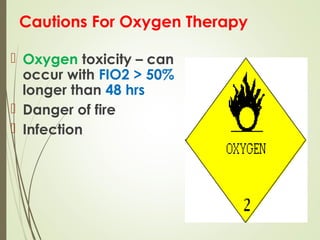
Cautions For Oxygen Therapy
 Oxygen toxicity – can
occur with FIO2 > 50%
longer than 48 hrs
 Danger of fire
 Infection
Classification of Oxygen Delivery
Systems
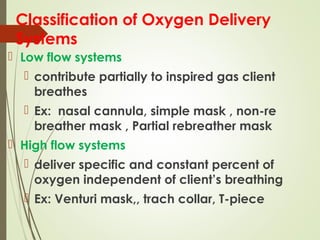
 Low flow systems
 contribute partially to inspired gas client
breathes
 Ex: nasal cannula, simple mask , non-re
breather mask , Partial rebreather mask
 High flow systems
 deliver specific and constant percent of
oxygen independent of client’s breathing
 Ex: Venturi mask,, trach collar, T-piece
: Methods of oxygen administration
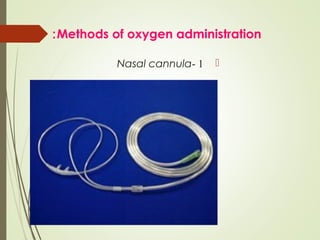
Nasal cannula- 1


Nasal cannula


It is a disposable.

plastic devise with two protruding
prongs for insertion into the nostrils,
connected to an oxygen source.
Used for low-medium concentrations of
Oxygen (24-44%).
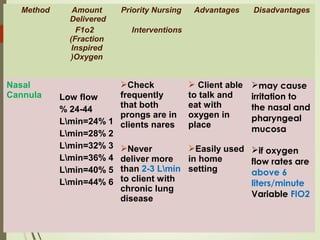
Method

Nasal
Cannula

Amount
Delivered
F1o2
(Fraction
Inspired
(Oxygen

Priority Nursing

Advantages

Disadvantages

 Client able
to talk and
eat with
oxygen in
place

may cause
irritation to
the nasal and
pharyngeal
mucosa

Interventions

Check
frequently
Low flow
that both
% 24-44
prongs are in
Lmin=24% 1 clients nares
Lmin=28% 2
Lmin=32% 3 Never
Lmin=36% 4 deliver more
Lmin=40% 5 than 2-3 Lmin
Lmin=44% 6 to client with
chronic lung
disease

Easily used if oxygen
in home
flow rates are
setting
above 6
liters/minute
Variable FIO2
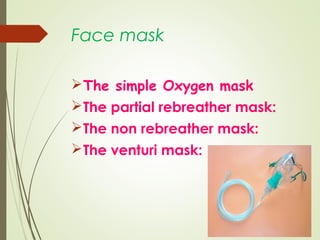
Face mask
 The simple Oxygen mask
 The partial rebreather mask:
 The non rebreather mask:
 The venturi mask:
The simple Oxygen mask

Simple mask is made of
clear, flexible , plastic or
rubber that can be molded
to fit the face.
The simple Oxygen mask
 It delivers 35% to 60% oxygen .
 A flow rate of 6 to 10 liters per minute.
 Often it is used when an increased
delivery of oxygen is needed for short
periods
 (i.e., less than 12 hours).
: The partial rebreather mask
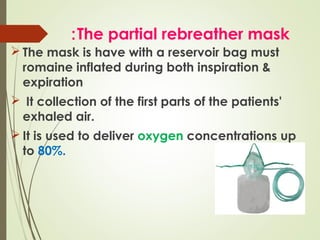
 The mask is have with a reservoir bag must
romaine inflated during both inspiration &
expiration
 It collection of the first parts of the patients'
exhaled air.
 It is used to deliver oxygen concentrations up
to 80%.
The partial rebreather mask
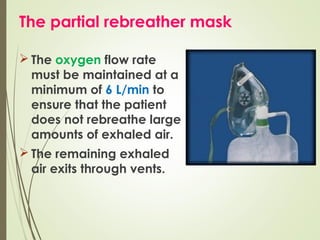
 The oxygen flow rate
must be maintained at a
minimum of 6 L/min to
ensure that the patient
does not rebreathe large
amounts of exhaled air.
 The remaining exhaled
air exits through vents.
The non rebreather mask


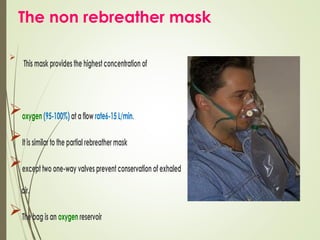
This mask provides the highest concentration of

oxygen (95-100%) at a flow rate6-15 L/min.
It is similar to the partial rebreather mask
except two one-way valves prevent conservation of exhaled
air.

The bag is an oxygen reservoir
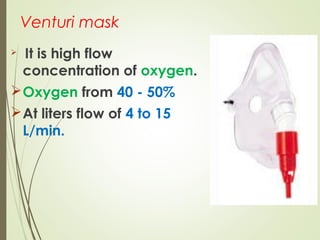
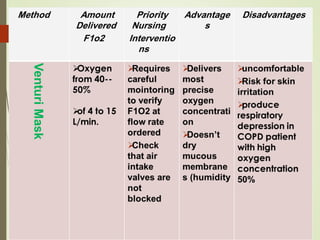
Venturi mask


It is high flow
concentration of oxygen.

 Oxygen from 40 - 50%
 At liters flow of 4 to 15
L/min.
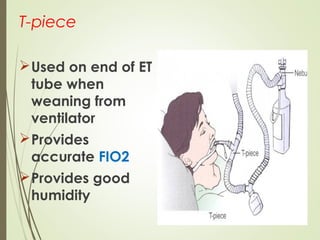
T-piece
 Used on end of ET
tube when
weaning from
ventilator
 Provides
accurate FIO2
 Provides good
humidity
Side effect & complication
of oxygen therapy
Oxygen toxicity
Retrolental fibroplasia
Absorption atelectasis
oxygen toxicity
It is a condition in which ventilator failure
 occurs due to inspiration of a high
concentration of oxygen for aprolonged
period of time.
 Oxygen concentration greater than 50%
over 24 to 48 hours can cause
pathological changes in the lungs.
:Signs and symptoms of oxygen toxicity

. Non-productive cough•
.Nausea and vomiting•
.Substernal chest pain•
.Fatigue•
.Nasal stuffiness•
.Headache•
.Sore throat•
.Hypoventilation•
.Nasal congestion.
.Dyspnea.
.Inspiration pain .
: Evaluation
 Breathing pattern regular and at normal
rate.
 pink color in nail beds, lips, conjunctiva
of eyes.
 No confusion, disorientation, difficulty
with cognition.
 Arterial oxygen concentration or
hemoglobin
 Oxygen saturation within normal limits.
: Documentation

Date and time oxygen started.
Method of delivery.
Oxygen concentration and flow
rate.
Patient observation.
Add oronasal care to the nursing
care plan
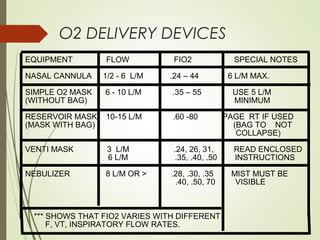
O2 DELIVERY DEVICES
EQUIPMENT

FLOW

FIO2

NASAL CANNULA

1/2 - 6 L/M

.24 – 44

SIMPLE O2 MASK
(WITHOUT BAG)

6 - 10 L/M

.35 – 55

RESERVOIR MASK
(MASK WITH BAG)

10-15 L/M

.60 -80

VENTI MASK

3 L/M
6 L/M

.24, 26, 31,
.35, .40, .50

NEBULIZER

8 L/M OR >

.28, .30, .35
.40, .50, 70

*** SHOWS THAT FIO2 VARIES WITH DIFFERENT
F, VT, INSPIRATORY FLOW RATES.

SPECIAL NOTES
6 L/M MAX.
USE 5 L/M
MINIMUM
PAGE RT IF USED
(BAG TO NOT
COLLAPSE)
READ ENCLOSED
INSTRUCTIONS
MIST MUST BE
VISIBLE
Oxygen therapy

Oxygen therapy

  • 1.
  • 2.
    Out line  Definitionof the oxygen therapy  Types of oxygen therapy  purposes of using the oxygen therapy  Administration of oxygen therapy  Complication of oxygen therapy
  • 3.
    Learning objectives:  Definethe oxygen therapy  Discuss the type of c oxygen therapy  List the purpose of using the oxygen therapy  Explain the procedure  Demonstrate the procedure  List Complication of oxygen therapy
  • 4.
    Oxygen therapy Definition:  Oxygenis a colorless, odorless, tasteless gas that is essential for the body to function properly and to survive.
  • 5.
    What is meaningof O2 therapy Oxygen therapy is the administration of oxygen at a concentration of pressure greater than that found in the environmental atmosphere The air that we breathe contain approximately 21% oxygen the heart relies on oxygen to pump blood.
  • 6.
    Purpose Oxygen therapy isa key treatment in respiratory care. The purpose is to increase oxygen saturation in tissues where the saturation levels are too low due to illness or injury.
  • 7.
    oxygen therapy isused to treat Example in case : Documented hypoxemia  Severe respiratory distress (acute asthma or pneumonia)  Severe trauma  Chronic obstructive pulmonary disease (COPD, including chronic bronchitis, emphysema, and chronic asthma)
  • 8.
    oxygen therapy isused to treat  Pulmonary hypertension  Acute myocardial infarction (heart attack)  Short-term therapy, such as postanesthesia recovery  Oxygen may also be used to treat chronic lung disease patients during exercise .
  • 9.
    Preparation  A physician'sorder is required for oxygen therapy, except in emergency use.  Clinical observations.  indicated in Artial Blood Gas measurements,(ABGs ) .  Pulse Oximetry.
  • 11.
    Cautions For OxygenTherapy  Oxygen toxicity – can occur with FIO2 > 50% longer than 48 hrs  Danger of fire  Infection
  • 13.
    Classification of OxygenDelivery Systems  Low flow systems  contribute partially to inspired gas client breathes  Ex: nasal cannula, simple mask , non-re breather mask , Partial rebreather mask  High flow systems  deliver specific and constant percent of oxygen independent of client’s breathing  Ex: Venturi mask,, trach collar, T-piece
  • 14.
    : Methods ofoxygen administration Nasal cannula- 1 
  • 15.
    Nasal cannula  It isa disposable. plastic devise with two protruding prongs for insertion into the nostrils, connected to an oxygen source. Used for low-medium concentrations of Oxygen (24-44%).
  • 16.
    Method Nasal Cannula Amount Delivered F1o2 (Fraction Inspired (Oxygen Priority Nursing Advantages Disadvantages  Clientable to talk and eat with oxygen in place may cause irritation to the nasal and pharyngeal mucosa Interventions Check frequently Low flow that both % 24-44 prongs are in Lmin=24% 1 clients nares Lmin=28% 2 Lmin=32% 3 Never Lmin=36% 4 deliver more Lmin=40% 5 than 2-3 Lmin Lmin=44% 6 to client with chronic lung disease Easily used if oxygen in home flow rates are setting above 6 liters/minute Variable FIO2
  • 18.
    Face mask  Thesimple Oxygen mask  The partial rebreather mask:  The non rebreather mask:  The venturi mask:
  • 19.
    The simple Oxygenmask Simple mask is made of clear, flexible , plastic or rubber that can be molded to fit the face.
  • 20.
    The simple Oxygenmask  It delivers 35% to 60% oxygen .  A flow rate of 6 to 10 liters per minute.  Often it is used when an increased delivery of oxygen is needed for short periods  (i.e., less than 12 hours).
  • 22.
    : The partialrebreather mask  The mask is have with a reservoir bag must romaine inflated during both inspiration & expiration  It collection of the first parts of the patients' exhaled air.  It is used to deliver oxygen concentrations up to 80%.
  • 23.
    The partial rebreathermask  The oxygen flow rate must be maintained at a minimum of 6 L/min to ensure that the patient does not rebreathe large amounts of exhaled air.  The remaining exhaled air exits through vents.
  • 24.
    The non rebreathermask  This mask provides the highest concentration of oxygen (95-100%) at a flow rate6-15 L/min. It is similar to the partial rebreather mask except two one-way valves prevent conservation of exhaled air. The bag is an oxygen reservoir
  • 27.
    Venturi mask  It ishigh flow concentration of oxygen.  Oxygen from 40 - 50%  At liters flow of 4 to 15 L/min.
  • 29.
    T-piece  Used onend of ET tube when weaning from ventilator  Provides accurate FIO2  Provides good humidity
  • 30.
    Side effect &complication of oxygen therapy Oxygen toxicity Retrolental fibroplasia Absorption atelectasis
  • 31.
    oxygen toxicity It isa condition in which ventilator failure  occurs due to inspiration of a high concentration of oxygen for aprolonged period of time.  Oxygen concentration greater than 50% over 24 to 48 hours can cause pathological changes in the lungs.
  • 32.
    :Signs and symptomsof oxygen toxicity . Non-productive cough• .Nausea and vomiting• .Substernal chest pain• .Fatigue• .Nasal stuffiness• .Headache• .Sore throat• .Hypoventilation• .Nasal congestion. .Dyspnea. .Inspiration pain .
  • 33.
    : Evaluation  Breathingpattern regular and at normal rate.  pink color in nail beds, lips, conjunctiva of eyes.  No confusion, disorientation, difficulty with cognition.  Arterial oxygen concentration or hemoglobin  Oxygen saturation within normal limits.
  • 34.
    : Documentation Date andtime oxygen started. Method of delivery. Oxygen concentration and flow rate. Patient observation. Add oronasal care to the nursing care plan
  • 35.
    O2 DELIVERY DEVICES EQUIPMENT FLOW FIO2 NASALCANNULA 1/2 - 6 L/M .24 – 44 SIMPLE O2 MASK (WITHOUT BAG) 6 - 10 L/M .35 – 55 RESERVOIR MASK (MASK WITH BAG) 10-15 L/M .60 -80 VENTI MASK 3 L/M 6 L/M .24, 26, 31, .35, .40, .50 NEBULIZER 8 L/M OR > .28, .30, .35 .40, .50, 70 *** SHOWS THAT FIO2 VARIES WITH DIFFERENT F, VT, INSPIRATORY FLOW RATES. SPECIAL NOTES 6 L/M MAX. USE 5 L/M MINIMUM PAGE RT IF USED (BAG TO NOT COLLAPSE) READ ENCLOSED INSTRUCTIONS MIST MUST BE VISIBLE