3 BASIC ESSENTIAL IN LIFE
 OXYGEN


 WATER


 FOOD
DEFINITION:
OXYGEN
 Element, gas, and drug.


OXYGEN THERAPY
 Is the administration of oxygen at concentrations
 greater than that in room air to treat or prevent
 hypoxemia.
WHAT IS HYPOXIA AND TYPES
HYPOXIA
 A condition of insufficient oxygen anywhere in the body
  from the inspired gas to the tissue.

TYPES OF HYPOXIA
 Hypoxemic hypoxia
 Circulatory hypoxia
 Hematological hypoxia
 Demand hypoxia
 Histotoxic hypoxia
SIGNS AND SYMPTOMS
 Tachypnea, dyspnea, hyperpnoea.
 Tachycardia, dysrhythmias, pulse
  change, hypertension.
 Anemia, polycythemia.
 Restlessness, disorientation, lethargy.
 Cyanosis, digital clubbing.
INDICATIONS FOR OXYGEN
THERAPY
1. Treat hypoxia


2. Decrease the work of breathing


3. Decrease myocardial work


4. Severe trauma


5. Short term/long term, post operative
OXYGEN FLOW RATES
 Determines the amount of oxygen delivered to the
 patient.

 Measured in LITERS PER MINUTE (litrs/min).


 Rate varies according to patient condition and route
 of O2 administration.
OXYGEN DELIVERY SYSTEMS
LOW FLOW
 Do not provide a constant or known concentration of
 inspired O2.
EXAMPLE- Nasal, face, partial, non-rebreather ..
HIGH FLOW
 Provide the total inspired air.
 Specific % of O2 is delivered independently.
 Requires constant & precise amount.
EXAMLE- Transtracheal, venturi, T- piece, face tent..
O2 ADMINISTRATION DEVICES
     cannula          1-6    24%-45%
   Facial mask        5-8    40%-60%
Partial rebreather   6-10    60%-90%
 Nonrebreather       10-15   95%-100%
    Venturi           4-8     24%-50%
   Face tent          4-8     30%-50%
NASAL PRONGS OR NASAL
       CANNULA
ADVANTAGES
 Common inexpensive device
 Easy to apply
 Does not interfere with eating and talking
 Relatively comfortable
 Permits freedom of movement
 Well tolerated by clients
DISADVANTAGES
 Delivers relatively low concentration
  of O2 (24%-45%) at a flow rate of
  2Lits-6Lits/Min.
 Above 6Lits/Min patient tends to
  swallow air and feels uncomfortable, hence FiO2
  cannot be increased
FACE MASKS

 Oxygen mask is fitted
Carefully to avoid leakage
Of O2.

 Shouldn’t be too tight.
COMMONLY USED TYPES OF
MASKS ARE-
 Simple face mask


 High concentration mask


 Venturi mask
SIMPLE FACE MASK
 Has vents on the sides for the
 room air to leak in and there by
 diluting the source of O2.

 Also allows exhaled CO2 to escape.


 Used when increased O2 delivery is
 needed for shorter periods.
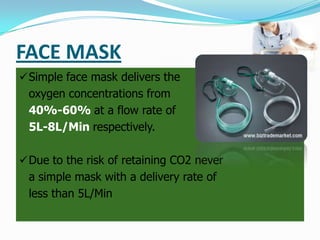
FACE MASK
 Simple face mask delivers the
 oxygen concentrations from
 40%-60% at a flow rate of
 5L-8L/Min respectively.

 Due to the risk of retaining CO2 never
 a simple mask with a delivery rate of
 less than 5L/Min
HIGH CONCENTRATION MASK/
NON REBREATHER MASK
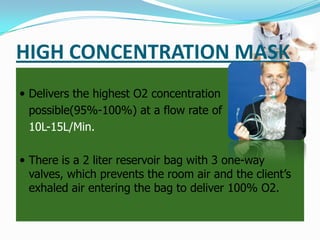
HIGH CONCENTRATION MASK
 Delivers the highest O2 concentration
 possible(95%-100%) at a flow rate of
 10L-15L/Min.

 There is a 2 liter reservoir bag with 3 one-way
 valves, which prevents the room air and the client’s
 exhaled air entering the bag to deliver 100% O2.
VENTURI MASK
VENTURI MASK
 It delivers O2 concentrations
 varying from 24%-60% at a
 flow rates of 4L-10L.

 It is a medical device to deliver a known oxygen
 concentration to patients on controlled oxygen
 therapy.
VENTURI MASK
  The color of the device reflects the delivered
             oxygen concentration:
  BLUE-24%, WHITE-28%, ORANGE-31%
   YELLOW-35%, RED-40%, GREEN-60%
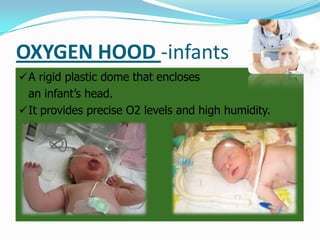
OXYGEN HOOD -infants
 A rigid plastic dome that encloses
  an infant’s head.
 It provides precise O2 levels and high humidity.
Nurse’s Responsibility

 The gas should not be
 allowed to blow directly
 into infants face.

 Hood should not rub against infant’s chin, neck or
 shoulder.
OXYGEN TENT-children
 Rectangular, clear, plastic
  canopy with outlets that
  connects to oxygen which
  is humidified.
 O2 flow should be 15L/Min
  for 5Mins initially and then
   adjust according to orders (delivers approx. 30%
  O2)
TRANSTRACHEAL 02 CATHETER
OXYGEN T-PIECE
 The Oxygen T-Piece is used for delivering oxygen to
 patients with a tracheostomy tube in situ.
NURSING RESPONSIBILITIES
ASSESSMENT
 Skin and mucus membrane.
 Breathing patterns.
 Chest movements.
 Lung sounds.
 Presence of clinical signs of hypoxemia.
 Presence of clinical signs of O2 toxicity.
GOLDEN RULE
“YOU SHOULD NEVER
STOP GIVING OXYGEN TO
A PATIENT IN NEED”
SOP (CARE HOSPITALS)
(Standard Operating Procedure)
 AIM :
       To provide guidelines during oxygen therapy.
 SCOPE :
       This procedure is applicable for nurses associates to
  care of the patients who require oxygen administration.
 RESPONSIBILITY :
       Assigned Nurse.
 ACCOUNTABILITY :
       Nurse manager.
SOP (CARE HOSPITALS)
(Standard Operating Procedure)
ARTICLES RERUIRED
1. Nasal cannula/oxygen mask/reservoir mask/trans tracheal
   catheter/non rebreather mask/ventilator.
2. Humidifier.
3. Oxygen source.
4. Gauze pads if applicable.
5. Pulse oxymeter.
PROCEDURE
1. Identify the patient
2. Check doctors order
3. Assess the patient for the signs and symptoms associated
SOP (CARE HOSPITALS)
(Standard Operating Procedure)
  with hypoxia.
4. Explain the procedure to the patient.
5. Provide comfortable position.
6. Record the vital signs and SPO2.
7. Perform hand hygiene.
8. Check proper functioning of equipment.
9. Administer oxygen by appropriate device as per
    requirement.
10. Use a clean flow meter with humidifier.
11. Monitor SPO2 during the procedure.
SOP (CARE HOSPITALS)
(Standard Operating Procedure)
12. Check the O2 supply and connections & patients
    comfort.
13. Record the date, time and flow rate of O2
    administration.
14. Do not permit smoking near O2 equipment.
oxygen therapy

oxygen therapy

  • 2.
    3 BASIC ESSENTIALIN LIFE  OXYGEN  WATER  FOOD
  • 3.
    DEFINITION: OXYGEN  Element, gas,and drug. OXYGEN THERAPY  Is the administration of oxygen at concentrations greater than that in room air to treat or prevent hypoxemia.
  • 4.
    WHAT IS HYPOXIAAND TYPES HYPOXIA  A condition of insufficient oxygen anywhere in the body from the inspired gas to the tissue. TYPES OF HYPOXIA  Hypoxemic hypoxia  Circulatory hypoxia  Hematological hypoxia  Demand hypoxia  Histotoxic hypoxia
  • 5.
    SIGNS AND SYMPTOMS Tachypnea, dyspnea, hyperpnoea.  Tachycardia, dysrhythmias, pulse change, hypertension.  Anemia, polycythemia.  Restlessness, disorientation, lethargy.  Cyanosis, digital clubbing.
  • 6.
    INDICATIONS FOR OXYGEN THERAPY 1.Treat hypoxia 2. Decrease the work of breathing 3. Decrease myocardial work 4. Severe trauma 5. Short term/long term, post operative
  • 7.
    OXYGEN FLOW RATES Determines the amount of oxygen delivered to the patient.  Measured in LITERS PER MINUTE (litrs/min).  Rate varies according to patient condition and route of O2 administration.
  • 8.
    OXYGEN DELIVERY SYSTEMS LOWFLOW  Do not provide a constant or known concentration of inspired O2. EXAMPLE- Nasal, face, partial, non-rebreather .. HIGH FLOW  Provide the total inspired air.  Specific % of O2 is delivered independently.  Requires constant & precise amount. EXAMLE- Transtracheal, venturi, T- piece, face tent..
  • 9.
    O2 ADMINISTRATION DEVICES cannula 1-6 24%-45% Facial mask 5-8 40%-60% Partial rebreather 6-10 60%-90% Nonrebreather 10-15 95%-100% Venturi 4-8 24%-50% Face tent 4-8 30%-50%
  • 10.
    NASAL PRONGS ORNASAL CANNULA
  • 11.
    ADVANTAGES  Common inexpensivedevice  Easy to apply  Does not interfere with eating and talking  Relatively comfortable  Permits freedom of movement  Well tolerated by clients
  • 12.
    DISADVANTAGES  Delivers relativelylow concentration of O2 (24%-45%) at a flow rate of 2Lits-6Lits/Min.  Above 6Lits/Min patient tends to swallow air and feels uncomfortable, hence FiO2 cannot be increased
  • 13.
    FACE MASKS  Oxygenmask is fitted Carefully to avoid leakage Of O2.  Shouldn’t be too tight.
  • 14.
    COMMONLY USED TYPESOF MASKS ARE-  Simple face mask  High concentration mask  Venturi mask
  • 15.
    SIMPLE FACE MASK Has vents on the sides for the room air to leak in and there by diluting the source of O2.  Also allows exhaled CO2 to escape.  Used when increased O2 delivery is needed for shorter periods.
  • 16.
    FACE MASK  Simpleface mask delivers the oxygen concentrations from 40%-60% at a flow rate of 5L-8L/Min respectively.  Due to the risk of retaining CO2 never a simple mask with a delivery rate of less than 5L/Min
  • 17.
  • 18.
    HIGH CONCENTRATION MASK Delivers the highest O2 concentration possible(95%-100%) at a flow rate of 10L-15L/Min.  There is a 2 liter reservoir bag with 3 one-way valves, which prevents the room air and the client’s exhaled air entering the bag to deliver 100% O2.
  • 19.
  • 20.
    VENTURI MASK  Itdelivers O2 concentrations varying from 24%-60% at a flow rates of 4L-10L.  It is a medical device to deliver a known oxygen concentration to patients on controlled oxygen therapy.
  • 21.
    VENTURI MASK The color of the device reflects the delivered oxygen concentration: BLUE-24%, WHITE-28%, ORANGE-31% YELLOW-35%, RED-40%, GREEN-60%
  • 22.
  • 23.
    OXYGEN HOOD -infants A rigid plastic dome that encloses an infant’s head.  It provides precise O2 levels and high humidity.
  • 24.
    Nurse’s Responsibility  Thegas should not be allowed to blow directly into infants face.  Hood should not rub against infant’s chin, neck or shoulder.
  • 25.
    OXYGEN TENT-children  Rectangular,clear, plastic canopy with outlets that connects to oxygen which is humidified.  O2 flow should be 15L/Min for 5Mins initially and then adjust according to orders (delivers approx. 30% O2)
  • 26.
  • 27.
    OXYGEN T-PIECE  TheOxygen T-Piece is used for delivering oxygen to patients with a tracheostomy tube in situ.
  • 28.
    NURSING RESPONSIBILITIES ASSESSMENT  Skinand mucus membrane.  Breathing patterns.  Chest movements.  Lung sounds.  Presence of clinical signs of hypoxemia.  Presence of clinical signs of O2 toxicity.
  • 29.
    GOLDEN RULE “YOU SHOULDNEVER STOP GIVING OXYGEN TO A PATIENT IN NEED”
  • 30.
    SOP (CARE HOSPITALS) (StandardOperating Procedure)  AIM : To provide guidelines during oxygen therapy.  SCOPE : This procedure is applicable for nurses associates to care of the patients who require oxygen administration.  RESPONSIBILITY : Assigned Nurse.  ACCOUNTABILITY : Nurse manager.
  • 31.
    SOP (CARE HOSPITALS) (StandardOperating Procedure) ARTICLES RERUIRED 1. Nasal cannula/oxygen mask/reservoir mask/trans tracheal catheter/non rebreather mask/ventilator. 2. Humidifier. 3. Oxygen source. 4. Gauze pads if applicable. 5. Pulse oxymeter. PROCEDURE 1. Identify the patient 2. Check doctors order 3. Assess the patient for the signs and symptoms associated
  • 32.
    SOP (CARE HOSPITALS) (StandardOperating Procedure) with hypoxia. 4. Explain the procedure to the patient. 5. Provide comfortable position. 6. Record the vital signs and SPO2. 7. Perform hand hygiene. 8. Check proper functioning of equipment. 9. Administer oxygen by appropriate device as per requirement. 10. Use a clean flow meter with humidifier. 11. Monitor SPO2 during the procedure.
  • 33.
    SOP (CARE HOSPITALS) (StandardOperating Procedure) 12. Check the O2 supply and connections & patients comfort. 13. Record the date, time and flow rate of O2 administration. 14. Do not permit smoking near O2 equipment.