BASIC
CRYSTALLOGRAPHY
EARTH AND LIFE SCIENCE
DEFINITION
Crystallography is the branch of science that deals with
discerning the arrangement or sequence of the atoms’ bonding
as well as its geometric structure of its crystal lattices
DEFINITION
Crystallographers uses the properties and inner structures of
crystals to determine the arrangement of atoms and share the
known information or data to other scientific professionals such
as chemists, physicists, pharmacists, biochemists, etc.
DEFINITION
The pharmaceutical and biochemical fields rely extensively on
crystallographic studies. Many important pharmaceuticals are
administered in crystalline form, and detailed descriptions of
their crystal structures provide evidence to verify claims in
patents.
X-RAY CRYSTALLOGRAPHY
▪ A branch of crystallography that determines the atomic and
molecular structure of a crystal in three-dimensional (3-D)
space
▪ Fundamental in the development of many scientific fields
▪ Principle: A beam of X-Rays causes the crystal to diffract into
different directions
X-RAY CRYSTALLOGRAPHY
▪ The arrangement of the atoms needs to be in an ordered,
periodic structure in order for them to diffract the x-ray
beams.
SIR WILLIAM LAWRENCE BRAGG
▪ British physicist and crystallographer
▪ At age 25, he became the youngest recipient of the Nobel
Laureate for Physics
▪ He observed the diffraction pattern that could be used in
determining the atom’s position of the crystal
▪ He became a pioneer of X-Ray Crystallography
BRAGG’s LAW
When the x-ray is incident onto a crystal surface, its angle of
incidence, θ, will reflect back with a same angle of scattering, θ.
And, when the path difference, d, is equal to a whole number, n,
of wavelength, a constructive interference will occur.
BRAGG’s LAW
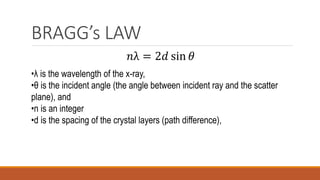
𝑛λ = 2𝑑 sin 𝜃
•λ is the wavelength of the x-ray,
•θ is the incident angle (the angle between incident ray and the scatter
plane), and
•n is an integer
•d is the spacing of the crystal layers (path difference),
PETER JOSEPH DEBYE
▪ Dutch-American physicist
▪ He studied under theoretical physicist, Arnold Sommerfield in
Aachen University of Technology
▪ Solved the effect of temperature on X-Ray diffraction patterns
of crystalline solids
VICTOR GOLDSCHMIDT
▪ “Founder of Modern Geochemistry and Crystal Chemistry”
▪ Studied the courses of Inorganic chemistry, geology,
mineralogy, physics, mathematics and zoology at University of
Oslo
▪ He was one of the scientists who developed rules for
eliminating chemically unlikely structures and for determining
the relative sizes of atoms.
ANGSTROM (Å)
▪ Named after Andres Jonas Ångström, a Swedish physicist
▪ Unit of measurement used in X-Ray crystallography
▪ 1 Å = 0.1 nanometers or 10−10
𝑚𝑒𝑡𝑒𝑟𝑠
SINGLE X-RAY DIFFRACTION
MEASUREMENT
▪ The crystal must be larger than 0.1 millimeter in all
dimensions with no internal imperfections
▪ Then, it is mounted on a goniometer, a tool used to accurately
record the angular position of an object
▪ The crystal is illuminated with a finely
focused monochromatic beam of X-rays, producing
a diffraction pattern of regularly spaced spots known
as reflections.

Earth and Life Science - Basic Crystallography

  • 1.
  • 2.
    DEFINITION Crystallography is thebranch of science that deals with discerning the arrangement or sequence of the atoms’ bonding as well as its geometric structure of its crystal lattices
  • 3.
    DEFINITION Crystallographers uses theproperties and inner structures of crystals to determine the arrangement of atoms and share the known information or data to other scientific professionals such as chemists, physicists, pharmacists, biochemists, etc.
  • 4.
    DEFINITION The pharmaceutical andbiochemical fields rely extensively on crystallographic studies. Many important pharmaceuticals are administered in crystalline form, and detailed descriptions of their crystal structures provide evidence to verify claims in patents.
  • 5.
    X-RAY CRYSTALLOGRAPHY ▪ Abranch of crystallography that determines the atomic and molecular structure of a crystal in three-dimensional (3-D) space ▪ Fundamental in the development of many scientific fields ▪ Principle: A beam of X-Rays causes the crystal to diffract into different directions
  • 6.
    X-RAY CRYSTALLOGRAPHY ▪ Thearrangement of the atoms needs to be in an ordered, periodic structure in order for them to diffract the x-ray beams.
  • 7.
    SIR WILLIAM LAWRENCEBRAGG ▪ British physicist and crystallographer ▪ At age 25, he became the youngest recipient of the Nobel Laureate for Physics ▪ He observed the diffraction pattern that could be used in determining the atom’s position of the crystal ▪ He became a pioneer of X-Ray Crystallography
  • 8.
    BRAGG’s LAW When thex-ray is incident onto a crystal surface, its angle of incidence, θ, will reflect back with a same angle of scattering, θ. And, when the path difference, d, is equal to a whole number, n, of wavelength, a constructive interference will occur.
  • 9.
    BRAGG’s LAW 𝑛λ =2𝑑 sin 𝜃 •λ is the wavelength of the x-ray, •θ is the incident angle (the angle between incident ray and the scatter plane), and •n is an integer •d is the spacing of the crystal layers (path difference),
  • 10.
    PETER JOSEPH DEBYE ▪Dutch-American physicist ▪ He studied under theoretical physicist, Arnold Sommerfield in Aachen University of Technology ▪ Solved the effect of temperature on X-Ray diffraction patterns of crystalline solids
  • 11.
    VICTOR GOLDSCHMIDT ▪ “Founderof Modern Geochemistry and Crystal Chemistry” ▪ Studied the courses of Inorganic chemistry, geology, mineralogy, physics, mathematics and zoology at University of Oslo ▪ He was one of the scientists who developed rules for eliminating chemically unlikely structures and for determining the relative sizes of atoms.
  • 12.
    ANGSTROM (Å) ▪ Namedafter Andres Jonas Ångström, a Swedish physicist ▪ Unit of measurement used in X-Ray crystallography ▪ 1 Å = 0.1 nanometers or 10−10 𝑚𝑒𝑡𝑒𝑟𝑠
  • 13.
    SINGLE X-RAY DIFFRACTION MEASUREMENT ▪The crystal must be larger than 0.1 millimeter in all dimensions with no internal imperfections ▪ Then, it is mounted on a goniometer, a tool used to accurately record the angular position of an object ▪ The crystal is illuminated with a finely focused monochromatic beam of X-rays, producing a diffraction pattern of regularly spaced spots known as reflections.