CRYSTALLOGRAPHY
INTRO
INTRODUCTION
● The matters in this world are classified
as solids, liquids and gases.
● These materials are made up ofatoms
and molecules.
● Materials differ from one another on
their properties.
● These differences in properties of the
solids are due to their structures.
● The behaviour of a solid material is
closely related to its structure.
CLASSIFICATION OF SOLIDS
On the basis of crystal structure
materials are broadly classified as
(i) Crystalline solids
(ii) Non-Crystalline or
Amorphous solids
(i) Crystalline solids
Materials in which the atoms are
arranged in systematic pattern are known
as crystalline solids.
They have well defined
geometrical form.
Eg: Diamond, copper, platinum, silver,
polonium, etc.
The crystals are of two forms:
1. Single crystal 2. Poly crystal
--- Single crystal contains only
one crystal.
--- Poly crystal is an aggregate of
many small crystals separated by well
defined grain boundaries.
(ii) Non-Crystalline or Amorphous
solids
Materials in which the
atoms are arranged in an irregular
fashion are known as non-crystalline
solids.
Eg: Plastics, Rubber and Glass
Crystallography
The branch of physics that deals with
the structure, properties and external or
internal symmetries in crystals are known
as crystal physics or crystallography.
Fundamentals of crystallographic
terms
 Lattice :
● It is defined as an array of
points which represents the position of
atoms in the crystals in three
dimensions.
● It is an imaginary concept.
 Space lattice:
The geometrical
representation of the crystal structure
in terms of lattice points is called
space lattice ,
provided the
environment about every point is
identical to that of every other point.
 Lattice points:
The points in the space lattice are
called lattice points.
 Lattice line:
The lines joining the lattice
points are called as lattice line.
 Lattice plane:
The place containing the lattice
points are called as lattice plane.
 Basis:
The crystal structure is formed
by associating unit assembly of atoms or molecules
with every lattice point. This unit assembly of atoms
or molecules is called basis or motif.
 Crystal structure:
Crystal structure is formed by
combining space lattice with a basis.
Space lattice + Basis  Crystal Structure
Unit cell:
A unit cell is defined as the
smallest geometric figure which on repetition
gives the actual crystal structure.
It is also defined as fundamental
elementary pattern with minimum number of
atoms or molecules which represents the total
characteristics of the crystal.
Lattice parameters:
The intercepts a, b and c
are nothing but the edges of the unit cell. These
are known as primitives or characteristic
intercepts.
The distance between two lattice
points are known as axial length.
The angles between a, b and b, c and
c, a are called interfacial angles.
Both intercepts and interfacial angles
form the lattice parameters of unit cell.
Primitive cell:
The primitive cell is the simplest type of
unit cell which contains only one lattice
point (only one atom)
per unit cell.
Eg: Simple cubic
Non – Primitive cells:
If more than one lattice point (more than
one atom) in an unit cell, it is called a non-
primitive cell.
Eg: BCC and FCC
CRYSTAL SYSTEMS AND
BRAVAIS LATTICES
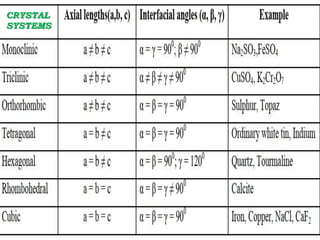
Crystals are classified into 7
crystal systems on the basis of lattice
parameters.
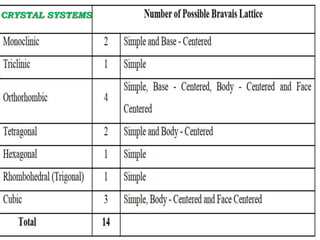
Bravais Lattices:
-> According to Bravais, there
are only 14 possible ways of arranging
points in space lattice from the seven
crystal systems such that all the lattice
points have exactly the same
surroundings.
-> These 14 space lattices are
called the Bravais lattices.
CRYSTAL
SYSTEMS
CRYSTAL SYSTEMS

Crystallography INTRODUCTION

  • 1.
  • 2.
    INTRODUCTION ● The mattersin this world are classified as solids, liquids and gases. ● These materials are made up ofatoms and molecules. ● Materials differ from one another on their properties. ● These differences in properties of the solids are due to their structures. ● The behaviour of a solid material is closely related to its structure.
  • 3.
    CLASSIFICATION OF SOLIDS Onthe basis of crystal structure materials are broadly classified as (i) Crystalline solids (ii) Non-Crystalline or Amorphous solids
  • 4.
    (i) Crystalline solids Materialsin which the atoms are arranged in systematic pattern are known as crystalline solids. They have well defined geometrical form. Eg: Diamond, copper, platinum, silver, polonium, etc. The crystals are of two forms: 1. Single crystal 2. Poly crystal --- Single crystal contains only one crystal. --- Poly crystal is an aggregate of many small crystals separated by well defined grain boundaries.
  • 5.
    (ii) Non-Crystalline orAmorphous solids Materials in which the atoms are arranged in an irregular fashion are known as non-crystalline solids. Eg: Plastics, Rubber and Glass
  • 6.
    Crystallography The branch ofphysics that deals with the structure, properties and external or internal symmetries in crystals are known as crystal physics or crystallography.
  • 7.
    Fundamentals of crystallographic terms Lattice : ● It is defined as an array of points which represents the position of atoms in the crystals in three dimensions. ● It is an imaginary concept.
  • 8.
     Space lattice: Thegeometrical representation of the crystal structure in terms of lattice points is called space lattice , provided the environment about every point is identical to that of every other point.
  • 9.
     Lattice points: Thepoints in the space lattice are called lattice points.  Lattice line: The lines joining the lattice points are called as lattice line.  Lattice plane: The place containing the lattice points are called as lattice plane.  Basis: The crystal structure is formed by associating unit assembly of atoms or molecules with every lattice point. This unit assembly of atoms or molecules is called basis or motif.  Crystal structure: Crystal structure is formed by combining space lattice with a basis. Space lattice + Basis  Crystal Structure
  • 10.
    Unit cell: A unitcell is defined as the smallest geometric figure which on repetition gives the actual crystal structure. It is also defined as fundamental elementary pattern with minimum number of atoms or molecules which represents the total characteristics of the crystal.
  • 11.
    Lattice parameters: The interceptsa, b and c are nothing but the edges of the unit cell. These are known as primitives or characteristic intercepts. The distance between two lattice points are known as axial length. The angles between a, b and b, c and c, a are called interfacial angles. Both intercepts and interfacial angles form the lattice parameters of unit cell.
  • 12.
    Primitive cell: The primitivecell is the simplest type of unit cell which contains only one lattice point (only one atom) per unit cell. Eg: Simple cubic Non – Primitive cells: If more than one lattice point (more than one atom) in an unit cell, it is called a non- primitive cell. Eg: BCC and FCC
  • 13.
    CRYSTAL SYSTEMS AND BRAVAISLATTICES Crystals are classified into 7 crystal systems on the basis of lattice parameters. Bravais Lattices: -> According to Bravais, there are only 14 possible ways of arranging points in space lattice from the seven crystal systems such that all the lattice points have exactly the same surroundings. -> These 14 space lattices are called the Bravais lattices.
  • 14.
  • 15.