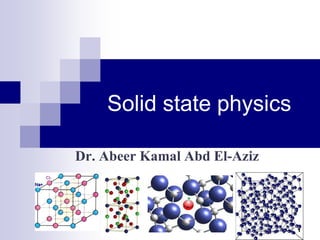
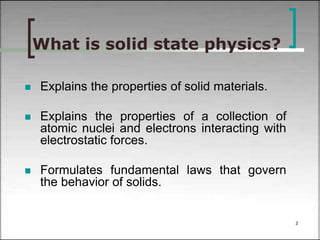
Solid state physics 
Dr. Abeer Kamal Abd El-Aziz 
1
What is solid state physics? 
 Explains the properties of solid materials. 
 Explains the properties of a collection of 
atomic nuclei and electrons interacting with 
electrostatic forces. 
 Formulates fundamental laws that govern 
the behavior of solids. 
2
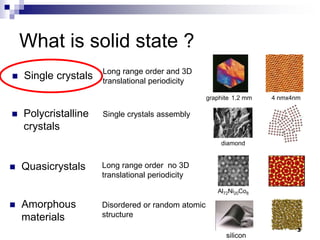
What is solid state ? 
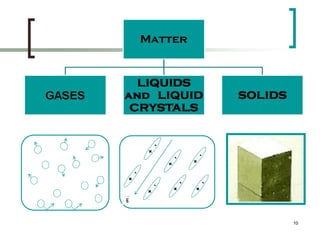
 Single crystals 
 Polycristalline 
crystals 
Long range order and 3D 
translational periodicity 
Single crystals assembly 
 Quasicrystals Long range order no 3D 
 Amorphous 
materials 
translational periodicity 
Disordered or random atomic 
structure 
graphite 1.2 mm 4 nmx4nm 
diamond 
Al72Ni20Co8 
silicon 
3
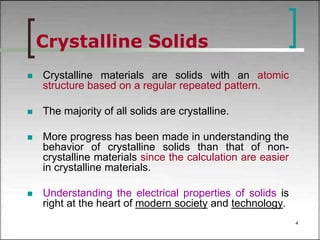
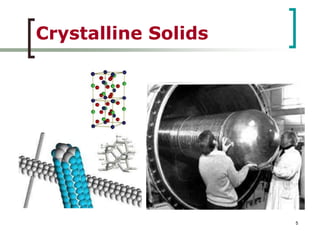
Crystalline Solids 
 Crystalline materials are solids with an atomic 
structure based on a regular repeated pattern. 
 The majority of all solids are crystalline. 
 More progress has been made in understanding the 
behavior of crystalline solids than that of non-crystalline 
materials since the calculation are easier 
in crystalline materials. 
 Understanding the electrical properties of solids is 
right at the heart of modern society and technology. 
4
Crystalline Solids 
5
Electrical resistivity of 
three solid Carbon states 
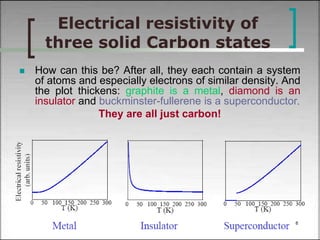
 How can this be? After all, they each contain a system 
of atoms and especially electrons of similar density. And 
the plot thickens: graphite is a metal, diamond is an 
insulator and buckminster-fullerene is a superconductor. 
They are all just carbon! 
6
LECTURE’S OUTLINE 
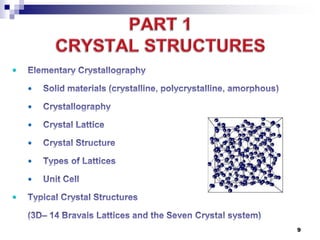
 Part 1. Crystal Structures 
 Part 2. Interatomic Forces 
7
Chap.1 
Crystal structure 
8
 
 
 
 
 
 
 
 
9
10
11 
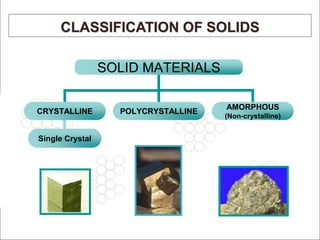
CLASSIFICATION OF SOLIDS 
SOLID MATERIALS 
CRYSTALLINE POLYCRYSTALLINE 
AMORPHOUS 
(Non-crystalline) 
Single Crystal
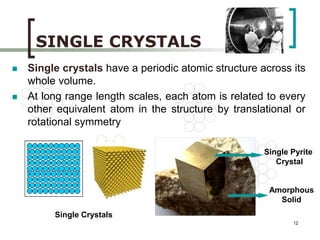
 Single crystals have a periodic atomic structure across its 
12 
SINGLE CRYSTALS 
Single Crystals 
Single Pyrite 
Crystal 
Amorphous 
Solid 
whole volume. 
 At long range length scales, each atom is related to every 
other equivalent atom in the structure by translational or 
rotational symmetry
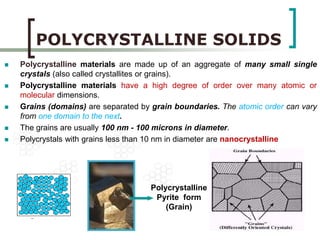
 Polycrystalline materials are made up of an aggregate of many small single 
 Polycrystalline materials have a high degree of order over many atomic or 
13 
POLYCRYSTALLINE SOLIDS 
crystals (also called crystallites or grains). 
Polycrystalline 
Pyrite form 
(Grain) 
molecular dimensions. 
 Grains (domains) are separated by grain boundaries. The atomic order can vary 
from one domain to the next. 
 The grains are usually 100 nm - 100 microns in diameter. 
 Polycrystals with grains less than 10 nm in diameter are nanocrystalline
14 
AMORPHOUS SOLIDS 
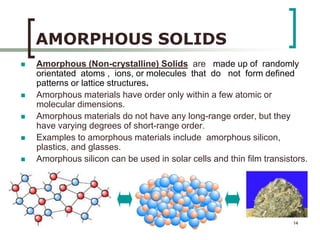
 Amorphous (Non-crystalline) Solids are made up of randomly 
orientated atoms , ions, or molecules that do not form defined 
patterns or lattice structures. 
 Amorphous materials have order only within a few atomic or 
molecular dimensions. 
 Amorphous materials do not have any long-range order, but they 
have varying degrees of short-range order. 
 Examples to amorphous materials include amorphous silicon, 
plastics, and glasses. 
 Amorphous silicon can be used in solar cells and thin film transistors.
15 
CRYSTALLOGRAPHY 
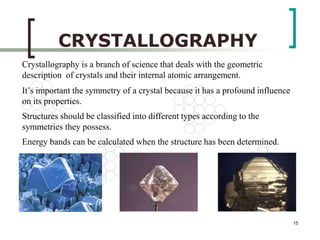
Crystallography is a branch of science that deals with the geometric 
description of crystals and their internal atomic arrangement. 
It’s important the symmetry of a crystal because it has a profound influence 
on its properties. 
Structures should be classified into different types according to the 
symmetries they possess. 
Energy bands can be calculated when the structure has been determined.
16 
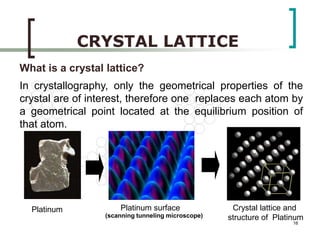
CRYSTAL LATTICE 
What is a crystal lattice? 
In crystallography, only the geometrical properties of the 
crystal are of interest, therefore one replaces each atom by 
a geometrical point located at the equilibrium position of 
that atom. 
Platinum Platinum surface Crystal lattice and 
(scanning tunneling microscope) structure of Platinum
17 
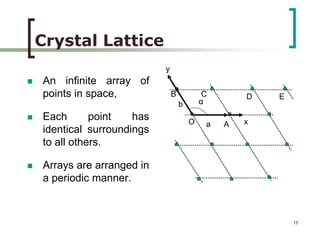
Crystal Lattice 
 An infinite array of 
points in space, 
 Each point has 
identical surroundings 
to all others. 
 Arrays are arranged in 
a periodic manner. 
B C D E 
α 
a 
b 
O A 
y 
x
18 
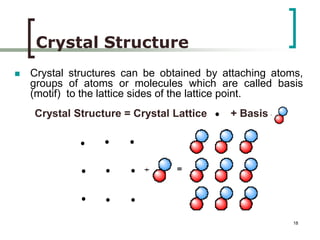
Crystal Structure 
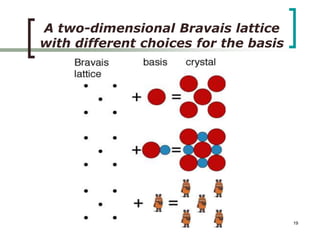
 Crystal structures can be obtained by attaching atoms, 
groups of atoms or molecules which are called basis 
(motif) to the lattice sides of the lattice point. 
Crystal Structure = Crystal Lattice + Basis
A two-dimensional Bravais lattice 
with different choices for the basis 
19
B. Lattice types 
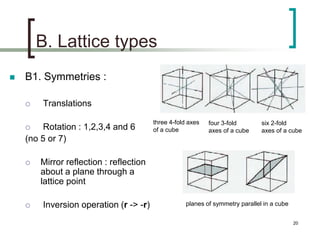
 B1. Symmetries : 
 Translations 
 Rotation : 1,2,3,4 and 6 
(no 5 or 7) 
 Mirror reflection : reflection 
about a plane through a 
lattice point 
 Inversion operation (r -> -r) 
three 4-fold axes 
of a cube 
four 3-fold 
axes of a cube 
six 2-fold 
axes of a cube 
planes of symmetry parallel in a cube 
20
21 
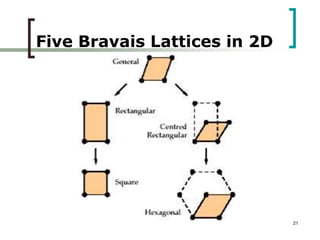
Five Bravais Lattices in 2D
22 
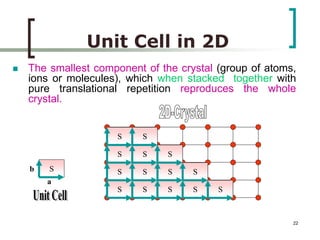
Unit Cell in 2D 
 The smallest component of the crystal (group of atoms, 
ions or molecules), which when stacked together with 
pure translational repetition reproduces the whole 
crystal. 
S 
a 
b 
S 
S 
S 
S 
S 
S 
S 
S 
S 
S 
S 
S 
S 
S
23 
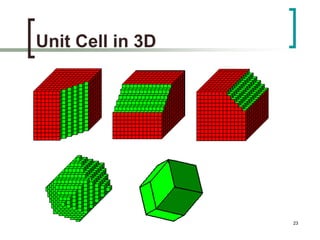
Unit Cell in 3D
24 
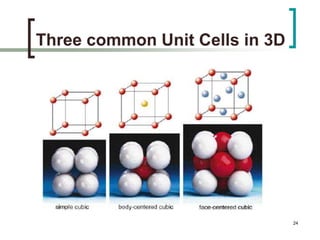
Three common Unit Cells in 3D
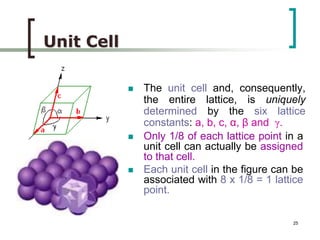
 The unit cell and, consequently, 
the entire lattice, is uniquely 
determined by the six lattice 
constants: a, b, c, α, β and γ. 
 Only 1/8 of each lattice point in a 
unit cell can actually be assigned 
to that cell. 
 Each unit cell in the figure can be 
associated with 8 x 1/8 = 1 lattice 
point. 
25 
Unit Cell
26 
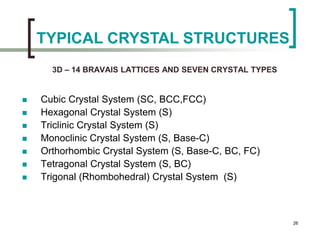
TYPICAL CRYSTAL STRUCTURES 
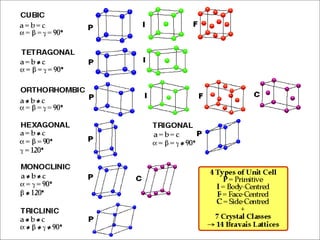
3D – 14 BRAVAIS LATTICES AND SEVEN CRYSTAL TYPES 
 Cubic Crystal System (SC, BCC,FCC) 
 Hexagonal Crystal System (S) 
 Triclinic Crystal System (S) 
 Monoclinic Crystal System (S, Base-C) 
 Orthorhombic Crystal System (S, Base-C, BC, FC) 
 Tetragonal Crystal System (S, BC) 
 Trigonal (Rhombohedral) Crystal System (S)
27
28 
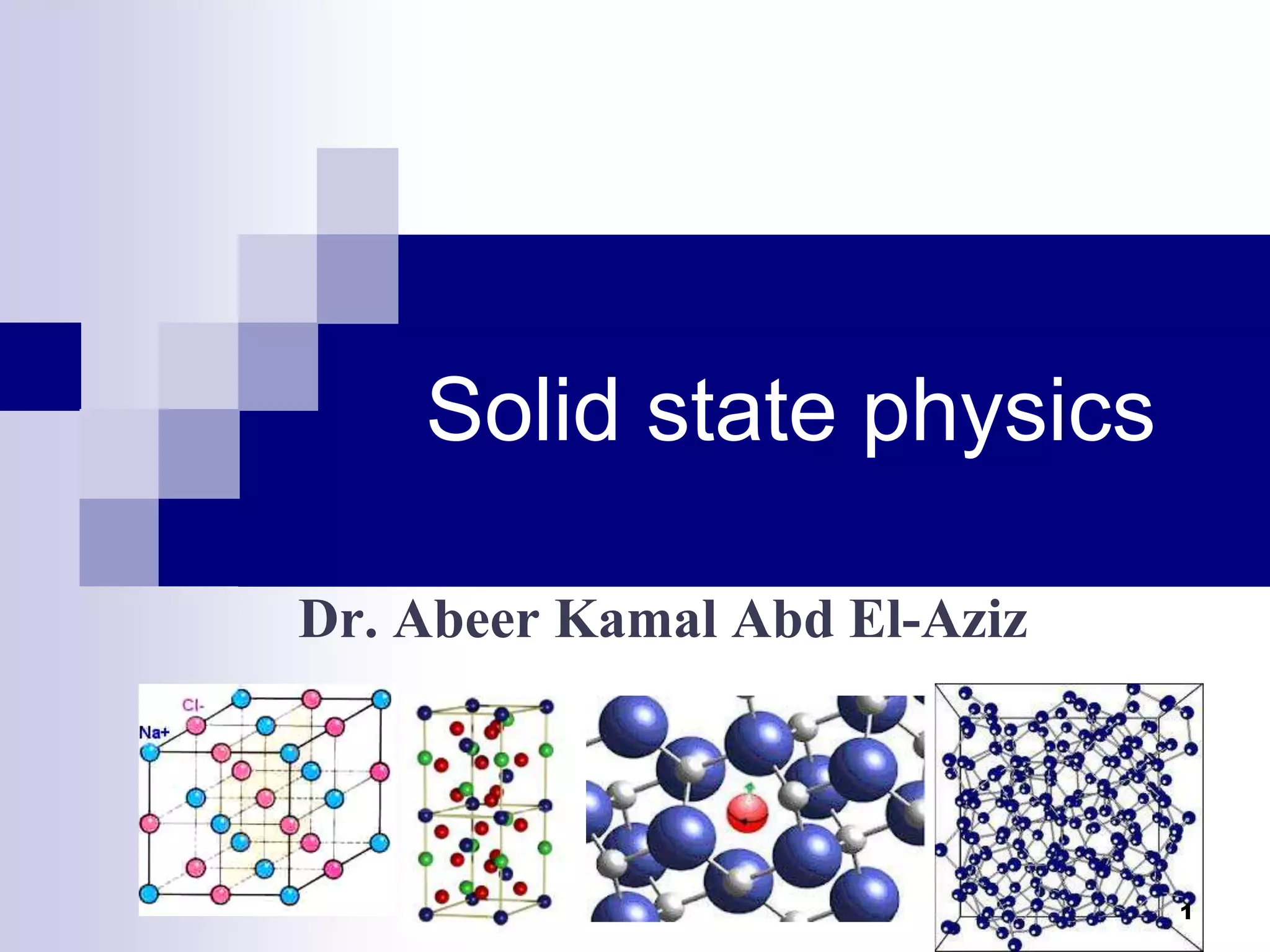
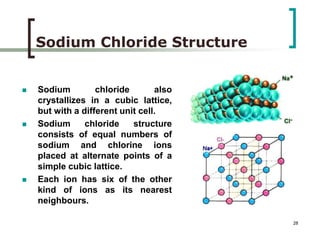
Sodium Chloride Structure 
 Sodium chloride also 
crystallizes in a cubic lattice, 
but with a different unit cell. 
 Sodium chloride structure 
consists of equal numbers of 
sodium and chlorine ions 
placed at alternate points of a 
simple cubic lattice. 
 Each ion has six of the other 
kind of ions as its nearest 
neighbours.
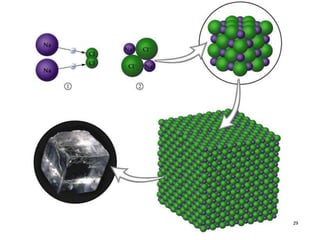
29

Solid state physics lec 1

  • 1.
    Solid state physics Dr. Abeer Kamal Abd El-Aziz 1
  • 2.
    What is solidstate physics?  Explains the properties of solid materials.  Explains the properties of a collection of atomic nuclei and electrons interacting with electrostatic forces.  Formulates fundamental laws that govern the behavior of solids. 2
  • 3.
    What is solidstate ?  Single crystals  Polycristalline crystals Long range order and 3D translational periodicity Single crystals assembly  Quasicrystals Long range order no 3D  Amorphous materials translational periodicity Disordered or random atomic structure graphite 1.2 mm 4 nmx4nm diamond Al72Ni20Co8 silicon 3
  • 4.
    Crystalline Solids Crystalline materials are solids with an atomic structure based on a regular repeated pattern.  The majority of all solids are crystalline.  More progress has been made in understanding the behavior of crystalline solids than that of non-crystalline materials since the calculation are easier in crystalline materials.  Understanding the electrical properties of solids is right at the heart of modern society and technology. 4
  • 5.
  • 6.
    Electrical resistivity of three solid Carbon states  How can this be? After all, they each contain a system of atoms and especially electrons of similar density. And the plot thickens: graphite is a metal, diamond is an insulator and buckminster-fullerene is a superconductor. They are all just carbon! 6
  • 7.
    LECTURE’S OUTLINE Part 1. Crystal Structures  Part 2. Interatomic Forces 7
  • 8.
  • 9.
            9
  • 10.
  • 11.
    11 CLASSIFICATION OFSOLIDS SOLID MATERIALS CRYSTALLINE POLYCRYSTALLINE AMORPHOUS (Non-crystalline) Single Crystal
  • 12.
     Single crystalshave a periodic atomic structure across its 12 SINGLE CRYSTALS Single Crystals Single Pyrite Crystal Amorphous Solid whole volume.  At long range length scales, each atom is related to every other equivalent atom in the structure by translational or rotational symmetry
  • 13.
     Polycrystalline materialsare made up of an aggregate of many small single  Polycrystalline materials have a high degree of order over many atomic or 13 POLYCRYSTALLINE SOLIDS crystals (also called crystallites or grains). Polycrystalline Pyrite form (Grain) molecular dimensions.  Grains (domains) are separated by grain boundaries. The atomic order can vary from one domain to the next.  The grains are usually 100 nm - 100 microns in diameter.  Polycrystals with grains less than 10 nm in diameter are nanocrystalline
  • 14.
    14 AMORPHOUS SOLIDS  Amorphous (Non-crystalline) Solids are made up of randomly orientated atoms , ions, or molecules that do not form defined patterns or lattice structures.  Amorphous materials have order only within a few atomic or molecular dimensions.  Amorphous materials do not have any long-range order, but they have varying degrees of short-range order.  Examples to amorphous materials include amorphous silicon, plastics, and glasses.  Amorphous silicon can be used in solar cells and thin film transistors.
  • 15.
    15 CRYSTALLOGRAPHY Crystallographyis a branch of science that deals with the geometric description of crystals and their internal atomic arrangement. It’s important the symmetry of a crystal because it has a profound influence on its properties. Structures should be classified into different types according to the symmetries they possess. Energy bands can be calculated when the structure has been determined.
  • 16.
    16 CRYSTAL LATTICE What is a crystal lattice? In crystallography, only the geometrical properties of the crystal are of interest, therefore one replaces each atom by a geometrical point located at the equilibrium position of that atom. Platinum Platinum surface Crystal lattice and (scanning tunneling microscope) structure of Platinum
  • 17.
    17 Crystal Lattice  An infinite array of points in space,  Each point has identical surroundings to all others.  Arrays are arranged in a periodic manner. B C D E α a b O A y x
  • 18.
    18 Crystal Structure  Crystal structures can be obtained by attaching atoms, groups of atoms or molecules which are called basis (motif) to the lattice sides of the lattice point. Crystal Structure = Crystal Lattice + Basis
  • 19.
    A two-dimensional Bravaislattice with different choices for the basis 19
  • 20.
    B. Lattice types  B1. Symmetries :  Translations  Rotation : 1,2,3,4 and 6 (no 5 or 7)  Mirror reflection : reflection about a plane through a lattice point  Inversion operation (r -> -r) three 4-fold axes of a cube four 3-fold axes of a cube six 2-fold axes of a cube planes of symmetry parallel in a cube 20
  • 21.
    21 Five BravaisLattices in 2D
  • 22.
    22 Unit Cellin 2D  The smallest component of the crystal (group of atoms, ions or molecules), which when stacked together with pure translational repetition reproduces the whole crystal. S a b S S S S S S S S S S S S S S
  • 23.
  • 24.
    24 Three commonUnit Cells in 3D
  • 25.
     The unitcell and, consequently, the entire lattice, is uniquely determined by the six lattice constants: a, b, c, α, β and γ.  Only 1/8 of each lattice point in a unit cell can actually be assigned to that cell.  Each unit cell in the figure can be associated with 8 x 1/8 = 1 lattice point. 25 Unit Cell
  • 26.
    26 TYPICAL CRYSTALSTRUCTURES 3D – 14 BRAVAIS LATTICES AND SEVEN CRYSTAL TYPES  Cubic Crystal System (SC, BCC,FCC)  Hexagonal Crystal System (S)  Triclinic Crystal System (S)  Monoclinic Crystal System (S, Base-C)  Orthorhombic Crystal System (S, Base-C, BC, FC)  Tetragonal Crystal System (S, BC)  Trigonal (Rhombohedral) Crystal System (S)
  • 27.
  • 28.
    28 Sodium ChlorideStructure  Sodium chloride also crystallizes in a cubic lattice, but with a different unit cell.  Sodium chloride structure consists of equal numbers of sodium and chlorine ions placed at alternate points of a simple cubic lattice.  Each ion has six of the other kind of ions as its nearest neighbours.
  • 29.