1
Dyadics
SOLO HERMELIN
Updated: 9.04.07http://www.solohermelin.com
2
SOLO
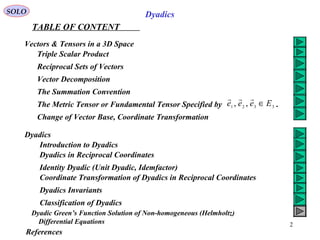
TABLE OF CONTENT
References
Dyadics
Vectors & Tensors in a 3D Space
Triple Scalar Product
Reciprocal Sets of Vectors
Vector Decomposition
The Summation Convention
The Metric Tensor or Fundamental Tensor Specified by .3321 ,, Eeee ∈

Change of Vector Base, Coordinate Transformation
Dyadics
Introduction to Dyadics
Dyadics in Reciprocal Coordinates
Identity Dyadic (Unit Dyadic, Idemfactor)
Coordinate Transformation of Dyadics in Reciprocal Coordinates
Dyadics Invariants
Classification of Dyadics
Dyadic Green’s Function Solution of Non-homogeneous (Helmholtz)
Differential Equations
3
SOLO
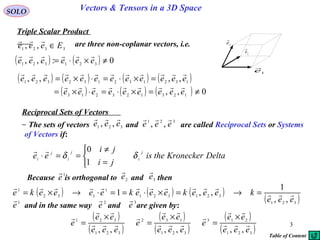
Triple Scalar Product
Vectors & Tensors in a 3D Space
3321 ,, Eeee ∈
 are three non-coplanar vectors, i.e.
1e

2e

3e

( ) ( ) 0:,, 321321 ≠×⋅= eeeeee

( ) ( ) ( ) ( )
( ) ( ) ( ) 0,,
,,,,
123123213
132132132321
≠=×⋅=⋅×=
=×⋅=⋅×=
eeeeeeeee
eeeeeeeeeeee


Reciprocal Sets of Vectors
The sets of vectors and are called Reciprocal Sets or Systems
of Vectors if:
321 ,, eee
 321
,, eee

DeltaKroneckertheis
ji
ji
ee
j
i
j
i
j
i
δδ



=
≠
==⋅
1
0
Because is orthogonal to and then2e

3e
1
e

( ) ( ) ( )
( )321
321321
1
132
1
,,
1
,,1
eee
keeekeeekeeeeke 

=→=×⋅==⋅→×=
and in the same way and are given by:
2
e
 3
e
1
e

( )
( )
( )
( )
( )
( )321
213
321
132
321
321
,,,,,, eee
ee
e
eee
ee
e
eee
ee
e 







 ×
=
×
=
×
=
Table of Content
4
SOLO Vectors & Tensors in a 3D Space
Reciprocal Sets of Vectors (continue)
By using the previous equations we get:
( ) ( )
( )
( )[ ] ( )[ ]
( ) ( )321
3
2
321
13323132
2
321
133221
,,,,,, eee
e
eee
eeeeeeee
eee
eeee
ee 






=
⋅×−⋅×
=
×××
=×
( )
( )
( )
( )
( )
( )321
213
321
132
321
321
,,,,,, eee
ee
e
eee
ee
e
eee
ee
e 







 ×
=
×
=
×
=
( ) ( )
( ) ( )
0
,,
1
,,
,,
321321
3
3321321
≠=
⋅
==⋅×
eeeeee
ee
eeeeee 


Multiplying (scalar product) this equation by we get:
3
e

In the same way we can show that:
Therefore are also non-coplanar, and:
321
,, eee

( ) ( ) 1,,,, 321
321
=eeeeee

( )
( )
( )
( )
( )
( )321
21
3321
13
2321
32
1
,,,,,, eee
ee
e
eee
ee
e
eee
ee
e 







 ×
=
×
=
×
=
1e

2e

3
e

1
e

2
e

3
e

Table of Content
5
SOLO Vectors & Tensors in a 3D Space
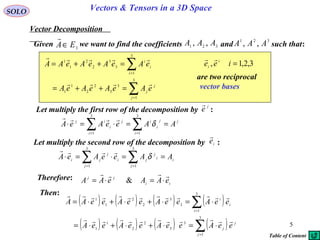
Vector Decomposition
Given we want to find the coefficients and such that:3EA∈

321 ,, AAA 321
,, AAA
∑
∑
=
=
=++=
=++=
3
1
3
3
2
2
1
1
3
1
3
3
2
2
1
1
j
j
j
i
i
i
eAeAeAeA
eAeAeAeAA


3,2,1, =iee i
i

are two reciprocal
vector bases
Let multiply the first row of the decomposition by :
j
e

Let multiply the second row of the decomposition by :ie

j
i
j
i
i
i
j
i
ij
AAeeAeA ==⋅=⋅ ∑∑ ==
3
1
3
1
δ

i
j
i
j
j
j
i
j
ji
AAeeAeA ==⋅=⋅ ∑∑ ==
3
1
3
1
δ

Therefore:
ii
jj
eAAeAA

⋅=⋅= &
Then:
( ) ( ) ( ) ( )
( ) ( ) ( ) ( )∑
∑
=
=
⋅=⋅+⋅+⋅=
⋅=⋅+⋅+⋅=
3
1
3
3
2
2
1
1
3
1
3
3
2
2
1
1
j
j
j
i
i
i
eeAeeAeeAeeA
eeAeeAeeAeeAA


Table of Content
6
SOLO Vectors & Tensors in a 3D Space
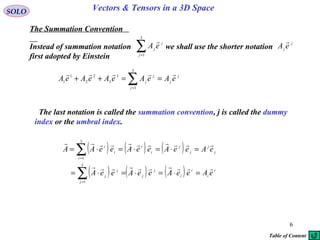
The Summation Convention
j
j
j
j
j eAeAeAeAeA

==++ ∑=
3
1
3
3
2
2
1
1
The last notation is called the summation convention, j is called the dummy
index or the umbral index.
( ) ( ) ( )
( ) ( ) ( ) i
i
i
i
j
j
j
j
j
j
j
j
j
i
i
i
i
i
eAeeAeeAeeA
eAeeAeeAeeAA


=⋅=⋅=⋅=
=⋅=⋅=⋅=
∑
∑
=
=
3
1
3
1
Instead of summation notation we shall use the shorter notation
first adopted by Einstein
∑=
3
1j
j
j
eA
 j
j eA

Table of Content
7
SOLO Vectors & Tensors in a 3D Space
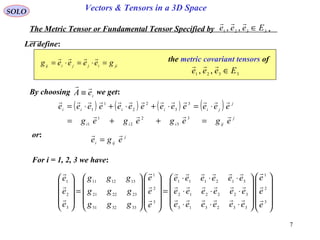
Let define:
The Metric Tensor or Fundamental Tensor Specified by .3321 ,, Eeee ∈

jiijjiij geeeeg =⋅=⋅=

3321 ,, Eeee ∈

the metric covariant tensors of
By choosing we get:
( ) ( ) ( ) ( )
j
ijiii
j
jiiiii
egegegeg
eeeeeeeeeeeee


=++=
⋅=⋅+⋅+⋅=
3
3
2
2
1
1
3
3
2
2
1
1
ieA

≡
or: j
iji ege

=
For i = 1, 2, 3 we have:




















⋅⋅⋅
⋅⋅⋅
⋅⋅⋅
=




















=










3
2
1
332313
322212
312111
3
2
1
333231
232221
131211
3
2
1
e
e
e
eeeeee
eeeeee
eeeeee
e
e
e
ggg
ggg
ggg
e
e
e












8
SOLO Vectors & Tensors in a 3D Space
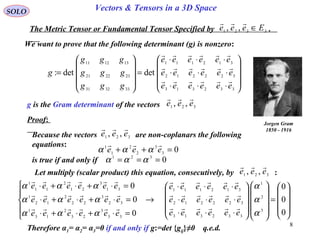
We want to prove that the following determinant (g) is nonzero:
The Metric Tensor or Fundamental Tensor Specified by .3321 ,, Eeee ∈











⋅⋅⋅
⋅⋅⋅
⋅⋅⋅
=










=
332313
322212
312111
333231
232221
131211
detdet:
eeeeee
eeeeee
eeeeee
ggg
ggg
ggg
g



g is the Gram determinant of the vectors 321 ,, eee

Jorgen Gram
1850 - 1916
Proof:
Because the vectors are non-coplanars the following
equations:
321 ,, eee

03
3
2
2
1
1
=++ eee

ααα
is true if and only if 0321
=== ααα
Let multiply (scalar product) this equation, consecutively, by :321
,, eee











=




















⋅⋅⋅
⋅⋅⋅
⋅⋅⋅
→





=⋅+⋅+⋅
=⋅+⋅+⋅
=⋅+⋅+⋅
0
0
0
0
0
0
3
2
1
332313
322212
312111
33
3
23
2
13
1
32
3
22
2
12
1
31
3
21
2
11
1
α
α
α
ααα
ααα
ααα
eeeeee
eeeeee
eeeeee
eeeeee
eeeeee
eeeeee






Therefore α1= α2= α3=0 if and only if g:=det {gij}≠0 q.e.d.
9
SOLO Vectors & Tensors in a 3D Space
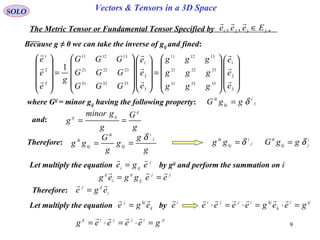
Because g ≠ 0 we can take the inverse of gij and fined:
The Metric Tensor or Fundamental Tensor Specified by .3321 ,, Eeee ∈

where Gij
= minor gij having the following property: j
i
kj
ik
ggG δ=




















=




















=










3
2
1
333231
232221
131211
3
2
1
333231
232221
131211
3
2
1
1
e
e
e
ggg
ggg
ggg
e
e
e
GGG
GGG
GGG
g
e
e
e









and:
g
G
g
gminor
g
ij
ijij
==
Therefore:
g
g
g
g
G
gg
j
i
kj
ik
kj
ik δ
== j
i
kj
ik
gg δ=
Let multiply the equation by gij
and perform the summation on i
j
iji ege

=
jj
ij
ij
i
ij
eeggeg

==
Therefore: i
ijj
ege

=
Let multiply the equation byk
kjj
ege

= i
e
 iji
k
kjijji
geegeeee =⋅=⋅=⋅

jiijjiij
geeeeg =⋅=⋅=

i
jkj
ik
ggG δ=
10
SOLO Vectors & Tensors in a 3D Space
Let find the relation between g and
The Metric Tensor or Fundamental Tensor Specified by .3321 ,, Eeee ∈

( ) ( )321321 :,, eeeeee

×⋅=
We shall write the decomposition of in the vector base32 ee

× 321 ,, eee

3
3
2
2
1
1
32 eeeee

λλλ ++=×
Let find λ1
, λ2
, λ3
. Multiply the previous equation (scalar product) by .1e

( ) ( ) i
i
ggggeeeeee 113
3
12
2
11
1
321321 ,, λλλλ =++==×⋅

Multiply this equation by g1i
: ( ) ii
i
ii
ggeeeg λλ ==


1
1
1321
1
,,
Therefore: ( )321
1
,, eeeg ii 
=λ
Let compute now:
( ) ( ) ( ) ( ) ( ) ( )321
1
0
323
3
0
322
2
321
1
3232
eeeeeeeeeeeeeeee





×⋅=×⋅+×⋅+×⋅=×⋅× λλλλ
( ) ( )[ ]
( )
( )[ ]
( )
( ) ( )[ ]
( ) ( ) ( ) ( )321
11
321
11
321
2
233322
321
3322332
321
3232
321
32321
,,,,,,,,
,,,,
eee
gg
eee
G
eee
ggg
eee
eeeeeee
eee
eeee
eee
eeee






==
−
=
⋅−⋅⋅
=
××⋅
=
×⋅×
=λ
From those equations we obtain:
( )321
11
1
,, eee
gg
=λ
Finally: ( ) ( ) geeeeee =⇒= 321
2
321
1
,,,,

λ
We can see that if are collinear than and g are zero.321 ,, eee
 321
,, eee

Table of Content
11
SOLO Vectors & Tensors in a 3D Space
Let choose another base and its reciprocal
Change of Vector Base, Coordinate Transformation
( )321 ,, fff

( )321
,, fff

[ ]










=




















=












→=
3
2
1
3
2
1
3
3
2
3
1
3
3
2
2
2
1
2
3
1
2
1
1
1
3
2
1
e
e
e
L
e
e
e
f
f
f
ef j
j
ii










ααα
ααα
ααα
α
where j
i
j
i ef

⋅=α
By tacking the inverse of those equations we obtain:
[ ]












=






















=










→=
−
3
2
1
1
3
2
1
3
3
2
3
1
3
3
2
2
2
1
2
3
1
2
1
1
1
3
2
1
f
f
f
L
f
f
f
e
e
e
fe i
j
ij










βββ
βββ
βββ
β
where j
ij
i ef

⋅=β
Because are the coefficients of the inverse matrix with coefficients :
j
i
β j
i
α
i
j
i
k
k
j
δαβ =
12
SOLO Vectors & Tensors in a 3D Space
Let write any vector in those two bases:
Change of Vector Base, Coordinate Transformation (continue – 1)
A

[ ]










=




















=












→




⋅=
=
3
2
1
3
2
1
3
3
2
3
1
3
3
2
2
2
1
2
3
1
2
1
1
1
3
2
1
e
e
e
L
e
e
e
f
f
f
ef
ef
ji
j
i
j
j
ii











ααα
ααα
ααα
α
α
then:
[ ]










=




















=










→




⋅=
= −
3
2
1
1
3
2
1
3
3
3
2
3
1
2
3
2
2
2
1
1
3
1
2
1
1
3
2
1
E
E
E
L
E
E
E
F
F
F
ef
EF T
j
ii
j
i
j
ji
βββ
βββ
βββ
β
β

i
i
j
j
fFeEA

== iijj
fAFeAE

⋅=⋅= &
i
j
ji
i
i
j
j
j
j
i
i
EFfEeEfF ββ =→==

or:
But we remember that:
We can see that the relation between the components F1
, F2
, F3
to E1
, E2
, E3
is
not similar, contravariant, to the relation between the two bases of vectors
to . Therefore we define F1
, F2
, F3
and E1
, E2
, E3
as the contravariant
components of the bases and .
( )321 ,, fff

( )321
,, eee

( )321 ,, fff

( )321 ,, eee

where
13
SOLO Vectors & Tensors in a 3D Space
Let write now the vector in the two bases and
Change of Vector Base, Coordinate Transformation (continue – 2)
A

[ ]










=




















=










→=
3
2
1
3
2
1
3
3
2
3
1
3
3
2
2
2
1
2
3
1
2
1
1
1
3
2
1
E
E
E
L
E
E
E
F
F
F
EF j
iji
ααα
ααα
ααα
α
and
i
i
j
j fFeEA

== iijj fAFeAE

⋅=⋅= &
then:
( )321
,, fff

( )321
,, eee

where
j
ij
ef
ijjjjii EfeEeEAfAF j
iji
α
α=⋅
=⋅==⋅= 

We can see that the relation between the components F1, F2, F3 to E1, E2, E3 is
similar, covariant, to the relation between the two bases of vectors
to . Therefore wew define F1
, F2
, F3
and E1
, E2
, E3
as the covariant
components of the bases and .
( )321
,, fff

( )321
,, eee

( )321
,, fff

( )321
,, eee

14
SOLO Vectors & Tensors in a 3D Space
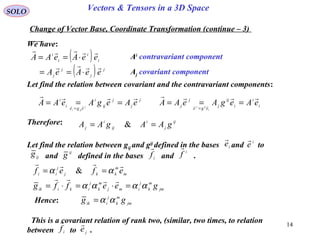
We have:
Change of Vector Base, Coordinate Transformation (continue – 3)
( )
( ) j
j
j
j
i
i
i
i
eeAeA
eeAeAA


⋅==
⋅== Ai
contravariant component
Aj covariant component
Let find the relation between covariant and the contravariant components:
j
j
j
ij
i
ege
i
i
eAegAeAA j
iji

 ===
=
i
i
i
ij
j
ege
j
j eAegAeAA
i
ijj

 ===
=
Therefore: ij
j
i
ij
i
j gAAgAA == &
Let find the relation between gij and gij
defined in the bases and to
and defined in the bases and .
i
e
 i
e

i
f

i
f

ijg ij
g
m
m
kkj
j
ii efef

αα == &
jm
m
k
j
imj
m
k
j
ikiik geeffg αααα =⋅=⋅=

Hence: jm
m
k
j
iik gg αα=
This is a covariant relation of rank two, (similar, two times, to relation
between to .i
f

je

15
SOLO Vectors & Tensors in a 3D Space
Change of Vector Base, Coordinate Transformation (continue – 4)
[ ]










=




















=












→




⋅=
=
3
2
1
3
2
1
3
3
2
3
1
3
3
2
2
2
1
2
3
1
2
1
1
1
3
2
1
e
e
e
L
e
e
e
f
f
f
ef
ef
ji
j
i
j
j
ii











ααα
ααα
ααα
α
α
Since we have:k
iki fgf

= ( ) m
jm
j
i
ege
j
j
i
ef
k
iki
egefgf m
jmjj
j
ii

 αα
α ==
===
and: ( ) ( ) m
jm
j
i
km
kjm
j
i
gg
k
ik egfgfg
mjm
m
k
j
iik

ααα
αα
==
=
Therefore, by equalizing the terms that multiply we obtain:
[ ]












=






















=










→=
3
2
1
3
2
1
3
3
3
2
3
1
2
3
2
2
2
1
1
3
1
2
1
1
3
2
1
f
f
f
L
f
f
f
e
e
e
fe
Tkm
k
m










ααα
ααα
ααα
α
We found the relation:
( )jm
j
i gα
16
SOLO Vectors & Tensors in a 3D Space
Change of Vector Base, Coordinate Transformation (continue – 5)
Therefore:
Let take the inverse of the relation by multiplying by and summarize on m:
j
m
β
[ ]










=




















=












→= −
3
2
1
1
3
2
1
3
3
3
2
3
1
2
3
2
2
2
1
1
3
1
2
1
1
3
2
1
e
e
e
L
e
e
e
f
f
f
ef
Tmj
m
j










βββ
βββ
βββ
β
km
k
m
fe

α=
jkj
k
km
k
j
m
mj
m fffe

=== δαββ
From the relation: mk
m
kjj
i
i
efef

ββ == &
we have: jmk
m
j
i
mjk
m
j
i
kiik
geeffg ββββ =⋅=⋅=

or: jmk
m
j
i
ik
gg ββ= This is a contravariant relation of rank two.
From the relation:
m
m
kk
jj
i
i
efef

αβ == &
we have: m
j
m
k
i
jm
jm
k
i
j
i
kk
i
eeff δαβαβδ =⋅==⋅

or: This is a relation once covariant and once contravariant of
rank two.
m
j
m
k
i
j
i
k δαβδ =
Table of Content
17
SOLO
conjugate of the dyadic
Dyadics
Introduction to Dyadics
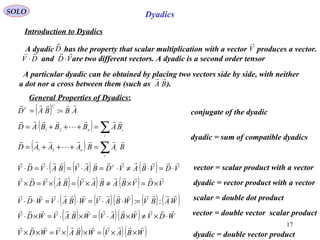
A dyadic has the property that scalar multiplication with a vector produces a vector.
and are two different vectors. A dyadic is a second order tensor
D

V

DV

⋅ VD

⋅
( ) ∑=+++=
i
in BABBBAD



21
A particular dyadic can be obtained by placing two vectors side by side, with neither
a dot nor a cross between them (such as ).BA

General Properties of Dyadics:
( ) ∑=+++=
i
in
BABAAAD



21
( ) ( ) ( ) VDVBAVDBAVBAVDV C

⋅=⋅≠⋅=⋅=⋅=⋅ vector = scalar product with a vector
( ) ( ) ( ) VDVBABAVBAVDV

×=×≠×=×=× dyadic = vector product with a vector
( ) ABBAD
C
C

== :
dyadic = sum of compatible dyadics
( ) ( )( ) ( ) ( )WABVWBAVWBAVWDV

::=⋅⋅=⋅⋅=⋅⋅ scalar = double dot product
( ) ( )( ) WDVWBAVWBAVWDV

⋅×≠×⋅=×⋅=×⋅
( ) ( )( )WBAVWBAVWDV

××=××=×× dyadic = double vector product
vector = double vector scalar product
18
SOLO Dyadics
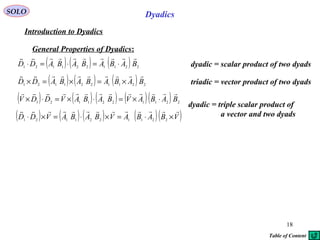
Introduction to Dyadics
General Properties of Dyadics:
triadic = vector product of two dyads
dyadic = scalar product of two dyads( ) ( ) ( ) 2211221121
BABABABADD

⋅=⋅=⋅
( ) ( ) ( ) 2211221121
BABABABADD

×=×=×
( ) ( ) ( ) ( )( ) 2211221121
BABAVBABAVDDV

⋅×=⋅×=⋅×
dyadic = triple scalar product of
a vector and two dyads( ) ( ) ( ) ( )( )VBABAVBABAVDD

×⋅=×⋅=×⋅ 2211221121
Table of Content
19
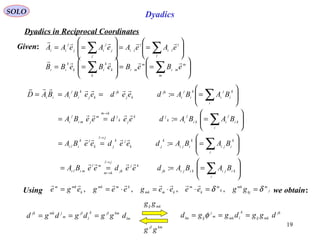
SOLO Dyadics
Dyadics in Reciprocal Coordinates
Given: 





==







== ∑∑ l
l
li
l
li
j
j
j
ij
j
ii
eAeAeAeAA







==





== ∑∑ m
m
mi
m
mi
k
k
k
ik
k
ii
eBeBeBeBB







====






====






====






=====
∑
∑
∑
∑
→
→
→
→
i
kijikijijk
kj
jk
jl
km
ml
mili
i
k
iji
k
iji
k
jk
jk
j
jl
k
lk
ili
i
ki
j
iki
j
ik
jk
jk
j
km
m
jmi
j
i
i
k
i
j
i
k
i
j
i
jk
kj
jk
kj
k
i
j
iii
BABAdeedeeBA
BABAdeedeeBA
BABAdeedeeBA
BABAdeedeeBABAD
:
:
:
:




lm
kmjlk
l
jl
m
jmkjk
dggdgdgd ===
j
m
kj
mk
k
m
k
m
kmmk
kmmk
k
mkm
ggeeeegeegege δδ ==⋅⋅=⋅== ,,,,

Using we obtain:
jk
mklj
k
lmkm
j
ljlm
dggdggd === φ
mklj
gg
kmjl
gg
20
SOLO Dyadics
Dyadics in Reciprocal Coordinates
Given: 





==







== ∑∑ l
l
li
l
li
j
j
j
ij
j
ii
eAeAeAeAA







==





== ∑∑ m
m
mi
m
mi
k
k
k
ik
k
ii
eBeBeBeBB

( ) ( ) [ ]










=




















===
3
2
1
321
3
2
1
333231
232221
131211
321
e
e
e
Deee
e
e
e
ddd
ddd
ddd
eeeeedBAD kj
jk
ii








Decomposition of a dyadic in symmetric and anti-symmetric parts:
( ) ( ) [ ]










=




















===
3
2
1
321
3
2
1
332313
322212
312111
321
e
e
e
Deee
e
e
e
ddd
ddd
ddd
eeeeedABD
T
kj
kj
ii
C








( ) ( ) ( ) ( )
( )
( ) ( ) ( )
( ) ( ) ( )
( ) ( ) ( )
[ ] [ ]( )
( )
( ) ( )
( ) ( )
( ) ( )
[ ] [ ]( )




















−−−−
−−−
−−
+




















+++
+++
+++
=
Ω+Φ=−++=−++=
−+
−
3
2
1
2
1
32233113
32232112
31132112
321
3
2
1
2
1
333332233113
322322222112
311321121111
321
0
0
0
2
1
2
1
2
1
2
1
2
1
2
1
e
e
e
dddd
dddd
dddd
eee
e
e
e
dddddd
dddddd
dddddd
eee
eeddeeddDDDDD
TT
DDDD
kj
kjjk
kj
kjjk
symmetricanti
C
symmetric
C



  




  






The conjugate dyadic of is:D

Table of Content
21
SOLO Dyadics
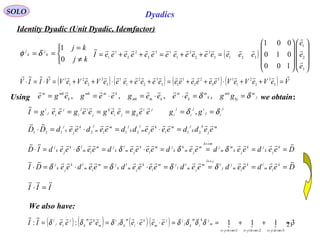
Identity Dyadic (Unit Dyadic, Idemfactor)



≠
=
==
kj
kj
k
j
k
j
0
1
δφ ( )




















=++=++=
3
2
1
3213
3
2
2
1
13
3
2
2
1
1
100
010
001
e
e
e
eeeeeeeeeeeeeeeI




( ) ( ) ( ) ( ) VeVeVeVeeeeeeeeeeeeeVeVeVVIIV

=++⋅++=++⋅++=⋅=⋅ 3
3
2
2
1
13
3
2
2
1
13
3
2
2
1
1
3
3
2
2
1
1
j
m
kj
mk
k
m
k
m
kmmk
kmmk
k
mkm
ggeeeegeegege δδ ==⋅⋅=⋅== ,,,,

Using we obtain:
j
ij
ij
i
j
i
ji
ijji
ij
j
ij
i
j
ij
i
ggeegeegeegeegI δδ ====== ,

III

=⋅
( ) ( ) ( ) ( )    3111::
321
=++==⋅⋅==
============ mkjimkjimkji
m
jk
i
m
kj
ij
m
k
i
m
kj
i
m
km
k
j
ij
i
eeeeeeeeII δδδδδδδδ

We also have:
m
j
k
k
jm
l
k
jm
l
k
jm
lm
lk
jk
j
eeddeeeeddeedeedDD

21212121
=⋅=⋅=⋅
DeedeedeedeeeedeeeedID k
jk
jk
jk
m
m
j
mk
m
jm
k
k
jm
l
k
jm
l
k
jm
lm
lk
jk
j

====⋅=⋅=⋅
↔
δδδδ
DeedeedeedeeeedeedeeDI k
lm
lk
lm
j
j
l
jl
m
jm
l
l
jm
l
k
jm
l
k
jm
lm
lk
jk
j

====⋅=⋅=⋅
↔
δδδδ
22
SOLO Dyadics
Identity Dyadic (Unit Dyadic, Idemfactor) (continue – 1)
( ) ( )
( ) ( ) ( )[ ]211231331232231
3
3
2
2
1
13
3
2
2
1
1
eeeeVeeeeVeeeeVg
eeeeeeeVeVeVIV


−+−+−=
++×++=×
( ) ( ) ( ) ( )32121
3
13
2
32
1
,,
111
eeegee
g
eee
g
eee
g
e

=×=×=×=
We found:
Using:
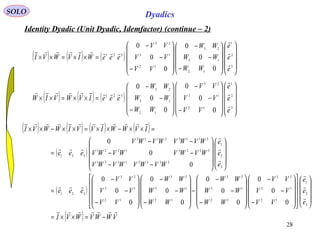
( ) WVWIVWIV

⋅=⋅⋅=⋅⋅VVIIV

=⋅=⋅
( ) ( )
( ) ( ) ( )[ ]211231331232231
3
3
2
2
1
1
3
3
2
2
1
1
eeeeVeeeeVeeeeVg
eVeVeVeeeeeeVI


−+−+−=
++×++=×
( )c
IVVIIV

×−=×=×
( )
( ) ( ) ( )( )
( )




















−
−
−
=
−+−+−=
==×=×−=×=×
3
2
1
12
13
23
321
211231331232231
0
0
0
e
e
e
VV
VV
VV
eeeg
eeeeVeeeeVeeeeVg
eeVgeegVeeeVIVVIIV jm
ijm
ik
k
jm
ijm
ik
jk
j
i
i
c






εδεδ
23
SOLO Dyadics
Identity Dyadic (Unit Dyadic, Idemfactor) (continue – 2)
( ) ( ) ( )






























−
−
−










−
−
−
−










−
−
−










−
−
−
=




















−−
−−
−−
=
×⋅=×=⋅×=⋅×
⋅=×=×
3
2
1
12
13
23
12
13
23
12
13
23
12
13
23
3
2
1
23321331
32231221
31132112
0
0
0
0
0
0
0
0
0
0
0
0
0
0
0
e
e
e
VV
VV
VV
WW
WW
WW
WW
WW
WW
VV
VV
VV
g
e
e
e
WVWVWVWV
WVWVWVWV
WVWVWVWV
g
WVIWVWIVWVI
VIVIVVI






 
( ) ( ) ( ) ( ) ( )[ ] ( )
( ) ( ) ( )[ ]
( ) ( ) ( )[ ] WVeeWVWVeeWVWVeeWVWV
eWVWVeWVWVeWVWVg
eWeWeWeeeeVeeeeVeeeeVgWIVWVI
k
m
k
m
ee




×=×−+×−+×−=
−+−+−=
++⋅−+−+−=⋅×=⋅×
=⋅
21
1221
13
3113
32
2332
312212311312332
3
3
2
2
1
1211231331232231
δ
( ) ( ) WVWIVWVI

×=⋅×=⋅×
( ) ( ) ( ) ( )[ ]211231331232231
eeeeVeeeeVeeeeVgIVVIIV c 
−+−+−=×−=×=×
24
SOLO Dyadics
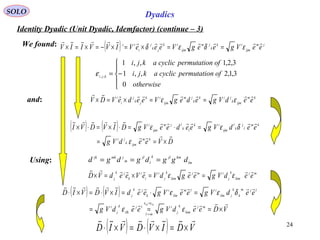
Identity Dyadic (Unit Dyadic, Idemfactor) (continue – 3)
We found:
( ) ( )
DVeedVg
eedVgeedeeVgDIVDVI
km
ijmk
ji
km
l
j
k
l
ijm
ik
lk
ljm
ijm
i


×==
=⋅=⋅×=⋅×
ε
δεε
km
ijmk
jik
k
jm
ijm
ik
jk
j
i
i
eedVgedegVeedeVDV

εε ==×=×
( ) jm
ijm
ik
k
jm
ijm
ik
jk
j
i
ic
eeVgeegVeeeVIVVIIV

εδεδ ==×=×−=×=×
and:
( ) ( )
VDeedVgeedVg
eedVgeeVgeedIVDVID
mj
kim
k
j
i
ml
lj
ilk
k
j
i
ljm
k
k
jilm
ilm
ilm
i
k
jk
j
kililk 

×===
=⋅=×⋅=×⋅
=
→
εε
δεε
εε
mj
kim
k
j
imj
kim
k
j
i
i
i
k
jk
j
eedVgeegdVeVeedVD

εε ==×=×
Using: lm
kmjlk
l
jl
m
jmkjk
dggdgdgd ===
( ) ( ) VDIVDVID

×=×⋅=×⋅





−=
otherwise
ofnpermutatiocyclicakji
kji
0
3,1,2,,1
3,2,1,,1
,,
ε
25
SOLO Dyadics
Identity Dyadic (Unit Dyadic, Idemfactor) (continue – 4)
( ) ( ) ( )[ ]
( ) ( ) ( )[ ]
( ) ( ) ( )[ ]
( ) ( ) ( )[ ]
( )
( ) ( ) ( )
( ) ( ) ( )
( ) ( ) ( )
( )






























−
−
−
=




















−−−
−−−
−−−
=










−+−+−+
−+−+−+
−+−+−
=
−+−+−=
==×=×
3
2
1
3
3
2
3
1
3
3
2
2
2
1
2
3
1
2
1
1
1
12
13
23
321
3
2
1
3
12
3
21
2
12
2
21
1
12
1
21
3
31
3
13
2
31
2
13
1
31
1
13
3
23
3
32
2
23
2
32
1
23
1
32
321
31
3
22
3
133
3
11
3
322
3
33
3
21
21
2
22
2
133
2
11
2
322
2
33
2
21
11
1
22
1
133
1
11
1
322
1
33
1
21
122133113223321
0
0
0
e
e
e
ddd
ddd
ddd
VV
VV
VV
eeeg
e
e
e
dVdVdVdVdVdV
dVdVdVdVdVdV
dVdVdVdVdVdV
eeeg
eededVededVededV
eededVededVededV
eededVededVededV
g
eededVededVededVg
eedVgedegVeedeVDV
k
kkkkkk
km
ijmk
jik
k
jm
ijm
ik
jk
j
i
i













εε





−=
otherwise
ofnpermutatiocyclicakji
kji
0
3,1,2,,1
3,2,1,,1
,,
ε
26
SOLO Dyadics
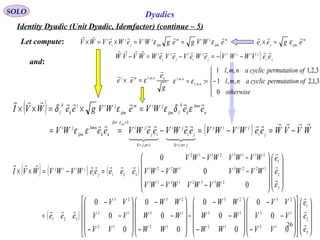
Identity Dyadic (Unit Dyadic, Idemfactor) (continue – 5)
Let compute: m
ijm
jim
ijm
ji
j
j
i
i
eWVgegWVeWeVWV

εε ==×=×
and:
( )
( ) WVVWeeWVWVeeWVeeWVeeWV
eeWVeWVgeeWVI
ji
jiij
jnik
ji
ji
injk
ij
ji
for
nk
kmn
ijm
ji
n
lmn
k
k
lijm
jim
ijm
jil
k
k
l
ijm 





−=−=−==
=×=××
====
=
,,
1ε
εε
εδεεδ
( ) ji
jiji
j
j
i
i
j
j
i
i
eeVWWVeWeVeVeWWVVW

−−=−=−
g
e
ee nnmlml

 ,,
ε=×
( ) ( ) ( )
( )






























−
−
−










−
−
−
−










−
−
−










−
−
−
=




















−−
−−
−−
=−=××
3
2
1
12
13
23
12
13
23
12
13
23
12
13
23
321
3
2
1
23321331
32231221
31132112
321
0
0
0
0
0
0
0
0
0
0
0
0
0
0
0
e
e
e
VV
VV
VV
WW
WW
WW
WW
WW
WW
VV
VV
VV
eee
e
e
e
WVWVWVWV
WVWVWVWV
WVWVWVWV
eeeeeWVWVWVI ji
jiij













−==
otherwise
ofnpermutatiocyclicanml
nml
nml
0
3,1,2,,1
3,2,1,,1
:,,
,,
εε
m
ijmji
egee

ε=×
27
SOLO Dyadics
Identity Dyadic (Unit Dyadic, Idemfactor) (continue – 2)
( ) ( ) ( ) ( ) ( )[ ] ( )
( )
( ) ( ) ( )
( ) ( ) ( )
( ) ( ) ( )
( )




















−
−
−










−
−
−
=




















+−
+−
+−
=
++⋅×−+−+−=××=××
=×
3
2
1
12
13
23
12
13
23
321
3
2
1
2
2
1
1
3
2
3
1
2
3
3
3
1
1
2
1
1
3
1
2
3
3
2
2
321
3
3
2
2
1
1
211231331232231
0
0
0
0
0
0
,,
e
e
e
WW
WW
WW
VV
VV
VV
eee
e
e
e
WVWVWVWV
WVWVWVWV
WVWVWVWV
eee
eWeWeWeeeeVeeeeVeeeeVgWIVWVI
g
e
ee kkjiji











ε
( ) ( ) ( ) ( )[ ]211231331232231
eeeeVeeeeVeeeeVgIVVIIV c 
−+−+−=×−=×=×
( ) ( ) ( ) ( ) ( ) ( )[ ]
( )
( ) ( ) ( )
( ) ( ) ( )
( ) ( ) ( )
( )




















−
−
−










−
−
−
=




















+−
+−
+−
=
−+−+−×++=××=××
=×
3
2
1
12
13
23
12
13
23
321
3
2
1
2
2
1
1
2
3
1
3
3
2
3
3
1
1
1
2
3
1
2
1
3
3
2
2
321
2112313312322313
3
2
2
1
1
0
0
0
0
0
0
,,
e
e
e
VV
VV
VV
WW
WW
WW
eee
e
e
e
WVWVWVWV
WVWVWVWV
WVWVWVWV
eee
eeeeVeeeeVeeeeVgeWeWeWIVWVIW
g
e
ee kkjiji











ε
28
SOLO Dyadics
Identity Dyadic (Unit Dyadic, Idemfactor) (continue – 2)
( ) ( ) ( ) ( )
( )
( )
( ) VWWVWVI
e
e
e
VV
VV
VV
WW
WW
WW
WW
WW
WW
VV
VV
VV
eee
e
e
e
WVWVWVWV
WVWVWVWV
WVWVWVWV
eee
IVWWIVVIWWVI










−=××=






























−
−
−










−
−
−
−










−
−
−










−
−
−
=




















−−
−−
−−
=
=××−××=××−××
3
2
1
12
13
23
12
13
23
12
13
23
12
13
23
321
3
2
1
23321331
32231221
31132112
321
0
0
0
0
0
0
0
0
0
0
0
0
0
0
0
( ) ( ) ( )




















−
−
−










−
−
−
=××=××
3
2
1
12
13
23
12
13
23
321
0
0
0
0
0
0
e
e
e
WW
WW
WW
VV
VV
VV
eeeWIVWVI




( ) ( ) ( )




















−
−
−










−
−
−
=××=××
3
2
1
12
13
23
12
13
23
321
0
0
0
0
0
0
e
e
e
VV
VV
VV
WW
WW
WW
eeeIVWVIW




29
SOLO Dyadics
Identity Dyadic Algebra (Summary)
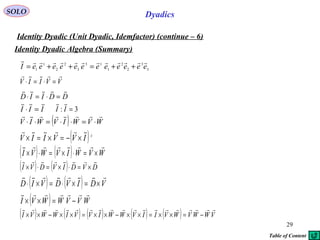
3
3
2
2
1
13
3
2
2
1
1
eeeeeeeeeeeeI

++=++=
VVIIV

=⋅=⋅
III

=⋅ 3: =II

DDIID

=⋅=⋅
( ) WVWIVWIV

⋅=⋅⋅=⋅⋅
( )c
IVVIIV

×−=×=×
( ) ( ) WVWIVWVI

×=⋅×=⋅×
( ) ( ) DVDIVDVI

×=⋅×=⋅×
( ) ( ) VDIVDVID

×=×⋅=×⋅
( ) WVVWWVI

−=××
Table of Content
Identity Dyadic (Unit Dyadic, Idemfactor) (continue – 6)
( ) ( ) ( ) ( ) ( ) VWWVWVIIVWWIVVIWWVI

−=××=××−××=××−××
30
SOLO Dyadics
Coordinate Transformation of Dyadics in Reciprocal Coordinates
kj
jkk
jk
j
k
jk
j
kj
jk
kj
k
i
j
iii eedeedeedeedeeBABAD

======
nm
mnn
mn
m
n
mn
m
nm
mn
ii ffdffdffdffdBAD

=====
where
k
jk
jk
j
n
k
j
mn
mn
mn
m
eedeedffdD

=== βα
Let find the relation between defined in the bases and to
defined in the bases and .
i
e
 i
e

i
f

i
f
 k
j
d
n
m
d
[ ]










=




















=












→




=
= −
3
2
1
1
3
2
1
3
3
3
2
3
1
2
3
2
2
2
1
1
3
1
2
1
1
3
2
1
e
e
e
L
e
e
e
f
f
f
ef T
i
j
i
k
k
j
mj
m
j










βββ
βββ
βββ
δαβ
β
[ ]










=




















=












→




⋅=
=
3
2
1
3
2
1
3
3
2
3
1
3
3
2
2
2
1
2
3
1
2
1
1
1
3
2
1
e
e
e
L
e
e
e
f
f
f
ef
ef
ji
j
i
j
j
ii











ααα
ααα
ααα
α
α
n
k
j
mn
m
k
j
dd βα=
n
mm
n
n
k
k
j
j
mn
mm
n
k
j
n
k
j
mn
mm
n
k
jk
j
dddd
m
k
k
m
===

δδ
αββααββααβ
m
j
k
nk
j
n
m
dd αβ=
31
SOLO Dyadics
Coordinate Transformation of Dyadics in Reciprocal Coordinates (continuous – 1)
where
[ ]










=




















=












→




=
= −
3
2
1
1
3
2
1
3
3
3
2
3
1
2
3
2
2
2
1
1
3
1
2
1
1
3
2
1
e
e
e
L
e
e
e
f
f
f
ef T
i
j
i
k
k
j
mj
m
j










βββ
βββ
βββ
δαβ
β
[ ]










=




















=












→




⋅=
=
3
2
1
3
2
1
3
3
2
3
1
3
3
2
2
2
1
2
3
1
2
1
1
1
3
2
1
e
e
e
L
e
e
e
f
f
f
ef
ef
ji
j
i
j
j
ii











ααα
ααα
ααα
α
α
m
j
k
nk
j
n
m
dd αβ=
We found
[ ]
[ ] [ ] [ ] 1
3
3
2
3
1
3
3
2
2
2
1
2
3
1
2
1
1
1
3
3
2
3
1
3
3
2
2
2
1
2
3
1
2
1
1
1
3
3
2
3
1
3
3
2
2
2
1
2
3
1
2
1
1
1
3
3
2
3
1
3
3
2
2
2
1
2
3
1
2
1
1
1
:
−
=






























=












=
LDL
ddd
ddd
ddd
ddd
ddd
ddd
D
βββ
βββ
βββ
ααα
ααα
ααα
Table of Content
32
SOLO Dyadics
Dyadic Invariants
The invariants of the dyadic are derived from the following invariant equation
[ ] [ ] [ ] [ ] [ ] [ ]( ) [ ]
[ ] [ ] [ ]( ) [ ]( ) 0detdetdetdet
detdetdet
3333
1
1
1
33
1
3333
=−=−=
−=−=−
−
−−
DIDILL
LDILLDLIDI
xx
xxx
λλ
λλλ
  
This is the invariant characteristic equation derived from the dyadic
[ ]( )
( ) ( )[ ] ( ) ( )
( ) ( )
0
detdet
2
3
1
2
3
1
2
2
1
3
3
1
1
3
3
2
2
1
3
3
1
2
2
1
2
3
3
2
1
1
3
3
2
2
1
1
1
3
3
1
1
2
2
1
2
3
3
2
3
3
2
2
3
3
1
1
2
2
1
12
3
3
2
2
1
13
2
2
1
3
2
3
1
2
1
3
3
1
1
3
3
2
3
3
1
2
1
2
2
1
2
3
3
2
3
3
2
2
3
3
2
22
1
1
3
3
2
3
1
3
3
2
2
2
1
2
3
1
2
1
1
1
33
=−+−++−
−−−+++++−=
−+−−+−+−++−−=










−−−
−−−
−−−
=−
dddddddddddddddddd
ddddddddddddddd
ddddddddddddddddddd
ddd
ddd
ddd
DI x
λλλ
λλλλλ
λ
λ
λ
λ
We found the following three scalar invariants of the dyadic
( ) ( )
2
3
1
2
3
1
1
3
3
2
2
1
3
3
2
2
1
1
3
3
1
2
2
1
2
2
1
3
3
1
2
3
3
2
1
1
3
1
3
3
1
1
2
2
1
2
3
3
2
3
3
2
2
3
3
1
1
2
2
1
1
23
3
2
2
1
1
1
ddddddddddddddddddI
ddddddddddddIdddI
−−−++=
−−−++=++=
[ ] [ ] [ ] [ ] 1−
= LDLDWe found that under a coordinate transformation :[ ] [ ] [ ]eLf

=
Any dyadic has five important invariants associated with: three scalar invariants,
one dyadic invariant and one vector invariant.
33
SOLO Dyadics
Dyadics Invariants (continue – 1)
We found the following three scalar invariants of a dyadic
Let Compute
( ) ( ) i
k
k
i
m
k
i
m
k
i
m
ki
ji
m
k
j
m
ki
ji
m
k
j
m
i
i
mk
jk
j
ddddddeeeeddeedeedDD ===⋅⋅== δδδ

::
( ) [ ] SDDscalarDtracedddI

===++= 3
3
2
2
1
1
1
( )1
3
3
1
1
2
2
1
2
3
3
2
3
3
2
2
3
3
1
1
2
2
1
1
2
ddddddddddddI −−−++=
[ ]DddddddddddddddddddI det2
3
1
2
3
1
1
3
3
2
2
1
3
3
2
2
1
1
3
3
1
2
2
1
2
2
1
3
3
1
2
3
3
2
1
1
3
=−−−++=
The matrix [ ]










=
333231
232221
131211
ddd
ddd
ddd
D
[ ]






















−
−−
−
=
2221
1211
2321
1311
2322
1312
3231
1211
3331
1311
3332
1312
3231
2221
3331
2321
3332
2322
:
dd
dd
dd
dd
dd
dd
dd
dd
dd
dd
dd
dd
dd
dd
dd
dd
dd
dd
D adj
The adjoin dyadic is defined as
( ) [ ]










=
3
2
1
321
:
e
e
e
DeeeD adjadj




( ) [ ]










=
3
2
1
321:
e
e
e
DeeeD




The adjoin dyadic is the fourth
dyadic invariant.D
 adj
D

34
SOLO Dyadics
Dyadics Invariants (continue – 2)
We have:
If we can define:
and
[ ] [ ] [ ][ ] 33det xadj IDDD =
[ ] 0det 3 ≠= ID [ ] [ ] [ ] [ ] [ ] [ ] 33
11
det/: xadj IDDDDD =→=
−−
( ) [ ]










=
−−
3
2
1
1
321
1
:
e
e
e
DeeeD




( ) [ ] ( ) [ ] ( ) [ ] I
e
e
e
Ieee
e
e
e
Deee
e
e
e
DeeeDD x













=










=




















=⋅
−−
3
2
1
33321
3
2
1
1
321
3
2
1
321
1
35
SOLO Dyadics
Dyadics Invariants (continue – 3)
The fifth dyadic invariant is the vector obtained by introducing the cross vector
product between the dyadic vectors
kj
jkk
jk
j
k
jk
j
kj
jk
kj
k
i
j
iii eedeedeedeedeeBABAD

======
kj
jkk
jk
j
k
jk
j
kj
jk
kj
k
i
j
iiiV
eedeedeedeedeeBABAD

×=×=×=×=×=×=
( ) ( )321 ,, eeegee
g
e kj
ijki 
=×=
ε
Use
( ) ( ) ( )[ ]321122133113223
eddeddeddgedgD ijk
ijkV

−+−+−== ε
We defined the decomposition of a dyadic in symmetric and anti-symmetric parts:
( ) ( ) ( )
( ) ( ) ( )
( ) ( ) ( )
( ) ( ) ( )
( )
( ) ( )
( ) ( )
( ) ( ) 



















−−−−
−−−
−−
+




















+++
+++
+++
=−++=
−
ΩΦ
3
2
1
32233113
32232112
31132112
321
3
2
1
333332233113
322322222112
311321121111
321
0
0
0
2
1
2
1
2
1
2
1
e
e
e
dddd
dddd
dddd
eee
e
e
e
dddddd
dddddd
dddddd
eeeDDDDD
symmetricanti
C
symmetric
C















Since the matrix representation of the vector cross-product of isV
D

( )
( )
( )
( ) ( )
( ) ( )
( ) ( ) 









−−−
−−−
−−−
=×










−
−
−
=×
0
0
0
32231331
32232112
13312112
2112
1331
3223
dddd
dddd
dddd
g
dd
dd
dd
gDV

i.e. the
antisymmetric
part of
multiplied by
D

g
Table of Content
36
SOLO
Accordingly we can classify the dyadics as follows:
Dyadics
Classification of Dyadics
Physically, dyadics describe at each point the properties of the field that relate an
input or cause vector to an output or effect vector. If the family of input vectors includes
all magnitudes and directions, then one class of dyadics produces families of output
vectors that also include all magnitudes and directions. Dyadics of this class are called
“complete”. All others are called “incomplete”.
[ ] 0det 3
≠= IDIf
CompleteThe three rows/columns of
[D] are linearly independent
Property Comment Classification
[ ] 0&0det 3

≠== adj
DIDIf PlanarOnly two rows/columns of
[D] are linearly independent
LinearThe three rows/columns of
[D] are linearly dependent
If [ ] 0&0det 3

=== adjDID
A Planar Dyadic can be reduced by a suitable coordinate transformation to the
sum of two dyads (no less) 2211 BABAD

+=
A Linear Dyadic can be reduced by a suitable coordinate transformation to
a single dyad 11BAD

= Table of Content
37
SOLO Dyadics
Differentiation of Dyadics
Define:
( )tD

Suppose we have a dyadics and the vector that are differentiable
functions of the parameter scalar t.
( )tV

( ) ( ) ( ) ( ) ( ) ( )[ ] ( ) ( ) ( ) ( ) ( )[ ] ( )tVtBtAtVtDtWtBtAtVtDtVtU

⋅=⋅=⋅=⋅= :&:
( ) td
Dd
VD
td
Vd
td
Bd
AVB
td
Ad
VBA
td
Vd
td
Ud







⋅+⋅=







⋅+







⋅+⋅=
where:








+







=
td
Bd
AB
td
Ad
td
Dd



:
( ) V
td
Dd
td
Vd
DV
td
Bd
AVB
td
Ad
td
Vd
BA
td
Wd 







⋅+⋅=⋅







+⋅







+⋅=
( ) ( ) V
td
Dd
td
Vd
DVD
td
d
td
Dd
VD
td
Vd
DV
td
d 






⋅+⋅=⋅⋅+⋅=⋅ &
( ) ( ) V
td
Dd
td
Vd
DVD
td
d
td
Dd
VD
td
Vd
DV
td
d 






×+×=××+×=× &
In the same way:
38
SOLO Dyadics
Differentiation of Dyadics
( )zyxV ,,

Gradient of a Vector .
( ) [ ]
































∂
∂
∂
∂
∂
∂
∂
∂
∂
∂
∂
∂
∂
∂
∂
∂
∂
∂
=++





∂
∂
+
∂
∂
+
∂
∂
=∇
z
y
x
z
V
z
V
z
V
y
V
y
V
y
V
x
V
x
V
x
V
zyxzVyVxV
z
z
y
y
x
xV
zyx
zyx
zyx
zyx
1
1
1
111111111

This id a dyadic.
Let compute:
( ) ( ) [ ]
































∂
∂
∂
∂
∂
∂
∂
∂
∂
∂
∂
∂
∂
∂
∂
∂
∂
∂
=





∂
∂
+
∂
∂
+
∂
∂
++=∇
z
y
x
z
V
y
V
x
V
z
V
y
V
x
V
z
V
y
V
x
V
zyx
z
z
y
y
x
xzVyVxVV
zyx
zyx
zyx
zyx
c
1
1
1
111111111

39
SOLO Dyadics
Differentiation of Dyadics
( )zyxV ,,

Gradient of a Vector (continue – 1) .
( )[ ] ( )[ ]
[ ]
[ ]
































∂
∂






∂
∂
−
∂
∂
−





∂
∂
−
∂
∂
−






∂
∂
−
∂
∂
+





∂
∂
−
∂
∂
−






∂
∂
−
∂
∂
+





∂
∂
−
∂
∂
+
+
































∂
∂






∂
∂
+
∂
∂






∂
∂
+
∂
∂






∂
∂
+
∂
∂
∂
∂






∂
∂
+
∂
∂






∂
∂
+
∂
∂






∂
∂
+
∂
∂
∂
∂
=
∇−∇+∇+∇=∇
z
y
x
z
V
z
V
y
V
z
V
x
V
z
V
y
V
y
V
x
V
z
V
x
V
y
V
x
V
zyx
z
y
x
z
V
z
V
y
V
z
V
x
V
z
V
y
V
y
V
y
V
x
V
z
V
x
V
y
V
x
V
x
V
zyx
VVVVV
zyzxz
yzxy
xzxy
zyzxz
yzyxy
xzxyx
CC
1
1
1
2
1
2
1
2
1
0
2
1
2
1
2
1
0
111
1
1
1
2
1
2
1
2
1
2
1
2
1
2
1
111
2
1
2
1 
Let decompose the gradient of the vector in the symmetric and anti-symmetric parts.
40
SOLO Dyadics
Differentiation of Dyadics
( )zyxV ,,

Gradient of a Vector (continue – 2)
Let find the scalar and vector invariants of [ ]
































∂
∂
∂
∂
∂
∂
∂
∂
∂
∂
∂
∂
∂
∂
∂
∂
∂
∂
=∇
z
y
x
z
V
z
V
z
V
y
V
y
V
y
V
x
V
x
V
x
V
zyxV
zyx
zyx
zyx
1
1
1
111

( ) [ ]
































∂
∂
∂
∂
∂
∂
∂
∂
∂
∂
∂
∂
∂
∂
∂
∂
∂
∂
=∇
z
y
x
z
V
y
V
x
V
z
V
y
V
x
V
z
V
y
V
x
V
zyxV
zyx
zyx
zyx
c
1
1
1
111

[ ] ( )[ ] V
z
V
y
V
x
V
VV zyx
S
c
S

⋅∇=
∂
∂
+
∂
∂
+
∂
∂
=∇=∇ Divergence of V

[ ]
V
z
z
V
y
V
y
x
V
z
V
x
y
V
x
V
V
yzzxxy
V


×∇=






∂
∂
−
∂
∂
+





∂
∂
−
∂
∂
+





∂
∂
−
∂
∂
=∇ 111
( )[ ]




















∂
∂






∂
∂
−
∂
∂
−





∂
∂
−
∂
∂
−






∂
∂
−
∂
∂
+





∂
∂
−
∂
∂
−






∂
∂
−
∂
∂
+





∂
∂
−
∂
∂
+
=∇−∇
z
V
z
V
y
V
z
V
x
V
z
V
y
V
y
V
x
V
z
V
x
V
y
V
x
V
VV
zyzxz
yzxy
xzxy
c
2
1
2
1
2
1
0
2
1
2
1
2
1
0
2
1 
( )[ ]
V
z
z
V
y
V
y
x
V
z
V
x
y
V
x
V
V
yzzxxy
V
c


×∇−=






∂
∂
−
∂
∂
−





∂
∂
−
∂
∂
−





∂
∂
−
∂
∂
−=∇ 111
Rotor of V

41
Vector AnalysisSOLO
Dyadic Identities Summary
( ) ( ) ( ) CbaCabCba

⋅×=×⋅−=×⋅
( ) ( ) ( )CbaCabCba

⋅−×⋅=××
( ) CCC

⋅∇+⋅∇=⋅∇ φφφ
( ) CCC

×∇+×∇=×∇ φφφ
( ) ( ) CCC
 2
∇−⋅∇∇=×∇×∇
0=×∇⋅∇ C

aCCa T 
⋅=⋅
[ ]TT
aCCa

×−=×
( ) ( ) BCaBaC
TT

⋅×−=×⋅
42
Dyadic Green’s Function Solution of Non-homogeneous (Helmholtz) Differential Equations
ELECTROMAGNETICSSOLO
The Dyadic (Matrix) Green’s function is the solution of the vector equation( )SF rrG

,
( ) ( )SFSS rrIGkG

−=−×∇×∇ δπ42
where is the unit dyadic or the identity matrix.I

( ) ( )
( ) ( ) ( )
( ) ( )GrrIGkG
GGG
rrIGkG
SSSFS
SSSSSS
SFSS



⋅∇∇+−−=+∇⇒
⇒








∇⋅∇−⋅∇∇=×∇×∇
−=−×∇×∇
δπ
δπ
4
4
22
2
( ) ( )
( ) ( )
⇒








=×∇⋅∇×∇=×∇×∇⋅∇→=∇×∇
−=−×∇×∇⋅∇
00
42
GG
rrIGkG
SSSSSSSS
SFSSS


δπ
and
( ) ( )
( ) ⇒−∇−=⋅∇⇒
⇒−∇=−⋅∇=⋅∇−⇒
SFSS
SFSSFSS
rr
k
G
rrrrIGk


δ
π
δπδπ
2
2
4
44
( ) ( )SFSSSS rr
k
G

−∇∇−=⋅∇∇⇒ δ
π
2
4
Therefore ( ) ( )
( ) ( )
( )SFSSS
SFSSSS
SSSFS
rr
k
IGkG
rr
k
G
GrrIGkG



−





∇∇+−=+∇
⇒










−∇∇−=⋅∇∇
⋅∇∇+−−=+∇
δπ
δ
π
δπ
2
22
2
22
1
4
4
4
43
Dyadic Green’s Function Solution of Non-homogeneous (Helmholtz) Differential Equations
(continue – 1)
ELECTROMAGNETICSSOLO
( )SFSSS
rr
k
IGkG

−





∇∇+−=+∇ δπ 2
22 1
4
The form of the above equation suggests that can be written in terms of a
Scalar Green’s function as
( )SF rrG

,
( )SF rr

,ψ
( ) ( )SFSSSF rr
k
IrrG

,
1
, 2
ψ





∇∇+=
To find let perform the following calculations:( )SF rr

,ψ
( ) ( )
( ) ψ
ψ
ψ






∇∇+−∇−⋅∇∇=






∇∇+−×∇×∇=−×∇×∇
⇒





∇∇+=
SSSSS
SSSSSS
SS
k
Ik
k
IkGkG
k
IG
2
22
2
22
2
1
1
1



( ) ( )
( ) ( )
( ) ( ) ( )ψψψ
ψψ
ψψ
ψψψψψψ
22
0
222
2222
2222
22222
kIkkI
kkI
kkI
kIkIk
SSSSSS
SSSSSS
SSSSSSSS
SSSSSSSSSSSS
SS
+∇−=∇∇×∇×∇++∇−=
∇∇−∇⋅∇∇++∇−=
∇∇∇−∇∇⋅∇∇++∇−=
∇∇−−∇∇∇−∇−∇∇⋅∇∇+∇∇=
=∇×∇
−
−
−
−−




We can see that: ( ) ( ) ( )SFSSS rrIkIGkG

−=+∇−=−×∇×∇ δπψ 4222
44
Dyadic Green’s Function Solution of Non-homogeneous (Helmholtz) Differential Equations
(continue – 2)
ELECTROMAGNETICSSOLO
We found that the solution of this equation is:
( ) ( ) ( )SFSSS rrIkIGkG

−=+∇−=−×∇×∇ δπψ 4222
Therefore satisfies the scalar wave equation:( )SF rr

,ψ
( ) ( ) ( )SFSFSFS rrrrkrr

−−=+∇ δπψψ 4,, 22
( ) ( )
SFSF rrrwhere
r
rkj
rr

−=
−
=
exp
,ψ
45
Dyadic Green’s Function Solution of Non-homogeneous (Helmholtz) Differential Equations
(continue – 3)
ELECTROMAGNETICSSOLO
Using the Second Vector Green Identity
( )( )( ) ( ) ( )( )[ ] ( ) ( ) ( )( )[ ]∫∫
→
⋅⋅×∇×−×∇×⋅=×∇×∇⋅⋅−⋅×∇×∇⋅=
S
SS
V
SSSSV dSnaGEEaGdVEaGaGEI 1

where is an arbitrary constant vectora

iS
nS

n
i
iSS
1=
=dV
dSn
→
1
V
Fr

Sr

F
0r
SF rrr

−= iS
nS
dV
dSn
→
1
V
Fr

Sr

F
0r SF rrr

−=
We have
and we get
( ) ( )( )aGaG SS
consta
SS
 
⋅×∇×∇=⋅×∇×∇
=
( )( )( ) ( ) ( )( )[ ]
( )[ ] ( ) [ ]{ }
( ) ( )[ ]dVJJjGaaE
dVJJjEkGarraaGkE
EaGaGEI
V
mSe
V
mSeSF
V
SSSSV
∫
∫
∫
×∇+⋅⋅+⋅=
×∇−−⋅⋅−−+⋅⋅=
×∇×∇⋅⋅−⋅×∇×∇⋅=
ωµπ
ωµδπ



4
4 22
We used the fact that, since the sources and the observation point are both
in the volume V,
Sr

Fr

( ) aEdVrraE
V
SF

⋅=−⋅∫ δ
( )[ ] ( ) ( ) ( )( )[ ]∫∫ ⋅×∇×−×∇×⋅⋅+






×∇+⋅⋅−=⋅
→
S
SS
V
mSe dSaGEEaGndVJJjGaEa

14 ωµπ
Therefore we obtain
Solution of the equation: ( ) mSeSS JJjEkE ×∇−−=−×∇×∇ ωµ2
46
Dyadic Green’s Function Solution of Non-homogeneous (Helmholtz) Differential Equations
(continue – 4)
ELECTROMAGNETICSSOLO
Let develop now the expression
( )[ ] ( ) ( ) ( )( )[ ]∫∫ ⋅×∇×−×∇×⋅⋅+






×∇+⋅⋅−=⋅
→
S
SS
V
mSe dSaGEEaGndVJJjGaEa

14 ωµπ
Solution of the equation: ( ) mSeSS JJjEkE ×∇−−=−×∇×∇ ωµ2
(continue – 1)
( ) ( ) ( )( )[ ]aGEEaGn SS

⋅×∇×−×∇×⋅⋅
→
1
( ) ( ) ( )
a
k
aa
k
aaaG
S
consta
SSSS
consta
SSSS





×∇=
=∇×∇∇⋅+×∇=





∇∇⋅+×∇=⋅×∇
→
→
=
=
ψ
ψψψ 2
0
2
11
and
( )( ) ( ) ( )
( ) aEnaEn
aEnnaEnaGE
SS
SSS


⋅∇×





×=×∇⋅





×=
=×∇×⋅=⋅×∇×=⋅⋅×∇×
→→
→→→
ψψ
ψψ
11
111
47
Dyadic Green’s Function Solution of Non-homogeneous (Helmholtz) Differential Equations
(continue – 5)
ELECTROMAGNETICSSOLO
Solution of the equation: ( ) mSeSS JJjEkE ×∇−−=−×∇×∇ ωµ2
(continue – 2)
Since is symmetric andG
k
IG SS

,
1
2
ψ





∇∇+= GaaG

⋅=⋅
( ) ( ) ( ) ( ) ( ) ( )
( ) ( )
( ) ( ) ( )Ena
k
Ena
En
k
IaEnGa
nEGanEaGnEaG
SSSS
SSSS
SSS
×∇×⋅∇∇⋅−×∇×⋅−=






×∇×⋅





∇∇+⋅−=



 ×∇×⋅⋅−=
××∇⋅⋅=××∇⋅⋅=⋅×∇×⋅
→→
→→
→→→
1
1
1
1
1
1
111
2
2
ψψ
ψ



( ) ( ) ( )
( ) ( ) ( ) ( ) addEna
k
Ena
k
subtractEna
k
Ena
SSSSSS
SSSS
←×∇×∇⋅∇⋅+×∇×⋅∇∇⋅−
←×∇×∇⋅∇⋅−×∇×⋅−=
→→
→→
1
1
1
1
1
1
1
22
2
ψψ
ψψ


But since ( ) ( ) ⇒=∇⋅∇=×∇×∇⇒==∇×∇
→
0&0 aaconsta SSSSSS

ψψψ
( ) ( ) ( ) ( ) ( )
( ) ψ
ψψψψψ
SS
SSSSSSSSSS
a
aaaaa
∇∇⋅=
∇⋅∇+∇∇⋅+×∇×∇+∇×∇×=∇⋅∇


we can develop the following expression
( ) ( ) ( ) ( )
( ) ( ) ( ) ( )
→→
→→
⋅×∇×∇∇⋅+××∇⋅∇⋅∇=
×∇×∇⋅∇⋅+×∇×⋅∇∇⋅−
nEa
k
nEa
k
Ena
k
Ena
k
SSSSSS
SSSSSS
1
1
1
1
1
1
1
1
22
22
ψψ
ψψ


( ) ( ) ( ) ( )[ ]
( ) ( )[ ]
→
→
⋅×∇∇⋅×∇=
⋅×∇×∇∇⋅+×∇×∇⋅∇=
nEa
k
nEaEa
k
SSS
SSSSSS
1
1
1
1
2
2
ψ
ψψ


48
Dyadic Green’s Function Solution of Non-homogeneous (Helmholtz) Differential Equations
(continue – 6)
ELECTROMAGNETICSSOLO
Solution of the equation: ( ) mSeSS JJjEkE ×∇−−=−×∇×∇ ωµ2
(continue – 3)
We get therefore
( ) ( ) =⋅×∇×⋅
→
nEaG S 1

( ) ( ) ( )
( ) ( ) ( ) ( )Ena
k
Ena
k
Ena
k
Ena
SSSSSS
SSSS
×∇×∇⋅∇⋅+×∇×⋅∇∇⋅−
×∇×∇⋅∇⋅−×∇×⋅−=
→→
→→
1
1
1
1
1
1
1
22
2
ψψ
ψψ


( ) ( ) ( )Ena
k
Ena SSSS ×∇×∇⋅∇⋅−×∇×⋅−=
→→
1
1
1 2
ψψ

( ) ( )[ ]
→
⋅×∇∇⋅×∇+ nEa
k
SSS 1
1
2
ψ

( )( ) aEnnaGE SS

⋅∇×





×=⋅⋅×∇×
→→
ψ11We found that
therefore ( ) ( ) ( )( )[ ]aGEEaGn SS

⋅×∇×−×∇×⋅⋅
→
1
( ) ( ) ( )Ena
k
Ena SSSS
×∇×∇⋅∇⋅−×∇×⋅−=
→→
1
1
1 2
ψψ

( ) ( )[ ] aEnnEa
k
SSSS

⋅∇×





×−⋅×∇∇⋅×∇+
→→
ψψ 11
1
2
( ) ( )





×∇×∇⋅∇+∇×





×+×∇×⋅−=
→→→
En
k
EnEna SSSSS 1
1
11 2
ψψψ

( ) ( )[ ]
→
⋅×∇∇⋅×∇+ nEa
k
SSS 1
1
2
ψ

49
Dyadic Green’s Function Solution of Non-homogeneous (Helmholtz) Differential Equations
(continue – 7)
ELECTROMAGNETICSSOLO
Solution of the equation: ( ) mSeSS JJjEkE ×∇−−=−×∇×∇ ωµ2
(continue – 4)
Since and we
get
( ) ( ) ( )( )[ ]aGEEaGn SS

⋅×∇×−×∇×⋅⋅
→
1 ( ) ( )





×∇×∇⋅∇+∇×





×+×∇×⋅−=
→→→
En
k
EnEna SSSSS 1
1
11 2
ψψψ

( ) ( )[ ]
→
⋅×∇∇⋅×∇+ nEa
k
SSS 1
1
2
ψ

( ) mSeSS JJjEkE ×∇−−=−×∇×∇ ωµ2
µεω 22
=k
( ) ( ) ( )( )[ ]
( ) ( )
( ) ( )[ ]
→
→→→→
→
⋅×∇∇⋅×∇+





 ∇
×∇+⋅−∇




 ⋅+∇×




 ×+×∇×⋅−=
⋅×∇×−×∇×⋅⋅
nEa
k
k
JJjnEnEnEna
aGEEaGn
SSS
S
mSeSSS
SS
1
1
1111
1
2
2
ψ
ψ
ωµψψψ



50
Dyadic Green’s Function Solution of Non-homogeneous (Helmholtz) Differential Equations
(continue – 8)
ELECTROMAGNETICSSOLO
Solution of the equation: ( ) mSeSS JJjEkE ×∇−−=−×∇×∇ ωµ2
(continue – 5)
Let compute
( ) ( ) ( )( )[ ]∫
→
⋅⋅×∇×−×∇×⋅
S
SS dSnaGEEaG 1

( ) ( )∫ 




 ∇
×∇+⋅−∇





⋅+∇×





×+×∇×⋅−=
→→→→
S
S
mSeSSS dS
k
JJjnEnEnEna 2
1111
ψ
ωµψψψ

( ) ( )[ ] dSnEa
k S
SSS∫
→
⋅×∇∇⋅×∇+ 1
1
2
ψ

In our case the integral is performed over a closed surface S and therefore the last
integral is (using Gauss’ 5 Theorem: ):∫∫ ×∇=×
→
VS
dvAdSAn

1
( ) ( )[ ] ( ) ( )[ ] ( ) ( )[ ] 011
0
5
=×∇∇⋅⋅∇×∇=××∇∇⋅⋅∇=⋅×∇∇⋅×∇ ∫∫∫
→→
V
SSSS
Gauss
S
SSS
S
SSS dvEadSnEadSnEa
  

ψψψ
Compute (using Gauss’ 4 Theorem: ):( )[ ]∫∫ ⋅∇+∇⋅=





⋅
→
VS
dvABBAdSnAB

1
( )
( )
( ) ∫∫
∫∫
∫
∇⋅+
∇∇
×∇+⋅=








×∇⋅∇+⋅∇
∇
⋅+
∇∇
×∇+⋅=




×∇+⋅
∇
⋅
=
−
→
V
S
e
V
SS
mSe
k
V
mSS
j
S
S
V
SS
mSe
Gauss
S
mSe
S
dvadv
k
JJja
dvJJj
k
adv
k
JJja
dSJJjn
k
a
e
ψ
ε
ρψ
ωµ
ωµ
ψψ
ωµ
ωµ
ψ
µεω
ρω




2
0
22
4
2
2
1
51
Dyadic Green’s Function Solution of Non-homogeneous (Helmholtz) Differential Equations
(continue – 8)
ELECTROMAGNETICSSOLO
Solution of the equation: ( ) mSeSS JJjEkE ×∇−−=−×∇×∇ ωµ2
(continue – 5)
Let substitute this result in
( ) ( ) ∫∫∫ ∇⋅+
∇∇
×∇+⋅=


 ×∇+⋅
∇
⋅
→
V
S
e
V
SS
mSe
S
mSe
S
dvadv
k
JJjadSJJjn
k
a ψ
ε
ρψ
ωµωµ
ψ 
22
1
( )[ ] ( ) ( ) ( )( )[ ]∫∫
→
⋅⋅×∇×−×∇×⋅+






×∇+⋅⋅−=⋅
S
SS
V
mSe dSnaGEEaGdVJJjGaEa 14

ωµπ
( )












×∇+⋅




 ∇∇
+⋅−=⋅ ∫ dVJJj
k
IaEa
V
mSe
SS
ωµψπ 2
4

( )∫ 





∇





⋅+∇×





×+×∇×⋅−
→→→
S
SSS dSEnEnEna ψψψ 111

( ) ∫∫ ∇⋅+
∇∇
×∇+⋅+
V
S
e
V
SS
mSe dvadv
k
JJja ψ
ε
ρψ
ωµ

2
we obtain
Since this is true for all constant vectors , after simplification and rearranging terms,
we obtain
a

( )∫∫ 



∇




 ⋅+∇×




 ×+×∇×−





∇−×∇+−=
→→→
S
SSS
V
S
e
mSe dSEnEnEndVJJjE ψψψ
π
ψ
ε
ρ
ψψωµ
π
111
4
1
4
1
52
Dyadic Green’s Function Solution of Non-homogeneous (Helmholtz) Differential Equations
(continue – 9)
ELECTROMAGNETICSSOLO
Solution of the equation: ( ) mSeSS JJjEkE ×∇−−=−×∇×∇ ωµ2
(continue – 6)
Using
( )∫∫ 



∇




 ⋅+∇×




 ×+×∇×−





∇−×∇+−=
→→→
S
SSS
V
S
e
mSe
dSEnEnEndVJJjE ψψψ
π
ψ
ε
ρ
ψψωµ
π
111
4
1
4
1
we obtain
We recovered Stratton-Chu solution
Using the duality relations
we can write
( ) ( ) ∫∫∫∫∫ ×∇−×=×∇−×∇=×∇
→
V
mS
S
m
Gauss
V
mS
V
mS
V
mS
dVJdSJndVJdVJdVJ ψψψψψ 1
5
( )∫∫ 



∇




 ⋅+∇×




 ×++×∇×−





∇−×∇−−=
→→→
S
SSmS
V
S
e
mSe
dSEnEnJEndVJJjE ψψψ
π
ψ
ε
ρ
ψψωµ
π
111
4
1
4
1










⇓










⇓










−
⇓










⇓












−
⇓












⇓












−
⇓












⇓
µ
ε
ε
µ
ρ
ρ
ρ
ρ
e
m
m
e
e
m
m
e
J
J
J
J
E
H
H
E








( )∫∫ 



∇




 ⋅+∇×




 ×+−×∇×−





∇−×∇+−=
→→→
S
SSeS
V
S
m
eSm dSHnHnJHndVJJjH ψψψ
π
ψ
µ
ρ
ψωεψ
π
111
4
1
4
1
53
Dyadic Green’s Function Solution of Non-homogeneous (Helmholtz) Differential Equations
(continue – 10)
ELECTROMAGNETICSSOLO
Discontinuous Surface Distribution
Stratton-Chu equations are valid only if the vectors are continuous and have
continuous derivatives on the S surface. They cannot be applied, therefore, to the
problem of diffraction at a slit.
HE

,
Suppose we have a slit of surface S1 with the
curve C serving as his boundary. Let assume
any surface S2 closed at infinity that
complements the surface S1 and has in
common the curve C. Assume no sources
0,0,0,0 ==== meme JJ ρρ

Assume also that on S2 we have 0,0 22

== HE
ConkHnkEn me

=×−=×
→→
11 1,1
To overcome the discontinuity problem assume that on curve C we have a
distribution of charges such that
54
Dyadic Green’s Function Solution of Non-homogeneous (Helmholtz) Differential Equations
(continue – 11)
ELECTROMAGNETICSSOLO
Discontinuous Surface Distribution (continue – 1)
Let return to
 
( ) ( ) ( )( )[ ]
( ) ( ) ( )( )[ ]∫
∫∫
⋅×∇×−×∇×⋅⋅=
⋅×∇×−×∇×⋅⋅+
























×∇+⋅⋅−=⋅
→
+
→
1
21
1
14
00
S
SS
SS
SS
V
mSe
dSaGEEaGn
dSaGEEaGndVJJjGaEa


ωµπ
We found ( ) ( ) ( )( )[ ]
( )  
( ) ( )[ ]
→
→→→→
→
⋅×∇∇⋅×∇+







 ∇








×∇+⋅−∇





⋅+∇×





×+×∇×⋅−=
⋅⋅×∇×−×∇×⋅
nEa
k
k
JJjnEnEnEna
naGEEaG
SSS
S
mSeSSS
SS
1
1
1111
1
2
2
00
ψ
ψ
ωµψψψ



Using Stokes’ Theorem: we have∫∫ ⋅=⋅×∇
CS
rdASdA

( ) ( )[ ] ( ) ( )∫∫∫ ⋅×∇∇⋅=⋅×∇∇⋅=⋅×∇∇⋅×∇
→
C
SS
C
SS
Stokes
S
SSS rdEardEadSnEa

ψψψ
1
1
Therefore
( ) ( ) ( )( )[ ]
( ) ( )∫∫
∫
⋅×∇∇⋅+



∇




 ⋅+∇×




 ×+×∇×⋅−=
⋅×∇×−×∇×⋅⋅=⋅
→→→
→
C
SS
S
SSS
S
SS
rdEa
k
dSEnEnEna
dSaGEEaGnEa


ψψψψ
π
2
1
111
14
1
1
55
Dyadic Green’s Function Solution of Non-homogeneous (Helmholtz) Differential Equations
(continue – 12)
ELECTROMAGNETICSSOLO
Discontinuous Surface Distribution (continue – 2)
Using the duality relations
( ) ( )∫∫ ⋅×∇∇⋅+



∇




 ⋅+∇×




 ×+×∇×⋅−=⋅
→→→
C
SS
S
SSS
rdEa
k
dSEnEnEnaEa

ψψψψπ 2
1
1114
1
Since this is true for all constant vectors , we obtaina

( ) ( )∫∫ ⋅×∇∇+





∇





⋅+∇×





×+×∇×−=
→→→
C
SS
S
SSS rdE
k
dSEnEnEnE

ψ
π
ψψψ
π 2
4
1
111
4
1
1
Using and we getµεω 22
=kHjES µω=×∇
∫∫ ⋅∇+





∇





⋅+∇×





×+





×−=
→→→
C
S
S
SS rdH
j
dSEnEnHnjE

ψ
εωπ
ψψψµω
π 4
111
4
1
1
we can write










⇓










⇓










−
⇓










⇓












−
⇓












⇓












−
⇓












⇓
µ
ε
ε
µ
ρ
ρ
ρ
ρ
e
m
m
e
e
m
m
e
J
J
J
J
E
H
H
E








∫∫ ⋅∇−





∇





⋅+∇×





×+





×−−=
→→→
C
S
S
SS rdE
j
dSHnHnEnjH

ψ
µωπ
ψψψεω
π 4
111
4
1
1
56
SOLO
References
[1] Vavra, M.H., “Aero-Thermodynamics and Flow Turbomachines”,
John Wiley & Sons, 1960
Appendix B: ”Introduction to Operations Involving Dyadics”, pp.531-557
Dyadics
[2] Reddy, J.N. & Rasmussen, M.L., “Advanced Engineering Analysis”,
John Wiley & Sons, 1982, Ch. 1.5: Dyadics and Tensors, pp.107-152
[3] Chou, P.C., Pagano, N.J., “Elasticity - Tensor, Dyadic and Engineering Approaches”,
Dover, 1992, Ch. 11: Vector and Dyadic Notation in Elasticity, pp.225-244
[4] Chen-To Tai, “Dyadic Green Functions in Electromagnetic Theory”, 2nd
Ed.,
IEEE Press, 1993
January 6, 2015 57
SOLO
Technion
Israeli Institute of Technology
1964 – 1968 BSc EE
1968 – 1971 MSc EE
Israeli Air Force
1970 – 1974
RAFAEL
Israeli Armament Development Authority
1974 – 2013
Stanford University
1983 – 1986 PhD AA

Dyadics

  • 1.
  • 2.
    2 SOLO TABLE OF CONTENT References Dyadics Vectors& Tensors in a 3D Space Triple Scalar Product Reciprocal Sets of Vectors Vector Decomposition The Summation Convention The Metric Tensor or Fundamental Tensor Specified by .3321 ,, Eeee ∈  Change of Vector Base, Coordinate Transformation Dyadics Introduction to Dyadics Dyadics in Reciprocal Coordinates Identity Dyadic (Unit Dyadic, Idemfactor) Coordinate Transformation of Dyadics in Reciprocal Coordinates Dyadics Invariants Classification of Dyadics Dyadic Green’s Function Solution of Non-homogeneous (Helmholtz) Differential Equations
  • 3.
    3 SOLO Triple Scalar Product Vectors& Tensors in a 3D Space 3321 ,, Eeee ∈  are three non-coplanar vectors, i.e. 1e  2e  3e  ( ) ( ) 0:,, 321321 ≠×⋅= eeeeee  ( ) ( ) ( ) ( ) ( ) ( ) ( ) 0,, ,,,, 123123213 132132132321 ≠=×⋅=⋅×= =×⋅=⋅×= eeeeeeeee eeeeeeeeeeee   Reciprocal Sets of Vectors The sets of vectors and are called Reciprocal Sets or Systems of Vectors if: 321 ,, eee  321 ,, eee  DeltaKroneckertheis ji ji ee j i j i j i δδ    = ≠ ==⋅ 1 0 Because is orthogonal to and then2e  3e 1 e  ( ) ( ) ( ) ( )321 321321 1 132 1 ,, 1 ,,1 eee keeekeeekeeeeke   =→=×⋅==⋅→×= and in the same way and are given by: 2 e  3 e 1 e  ( ) ( ) ( ) ( ) ( ) ( )321 213 321 132 321 321 ,,,,,, eee ee e eee ee e eee ee e          × = × = × = Table of Content
  • 4.
    4 SOLO Vectors &Tensors in a 3D Space Reciprocal Sets of Vectors (continue) By using the previous equations we get: ( ) ( ) ( ) ( )[ ] ( )[ ] ( ) ( )321 3 2 321 13323132 2 321 133221 ,,,,,, eee e eee eeeeeeee eee eeee ee        = ⋅×−⋅× = ××× =× ( ) ( ) ( ) ( ) ( ) ( )321 213 321 132 321 321 ,,,,,, eee ee e eee ee e eee ee e          × = × = × = ( ) ( ) ( ) ( ) 0 ,, 1 ,, ,, 321321 3 3321321 ≠= ⋅ ==⋅× eeeeee ee eeeeee    Multiplying (scalar product) this equation by we get: 3 e  In the same way we can show that: Therefore are also non-coplanar, and: 321 ,, eee  ( ) ( ) 1,,,, 321 321 =eeeeee  ( ) ( ) ( ) ( ) ( ) ( )321 21 3321 13 2321 32 1 ,,,,,, eee ee e eee ee e eee ee e          × = × = × = 1e  2e  3 e  1 e  2 e  3 e  Table of Content
  • 5.
    5 SOLO Vectors &Tensors in a 3D Space Vector Decomposition Given we want to find the coefficients and such that:3EA∈  321 ,, AAA 321 ,, AAA ∑ ∑ = = =++= =++= 3 1 3 3 2 2 1 1 3 1 3 3 2 2 1 1 j j j i i i eAeAeAeA eAeAeAeAA   3,2,1, =iee i i  are two reciprocal vector bases Let multiply the first row of the decomposition by : j e  Let multiply the second row of the decomposition by :ie  j i j i i i j i ij AAeeAeA ==⋅=⋅ ∑∑ == 3 1 3 1 δ  i j i j j j i j ji AAeeAeA ==⋅=⋅ ∑∑ == 3 1 3 1 δ  Therefore: ii jj eAAeAA  ⋅=⋅= & Then: ( ) ( ) ( ) ( ) ( ) ( ) ( ) ( )∑ ∑ = = ⋅=⋅+⋅+⋅= ⋅=⋅+⋅+⋅= 3 1 3 3 2 2 1 1 3 1 3 3 2 2 1 1 j j j i i i eeAeeAeeAeeA eeAeeAeeAeeAA   Table of Content
  • 6.
    6 SOLO Vectors &Tensors in a 3D Space The Summation Convention j j j j j eAeAeAeAeA  ==++ ∑= 3 1 3 3 2 2 1 1 The last notation is called the summation convention, j is called the dummy index or the umbral index. ( ) ( ) ( ) ( ) ( ) ( ) i i i i j j j j j j j j j i i i i i eAeeAeeAeeA eAeeAeeAeeAA   =⋅=⋅=⋅= =⋅=⋅=⋅= ∑ ∑ = = 3 1 3 1 Instead of summation notation we shall use the shorter notation first adopted by Einstein ∑= 3 1j j j eA  j j eA  Table of Content
  • 7.
    7 SOLO Vectors &Tensors in a 3D Space Let define: The Metric Tensor or Fundamental Tensor Specified by .3321 ,, Eeee ∈  jiijjiij geeeeg =⋅=⋅=  3321 ,, Eeee ∈  the metric covariant tensors of By choosing we get: ( ) ( ) ( ) ( ) j ijiii j jiiiii egegegeg eeeeeeeeeeeee   =++= ⋅=⋅+⋅+⋅= 3 3 2 2 1 1 3 3 2 2 1 1 ieA  ≡ or: j iji ege  = For i = 1, 2, 3 we have:                     ⋅⋅⋅ ⋅⋅⋅ ⋅⋅⋅ =                     =           3 2 1 332313 322212 312111 3 2 1 333231 232221 131211 3 2 1 e e e eeeeee eeeeee eeeeee e e e ggg ggg ggg e e e            
  • 8.
    8 SOLO Vectors &Tensors in a 3D Space We want to prove that the following determinant (g) is nonzero: The Metric Tensor or Fundamental Tensor Specified by .3321 ,, Eeee ∈            ⋅⋅⋅ ⋅⋅⋅ ⋅⋅⋅ =           = 332313 322212 312111 333231 232221 131211 detdet: eeeeee eeeeee eeeeee ggg ggg ggg g    g is the Gram determinant of the vectors 321 ,, eee  Jorgen Gram 1850 - 1916 Proof: Because the vectors are non-coplanars the following equations: 321 ,, eee  03 3 2 2 1 1 =++ eee  ααα is true if and only if 0321 === ααα Let multiply (scalar product) this equation, consecutively, by :321 ,, eee            =                     ⋅⋅⋅ ⋅⋅⋅ ⋅⋅⋅ →      =⋅+⋅+⋅ =⋅+⋅+⋅ =⋅+⋅+⋅ 0 0 0 0 0 0 3 2 1 332313 322212 312111 33 3 23 2 13 1 32 3 22 2 12 1 31 3 21 2 11 1 α α α ααα ααα ααα eeeeee eeeeee eeeeee eeeeee eeeeee eeeeee       Therefore α1= α2= α3=0 if and only if g:=det {gij}≠0 q.e.d.
  • 9.
    9 SOLO Vectors &Tensors in a 3D Space Because g ≠ 0 we can take the inverse of gij and fined: The Metric Tensor or Fundamental Tensor Specified by .3321 ,, Eeee ∈  where Gij = minor gij having the following property: j i kj ik ggG δ=                     =                     =           3 2 1 333231 232221 131211 3 2 1 333231 232221 131211 3 2 1 1 e e e ggg ggg ggg e e e GGG GGG GGG g e e e          and: g G g gminor g ij ijij == Therefore: g g g g G gg j i kj ik kj ik δ == j i kj ik gg δ= Let multiply the equation by gij and perform the summation on i j iji ege  = jj ij ij i ij eeggeg  == Therefore: i ijj ege  = Let multiply the equation byk kjj ege  = i e  iji k kjijji geegeeee =⋅=⋅=⋅  jiijjiij geeeeg =⋅=⋅=  i jkj ik ggG δ=
  • 10.
    10 SOLO Vectors &Tensors in a 3D Space Let find the relation between g and The Metric Tensor or Fundamental Tensor Specified by .3321 ,, Eeee ∈  ( ) ( )321321 :,, eeeeee  ×⋅= We shall write the decomposition of in the vector base32 ee  × 321 ,, eee  3 3 2 2 1 1 32 eeeee  λλλ ++=× Let find λ1 , λ2 , λ3 . Multiply the previous equation (scalar product) by .1e  ( ) ( ) i i ggggeeeeee 113 3 12 2 11 1 321321 ,, λλλλ =++==×⋅  Multiply this equation by g1i : ( ) ii i ii ggeeeg λλ ==   1 1 1321 1 ,, Therefore: ( )321 1 ,, eeeg ii  =λ Let compute now: ( ) ( ) ( ) ( ) ( ) ( )321 1 0 323 3 0 322 2 321 1 3232 eeeeeeeeeeeeeeee      ×⋅=×⋅+×⋅+×⋅=×⋅× λλλλ ( ) ( )[ ] ( ) ( )[ ] ( ) ( ) ( )[ ] ( ) ( ) ( ) ( )321 11 321 11 321 2 233322 321 3322332 321 3232 321 32321 ,,,,,,,, ,,,, eee gg eee G eee ggg eee eeeeeee eee eeee eee eeee       == − = ⋅−⋅⋅ = ××⋅ = ×⋅× =λ From those equations we obtain: ( )321 11 1 ,, eee gg =λ Finally: ( ) ( ) geeeeee =⇒= 321 2 321 1 ,,,,  λ We can see that if are collinear than and g are zero.321 ,, eee  321 ,, eee  Table of Content
  • 11.
    11 SOLO Vectors &Tensors in a 3D Space Let choose another base and its reciprocal Change of Vector Base, Coordinate Transformation ( )321 ,, fff  ( )321 ,, fff  [ ]           =                     =             →= 3 2 1 3 2 1 3 3 2 3 1 3 3 2 2 2 1 2 3 1 2 1 1 1 3 2 1 e e e L e e e f f f ef j j ii           ααα ααα ααα α where j i j i ef  ⋅=α By tacking the inverse of those equations we obtain: [ ]             =                       =           →= − 3 2 1 1 3 2 1 3 3 2 3 1 3 3 2 2 2 1 2 3 1 2 1 1 1 3 2 1 f f f L f f f e e e fe i j ij           βββ βββ βββ β where j ij i ef  ⋅=β Because are the coefficients of the inverse matrix with coefficients : j i β j i α i j i k k j δαβ =
  • 12.
    12 SOLO Vectors &Tensors in a 3D Space Let write any vector in those two bases: Change of Vector Base, Coordinate Transformation (continue – 1) A  [ ]           =                     =             →     ⋅= = 3 2 1 3 2 1 3 3 2 3 1 3 3 2 2 2 1 2 3 1 2 1 1 1 3 2 1 e e e L e e e f f f ef ef ji j i j j ii            ααα ααα ααα α α then: [ ]           =                     =           →     ⋅= = − 3 2 1 1 3 2 1 3 3 3 2 3 1 2 3 2 2 2 1 1 3 1 2 1 1 3 2 1 E E E L E E E F F F ef EF T j ii j i j ji βββ βββ βββ β β  i i j j fFeEA  == iijj fAFeAE  ⋅=⋅= & i j ji i i j j j j i i EFfEeEfF ββ =→==  or: But we remember that: We can see that the relation between the components F1 , F2 , F3 to E1 , E2 , E3 is not similar, contravariant, to the relation between the two bases of vectors to . Therefore we define F1 , F2 , F3 and E1 , E2 , E3 as the contravariant components of the bases and . ( )321 ,, fff  ( )321 ,, eee  ( )321 ,, fff  ( )321 ,, eee  where
  • 13.
    13 SOLO Vectors &Tensors in a 3D Space Let write now the vector in the two bases and Change of Vector Base, Coordinate Transformation (continue – 2) A  [ ]           =                     =           →= 3 2 1 3 2 1 3 3 2 3 1 3 3 2 2 2 1 2 3 1 2 1 1 1 3 2 1 E E E L E E E F F F EF j iji ααα ααα ααα α and i i j j fFeEA  == iijj fAFeAE  ⋅=⋅= & then: ( )321 ,, fff  ( )321 ,, eee  where j ij ef ijjjjii EfeEeEAfAF j iji α α=⋅ =⋅==⋅=   We can see that the relation between the components F1, F2, F3 to E1, E2, E3 is similar, covariant, to the relation between the two bases of vectors to . Therefore wew define F1 , F2 , F3 and E1 , E2 , E3 as the covariant components of the bases and . ( )321 ,, fff  ( )321 ,, eee  ( )321 ,, fff  ( )321 ,, eee 
  • 14.
    14 SOLO Vectors &Tensors in a 3D Space We have: Change of Vector Base, Coordinate Transformation (continue – 3) ( ) ( ) j j j j i i i i eeAeA eeAeAA   ⋅== ⋅== Ai contravariant component Aj covariant component Let find the relation between covariant and the contravariant components: j j j ij i ege i i eAegAeAA j iji   === = i i i ij j ege j j eAegAeAA i ijj   === = Therefore: ij j i ij i j gAAgAA == & Let find the relation between gij and gij defined in the bases and to and defined in the bases and . i e  i e  i f  i f  ijg ij g m m kkj j ii efef  αα == & jm m k j imj m k j ikiik geeffg αααα =⋅=⋅=  Hence: jm m k j iik gg αα= This is a covariant relation of rank two, (similar, two times, to relation between to .i f  je 
  • 15.
    15 SOLO Vectors &Tensors in a 3D Space Change of Vector Base, Coordinate Transformation (continue – 4) [ ]           =                     =             →     ⋅= = 3 2 1 3 2 1 3 3 2 3 1 3 3 2 2 2 1 2 3 1 2 1 1 1 3 2 1 e e e L e e e f f f ef ef ji j i j j ii            ααα ααα ααα α α Since we have:k iki fgf  = ( ) m jm j i ege j j i ef k iki egefgf m jmjj j ii   αα α == === and: ( ) ( ) m jm j i km kjm j i gg k ik egfgfg mjm m k j iik  ααα αα == = Therefore, by equalizing the terms that multiply we obtain: [ ]             =                       =           →= 3 2 1 3 2 1 3 3 3 2 3 1 2 3 2 2 2 1 1 3 1 2 1 1 3 2 1 f f f L f f f e e e fe Tkm k m           ααα ααα ααα α We found the relation: ( )jm j i gα
  • 16.
    16 SOLO Vectors &Tensors in a 3D Space Change of Vector Base, Coordinate Transformation (continue – 5) Therefore: Let take the inverse of the relation by multiplying by and summarize on m: j m β [ ]           =                     =             →= − 3 2 1 1 3 2 1 3 3 3 2 3 1 2 3 2 2 2 1 1 3 1 2 1 1 3 2 1 e e e L e e e f f f ef Tmj m j           βββ βββ βββ β km k m fe  α= jkj k km k j m mj m fffe  === δαββ From the relation: mk m kjj i i efef  ββ == & we have: jmk m j i mjk m j i kiik geeffg ββββ =⋅=⋅=  or: jmk m j i ik gg ββ= This is a contravariant relation of rank two. From the relation: m m kk jj i i efef  αβ == & we have: m j m k i jm jm k i j i kk i eeff δαβαβδ =⋅==⋅  or: This is a relation once covariant and once contravariant of rank two. m j m k i j i k δαβδ = Table of Content
  • 17.
    17 SOLO conjugate of thedyadic Dyadics Introduction to Dyadics A dyadic has the property that scalar multiplication with a vector produces a vector. and are two different vectors. A dyadic is a second order tensor D  V  DV  ⋅ VD  ⋅ ( ) ∑=+++= i in BABBBAD    21 A particular dyadic can be obtained by placing two vectors side by side, with neither a dot nor a cross between them (such as ).BA  General Properties of Dyadics: ( ) ∑=+++= i in BABAAAD    21 ( ) ( ) ( ) VDVBAVDBAVBAVDV C  ⋅=⋅≠⋅=⋅=⋅=⋅ vector = scalar product with a vector ( ) ( ) ( ) VDVBABAVBAVDV  ×=×≠×=×=× dyadic = vector product with a vector ( ) ABBAD C C  == : dyadic = sum of compatible dyadics ( ) ( )( ) ( ) ( )WABVWBAVWBAVWDV  ::=⋅⋅=⋅⋅=⋅⋅ scalar = double dot product ( ) ( )( ) WDVWBAVWBAVWDV  ⋅×≠×⋅=×⋅=×⋅ ( ) ( )( )WBAVWBAVWDV  ××=××=×× dyadic = double vector product vector = double vector scalar product
  • 18.
    18 SOLO Dyadics Introduction toDyadics General Properties of Dyadics: triadic = vector product of two dyads dyadic = scalar product of two dyads( ) ( ) ( ) 2211221121 BABABABADD  ⋅=⋅=⋅ ( ) ( ) ( ) 2211221121 BABABABADD  ×=×=× ( ) ( ) ( ) ( )( ) 2211221121 BABAVBABAVDDV  ⋅×=⋅×=⋅× dyadic = triple scalar product of a vector and two dyads( ) ( ) ( ) ( )( )VBABAVBABAVDD  ×⋅=×⋅=×⋅ 2211221121 Table of Content
  • 19.
    19 SOLO Dyadics Dyadics inReciprocal Coordinates Given:       ==        == ∑∑ l l li l li j j j ij j ii eAeAeAeAA        ==      == ∑∑ m m mi m mi k k k ik k ii eBeBeBeBB        ====       ====       ====       ===== ∑ ∑ ∑ ∑ → → → → i kijikijijk kj jk jl km ml mili i k iji k iji k jk jk j jl k lk ili i ki j iki j ik jk jk j km m jmi j i i k i j i k i j i jk kj jk kj k i j iii BABAdeedeeBA BABAdeedeeBA BABAdeedeeBA BABAdeedeeBABAD : : : :     lm kmjlk l jl m jmkjk dggdgdgd === j m kj mk k m k m kmmk kmmk k mkm ggeeeegeegege δδ ==⋅⋅=⋅== ,,,,  Using we obtain: jk mklj k lmkm j ljlm dggdggd === φ mklj gg kmjl gg
  • 20.
    20 SOLO Dyadics Dyadics inReciprocal Coordinates Given:       ==        == ∑∑ l l li l li j j j ij j ii eAeAeAeAA        ==      == ∑∑ m m mi m mi k k k ik k ii eBeBeBeBB  ( ) ( ) [ ]           =                     === 3 2 1 321 3 2 1 333231 232221 131211 321 e e e Deee e e e ddd ddd ddd eeeeedBAD kj jk ii         Decomposition of a dyadic in symmetric and anti-symmetric parts: ( ) ( ) [ ]           =                     === 3 2 1 321 3 2 1 332313 322212 312111 321 e e e Deee e e e ddd ddd ddd eeeeedABD T kj kj ii C         ( ) ( ) ( ) ( ) ( ) ( ) ( ) ( ) ( ) ( ) ( ) ( ) ( ) ( ) [ ] [ ]( ) ( ) ( ) ( ) ( ) ( ) ( ) ( ) [ ] [ ]( )                     −−−− −−− −− +                     +++ +++ +++ = Ω+Φ=−++=−++= −+ − 3 2 1 2 1 32233113 32232112 31132112 321 3 2 1 2 1 333332233113 322322222112 311321121111 321 0 0 0 2 1 2 1 2 1 2 1 2 1 2 1 e e e dddd dddd dddd eee e e e dddddd dddddd dddddd eee eeddeeddDDDDD TT DDDD kj kjjk kj kjjk symmetricanti C symmetric C                    The conjugate dyadic of is:D  Table of Content
  • 21.
    21 SOLO Dyadics Identity Dyadic(Unit Dyadic, Idemfactor)    ≠ = == kj kj k j k j 0 1 δφ ( )                     =++=++= 3 2 1 3213 3 2 2 1 13 3 2 2 1 1 100 010 001 e e e eeeeeeeeeeeeeeeI     ( ) ( ) ( ) ( ) VeVeVeVeeeeeeeeeeeeeVeVeVVIIV  =++⋅++=++⋅++=⋅=⋅ 3 3 2 2 1 13 3 2 2 1 13 3 2 2 1 1 3 3 2 2 1 1 j m kj mk k m k m kmmk kmmk k mkm ggeeeegeegege δδ ==⋅⋅=⋅== ,,,,  Using we obtain: j ij ij i j i ji ijji ij j ij i j ij i ggeegeegeegeegI δδ ====== ,  III  =⋅ ( ) ( ) ( ) ( )    3111:: 321 =++==⋅⋅== ============ mkjimkjimkji m jk i m kj ij m k i m kj i m km k j ij i eeeeeeeeII δδδδδδδδ  We also have: m j k k jm l k jm l k jm lm lk jk j eeddeeeeddeedeedDD  21212121 =⋅=⋅=⋅ DeedeedeedeeeedeeeedID k jk jk jk m m j mk m jm k k jm l k jm l k jm lm lk jk j  ====⋅=⋅=⋅ ↔ δδδδ DeedeedeedeeeedeedeeDI k lm lk lm j j l jl m jm l l jm l k jm l k jm lm lk jk j  ====⋅=⋅=⋅ ↔ δδδδ
  • 22.
    22 SOLO Dyadics Identity Dyadic(Unit Dyadic, Idemfactor) (continue – 1) ( ) ( ) ( ) ( ) ( )[ ]211231331232231 3 3 2 2 1 13 3 2 2 1 1 eeeeVeeeeVeeeeVg eeeeeeeVeVeVIV   −+−+−= ++×++=× ( ) ( ) ( ) ( )32121 3 13 2 32 1 ,, 111 eeegee g eee g eee g e  =×=×=×= We found: Using: ( ) WVWIVWIV  ⋅=⋅⋅=⋅⋅VVIIV  =⋅=⋅ ( ) ( ) ( ) ( ) ( )[ ]211231331232231 3 3 2 2 1 1 3 3 2 2 1 1 eeeeVeeeeVeeeeVg eVeVeVeeeeeeVI   −+−+−= ++×++=× ( )c IVVIIV  ×−=×=× ( ) ( ) ( ) ( )( ) ( )                     − − − = −+−+−= ==×=×−=×=× 3 2 1 12 13 23 321 211231331232231 0 0 0 e e e VV VV VV eeeg eeeeVeeeeVeeeeVg eeVgeegVeeeVIVVIIV jm ijm ik k jm ijm ik jk j i i c       εδεδ
  • 23.
    23 SOLO Dyadics Identity Dyadic(Unit Dyadic, Idemfactor) (continue – 2) ( ) ( ) ( )                               − − −           − − − −           − − −           − − − =                     −− −− −− = ×⋅=×=⋅×=⋅× ⋅=×=× 3 2 1 12 13 23 12 13 23 12 13 23 12 13 23 3 2 1 23321331 32231221 31132112 0 0 0 0 0 0 0 0 0 0 0 0 0 0 0 e e e VV VV VV WW WW WW WW WW WW VV VV VV g e e e WVWVWVWV WVWVWVWV WVWVWVWV g WVIWVWIVWVI VIVIVVI         ( ) ( ) ( ) ( ) ( )[ ] ( ) ( ) ( ) ( )[ ] ( ) ( ) ( )[ ] WVeeWVWVeeWVWVeeWVWV eWVWVeWVWVeWVWVg eWeWeWeeeeVeeeeVeeeeVgWIVWVI k m k m ee     ×=×−+×−+×−= −+−+−= ++⋅−+−+−=⋅×=⋅× =⋅ 21 1221 13 3113 32 2332 312212311312332 3 3 2 2 1 1211231331232231 δ ( ) ( ) WVWIVWVI  ×=⋅×=⋅× ( ) ( ) ( ) ( )[ ]211231331232231 eeeeVeeeeVeeeeVgIVVIIV c  −+−+−=×−=×=×
  • 24.
    24 SOLO Dyadics Identity Dyadic(Unit Dyadic, Idemfactor) (continue – 3) We found: ( ) ( ) DVeedVg eedVgeedeeVgDIVDVI km ijmk ji km l j k l ijm ik lk ljm ijm i   ×== =⋅=⋅×=⋅× ε δεε km ijmk jik k jm ijm ik jk j i i eedVgedegVeedeVDV  εε ==×=× ( ) jm ijm ik k jm ijm ik jk j i ic eeVgeegVeeeVIVVIIV  εδεδ ==×=×−=×=× and: ( ) ( ) VDeedVgeedVg eedVgeeVgeedIVDVID mj kim k j i ml lj ilk k j i ljm k k jilm ilm ilm i k jk j kililk   ×=== =⋅=×⋅=×⋅ = → εε δεε εε mj kim k j imj kim k j i i i k jk j eedVgeegdVeVeedVD  εε ==×=× Using: lm kmjlk l jl m jmkjk dggdgdgd === ( ) ( ) VDIVDVID  ×=×⋅=×⋅      −= otherwise ofnpermutatiocyclicakji ofnpermutatiocyclicakji kji 0 3,1,2,,1 3,2,1,,1 ,, ε
  • 25.
    25 SOLO Dyadics Identity Dyadic(Unit Dyadic, Idemfactor) (continue – 4) ( ) ( ) ( )[ ] ( ) ( ) ( )[ ] ( ) ( ) ( )[ ] ( ) ( ) ( )[ ] ( ) ( ) ( ) ( ) ( ) ( ) ( ) ( ) ( ) ( ) ( )                               − − − =                     −−− −−− −−− =           −+−+−+ −+−+−+ −+−+− = −+−+−= ==×=× 3 2 1 3 3 2 3 1 3 3 2 2 2 1 2 3 1 2 1 1 1 12 13 23 321 3 2 1 3 12 3 21 2 12 2 21 1 12 1 21 3 31 3 13 2 31 2 13 1 31 1 13 3 23 3 32 2 23 2 32 1 23 1 32 321 31 3 22 3 133 3 11 3 322 3 33 3 21 21 2 22 2 133 2 11 2 322 2 33 2 21 11 1 22 1 133 1 11 1 322 1 33 1 21 122133113223321 0 0 0 e e e ddd ddd ddd VV VV VV eeeg e e e dVdVdVdVdVdV dVdVdVdVdVdV dVdVdVdVdVdV eeeg eededVededVededV eededVededVededV eededVededVededV g eededVededVededVg eedVgedegVeedeVDV k kkkkkk km ijmk jik k jm ijm ik jk j i i              εε      −= otherwise ofnpermutatiocyclicakji ofnpermutatiocyclicakji kji 0 3,1,2,,1 3,2,1,,1 ,, ε
  • 26.
    26 SOLO Dyadics Identity Dyadic(Unit Dyadic, Idemfactor) (continue – 5) Let compute: m ijm jim ijm ji j j i i eWVgegWVeWeVWV  εε ==×=× and: ( ) ( ) WVVWeeWVWVeeWVeeWVeeWV eeWVeWVgeeWVI ji jiij jnik ji ji injk ij ji for nk kmn ijm ji n lmn k k lijm jim ijm jil k k l ijm       −=−=−== =×=×× ==== = ,, 1ε εε εδεεδ ( ) ji jiji j j i i j j i i eeVWWVeWeVeVeWWVVW  −−=−=− g e ee nnmlml   ,, ε=× ( ) ( ) ( ) ( )                               − − −           − − − −           − − −           − − − =                     −− −− −− =−=×× 3 2 1 12 13 23 12 13 23 12 13 23 12 13 23 321 3 2 1 23321331 32231221 31132112 321 0 0 0 0 0 0 0 0 0 0 0 0 0 0 0 e e e VV VV VV WW WW WW WW WW WW VV VV VV eee e e e WVWVWVWV WVWVWVWV WVWVWVWV eeeeeWVWVWVI ji jiij              −== otherwise ofnpermutatiocyclicanml ofnpermutatiocyclicanml nml nml 0 3,1,2,,1 3,2,1,,1 :,, ,, εε m ijmji egee  ε=×
  • 27.
    27 SOLO Dyadics Identity Dyadic(Unit Dyadic, Idemfactor) (continue – 2) ( ) ( ) ( ) ( ) ( )[ ] ( ) ( ) ( ) ( ) ( ) ( ) ( ) ( ) ( ) ( ) ( ) ( )                     − − −           − − − =                     +− +− +− = ++⋅×−+−+−=××=×× =× 3 2 1 12 13 23 12 13 23 321 3 2 1 2 2 1 1 3 2 3 1 2 3 3 3 1 1 2 1 1 3 1 2 3 3 2 2 321 3 3 2 2 1 1 211231331232231 0 0 0 0 0 0 ,, e e e WW WW WW VV VV VV eee e e e WVWVWVWV WVWVWVWV WVWVWVWV eee eWeWeWeeeeVeeeeVeeeeVgWIVWVI g e ee kkjiji            ε ( ) ( ) ( ) ( )[ ]211231331232231 eeeeVeeeeVeeeeVgIVVIIV c  −+−+−=×−=×=× ( ) ( ) ( ) ( ) ( ) ( )[ ] ( ) ( ) ( ) ( ) ( ) ( ) ( ) ( ) ( ) ( ) ( )                     − − −           − − − =                     +− +− +− = −+−+−×++=××=×× =× 3 2 1 12 13 23 12 13 23 321 3 2 1 2 2 1 1 2 3 1 3 3 2 3 3 1 1 1 2 3 1 2 1 3 3 2 2 321 2112313312322313 3 2 2 1 1 0 0 0 0 0 0 ,, e e e VV VV VV WW WW WW eee e e e WVWVWVWV WVWVWVWV WVWVWVWV eee eeeeVeeeeVeeeeVgeWeWeWIVWVIW g e ee kkjiji            ε
  • 28.
    28 SOLO Dyadics Identity Dyadic(Unit Dyadic, Idemfactor) (continue – 2) ( ) ( ) ( ) ( ) ( ) ( ) ( ) VWWVWVI e e e VV VV VV WW WW WW WW WW WW VV VV VV eee e e e WVWVWVWV WVWVWVWV WVWVWVWV eee IVWWIVVIWWVI           −=××=                               − − −           − − − −           − − −           − − − =                     −− −− −− = =××−××=××−×× 3 2 1 12 13 23 12 13 23 12 13 23 12 13 23 321 3 2 1 23321331 32231221 31132112 321 0 0 0 0 0 0 0 0 0 0 0 0 0 0 0 ( ) ( ) ( )                     − − −           − − − =××=×× 3 2 1 12 13 23 12 13 23 321 0 0 0 0 0 0 e e e WW WW WW VV VV VV eeeWIVWVI     ( ) ( ) ( )                     − − −           − − − =××=×× 3 2 1 12 13 23 12 13 23 321 0 0 0 0 0 0 e e e VV VV VV WW WW WW eeeIVWVIW    
  • 29.
    29 SOLO Dyadics Identity DyadicAlgebra (Summary) 3 3 2 2 1 13 3 2 2 1 1 eeeeeeeeeeeeI  ++=++= VVIIV  =⋅=⋅ III  =⋅ 3: =II  DDIID  =⋅=⋅ ( ) WVWIVWIV  ⋅=⋅⋅=⋅⋅ ( )c IVVIIV  ×−=×=× ( ) ( ) WVWIVWVI  ×=⋅×=⋅× ( ) ( ) DVDIVDVI  ×=⋅×=⋅× ( ) ( ) VDIVDVID  ×=×⋅=×⋅ ( ) WVVWWVI  −=×× Table of Content Identity Dyadic (Unit Dyadic, Idemfactor) (continue – 6) ( ) ( ) ( ) ( ) ( ) VWWVWVIIVWWIVVIWWVI  −=××=××−××=××−××
  • 30.
    30 SOLO Dyadics Coordinate Transformationof Dyadics in Reciprocal Coordinates kj jkk jk j k jk j kj jk kj k i j iii eedeedeedeedeeBABAD  ====== nm mnn mn m n mn m nm mn ii ffdffdffdffdBAD  ===== where k jk jk j n k j mn mn mn m eedeedffdD  === βα Let find the relation between defined in the bases and to defined in the bases and . i e  i e  i f  i f  k j d n m d [ ]           =                     =             →     = = − 3 2 1 1 3 2 1 3 3 3 2 3 1 2 3 2 2 2 1 1 3 1 2 1 1 3 2 1 e e e L e e e f f f ef T i j i k k j mj m j           βββ βββ βββ δαβ β [ ]           =                     =             →     ⋅= = 3 2 1 3 2 1 3 3 2 3 1 3 3 2 2 2 1 2 3 1 2 1 1 1 3 2 1 e e e L e e e f f f ef ef ji j i j j ii            ααα ααα ααα α α n k j mn m k j dd βα= n mm n n k k j j mn mm n k j n k j mn mm n k jk j dddd m k k m ===  δδ αββααββααβ m j k nk j n m dd αβ=
  • 31.
    31 SOLO Dyadics Coordinate Transformationof Dyadics in Reciprocal Coordinates (continuous – 1) where [ ]           =                     =             →     = = − 3 2 1 1 3 2 1 3 3 3 2 3 1 2 3 2 2 2 1 1 3 1 2 1 1 3 2 1 e e e L e e e f f f ef T i j i k k j mj m j           βββ βββ βββ δαβ β [ ]           =                     =             →     ⋅= = 3 2 1 3 2 1 3 3 2 3 1 3 3 2 2 2 1 2 3 1 2 1 1 1 3 2 1 e e e L e e e f f f ef ef ji j i j j ii            ααα ααα ααα α α m j k nk j n m dd αβ= We found [ ] [ ] [ ] [ ] 1 3 3 2 3 1 3 3 2 2 2 1 2 3 1 2 1 1 1 3 3 2 3 1 3 3 2 2 2 1 2 3 1 2 1 1 1 3 3 2 3 1 3 3 2 2 2 1 2 3 1 2 1 1 1 3 3 2 3 1 3 3 2 2 2 1 2 3 1 2 1 1 1 : − =                               =             = LDL ddd ddd ddd ddd ddd ddd D βββ βββ βββ ααα ααα ααα Table of Content
  • 32.
    32 SOLO Dyadics Dyadic Invariants Theinvariants of the dyadic are derived from the following invariant equation [ ] [ ] [ ] [ ] [ ] [ ]( ) [ ] [ ] [ ] [ ]( ) [ ]( ) 0detdetdetdet detdetdet 3333 1 1 1 33 1 3333 =−=−= −=−=− − −− DIDILL LDILLDLIDI xx xxx λλ λλλ    This is the invariant characteristic equation derived from the dyadic [ ]( ) ( ) ( )[ ] ( ) ( ) ( ) ( ) 0 detdet 2 3 1 2 3 1 2 2 1 3 3 1 1 3 3 2 2 1 3 3 1 2 2 1 2 3 3 2 1 1 3 3 2 2 1 1 1 3 3 1 1 2 2 1 2 3 3 2 3 3 2 2 3 3 1 1 2 2 1 12 3 3 2 2 1 13 2 2 1 3 2 3 1 2 1 3 3 1 1 3 3 2 3 3 1 2 1 2 2 1 2 3 3 2 3 3 2 2 3 3 2 22 1 1 3 3 2 3 1 3 3 2 2 2 1 2 3 1 2 1 1 1 33 =−+−++− −−−+++++−= −+−−+−+−++−−=           −−− −−− −−− =− dddddddddddddddddd ddddddddddddddd ddddddddddddddddddd ddd ddd ddd DI x λλλ λλλλλ λ λ λ λ We found the following three scalar invariants of the dyadic ( ) ( ) 2 3 1 2 3 1 1 3 3 2 2 1 3 3 2 2 1 1 3 3 1 2 2 1 2 2 1 3 3 1 2 3 3 2 1 1 3 1 3 3 1 1 2 2 1 2 3 3 2 3 3 2 2 3 3 1 1 2 2 1 1 23 3 2 2 1 1 1 ddddddddddddddddddI ddddddddddddIdddI −−−++= −−−++=++= [ ] [ ] [ ] [ ] 1− = LDLDWe found that under a coordinate transformation :[ ] [ ] [ ]eLf  = Any dyadic has five important invariants associated with: three scalar invariants, one dyadic invariant and one vector invariant.
  • 33.
    33 SOLO Dyadics Dyadics Invariants(continue – 1) We found the following three scalar invariants of a dyadic Let Compute ( ) ( ) i k k i m k i m k i m ki ji m k j m ki ji m k j m i i mk jk j ddddddeeeeddeedeedDD ===⋅⋅== δδδ  :: ( ) [ ] SDDscalarDtracedddI  ===++= 3 3 2 2 1 1 1 ( )1 3 3 1 1 2 2 1 2 3 3 2 3 3 2 2 3 3 1 1 2 2 1 1 2 ddddddddddddI −−−++= [ ]DddddddddddddddddddI det2 3 1 2 3 1 1 3 3 2 2 1 3 3 2 2 1 1 3 3 1 2 2 1 2 2 1 3 3 1 2 3 3 2 1 1 3 =−−−++= The matrix [ ]           = 333231 232221 131211 ddd ddd ddd D [ ]                       − −− − = 2221 1211 2321 1311 2322 1312 3231 1211 3331 1311 3332 1312 3231 2221 3331 2321 3332 2322 : dd dd dd dd dd dd dd dd dd dd dd dd dd dd dd dd dd dd D adj The adjoin dyadic is defined as ( ) [ ]           = 3 2 1 321 : e e e DeeeD adjadj     ( ) [ ]           = 3 2 1 321: e e e DeeeD     The adjoin dyadic is the fourth dyadic invariant.D  adj D 
  • 34.
    34 SOLO Dyadics Dyadics Invariants(continue – 2) We have: If we can define: and [ ] [ ] [ ][ ] 33det xadj IDDD = [ ] 0det 3 ≠= ID [ ] [ ] [ ] [ ] [ ] [ ] 33 11 det/: xadj IDDDDD =→= −− ( ) [ ]           = −− 3 2 1 1 321 1 : e e e DeeeD     ( ) [ ] ( ) [ ] ( ) [ ] I e e e Ieee e e e Deee e e e DeeeDD x              =           =                     =⋅ −− 3 2 1 33321 3 2 1 1 321 3 2 1 321 1
  • 35.
    35 SOLO Dyadics Dyadics Invariants(continue – 3) The fifth dyadic invariant is the vector obtained by introducing the cross vector product between the dyadic vectors kj jkk jk j k jk j kj jk kj k i j iii eedeedeedeedeeBABAD  ====== kj jkk jk j k jk j kj jk kj k i j iiiV eedeedeedeedeeBABAD  ×=×=×=×=×=×= ( ) ( )321 ,, eeegee g e kj ijki  =×= ε Use ( ) ( ) ( )[ ]321122133113223 eddeddeddgedgD ijk ijkV  −+−+−== ε We defined the decomposition of a dyadic in symmetric and anti-symmetric parts: ( ) ( ) ( ) ( ) ( ) ( ) ( ) ( ) ( ) ( ) ( ) ( ) ( ) ( ) ( ) ( ) ( ) ( ) ( )                     −−−− −−− −− +                     +++ +++ +++ =−++= − ΩΦ 3 2 1 32233113 32232112 31132112 321 3 2 1 333332233113 322322222112 311321121111 321 0 0 0 2 1 2 1 2 1 2 1 e e e dddd dddd dddd eee e e e dddddd dddddd dddddd eeeDDDDD symmetricanti C symmetric C                Since the matrix representation of the vector cross-product of isV D  ( ) ( ) ( ) ( ) ( ) ( ) ( ) ( ) ( )           −−− −−− −−− =×           − − − =× 0 0 0 32231331 32232112 13312112 2112 1331 3223 dddd dddd dddd g dd dd dd gDV  i.e. the antisymmetric part of multiplied by D  g Table of Content
  • 36.
    36 SOLO Accordingly we canclassify the dyadics as follows: Dyadics Classification of Dyadics Physically, dyadics describe at each point the properties of the field that relate an input or cause vector to an output or effect vector. If the family of input vectors includes all magnitudes and directions, then one class of dyadics produces families of output vectors that also include all magnitudes and directions. Dyadics of this class are called “complete”. All others are called “incomplete”. [ ] 0det 3 ≠= IDIf CompleteThe three rows/columns of [D] are linearly independent Property Comment Classification [ ] 0&0det 3  ≠== adj DIDIf PlanarOnly two rows/columns of [D] are linearly independent LinearThe three rows/columns of [D] are linearly dependent If [ ] 0&0det 3  === adjDID A Planar Dyadic can be reduced by a suitable coordinate transformation to the sum of two dyads (no less) 2211 BABAD  += A Linear Dyadic can be reduced by a suitable coordinate transformation to a single dyad 11BAD  = Table of Content
  • 37.
    37 SOLO Dyadics Differentiation ofDyadics Define: ( )tD  Suppose we have a dyadics and the vector that are differentiable functions of the parameter scalar t. ( )tV  ( ) ( ) ( ) ( ) ( ) ( )[ ] ( ) ( ) ( ) ( ) ( )[ ] ( )tVtBtAtVtDtWtBtAtVtDtVtU  ⋅=⋅=⋅=⋅= :&: ( ) td Dd VD td Vd td Bd AVB td Ad VBA td Vd td Ud        ⋅+⋅=        ⋅+        ⋅+⋅= where:         +        = td Bd AB td Ad td Dd    : ( ) V td Dd td Vd DV td Bd AVB td Ad td Vd BA td Wd         ⋅+⋅=⋅        +⋅        +⋅= ( ) ( ) V td Dd td Vd DVD td d td Dd VD td Vd DV td d        ⋅+⋅=⋅⋅+⋅=⋅ & ( ) ( ) V td Dd td Vd DVD td d td Dd VD td Vd DV td d        ×+×=××+×=× & In the same way:
  • 38.
    38 SOLO Dyadics Differentiation ofDyadics ( )zyxV ,,  Gradient of a Vector . ( ) [ ]                                 ∂ ∂ ∂ ∂ ∂ ∂ ∂ ∂ ∂ ∂ ∂ ∂ ∂ ∂ ∂ ∂ ∂ ∂ =++      ∂ ∂ + ∂ ∂ + ∂ ∂ =∇ z y x z V z V z V y V y V y V x V x V x V zyxzVyVxV z z y y x xV zyx zyx zyx zyx 1 1 1 111111111  This id a dyadic. Let compute: ( ) ( ) [ ]                                 ∂ ∂ ∂ ∂ ∂ ∂ ∂ ∂ ∂ ∂ ∂ ∂ ∂ ∂ ∂ ∂ ∂ ∂ =      ∂ ∂ + ∂ ∂ + ∂ ∂ ++=∇ z y x z V y V x V z V y V x V z V y V x V zyx z z y y x xzVyVxVV zyx zyx zyx zyx c 1 1 1 111111111 
  • 39.
    39 SOLO Dyadics Differentiation ofDyadics ( )zyxV ,,  Gradient of a Vector (continue – 1) . ( )[ ] ( )[ ] [ ] [ ]                                 ∂ ∂       ∂ ∂ − ∂ ∂ −      ∂ ∂ − ∂ ∂ −       ∂ ∂ − ∂ ∂ +      ∂ ∂ − ∂ ∂ −       ∂ ∂ − ∂ ∂ +      ∂ ∂ − ∂ ∂ + +                                 ∂ ∂       ∂ ∂ + ∂ ∂       ∂ ∂ + ∂ ∂       ∂ ∂ + ∂ ∂ ∂ ∂       ∂ ∂ + ∂ ∂       ∂ ∂ + ∂ ∂       ∂ ∂ + ∂ ∂ ∂ ∂ = ∇−∇+∇+∇=∇ z y x z V z V y V z V x V z V y V y V x V z V x V y V x V zyx z y x z V z V y V z V x V z V y V y V y V x V z V x V y V x V x V zyx VVVVV zyzxz yzxy xzxy zyzxz yzyxy xzxyx CC 1 1 1 2 1 2 1 2 1 0 2 1 2 1 2 1 0 111 1 1 1 2 1 2 1 2 1 2 1 2 1 2 1 111 2 1 2 1  Let decompose the gradient of the vector in the symmetric and anti-symmetric parts.
  • 40.
    40 SOLO Dyadics Differentiation ofDyadics ( )zyxV ,,  Gradient of a Vector (continue – 2) Let find the scalar and vector invariants of [ ]                                 ∂ ∂ ∂ ∂ ∂ ∂ ∂ ∂ ∂ ∂ ∂ ∂ ∂ ∂ ∂ ∂ ∂ ∂ =∇ z y x z V z V z V y V y V y V x V x V x V zyxV zyx zyx zyx 1 1 1 111  ( ) [ ]                                 ∂ ∂ ∂ ∂ ∂ ∂ ∂ ∂ ∂ ∂ ∂ ∂ ∂ ∂ ∂ ∂ ∂ ∂ =∇ z y x z V y V x V z V y V x V z V y V x V zyxV zyx zyx zyx c 1 1 1 111  [ ] ( )[ ] V z V y V x V VV zyx S c S  ⋅∇= ∂ ∂ + ∂ ∂ + ∂ ∂ =∇=∇ Divergence of V  [ ] V z z V y V y x V z V x y V x V V yzzxxy V   ×∇=       ∂ ∂ − ∂ ∂ +      ∂ ∂ − ∂ ∂ +      ∂ ∂ − ∂ ∂ =∇ 111 ( )[ ]                     ∂ ∂       ∂ ∂ − ∂ ∂ −      ∂ ∂ − ∂ ∂ −       ∂ ∂ − ∂ ∂ +      ∂ ∂ − ∂ ∂ −       ∂ ∂ − ∂ ∂ +      ∂ ∂ − ∂ ∂ + =∇−∇ z V z V y V z V x V z V y V y V x V z V x V y V x V VV zyzxz yzxy xzxy c 2 1 2 1 2 1 0 2 1 2 1 2 1 0 2 1  ( )[ ] V z z V y V y x V z V x y V x V V yzzxxy V c   ×∇−=       ∂ ∂ − ∂ ∂ −      ∂ ∂ − ∂ ∂ −      ∂ ∂ − ∂ ∂ −=∇ 111 Rotor of V 
  • 41.
    41 Vector AnalysisSOLO Dyadic IdentitiesSummary ( ) ( ) ( ) CbaCabCba  ⋅×=×⋅−=×⋅ ( ) ( ) ( )CbaCabCba  ⋅−×⋅=×× ( ) CCC  ⋅∇+⋅∇=⋅∇ φφφ ( ) CCC  ×∇+×∇=×∇ φφφ ( ) ( ) CCC  2 ∇−⋅∇∇=×∇×∇ 0=×∇⋅∇ C  aCCa T  ⋅=⋅ [ ]TT aCCa  ×−=× ( ) ( ) BCaBaC TT  ⋅×−=×⋅
  • 42.
    42 Dyadic Green’s FunctionSolution of Non-homogeneous (Helmholtz) Differential Equations ELECTROMAGNETICSSOLO The Dyadic (Matrix) Green’s function is the solution of the vector equation( )SF rrG  , ( ) ( )SFSS rrIGkG  −=−×∇×∇ δπ42 where is the unit dyadic or the identity matrix.I  ( ) ( ) ( ) ( ) ( ) ( ) ( )GrrIGkG GGG rrIGkG SSSFS SSSSSS SFSS    ⋅∇∇+−−=+∇⇒ ⇒         ∇⋅∇−⋅∇∇=×∇×∇ −=−×∇×∇ δπ δπ 4 4 22 2 ( ) ( ) ( ) ( ) ⇒         =×∇⋅∇×∇=×∇×∇⋅∇→=∇×∇ −=−×∇×∇⋅∇ 00 42 GG rrIGkG SSSSSSSS SFSSS   δπ and ( ) ( ) ( ) ⇒−∇−=⋅∇⇒ ⇒−∇=−⋅∇=⋅∇−⇒ SFSS SFSSFSS rr k G rrrrIGk   δ π δπδπ 2 2 4 44 ( ) ( )SFSSSS rr k G  −∇∇−=⋅∇∇⇒ δ π 2 4 Therefore ( ) ( ) ( ) ( ) ( )SFSSS SFSSSS SSSFS rr k IGkG rr k G GrrIGkG    −      ∇∇+−=+∇ ⇒           −∇∇−=⋅∇∇ ⋅∇∇+−−=+∇ δπ δ π δπ 2 22 2 22 1 4 4 4
  • 43.
    43 Dyadic Green’s FunctionSolution of Non-homogeneous (Helmholtz) Differential Equations (continue – 1) ELECTROMAGNETICSSOLO ( )SFSSS rr k IGkG  −      ∇∇+−=+∇ δπ 2 22 1 4 The form of the above equation suggests that can be written in terms of a Scalar Green’s function as ( )SF rrG  , ( )SF rr  ,ψ ( ) ( )SFSSSF rr k IrrG  , 1 , 2 ψ      ∇∇+= To find let perform the following calculations:( )SF rr  ,ψ ( ) ( ) ( ) ψ ψ ψ       ∇∇+−∇−⋅∇∇=       ∇∇+−×∇×∇=−×∇×∇ ⇒      ∇∇+= SSSSS SSSSSS SS k Ik k IkGkG k IG 2 22 2 22 2 1 1 1    ( ) ( ) ( ) ( ) ( ) ( ) ( )ψψψ ψψ ψψ ψψψψψψ 22 0 222 2222 2222 22222 kIkkI kkI kkI kIkIk SSSSSS SSSSSS SSSSSSSS SSSSSSSSSSSS SS +∇−=∇∇×∇×∇++∇−= ∇∇−∇⋅∇∇++∇−= ∇∇∇−∇∇⋅∇∇++∇−= ∇∇−−∇∇∇−∇−∇∇⋅∇∇+∇∇= =∇×∇ − − − −−     We can see that: ( ) ( ) ( )SFSSS rrIkIGkG  −=+∇−=−×∇×∇ δπψ 4222
  • 44.
    44 Dyadic Green’s FunctionSolution of Non-homogeneous (Helmholtz) Differential Equations (continue – 2) ELECTROMAGNETICSSOLO We found that the solution of this equation is: ( ) ( ) ( )SFSSS rrIkIGkG  −=+∇−=−×∇×∇ δπψ 4222 Therefore satisfies the scalar wave equation:( )SF rr  ,ψ ( ) ( ) ( )SFSFSFS rrrrkrr  −−=+∇ δπψψ 4,, 22 ( ) ( ) SFSF rrrwhere r rkj rr  −= − = exp ,ψ
  • 45.
    45 Dyadic Green’s FunctionSolution of Non-homogeneous (Helmholtz) Differential Equations (continue – 3) ELECTROMAGNETICSSOLO Using the Second Vector Green Identity ( )( )( ) ( ) ( )( )[ ] ( ) ( ) ( )( )[ ]∫∫ → ⋅⋅×∇×−×∇×⋅=×∇×∇⋅⋅−⋅×∇×∇⋅= S SS V SSSSV dSnaGEEaGdVEaGaGEI 1  where is an arbitrary constant vectora  iS nS  n i iSS 1= =dV dSn → 1 V Fr  Sr  F 0r SF rrr  −= iS nS dV dSn → 1 V Fr  Sr  F 0r SF rrr  −= We have and we get ( ) ( )( )aGaG SS consta SS   ⋅×∇×∇=⋅×∇×∇ = ( )( )( ) ( ) ( )( )[ ] ( )[ ] ( ) [ ]{ } ( ) ( )[ ]dVJJjGaaE dVJJjEkGarraaGkE EaGaGEI V mSe V mSeSF V SSSSV ∫ ∫ ∫ ×∇+⋅⋅+⋅= ×∇−−⋅⋅−−+⋅⋅= ×∇×∇⋅⋅−⋅×∇×∇⋅= ωµπ ωµδπ    4 4 22 We used the fact that, since the sources and the observation point are both in the volume V, Sr  Fr  ( ) aEdVrraE V SF  ⋅=−⋅∫ δ ( )[ ] ( ) ( ) ( )( )[ ]∫∫ ⋅×∇×−×∇×⋅⋅+       ×∇+⋅⋅−=⋅ → S SS V mSe dSaGEEaGndVJJjGaEa  14 ωµπ Therefore we obtain Solution of the equation: ( ) mSeSS JJjEkE ×∇−−=−×∇×∇ ωµ2
  • 46.
    46 Dyadic Green’s FunctionSolution of Non-homogeneous (Helmholtz) Differential Equations (continue – 4) ELECTROMAGNETICSSOLO Let develop now the expression ( )[ ] ( ) ( ) ( )( )[ ]∫∫ ⋅×∇×−×∇×⋅⋅+       ×∇+⋅⋅−=⋅ → S SS V mSe dSaGEEaGndVJJjGaEa  14 ωµπ Solution of the equation: ( ) mSeSS JJjEkE ×∇−−=−×∇×∇ ωµ2 (continue – 1) ( ) ( ) ( )( )[ ]aGEEaGn SS  ⋅×∇×−×∇×⋅⋅ → 1 ( ) ( ) ( ) a k aa k aaaG S consta SSSS consta SSSS      ×∇= =∇×∇∇⋅+×∇=      ∇∇⋅+×∇=⋅×∇ → → = = ψ ψψψ 2 0 2 11 and ( )( ) ( ) ( ) ( ) aEnaEn aEnnaEnaGE SS SSS   ⋅∇×      ×=×∇⋅      ×= =×∇×⋅=⋅×∇×=⋅⋅×∇× →→ →→→ ψψ ψψ 11 111
  • 47.
    47 Dyadic Green’s FunctionSolution of Non-homogeneous (Helmholtz) Differential Equations (continue – 5) ELECTROMAGNETICSSOLO Solution of the equation: ( ) mSeSS JJjEkE ×∇−−=−×∇×∇ ωµ2 (continue – 2) Since is symmetric andG k IG SS  , 1 2 ψ      ∇∇+= GaaG  ⋅=⋅ ( ) ( ) ( ) ( ) ( ) ( ) ( ) ( ) ( ) ( ) ( )Ena k Ena En k IaEnGa nEGanEaGnEaG SSSS SSSS SSS ×∇×⋅∇∇⋅−×∇×⋅−=       ×∇×⋅      ∇∇+⋅−=     ×∇×⋅⋅−= ××∇⋅⋅=××∇⋅⋅=⋅×∇×⋅ →→ →→ →→→ 1 1 1 1 1 1 111 2 2 ψψ ψ    ( ) ( ) ( ) ( ) ( ) ( ) ( ) addEna k Ena k subtractEna k Ena SSSSSS SSSS ←×∇×∇⋅∇⋅+×∇×⋅∇∇⋅− ←×∇×∇⋅∇⋅−×∇×⋅−= →→ →→ 1 1 1 1 1 1 1 22 2 ψψ ψψ   But since ( ) ( ) ⇒=∇⋅∇=×∇×∇⇒==∇×∇ → 0&0 aaconsta SSSSSS  ψψψ ( ) ( ) ( ) ( ) ( ) ( ) ψ ψψψψψ SS SSSSSSSSSS a aaaaa ∇∇⋅= ∇⋅∇+∇∇⋅+×∇×∇+∇×∇×=∇⋅∇   we can develop the following expression ( ) ( ) ( ) ( ) ( ) ( ) ( ) ( ) →→ →→ ⋅×∇×∇∇⋅+××∇⋅∇⋅∇= ×∇×∇⋅∇⋅+×∇×⋅∇∇⋅− nEa k nEa k Ena k Ena k SSSSSS SSSSSS 1 1 1 1 1 1 1 1 22 22 ψψ ψψ   ( ) ( ) ( ) ( )[ ] ( ) ( )[ ] → → ⋅×∇∇⋅×∇= ⋅×∇×∇∇⋅+×∇×∇⋅∇= nEa k nEaEa k SSS SSSSSS 1 1 1 1 2 2 ψ ψψ  
  • 48.
    48 Dyadic Green’s FunctionSolution of Non-homogeneous (Helmholtz) Differential Equations (continue – 6) ELECTROMAGNETICSSOLO Solution of the equation: ( ) mSeSS JJjEkE ×∇−−=−×∇×∇ ωµ2 (continue – 3) We get therefore ( ) ( ) =⋅×∇×⋅ → nEaG S 1  ( ) ( ) ( ) ( ) ( ) ( ) ( )Ena k Ena k Ena k Ena SSSSSS SSSS ×∇×∇⋅∇⋅+×∇×⋅∇∇⋅− ×∇×∇⋅∇⋅−×∇×⋅−= →→ →→ 1 1 1 1 1 1 1 22 2 ψψ ψψ   ( ) ( ) ( )Ena k Ena SSSS ×∇×∇⋅∇⋅−×∇×⋅−= →→ 1 1 1 2 ψψ  ( ) ( )[ ] → ⋅×∇∇⋅×∇+ nEa k SSS 1 1 2 ψ  ( )( ) aEnnaGE SS  ⋅∇×      ×=⋅⋅×∇× →→ ψ11We found that therefore ( ) ( ) ( )( )[ ]aGEEaGn SS  ⋅×∇×−×∇×⋅⋅ → 1 ( ) ( ) ( )Ena k Ena SSSS ×∇×∇⋅∇⋅−×∇×⋅−= →→ 1 1 1 2 ψψ  ( ) ( )[ ] aEnnEa k SSSS  ⋅∇×      ×−⋅×∇∇⋅×∇+ →→ ψψ 11 1 2 ( ) ( )      ×∇×∇⋅∇+∇×      ×+×∇×⋅−= →→→ En k EnEna SSSSS 1 1 11 2 ψψψ  ( ) ( )[ ] → ⋅×∇∇⋅×∇+ nEa k SSS 1 1 2 ψ 
  • 49.
    49 Dyadic Green’s FunctionSolution of Non-homogeneous (Helmholtz) Differential Equations (continue – 7) ELECTROMAGNETICSSOLO Solution of the equation: ( ) mSeSS JJjEkE ×∇−−=−×∇×∇ ωµ2 (continue – 4) Since and we get ( ) ( ) ( )( )[ ]aGEEaGn SS  ⋅×∇×−×∇×⋅⋅ → 1 ( ) ( )      ×∇×∇⋅∇+∇×      ×+×∇×⋅−= →→→ En k EnEna SSSSS 1 1 11 2 ψψψ  ( ) ( )[ ] → ⋅×∇∇⋅×∇+ nEa k SSS 1 1 2 ψ  ( ) mSeSS JJjEkE ×∇−−=−×∇×∇ ωµ2 µεω 22 =k ( ) ( ) ( )( )[ ] ( ) ( ) ( ) ( )[ ] → →→→→ → ⋅×∇∇⋅×∇+       ∇ ×∇+⋅−∇      ⋅+∇×      ×+×∇×⋅−= ⋅×∇×−×∇×⋅⋅ nEa k k JJjnEnEnEna aGEEaGn SSS S mSeSSS SS 1 1 1111 1 2 2 ψ ψ ωµψψψ   
  • 50.
    50 Dyadic Green’s FunctionSolution of Non-homogeneous (Helmholtz) Differential Equations (continue – 8) ELECTROMAGNETICSSOLO Solution of the equation: ( ) mSeSS JJjEkE ×∇−−=−×∇×∇ ωµ2 (continue – 5) Let compute ( ) ( ) ( )( )[ ]∫ → ⋅⋅×∇×−×∇×⋅ S SS dSnaGEEaG 1  ( ) ( )∫       ∇ ×∇+⋅−∇      ⋅+∇×      ×+×∇×⋅−= →→→→ S S mSeSSS dS k JJjnEnEnEna 2 1111 ψ ωµψψψ  ( ) ( )[ ] dSnEa k S SSS∫ → ⋅×∇∇⋅×∇+ 1 1 2 ψ  In our case the integral is performed over a closed surface S and therefore the last integral is (using Gauss’ 5 Theorem: ):∫∫ ×∇=× → VS dvAdSAn  1 ( ) ( )[ ] ( ) ( )[ ] ( ) ( )[ ] 011 0 5 =×∇∇⋅⋅∇×∇=××∇∇⋅⋅∇=⋅×∇∇⋅×∇ ∫∫∫ →→ V SSSS Gauss S SSS S SSS dvEadSnEadSnEa     ψψψ Compute (using Gauss’ 4 Theorem: ):( )[ ]∫∫ ⋅∇+∇⋅=      ⋅ → VS dvABBAdSnAB  1 ( ) ( ) ( ) ∫∫ ∫∫ ∫ ∇⋅+ ∇∇ ×∇+⋅=         ×∇⋅∇+⋅∇ ∇ ⋅+ ∇∇ ×∇+⋅=     ×∇+⋅ ∇ ⋅ = − → V S e V SS mSe k V mSS j S S V SS mSe Gauss S mSe S dvadv k JJja dvJJj k adv k JJja dSJJjn k a e ψ ε ρψ ωµ ωµ ψψ ωµ ωµ ψ µεω ρω     2 0 22 4 2 2 1
  • 51.
    51 Dyadic Green’s FunctionSolution of Non-homogeneous (Helmholtz) Differential Equations (continue – 8) ELECTROMAGNETICSSOLO Solution of the equation: ( ) mSeSS JJjEkE ×∇−−=−×∇×∇ ωµ2 (continue – 5) Let substitute this result in ( ) ( ) ∫∫∫ ∇⋅+ ∇∇ ×∇+⋅=    ×∇+⋅ ∇ ⋅ → V S e V SS mSe S mSe S dvadv k JJjadSJJjn k a ψ ε ρψ ωµωµ ψ  22 1 ( )[ ] ( ) ( ) ( )( )[ ]∫∫ → ⋅⋅×∇×−×∇×⋅+       ×∇+⋅⋅−=⋅ S SS V mSe dSnaGEEaGdVJJjGaEa 14  ωµπ ( )             ×∇+⋅      ∇∇ +⋅−=⋅ ∫ dVJJj k IaEa V mSe SS ωµψπ 2 4  ( )∫       ∇      ⋅+∇×      ×+×∇×⋅− →→→ S SSS dSEnEnEna ψψψ 111  ( ) ∫∫ ∇⋅+ ∇∇ ×∇+⋅+ V S e V SS mSe dvadv k JJja ψ ε ρψ ωµ  2 we obtain Since this is true for all constant vectors , after simplification and rearranging terms, we obtain a  ( )∫∫     ∇      ⋅+∇×      ×+×∇×−      ∇−×∇+−= →→→ S SSS V S e mSe dSEnEnEndVJJjE ψψψ π ψ ε ρ ψψωµ π 111 4 1 4 1
  • 52.
    52 Dyadic Green’s FunctionSolution of Non-homogeneous (Helmholtz) Differential Equations (continue – 9) ELECTROMAGNETICSSOLO Solution of the equation: ( ) mSeSS JJjEkE ×∇−−=−×∇×∇ ωµ2 (continue – 6) Using ( )∫∫     ∇      ⋅+∇×      ×+×∇×−      ∇−×∇+−= →→→ S SSS V S e mSe dSEnEnEndVJJjE ψψψ π ψ ε ρ ψψωµ π 111 4 1 4 1 we obtain We recovered Stratton-Chu solution Using the duality relations we can write ( ) ( ) ∫∫∫∫∫ ×∇−×=×∇−×∇=×∇ → V mS S m Gauss V mS V mS V mS dVJdSJndVJdVJdVJ ψψψψψ 1 5 ( )∫∫     ∇      ⋅+∇×      ×++×∇×−      ∇−×∇−−= →→→ S SSmS V S e mSe dSEnEnJEndVJJjE ψψψ π ψ ε ρ ψψωµ π 111 4 1 4 1           ⇓           ⇓           − ⇓           ⇓             − ⇓             ⇓             − ⇓             ⇓ µ ε ε µ ρ ρ ρ ρ e m m e e m m e J J J J E H H E         ( )∫∫     ∇      ⋅+∇×      ×+−×∇×−      ∇−×∇+−= →→→ S SSeS V S m eSm dSHnHnJHndVJJjH ψψψ π ψ µ ρ ψωεψ π 111 4 1 4 1
  • 53.
    53 Dyadic Green’s FunctionSolution of Non-homogeneous (Helmholtz) Differential Equations (continue – 10) ELECTROMAGNETICSSOLO Discontinuous Surface Distribution Stratton-Chu equations are valid only if the vectors are continuous and have continuous derivatives on the S surface. They cannot be applied, therefore, to the problem of diffraction at a slit. HE  , Suppose we have a slit of surface S1 with the curve C serving as his boundary. Let assume any surface S2 closed at infinity that complements the surface S1 and has in common the curve C. Assume no sources 0,0,0,0 ==== meme JJ ρρ  Assume also that on S2 we have 0,0 22  == HE ConkHnkEn me  =×−=× →→ 11 1,1 To overcome the discontinuity problem assume that on curve C we have a distribution of charges such that
  • 54.
    54 Dyadic Green’s FunctionSolution of Non-homogeneous (Helmholtz) Differential Equations (continue – 11) ELECTROMAGNETICSSOLO Discontinuous Surface Distribution (continue – 1) Let return to   ( ) ( ) ( )( )[ ] ( ) ( ) ( )( )[ ]∫ ∫∫ ⋅×∇×−×∇×⋅⋅= ⋅×∇×−×∇×⋅⋅+                         ×∇+⋅⋅−=⋅ → + → 1 21 1 14 00 S SS SS SS V mSe dSaGEEaGn dSaGEEaGndVJJjGaEa   ωµπ We found ( ) ( ) ( )( )[ ] ( )   ( ) ( )[ ] → →→→→ → ⋅×∇∇⋅×∇+         ∇         ×∇+⋅−∇      ⋅+∇×      ×+×∇×⋅−= ⋅⋅×∇×−×∇×⋅ nEa k k JJjnEnEnEna naGEEaG SSS S mSeSSS SS 1 1 1111 1 2 2 00 ψ ψ ωµψψψ    Using Stokes’ Theorem: we have∫∫ ⋅=⋅×∇ CS rdASdA  ( ) ( )[ ] ( ) ( )∫∫∫ ⋅×∇∇⋅=⋅×∇∇⋅=⋅×∇∇⋅×∇ → C SS C SS Stokes S SSS rdEardEadSnEa  ψψψ 1 1 Therefore ( ) ( ) ( )( )[ ] ( ) ( )∫∫ ∫ ⋅×∇∇⋅+    ∇      ⋅+∇×      ×+×∇×⋅−= ⋅×∇×−×∇×⋅⋅=⋅ →→→ → C SS S SSS S SS rdEa k dSEnEnEna dSaGEEaGnEa   ψψψψ π 2 1 111 14 1 1
  • 55.
    55 Dyadic Green’s FunctionSolution of Non-homogeneous (Helmholtz) Differential Equations (continue – 12) ELECTROMAGNETICSSOLO Discontinuous Surface Distribution (continue – 2) Using the duality relations ( ) ( )∫∫ ⋅×∇∇⋅+    ∇      ⋅+∇×      ×+×∇×⋅−=⋅ →→→ C SS S SSS rdEa k dSEnEnEnaEa  ψψψψπ 2 1 1114 1 Since this is true for all constant vectors , we obtaina  ( ) ( )∫∫ ⋅×∇∇+      ∇      ⋅+∇×      ×+×∇×−= →→→ C SS S SSS rdE k dSEnEnEnE  ψ π ψψψ π 2 4 1 111 4 1 1 Using and we getµεω 22 =kHjES µω=×∇ ∫∫ ⋅∇+      ∇      ⋅+∇×      ×+      ×−= →→→ C S S SS rdH j dSEnEnHnjE  ψ εωπ ψψψµω π 4 111 4 1 1 we can write           ⇓           ⇓           − ⇓           ⇓             − ⇓             ⇓             − ⇓             ⇓ µ ε ε µ ρ ρ ρ ρ e m m e e m m e J J J J E H H E         ∫∫ ⋅∇−      ∇      ⋅+∇×      ×+      ×−−= →→→ C S S SS rdE j dSHnHnEnjH  ψ µωπ ψψψεω π 4 111 4 1 1
  • 56.
    56 SOLO References [1] Vavra, M.H.,“Aero-Thermodynamics and Flow Turbomachines”, John Wiley & Sons, 1960 Appendix B: ”Introduction to Operations Involving Dyadics”, pp.531-557 Dyadics [2] Reddy, J.N. & Rasmussen, M.L., “Advanced Engineering Analysis”, John Wiley & Sons, 1982, Ch. 1.5: Dyadics and Tensors, pp.107-152 [3] Chou, P.C., Pagano, N.J., “Elasticity - Tensor, Dyadic and Engineering Approaches”, Dover, 1992, Ch. 11: Vector and Dyadic Notation in Elasticity, pp.225-244 [4] Chen-To Tai, “Dyadic Green Functions in Electromagnetic Theory”, 2nd Ed., IEEE Press, 1993
  • 57.
    January 6, 201557 SOLO Technion Israeli Institute of Technology 1964 – 1968 BSc EE 1968 – 1971 MSc EE Israeli Air Force 1970 – 1974 RAFAEL Israeli Armament Development Authority 1974 – 2013 Stanford University 1983 – 1986 PhD AA