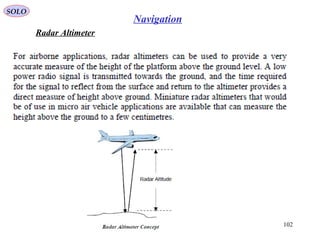
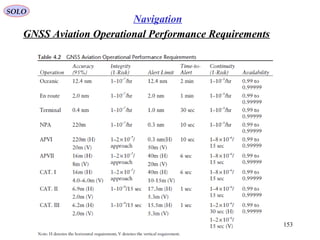
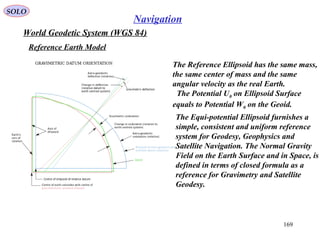
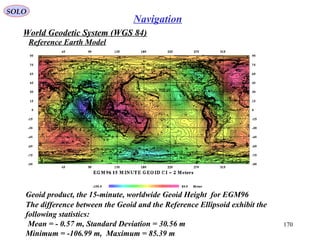
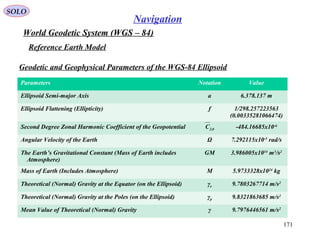
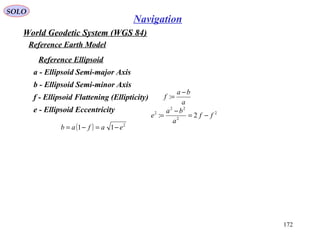
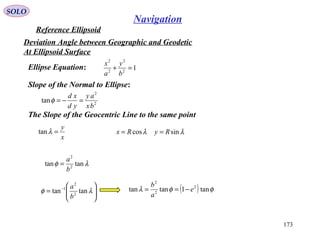
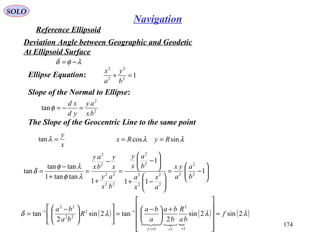
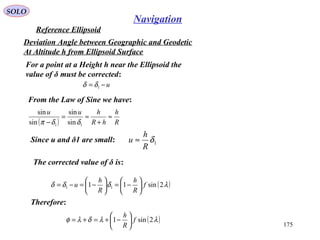
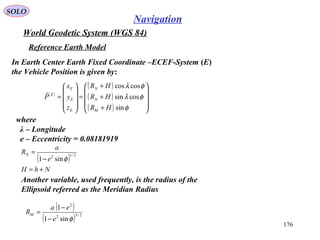
The document outlines the principles of navigation systems for aircraft, detailing the various headings, tracks, and the calculation of deviations from desired flight paths using spherical trigonometry. It also explains the concept of great circles as the shortest distance between two points on Earth and introduces multiple coordinate systems relevant to navigation. Furthermore, it discusses the dynamics of air vehicles within a spherical Earth model and the forces acting on them.
Introduction to navigation systems, updated by Solo Hermelin, presenting table of contents.
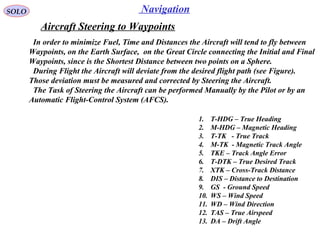
Discusses aircraft navigation to waypoints, describing true/magnetic headings, track angles, spherical trigonometry, and great circle flight paths.
Describes various coordinate systems including Heliocentric, Geocentric, Right Ascension-Declination, and Perifocal systems, along with their applications.
Defines inertial, body, and wind coordinate systems impacting air vehicle navigation and motion in a spherical atmosphere.
Explains aerodynamic forces including lift, drag, and side forces acting on vehicles, with integration of pressure and friction-based calculations.
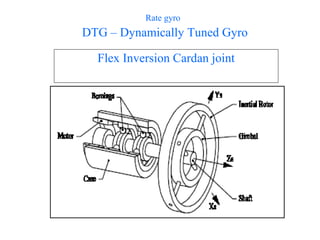
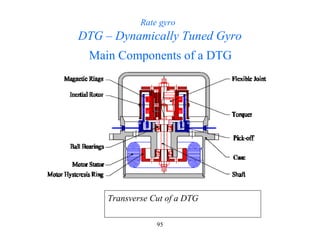
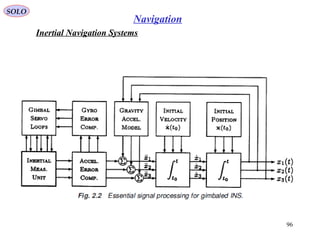
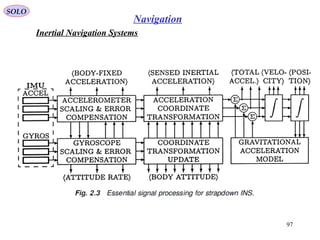
Overview of inertial navigation systems leveraging gyroscopes and IMUs for navigation, including strapdown algorithms.
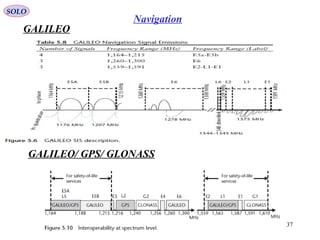
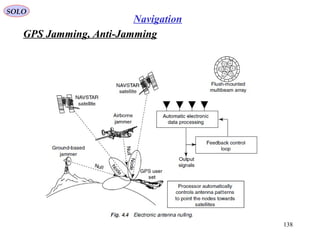
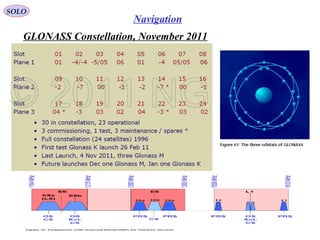
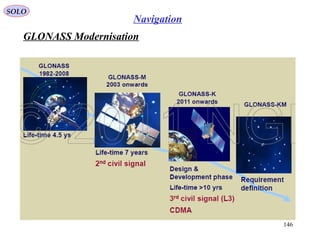
Explains various Global Navigation Satellite Systems (GNSS) including GPS, GLONASS, GALILEO, and discusses their operational principles.
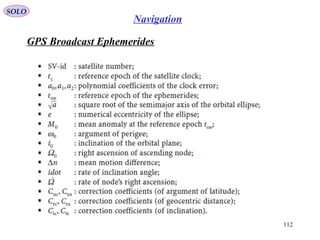
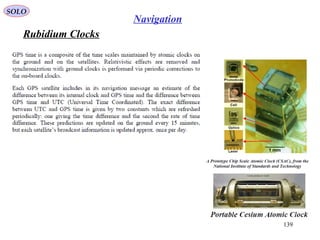
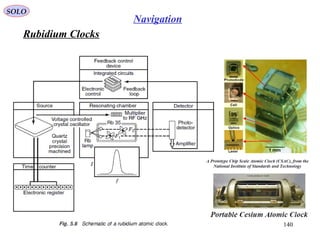
Details methods for satellite position calculation using ephemerides, GPS satellite constellations, and the importance of atomic clocks.
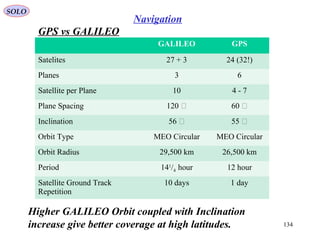
Compares GPS and GALILEO systems, analyzing satellite numbers, orbital characteristics, and coverage equivalence.
Explains differential GPS (DGPS) systems and their applications to improve location accuracy, including LORAN and DME systems.
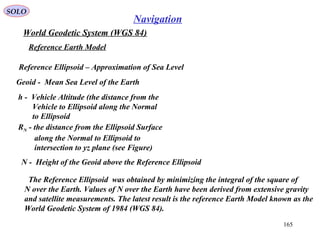
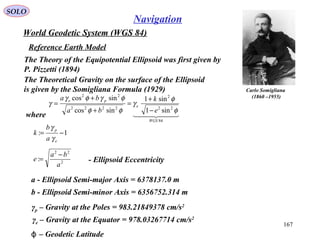
Discusses the World Geodetic System 1984 (WGS 84), explaining parameters, ellipsoid models, and geodetic principles related to navigation.
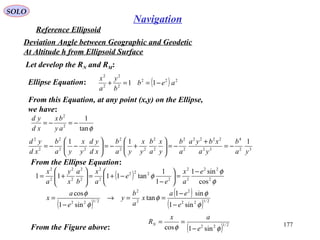
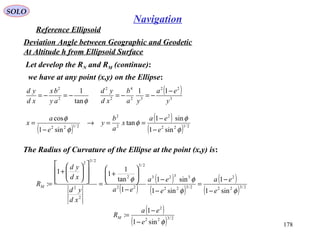
Explores the relation between geodetic latitude/longitude and the reference ellipsoid, defining their mathematical backgrounds.
NavigationSOLO
Aircraft Steering toWaypoints
1. T-HDG – True Heading
2. M-HDG – Magnetic Heading
3. T-TK - True Track
4. M-TK - Magnetic Track Angle
5. TKE – Track Angle Error
6. T-DTK – True Desired Track
7. XTK – Cross-Track Distance
8. DIS – Distance to Destination
9. GS - Ground Speed
10. WS – Wind Speed
11. WD – Wind Direction
12. TAS – True Airspeed
13. DA – Drift Angle
In order to minimize Fuel, Time and Distances the Aircraft will tend to fly between
Waypoints, on the Earth Surface, on the Great Circle connecting the Initial and Final
Waypoints, since is the Shortest Distance between two points on a Sphere.
During Flight the Aircraft will deviate from the desired flight path (see Figure).
Those deviation must be measured and corrected by Steering the Aircraft.
The Task of Steering the Aircraft can be performed Manually by the Pilot or by an
Automatic Flight-Control System (AFCS).
5
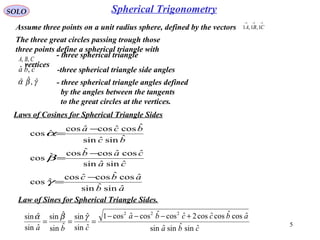
Spherical TrigonometrySOLO
Assume threepoints on a unit radius sphere, defined by the vectors
→→→
CBA 1,1,1
Laws of Cosines for Spherical Triangle Sides
ab
abc
ca
cab
bc
bca
ˆsinˆsin
ˆcosˆcosˆcos
ˆcos
ˆsinˆsin
ˆcosˆcosˆcosˆcos
ˆsinˆsin
ˆcosˆcosˆcos
ˆcos
−
=
−
=
−
=
γ
β
α
Law of Sines for Spherical Triangle Sides.
cba
abccba
cba ˆsinˆsinˆsin
ˆcosˆcosˆcos2ˆcosˆcosˆcos1
ˆsin
ˆsin
ˆsin
ˆsin
ˆsin
ˆsin
222
+−−−
===
γβα
The three great circles passing trough those
three points define a spherical triangle with
CBA ,,
- three spherical triangle
vertices
cba ˆ,ˆˆ -three spherical triangle side angles
γβα ˆ,ˆˆ - three spherical triangle angles defined
by the angles between the tangents
to the great circles at the vertices.
6.
6
SOLO
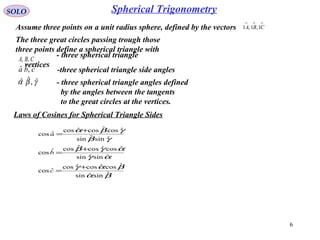
Assume three pointson a unit radius sphere, defined by the vectors
→→→
CBA 1,1,1
Laws of Cosines for Spherical Triangle Sides
The three great circles passing trough those
three points define a spherical triangle with
CBA ,,
- three spherical triangle
vertices
cba ˆ,ˆˆ -three spherical triangle side angles
γβα ˆ,ˆˆ - three spherical triangle angles defined
by the angles between the tangents
to the great circles at the vertices.
βα
βαγ
αγ
αγβ
γβ
γβα
ˆsinˆsin
ˆcosˆcosˆcos
ˆcos
ˆsinˆsin
ˆcosˆcosˆcosˆcos
ˆsinˆsin
ˆcosˆcosˆcos
ˆcos
+
=
+
=
+
=
c
b
a
Spherical Trigonometry
7.
7
NavigationSOLO
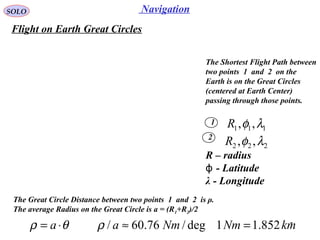
Flight on EarthGreat Circles
The Shortest Flight Path between
two points 1 and 2 on the
Earth is on the Great Circles
(centered at Earth Center)
passing through those points.
1
2
111 ,, λφR
222 ,, λφR
The Great Circle Distance between two points 1 and 2 is ρ.
The average Radius on the Great Circle is a = (R1+R2)/2
θρ ⋅= a
R – radius
- Latitudeϕ
λ - Longitude
kmNmNma 852.11deg/76.60/ =≈ρ
8.
8
NavigationSOLO
Flight on EarthGreat Circles
1
2
111 ,, λφR
222 ,, λφR
The Great Circle Distance between two points 1 and
2 is ρ.
θρ ⋅= a
R – radius
- Latitudeϕ
λ - Longitude
( )
( ) ( ) ( ) ( ) ( )212121 cos90sin90sin90cos90cos
/coscos
λλφφφφ
ρθ
−⋅−⋅−+−⋅−=
=
a
From the Law of Cosines for Spherical Triangles
or
( ) ( )212121 coscoscossinsin/cos λλφφφφρ −⋅⋅+⋅=a
( ){ }212121
1
coscoscossinsincos λλφφφφρ −⋅⋅+⋅⋅= −
a
The Initial Heading Angle ψ0 can be obtained using the
Law of Cosines for Spherical Triangles as follows
( )
( )a
a
/sincos
/cossinsin
cos
1
12
0
ρφ
ρφφ
ψ
⋅
⋅−
=
( )[ ]
( )[ ]2
222
22221
coscoscossinsin1cos
coscoscossinsinsinsin
cos
λλφφφφφ
λλφφφφφφ
ψ
−⋅⋅+⋅−⋅
−⋅⋅+⋅⋅−
= −
The Heading Angle ψ from the Present Position (R, ,λ) to Destination Point (Rϕ 2,ϕ2,λ2)
9.
9
NavigationSOLO
Flight on EarthGreat Circles
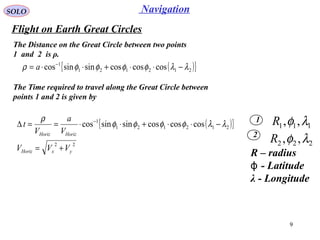
The Distance on the Great Circle between two points
1 and 2 is ρ.
1
2
111 ,, λφR
222 ,, λφR
R – radius
- Latitudeϕ
λ - Longitude
The Time required to travel along the Great Circle between
points 1 and 2 is given by
( ){ }
22
212121
1
coscoscossinsincos
yxHoriz
HorizHoriz
VVV
V
a
V
t
+=
−⋅⋅+⋅⋅==∆ −
λλφφφφ
ρ
( ){ }212121
1
coscoscossinsincos λλφφφφρ −⋅⋅+⋅⋅= −
a
10.
10
NavigationSOLO
Flight on EarthGreat Circles
1
2
111 ,, λφR
222 ,, λφR
If the Aircraft flies with an Heading Error Δψ we want to calculate the Down Range
Error Xd and Cross Range Error Yd, in the Spherical Triangle APB.
R – radius
- Latitudeϕ
λ - Longitude
Using the Law of Cosines for Spherical Triangle APB we have
( ) ( )aaYd /sin
90sin
/sin
sin
ρ
ψ
=
∆
( ) ( ) ( )
( ) ( ) 2/sin/sin
/cos/cos/cos
0ˆcos 21
90ˆ
RR
a
aYaX
aYaXa
P
dd
dd
P +
=
⋅
⋅−
==
= ρ
Using the Law of Sines for Spherical Triangle APB we have
( )
( )
⋅= −
aY
a
aX
d
d
/cos
/cos
cos 1 ρ
( )[ ]ψρ ∆⋅⋅= −
sin/sinsin 1
aaYd
11.
11
SOLO
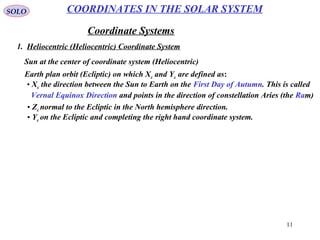
Coordinate Systems
1. Heliocentric(Heliocentric) Coordinate System
COORDINATES IN THE SOLAR SYSTEM
Sun at the center of coordinate system (Heliocentric)
Earth plan orbit (Ecliptic) on which Xε and Yε are defined as:
• Xε the direction between the Sun to Earth on the First Day of Autumn. This is called
Vernal Equinox Direction and points in the direction of constellation Aries (the Ram)
• Zε normal to the Ecliptic in the North hemisphere direction.
• Yε on the Ecliptic and completing the right hand coordinate system.
12.
12
SOLO
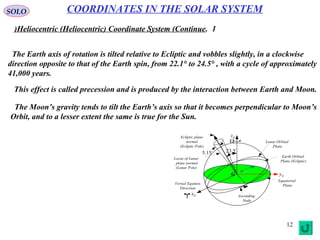
1.Heliocentric (Heliocentric) CoordinateSystem (Continue)
COORDINATES IN THE SOLAR SYSTEM
The Earth axis of rotation is tilted relative to Ecliptic and vobbles slightly, in a clockwise
direction opposite to that of the Earth spin, from 22.1° to 24.5° , with a cycle of approximately
41,000 years.
G
Gz
Ω
Gx
Gy
Ecliptic plane
normal
(Ecliptic Pole)
Locus of Lunar
plane normal
(Lunar Pole)
Lunar Orbital
Plane
Earth Orbital
Plane (Ecliptic)
Equatorial
Plane
Ascending
Node
5.23
15.5
Vernal Equinox
Direction
The Moon’s gravity tends to tilt the Earth’s axis so that it becomes perpendicular to Moon’s
Orbit, and to a lesser extent the same is true for the Sun.
This effect is called precession and is produced by the interaction between Earth and Moon.
13.
13
SOLO
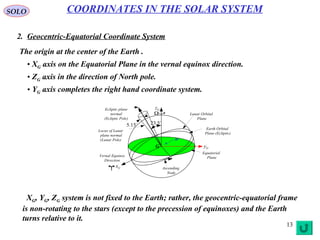
2. Geocentric-Equatorial CoordinateSystem
COORDINATES IN THE SOLAR SYSTEM
The origin at the center of the Earth .
G
Gz
Ω
Gx
Gy
Ecliptic plane
normal
(Ecliptic Pole)
Locus of Lunar
plane normal
(Lunar Pole)
Lunar Orbital
Plane
Earth Orbital
Plane (Ecliptic)
Equatorial
Plane
Ascending
Node
5.23
15.5
Vernal Equinox
Direction
• XG axis on the Equatorial Plane in the vernal equinox direction.
• ZG axis in the direction of North pole.
• YG axis completes the right hand coordinate system.
XG, YG, ZG system is not fixed to the Earth; rather, the geocentric-equatorial frame
is non-rotating to the stars (except to the precession of equinoxes) and the Earth
turns relative to it.
14.
14
SOLO
3. The RightAscension-Declination System
COORDINATES IN THE SOLAR SYSTEM
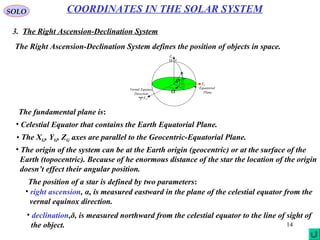
The Right Ascension-Declination System defines the position of objects in space.
• Celestial Equator that contains the Earth Equatorial Plane.
• The XG, YG, ZG axes are parallel to the Geocentric-Equatorial Plane.
• The origin of the system can be at the Earth origin (geocentric) or at the surface of the
Earth (topocentric). Because of he enormous distance of the star the location of the origin
doesn’t effect their angular position.
GZ
Ω
GX
GY
Equatorial
Planeα
δ
Vernal Equinox
Direction
The fundamental plane is:
The position of a star is defined by two parameters:
• right ascension, α, is measured eastward in the plane of the celestial equator from the
vernal equinox direction.
• declination,δ, is measured northward from the celestial equator to the line of sight of
the object.
15.
15
SOLO
Coordinate Systems
4. ThePerifocal Coordinate System
COORDINATES IN THE SOLAR SYSTEM
The Perifocal Coordinate System is related to a satellite’s orbit.
• Xω axis in the direction of the orbit Periapsis (direction from the focal point to the
point of minimum range of the orbit).
Plane of the Satellite’s Orbit is the fundamental plane with:
• Zω axis in the direction of (perpendicular to the Satellite’s Orbit and showing
the satellite’s movement direction).
vrh
×=
• Yω axis completes the right hand coordinate system.
16.
16
SOLO
4. The PerifocalCoordinate System (Continue)
COORDINATES IN THE SOLAR SYSTEM
Five independent quantities, called orbital elements,
describe size, shape and orientation of an orbit.
A sixth element is required to determine the position of the satellite along the orbit at a
given time.
1. a – semi-major axis – a constant defining the size of the coning orbit.
2. e – eccentricity – a constant defining the shape of the coning orbit.
3. i – inclination – the angle between ZG and the specific angular momentum
of the coning orbit . vrh
×=
4. Ω – longitude of the ascending node – the angle, in the Equatorial Plane, between
the unit vector and the point where the satellite crosses through the Equatorial
Plane in a northerly direction (ascending node) measured counterclockwise
where viewed from the northern emisphere.
5. ω – argument of the periapsis – the angle, in the plane of the satellite’s orbit,
between ascending node and the periapsis point, measured in the direction of
satellite’s motion.
6. T – time of periapsis passage – the time when the satellite was at the periapsis.
Classical Orbital Parameters
17.
17
SOLO
4. The PerifocalCoordinate System (Continue)
COORDINATES IN THE SOLAR SYSTEM
Let find a, e, ω, i, Ω from the initial position and
velocity vectors .00 ,vr
1. From the specific angular momentum of the orbit we can findvrh
×= 00 vrh
×=
01 00
≠
×
=
→
h
h
vr
Z
ε
2. From the specific mechanical energy of an elliptic orbit equation ar
vv
E
22 0
00 µµ
−=−
⋅
=
we obtain
00
0
2 vv
r
a
⋅−
=
µ
µ
3. i inclination is computed using
→→
⋅= GZZi 11cos ε
22
11cos 1 ππ
ε ≤≤−
⋅=
→→
−
iZZi G
4. The eccentricity vector of a Keplerian trajectory is defined as
( )
→
=
⋅−
−⋅= ε
µ
µ
Xevvrr
r
vve 1
1
0000
0
00
from which ee
= 01 ≠=
→
e
e
e
X
ε
→→→
×= εεη XZY 111
18.
18
SOLO
4. The PerifocalCoordinate System (Continue)
COORDINATES IN THE SOLAR SYSTEM
Let find a, e, ω, i, Ω from the initial position and
velocity vectors (continue).00 ,vr
5. The ascending node (intersection of the equatorial and orbit planes) is given by
011
11
11
1 ≠×←
×
×
=
→→
→→
→→
→
ε
ε
ε
ZZ
ZZ
ZZ
N G
G
G
Ω – longitude of the ascending node – is computed using
→→
⋅=Ω NXG 11cos
→→→
⋅
×=Ω GG ZNX 111sin
Ω
Ω
=Ω −
cos
sin
tan 1
6. ω – argument of the periapsis – is computed using
→→
⋅= εω XN 11cos
→→→
⋅
×= εεω ZXN 111sin
= −
ω
ω
ω
cos
sin
tan 1
7. Ө – satellite position from the periapsis – is computed using
→→
⋅=Θ rX 11cos ε
→→→
⋅
×=Θ εε ZrX 111sin
Θ
Θ
=Θ −
cos
sin
tan 1
19.
19
SOLO
4. The PerifocalCoordinate System (Continue)
COORDINATES IN THE SOLAR SYSTEM
Let find a, e, ω, i, Ω from the initial position and
velocity vectors (continue).00 ,vr
The rotation matrix from the Perifocal Coordinate System Xε , Yε, Zε to the
Geocentric-Equatorial Coordinate System XG, YG, ZG is given by:
[ ] [ ] [ ]
ΩΩ−
ΩΩ
−
−=Ω=
100
0cossin
0sincos
cossin0
sincos0
001
100
0cossin
0sincos
313
ii
iiiCG
ωω
ωω
ωε
Ω−Ω
Ω+Ω−Ω−Ω−
Ω+ΩΩ−Ω
=
iii
iii
iii
cossincossinsin
sincoscoscoscossinsinsincoscoscossin
sinsincoscossinsincossincossincoscos
ωωωωω
ωωωωω
20.
20
SOLO AIR VEHICLEIN SPHERICAL EARTH ATMOSPHERE
1. Inertial System Frame
2. Earth-Center Fixed Coordinate System (E)
3. Earth Fixed Coordinate System (E0)
4. Local-Level-Local-North (L) for a Spherical Earth Model
5. Body Coordinates (B)
6. Wind Coordinates (W)
7. Forces Acting on the Vehicle
8. Simulation
8.1 Summary of the Equation of Motion of a Variable Mass
System
8.2 Missile Kinematics Model 1 (Spherical Earth)
8.3 Missile Kinematics Model 2 (Spherical Earth)
21.
21
Given an AirVehicle, we define:
1. Inertial System Frame III zyx ,,
3. Body Coordinates (B) , with the origin at the center of mass.BBB zyx ,,
2. Local-Level-Local-North (L) for a Spherical Earth Model LLL zyx ,,
4. Wind Coordinates (W) , with the origin at the center of mass.WWW zyx ,,
AIR VEHICLE IN SPHERICAL EARTH ATMOSPHERESOLO
Coordinate Systems
Table of Content
22.
22
SOLO
Coordinate Systems
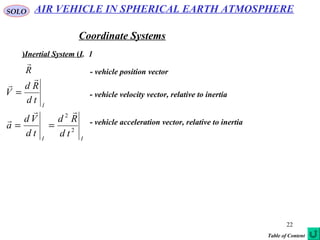
1.Inertial System(I(
R
- vehicle position vector
I
td
Rd
V
= - vehicle velocity vector, relative to inertia
II
td
Rd
td
Vd
a 2
2
== - vehicle acceleration vector, relative to inertia
AIR VEHICLE IN SPHERICAL EARTH ATMOSPHERE
Table of Content
23.
23
SOLO
Coordinate Systems (continue– 2)
2. Earth Center Earth Fixed Coordinate –ECEF-System (E(
xE, yE in the equatorial plan with xE pointed to the intersection between the equator
to zero longitude meridian.
The Earth rotates relative to Inertial system I, with the angular velocity
sec/10.292116557.7 5
rad−
=Ω
EIIE zz
11 Ω=Ω=Ω=←ω
( )
Ω
=← 0
0
EC
IEω
Rotation Matrix from I to E
[ ]
( ) ( )
( ) ( )
ΩΩ−
ΩΩ
=Ω=
100
0cossin
0sincos
3 tt
tt
tCE
I
AIR VEHICLE IN SPHERICAL EARTH ATMOSPHERE
24.
24
SOLO
Coordinate Systems (continue– 3)
2. Earth Center Earth Fixed Coordinate System (E(
(continue – 1(
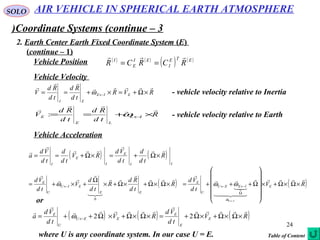
Vehicle Position ( ) ( )
( ) ( )ETE
I
EI
E
I
RCRCR
==
Vehicle Velocity
Vehicle Acceleration
RVR
td
Rd
td
Rd
V EIE
EI
×Ω+=×+== ←ω - vehicle velocity relative to Inertia
R
td
Rd
td
Rd
V IE
LE
E
×+== ←ω: - vehicle velocity relative to Earth
( ) ( )
II
E
I
E
I
R
td
d
td
Vd
RV
td
d
td
Vd
a
×Ω+=×Ω+==
( ) ( )RV
td
Vd
R
td
Rd
R
td
d
V
td
Vd
EIEEU
U
E
EE
EIU
U
E
IU
×Ω×Ω+×
Ω+++=×Ω×Ω+×Ω+×
Ω
+×+=
←
Ω
←←←
ω
ωωω
0
( ) ( ) ( )RV
td
Vd
RV
td
Vd
a E
E
E
EEU
U
E
×Ω×Ω+×Ω+=×Ω×Ω+×Ω++= ← 22ω
or
where U is any coordinate system. In our case U = E.
AIR VEHICLE IN SPHERICAL EARTH ATMOSPHERE
Table of Content
25.
25
SOLO
Coordinate Systems (continue– 4)
3.Earth Fixed Coordinate System (E0(
The origin of the system is fixed on the earth at some
given point on the Earth surface (topocentric) of
Longitude Long0 and latitude Lat0.
xE0 is pointed to the geodesic North, yE0 is pointed to the East parallel to Earth
surface, zE0 is pointed down.
[ ] [ ]
( ) ( )
( ) ( )
( ) ( )
( ) ( ) =
−
−−
−
=−−=
100
0cossin
0sincos
sin0cos
010
cos0sin
2/ 00
00
00
00
3020
0
LongLong
LongLong
LatLat
LatLat
LongLatCE
E π
( ) ( ) ( ) ( ) ( )
( ) ( )
( ) ( ) ( ) ( ) ( )
−−−
−
−−
=
00000
00
00000
sinsincoscoscos
0cossin
cossinsincossin
LatLongLatLongLat
LongLong
LatLongLatLongLat
The Angular Velocity of E relative to I is: EIIEIE zz
110 Ω=Ω== ←← ωω or
( )
( ) ( ) ( ) ( ) ( )
( ) ( )
( ) ( ) ( ) ( ) ( )
( )
( )
Ω−
Ω
=
Ω
−−−
−
−−
=
Ω
=←
0
0
00000
00
00000
00
0
sin
0
cos
0
0
sinsincoscoscos
0cossin
cossinsincossin
0
0
Lat
Lat
LatLongLatLongLat
LongLong
LatLongLatLongLat
CE
E
E
IEω
AIR VEHICLE IN SPHERICAL EARTH ATMOSPHERE
Table of Content
26.
26
SOLO
Coordinate Systems (continue– 5)
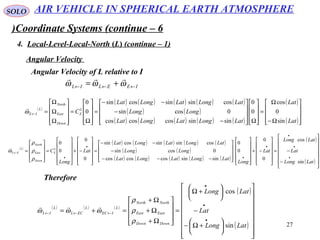
4. Local-Level-Local-North (L) or Navigation Frame
The origin of the LLLN coordinate system is located at
the projection of the center of gravity CG of the vehicle
on the Earth surface, with zDown axis pointed down,
xNorth, yEast plan parallel to the local level, with
xNorth pointed to the local North and yEast pointed to
the local East. The vehicle is located at:.
Latitude = Lat, Longitude = Long, Height = H
Rotation Matrix from E to L
[ ] [ ]
( ) ( )
( ) ( )
( ) ( )
( ) ( ) =
−
−−
−
=−−=
100
0cossin
0sincos
sin0cos
010
cos0sin
2/ 32 LongLong
LongLong
LatLat
LatLat
LongLatCL
E π
( ) ( ) ( ) ( ) ( )
( ) ( )
( ) ( ) ( ) ( ) ( )
−−−
−
−−
=
LatLongLatLongLat
LongLong
LatLongLatLongLat
sinsincoscoscos
0cossin
cossinsincossin
AIR VEHICLE IN SPHERICAL EARTH ATMOSPHERE
28
SOLO
Coordinate Systems (continue– 7)
4. Local-Level-Local-North (L( (continue – 2)
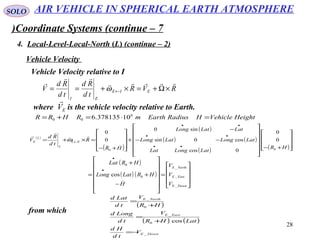
Vehicle Velocity
Vehicle Velocity relative to I
RVR
td
Rd
td
Rd
V EIE
EI
×Ω+=×+== ←ω
( )
( )
( )
( ) ( )
( ) ( )
+−
−−
−
+
+−
=×+=
••
••
••
←
HR
LatLongLat
LatLongLatLong
LatLatLong
HR
R
td
Rd
V EL
L
L
E
00
0
0
0cos
cos0sin
sin0
0
0
ω
where is the vehicle velocity relative to Earth.EV
( )
( ) ( )
=
−
+
+
=
•
•
DownE
EastE
NorthE
V
V
V
H
HRLatLong
HRLat
_
_
_
0
0
cos
from which
( )
( ) ( )
DownE
EastE
NorthE
V
td
Hd
LatHR
V
td
Longd
HR
V
td
Latd
_
0
_
0
_
cos
−=
+
=
+
=
AIR VEHICLE IN SPHERICAL EARTH ATMOSPHERE
HeightVehicleHRadiusEarthmRHRR =⋅=+= 6
00 10378135.6
29.
29
SOLO
Coordinate Systems (continue– 8)
4. Local-Level-Local-North (L( (continue – 3)
Vehicle Velocity (continue – 1)
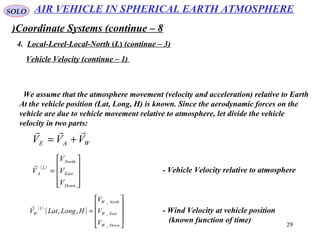
We assume that the atmosphere movement (velocity and acceleration) relative to Earth
At the vehicle position (Lat, Long, H) is known. Since the aerodynamic forces on the
vehicle are due to vehicle movement relative to atmosphere, let divide the vehicle
velocity in two parts:
WAE VVV
+=
( )
=
Down
East
North
L
A
V
V
V
V
- Vehicle Velocity relative to atmosphere
( )
( )
=
DownW
EastW
NorthW
L
W
V
V
V
HLongLatV
_
_
_
,,
- Wind Velocity at vehicle position
(known function of time)
AIR VEHICLE IN SPHERICAL EARTH ATMOSPHERE
30.
30
SOLO
Coordinate Systems (continue– 9)
4. Local-Level-Local-North (L( (continue – 4)
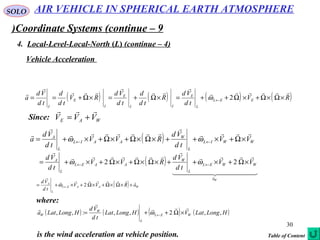
Vehicle Acceleration
Since:
( ) ( ) ( ) ( )RV
td
Vd
R
td
d
td
Vd
RV
td
d
td
Vd
a EEL
L
E
II
E
I
E
I
×Ω×Ω+×Ω++=×Ω+=×Ω+== ← 2ω
WAE VVV
+=
( ) WWIL
L
W
AAIL
L
A
VV
td
Vd
RVV
td
Vd
a
×Ω+×++×Ω×Ω+×Ω+×+= ←← ωω
( )
Wa
WWEL
L
W
AAEL
L
A
VV
td
Vd
RVV
td
Vd
×Ω+×++×Ω×Ω+×Ω+×+= ←← 22 ωω
( ) ( ) ( ) ( )HLongLatVHLongLat
td
Vd
HLongLata WEL
L
W
W ,,2,,:,,
×Ω++= ←ω
( ) WAAEL
L
A
aRVV
td
Vd
+×Ω×Ω+×Ω+×+= ← 2ω
where:
is the wind acceleration at vehicle position.
AIR VEHICLE IN SPHERICAL EARTH ATMOSPHERE
Table of Content
31.
31
SOLO
Coordinate Systems (continue– 10)
5.Body Coordinates (B(
The origin of the Body coordinate system
is located at the instantaneous center of
gravity CG of the vehicle, with xB pointed
to the front of the Air Vehicle, yB pointed
toward the right wing and zB completing
the right-handed Cartesian reference frame.
Rotation Matrix from LLLN to B (Euler Angles(:
[ ] [ ] [ ]
−+
+−
−
==
θφψφψθφψφψθφ
θφψφψθφψφψθφ
θψθψθ
ψθφ
cccssscsscsc
csccssssccss
ssccc
CB
L 321
ψ - azimuth angle
θ - pitch angle
φ - roll angle
AIR VEHICLE IN SPHERICAL EARTH ATMOSPHERE
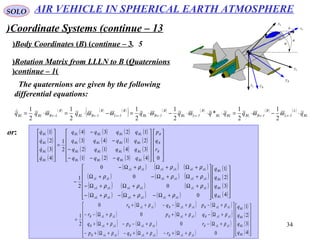
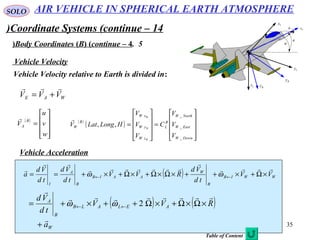
35
SOLO
Coordinate Systems (continue– 14)
5.Body Coordinates (B( (continue – 4( ψ
θ
φ Bx
Lx
Bz
Ly
Lz
By
Vehicle Velocity
Vehicle Velocity relative to Earth is divided in:
WAE VVV
+=
( )
=
w
v
u
V
B
A
( )
( )
=
=
DownW
EastW
NorthW
B
L
zW
yW
xW
B
W
V
V
V
C
V
V
V
HLongLatV
B
B
B
_
_
_
,,
Vehicle Acceleration
( ) WWIB
B
W
AAIB
B
A
I
VV
td
Vd
RVV
td
Vd
td
Vd
a
×Ω+×++×Ω×Ω+×Ω+×+== ←← ωω
( ) ( )
W
AELALB
B
A
a
RVV
td
Vd
+
×Ω×Ω+×Ω++×+= ←← 2ωω
AIR VEHICLE IN SPHERICAL EARTH ATMOSPHERE
Table of Content
36.
36
SOLO
Coordinate Systems (continue– 15)
6.Wind Coordinates (W(
The origin of the Wind coordinate system
is located at the instantaneous center of
gravity CG of the vehicle, with xW pointed
in the direction of the vehicle velocity vector
relative to air .AV
[ ] [ ]
−
−−=
−
−=−=
αα
βαββα
βαββα
αα
αα
ββ
ββ
αβ
cos0sin
sinsincossincos
cossinsincoscos
cos0sin
010
sin0cos
100
0cossin
0sincos
23
W
BC
The Wind coordinate frame is defined by the following two angles:
α - angle of attack
β - sideslip angle
AIR VEHICLE IN SPHERICAL EARTH ATMOSPHERE
37.
37
SOLO
Coordinate Systems (continue– 16)
6.Wind Coordinates (W( (continue -1(
Rotation Matrix from L (LLLN) to W is:
χ - azimuth angle of the trajectory
γ - pitch angle of the trajectory
Rotation Matrix
[ ] [ ] [ ] [ ] [ ] 32123 ψθφαβ −== B
L
W
B
W
L CCC
The Rotation Matrix from L (LLLN) to W can also be defined by the following
Consecutive rotations:
σ - bank angle of the
trajectory
[ ] [ ] [ ] [ ]
−+
+−
−
===
γσχσχγσχσχγσ
γσχσχγσχσχγσ
γχγχγ
χγσσ
cccssscsscsc
csccssssccss
ssccc
CC W
L
W
L 321
*
1
We defined also the intermediate wind frame W* by:
[ ] [ ]
−
−
==
γχγχγ
χχ
γχγχγ
χγ
csscs
cs
ssccc
CW
L 032
*
AIR VEHICLE IN SPHERICAL EARTH ATMOSPHERE
39
SOLO
Coordinate Systems (continue– 18)
6.Wind Coordinates (W( (continue -3(
We have also:
Angular Velocities (continue – 1(
( ) ( )
( )
( )
Ω
Ω
Ω
=
Ω−
Ω
==
Ω
Ω
Ω
= ←←
Down
East
North
W
L
W
L
L
IE
W
L
zW
yW
xW
W
IE C
Lat
Lat
CC ***
*
*
*
*
sin
0
cos
ωω
( ) ( )
( )
( )
=
−
−==
=
•
•
•
←←
Down
East
North
W
L
W
L
L
EL
W
L
zW
yW
xW
W
EL C
LatLong
Lat
LatLong
CC
ρ
ρ
ρ
ω
ρ
ρ
ρ
ω ***
*
*
*
*
sin
cos
( ) ( )
( )
( )
[ ] ( )*
1
sin
0
cos
W
IE
W
L
L
IE
W
L
zW
yW
xW
W
IE
Lat
Lat
CC ←←← =
Ω−
Ω
==
Ω
Ω
Ω
= ωσωω
( ) ( )
( )
( )
[ ] ( )*
1
sin
cos
W
IL
W
L
L
IL
W
L
W
IL
LatLong
Lat
LatLong
CC ←
•
•
•
←← =
+Ω−
−
+Ω
== ωσωω
AIR VEHICLE IN SPHERICAL EARTH ATMOSPHERE
40.
40
SOLO
Coordinate Systems (continue– 19)
6.Wind Coordinates (W( (continue -4(
The Angular Velocity from I to W is:
Angular Velocities (continue – 2(
( ) ( ) ( ) ( )
Ω+
Ω+
Ω+
+
=+
=+=
= ←←←←
DownDown
EastEast
NorthNorth
W
L
W
W
W
L
IL
W
L
W
W
W
W
IL
W
LW
W
W
W
W
IW C
R
Q
P
C
R
Q
P
r
q
p
ρ
ρ
ρ
ωωωω
Using the angle of attack α and the sideslip angle β , we can write:
BWBW yz
11 αβω −=←
or:
( ) ( ) ( )
[ ]
−
=
−
=−= ←←←
0
0
0
0
3 αβ
β
ωωω
r
q
p
C
r
q
p
W
B
W
W
W
W
IB
W
IW
W
BW
but also:
( ) ( ) ( )
[ ]
−
=
−
=−= ←←←
0
0
0
0
3 αβ
β
ωωω
R
Q
P
C
R
Q
P
W
B
W
W
W
W
LB
W
LW
W
BW
AIR VEHICLE IN SPHERICAL EARTH ATMOSPHERE
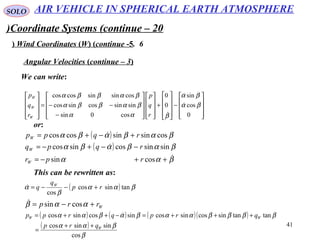
41.
41
SOLO
Coordinate Systems (continue– 20)
6.Wind Coordinates (W( (continue -5(
We can write:
Angular Velocities (continue – 3(
−
+
−
−−=
0
cos
sin
0
0
cos0sin
sinsincossincos
cossinsincoscos
βα
βα
βαα
βαββα
βαββα
r
q
p
r
q
p
W
W
W
or:
( )
( )
βαα
βαβαβα
βαβαβα
++−=
−−+−=
+−+=
cossin
sinsincossincos
cossinsincoscos
rpr
rqpq
rqpp
W
W
W
This can be rewritten as:
( ) βαα
β
α tansincos
cos
rp
q
q W
+−−=
Wrrp +−= ααβ cossin
( ) ( ) ( )( )
( )
β
βαα
ββββααβαβαα
cos
sinsincos
tantansincossincossincossincos
W
WW
qrp
qrpqrpp
++
=
+++=−++=
AIR VEHICLE IN SPHERICAL EARTH ATMOSPHERE
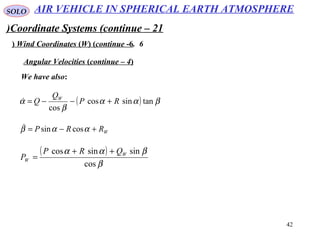
42.
42
SOLO
Coordinate Systems (continue– 21)
6.Wind Coordinates (W( (continue -6(
We have also:
Angular Velocities (continue – 4(
( ) βαα
β
α tansincos
cos
RP
Q
Q W
+−−=
WRRP +−= ααβ cossin
( )
β
βαα
cos
sinsincos W
W
QRP
P
++
=
AIR VEHICLE IN SPHERICAL EARTH ATMOSPHERE
43.
43
SOLO
Coordinate Systems (continue– 22)
6.Wind Coordinates (W( (continue -7(
The vehicle velocity was decomposed in:
Vehicle Velocity
WAE VVV
+=
( )
=
0
0
V
V
W
A
- vehicle velocity relative to atmosphere
( )
( )
=
=
DownW
EastW
NorthW
W
L
zW
yW
xW
W
W
V
V
V
C
V
V
V
HLongLatV
W
W
W
_
_
_
,,
- wind velocity at velocity position
also
( )
[ ] ( )
[ ]
=
−=−=
0
0
0
011
*
VV
VV
W
A
W
A σσ
( )
( )
=
=
DownW
EastW
NorthW
W
L
zW
yW
xW
W
W
V
V
V
C
V
V
V
HLongLatV
W
W
W
_
_
_
*
*
*
*
*
,,
AIR VEHICLE IN SPHERICAL EARTH ATMOSPHERE
44.
44
SOLO
Coordinate Systems (continue– 23)
6.Wind Coordinates (W( (continue -8(
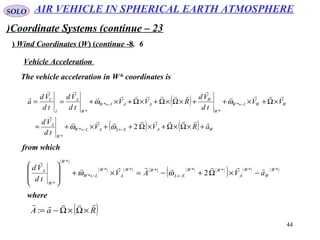
The vehicle acceleration in W* coordinates is
Vehicle Acceleration
( )
( ) ( ) WAELALW
W
A
WWIW
W
W
AAIW
W
A
I
C
aRVV
td
Vd
VV
td
Vd
RVV
td
Vd
td
Vd
a
+×Ω×Ω+×Ω++×+=
×Ω+×++×Ω×Ω+×Ω+×+==
←←
←←
2*
*
*
*
*
*
ωω
ωω
from which
( )
( ) ( ) ( ) ( ) ( )
( ) ( ) ( )*******
*
*
*
2
W
W
W
A
WW
EL
WW
A
W
LW
W
W
A
aVAV
td
Vd
−×Ω+−=×+
←← ωω
where
( )RaA
×Ω×Ω−=:
AIR VEHICLE IN SPHERICAL EARTH ATMOSPHERE
45.
45
SOLO
Coordinate Systems (continue– 24)
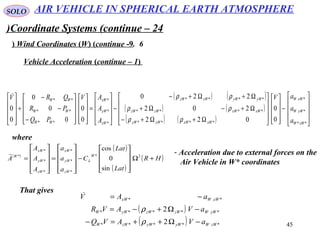
6.Wind Coordinates (W( (continue -9(
Vehicle Acceleration (continue – 1(
( ) ( )
( ) ( )
( ) ( )
−
Ω+Ω+−
Ω+−Ω+
Ω+Ω+−
−
=
−
−
−
+
**
*
*
****
****
****
*
*
*
**
**
**
0
0
022
202
220
0
0
0
0
0
0
0
zWW
yWW
xWW
xWxWyWyW
xWxWzWzW
yWyWzWzW
zW
yW
xW
WW
WW
WW
a
a
aV
A
A
AV
PQ
PR
QRV
ρρ
ρρ
ρρ
where
( )
( )
( )
( )HR
Lat
Lat
C
a
a
a
A
A
A
A
W
L
zW
yW
xW
zW
yW
xW
W
+Ω
−
=
= 2*
*
*
*
*
*
*
*
sin
0
cos
- Acceleration due to external forces on the
Air Vehicle in W* coordinates
That gives
( )
( ) *****
*****
**
2
2
zWWyWyWzWW
yWWzWzWyWW
xWWxW
aVAVQ
aVAVR
aAV
−Ω++=−
−Ω+−=
−=
ρ
ρ
AIR VEHICLE IN SPHERICAL EARTH ATMOSPHERE
46.
46
SOLO
Coordinate Systems (continue– 25(
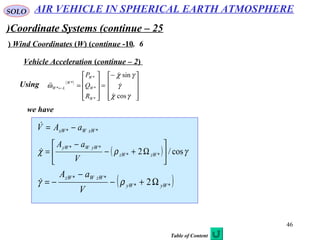
6.Wind Coordinates (W) (continue -10)
Vehicle Acceleration (continue – 2)
Using ( )
−
=
=←
γχ
γ
γχ
ω
cos
sin
*
*
*
*
*
W
W
W
W
LW
R
Q
P
we have
** xWWxW aAV −=
( ) γρχ cos/2 **
**
Ω+−
−
= zWzW
yWWyW
V
aA
( )**
**
2 yWyW
zWWzW
V
aA
Ω+−
−
−= ργ
AIR VEHICLE IN SPHERICAL EARTH ATMOSPHERE
Table of Content
47.
47
SOLO
Aerodynamic Forces
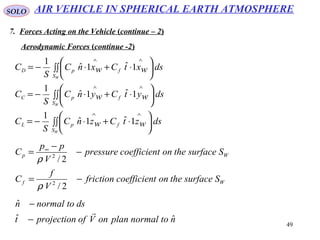
( )[]∫∫ +−= ∞
WS
A dstfnppF
11
ntonormalplanonVofprojectiont
dstonormaln
ˆˆ
ˆ
−
−
( )
airflowingthebyweatedsurfaceVehicleS
SsurfacetheonmNstressforcefrictionf
Ssurfacetheondifferencepressurepp
W
W
W
−
−
−−∞
)/( 2
AIR VEHICLE IN SPHERICAL EARTH ATMOSPHERE
7. Forces Acting on the Vehicle
48.
48
SOLO
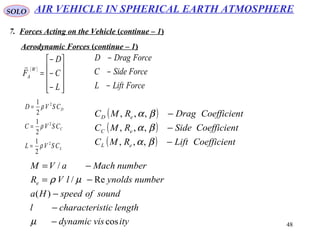
7. Forces Actingon the Vehicle (continue – 1)
Aerodynamic Forces (continue – 1)
( )
−
−
−
=
L
C
D
F
W
A
ForceLiftL
ForceSideC
ForceDragD
−
−
−
L
C
D
CSVL
CSVC
CSVD
2
2
2
2
1
2
1
2
1
ρ
ρ
ρ
=
=
=
( )
( )
( ) tCoefficienLiftRMC
tCoefficienSideRMC
tCoefficienDragRMC
eL
eC
eD
−
−
−
βα
βα
βα
,,,
,,,
,,,
ityvisdynamic
lengthsticcharacteril
soundofspeedHa
numberynoldslVR
numberMachaVM
e
cos
)(
Re/
/
−
−
−
−=
−=
µ
µρ
AIR VEHICLE IN SPHERICAL EARTH ATMOSPHERE
49.
49
SOLO
7. Forces Actingon the Vehicle (continue – 2)
Aerodynamic Forces (continue -2)
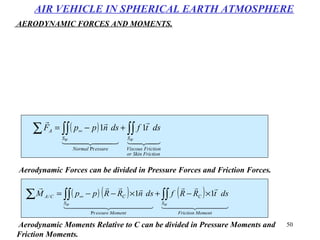
∫∫
⋅+⋅−=
∫∫
⋅+⋅−=
∫∫
⋅+⋅−=
∧∧
∧∧
∧∧
W
W
W
S
fpL
S
fpC
S
fpD
dswztCwznC
S
C
dswytCwynC
S
C
dswxtCwxnC
S
C
1ˆ1ˆ
1
1ˆ1ˆ
1
1ˆ1ˆ
1
Wf
Wp
Ssurfacetheontcoefficienfriction
V
f
C
Ssurfacetheontcoefficienpressure
V
pp
C
−=
−
−
= ∞
2/
2/
2
2
ρ
ρ
ntonormalplanonVofprojectiont
dstonormaln
ˆˆ
ˆ
−
−
AIR VEHICLE IN SPHERICAL EARTH ATMOSPHERE
50.
50
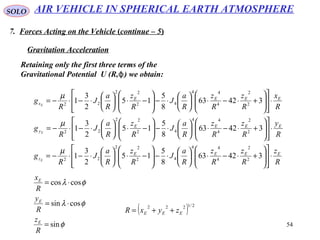
( ) () ( )
MomentFriction
S
C
Momentessure
S
CCA
WW
dstRRfdsnRRppM ∫∫∫∫∑ ×−+×−−= ∞ 11
Pr
/
Aerodynamic Moments Relative to C can be divided in Pressure Moments and
Friction Moments.
( )
FrictionSkinor
FrictionViscous
S
essureNormal
S
A
WW
dstfdsnppF ∫∫∫∫∑ +−= ∞ 11
Pr
Aerodynamic Forces can be divided in Pressure Forces and Friction Forces.
AIR VEHICLE IN SPHERICAL EARTH ATMOSPHERE
AERODYNAMIC FORCES AND MOMENTS.
52
SOLO
7. Forces Actingon the Vehicle (continue – 3)
Thrust
( ) ( )
−
−−==
B
B
B
z
y
x
BW
B
W
T
T
T
TCT
αα
βαββα
βαββα
cos0sin
sinsincossincos
cossinsincoscos
**
( )
[ ] ( )
−
==
=
*
*
*
cossin0
sincos0
001
*
1
W
W
W
W
W
W
z
y
x
W
z
y
x
W
T
T
T
T
T
T
T
T
σσ
σσσ
AIR VEHICLE IN SPHERICAL EARTH ATMOSPHERE
F-35Thrust Vector Control
53.
53
SOLO
7. Forces Actingon the Vehicle (continue – 4)
Gravitation Acceleration
( ) ( )
−
−
−
==
zg
yg
xg
gg
100
0
0
0
010
0
0
0
001
χχ
χχ
γγ
γγ
σσ
σσ cs
sc
cs
sc
cs
scC EW
E
W
( )
gg
−
=
γσ
γσ
γ
cc
cs
s
W
2sec/174.322sec/81.9
0
2
0
0
0
gg ftmg
HR
R
==
+
=
AIR VEHICLE IN SPHERICAL EARTH ATMOSPHERE
The derivation of Gravitation Acceleration assumes an Ellipsoidal Symmetrical Earth.
The Gravitational Potential U (R, ( is given byϕ
( ) ( )
( )
( )φ
φ
µ
φ
,
sin1, 2
RUg
P
R
a
J
R
RU
E
E
n n
n
n
∇=
−⋅−= ∑
∞
=
μ – The Earth Gravitational Constant
a – Mean Equatorial Radius of the Earth
R=[xE
2
+yE
2
+zE
2
]]/2
is the magnitude of
the Geocentric Position Vector
– Geocentric Latitude (sin =zϕ ϕ E/R(
Jn – Coefficients of Zonal Harmonics of the
Earth Potential Function
P (sin ( – Associated Legendre Polynomialsϕ
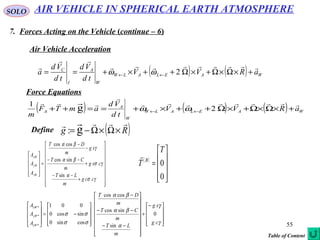
54.
54
SOLO
7. Forces Actingon the Vehicle (continue – 5)
Gravitation Acceleration
AIR VEHICLE IN SPHERICAL EARTH ATMOSPHERE
Retaining only the first three terms of the
Gravitational Potential U (R, ( we obtain:ϕ
R
z
R
z
R
z
R
a
J
R
z
R
a
J
R
g
R
y
R
z
R
z
R
a
J
R
z
R
a
J
R
g
R
x
R
z
R
z
R
a
J
R
z
R
a
J
R
g
EEEE
z
EEEE
y
EEEE
x
E
E
E
⋅
+⋅−⋅
⋅−
−⋅
⋅−⋅−=
⋅
+⋅−⋅
⋅−
−⋅
⋅−⋅−=
⋅
+⋅−⋅
⋅−
−⋅
⋅−⋅−=
34263
8
5
15
2
3
1
34263
8
5
15
2
3
1
34263
8
5
15
2
3
1
2
2
4
44
42
22
22
2
2
4
44
42
22
22
2
2
4
44
42
22
22
µ
µ
µ
φ
φλ
φλ
sin
cossin
coscos
=
⋅=
⋅=
R
z
R
y
R
x
E
E
E
( ) 2/1222
EEE zyxR ++=
55.
55
SOLO
7. Forces Actingon the Vehicle (continue – 6)
Force Equations
Air Vehicle Acceleration
( ) ( ) WAELALW
W
A
I
C
aRVV
td
Vd
td
Vd
a
+×Ω×Ω+×Ω++×+== ←← 2ωω
( ) ( ) ( ) WAELALW
W
A
A aRVV
td
Vd
amTF
m
+×Ω×Ω+×Ω++×+==++ ←← 2
1
g ωω
( )Rg
×Ω×Ω−= g:Define
+
−−
+
−−
−
−
=
γσ
α
γσ
βα
γ
βα
ccg
m
LT
csg
m
CT
sg
m
DT
A
A
A
zW
yW
xW
sin
sincos
coscos
−
+
−−
−−
−
−=
γ
γ
α
βα
βα
σσ
σσ
cg
sg
m
LT
m
CT
m
DT
A
A
A
zW
yW
xW
0
sin
sincos
coscos
cossin0
sincos0
001
*
*
*
AIR VEHICLE IN SPHERICAL EARTH ATMOSPHERE
Table of Content
( )
=
0
0
T
T B
56.
56
SOLO
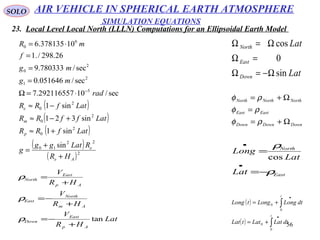
23. Local LevelLocal North (LLLN( Computations for an Ellipsoidal Earth Model
( )
( )
( )
( )
( )2
22
10
2
0
2
0
2
0
5
2
1
2
0
6
0
sin
sin1
sin321
sin1
sec/10292116557.7
sec/051646.0
sec/780333.9
26.298/.1
10378135.6
Ae
e
p
m
e
HR
RLatgg
g
LatfRR
LatffRR
LatfRR
rad
mg
mg
f
mR
+
+
=
+≈
+−≈
−≈
⋅=Ω
=
=
=
⋅=
−
Lat
HR
V
HR
V
HR
V
Ap
East
Down
Am
North
East
Ap
East
North
tan
+
−=
+
−=
+
=
ρ
ρ
ρ
Lat
Lat
Down
East
North
sin
0
cos
Ω−=Ω
=Ω
Ω=Ω
DownDownDown
EastEast
NorthNorthNorth
Ω+=
=
Ω+=
ρφ
ρφ
ρφ
East
North
Lat
Lat
Long
ρ
ρ
−=
=
•
•
cos
( )
( ) ∫
∫
•
•
+=
+=
t
t
dtLatLattLat
dtLongLongtLong
0
0
0
0
AIR VEHICLE IN SPHERICAL EARTH ATMOSPHERE
SIMULATION EQUATIONS
57.
57
SOLO AIR VEHICLEIN SPHERICAL EARTH ATMOSPHERE
SIMULATION EQUATIONS
Table of Content
SOLO
62
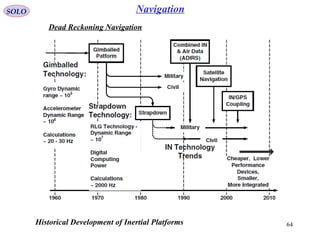
Navigation
Methods of Navigation
•Dead Reckoning (e.g. Inertial Navigation(
• Externally Dependent (e.g. GPS(
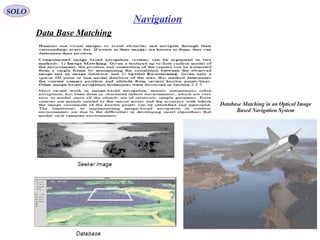
• Database Matching (e.g Celestial Navigation, or
Terrain Referenced Navigation(
63.
SOLO
63
Navigation
Dead Reckoning Navigation
ADead Reckoning System uses a Platform Initial Position and Initial Velocity
Vector and then Computes its Position and Velocity based on Measured or
Estimated Velocity Vector and Elapsed Time.
Dead Reckoning Evolution of a Vehicle’s Position Based on Velocity Vector
SOLO
65
Navigation
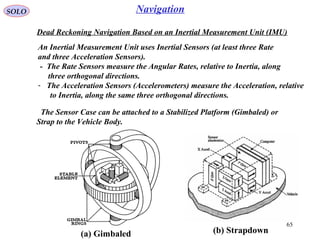
Dead Reckoning NavigationBased on an Inertial Measurement Unit (IMU(
An Inertial Measurement Unit uses Inertial Sensors (at least three Rate
and three Acceleration Sensors(.
- The Rate Sensors measure the Angular Rates, relative to Inertia, along
three orthogonal directions.
- The Acceleration Sensors (Accelerometers( measure the Acceleration, relative
to Inertia, along the same three orthogonal directions.
The Sensor Case can be attached to a Stabilized Platform (Gimbaled( or
Strap to the Vehicle Body.
(b) Strapdown(a) Gimbaled
66.
SOLO
66
Navigation
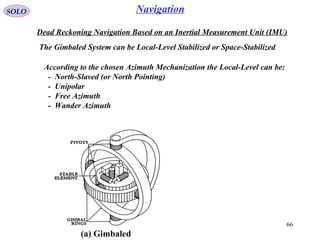
Dead Reckoning NavigationBased on an Inertial Measurement Unit (IMU(
The Gimbaled System can be Local-Level Stabilized or Space-Stabilized
(a) Gimbaled
According to the chosen Azimuth Mechanization the Local-Level can be:
- North-Slaved (or North Pointing(
- Unipolar
- Free Azimuth
- Wander Azimuth
SOLO
68
Navigation
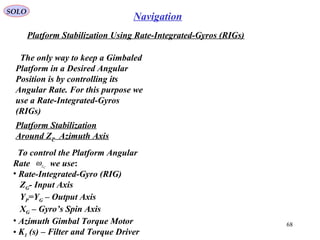
Platform Stabilization UsingRate-Integrated-Gyros (RIGs(
The only way to keep a Gimbaled
Platform in a Desired Angular
Position is by controlling its
Angular Rate. For this purpose we
use a Rate-Integrated-Gyros
(RIGs(
Platform Stabilization
Around ZP Azimuth Axis
To control the Platform Angular
Rate we use:
• Rate-Integrated-Gyro (RIG(
ZG- Input Axis
YP=YG – Output Axis
XG – Gyro’s Spin Axis
• Azimuth Gimbal Torque Motor
• K1 (s( – Filter and Torque Driver
Czω
69.
SOLO
69
Navigation
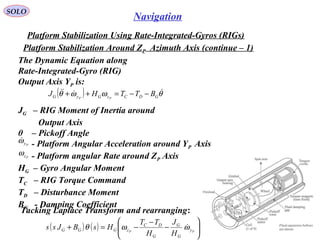
Platform Stabilization UsingRate-Integrated-Gyros (RIGs(
The Dynamic Equation along
Rate-Integrated-Gyro (RIG(
Output Axis YP is:
Platform Stabilization Around ZP Azimuth Axis (continue – 1(
( ) θωωθ
GDCzGyG BTTHJ PP
−−=++
( ) ( )
−
−
−=+ PP y
G
G
G
DC
zGGG
H
J
H
TT
HsBJss ωωθ
JG – RIG Moment of Inertia around
Output Axis
θ – Pickoff Angle
- Platform Angular Acceleration around YP Axis
- Platform angular Rate around ZP Axis
HG – Gyro Angular Moment
TC – RIG Torque Command
TD – Disturbance Moment
BG - Damping Coefficient
Pyω
Pzω
Tacking Laplace Transform and rearranging:
70.
SOLO
70
Navigation
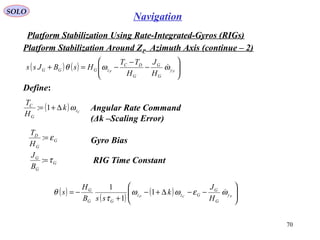
Platform Stabilization UsingRate-Integrated-Gyros (RIGs(
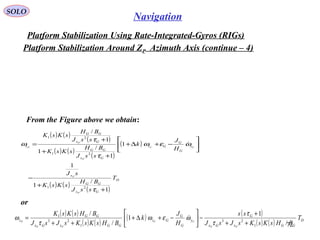
Platform Stabilization Around ZP Azimuth Axis (continue – 2(
( ) ( )
−
−
−=+ PP y
G
G
G
DC
zGGG
H
J
H
TT
HsBJss ωωθ
Define:
( ) Cz
G
C
k
H
T
ω∆+= 1: Angular Rate Command
(Δk –Scaling Error(
G
G
D
H
T
ε=: Gyro Bias
G
G
G
B
J
τ=: RIG Time Constant
( )
( )
( )
−−∆+−
+
−= PCP y
G
G
Gzz
GG
G
H
J
k
ssB
H
s ωεωω
τ
θ 1
1
1
71.
SOLO
71
Navigation
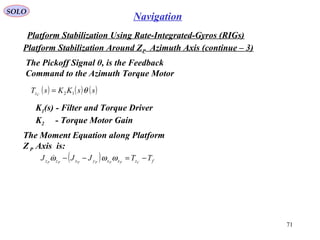
Platform Stabilization UsingRate-Integrated-Gyros (RIGs(
Platform Stabilization Around ZP Azimuth Axis (continue – 3(
The Pickoff Signal θ, is the Feedback
Command to the Azimuth Torque Motor
( ) ( ) ( )ssKKsT Cz θ12=
K1(s( - Filter and Torque Driver
( ) fzxxyxzz TTJJJ CPPPPPP
−=−− ωωω
K2 - Torque Motor Gain
The Moment Equation along Platform
ZP Axis is:
72.
SOLO
72
Navigation
Platform Stabilization UsingRate-Integrated-Gyros (RIGs(
Platform Stabilization Around ZP Azimuth Axis (continue – 4(
( ) ( )
( ) ( )
( ) ( )
( ) ( ) D
GGxGx
G
y
G
G
Gz
GGxGx
GG
z T
BHsKsKsJsJ
ss
H
J
k
BHsKsKsJsJ
BHsKsK
PP
CC
PP
P
/
1
1
/
/
1
23
1
23
1
++
+
−
−+∆+
++
=
τ
τ
ωεω
τ
ω
( ) ( )
( )
( ) ( )
( )
( )
( ) ( )
( )
D
Gx
GG
x
y
G
G
Gz
Gx
GG
Gx
GG
z
T
ssJ
BH
sKsK
sJ
H
J
k
ssJ
BH
sKsK
ssJ
BH
sKsK
P
P
CC
P
P
P
1
/
1
1
1
1
/
1
1
/
21
21
21
+
+
−
−+∆+
+
+
+
=
τ
ωεω
τ
τ
ω
or
From the Figure above we obtain:
73.
SOLO
73
Navigation
Platform Stabilization UsingRate-Integrated-Gyros (RIGs(
Platform Stabilization Around ZP Azimuth Axis (continue – 5(
( ) ( )
( ) ( )
( ) ( )
( ) ( ) D
GGxGx
G
y
G
G
Gz
GGxGx
GG
z T
BHsKsKsJsJ
ss
H
J
k
BHsKsKsJsJ
BHsKsK
PP
CC
PP
P
/
1
1
/
/
1
23
1
23
1
++
+
−
−+∆+
++
=
τ
τ
ωεω
τ
ω
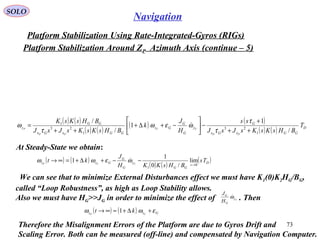
At Steady-State we obtain:
( ) ( )
( ) ( )
( )D
s
GG
y
G
G
Gzz Ts
BHsKKH
J
kt CCP 0
1
lim
/0
1
1
→
−−+∆+=∞→ ωεωω
We can see that to minimize External Disturbances effect we must have K1(0(K2HG/BG,
called “Loop Robustness”, as high as Loop Stability allows.
Also we must have HG>>JG in order to minimize the effect of . ThenCy
G
G
H
J
ω
( ) ( ) Gzz CP
kt εωω +∆+≈∞→ 1
Therefore the Misalignment Errors of the Platform are due to Gyros Drift and
Scaling Error. Both can be measured (off-line( and compensated by Navigation Computer.
SOLO
75
Navigation
Platform Stabilization UsingRate-Integrated-Gyros (RIGs(
The Platform is angular isolated from the Aircraft
via, at least, three Gimbals. Those Gimbals are,
from Aircraft to Platform:
- Azimuth (Heading( – Angle ψG
- Pitch – Angle θ
- Roll – Angle ϕ
The Rotation Matrix from Aircraft to Platform is:
[ ] [ ] [ ]
−
−
−
==
100
0cossin
0sincos
cos0sin
010
sin0cos
cossin0
sincos0
001
321 GG
GG
G
P
AC ψψ
ψψ
θθ
θθ
φφ
φφψθφ
We want to apply Moments on the Platform, related to the Pjckoff
Outputs
of the Three RIGs mounted on the Platform
( )
( )
=
=
z
y
x
z
y
x
P
KsK
T
T
T
T
P
P
P
θ
θ
θ
21
The 3 Torque Motors Roll (TR(, Pitch (TP( and Heading (TH(
are located on Gimbal Axes .PA zyx 1,1,1 '
76.
SOLO
76
Navigation
Platform Stabilization UsingRate-Integrated-Gyros (RIGs(
We want to find the relation between and
TR, TP, TH.
PPP zyx TTT ,,
The 3 Torque Motors Roll (TR(, Pitch (TP( and Heading (TH(
are located on Gimbal Axes .PA zyx 1,1,1 '
PAPPPPPP zHyPxRzzyyxx TTTTTTT 111111 '
++=++=
( )
[ ] [ ] [ ]
( )
[ ] [ ]
( )
[ ]
( )
P
Pzy
A
Ax
P
P
P
GHGPGR
z
y
x
P
TTT
T
T
T
T
1
3
1
23
1
123
1
0
0
0
1
0
0
0
1
,
'
−+
−−+
−−−=
= ψθψφθψ
−
−
=
H
P
R
GG
GG
z
y
x
T
T
T
T
T
T
P
P
P
10sin
0coscossin
0sincoscos
θ
ψθψ
ψθψ
−=
P
P
P
z
y
x
GG
GG
GG
H
P
R
T
T
T
T
T
T
1tansintancos
0cossin
0cos/sincos/cos
θψθψ
ψψ
θψθψ
77.
SOLO
77
Navigation
Platform Stabilization UsingRate-Integrated-Gyros (RIGs(
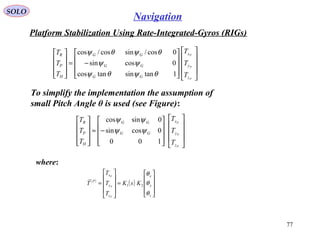
To simplify the implementation the assumption of
small Pitch Angle θ is used (see Figure(:
−=
P
P
P
z
y
x
GG
GG
GG
H
P
R
T
T
T
T
T
T
1tansintancos
0cossin
0cos/sincos/cos
θψθψ
ψψ
θψθψ
−≈
P
P
P
z
y
x
GG
GG
H
P
R
T
T
T
T
T
T
100
0cossin
0sincos
ψψ
ψψ
( )
( )
=
=
z
y
x
z
y
x
P
KsK
T
T
T
T
P
P
P
θ
θ
θ
21
where:
SOLO
81
Navigation
Derivation of theIMU Position and Platform Misalignment Error Equations
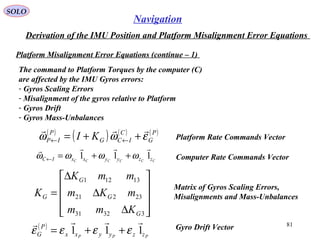
Platform Misalignment Error Equations (continue – 1(
The command to Platform Torques by the computer (C(
are affected by the IMU Gyros errors:
- Gyros Scaling Errors
- Misalignment of the gyros relative to Platform
- Gyros Drift
- Gyros Mass-Unbalances
( )
( ) ( ) ( )P
G
C
ICG
P
IP KI εωω
++= ←← Platform Rate Commands Vector
∆
∆
∆
=
33231
23221
13121
G
G
G
G
Kmm
mKm
mmK
K
Matrix of Gyros Scaling Errors,
Misalignments and Mass-Unbalances
( )
PPP zzyyxx
P
G 111
εεεε ++= Gyro Drift Vector
Computer Rate Commands VectorCCCCCC zzyyxxIC 111
ωωωω ++=←
82.
SOLO
82
Navigation
Derivation of theIMU Position and Platform Misalignment Error Equations
Platform Misalignment Error Equations (continue – 2(
Let find the angular velocity vector of the Platform (P(
relative to the Computer (C(:
ICIPCP ←←← −= ωωω
( ) ( ) ( ) ( ) ( )C
IC
P
C
P
IP
P
IC
P
IP
P
CP C ←←←←← −=−= ωωωωω
( ) ( ) ( )
[ ]{ } ( )
[ ] ( ) ( ) ( )P
G
C
ICG
C
IC
C
IC
P
G
C
ICG KIKI εωωψωψεωψ
++×=×−−++= ←←←←
Using we obtain:[ ] ( ) ( )
[ ] ψωωψ
×−=× ←←
C
IC
C
IC
( )
[ ] ( ) ( )P
G
C
ICG
C
IC K εωψωψ
++×−= ←←
or
+
∆
∆
∆
+
−
−
−
−=
z
y
x
z
y
x
G
G
G
z
y
x
xy
xz
yz
z
y
x
C
C
C
CC
CC
CC
Kmm
mKm
mmK
ε
ε
ε
ω
ω
ω
ψ
ψ
ψ
ωω
ωω
ωω
ψ
ψ
ψ
33231
23221
13121
0
0
0
83.
SOLO
83
Navigation
Derivation of theIMU Position and Platform Misalignment Error Equations
Position Error Equations
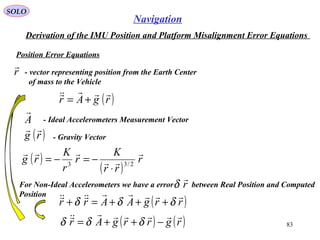
- vector representing position from the Earth Center
of mass to the Vehicle
r
( )rgAr
+=
- Ideal Accelerometers Measurement VectorA
( )
( )
r
rr
K
r
r
K
rg
2/33
⋅
−=−=
( )rg
- Gravity Vector
( )rrgAArr
δδδ +++=+
For Non-Ideal Accelerometers we have a error between Real Position and Computed
Position
r
δ
( ) ( )rgrrgAr
−++= δδδ
84.
SOLO
84
Navigation
Derivation of theIMU Position and Platform Misalignment Error Equations
Position Error Equations (continue – 1(
( ) ( )rgrrgAr
−++= δδδ
( ) ( )
( ) ( )[ ]
r
r
K
r
rrrr
K
rgrrg
32/3
+
+⋅+
−=−+
δδ
δ
( )
( ) r
r
K
r
rr
rr
r
K
r
r
K
r
rrr
K
32332/32
31
2
+
⋅
−+−≈+
⋅+
−≈
δ
δ
δ
r
r
K
r
r
r
r
r
r
K
r
r
K
r
r
K
3333
+
⋅+−−≈ δδ
therefore
Ar
r
r
r
r
r
r
K
r
δδδδ =
⋅−+ 33
85.
SOLO
85
Navigation
Derivation of theIMU Position and Platform Misalignment Error Equations
Position Error Equations (continue – 2(
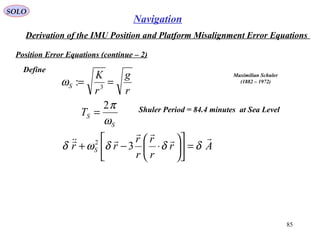
Define
r
g
r
K
S == 3
:ω
Maximilian Schuler
(1882 – 1972(
S
ST
ω
π2
= Shuler Period = 84.4 minutes at Sea Level
Ar
r
r
r
r
rr S
δδδωδ =
⋅−+ 32
86.
SOLO
86
Navigation
Derivation of theIMU Position and Platform Misalignment Error Equations
Position Error Equations (continue – 3(
Let find the Accelerometer Measurements received by the Navigation Computer (C(
The Accelerometer Errors are related to:
- Accelerometers Scaling Errors
- Misalignment of the Accelerometers relative to Platform
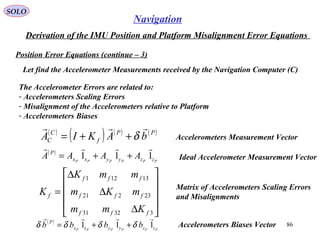
- Accelerometers Biases
( )
( ) ( ) ( )PP
f
C
C bAKIA
δ++= Accelerometers Measurement Vector
∆
∆
∆
=
33231
23221
13121
fff
fff
fff
f
Kmm
mKm
mmK
K Matrix of Accelerometers Scaling Errors
and Misalignments
Ideal Accelerometer Measurement Vector
( )
PPPPPP zzyyxx
P
AAAA 111
++=
( )
PPPPPP zzyyxx
P
bbbb 111
δδδδ ++= Accelerometers Biases Vector
87.
SOLO
87
Navigation
Derivation of theIMU Position and Platform Misalignment Error Equations
Position Error Equations (continue – 4(
AAA C
−=:δ Accelerometers Error Vector
( ) ( ) ( )
( ) ( ) ( )
[ ]( ) ( )PPP
f
PC
P
C
C
C
AIbAKIACAA
×+−++=−= ψδδ
We used the relation ( ) [ ]( ) [ ]( )×+≈×−==
−−
ψψ
IICC P
C
C
P
11
Finally we obtain
( )
[ ] ( ) ( ) ( )PP
f
PC
bAKAA
δψδ ++×−=
[ ] ( ) ( ) ( )PP
f
P
S bAKAr
r
r
r
r
rr
δψδδωδ ++×−=
⋅−+ 32
The Position Error Equation is
88.
SOLO
88
Navigation
Derivation of theIMU Position and Platform Misalignment Error Equations
Position Error Equations (continue – 5(
Let compute ( )C
r
δ
( ) ( ) ( )
[ ] ( )CC
IC
CC
rrr
δωδδ ×+= ←
Therefore
( )
( )
( )
( ) ( )
CCCCCC
CCC
C
IC
C
CCC
CCC
CCCCCC
CCC
zzyyxxIC
C
ICzyxICzyx
zyx
C
zyxzyx
C
zyx
C
rzyxzyx
zyxr
zyxzyxr
zyxr
111
111111
111:
111111
111
11
ωωωω
δωδδδωδδδ
δδδδ
δδδδδδδ
δδδδ
αα
ω
++=
×=++×=++
++=
+++++=
++=
←
←←
×= ←
In the same way
( ) ( ) ( )
[ ] ( ) ( ) ( )
[ ] ( ) ( )
( )
[ ] ( ) ( )
[ ] ( )
( )CC
IC
CC
IC
CC
IC
C
IC
C
IC
CC
IC
CC
rr
rrrr
δωδω
δωωωδωδδ
×+×+
×
×++×+=
←←
←←←←
0
89.
SOLO
89
Navigation
Derivation of theIMU Position and Platform Misalignment Error Equations
Position Error Equations (continue – 6(
( ) ( ) ( )
[ ] ( )CC
IC
CC
rrr
δωδδ ×+= ←
Therefore
( ) ( ) ( )
[ ] ( ) ( )
[ ] ( )
[ ] ( )
[ ]( ) ( )CC
IC
C
IC
C
IC
CC
IC
CC
rrrr
δωωωδωδδ ××+×+×+= ←←←←2
( ) ( )
[ ] ( ) ( )
[ ] ( )
[ ] ( )
[ ]( ) ( ) ( )
( ) ( )
( )
[ ] ( ) ( ) ( )PP
f
P
C
CC
C
S
CC
IC
C
IC
C
IC
CC
IC
C
bAKA
r
r
r
r
r
rrrr
δψ
δδωδωωωδωδ
++×−=
⋅−+××+×+×+ ←←←← 32 2
Together with the Platform Misalignment Error Equations
( )
[ ] ( ) ( )P
G
C
ICG
C
IC K εωψωψ
++×−= ←←
90.
SOLO
90
Navigation
Derivation of theIMU Position and Platform Misalignment Error Equations
Position Error Equations (continue – 7(
CCCCCC zzyyxxIC 111
ωωωω ++=←
( )
[ ]
−
−
−
=×←
0
0
0
CC
CC
CC
xy
xz
yz
C
IC
ωω
ωω
ωω
ω
( )
[ ]
−
−
−
=×←
0
0
0
CC
CC
CC
xy
xz
yz
C
IC
ωω
ωω
ωω
ω
( )
[ ] ( )
[ ]
( )
( )
( )
+−
+−
+−
=
−
−
−
−
−
−
=×× ←←
22
22
22
0
0
0
0
0
0
CCCCCC
CCCCCC
CCCCCC
CC
CC
CC
CC
CC
CC
yxzyzx
zyzxyx
zxyxzy
xy
xz
yz
xy
xz
yz
C
IC
C
IC
ωωωωωω
ωωωωωω
ωωωωωω
ωω
ωω
ωω
ωω
ωω
ωω
ωω
Czrr 1
= ( )
( )
( )
( )
−
=
−
=
⋅−
z
y
x
z
z
y
x
r
r
r
r
r
r
C
C
C
C
δ
δ
δ
δ
δ
δ
δ
δδ
21
0
0
33
91.
SOLO
91
Navigation
Derivation of theIMU Position and Platform Misalignment Error Equations
Position Error Equations (continue – 8)
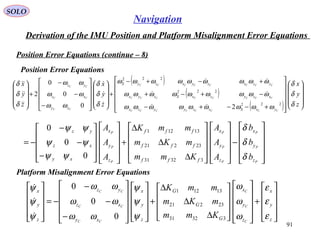
( )
( )
( )
+−−+−
−+−+
+−+−
+
−
−
−
+
z
y
x
z
y
x
z
y
x
CCCCCCCC
CCCCCCCC
CCCCCCCC
CC
CC
CC
yxSxzyyzx
xzyzxSzyx
yzxzyxzyS
xy
xz
yz
δ
δ
δ
ωωωωωωωωω
ωωωωωωωωω
ωωωωωωωωω
δ
δ
δ
ωω
ωω
ωω
δ
δ
δ
222
222
222
20
0
0
2
−
∆
∆
∆
+
−
−
−
−=
P
P
P
P
P
P
P
P
P
z
y
x
z
y
x
fff
fff
fff
z
y
x
xy
xz
yz
b
b
b
A
A
A
Kmm
mKm
mmK
A
A
A
δ
δ
δ
ψψ
ψψ
ψψ
33231
23221
13121
0
0
0
Position Error Equations
Platform Misalignment Error Equations
+
∆
∆
∆
+
−
−
−
−=
z
y
x
z
y
x
G
G
G
z
y
x
xy
xz
yz
z
y
x
C
C
C
CC
CC
CC
Kmm
mKm
mmK
ε
ε
ε
ω
ω
ω
ψ
ψ
ψ
ωω
ωω
ωω
ψ
ψ
ψ
33231
23221
13121
0
0
0
SOLO
103
Navigation
Externally Navigation AddSystems
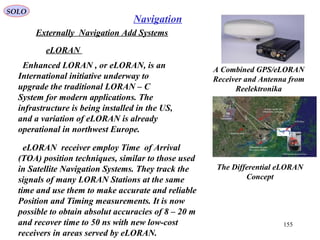
eLORAN
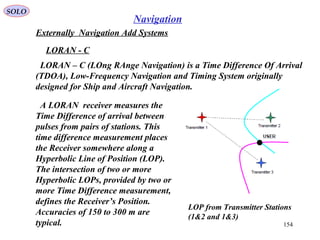
LORAN - C
Global Navigation Satelite System (GNSS)
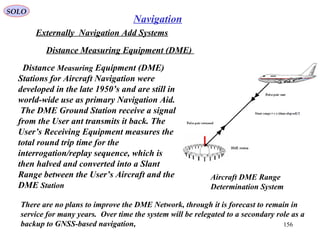
Distance Measuring Equipment (DME)
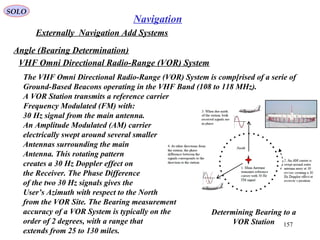
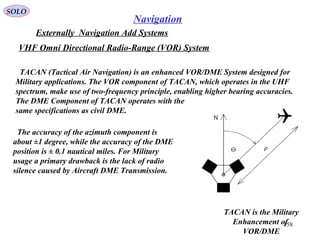
VHF Omni Directional Radio-Range (VOR) System
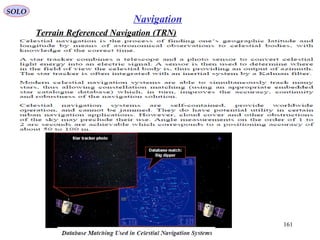
Data Base Matching
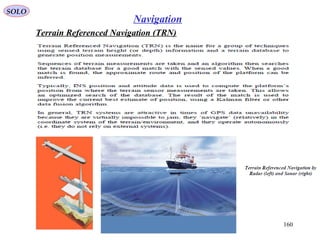
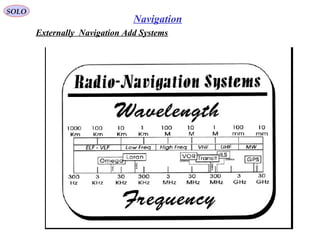
Terrain Referenced Navigation (TRN)
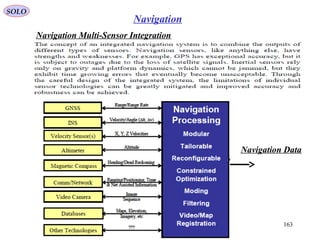
Navigation Multi-Sensor Integration
104.
SOLO
104
Navigation
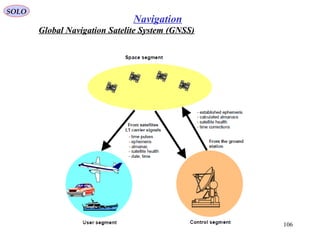
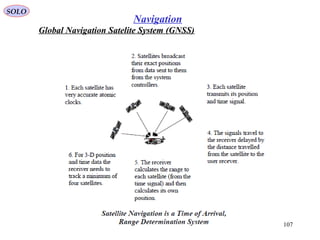
Global Navigation SateliteSystem (GNSS)
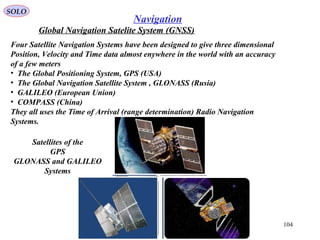
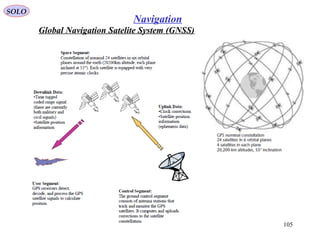
Satellites of the
GPS
GLONASS and GALILEO
Systems
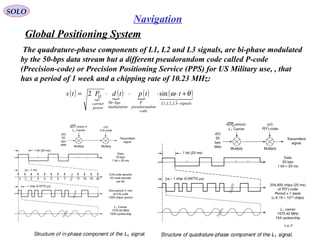
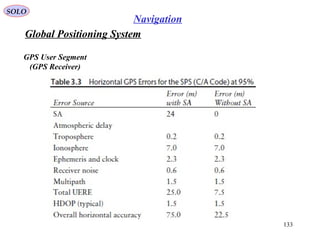
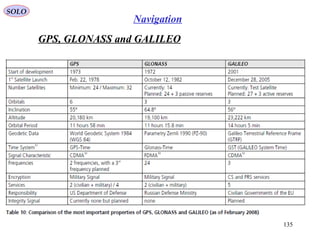
Four Satellite Navigation Systems have been designed to give three dimensional
Position, Velocity and Time data almost enywhere in the world with an accuracy
of a few meters
• The Global Positioning System, GPS (USA)
• The Global Navigation Satellite System , GLONASS (Rusia)
• GALILEO (European Union)
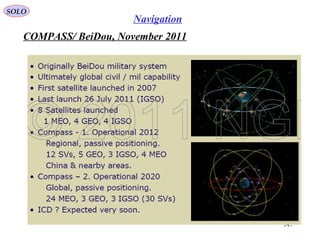
• COMPASS (China)
They all uses the Time of Arrival (range determination) Radio Navigation
Systems.
SOLO
108
Navigation
Global Navigation SateliteSystem (GNSS)
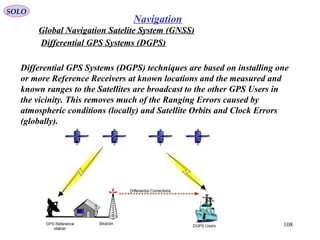
Differential GPS Systems (DGPS)
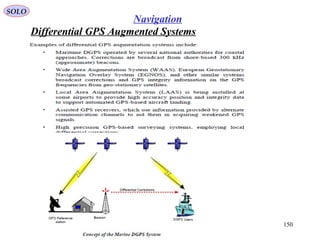
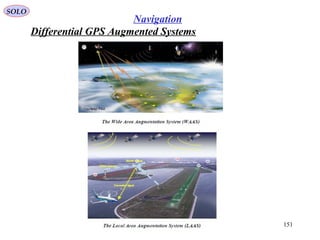
Differential GPS Systems (DGPS) techniques are based on installing one
or more Reference Receivers at known locations and the measured and
known ranges to the Satellites are broadcast to the other GPS Users in
the vicinity. This removes much of the Ranging Errors caused by
atmospheric conditions (locally) and Satellite Orbits and Clock Errors
(globally).
109.
Global Positioning System(GPS)
SOLO
109
Navigation
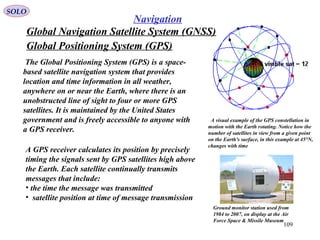
A visual example of the GPS constellation in
motion with the Earth rotating. Notice how the
number of satellites in view from a given point
on the Earth's surface, in this example at 45°N,
changes with time
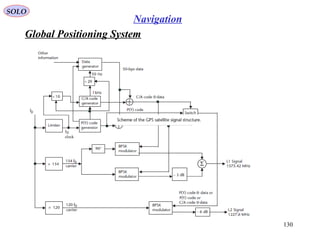
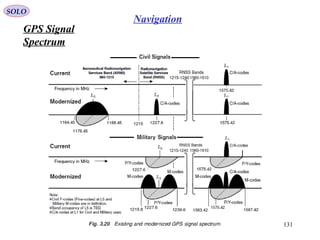
The Global Positioning System (GPS) is a space-
based satellite navigation system that provides
location and time information in all weather,
anywhere on or near the Earth, where there is an
unobstructed line of sight to four or more GPS
satellites. It is maintained by the United States
government and is freely accessible to anyone with
a GPS receiver.
Ground monitor station used from
1984 to 2007, on display at the Air
Force Space & Missile Museum
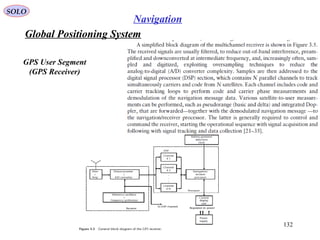
A GPS receiver calculates its position by precisely
timing the signals sent by GPS satellites high above
the Earth. Each satellite continually transmits
messages that include:
• the time the message was transmitted
• satellite position at time of message transmission
Global Navigation Satellite System (GNSS)
110.
Global Positioning System
SOLO
110
Navigation
Othersatellite navigation systems in use or
various states of development include:
• GLONASS – Russia's global navigation
system. Fully operational worldwide.
• GALILEO – a global system being
developed by the European Union and other
partner countries, planned to be operational
by 2014 (and fully deployed by 2019)
• BEIDOU – People's Republic of China's
regional system, currently limited to Asia and
the West Pacific[123]
• COMPASS – People's Republic of China's
global system, planned to be operational by
2020.
• IRNSS – India's regional navigation
system, planned to be operational by 2012,
covering India and Northern Indian Ocean.
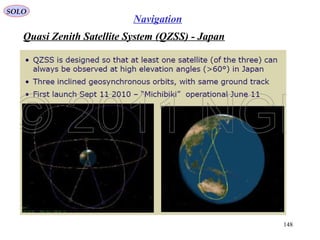
• QZSS – Japanese regional system covering
Asia and Oceania.
Comparison of GPS, GLONASS, Galileo and Compass (medium earth orbit)
satellite navigation system orbits with the International Space Station, Hubble
Space Telescope and Iridium constellation orbits, Geostationary Earth Orbit, and
the nominal size of the Earth.[121]
The Moon's orbit is around 9 times larger (in
radius and length) than geostationary orbit
111.
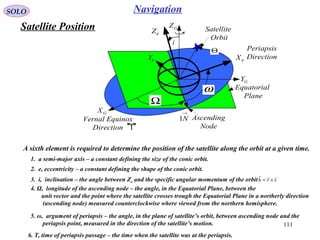
Satellite Position
SOLO
111
Navigation
GZ
GX
GY
Equatorial
Plane
εY
εZ
εX
Ascending
Node
Satellite
Orbit
Periapsis
Direction
Vernal Equinox
Direction
Ω
ω
i
→
N1
Θ
Asixth element is required to determine the position of the satellite along the orbit at a given time.
1. a semi-major axis – a constant defining the size of the conic orbit.
2. e, eccentricity – a constant defining the shape of the conic orbit.
3. i, inclination – the angle between Ze and the specific angular momentum of the orbit vrh
×=
4. Ω, longitude of the ascending node – the angle, in the Equatorial Plane, between the
unit vector and the point where the satellite crosses trough the Equatorial Plane in a northerly direction
(ascending node) measured counterclockwise where viewed from the northern hemisphere.
5. ω, argument of periapsis – the angle, in the plane of satellite’s orbit, between ascending node and the
periapsis point, measured in the direction of the satellite’s motion.
6. T, time of periapsis passage – the time when the satellite was at the periapsis.
113
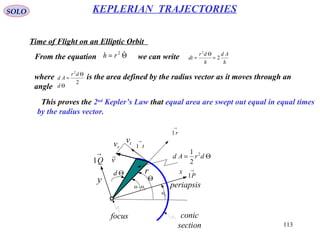
SOLO KEPLERIAN TRAJECTORIES
Timeof Flight on an Elliptic Orbit
From the equation Θ= 2
rh we can write
h
Ad
h
dr
dt 2
2
=
Θ
=
where is the area defined by the radius vector as it moves through an
angle
2
2
Θ
=
dr
Ad
Θd
Θ
pΘ
pΘ−Θ
r
focus conic
section
x
y
→
P1
→
Q1
→
r1
→
t1
v
rv tv
Θd
Θ= drAd 2
2
1
periapsis
This proves the 2nd
Kepler’s Law that equal area are swept out equal in equal times
by the radius vector.
114.
114
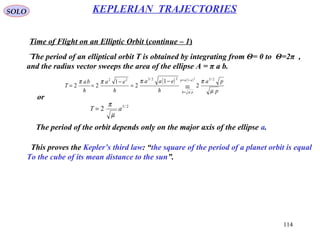
SOLO KEPLERIAN TRAJECTORIES
Timeof Flight on an Elliptic Orbit (continue – 1)
The period of the orbit depends only on the major axis of the ellipse a.
( ) ( )
p
pa
h
eaa
h
ea
h
ba
T
eap
ph µ
ππππ
µ
2/3122/322
2
1
2
1
22
2
=
−=
=
−
=
−
==
or
2/3
2 aT
µ
π
=
The period of an elliptical orbit T is obtained by integrating from Θ= 0 to Θ=2π ,
and the radius vector sweeps the area of the ellipse A = π a b.
This proves the Kepler’s third law: “the square of the period of a planet orbit is equal
To the cube of its mean distance to the sun”.
115.
115
SOLO KEPLERIAN TRAJECTORIES
Timeof Flight on an Elliptic Orbit (continue – 2)
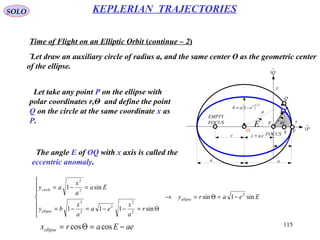
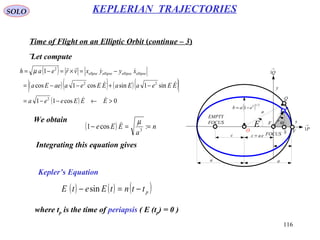
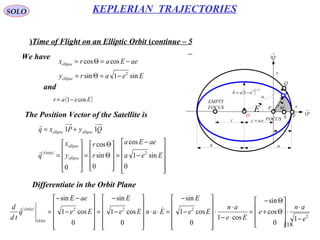
Let draw an auxiliary circle of radius a, and the same center O as the geometric center
of the ellipse.
x
y
eac =
a a
( ) 2/12
1 eab −=
r
Θ
FOCUS
EMPTY
FOCUS
c
→
P1
→
Q1
a
F
Q
O VS
E
P
Let take any point P on the ellipse with
polar coordinates r,Θ and define the point
Q on the circle at the same coordinate x as
P.
Eeary
r
a
x
ea
a
x
by
Ea
a
x
ay
ellipse
ellipse
circle
sin1sin
sin111
sin1
2
2
2
2
2
2
2
2
−=Θ=→
Θ=−−=−=
=−=
The angle E of OQ with x axis is called the
eccentric anomaly.
aeEarxellipse −=Θ= coscos
116.
116
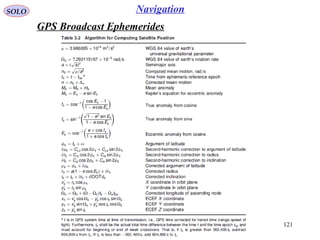
SOLO KEPLERIAN TRAJECTORIES
Timeof Flight on an Elliptic Orbit (continue – 3)
Let compute
x
y
eac =
a a
( ) 2/12
1 eab −=
r
Θ
FOCUS
EMPTY
FOCUS
c
→
P1
→
Q1
a
F
Q
O VS
E
P
( )
( )( ) ( )( )
( ) 0cos11
sin1sincos1cos
1
2
22
2
>←−−=
−+−−=
−=×=−=
EEEeea
EEeaEaEEeaaeEa
xyyxvreah ellipseellipseellipseellpse
µ
We obtain
( ) n
a
EEe ==− :cos1 3
µ
( ) ( ) ( )pttntEetE −=− sin
Integrating this equation gives
Kepler’s Equation
where tp is the time of periapsis ( E (tp) = 0 )
117.
117
SOLO KEPLERIAN TRAJECTORIES
Timeof Flight on an Elliptic Orbit (continue – 4)
From
x
y
eac =
a a
( ) 2/12
1 eab −=
rΘ
FOCUS
EMPTY
FOCUS
c
→
P1
→
Q1
a
F
Q
O VS
E
P
Eeary
aeEarx
ellipse
ellipse
sin1sin
coscos
2
−=Θ=
−=Θ=
we have
( ) ( )[ ] [ ]
( )Eea
EeEeaEeaaeEar
cos1
coscos21sin1cos
2/1222/12222
−=
+−=−+−=
Therefore
Θ+
Θ−
=
−
−
=Θ
Θ+
Θ+
=
−
−
=Θ
cos1
sin1
sin
cos1
sin1
sin
cos1
cos
cos
cos1
cos
cos
22
e
e
E
Ee
Ee
e
e
E
Ee
eE
( )( )
Ee
Ee
Ee
eEEe
sin1
cos11
sin1
coscos1
sin
cos1
2
tan
22
−
−+
=
−
+−−
=
Θ
Θ−
=
Θ
From
2
tan
1
1
2
tan
E
e
e
−
+
=
Θ
or
and are always in the same quadrant.2
Θ
2
E
118.
118
SOLO KEPLERIAN TRAJECTORIES
Timeof Flight on an Elliptic Orbit (continue – 5)
We have
x
y
eac =
a a
( ) 2/12
1 eab −=
rΘ
FOCUS
EMPTY
FOCUS
c
→
P1
→
Q1
a
F
Q
O VS
E
P
Eeary
aeEarx
ellipse
ellipse
sin1sin
coscos
2
−=Θ=
−=Θ=
and
( )Eear cos1−=
The Position Vector of the Satellite is
( )
−
−
=
Θ
Θ
=
=
+=
0
sin1
cos
0
sin
cos
0
11
2
Eea
aeEa
r
r
y
x
q
QyPxq
ellipse
ellipse
Orbit
ellipseellipse
Differentiate in the Orbit Plane
( )
2
222
1
0
cos
sin
cos1
0
cos1
sin
0
cos1
sin
0
cos1
sin
e
an
e
Ee
an
Ee
E
EanEe
E
Ee
aeE
q
td
d
Orbit
Orbit
−
⋅
⋅
Θ+
Θ−
=
⋅−
⋅
⋅
−
−
=⋅⋅
−
−
=
−
−−
=
119.
GPS Broadcast Ephemerides
SOLO
119
Navigation
TheSatellite Position can be computed as follows:
( ) ( )
( )
( ) ( )
( ) ( )
( ) ( ) ( )oeisic
rsrc
usuc
oe
oe
ttidotuCuCii
uCuCrr
uCuC
tt
ttnnMM
a
n
−⋅+⋅+⋅+=
⋅+⋅+=
⋅+⋅+=
−⋅Ω+Ω=Ω
−⋅∆++=
=
000
000
000
0
0
3
2sin2cos
2sin2cos
2sin2cosωω
µ
where:
( )
Θ+=
⋅
−
+
⋅=Θ
⋅−⋅=
⋅+=
−
00
1
0
2
tan
1
1
tan2
cos1
sin
ωu
E
e
e
Eear
EeME
Six Keplerian Elements Define the
Satellite Posision (Ω, I, ω, a, e, M0)
where M0 = n (t – tP)
120.
GPS Broadcast Ephemerides
SOLO
120
Navigation
()
Θ+=
=
= ωuur
ur
y
x
q ellipse
ellipse
Orbit
0
sin
cos
0
( )
2
1
0
cos
sin
0
e
an
ue
u
y
x
q ellipse
ellipse
Orbit
Orbit
−
⋅
⋅
+
−
=
=
( ) oecoec ttt ⋅+−⋅=Θ ωω
[ ] [ ] [ ]
−−Ω−=
=
0
sin
cos
0
313 ur
ur
iy
x
C
z
y
x
ellipse
ellipse
G
G
ωε
Θ+= ωu
Global Positioning System
SOLO
122
Navigation
-x, y, z Satellite Coordinate in Geocentric-Equatorial Coordinate System
( ) ( ) ( )222
ZzYyXx −+−+−=ρ
- X, Y, Z User Coordinate in Geocentric-Equatorial Coordinate System
Squaring both sides gives
The User to Satellite Range is given by
( ) ( ) ( )
ZzYyXxzyxZYX
ZzYyXx
r
⋅⋅−⋅⋅−⋅⋅−+++++=
−+−+−=
222222222
2222
2
ρ
The four unknown are X, Y, Z, Crr.
Satellite position (x,y,z) is calculated from received Satellite Ephemeris Data.
Since we have four unknowns we need data from at least four Satellites.
( ) ZzYyXxCrrrzyxr ⋅⋅−⋅⋅−⋅⋅−=−++− 22222222
ρ
where r = Earth Radius
This is true if (x,y,z) and (X,Y,Z) are measured at the same time. The GPS
Satellites clocks are more accurate then the Receiver clock. Let assume that
Crr is the range-square bias due to time bias between Receiver GPS and
Satellites clocks. Therefore instead of the real Range ρ the Receiver GPS
measures the Pseudo-range ρr..
Global Positioning System
SOLO
128
Navigation
Thekey to the system accuracy is the fact that all signal components are
controlled by Atomic Clocks.
• Block II Satellites have four on-board clocks: two rubidium and two cesium
clocks. The long term frequency stability of these clocks reaches a few part in
10-13
and 10-14
over one day.
• Block III will use hydrogen masers with stability of 10-14
to 10-15
over one day.
The Fundamental L-Band Frequency of 10.23 MHz is produced from those Clocks.
Coherently derived from the Fundamental Frequency are three signals
(with in-phase (cos), and quadrature-phase (sin) components):
- L1 = 154 x 10.23 MHz = 1575.42 MHz
- L2 = 120 x 10.23 MHz = 1227.60 MHz
- L3 = 115 x 10.23 MHz = 1176.45 MHz
The in-phase components of L1 signal, is bi-phase modulated by a 50-bps data
stream and a pseudorandom code called C/A-code (Coarse Civilian) consisting of a
1023-chip sequence, that has a period of 1 ms and a chipping rate of 1.023 MHz:
( )
( ) ( ) ( )
signalL
code
ompseudorand
AC
ulation
bps
power
carrier
I ttctdPts
−−
+⋅⋅⋅⋅=
1/
mod
50
cos2 θω
129.
Global Positioning System
SOLO
129
Navigation
Thequadrature-phase components of L1, L2 and L3 signals, are bi-phase modulated
by the 50-bps data stream but a different pseudorandom code called P-code
(Precision-code) or Precision Positioning Service (PPS) for US Military use, , that
has a period of 1 week and a chipping rate of 10.23 MHz:
( )
( ) ( ) ( )
signalsLLL
code
ompseudorand
P
ulation
bps
power
carrier
Q ttptdPts
−−
+⋅⋅⋅⋅=
3,2,1
mod
50
sin2 θω
SOLO
154
Navigation
Externally Navigation AddSystems
LORAN - C
A LORAN receiver measures the
Time Difference of arrival between
pulses from pairs of stations. This
time difference measurement places
the Receiver somewhere along a
Hyperbolic Line of Position (LOP).
The intersection of two or more
Hyperbolic LOPs, provided by two or
more Time Difference measurement,
defines the Receiver’s Position.
Accuracies of 150 to 300 m are
typical.
LOP from Transmitter Stations
(1&2 and 1&3)
LORAN – C (LOng RAnge Navigation) is a Time Difference Of Arrival
(TDOA), Low-Frequency Navigation and Timing System originally
designed for Ship and Aircraft Navigation.
155.
SOLO
155
Navigation
Externally Navigation AddSystems
eLORAN
eLORAN receiver employ Time of Arrival
(TOA) position techniques, similar to those used
in Satellite Navigation Systems. They track the
signals of many LORAN Stations at the same
time and use them to make accurate and reliable
Position and Timing measurements. It is now
possible to obtain absolut accuracies of 8 – 20 m
and recover time to 50 ns with new low-cost
receivers in areas served by eLORAN.
The Differential eLORAN
Concept
Enhanced LORAN , or eLORAN, is an
International initiative underway to
upgrade the traditional LORAN – C
System for modern applications. The
infrastructure is being installed in the US,
and a variation of eLORAN is already
operational in northwest Europe.
A Combined GPS/eLORAN
Receiver and Antenna from
Reelektronika
156.
SOLO
156
Navigation
Externally Navigation AddSystems
Distance Measuring Equipment (DME)
Aircraft DME Range
Determination System
Distance Measuring Equipment (DME)
Stations for Aircraft Navigation were
developed in the late 1950’s and are still in
world-wide use as primary Navigation Aid.
The DME Ground Station receive a signal
from the User ant transmits it back. The
User’s Receiving Equipment measures the
total round trip time for the
interrogation/replay sequence, which is
then halved and converted into a Slant
Range between the User’s Aircraft and the
DME Station
There are no plans to improve the DME Network, through it is forecast to remain in
service for many years. Over time the system will be relegated to a secondary role as a
backup to GNSS-based navigation,
157.
SOLO
157
Navigation
Externally Navigation AddSystems
Angle (Bearing Determination)
Determining Bearing to a
VOR Station
VHF Omni Directional Radio-Range (VOR) System
The VHF Omni Directional Radio-Range (VOR) System is comp[rised of a serie of
Ground-Based Beacons operating in the VHF Band (108 to 118 MHz).
A VOR Station transmits a reference carrier
Frequency Modulated (FM) with:
30 Hz signal from the main antenna.
An Amplitude Modulated (AM) carrier
electrically swept around several smaller
Antennas surrounding the main
Antenna. This rotating pattern
creates a 30 Hz Doppler effect on
the Receiver. The Phase Difference
of the two 30 Hz signals gives the
User’s Azimuth with respect to the North
from the VOR Site. The Bearing measurement
accuracy of a VOR System is typically on the
order of 2 degrees, with a range that
extends from 25 to 130 miles.
158.
SOLO
158
Navigation
Externally Navigation AddSystems
TACAN is the Military
Enhancement of
VOR/DME
VHF Omni Directional Radio-Range (VOR) System
TACAN (Tactical Air Navigation) is an enhanced VOR/DME System designed for
Military applications. The VOR component of TACAN, which operates in the UHF
spectrum, make use of two-frequency principle, enabling higher bearing accuracies.
The DME Component of TACAN operates with the
same specifications as civil DME.
The accuracy of the azimuth component is
about ±1 degree, while the accuracy of the DME
position is ± 0.1 nautical miles. For Military
usage a primary drawback is the lack of radio
silence caused by Aircraft DME Transmission.
164
SOLO
Technion
Israeli Institute ofTechnology
1964 – 1968 BSc EE
1968 – 1971 MSc EE
Israeli Air Force
1970 – 1974
RAFAEL
Israeli Armament Development Authority
1974 – 2013
Stanford University
1983 – 1986 PhD AA
165.
SOLO
165
Navigation
World Geodetic System(WGS 84)
Geoid - Mean Sea Level of the Earth
Reference Ellipsoid – Approximation of Sea Level
Reference Earth Model
h - Vehicle Altitude (the distance from the
Vehicle to Ellipsoid along the Normal
to Ellipsoid
RN - the distance from the Ellipsoid Surface
along the Normal to Ellipsoid to
intersection to yz plane (see Figure)
N - Height of the Geoid above the Reference Ellipsoid
The Reference Ellipsoid was obtained by minimizing the integral of the square of
N over the Earth. Values of N over the Earth have been derived from extensive gravity
and satellite measurements. The latest result is the reference Earth Model known as the
World Geodetic System of 1984 (WGS 84).
166.
SOLO
166
Navigation
World Geodetic System(WGS 84)
Reference Earth Model
Clairaut's theorem
Clairaut's theorem, published in 1743 by Alexis Claude Clairaut in
his Théorie de la figure de la terre, tirée des principes de
l'hydrostatique,[1]
synthesized physical and geodetic evidence that
the Earth is an oblate rotational ellipsoid. It is a general
mathematical law applying to spheroids of revolution. It was
initially used to relate the gravity at any point on the Earth's
surface to the position of that point, allowing the ellipticity of the
Earth to be calculated from measurements of gravity at different
latitudes.
Clairaut's formula for the acceleration due to gravity g on the surface of a spheroid
at latitude φ, was:
where G is the value of the acceleration of gravity at the equator, m the ratio of
the centrifugal force to gravity at the equator, and f the flattening of a meridian
section of the earth, defined as:
a
ba
f
−
=:
Alexis Claude Clairaut
)1713–1765(
−+= φ2
sin
2
5
1 fmGg
167.
SOLO
167
Navigation
World Geodetic System(WGS 84)
Reference Earth Model
Carlo Somigliana
(1860 –1955)
The Theoretical Gravity on the surface of the Ellipsoid
is given by the Somigliana Formula (1929)
84
22
2
2222
22
sin1
sin1
sincos
sincos
WGS
e
pe
e
k
ba
ba
φ
φ
γ
φφ
φγφγ
γ
−
+
=
+
+
=
where
1: −=
e
p
a
b
k
γ
γ
2
22
:
a
ba
e
−
= - Ellipsoid Eccentricity
a - Ellipsoid Semi-major Axis = 6378137.0 m
b - Ellipsoid Semi-minor Axis = 6356752.314 m
γp – Gravity at the Poles = 983.21849378 cm/s2
γe – Gravity at the Equator = 978.03267714 cm/s2
– Geodetic Latitudeϕ
The Theory of the Equipotential Ellipsoid was first given by
P. Pizzetti (1894)
168.
SOLO
168
Navigation
World Geodetic System(WGS 84)
Reference Earth Model
The coordinate origin of WGS 84 is meant to be located at the
Earth's center of mass; the error is believed to be less than 2 cm.
The WGS 84 meridian of zero longitude is the IERS Reference
Meridian. 5.31 arc seconds or 102.5 meters (336.3 ft) east of the
Greenwich meridian at the latitude of the Royal Observatory.
The WGS 84 datum surface is an oblate spheroid (ellipsoid) with major
(transverse) radius a = 6378137 m at the equator and flattening
f = 1/298.257223563.The polar semi-minor (conjugate) radius b then equals a
times (1−f), or b = 6356752.3142 m.
Presently WGS 84 uses the EGM96 (Earth Gravitational Model 1996) Geoid,
revised in 2004. This Geoid defines the nominal sea level surface by means of a
spherical harmonics series of degree 360 (which provides about 100 km
horizontal resolution).[7]
The deviations of the EGM96 Geoid from the WGS 84
Reference Ellipsoid range from about −105 m to about +85 m.[8]
EGM96 differs
from the original WGS 84 Geoid, referred to as EGM84.
169.
SOLO
169
Navigation
The Reference Ellipsoidhas the same mass,
the same center of mass and the same
angular velocity as the real Earth.
The Potential U0 on Ellipsoid Surface
equals to Potential W0 on the Geoid.
World Geodetic System (WGS 84)
Reference Earth Model
The Equi-potential Ellipsoid furnishes a
simple, consistent and uniform reference
system for Geodesy, Geophysics and
Satellite Navigation. The Normal Gravity
Field on the Earth Surface and in Space, is
defined in terms of closed formula as a
reference for Gravimetry and Satellite
Geodesy.
170.
SOLO
170
Navigation
World Geodetic System(WGS 84)
Reference Earth Model
Geoid product, the 15-minute, worldwide Geoid Height for EGM96
The difference between the Geoid and the Reference Ellipsoid exhibit the
following statistics:
Mean = - 0.57 m, Standard Deviation = 30.56 m
Minimum = -106.99 m, Maximum = 85.39 m
171.
SOLO
171
Navigation
World Geodetic System(WGS – 84)
Reference Earth Model
Parameters Notation Value
Ellipsoid Semi-major Axis a 6.378.137 m
Ellipsoid Flattening (Ellipticity) f 1/298.257223563
(0.00335281066474)
Second Degree Zonal Harmonic Coefficient of the Geopotential C2,0 -484.16685x10⁻⁶
Angular Velocity of the Earth Ω 7.292115x10⁻⁵
rad/s
The Earth’s Gravitational Constant (Mass of Earth includes
Atmosphere)
GM 3.986005x10¹⁴
m3
/s2
Mass of Earth (Includes Atmosphere) M 5.9733328x1024
kg
Theoretical (Normal) Gravity at the Equator (on the Ellipsoid) γe 9.7803267714 m/s2
Theoretical (Normal) Gravity at the Poles (on the Ellipsoid) γp 9.8321863685 m/s2
Mean Value of Theoretical (Normal) Gravity γ 9.7976446561 m/s2
Geodetic and Geophysical Parameters of the WGS-84 Ellipsoid
172.
SOLO
172
Navigation
World Geodetic System(WGS 84)
Reference Earth Model
a
ba
f
−
=:f - Ellipsoid Flattening (Ellipticity)
a - Ellipsoid Semi-major Axis
b - Ellipsoid Semi-minor Axis
e - Ellipsoid Eccentricity 2
2
22
2
2: ff
a
ba
e −=
−
=
( ) 2
11 eafab −=−=
Reference Ellipsoid
173.
SOLO
173
Navigation
Reference Ellipsoid
Ellipse Equation:12
2
2
2
=+
b
y
a
x
Slope of the Normal to Ellipse:
2
2
tan
bx
ay
yd
xd
=−=φ
The Slope of the Geocentric Line to the same point
x
y
=λtan λλ sincos RyRx ==
Deviation Angle between Geographic and Geodetic
At Ellipsoid Surface
λφ tantan 2
2
b
a
=
= −
λφ tantan 2
2
1
b
a ( ) φφλ tan1tantan 2
2
2
e
a
b
−==
174.
SOLO
174
Navigation
Reference Ellipsoid
Ellipse Equation:
λφδ−=
12
2
2
2
=+
b
y
a
x
Slope of the Normal to Ellipse:
2
2
tan
bx
ay
yd
xd
=−=φ
The Slope of the Geocentric Line to the same point
x
y
=λtan
−=
−+
−
=
+
−
=
+
−
= 1
11
1
1
tantan1
tantan
tan 2
2
2
2
2
2
2
2
2
22
22
2
2
b
a
a
yx
a
x
x
a
b
a
x
y
bx
ay
x
y
bx
ay
λφ
λφ
δ
λλ sincos RyRx ==
( )
( ) ( )λλλδ 2sin2sin
2
tan2sin
2
tan
1
2
11
12
22
22
1
f
ba
R
b
ba
a
ba
R
ba
ba
f
≈
+
−
=
−
=
≈≈<<
−−
Deviation Angle between Geographic and Geodetic
At Ellipsoid Surface
175.
SOLO
175
Navigation
Reference Ellipsoid
For apoint at a Height h near the Ellipsoid the
value of δ must be corrected:
u−= 1δδ
From the Law of Sine we have:
Deviation Angle between Geographic and Geodetic
At Altitude h from Ellipsoid Surface
( ) R
h
hR
huu
≈
+
≈=
− 11 sin
sin
sin
sin
δδπ
Since u and δ1 are small: 1δ
R
h
u ≈
The corrected value of δ is:
( )λδδδ 2sin11 11 f
R
h
R
h
u
−=
−=−=
Therefore:
( )λλδλφ 2sin1 f
R
h
−+=+=
176.
SOLO
176
Navigation
World Geodetic System(WGS 84)
where
λ – Longitude
e – Eccentricity = 0.08181919
Reference Earth Model
In Earth Center Earth Fixed Coordinate –ECEF-System (E)
the Vehicle Position is given by:
( )
( )
( )
( )
+
+
+
=
=
φ
φλ
φλ
sin
cossin
coscos
HR
HR
HR
z
y
x
P
M
N
N
E
E
E
E
( )
NhH
e
a
RN
+=
−
= 2/12
sin1 φ
Another variable, used frequently, is the radius of the
Ellipsoid referred as the Meridian Radius
( )
( ) 2/32
2
sin1
1
φe
ea
RM
−
−
=
177.
SOLO
177
Navigation
Reference Ellipsoid
Let developthe RN and RM:
Deviation Angle between Geographic and Geodetic
At Altitude h from Ellipsoid Surface
Ellipse Equation: ( ) 222
2
2
2
2
11 aeb
b
y
a
x
−==+
From this Equation, at any point (x,y) on the Ellipse,
we have:
φtan
1
2
2
−=−=
ay
bx
xd
yd
32
4
32
2222
2
2
2
2
22
2
22
2
2
2
111
ya
b
ya
xbya
a
b
y
x
a
b
y
x
ya
b
xd
yd
y
x
ya
b
xd
yd
−=
+
−=
+−=
−−=
From the Ellipse Equation:
( ) φ
φ
φ 2
22
2
2
2
222
2
2
2
2
2
2
2
2
cos
sin1
1
1
tan1111
e
a
x
e
e
a
x
b
a
x
y
a
x −
=
−
−+=
+=
( )
( )
( ) 2/122
2
2
2
2/122
sin1
sin1
tan
sin1
cos
φ
φ
φ
φ
φ
e
ea
x
a
b
y
e
a
x
−
−
==→
−
=
From the Figure above: ( ) 2/122
sin1cos φφ e
ax
RN
−
==
178.
SOLO
178
Navigation
Reference Ellipsoid
Let developthe RN and RM (continue):
Deviation Angle between Geographic and Geodetic
At Altitude h from Ellipsoid Surface
we have at any point (x,y) on the Ellipse:
φtan
1
2
2
−=−=
ay
bx
xd
yd ( )
3
22
32
4
2
2
11
y
ea
ya
b
xd
yd −
−=−=
The Radius of Curvature of the Ellipse at the point (x,y) is:
( )
( )
( )
( )
( ) 2/322
2
2/322
3323
22
2/3
2
2
2
2/32
sin1
1
sin1
sin1
1
tan
1
11
:
φφ
φφ
e
ea
e
ea
ea
xd
yd
xd
yd
RM
−
−
=
−
−
−
+
=
+
=
( )
( )
( ) 2/122
2
2
2
2/122
sin1
sin1
tan
sin1
cos
φ
φ
φ
φ
φ
e
ea
x
a
b
y
e
a
x
−
−
==→
−
=
( )
( ) 2/322
2
sin1
1
:
φe
ea
RM
−
−
=
179.
SOLO
179
Navigation
Reference Ellipsoid
Deviation Anglebetween Geographic and Geodetic
At Altitude h from Ellipsoid Surface
( )
( ) 2/322
2
sin1
1
:
φe
ea
RM
−
−
=
( ) 2/122
sin1cos φφ e
ax
RN
−
==
a
ba
f
−
=: 2
2
22
2
2: ff
a
ba
e −=
−
=Using
( )
( )[ ]
( ) ( ) [ ] ++−≈
+−++−≈
−−
−
= φφ
φ
2222
2/322
2
sin321sin2
2
3
121
sin21
1
: ffaffffa
ff
fa
RM
( )[ ]
( ) [ ]φφ
φ
222
2/122
sin31sin2
2
3
1
sin21
faffa
ff
a
RN +≈
+−+≈
−−
=
[ ]φ2
sin321 ffaRM +−≈
[ ]φ2
sin31 faRN +≈
We used and we neglect f2
terms
( )
( ) +
−
++=
− !2
1
1
1
1 nn
xn
x
n
180.
SOLO
180
Navigation
World Geodetic System(WGS 84)
Reference Earth Model
The definition of geodetic latitude (φ) and
longitude (λ) on an ellipsoid. The normal
to the surface does not pass through the
centre
Reference Ellipsoid
Geodetic latitude: the angle between the
normal and the equatorial plane. The
standard notation in English publications is ϕ
Geocentric latitude: the equatorial plane and
the radius from the centre to a point on the
surface. The relation between the geocentric
latitude (ψ) and the geodetic latitude ( ) isϕ
derived in the above references as
The definition of geodetic (or
geographic) and geocentric latitudes
( ) ( )[ ]φφψ tan1tan 21
e−= −
Editor's Notes
#4 George M. Siouris, “Aerospace Avionics Systems, A Modern Synthesis”, Academic Press, Inc., 1993
#5 George M. Siouris, “Aerospace Avionics Systems, A Modern Synthesis”, Academic Press, Inc., 1993
#113 G. Xu, “GPS, Theory, Algorithms and Applications”, 2nd Edition, Springer, 2003, 2007
#120 G. Xu, “GPS, Theory, Algorithms and Applications”, 2nd Edition, Springer, 2003, 2007
#121 G. Xu, “GPS, Theory, Algorithms and Applications”, 2nd Edition, Springer, 2003, 2007
#122 M. S. Grewal, L. R. Weill, A. P. Andrews, “Global Positioning Systems, Inertial Navigation and Integration”, 2001, John Wiley & Sons
#123 M. S. Grewal, L. R. Weill, A. P. Andrews, “Global Positioning Systems, Inertial Navigation and Integration”, 2001, John Wiley & Sons
#124 M. S. Grewal, L. R. Weill, A. P. Andrews, “Global Positioning Systems, Inertial Navigation and Integration”, 2001, John Wiley & Sons
#125 M. S. Grewal, L. R. Weill, A. P. Andrews, “Global Positioning Systems, Inertial Navigation and Integration”, 2001, John Wiley & Sons
#126 M. S. Grewal, L. R. Weill, A. P. Andrews, “Global Positioning Systems, Inertial Navigation and Integration”, 2001, John Wiley & Sons
#127 M. S. Grewal, L. R. Weill, A. P. Andrews, “Global Positioning Systems, Inertial Navigation and Integration”, 2001, John Wiley & Sons
#128 R. Prasad, M. Ruggieri, “Applied Satellite Navigation Using GPS, Galileo and Augmented Systems”, Artech House, 2005
#129 B. Hofmann-Wellenhof, H. Lichtenegger, J. Collins, “GPS Theory and Practice”, 2nd Ed., Springer –Verlag,1993
Guochang Xu, “GPS Theory, Algorithms and Applications”, 2nd Ed., Springer-Verlag, 2003, 2007
R. Prasad, M. Ruggieri, “Applied Satellite Navigation Using GPS, Galileo and Augmented Systems”, Artech House, 2005
#130 B. Hofmann-Wellenhof, H. Lichtenegger, J. Collins, “GPS Theory and Practice”, 2nd Ed., Springer –Verlag,1993
Guochang Xu, “GPS Theory, Algorithms and Applications”, 2nd Ed., Springer-Verlag, 2003, 2007
M.S. Grewal, L.R. Weill, A.P. Andrews, “Global Positioning Systems, Inertial Navigation and Integration”, John Wiley & Sons, 2001
R. Prasad, M. Ruggieri, “Applied Satellite Navigation Using GPS, Galileo and Augmented Systems”, Artech House, 2005
#131 R. Prasad, M. Ruggieri, “Applied Satellite Navigation Using GPS, Galileo and Augmented Systems”, Artech House, 2005
#132 M. S. Grewal, L. R. Weill, A. P. Andrews, “Global Positioning Systems, Inertial Navigation and Integration”, 2001, John Wiley & Sons
#133 R. Prasad, M. Ruggieri, “Applied Satellite Navigation Using GPS, Galileo and Augmented Systems”, Artech House, 2005
#134 R. Prasad, M. Ruggieri, “Applied Satellite Navigation Using GPS, Galileo and Augmented Systems”, Artech House, 2005
#135 R. Prasad, M. Ruggieri, “Applied Satellite Navigation Using GPS, Galileo and Augmented Systems”, Artech House, 2005
#136 “GPS Essentials of Satellite Navigation Compedium”,
#137 R. Prasad, M. Ruggieri, “Applied Satellite Navigation Using GPS, Galileo and Augmented Systems”, Artech House, 2005
#138 R. Prasad, M. Ruggieri, “Applied Satellite Navigation Using GPS, Galileo and Augmented Systems”, Artech House, 2005
#139 M. S. Grewal, L. R. Weill, A. P. Andrews, “Global Positioning Systems, Inertial Navigation and Integration”, 2001, John Wiley & Sons
#140 “Basic Guide to Advanced Navigation”, NATO Research and Technology Organisation Publication, SET-114/RTG-65,
#141 M. S. Grewal, L. R. Weill, A. P. Andrews, “Global Positioning Systems, Inertial Navigation and Integration”,
2001, John Wiley & Sons
“Basic Guide to Advanced Navigation”, NATO Research and Technology Organisation Publication, SET-114/RTG-65,
#142 Terry More, “GNSS Status and Future Developments”, The University of Nottingham, 1911
#143 Terry More, “GNSS Status and Future Developments”, The University of Nottingham, 1911
#144 Terry More, “GNSS Status and Future Developments”, The University of Nottingham, 1911
#145 Terry More, “GNSS Status and Future Developments”, The University of Nottingham, 1911
#146 Terry More, “GNSS Status and Future Developments”, The University of Nottingham, 1911
“GPS Compedium”,
#147 Terry More, “GNSS Status and Future Developments”, The University of Nottingham, 1911
#148 Terry More, “GNSS Status and Future Developments”, The University of Nottingham, 1911
#149 Terry More, “GNSS Status and Future Developments”, The University of Nottingham, 1911
#150 Terry More, “GNSS Status and Future Developments”, The University of Nottingham, 1911
#151 Terry More, “GNSS Status and Future Developments”, The University of Nottingham, 1911
#152 Terry More, “GNSS Status and Future Developments”, The University of Nottingham, 1911
#153 M. S. Grewal, L. R. Weill, A. P. Andrews, “Global Positioning Systems, Inertial Navigation and Integration”, 2001, John Wiley & Sons
#154 M. S. Grewal, L. R. Weill, A. P. Andrews, “Global Positioning Systems, Inertial Navigation and Integration”, 2001, John Wiley & Sons
#155 “Basic Guide to Advanced Navigation”, NATO Research and Technology Organisation Publication, SET-114/RTG-65,
#156 “Basic Guide to Advanced Navigation”, NATO Research and Technology Organisation Publication, SET-114/RTG-65,
#157 “Basic Guide to Advanced Navigation”, NATO Research and Technology Organisation Publication, SET-114/RTG-65,
#158 “Basic Guide to Advanced Navigation”, NATO Research and Technology Organisation Publication, SET-114/RTG-65,
#159 “Basic Guide to Advanced Navigation”, NATO Research and Technology Organisation Publication, SET-114/RTG-65,
#160 “Basic Guide to Advanced Navigation”, NATO Research and Technology Organisation Publication, SET-114/RTG-65,
#161 “Basic Guide to Advanced Navigation”, NATO Research and Technology Organisation Publication, SET-114/RTG-65,
#162 “Basic Guide to Advanced Navigation”, NATO Research and Technology Organisation Publication, SET-114/RTG-65,
#163 “Basic Guide to Advanced Navigation”, NATO Research and Technology Organisation Publication, SET-114/RTG-65,
#164 “Basic Guide to Advanced Navigation”, NATO Research and Technology Organisation Publication, SET-114/RTG-65,
#166 Averil B. Chatfield, “Fundamentals of High Accuracy Inertial Navigation”, Progress in Astronautics and Aeronautics 174, 1997
George M. Siouris, “Aerospace Avionics System”, Academic Press, 1993, Appendix B
#169 http://en.wikipedia.org/wiki/World_Geodetic_System
Averil B. Chatfield, “Fundamentals of High Accuracy Inertial Navigation”, Progress in Astronautics and Aeronautics 174, 1997
#171 http://earth-info.nga.mil/GandG/images/ww15mgh2.gif
http://earth-info.nga.mil/GandG/publications/tr8350.2/wgs84fin.pdf
Department of Defense, World Geodetic System 84, NIMA (National Imagery and Mapping Agency) TR8350.2, Third Edition
#172 George M. Siouris, “Aerospace Avionics System”, Academic Press, 1993, Appendix B
#177 Averil B. Chatfield, “Fundamentals of High Accuracy Inertial Navigation”, Progress in Astronautics and Aeronautics 174, 1997
George M. Siouris, “Aerospace Avionics System”, Academic Press, 1993, Appendix B