1
Prof. Samirsinh Parmar
Asst. Professor, Dept. of Civil Engg.
Dharmasinh Desai University, Nadiad, Gujarat, INDIA
Mail: samirddu@gmail.com
CHAPTER- 1
2
Table of Contents
1.1. INTRODUCTION
1.2. VECTOR AND TENSOR CALCULUS
1.3. STRESS AND STRAIN
1.4. MECHANICS OF CONTINUOUS BODIES
1.5. FINITE ELEMENT METHODS
3
VECTOR AND TENSOR
CALCULUS
1.2
4
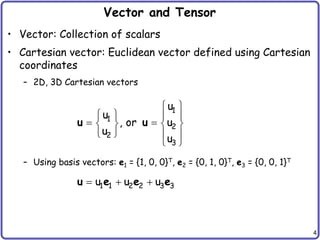
Vector and Tensor
• Vector: Collection of scalars
• Cartesian vector: Euclidean vector defined using Cartesian
coordinates
– 2D, 3D Cartesian vectors
– Using basis vectors: e1 = {1, 0, 0}T, e2 = {0, 1, 0}T, e3 = {0, 0, 1}T
 
   
 
   
   
 
1
1
2
2
3
u
u
, or u
u
u
u u
  
1 1 2 2 3 3
u u u
u e e e
5
Index Notation and Summation Rule
• Index notation: Any vector or matrix can be expressed in
terms of its indices
• Einstein summation convention
– In this case, k is a dummy variable (can be j or i)
– The same index cannot appear more than twice
• Basis representation of a vector
– Let ek be the basis of vector space V
– Then, any vector in V can be represented by



3
k k k k
k 1
a b a b

 

N
k k k k
k 1
w w
w e e
   
   
   
   
   
   
1 11 12 13
i 2 ij 21 22 23
3 31 32 33
v A A A
[v ] v [A ] A A A
v A A A
v A
6
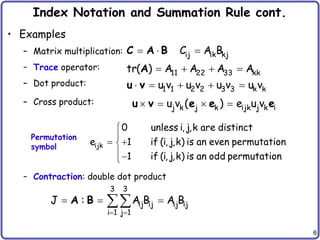
Index Notation and Summation Rule cont.
• Examples
– Matrix multiplication:
– Trace operator:
– Dot product:
– Cross product:
– Contraction: double dot product
   
j k j k ijk j k i
u v ( ) e u v
u v e e e


 



ijk
0 unless i, j,k are distinct
e 1 if (i, j,k) is an even permutation
1 if (i, j,k) is an odd permutation
 
  

3 3
ij ij ij ij
i 1 j 1
J : A B A B
A B
Permutation
symbol
  
   
    
ij ik kj
11 22 33 kk
1 1 2 2 3 3 k k
C A B
tr( ) A A A A
u v u v u v u v
C A B
A
u v
7
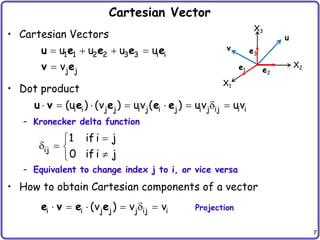
Cartesian Vector
• Cartesian Vectors
• Dot product
– Kronecker delta function
– Equivalent to change index j to i, or vice versa
• How to obtain Cartesian components of a vector
   

1 1 2 2 3 3 i i
j j
u u u u
v
u e e e e
v e
       
i i j j i j i j i j ij i i
(u ) (v ) uv ( ) uv uv
u v e e e e


  


ij
1 if i j
0 if i j
X1
X2
X3
e1 e2
e3
u
v
     
i i j j j ij i
(v ) v v
e v e e Projection
8
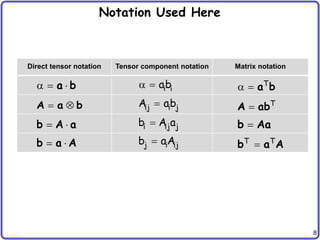
Direct tensor notation Tensor component notation Matrix notation
Notation Used Here
  
a b   i i
ab   T
a b
 
A a b 
ij i j
A ab  T
A ab
 
b A a 
i ij j
b A a 
b Aa
 
b a A 
j i ij
b aA 
T T
b a A
9
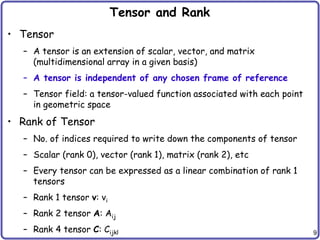
Tensor and Rank
• Tensor
– A tensor is an extension of scalar, vector, and matrix
(multidimensional array in a given basis)
– A tensor is independent of any chosen frame of reference
– Tensor field: a tensor-valued function associated with each point
in geometric space
• Rank of Tensor
– No. of indices required to write down the components of tensor
– Scalar (rank 0), vector (rank 1), matrix (rank 2), etc
– Every tensor can be expressed as a linear combination of rank 1
tensors
– Rank 1 tensor v: vi
– Rank 2 tensor A: Aij
– Rank 4 tensor C: Cijkl
10
Tensor Operations
• Basic rules for tensors
• Tensor (dyadic) product: increase rank
    
i j i j ij i j
uv A uv
A u v e e
   
   
    
( ) ( )
( ) ( )
( )( ) ( )
u v w u v w
w u v v w u
u v w x v w u x   
u v v u

  
    
 
( ) ( )
( )
( ) ( ) ( )
TS R T SR
T S R TS TR
TS T S T S
1T T1 T
Different notations
 
TS T S
Identity tensor
 ij
[ ]
1
11
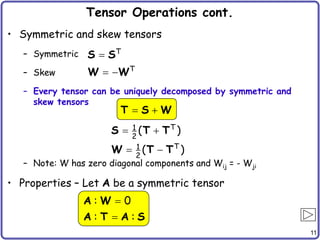
Tensor Operations cont.
• Symmetric and skew tensors
– Symmetric
– Skew
– Every tensor can be uniquely decomposed by symmetric and
skew tensors
– Note: W has zero diagonal components and Wij = - Wji
• Properties – Let A be a symmetric tensor
 
 
T
1
2
T
1
2
( )
( )
S T T
W T T

 
T
T
S S
W W
 
T S W


: 0
: :
A W
A T A S
12
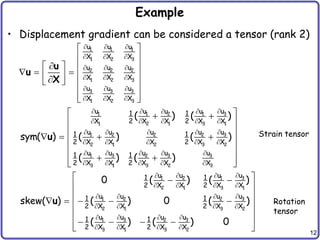
Example
• Displacement gradient can be considered a tensor (rank 2)
  
  
  
  
  
  
 
 

   
  
   

 
 
 
 
1 1 1
1 2 3
2 2 2
1 2 3
3 3 3
1 2 3
u u u
X X X
u u u
X X X
u u u
X X X
u
u
X

   
    

   
    
  
 
    
 
 
 
 
   
 
 
 
 
 
3
1 1 2 1
1 2 1 3 1
3
1 2 2 2
2 1 2 3 2
3 3 3
1 2
3 1 3 2 3
u
u u u u
1 1
X 2 X X 2 X X
u
u u u u
1 1
2 X X X 2 X X
u u u
u u
1 1
2 X X 2 X X X
( ) ( )
sym( ) ( ) ( )
( ) ( )
u

  
   

  
   
 
 
   
 
 
 
 
    
 
 
   
 
 
3
1 2 1
2 1 3 1
3
1 2 2
2 1 3 2
3 3
1 2
3 1 3 2
u
u u u
1 1
2 X X 2 X X
u
u u u
1 1
2 X X 2 X X
u u
u u
1 1
2 X X 2 X X
0 ( ) ( )
skew( ) ( ) 0 ( )
( ) ( ) 0
u
Strain tensor
Rotation
tensor
13
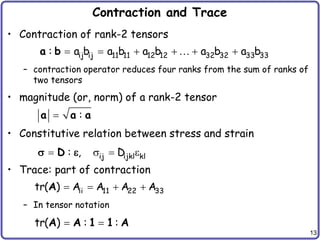
Contraction and Trace
• Contraction of rank-2 tensors
– contraction operator reduces four ranks from the sum of ranks of
two tensors
• magnitude (or, norm) of a rank-2 tensor
• Constitutive relation between stress and strain
• Trace: part of contraction
– In tensor notation
     
ij ij 11 11 12 12 32 32 33 33
: a b a b a b a b a b
a b
 :
a a a
   
  ij ijkl kl
: , D
D
   
ii 11 22 33
tr( ) A A A A
A
 
tr( ) : :
A A 1 1 A
14
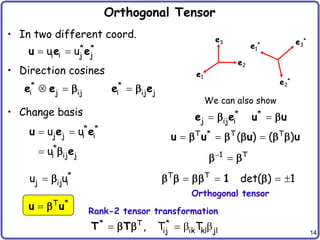
Orthogonal Tensor
• In two different coord.
• Direction cosines
• Change basis
  * *
i i j j
u u
u e e
  
*
i j ij
e e  
*
i ij j
e e
 
 
* *
j j i i
*
i ij j
u u
u
u e e
e
  *
j ij i
u u
 T *
u u
e1
*
e2
*
e3
*
e1
e2
e3
We can also show
 
 
* *
j ij i
e e u u
  
    
T * T T
( ) ( )
u u u u
   
   
T T
det( ) 1
1
Orthogonal tensor


 
1 T
   
 
* T *
ij ik kl jl
, T T
T T
Rank-2 tensor transformation
15
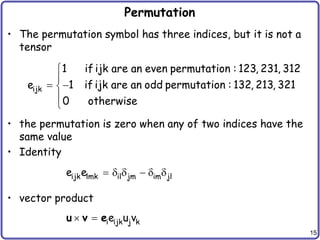
Permutation
• The permutation symbol has three indices, but it is not a
tensor
• the permutation is zero when any of two indices have the
same value
• Identity
• vector product


 



ijk
1 if ijk are an even permutation : 123, 231, 312
e 1 if ijk are an odd permutation : 132, 213, 321
0 otherwise
     
ijk lmk il jm im jl
e e
  i ijk j k
e u v
u v e
16
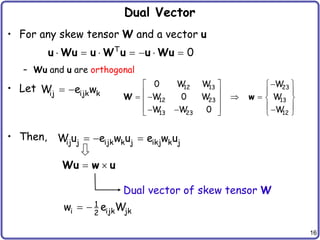
Dual Vector
• For any skew tensor W and a vector u
– Wu and u are orthogonal
• Let
• Then,
      
T
0
u Wu u W u u Wu
 
ij ijk k
W e w

   
 
 
     
 
 
 
  
   
12 13 23
12 23 13
13 23 12
0 W W W
W 0 W W
W W 0 W
W w
  
ij j ijk k j ikj k j
W u e w u e w u
 
Wu w u
Dual vector of skew tensor W
  1
i ijk jk
2
w e W
17
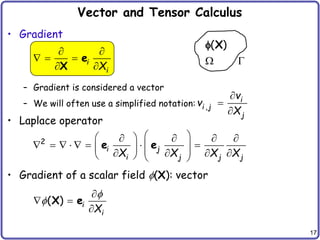
Vector and Tensor Calculus
• Gradient
– Gradient is considered a vector
– We will often use a simplified notation:
• Laplace operator
• Gradient of a scalar field f(X): vector
( )
 
X
f
i
i
X
 
  
 
e
X
,
i
i j
j
v
v
X



2
i j
i j j j
X X X X
 
 
   
       
 
   
   
   
e e
( ) i
i
X
f
f

 

X e
18
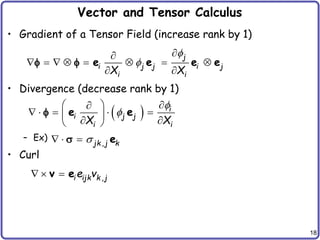
Vector and Tensor Calculus
• Gradient of a Tensor Field (increase rank by 1)
• Divergence (decrease rank by 1)
– Ex)
• Curl
j
i j j i j
i i
X X
f
f


       
 
e e e e
f f
  i
i j j
i i
X X
f
f

 

    
 
 
 
e e
f
,
jk j k

   e

,
i ijk k j
e v
  
v e
19
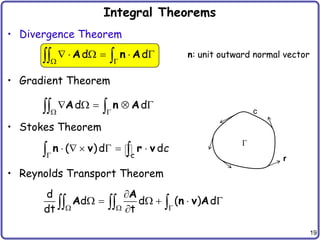
Integral Theorems
• Divergence Theorem
• Gradient Theorem
• Stokes Theorem
• Reynolds Transport Theorem
d d
 
     
 
A n A
d d
 
    
 
A n A
( )d d
c
c

     
 
n v r v

c
r
d
d d ( ) d
dt t
  

     

  
A
A n v A
n: unit outward normal vector
20
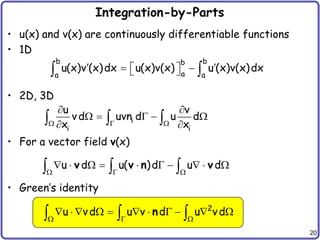
Integration-by-Parts
• u(x) and v(x) are continuously differentiable functions
• 1D
• 2D, 3D
• For a vector field v(x)
• Green’s identity
b b
b
a
a a
u(x)v (x)dx u(x)v(x) u (x)v(x)dx
 
 
 
 
 
i
i i
u v
vd uvn d u d
x x
  
 
    
 
  
u d u( )d u d
  
         
  
v v n v
2
u vd u v d u vd
  
          
  
n
21
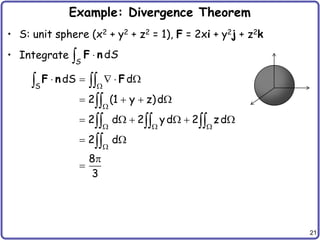
Example: Divergence Theorem
• S: unit sphere (x2 + y2 + z2 = 1), F = 2xi + y2j + z2k
• Integrate d
S
S

 F n
S
dS d
2 (1 y z)d
2 d 2 yd 2 zd
2 d
8
3


  

    
   
     
 


 

  

F n F
22
STRESS AND STRAIN
1.3
23
Surface Traction (Stress)
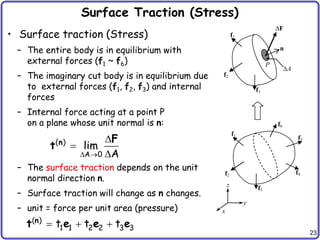
• Surface traction (Stress)
– The entire body is in equilibrium with
external forces (f1 ~ f6)
– The imaginary cut body is in equilibrium due
to external forces (f1, f2, f3) and internal
forces
– Internal force acting at a point P
on a plane whose unit normal is n:
– The surface traction depends on the unit
normal direction n.
– Surface traction will change as n changes.
– unit = force per unit area (pressure)
f1
f2
f3
f4
f6
f5
y
z
F
n
f1
f2
f3
P
A
x
( )
A 0
lim
A
 



n F
t
( )
1 1 2 2 3 3
t t t
  
n
t e e e
24
Cartesian Stress Components
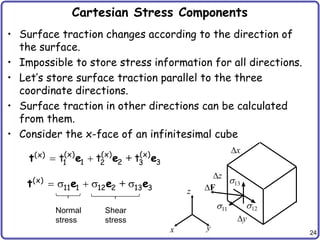
• Surface traction changes according to the direction of
the surface.
• Impossible to store stress information for all directions.
• Let’s store surface traction parallel to the three
coordinate directions.
• Surface traction in other directions can be calculated
from them.
• Consider the x-face of an infinitesimal cube
11 12
13
x y
z
x
y
z
F
(x) (x) (x)
(x)
1 2 3
1 2 3
t t t
 
t e e e
+
(x)
11 1 12 2 13 3
    
t e e e
+
Normal
stress
Shear
stress
25
Stress Tensor
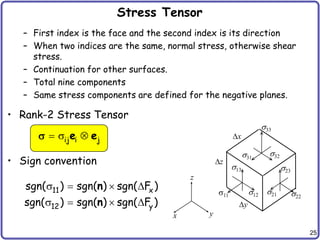
– First index is the face and the second index is its direction
– When two indices are the same, normal stress, otherwise shear
stress.
– Continuation for other surfaces.
– Total nine components
– Same stress components are defined for the negative planes.
• Rank-2 Stress Tensor
• Sign convention
11 22
33
12
13
21
23
31
32
x y
z
x
y
z
ij i j
  
e e

11 x
12 y
sgn( ) sgn( ) sgn( F )
   
   
n
n
26
Symmetry of Stress Tensor
– Stress tensor should be symmetric
9 components 6 components
– Equilibrium of the angular moment
– Similarly for all three directions:
– Let’s use vector notation:
12
21
x
y
12
21
O
l
l
A B
C D
12 21
12 21
M l( ) 0
     
   

11 12 13
ij 12 22 23
13 23 33
[ ]
  
 
 
    
 
 
  
 
11
22
33
12
23
13
{ }

 
 

 
 

  

 
 

 

 

12 21 23 32 13 31
, ,
        
Cartesian components
of stress tensor
27
Stress in Arbitrary Plane
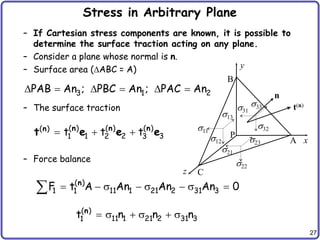
– If Cartesian stress components are known, it is possible to
determine the surface traction acting on any plane.
– Consider a plane whose normal is n.
– Surface area (ABC = A)
– The surface traction
– Force balance
3 1 2
PAB An ; PBC An ; PAC An
     
x
y
z
B
A
C
33
31
32
22
23
21
11
13
12
t(n)
n
P
( ) ( ) ( )
( )
1 2 3
1 2 3
t t t
  
n n n
n
t e e e
( )
1 11 1 21 2 31 3
1
F t A An An An 0
       
 n
( )
11 1 21 2 31 3
1
t n n n
     
n
28
Cauchy’s Lemma
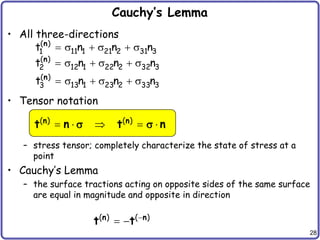
• All three-directions
• Tensor notation
– stress tensor; completely characterize the state of stress at a
point
• Cauchy’s Lemma
– the surface tractions acting on opposite sides of the same surface
are equal in magnitude and opposite in direction
( )
12 1 22 2 32 3
2
( )
13 1 23 2 33 3
3
t n n n
t n n n
     
     
n
n
( )
11 1 21 2 31 3
1
t n n n
     
n
( ) ( )
    
n n
t n t n
 

 
( ) ( )
n n
t t
29
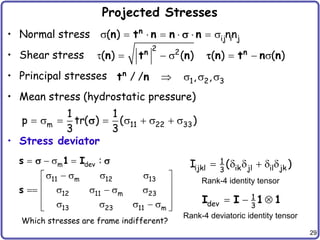
Projected Stresses
• Normal stress
• Shear stress
• Principal stresses
• Mean stress (hydrostatic pressure)
• Stress deviator
ij i j
( ) nn
       
n
n t n n n

2 2
( ) ( ) ( ) ( )
      
n n
n t n n t n n

1 2 3
/ / , ,
   
n
t n
m dev
11 m 12 13
12 11 m 23
13 23 11 m
:
   
    
 
 
     
 
 
    
 
s 1 I
s
 
Which stresses are frame indifferent?
m 11 22 33
1 1
p tr( ) ( )
3 3
        

1
dev 3
  
I I 1 1
1
ijkl ik jl il jk
3
I ( )
     
Rank-4 identity tensor
Rank-4 deviatoric identity tensor
30
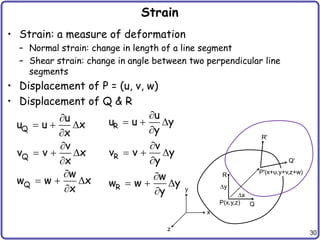
Strain
• Strain: a measure of deformation
– Normal strain: change in length of a line segment
– Shear strain: change in angle between two perpendicular line
segments
• Displacement of P = (u, v, w)
• Displacement of Q & R
P(x,y,z) Q
R P'(x+u,y+v,z+w)
Q'
R'
x
y
z
x
y
Q
Q
Q
u
u u x
x
v
v v x
x
w
w w x
x

  


  


  

R
R
R
u
u u y
y
v
v v y
y
w
w w y
y

  


  


  

31
Strain
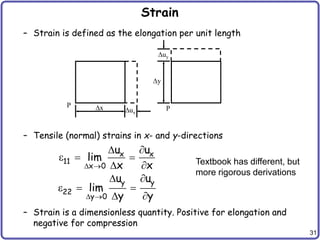
– Strain is defined as the elongation per unit length
– Tensile (normal) strains in x- and y-directions
– Strain is a dimensionless quantity. Positive for elongation and
negative for compression
P P
x ux
y
uy
x x
11
x 0
y y
22
y 0
u u
lim
x x
u u
lim
y y
 
 
 
  
 
 
  
 
Textbook has different, but
more rigorous derivations
32
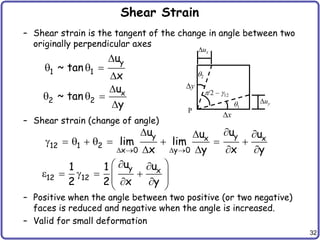
Shear Strain
– Shear strain is the tangent of the change in angle between two
originally perpendicular axes
– Shear strain (change of angle)
– Positive when the angle between two positive (or two negative)
faces is reduced and negative when the angle is increased.
– Valid for small deformation
P
ux
uy
q2
q1
/2 – g12
y
1 1
x
2 2
u
~ tan
x
u
~ tan
y

q q 


q q 

y y
x x
12 1 2
x 0 y 0
u u
u u
lim lim
x y x y
   
 
 
g  q  q    
   
y x
12 12
u u
1 1
2 2 x y

 

  g  
 
 
 
 
x
y
33
Strain Tensor
• Strain Tensor
• Cartesian Components
• Vector notation
ij i j
  
e e

11 12 13
ij 12 22 23
13 23 33
[ ]
  
 
 
   
 
 
  
 

11 11
22 22
33 33
12 12
23 23
13 13
{ }
2
2
2
 
   
   
 
   
   
 
 
   
 g
   
   
 g
   
 g
   

34
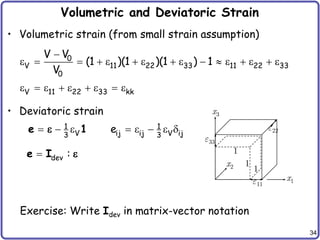
Volumetric and Deviatoric Strain
• Volumetric strain (from small strain assumption)
• Deviatoric strain
0
V 11 22 33 11 22 33
0
V V
(1 )(1 )(1 ) 1
V

               
V 11 22 33 kk
        
1 1
V ij ij V ij
3 3
e
       
e 1

dev :

e I 
x2
x3
x1
1
e11
e22
e33
1
1
Exercise: Write Idev in matrix-vector notation
35
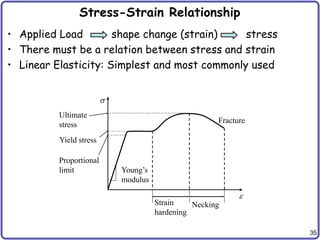
Stress-Strain Relationship
• Applied Load shape change (strain) stress
• There must be a relation between stress and strain
• Linear Elasticity: Simplest and most commonly used
Proportional
limit
Yield stress
Ultimate
stress
Strain
hardening
Necking
Fracture


Young’s
modulus
36
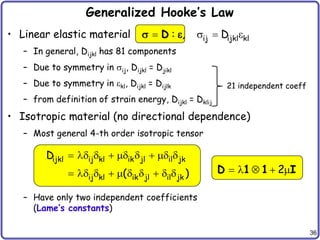
Generalized Hooke’s Law
• Linear elastic material
– In general, Dijkl has 81 components
– Due to symmetry in ij, Dijkl = Djikl
– Due to symmetry in kl, Dijkl = Dijlk
– from definition of strain energy, Dijkl = Dklij
• Isotropic material (no directional dependence)
– Most general 4-th order isotropic tensor
– Have only two independent coefficients
(Lame’s constants)
21 independent coeff
ijkl ij kl ik jl il jk
ij kl ik jl il jk
D
( )
        
         
ij ijkl kl
: , D
   
D
 
2
    
D 1 1 I
37
Generalized Hooke’s Law cont.
• Stress-strain relation
– Volumetric strain:
– Off-diagonal part:
– Bulk modulus K: relation b/w volumetric stress & strain
– Substitute so that we can separate volumetric part
• Total deform. = volumetric + deviatoric deform.
ij ijkl kl ij kl ik jl il jk kl kk ij ij
D [ ( )] 2
                  
kk 11 22 33 v
        
12 12 12
2
    g  is the shear modulus
1 m jj kk jj jj kk
I 3 2 (3 2 )
             
2
m kk v
3
( ) K
       
Bulk modulus
2
3
K
   
38
Generalized Hooke’s Law cont.
• Stress-strain relation cont.
2
ij kk ij ij
3
2
kk ij ij kk ij
3
1
ij kl kl ik jl ij kl kl
3
ij kl dev ijkl kl
(K ) 2
K 2
K 2 [ ]
K 2 (I )
       
       
           
 
     
 
dev
σ K 2 : ε
    
 
 
1 1 I
Deviatoric part
Volumetric part
v
m
σ K 2
σ
    
  
1 e
1 s
dev :

e I 
Deviatoric strain
Important for plasticity; plastic deformation only occurs in deviatoric part
volumetric part is always elastic
dev :

s I 
Deviatoric stress
39
Generalized Hooke’s Law cont.
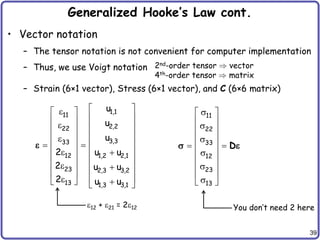
• Vector notation
– The tensor notation is not convenient for computer implementation
– Thus, we use Voigt notation
– Strain (6×1 vector), Stress (6×1 vector), and C (6×6 matrix)
2nd-order tensor vector
4th-order tensor matrix
1,1
11
2,2
22
3,3
33
12 1,2 2,1
23 2,3 3,2
13 1,3 3,1
u
u
u
2 u u
2 u u
2 u u
 

 
 
 
  
 
 
 

 
 
 
 
 
 
 
 
 
 
 
  
  
 

11
22
33
12
23
13

 
 

 
 

 
 

 
 

 

 
D
 
12 + 21 = 212 You don’t need 2 here
40
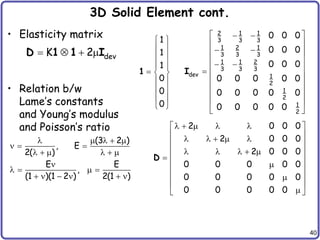
3D Solid Element cont.
• Elasticity matrix
• Relation b/w
Lame’s constants
and Young’s modulus
and Poisson’s ratio
(3 2 )
, E
2( )
E E
,
(1 )(1 2 ) 2(1 )
    
  
     

   
     
dev
K 2
   
D 1 1 I
2 0 0 0
2 0 0 0
2 0 0 0
0 0 0 0 0
0 0 0 0 0
0 0 0 0 0
    
 
 
    
 
 
    
  

 
 

 

 
D
1
1
1
0
0
0
 
 
 
 
  
 
 
 
 
1
2 1 1
3 3 3
1 2 1
3 3 3
1 1 2
3 3 3
dev 1
2
1
2
1
2
0 0 0
0 0 0
0 0 0
0 0 0 0 0
0 0 0 0 0
0 0 0 0 0
 
 
 
 
 
 
 
 

 
 
 
 
 
I
41
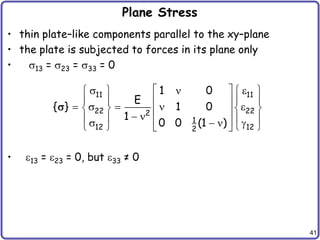
Plane Stress
• thin plate–like components parallel to the xy–plane
• the plate is subjected to forces in its plane only
• 13 = 23 = 33 = 0
• 13 = 23 = 0, but 33 ≠ 0
11 11
22 22
2
1
12 12
2
1 0
E
{ } 1 0
1
0 0 (1 )
 
  
   
   
 
    
   
 
 
   
 
   g
   
 

42
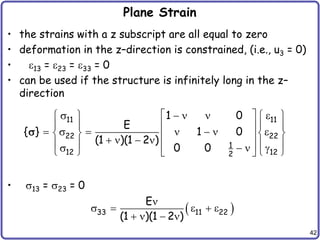
Plane Strain
• the strains with a z subscript are all equal to zero
• deformation in the z–direction is constrained, (i.e., u3 = 0)
• 13 = 23 = 33 = 0
• can be used if the structure is infinitely long in the z–
direction
• 13 = 23 = 0
11 11
22 22
1
12 12
2
1 0
E
{ } 1 0
(1 )(1 2 )
0 0
 
    
   
   
 
      
   
 
   
   
 
   g
   
 

 
33 11 22
E
(1 )(1 2 )

    
   
43
MECHANICS OF
CONTINUOUS BODIES
1.4
44
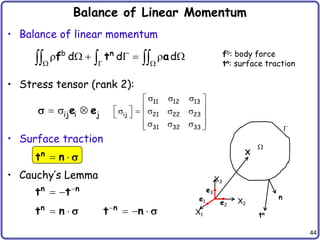
Balance of Linear Momentum
• Balance of linear momentum
• Stress tensor (rank 2):
• Surface traction
• Cauchy’s Lemma
b
d d d
  
      
  
n
f t a
ij i j
  
e e

11 12 13
ij 21 22 23
31 32 33
  
 
 
 
    
   
 
  
 
 
n
t n 

 
n n
t t

    
n n
t n t n
 


n
tn
X1
X2
X3
e1 e2
e3
X
fb: body force
tn: surface traction
45
Balance of Linear Momentum cont
• Balance of linear momentum
– For a static problem
• Balance of angular momentum
b
( )d d d
  
           
  
f a n  
b
[ ( )]d 0

      
 f a

b
( ) 0
     
f a

b b
ij,i j
0 f 0
        
f

b
d d d
  
         
  
n
x f x t x a
T
ij ji
   
 
Divergence Thm
46
Boundary-Valued Problem
• We want to determine the state of a body in equilibrium
• The equilibrium state (solution) of the body must satisfy
– local momentum balance equation
– boundary conditions
• Strong form of BVP
– Given body force fb, and traction t
on the boundary, find u such that
and
• Solution space
h
s
on essential BC
on natural BC
 
  
u 0
t n 
b
0
    
f
 (1)
(2)
(3)


n
t
X1
X2
X3
e1 e2
e3
X
fb
 
2 3 h s
A
D [C ( )] | 0 on , on
         
u u x n t x

47
Boundary-Valued Problem cont.
• How to solve BVP
– To solve the strong form, we want to construct trial solutions that
automatically satisfy a part of BVP and find the solution that
satisfy remaining conditions.
– Statically admissible stress field: satisfy (1) and (3)
– Kinematically admissible displacement field: satisfy (2) and have
piecewise continuous first partial derivative
– Admissible stress field is difficult to construct. Thus, admissible
displacement field is used often
48
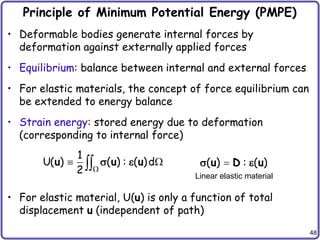
Principle of Minimum Potential Energy (PMPE)
• Deformable bodies generate internal forces by
deformation against externally applied forces
• Equilibrium: balance between internal and external forces
• For elastic materials, the concept of force equilibrium can
be extended to energy balance
• Strain energy: stored energy due to deformation
(corresponding to internal force)
• For elastic material, U(u) is only a function of total
displacement u (independent of path)
1
U( ) ( ) : ( )d
2 
 

u u u
  ( ) : ( )

u D u
 
Linear elastic material
49
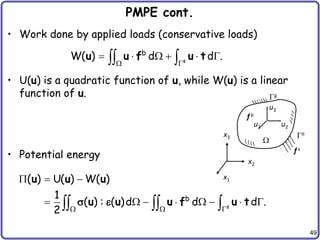
PMPE cont.
• Work done by applied loads (conservative loads)
• U(u) is a quadratic function of u, while W(u) is a linear
function of u.
• Potential energy
s
b
W( ) d d .
 
     
 
u u f u t
h
g

u1 u2
u3
x1
x2
x3
f s
f b
s
b
( ) U( ) W( )
1
( ) : ( )d d d .
2   
  
       
  
u u u
u u u f u t
 
50
PMPE cont.
• PMPE: for all displacements that satisfy the boundary
conditions, known as kinematically admissible
displacements, those which satisfy the boundary-valued
problem make the total potential energy stationary on DA
• But, the potential energy is well defined in the space of
kinematically admissible displacements
• No need to satisfy traction BC (it is a part of potential)
• Less requirement on continuity
• The solution is called a generalized (natural) solution
 
1 3 h
[H ( )] | 0 on ,
     
u u x
Z
H1: first-order derivatives are integrable
51
Example – Uniaxial Bar
• Strong form
• Integrate twice:
• Apply two BCs:
• PMPE with assumed solution u(x) = c1x + c2
• To satisfy KAD space, u(0) = 0,  u(x) = c1x
• Potential energy:
L
F
x
EAu 0 x [0,L]
u 0 x 0
EAu (L) F x L
  
 
  
1 2
EAu(x) c x c
 
Fx
u(x)
EA

L 2 2
1
0
1
1
U EA(u ) dx EALc
2
W Fu(L) FLc

 
 

1
1 1
d d
(U W) EALc FL 0
dc dc

     1
F Fx
c u(x)
EA EA
  
52
Virtual Displacement Field
• Virtual displacement (Space Z)
– Small arbitrary perturbation (variation) of real displacement
– Let ū be the virtual displacement, then u + ū must be kinematically
admissible, too
– Then, ū must satisfy homogeneous displacement BC
– Space Z only includes homogeneous
essential BCs
• Property of variation
    
u u u u
V Z
 
h
1 3
[H ( )] , 0

   
u u u
Z
In the literature, u is often used instead of ū
d d( )
dx dx

 
 
 
 
u u
0
0
1 d
lim [( ) ( )] ( ) .
d


         
 
u u u u u
  
53
PMPE As a Variation
• Necessary condition for minimum PE
– Stationary condition <--> first variation = 0
• Variation of strain energy
0
0
1 d
( ; ) lim [ ( ) ( )] ( ) 0
d


           
 
u u u u u u u
 Z
for all u
0
d
d 
    
   
  
   
   
   
u u u u
x x x
( ) ( )
  
u u
   :
  D
 
1
2
U( ; ) ( ) : : ( ) ( ) : : ( ) d
( ) : : ( )d
a( , )


   
 
 
 



u u u D u u D u
u D u
u u
   
 
Energy bilinear form
54
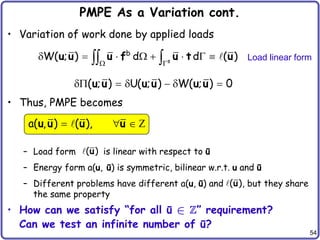
PMPE As a Variation cont.
• Variation of work done by applied loads
• Thus, PMPE becomes
– Load form is linear with respect to ū
– Energy form a(u, ū) is symmetric, bilinear w.r.t. u and ū
– Different problems have different a(u, ū) and , but they share
the same property
• How can we satisfy “for all ū ” requirement?
Can we test an infinite number of ū?
s
b
W( ; ) d d ( )
 
       
 
u u u f u t u
a( , ) ( ),
  
u u u u Z
( )
u
( )
u
( ; ) U( ; ) W( ; ) 0
     
u u u u u u
Load linear form
55
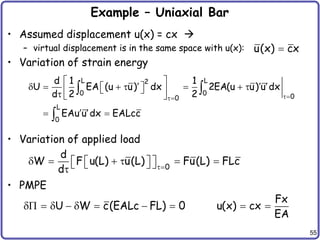
Example – Uniaxial Bar
• Assumed displacement u(x) = cx 
– virtual displacement is in the same space with u(x):
• Variation of strain energy
• Variation of applied load
• PMPE
u(x) cx

L L
2
0 0 0
0
L
0
d 1 1
U EA (u u) dx 2EA(u u) u dx
d 2 2
EAu u dx EALcc


 
  
      
 
 
 
  
 
 
 

0
d
W F u(L) u(L) Fu(L) FLc
d 
     
   
   

U W c(EALc FL) 0
       
Fx
u(x) cx
EA
 
56
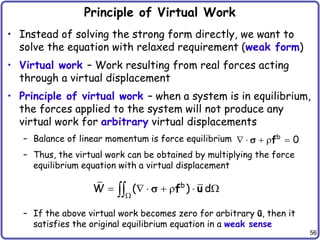
Principle of Virtual Work
• Instead of solving the strong form directly, we want to
solve the equation with relaxed requirement (weak form)
• Virtual work – Work resulting from real forces acting
through a virtual displacement
• Principle of virtual work – when a system is in equilibrium,
the forces applied to the system will not produce any
virtual work for arbitrary virtual displacements
– Balance of linear momentum is force equilibrium
– Thus, the virtual work can be obtained by multiplying the force
equilibrium equation with a virtual displacement
– If the above virtual work becomes zero for arbitrary ū, then it
satisfies the original equilibrium equation in a weak sense
b
0
    
f

b
W ( ) d

      
 f u

57
Principle of Virtual Work cont
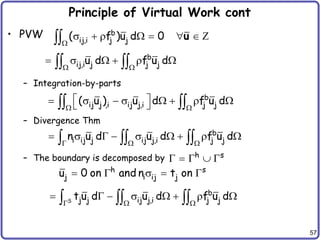
• PVW
– Integration-by-parts
– Divergence Thm
– The boundary is decomposed by
b
ij,i j j
( f )u d 0

      
 u Z
b
ij,i j j j
u d f u d
 
     
 
b
ij j ,i ij j,i j j
( u ) u d f u d
 
 
       
 
 
b
i ij j ij j,i j j
n u d u d f u d
  
        
  
h s
j i ij j
u 0 on and n t on
    
h s
    
S
b
j j ij j,i j j
t u d u d f u d
  
       
  
58
Principle of Virtual Work cont
• Since ij is symmetric
• Weak Form of BVP
Internal virtual work = external virtual work
Starting point of FEM
• Symbolic expression
– Energy form:
– Load form:
s
b
ij ij j j j j
d f u d t u d
  
         
   u Z
a( , ) ( )
  
u u u u Z
a( , ) : d

 

u u  
s
b
( ) d d
 
      
 
u u f u t
ij j,i ij j,i ij ij
u sym(u )
     
j
i
i,j ij
j i
u
u
1
sym(u )
2 X X

 

   
 
 
 
 
[ ]{ } { }

K d F
FE equation
59
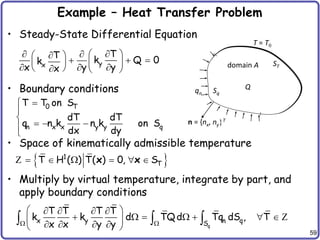
Example – Heat Transfer Problem
• Steady-State Differential Equation
• Boundary conditions
• Space of kinematically admissible temperature
• Multiply by virtual temperature, integrate by part, and
apply boundary conditions
Q
domain A
Sq
ST
qn
T = T0
n = {nx, ny}T
y
x
T
T k Q 0
k
y
x y
x

   

    
   

 
 
  
0 T
n x x y y q
T T on S
dT dT
q n k n k on S
dx dy




  


 
1
T
T H ( ) T( ) 0, S
     
x x
Z
q
x y n q
S
T T T T
k k d TQd Tq dS , T
x x y y
 
 
   
      
 
   
 
   Z
60
Example – Beam Problem
• Governing DE
• Boundary conditions for cantilevered beam
• Space of kinematically admissible displacement
• Integrate-by-part twice, and apply BCs
4
4
d v
EI f(x), x [0,L]
dx
 
2 3
2 3
dv d v d v
v(0) (0) (L) (L) 0
dx dx dx
   
f(x)
x L
2 dv
v H [0,L] v(0) (0) 0
dx
 
   
 
 
Z
2 2
L L
2 2
0 0
d v d v
EI dx fv dx, v
dx dx
  
  Z
61
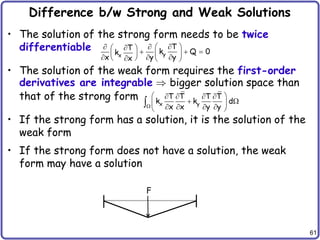
Difference b/w Strong and Weak Solutions
• The solution of the strong form needs to be twice
differentiable
• The solution of the weak form requires the first-order
derivatives are integrable bigger solution space than
that of the strong form
• If the strong form has a solution, it is the solution of the
weak form
• If the strong form does not have a solution, the weak
form may have a solution
F
y
x
T
T k Q 0
k
y
x y
x

   

    
   

 
 
  
x y
T T T T
k k d
x x y y

 
   
 
 
   
 

62
FINITE ELEMENT METHOD
1.5
63
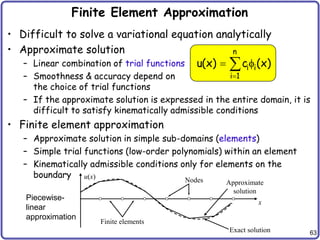
Finite Element Approximation
• Difficult to solve a variational equation analytically
• Approximate solution
– Linear combination of trial functions
– Smoothness & accuracy depend on
the choice of trial functions
– If the approximate solution is expressed in the entire domain, it is
difficult to satisfy kinematically admissible conditions
• Finite element approximation
– Approximate solution in simple sub-domains (elements)
– Simple trial functions (low-order polynomials) within an element
– Kinematically admissible conditions only for elements on the
boundary
n
i i
i 1
u(x) c (x)

 f

Exact solution
Approximate
solution
x
u(x)
Finite elements
Nodes
Piecewise-
linear
approximation
64
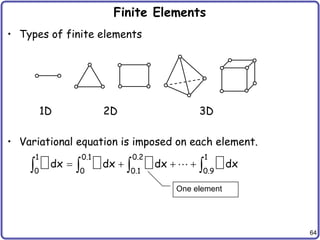
Finite Elements
• Types of finite elements
1D 2D 3D
• Variational equation is imposed on each element.
One element
1 0.1 0.2 1
0 0 0.1 0.9
dx dx dx dx
   
   
65
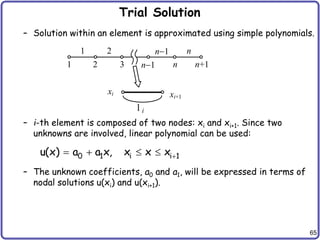
Trial Solution
– Solution within an element is approximated using simple polynomials.
– i-th element is composed of two nodes: xi and xi+1. Since two
unknowns are involved, linear polynomial can be used:
– The unknown coefficients, a0 and a1, will be expressed in terms of
nodal solutions u(xi) and u(xi+1).
1 2 3 n1 n+1
n
1 2 n1 n
xi xi+1
i
l
0 1 i i 1
u(x) a a x, x x x
   
66
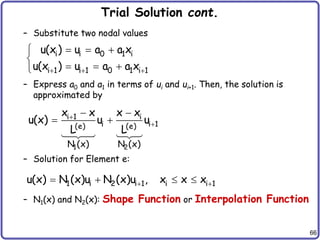
Trial Solution cont.
– Substitute two nodal values
– Express a0 and a1 in terms of ui and ui+1. Then, the solution is
approximated by
– Solution for Element e:
– N1(x) and N2(x): Shape Function or Interpolation Function
i i 0 1 i
i 1 i 1 0 1 i 1
u(x ) u a a x
u(x ) u a a x
  
  


  

1 2
i 1 i
i i 1
(e) (e)
N (x) N (x)
x x x x
u(x) u u
L L


 
 
1 i 2 i 1 i i 1
u(x) N (x)u N (x)u , x x x
 
   
67
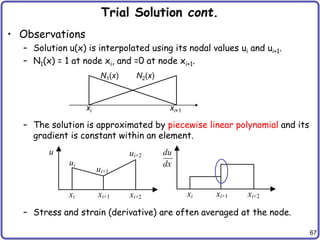
Trial Solution cont.
• Observations
– Solution u(x) is interpolated using its nodal values ui and ui+1.
– N1(x) = 1 at node xi, and =0 at node xi+1.
– The solution is approximated by piecewise linear polynomial and its
gradient is constant within an element.
– Stress and strain (derivative) are often averaged at the node.
N1(x) N2(x)
xi xi+1
xi xi+1 xi+2 xi xi+1 xi+2
ui
ui+1
ui+2 du
dx
u
68
1D Finite Elements
• 1D BVP
• Use PVW
• Integration-by-parts
– This variational equation also satisfies at individual element level
2
2
d u
p(x) 0, 0 x 1s
dx
u(0) 0
Boundary conditions
du
(1) 0
dx
   
 


 

2
1
2
0
d u
p u dx 0
dx
 
 
 
 
  
(1)
u H [0,1] u(0) 0
  
Z
Space of kinematically
admissible displacements
1
1 1
0 0
0
du du du
u dx pu dx
dx dx dx
  
 
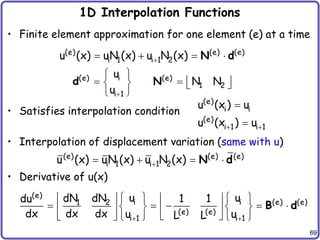
69
1D Interpolation Functions
• Finite element approximation for one element (e) at a time
• Satisfies interpolation condition
• Interpolation of displacement variation (same with u)
• Derivative of u(x)
(e) (e) (e)
i 1 i 1 2
u (x) uN (x) u N (x)

   
N d
i
(e) (e)
1 2
i 1
u
N N
u
 
   
   
 
d N
(e)
i i
(e)
i 1 i 1
u (x ) u
u (x ) u
 


(e) (e) (e)
i 1 i 1 2
u (x) uN (x) u N (x)

   
N d
(e)
i i (e) (e)
1 2
(e) (e)
i 1 i 1
u u
dN dN
du 1 1
dx dx dx u u
L L
 
   
   
    
   
   
 
     
B d
70
Element-Level Variational Equation
• Approximate variational equation for element (e)
– Must satisfied for all
– If element (e) is not on the boundary, can be arbitrary
• Element-level variational equation
j j
i i
i
x x
(e)T (e)T (e) (e) (e)T (e)T (e)T
x x
i 1
du
(x )
dx
dx p(x)dx
du
(x )
dx 
 

 
     
 
   

 
 
d B B d d N d
(e)
u (x)  Z
(e)
d
j j
i i
i
x x
(e)T (e) (e) (e)T
x x
i 1
du
(x )
dx
dx p(x)dx
du
(x )
dx 
 

 
     
 
   

 
 
B B d N
 
i
(e) (e) (e)
i 1
du
(x )
dx
[ ]{ }
du
(x )
dx 
 

 
   
 

 
k d f
2x2 matrix 2x1 vector
71
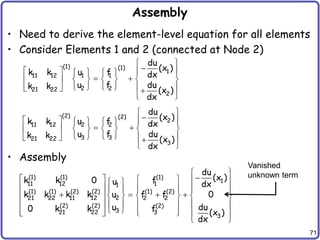
Assembly
• Need to derive the element-level equation for all elements
• Consider Elements 1 and 2 (connected at Node 2)
• Assembly
(1) (1)
1
11 12 1 1
2 2
21 22
2
du
(x )
k k u f dx
u f du
k k (x )
dx
 

 
     
 
     
 
   
   

 
(2) (2)
2
2 2
11 12
3 3
21 22
3
du
(x )
u f
k k dx
u f du
k k (x )
dx
 

 
     
 
     
 
   
   

 
(1) (1) (1)
1
11 12 1
1
(1) (1) (2) (2) (1) (2)
2
21 22 11 12 2 2
(2) (2) (2)
3
21 22 3
3
du
(x )
k k 0 f
u dx
k k k k u f f 0
u du
0 k k f (x )
dx
 

     
 
     
   
   
       
       
 
     
   
 
Vanished
unknown term
72
Assembly cont.
• Assembly of NE elements (ND = NE + 1)
• Coefficient matrix [K] is singular; it will become non-
singular after applying boundary conditions
 
 
   
E E
E
D
D
D D
(1) (1) (1)
11 12 1
1
(1) (1) (2) (2) (1) (2)
21 22 11 12 2 2
2
(2) (2) (2) (2) (3)
3
221 22 11 3 3
N (N )
(N )
N N
21 22 N 1 N 1
N N
k k 0 0 f
u
k k k k 0 f f
u
u
0 k k k 0 f f
u f
0 0 0 k k
 

 

 
   
 
   
 
 
   
   
   
 
   
     
     
     
   
 
 
 
D
1
N
N 1
du
(x )
dx
0
0
du
(x )
dx

 
 
 
 
 
 
 
 
 

 
 
[ ]{ } { }

K q F
73
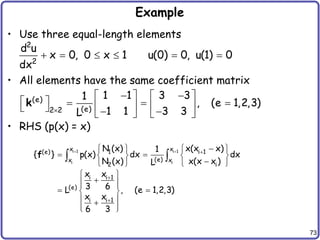
Example
• Use three equal-length elements
• All elements have the same coefficient matrix
• RHS (p(x) = x)
2
2
d u
x 0, 0 x 1 u(0) 0, u(1) 0
dx
     
(e)
(e)
2 2
1 1 3 3
1
, (e 1,2,3)
1 1 3 3
L

 
   
    
   
   
   
k
i 1 i 1
i i
x x
1 i 1
(e)
(e)
x x
2 i
i i 1
(e)
i i 1
N (x) x(x x)
1
{ } p(x) dx dx
N (x) x(x x )
L
x x
3 6
L , (e 1,2,3)
x x
6 3
  



   
 
   

   
 

 
 
 
 
 

 
 
 
f
74
Example cont.
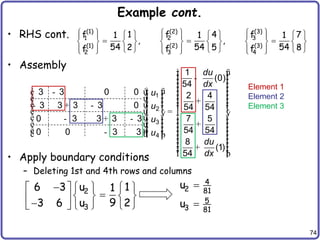
• RHS cont.
• Assembly
• Apply boundary conditions
– Deleting 1st and 4th rows and columns
(3)
(2)
(1)
3
2
1
(3)
(2)
(1)
3
2 4
f
f
f 1 4 7
1 1 1
, ,
54 54 54
2 5 8
f
f
f
 
 
       
     
  
           
     
     
     
1
2
3
4
1
(0)
54
3 3 0 0 2 4
3 3 3 3 0 54 54
0 3 3 3 3 7 5
54 54
0 0 3 3
8
(1)
54
du
dx
u
u
u
u
du
dx
ì ü
ï ï
ï ï
-
ï ï
ï ï
ï ï
ì ü
é ù
- ï ï ï ï
ï ï ï ï
ê ú
ï ï +
ï ï
ï ï
ê ú
- + - ï ï
ï ï ï ï
ê ú =
í ý í ý
ê ú
ï ï ï ï
- + - ï ï ï ï
ê ú +
ï ï ï ï
ï ï ï ï
ê ú
- ï ï ï ï
ë û
î þ ï ï
ï ï
ï ï
+
ï ï
ï ï
î þ
Element 1
Element 2
Element 3
2
3
u
6 3 1
1
9
u
3 6 2
  
   

   
 

   
 
4
2 81
5
3 81
u
u


75
EXAMPLE cont.
• Approximate solution
• Exact solution
– Three element solutions are poor
– Need more elements
4 1
x, 0 x
27 3
4 1 1 1 2
u(x) x , x
81 27 3 3 3
5 5 2 2
x , x 1
81 27 3 3

 


 

    
  
 

  
   
  
   0
0.02
0.04
0.06
0.08
0 0.2 0.4 0.6 0.8 1
x
u(x)
u-approx.
u-exact
 
2
1
u(x) x 1 x
6
 
76
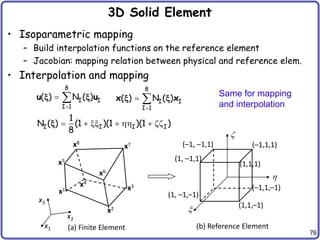
3D Solid Element
• Isoparametric mapping
– Build interpolation functions on the reference element
– Jacobian: mapping relation between physical and reference elem.
• Interpolation and mapping
(a) Finite Element (b) Reference Element
x

z
(1,1,–1)
(1,1,1)
(–1,1,1)
(–1,1,–1)
x1
x2
x3
x4
x5
x6
x7
x8
x2
x1
x3
(1, –1,–1)
(1, –1,1)
(–1, –1,1)
8
I I
I 1
( ) N ( )

 
u u
x x
8
I I
I 1
( ) N ( )

 
x x
x x
I I I I
1
N ( ) (1 )(1 )(1 )
8
  xx    zz
x
Same for mapping
and interpolation
77
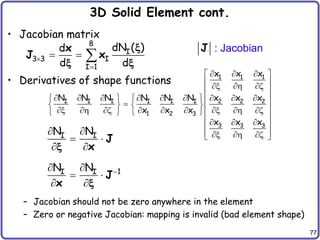
3D Solid Element cont.
• Jacobian matrix
• Derivatives of shape functions
– Jacobian should not be zero anywhere in the element
– Zero or negative Jacobian: mapping is invalid (bad element shape)
8
I
3 3 I
I 1
dN ( )
d
d d


  
x
J x
x
x x
1 1 1
I I I I I I 2 2 2
1 2 3
3 3 3
x x x
N N N N N N x x x
x x x
x x x
  
 
 
x  z
 
        
    

    
x  z    x  z
    
  
 
 
x  z
 
I I
N N
 
 
 
J
x
x
1
I I
N N 
 
 
 
J
x x
J : Jacobian
78
3D Solid Element cont.
• Displacement-strain relation
8
I I
I 1
( )

 
u B u

I,1
I,2
I,3
I
I,2 I,1
I,3 I,2
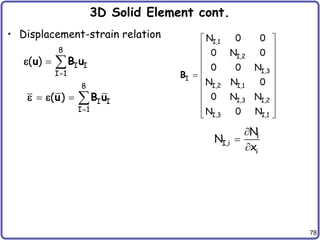
I,3 I,1
N 0 0
0 N 0
0 0 N
N N 0
0 N N
N 0 N
 
 
 
 
 

 
 
 
 
 
B
8
I I
I 1
( )

  
u B u
 
i
I,i
i
N
N
x



79
3D Solid Element cont.
• Transformation of integration domain
• Energy form
• Load form
• Discrete variational equation
1 1 1
1 1 1
d d d d
   
  x  z
    J
8 8
1 1 1
T T T
I I J J
1 1 1
I 1 J 1
a( , ) d d d { } [ ]{ }
  
 
 
 x  z 
 
 
   
u u u B DB J u d k d
8
1 1 1
T b T
I I
1 1 1
I 1
( ) N ( ) d d d { } { }
  

 x  z 
   
u u f J d f
x
T T
h
{ } [ ]{ } { } { }, { }
  
d k d d f d Z
80
Numerical Integration
• For bar and beam, analytical integration is possible
• For plate and solid, analytical integration is difficult, if
not impossible
• Gauss quadrature is most popular in FEM due to simplicity
and accuracy
• 1D Gauss quadrature
– NG: No. of integ. points; xi: integ. point; wi: integ. weight
– xi and wi are chosen so that the integration is exact
for (2NG – 1)-order polynomial
– Works well for smooth function
– Integration domain is [-1, 1]
NG
1
i i
1
i 1
f( )d f( )


x x  w x


81
Numerical Integration cont.
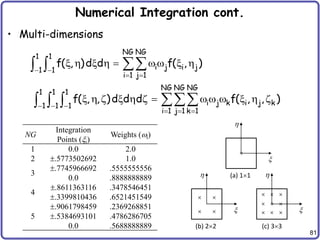
• Multi-dimensions
NG NG
1 1
i j i j
1 1
i 1 j 1
f( , )d d f( , )
 
 
x  x   ww x 

 
NG NG NG
1 1 1
i j k i j k
1 1 1
i 1 j 1 k 1
f( , , )d d d f( , , )
  
  
x  z x  z  ww w x  z

  
NG
Integration
Points (xi)
Weights (wi)
1 0.0 2.0
2 .5773502692 1.0
3
.7745966692
0.0
.5555555556
.8888888889
4
.8611363116
.3399810436
.3478546451
.6521451549
5
.9061798459
.5384693101
0.0
.2369268851
.4786286705
.5688888889
x

x

x

(a) 11
(b) 22 (c) 33
82

Chap-1 Preliminary Concepts and Linear Finite Elements.pptx

  • 1.
    1 Prof. Samirsinh Parmar Asst.Professor, Dept. of Civil Engg. Dharmasinh Desai University, Nadiad, Gujarat, INDIA Mail: samirddu@gmail.com CHAPTER- 1
  • 2.
    2 Table of Contents 1.1.INTRODUCTION 1.2. VECTOR AND TENSOR CALCULUS 1.3. STRESS AND STRAIN 1.4. MECHANICS OF CONTINUOUS BODIES 1.5. FINITE ELEMENT METHODS
  • 3.
  • 4.
    4 Vector and Tensor •Vector: Collection of scalars • Cartesian vector: Euclidean vector defined using Cartesian coordinates – 2D, 3D Cartesian vectors – Using basis vectors: e1 = {1, 0, 0}T, e2 = {0, 1, 0}T, e3 = {0, 0, 1}T                   1 1 2 2 3 u u , or u u u u u    1 1 2 2 3 3 u u u u e e e
  • 5.
    5 Index Notation andSummation Rule • Index notation: Any vector or matrix can be expressed in terms of its indices • Einstein summation convention – In this case, k is a dummy variable (can be j or i) – The same index cannot appear more than twice • Basis representation of a vector – Let ek be the basis of vector space V – Then, any vector in V can be represented by    3 k k k k k 1 a b a b     N k k k k k 1 w w w e e                         1 11 12 13 i 2 ij 21 22 23 3 31 32 33 v A A A [v ] v [A ] A A A v A A A v A
  • 6.
    6 Index Notation andSummation Rule cont. • Examples – Matrix multiplication: – Trace operator: – Dot product: – Cross product: – Contraction: double dot product     j k j k ijk j k i u v ( ) e u v u v e e e        ijk 0 unless i, j,k are distinct e 1 if (i, j,k) is an even permutation 1 if (i, j,k) is an odd permutation       3 3 ij ij ij ij i 1 j 1 J : A B A B A B Permutation symbol             ij ik kj 11 22 33 kk 1 1 2 2 3 3 k k C A B tr( ) A A A A u v u v u v u v C A B A u v
  • 7.
    7 Cartesian Vector • CartesianVectors • Dot product – Kronecker delta function – Equivalent to change index j to i, or vice versa • How to obtain Cartesian components of a vector      1 1 2 2 3 3 i i j j u u u u v u e e e e v e         i i j j i j i j i j ij i i (u ) (v ) uv ( ) uv uv u v e e e e        ij 1 if i j 0 if i j X1 X2 X3 e1 e2 e3 u v       i i j j j ij i (v ) v v e v e e Projection
  • 8.
    8 Direct tensor notationTensor component notation Matrix notation Notation Used Here    a b   i i ab   T a b   A a b  ij i j A ab  T A ab   b A a  i ij j b A a  b Aa   b a A  j i ij b aA  T T b a A
  • 9.
    9 Tensor and Rank •Tensor – A tensor is an extension of scalar, vector, and matrix (multidimensional array in a given basis) – A tensor is independent of any chosen frame of reference – Tensor field: a tensor-valued function associated with each point in geometric space • Rank of Tensor – No. of indices required to write down the components of tensor – Scalar (rank 0), vector (rank 1), matrix (rank 2), etc – Every tensor can be expressed as a linear combination of rank 1 tensors – Rank 1 tensor v: vi – Rank 2 tensor A: Aij – Rank 4 tensor C: Cijkl
  • 10.
    10 Tensor Operations • Basicrules for tensors • Tensor (dyadic) product: increase rank      i j i j ij i j uv A uv A u v e e              ( ) ( ) ( ) ( ) ( )( ) ( ) u v w u v w w u v v w u u v w x v w u x    u v v u            ( ) ( ) ( ) ( ) ( ) ( ) TS R T SR T S R TS TR TS T S T S 1T T1 T Different notations   TS T S Identity tensor  ij [ ] 1
  • 11.
    11 Tensor Operations cont. •Symmetric and skew tensors – Symmetric – Skew – Every tensor can be uniquely decomposed by symmetric and skew tensors – Note: W has zero diagonal components and Wij = - Wji • Properties – Let A be a symmetric tensor     T 1 2 T 1 2 ( ) ( ) S T T W T T    T T S S W W   T S W   : 0 : : A W A T A S
  • 12.
    12 Example • Displacement gradientcan be considered a tensor (rank 2)                                            1 1 1 1 2 3 2 2 2 1 2 3 3 3 3 1 2 3 u u u X X X u u u X X X u u u X X X u u X                                                     3 1 1 2 1 1 2 1 3 1 3 1 2 2 2 2 1 2 3 2 3 3 3 1 2 3 1 3 2 3 u u u u u 1 1 X 2 X X 2 X X u u u u u 1 1 2 X X X 2 X X u u u u u 1 1 2 X X 2 X X X ( ) ( ) sym( ) ( ) ( ) ( ) ( ) u                                                  3 1 2 1 2 1 3 1 3 1 2 2 2 1 3 2 3 3 1 2 3 1 3 2 u u u u 1 1 2 X X 2 X X u u u u 1 1 2 X X 2 X X u u u u 1 1 2 X X 2 X X 0 ( ) ( ) skew( ) ( ) 0 ( ) ( ) ( ) 0 u Strain tensor Rotation tensor
  • 13.
    13 Contraction and Trace •Contraction of rank-2 tensors – contraction operator reduces four ranks from the sum of ranks of two tensors • magnitude (or, norm) of a rank-2 tensor • Constitutive relation between stress and strain • Trace: part of contraction – In tensor notation       ij ij 11 11 12 12 32 32 33 33 : a b a b a b a b a b a b  : a a a       ij ijkl kl : , D D     ii 11 22 33 tr( ) A A A A A   tr( ) : : A A 1 1 A
  • 14.
    14 Orthogonal Tensor • Intwo different coord. • Direction cosines • Change basis   * * i i j j u u u e e    * i j ij e e   * i ij j e e     * * j j i i * i ij j u u u u e e e   * j ij i u u  T * u u e1 * e2 * e3 * e1 e2 e3 We can also show     * * j ij i e e u u         T * T T ( ) ( ) u u u u         T T det( ) 1 1 Orthogonal tensor     1 T       * T * ij ik kl jl , T T T T Rank-2 tensor transformation
  • 15.
    15 Permutation • The permutationsymbol has three indices, but it is not a tensor • the permutation is zero when any of two indices have the same value • Identity • vector product        ijk 1 if ijk are an even permutation : 123, 231, 312 e 1 if ijk are an odd permutation : 132, 213, 321 0 otherwise       ijk lmk il jm im jl e e   i ijk j k e u v u v e
  • 16.
    16 Dual Vector • Forany skew tensor W and a vector u – Wu and u are orthogonal • Let • Then,        T 0 u Wu u W u u Wu   ij ijk k W e w                             12 13 23 12 23 13 13 23 12 0 W W W W 0 W W W W 0 W W w    ij j ijk k j ikj k j W u e w u e w u   Wu w u Dual vector of skew tensor W   1 i ijk jk 2 w e W
  • 17.
    17 Vector and TensorCalculus • Gradient – Gradient is considered a vector – We will often use a simplified notation: • Laplace operator • Gradient of a scalar field f(X): vector ( )   X f i i X        e X , i i j j v v X    2 i j i j j j X X X X                               e e ( ) i i X f f     X e
  • 18.
    18 Vector and TensorCalculus • Gradient of a Tensor Field (increase rank by 1) • Divergence (decrease rank by 1) – Ex) • Curl j i j j i j i i X X f f             e e e e f f   i i j j i i X X f f                e e f , jk j k     e  , i ijk k j e v    v e
  • 19.
    19 Integral Theorems • DivergenceTheorem • Gradient Theorem • Stokes Theorem • Reynolds Transport Theorem d d           A n A d d          A n A ( )d d c c          n v r v  c r d d d ( ) d dt t               A A n v A n: unit outward normal vector
  • 20.
    20 Integration-by-Parts • u(x) andv(x) are continuously differentiable functions • 1D • 2D, 3D • For a vector field v(x) • Green’s identity b b b a a a u(x)v (x)dx u(x)v(x) u (x)v(x)dx           i i i u v vd uvn d u d x x                u d u( )d u d                 v v n v 2 u vd u v d u vd                  n
  • 21.
    21 Example: Divergence Theorem •S: unit sphere (x2 + y2 + z2 = 1), F = 2xi + y2j + z2k • Integrate d S S   F n S dS d 2 (1 y z)d 2 d 2 yd 2 zd 2 d 8 3                                 F n F
  • 22.
  • 23.
    23 Surface Traction (Stress) •Surface traction (Stress) – The entire body is in equilibrium with external forces (f1 ~ f6) – The imaginary cut body is in equilibrium due to external forces (f1, f2, f3) and internal forces – Internal force acting at a point P on a plane whose unit normal is n: – The surface traction depends on the unit normal direction n. – Surface traction will change as n changes. – unit = force per unit area (pressure) f1 f2 f3 f4 f6 f5 y z F n f1 f2 f3 P A x ( ) A 0 lim A      n F t ( ) 1 1 2 2 3 3 t t t    n t e e e
  • 24.
    24 Cartesian Stress Components •Surface traction changes according to the direction of the surface. • Impossible to store stress information for all directions. • Let’s store surface traction parallel to the three coordinate directions. • Surface traction in other directions can be calculated from them. • Consider the x-face of an infinitesimal cube 11 12 13 x y z x y z F (x) (x) (x) (x) 1 2 3 1 2 3 t t t   t e e e + (x) 11 1 12 2 13 3      t e e e + Normal stress Shear stress
  • 25.
    25 Stress Tensor – Firstindex is the face and the second index is its direction – When two indices are the same, normal stress, otherwise shear stress. – Continuation for other surfaces. – Total nine components – Same stress components are defined for the negative planes. • Rank-2 Stress Tensor • Sign convention 11 22 33 12 13 21 23 31 32 x y z x y z ij i j    e e  11 x 12 y sgn( ) sgn( ) sgn( F ) sgn( ) sgn( ) sgn( F )         n n
  • 26.
    26 Symmetry of StressTensor – Stress tensor should be symmetric 9 components 6 components – Equilibrium of the angular moment – Similarly for all three directions: – Let’s use vector notation: 12 21 x y 12 21 O l l A B C D 12 21 12 21 M l( ) 0            11 12 13 ij 12 22 23 13 23 33 [ ]                      11 22 33 12 23 13 { }                           12 21 23 32 13 31 , ,          Cartesian components of stress tensor
  • 27.
    27 Stress in ArbitraryPlane – If Cartesian stress components are known, it is possible to determine the surface traction acting on any plane. – Consider a plane whose normal is n. – Surface area (ABC = A) – The surface traction – Force balance 3 1 2 PAB An ; PBC An ; PAC An       x y z B A C 33 31 32 22 23 21 11 13 12 t(n) n P ( ) ( ) ( ) ( ) 1 2 3 1 2 3 t t t    n n n n t e e e ( ) 1 11 1 21 2 31 3 1 F t A An An An 0          n ( ) 11 1 21 2 31 3 1 t n n n       n
  • 28.
    28 Cauchy’s Lemma • Allthree-directions • Tensor notation – stress tensor; completely characterize the state of stress at a point • Cauchy’s Lemma – the surface tractions acting on opposite sides of the same surface are equal in magnitude and opposite in direction ( ) 12 1 22 2 32 3 2 ( ) 13 1 23 2 33 3 3 t n n n t n n n             n n ( ) 11 1 21 2 31 3 1 t n n n       n ( ) ( )      n n t n t n      ( ) ( ) n n t t
  • 29.
    29 Projected Stresses • Normalstress • Shear stress • Principal stresses • Mean stress (hydrostatic pressure) • Stress deviator ij i j ( ) nn         n n t n n n  2 2 ( ) ( ) ( ) ( )        n n n t n n t n n  1 2 3 / / , ,     n t n m dev 11 m 12 13 12 11 m 23 13 23 11 m :                               s 1 I s   Which stresses are frame indifferent? m 11 22 33 1 1 p tr( ) ( ) 3 3           1 dev 3    I I 1 1 1 ijkl ik jl il jk 3 I ( )       Rank-4 identity tensor Rank-4 deviatoric identity tensor
  • 30.
    30 Strain • Strain: ameasure of deformation – Normal strain: change in length of a line segment – Shear strain: change in angle between two perpendicular line segments • Displacement of P = (u, v, w) • Displacement of Q & R P(x,y,z) Q R P'(x+u,y+v,z+w) Q' R' x y z x y Q Q Q u u u x x v v v x x w w w x x                R R R u u u y y v v v y y w w w y y               
  • 31.
    31 Strain – Strain isdefined as the elongation per unit length – Tensile (normal) strains in x- and y-directions – Strain is a dimensionless quantity. Positive for elongation and negative for compression P P x ux y uy x x 11 x 0 y y 22 y 0 u u lim x x u u lim y y                   Textbook has different, but more rigorous derivations
  • 32.
    32 Shear Strain – Shearstrain is the tangent of the change in angle between two originally perpendicular axes – Shear strain (change of angle) – Positive when the angle between two positive (or two negative) faces is reduced and negative when the angle is increased. – Valid for small deformation P ux uy q2 q1 /2 – g12 y 1 1 x 2 2 u ~ tan x u ~ tan y  q q    q q   y y x x 12 1 2 x 0 y 0 u u u u lim lim x y x y         g  q  q         y x 12 12 u u 1 1 2 2 x y       g           x y
  • 33.
    33 Strain Tensor • StrainTensor • Cartesian Components • Vector notation ij i j    e e  11 12 13 ij 12 22 23 13 23 33 [ ]                      11 11 22 22 33 33 12 12 23 23 13 13 { } 2 2 2                              g          g      g     
  • 34.
    34 Volumetric and DeviatoricStrain • Volumetric strain (from small strain assumption) • Deviatoric strain 0 V 11 22 33 11 22 33 0 V V (1 )(1 )(1 ) 1 V                  V 11 22 33 kk          1 1 V ij ij V ij 3 3 e         e 1  dev :  e I  x2 x3 x1 1 e11 e22 e33 1 1 Exercise: Write Idev in matrix-vector notation
  • 35.
    35 Stress-Strain Relationship • AppliedLoad shape change (strain) stress • There must be a relation between stress and strain • Linear Elasticity: Simplest and most commonly used Proportional limit Yield stress Ultimate stress Strain hardening Necking Fracture   Young’s modulus
  • 36.
    36 Generalized Hooke’s Law •Linear elastic material – In general, Dijkl has 81 components – Due to symmetry in ij, Dijkl = Djikl – Due to symmetry in kl, Dijkl = Dijlk – from definition of strain energy, Dijkl = Dklij • Isotropic material (no directional dependence) – Most general 4-th order isotropic tensor – Have only two independent coefficients (Lame’s constants) 21 independent coeff ijkl ij kl ik jl il jk ij kl ik jl il jk D ( )                    ij ijkl kl : , D     D   2      D 1 1 I
  • 37.
    37 Generalized Hooke’s Lawcont. • Stress-strain relation – Volumetric strain: – Off-diagonal part: – Bulk modulus K: relation b/w volumetric stress & strain – Substitute so that we can separate volumetric part • Total deform. = volumetric + deviatoric deform. ij ijkl kl ij kl ik jl il jk kl kk ij ij D [ ( )] 2                    kk 11 22 33 v          12 12 12 2     g  is the shear modulus 1 m jj kk jj jj kk I 3 2 (3 2 )               2 m kk v 3 ( ) K         Bulk modulus 2 3 K    
  • 38.
    38 Generalized Hooke’s Lawcont. • Stress-strain relation cont. 2 ij kk ij ij 3 2 kk ij ij kk ij 3 1 ij kl kl ik jl ij kl kl 3 ij kl dev ijkl kl (K ) 2 K 2 K 2 [ ] K 2 (I )                                       dev σ K 2 : ε          1 1 I Deviatoric part Volumetric part v m σ K 2 σ         1 e 1 s dev :  e I  Deviatoric strain Important for plasticity; plastic deformation only occurs in deviatoric part volumetric part is always elastic dev :  s I  Deviatoric stress
  • 39.
    39 Generalized Hooke’s Lawcont. • Vector notation – The tensor notation is not convenient for computer implementation – Thus, we use Voigt notation – Strain (6×1 vector), Stress (6×1 vector), and C (6×6 matrix) 2nd-order tensor vector 4th-order tensor matrix 1,1 11 2,2 22 3,3 33 12 1,2 2,1 23 2,3 3,2 13 1,3 3,1 u u u 2 u u 2 u u 2 u u                                                   11 22 33 12 23 13                           D   12 + 21 = 212 You don’t need 2 here
  • 40.
    40 3D Solid Elementcont. • Elasticity matrix • Relation b/w Lame’s constants and Young’s modulus and Poisson’s ratio (3 2 ) , E 2( ) E E , (1 )(1 2 ) 2(1 )                          dev K 2     D 1 1 I 2 0 0 0 2 0 0 0 2 0 0 0 0 0 0 0 0 0 0 0 0 0 0 0 0 0 0                                      D 1 1 1 0 0 0                    1 2 1 1 3 3 3 1 2 1 3 3 3 1 1 2 3 3 3 dev 1 2 1 2 1 2 0 0 0 0 0 0 0 0 0 0 0 0 0 0 0 0 0 0 0 0 0 0 0 0                            I
  • 41.
    41 Plane Stress • thinplate–like components parallel to the xy–plane • the plate is subjected to forces in its plane only • 13 = 23 = 33 = 0 • 13 = 23 = 0, but 33 ≠ 0 11 11 22 22 2 1 12 12 2 1 0 E { } 1 0 1 0 0 (1 )                                      g       
  • 42.
    42 Plane Strain • thestrains with a z subscript are all equal to zero • deformation in the z–direction is constrained, (i.e., u3 = 0) • 13 = 23 = 33 = 0 • can be used if the structure is infinitely long in the z– direction • 13 = 23 = 0 11 11 22 22 1 12 12 2 1 0 E { } 1 0 (1 )(1 2 ) 0 0                                            g          33 11 22 E (1 )(1 2 )          
  • 43.
  • 44.
    44 Balance of LinearMomentum • Balance of linear momentum • Stress tensor (rank 2): • Surface traction • Cauchy’s Lemma b d d d              n f t a ij i j    e e  11 12 13 ij 21 22 23 31 32 33                            n t n     n n t t       n n t n t n     n tn X1 X2 X3 e1 e2 e3 X fb: body force tn: surface traction
  • 45.
    45 Balance of LinearMomentum cont • Balance of linear momentum – For a static problem • Balance of angular momentum b ( )d d d                   f a n   b [ ( )]d 0          f a  b ( ) 0       f a  b b ij,i j 0 f 0          f  b d d d                 n x f x t x a T ij ji       Divergence Thm
  • 46.
    46 Boundary-Valued Problem • Wewant to determine the state of a body in equilibrium • The equilibrium state (solution) of the body must satisfy – local momentum balance equation – boundary conditions • Strong form of BVP – Given body force fb, and traction t on the boundary, find u such that and • Solution space h s on essential BC on natural BC      u 0 t n  b 0      f  (1) (2) (3)   n t X1 X2 X3 e1 e2 e3 X fb   2 3 h s A D [C ( )] | 0 on , on           u u x n t x 
  • 47.
    47 Boundary-Valued Problem cont. •How to solve BVP – To solve the strong form, we want to construct trial solutions that automatically satisfy a part of BVP and find the solution that satisfy remaining conditions. – Statically admissible stress field: satisfy (1) and (3) – Kinematically admissible displacement field: satisfy (2) and have piecewise continuous first partial derivative – Admissible stress field is difficult to construct. Thus, admissible displacement field is used often
  • 48.
    48 Principle of MinimumPotential Energy (PMPE) • Deformable bodies generate internal forces by deformation against externally applied forces • Equilibrium: balance between internal and external forces • For elastic materials, the concept of force equilibrium can be extended to energy balance • Strain energy: stored energy due to deformation (corresponding to internal force) • For elastic material, U(u) is only a function of total displacement u (independent of path) 1 U( ) ( ) : ( )d 2     u u u   ( ) : ( )  u D u   Linear elastic material
  • 49.
    49 PMPE cont. • Workdone by applied loads (conservative loads) • U(u) is a quadratic function of u, while W(u) is a linear function of u. • Potential energy s b W( ) d d .           u u f u t h g  u1 u2 u3 x1 x2 x3 f s f b s b ( ) U( ) W( ) 1 ( ) : ( )d d d . 2                  u u u u u u f u t  
  • 50.
    50 PMPE cont. • PMPE:for all displacements that satisfy the boundary conditions, known as kinematically admissible displacements, those which satisfy the boundary-valued problem make the total potential energy stationary on DA • But, the potential energy is well defined in the space of kinematically admissible displacements • No need to satisfy traction BC (it is a part of potential) • Less requirement on continuity • The solution is called a generalized (natural) solution   1 3 h [H ( )] | 0 on ,       u u x Z H1: first-order derivatives are integrable
  • 51.
    51 Example – UniaxialBar • Strong form • Integrate twice: • Apply two BCs: • PMPE with assumed solution u(x) = c1x + c2 • To satisfy KAD space, u(0) = 0,  u(x) = c1x • Potential energy: L F x EAu 0 x [0,L] u 0 x 0 EAu (L) F x L         1 2 EAu(x) c x c   Fx u(x) EA  L 2 2 1 0 1 1 U EA(u ) dx EALc 2 W Fu(L) FLc       1 1 1 d d (U W) EALc FL 0 dc dc       1 F Fx c u(x) EA EA   
  • 52.
    52 Virtual Displacement Field •Virtual displacement (Space Z) – Small arbitrary perturbation (variation) of real displacement – Let ū be the virtual displacement, then u + ū must be kinematically admissible, too – Then, ū must satisfy homogeneous displacement BC – Space Z only includes homogeneous essential BCs • Property of variation      u u u u V Z   h 1 3 [H ( )] , 0      u u u Z In the literature, u is often used instead of ū d d( ) dx dx          u u 0 0 1 d lim [( ) ( )] ( ) . d               u u u u u   
  • 53.
    53 PMPE As aVariation • Necessary condition for minimum PE – Stationary condition <--> first variation = 0 • Variation of strain energy 0 0 1 d ( ; ) lim [ ( ) ( )] ( ) 0 d                 u u u u u u u  Z for all u 0 d d                          u u u u x x x ( ) ( )    u u    :   D   1 2 U( ; ) ( ) : : ( ) ( ) : : ( ) d ( ) : : ( )d a( , )                u u u D u u D u u D u u u       Energy bilinear form
  • 54.
    54 PMPE As aVariation cont. • Variation of work done by applied loads • Thus, PMPE becomes – Load form is linear with respect to ū – Energy form a(u, ū) is symmetric, bilinear w.r.t. u and ū – Different problems have different a(u, ū) and , but they share the same property • How can we satisfy “for all ū ” requirement? Can we test an infinite number of ū? s b W( ; ) d d ( )             u u u f u t u a( , ) ( ),    u u u u Z ( ) u ( ) u ( ; ) U( ; ) W( ; ) 0       u u u u u u Load linear form
  • 55.
    55 Example – UniaxialBar • Assumed displacement u(x) = cx  – virtual displacement is in the same space with u(x): • Variation of strain energy • Variation of applied load • PMPE u(x) cx  L L 2 0 0 0 0 L 0 d 1 1 U EA (u u) dx 2EA(u u) u dx d 2 2 EAu u dx EALcc                               0 d W F u(L) u(L) Fu(L) FLc d                 U W c(EALc FL) 0         Fx u(x) cx EA  
  • 56.
    56 Principle of VirtualWork • Instead of solving the strong form directly, we want to solve the equation with relaxed requirement (weak form) • Virtual work – Work resulting from real forces acting through a virtual displacement • Principle of virtual work – when a system is in equilibrium, the forces applied to the system will not produce any virtual work for arbitrary virtual displacements – Balance of linear momentum is force equilibrium – Thus, the virtual work can be obtained by multiplying the force equilibrium equation with a virtual displacement – If the above virtual work becomes zero for arbitrary ū, then it satisfies the original equilibrium equation in a weak sense b 0      f  b W ( ) d          f u 
  • 57.
    57 Principle of VirtualWork cont • PVW – Integration-by-parts – Divergence Thm – The boundary is decomposed by b ij,i j j ( f )u d 0          u Z b ij,i j j j u d f u d           b ij j ,i ij j,i j j ( u ) u d f u d                 b i ij j ij j,i j j n u d u d f u d                h s j i ij j u 0 on and n t on      h s      S b j j ij j,i j j t u d u d f u d              
  • 58.
    58 Principle of VirtualWork cont • Since ij is symmetric • Weak Form of BVP Internal virtual work = external virtual work Starting point of FEM • Symbolic expression – Energy form: – Load form: s b ij ij j j j j d f u d t u d                 u Z a( , ) ( )    u u u u Z a( , ) : d     u u   s b ( ) d d            u u f u t ij j,i ij j,i ij ij u sym(u )       j i i,j ij j i u u 1 sym(u ) 2 X X                 [ ]{ } { }  K d F FE equation
  • 59.
    59 Example – HeatTransfer Problem • Steady-State Differential Equation • Boundary conditions • Space of kinematically admissible temperature • Multiply by virtual temperature, integrate by part, and apply boundary conditions Q domain A Sq ST qn T = T0 n = {nx, ny}T y x T T k Q 0 k y x y x                        0 T n x x y y q T T on S dT dT q n k n k on S dx dy            1 T T H ( ) T( ) 0, S       x x Z q x y n q S T T T T k k d TQd Tq dS , T x x y y                           Z
  • 60.
    60 Example – BeamProblem • Governing DE • Boundary conditions for cantilevered beam • Space of kinematically admissible displacement • Integrate-by-part twice, and apply BCs 4 4 d v EI f(x), x [0,L] dx   2 3 2 3 dv d v d v v(0) (0) (L) (L) 0 dx dx dx     f(x) x L 2 dv v H [0,L] v(0) (0) 0 dx           Z 2 2 L L 2 2 0 0 d v d v EI dx fv dx, v dx dx      Z
  • 61.
    61 Difference b/w Strongand Weak Solutions • The solution of the strong form needs to be twice differentiable • The solution of the weak form requires the first-order derivatives are integrable bigger solution space than that of the strong form • If the strong form has a solution, it is the solution of the weak form • If the strong form does not have a solution, the weak form may have a solution F y x T T k Q 0 k y x y x                        x y T T T T k k d x x y y                  
  • 62.
  • 63.
    63 Finite Element Approximation •Difficult to solve a variational equation analytically • Approximate solution – Linear combination of trial functions – Smoothness & accuracy depend on the choice of trial functions – If the approximate solution is expressed in the entire domain, it is difficult to satisfy kinematically admissible conditions • Finite element approximation – Approximate solution in simple sub-domains (elements) – Simple trial functions (low-order polynomials) within an element – Kinematically admissible conditions only for elements on the boundary n i i i 1 u(x) c (x)   f  Exact solution Approximate solution x u(x) Finite elements Nodes Piecewise- linear approximation
  • 64.
    64 Finite Elements • Typesof finite elements 1D 2D 3D • Variational equation is imposed on each element. One element 1 0.1 0.2 1 0 0 0.1 0.9 dx dx dx dx        
  • 65.
    65 Trial Solution – Solutionwithin an element is approximated using simple polynomials. – i-th element is composed of two nodes: xi and xi+1. Since two unknowns are involved, linear polynomial can be used: – The unknown coefficients, a0 and a1, will be expressed in terms of nodal solutions u(xi) and u(xi+1). 1 2 3 n1 n+1 n 1 2 n1 n xi xi+1 i l 0 1 i i 1 u(x) a a x, x x x    
  • 66.
    66 Trial Solution cont. –Substitute two nodal values – Express a0 and a1 in terms of ui and ui+1. Then, the solution is approximated by – Solution for Element e: – N1(x) and N2(x): Shape Function or Interpolation Function i i 0 1 i i 1 i 1 0 1 i 1 u(x ) u a a x u(x ) u a a x             1 2 i 1 i i i 1 (e) (e) N (x) N (x) x x x x u(x) u u L L       1 i 2 i 1 i i 1 u(x) N (x)u N (x)u , x x x      
  • 67.
    67 Trial Solution cont. •Observations – Solution u(x) is interpolated using its nodal values ui and ui+1. – N1(x) = 1 at node xi, and =0 at node xi+1. – The solution is approximated by piecewise linear polynomial and its gradient is constant within an element. – Stress and strain (derivative) are often averaged at the node. N1(x) N2(x) xi xi+1 xi xi+1 xi+2 xi xi+1 xi+2 ui ui+1 ui+2 du dx u
  • 68.
    68 1D Finite Elements •1D BVP • Use PVW • Integration-by-parts – This variational equation also satisfies at individual element level 2 2 d u p(x) 0, 0 x 1s dx u(0) 0 Boundary conditions du (1) 0 dx            2 1 2 0 d u p u dx 0 dx            (1) u H [0,1] u(0) 0    Z Space of kinematically admissible displacements 1 1 1 0 0 0 du du du u dx pu dx dx dx dx     
  • 69.
    69 1D Interpolation Functions •Finite element approximation for one element (e) at a time • Satisfies interpolation condition • Interpolation of displacement variation (same with u) • Derivative of u(x) (e) (e) (e) i 1 i 1 2 u (x) uN (x) u N (x)      N d i (e) (e) 1 2 i 1 u N N u             d N (e) i i (e) i 1 i 1 u (x ) u u (x ) u     (e) (e) (e) i 1 i 1 2 u (x) uN (x) u N (x)      N d (e) i i (e) (e) 1 2 (e) (e) i 1 i 1 u u dN dN du 1 1 dx dx dx u u L L                                B d
  • 70.
    70 Element-Level Variational Equation •Approximate variational equation for element (e) – Must satisfied for all – If element (e) is not on the boundary, can be arbitrary • Element-level variational equation j j i i i x x (e)T (e)T (e) (e) (e)T (e)T (e)T x x i 1 du (x ) dx dx p(x)dx du (x ) dx                        d B B d d N d (e) u (x)  Z (e) d j j i i i x x (e)T (e) (e) (e)T x x i 1 du (x ) dx dx p(x)dx du (x ) dx                        B B d N   i (e) (e) (e) i 1 du (x ) dx [ ]{ } du (x ) dx                k d f 2x2 matrix 2x1 vector
  • 71.
    71 Assembly • Need toderive the element-level equation for all elements • Consider Elements 1 and 2 (connected at Node 2) • Assembly (1) (1) 1 11 12 1 1 2 2 21 22 2 du (x ) k k u f dx u f du k k (x ) dx                                 (2) (2) 2 2 2 11 12 3 3 21 22 3 du (x ) u f k k dx u f du k k (x ) dx                                 (1) (1) (1) 1 11 12 1 1 (1) (1) (2) (2) (1) (2) 2 21 22 11 12 2 2 (2) (2) (2) 3 21 22 3 3 du (x ) k k 0 f u dx k k k k u f f 0 u du 0 k k f (x ) dx                                                        Vanished unknown term
  • 72.
    72 Assembly cont. • Assemblyof NE elements (ND = NE + 1) • Coefficient matrix [K] is singular; it will become non- singular after applying boundary conditions         E E E D D D D (1) (1) (1) 11 12 1 1 (1) (1) (2) (2) (1) (2) 21 22 11 12 2 2 2 (2) (2) (2) (2) (3) 3 221 22 11 3 3 N (N ) (N ) N N 21 22 N 1 N 1 N N k k 0 0 f u k k k k 0 f f u u 0 k k k 0 f f u f 0 0 0 k k                                                                     D 1 N N 1 du (x ) dx 0 0 du (x ) dx                         [ ]{ } { }  K q F
  • 73.
    73 Example • Use threeequal-length elements • All elements have the same coefficient matrix • RHS (p(x) = x) 2 2 d u x 0, 0 x 1 u(0) 0, u(1) 0 dx       (e) (e) 2 2 1 1 3 3 1 , (e 1,2,3) 1 1 3 3 L                         k i 1 i 1 i i x x 1 i 1 (e) (e) x x 2 i i i 1 (e) i i 1 N (x) x(x x) 1 { } p(x) dx dx N (x) x(x x ) L x x 3 6 L , (e 1,2,3) x x 6 3                                          f
  • 74.
    74 Example cont. • RHScont. • Assembly • Apply boundary conditions – Deleting 1st and 4th rows and columns (3) (2) (1) 3 2 1 (3) (2) (1) 3 2 4 f f f 1 4 7 1 1 1 , , 54 54 54 2 5 8 f f f                                                    1 2 3 4 1 (0) 54 3 3 0 0 2 4 3 3 3 3 0 54 54 0 3 3 3 3 7 5 54 54 0 0 3 3 8 (1) 54 du dx u u u u du dx ì ü ï ï ï ï - ï ï ï ï ï ï ì ü é ù - ï ï ï ï ï ï ï ï ê ú ï ï + ï ï ï ï ê ú - + - ï ï ï ï ï ï ê ú = í ý í ý ê ú ï ï ï ï - + - ï ï ï ï ê ú + ï ï ï ï ï ï ï ï ê ú - ï ï ï ï ë û î þ ï ï ï ï ï ï + ï ï ï ï î þ Element 1 Element 2 Element 3 2 3 u 6 3 1 1 9 u 3 6 2                      4 2 81 5 3 81 u u  
  • 75.
    75 EXAMPLE cont. • Approximatesolution • Exact solution – Three element solutions are poor – Need more elements 4 1 x, 0 x 27 3 4 1 1 1 2 u(x) x , x 81 27 3 3 3 5 5 2 2 x , x 1 81 27 3 3                                 0 0.02 0.04 0.06 0.08 0 0.2 0.4 0.6 0.8 1 x u(x) u-approx. u-exact   2 1 u(x) x 1 x 6  
  • 76.
    76 3D Solid Element •Isoparametric mapping – Build interpolation functions on the reference element – Jacobian: mapping relation between physical and reference elem. • Interpolation and mapping (a) Finite Element (b) Reference Element x  z (1,1,–1) (1,1,1) (–1,1,1) (–1,1,–1) x1 x2 x3 x4 x5 x6 x7 x8 x2 x1 x3 (1, –1,–1) (1, –1,1) (–1, –1,1) 8 I I I 1 ( ) N ( )    u u x x 8 I I I 1 ( ) N ( )    x x x x I I I I 1 N ( ) (1 )(1 )(1 ) 8   xx    zz x Same for mapping and interpolation
  • 77.
    77 3D Solid Elementcont. • Jacobian matrix • Derivatives of shape functions – Jacobian should not be zero anywhere in the element – Zero or negative Jacobian: mapping is invalid (bad element shape) 8 I 3 3 I I 1 dN ( ) d d d      x J x x x x 1 1 1 I I I I I I 2 2 2 1 2 3 3 3 3 x x x N N N N N N x x x x x x x x x        x  z                       x  z    x  z             x  z   I I N N       J x x 1 I I N N        J x x J : Jacobian
  • 78.
    78 3D Solid Elementcont. • Displacement-strain relation 8 I I I 1 ( )    u B u  I,1 I,2 I,3 I I,2 I,1 I,3 I,2 I,3 I,1 N 0 0 0 N 0 0 0 N N N 0 0 N N N 0 N                      B 8 I I I 1 ( )     u B u   i I,i i N N x   
  • 79.
    79 3D Solid Elementcont. • Transformation of integration domain • Energy form • Load form • Discrete variational equation 1 1 1 1 1 1 d d d d       x  z     J 8 8 1 1 1 T T T I I J J 1 1 1 I 1 J 1 a( , ) d d d { } [ ]{ }         x  z          u u u B DB J u d k d 8 1 1 1 T b T I I 1 1 1 I 1 ( ) N ( ) d d d { } { }      x  z      u u f J d f x T T h { } [ ]{ } { } { }, { }    d k d d f d Z
  • 80.
    80 Numerical Integration • Forbar and beam, analytical integration is possible • For plate and solid, analytical integration is difficult, if not impossible • Gauss quadrature is most popular in FEM due to simplicity and accuracy • 1D Gauss quadrature – NG: No. of integ. points; xi: integ. point; wi: integ. weight – xi and wi are chosen so that the integration is exact for (2NG – 1)-order polynomial – Works well for smooth function – Integration domain is [-1, 1] NG 1 i i 1 i 1 f( )d f( )   x x  w x  
  • 81.
    81 Numerical Integration cont. •Multi-dimensions NG NG 1 1 i j i j 1 1 i 1 j 1 f( , )d d f( , )     x  x   ww x     NG NG NG 1 1 1 i j k i j k 1 1 1 i 1 j 1 k 1 f( , , )d d d f( , , )       x  z x  z  ww w x  z     NG Integration Points (xi) Weights (wi) 1 0.0 2.0 2 .5773502692 1.0 3 .7745966692 0.0 .5555555556 .8888888889 4 .8611363116 .3399810436 .3478546451 .6521451549 5 .9061798459 .5384693101 0.0 .2369268851 .4786286705 .5688888889 x  x  x  (a) 11 (b) 22 (c) 33
  • 82.