Inner-Outer and Spectral Factorizations
SOLO HERMELIN
Updated: 27.05.11
1
Table of Content
SOLO
Inner-Outer and Spectral Factorizations
2
Linear Quadratic Regulator (LQR) Problem
SOLO
Inner-Outer and Spectral Factorizations
3
Given the Linear Time-Invariant System
( ) 00 xxuBxAx =+=
and the Quadratic Cost Function:
[ ] TT
T
TT
c PPRRdt
u
x
RS
SP
uxJ =>=











= ∫
∞
&0
2
1
0
The Optimal Regulator that Minimizes the Cost Function Jc is given by the following
procedure:
Define the Hamiltonian of the Optimization Problem:
( ) [ ] ( )uBxA
u
x
RS
SP
uxuxH T
T
TT
++











= λλ
2
1
,,
The Euler-Lagrange Equations are:
( )λλ
λ
λ
λ
TTTT
T
T
T
BxSRuBxSuR
u
H
uSxPA
x
H
td
d
uBxA
H
td
xd
+−=⇒++=
∂
∂
=
−−−=





∂
∂
−=
+=





∂
∂
=
−1
0
Linear Quadratic Regulator (LQR) Problem
SOLO
Inner-Outer and Spectral Factorizations
4
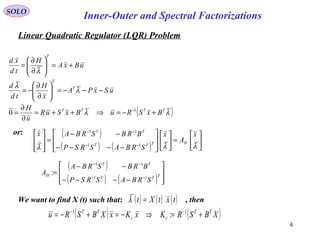
( )λλ
λ
λ
λ
TTTT
T
T
T
BxSRuBxSuR
u
H
uSxPA
x
H
td
d
uBxA
H
td
xd
+−=⇒++=
∂
∂
=
−−−=





∂
∂
−=
+=





∂
∂
=
−1
0
or: ( )
( ) ( ) 





=













−−−−
−−
=








−−
−−
λλλ
x
A
x
SRBASRSP
BRBSRBAx
HTTT
TT
11
11


( )
( ) ( ) 







−−−−
−−
=
−−
−−
TTT
TT
H
SRBASRSP
BRBSRBA
A
11
11
:
We want to find X (t) such that: , then( ) ( ) ( )txtXt =λ
( ) ( )XBSRKxKxXBSRu TT
cc
TT
+=⇒−=+−= −− 11
:
Linear Quadratic Regulator (LQR) Problem
SOLO
Inner-Outer and Spectral Factorizations
5
( )
( ) ( ) 





=













−−−−
−−
=








−−
−−
λλλ
x
A
x
SRBASRSP
BRBSRBAx
HTTT
TT
11
11


We want to find X (t) such that: , then( ) ( ) ( )txtXt =λ
( ) ( ) ( ) ( ) ( )txtXtxtXt  +=λ
( ) ( ) ( )[ ]xXBRBxSRBAXxXxXSRBAxSRSP TTTTT 1111 −−−−
−−+=−−−− 
( ) ( ) ( )[ ] ( )txxSRSPXBRBXSRBAXXSRBAX TTTTT
∀=−+−−+−+ −−−−
01111
( ) ( ) ( )TTTTT
SRSPXBRBXSRBAXXSRBAX 1111 −−−−
−−+−−−−=
We obtain the following Differential Riccati Equation for :X
( ) ( ) ( )
[ ]
( )
( ) ( )
[ ]
( ) ( ) 0
0
1
11
11
1111
=+++−+=






−=













−−−−
−−
−=
−−+−−−−=
−
−−
−−
−−−−
PXBSRXBSAXXA
X
I
AIX
X
I
SRBASRSP
BRBSRBA
IX
SRSPXBRBXSRBAXXSRBA
TTTTTT
HTTT
TT
TTTTT
If a Steady-state Solution exists for t→∞ then and:0→X
Continuous
Algebraic
Riccati
Equation
(CARE)
Linear Quadratic Regulator (LQR) Problem
SOLO
Inner-Outer and Spectral Factorizations
Theorem 1 A Unique Stabilizing
( A+BKc=[A-BR-1
(ST
+BT
X)] is Stable)
Solution of CARE, X=XT
, is obtained iff:
a.(A,B) is Stabilizable
b.Re[λi(AH)]≠0 for all i=1,2,…,2n
The Unique Stabilizing Solution is denoted X=Ric [AH]
Proof
a. It is clear that the condition that (A,B) is Stabilizable is a necessary condition to
stabilize A+BKc.
b. Rewrite
( )
( ) ( )
( )
( )[ ] 





−







+−−
−+−






=








−−−−
−−
=
−
−−
−−
−−
IX
I
XBSRBA
BRBXBSRBA
IX
I
SRBASRSP
BRBSRBA
A TTT
TTT
TTT
TT
H
0
0
0
:
1
11
11
11
If λi is an eigenvalue of AH, - λi is also; hence AH has n eigenvalues λi s.t. Re[λi] ≤ 0
and n eigenvalues λj s.t. Re[λj] ≥ 0. If AH has no eigenvalue of jω axis, then we can
find a solution X s.t. all the eigenvalues of A-BR-1
(ST
+BT
X)=A+BKc are the stable
eigenvalues of AH.
( ) ( ) 01
1
1 =+++−+ −
PXBSRXBSAXXA TTTTTT
Linear Quadratic Regulator (LQR) Problem
SOLO
Inner-Outer and Spectral Factorizations
Theorem 1 A Unique Stabilizing
( A+BKc=[A-BR-1
(ST
+BT
X)] is Stable)
Solution of CARE is obtained iff:
a.(A,B) is Stabilizable
b.Re[λi(AH)]≠0 for all i=1,2,…,2n
The Unique Stabilizing Solution is denoted X=Ric [AH]
Proof (continue -1)
c. Assume that there are two Stabilizing Solutions X1=X1
T
and X2 =X2
T
that satisfy the
CARE ( ) ( )
( ) ( ) 0
0
2
1
222
1
1
111
=+++−+
=+++−+
−
−
PXBSRXBSAXXA
PXBSRXBSAXXA
TTTTTT
TTTTTT
Subtracting those two equations we obtain:
( ) ( ) ( ) ( )
0
0
1
1
21
1
2
2
1
21
1
1
1
2121
1
2121
=−+
−−−−−−−+−
−−
−−−−
  
XBRBXXBRBX
XBRBXXBRBXSRBXXXXBRSAXXXXA
TT
TTTTT
or: ( )[ ] ( ) ( ) ( )[ ] 01
1
21212
1
=+−−+−+− −−
XBSRBAXXXXXBSRBA TTTTT
Linear Quadratic Regulator (LQR) Problem
SOLO
Inner-Outer and Spectral Factorizations
Theorem 1 A Unique Stabilizing
( A+BKc=[A-BR-1
(ST
+BT
X)] is Stable)
Solution of CARE is obtained iff:
a.(A,B) is Stabilizable
b.Re[λi(AH)]≠0 for all i=1,2,…,2n
The Unique Stabilizing Solution is denoted X=Ric [AH]
Proof (continue -2)
c. Assume that there are two Stabilizing Solutions X1=X1
T
and X2 =X2
T
that satisfy the
CARE
This is a Sylvester Matrix Equation and since both X1 and X2 are Stabilizing
Solutions we must have:
( )[ ] ( ) ( ) ( )[ ] 01
1
21212
1
=+−−+−+− −−
XBSRBAXXXXXBSRBA TTTTT
( )[ ]{ }
( )[ ]{ }
( )[ ]{ } ( )[ ]{ } jiXBSRBAXBSRBA
njXBSRBA
niXBSRBA TT
j
TT
iTT
j
TT
i
,0ReRe
,,10Re
,,10Re
2
1
1
1
2
1
1
1
∀≠+−++−⇒




=∀<+−
=∀<+− −−
−
−
λλ
λ
λ


Therefore the solution of the Sylvester Matrix Equation is Unique, and by
substitution we can see that X1 = X2 is the Unique Solution.
q.e.d.
Linear Quadratic Regulator (LQR) Problem
SOLO
Inner-Outer and Spectral Factorizations
Proof (1)
(1) The Matrix YT
Z is Symmetric.
(2) If Y-1
exists, the X=ZY-1
is the Solution of CARE such that the Matrix
((A-BR-1
ST
)-BR-1
BT
X) has the Eigenvalues λ1,λ2,…,λn. X is Symmetric.
(3) If (A,B) Stabilizable and Re[λi(AH)]≠0 for all i=1,2,…,2n (Theorem 1) Y-1
exists.
Theorem 2 Let the columns of the Matrix be the Eigenvectors
of AH corresponding to the Stable Eigenvalues λ1,λ2,…,λn, and J the corresponding
Jordan Matrix. Then
( )nxnnxn
RZYR
Z
Y
∈∈





,2
Define TTT
SRSPQBRBWSRBAE 111
:,:,: −−−
−==−=
( )
( ) ( ) 





−−
−
=








−−−−
−−
=
−−
−−
TTTT
TT
H
EQ
WE
SRBASRSP
BRBSRBA
A
11
11
:



=−−
=−
⇒





=











−−
−
⇒





=





JZZEQY
JYZWYE
J
Z
Y
Z
Y
EQ
WE
J
Z
Y
Z
Y
A TTHWe have
( ) ZYJZWZZEYZYJWZEYJYZWYE TTTTTTTTTTT
=−⇒=−⇒=−
JZYQYYZEYJZYZEYQYYJZZEQYY TTTTTTTTTT
−−=⇒=−−⇒=−−
Linear Quadratic Regulator (LQR) Problem
SOLO
Inner-Outer and Spectral Factorizations
Proof (1) (continue – 1)
Since –YT
QT
Y-ZT
WZ is symmetric so is (YT
Z)J+JT
(YT
Z) or
( ) ( )ZYJJZYZWZQYYZWZZYJJZYQYY
JZYQYYZEY
ZYJZWZZEY TTTTTTTTTT
TTTT
TTTTT
+=−−⇒+=−−⇒




−−=
=−
( ) ( ) ( ) ( )[ ] ( ) ( )TTTTTTTTTTT
ZYJJZYZYJJZYZYJJZY +=+=+
Because J represents the stable Eigenvalues Re[λi(J)+λj(J)]≠0 for all I,j=1,…,n, the
Unique Solution of the Sylvester Matrix Equation is
( ) ( )[ ] ( ) ( )[ ] [ ]0=−+−
TTTTTTT
ZYZYJJZYZY Sylvester Matrix Equation
( ) ( ) [ ] ( ) ( ) SymmetricisZYZYZYZYZY TTTTTTT
=⇒=− 0
(1) The Matrix YT
Z is Symmetric.
(2) If Y-1
exists, the X=ZY-1
is the Solution of CARE such that the Matrix
((A-BR-1
ST
)-BR-1
BT
X) has the Eigenvalues λ1,λ2,…,λn. X is Symmetric.
(3) If (A,B) Stabilizable and Re[λi(AH)]≠0 for all i=1,2,…,2n (Theorem 1) Y-1
exists.
Theorem 2 Let the columns of the Matrix be the Eigenvectors
of AH corresponding to the Stable Eigenvalues λ1,λ2,…,λn, and J the corresponding
Jordan Matrix. Then
( )nxnnxn
RZYR
Z
Y
∈∈





,2
Linear Quadratic Regulator (LQR) Problem
SOLO
Inner-Outer and Spectral Factorizations
Proof (2)



=−−
=−
JZZEQY
JYZWYE
T
111 −−−
=−⇒=− YJYYZWEYJYZWYE
1111111 −−−−−−−
=−⇒=− YJZYZWYZEYZYJYYZWEYZ
111 −−−
=−−⇒=−− YJZYZEQYJZZEQY TT
( ) ( ) ( ) ( ) [ ]01111
=+−+ −−−−
QYZWYZEYZYZET
Define TTT
SRSPQBRBWSRBAE 111
:,:,: −−−
−==−=
Therefore X=ZY-1
is the Unique Stabilizing Solution of the CARE
( ) ( ) ( ) [ ]01111
=−+−−+− −−−− TTTTT
SRSPXBRBXSRBAXXSRBA q.e.d.
(1) The Matrix YT
Z is Symmetric.
(2) If Y-1
exists, the X=ZY-1
is the Solution of CARE such that the Matrix
((A-BR-1
ST
)-BR-1
BT
X) has the Eigenvalues λ1,λ2,…,λn. X is Symmetric.
(3) If (A,B) Stabilizable and Re[λi(AH)]≠0 for all i=1,2,…,2n (Theorem 1) Y-1
exists.
Theorem 2 Let the columns of the Matrix be the Eigenvectors
of AH corresponding to the Stable Eigenvalues λ1,λ2,…,λn, and J the corresponding
Jordan Matrix. Then
( )nxnnxn
RZYR
Z
Y
∈∈





,2
Assume Y-1
exists:
Linear Quadratic Regulator (LQR) Problem
SOLO
Inner-Outer and Spectral Factorizations
Proof (2) (continue – 1)
q.e.d.
From (1) YT
Z is Symmetric, so
( ) YZZYZY TTTT
==
TTTTTTTT
ZYXZXYZYZYYYZZY −−−
=⇒=⇒=⇒= 11
1−
= YZX
( ) TTTT
XYZZYX === −− 1
X is Symmetric
(1) The Matrix YT
Z is Symmetric.
(2) If Y-1
exists, the X=ZY-1
is the Solution of CARE such that the Matrix
((A-BR-1
ST
)-BR-1
BT
X) has the Eigenvalues λ1,λ2,…,λn. X is Symmetric.
(3) If (A,B) Stabilizable and Re[λi(AH)]≠0 for all i=1,2,…,2n (Theorem 1) Y-1
exists.
Theorem 2 Let the columns of the Matrix be the Eigenvectors
of AH corresponding to the Stable Eigenvalues λ1,λ2,…,λn, and J the corresponding
Jordan Matrix. Then
( )nxnnxn
RZYR
Z
Y
∈∈





,2
References
SOLO
13
S. Hermelin, “Robustness and Sensitivity Design of Linear Time-Invariant Systems”,
PhD Thesis, Stanford University, 1986
G.Stein, J.Doyle, B.Francis, “Advances in Multivariable Control”, ONR/Honeywell
Workshop, 1984
Inner-Outer and Spectral Factorizations
T. Kailath, A.H. Sayed, B. Hassibi, “Linear Estimation”. Prentice Hall, 2000
14
SOLO
Technion
Israeli Institute of Technology
1964 – 1968 BSc EE
1968 – 1971 MSc EE
Israeli Air Force
1970 – 1974
RAFAEL
Israeli Armament Development Authority
1974 – 2013
Stanford University
1983 – 1986 PhD AA
Sylvester Matrix Equation : Anxn Xnxm+Xnxm Bmxm=Cnxm
SOLO
15
Consider the Sylvester Matrix Equation
where Anxn, Bmxm, Cnxm are given matrices. Then there
exists a Unique Solution Xnxm if and only if
Matrices
James Joseph Sylvester
(1814 – 1887)
nxmmxmnxmnxmnxn CBXXA =+
( )[ ] ( )[ ] njiAA nxnjnxni ,,1,0ReRe =∀≠+ λλ
∫
∞
=
0
dteCeX tB
nxm
tA
nxm
mxmnxn
Note : If B=AT
: Lyapunov Equation
The Necessary and Sufficient Condition for the existence of a
Unique Solution is
nxn
T
nxnnxnnxnnxn CAXXA =+
In particular if λi(A)=- λj(A) = j ω a Unique Solution
does not exist.
Aleksandr Mikhailovich
Lyapunov
1857 - 1918
( ) ( ) mjniBA mxmjnxni ,,1,,,10  ==∀≠+ λλ
the Unique Solution is given by
If ( )[ ] ( )[ ] mjniBA mxmjnxni ,,1,,,10ReRe  ==∀<+ λλ
Sylvester Matrix Equation : Anxn Xnxm+Xnxm Bmxm=Cnxm
SOLO
Matrices
Proof
Let rewrite
[ ]0
21
22221
11211
21
22221
11211
21
22221
11211
21
22221
11211
21
22221
11211
=












−
























+
























=
−+
nmnn
m
m
mmmm
m
m
nmnn
m
m
nmnn
m
m
nnnn
n
n
nxmmxmnxmnxmnxn
ccc
ccc
ccc
bbb
bbb
bbb
xxx
xxx
xxx
xxx
xxx
xxx
aaa
aaa
aaa
CBXXA












































=
nmnn
m
m
nnnn
n
n
nxmnxn
xxx
xxx
xxx
aaa
aaa
aaa
XA








21
22221
11211
21
22221
11211
( ) ( )
( )
[ ]nxmnxnc
mnxn
nxn
nxn
Xvec
m
nm
m
n
n
nxn
nxn
nxn
nxmcnxnm XAvec
cA
cA
cA
c
x
x
c
x
x
c
x
x
A
A
A
XvecAI
nxmc
=












=



























































=⊗










2
1
1
2
2
12
1
1
11
00
00
00
( ) [ ]
( )
( )
  





nxmc Xvec
xmn
m
nm
m
n
n
mcnxmc
c
x
x
c
x
x
c
x
x
cccvecXvec
1
1
2
2
12
1
1
11
21 :
⋅















































==
Define the
Vectorization
Operator vec:
Sylvester Matrix Equation : Anxn Xnxm+Xnxm Bmxm=Cnxm
SOLO
Matrices
Proof (continue – 1)
Let rewrite
[ ]0
21
22221
11211
21
22221
11211
21
22221
11211
21
22221
11211
21
22221
11211
=












−
























+
























=
−+
nmnn
m
m
mmmm
m
m
nmnn
m
m
nmnn
m
m
nnnn
n
n
nxmmxmnxmnxmnxn
ccc
ccc
ccc
bbb
bbb
bbb
xxx
xxx
xxx
xxx
xxx
xxx
aaa
aaa
aaa
CBXXA




















( ) ( )
( )
[ ]mxmnxmc
mmmmm
mm
mm
Xvec
m
nm
m
n
n
nmmnmnm
nmnm
nmnn
nxmcn
T
mxm BXvec
cbcbcb
cbcbcb
cbcbcb
c
x
x
c
x
x
c
x
x
IbIbIb
IbIbIb
IbIbIb
XvecIB
nxmc
=












+++
+++
+++
=



























































=⊗













2211
2222112
1221111
1
2
2
12
1
1
11
21
22212
12111
























=
mmmm
m
m
nmnn
m
m
mxmnxm
bbb
bbb
bbb
xxx
xxx
xxx
BX








21
22221
11211
21
22221
11211
Sylvester Matrix Equation : Anxn Xnxm+Xnxm Bmxm=Cnxm
SOLO
Matrices
Proof (continue – 2)
We have
[ ] [ ] [ ] [ ] [ ]0=−+=−+ nxmcmxmnxmcnxmnxncnxmmxmnxmnxmnxnc CvecBXvecXAvecCBXXAvec
( ) ( ) [ ]nxmcnxmcn
T
mxmnxnm CvecXvecIBAI =⊗+⊗or
Let use the Jordan decomposition for Anxn and Bmxm
11
&
−−
== TTT
BBB
T
mxmAAAnxn SJSBSJSA
( ) ( )
( ) ( ) ( ) ( )
n
TTT
m
TT
TTT
I
AABBBAAA
I
BB
nBBBAAAmn
T
mxmnxnm
SSSJSSJSSS
ISJSSJSIIBAI
1111
11
−−−−
−−
⊗+⊗=
⊗+⊗=⊗+⊗
( )
( )( ) ( ) ( )
( ) ( )( )
( ) ( )
( )( )
( )( )
( )
( )
    
111
111
1111
−−−
−−−
⊗
−−
⊗⊗⊗⊗
−−
⋅⊗⋅=⊗⊗
⊗=⊗
⊗⊗+⊗⊗=
ATB
T
nTBATB
TT
ATBAm
TT
SS
AB
IJSS
ABB
SSJI
AABAB
DBCADCBA
BABA
SSSJSSJSSS
( )( )( ) 1−
⊗⊗+⊗⊗=⊗+⊗ ABnBAmABn
T
mxmnxnm SSIJJISSIBAI T
T
T
This equation has a Unique Solution iff is Nonsingular.( )n
T
mxmnxnm IBAI ⊗+⊗
Sylvester Matrix Equation : Anxn Xnxm+Xnxm Bmxm=Cnxm
SOLO
Matrices
Proof (continue – 3)
where
( )( )( ) 1−
⊗⊗+⊗⊗=⊗+⊗ ABnBAmABn
T
mxmnxnm SSIJJISSIBAI T
T
T
[ ] [ ] [ ]
[ ] [ ] [ ]
[ ] [ ] [ ]











=
lJ
J
J
J




00
00
00
2
1
[ ]




















=
i
i
i
i
i
xkki ii
J
λ
λ
λ
λ
λ
0000
1000
0000
0010
0001






Ji are Upper-Triangular Matrices
( )nBAm IJJI T ⊗+⊗Therefore is also Upper Triangular with diagonal elements λi[A] + λj[B]
(i=1,…,n, j=1,…,m), that are the Eigenvalues of and therefore to the
Similar Matrix . This Matrix is Nonsingular iff
( )nBAm IJJI T ⊗+⊗
( )n
T
mxmnxnm IBAI ⊗+⊗
( ) ( ) mjniBA mxmjnxni ,,1,,,10  ==∀≠+ λλ
Sylvester Matrix Equation : Anxn Xnxm+Xnxm Bmxm=Cnxm
SOLO
Matrices
Since ( )[ ] ( )[ ] [ ] [ ]0lim,0lim,,1,,,10ReRe ====∀<+
∞→∞→
tB
t
tA
t
mxmjnxni eemjniBA λλ
Proof (continue – 4)
Let rewrite
[ ] [ ] 





=











−
=−+=
nxm
m
Snnxm
nxm
m
nxnnxm
mxm
nnxmnxmmxmnxmnxmnxn
X
I
AIX
X
I
AC
B
IXCBXXA
0
0
( ) ( ) nxmnxm
tB
nxm
tA
nxm CPeCetP mxmnxn
−=⇒−= 0:Define
By differentiation
( )
mxmnxmnxmnxnmxm
tB
nxm
tAtB
nxm
tA
nxn
nxm
BPPABeCeeCeA
td
tPd mxmnxnmxmnxn
−−=−−=
Let Integrate the Differential Equation
( ) ( ) ( )
mxmnxmnxmnxn
nxm
nxmnxm BdtPdtPAdt
td
tPd
PP 







−+







−==−∞ ∫∫∫
∞∞∞
000
0
We have
and
where
∫
∞
=
0
dteCeX tB
nxm
tA
nxm
mxmnxn
( ) [ ]0=∞nxmP
mxmnxmnxmnxnmxmnxmnxmnxnnxm BXXABdtPdtPAC +=







−+







−= ∫∫
∞∞
00
Matrix Differential Riccati Equation
SOLO
Inner-Outer and Spectral Factorizations
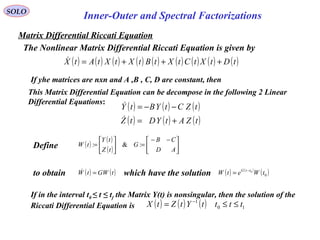
( ) ( ) ( ) ( ) ( ) ( ) ( ) ( ) ( )tDtXtCtXtBtXtXtAtX +++=
where all matrices are nxn and A (t),B (t), C(t), D(t) are integrable over an
interval t0 ≤ t ≤ tf.
This Matrix Differential Equation can be decompose in the following 2 Linear
Differential Equations:
The Nonlinear Matrix Differential Riccati Equation is given by
( ) ( ) ( ) ( ) ( )
( ) ( ) ( ) ( ) ( )tZtAtYtDtZ
tZtCtYtBtY
+=
−−=


If in the interval t0 ≤ t ≤ tf the Matrix Y(t) is nonsingular, then the solution of the
Riccati Differential Equation is ( ) ( ) ( ) 10
1
ttttYtZtX ≤≤= −
To verify we have ( ) ( ) ( ) ( ) ( ) ( ) ( ) ( ) ( )tY
td
tYd
tYtY
td
d
tY
td
d
tZtY
td
tZd
tX
td
d 11111
& −−−−−
−=+=
( ) ( ) ( ) ( ) ( )[ ] ( ) ( ) ( ) ( ) ( ) ( ) ( )[ ] ( )
( ) ( ) ( ) ( ) ( ) ( ) ( ) ( )tXtCtXtBtXtXtAtD
tYtZtCtYtBtYtZtYtZtAtYtDtX
td
d
+++=
−−−+= −−− 111
Matrix Differential Riccati Equation
SOLO
Inner-Outer and Spectral Factorizations
( ) ( ) ( ) ( ) ( ) ( ) ( ) ( ) ( )tDtXtCtXtBtXtXtAtX +++=
If yhe matrices are nxn and A ,B , C, D are constant, then
This Matrix Differential Equation can be decompose in the following 2 Linear
Differential Equations:
The Nonlinear Matrix Differential Riccati Equation is given by
( ) ( ) ( )
( ) ( ) ( )tZAtYDtZ
tZCtYBtY
+=
−−=


If in the interval t0 ≤ t ≤ tf the Matrix Y(t) is nonsingular, then the solution of the
Riccati Differential Equation is ( ) ( ) ( ) 10
1
ttttYtZtX ≤≤= −
Define ( )
( )
( ) 




 −−
=





=
AD
CB
G
tZ
tY
tW :&:
to obtain which have the solution( ) ( )tGWtW = ( ) ( )
( )0
0
tWetW ttG −
=

Inner outer and spectral factorizations

  • 1.
    Inner-Outer and SpectralFactorizations SOLO HERMELIN Updated: 27.05.11 1
  • 2.
    Table of Content SOLO Inner-Outerand Spectral Factorizations 2
  • 3.
    Linear Quadratic Regulator(LQR) Problem SOLO Inner-Outer and Spectral Factorizations 3 Given the Linear Time-Invariant System ( ) 00 xxuBxAx =+= and the Quadratic Cost Function: [ ] TT T TT c PPRRdt u x RS SP uxJ =>=            = ∫ ∞ &0 2 1 0 The Optimal Regulator that Minimizes the Cost Function Jc is given by the following procedure: Define the Hamiltonian of the Optimization Problem: ( ) [ ] ( )uBxA u x RS SP uxuxH T T TT ++            = λλ 2 1 ,, The Euler-Lagrange Equations are: ( )λλ λ λ λ TTTT T T T BxSRuBxSuR u H uSxPA x H td d uBxA H td xd +−=⇒++= ∂ ∂ = −−−=      ∂ ∂ −= +=      ∂ ∂ = −1 0
  • 4.
    Linear Quadratic Regulator(LQR) Problem SOLO Inner-Outer and Spectral Factorizations 4 ( )λλ λ λ λ TTTT T T T BxSRuBxSuR u H uSxPA x H td d uBxA H td xd +−=⇒++= ∂ ∂ = −−−=      ∂ ∂ −= +=      ∂ ∂ = −1 0 or: ( ) ( ) ( )       =              −−−− −− =         −− −− λλλ x A x SRBASRSP BRBSRBAx HTTT TT 11 11   ( ) ( ) ( )         −−−− −− = −− −− TTT TT H SRBASRSP BRBSRBA A 11 11 : We want to find X (t) such that: , then( ) ( ) ( )txtXt =λ ( ) ( )XBSRKxKxXBSRu TT cc TT +=⇒−=+−= −− 11 :
  • 5.
    Linear Quadratic Regulator(LQR) Problem SOLO Inner-Outer and Spectral Factorizations 5 ( ) ( ) ( )       =              −−−− −− =         −− −− λλλ x A x SRBASRSP BRBSRBAx HTTT TT 11 11   We want to find X (t) such that: , then( ) ( ) ( )txtXt =λ ( ) ( ) ( ) ( ) ( )txtXtxtXt  +=λ ( ) ( ) ( )[ ]xXBRBxSRBAXxXxXSRBAxSRSP TTTTT 1111 −−−− −−+=−−−−  ( ) ( ) ( )[ ] ( )txxSRSPXBRBXSRBAXXSRBAX TTTTT ∀=−+−−+−+ −−−− 01111 ( ) ( ) ( )TTTTT SRSPXBRBXSRBAXXSRBAX 1111 −−−− −−+−−−−= We obtain the following Differential Riccati Equation for :X ( ) ( ) ( ) [ ] ( ) ( ) ( ) [ ] ( ) ( ) 0 0 1 11 11 1111 =+++−+=       −=              −−−− −− −= −−+−−−−= − −− −− −−−− PXBSRXBSAXXA X I AIX X I SRBASRSP BRBSRBA IX SRSPXBRBXSRBAXXSRBA TTTTTT HTTT TT TTTTT If a Steady-state Solution exists for t→∞ then and:0→X Continuous Algebraic Riccati Equation (CARE)
  • 6.
    Linear Quadratic Regulator(LQR) Problem SOLO Inner-Outer and Spectral Factorizations Theorem 1 A Unique Stabilizing ( A+BKc=[A-BR-1 (ST +BT X)] is Stable) Solution of CARE, X=XT , is obtained iff: a.(A,B) is Stabilizable b.Re[λi(AH)]≠0 for all i=1,2,…,2n The Unique Stabilizing Solution is denoted X=Ric [AH] Proof a. It is clear that the condition that (A,B) is Stabilizable is a necessary condition to stabilize A+BKc. b. Rewrite ( ) ( ) ( ) ( ) ( )[ ]       −        +−− −+−       =         −−−− −− = − −− −− −− IX I XBSRBA BRBXBSRBA IX I SRBASRSP BRBSRBA A TTT TTT TTT TT H 0 0 0 : 1 11 11 11 If λi is an eigenvalue of AH, - λi is also; hence AH has n eigenvalues λi s.t. Re[λi] ≤ 0 and n eigenvalues λj s.t. Re[λj] ≥ 0. If AH has no eigenvalue of jω axis, then we can find a solution X s.t. all the eigenvalues of A-BR-1 (ST +BT X)=A+BKc are the stable eigenvalues of AH. ( ) ( ) 01 1 1 =+++−+ − PXBSRXBSAXXA TTTTTT
  • 7.
    Linear Quadratic Regulator(LQR) Problem SOLO Inner-Outer and Spectral Factorizations Theorem 1 A Unique Stabilizing ( A+BKc=[A-BR-1 (ST +BT X)] is Stable) Solution of CARE is obtained iff: a.(A,B) is Stabilizable b.Re[λi(AH)]≠0 for all i=1,2,…,2n The Unique Stabilizing Solution is denoted X=Ric [AH] Proof (continue -1) c. Assume that there are two Stabilizing Solutions X1=X1 T and X2 =X2 T that satisfy the CARE ( ) ( ) ( ) ( ) 0 0 2 1 222 1 1 111 =+++−+ =+++−+ − − PXBSRXBSAXXA PXBSRXBSAXXA TTTTTT TTTTTT Subtracting those two equations we obtain: ( ) ( ) ( ) ( ) 0 0 1 1 21 1 2 2 1 21 1 1 1 2121 1 2121 =−+ −−−−−−−+− −− −−−−    XBRBXXBRBX XBRBXXBRBXSRBXXXXBRSAXXXXA TT TTTTT or: ( )[ ] ( ) ( ) ( )[ ] 01 1 21212 1 =+−−+−+− −− XBSRBAXXXXXBSRBA TTTTT
  • 8.
    Linear Quadratic Regulator(LQR) Problem SOLO Inner-Outer and Spectral Factorizations Theorem 1 A Unique Stabilizing ( A+BKc=[A-BR-1 (ST +BT X)] is Stable) Solution of CARE is obtained iff: a.(A,B) is Stabilizable b.Re[λi(AH)]≠0 for all i=1,2,…,2n The Unique Stabilizing Solution is denoted X=Ric [AH] Proof (continue -2) c. Assume that there are two Stabilizing Solutions X1=X1 T and X2 =X2 T that satisfy the CARE This is a Sylvester Matrix Equation and since both X1 and X2 are Stabilizing Solutions we must have: ( )[ ] ( ) ( ) ( )[ ] 01 1 21212 1 =+−−+−+− −− XBSRBAXXXXXBSRBA TTTTT ( )[ ]{ } ( )[ ]{ } ( )[ ]{ } ( )[ ]{ } jiXBSRBAXBSRBA njXBSRBA niXBSRBA TT j TT iTT j TT i ,0ReRe ,,10Re ,,10Re 2 1 1 1 2 1 1 1 ∀≠+−++−⇒     =∀<+− =∀<+− −− − − λλ λ λ   Therefore the solution of the Sylvester Matrix Equation is Unique, and by substitution we can see that X1 = X2 is the Unique Solution. q.e.d.
  • 9.
    Linear Quadratic Regulator(LQR) Problem SOLO Inner-Outer and Spectral Factorizations Proof (1) (1) The Matrix YT Z is Symmetric. (2) If Y-1 exists, the X=ZY-1 is the Solution of CARE such that the Matrix ((A-BR-1 ST )-BR-1 BT X) has the Eigenvalues λ1,λ2,…,λn. X is Symmetric. (3) If (A,B) Stabilizable and Re[λi(AH)]≠0 for all i=1,2,…,2n (Theorem 1) Y-1 exists. Theorem 2 Let the columns of the Matrix be the Eigenvectors of AH corresponding to the Stable Eigenvalues λ1,λ2,…,λn, and J the corresponding Jordan Matrix. Then ( )nxnnxn RZYR Z Y ∈∈      ,2 Define TTT SRSPQBRBWSRBAE 111 :,:,: −−− −==−= ( ) ( ) ( )       −− − =         −−−− −− = −− −− TTTT TT H EQ WE SRBASRSP BRBSRBA A 11 11 :    =−− =− ⇒      =            −− − ⇒      =      JZZEQY JYZWYE J Z Y Z Y EQ WE J Z Y Z Y A TTHWe have ( ) ZYJZWZZEYZYJWZEYJYZWYE TTTTTTTTTTT =−⇒=−⇒=− JZYQYYZEYJZYZEYQYYJZZEQYY TTTTTTTTTT −−=⇒=−−⇒=−−
  • 10.
    Linear Quadratic Regulator(LQR) Problem SOLO Inner-Outer and Spectral Factorizations Proof (1) (continue – 1) Since –YT QT Y-ZT WZ is symmetric so is (YT Z)J+JT (YT Z) or ( ) ( )ZYJJZYZWZQYYZWZZYJJZYQYY JZYQYYZEY ZYJZWZZEY TTTTTTTTTT TTTT TTTTT +=−−⇒+=−−⇒     −−= =− ( ) ( ) ( ) ( )[ ] ( ) ( )TTTTTTTTTTT ZYJJZYZYJJZYZYJJZY +=+=+ Because J represents the stable Eigenvalues Re[λi(J)+λj(J)]≠0 for all I,j=1,…,n, the Unique Solution of the Sylvester Matrix Equation is ( ) ( )[ ] ( ) ( )[ ] [ ]0=−+− TTTTTTT ZYZYJJZYZY Sylvester Matrix Equation ( ) ( ) [ ] ( ) ( ) SymmetricisZYZYZYZYZY TTTTTTT =⇒=− 0 (1) The Matrix YT Z is Symmetric. (2) If Y-1 exists, the X=ZY-1 is the Solution of CARE such that the Matrix ((A-BR-1 ST )-BR-1 BT X) has the Eigenvalues λ1,λ2,…,λn. X is Symmetric. (3) If (A,B) Stabilizable and Re[λi(AH)]≠0 for all i=1,2,…,2n (Theorem 1) Y-1 exists. Theorem 2 Let the columns of the Matrix be the Eigenvectors of AH corresponding to the Stable Eigenvalues λ1,λ2,…,λn, and J the corresponding Jordan Matrix. Then ( )nxnnxn RZYR Z Y ∈∈      ,2
  • 11.
    Linear Quadratic Regulator(LQR) Problem SOLO Inner-Outer and Spectral Factorizations Proof (2)    =−− =− JZZEQY JYZWYE T 111 −−− =−⇒=− YJYYZWEYJYZWYE 1111111 −−−−−−− =−⇒=− YJZYZWYZEYZYJYYZWEYZ 111 −−− =−−⇒=−− YJZYZEQYJZZEQY TT ( ) ( ) ( ) ( ) [ ]01111 =+−+ −−−− QYZWYZEYZYZET Define TTT SRSPQBRBWSRBAE 111 :,:,: −−− −==−= Therefore X=ZY-1 is the Unique Stabilizing Solution of the CARE ( ) ( ) ( ) [ ]01111 =−+−−+− −−−− TTTTT SRSPXBRBXSRBAXXSRBA q.e.d. (1) The Matrix YT Z is Symmetric. (2) If Y-1 exists, the X=ZY-1 is the Solution of CARE such that the Matrix ((A-BR-1 ST )-BR-1 BT X) has the Eigenvalues λ1,λ2,…,λn. X is Symmetric. (3) If (A,B) Stabilizable and Re[λi(AH)]≠0 for all i=1,2,…,2n (Theorem 1) Y-1 exists. Theorem 2 Let the columns of the Matrix be the Eigenvectors of AH corresponding to the Stable Eigenvalues λ1,λ2,…,λn, and J the corresponding Jordan Matrix. Then ( )nxnnxn RZYR Z Y ∈∈      ,2 Assume Y-1 exists:
  • 12.
    Linear Quadratic Regulator(LQR) Problem SOLO Inner-Outer and Spectral Factorizations Proof (2) (continue – 1) q.e.d. From (1) YT Z is Symmetric, so ( ) YZZYZY TTTT == TTTTTTTT ZYXZXYZYZYYYZZY −−− =⇒=⇒=⇒= 11 1− = YZX ( ) TTTT XYZZYX === −− 1 X is Symmetric (1) The Matrix YT Z is Symmetric. (2) If Y-1 exists, the X=ZY-1 is the Solution of CARE such that the Matrix ((A-BR-1 ST )-BR-1 BT X) has the Eigenvalues λ1,λ2,…,λn. X is Symmetric. (3) If (A,B) Stabilizable and Re[λi(AH)]≠0 for all i=1,2,…,2n (Theorem 1) Y-1 exists. Theorem 2 Let the columns of the Matrix be the Eigenvectors of AH corresponding to the Stable Eigenvalues λ1,λ2,…,λn, and J the corresponding Jordan Matrix. Then ( )nxnnxn RZYR Z Y ∈∈      ,2
  • 13.
    References SOLO 13 S. Hermelin, “Robustnessand Sensitivity Design of Linear Time-Invariant Systems”, PhD Thesis, Stanford University, 1986 G.Stein, J.Doyle, B.Francis, “Advances in Multivariable Control”, ONR/Honeywell Workshop, 1984 Inner-Outer and Spectral Factorizations T. Kailath, A.H. Sayed, B. Hassibi, “Linear Estimation”. Prentice Hall, 2000
  • 14.
    14 SOLO Technion Israeli Institute ofTechnology 1964 – 1968 BSc EE 1968 – 1971 MSc EE Israeli Air Force 1970 – 1974 RAFAEL Israeli Armament Development Authority 1974 – 2013 Stanford University 1983 – 1986 PhD AA
  • 15.
    Sylvester Matrix Equation: Anxn Xnxm+Xnxm Bmxm=Cnxm SOLO 15 Consider the Sylvester Matrix Equation where Anxn, Bmxm, Cnxm are given matrices. Then there exists a Unique Solution Xnxm if and only if Matrices James Joseph Sylvester (1814 – 1887) nxmmxmnxmnxmnxn CBXXA =+ ( )[ ] ( )[ ] njiAA nxnjnxni ,,1,0ReRe =∀≠+ λλ ∫ ∞ = 0 dteCeX tB nxm tA nxm mxmnxn Note : If B=AT : Lyapunov Equation The Necessary and Sufficient Condition for the existence of a Unique Solution is nxn T nxnnxnnxnnxn CAXXA =+ In particular if λi(A)=- λj(A) = j ω a Unique Solution does not exist. Aleksandr Mikhailovich Lyapunov 1857 - 1918 ( ) ( ) mjniBA mxmjnxni ,,1,,,10  ==∀≠+ λλ the Unique Solution is given by If ( )[ ] ( )[ ] mjniBA mxmjnxni ,,1,,,10ReRe  ==∀<+ λλ
  • 16.
    Sylvester Matrix Equation: Anxn Xnxm+Xnxm Bmxm=Cnxm SOLO Matrices Proof Let rewrite [ ]0 21 22221 11211 21 22221 11211 21 22221 11211 21 22221 11211 21 22221 11211 =             −                         +                         = −+ nmnn m m mmmm m m nmnn m m nmnn m m nnnn n n nxmmxmnxmnxmnxn ccc ccc ccc bbb bbb bbb xxx xxx xxx xxx xxx xxx aaa aaa aaa CBXXA                                             = nmnn m m nnnn n n nxmnxn xxx xxx xxx aaa aaa aaa XA         21 22221 11211 21 22221 11211 ( ) ( ) ( ) [ ]nxmnxnc mnxn nxn nxn Xvec m nm m n n nxn nxn nxn nxmcnxnm XAvec cA cA cA c x x c x x c x x A A A XvecAI nxmc =             =                                                            =⊗           2 1 1 2 2 12 1 1 11 00 00 00 ( ) [ ] ( ) ( )         nxmc Xvec xmn m nm m n n mcnxmc c x x c x x c x x cccvecXvec 1 1 2 2 12 1 1 11 21 : ⋅                                                == Define the Vectorization Operator vec:
  • 17.
    Sylvester Matrix Equation: Anxn Xnxm+Xnxm Bmxm=Cnxm SOLO Matrices Proof (continue – 1) Let rewrite [ ]0 21 22221 11211 21 22221 11211 21 22221 11211 21 22221 11211 21 22221 11211 =             −                         +                         = −+ nmnn m m mmmm m m nmnn m m nmnn m m nnnn n n nxmmxmnxmnxmnxn ccc ccc ccc bbb bbb bbb xxx xxx xxx xxx xxx xxx aaa aaa aaa CBXXA                     ( ) ( ) ( ) [ ]mxmnxmc mmmmm mm mm Xvec m nm m n n nmmnmnm nmnm nmnn nxmcn T mxm BXvec cbcbcb cbcbcb cbcbcb c x x c x x c x x IbIbIb IbIbIb IbIbIb XvecIB nxmc =             +++ +++ +++ =                                                            =⊗              2211 2222112 1221111 1 2 2 12 1 1 11 21 22212 12111                         = mmmm m m nmnn m m mxmnxm bbb bbb bbb xxx xxx xxx BX         21 22221 11211 21 22221 11211
  • 18.
    Sylvester Matrix Equation: Anxn Xnxm+Xnxm Bmxm=Cnxm SOLO Matrices Proof (continue – 2) We have [ ] [ ] [ ] [ ] [ ]0=−+=−+ nxmcmxmnxmcnxmnxncnxmmxmnxmnxmnxnc CvecBXvecXAvecCBXXAvec ( ) ( ) [ ]nxmcnxmcn T mxmnxnm CvecXvecIBAI =⊗+⊗or Let use the Jordan decomposition for Anxn and Bmxm 11 & −− == TTT BBB T mxmAAAnxn SJSBSJSA ( ) ( ) ( ) ( ) ( ) ( ) n TTT m TT TTT I AABBBAAA I BB nBBBAAAmn T mxmnxnm SSSJSSJSSS ISJSSJSIIBAI 1111 11 −−−− −− ⊗+⊗= ⊗+⊗=⊗+⊗ ( ) ( )( ) ( ) ( ) ( ) ( )( ) ( ) ( ) ( )( ) ( )( ) ( ) ( )      111 111 1111 −−− −−− ⊗ −− ⊗⊗⊗⊗ −− ⋅⊗⋅=⊗⊗ ⊗=⊗ ⊗⊗+⊗⊗= ATB T nTBATB TT ATBAm TT SS AB IJSS ABB SSJI AABAB DBCADCBA BABA SSSJSSJSSS ( )( )( ) 1− ⊗⊗+⊗⊗=⊗+⊗ ABnBAmABn T mxmnxnm SSIJJISSIBAI T T T This equation has a Unique Solution iff is Nonsingular.( )n T mxmnxnm IBAI ⊗+⊗
  • 19.
    Sylvester Matrix Equation: Anxn Xnxm+Xnxm Bmxm=Cnxm SOLO Matrices Proof (continue – 3) where ( )( )( ) 1− ⊗⊗+⊗⊗=⊗+⊗ ABnBAmABn T mxmnxnm SSIJJISSIBAI T T T [ ] [ ] [ ] [ ] [ ] [ ] [ ] [ ] [ ]            = lJ J J J     00 00 00 2 1 [ ]                     = i i i i i xkki ii J λ λ λ λ λ 0000 1000 0000 0010 0001       Ji are Upper-Triangular Matrices ( )nBAm IJJI T ⊗+⊗Therefore is also Upper Triangular with diagonal elements λi[A] + λj[B] (i=1,…,n, j=1,…,m), that are the Eigenvalues of and therefore to the Similar Matrix . This Matrix is Nonsingular iff ( )nBAm IJJI T ⊗+⊗ ( )n T mxmnxnm IBAI ⊗+⊗ ( ) ( ) mjniBA mxmjnxni ,,1,,,10  ==∀≠+ λλ
  • 20.
    Sylvester Matrix Equation: Anxn Xnxm+Xnxm Bmxm=Cnxm SOLO Matrices Since ( )[ ] ( )[ ] [ ] [ ]0lim,0lim,,1,,,10ReRe ====∀<+ ∞→∞→ tB t tA t mxmjnxni eemjniBA λλ Proof (continue – 4) Let rewrite [ ] [ ]       =            − =−+= nxm m Snnxm nxm m nxnnxm mxm nnxmnxmmxmnxmnxmnxn X I AIX X I AC B IXCBXXA 0 0 ( ) ( ) nxmnxm tB nxm tA nxm CPeCetP mxmnxn −=⇒−= 0:Define By differentiation ( ) mxmnxmnxmnxnmxm tB nxm tAtB nxm tA nxn nxm BPPABeCeeCeA td tPd mxmnxnmxmnxn −−=−−= Let Integrate the Differential Equation ( ) ( ) ( ) mxmnxmnxmnxn nxm nxmnxm BdtPdtPAdt td tPd PP         −+        −==−∞ ∫∫∫ ∞∞∞ 000 0 We have and where ∫ ∞ = 0 dteCeX tB nxm tA nxm mxmnxn ( ) [ ]0=∞nxmP mxmnxmnxmnxnmxmnxmnxmnxnnxm BXXABdtPdtPAC +=        −+        −= ∫∫ ∞∞ 00
  • 21.
    Matrix Differential RiccatiEquation SOLO Inner-Outer and Spectral Factorizations ( ) ( ) ( ) ( ) ( ) ( ) ( ) ( ) ( )tDtXtCtXtBtXtXtAtX +++= where all matrices are nxn and A (t),B (t), C(t), D(t) are integrable over an interval t0 ≤ t ≤ tf. This Matrix Differential Equation can be decompose in the following 2 Linear Differential Equations: The Nonlinear Matrix Differential Riccati Equation is given by ( ) ( ) ( ) ( ) ( ) ( ) ( ) ( ) ( ) ( )tZtAtYtDtZ tZtCtYtBtY += −−=   If in the interval t0 ≤ t ≤ tf the Matrix Y(t) is nonsingular, then the solution of the Riccati Differential Equation is ( ) ( ) ( ) 10 1 ttttYtZtX ≤≤= − To verify we have ( ) ( ) ( ) ( ) ( ) ( ) ( ) ( ) ( )tY td tYd tYtY td d tY td d tZtY td tZd tX td d 11111 & −−−−− −=+= ( ) ( ) ( ) ( ) ( )[ ] ( ) ( ) ( ) ( ) ( ) ( ) ( )[ ] ( ) ( ) ( ) ( ) ( ) ( ) ( ) ( ) ( )tXtCtXtBtXtXtAtD tYtZtCtYtBtYtZtYtZtAtYtDtX td d +++= −−−+= −−− 111
  • 22.
    Matrix Differential RiccatiEquation SOLO Inner-Outer and Spectral Factorizations ( ) ( ) ( ) ( ) ( ) ( ) ( ) ( ) ( )tDtXtCtXtBtXtXtAtX +++= If yhe matrices are nxn and A ,B , C, D are constant, then This Matrix Differential Equation can be decompose in the following 2 Linear Differential Equations: The Nonlinear Matrix Differential Riccati Equation is given by ( ) ( ) ( ) ( ) ( ) ( )tZAtYDtZ tZCtYBtY += −−=   If in the interval t0 ≤ t ≤ tf the Matrix Y(t) is nonsingular, then the solution of the Riccati Differential Equation is ( ) ( ) ( ) 10 1 ttttYtZtX ≤≤= − Define ( ) ( ) ( )       −− =      = AD CB G tZ tY tW :&: to obtain which have the solution( ) ( )tGWtW = ( ) ( ) ( )0 0 tWetW ttG − =

Editor's Notes

  • #17 K. Ogata, “State Space Analysis of Control Systems”, Prentice Hall, Inc., 1967 , pp.356-357
  • #18 K. Ogata, “State Space Analysis of Control Systems”, Prentice Hall, Inc., 1967 , pp.356-357
  • #19 K. Ogata, “State Space Analysis of Control Systems”, Prentice Hall, Inc., 1967 , pp.356-357
  • #20 K. Ogata, “State Space Analysis of Control Systems”, Prentice Hall, Inc., 1967 , pp.356-357
  • #21 K. Ogata, “State Space Analysis of Control Systems”, Prentice Hall, Inc., 1967 , pp.356-357
  • #22 K. Ogata, “State Space Analysis of Control Systems”, Prentice Hall, Inc., 1967 , pp.321-322
  • #23 K. Ogata, “State Space Analysis of Control Systems”, Prentice Hall, Inc., 1967 , pp.321-322