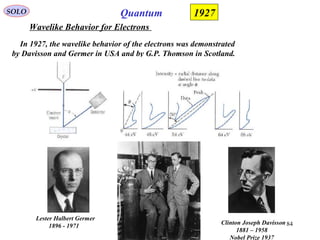
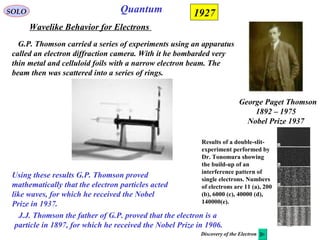
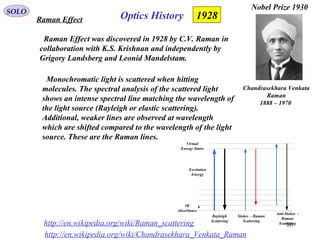
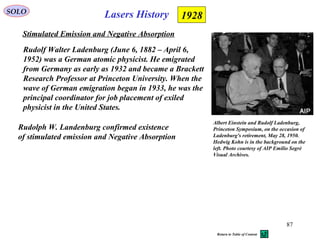
1
Introduction
to
Quantum Mechanics
SOLO HERMELIN
Updated: 11.11.13
10.10.14
Introduction to Quantum MechanicsSOLO
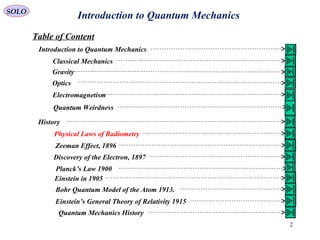
Table of Content
2
Introduction to Quantum Mechanics
Classical Mechanics
Gravity
Optics
Electromagnetism
Quantum Weirdness
History
Physical Laws of Radiometry
Zeeman Effect, 1896
Discovery of the Electron, 1897
Planck’s Law 1900
Einstein in 1905
Bohr Quantum Model of the Atom 1913.
Einstein’s General Theory of Relativity 1915
Quantum Mechanics History
Introduction to Quantum MechanicsSOLO
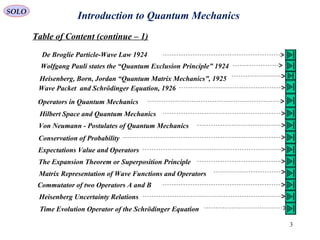
Table of Content (continue – 1)
3
De Broglie Particle-Wave Law 1924
Wolfgang Pauli states the “Quantum Exclusion Principle” 1924
Heisenberg, Born, Jordan “Quantum Matrix Mechanics”, 1925
Wave Packet and Schrödinger Equation, 1926
Operators in Quantum Mechanics
Hilbert Space and Quantum Mechanics
Von Neumann - Postulates of Quantum Mechanics
Conservation of Probability
Expectations Value and Operators
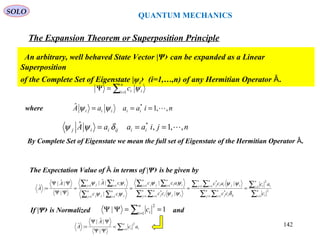
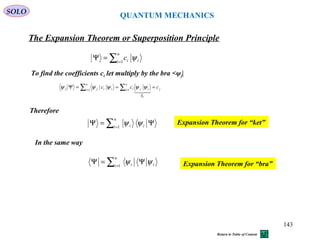
The Expansion Theorem or Superposition Principle
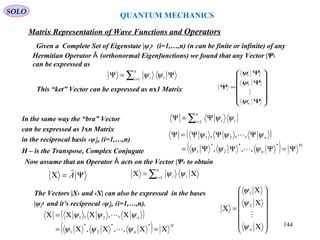
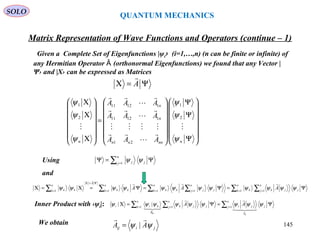
Matrix Representation of Wave Functions and Operators
Commutator of two Operators A and B
Time Evolution Operator of the Schrödinger Equation
Heisenberg Uncertainty Relations
Introduction to Quantum MechanicsSOLO
Table of Content (Continue -2)
4
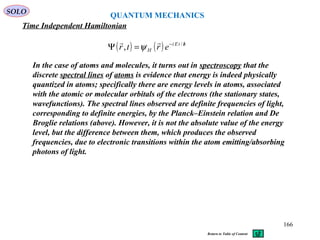
Time Independent Hamiltonian
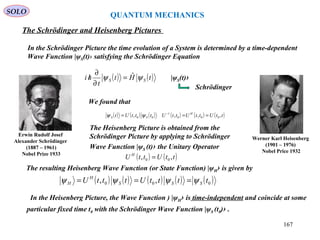
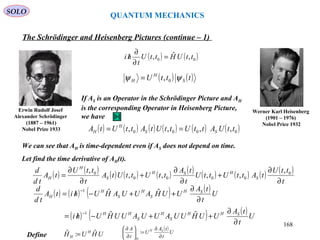
The Schrödinger and Heisenberg Pictures
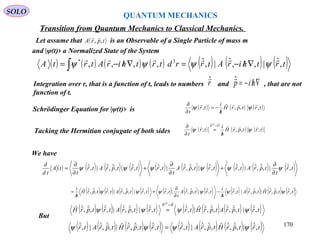
Transition from Quantum Mechanics to Classical Mechanics.
Pauli Exclusion Principle
Klein-Gordon Equation for a Spinless Particle
Non-relativistic Schrödinger Equation in an Electromagnetic Field
Pauli Equation
Dirac Equation
Light Polarization and Quantum Theory
Copenhagen Interpretation of Quantum Mechanics
Measurement in Quantum Mechanics
Schrödinger’s Cat
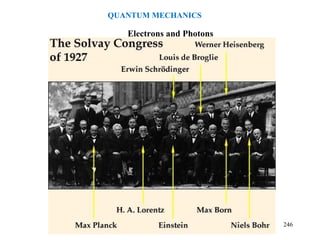
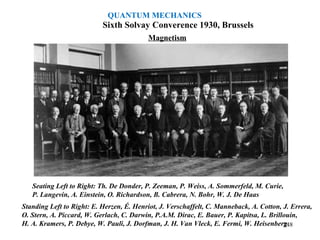
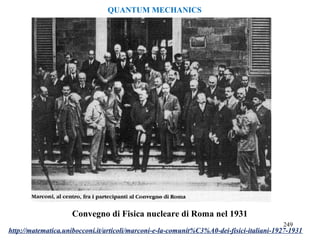
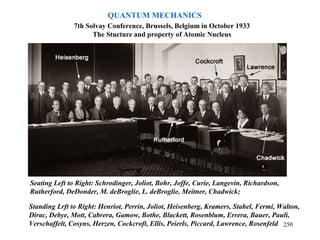
Solvay Conferences
Bohr–Einstein Debates
Feynman Path Integral Representation of Time Evolution Amplitudes
Introduction to Quantum MechanicsSOLO
Table of Content (Continue -3)
5
Quantum Field Theories
References
Aharonov–Bohm Effect
Wheeler's delayed choice experiment
Zero-Point Energy
Quantum Foam
De Broglie–Bohm Theory in Quantum Mechanics
Bell's Theorem
Bell Test Experiments
Wheeler's delayed choice experiment
Hidden Variables
Physics
The Presentation is my attempt to study and cover the fascinating
subject of Quantum Mechanics. The completion of this presentation
does not make me an expert on the subject, since I never worked in the
field.
I thing that I reached a good coverage of the subject and I want to
share it. Comments and suggestions for improvements are more than
welcomed.
6
SOLO
Introduction to Quantum Mechanics
Physics
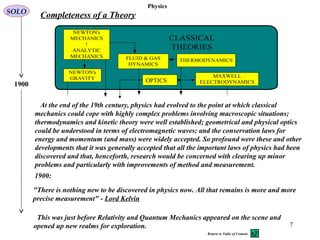
NEWTON's
MECHANICS
!
ANALYTIC
MECHANICS FLUID & GAS
DYNAMICS
THERMODYNAMICS
MAXWELL
ELECTRODYNAMICS
CLASSICAL
THEORIES
NEWTON's
GRAVITY
OPTICS
1900
At the end of the 19th century, physics had evolved to the point at which classical
mechanics could cope with highly complex problems involving macroscopic situations;
thermodynamics and kinetic theory were well established; geometrical and physical optics
could be understood in terms of electromagnetic waves; and the conservation laws for
energy and momentum (and mass) were widely accepted. So profound were these and other
developments that it was generally accepted that all the important laws of physics had been
discovered and that, henceforth, research would be concerned with clearing up minor
problems and particularly with improvements of method and measurement.
"There is nothing new to be discovered in physics now. All that remains is more and more
precise measurement" - Lord Kelvin
1900:
This was just before Relativity and Quantum Mechanics appeared on the scene and
opened up new realms for exploration.
Completeness of a Theory
7
Return to Table of Content
SOLO
8
Classical TheoriesSOLO
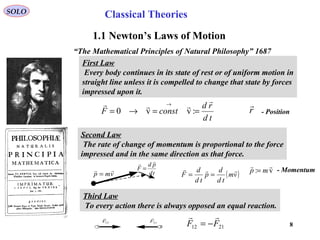
1.1 Newton’s Laws of Motion
“The Mathematical Principles of Natural Philosophy” 1687
First Law
Every body continues in its state of rest or of uniform motion in
straight line unless it is compelled to change that state by forces
impressed upon it.
Second Law
The rate of change of momentum is proportional to the force
impressed and in the same direction as that force.
Third Law
To every action there is always opposed an equal reaction.
td
rd
constF


==→=
→
:vv0
( )vm
td
d
p
td
d
F

==
2112 FF

−=
vmp

= td
pd
F

=
12F

1 2
21F

r

- Position
v:

mp = - Momentum
9
SOLO
1.2 Work and Energy
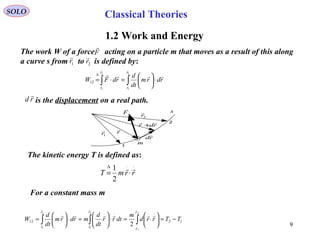
The work W of a force acting on a particle m that moves as a result of this along
a curve s from to is defined by:
F

1r

2r

∫∫ ⋅





=⋅=
⋅∆ 2
1
2
1
12
r
r
r
r
rdrm
dt
d
rdFW





r

1r

2r

rd

rdr

+
1
2
F

m
s
rd

is the displacement on a real path.
⋅⋅∆
⋅= rrmT

2
1
The kinetic energy T is defined as:
1212
2
1
2
1
2
1
2
TTrrd
m
dtrr
dt
d
mrdrm
dt
d
W
r
r
r
r
r
r
−=





⋅=⋅





=⋅





= ∫∫∫
⋅
⋅
⋅⋅⋅⋅⋅







For a constant mass m
Classical Theories
10
SOLO
Work and Energy (continue)
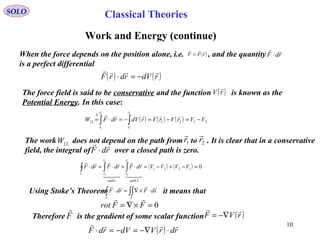
When the force depends on the position alone, i.e. , and the quantity
is a perfect differential
( )rFF

= rdF

⋅
( ) ( )rdVrdrF

−=⋅
The force field is said to be conservative and the function is known as the
Potential Energy. In this case:
( )rV

( ) ( ) ( ) 212112
2
1
2
1
VVrVrVrdVrdFW
r
r
r
r
−=−=−=⋅= ∫∫
∆ 




The work does not depend on the path from to . It is clear that in a conservative
field, the integral of over a closed path is zero.
12W 1r

2r

rdF

⋅
( ) ( ) 01221
21
1
2
2
1
=−+−=⋅+⋅=⋅ ∫∫∫ VVVVrdFrdFrdF
path
r
r
path
r
rC








Using Stoke’s Theorem it means that∫∫∫ ⋅×∇=⋅
SC
sdFrdF

0=×∇= FFrot

Therefore is the gradient of some scalar functionF

( ) rdrVdVrdF

⋅−∇=−=⋅
( )rVF

−∇=
Classical Theories
11
SOLO
Work and Energy (continue)
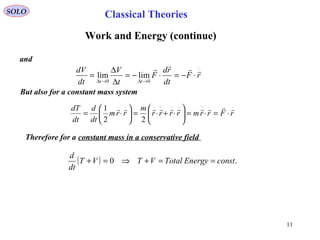
and
⋅
→∆→∆
⋅−=⋅−=
∆
∆
= rF
dt
rd
F
t
V
dt
dV
tt

00
limlim
But also for a constant mass system
⋅⋅⋅⋅⋅⋅⋅⋅⋅⋅⋅⋅
⋅=⋅=





⋅+⋅=





⋅= rFrrmrrrr
m
rrm
dt
d
dt
dT 
22
1
Therefore for a constant mass in a conservative field
( ) .0 constEnergyTotalVTVT
dt
d
==+⇒=+
Classical Theories
SOLO
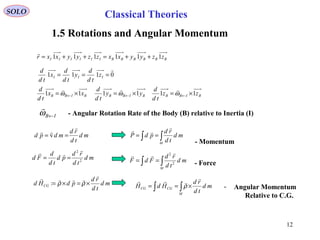
1.5 Rotations and Angular Momentum
Classical Theories
md
td
rd
mdpd


== v
md
td
rd
pd
td
d
Fd 2
2 

==
md
td
rd
pdHd CG


×=×= ρρ:
∫∫ ==
M
md
td
rd
pdP


∫∫ ==
M
md
td
rd
FdF 2
2 
- Angular Rotation Rate of the Body (B) relative to Inertia (I)
- Force
∫∫ ×==
M
CGCG md
td
rd
HdH


ρ - Angular Momentum
Relative to C.G.
BBBBBBIIIIII zzyyxxzzyyxxr 111111 ++=++=

BIBBBIBBBIBB
III
zz
td
d
yy
td
d
xx
td
d
z
td
d
y
td
d
x
td
d
111111
0111
×=×=×=
===
←←← ωωω


IB←ω

- Momentum
12
SOLO
1.6 Lagrange, Hamilton, Jacobi
Classical Theories
Carl Gustav Jacob
Jacobi
(1804-1851)
William Rowan
Hamilton
1805-1865
Joseph Louis
Lagrange
1736-1813
Lagrangiams
Lagrange’s Equations: nicQ
q
L
q
L
dt
d m
k
k
ikin
ii
,,2,1
1


=+=
∂
∂
−





∂
∂
∑=
λ
mkcqc k
t
n
i
i
k
i ,,2,10
1
 ==+∑=
( ) ( ) ( )qVtqqTtqqL

−= ,,:,,
ni
cQ
q
H
p
p
H
q
m
j
j
iji
i
i
i
i
,,2,1
1



=







++
∂
∂
−=
∂
∂
=
∑=
λ
mkcqc k
t
n
i
i
k
i ,,2,10
1
 ==+∑=
Extended Hamilton’s Equations
Constrained Differential Equations
Hamiltonian ( )tqqTqpH
n
i
ii ,,:
1

 −= ∑=
ni
q
T
p
i
i ,,2,1 

=
∂
∂
=
Hamilton-Jacobi Equation 0,, =





∂
∂
+
∂
∂
k
k
q
S
qtH
t
S 





∂
∂
= k
kjj
q
S
qtq ,,φ
kk
q
S
p
∂
∂
= 13
14
SOLO
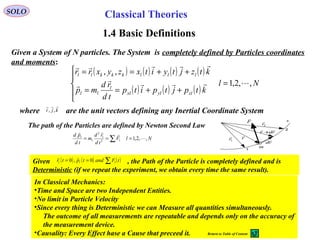
1.4 Basic Definitions
Given a System of N particles. The System is completely defined by Particles coordinates
and moments:
( ) ( ) ( ) ( )
( ) ( ) ( )
Nl
ktpjtpitp
td
rd
mp
ktzjtyitxzyxrr
zlylxl
l
ll
lllkkkll
,,2,1
,,



=





++==
++==
where are the unit vectors defining any Inertial Coordinate Systemkji

,,
r

1r

2r

rd

rdr

+
1
2
F

m
s
The path of the Particles are defined by Newton Second Law
NlF
td
rd
m
td
pd
l
l
l
l
,,2,12
2


=== ∑
Given , the Path of the Particle is completely defined and is
Deterministic (if we repeat the experiment, we obtain every time the same result).
( ) ( ) ( )tFandtptr lll ∑== 0,0

In Classical Mechanics:
•Time and Space are two Independent Entities.
•No limit in Particle Velocity
•Since every thing is Deterministic we can Measure all quantities simultaneously.
The outcome of all measurements are repeatable and depends only on the accuracy of
the measurement device.
•Causality: Every Effect hase a Cause that preceed it.
Classical Theories
Return to Table of Content
GRAVITY
Classical Theories
GF

GF
M m
  


EQPOISSON
G
GU
r
MG
UU
r
GM
g
gm
r
MG
mr
r
mM
GF
ρπ4&&
1
2
2
=∇=−∇=





−∇=
−=





∇=−=
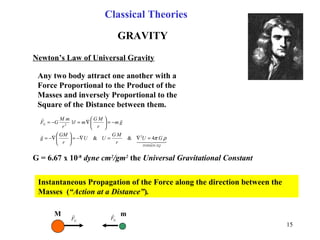
Newton’s Law of Universal Gravity
Any two body attract one another with a
Force Proportional to the Product of the
Masses and inversely Proportional to the
Square of the Distance between them.
G = 6.67 x 10⁻⁸
dyne cm2
/gm2
the Universal Gravitational Constant
Instantaneous Propagation of the Force along the direction between the
Masses (“Action at a Distance”).
15
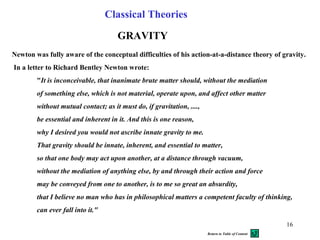
Newton was fully aware of the conceptual difficulties of his action-at-a-distance theory of gravity.
In a letter to Richard Bentley Newton wrote:
"It is inconceivable, that inanimate brute matter should, without the mediation
of something else, which is not material, operate upon, and affect other matter
without mutual contact; as it must do, if gravitation, ....,
be essential and inherent in it. And this is one reason,
why I desired you would not ascribe innate gravity to me.
That gravity should be innate, inherent, and essential to matter,
so that one body may act upon another, at a distance through vacuum,
without the mediation of anything else, by and through their action and force
may be conveyed from one to another, is to me so great an absurdity,
that I believe no man who has in philosophical matters a competent faculty of thinking,
can ever fall into it."
GRAVITY
Classical Theories
16
Return to Table of Content
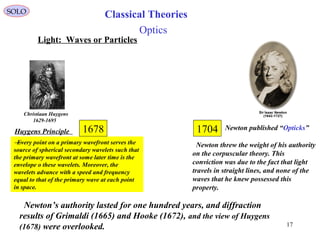
17
SOLO
Newton published “Opticks”1704
Newton threw the weight of his authority
on the corpuscular theory. This
conviction was due to the fact that light
travels in straight lines, and none of the
waves that he knew possessed this
property.
Newton’s authority lasted for one hundred years, and diffraction
results of Grimaldi (1665) and Hooke (1672), and the view of Huygens
(1678) were overlooked.
Optics
Every point on a primary wavefront serves the
source of spherical secondary wavelets such that
the primary wavefront at some later time is the
envelope o these wavelets. Moreover, the
wavelets advance with a speed and frequency
equal to that of the primary wave at each point
in space.
Christiaan Huygens
1629-1695
Huygens Principle 1678
Light: Waves or Particles
Classical Theories
18
SOLO
In 1801 Thomas Young uses constructive and destructive interference
of waves to explain the Newton’s rings.
Thomas Young
1773-1829
1801 - 1803
In 1803 Thomas Young explains the fringes at the edges of shadows
using the wave theory of light. But, the fact that was belived that the
light waves are longitudinal, mad difficult the explanation of double
refraction in certain crystals.
Optics
Run This
Young Double Slit Experiment
Classical Theories
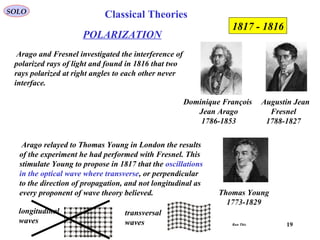
19
POLARIZATION
Arago and Fresnel investigated the interference of
polarized rays of light and found in 1816 that two
rays polarized at right angles to each other never
interface.
SOLO
Dominique François
Jean Arago
1786-1853
Augustin Jean
Fresnel
1788-1827
Arago relayed to Thomas Young in London the results
of the experiment he had performed with Fresnel. This
stimulate Young to propose in 1817 that the oscillations
in the optical wave where transverse, or perpendicular
to the direction of propagation, and not longitudinal as
every proponent of wave theory believed. Thomas Young
1773-1829
1816-1817
longitudinal
waves
transversal
waves
Classical Theories
Run This
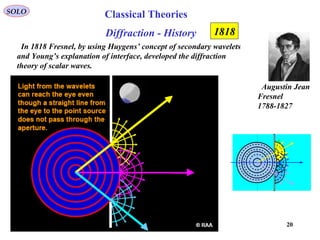
20
SOLO
Augustin Jean
Fresnel
1788-1827
In 1818 Fresnel, by using Huygens’ concept of secondary wavelets
and Young’s explanation of interface, developed the diffraction
theory of scalar waves.
1818Diffraction - History
Classical Theories
21
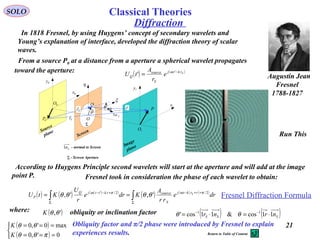
Diffraction
SOLO
Augustin Jean
Fresnel
1788-1827
In 1818 Fresnel, by using Huygens’ concept of secondary wavelets and
Young’s explanation of interface, developed the diffraction theory of scalar
waves.
P
0P
Q 1x
0x
1y
0y
η
ξ
Fr

Sr

ρ
 r

O
'θ
θ
Screen
Image
plane
Source
plane
0O
1O
Sn1
Σ
Σ - Screen Aperture
Sn1 - normal to Screen
From a source P0 at a distance from a aperture a spherical wavelet propagates
toward the aperture: ( ) ( )Srktj
S
source
Q e
r
A
tU −
= '
' ω
According to Huygens Principle second wavelets will start at the aperture and will add at the image
point P.
( ) ( ) ( )( )
( ) ( )( )
∫∫ Σ
++−
Σ
+−−
== dre
rr
A
Kdre
r
U
KtU rrktj
S
sourcerkttjQ
P
S 2/2/'
',', πωπω
θθθθ
where: ( )',θθK obliquity or inclination factor ( ) ( )SSS nrnr 11cos&11cos' 11
⋅=⋅= −−
θθ
( )
( )


===
===
0',0
max0',0
πθθ
θθ
K
K Obliquity factor and π/2 phase were introduced by Fresnel to explain
experiences results.
Fresnel Diffraction Formula
Fresnel took in consideration the phase of each wavelet to obtain:
Run This
Return to Table of Content
Classical Theories
22
MAXWELL’s EQUATIONS
SOLO
Magnetic Field IntensityH

[ ]1−
⋅mA
Electric DisplacementD

[ ]2−
⋅⋅ msA
Electric Field IntensityE

[ ]1−
⋅mV
Magnetic InductionB

[ ]2−
⋅⋅ msV
Electric Current DensityeJ

[ ]2−
⋅mA
Free Electric Charge Distributioneρ [ ]3−
⋅⋅ msA
1. AMPÈRE’S CIRCUIT LAW (A) 1821 eJ
t
D
H



+
∂
∂
=×∇
2. FARADAY’S INDUCTION LAW (F) 1831
t
B
E
∂
∂
−=×∇


3. GAUSS’ LAW – ELECTRIC (GE) ~ 1830
eD ρ=⋅∇

4. GAUSS’ LAW – MAGNETIC (GM) 0=⋅∇ B

André-Marie Ampère
1775-1836
Michael Faraday
1791-1867
Karl Friederich Gauss
1777-1855
James Clerk Maxwell
(1831-1879)
1865
Electromagnetism
MAXWELL UNIFIED ELECTRICITY AND MAGNETISM
Classical Theories
23
SOLO
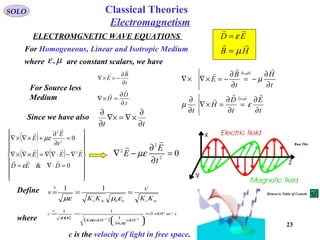
ELECTROMGNETIC WAVE EQUATIONS
For Homogeneous, Linear and Isotropic Medium
ED

ε=
HB

µ=
where are constant scalars, we haveµε,
t
E
t
D
H
t
t
H
t
B
E
ED
HB
∂
∂
=
∂
∂
=×∇
∂
∂
∂
∂
−=
∂
∂
−=×∇×∇
=
=






εµ
µ
ε
µ
Since we have also
tt ∂
∂
×∇=∇×
∂
∂
( )
( ) ( )


















=⋅∇=
∇−⋅∇∇=×∇×∇
=
∂
∂
+×∇×∇
0&
0
2
2
2
DED
EEE
t
E
E




ε
µε
t
D
H
∂
∂
=×∇


t
B
E
∂
∂
−=×∇


For Source less
Medium
02
2
2
=
∂
∂
−∇
t
E
E


µε
Define
meme KK
c
KK
v ===
∆
00
11
εµµε
where ( )
smc /103
10
36
1
104
11 8
9700
×=






××
==
−−
∆
π
π
εµ
c is the velocity of light in free space.
Electromagnetism
Run This
Return to Table of Content
Classical Theories
Completeness of a Theory
SOLO
At the end of the 19th century, physics had evolved to the point at which classical
mechanics could cope with highly complex problems involving macroscopic situations;
thermodynamics and kinetic theory were well established; geometrical and physical optics
could be understood in terms of electromagnetic waves; and the conservation laws for
energy and momentum (and mass) were widely accepted. So profound were these and other
developments that it was generally accepted that all the important laws of physics had been
discovered and that, henceforth, research would be concerned with clearing up minor
problems and particularly with improvements of method and measurement.
"There is nothing new to be discovered in physics now. All that remains is more and more
precise measurement" - Lord Kelvin
1900:
1894:
"The more important fundamental laws and facts of physical science have all been
discovered, and these are now so firmly established that the possibility of their ever being
supplanted in consequence of new discoveries is exceedingly remote.... Our future
discoveries must be looked for in the sixth place of decimals."
- Albert. A. Michelson, speech at the dedication of Ryerson Physics Lab, U. of Chicago 1894
This was just before Relativity and Quantum Mechanics appeared on the scene and
opened up new realms for exploration. 24
Classical Theories
25
QUANTUM THEORIES
Many classical particles, both slits are open
http://www.mathematik.uni-
muenchen.de/~bohmmech/Poster/post/postE.htmlThe Double Slit Experiment
A single particle, both slits are open
Many particles, one slit is open.
Many atomic particles, both slits are open
http://en.wikipedia.org/wiki/Introduction_to_quantum_mechanics#Schr.C3.B6ding
er_wave_equation
SOLO
Run This
26
QUANTUM THEORIES
https://www.youtube.com/watch?v=Q1YqgPAtzho&src_vid=4C5pq7W5yRM&feature=iv&annotation_id=an
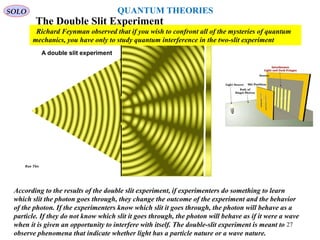
According to the results of the double slit experiment, if experimenters do something to learn
which slit the photon goes through, they change the outcome of the experiment and the behavior
of the photon. If the experimenters know which slit it goes through, the photon will behave as a
particle. If they do not know which slit it goes through, the photon will behave as if it were a wave
when it is given an opportunity to interfere with itself. The double-slit experiment is meant to
observe phenomena that indicate whether light has a particle nature or a wave nature.
Richard Feynman observed that if you wish to confront all of the mysteries of quantum
mechanics, you have only to study quantum interference in the two-slit experiment
The Double Slit Experiment
SOLO
Run This
27
QUANTUM THEORIES
QUANTUM THEORIES
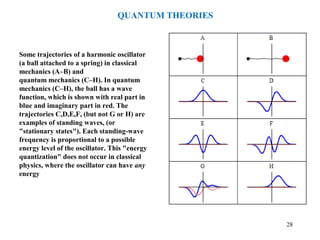
Some trajectories of a harmonic oscillator
(a ball attached to a spring) in classical
mechanics (A–B) and
quantum mechanics (C–H). In quantum
mechanics (C–H), the ball has a wave
function, which is shown with real part in
blue and imaginary part in red. The
trajectories C,D,E,F, (but not G or H) are
examples of standing waves, (or
"stationary states"). Each standing-wave
frequency is proportional to a possible
energy level of the oscillator. This "energy
quantization" does not occur in classical
physics, where the oscillator can have any
energy
28
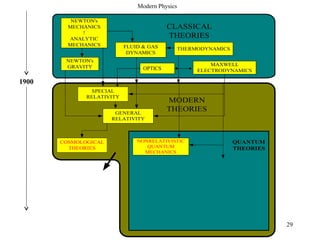
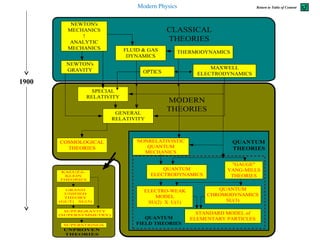
SPECIAL
RELATIVITY
GENERAL
RELATIVITY
COSMOLOGICAL
THEORIES
MODERN
THEORIES
Modern Physics
NONRELATIVISTIC
QUANTUM
MECHANICS
QUANTUM
THEORIES
NEWTON's
MECHANICS
!
ANALYTIC
MECHANICS FLUID & GAS
DYNAMICS
THERMODYNAMICS
MAXWELL
ELECTRODYNAMICS
CLASSICAL
THEORIES
NEWTON's
GRAVITY OPTICS
1900
29
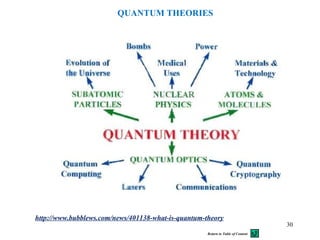
http://www.bubblews.com/news/401138-what-is-quantum-theory
30
Return to Table of Content
QUANTUM THEORIES
31
SOLO
http://thespectroscopynet.com/educational/Kirchhoff.htm
Spectroscopy
1868
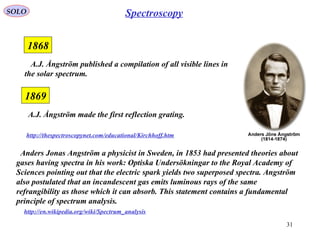
A.J. Ångström published a compilation of all visible lines in
the solar spectrum.
1869
A.J. Ångström made the first reflection grating.
Anders Jonas Angström a physicist in Sweden, in 1853 had presented theories about
gases having spectra in his work: Optiska Undersökningar to the Royal Academy of
Sciences pointing out that the electric spark yields two superposed spectra. Angström
also postulated that an incandescent gas emits luminous rays of the same
refrangibility as those which it can absorb. This statement contains a fundamental
principle of spectrum analysis.
http://en.wikipedia.org/wiki/Spectrum_analysis
32
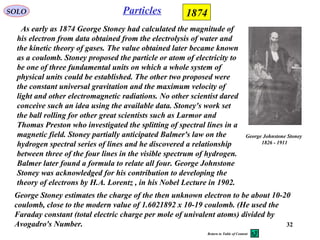
ParticlesSOLO 1874
George Johnstone Stoney
1826 - 1911
As early as 1874 George Stoney had calculated the magnitude of
his electron from data obtained from the electrolysis of water and
the kinetic theory of gases. The value obtained later became known
as a coulomb. Stoney proposed the particle or atom of electricity to
be one of three fundamental units on which a whole system of
physical units could be established. The other two proposed were
the constant universal gravitation and the maximum velocity of
light and other electromagnetic radiations. No other scientist dared
conceive such an idea using the available data. Stoney's work set
the ball rolling for other great scientists such as Larmor and
Thomas Preston who investigated the splitting of spectral lines in a
magnetic field. Stoney partially anticipated Balmer's law on the
hydrogen spectral series of lines and he discovered a relationship
between three of the four lines in the visible spectrum of hydrogen.
Balmer later found a formula to relate all four. George Johnstone
Stoney was acknowledged for his contribution to developing the
theory of electrons by H.A. Lorentz , in his Nobel Lecture in 1902.
George Stoney estimates the charge of the then unknown electron to be about 10-20
coulomb, close to the modern value of 1.6021892 x 10⁻¹⁹ coulomb. (He used the
Faraday constant (total electric charge per mole of univalent atoms) divided by
Avogadro's Number.
Return to Table of Content
33
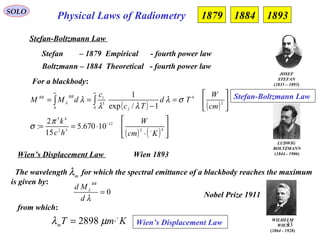
Physical Laws of RadiometrySOLO
Stefan-Boltzmann Law
Stefan – 1879 Empirical - fourth power law
Boltzmann – 1884 Theoretical - fourth power law
For a blackbody:
( ) ( )
( ) ( ) 





⋅
⋅==






=
−
==
−
∞∞
∫∫
42
12
32
45
2
4
0 2
5
1
0
10670.5
15
2
:
1/exp
1
Kcm
W
hc
k
cm
W
Td
Tc
c
dMM
BBBB

π
σ
σλ
λλ
λλ
LUDWIG
BOLTZMANN
(1844 - 1906)
Stefan-Boltzmann Law
JOSEF
STEFAN
(1835 – 1893)
1879 1884 1893
Wien’s Displacement Law
0=
λ
λ
d
Md
BB
Wien 1893
from which:
The wavelength for which the spectral emittance of a blackbody reaches the maximum
is given by:
mλ
KmTm

⋅= µλ 2898 Wien’s Displacement Law WILHELM
WIEN
(1864 - 1928)
Nobel Prize 1911
34
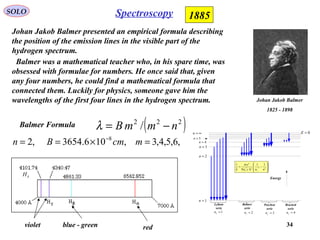
SOLO
Johan Jakob Balmer presented an empirical formula describing
the position of the emission lines in the visible part of the
hydrogen spectrum.
Spectroscopy 1885
Johan Jakob Balmer
1825 - 1898
Balmer Formula ( )222
/ nmmB −=λ
,6,5,4,3,106.3654,2 8
=×== −
mcmBn
δH
violet blue - green red
1=n
2=n
3=n
4=n
5=n
∞=n
Lyman
serie
Balmer
serie
Paschen
serie
Brackett
serie
0=E
Energy








−= 2232
0
4
11
8
1
nnhc
em
f
ελ
1=fn 2=f
n 3=fn 4=f
n
Balmer was a mathematical teacher who, in his spare time, was
obsessed with formulae for numbers. He once said that, given
any four numbers, he could find a mathematical formula that
connected them. Luckily for physics, someone gave him the
wavelengths of the first four lines in the hydrogen spectrum.
35
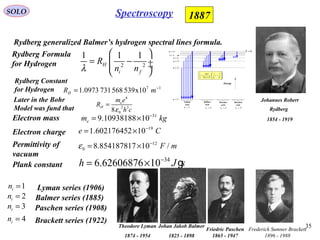
SOLO Spectroscopy 1887
Johannes Robert
Rydberg
1854 - 1919
Rydberg Formula
for Hydrogen 2 2
1 1 1
H
i f
R
n nλ
 
= − ÷ ÷
 
1=n
2=n
3=n
4=n
5=n
∞=n
Lyman
serie
Balmer
serie
Paschen
serie
Brackett
serie
0=E
Energy








−= 2232
0
4
11
8
1
nnhc
em
f
ελ
1=fn 2=fn 3=f
n 4=fn
34
6.62606876 10h J s−
= × gPlank constant
31
9.10938188 10em kg−
= ×Electron mass
19
1.602176452 10e C−
= ×Electron charge
12
0 8.854187817 10 /F mε −
= ×Permittivity of
vacuum
Rydberg generalized Balmer’s hydrogen spectral lines formula.
Theodore Lyman
1874 - 1954
2in = Balmer series (1885)
Johan Jakob Balmer
1825 - 1898
Friedric Paschen
1865 - 1947
3in = Paschen series (1908)
4in = Brackett series (1922)
Lyman series (1906)1in =
Rydberg Constant
for Hydrogen 17
x105395687310973.1 −
= mRH
4
2 3
08
e
H
m e
R
h cε
=
Later in the Bohr
Model was fund that
Frederick Sumner Brackett
1896 - 1988
36
PhotoelectricitySOLO
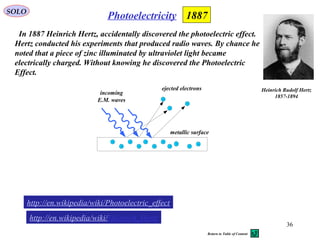
In 1887 Heinrich Hertz, accidentally discovered the photoelectric effect.
Hertz conducted his experiments that produced radio waves. By chance he
noted that a piece of zinc illuminated by ultraviolet light became
electrically charged. Without knowing he discovered the Photoelectric
Effect.
1887
Heinrich Rudolf Hertz
1857-1894
-
-
-
-
-
-
-
-
--
-
-
-
-
metallic surface
ejected electrons
incoming
E.M. waves
http://en.wikipedia/wiki/Photoelectric_effect
http://en.wikipedia/wiki/Heinrich_Hertz
Return to Table of Content
37
SpectroscopySOLO
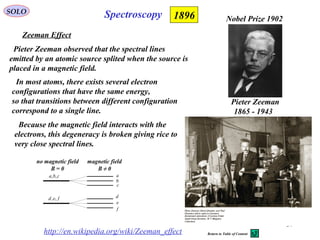
Zeeman Effect
Pieter Zeeman observed that the spectral lines
emitted by an atomic source splited when the source is
placed in a magnetic field.
In most atoms, there exists several electron
configurations that have the same energy,
so that transitions between different configuration
correspond to a single line.
1896
Because the magnetic field interacts with the
electrons, this degeneracy is broken giving rice to
very close spectral lines.
no magnetic field
B = 0
cba ,,
fed ,,
a
b
c
d
e
f
magnetic field
B 0≠
http://en.wikipedia.org/wiki/Zeeman_effect
Pieter Zeeman
1865 - 1943
Nobel Prize 1902
Return to Table of Content
38
Physical Laws of RadiometrySOLO
Wien Approximation to Black Body Radiation
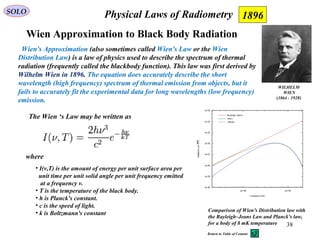
Wien's Approximation (also sometimes called Wien's Law or the Wien
Distribution Law) is a law of physics used to describe the spectrum of thermal
radiation (frequently called the blackbody function). This law was first derived by
Wilhelm Wien in 1896. The equation does accurately describe the short
wavelength (high frequency) spectrum of thermal emission from objects, but it
fails to accurately fit the experimental data for long wavelengths (low frequency)
emission.
WILHELM
WIEN
(1864 - 1928)
Comparison of Wien's Distribution law with
the Rayleigh–Jeans Law and Planck's law,
for a body of 8 mK temperature
The Wien ‘s Law may be written as
where
• I(ν,T) is the amount of energy per unit surface area per
unit time per unit solid angle per unit frequency emitted
at a frequency ν.
• T is the temperature of the black body.
• h is Planck's constant.
• c is the speed of light.
• k is Boltzmann's constant
1896
Return to Table of Content
39
SOLO Particles
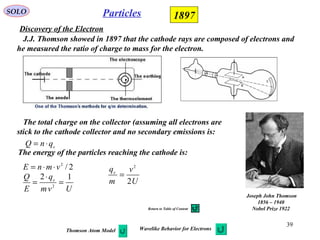
J.J. Thomson showed in 1897 that the cathode rays are composed of electrons and
he measured the ratio of charge to mass for the electron.
Discovery of the Electron
1897
Joseph John Thomson
1856 – 1940
Nobel Prize 1922
The total charge on the collector (assuming all electrons are
stick to the cathode collector and no secondary emissions is:
e
qnQ ⋅=
The energy of the particles reaching the cathode is:
2/2
vmnE ⋅⋅=
Uvm
q
E
Q e 12
2
=
⋅
= U
v
m
qe
2
2
=
Thomson Atom Model Wavelike Behavior for Electrons
Return to Table of Content
40
Physical Laws of RadiometrySOLO
Rayleigh–Jeans Law
Comparison of Rayleigh–Jeans law with
Wien approximation and Planck's law, for
a body of 8 mK temperature
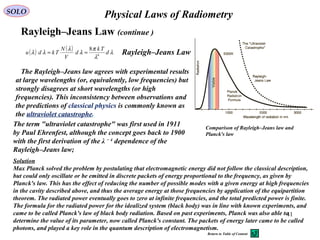
In 1900, the British physicist Lord Rayleigh derived
the λ−4
dependence of the Rayleigh–Jeans law based on
classical physical arguments.[3]
A more complete
derivation, which included the proportionality constant,
was presented by Rayleigh and Sir James Jeans in
1905. The Rayleigh–Jeans law revealed an important
error in physics theory of the time. The law predicted
an energy output that diverges towards infinity as
wavelength approaches zero (as frequency tends to
infinity) and measurements of energy output at short
wavelengths disagreed with this prediction.
John William Strutt,
3rd Baron Rayleigh
1842- 1919
James Hopwood Jeans
1877 - 1946
Rayleigh considered the radiation inside a cubic
cavity of length L and temperature T whose walls
are perfect reflectors as a series of standing
electromagnetic waves. At the walls of the cube, the
parallel component of the electric field and the
orthogonal component of the magnetic field must
vanish. Analogous to the wave function of a
particle in a box, one finds that the fields are
superpositions of periodic functions. The three
wavelengths λ1, λ2 and λ3, in the three directions
orthogonal to the walls can be: ,2,1,,
2
=== i
i
i
nzyxi
n
Lλ
1900 1905
41
Physical Laws of RadiometrySOLO
Rayleigh–Jeans Law (continue )
The Rayleigh–Jeans law agrees with experimental results
at large wavelengths (or, equivalently, low frequencies) but
strongly disagrees at short wavelengths (or high
frequencies). This inconsistency between observations and
the predictions of classical physics is commonly known as
the ultraviolet catastrophe.
Comparison of Rayleigh–Jeans law and
Planck's law
The term "ultraviolet catastrophe" was first used in 1911
by Paul Ehrenfest, although the concept goes back to 1900
with the first derivation of the λ − 4
dependence of the
Rayleigh–Jeans law;
Solution
Max Planck solved the problem by postulating that electromagnetic energy did not follow the classical description,
but could only oscillate or be emitted in discrete packets of energy proportional to the frequency, as given by
Planck's law. This has the effect of reducing the number of possible modes with a given energy at high frequencies
in the cavity described above, and thus the average energy at those frequencies by application of the equipartition
theorem. The radiated power eventually goes to zero at infinite frequencies, and the total predicted power is finite.
The formula for the radiated power for the idealized system (black body) was in line with known experiments, and
came to be called Planck's law of black body radiation. Based on past experiments, Planck was also able to
determine the value of its parameter, now called Planck's constant. The packets of energy later came to be called
photons, and played a key role in the quantum description of electromagnetism.
( ) ( ) λ
λ
π
λ
λ
λλ d
Tk
d
V
N
Tkdu 4
8
== Rayleigh–Jeans Law
Return to Table of Content
42
Physical Laws of RadiometrySOLO
MAX
PLANCK
(1858 - 1947)
4242( ) ν
ννπ
νν ν
d
e
h
c
du
kT
h
1
8
3
2
−
=
( ) ν
νπ
νν
ν
de
c
h
du kT
h
−
= 3
3
8
WILHELM
WIEN
(1864 - 1928)
Wien’s Law 1896
( ) ν
νπ
νν dTk
c
du 3
2
8
=
Rayleigh–Jeans Law
1900 - 1905
John William Strutt,
3rd Baron Rayleigh
1842- 1919
James Hopwood Jeans
1877 - 1946
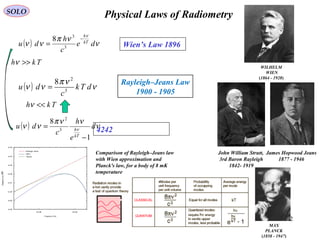
Comparison of Rayleigh–Jeans law
with Wien approximation and
Planck's law, for a body of 8 mK
temperature
Tkh <<ν
Tkh >>ν
43
Physical Laws of RadiometrySOLO
MAX
PLANCK
(1858 - 1947)
Planck’s Law 1900
( ) ν
ννπ
νν ν
d
e
h
c
du
kT
h
1
8
3
2
−
=
Planck derived empirically, by fitting the observed black body
distribution to a high degree of accuracy, the relation
By comparing this empirical correlation with the Rayleigh-Jeans
formula Planck concluded that the error in
classical theory must be in the identification of the average oscillator
energy as kT and therefore in the assumption that the oscillator
energy is distributed continuously. He then posed the following
question:
If the average energy is defined as
how is the actual oscillator energies distributed?
( ) ν
νπ
νν dTk
c
du 3
2
8
=
1/
−
= kTh
e
h
E ν
ν
KT
KWk
Wh


ineTemperaturAbsolute-
constantBoltzmannsec/103806.1
constantPlanksec106260.6
23
234
−⋅⋅=
−⋅⋅=
−
−
44
Physical Laws of RadiometrySOLO
MAX
PLANCK
(1858 - 1947)
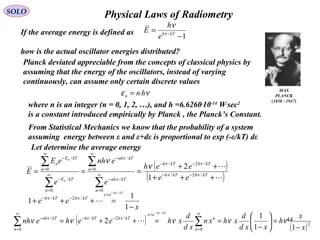
If the average energy is defined as
how is the actual oscillator energies distributed?
1/
−
= kTh
e
h
E ν
ν
Planck deviated appreciable from the concepts of classical physics by
assuming that the energy of the oscillators, instead of varying
continuously, can assume only certain discrete values
νε hnn =
Let determine the average energy
( )
( )

+++
++
=== −−
−−
∞
=
−
∞
=
−
∞
=
−
∞
=
−
∑
∑
∑
∑
kThkTh
kThkTh
n
kTnh
n
kTnh
n
kTE
n
kTE
n
ee
eeh
e
enh
e
eE
E
n
n
/2/
/2/
0
/
0
/
0
/
0
/
1
2
νν
νν
ν
ν
ν
ν
From Statistical Mechanics we know that the probability of a system
assuming energy between ε and ε+dε is proportional to exp (-ε/kT) dε
x
ee
kTh
ex
kThkTh
−
=+++
−
=
−−
1
1
1
/
/2/
ν
νν

( )
( )2
0
/2/
0
/
11
1
2
/
x
x
h
xxd
d
xhxn
xd
d
xheehenh
n
n
ex
kThkTh
n
kTnh
kTh
−
=





−
==++= ∑∑
∞
=
=
−−
∞
=
−
−
ννννν
ν
ννν

where n is an integer (n = 0, 1, 2, …), and h =6.6260.
10-14
W.
sec2
is a constant introduced empirically by Planck , the Planck’s Constant.
45
Physical Laws of RadiometrySOLO
MAX
PLANCK
(1858 - 1947)
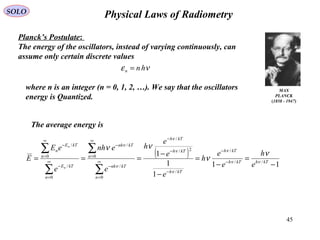
Planck’s Postulate:
The energy of the oscillators, instead of varying continuously, can
assume only certain discrete values
νε hnn =
where n is an integer (n = 0, 1, 2, …). We say that the oscillators
energy is Quantized.
( )
11
1
1
1
//
/
/
2/
/
0
/
0
/
0
/
0
/
−
=
−
=
−
−
=== −
−
−
−
−
∞
=
−
∞
=
−
∞
=
−
∞
=
−
∑
∑
∑
∑
kThkTh
kTh
kTh
kTh
kTh
n
kTnh
n
kTnh
n
kTE
n
kTE
n
e
h
e
e
h
e
e
e
h
e
enh
e
eE
E
n
n
νν
ν
ν
ν
ν
ν
ν
ν
ν
νν
The average energy is
46
Physical Laws of RadiometrySOLO
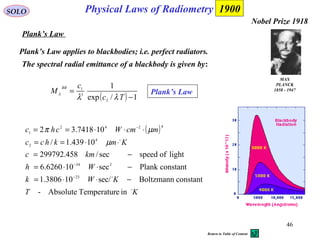
Plank’s Law
( ) 1/exp
1
2
5
1
−
=
Tc
c
M
BB
λλ
λ
Plank’s Law applies to blackbodies; i.e. perfect radiators.
The spectral radial emittance of a blackbody is given by:
( )
KT
KWk
Wh
kmc
Kmkhcc
mcmWchc



ineTemperaturAbsolute-
constantBoltzmannsec/103806.1
constantPlanksec106260.6
lightofspeedsec/458.299792
10439.1/
107418.32
23
234
4
2
4242
1
−⋅⋅=
−⋅⋅=
−=
⋅⋅==
⋅⋅⋅==
−
−
−
µ
µπ
Plank’s Law
1900
MAX
PLANCK
1858 - 1947
Nobel Prize 1918
Return to Table of Content
47
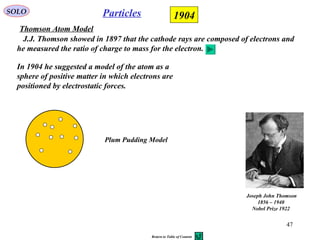
SOLO Particles
J.J. Thomson showed in 1897 that the cathode rays are composed of electrons and
he measured the ratio of charge to mass for the electron.
In 1904 he suggested a model of the atom as a
sphere of positive matter in which electrons are
positioned by electrostatic forces.
Thomson Atom Model
1904
--
--
--
--
--
--
--
--
--
--
Joseph John Thomson
1856 – 1940
Nobel Prize 1922
Plum Pudding Model
Return to Table of Content
48
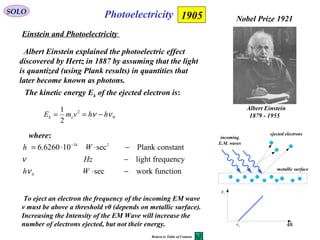
PhotoelectricitySOLO
Einstein and Photoelectricity
Albert Einstein explained the photoelectric effect
discovered by Hertz in 1887 by assuming that the light
is quantized (using Plank results) in quantities that
later become known as photons.
1905
-
-
-
-
-
-
-
-
--
-
-
-
-
metallic surface
ejected electrons
incoming
E.M. waves
k
E
0
ν ν
0
2
2
1
νν hhvmE ek −==
The kinetic energy Ek of the ejected electron is:
where:
functionworksec
frequencylight
constantPlanksec106260.6
0
234
−⋅
−
−⋅⋅= −
Wh
Hz
Wh
ν
ν
Albert Einstein
1879 - 1955
Nobel Prize 1921
To eject an electron the frequency of the incoming EM wave
v must be above a threshold v0 (depends on metallic surface).
Increasing the Intensity of the EM Wave will increase the
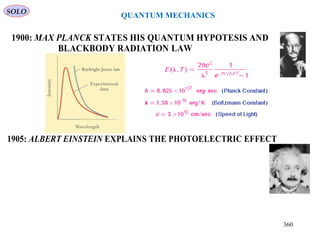
number of electrons ejected, but not their energy.
Return to Table of Content
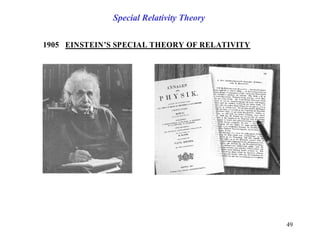
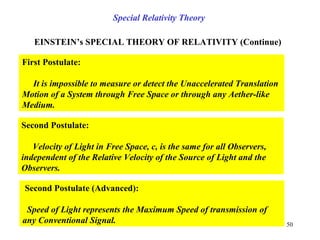
1905 EINSTEIN’S SPECIAL THEORY OF RELATIVITY
Special Relativity Theory
49
EINSTEIN’s SPECIAL THEORY OF RELATIVITY (Continue)
First Postulate:
It is impossible to measure or detect the Unaccelerated Translation
Motion of a System through Free Space or through any Aether-like
Medium.
Second Postulate:
Velocity of Light in Free Space, c, is the same for all Observers,
independent of the Relative Velocity of the Source of Light and the
Observers.
Second Postulate (Advanced):
Speed of Light represents the Maximum Speed of transmission of
any Conventional Signal.
Special Relativity Theory
50
51
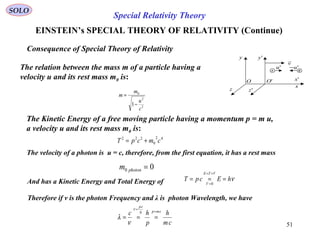
SOLO
x
z
y
'x
'z
'y
v

'u
'OO
'u−
A B
Consequence of Special Theory of Relativity
The relation between the mass m of a particle having a
velocity u and its rest mass m0 is:
2
2
0
1
c
u
m
m
−
=
Special Relativity Theory
EINSTEIN’s SPECIAL THEORY OF RELATIVITY (Continue)
The Kinetic Energy of a free moving particle having a momentum p = m u,
a velocity u and its rest mass m0 is:
42
0
222
cmcpT +=
The velocity of a photon is u = c, therefore, from the first equation, it has a rest mass
00 =photonm
And has a Kinetic Energy and Total Energy of νhEcpT
VTE
V
===
+=
=0
Therefore if v is the photon Frequency and λ is photon Wavelength, we have
cm
h
p
hc cmph
cp
=
=
===
ν
ν
λ
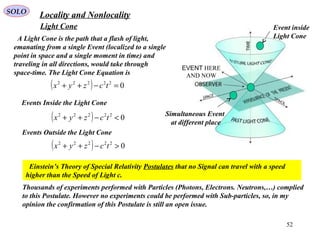
Locality and NonlocalitySOLO
Event inside
Light Cone
EVENT HERE
AND NOW
Simultaneous Event
at different place
A Light Cone is the path that a flash of light,
emanating from a single Event (localized to a single
point in space and a single moment in time) and
traveling in all directions, would take through
space-time. The Light Cone Equation is
( ) 022222
=−++ tczyx
Events Inside the Light Cone
( ) 022222
<−++ tczyx
Events Outside the Light Cone
( ) 022222
>−++ tczyx
Einstein’s Theory of Special Relativity Postulates that no Signal can travel with a speed
higher than the Speed of Light c.
Thousands of experiments performed with Particles (Photons, Electrons. Neutrons,…) complied
to this Postulate. However no experiments could be performed with Sub-particles, so, in my
opinion the confirmation of this Postulate is still an open issue.
Light Cone
52
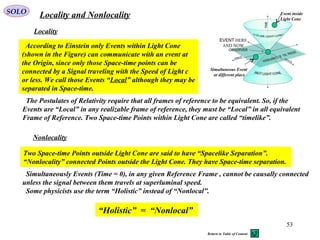
Locality and NonlocalitySOLO Event inside
Light Cone
EVENT HERE
AND NOW
Simultaneous Event
at different place
According to Einstein only Events within Light Cone
(shown in the Figure) can communicate with an event at
the Origin, since only those Space-time points can be
connected by a Signal traveling with the Speed of Light c
or less. We call those Events “Local” although they may be
separated in Space-time.
Locality
The Postulates of Relativity require that all frames of reference to be equivalent. So, if the
Events are “Local” in any realizable frame of reference, they must be “Local” in all equivalent
Frame of Reference. Two Space-time Points within Light Cone are called “timelike”.
Nonlocality
Two Space-time Points outside Light Cone are said to have “Spacelike Separation”.
“Nonlocality” connected Points outside the Light Cone. They have Space-time separation.
Simultaneously Events (Time = 0), in any given Reference Frame , cannot be causally connected
unless the signal between them travels at superluminal speed.
Some physicists use the term “Holistic” instead of “Nonlocal”.
“Holistic” = “Nonlocal”
53
Return to Table of Content
54
SOLO
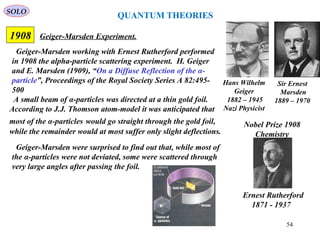
1908 Geiger-Marsden Experiment.
Ernest Rutherford
1871 - 1937
Nobel Prize 1908
Chemistry
Hans Wilhelm
Geiger
1882 – 1945
Nazi Physicist
Sir Ernest
Marsden
1889 – 1970
Geiger-Marsden working with Ernest Rutherford performed
in 1908 the alpha-particle scattering experiment. H. Geiger
and E. Marsden (1909), “On a Diffuse Reflection of the α-
particle”, Proceedings of the Royal Society Series A 82:495-
500
A small beam of α-particles was directed at a thin gold foil.
According to J.J. Thomson atom-model it was anticipated that
most of the α-particles would go straight through the gold foil,
while the remainder would at most suffer only slight deflections.
Geiger-Marsden were surprised to find out that, while most of
the α-particles were not deviated, some were scattered through
very large angles after passing the foil.
QUANTUM THEORIES
55
ParticlesSOLO
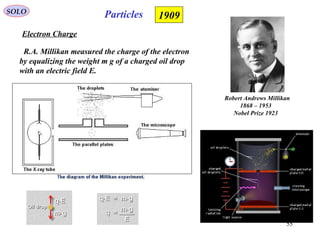
Electron Charge
R.A. Millikan measured the charge of the electron
by equalizing the weight m g of a charged oil drop
with an electric field E.
1909
Robert Andrews Millikan
1868 – 1953
Nobel Prize 1923
56
SOLO
Rutherford Atom Model
1911 Ernest Rutherford finds the first evidence of protons.
To explain the Geiger-Marsden Experiment of 1908 he
suggested in 1911 that the positively charged atomic
nucleus contain protons.
Ernest Rutherford
1871 - 1937
Nobel Prize 1908
Chemistry
Hans Wilhelm
Geiger
1882 – 1945
Nazi Physicist
Sir Ernest
Marsden
1889 – 1970
--
--
--
--
--
--
--
--
--
--
+2
+2
+2
Rutherford assumed that the atom model consists of a small
nucleus, of positive charge, concentrated at the center, surrounded
by a cloud of negative electrons. The positive α-particles that passed
close to the positive nucleus were scattered because of the electrical
repealing force between the positive charged α-particle and the nucleus .
QUANTUM MECHANICS
Return to Table of Content
57
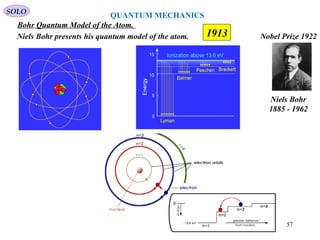
1913
SOLO
Niels Bohr presents his quantum model of the atom.
Niels Bohr
1885 - 1962
Nobel Prize 1922
QUANTUM MECHANICS
Bohr Quantum Model of the Atom.
58
1913
SOLO
Niels Bohr
1885 - 1962
Nobel Prize 1922
Explanation of Bohr Hydrogen Model
In 1911, Bohr travelled to England. He met with J. J. Thomson of the Cavendish
Laboratory and Trinity College, Cambridge, and New Zealand's Ernest
Rutherford, whose 1911 Rutherford model of the atom had challenged Thomson's
1904 Plum Pudding Model.[
Bohr received an invitation from Rutherford to
conduct post-doctoral work at Victoria University of Manchester. He adapted
Rutherford's nuclear structure to Max Planck's quantum theory and so created
his Bohr model of the atom.[
In 1885, Johan Balmer had come up with his Balmer series to describe
the visible spectral lines of a hydrogen atoms:
that was extended by Rydberg in 1887, to
Additional series by Lyman (1906), Paschen (1908)
( )222
/ nmmB −=λ
2 2
1 1 1
H
i f
R
n nλ
 
= − ÷ ÷
 
Bohr Model of the Hydrogen Atom consists on a electron, of
negative charge, orbiting a positive charge nucleus.
The Forces acting on the orbiting electron are
AttractionofForceticElectrosta
r
e
F
ForcelCentripeta
r
m
F
e
c
2
0
2
2
4
v
επ
=
=
m – electron mass
v – electron orbital velocity
r – orbit radius
e – electron charge
( )229
0
/109
4
1
coulombmN ⋅×=
επ
QUANTUM MECHANICS
59
1913
SOLO
Niels Bohr
1885 - 1962
Nobel Prize 1922
Explanation of Bohr Hydrogen Model (continue – 1)
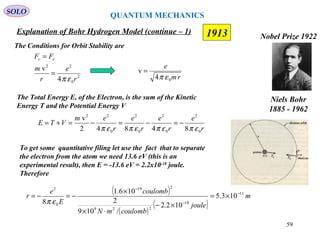
The Conditions for Orbit Stability are
2
0
22
4
v
r
e
r
m
FF ec
επ
=
=
rm
e
04
v
επ
=
The Total Energy E, of the Electron, is the sum of the Kinetic
Energy T and the Potential Energy V
r
e
r
e
r
e
r
em
VTE
0
2
0
2
0
2
0
22
84842
v
επεπεπεπ
−=−=−=+=
To get some quantitative filing let use the fact that to separate
the electron from the atom we need 13.6 eV (this is an
experimental result), then E = -13.6 eV = 2.2x10⁻¹⁸
joule.
Therefore
( )
( )
( )
m
joule
coulombmN
coulomb
E
e
r 11
18
229
219
0
2
103.5
102.2
/109
2
106.1
8
−
−
−
×=
×−
⋅×
×
−=−=
επ
QUANTUM MECHANICS
1913
SOLO
Niels Bohr
1885 - 1962
Nobel Prize 1922
Explanation of Bohr Hydrogen Model (continue – 2)
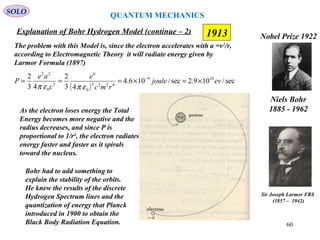
The problem with this Model is, since the electron accelerates with a =v2
/r,
according to Electromagnetic Theory it will radiate energy given by
Larmor Formula (1897)
( )
sec/109.2sec/106.4
43
2
43
2 109
4233
0
6
3
0
22
evjoule
rmc
e
c
ae
P ×=×=== −
επεπ
As the electron loses energy the Total
Energy becomes more negative and the
radius decreases, and since P is
proportional to 1/r4
, the electron radiates
energy faster and faster as it spirals
toward the nucleus.
Bohr had to add something to
explain the stability of the orbits.
He knew the results of the discrete
Hydrogen Spectrum lines and the
quantization of energy that Planck
introduced in 1900 to obtain the
Black Body Radiation Equation.
Sir Joseph Larmor FRS
(1857 – 1942)
QUANTUM MECHANICS
60
1913
SOLO
Niels Bohr
1885 - 1962
Nobel Prize 1922
Explanation of Bohr Hydrogen Model (continue – 3)
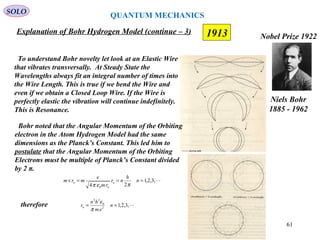
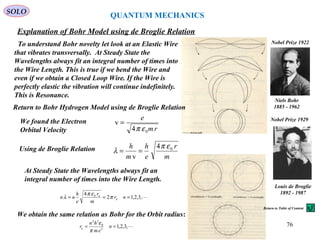
To understand Bohr novelty let look at an Elastic Wire
that vibrates transversally. At Steady State the
Wavelengths always fit an integral number of times into
the Wire Length. This is true if we bend the Wire and
even if we obtain a Closed Loop Wire. If the Wire is
perfectly elastic the vibration will continue indefinitely.
This is Resonance.
Bohr noted that the Angular Momentum of the Orbiting
electron in the Atom Hydrogen Model had the same
dimensions as the Planck’s Constant. This led him to
postulate that the Angular Momentum of the Orbiting
Electrons must be multiple of Planck’s Constant divided
by 2 π.
,3,2,1
24
v
0
=== n
h
nr
rm
e
mrm n
n
n
πεπ
,3,2,12
0
22
== n
em
hn
rn
π
ε
therefore
QUANTUM MECHANICS
61
1913
SOLO
Niels Bohr
1885 - 1962
Nobel Prize 1922
Explanation of Bohr Hydrogen Model (continue – 4)
Energy Levels and Spectra
We obtained
,3,2,1
1
88 222
0
4
0
2
=





−=−= n
nh
em
r
e
E
n
n
εεπ
,3,2,12
0
22
== n
em
hn
rn
π
ε
and Energy Levels:
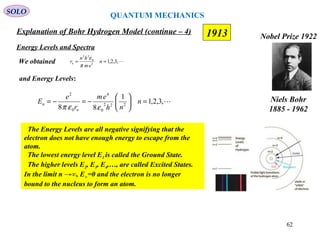
The Energy Levels are all negative signifying that the
electron does not have enough energy to escape from the
atom.
The lowest energy level E1 is called the Ground State.
The higher levels E2, E3, E4,…, are called Excited States.
In the limit n →∞, E∞=0 and the electron is no longer
bound to the nucleus to form an atom.
QUANTUM MECHANICS
62
63
1913
SOLO
Niels Bohr
1885 - 1962
Nobel Prize 1922
Explanation of Bohr Hydrogen Model (continue – 5)
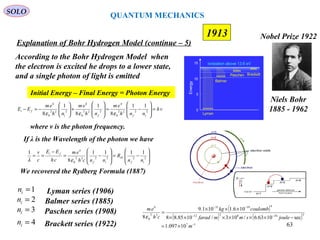
According to the Bohr Hydrogen Model when
the electron is excited he drops to a lower state,
and a single photon of light is emitted
Initial Energy – Final Energy = Photon Energy
vh
nnh
em
nh
em
nh
em
EE
iffi
fi =








−=








+







−=− 2222
0
4
222
0
4
222
0
4
11
8
1
8
1
8 εεε
where v is the photon frequency.
If λ is the Wavelength of the photon we have








−=








−=
−
== 222232
0
4
1111
8
1
if
H
if
fi
nn
R
nnch
em
ch
EE
c
v
ελ
2in = Balmer series (1885)
3in = Paschen series (1908)
4in = Brackett series (1922)
Lyman series (1906)1in =
We recovered the Rydberg Formula (1887)
( )
( ) ( )
17
3348212
41931
32
0
4
10097.1
sec1063.6/103/1085.88
106.1101.9
8
−
−−
−−
×=
−××××××
×××
=
m
joulesmmfarad
coulombkg
ch
em
ε
QUANTUM MECHANICS
64
1913
SOLO
Niels Bohr
1885 - 1962
Nobel Prize 1922
Explanation of Bohr Hydrogen Model (continue – 6)
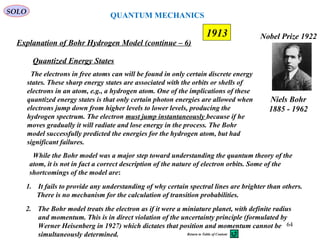
2. The Bohr model treats the electron as if it were a miniature planet, with definite radius
and momentum. This is in direct violation of the uncertainty principle (formulated by
Werner Heisenberg in 1927) which dictates that position and momentum cannot be
simultaneously determined.
1. It fails to provide any understanding of why certain spectral lines are brighter than others.
There is no mechanism for the calculation of transition probabilities.
While the Bohr model was a major step toward understanding the quantum theory of the
atom, it is not in fact a correct description of the nature of electron orbits. Some of the
shortcomings of the model are:
The electrons in free atoms can will be found in only certain discrete energy
states. These sharp energy states are associated with the orbits or shells of
electrons in an atom, e.g., a hydrogen atom. One of the implications of these
quantized energy states is that only certain photon energies are allowed when
electrons jump down from higher levels to lower levels, producing the
hydrogen spectrum. The electron must jump instantaneously because if he
moves gradually it will radiate and lose energy in the process. The Bohr
model successfully predicted the energies for the hydrogen atom, but had
significant failures.
Quantized Energy States
QUANTUM MECHANICS
Return to Table of Content
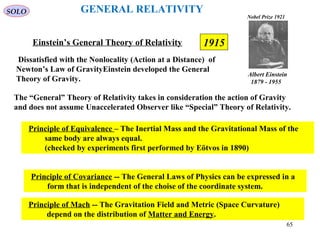
1915Einstein’s General Theory of Relativity
The “General” Theory of Relativity takes in consideration the action of Gravity
and does not assume Unaccelerated Observer like “Special” Theory of Relativity.
Principle of Equivalence – The Inertial Mass and the Gravitational Mass of the
same body are always equal.
(checked by experiments first performed by Eötvos in 1890)
Principle of Covariance -- The General Laws of Physics can be expressed in a
form that is independent of the choise of the coordinate system.
Principle of Mach -- The Gravitation Field and Metric (Space Curvature)
depend on the distribution of Matter and Energy.
SOLO GENERAL RELATIVITY
Dissatisfied with the Nonlocality (Action at a Distance) of
Newton’s Law of GravityEinstein developed the General
Theory of Gravity.
Albert Einstein
1879 - 1955
Nobel Prize 1921
65
GENERAL RELATIVITY
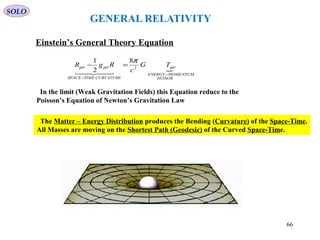
Einstein’s General Theory Equation

TENSOR
MOMENTUMENERGY
CURVATURETIMESPACE
TG
c
RgR
−
−
=− µνµνµν
π
2
8
2
1

The Matter – Energy Distribution produces the Bending (Curvature) of the Space-Time.
All Masses are moving on the Shortest Path (Geodesic) of the Curved Space-Time.
In the limit (Weak Gravitation Fields) this Equation reduce to the
Poisson’s Equation of Newton’s Gravitation Law
SOLO
66
SOLO GENERAL RELATIVITY
67
GENERAL RELATIVITY
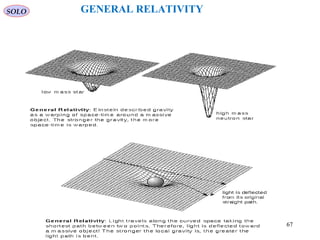
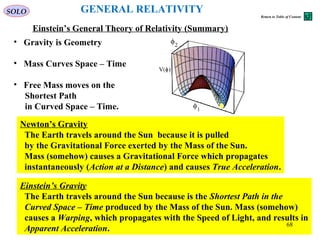
Einstein’s General Theory of Relativity (Summary)
• Gravity is Geometry
• Mass Curves Space – Time
• Free Mass moves on the
Shortest Path
in Curved Space – Time.
SOLO
Newton’s Gravity
The Earth travels around the Sun because it is pulled
by the Gravitational Force exerted by the Mass of the Sun.
Mass (somehow) causes a Gravitational Force which propagates
instantaneously (Action at a Distance) and causes True Acceleration.
Einstein’s Gravity
The Earth travels around the Sun because is the Shortest Path in the
Curved Space – Time produced by the Mass of the Sun. Mass (somehow)
causes a Warping, which propagates with the Speed of Light, and results in
Apparent Acceleration.
68
Return to Table of Content
69
Photons EmissionSOLO
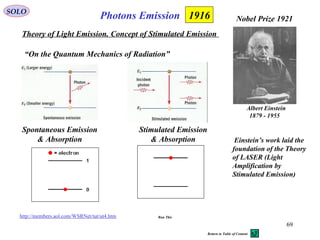
Theory of Light Emission. Concept of Stimulated Emission
1916
Albert Einstein
1879 - 1955
Nobel Prize 1921
http://members.aol.com/WSRNet/tut/ut4.htm
Spontaneous Emission
& Absorption
Stimulated Emission
& Absorption
“On the Quantum Mechanics of Radiation”
Run This
Einstein’s work laid the
foundation of the Theory
of LASER (Light
Amplification by
Stimulated Emission)
Return to Table of Content
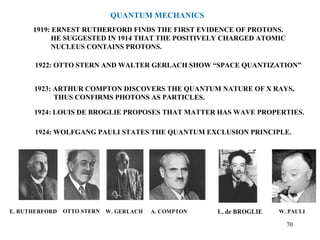
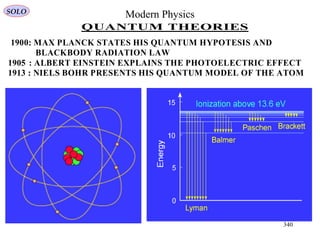
E. RUTHERFORD OTTO STERN W. GERLACH A. COMPTON L. de BROGLIE W. PAULI
QUANTUM MECHANICS
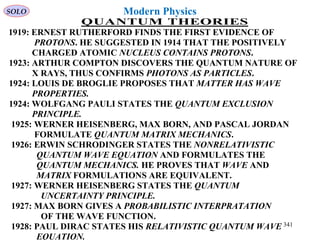
1919: ERNEST RUTHERFORD FINDS THE FIRST EVIDENCE OF PROTONS.
HE SUGGESTED IN 1914 THAT THE POSITIVELY CHARGED ATOMIC
NUCLEUS CONTAINS PROTONS.
1922: OTTO STERN AND WALTER GERLACH SHOW “SPACE QUANTIZATION”
1923: ARTHUR COMPTON DISCOVERS THE QUANTUM NATURE OF X RAYS,
THUS CONFIRMS PHOTONS AS PARTICLES.
1924: LOUIS DE BROGLIE PROPOSES THAT MATTER HAS WAVE PROPERTIES.
1924: WOLFGANG PAULI STATES THE QUANTUM EXCLUSION PRINCIPLE.
70
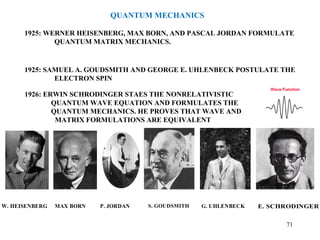
W. HEISENBERG MAX BORN P. JORDAN S. GOUDSMITH G. UHLENBECK E. SCHRODINGER
QUANTUM MECHANICS
1925: WERNER HEISENBERG, MAX BORN, AND PASCAL JORDAN FORMULATE
QUANTUM MATRIX MECHANICS.
1925: SAMUEL A. GOUDSMITH AND GEORGE E. UHLENBECK POSTULATE THE
ELECTRON SPIN
1926: ERWIN SCHRODINGER STAES THE NONRELATIVISTIC
QUANTUM WAVE EQUATION AND FORMULATES THE
QUANTUM MECHANICS. HE PROVES THAT WAVE AND
MATRIX FORMULATIONS ARE EQUIVALENT
71
W. HEISENBERGMAX BORN PAUL DIRAC J. von NEUMANN
QUANTUM MECHANICS
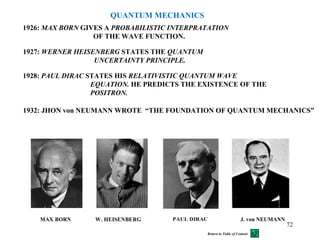
1926: MAX BORN GIVES A PROBABILISTIC INTERPRATATION
OF THE WAVE FUNCTION.
1927: WERNER HEISENBERG STATES THE QUANTUM
UNCERTAINTY PRINCIPLE.
1928: PAUL DIRAC STATES HIS RELATIVISTIC QUANTUM WAVE
EQUATION. HE PREDICTS THE EXISTENCE OF THE
POSITRON.
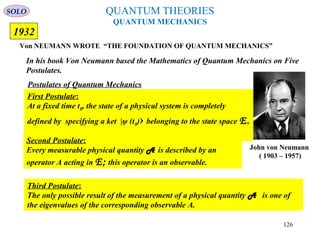
1932: JHON von NEUMANN WROTE “THE FOUNDATION OF QUANTUM MECHANICS”
72
Return to Table of Content
73
SOLO
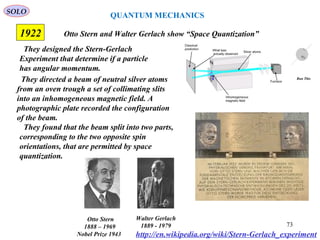
1922 Otto Stern and Walter Gerlach show “Space Quantization”
Walter Gerlach
1889 - 1979
They designed the Stern-Gerlach
Experiment that determine if a particle
has angular momentum.
http://en.wikipedia.org/wiki/Stern-Gerlach_experiment
Otto Stern
1888 – 1969
Nobel Prize 1943
They directed a beam of neutral silver atoms
from an oven trough a set of collimating slits
into an inhomogeneous magnetic field. A
photographic plate recorded the configuration
of the beam.
They found that the beam split into two parts,
corresponding to the two opposite spin
orientations, that are permitted by space
quantization.
Run This
QUANTUM MECHANICS
74
SOLO
1923
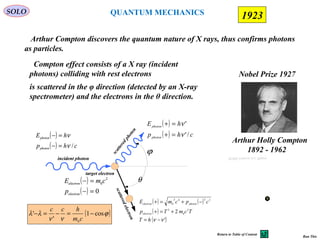
Arthur Compton discovers the quantum nature of X rays, thus confirms photons
as particles.
Arthur Holly Compton
1892 - 1962
Nobel Prize 1927
incident photon
( )
( ) chp
hE
photon
photon
/ν
ν
=−
=−
( )
( ) 0
2
0
=−
=−
electron
electron
p
cmE
target electron
Compton effect consists of a X ray (incident
photons) colliding with rest electrons
incident photon
scatteredphoton
( )
( ) chp
hE
photon
photon
/ν
ν
=−
=−
( )
( ) 0
2
0
=−
=−
electron
electron
p
cmE
( )
( ) chp
hE
photon
photon
/'
'
ν
ν
=+
=+
( ) ( )
( )
( )'
2 2
0
2
2242
0
νν −=
+=+
−+=+
hT
TcmTp
cpcmE
electron
photonelectron
ϕ
θ
( )ϕ
νν
λλ cos1
'
'
0
−=−=−
cm
hcc
scatteredelectron
target electron
is scattered in the φ direction (detected by an X-ray
spectrometer) and the electrons in the θ direction.
Run This
QUANTUM MECHANICS
Return to Table of Content
75
SOLO
1924
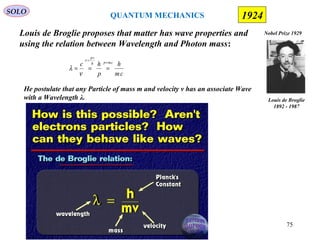
Louis de Broglie proposes that matter has wave properties and
using the relation between Wavelength and Photon mass:
Louis de Broglie
1892 - 1987
Nobel Prize 1929
cm
h
p
hc cmph
cp
=
=
===
ν
ν
λ
He postulate that any Particle of mass m and velocity v has an associate Wave
with a Wavelength λ.
QUANTUM MECHANICS
SOLO
Niels Bohr
1885 - 1962
Nobel Prize 1922
Explanation of Bohr Model using de Broglie Relation
To understand Bohr novelty let look at an Elastic Wire
that vibrates transversally. At Steady State the
Wavelengths always fit an integral number of times into
the Wire Length. This is true if we bend the Wire and
even if we obtain a Closed Loop Wire. If the Wire is
perfectly elastic the vibration will continue indefinitely.
This is Resonance.
,3,2,12
4 0
=== nr
m
r
e
h
nn n
n
π
επ
λ
,3,2,12
0
22
== n
em
hn
rn
π
ε
We found the Electron
Orbital Velocity
Return to Bohr Hydrogen Model using de Broglie Relation
Louis de Broglie
1892 - 1987
Nobel Prize 1929
rm
e
04
v
επ
=
Using de Broglie Relation
m
r
e
h
m
h 04
v
επ
λ ==
At Steady State the Wavelengths always fit an
integral number of times into the Wire Length.
We obtain the same relation as Bohr for the Orbit radius:
QUANTUM MECHANICS
76
Return to Table of Content
77
SOLO
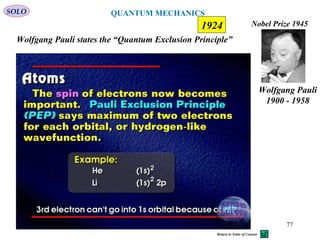
1924
Wolfgang Pauli states the “Quantum Exclusion Principle”
Wolfgang Pauli
1900 - 1958
Nobel Prize 1945
QUANTUM MECHANICS
Return to Table of Content
QUANTUM THEORIES
Werner Heisenberg, Max Born, and Pascal Jordan formulate Quantum
Matrix Mechanics.
QUANTUM MATRIX MECHANICS.
Werner Karl Heisenberg
(1901 – 1976)
Nobel Price 1932
Max Born
(1882–1970)
Nobel Price 1954
Ernst Pascual Jordan
(1902 – 1980)
Nazi Physicist
http://en.wikipedia.org/wiki/Matrix_mechanics
1925
Matrix mechanics was the first conceptually autonomous and
logically consistent formulation of quantum mechanics. It extended the
Bohr Model by describing how the quantum jumps occur. It did so by
interpreting the physical properties of particles as matrices that evolve
in time. It is equivalent to the Schrödinger wave formulation of
quantum mechanics, and is the basis of Dirac's bra-ket notation for the
wave function.
SOLO
In 1928, Einstein nominated Heisenberg, Born, and Jordan for the
Nobel Prize in Physics, but Heisenberg alone won the 1932 Prize "for
the creation of quantum mechanics, the application of which has led to
the discovery of the allotropic forms of hydrogen",[47]
while
Schrödinger and Dirac shared the 1933 Prize "for the discovery of new
productive forms of atomic theory".[47]
On 25 November 1933, Born
received a letter from Heisenberg in which he said he had been delayed
in writing due to a "bad conscience" that he alone had received the
Prize "for work done in Gottingen in collaboration — you, Jordan and
I."[48]
Heisenberg went on to say that Born and Jordan's contribution
to quantum mechanics cannot be changed by "a wrong decision from
the outside." 78
Return to Table of Content
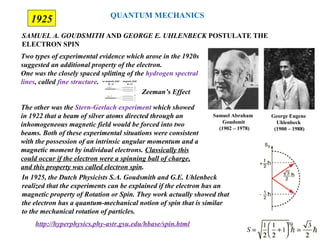
1925
SAMUEL A. GOUDSMITH AND GEORGE E. UHLENBECK POSTULATE THE
ELECTRON SPIN
George Eugene
Uhlenbeck
(1900 – 1988)
Samuel Abraham
Goudsmit
(1902 – 1978)
Two types of experimental evidence which arose in the 1920s
suggested an additional property of the electron.
One was the closely spaced splitting of the hydrogen spectral
lines, called fine structure.
The other was the Stern-Gerlach experiment which showed
in 1922 that a beam of silver atoms directed through an
inhomogeneous magnetic field would be forced into two
beams. Both of these experimental situations were consistent
with the possession of an intrinsic angular momentum and a
magnetic moment by individual electrons. Classically this
could occur if the electron were a spinning ball of charge,
and this property was called electron spin.
In 1925, the Dutch Physicists S.A. Goudsmith and G.E. Uhlenbeck
realized that the experiments can be explained if the electron has an
magnetic property of Rotation or Spin. They work actually showed that
the electron has a quantum-mechanical notion of spin that is similar
to the mechanical rotation of particles.
http://hyperphysics.phy-astr.gsu.edu/hbase/spin.html
no magnetic field
B = 0
cba ,,
fed ,,
a
b
c
d
e
f
magnetic field
B 0≠
Zeeman’s Effect
QUANTUM MECHANICS
79
Spin
In quantum mechanics and particle physics, Spin is an intrinsic form of angular
momentum carried by elementary particles, composite particles (hadrons), and
atomic nuclei. Spin is a solely quantum-mechanical phenomenon; it does not have a
counterpart in classical mechanics (despite the term spin being reminiscent of
classical phenomena such as a planet spinning on its axis).[
Spin is one of two types of angular momentum in quantum mechanics, the other
being orbital angular momentum. Orbital angular momentum is the quantum-
mechanical counterpart to the classical notion of angular momentum: it arises
when a particle executes a rotating or twisting trajectory (such as when an electron
orbits a nucleus).The existence of spin angular momentum is inferred from
experiments, such as the Stern–Gerlach experiment, in which particles are observed
to possess angular momentum that cannot be accounted for by orbital angular
momentum alone.[
http://en.wikipedia.org/wiki/Spin_(physics)
In some ways, spin is like a vector quantity; it has a definite “magnitude”; and it has
a "direction" (but quantization makes this "direction" different from the direction
of an ordinary vector). All elementary particles of a given kind have the same
magnitude of spin angular momentum, which is indicated by assigning the particle a
spin quantum number.[2]
However, in a technical sense, spins are not strictly vectors,
and they are instead described as a related quantity: a Spinor. In particular, unlike a
Euclidean vector, a spin when rotated by 360 degrees can have its sign reversed
QUANTUM MECHANICS
80
ERWIN SCHRÖDINGER STAES THE NONRELATIVISTIC
QUANTUM WAVE EQUATION AND FORMULATES THE
QUANTUM MECHANICS. HE PROVES THAT WAVE AND
MATRIX FORMULATIONS ARE EQUIVALENT
1926
In January 1926, Schrödinger published in Annalen der Physik the paper
"Quantisierung als Eigenwertproblem" [“Quantization as an Eigenvalue Problem”]
on wave mechanics and presented what is now known as the Schrödinger equation. In
this paper, he gave a "derivation" of the wave equation for time-independent systems
and showed that it gave the correct energy eigenvalues for a hydrogen-like atom. This
paper has been universally celebrated as one of the most important achievements of the
twentieth century and created a revolution in quantum mechanics and indeed of all
physics and chemistry. A second paper was submitted just four weeks later that solved
the quantum harmonic oscillator, rigid rotor, and diatomic molecule problems and
gave a new derivation of the Schrödinger equation. A third paper in May showed the
equivalence of his approach to that of Heisenberg.
http://en.wikipedia.org/wiki/Erwin_Schr%C3%B6dinger
QUANTUM MECHANICS
Erwin Rudolf Josef
Alexander Schrödinger
(1887 – 1961)
Nobel Prize 1933
SOLO
81
MAX BORN GIVES A PROBABILISTIC INTERPRATATION
OF THE WAVE FUNCTION.
1926
Max Born
(1882–1970)
Nobel Price 1954
Max Born wrote in 1926 a short paper on collisions between particles,
about the same time as Schrödinger paper “Quantization as an
Eigenvalue Problem”. Born rejected the Schrödinger Wave Field
approach. He had been influenced by a suggestion made by Einstein
that, for photons, the Wave Field acts as strange kind of ‘phantom’ Field
‘guiding’ the photon particles on paths which could therefore be
determined by Wave Interference Effects.
Max Born reasoned that the Square of the Amplitude of the Waveform in some specific region
of configuration space is related to the Probability of finding the associated quantum particle in
that region of configuration space.
Since Probability is a real number, and the integral of all Probabilities over all regions of
configuration space, the Wave Function must satisfy
1*
=∫
+∞
∞−
dVψψ Condition of Normalization of the Wave Function
Therefore the probability of finding the particle
between a and b is given by
[ ] ( ) ( )∫=≤≤
b
a
xdxxbXaP ψψ *
Einstein rejected this interpretation. In a 1926 letter to Max Born, Einstein
wrote: "I, at any rate, am convinced that He [God] does not throw dice."[
QUANTUM MECHANICS
SOLO
82
Return to Table of Content
QUANTUM MECHANICS
In December 1926 Einstein wrote a letter to Bohr which
contains a phrase that has since become symbolic of
Einstein’s lasting dislike of the element of chance
implied by the quantum theory:
J. Baggott, “The Meaning of Quantum Theory”, Oxford University Press, 1992, pp. 28-29
SOLO
1926
http://en.wikipedia.org/wiki/Max_Born
“Quantum mechanics is very impressive. But an inner
voice tells me that it is not the real thing. The theory
produce a good deal but hardly brings us closer to the
secret of the Old One. I am at all events convinced that
He does not play dice.”
83
84
SOLO
Wavelike Behavior for Electrons
In 1927, the wavelike behavior of the electrons was demonstrated
by Davisson and Germer in USA and by G.P. Thomson in Scotland.
Quantum 1927
Clinton Joseph Davisson
1881 – 1958
Nobel Prize 1937
Lester Halbert Germer
1896 - 1971
85
SOLO
Wavelike Behavior for Electrons
Quantum 1927
G.P. Thomson carried a series of experiments using an apparatus
called an electron diffraction camera. With it he bombarded very
thin metal and celluloid foils with a narrow electron beam. The
beam then was scattered into a series of rings.
George Paget Thomson
1892 – 1975
Nobel Prize 1937
Using these results G.P. Thomson proved
mathematically that the electron particles acted
like waves, for which he received the Nobel
Prize in 1937.
J.J. Thomson the father of G.P. proved that the electron is a
particle in 1897, for which he received the Nobel Prize in 1906.
Discovery of the Electron
Results of a double-slit-
experiment performed by
Dr. Tonomura showing
the build-up of an
interference pattern of
single electrons. Numbers
of electrons are 11 (a), 200
(b), 6000 (c), 40000 (d),
140000(e).
86
SOLO
Optics HistoryRaman Effect 1928
http://en.wikipedia.org/wiki/Raman_scattering
http://en.wikipedia.org/wiki/Chandrasekhara_Venkata_Raman
Nobel Prize 1930
Chandrasekhara Venkata
Raman
1888 – 1970
Raman Effect was discovered in 1928 by C.V. Raman in
collaboration with K.S. Krishnan and independently by
Grigory Landsberg and Leonid Mandelstam.
Monochromatic light is scattered when hitting
molecules. The spectral analysis of the scattered light
shows an intense spectral line matching the wavelength of
the light source (Rayleigh or elastic scattering).
Additional, weaker lines are observed at wavelength
which are shifted compared to the wavelength of the light
source. These are the Raman lines.
Virtual
Energy States
IR
Absorbance
Excitation
Energy
Rayleigh
Scattering
Stokes - Raman
Scattering
Anti-Stokes -
Raman
Scattering
87
SOLO
Stimulated Emission and Negative Absorption
1928
Rudolph W. Landenburg confirmed existence
of stimulated emission and Negative Absorption
Lasers History
Rudolf Walter Ladenburg (June 6, 1882 – April 6,
1952) was a German atomic physicist. He emigrated
from Germany as early as 1932 and became a Brackett
Research Professor at Princeton University. When the
wave of German emigration began in 1933, he was the
principal coordinator for job placement of exiled
physicist in the United States.
Albert Einstein and Rudolf Ladenburg,
Princeton Symposium, on the occasion of
Ladenburg's retirement, May 28, 1950.
Hedwig Kohn is in the background on the
left. Photo courtesy of AIP Emilio Segrè
Visual Archives.
Return to Table of Content
QUANTUM MECHANICS
SOLO
Wave Packet
A wave packet (or wave train) is a short "burst" or "envelope" of localized wave action
that travels as a unit. A wave packet can be analyzed into, or can be synthesized from, an
infinite set of component sinusoidal waves of different wavenumbers, with phases and
amplitudes such that they interfere constructively only over a small region of space, and
destructively elsewhere
Depending on the evolution equation, the wave packet's envelope may remain constant
(no dispersion, see figure) or it may change (dispersion) while propagating.
As an example of propagation without dispersion, consider wave solutions to the following
wave equation:
ψ
ψ 2
2
2
2
v
1
∇=
∂
∂
t
where v is the speed of the wave's propagation in a given medium.
The wave equation has plane-wave solutions ( ) ( )trki
eAtr ω
ψ −⋅
=


,
( ) v,/1111 2222
kkkkknPropagatioWaveofDirectionkzkykxkk zyxzyx =++=++= ω
A wave packet without dispersion A wave packet with dispersion
( ) ( ) ( )tcxiktcx
etx −+−−
= 0
2
,ψ
88
Run This
QUANTUM MECHANICS
SOLO
Wave Packet
The wave equation has plane-wave solutions ( ) ( )rkti
eAtr

 ⋅−−
= ω
ψ ,
( ) v,/1111 2222
kkkkknPropagatioWaveofDirectionkzkykxkk zyxzyx =++=++= ω
( )rptE
h
r
k
k
ktE
h
rkt
hv



⋅−
/
=⋅−=⋅−
=
=
122
/E
π
ω
νπω
( )
p
h
p
h
v
k
hhphv
/
=====
=/== 122
v
2
v
2/://v πλλ π
λ
ππω
( ) ( ) ( ) ( )rptEhirkti
eAeAtr

 ⋅−/−⋅−−
== /
, ω
ψ
where v is the velocity , v is the frequency, λ is the Wavelength of the Wave Packet.
The Energy E and Momentum p of the Particle are
( ) ( )
λ
π
λ
νπν
ππ
hh
phhE
hhhh
/
==/==
=/=/
2
&2
2/:2/:
de Broglie RelationEinstein Relation
The wave packet travels to the direction for ω = kv and to direction for ω = - kv.k1 k1−
89
QUANTUM MECHANICS
SOLO
Wave Packet
A wave packet is a localized disturbance that results from the sum of many different wave
forms. If the packet is strongly localized, more frequencies are needed to allow the
constructive superposition in the region of localization and destructive superposition
outside the region. From the basic solutions in one dimension, a general form of a wave
packet can be expressed as
( )
( )
( ) ( ) ( )
( ) ( ) tEhirptEhi
erepApd
h
tr //−
+∞
∞−
⋅−//−
=
/
= ∫
//3
3
2
1
,
 
ψ
π
ψ
( )
( )
( ) ( )
( )perrd
h
pA rphi  
Φ=
/
= ∫
+∞
∞−
⋅/−
:0,
2
1 /3
3
ψ
π
The factor comes from Fourier Transform conventions. The amplitude
contains the coefficients of the linear superposition of the plane-wave solutions.
Using the Inverse Fourier Transform we obtain:
( )3
2/1 π ( )pA

( )
( )
( ) ( )
∫
+∞
∞−
⋅//
/
= rphi
epApd
h
r
 /3
3
2
1
π
ψwhere
zyx pdpdpdpd =3
dzdydxrd =3
Define ( )
( )
( ) ( )
∫
+∞
∞−
⋅//−
/
=Φ rphi
etrrd
h
tp
 /3
3
,
2
1
:, ψ
π
Wave Function in
Momentum Space 90
Return to Table of Content
ERWIN SCHRÖDINGER STAES THE NONRELATIVISTIC
QUANTUM WAVE EQUATION AND FORMULATES THE
QUANTUM MECHANICS. HE PROVES THAT WAVE AND
MATRIX FORMULATIONS ARE EQUIVALENT
1926
Following Max Planck's quantization of light (see black body radiation),
Albert Einstein interpreted Planck's quanta to be photons, particles of light,
and proposed that the energy of a photon is proportional to its frequency, one
of the first signs of wave–particle duality. Since energy and momentum are
related in the same way as frequency and wavenumber in special relativity, it
followed that the momentum p of a photon is proportional to its wavenumber k.
c
k
h
hwherekh
h
p
c πν
λ
π
πλ
νλ 22
:,
2
:
/=
===//==
Louis de Broglie hypothesized that this is true for all particles, even particles such as electrons. He
showed that, assuming that the matter waves propagate along with their particle counterparts,
electrons form standing waves, meaning that only certain discrete rotational frequencies about the
nucleus of an atom are allowed.[7]
These quantized orbits correspond to discrete energy levels, and
de Broglie reproduced the Bohr model formula for the energy levels. The Bohr model was based on
the assumed quantization of angular momentum:
hn
h
nL /==
π2
According to de Broglie the electron is described by a wave and a whole number of wavelengths
must fit along the circumference of the electron's orbit: n λ = 2 π r
http://en.wikipedia.org/wiki/Schr%C3%B6dinger_equation
Historical Background and Development
QUANTUM MECHANICS
Erwin Rudolf Josef
Alexander Schrödinger
(1887 – 1961)
Nobel Prize 1933
SOLO
91
ERWIN SCHRÖDINGER STAES THE NONRELATIVISTIC
QUANTUM WAVE EQUATION AND FORMULATES THE
QUANTUM MECHANICS. HE PROVES THAT WAVE AND
MATRIX FORMULATIONS ARE EQUIVALENT
1926
( ) ( ) ( )λνπ
νπω
νλ
ω
ψ /2
2
/v
v/
, xtixti
eAeAtx −−
=
=
−−
==
http://en.wikipedia.org/wiki/Schr%C3%B6dinger_equation
Historical Background and Development (continue – 1)
Following up on de Broglie's ideas, physicist Peter Debye made
an offhand comment that if particles behaved as waves, they
should satisfy some sort of wave equation. Inspired by Debye's
remark, Schrödinger decided to find a proper 3-dimensional wave
equation for the electron.
He was guided by William R. Hamilton's analogy between mechanics and optics, encoded in the
observation that the zero-wavelength limit of optics resembles a mechanical system — the
trajectories of light rays become sharp tracks that obey Fermat's principle, an analog of the
principle of least action.
For a general form of a Progressive Wave Function in + x direction with velocity v and frequency v:
The Energy E and Momentum p of the Particle are
λ
π
λ
νπν
hh
phhE
/
==/==
2
2
( ) ( ) ( )xptEhi
eAtx −/−
= /
,ψTherefore
QUANTUM MECHANICS
Erwin Rudolf Josef
Alexander Schrödinger
(1887 – 1961)
Nobel Prize 1933
SOLO
92
ERWIN SCHRÖDINGER STAES THE NONRELATIVISTIC
QUANTUM WAVE EQUATION AND FORMULATES THE
QUANTUM MECHANICS. HE PROVES THAT WAVE AND
MATRIX FORMULATIONS ARE EQUIVALENT
1926
Erwin Rudolf Josef
Alexander Schrödinger
(1887 – 1961)
Historical Background and Development (continue – 2)
We want to find the Differential Equation yielding the Wave Function .
We have
Wave Function:
( ) ( )
ψ
ψ
2
2
/
2
2
2
2
h
p
eA
h
p
x
xptEhi
/
−=
/
−=
∂
∂ −/−
At particle speeds small compared to speed of light c, the Total Energy E is the sum of the
Kinetic Energy p2
/2m and the Potential Energy V (function of position and time):
ψψψ
ψ
V
m
p
EV
m
p
E +=⇒+=
×
22
22
2
2
22
x
hp
∂
∂
/−=
ψ
ψ ti
h
E
∂
∂/
−=
ψ
ψ
cV
xm
h
ti
h
<<−
∂
∂/
=
∂
∂/
v
2 2
22
ψ
ψψ
QUANTUM MECHANICS
SOLO
( ) ( ) ( )xptEhi
eAtx −/−
= /
,ψ
93
ERWIN SCHRÖDINGER STAES THE NONRELATIVISTIC
QUANTUM WAVE EQUATION AND FORMULATES THE
QUANTUM MECHANICS. HE PROVES THAT WAVE AND
MATRIX FORMULATIONS ARE EQUIVALENT
1926
Erwin Rudolf Josef
Alexander Schrödinger
(1887 – 1961)
Historical Background and Development (continue – 3)
cV
xm
h
ti
h
<<−
∂
∂/
=
∂
∂/
v
2 2
22
ψ
ψψ
Non-Relativistic
One-Dimensional
Time Dependent
Schrödinger Equation
In the same way
cV
m
h
ti
h
<<−∇
/
=
∂
∂/
v
2
2
2
ψψ
ψ
Non-Relativistic
Three-Dimensional
Time Dependent
Schrödinger Equation
QUANTUM MECHANICS
SOLO
This is a Linear Partial Differential Equation. It is
also a Diffusion Equation (with an Imaginary
Diffusion Coefficient), but unlike the Heat
Equation, this one is also a Wave Equation given
the imaginary unit present in the transient term.
94
1926 Schrödinger Equation
Time-dependent Schrödinger equation
(single non-relativistic particle)
A wave function that satisfies the
non-relativistic Schrödinger
equation with V=0. In other
words, this corresponds to a
particle traveling freely through
empty space. The real part of the
wave function is plotted here
Each of these three rows is a wave function which satisfies the
time-dependent Schrödinger equation for a harmonic
oscillator. Left: The real part (blue) and imaginary part (red)
of the wave function. Right: The probability distribution of
finding the particle with this wave function at a given position.
The top two rows are examples of stationary states, which
correspond to standing waves. The bottom row an example of
a state which is not a stationary state. The right column
illustrates why stationary states are called "stationary".
QUANTUM MECHANICS
Erwin Rudolf Josef
Alexander Schrödinger
(1887 – 1961)
Nobel Prize 1933
SOLO
95
Schrödinger Equation: Steady State Form
Using
ti
h
E
∂
∂/
−=
ψ
ψ
and the Time-dependent Schrödinger equations
cV
xm
h
ti
h
<<−
∂
∂/
=
∂
∂/
v
2 2
22
ψ
ψψ
Non-Relativistic
One-Dimensional
Time Dependent
Schrödinger Equation
cV
m
h
ti
h
<<−∇
/
=
∂
∂/
v
2
2
2
ψψ
ψ Non-Relativistic
Three-Dimensional
Time Dependent
Schrödinger Equationwe can write
( ) cVE
h
m
x
<<=−
/
+
∂
∂
v0
2
22
2
ψ
ψ
Non-Relativistic
One-Dimensional
Steady-State
Schrödinger Equation
( ) cVE
h
m
<<−
/
+∇ v
2
2
2
ψψ
Non-Relativistic
Three-Dimensional
Steady-State
Schrödinger Equation
QUANTUM MECHANICS
Erwin Rudolf Josef
Alexander Schrödinger
(1887 – 1961)
Nobel Prize 1933
1926
SOLO
96
Return to Table of Content
Operators in Quantum Mechanics
Since, according to Born, ψ*ψ represents Probability of finding the associated quantum particle in
a region we can compute the Expectation (Mean) Value of the Total Energy E and of the
Momentum p in that region using
( ) ( ) ( ) ( )∫
+∞
∞−
= xdtxtxEtxtE ,,,*
ψψ
( ) ( ) ( ) ( )∫
+∞
∞−
= dxtxtxptxtp ,,,*
ψψ
But those integrals can not compute exactly, since p (x,t) is unknown if x is know, according to
Uncertainty Principle. A way to find is by differentiating the Free-Particle Wave
Function
pandE
( ) ( )xptEhi
eA −/−
= /
ψ
( ) ( )
( ) ( )
ψ
ψ
ψ
ψ
E
h
i
eAE
h
i
t
p
h
i
eAp
h
i
x
xptEhi
xptEhi
/
−=
/
−=
∂
∂
/
=
/
=
∂
∂
−/−
−/−
/
/
Rearranging we obtain
ψψ
ψψ
t
hiE
xi
h
p
∂
∂
/=
∂
∂/
=
t
hiE
xi
h
p
∂
∂
/=
∂
∂/
=
:ˆ
:ˆ
QUANTUM MECHANICS
SOLO
We can look at p and E as Operators on ψ
(the symbol means “Operator”)∧
Note: One other way to arrive to this result by manipulating the integrals will be given in
the following presentations.
97
Operators in Quantum Mechanics (continue – 1)
We obtained
Moment Operatorxi
h
p
∂
∂/
=:ˆ
t
hiE
∂
∂
/=:ˆ Total Energy Operator
Although we derived those operators for free particles, they are entire general results, equivalent
to Schrödinger Equation. To see this let write the Operator Equation
  
Operator
Energy
Potential
Operator
Energy
Kinetic
Operator
Energy
Total
VTE ˆˆˆ +=
 2
2222
22
1
2
ˆ
xm
h
xi
h
mm
p
T
Operator
Energy
Kinetic ∂
∂/
−=





∂
∂/
==We have
 V
xm
h
t
hiE
Operator
Energy
Total
+
∂
∂/
−=
∂
∂
/= 2
22
2
ˆ
Applying this Operator on Wave Function ψ we recover the Schrödinger Equation
ψ
ψψ
V
xm
h
t
hi +
∂
∂/
−=
∂
∂
/ 2
22
2
The two descriptions (Operator and Schrödinger’s) are equivalent.
QUANTUM MECHANICS
SOLO
98
QUANTUM MECHANICS
Operators in Quantum Mechanics (continue – 3)
We obtained
Moment Operatorxi
h
p
∂
∂/
=:ˆ
t
hiE
∂
∂
/=:ˆ Total Energy Operator
Because p and E can be replaced by their Operators in an equation, we can use those Operators
to obtain Expectation Values for p and E.
∫∫∫
∞+
∞−
∞+
∞−
∞+
∞− ∂
∂/
=





∂
∂/
== dx
xi
h
dx
xi
h
dxpp
ψ
ψψψψψ ***
ˆ
∫∫∫
∞+
∞−
∞+
∞−
∞+
∞− ∂
∂
/=





∂
∂
/== xd
x
hixd
x
hixdEE
ψ
ψψψψψ *** ˆ
Let define the Hamiltonian Operator V
xm
h
H ˆ
2
:ˆ
2
22
+
∂
∂/
−=
Schrödinger Equation in Operator form is ψψ EH ˆˆ =
This Equation has a form of an Eigenvalue Equation of the Operator with Eigenvalue Ê
and Eigenfunction as the Wavefunction ψ.
Hˆ
SOLO
99
Dirac bracket notation
Paul Adrien Maurice
Dirac
( 1902 –1984)
A elegant shorthand notation for the integrals used to define Operators
was introduced by Dirac in 1939
onWavefunctiket nn ψψ ⇔""
Instead of dealing with Wavefunctions ψn, we defined a related Quantum “State”,
denoted |ψ› which is called a “ket”, “ket vector”, “state” or “state vector”.
The complex conjugate of |ψ› is called the “bra” and is denoted by ‹ψ|.
onWavefunctibra nn
*
"" ψψ ⇔
 
ket
m
bra
n ψψ
When a “bra” is combined with a “ket” we obtain a “bracket”.
The following integrals are represented by “bra” and “ket”
mnmn AdA ψψτψψ |ˆ|ˆ*
≡∫
mnmn d ψψτψψ |*
≡∫
nnnnnn aAaA ψψψψ =⇔= ˆˆ
Operators in Quantum Mechanics (continue – 5)
( ) ( ) ( ) ( ) mnmnmnmnmn AAdAAdA ψψψψτψψψψτψψ |ˆ|ˆ|ˆ|ˆˆ ***
==== ∫∫
nnnnnn aAaA ψψψψ ****** ˆˆ =⇔=
QUANTUM MECHANICS
SOLO
100
Return to Table of Content
QUANTUM THEORIES
HILBERT SPACE AND QUANTUM MECHANICS.
Ernst Pascual Jordan
(1902 – 1980)
Nazi Physicist
http://en.wikipedia.org/wiki/Matrix_mechanics
Born had also learned Hilbert’s theory of integral
equations and quadratic forms for an infinite number of
variables as was apparent from a citation by Born of
Hilbert’s work “Grundzüge einer allgemeinen Theorie
der Linearen Integralgleichungen” published in 1912.
Jordan, too was well equipped for the task. For a
number of years, he had been an assistant to Richard
Courant at Göttingen in the preparation of Courant and
David Hilbert’s book Methoden der mathematischen
Physik I, which was published in 1924. This book,
fortuitously, contained a great many of the
mathematical tools necessary for the continued
development of quantum mechanics.
In 1926, John von Neumann became assistant to David
Hilbert, and he would coin the term Hilbert Space to
describe the algebra and analysis which were used in the
development of quantum mechanics
Max Born
(1882–1970)
Nobel Price 1954
John von Neumann
(1903 –1957)
David Hilbert
(1862 –1943)
Richard Courant
(1888 –1972)
SOLO
101
102
Functional AnalysisSOLO
Vector (Linear) Space: E is a Linear Space if Addition and Scalar Multiplication are Defined
Addition
Scalar Multiplication
From those equations follows:
The null element 0 ∈ E is unique.
The addition inverse |η› of |ψ›,
(|ψ›+|η›= 0) is unique.
E∈∀=⋅ ψψ 00
|η› = (-1) |ψ› is the multiplication
inverse of |ψ›.
αβ −=
E∈∀+=+ χψψχχψ ,1 Commutativity
ψψ +=+∈∃ 00..0 tsE3 Identity
0.. =+∈∃∈∀ χψχψ tsEE4 Inverse
E∈∀=⋅ ψψψ15 Normalization
( ) ( ) βαψψβαψβα ,& ∀∈∀= E6
Associativity
8 ( ) αηψηαψαηψα ∀∈∀+=+ &, E Distributivity
7 ( ) βαψψβψαψβα ,& ∀∈∀+=+ E Distributivity
2 Associativity( ) ( ) E∈∀++=++ ηχψηψχηχψ ,,
The same apply for “bra” ‹ψ| the “conjugate” of the “ket” |ψ›.
See also “Functional Analysis ” Presentation for a detailed description
103
Functional AnalysisSOLO
Vector (Linear) Space: E is a Linear Space if Addition and Scalar Multiplication are Defined
Linear Independence, Dimensionality and Bases



∈≠
=
⇒=∑=
CsomefortrueifDependentLinear
allifonlytrueiftIndependenLinear
i
in
i ii
0
0
01
α
α
ψα
A set of vectors |ψi› (i=1,…,n) that satisfy the relation
Dimension of a Vector Space E , is the maximum number N of Linear Independent Vectors
in this space. Thus, between any set of more that N Vectors |ψi› (i=1,2,…,n>N), there exist a
relation of Linear Dependency.
Any set of N Linearly Independent Vectors |ψi› (i=1,2,…,N), form a Basis of the Vector
Space E ,of Dimension N, meaning that any vector |η› ∈ E can be written as a Linear
Combination of those Vectors.
Ci
N
i ii ∈≠= ∑=
αψαη 01
In the case of an Infinite Dimensional Space (N→∞), the space will be defined by a
“Complete Set” of Basis Vectors. This is a Set of Linearly Independent Vectors of the
Space, such that if any other Vector of the Space is added to the set, there will exist a
relation of Linear Dependency to the Basis Vectors.
SOLO Functional Analysis
Use of bra-ket notation of Dirac for Vectors.
ketbra
TransposeConjugateComplexHfefeefef HH
−
=⋅==⋅= ,|
operatorkete
operatorbraf
|
|
Paul Adrien Maurice Dirac
(1902 – 1984)
Assume the are a basis and the a reciprocal basis for the Hilbert
space. The relation between the basis and the reciprocal basis is described, in
part, by:
je| |if
ketbra
ji
ji
efef jij
H
iji
−



=
≠
===
1
0
| ,δ
104
The Inner Product of the Vectors f and e is defined as
Inner Product Using Dirac Notation
( ) ( )**
& ψψψψ ==
To every “ket” corresponds a “bra”.
105
Functional AnalysisSOLO
Inner Product Using Dirac Notation
If E is a complex Linear Space, for the Inner Product (bracket) < | >
between the elements (a complex number) is defined by:
E∈∀ 321 ,, ψψψ
*
1221 || >>=<< ψψψψ1 Commutative Law
Using to we can show that:1 4
If E is an Inner Product Space, than we can induce the Norm: [ ] 2/1
111 , ><= ψψψ
2 Distributive Law><+>>=<+< 3121321 ||| ψψψψψψψ
3 C∈><>=< αψψαψψα 2121 ||
4
00|&0| 11111 =⇔>=<≥>< ψψψψψ
( ) ( ) ( )
><+><=><+><=>+<=>+< 1312
1
*
31
*
21
2
*
321
1
132 |||||| ψψψψψψψψψψψψψψ
( ) ( ) ( )
><=><=><=>< 21
*
1
*
12
*
3
*
12
1
21 |||| ψψαψψαψψαψαψ
( ) ( )
*
1
1
111
2
11 |000|0|0|00|0| ><=>=<⇒><+><=>+>=<< ψψψψψψ
106
Functional AnalysisSOLO
Inner Product
ηψηψ ≤>< |
Cauchy, Bunyakovsky, Schwarz Inequality known as Schwarz Inequality
Let |ψ›, |η› be the elements of an Inner Product space E, than :
x
y
><=
><
y
y
x
y
yx
,
,
y
y
y
y
xxy
y
yx
x ><−=
><
− ,
,
2
0|||||
2*
≥><+><+><+>>=<++< ηηλψηληψλψψηλψηλψ
Assuming that , we choose:0|
2/1
≠= ηηη
><
><
−=
ηη
ηψ
λ
|
|
we have:
0|
|
|
|
||
|
||
| 2
2*
≥><
><
><
+
><
><><
−
><
><><
−>< ηη
ηη
ηψ
ηη
ψηηψ
ηη
ηψηψ
ψψ
which reduce to:
0
|
|
|
|
|
|
|
222
≥
><
><
+
><
><
−
><
><
−><
ηη
ηψ
ηη
ηψ
ηη
ηψ
ψψ
or:
><≥⇔≥><−><>< ηψηψηψηηψψ |0|||
2
q.e.d.
Augustin Louis Cauchy
)1789-1857(
Viktor Yakovlevich
Bunyakovsky
1804 - 1889
Hermann Amandus
Schwarz
1843 - 1921
Proof:
107
Functional Analysis
SOLO
Hilbert Space
A Complete Space E is a Metric Space (in our case ) in which every
Cauchy Sequence converge to a limit inside E.
( ) 2121, ψψψψρ −=
David Hilbert
1862 - 1943
A Linear Space E is called a Hilbert Space if E is an Inner Product Space that is
complete with respect to the Norm induced by the Inner Product ||ψ1||=[< ψ1, ψ1>]1/2
.
Equivalently, a Hilbert Space is a Banach Space (Complete Metric Space) whose
Norm is induced by the Inner Product ||ψ1||=[< ψ1, ψ1>]1/2
.
Orthogonal Vectors in a Hilbert Space:
Two Vectors |η› and |ψ› are Orthogonal if 0|| == ηψψη
Theorem: Given a Set of Linearly Independent Vectors in a Hilbert
Space |ψi› (i=1,…,n) and any Vector |ψm› Orthogonal to all |ψi›,
than it is also Linearly Independent.
Proof: Suppose that the Vector |ψm› is Linearly Dependent on |ψi› (i=1,…,n)
∑=
=≠
n
i iim 1
0 ψαψ
But ∑=
==≠
n
i imimm 1
0
00

ψψαψψ
We obtain a inconsistency, therefore |ψm› is Linearly Independent on |ψi› (i=1,…,n)
Therefore in a Hilbert Space, of Finite or Infinite Dimension, by finding the Maximum
Set of Orthogonal Vectors we find a Basis that “Complete” covers the Space.
q.e.d.
108
Functional Analysis
SOLO
Hilbert Space
Orthonormal Sets
Let |ψ1›, |ψ2›, ,…, |ψn›, denote a set of elements in the Hilbert Space H.
( )












><><><
><><><
><><><
=
nnnn
n
n
nG
ψψψψψψ
ψψψψψψ
ψψψψψψ
ψψψ
,,,
,,,
,,,
:,,,
21
22212
12111
21





Jorgen Gram
1850 - 1916
Define the Gram Matrix of the set:
Theorem: A set of functions |ψ1›, |ψ2›, ,…, |ψn› of the Hilbert Space H is linearly dependent
if and only if the Gram determinant of the set is zero.
zeroequalallnot inn αψαψαψα 02211 =+++ Proof: Linearly Dependent Set:
Multiplying (inner product) this equation consecutively by |ψ1›, |ψ2›, ,…, |ψn›, we obtain:
( ) 0,,,det
0
0
0
,,,
,,,
,,,
21
2
1
21
22212
12111
=⇔












=
























><><><
><><><
><><><
n
Solution
nontrivial
nnnnn
n
n
G ψψψ
α
α
α
ψψψψψψ
ψψψψψψ
ψψψψψψ






q.e.d.
109
Functional Analysis
SOLO
Hilbert Space
Orthonormal Sets (continue – 2)
Theorem: A set of functions |ψ1›, |ψ2›, ,…, |ψn›, of the Hilbert space H is linearly dependent
if and only if the Gram Determinant of the Set is zero.
Proof: The Gram Matrix of an Orthogonal Set has only nonzero diagonal; therefore
Determinant G (|ψ1›, |ψ2›, ,…, |ψn› ).=║|ψ1 ›║2
║ |ψ2 › ║2
… ║ |ψn › ║2
≠ 0, and the Set is Linearly
Independent.
q.e.d.
Corollary: The rank of the Gram Matrix equals the dimension of the Linear Manifold
L (|ψ1›, |ψ2›, ,…, |ψn› ). If Determinant G (ψ1›, |ψ2›, ,…, |ψn›) is nonzero, the Gram Determinant of
any other Subset is also nonzero.
Definition 1: Two elements |ψ›,|η› of a Hilbert Space H are said to be orthogonal if <ψ|η>=0.
Definition 2: Let S be a nonempty Subset of a Hilbert Space H. S is called an Orthogonal
Set if |ψ›┴|η› for every pair |ψ›,|η› є S and |ψ› ≠ |η›. If in addition ║ |ψ›║=1 for every |ψ› є S, then
S is called an Orthonormal Set.
Lemma: Every Orthogonal Set is Linearly Independent. If |η› is Orthogonal to every
element of the Set (|ψ1›, |ψ2›, ,…, |ψn› ), then |η› is Orthogonal to Manifold L (|ψ1›, |ψ2›, ,…, |ψn› ).
If then for every we have:nii ,,2,10, =∀=>< ψη ( )n
n
i
ii L ψψψαχ ,,1
1
∈= ∑=
0,,
1
=><>=< ∑=
n
i
ii

ψηαχη
110
Functional AnalysisSOLO
Hilbert Space
Orthonormal Sets (continue – 3)
Gram-Schmidt Orthogonalization Process
Jorgen Gram
1850 - 1916
Erhard Schmidt
1876 - 1959
Let Ψ=(|ψ1›, |ψ2›, ,…, |ψn› ) any finite Set of Linearly Independent Vectors
and L (|ψ1›, |ψ2›, ,…, |ψn› ) the Manifold spanned by the Set Ψ.
The Gram-Schmidt Orthogonalization Process derive a Set
(|e1›, |e2›, ,…, |en› ) of Orthonormal Elements from the Set Ψ.
11 : ψη =
1
11
21
22
11
21
21
1121212112122
,
,
,
,
,,,0:
η
ηη
ψη
ψη
ηη
ψη
α
ηηαψηηψαψη
><
><
−=⇒
><
><
=⇒
><−>>=<=<⇒−= y
∑
∑∑
−
=
−
=
−
=
><
><
−=⇒
><
><
=⇒
><−>>=<=<⇒−=
1
1
1
1
1
1
,
,
,
,
,,,0:
i
j
j
ji
ji
ii
kk
ki
ik
i
j
jkkjikki
i
j
jijii
kj
η
ηη
ηψ
ψη
ηη
ηψ
α
ηηαψηηηηαψη
δ


111
Functional AnalysisSOLO
Hilbert Space
Orthonormal Sets (continue – 4)
Gram-Schmidt Orthogonalization Process (continue)
Jorgen Gram
1850 - 1916
Erhard Schmidt
1876 - 1959
11 : ψη =
1
11
21
22
,
,
: η
ηη
ψη
ψη
><
><
−=
∑
−
= ><
><
−=
1
1 ,
,
:
i
j
j
ji
ji
ii η
ηη
ηψ
ψη


2/1
11
1
1
,
:
><
=
ηη
η
e


Orthogonalization Normalization
∑
−
= ><
><
−=
1
1 ,
,
:
n
j
j
ji
jn
nn η
ηη
ηψ
ψη
2/1
22
2
2
,
:
><
=
ηη
η
e
2/1
,
:
><
=
ii
i
ie
ηη
η
2/1
,
:
><
=
nn
n
ne
ηη
η
112
Functional AnalysisSOLO
Hilbert Space
Discrete |ei› and Continuous |wα› Orthonormal Bases
From those equations we obtain
ijji ee δ=|
The Orthonormalization Relation
( )'| ' ααδαα −=ww
A Vector |ψ› will be represented by
( ) ψψψψ ∑∑∑∑ ====
====
n
i ii
n
i ii
n
i ii
n
i ii eeeeeeec 1111
||
( )ψαψαψααψ αααααααα ∫∫∫∫ ==== wwdwwdwwdwcd
i
n
j jiji
n
j jj ceeceec
ij
==⇒= ∑∑ == 11

δ
ψψ
( )
α
ααδ
αααααα αψαψ cwwcdwwcd ==⇒= ∫∫
−

'
'''''
Therefore
Iee
n
i ii =∑=1
Iwwd =∫ ααα
The Closure Relations
I – the Identity Operator
(its action on any state
leaves it unchanged).
α- a real number or vector, not complex-valued
The Vectors in Hilbert Space can be Countable (Discrete) or Uncountable (Continuous).
113
Functional AnalysisSOLO
Hilbert Space
Series Expansions of Arbitrary Functions
Definitions:
Approximation in the Mean by an Orthonormal Series |ψ1›, |ψ2›, ,…, |ψn› :
Let |η› be any function. The numbers:
are called the Expansions Coefficients or Components of |η› with respect to the given
Orthonormal System
nn ψηα ,:=
From the relation
we obtain
or 2
1
2
, ηηηα =≤∑=
n
i
i
0|
11
2
1
≥





−





−=





− ∑∑∑ ===
n
i
ii
n
i
ii
n
i
ii ψαηψαηψαη
0|2|
|||
1
*
1
*
1
*
1
*
11
*
≥−=+−=
+−−
∑∑∑
∑∑∑
===
===
n
i
ii
n
i
ii
n
i
ii
n
i
ii
n
i
ii
n
i
ii
ααηηααααηη
ααηψαψηαηη
114
Functional AnalysisSOLO
Hilbert Space
Series Expansions of Arbitrary Functions
Approximation in the Mean by an Orthonormal Series |ψ1›, |ψ2›, |ψ3›,… :
Let |η› be any function. The numbers:
are called the Expansions Coefficients or Components of |η› with respect to the given
Orthonormal System
nnc ψη,:=
2
1
2
ηα ≤∑=
n
i
i
Since the sum on the right is independent on n, is true also
for n →∞, we have 2
1
2
ηα ≤∑
∞
=i
i Bessel’s Inequality
Bessel’s Inequality is true for every Orthonormal System. It proves that the sum of the
square of the Expansion Coefficients always converges.
Friedrich Wilhelm
Bessel
1784 - 1846
115
Functional AnalysisSOLO
Hilbert Space
Series Expansions of Arbitrary Functions
Approximation in the Mean by an Orthonormal Series |ψ1›, |ψ2›, |ψ3›,… :
If for a given Orthonormal System |ψ1›, |ψ2›, |ψ3›,… any piecewise continuous function |η›
can be approximated in the mean to any desired degree of accuracy ε by choosing a n large
enough ( n>N (ε) ), i.e.:
( )εεψαη Nnfor
n
i
ii >≤− ∑=1
then the Orthonormal System |ψ1›, |ψ2›, |ψ3›,… is said to be Complete.
For a Complete Orthonormal System |ψ1›, |ψ2›, |ψ3›,… the Bessel’s Inequality becomes an
Equality:
2
1
2
ηα =∑
∞
=i
i
Parseval’s Equality applies for
Complete Orthonormal Systems
This relation is known as the “Completeness Relation”.
( )( ) ∑∑∑∑∑
∞
=
∞
=
∞
=
∞
=
∞
=
+++=++=+
++=++=+
1
*
1
*
1
*
1
*
1
,2,
i
ii
i
ii
i
ii
i
ii
i
iiii dcdc βββαβαααχη
χχηηχηχηχη
∑∑
∞
=
∞
=
+=
1
*
1
*
,2
i
ii
i
ii βαβαχη
A more general form, for , can be derived as follows:∑∑
∞
=
∞
=
==
1
*
1
*
&
i
ii
i
ii ββχααη
Marc-Antoine
Parseval des Chênes
1755 - 1836
Functional AnalysisSOLO
Hilbert Space
Linear Operators in Hilbert Space
An Operator L in Hilbert Space acting on a Vector |ψ›, produces a Vector |η›.
ψη L

=
L

ψη =
The arrow over L means that the Operator is acting on the Vector on the Left, ‹ψ|.
An Operator L is Linear if it Satisfies ( ) CLLL ∈+=+ βαηβψαηβψα ,

Consider the quantities . They are in general not equal.( ) ( ) ψηψη || LandL

Eigenvalues and Eigenfunction of a Linear Operator are defined by
CL ∈= λψλψ

The Eigenfunction |ψ› is transformed by the Operator L into multiple of itself, by the
Eigenvalue λ. The conjugate equation is
( ) CLL ∈== λψλψψ ** 
The corresponding Operator which transforms the “bra” ‹ψ| , called the
Adjoint Operator, is
L

The arrow over means that the Operator is acting on the Vector
on the Right, |ψ›.
L

116
Functional AnalysisSOLO
Hilbert Space
Adjoint or Hermitian Conjugates Operators
An Operator L1 in Hilbert Space acting on a Vector |ψ›, produces a Vector |η›.
Let have another Operator in Hilbert Space acting on the Vector |η›, and produce a Vector |χ›.
( ) 1111 LLorLL

=⇔
1L

Operator ψη 1L

=
1L

Adjoint Operator 1L

ψη =
22 & LL

ηχηχ ==
Therefore
2112 & LLLL

ψχψχ ==
( ) 21122112 LLLLorLLLL

=⇔
The Adjoint of a Product of Operators is obtained by Reversing the order of the
Product of Adjoint of Operators.
117
Functional AnalysisSOLO
Hilbert Space
ILLLLILLLL ==== −−−− 1111
&

Inverse Operator
Given
ψη L

= L

ψη =
The Inverse Operator on is the Operator that will return .ψL

ψ1−
L

ψψη == −−
LLL
 11
Therefore
ηψη ==−
LLL
 1
The Inverse Operator on is the Operator that will return .L

ψ ψ1−
L

ψψη == −− 11
LLL

In the same way
ηψη ==−
LLL
 1
Not all Operators have an Inverse.
118
Functional AnalysisSOLO
Hilbert Space
( ) ( ) ( ) ηψηψψηψη ,|||
*
∀== LLL

Hermitian Operator
In Quantum Mechanics the Operators for which are equal present a
great importance. They are called Hermitian or Self-Adjoint Operators.
( ) ( ) ψηψη || LandL

Properties of Hermitian Operators
From the definition we can see that the direction of the arrow is not important and we can
write
( ) ( ) ηψηψψηψηψη ,||||:||
*
∀=== LLLL

1
2 All the Eigenvalues of a Hermitian Operator are Real
( ) ( ) ( ) ( ) ( ) ψηψηψηηψψη |||||| *******
LLLLL

====
( ) ψψλψψλψλψ || =⇒∈= LCL

( ) ψψλψψλψλψ || **
=⇒∈= LCL

Hermitian Operator : ( ) ( ) ( ) *
0
*
0||| λλψψλλψψψψ =⇒=−⇒=
>


LL
An Operator is Hermitian if it is equal to its Adjoint:
Hermitian or Self-Adjoint Operators ( ) LLL

==
119
Functional AnalysisSOLO
Hilbert Space
( ) ( ) ( ) ηψηψψηψη ,|||
*
∀== LLL

Hermitian Operator
In Quantum Mechanics the Operators for which are equal present a
great importance. They are called Hermitian Operators.
( ) ( ) ψηψη || LandL

Properties of Hermitian Operators
If all the Eigenvalues of an Operator are Real the Operator is Hermitian3
iiii
i
iiiiiiii
iiiiiiii
iii
iii
LL
L
L
i
L
L ii
ψψψψ
ψψλψψλψψ
ψψλψλψψψ
ψλψ
ψλψ λλ
||
|||
||| *
*
*





=⇒




==
==
⇒∀




=
= =
∀
Hermitian Operator
120
Functional AnalysisSOLO
Hilbert Space
( ) ( ) ( ) ηψηψψηψη ,|||
*
∀== LLL

Hermitian Operator
In Quantum Mechanics the Operators for which are equal present a
great importance. They are called Hermitian Operators.
( ) ( ) ψηψη || LandL

Properties of Hermitian Operators
4 All the Eigenfunctions of a Hermitian Operator corresponding to different Eigenvalues
are Orthogonal, the others can be Orthogonalized using the Gram-Schmidt Procedure.
Therefore for a Hermitian Operator we can obtain a “complete Set” of Orthogonal
(and Linearly Independent) Eigenfunctions




==
=
⇒




==
==
**
*
|||
||
nmmmnmmn
nmnnm
mmmmm
nnnnn
L
L
L
L
ψψλψψλψψ
ψψλψψ
λλψλψ
λλψλψ
If |ψn› and |ψm› are two Eigenfunctions of the Hermitian Operator L, with eigenvalues λn
and λm, respectively
Hermitian Operator: nmmnmnmnnm LL ψψλψψλψψψψ |||| =⇒=
If λm ≠ λn this equality is possible only if ψn and ψm are Orthogonal 0| =nm ψψ
If λm = λn we can use the Gram-Schmidt Procedure to obtain a new Eigenfunction
Orthogonal to |ψn›.
n
nn
mn
mm ψ
ψψ
ψψ
ψψ 







−=
|
|
:~ 0|
|
|
|~| =







−= nn
nn
mn
mnmn ψψ
ψψ
ψψ
ψψψψ
The Hermitian Operators have Real Eigenvalues and Orthogonal Eigenfunctions.
λm ≠ λn
121
Functional AnalysisSOLO
Hilbert Space
1−
=UU

Unitary Operator
Properties of Unitary Operators
A Unitary Operator U is defined by the relation where I is the Identity Operator.IUUUU ==

A Unitary Matrix is such that it’s Adjoint is equal to it’s Inverse.
All Eigenvalues of a Unitary Matrix have absolute values equal to 1.
Suppose |ψi› is an Eigenfunction and λi is the corresponding Eigenvalue of a Unitary Operator.
 iUU
U
U
iiiiiii
I
i
iii
iii
∀=⇒=⇒




=
=
1| **
*
λλψψλλψψ
ψλψ
ψλψ 


1
2
 ψηψηψη ,| ∀=
I
UU

For all <η| and |ψ› the Inner Product of equals‹η|ψ›ψη UandU

3 ψψψ ∀=U

 ψψψψψψψψ ∀===
2/1
2/1
2/1
||
I
UUUUU

122
Let |ψ› and |χ› be two State Vectors and A be a Linear Hermitian Operator, such that
χψ =A
Let apply the Unitary U, so that χχψψ UU

== :'&:'
We define a new Operator A’ such that
ψχψχψ AUUUAA

==⇒= ''''
ψψ AUAU =

'
Since this is true for any |ψ›, we obtain
UAUAUAUA

== '&'
Functional AnalysisSOLO
Hilbert Space
1−
=UU

Unitary Operator
A Unitary Operator U is defined by the relation where I is the Identity Operator.IUUUU ==

Pre-multiply the last relation by and useU

IUUUU ==

Properties of Unitary Operators
4
Go to Schr dinger and Heisenberg Picturesӧ
123
Properties of Unitary Operators
If A is Hermitian, then A’ is also Hermitian
AA

=
Operator Equations remain unchanged in form under Unitary Transformations
Consider the Operator CDcBcA 21 +=
UDUUCUcUBUcUAU

21 +=
'''' 21 DCcBcA +=or
The Eigenvalues of A are the same as those of A’
nnnnnn UUaUUAaA ψψψψ

=⇒=
 nnnn
I
nn
A
aAUUUaUUAU
nn
'''
'''
ψψψψ
ψψ
=⇒=






Functional AnalysisSOLO
Hilbert Space
1−
=UU

Unitary Operator
A Unitary Operator U is defined by the relation where I is the Identity Operator.IUUUU ==

UAUAUAUA

== '&'
4a
4b
4c
where c1 and c2 are real constants and B, C, D are Operators. Using IUUUU ==

Pre-multiply the last relation by U

( ) ( )( )( ) '' AUAUUAUUAUUAUA
AA 

=====
=
124
Return to Table of Content
QUANTUM THEORIES
QUANTUM MECHANICS
Von NEUMANN WROTE “THE FOUNDATION OF QUANTUM
MECHANICS”
1932
John von Neumann
( 1903 – 1957)
Von Neumann was the first to rigorously establish a mathematical
framework for quantum mechanics, known as the Dirac–von
Neumann Axioms, with his 1932 work “Mathematische Grundlagen
der Quantenmechanik”.
After having completed the axiomatization of set theory, von Neumann began to
confront the axiomatization of quantum mechanics. He immediately realized, in
1926, that a quantum system could be considered as a point in a so-called Hilbert
space, analogous to the 6N dimension (N is the number of particles, 3 general
coordinate and 3 canonical momentum for each) phase space of classical mechanics
but with infinitely many dimensions (corresponding to the infinitely many possible
states of the system) instead: the traditional physical quantities (e.g., position and
momentum) could therefore be represented as particular linear operators operating
in these spaces. The physics of quantum mechanics was thereby reduced to the
mathematics of the linear Hermitian Operators on Hilbert Spaces.
For example, the Uncertainty Principle, according to which the determination of the position of a
particle prevents the determination of its momentum and vice versa, is translated into the non-
commutativity of the two corresponding operators. This new mathematical formulation included as
special cases the formulations of both Heisenberg and Schrödinger.
http://en.wikipedia.org/wiki/John_von_Neumann
SOLO
125
QUANTUM THEORIES
QUANTUM MECHANICS
Von NEUMANN WROTE “THE FOUNDATION OF QUANTUM MECHANICS”
1932
Postulates of Quantum Mechanics
First Postulate:
At a fixed time t0, the state of a physical system is completely
defined by specifying a ket |ψ (t0)› belonging to the state space E.
Second Postulate:
Every measurable physical quantity A is described by an
operator A acting in E; this operator is an observable.
Third Postulate:
The only possible result of the measurement of a physical quantity A is one of
the eigenvalues of the corresponding observable A.
In his book Von Neumann based the Mathematics of Quantum Mechanics on Five
Postulates.
John von Neumann
( 1903 – 1957)
SOLO
126
QUANTUM THEORIES
QUANTUM MECHANICS
Von NEUMANN “THE FOUNDATION OF QUANTUM MECHANICS”
1932
Fourth Postulate (case of discrete spectrum):
When the physical quantity A is measured on a system in the normalized state
|ψ › the probability P (an) of obtaining a non-degenerate eigenvalue an of the
corresponding observable A is
Where gn is the degree of degeneracy of an and
is an orthonormal set of vectors which form a basis in the Eigen subspace E.
associated with the eigenvalue an. of A.
( ) ∑=
=
ng
i
i
nn ua
1
2
|ψP
{ }( )n
i
n giu ,2,1| =
Fourth Postulate (case of discrete non-degenerate spectrum):
When the physical quantity A is measured on a system in the normalized state
|ψ › the probability P (an) of obtaining a non-degenerate eigenvalue an of the corresponding
observable A is
where |u› is the normalized eigenvector of A associated with the eigenvalue an.
( )
2
|ψnn ua =P
SOLO
127
QUANTUM MECHANICS
Von NEUMANN “THE FOUNDATION OF QUANTUM MECHANICS”
1932
Fourth Postulate (case of continuous non-degenerate spectrum):
When the physical quantity A is measured on a system in the normalized state
|ψ › the probability dP (an) of obtaining a result included between α and α + dα
is equal to
where |vα› is the eigenvector corresponding to the eigenvalue α of the observable
A associated with A.
Postulates of Quantum Mechanics (continue – 1)
Fifth Postulate:
If the measurements of the physical quantity A on the system in state
|ψ › gives the result an, the state of the system after the measurement is the
normalized projection
of |ψ› on the eigenspace associated with an.
ψψ
ψ
||
|
n
n
P
P
( ) αψα α dvd
2
|=P
SOLO
128
Return to Table of Content
QUANTUM MECHANICS
Conservation of Probability
SOLO
( )
( )
( ) ( )
∫
+∞
∞−
⋅//
Φ
/
=Ψ rphi
etppd
h
tr
 /3
3
,
2
1
,
π
that is related to the Wave Vector in Momentum Space by:
( )
( )
( ) ( )
∫
+∞
∞−
⋅//−
Ψ
/
=Φ rphi
etrrd
h
tp
 /3
3
,
2
1
:,
π
We find the Wave Vector in Position Space is:
The Probability of finding a particle at time t, within the volume d3
r=dx dy dz
(Configuration Space) at a point isr

( ) ( ) ( ) rdtrtrrdtrP 3*3
,,,

ΨΨ=
The Probability of finding a particle at time t, within the Moment volume d3
p=dpx dpy dpz,
(Momentum Space) and with a Moment isp

( ) ( ) ( ) pdtptppdtp 3*3
,,,

ΦΦ=Π
( )trP ,

- Position Probability Density
( )tp,

Π - Momentum Probability Density
( ) ( )0,: =Ψ=Ψ trr

( ) ( )0,: =Φ=Φ tpp

129
QUANTUM MECHANICS
SOLO
The condition that the probability of finding the particle somewhere to be unity, we deduce that
should be normalized to unity.( )tr,

Ψ
( ) ( )
( )
( ) ( ) ( )[ ]
( ) ( ) ( )[ ]
( )
( ) ( ) ( ) ( ) ( )[ ] ( )( )
∫ ∫∫
∫ ∫∫∫
∞+
∞−
∞+
∞−
⋅−//
∞+
∞−
−//−
+∞
∞−
+∞
∞−
⋅−//−
+∞
∞−
⋅−//
ΦΦ
/
=
ΦΦ
/
=ΨΨ=
rpphitpEpEhi
rptpEhirptpEhi
erdetptppdpd
h
etppdetppdrd
h
trtrrd




'/3'/*33
3
/3''/*33
3
*3
,,''
2
1
,,''
2
1
,,1
π
π
Use
( )
( )( ) ( )( ) ( )( ) ( )( )
( ) ( ) ( ) ( )''''
2
1
2
1
2
1
2
1 '/'/'/'/3
3
ppppppppezd
h
eyd
h
exd
h
erd
h
zzyyxx
zpphiypphixpphirpphi zzyyxx

−=−−−=





/





/





/
=
/ ∫∫∫∫
∞+
∞−
−//
∞+
∞−
−//∞+
∞−
−//
∞+
∞−
⋅−//
δδδδ
ππππ
( ) ( ) ( ) ( ) ( ) ( ) ( )[ ]
( )∫ ∫∫
+∞
∞−
+∞
∞−
−//−
−ΦΦ=ΨΨ ',,'',, '/*33*3
ppetptppdpdtrtrrd tpEpEhi  
δ
Finally we obtain
( ) ( ) ( ) ( ) 1,,',, *3*3
=ΦΦ=ΨΨ ∫∫
+∞
∞−
tptppdtrtrrd

Return to Conservation
of Probability
Conservation of Probability
130
QUANTUM MECHANICS
Conservation of Probability
SOLO
Since at any time t, the Probability of finding the particle somewhere is unity, and the
Probability of the particle being in the Momentum Space is unity we have
( ) ( ) ( ) 1,,, 3*3
=ΨΨ= ∫∫ rdtrtrrdtrP

( ) ( ) ( ) 1,,, 3*3
=ΦΦ=Π ∫∫ pdtptppdtp

( ) ( ) ( ) ( ) ( ) 0,,,,, 3**3
=





Ψ
∂
∂
Ψ+ΨΨ
∂
∂
=
∂
∂
∫∫ rdtr
t
trtrtr
t
rdtrP
t

Use Schrödinger equation : ( ) ( ) ctrV
m
h
tr
t
hi <<Ψ





−∇
/
=Ψ
∂
∂
/− v,
2
, 2
2

( ) ( ) ctrV
m
h
tr
t
hi
VV
<<Ψ





−∇
/
=Ψ
∂
∂
/
=
v,
2
, *2
2
*
*
and its conjugate:
Let consider a finite Region T in the Position Space:
Since: ( ) ( ) ( )( ) ( )( ) ( ) ( )trVtrtrtrVtrtrV ,,,,,, **** 
ΨΨ=ΨΨ=ΨΨ
( ) ( ) ( ) ( ) ( ) rdtrV
m
h
trtrtrV
m
h
hi
rdtrP
t
32
2
**2
2
3
,
2
,,,
2
1
, ∫∫ ΤΤ






Ψ





−∇
/
Ψ−ΨΨ





−∇
/
/
=
∂
∂ 
( ) ( ) ( ) ( ) ( )[ ]
( ) ( ) ( ) ( )[ ]∫
∫∫
Ψ∇Ψ−ΨΨ∇⋅∇
/
=
Ψ∇Ψ−ΨΨ∇
/
=
∂
∂
T
TT
rdtrtrtrtr
im
h
rdtrtrtrtr
im
h
rdtrP
t
3**
32**23
,,,,
2
,,,,
2
,


131
QUANTUM MECHANICS
Conservation of Probability
SOLO
( ) ( ) ( ) ( ) ( )[ ] ∫∫∫ ⋅∇−=ΨΨ∇−Ψ∇Ψ⋅∇
/
−=
∂
∂
TTT
rdjrdtrtrtrtr
im
h
rdtrP
t
33**3
,,,,
2
,

where
( ) ( ) ( ) ( )[ ]
( ) ( )[ ]trtr
m
h
trtrtrtr
im
h
j
,,Im
,,,,
2
:
*
**


Ψ∇Ψ
/
=
ΨΨ∇−Ψ∇Ψ
/
=
Since in the Equation above we have any time independent Spatial Volume T we can write
( ) ( ) 0,, =⋅∇+
∂
∂
trjtrP
t

Therefore is the Probability Current Density.( )trj ,

132
( ) ( ) ( ) rdtrtrrdtrP 3*3
,,,

ΨΨ= ( )trP ,

- Position Probability Density
QUANTUM MECHANICS
Conservation of Probability
SOLO
The Probability Current Density is( )trj ,

133
Return to Table of Content
Connection with classical mechanics
The wave function can also be written in the complex exponential (polar) form
( ) ( ) ( )
( ) ( ) R∈=Ψ /
trStrRetrRtr htrSi
,,,,, /,  
The Probability is defined as ( ) ( ) ( ) ( )trRtrtrtrP ,,,:, 2* 
=ΨΨ=
( ) ( ) ( )[ ]












∇
/
−∇−





∇
/
+∇
/
=












∇
/
−∇−





∇
/
+∇
/
=
∇−∇
/
=Ψ∇Ψ−Ψ∇Ψ
/
=
/−/−////−
/−///−
SR
h
i
RRSR
h
i
RR
im
h
SeR
h
i
ReeRSeR
h
i
ReeR
im
h
eReReReR
im
h
im
h
j
hSihSihSihSihSihSi
hSihSihSihSi
2
2
22
:
//////
////**

Therefore
m
S
j
∇
= ρ:

Define
m
Sj ∇
==
ρ


:v Probability Current Velocity
( ) ( ) ( )( ) 0,v,, =⋅∇+
∂
∂
trtrtrP
t

ρWe have Conservation of Probability
QUANTUM MECHANICS
Expectations Value and Operators
SOLO
Since is the Probability of finding a particle at time t, within
the volume d3
r=dx dy dz, at a point , (Configuration Space) the Expectation Value (or
Average Value) of the Position Vector of the Particle is
r

( ) ( ) ( ) rdtrtrrdtrP 3*3
,,,

ΨΨ=
r

( ) ( ) ( )∫∫ ΨΨ== rdtrrtrrdtrPrr 3*3
,,,:

( ) ( )
( ) ( )
( ) ( )∫
∫
∫
ΨΨ=
ΨΨ=
ΨΨ=
rdtrztrz
rdtrytry
rdtrxtrx
3*
3*
3*
,,:
,,:
,,:



In the same way the Expectation Value of the Momentum of the Particle isp

( ) ( ) ( )∫∫ ΦΦ=Π= pdtpptppdtppp 3*3
,,,:

( ) ( )
( ) ( )
( ) ( )∫
∫
∫
ΦΦ=
ΦΦ=
ΦΦ=
pdtpptpp
pdtpptpp
pdtpptpp
zz
yy
xx
3*
3*
3*
,,:
,,:
,,:



134
QUANTUM MECHANICS
SOLO
( ) ( ) ( ) ( ) ( ) ( )∫∫ ΨΨ== rdtrtrftrrdtrPtrftrf 3*3
,,,,,:,

In general the Expectation Value of a function ( )trf ,

( ) ( ) ( ) ( ) ( ) ( )∫∫ ΦΦ=Π= pdtptpgtppdtptpgtpg 3*3
,,,,,:,

In general the Expectation Value of a function ( )tpg ,

( ) ( ) ( ) ( ) ( ) ( )∫∫ ΨΨ== rdtrtrVtrrdtrPtrVtrV 3*3
,,,,,:,

Example: The Expectation Value of the Potential Energy ( )trV ,

Example: The Expectation Value of the Kinetic Energy
m
pp
2

⋅
( ) ( ) ( )∫∫ Φ
⋅
Φ=Π
⋅
=
⋅
pdtp
m
pp
tppdtp
m
pp
m
pp 3*3
,
2
,,
2
:
2




Expectations Value and Operators
135
QUANTUM MECHANICS
SOLO
( )
( )
( ) ( )
∫
+∞
∞−
⋅//−
Ψ
/
=Φ rphi
etrrd
h
tp
 /3
3
,
2
1
:,
π
( )
( )
( ) ( )
∫
+∞
∞−
⋅//
Ψ
/
=Φ '/*3
3
*
,''
2
1
:, rphi
etrrd
h
tp

π
and
( ) ( )
( )
( )( )
( ) ( ) ( )( )
∫ ∫ ∫∫
⋅/−⋅/
ΨΨ
/
=ΦΦ= rphirphi
etrptrerdrdpd
h
tpptppdp
  /*'/333
3
*3
,,''
2
1
,,
π
We found
We observe that ( )( ) ( )( )rphirphi
ehiep
 ⋅/−⋅/−
∇/= //
( )
( )( )
( ) ( )( )
( ) ( )∫ ∫ ∫ Ψ∇/Ψ
/
= ⋅/−⋅/
trehitrerdrdpd
h
p rphirphi
,,''
2
1 /*'/333
3
 
π
Integration by parts
( )( )
( ) ( ) ( )( )
( ) ( )( )
( )( )∫∫ Ψ∇/−Ψ/=Ψ∇/ ⋅/−+∞→
−∞→
⋅/−⋅/−
trhierdtrehitrehird rphir
r
rphirphi
,,, /3
0
//3 
  
 
( )
( ) ( )
( ) ( )( )∫ ∫ ∫ Ψ∇/−Ψ
/
= −⋅/
trhitrerdrdpd
h
p rrphi
,,''
2
1 *'/333
3
 
π
therefore
using
( )
( ) ( )
( ) ( ) ( ) ( )zzyyxxrrepd
h
rrphi
−−−=−=
/ ∫
−⋅/
''''
2
1 '/3
3
δδδδ
π

we obtain
( )
( )( ) ( )∫ Ψ∇/−Ψ
/
= trhitrrd
h
p ,,
2
1 *3
3

π
Expectations Value and Operators
136
QUANTUM MECHANICS
SOLO
We found
( )
( )( ) ( )∫ Ψ∇/−Ψ
/
= trhitrrd
h
p ,,
2
1 *3
3

π
we say that is the Moment Operator∇/−= hip :ˆ
The Expectation Value of the Kinetic Energy
m
pp
2

⋅
( ) ( ) ( ) ( )∫∫ Ψ





∇
/
−Ψ=Φ
⋅
Φ=
⋅
rdtr
m
h
trpdtp
m
pp
tp
m
pp 32
2
*3*
,
2
,,
2
,
2




We also found ( ) ( ) ( ) ( )∫ ΨΨ= rdtrtrVtrtrV 3*
,,,,

Using Schrödinger Equation cV
m
h
t
hi <<Ψ





−∇
/
=Ψ
∂
∂
/− v
2
2
2
Total Energy E is the sum of the Kinetic Energy p2
/2m and the Potential Energy V: V
m
p
E +=
2
2
( ) ( ) ( ) ( )∫ ∫ Ψ





∂
∂
/Ψ=Ψ





+∇
/
−Ψ=+= rdtr
t
hitrrdtrV
m
h
trV
m
p
E 3*32
2
*
2
,,,
2
,
2

we say that is the Total Energy Operator
t
hiE
∂
∂
/=:ˆ
Return to Operators in Quantum Mechanics
Expectations Value and Operators
137
QUANTUM MECHANICS
SOLO
We found
Expectations Value and Operators
( )
( )
( ) ( )
∫
+∞
∞−
⋅//
Φ
/
=Ψ rphi
etppd
h
tr
 /3
3
,
2
1
,
π
( )
( )
( ) ( )
∫
+∞
∞−
⋅//−
Φ
/
=Ψ rphi
etppd
h
tr
 /*3
3
*
,
2
1
,
π
and ( ) ( )
( )
( )( )
( ) ( ) ( )( )
∫ ∫ ∫∫
⋅/⋅/−
ΦΦ
/
=ΨΨ= rphirphi
etprtpepdpdrd
h
rdtrrtrr
  /*'/333
3
3*
,,''
2
1
,,
π
We observe that
( )( ) ( )( )rphi
p
rphi
ehier
 ⋅/⋅/
∇/−= //
( ) ( )
( )
( )( )
( ) ( )( )
( ) ( )∫ ∫ ∫∫ Φ∇/−Φ
/
=ΨΨ= ⋅/⋅/−
tpehitpepdpdrd
h
rdtrrtrr rphi
p
rphi
,,''
2
1
,, /*'/333
3
3*  
π
Integration by parts
therefore
( )( )
( ) ( ) ( )( )
( ) ( )( )
( )( )∫∫ Φ∇/−−Φ/−=Φ∇/− ⋅/+∞→
−∞→
⋅/⋅/
tphiepdtpehitpehipd p
rphip
p
rphirphi
p ,,, /3
0
//3 
  
 
( )
( ) ( )
( ) ( )( )∫ ∫ ∫ Φ∇/Φ
/
= −⋅/−
tphitpepdpdrd
h
r p
pprhi
,,''
2
1 *'/333
3
 
π
using
we obtain
( )
( )( ) ( )∫ Φ∇/Φ
/
= tphitppd
h
r p ,,
2
1 *3
3

π
( )
( ) ( )
( ) ( ) ( ) ( )zzyyxx
pprhi
ppppppppepd
h
−−−=−=
/ ∫
−⋅/−
'''
'/3
3
'
2
1
δδδδ
π

138
QUANTUM MECHANICS
SOLO
We found
we say that is the Position Operator in Moment Spacephix ∇/=:ˆ
Expectations Value and Operators
( )
( )( ) ( )∫ Φ∇/Φ
/
= tphitppd
h
r p ,,
2
1 *3
3

π
139
QUANTUM MECHANICS
SOLO
Total Energy ( )trV
m
p
E ,
2
2

+=
t
hi
HV
m
h
E
∂
∂
/=
=+∇
/
−= ˆ:ˆ
2
ˆ 2
2
Potential Energy ( )trV ,

Vˆ
Kinetic Energy
m
p
T
2
2
= 2
2
2
ˆ ∇
/
−=
m
h
T
Physical Quantity
Operator
Physical Quantities and Corresponding Operators in Configuration Space
Position Vector r

phir ∇/=ˆ
Momentum Vector p

∇/−= hipˆ
Expectations Value and Operators
140
Return to Table of Content
QUANTUM MECHANICS
Value of Observables
The Main Value of an Observable is equal to the Expectation Value of its corresponding
Operator.
∫
∫=
τψψ
τψψ
d
dA
A
nn
nn
n *
* ˆ
:
This expression is due to the Probability property associated to ψn function.
If ψn is Eigenfunction of the Operator , i.e.Ȃ
nnn aA ψψ =ˆ
n
nn
nn
n a
d
dA
A ==
∫
∫
τψψ
τψψ
*
* ˆ
:then
Since the Observable are Real the Expectation Value an must be Real, therefore the
Operator has only Real Eigenvalues meaning that it is Hermitian.Ȃ
SOLO
141
Return to Table of Content
QUANTUM MECHANICS
The Expansion Theorem or Superposition Principle
An arbitrary, well behaved State Vector |Ψ› can be expanded as a Linear
Superposition
of the Complete Set of Eigenstate |ψi› (i=1,…,n) of any Hermitian Operator .Ȃ
∑=
=Ψ
n
i iic1
ψ
By Complete Set of Eigenstate we mean the full set of Eigenstate of the Hermitian Operator .Ȃ
where niaaaA iiiii ,,1ˆ *
=== ψψ
njiaaaA iiijiij ,,1,ˆ *
=== δψψ
The Expectation Value of in terms of |ΨȂ › is be given by
∑
∑
∑ ∑
∑ ∑
∑ ∑
∑∑
∑∑
∑∑
=
=
= =
= =
= =
==
==
==
====
ΨΨ
ΨΨ
= n
i i
n
i ii
n
j
n
i ijij
n
j
n
i ijiij
n
j
n
i ijij
n
i iii
n
j jj
n
i ji
n
j jj
n
i ii
n
j j
c
ac
cc
acc
cc
acc
cc
cAA
A
1
2
1
2
1 1
*
1 1
*
1 1
*
11
11
11
|
|
|
|
|ˆ|
|
|ˆ|
:ˆ
δ
ψψ
ψψ
ψψ
ψψ
ψψ
If |Ψ› is Normalized and1| 1
2
==ΨΨ ∑=
n
i ic
∑=
=
ΨΨ
ΨΨ
=
n
i ii ac
A
A 1
2
|
|ˆ|
:ˆ
SOLO
142
QUANTUM MECHANICS
The Expansion Theorem or Superposition Principle
∑=
=Ψ
n
i iic1
ψ
To find the coefficients ci let multiply by the bra <ψj|
j
n
i iji
n
i iijj ccc
ij
===Ψ ∑∑ == 11
|

δ
ψψψψψ
Therefore
∑=
Ψ=Ψ
n
i ii1
ψψ Expansion Theorem for “ket”
In the same way
∑=
Ψ=Ψ
n
i ii1
ψψ Expansion Theorem for “bra”
SOLO
143
Return to Table of Content
QUANTUM MECHANICS
Matrix Representation of Wave Functions and Operators
This “ket” Vector can be expressed as nx1 Matrix














Ψ
Ψ
Ψ
=Ψ
nψ
ψ
ψ

2
1
Given a Complete Set of Eigenstate |ψi› (i=1,…,n) (n can be finite or infinite) of any
Hermitian Operator (orthonormal Eigenfunctions) we found that any Vector |Ψ›Ȃ
can be expressed as
∑=
Ψ=Ψ
n
i ii1
ψψ
In the same way the “bra” Vector
can be expressed as 1xn Matrix
in the reciprocal basis ‹ψi|, (i=1,…,n)
H – is the Transpose, Complex Conjugate
∑=
Ψ=Ψ
n
i ii1
ψψ
( )
( ) H
n
n
Ψ=ΨΨΨ=
ΨΨΨ=Ψ
**
2
*
1
21
,,,
,,,
ψψψ
ψψψ


Now assume that an Operator acts on the Vector |Ψ› to obtainȂ
Ψ=Χ A















Χ
Χ
Χ
=Χ
nψ
ψ
ψ

2
1
( )
( ) H
n
n
Χ=ΧΧΧ=
ΧΧΧ=Χ
**
2
*
1
21
,,,
,,,
ψψψ
ψψψ


∑=
Χ=Χ
n
i ii1
ψψ
The Vectors |Χ› and ‹Χ| can also be expressed in the bases
|ψi› and it’s reciprocal ‹ψi|, (i=1,…,n).
SOLO
144
QUANTUM MECHANICS
Matrix Representation of Wave Functions and Operators (continue – 1)
Given a Complete Set of Eigenfunctions |ψi› (i=1,…,n) (n can be finite or infinite) of
any Hermitian Operator (orthonormal Eigenfunctions) we found that any Vector |Ȃ
Ψ› and |Χ› can be expressed as Matrices
Using
Ψ=Χ A















Ψ
Ψ
Ψ














=














Χ
Χ
Χ
nnnnn
n
n
n AAA
AAA
AAA
ψ
ψ
ψ
ψ
ψ
ψ












2
1
21
11211
11211
2
1
jiij AA ψψ

|=
∑ ∑∑ ∑∑∑ = == ==
Ψ=Χ
=
Ψ=Ψ=Ψ=Χ=Χ
n
k j
n
j jkk
n
k
n
j jjkk
n
k kk
A
n
k kk AAA 1 11 111
ψψψψψψψψψψψψ


∑ =
Ψ=Ψ
n
j jj1
ψψ
and
∑∑ ∑ == =
Ψ=Ψ=Χ
n
j j
A
ji
n
k j
n
j jkkii
ijik
AA 11 1
|| ψψψψψψψψψ
δ



Inner Product with ‹ψi|:
We obtain
SOLO
145
QUANTUM MECHANICS
Matrix Representation of Wave Functions and Operators (continue – 2)
In the same way
Using
A

Ψ=Χ
( ) ( )














ΨΨΨ=ΧΧΧ
nnnn
n
n
nn
AAA
AAA
AAA











21
11211
11211
2121 ,,,,,, ψψψψψψ
jiij AA ψψ |

=
and
Inner Product with |ψj›:
We obtain
∑=
Ψ=Ψ
n
i ii1
ψψ
∑ ∑∑∑ = ==
Ψ=Χ
=
Ψ=Ψ=Χ=Χ
n
k kk
n
i ii
n
k kk
A
n
k kk AA 1 111
ψψψψψψψψ


∑∑ ∑ == =
Ψ=Ψ=Χ
n
i
A
jii
n
k jkk
n
i ii
ijkj
j
AA 11 1
||





ψψψψψψψψψ
δ
SOLO
146
QUANTUM MECHANICS
Matrix Representation of Wave Functions and Operators (continue – 3)
By tacking the Conjugate Complex, Transpose (H) of this equation
We obtained
A

Ψ=Χ
we see that (since is Hermitian)Ȃ
SOLO
Ψ=Χ A















Ψ
Ψ
Ψ














=














Χ
Χ
Χ
nnnnn
n
n
n AAA
AAA
AAA
ψ
ψ
ψ
ψ
ψ
ψ












2
1
21
11211
11211
2
1
HHHH
AA
H
H

Ψ=Χ⇒Ψ=Χ
Χ=Χ
Ψ=Ψ
Comparing with
HH
AAAA

== &
H
nnnn
n
n
nnnn
n
n
AAA
AAA
AAA
AAA
AAA
AAA














=


































21
11211
11211
21
11211
11211
**
|| jiijjiij AAAA ψψψψ

=== 147
QUANTUM MECHANICS
Matrix Representation of Wave Functions and Operators (continue – 4)
Matrix Properties and Definitions
SOLO
If A, B, C are Matrices of corresponding dimensions then
ijijijijnmnmnmnm abbaABBA +=+⇔+=+ ××××
∑=⇔= ×××
k
kjikijnkkmnm bacBAC
( ) nkkmnkkmnknkkm CABACBA ××××××× +=+
( ) ( ) nrrkkmnrrkkm CBACBA ×××××× =
Inverse A-1
of Square Matrix A, if exists, then A is Nonsingular (det A≠0) and
nnnnnnnnnn IAAAA ××
−
×
−
×× == 11
Transpose AT
of A, change the rows by the columns
( ) { } jiij
T
mn
T
nm aAA =⇔ ××
Adjoint AH
of A, is the Complex Conjugate of the Transpose
( ) ( ) { } **
jiij
H
mn
T
nm
H
nm aAAA =⇔= ×××
Hermitian Square Matrix
*
jiij
H
nnnn aaAA =⇔= ××
See also “Matrix” Presentation for a detailed description
148
QUANTUM MECHANICS
Matrix Representation of Wave Functions and Operators (continue – 5)
Matrix Properties and Definitions
SOLO
Eigenvectors and Eigenvalues of Square Matrices
CuuA iniininn ∈= ××× λλ 11
See also “Matrix” Presentation for a detailed description
where ui nx1 are Eigenvectors and λi (i=1,…,n) are Eigenvalues of A
Unitary Square Matrices 1−
×× = nn
H
nn UU
nn
H
nnnnnn
H
nn IUUUU ××××× ==
For every Unitary Matrix U exists a Hermitian Matrix A such that
H
nnnn
Ai
nn AAieU nn
××× =−== ×
,12
149
Return to Table of Content
[ ] ABBABA −=:,
Commutator of two Operators A and B
[ ] [ ]ABBA ,, −=
[ ] [ ] [ ]CABACBA ,,, +=+
[ ] [ ] [ ]CABCBACBA ,,, +=
[ ][ ] [ ][ ] [ ][ ] 0,,,,,, =++ BACACBCBA
General Commutator Properties
If A B = B A we say that the two Operators A and B Commute, and then [A,B] = 0 .
In general A B ≠ B A and we say that A and B don’t commute.
Theorem: A and B Commute if and only if they have the same Eigenfunctions ψi
nibBaA iiiiii ,,1& === ψψψψ
Using Expansion Theorem any Vector
[ ] ( ) ( ) 0||,
0
11
=−Ψ=−Ψ=Ψ−Ψ=Ψ ∑∑ ==    iiiiii
n
i i
n
i iii abbaABBAABBABA ψψψψψψ
∑=
Ψ=Ψ
n
i ii1
ψψ
Proof: If A and B have the same Eigenfunctions ψi then
Therefore A and B Commute.
QUANTUM MECHANICS
Antisymmetry
Associativity
Jacobi Identity
SOLO
150
[ ] ABBABA −=:,
Commutator of two Operators A and B
Theorem: A and B Commute if and only if they have the same Eigenfunctions ψn
iii aA ψψ =Suppose that A have a complete set of Eigenfunctions
Proof (continue - 1): If A and B Commute, then they have the same Eigenfunctions ψn
then ( ) ( )ii
aA
i
ABBA
i BaABBA
iii
ψψψ
ψψ ==
==
Therefore Bψi and ψi are both Eigenfunctions of A, having the Eigenvalue ai, but this is
possible only if they differ by a constant which will call bi
iii bB ψψ =
Assume first that A has non-degenerate Eigenvalues ai
Therefore A and B have the same Eigenfunctions ψi , if ai are non-degenerate Eigenvalues. .
Now assume that A has a degenerate Eigenvalue ai, of degree α, with corresponding linearly
independent Eigenfunctions ψir (r=1,2,…,α). Since A B Commute (B ψi) is an Eigenfunction
of A belonging to the degenerated Eigenvalue ai. It follows that (B ψi) can be expanded in terms
of the linearly independent functions ψi1 , ψi2 ,…, ψiα
∑ =
=
α
ψψ 1s isisir cB
QUANTUM MECHANICS
SOLO
151
[ ] ABBABA −=:,
Commutator of two Operators A and B
Theorem: A and B Commute if and only if they have the same Eigenfunctions ψi
Proof (continue - 2): If A and B Commute, then they have the same Eigenfunctions ψi
Therefore A and B have the same Eigenfunctions , even if ai are degenerate Eigenvalues. .
{ } nsrrss isrsir ccB ,,1,1 ==∑=
α
ψψ
Let form a linear combination of the functions ψir with α constants dr (r=1,2,…,α) to be
defined ∑ ∑∑ = ==
=
α αα
ψψ 1 11 r s isrsrr irr cddB
If we can find constants biβ (β=1,..,α) such that αβ
α
,,2,11
==∑ =
sdbcd sis rsr
Then and is an
Eigenfunction of B and by its structure, is also an Eigenfunction of A. To find α
Eigenfunctions and Eigenvalues we must solve
( ) ∑∑ ∑∑ == ==
==
α
β
α αα
ψψψ 11 11 s issis isr rsrr irr dbcddB ∑ =
α
ψ1r irrd
{ }( ) 0,,2,1
1
1
=










−⇒==∑ =
α
α
α
α
d
d
Ibcsdbcd iissis isr 
We find α Eigenvectors (d1,…,dα)T
and Eigenvalues biβ of Matrix {cis}.
Now assume that A has a degenerate Eigenvalue ai, of degree α, , then
since AB Commute, (Bψir)is an Eigenfunction of A, and
( )αψψ ,,1 == raA iriir
QUANTUM MECHANICS
SOLO
152
[ ] ABBABA −=:,
Commutator of two Operators A and B
Examples
xhipBxA x ∂∂/−=== /&
[ ] ( ) ( ) ψψ
ψ
ψψ hix
xx
xhixppxpx xxx /=





∂
∂
−
∂
∂
/−=−=,
In the same way [ ] [ ] ψψψψ hipzhipy zy /=/= ,&,
[ ] [ ] [ ] hipzhipyhipx zyx /=/=/= ,&,&,
1
3
t
hiEBtA
∂
∂
/=== &
[ ] ( ) ψψ
ψ
ψψ hit
tt
thitp
t
hitEt x /−=





∂
∂
−
∂
∂
/=





−
∂
∂
/=,
Since this is true for all State Vectors ψ
[ ] hiEt /−=,
QUANTUM MECHANICS
SOLO
[ ] ( )[ ] ( ) ψψψψψ hirhirrhipr
I
/=∇/=∇−∇/−=

, [ ] hipr /=

,
∇/−=== hipBrA

&2
[ ] [ ] [ ] [ ] [ ] [ ] 0,,&0,,&0,, ====== yxzxzy pzpzpypypxpxalso
153
Return to Table of Content
ΨΨ=ΨΨ= ||&|| BBAA
Heisenberg Uncertainty Relations
Consider two Observable A and B, and a given Normalized State |Ψ›.
We define the Uncertainties ∆A and ∆B (Observable Variances) as
1| =ΨΨ
( )[ ] ( )[ ] 2/122/12
:&: BBBAAA −=∆−=∆
( ) ( ) 222222
2 AAAAAAAAA −=+−=−=∆ ( ) 222
BBB −=∆
Define
0
~
&0
~
:
~
&:
~
==
−=−=
BA
BBBAAA
[ ] [ ] [ ] [ ] [ ] [ ] [ ] [ ]
000
,,,,,,,
~
,
~
BABABABABBABBABBAABA +−−=−−−=−−=
Define the Linear but no Hermitian Operator
BiAC
constBiAC
~~
:
~~
:
*
*
λ
λλλ
−=
==+=
Werner Karl Heisenberg
(1901 – 1976)
Nobel Price 1932
1927
The Expectations (Observables Main Values) of A and B are given by:
QUANTUM MECHANICS
SOLO
154
Heisenberg Uncertainty Relations (continue – 1)
Define the Real and Nonnegative Function of λ
0||| ****
≥ΨΨ=ΨΨ=

Real
CCCCCC
( )( ) ( ) [ ]BAiBAABBAiBABiABiACC
~
,
~~~~~~~~~~~~~ 222222*
λλλλλλ −+=−−+=−+=
( ) [ ] [ ]
( ) ( ) [ ] 0,
~
,
~~~~
,
~~~
222
222222
≥−∆+∆=
−+=−+=
BAiBA
BAiBABAiBAf
λλ
λλλλλ
Since f (λ) is Real → i λ ‹[A,B]› is Real → ‹[A,B]› is Purely Imaginary → ‹[A,B]› 2
≤0
f (λ) has a nonnegative minimum for
[ ]
( )20
,
2 B
BAi
∆
=λ
( ) ( ) ( )
[ ]
( )
0
,
4
1
min 2
2
2
0 ≥
∆
+∆==
B
BA
Aff λλ ( ) ( ) [ ] 0,
4
1 222
≥−≥∆∆ BABA
QUANTUM MECHANICS
SOLO
155
Heisenberg Uncertainty Relations (continue – 2)
Since ∆A and ∆B are real and positive, we found
[ ]BABA ,
2
1
≥∆⋅∆
and
Therefore
2
&
2
&
2
h
pz
h
py
h
px zyx
/
≥∆⋅∆
/
≥∆⋅∆
/
≥∆⋅∆
2
h
Et
/
≥∆⋅∆
Heisenberg Uncertainty
Relation for Simultaneous
Position & Momentum
Measurements
Heisenberg Uncertainty
Relation for Simultaneous
Time & Energy
Measurements
1 [ ] [ ] [ ] hipzhipyhipx zyx /=/=/= ,&,&,
2 [ ] hiEt /−=,
QUANTUM MECHANICS
SOLO
156
Heisenberg Uncertainty Relations 1927
QUANTUM MECHANICS
SOLO
157
( )
( )
( ) ( )
∫
+∞
∞−
⋅//−
Ψ
/
=Φ rphi
errd
h
p
 /3
3
2
1
:
π
( )
( )
( ) ( )
∫
+∞
∞−
⋅//+
Φ
/
= rphi
eppd
h
r
 /3
3
2
1
π
ψ
We are interested in the variances of position and momentum, defined as
( ) ( )
2
2222




 ⋅−⋅= ∫∫
∞+
∞−
∞+
∞−
xdxxxdxxx ψψσ
( ) ( )
2
2222




 ⋅−⋅= ∫∫
∞+
∞−
∞+
∞−
pdpppdppp φφσ
Without loss of generality, we will assume that the means vanish, which just amounts to a shift
of the origin of our coordinates. (A more general proof that does not make this assumption is
given below.) This gives us the simpler form
( )∫
+∞
∞−
⋅= xdxxx
222
ψσ
( )∫
+∞
∞−
⋅= pdppp
222
φσ
We found that are wave functions for position and momentum, which are
Fourier transforms of each other.
( ) ( )pr

φψ &
Second way using Fourier Transform Properties
Heisenberg Uncertainty Relations 1927
QUANTUM MECHANICS
SOLO
158
( ) ( )
( ) ( ) ( ) ( )
( )
( ) ( )
xd
xd
hi
d
hdp
e
d
d
hipdede
d
di
pdede
d
d
hiehi
h
x
hxpihxpihpi
hxpihpihpi
ψ
χ
πχ
χψ
χ
χ
χψ
π
χ
χ
χψ
χψ
π
χδ
χχ
χχ
/−=
/
/−=⋅
−
=
⋅





/−/
/
=
∫ ∫∫ ∫
∫ ∫
∞+
∞−
−
∞+
∞−
/−−
∞+
∞−
/
∞+
∞−
/−
∞+
∞−
/
∞+
∞−
/−∞+
∞−
/−
  
2
/
2
2
1
///
///
( )
( )
( ) ( )
∫
+∞
∞−
⋅//−
Ψ
/
=Φ rphi
errd
h
p
 /3
3
2
1
:
π
We found
( )
( )
( ) ( )
∫
+∞
∞−
⋅//+
Φ
/
= rphi
eppd
h
r
 /3
3
2
1
π
ψ
Define ( ) ( ) ( ) ( )xxxfpppg ψφ ⋅=⋅= :&:~
( ) ( )
( ) ( )∫ ∫∫
∫
∞+
∞−
/
∞+
∞−
/−
∞+
∞−
/
+∞
∞−
/
⋅



 ⋅
/
=⋅⋅
/
=
⋅
/
=
pdedep
h
pdepp
h
pdepg
h
xg
hxpihpihxpi
hxpi
///
/
2
1
2
1
~
2
1
χχψ
π
φ
π
π
χ
( ) ( )x
xd
d
hixg ψ





/−=
Second way using Fourier Transform Properties
Heisenberg Uncertainty Relations 1927
QUANTUM MECHANICS
SOLO
159
and
We defined ( ) ( ) ( ) ( )xxxfpppg ψφ ⋅=⋅= :&:~
( ) ( ) ffxdxfxdxxx |
2222
==⋅= ∫∫
+∞
∞−
+∞
∞−
ψσ
( ) ( ) ( ) ggxdxgpdpgpdpp
Parseval
p |~ 22222
===⋅= ∫∫∫
+∞
∞−
+∞
∞−
+∞
∞−
φσ
From Cauchy-Schwarz Inequality
222
||| gfggffpx ≥⋅=σσ
The modulus squared of any complex number z can be expressed as
( )( ) ( )( ) ( )( )
2*
2222
2
ImImRe 




 −
=≥+=
i
zz
zzzz
Define fgzgfz ||: *
=⇒=
2
222
2
||
| 






 −
≥≥
i
fggf
gfpx σσTherefore
2
2
2
||
| 






 −
≥
i
fggf
gf
Second way using Fourier Transform Properties
Heisenberg Uncertainty Relations 1927
QUANTUM MECHANICS
SOLO
160
2
22
2
||







 −
≥
i
fggf
px σσ
Let compute
Second way using Fourier Transform Properties
( ) ( ) ( ) ( )( )∫∫
∞+
∞−
∞+
∞− 





/−⋅−





/−⋅=− xdxx
xd
d
hixxdx
xd
d
hixxfggf ψψψψ **
||
( ) ( ) ( )( )
∫
∞+
∞−






+





⋅−/= xd
xd
xxd
xd
xd
xxhi
ψψ
ψ *
( ) ( ) ( ) ( ) ( ) ( )
( )
hixdxxhixd
xd
xd
xx
xd
xd
xxhi
xprob
/=/=





⋅++





⋅−/= ∫∫
∞+
∞−
∞+
∞−
  

1
**
ψψ
ψ
ψ
ψ
ψ
Return to Table of Content
2
22
2





 /
≥
h
px σσ
QUANTUM MECHANICS
Time Evolution Operator of the Schrödinger Equation
We obtained
t
hiE
∂
∂
/=: Total Energy Operator
Non-Relativistic Hamiltonian OperatorV
xm
h
H +
∂
∂/
−= 2
22
2
:ˆ
ψψ HE ˆ=
( ) ( )tHt
t
hi ψψ ˆ=
∂
∂
/
Therefore
Assume ( ) ( ) ( ) ( ) IttUwithtttUt == 0000 ,, ψψ
also ( ) ( ) ( ) ( )ttUttUIttUttU ,,,, 00
1
00 =⇒= −
( ) ( )00 ,ˆ, ttUHttU
t
hi =
∂
∂
/
or
Integration of this Equation gives ( ) ( )∫/
−=
t
t
tdttUH
h
i
IttU
0
','ˆ, 00
SOLO
161
QUANTUM MECHANICS
Time Evolution Operator of the Schrödinger Equation (continue – 1)
We obtain the Conservation of Probability:
Therefore
U (t,t0) is a Unitary Matrix.
( ) ( ) ( ) ( )00 || tttt ψψψψ =
( ) ( ) ( ) ( ) ( ) ( )
( ) ( ) ( ) ( ) ( ) ( )000000
0000
||,,|
,|,|
tttttUttUt
tttUtttUtt
H
ψψψψ
ψψψψ
==
=
( ) ( ) IttUttU H
=00 ,,
If Ĥ is Hermitian U (t,t0) is a Unitary Matrix.
( ) ( )tHt
t
hi ψψ ˆ=
∂
∂
/
Take the Conjugate Equation
Schrödinger Equation
( ) ( ) ( )tHtHt
t
hi
HH
ψψψ ˆˆ
*ˆˆ
*
=
==
∂
∂
/−
Multiply first equation by ‹ψ(t)| and the second by |ψ(t)› and subtract
( ) ( ) ( ) ( ) ( ) ( ) 0|0 =
∂
∂
⇒=













∂
∂
+
∂
∂
/ tt
t
tt
t
t
t
thi ψψψψψψ
SOLO
162
QUANTUM MECHANICS
Time Evolution Operator of the Schrödinger Equation (continue – 2)
Assume that Ĥ does not depend on time, from the equation
( ) ( )00 ,ˆ, ttUHttU
t
hi =
∂
∂
/
has the solution ( ) ( )
0
ˆ
, /ˆ
0
0
=
∂
∂
⇐= /−−
t
H
ettU httHi
SOLO
163
Return to Table of Content
QUANTUM MECHANICS
Time Independent Hamiltonian
SOLO
If the Hamiltonian is not an explicit function of time, the equation is separable into its
spatial and temporal parts, i.e. ( ) ( ) ( )trtr τψ

=Ψ ,
An eigenvalue equation for the Hamiltonian ( ) ( ) ( )rErprH HH

ψψ =,ˆ
The energy operator can then be replaced by the energy eigenvalue EthiE ∂∂/= /ˆ
A solution of the time-independent equation is called an energy Eigenstate with energy E
To find the time dependence of the state, consider starting the time-dependent equation
with an initial condition ( )r

ψ
The time derivative at t = 0 is everywhere proportional to the value:
( ) ( ) ( )0,,ˆ, 00
rEtrHtr
t
hi tt

Ψ=Ψ=Ψ
∂
∂
/ ==
so for all times t, ( ) ( ) ( )trtr H τψ

=Ψ ,
( ) ( ) ( ) ( ) ( ) ( ) ( ) ( )t
h
E
i
td
td
trE
td
td
rhitrEtr
t
hi HH τ
τ
τψ
τ
ψ
/
−=⇒=/⇒Ψ=Ψ
∂
∂
/

,,
( ) ( ) htEi
H ertr /−
=Ψ /
,

ψ
164
QUANTUM MECHANICS
Time Independent Hamiltonian
SOLO
( ) ( ) htEi
H ertr /−
=Ψ /
,

ψThis case describes the standing wave solutions of
the time-dependent equation, which are the states
with definite energy (instead of a probability
distribution of different energies). In physics, these
standing waves are called "stationary states" or
"energy eigenstates"; in chemistry they are called
"atomic orbitals" or "molecular orbitals".
Superpositions of energy eigenstates change their
properties according to the relative phases between
the energy levels.
Diagrammatic summary of the quantities
related to the wavefunction, as used in De
broglie's hypothesis and development of
the Schrödinger equation
The energy eigenvalues from this equation form a
discrete spectrum of values, so mathematically
energy must be quantized. More specifically, the
energy eigenstates form a basis – any wavefunction
may be written as a sum over the discrete energy
states or an integral over continuous energy states,
or more generally as an integral over a measure.
This is the spectral theorem in mathematics, and in
a finite state space it is just a statement of the
completeness of the eigenvectors of a Hermitian
matrix.
165
QUANTUM MECHANICS
Time Independent Hamiltonian
SOLO
( ) ( ) htEi
H ertr /−
=Ψ /
,

ψ
In the case of atoms and molecules, it turns out in spectroscopy that the
discrete spectral lines of atoms is evidence that energy is indeed physically
quantized in atoms; specifically there are energy levels in atoms, associated
with the atomic or molecular orbitals of the electrons (the stationary states,
wavefunctions). The spectral lines observed are definite frequencies of light,
corresponding to definite energies, by the Planck–Einstein relation and De
Broglie relations (above). However, it is not the absolute value of the energy
level, but the difference between them, which produces the observed
frequencies, due to electronic transitions within the atom emitting/absorbing
photons of light.
166
Return to Table of Content
QUANTUM MECHANICS
The Schrödinger and Heisenberg Pictures
( ) ( )tHt
t
hi SS ψψ ˆ=
∂
∂
/
We found that
In the Schrödinger Picture the time evolution of a System is determined by a time-dependent
Wave Function |ψS(t)› satisfying the Schrödinger Equation
|ψS(t)›
Schrödinger
( ) ( ) ( ) ( ) ( ) ( )ttUttUttUtttUt H
SS ,,,, 000
1
00 === −
ψψ
Werner Karl Heisenberg
(1901 – 1976)
Nobel Price 1932
Erwin Rudolf Josef
Alexander Schrödinger
(1887 – 1961)
Nobel Prize 1933
The Heisenberg Picture is obtained from the
Schrödinger Picture by applying to Schrödinger
Wave Function |ψS (t)› the Unitary Operator
( ) ( )ttUttU H
,, 00 =
The resulting Heisenberg Wave Function (or State Function) |ψH› is given by
( ) ( ) ( ) ( ) ( )000 ,, ttttUtttU SSS
H
H ψψψψ ===
In the Heisenberg Picture, the Wave Function ) |ψH› is time-independent and coincide at some
particular fixed time t0 with the Schrödinger Wave Function |ψS (t0)› .
SOLO
167
QUANTUM MECHANICS
The Schrödinger and Heisenberg Pictures (continue – 1)
Werner Karl Heisenberg
(1901 – 1976)
Nobel Price 1932
Erwin Rudolf Josef
Alexander Schrödinger
(1887 – 1961)
Nobel Prize 1933 ( ) ( ) ( ) ( ) ( ) ( )0000 ,,,, ttUAttUttUtAttUtA SS
H
H ==
Let find the time derivative of AH(t).
If AS is an Operator in the Schrödinger Picture and AH
is the corresponding Operator in Heisenberg Picture,
we have
We can see that AH is time-dependent even if AS does not depend on time.
( ) ( )tttU S
H
H ψψ 0,=
( ) ( ) ( ) ( ) ( ) ( ) ( ) ( ) ( ) ( )
t
ttU
tAttUttU
t
tA
ttUttUtA
t
ttU
tA
td
d
S
HSH
S
H
H
∂
∂
+
∂
∂
+
∂
∂
= 0
0000
0 ,
,,,,
,
( ) ( )00 ,ˆ, ttUHttU
t
hi =
∂
∂
/
( ) ( ) ( ) ( )
( ) ( ) ( )U
t
tA
UUHUUAUUAUUHUhi
U
t
tA
UUHAUUAHUhitA
td
d
SHH
S
H
S
HH
SH
S
H
S
H
H
∂
∂
++−/=
∂
∂
++−/=
−
−
ˆˆ
ˆˆ
1
1
Define UHUH H
H
ˆ:ˆ =
( )U
t
tA
U
t
A SH
H
∂
∂
=





∂
∂
:
SOLO
168
QUANTUM MECHANICS
The Schrödinger and Heisenberg Pictures (continue – 2)
Werner Karl Heisenberg
(1901 – 1976)
Nobel Price 1932
Erwin Rudolf Josef
Alexander Schrödinger
(1887 – 1961)
Nobel Prize 1933
( ) ( )UtAUtA S
H
H =
( ) ( )tttU S
H
H ψψ 0,=
( ) ( )00 ,ˆ, ttUHttU
t
hi =
∂
∂
/
( ) ( ) ( )
H
HHHHH
t
A
HAAHhitA
td
d






∂
∂
++−/=
− ˆˆ1
We obtained
UHUH H
H
ˆ:ˆ =
( )U
t
tA
U
t
A SH
H
∂
∂
=





∂
∂
:
Using the Commutator definition , we obtain[ ] HHHHHH AHHAHA ˆˆ:ˆ, −=
( ) ( ) [ ]
H
HHH
t
A
HAhitA
td
d






∂
∂
+/=
− ˆ,
1
This is Heisenberg Equation of Motion for the Operator AH.
SOLO
169
Return to Table of Content
QUANTUM MECHANICS
SOLO
Schrödinger Equation for |ψ(t)› is ( ) ( ) ( )trtprH
h
i
tr
t
,,,ˆ,

ψψ
/
−=
∂
∂
Tacking the Hermitian conjugate of both sides ( ) ( ) ( )trtprH
h
i
tr
t
HH H
,,,ˆ,
ˆˆ

ψψ
/
=
∂
∂ =
( ) ( ) ( ) ( ) ( ) ( ) ( )trthirAtrrdtrthirAtrtA ,ˆ|,,ˆ|,ˆ,,,, 3* 
ψψψψ ∇/−=∇/−= ∫
Let assume that is an Observable of a Single Particle of mass m
and |ψ(t)› a Normalized State of the System
( )tprA ,,

We have
( ) ( ) ( ) ( ) ( ) ( ) ( ) ( ) ( ) ( )tr
t
tprAtrtrtprA
t
trtrtprAtr
t
tA
td
d
,ˆ|,ˆ,ˆ|,ˆ,ˆ|,ˆ,ˆ|,ˆ,ˆ|,ˆ,ˆ|,ˆ 
ψψψψψψ
∂
∂
+
∂
∂
+
∂
∂
=
( ) ( ) ( ) ( ) ( ) ( ) ( ) ( ) ( ) ( ) ( )trtprHtprAtr
h
i
trtprA
t
trtrtprAtrtprH
h
i
,ˆ,ˆ,ˆˆ|,ˆ,ˆ|,ˆ,ˆ|,ˆ,ˆ|,ˆ,ˆ|,ˆ,ˆ|,ˆ,ˆ,ˆˆ 
ψψψψψψ
/
−
∂
∂
+
/
=
Integration over r, that is a function of t, leads to numbers and , that are not
function of t.
rˆ
∇/−= hipˆ
( ) ( ) ( ) ( ) ( ) ( ) ( ) ( )trtprAtprHtrtrtprAtrtprH
HH H
,ˆ|,ˆ,ˆ,ˆ,ˆˆ|,ˆ,ˆ|,ˆ,ˆ|,ˆ,ˆ,ˆˆ
ˆˆ

ψψψψ
=
=
( ) ( ) ( ) ( ) ( ) ( ) ( ) ( )trtprHtprAtrtrtprHtprAtr ,ˆ|,ˆ,ˆˆ,ˆ,ˆ|,ˆ,ˆ,ˆ,ˆˆ|,ˆ,ˆ|,ˆ 
ψψψψ =
But
Transition from Quantum Mechanics to Classical Mechanics.
170
QUANTUM MECHANICS
SOLO
( ) ( ) ( ) ( ) ( ) ( ) ( ) ( ) ( ) ( )trtprA
t
trtrtprHtprAtprAtprHtr
h
i
tA
td
d
,ˆ|,ˆ,ˆ|,ˆ,ˆ|,ˆ,ˆˆ,ˆ,ˆ,ˆ,ˆ,ˆ,ˆˆ|,ˆ 
ψψψψ
∂
∂
+−
/
=
or
( ) [ ] ψψψψ |||ˆ,|
1
A
t
HA
hi
tA
td
d
∂
∂
+
/
=
where Commutator of H and A.[ ] ( ) ( ) ( ) ( )tprAtprHtprHtprAHA ,ˆ,ˆ,ˆ,ˆˆ,ˆ,ˆˆ,ˆ,ˆ:,

−=
We obtain
The previous equation can be written (shorthand notation) as
( ) [ ] A
t
HA
hi
tA
td
d
∂
∂
+
/
= ˆ,
1
Transition from Quantum Mechanics to Classical Mechanics.
171
QUANTUM MECHANICS
SOLO
( )
( )







∂
∂
−=
∂
∂
=
r
tprH
td
pd
p
tprH
td
rd




,,
,,
In Classical Mechanics the Equation of Motion of a Particle of mass m can be described
Using Hamilton-Jacobi Canonical Equations
Transition from Quantum Mechanics to Classical Mechanics.
where is the Hamiltonian( ) ( )trV
m
pp
tprH ,
2
:,,



+
⋅
=
To see this
( )
( ) ( )







=
∂
∂
−=
∂
∂
−=
==
∂
∂
=
=
F
r
trV
r
tprH
td
pd
m
p
p
tprH
td
rd mp








 
,,,
v
,, v
For any differentiable function we have( )tprA ,,

( ) ( ) ( ) ( ) ( ) ( ) ( ) ( ) ( )
t
tprA
r
tprH
p
tprA
p
tprH
r
tprA
t
tprA
td
pd
p
tprA
td
rd
r
tprA
tprA
td
d
∂
∂
+
∂
∂
∂
∂
−
∂
∂
∂
∂
=
∂
∂
+
∂
∂
+
∂
∂
=
,,,,,,,,,,,,,,,,
,,














Define Poisson Brackets{ } ( ) ( ) ( ) ( )
r
tprH
p
tprA
p
tprH
r
tprA
HA 







∂
∂
∂
∂
−
∂
∂
∂
∂
=
,,,,,,,,
:,
( ) { } ( )
t
tprA
HAtprA
td
d
∂
∂
+=
,,
,,,


Carl Gustav Jacob Jacobi
(1804-1851)
William Rowan Hamilton
(1805-1855)
Siméon Denis
Poisson
1781-1840
172We see that to go from Classical to Quantum we must replace the Poisson Brackets { }with
the Commutator [ ] multiplied by .( )hi //1
QUANTUM MECHANICS
SOLO
We obtained
Let compute ( ) [ ] ( )
[ ] [ ] [ ]
( )[ ]trVr
him
p
r
hi
trV
m
p
r
hi
r
t
Hr
hi
tr
td
d CBCACBA
,,
1
2
,
1
,
2
,
1ˆ,
1 2,,,2
0



/
+





/
=





+
/
=
∂
∂
+
/
=
+=+
[ ]
[ ] [ ] [ ]
[ ] [ ] p
m
prpppr
him
ppr
himm
p
r
hi hihi
CABCBABCA
 1
,,
2
1
,
2
1
2
,
1 ,,,2
=+
/
=⋅
/
=





/ ////
+=
( )[ ] ( ) ( ) 0,,
1
,,
1
=−
/
=
/
rtrVtrVr
hi
trVr
hi

Therefore ( ) ptr
td
d
m

=
( ) [ ] A
t
HA
hi
tA
td
d
∂
∂
+
/
= ˆ,
1
Transition from Quantum Mechanics to Classical Mechanics.
173
QUANTUM MECHANICS
SOLO
In the same way ( ) [ ] ( )
[ ] [ ] [ ]
( )[ ]trVp
him
pp
p
hi
trV
m
p
p
hi
p
t
Hp
hi
tp
td
d CBCACBA
,,
1
2
,
1
,
2
,
1ˆ,
1 ,,,2
0





/
+




 ⋅
/
=





+
/
=
∂
∂
+
/
=
+=+
[ ]
[ ] [ ] [ ]
[ ] [ ] 0,,
2
1
,
2
1
00
,,,
=+
/
=⋅
/
+=




pppppp
him
ppp
him
CABCBABCA
( )[ ] ( )[ ] ( )( ) ( )∫∫ ∇+∇−=∇/−
/
=
/
ψψψψ trVrdtrVrdtrVhi
hi
trVp
hi
,,,,
1
,,
1 *3*3 
( )( ) ( ) ( ) ( )( ) ( ) FtrVtrVrdtrVrdtrVrdtrVrd

=∇−=∇−=∇+∇−∇−= ∫∫∫∫ ,,,,, *3*3*3*3
ψψψψψψψψ
Therefore ( ) ( ) FtrVtp
td
d 
=∇−= ,
Transition from Quantum Mechanics to Classical Mechanics.
174
QUANTUM MECHANICS
SOLO
( ) ( ) FtrVtp
td
d 
=∇−= ,
Ehrenfest Theorem (1927)
Paul Ehrenfest
(1880 – 1933)
The results obtained where derived by Paul Ehrenfest and are named
Ehrenfest Theorem. Their counterparts in Classical Mechanics are
also given.
( ) ptr
td
d
m

=
Quantum Mechanics Classical Mechanics
pr
td
d
m

=
( ) FtrV
td
rd
mp
td
d 


=−∇== ,2
2
Transition from Quantum Mechanics to Classical Mechanics.
175
1927
QUANTUM MECHANICS
SOLO
Time Independent Hamiltonian
Transition from Quantum Mechanics to Classical Mechanics.
Assume a Time Independent Hamiltonian H 







=
∂
∂
0
ˆ
t
H
than choosing in the equationHA ˆ=
( ) [ ] A
t
HA
hi
tA
td
d
∂
∂
+
/
= ˆ,
1
we obtain
( ) [ ] 0ˆˆ,ˆˆ
0
0
=
∂
∂
+
/
=

 H
t
HH
h
i
tH
td
d
Since the Total Energy is a Constant of Motion. This is the analogue to
Conservation of Energy in Classical Mechanics.
EH ˆˆ =
( ) ( ) ( )prErV
m
pp
prH



,
2
:, =+
⋅
=
( ) ( ) { } ( ) 0
,
,,,
0
0
=
∂
∂
+==




t
prH
HHprH
td
d
prE
td
d
176
QUANTUM MECHANICS
SOLO
Virial Theorem
Transition from Quantum Mechanics to Classical Mechanics.
Assume a Time Independent Operator in the equation( ) prprA ˆˆ,

⋅=
( ) [ ]

0
ˆ,
1
A
t
HA
hi
tA
td
d
∂
∂
+
/
=
Assume also a Time Independent Hamiltonian, whose Eigenfunctions are given using
( ) ( ) ( )trEtrprH HnnHn ,,,ˆ 
Ψ=Ψ
Schrödinger Equation for |ψ(t)› is ( ) ( ) ( )trprH
h
i
tr
t
HH ,,ˆ,

ψψ
/
−=
∂
∂
( ) ( ) HEertr htEi
HH == /−
,0,, /
ψψ
Using those Eigenfunction we can calculate
( ) ( ) ( ) ( ) ( ) ( )∑∫∑∫ === −
n
HnHn
n
tEi
Hn
tEi
HnHH rprArrderprAerrdAA 0,,0,0,,0,|| *3*3 
ψψψψψψ
We can see that if A is not an explicit function of time then <A> is Time Independent
( ) 0=tA
td
d
177
QUANTUM MECHANICS
SOLO
Virial Theorem
Transition from Quantum Mechanics to Classical Mechanics.
Assume a Time Independent Operator in the equation
[ ] ( ) ( )[ ]rVpr
m
pp
prrV
m
pp
prHpr





,ˆˆ
2
ˆˆ
,ˆˆˆ
2
ˆˆ
,ˆˆˆ,ˆˆ ⋅+







 ⋅
⋅=








+
⋅
⋅=⋅
[ ] [ ]( ) [ ] [ ] [ ] [ ] m
pp
hipprpprpppprppr
m
pprppppr
mm
pp
pr
hihi
ˆˆ
ˆˆ,ˆˆ,ˆˆˆˆˆˆ,ˆˆ,ˆˆ
2
1ˆ,ˆˆˆˆˆ,ˆˆ
2
1
2
ˆˆ
,ˆˆ
00



 ⋅
/=
















+⋅+⋅








+=⋅⋅+⋅⋅=







 ⋅
⋅
//
( )[ ] ( )[ ] ( )[ ] ( )[ ] ( )rVrhirVhirprVrrVprrVpr



∇/−=∇/−=+=⋅ ,ˆ,,ˆˆ,ˆ,ˆ,ˆ,ˆˆ
0
( ) prprA ˆˆ,

⋅=
( ) [ ]

0ˆ,
1
0
=
∂
∂
+
/
= A
t
HA
hi
tA
td
d
We obtain
( )[ ] ( )[ ] ( )( ) ( )( ) ( )( )∫∫∫ ∇/−=∇−∇/−=∇/−=∇/− ψψψψψψ rVrdhirVrdrVrdhirVhirVhi
 *3*3*3
,,
[ ] ( ) 0ˆ
2
ˆˆ
2ˆ,ˆˆ =∇⋅/−
⋅
/=⋅ rVrhi
m
pp
hiHpr
T




where we used
( )rVrT

∇⋅=2 Virial Theorem 178
Return to Table of Content
QUANTUM MECHANICS
Pauli Exclusion Principle
12212112
12
ψψψψ cc +=Ψ
Assume that we have two identical particles 1 and 2.
Particle 1 is described by the Status Vector |ψ1›.
Particle 2 is described by the Status Vector |ψ2›.
Wolfgang Pauli
1900 - 1958
Nobel Prize 1945
We want to find the State Vector of the assemble of the Quantum Particles
1 and 2, |Ψ12
› . The particles are independent. The Probability of two
independent variable is the product of their Probabilities, and since the
Probability of the particles is given by the square of their State Vectors
The State Vector of the assemble depends on the product of |ψ1› and |ψ2›.
There are two possibilities . 1221 ψψψψ and
Therefore
Since the two possibilities must be equally possible, it follows that
|c12|=|c21|. If we assume that |Ψ12
› is normalized, |c12|2
+|c21|2
=1, then .
1221 ψψψψ and
2/12112 == cc
We obtain two possible solutions
( )
( ) symmetricAnti
Symmetric
A
S
−−=Ψ
+=Ψ
1221
12
1221
12
2
1
2
1
ψψψψ
ψψψψ
SOLO
179
1924
QUANTUM MECHANICS
Pauli Exclusion Principle
Wolfgang Pauli
1900 - 1958
Nobel Prize 1945
21 ψψ =
|Ψ12
s› is Symmetric. Quantum Particles whose Two-particles State Vectors possess this property
are called Bosons, they can occupy the same Quantum State, and they have Integral Spin
Quantum Number. Examples are Photons, Electroweak Forces (W+
,W-
,Z0
), Gluons…
( )
( ) symmetricAnti
Symmetric
A
S
−−=Ψ
+=Ψ
1221
12
1221
12
2
1
2
1
ψψψψ
ψψψψ
SOLO
Let find what happen if we put two Quantum Particles into the same State
For the Symmetric Possibility:
( ) ( ) SymmetricSS
21
21121221
12
2
1
2
1
Ψ=+=+=Ψ ψψψψψψψψ
For the Anti-Symmetric Possibility:
( ) symmetricAntiA −=−=Ψ
=
0
2
1 21
1221
12
ψψ
ψψψψ
Quantum Particles whose Two-particles State Vectors are antysymmetric are forbidden for
occupying the same Quantum State. Such particles are called Fermions and have Half-
integral Spin Quantum Number. Examples: Electrons, Protons, Neutrons…
180
1924
ELEMENTARY PARTICLES
181
ELEMENTARY PARTICLES
182
QUANTUM MECHANICS
Pauli Exclusion Principle
Wolfgang Pauli
1900 - 1958
Nobel Prize 1945
( )
( ) FermionssymmetricAnti
BosonsSymmetric
A
S
−−=Ψ
+=Ψ
1221
12
1221
12
2
1
2
1
ψψψψ
ψψψψ
SOLO
1924
Pauli stated the Exclusion Principle for electrons in 1924, but as we have seen
it applies to the wide class of Fermions (named after Enrico Fermi – see Fermi-Dirac Statistics).
On the other hand it not applies to Bosons (named after Satyendra Nath Bose – see also
Bose-Einstein Statistics).
183
Return to Table of Content
Klein-Gordon Equation for a Spinless Particle
SOLO
184
The equation was named after the physicists Oskar Klein and Walter
Gordon, who in 1926 proposed that it describes relativistic electrons. Other
authors making similar claims in that same year were Vladimir Fock,
Johann Kudar, Théophile de Donder and Frans-H. van den Dungen, and
Louis de Broglie. Oskar Benjamin Klein
(1894 –1977)
Walter Gordon
(1893 –1939)
Vladimir Aleksandrovich
Fock
(1898 –1974)
1926
The Klein–Gordon equation was first considered as a quantum wave equation
by Schrödinger in his search for an equation describing de Broglie waves. The
equation is found in his notebooks from late 1925, and he appears to have
prepared a manuscript applying it to the hydrogen atom. Yet, because it fails to
take into account the electron's spin, the equation predicts the hydrogen atom's
fine structure incorrectly.
Development of the Klein–Gordon Equation
The non-relativistic equation for the energy of a free particle is E
m
p
=
2
2
By quantizing this, we get the non-relativistic Schrödinger
Equation for a free particle, ψψ E
m
p ˆ
2
ˆ2
=
∇/−= hipˆ - Momentum Operator ( - del Operator)∇
- Energy Operator
t
hiE
∂
∂
/=ˆ
The Schrödinger equation does not take into account Einstein's special
relativity.
QUANTUM MECHANICS
Klein-Gordon Equation for a Spinless Particle
SOLO
185
Oskar Benjamin Klein
(1894 –1977)
Walter Gordon
(1893 –1939)
Vladimir Aleksandrovich
Fock
(1898 –1974)
1926
Development of the Klein–Gordon Equation
24222
Ecmcp =+
Klein and Gordon used the identity from special relativity describing the
energy:
( )( ) ψψ
2
4222






∂
∂
/=+∇/−
t
hicmchi
When quantized gives
ψψψ 2
2
242222
t
hcmch
∂
∂
/−=+∇/−
Rearranging
0
1
2
22
2
2
2
2
=
/
+∇−
∂
∂
ψψ
ψ
h
cm
tc
Klein-Gordon Equation for a
Spinless Particle
Using the inverse of the Minkowski metric
02
22
=





/
+ ψ
h
cm
0
1
,
0
0
=∇+
∂
∂
=





∇
∂
∂
=∂
=
ψ
ψ
ψψα
tcx
tcx






−∇
∂
∂






∇
∂
∂
=∇−
∂
∂
= ,
1
,
11
: 2
2
2
2
tctctc
D’Alembertian
QUANTUM MECHANICS
Klein-Gordon Equation for a Spinless Particle
SOLO
186
Probability and Current
Klein and Gordon used the identity from special relativity describing the
energy:
Klein-Gordon Equation
Let apply this first to ψ and pre multiply by ψ*. After this apply it to ψ*
and pre multiply by ψ
0
1
2
22
2
2
2
2
=
/
+∇−
∂
∂
h
cm
tc
( )
( ) 0
11
2
0
11
1
*
2
22
*2
2
*2
2
*
2
22
2
2
2
2
*
2
22
2*
2
2
*
22
22
2
2
2
2
*
=
/
+∇−
∂
∂
=





/
+∇−
∂
∂
=
/
+∇−
∂
∂
=





/
+∇−
∂
∂
ψψψψ
ψ
ψψψ
ψψψψ
ψ
ψψψ
h
cm
tch
cm
tc
h
cm
tch
cm
tc
Define the Relativistic Probability Density Function and the Probability Current Density
( ) ( )**
2
:, ψψψψ ∇−∇
/
−=
m
hi
trj

Therefore from (1) – (2) we obtain
( )
( ) ( ) 





∂
∂
−
∂
∂/
=
tctcm
hi
tr
*
*
2
:,
ψ
ψ
ψ
ψρ

( )
( )
( ) 0,
,
=⋅∇+
∂
∂
trj
tc
tr 
ρ Relativistic Continuity Equation
( ) ( ) ( ) ( ) ( )
( ) 0
1
21 **
*
**22*
2
*2
2
2
*
2
=∇−∇⋅∇−





∂
∂
−
∂
∂
=∇−∇−





∂
∂
−
∂
∂
− ψψψψ
ψ
ψ
ψ
ψψψψψ
ψ
ψ
ψ
ψ
tctcttc
Return to Table of Content
QUANTUM MECHANICS
08/13/15 187
SOLO
Non-relativistic Schrödinger Equation in an Electromagnetic Field
Electromagnetic Field
In Quantum Mechanics an electron, with no external electromagnetic field presented, is
expressed by a wave function ψ that satisfies the Schrödinger Equation:
( ) ( ) ( )rtprH
t
rt
hi


,,
,
ψ
ψ
=
∂
∂
/
( ) ( ) ( )rV
m
rtp
prH



+=
2
,
:,
2
where Hamiltonian
and is Canonical Momentum, and is represented by the differential operatorp

∇/−= hipˆ - Momentum Operator ( - del Operator)∇
The Schrödinger Equation:
( ) ( ) ( )rtVrt
m
h
t
rt
hi


,,
2
, 2
2
ψψ
ψ
+∇




 /
−=
∂
∂
/
AB
t
A
c
E



×∇=∇−
∂
∂
−= ,
1
ϕIf an external Electromagnetic Field :
is presented, we must replace
BE

,
ϕeVVA
c
e
pp +→−→ &

( ) ( ) ( ) ( ) ( )[ ] ( )rtrterVrt
c
rtA
h
ei
m
h
t
rt
hi


,,,
,
2
,
2
2
ψϕψ
ψ
++











/
−∇




 /
−=
∂
∂
/
Schrödinger Equation in
an Electromagnetic Field
( )
( ) ( )
( ) ( )rterV
m
rtA
c
e
rtp
prH



,
2
,,
:,
2
ϕ++




−
=
to obtain Non-relativistic Hamiltonian in
an Electromagnetic Field
08/13/15 188
SOLO
Electromagnetic Field
( ) ( ) ( ) ( ) ( )[ ] ( )rtrterVrtrtA
c
e
i
h
mt
rt
hi

,,,,
2
1,
2
ψϕψ
ψ
++





−∇
/
=
∂
∂
/ Schrödinger Equation in
an Electromagnetic Field
xi
h
p
∂
∂/
=:ˆUsing the Momentum Operator we can write
( ) ( ) ( ) ( ) ( )rtrterVrtA
c
e
p
mt
rt
hi

,,,ˆ
2
1,
2
ψϕ
ψ








++





−=
∂
∂
/
Schrödinger Equation in
an Electromagnetic Field
Non-relativistic Schrödinger Equation in an Electromagnetic Field
Return to Table of Content
Pauli Equation
SOLO
In 1924 Wolfgang Pauli introduced the “Pauli Exclusion Principle” that says
that maximum two electrons can coexist in the same quantum state.
In 1927 Pauli introduced the Pauli Equation or Schrödinger–Pauli equation,
that is the formulation of the Schrödinger equation for spin-½ particles, which
takes into account the interaction of the particle's spin with an external
electromagnetic field.
189
1927
Pauli’s approach was based on the following assumptions:
1.Measurement of the Spin Angular Momentum component along any coordinate axis for
an electron should give the results
2.The Operators for Spin components along the three orthogonal axes Sx, Sy, Sz should obey
commutation rules similar to those obeyed by the Operators associated with components of
the Orbital Angular Momentum Lx, Ly, Lz, i.e.
2/2/ horh /−/+
zxyyx
yzxxz
xyzzy
LhiLLLL
LhiLLLL
LhiLLLL
/=−
/=−
/=−
zxyyx
yzxxz
xyzzy
ShiSSSS
ShiSSSS
ShiSSSS
/=−
/=−
/=−
In the Stern-Gerlach experiment , a beam of
neutral silver atoms from an oven was directed
trough a set of collimating slits into an
inhomogeneous magnetic field. A photographic
plate recorded the configuration of the beam that
split into two parts, corresponding to the two
opposite spin orientations.
Run This
Stern-Gerlach Experiment
Wolfgang Pauli
1900 - 1958
Nobel Prize 1945
QUANTUM MECHANICS
Pauli Equation
SOLO
190
1927
The Stern-Gerlach experiment was interpreted as being caused by a
Spin Angular Momentum S whose the measured component has two
values . Therefore, the matrix operator must be
1.2x2 matrix (because such a matrix has two eigenvalues).
2.Those eigenvalues must be .
2/2/ horh /−/+
2/h/±






−
=




 −
=





=
10
01
,
0
0
,
01
10
zyx
i
i
σσσ Pauli Spinor Matrices
To perform this task Pauli introduced the 2x2 Pauli Spinor Matrices
zzyyxx
h
S
h
S
h
S σσσ
2
,
2
,
2
/
=
/
=
/
=Pauli defined that satisfies the commutation rules.
The eigenvalues of the Pauli Spinor Matrices are ± 1.






−=











−
=











−
−=





−




 −
=





−





−
−=





−





=





−






+=











−
=











+=










 −
=











+=











=





1
0
1
1
0
10
01
1
0
,
1
2
1
1
1
2
1
0
01
2
1
,
1
1
2
1
1
1
1
2
1
01
10
1
1
2
1
0
1
1
0
1
10
01
0
1
,
1
2
1
1
1
2
1
0
01
2
1
,
1
1
2
1
1
1
1
2
1
01
10
1
1
2
1
zyx
zyx
iii
i
i
iii
i
i
σσσ
σσσ
zxyyx
yzxxz
xyzzy
i
i
i
σσσσσ
σσσσσ
σσσσσ
2
2
2
=−
=−
=−
We also have
Wolfgang Pauli
1900 - 1958
Nobel Prize 1945
QUANTUM MECHANICS
Pauli Equation
SOLO
191
1927
( )






−
+




 −
+





=++=
∆
10
01
v
0
0
v
01
10
vvvv22 zAyAxAzzAyyAxxA
A
x
i
i
V σσσ
We have:
( ) ( )








−+
−
=⋅=
zAyAxA
yAxAzAAA
x
i
i
V
vvv
vvv
v22 σ

( ) ( )








−+
−
=⋅=
zByBxB
yBxBzBBB
x
i
i
V
vvv
vvv
v22 σ

Using the Pauli Spinor Matrices we can write any 3x1 vector as a 2x2 matrix
( ) ( )










=










=
∆∆
zB
yB
xB
B
x
zA
yA
xA
A
x
v
v
v
v,
v
v
v
v 1313






−
=




 −
=





=
10
01
,
0
0
,
01
10
zyx
i
i
σσσ
also:
2x2Izzyyxx === σσσσσσ z
H
zy
H
yx
H
x σσσσσσ === ,,
Hermitian
MatricesH
is transpose conjugate
Wolfgang Pauli
1900 - 1958
Nobel Prize 1945
QUANTUM MECHANICS
192
SOLO






−
=




 −
=





=
10
01
,
0
0
,
01
10
zyx
i
i
σσσ
One of Elementary Features of the 2x2 Pauli Spinor Matrices is
Proof
q.e.d.
( )( ) ( ) ( )21222121
ˆˆˆˆˆˆ nniInnnn x ×⋅+⋅=⋅⋅ σσσ

( )( )
( ) ( ) ( )
( ) ( ) ( )
( ) ( ) ( )
( ) ( ) ( )
( )
( ) ( ) ( )
( ) ( ) ( ) 







×−×+×
×−××
+





⋅=








×−⋅×+×−
×+××+⋅
=








−−++−+−−
−+−−+++
=








−+
−








−+
−
=⋅⋅
zyx
yxz
zxy
xyz
xyyxyyxxzzyzzyzxxz
yzzyzxxzxyyxyyxxzz
zyx
yxz
zyx
yxz
nnnninn
nninnnn
inn
nninnnninn
nninnnninn
nnnninnnnnninnnninnnn
innnninnnnnnnninnnnnn
ninn
innn
ninn
innn
nn
212121
212121
21
21212121
21212121
212121212121212121
212121212121212121
222
222
111
111
21
ˆˆˆˆˆˆ
ˆˆˆˆˆˆ
10
01
ˆˆ
ˆˆˆˆˆˆˆˆ
ˆˆˆˆˆˆˆˆ
ˆˆ σσ

Pauli Equation
1927
Wolfgang Pauli
1900 - 1958
Nobel Prize 1945
QUANTUM MECHANICS
Pauli Equation
SOLO
Pauli Equation or Schrödinger–Pauli equation is the formulation of the
Schrödinger equation for spin-½ particles, which takes into account the
interaction of the particle's spin with an external electromagnetic field. It is the
non-relativistic limit of the Dirac equation and can be used where particles are
moving at speeds much less than the speed of light, so that relativistic effects can
be neglected. It was formulated by Wolfgang Pauli in 1927.
193
1927
( ) ( ) ( ) ( ) ( )rtrterVrtA
c
e
p
mt
rt
hi

,,,ˆ
2
1,
2
ψϕ
ψ








++





−=
∂
∂
/
Schrödinger Equation in an
Electromagnetic Field
for a spinless particle
For a particle of mass m, charge e, and without spin, in an electromagnetic field described
by the vector potential A = (Ax, Ay, Az) and scalar electric potential φ, and in a conservative
external field described by the potential ,the Schrödinger equation is:( )rV

where σ = (σx, σy, σz) are the Pauli matrices collected into a tensor for convenience, p = −iħ is∇
the momentum operator wherein denotes the gradient operator, and∇
is the two-component Spinor Wave Function, a column vector written in Dirac notation.






=
−
+
2/1
2/1
1x2
ψ
ψ
ψ
( ) ( ) ( ) ( )[ ] ( )rtrterVIrtA
c
e
p
mt
rt
hi


,,,ˆ
2
1,
2x2
2
ψϕσ
ψ








++











−⋅=
∂
∂
/
Pauli- Schrödinger Equation in an
Electromagnetic Field for a particle
with Spin 2/h/±
For a particle of mass m ,charge e, spin in an electromagnetic field described by the
vector potential A = (Ax, Ay, Az) and scalar electric potential , and scalar electric potential ,ϕ ϕ
and in a conservative external field described by the potential ,the Pauli equation is:( )rV

2/h/±
Wolfgang Pauli
1900 - 1958
Nobel Prize 1945
QUANTUM MECHANICS
Pauli Equation
SOLO
194
The Hamiltonian operator is
is a 2 × 2 matrix operator, because of the Pauli matrices. Substitution into the
Schrödinger equation
gives the Pauli equation.
1927
ψψ EH ˆˆ =
( ) ( ) ( )[ ]








++











−⋅= rterVIrtA
c
e
p
m
H

,,ˆ
2
1
:ˆ
2x2
2
2x2 ϕσ
t
IhiE
∂
∂
/= 2x22x2 :ˆ
The Pauli matrices can be removed from the kinetic energy term, using the Pauli vector
identity:
Let develop
( )( ) ( ) ( )21222121
ˆˆˆˆˆˆ nniInnnn x ×⋅+⋅=⋅⋅ σσσ

( ) ( ) ( ) ( )
( )
( ) ( )
( )
( ) ( )
  



  

  

  



i
hp
AA
pAeipAeApeiApe
pp
i
hAA
i
h
c
e
iA
c
e
pA
c
e
p
AA
c
e
pA
c
e
Ap
c
e
ppA
c
e
p
∇
/=
⋅
×⋅+⋅×⋅+⋅
⋅





 ∇
/×+×
∇
/⋅−





−⋅





−=
⋅⋅⋅





+⋅⋅⋅−⋅⋅⋅−⋅⋅⋅=











−⋅
ˆ
2
ˆˆˆˆ
ˆˆ
2
ˆˆ
ˆˆˆˆˆ
σ
σσσσσσσσσ
σσ
Wolfgang Pauli
1900 - 1958
Nobel Prize 1945
QUANTUM MECHANICS
Pauli Equation
SOLO
195
where B = × A is the magnetic field.∇
( ) ( ) ( ) ( ) ( )[ ] ( )
( ) ( ) ( ) ( )( ) ( ) ( )[ ] ( )rtrterVIrtArtAh
c
e
rtA
c
e
rtp
m
rtrterVIrtA
c
e
rtp
mt
rt
hi



,,,,,,ˆ
2
1
,,,,ˆ
2
1,
2x2
2
2x2
2
ψϕσ
ψϕσ
ψ








++








∇×+×∇⋅/−





−=








++











−⋅=
∂
∂
/
Pauli- Schrödinger Equation in an Electromagnetic Field for a particle
with Spin 2/h/±
( ) ( )( ) ( ) ( ) ( )[ ] ( ) ( )
( ) ( ) ( ) ( ) ( ) ( )rtrtArtArtrtArt
rtrtArtrtArtrtArtA


,,,,,,
,,,,,,,
ψψψ
ψψψ
∇×+×∇+×∇=
∇×+×∇=∇×+×∇
( ) ( ) ( ) ( ) ( ) ( )[ ] ( )rtrterVIrtB
cm
he
rtA
c
e
rtp
mt
rt
hi


,,,
2
,,ˆ
2
1,
2x2
2
ψϕσ
ψ








++⋅
/
−



−=
∂
∂
/
Pauli- Schrödinger Equation in an Electromagnetic Field for a particle with Spin 2/h/±
and the Hamiltonian is
( ) ( ) ( ) ( ) ( ) ( )[ ]rterVIrtB
cm
he
rtA
c
e
rtp
m
rtH

,,
2
,,ˆ
2
1
:, 2x2
2
ϕσ ++⋅
/
−



−=
( ) ( ) ( ) ( )rtBrtrtArt

,,,, ψψ =×∇=
Wolfgang Pauli
1900 - 1958
Nobel Prize 1945
1927
QUANTUM MECHANICS
Pauli Equation
SOLO
196
The Spinor Methods have been formally successful.
But, the Pauli equation does not provide any insight in the origin or
characteristics of Spin.
Pauli’s Theory does not explain the origin of the Spin, nor does it give
any reason for its magnitude. It provides only a method for incorporating it
into Quantum Mechanics. But such is the Quantum Mechanics Theory.
Wolfgang Pauli
1900 - 1958
Nobel Prize 1945
1927
Return to Table of Content
QUANTUM MECHANICS
Dirac Equation
SOLO
Dirac derived a version of the Wave Equation for a free electron in which Space
and Time are treated on equal footing. It admits twice as many solutions for the
Wavefunctions, half of them corresponding to States of Negative Energy. This is a
consequence of using the correct relativistic expressions for the energy of a freely
moving particles. Dirac, using the negative – energy solution predicted the
existence of Antimatter.
197
1928
To obtain a relativistic equation Dirac wanted to find an equation that was first
order in both space and time.
24222
Ecmcp =+
( )( ) ψψ
2
4222






∂
∂
/=+∇/−
t
hicmchi
Klein and Gordon used the identity from special relativity describing the energy of a free particle:
When quantized gives
ψψψ 2
2
242222
t
hcmch
∂
∂
/−=+∇/−
Rearranging
ψ
ψ
ψ 2
22
2
2
2
2 1
h
cm
tc /
=
∂
∂
−∇
Klein-Gordon Relativistic Second Order (in Space and
Time) Differential Equation for a Spinless Particle
Paul Adrien Maurice
Dirac
(1902 – 1984)
Nobel Prize 1933
QUANTUM MECHANICS
Dirac Equation
SOLO
198
1928
To obtain Dirac Equation we use Feynman development and start from
Relativistic Energy Equation of a Particle in a Electromagnetic Field
described by the vector potential A = (Ax, Ay, Az) and scalar electric potential φ
Now introduce the Quantum Operators
∇/−= hipˆ - Momentum Operator ( - del Operator)∇
- Energy Operator
t
hiE
∂
∂
/=ˆ
This is a relativistic equation, and we define x0 := c t.
EecmA
c
e
PcH =++





−= ϕ22
0
2

and to obtain the two components of spins wave functions we introduce,
as Pauli did, the Pauli matrices σ = (σx, σy, σz) collected into a tensor.
2/2/ handh /−/+
where I2x2 is the identity matrix.
( )
Ψ=Ψ




















−∇/−⋅−





−
∂
∂
/ 22
0
2
2x2
2
cmA
c
e
hiI
c
e
tc
hi

σϕ
22
0
22
cmA
c
e
P
c
e
c
E
=





−−





−

ϕor
( ) ( )
( ) Ψ=Ψ











−∇/−⋅−





−
∂
∂
/











−∇/−⋅+





−
∂
∂
/
2
2x22x2 cmA
c
e
hiI
c
e
tc
hiA
c
e
hiI
c
e
tc
hi

σϕσϕor
Paul Adrien Maurice
Dirac
(1902 – 1984)
Nobel Prize 1933
QUANTUM MECHANICS
Dirac Equation
SOLO
199
1928
( ) ( ) ( )
( ) ( ) ( )LR
RL
cmA
c
e
hiI
c
e
x
hi
cmA
c
e
hiI
c
e
x
hi
ψψσϕ
ψψσϕ
=











−∇/−⋅−





−
∂
∂
/
=











−∇/−⋅+





−
∂
∂
/


2x2
0
2x2
0
2
1
This will lead to a equation of second order derivative in time with
two components of spin . To obtain first order derivatives
in time, like in the Schrodinger equation, we must extend this equation
to four components wave function |Ψ4x1>
2/2/ handh /−/+
To obtain first order relations for those four components let define
the following 2 components wave functions ψ(R)
2x1, ψ(L)
2x1.
( ) ( ) ( ) ( )
( ) ( ) ( )
( ) ( ) ( )
( )
( ) ( ) ( ) ( )
( ) ( ) ( )
( ) ( ) ( )
( )LRLRLR
LRLRLR
cmA
c
e
hi
c
e
x
hi
cmA
c
e
hi
c
e
x
hi
ψψψψσψψϕ
ψψψψσψψϕ
−=+





−∇/−⋅+−





−
∂
∂
/−−
+=−





−∇/−⋅−+





−
∂
∂
/+


0
0
21
21
Since the 2 components wave functions ψ(R)
, ψ(L)
are solutions, any linear combinations are
also solutions. To obtain more compact first order differential equation let perform
( ) ( )
( ) ( )
( )
( ) 







=







−
+
=Ψ
1x2
1x2
1x21x2
1x21x2
:1x4 B
A
LR
LR
ψ
ψ
ψψ
ψψDefine
( ) ( )
( ) Ψ=Ψ











−∇/−⋅−





−
∂
∂
/−











−∇/⋅+





−
∂
∂
/
2
2x22x2 cmA
c
e
hiI
c
e
tc
hiA
c
e
hiI
c
e
tc
hi

σϕσϕ
( )
( ) ( )
( )
( ) ( )LL
RR
cmA
c
e
hiI
c
e
x
hiA
c
e
hiI
c
e
x
hi
cmA
c
e
hiI
c
e
x
hiA
c
e
hiI
c
e
x
hi
ψψσϕσϕ
ψψσϕσϕ
2
2x2
0
2x2
0
2
2x2
0
2x2
0
=











−∇/−⋅−





−
∂
∂
/











−∇/−⋅+





−
∂
∂
/
=











−∇/−⋅−





−
∂
∂
/











−∇/−⋅+





−
∂
∂
/


Paul Adrien Maurice
Dirac
(1902 – 1984)
Nobel Prize 1933
QUANTUM MECHANICS
200
( )
( )
( )
( ) 







=



























−
∂
∂
/−





−∇/−⋅






−∇/−⋅−





−
∂
∂
/
B
A
B
A
cm
I
c
e
x
hiA
c
e
hi
A
c
e
hiI
c
e
x
hi
ψ
ψ
ψ
ψ
ϕσ
σϕ
2x2
0
2x2
0


Dirac Equation
SOLO
1928
Define
( )














−







−





−
=





−
==





−
=
0
0
,
0
0
,
0
0
:
0
0
:,,:,
0
0
: 321
2x2
2x20
z
z
y
y
x
x
I
I
σ
σ
σ
σ
σ
σ
σ
σ
γγγγγ 


Define the relativistic 4 vectors equation
Ψ=Ψ











−∇/−⋅−





−
∂
∂
/ cmA
c
e
hi
c
e
x
hi

γϕγ
0
0
Dirac Equation






−∇/−⋅





−
−





−
∂
∂
/





−
=
































−∇/−⋅−






−∇/−⋅
−




















−
∂
∂
/−






−
∂
∂
/
=




















−
∂
∂
/−





−∇/−⋅






−∇/−⋅−





−
∂
∂
/
A
c
e
hi
c
e
x
hi
I
I
A
c
e
hi
A
c
e
hi
I
c
e
x
hi
I
c
e
x
hi
I
c
e
x
hiA
c
e
hi
A
c
e
hiI
c
e
x
hi







0
0
0
0
0
0
0
0
02x2
2x2
2x2
0
2x2
0
2x2
0
2x2
0
σ
σ
ϕ
σ
σ
ϕ
ϕ
ϕσ
σϕ
Develop
Paul Adrien Maurice
Dirac
(1902 – 1984)
Nobel Prize 1933
QUANTUM MECHANICS
201
Dirac Equation
SOLO
1928
Using ( )














−







−





−
=





−
==





−
=
0
0
,
0
0
,
0
0
:
0
0
:,,:,
0
0
: 321
2x2
2x20
z
z
y
y
x
x
I
I
σ
σ
σ
σ
σ
σ
σ
σ
γγγγγ 


( )
( )
( )
( ) 







=



















−∇/−⋅−





−
∂
∂
/ B
A
B
A
cmA
c
e
hi
c
e
x
hi
ψ
ψ
ψ
ψ
γϕγ

0
0 Dirac Equation
( ) ( )
( ) ( )BB
AA
cmA
c
e
hi
c
e
x
hiI
cmA
c
e
hi
c
e
x
hiI
ψψσϕ
ψψσϕ
−=











−∇/−⋅−





−
∂
∂
/
=











−∇/−⋅−





−
∂
∂
/


0
2x2
0
2x2
we obtain
The paper published by Dirac in 1928 that introduced the Dirac Equation did not explicitly predict
a new particle, but did allow for electrons having either positive or negative energy as solutions.
The positive-energy solution explained experimental results, but Dirac was puzzled by the equally
valid negative-energy solution that the mathematical model allowed.
Dirac published a paper in 1931 that predicted the existence of an as-yet unobserved particle that
he called an "anti-electron" that would have the same mass as an electron and that would
mutually annihilate upon contact with an electron. This particle was observed in 1932 by
Carl David Anderson.
Paul Adrien Maurice
Dirac
(1902 – 1984)
Nobel Prize 1933
QUANTUM MECHANICS
ELEMENTARY PARTICLES
1932 : ANDERSON DISCOVERED THE POSITRON
(POSITIVE ELECTRON).
SOLO
Carl David Anderson
(1905 – 1991)
Nobel Prize 1936
1932
Carl David Anderson began investigations into cosmic rays at
Caltech, during the course of which he encountered unexpected
particle tracks in his (modern versions now commonly referred to as
an Anderson) cloud chamber photographs that he correctly
interpreted as having been created by a particle with the same mass
as the electron, but with opposite electrical charge. This discovery,
announced in 1932 and later confirmed by others, validated Paul
Dirac's theoretical prediction (1928) of the existence of the positron.
Cloud chamber photograph by C. D. Anderson of the first positron ever identified at
August 2 1932. A 6 mm lead plate separates the upper and lower halves of the chamber.
The deflection and direction of the particle's ion trail indicate the particle is a positron
Electron–positron annihilation occurs when an electron (e−) and a
positron (e+, the electron's antiparticle) collide. The result of the
collision is the annihilation of the electron and positron, and the
creation of gamma ray photons or, at higher energies, other particles:
e−
+ e+
→ γ + γ
Feynman Diagram of
Electron-Positron Annihilation
203
Dirac Equation
SOLO
1928
Define the relativistic 4 vectors
The 4-divergence of the 4-vector A is the invariant:
( ) ( ) A
x
A
AA
x
AAA
x
A

⋅∇+
∂
∂
=





∇
∂
∂
=∂=−





−∇
∂
∂
=∂ 0
0
0
0
0
0
,,,, α
αα
α
( ) ( ) ( )( )
( ) ( ) ( )( )
( )321
3210
3210
,,
,,,,,
,,,,,
AAAAwhere
rtArAAAAA
rtArAAAAA
=




−=−−−=
== 


ϕ
ϕ
α
α
The 4-vector A is :
( ) ( ) ctxxxxxxxx == 003210
,,,,:
α
The 4-dimensional space-time or four-vector x
( )3210
,,,: γγγγγ α 
=
The 4-dimensional gamma tensor
Therefore we can write the first order relativistic differential Dirac Equation
Ψ=Ψ





−∂/ cmA
c
e
hi αα
α
γ

Relativistic Dirac Equation
Ψ=Ψ











−∇/−⋅−





−
∂
∂
/ cmA
c
e
hi
c
e
x
hi

γϕγ
0
0
Dirac Equation
Paul Adrien Maurice
Dirac
(1902 – 1984)
Nobel Prize 1933
QUANTUM MECHANICS
204
Dirac Equation
SOLO
1928
Ψ=Ψ











−∇/−⋅−





−
∂
∂
/ cmA
c
e
hi
c
e
x
hi

γϕγ
0
0
Dirac Equation
Let multiply this equation by and using0
γ

c
4x4
2x2
2x2
2x2
2x200
0
0
0
0
I
I
I
I
I
=





−





−
=γγ







=





−





−
=
0
0
0
0
0
0
2x2
2x20
σ
σ
σ
σ
γγ 




I
I
we obtain
( )
Ψ=Ψ











−∇/−⋅−





−
∂
∂
/ 02000
γγγϕγγ

cmA
c
e
hic
c
e
tc
hic
rearranging we obtain
( )[ ] Ψ=Ψ++−∇/−⋅=Ψ
∂
∂
/ 4x4
20000 ˆHcmeAehci
t
hi γϕγγγγ

where the 4x4 Hamiltonian is defined as
( )[ ]20000
4x4 :ˆ cmeAehciH γϕγγγγ

++−∇/−⋅=
( )
( ) 







=Ψ
1x2
1x2
:1x4 B
A
ψ
ψ
Paul Adrien Maurice
Dirac
(1902 – 1984)
Nobel Prize 1933
QUANTUM MECHANICS
Dirac Equation (Dirac Development)
SOLO
205
1928
Dirac had the idea of taking the square root of the Wave Equation
( ) ( ) ( )
( ) ( ) ( ) tzzztyyytxxx
zyyzzyzxxzzxyxxyyxtzzyyxx
zzyyxxzzyyxx
c
i
c
i
c
i
c
t
c
i
t
c
i
tc
∂∂++∂∂++∂∂++
∂∂++∂∂++∂∂++∂−∂+∂+∂=






∂+∂+∂+∂





∂+∂+∂+∂=
∂
∂
−∇
γγγγγγγγγγγγ
γγγγγγγγγγγγ
γ
γγγ
γγγγγγγγ
000000
2
2
2
0222222
002
2
2
2 1
We can see that the unknown γ0, γx, γy, and γz, must satisfy
0000000 =+=+=+=+=+=+ γγγγγγγγγγγγγγγγγγγγγγγγ zzyyxxyzzyxzzxxyyx
12222
0 ==== zyx γγγγ
To satisfy those equations γ0, γx, γy, and γz can not be ordinary numbers but matrices.
Dirac , used first the 2x2 Pauli matrices, but found that the lower order matrices that
satisfy the equations are 4x4 matrices, with the implication that the wave function has
multiple components.






−
=








−
=





−
=





−
=
22
22
22
22
22
22
2222
2222
0
0
0
:,
0
0
:,
0
0
:,
0
0
:
xz
zx
z
xy
yx
y
xx
xx
x
xx
xx
I
I
σ
σ
γ
σ
σ
γ
σ
σ
γγ
We can see that





==−
==+
≠
=
=+
3,2,11
01
0
2
βα
βα
βα
δ
δγγγγ
αβ
αβαββα
Paul Adrien Maurice
Dirac
(1902 – 1984)
Nobel Prize 1933
QUANTUM MECHANICS
Dirac Equation
SOLO
Paul Adrien Maurice
Dirac
(1902 – 1984)
206
1928
Dirac equation is a relativistic wave equation. In its free form, or including
electromagnetic interactions, it describes all spin-½ massive particles, for
which parity is a symmetry, such as electrons and quarks, and is consistent
with both the principles of quantum mechanics and the theory of special
relativity,and was the first theory to account fully for special relativity in the
context of quantum mechanics.
It accounted for the fine details of the hydrogen spectrum in a completely
rigorous way. The equation also implied the existence of a new form of
matter, antimatter, hitherto unsuspected and unobserved, and actually
predated its experimental discovery. It also provided a theoretical
justification for the introduction of several-component wave functions in
Pauli's phenomenological theory of spin; the wave functions in the Dirac
theory are vectors of four complex numbers (known as bi-spinors), two of
which resemble the Pauli wave function in the non-relativistic limit, in
contrast to the Schrödinger equation which described wave functions of only
one complex value. Moreover, in the limit of zero mass, the Dirac equation
reduces to the Weyl equation.
Return to Table of Content
QUANTUM MECHANICS
207
POLARIZATIONSOLO
Light is a transverse electromagnetic wave; i.e. the Electric and Magnetic Intensities
are perpendicular to each other and oscillate perpendicular to the direction of propagation.
A Planar wave (in which the Electric Intensity propagates remaining in a plane –
containing the propagation direction) is said to be Linearly Polarized or Plane-Polarized.
If light is composed of two plane waves of equal amplitude but differing in phase by 90°
then the light is aid to be Circular Polarized.
If light is composed of two plane waves of different amplitudes and/or the difference
in phase is different than 0,90,180,270° then the light is said to be Elliptically Polarized.
For the natural light the direction of the Electric Intensity vector changes randomly
from time to time. We say that the natural light is Unpolarized.
E

208
POLARIZATIONSOLO
( ) ( )
yx yx
zktj
y
zktj
x eAeAE 11
∧
+−
∧
+−
+=
δωδω
Linearly Horizontally Polarized (LHP):
( )x
x
x
zkt
A
E
δω +−= cos
Degenerated States of Polarization Ellipse
( )
01 ==
∧
+−
y
zktj
x AeAE xxδω
Linearly Vertically Polarized (LVP): ( )
01 ==
∧
+−
x
zktj
y AeAE yyδω
( )y
y
y
zkt
A
E
δω +−= cos
http://www.enzim.hu/~szia/cddemo/edemo0.htm (Andras Szilagyi)
209
POLARIZATIONSOLO
History
Étienne Louis Malus
1775-1812
Etienne Louis Malus, military engineer and captain in the army of
Napoleon, published in 1809 the Malus Law of irradiance through a
Linear polarizer: I(θ)=I(0) cos2
θ. In 1810 he won the French Academy
Prize with the discovery that reflected and scattered light also possessed
“sidedness” which he called “polarization”.
The Polarizer has the property that it transfers only the
Light Polarized along its Optical Axis h’. Example
1. φ = 0, Incident Light Horizontal Polarized Eincident=Eh
Eout =Eh. I out= Iin .
2. φ = 90, Incident Light Horizontal Polarized Eincident=Eh
Eout =0. I out= 0 .
3. φ≠0, Incident Light Horizontal Polarized Eincident=Eh
Eout =Eh cosφ. I out= Iin cos2
φ.
Malus Law is deterministic.
210
SOLO
Polarization States
In Quantum Physics we assign to a Photon in Horizontal
Polarization the State Vector |ψh› and to a Photon in Vertical
Polarization the State Vector |ψv› . Suppose that we have a
Polarizer at an angle φ. At the Output of the Polarizer we
obtain the State Vector |ψh’›.
0||
1||||
2
v''
2
v
2
vv
2
v'v'
2
''
2
==
====
ψψψψ
ψψψψψψψψ
hh
hhhh
ϕϕψψϕψψψϕψϕψψψ
ψϕψϕψ
cossin|cos||sincos|
sincos
0
hv
1
hhhvhh'
vh'
=+=+=
+=
h
h
The probability of detection is ϕψψ 22
h' cos| =h
ϕψψ
ϕψψ
ϕψψ
ϕψψ
22
v'
22
v'v
22
'v
22
'
sin|
cos|
sin|
cos|
=
=
=
=
h
h
hhIn the same way we get














−
=








v
h
'v
'
cossin
sincos
ψ
ψ
ϕϕ
ϕϕ
ψ
ψh
It seems that we obtained
the same result as that of
Malus Law, but this is a
Statistical result, because
here we deal with
Probabilities.
QUANTUM MECHANICS
211
POLARIZATIONSOLO
( )x
x
zkt
A
E
δω +−= cos ( )x
y
zkt
A
E
δω +−−= sin
Degenerated States of Polarization Ellipse
Right Circular Polarization (RCP) AAA yxxy
===−= &2/πδδδ
1
22
=





+





A
E
A
E yx
http://www.enzim.hu/~szia/cddemo/edemo0.htm (Andras Szilagyi)
( ) ( )
yx yx
zktj
y
zktj
x eAeAE 11
∧
+−
∧
+−
+=
δωδω
( )x
x
zkt
A
E
δω +−= cos ( )x
y
zkt
A
E
δω +−= sin
Left Circular Polarization (LCP)
AAA yxxy
===−= &
2
3π
δδδ
Photon Spin in Circular Polarization
SOLO
Left Circular
Polarization
Right Circular
Polarization
Direction of
Propagation
Toward ReaderPhotons are Bosons with Spin Quantum
Number of s=±1.
We associate s = +1 with Left Polarization and
s = -1 with Right Polarization of Light.
http://www.enzim.hu/~szia/cddemo/edemo0.htm
(Andras Szilagyi)
Superposition of Two Circular Polarizations
Although the Spin Property of a Quantum
Particle it doesn’t mean that the Particle is
spinning on its axis, it is manifested as an
Intrinsic Angular Momentum. For example
in the absorption of an individual Photon
resulting in an Electron excitation in an
Atom or Molecule, the Angular Momentum
intrinsic to the Photon is transferred to the
excited Electron and the Total Angular
Momentum is conserved.
Linearly Polarized Light can be synthesized
from an equal mixture of Left |ψL› and
Right |ψR› Circularly Polarized Light.
( )
( )LR
LR
i
ψψψ
ψψψ
−−=
+=
2
2
1
v
h
i– a 90 ͦ Phase
Shift
QUANTUM MECHANICS
212
Photon Spin in Circular Polarization
SOLO
We found
We can obtain Right |ψR› and Left |ψL› Circular Polarizations from Horizontal |ψh› and
Vertical |ψv› Polarizations, by using the previous equations:
( )
( )vh
vh
2
1
2
1
ψψψ
ψψψ
i
i
L
R
−−=
+=
We can see that
0
2
1
|
2
1
||
1
vv
0
hv
0
vh
1
hhvh
*
v
*
h
*
=








−++−=−−+==

ψψψψψψψψψψψψψψψψ iiiiRLRL
as expected.
i– a 90 ͦ Phase
Shift
QUANTUM MECHANICS
( )
( )LR
LR
i
ψψψ
ψψψ
−−=
+=
2
2
1
v
h
213
Photon Spin in Circular Polarization
SOLO
We can obtain a Right |ψR’› and Left |ψL’› Circular Polarizations from Horizontal |ψh’› and
Vertical |ψv’› Polarizations:
( )
( )v'h'L'
v'h'R'
2
1
2
1
ψψψ
ψψψ
i
i
−−=
+=
where
in the same way
vh'v
vh'
cossin
sincos
ψϕψϕψ
ψϕψϕψ
+−=
+=h
( ) ( )
( ) ( )( ) ( ) ( ) Rvhvh
vhvhv'h'R'
sincos
2
1
sincossincos
2
1
cossinsincos
2
1
2
1
ψψψϕϕψϕϕψϕϕ
ψϕψϕψϕψϕψψψ
ϕi
eiiiii
iii
−
=+−=−+−=
+−+=+=
Therefore
L
i
L e ψψ ϕ+
='
R
i
R e ψψ ϕ−
='
QUANTUM MECHANICS
Polarizer at an angle φ
214
Direction of
propagation
Direction of
propagation
toward the
reader
Left Circular
Polarization
Right Circular
Polarization
Convention for Circular Polarization
Final state
|ψf›
Initial state |ψi›
hv ψψ h'v' ψψ RL ψψ
h
v
ψ
ψ
h'
v'
ψ
ψ
R
L
ψ
ψ






10
01






10
01






10
01






− ϕϕ
ϕϕ
cossin
sincos





 −
ϕϕ
ϕϕ
cossin
sincos







 −
2/2/1
2/2/1
i
i







 −
−−
2/2/
2/2/
ϕϕ
ϕϕ
ii
ii
eie
eie








− 2/2/
2/12/1
ii
Projection amplitudes, ψ˂ f|ψi for photon polarization states˃
CIRCULAR POLARIZATIONS
SOLO QUANTUM MECHANICS








−−
−
2/2/
2/2/
ϕϕ
ϕϕ
ii
ii
eiie
ee
Polarizer at an angle φ
215
Direction of
propagation
Direction of
propagation
toward the
reader
Left Circular
Polarization
Right Circular
Polarization
Convention for Circular Polarization
Final state
|ψf›
Initial state |ψi›
hv ψψ h'v' ψψ RL ψψ
h
v
ψ
ψ
h'
v'
ψ
ψ
R
L
ψ
ψ






10
01






10
01






10
01








ϕϕ
ϕϕ
22
22
cossin
sincos








ϕϕ
ϕϕ
22
22
cossin
sincos






2/12/1
2/12/1






2/12/1
2/12/1






2/12/1
2/12/1






2/12/1
2/12/1
Projection probabilities, | ψ˂ f|ψi |˃ 2
for photon polarization states
CIRCULAR POLARIZATIONS
SOLO QUANTUM MECHANICS
Polarizer at an angle φ
216
217
SOLO
Calcite Crystal Used to Separate between Horizontally and Vertically Polarizations
The Detection can be done using a Calcite (CaCO3) , that produces two refracted rays from
a single incident beam. One ray, the “ordinary ray”, followed Snell’s law, while the other,
the “extraordinary ray”, was not always even in the plan of incidence.
Photon from a Calcite Crystal are always Polarized
Horizontally at one Output and Vertically at the Second
Output.
Calcite is Birefringent; it has a crystal structure which have different refractive indices along
two distinct planes. One offers an axis of maximum transmission for Vertically Polarized Light
and the other offers an axis of maximum transmission for Horizontally Polarized Light.
QUANTUM MECHANICS
See presentation “Maxwell Equations and Propagation in Anisotropic Media”
The Polarizing Filter are not very efficient, therefore we introduce Calcite Crystals.
218
SOLO
Calcite Crystal Used to Separate between Horizontally and Vertically Polarizations
Photon from a Calcite Crystal are always Polarized
Horizontally at one Output and Vertically at the Second
Output.
QUANTUM MECHANICS
Measurement Operators
Let pass a Vertically Polarized photon through a Calcite Crystal. The photon will emerge only
through the Vertical Channel.
vψ Photon entering the Calcite Crystal is in a state of Vertical Polarization.
Since the Photon emerging from the Calcite Crystal is detected only in the Vertical Channel we
can write
vvv
ˆ ψψ RM =
We will described the detection measurement as an operator .Mˆ
MˆThe State Vector for Vertical Polarization is an Eigenvector of the Measurement System
with the Eigenvalue Rv.
vψ
If we now pass a Horizontally Polarized photon through a Calcite Crystal, the photon will
emerge only through the Horizontal Channel. This can be written as
hhh
ˆ ψψ RM =
The State Vector for Horizontal Polarization is an Eigenvector of the Measurement System
with the Eigenvalue Rh.
hψ Mˆ
219
SOLO
Calcite Crystal Used to Separate between Horizontally and Vertically Polarizations
Photon from a Calcite Crystal are always Polarized
Horizontally at one Output and Vertically at the Second
Output.
QUANTUM MECHANICS
Measurement Operators
Let pass now a Left Circularly Polarized photon through a Calcite Crystal. We have shown that
the photon state |ψL> can be expressed as a linear superposition of |ψv> and |ψh>.
( )hvL
2
1
ψψψ i+=
The effect of passing the Left Circularly Polarized Photon through the Measurement Apparatus
(the Calcite Crystal and the end Detectors) is given by
i– a 90 ͦ Phase
Shift
( ) ( )hhvvhvL
2
1ˆˆ
2
1ˆ ψψψψψ RiRMiMM +=+=
( ) ( )
( )2
h
2
v
1
hh
2
h
0
vhvh
0
hvhv
1
vv
2
v
hhvvhhvvLL
2
1
2
1
2
1
2
1ˆˆ
RRRRRiRRiR
RiRRiRMM
+=








+++=
+⋅−==

ψψψψψψψψ
ψψψψψψ
The Expectation Value of the Operator isMˆ
This equation indicates that the detection probabilities of a Vertical Polarized Photon and of a
Horizontal Polarized Photon are equal.
Photon Spin in Circular Polarization
SOLO
H
Suppose that a Single Photon with any
Polarization (Circular, Linear) passes through
the First Crystal and emerges from the
Horizontal Channel. The Photon enters the
Horizontal Channel of the Reversed Second
Crystal. In the Classical View at the Output of
the Second Crystal we should obtain a Single
Photon in Horizontal Polarization. What
happens if we perform a measurement at the
Output of the Second Crystal is that the
Polarization of the Photon is the same as that
of the Single Photon at the Source.
It seems that the Single Photon even it passes
through one of the Channels is “aware” of the
existence of the other Channel.
If we repeat the experiment, but we disconnect the
connection between the two Vertical Channels, so
that the Single Photon is “constrained” to move
through the Horizontal Channels, the experiment
shows that the Single Photon emerges in the
Horizontal Polarization.
QUANTUM MECHANICS
220
Source
BA
Left
Polarization
Photons
Right
Polarization
Photons
SOLO QUANTUM MECHANICS
A Source is emitted two Photons in opposite directions and with opposite spin orientations,
SpinA = - SpinB
We define the Quantum States of the two Photons as
A
R
A
L ψψ ,
B
R
B
L ψψ ,
Photon A is in a state of Left, Right Circular Polarization
(moving to the left)
Photon B is in a state of Left, Right Circular Polarization
(moving to the right)
Let use two Polarization Analyzers (Calcite Crystals with Detectors) PA1 and PA2 with the
same Optical Axes and aligned with the Source.
Let align, also, the Vertical and Horizontal
Planes of PA1 and PA2 (φ = 0) (orientation a)
The Initial State Vector |Ψ> of the Measurement System (PA1, PA2, Source) is (since photons
A and B have opposite spins (the photons A and B enter PA1 and PA2 only as both Left
Circular Polarization or as both Right Circular Polarization).
( )B
R
A
R
B
L
A
L ψψψψ +=Ψ
2
1
Correlated Photons
Source
v
h
Polarization Analyzer2 (PA2)
Orientation a
v
h
Polarization Analyzer1 (PA1)
Orientation a
BA
Left
Polarization
Photons
Right
Polarization
Photons
221
http://online.wsj.com/article/SB124147752556985009.html
SOLO QUANTUM MECHANICS
222
http://peaceaware.com/quantum/
QUANTUM MECHANICS
223
SOLO QUANTUM MECHANICS
Let use the Extension Theorem to express the Initial State Vector |Ψ> as function of
Measurement Eigenstates.
BABA
BABA
hhhhvhhv
hvvhvvvv
ψψψψψψ
ψψψψψψ
==
==
Measurement
of PA1
Measurement
of PA2
Measurement
Eigenstate
vertical (v) = |ψv
A
> vertical (v) = |ψv
B
> |ψvv>
vertical (v) = |ψv
A
> horizontal (h) = |ψh
B
> |ψvh>
horizontal (h) ) = |ψh
A
> vertical (v) = |ψv
B
> |ψhv>
horizontal (h) = |ψh
A
> horizontal (h) = |ψh
B
> |ψvv>
Correlated Photons (continue – 1)
Ψ+Ψ+Ψ+Ψ=Ψ |||| hhhhhvhvvhvhvvvv ψψψψψψψψ
Source
v
h
Polarization Analyzer2 (PA2)
Orientation a
v
h
Polarization Analyzer1 (PA1)
Orientation a
BA
Left
Polarization
Photons
Right
Polarization
Photons
224
SOLO QUANTUM MECHANICS
Source
v
h
Polarization Analyzer2 (PA2)
Orientation a
v
h
Polarization Analyzer1 (PA1)
Orientation a
BA
Left
Polarization
Photons
Right
Polarization
Photons
In the same way
BABA
BABA
hhhhvhhv
hvvhvvvv
ψψψψψψ
ψψψψψψ
==
==
Ψ+Ψ+Ψ+Ψ=Ψ |||| hhhhhvhvvhvhvvvv ψψψψψψψψ
Let find expressions for individual projections
( )B
R
A
R
B
L
A
L ψψψψ +=Ψ
2
1
Extension Theorem
( ) ( )
2
1
2
1
2
1
2
1
2
1
2
1
2
1
2
1
| vvvvvvvv
=





+=
+=+=Ψ B
R
BA
R
AB
L
BA
L
AB
R
A
R
B
L
A
L
BA
ψψψψψψψψψψψψψψψ
2
1
|,0|,0| hhhvvh −=Ψ=Ψ=Ψ ψψψ
Therefore ( )hhvv
2
1
ψψ −=Ψ
The Joint Probability Pvv(a,a) for both photons to exit through Vertical Channel is equal
to the Joint Probability Phh(a,a) for both photons to exit through Horizontal Channel
( ) ( )
2
1
,,
2
1
,
2
hhhh
2
vvvv =Ψ==Ψ= ψψ aaPaaP
Correlated Photons (continue – 2)
225
SOLO QUANTUM MECHANICS
Source
v
h
Polarization Analyzer2 (PA2)
Orientation a
v
h
Polarization Analyzer1 (PA1)
Orientation a
BA
Left
Polarization
Photons
Right
Polarization
Photons
We denote the Measurement Operator
corresponding to PA1 in orientation a as
M1 (a). The result of the operation of M1(a)
on Photon A are Rv
A
or Rh
A
, depending on
whether A is detected in Vertical or
Horizontal Channel. We can write
Expectation Value
( ) ( ) AAAAAA
RaMRaM hhh1vvv1
ˆ,ˆ ψψψψ ==
In the same way ( ) ( ) BBBBBB
RaMRaM hhh2vvv2
ˆ,ˆ ψψψψ ==
where M2(a) is the Measurement Operator corresponding to PA2 in orientation a and Rv
B
and Rh
B
are the corresponding eigenvalues.
( ) ( ) ( )( ) ( ) ( )( ) ( )hhhvvvhh2vv2hh2vv22
2
1ˆˆ
2
1ˆˆ
2
1ˆ ψψψψψψψψ BBBABA
RRaMaMaMaMaM −=−=−=Ψ
( ) ( ) ( ) ( )( ) ( ) ( )( ) ( )hhhhvvvvhh1hvv1vhh1hvv1v21
2
1ˆˆ
2
1ˆˆ
2
1ˆˆ ψψψψψψψψ BABABABBABBB
RRRRaMRaMRaMRaMRaMaM −=−=−=Ψ
The Expectation Value for the Joint Measurement is given by
( ) ( ) ( ) ( ) ( ) ( )BABABABA
RRRRRRRRaMaMaaE hhvvhhhhvvvvhhvv21
2
1
2
1
2
1ˆˆ, +=−−=ΨΨ= ψψψψ
If we define the measurement apparatus such that Rv
A
=Rv
B
= 1 and Rh
A
=Rh
B
= -1 we obtain
( ) 1, =aaE the joint result are completely correlated for orientation (a,a).
Correlated Photons (continue – 3)
(+1 (detection in v channel) or -1 (detection in h channel) ) 226
Source
BA
Left
Polarization
Photons
Right
Polarization
Photons
SOLO QUANTUM MECHANICS
A Source is emitted two Photons in opposite directions and with opposite spin orientations,
SpinA = - SpinB
We define the Quantum States of the two Photons as
A
R
A
L ψψ ,
B
R
B
L ψψ ,
Photon A is in a state of Left, Right Circular Polarization
(moving to the left)
Photon B is in a state of Left, Right Circular Polarization
(moving to the right)
Let use two Polarization Analyzers (Calcite Crystals with Detectors) PA1 and PA2 with the
same Optical Axes and aligned with the Source.
Let rotate PA2 around the optical axis by an
angle φ (orientation b), relative to PA1.
BABA
BABA
h'hhh'v'hhv'
h'vvh'v'vvv'
''
''
ψψψψψψ
ψψψψψψ
==
==
The eigenstates in this measurement system are
Let use the Extension Theorem to express the Initial State Vector |Ψ>
as function of Measurement Eigenstates.
Ψ+Ψ+Ψ+Ψ=Ψ |''|''|''|'' hh'hh'hv'hv'vh'vh'vv'vv' ψψψψψψψψ
Correlated Photons (continue – 4)
Source
v͛
h͛
Polarization Analyzer2 (PA2)
Orientation b (φ angle)
v
h
Polarization Analyzer1 (PA1)
Orientation a
BA
Left
Polarization
Photons
Right
Polarization
Photons
227
SOLO QUANTUM MECHANICS
In the same way
Let find expressions for individual projections
( )B
R
A
R
B
L
A
L ψψψψ +=Ψ
2
1
Extension Theorem
( ) ( )
ϕ
ψψψψψψψψψψψψψψψ
ϕϕ
cos
2
1
22
1
22
1
2
1
2
1
2
1
| v'vv'vv'vvv'
=





+=
+=+=Ψ
− ii
B
R
BA
R
AB
L
BA
L
AB
R
A
R
B
L
A
L
BA
ee
ϕψ
ϕψ
ϕψ
cos
2
1
|'
,sin
2
1
|'
,sin
2
1
|'
hh'
hv'
vh'
−=Ψ
=Ψ
=Ψ
Therefore
BABA
BABA
h'hhh'v'hhv'
h'vvh'v'vvv'
''
''
ψψψψψψ
ψψψψψψ
==
==
Ψ+Ψ+Ψ+Ψ=Ψ |''|''|''|'' hh'hh'hv'hv'vh'vh'vv'vv' ψψψψψψψψ
( )ϕψϕψϕψϕψ cos'sin'sin'cos'
2
1
hh'hv'vh'vv' −++=Ψ
Correlated Photons (continue – 5)
Source
v͛
h͛
Polarization Analyzer2 (PA2)
Orientation b (φ angle)
v
h
Polarization Analyzer1 (PA1)
Orientation a
BA
Left
Polarization
Photons
Right
Polarization
Photons
228
SOLO QUANTUM MECHANICS
The Joint Probabilities are given by
( )
( )
( )
( ) ϕψ
ϕψ
ϕψ
ϕψ
22
hh'hh'
22
hv'hv'
22
vh'vh'
22
vv'vv'
cos
2
1
',
,sin
2
1
',
,sin
2
1
',
,cos
2
1
',
=Ψ=
=Ψ=
=Ψ=
=Ψ=
aaP
baP
baP
baP
We denote the Measurement Operator corresponding to PA1 in orientation a as M1 (a).
The result of the operation of M1(a) on Photon A are Rv
A
or Rh
A
, depending on whether A is
detected in Vertical or Horizontal Channel. We can write
( ) ( ) AAAAAA
RaMRaM hhh1vvv1
ˆ,ˆ ψψψψ ==
In the same way ( ) ( ) BBBBBB
RbMRbM h'h'h'2v'v'v'2
ˆ,ˆ ψψψψ ==
where M2(b) is the Measurement Operator corresponding to PA2 in orientation b and Rv’
B
and Rh’
B
are the corresponding eigenvalues.
( ) ( ) ( ) ( ) ( )( )
( ) ( ) ( ) ( )( )
( )ϕψϕψϕψϕψ
ϕψψϕψψϕψψϕψψ
ϕψϕψϕψϕψ
cos'sin'sin'cos'
2
1
cosˆsinˆsinˆcosˆ
2
1
cos'ˆsin'ˆsin'ˆcos'ˆ
2
1ˆ
hh''hhv''vvh''hvv''v
h'h2v'h2h'v2v'v2
hh'2hv'2vh'2vv'22
BBBB
BABABABA
RRRR
bMbMbMbM
bMbMbMbMbM
−++=
−++=
−++=Ψ
BABA
BABA
h'hhh'v'hhv'
h'vvh'v'vvv'
''
''
ψψψψψψ
ψψψψψψ
==
==
We also found
Correlated Photons (continue – 6)
Source
v͛
h͛
Polarization Analyzer2 (PA2)
Orientation b (φ angle)
v
h
Polarization Analyzer1 (PA1)
Orientation a
BA
Left
Polarization
Photons
Right
Polarization
Photons
229
SOLO QUANTUM MECHANICS
We found
( )
( )
( )
( ) ϕψ
ϕψ
ϕψ
ϕψ
22
hh'hh'
22
hv'hv'
22
vh'vh'
22
vv'vv'
cos
2
1
',
,sin
2
1
',
,sin
2
1
',
,cos
2
1
',
=Ψ=
=Ψ=
=Ψ=
=Ψ=
aaP
baP
baP
baP
( ) ( )ϕψϕψϕψϕψ cos'sin'sin'cos'
2
1ˆ
hh''hhv''vvh''hvv''v2
BBBB
RRRRbM −++=Ψ
BABA
BABA
h'hhh'v'hhv'
h'vvh'v'vvv'
''
''
ψψψψψψ
ψψψψψψ
==
==
We also found
( ) ( ) ( ) ( ) ( ) ( )( )
( ) ( ) ( ) ( )( )
( )ϕψϕψϕψϕψ
ϕψψϕψψϕψψϕψψ
ϕψϕψϕψϕψ
cos'sin'sin'cos'
2
1
cosˆsinˆsinˆcosˆ
2
1
cos'ˆsin'ˆsin'ˆcos'ˆ
2
1ˆˆ
hh'h'hhv'h'vvh'v'hvv'v'v
h'h1'hv'h1'vh'v1'hv'v1'v
hh'1'hhv'1'vvh'1'hvv'1'v21
ABABABAB
BABBABBABBAB
BBBB
RRRRRRRR
aMRaMRaMRaMR
aMRaMRaMRaMRbMaM
−++=
−++=
−++=Ψ
The Expectation Value for the Joint Measurement is given by
( ) ( ) ( ) ( )
( )
( ) ( ) ( ) ( )baPRRbaPRRbaPRRbaPRR
RRRRRRRR
RRRRRRRRbMaMbaE
BABABABA
ABABABAB
ABABABAB
,,,,
cossinsincos
2
1
cos'sin'sin'cos'
2
1ˆˆ,
hh''hhhv''vhvh''hvvv''vv
2
h'h
2
h'v
2
v'h
2
v'v
hh'h'hhv'h'vvh'v'hvv'v'v21
+++=
+++=
Ψ−Ψ+Ψ+Ψ=ΨΨ=
ϕϕϕϕ
ϕψϕψϕψϕψ
ϕψ
ϕψ
ϕψ
ϕψ
cos
2
1
|'
,sin
2
1
|'
,sin
2
1
|'
,cos
2
1
|'
hh'
hv'
vh'
vv'
−=Ψ
=Ψ
=Ψ
=Ψ
Correlated Photons (continue – 7)
Source
v͛
h͛
Polarization Analyzer2 (PA2)
Orientation b (φ angle)
v
h
Polarization Analyzer1 (PA1)
Orientation a
BA
Left
Polarization
Photons
Right
Polarization
Photons
230
SOLO QUANTUM MECHANICS
The Expectation Value for the Joint Measurement is
given by
( ) ( ) ( ) ( ) ( )
( )ϕϕϕϕ 2
h'h
2
h'v
2
v'h
2
v'v
hh''hhhv''vhvh''hvvv''vv
cossinsincos
2
1
,,,,,
ABABABAB
BABABABA
RRRRRRRR
baPRRbaPRRbaPRRbaPRRbaE
+++=
+++=
If we define the measurement apparatus such that Rv
A
=Rv’
B
= 1 and Rh
A
=Rh’
B
= -1 we obtain
( ) ( ) ( ) ( ) ( ) ( ) ϕϕϕϕϕ 2coscossinsincos
2
1
,,,,, 2222
hh'hv'vh'vv' =+−−=+−−= baPbaPbaPbaPbaE
The Correlation between the photon polarization
states predicted by the Quantum Theory, plotted
as a function of the angle between the vertical
axes of the analyzers.
Correlated Photons (continue – 8)
Source
v͛
h͛
Polarization Analyzer2 (PA2)
Orientation b (φ angle)
v
h
Polarization Analyzer1 (PA1)
Orientation a (ϕ=0)
BA
Left
Polarization
Photons
Right
Polarization
Photons
(+1 (detection in v channel) or -1 (detection in h channel)
The results presented here were confirmed by every experience performed.
231
Return to Table of Content
QUANTUM MECHANICS
SOLO
Copenhagen Interpretation of Quantum Mechanics
Werner Karl Heisenberg
(1901 – 1976)
Nobel Price 1932
Niels Bohr
1885 – 1962
Nobel Prize 1922
The Niels Bohr Institute
232
QUANTUM MECHANICS
Copenhagen Interpretation of Quantum Mechanics
The Copenhagen interpretation is one of the earliest and most commonly taught
interpretations of quantum mechanics.[1]
It holds that quantum mechanics does not yield
a description of an objective reality but deals only with probabilities of observing, or
measuring, various aspects of energy quanta, entities that fit neither the classical idea of
particles nor the classical idea of waves. The act of measurement causes the set of
probabilities to immediately and randomly assume only one of the possible values. This
feature of the mathematics is known as wavefunction collapse. The essential concepts of
the interpretation were devised by Niels Bohr, Werner Heisenberg and others in the years
1924–27.
There are several basic principles that are generally accepted as being part of the
interpretation:
1. A system is completely described by a wave function Ψ, representing the state of the
system, which evolves smoothly in time, except when a measurement is made, at which
point it instantaneously collapses to an eigenstate of the observable that is measured.
2. The description of nature is essentially probabilistic, with the probability of a given
outcome of a measurement given by the square of the modulus of the amplitude of the
wave function. (The Born rule, after Max Born)
SOLO
233
QUANTUM MECHANICS
Copenhagen Interpretation of Quantum Mechanics (continue)
3. It is not possible to know the value of all the properties of the system at the same
time; those properties that are not known exactly must be described by probabilities.
(Heisenberg's uncertainty principle)
4. Matter exhibits a wave–particle duality. An experiment can show the particle-like
properties of matter, or the wave-like properties; in some experiments both of these
complementary viewpoints must be invoked to explain the results, according to the
complementarity principle of Niels Bohr.
5. Measuring devices are essentially classical devices, and measure only classical
properties such as position and momentum.
6. The quantum mechanical description of large systems will closely approximate the
classical description. (This is the correspondence principle of Bohr and Heisenberg.)
SOLO
Copenhagen School included the additional assertion that Quantum Mechanics Theory is
Complete. That means that no Theoretical Structure can be found that can make prediction
about Observable Phenomena, and that does not fit within framework of Quantum
Mechanics.
This not meant that Quantum Mechanics can explain everything, but that any New Theory
must no contain elements that violate the basic precepts of Quantum Mechanics. 234
Return to Table of Content
QUANTUM MECHANICS
Measurement in Quantum Mechanics
SOLO
In Classical Mechanics, a simple system consisting of only one single particle is fully
described by the Position Momentum of the particle, that can be measured
simultaneously, with an accuracy that is a function of the Measurement device.
The measurement itself will not affect the state of the particle.
r

p

In Quantum Mechanics a system is described by its Quantum State, |Ψ›.
In mathematical languages, all possible pure States of a system form a complete
abstract Vector Space called Hilbert Space, which is typically infinite-dimensional.
A pure State is represented by a State Vector (or precisely a ray) in the Hilbert Space.
In Quantum Mechanics in order to perform a Measurement of the State, the Measurement
System must interact with the measured Particle, and by doing this it changes the Particle
State. The Measurement System becomes a part of the Quantum System and the
Measurement Outcome is a function of the Measurement Instrumentation.
Measurement plays an important role in quantum mechanics, and it is viewed in
different ways among various interpretations of quantum mechanics. In spite of
considerable philosophical differences, different views of measurement almost
universally agree on the practical question of what results from a routine quantum-
physics laboratory measurement.
235
QUANTUM MECHANICS
Measurement in Quantum Mechanics
SOLO
In the experimental aspect, once a quantum
system has been prepared in laboratory, some
measurable quantities such as position and energy
are measured. That is, the dynamic state of the
system is already in an eigenstate of some
measurable quantities which is probably not the
quantity that will be measured. For pedagogic
reasons, the measurement is usually assumed to be
ideally accurate. Hence, the dynamic state of a
system after measurement is assumed to
"collapse" into an eigenstate of the operator
corresponding to the measurement. Repeating the
same measurement without any significant
evolution of the quantum state will lead to the
same result. If the preparation is repeated, which
does not put the system into the previous
eigenstate, subsequent measurements will likely
lead to different result. That is, the dynamic state
collapses to different eigenstates.
Wave function collapse in conventional
quantum mechanics. An electron is localized
by passing through an aperture. The
probability that it will then be found at the
particular position is determined by the wave
function illustrated to the right of the
aperture. When the electron is then detected at
A, the wave function instantaneously collapses
so that it is zero at B.
“Quantum Quackery”
Victor J. Stenger
236
Return to Table of Content
QUANTUM MECHANICS
Schrödinger’s Cat
SOLO
Among the Physicists of the early twenty century only Einstein and
Schrödinger were not won by the Copenhagen interpretation of
Quantum Mechanics. They accepted the calculation power of the
Quantum Mechanics, and indeed each contributed immensely to its
development. They felt that the formalism of Quantum Mechanics was
not enough. Inspired by the EPR article Schrödinger published in 1935
one the famous paradoxes of Quantum Theory, the
Paradox of Schrödinger’s Cat.
A Cat is placed inside a steel chamber
together with a Geiger Tube containing a
small amount of radioactive substance, a
hammer mounted on a pivot and a phial with
Cyanide Poison.
From the amount of radioactive substance
used and its known half-life, we expect that
within one hour there is a probability of ½
that one atom has disintegrated.
If an atom disintegrated, the Geiger Counter is triggered, releasing the hammer which
smashes the phial. The Cyanide Poison is released killing the Cat. The chamber is closed, so
that to see if the Cat is dead or alive we must open it (measure the Cat Status).
J. Baggott, “The Meaning of Quantum Theory”, Oxford University Press,1992, pg. 105
237
1935
Erwin Rudolf Josef
Alexander Schrödinger
(1887 – 1961)
Nobel Prize 1933
QUANTUM MECHANICS
Schrödinger’s Cat
J. Baggott, “The Meaning of Quantum Theory”, Oxford University Press,1992, pg. 105
SOLO
Copenhagen Interpretation that the elements of empirical reality are defined by the nature of
the experimental apparatus used to perform the measurements on a Quantum System.
In this interpretation the Cat Status before the measurement is meaningless.
http://en.wikipedia.org/wiki/Many-worlds_interpretation
Many-Worlds interpretation of
Schrödinger’s Cat Experiment
In Many-Worlds interpretation of quantum
Mechanics there are two parallel Worlds,
before measurement. In one the Cat is alive’
in the other the Cat is dead. When we
perform the Measurement (open the box) we
will be in one of the two worlds.
238
Return to Table of Content
Ernest Gaston
Joseph Solvay
(1838 –1922)
Solvay Conferences
QUANTUM MECHANICS
SOLO
The International Solvay Institutes for Physics and Chemistry, located
in Brussels, were founded by the Belgian industrialist Ernest Solvay in
1912, following the historic invitation-only 1911 Conseil Solvay,
considered a turning point in the world of physics.
Following the initial success of 1911, the Solvay Conferences
(Conseils Solvay) have been devoted to outstanding preeminent open
problems in both physics and chemistry. The usual schedule is every
three years, but there have been larger gaps.
239
Solvay Conference 1911, Radiation Theory and the Quanta
240
QUANTUM MECHANICS
The Structure of Matter
Second Solvay Congress, 1913, Brussels
Seating, Left to Right: Nernst, Rutherford, Wien, Thomson, Warburg, Lorentz, Brilloin,
Barlow, Kamerlingh Onnes, Wood, Gouy, Weiss;
Standing: Hasenohrl, Verschaffelt, Jeans, Bragg, Laue, Rubens, Mme Curie, Goldschmidt,
Sommerfeld, Herzen, Einstein, Lindemann, deBroglie, Pope, Gruneisen, Knudsen, Hostelet,
241
QUANTUM MECHANICS
Third Solvay Conference 1921, Brussels
Atoms and Electrons
Seating 1st
Row Left to Right:A.A. Michelson, P. Weiss, M. Brillouin, E. Solvay, H.A. Lorentz, E.
Rutherford, R.A. Millikan, Madame Curie;
Seating 2nd
Row left to Right: M. Knudsen, J. Perrin, P. Langevin, O.W. Richardson, J. Larmor,
K. Kamerlingh Onnes, P. Zeeman, M. De Broglie;
Standing: W.L. Bragg, E. Van Aubel, W.J. De Haas, E. Herzen, C.G. Barkla, P. Ehrenfest,
M. Siegbahn, J.E. Verschaffelt, L. Brillouin
242
QUANTUM MECHANICS
Fourth Solvay Conference 1924, Brussels
Electrical Conductivity of Metals and related problems
Seating 1st
Row Left to Right: E. Rutherford, Madame Curie, E.H. Hall, H.A. Lorentz, W.H. Bragg,
M. Brillouin, W.H. Keesom, I. Van Aubel;
Seating 2nd
Row Left to Right: L P. Debye, A. Joffe, O. W. Richardson, W. Broniewski, W. Rosenhain,
P. Langevin, G. deHevesy;
Standing Left to Right: L. Brillouin, E. Henriot, Th. Dedonder, H.E.G. Bauer, E. Herzen, Aug.
Piccard, E. Schrodinger, P.W. Bridgman, J. Verschaffelt
243
QUANTUM MECHANICS
Wolfgang Pauli, Werner Heisenberg and Enrico Fermi relax on Lake Como
during the 1927 International Conference on Physics.
The September 1927 conference (held in Como to commemorate the 100th
anniversary of the death of Alessandro Volta) is famous for Niels Bohr’s first
presentation of his ideas on complementarity. His lecture “The Quantum Postulate
and the Recent Development of Atomic Theory” became the basis of the Copenhagen
interpretation of quantum mechanics; a fuller version was presented at the Fifth
Solvay Conference (Brussels) in October. Bohr had discussed his ideas with colleagues
both before and after these conferences, and Pauli was particularly involved in the
preparation of the final manuscript.
Lake Como Conference, September 1927
244
QUANTUM MECHANICS
Complementarity in Quantum Mechanics
Lake Como Conference, September 1927
In the lecture delivered on 16 September 1927 at the Lake Como Conference Bohr introduced
the notion of Complementarity.
According to this interpretation, it is not meaningful to regard a quantum particle as heaving
any intrinsic properties independent of some measuring instrument. Bohr insisted that we can
say nothing at all about a quantum particle without making very clear reference to the nature of
the instrument which we used to make the measurement.
Bohr argued that although the Wave Picture and the Particle Picture are mutually exclusive,
they are not contradictory, but complementary.
A Theory is Complementarity if it contains at least two descriptions of its substance-matter,
neither of which taken alone accounts exhaustively for all phenomena within the Theory
Range of Applicability. They are mutually exclusive in the sense that their combination into a
single description would lead to logical contradiction.
245
QUANTUM MECHANICS
Electrons and Photons
246
QUANTUM MECHANICS
QUANTUM THEORIES
5th
SOLVAY Conference October 1927
Electrons and Photons
247
http://www.tcm.phy.cam.ac.uk/~mdt26/PWT/lectures/solvay.mp4
Sixth Solvay Converence 1930, Brussels
Magnetism
Seating Left to Right: Th. De Donder, P. Zeeman, P. Weiss, A. Sommerfeld, M. Curie,
P. Langevin, A. Einstein, O. Richardson, B. Cabrera, N. Bohr, W. J. De Haas
Standing Left to Right: E. Herzen, É. Henriot, J. Verschaffelt, C. Manneback, A. Cotton, J. Errera,
O. Stern, A. Piccard, W. Gerlach, C. Darwin, P.A.M. Dirac, E. Bauer, P. Kapitsa, L. Brillouin,
H. A. Kramers, P. Debye, W. Pauli, J. Dorfman, J. H. Van Vleck, E. Fermi, W. Heisenberg248
QUANTUM MECHANICS
Convegno di Fisica nucleare di Roma nel 1931
http://matematica.unibocconi.it/articoli/marconi-e-la-comunit%C3%A0-dei-fisici-italiani-1927-1931
249
QUANTUM MECHANICS
7th Solvay Conference, Brussels, Belgium in October 1933
The Stucture and property of Atomic Nucleus
Seating Left to Right: Schrodinger, Joliot, Bohr, Joffe, Curie, Langevin, Richardson,
Rutherford, DeDonder, M. deBroglie, L. deBroglie, Meitner, Chadwick;
Standing Lrft to Right: Henriot, Perrin, Joliot, Heisenberg, Kramers, Stahel, Fermi, Walton,
Dirac, Debye, Mott, Cabrera, Gamow, Bothe, Blackett, Rosenblum, Errera, Bauer, Pauli,
Verschaffelt, Cosyns, Herzen, Cockcroft, Ellis, Peierls, Piccard, Lawrence, Rosenfeld 250
QUANTUM MECHANICS
8th Solvay Conference, Brussels, Belgium in 1948
Elementary Particles
Seating Left to Right: Cockcroft, Tonnelat, Schroedinger, Richardson, Bohr, Pauli, Bragg,
Meitner, Dirac, Kramers, DeDonder, Heitler, Verschaffelt
Second Row Left to Right: Scherrer, Stahel, Kelin, Blackett, Dee, Blcoh, Frisch, Peierls, Bhabha,
Oppenheimer, Occhialini, Powell, Casimir, deHemptinne ;
Third Row Left to Right: Kipfer, Auger, Perrin, Serber, Rosenfeld, Ferretti, Moller, Leprince-Ringuet ;
Forth Row Left to Righy: Balasse, Flamache, Grove, Goche, Demeur, Ferrera, Vanisacker,
VanHove, Teller, Goldschmidt, Marton, Dilworth, Prigogine, Geheniau, Henriot, Vanstyvendael
251
QUANTUM THEORIES
Paul Dirac and Werner Heisenberg
in Cambridge, circa 1930
252Return to Table of Content
Bohr–Einstein Debates
The Bohr–Einstein debates were a series of public disputes about quantum mechanics
between Albert Einstein and Niels Bohr, who were two of its founders. Their debates are
remembered because of their importance to the philosophy of science.
Niels Bohr with
Albert Einstein at
Paul Ehrenfest's
home in Leiden
(December 1925)
in 1905 Einstein used the Planck’s quantum model to explain the Photoelectricity. Bohr
model of the hydrogen atom, presented in 1913, made use of the quantum to explain the
atomic spectrum. Einstein was at first dubious, but quickly changed his mind and admitted it.
Bohr and Einstein met first time in April 1920 in Berlin. Their spent some time together at
Einstein’s home. Over the years, their relationship was of friends that , amicably, debated about
the truth of nature.
Einstein-Bohr debate as one in which Einstein’s tries, from 1927 through
1930, to prove the quantum theory incorrect via thought experiments exhibiting
in-principle violations of the Heisenberg indeterminacy principle, only to have
Bohr find the flaw in each, after which Einstein shifts his direction of attack,
faulting the quantum theory now not as incorrect, but incomplete. In 1935,
the Einstein, Podolsky, and Rosen (EPR) paper, “Can Quantum-Mechanical
Description of Physical Reality Be Considered Complete?”
(Einstein, Podolsky, Rosen 1935) represents the high-water mark of this
critique.
SOLO QUANTUM MECHANICS
253
QUANTUM MECHANICS
Bohr–Einstein Debates (continue – 1)
The first serious attack by Einstein on the "orthodox" conception took place during the Fifth Solvay
International Conference on Electrons and Photons in 1927. Einstein pointed out how it was possible to
take advantage of the (universally accepted) laws of conservation of energy and of impulse (momentum)
in order to obtain information on the state of a particle in a process of interference which, according to
the principle of indeterminacy or that of complementarity, should not be accessible.
In order to follow his argumentation and to evaluate Bohr's response, it is
convenient to refer to the experimental apparatus illustrated in figure A. A
beam of light perpendicular to the X axis which propagates in the direction z
encounters a screen S1 which presents a narrow (with respect to the wavelength
of the ray) slit. After having passed through the slit, the wave function diffracts
with an angular opening that causes it to encounter a second screen S2 which
presents two slits. The successive propagation of the wave results in the
formation of the interference figure on the final screen F.
At the passage through the two slits of the second screen S2, the wave aspects of the process become
essential. In fact, it is precisely the interference between the two terms of the quantum superposition
corresponding to states in which the particle is localized in one of the two slits which implies that the
particle is "guided" preferably into the zones of constructive interference and cannot end up in a point in
the zones of destructive interference (in which the wave function is nullified). It is also important to note
that any experiment designed to evidence the "corpuscular" aspects of the process at the passage of the
screen S2 (which, in this case, reduces to the determination of which slit the particle has passed through)
inevitably destroys the wave aspects, implies the disappearance of the interference figure and the
emergence of two concentrated spots of diffraction which confirm our knowledge of the trajectory followed
by the particle.
http://en.wikipedia.org/wiki/Bohr%E2%80%93Einstein_debates
Einstein's First Criticism
SOLO
254
QUANTUM MECHANICS
Bohr–Einstein Debates (continue – 2)
http://en.wikipedia.org/wiki/Bohr%E2%80%93Einstein_debates
At this point Einstein brings into play the first screen as well and argues as
follows: since the incident particles have velocities (practically) perpendicular
to the screen S1, and since it is only the interaction with this screen that can
cause a deflection from the original direction of propagation, by the law of
conservation of impulse which implies that the sum of the impulses of two
systems which interact is conserved, if the incident particle is deviated toward
the top, the screen will recoil toward the bottom and vice-versa. In realistic
conditions the mass of the screen is so heavy that it will remain stationary,
but, in principle, it is possible to measure even an infinitesimal recoil. If we
imagine taking the measurement of the impulse of the screen in the direction
X after every single particle has passed, we can know, from the fact that the
screen will be found recoiled toward the top (bottom), if the particle in
question has been deviated toward the bottom (top) and therefore we can
know from which slit in S2 the particle has passed. But since the
determination of the direction of the recoil of the screen after the particle has
passed cannot influence the successive development of the process, we will still
have an interference figure on the screen F. The interference takes place
precisely because the state of the system is the superposition of two states
whose wave functions are non-zero only near one of the two slits. On the other
hand, if every particle passes through only the slit b or the slit c, then the set
of systems is the statistical mixture of the two states, which means that
interference is not possible. If Einstein is correct, then there is a violation of
the principle of indeterminacy.
Einstein's slit
Einstein's First Criticism
SOLO
255
QUANTUM MECHANICS
Bohr–Einstein Debates (continue – 3)
http://en.wikipedia.org/wiki/Bohr%E2%80%93Einstein_debates
Bohr's response was to illustrate Einstein's idea more clearly via the diagram in
Figure C (Figure C shows a fixed screen S1 that is bolted down. Then try to imagine
one that can slide up or down along a rod instead of a fixed bolt.) Bohr observes that
extremely precise knowledge of any (potential) vertical motion of the screen is an
essential presupposition in Einstein's argument. In fact, if its velocity in the direction
X before the passage of the particle is not known with a precision substantially
greater than that induced by the recoil (that is, if it were already moving vertically
with an unknown and greater velocity than that which it derives as a consequence of
the contact with the particle), then the determination of its motion after the passage
of the particle would not give the information we seek. However, Bohr continues, an
extremely precise determination of the velocity of the screen, when one applies the
principle of indeterminacy, implies an inevitable imprecision of its position in the
direction X. Before the process even begins, the screen would therefore occupy an
indeterminate position at least to a certain extent (defined by the formalism). Now
consider, for example, the point d in figure A, where there is destructive interference.
It's obvious that any displacement of the first screen would make the lengths of the
two paths, a-b-d and a-c-d, different from those indicated in the figure. If the
difference between the two paths varies by half a wavelength, at point d there will be
constructive rather than destructive interference. The ideal experiment must average
over all the possible positions of the screen S1, and, for every position, there
corresponds, for a certain fixed point F, a different type of interference, from the
perfectly destructive to the perfectly constructive. The effect of this averaging is that
the pattern of interference on the screen F will be uniformly grey. Once more, our
attempt to evidence the corpuscular aspects in S2 has destroyed the possibility of
interference in F which depends crucially on the wave aspects.
Einstein's First Criticism
SOLO
256
QUANTUM MECHANICS
Bohr–Einstein Debates (continue – 4)
http://en.wikipedia.org/wiki/Bohr%E2%80%93Einstein_debates
Sixth Solvay International Conference, Brussels, 1930
Einstein's Second Criticism
At the Sixth Congress of Solvay in 1930, the indeterminacy relation between time and energy
measurement errors (∆E ∆t ≥ h) was Einstein's target of criticism. His idea contemplates the existence
of an experimental apparatus which was subsequently designed by Bohr in such a way as to
emphasize the essential elements and the key points which he would use in his response.
Einstein considers a box (called Einstein's box; see figure) containing
electromagnetic radiation and a clock which controls the opening of a shutter
which covers a hole made in one of the walls of the box. The shutter uncovers the
hole for a time ∆t which can be chosen arbitrarily. During the opening, we are to
suppose that a photon, from among those inside the box, escapes through the hole.
In this way a wave of limited spatial extension has been created, following the
explanation given above. In order to challenge the indeterminacy relation between
time and energy, it is necessary to find a way to determine with adequate precision
the energy that the photon has brought with it. At this point, Einstein turns to his
celebrated relation between mass and energy of special relativity: E = mc2
. From
this it follows that knowledge of the mass of an object provides a precise indication
about its energy. The argument is therefore very simple: if one weighs the box
before and after the opening of the shutter and if a certain amount of energy has
escaped from the box, the box will be lighter. The variation in mass multiplied by
mc2
will provide precise knowledge of the energy emitted. Moreover, the clock will
indicate the precise time at which the event of the particle’s emission took place.
Since, in principle, the mass of the box can be determined to an arbitrary degree
of accuracy, the energy emitted can be determined with a precision ∆E. Therefore,
the product ∆E ∆t can be rendered less than what is implied by the principle of
indeterminacy. The idea is particularly acute and the argument seemed
unassailable.
Einstein's thought
experiment of 1930 as
designed by Bohr.
Einstein's box was
supposed to prove the
violation of the
indeterminacy relation
between time and energy
SOLO
257
QUANTUM MECHANICS
Bohr–Einstein Debates (continue – 5)
http://en.wikipedia.org/wiki/Bohr%E2%80%93Einstein_debates
Sixth Solvay International Conference, Brussels, 1930
Einstein's Second Criticism
Einstein's thought
experiment of 1930 as
designed by Bohr.
Einstein's box was
supposed to prove the
violation of the
indeterminacy relation
between time and energy
The answer of Bohr, given next morning, consisted in his
demonstrating, once again, that Einstein's subtle argument was not
conclusive, but even more so in the way that he arrived at this
conclusion by appealing precisely to one of the great ideas of Einstein:
the principle of equivalence between gravitational mass and inertial
mass. Bohr showed that, in order for Einstein's experiment to function,
the box would have to be suspended on a spring in the middle of a
gravitational field. In order to obtain a measurement of weight, a
pointer would have to be attached to the box which corresponded with
the index on a scale. After the release of a photon, weights could be
added to the box to restore it to its original position and this would
allow us to determine the weight. But in order to return the box to its
original position, the box itself would have to be measured. The
inevitable uncertainty of the position of the box translates into an
uncertainty in the position of the pointer and of the determination of
weight and therefore of energy. On the other hand, since the system is
immersed in a gravitational potential which varies with the position,
according to the principle of equivalence the uncertainty in the position
of the clock implies an uncertainty with respect to its measurement of
time and therefore of the value of the interval ∆t. A precise evaluation
of this effect leads to the conclusion that the relation ∆E ∆t ≥ h cannot
be violated,
SOLO
258
QUANTUM MECHANICS
Bohr–Einstein Debates (continue – 6)
http://en.wikipedia.org/wiki/Bohr%E2%80%93Einstein_debates
Second stage
The second phase of Einstein's "debate" with Bohr and the orthodox interpretation is characterized by an
acceptance of the fact that it is, as a practical matter, impossible to simultaneously determine the values of
certain incompatible quantities, but the rejection that this implies that these quantities do not actually
have precise values. Einstein rejects the probabilistic interpretation of Born and insists that quantum
probabilities are epistemic and not ontological in nature. As a consequence, the theory must be incomplete
in some way. He recognizes the great value of the theory, but suggests that it "does not tell the whole
story," and, while providing an appropriate description at a certain level, it gives no information on the
more fundamental underlying level:
I have the greatest consideration for the goals which are pursued by the physicists of the
latest generation which go under the name of quantum mechanics, and I believe that this
theory represents a profound level of truth, but I also believe that the restriction to laws of
a statistical nature will turn out to be transitory....Without doubt quantum mechanics has
grasped an important fragment of the truth and will be a paragon for all future
fundamental theories, for the fact that it must be deducible as a limiting case from such
foundations, just as electrostatics is deducible from Maxwell's equations of the
electromagnetic field or as thermodynamics is deducible from statistical mechanics.
These thoughts of Einstein’s would set off a line of research into hidden variable theories, such as
the Bohm interpretation, in an attempt to complete the edifice of quantum theory. If quantum
mechanics can be made complete in Einstein's sense, it cannot be done locally; this fact was
demonstrated by John Stewart Bell with the formulation of Bell's inequality in 1964.
epistemic – an abstract mathematical concept
ontological – a fundamental element of reality
SOLO
259
QUANTUM MECHANICS
Bohr–Einstein Debates
http://en.wikipedia.org/wiki/Bohr%E2%80%93Einstein_debates
Third stage: The argument of EPR, 1935
In 1935 Einstein, Boris Podolsky and Nathan Rosen developed an
argument, published in the magazine Physical Review with the title
Can Quantum-Mechanical Description of Physical Reality Be
Considered Complete?, based on an entangled state of two systems.
Before coming to this argument, it is necessary to formulate another
hypothesis that comes out of Einstein's work in relativity: the principle
of locality. The elements of physical reality which are objectively
possessed cannot be influenced instantaneously at a distance.
Nathan Rosen
(1909-1995)
Boris Yakovlevich
Podolsky
(1896–1966)
Albert Einstein
(/1879 – 1955)
SOLO
Einstein and his co-authors defined
Physical Reality: If without in any way disturbing a system we can
predict with certainty (with probability = 1) the value of a physical
quantity, the there exists an element of physical reality corresponding
to this physical quantity.
1935
260
Nathan Rosen
(1909-1995)
Boris Yakovlevich
Podolsky
(1896–1966)
Albert Einstein
(/1879 – 1955)
Einstein, Podolsky and Rosen showed with a thought experiment that
quantum theory is incomplete. Bohm developed a simplified version
which serves as a basis for actual experiments.
Prepare a system of two spin-1/2 particles in the so-called singlet state which
fly apart in opposite directions. In two widely separated Stern-Gerlach magnets,
the particles are deflected either to the North or the South pole of the magnet
(Fig. ). Depending on the deflection, one says the particle ``has spin up'' or
``has spin down''.
Einstein, Podolsky, Rosen (EPR) Argument
Given equal orientations of the
magnets, the particles of an EPR pair
are deflected in opposite directions.
Albert Einstein, Boris Podolsky, and Nathan Rosen, "Can Quantum-
Mechanical Description of Physical Reality Be Considered Complete?"
Phys. Rev. 47, 777–780 (May 1935).
SOLO
QUANTUM MECHANICS
Bohr–Einstein Debates
261
Nathan Rosen
(1909-1995)
Boris Yakovlevich
Podolsky
(1896–1966)
Albert Einstein
(/1879 – 1955)
Einstein, Podolsky, Rosen (EPR) Argument
Let denote the two Particles by A and B.
The Position qA and Momentum pA of Particle A are complementary
observables and we cannot measure one without introducing an
uncertainty in the other according to Heisenberg Uncertainty Principle.
Similar for qB and pB of Particle B.
SOLO
[ ] [ ] hipqpq BBAA /== ˆ,ˆˆ,ˆ
Since A and B are different
Quantum Particles we also have
[ ] [ ] 0ˆ,ˆˆ,ˆ == ABBA pqpq
Now consider the quantities BABA ppPqqQ ˆˆ:ˆ&ˆˆ:ˆ +=−=
Let compute the Commutator
[ ] ( )( ) ( )( )
( )
( ) ( ) ( ) ( )
[ ] [ ] [ ] [ ] 0ˆ,ˆˆ,ˆˆ,ˆˆ,ˆ
ˆˆˆˆˆˆˆˆˆˆˆˆˆˆˆˆ
ˆˆˆˆˆˆˆˆˆˆˆˆˆˆˆˆ
ˆˆˆˆˆˆˆˆˆˆˆˆˆ,ˆ
00
=−−+=
−−−−−+−=
−+−−−−+=
−+−+−=−=
//

hi
BBABBA
hi
AA
BBBBBAABABBAAAAA
BBABBAAABBABBAAA
BABABABA
pqpqpqpq
qppqqppqqppqqppq
qpqpqpqppqpqpqpq
qqppppqqQPPQPQ
Hence , the Operators commute, therefore we can
measure the Difference between Positions of Particles A and B and the
Sum of their Moments with high precision. Q and P are therefore
Physically Real Quantities.
[ ] 0ˆ,ˆ =PQ PandQ ˆˆ
QUANTUM MECHANICS
Bohr–Einstein Debates
262
Nathan Rosen
(1909-1995)
Boris Yakovlevich
Podolsky
(1896–1966)
Albert Einstein
(/1879 – 1955)
Einstein, Podolsky, Rosen (EPR) Argument
Suppose that we allow the two Particles to interact and move a long
distance apart. We perform a measurement on the Position of A to
obtain qA with certainty. Since (qA-qB) is a Physically Real quantity
we can, in principle, to deduce with certainty the position of B without
performing a measurement.
We can, instead, to perform a
measurement of Momentum pA
of A with certainty, and since
(pA+pB) is a Physical Real quantity
we can, in principle, to deduce with
certainty the Momentum of B without
performing a measurement.
SOLO
QUANTUM MECHANICS
Bohr–Einstein Debates
263
Nathan Rosen
(1909-1995)
Boris Yakovlevich
Podolsky
(1896–1966)
Albert Einstein
(/1879 – 1955)
Einstein, Podolsky, Rosen (EPR) Argument
SOLO
QUANTUM MECHANICS
Bohr–Einstein Debates
Bohm called for measuring not the momentum and
position of two particles from a common source but
rather their spin.
David Bohm
(1917-1992)
264
Einstein, Podolsky, Rosen (EPR) Argument
One observes that whenever the spatial orientation of the two magnets coincides, the two
particles are deflected in opposite directions. And the orientations of the magnets can be
chosen at late times, such that no effect travelling at the speed of light can allow the particles to
``communicate''. Assumed locality, it is impossible for a particle to decide about North or
South only when passing the magnet, as it could not manage to inform in time the other
particle which must choose precisely the opposite direction. Thus the particles must carry the
information about which way to go (given an arbitrary orientation of the magnet) all the time,
before they reach the magnets. Since quantum mechanics cannot describe this piece of
information, it must be incomplete, that is, there must be additional ``hidden parameters''
Quantum mechanics + locality => There must be local hidden parameters.
EPR:
SOLO
QUANTUM MECHANICS
Bohr–Einstein Debates
265
Einstein, Podolsky, Rosen (EPR) Argument (May 1935)
SOLO
QUANTUM MECHANICS
Niels Bohr
1885 - 1962
Nobel Prize 1922
Bohr Replay
Bohr Replay to EPR Argument was published in
Physical Review, October 1935.
Bohr reiterated his idea of “complimentarity”, arguing that
the EPR definition of “Physical Reality” contains an essential
ambiguity from the point of view of Quantum Mechanics. The
procedure of measurement defines the outcome, so Bohr
concluded that EPR definition of “Physical Reality” was
unjustified without defining the measurement procedure.
He added that one cannot analyze a Quantum System in terms
of independent, individual parts, as EPR did. The system must
be analyzed as a whole, taking in consideration the
measurement arrangement.
Bohr–Einstein Debates
266
QUANTUM MECHANICS
Bohr–Einstein Debates
Even after Einstein death in 1955, the debate
continued, with Bohr arguing with Einstein in his
mind, asking himself what Einstein would have
said in a particularly complex question.
SOLO
Albert Einstein and Niels Bohr at
1930 Solvey Conference
In conclusion the Bohr-Einstein Debates the
Quantum Theory
267Return to Table of Content
Path Integral Representation of Time Evolution Amplitudes
SOLO
The Path Integral approach to Quantum Mechanics was developed by Feynman in 1948.
Richard Feynman
(1918 – 1988)
Nobel Prize 1965
The Path Integral formulation of Quantum Mechanics is a description
of Quantum Theory which generalizes the Action Principle of Classical
Mechanics. It replaces the classical notion of a single, unique trajectory
for a system with a sum, or functional integral, over an infinity of
possible trajectories to compute a quantum amplitude.
The basic idea of the path integral formulation can be traced back to Norbert Wiener,
who introduced the Wiener integral for solving problems in diffusion and Brownian
motion.[1]
This idea was extended to the use of the Lagrangian in quantum mechanics by P.
A. M. Dirac in his 1933 paper.[2]
The complete method was developed in 1948 by Richard
Feynman. Some preliminaries were worked out earlier, in the course of his doctoral thesis
work with John Archibald Wheeler. The original motivation stemmed from the desire to
obtain a quantum-mechanical formulation for the Wheeler–Feynman absorber theory
using a Lagrangian (rather than a Hamiltonian) as a starting point.
1948QUANTUM MECHANICS
268
Path Integral Representation of Time Evolution Amplitudes
SOLO
Richard Feynman
(1918 – 1988)
Nobel Prize 1965
1948
Schrödinger's Equation, in bra–ket notation, is
ψψ H
t
hi ˆ=
∂
∂
/
where Ĥ is the Hamiltonian operator. We have assumed for simplicity
that there is only one spatial dimension.
The formal solution of the equation is 0
ˆexp qtH
h
i






/
−=ψ
where we have assumed the initial state is a free-particle spatial state |q0›.
The transition probability amplitude for a transition from an initial state |q0› to a
final free-particle spatial state |F0› at time T is
0
ˆexp qtH
h
i
FF 





/
−=ψ
QUANTUM MECHANICS
269
( )qV
m
p
H +=
2
ˆ
2
where V(q) is the potential energy, m is the mass and we have assumed for simplicity that
there is only one spatial dimension q.
The Hamiltonian operator can be written
Path Integral Representation of Time Evolution Amplitudes
SOLO
Richard Feynman
(1918 – 1988)
Nobel Prize 1965
1948
We can divide the time interval from 0 to T into N segments of length δt=T/N
The Transition Amplitude is written
00
ˆexpˆexpˆexpˆexp qtH
h
i
tH
h
i
tH
h
i
FqtH
h
i
FF 





/
−





/
−





/
−=





/
−= δδδψ 
01211
1
1
0 |ˆexpˆexpˆexp|ˆexp qtH
h
i
qqtH
h
i
qqtH
h
i
FqdqtH
h
i
FF NNN
N
j
j 





/
−





/
−





/
−







=





/
−= −−−
−
=
∏∫ δδδψ 
We insert the identity ∫= qqqdI
Let write ( ) jjjjj qtqV
h
i
t
m
p
h
i
qqtH
h
i
q 





/
−





/
−=





/
− ++ δδδ exp
2
expˆexp
2
11
We now insert the identity into the Amplitude to obtain∫= pp
pd
I
π2
( )
( ) ∫
∫
+
++






/
−





/
−=






/
−





/
−=





/
−
jjj
jjjjj
qppqt
m
p
h
ipd
tqV
h
i
qppt
m
p
h
i
q
pd
tqV
h
i
qtH
h
i
q
1
2
2
11
2
exp
2
exp
2
exp
2
expˆexp
δ
π
δ
δ
π
δδ
Let use the fact that the free particle wave function is
h
qp
h
i
qp
j
j
/






/
=
exp
( ) ( )∫ 





−
/
−
/
−





/
−=





/
− ++ jjjjj qqp
h
i
t
m
p
h
ipd
tqV
h
i
qtH
h
i
q 1
2
1
2
exp
2
expˆexp δ
π
δδ
QUANTUM MECHANICS
270
Path Integral Representation of Time Evolution Amplitudes
SOLO
Richard Feynman
(1918 – 1988)
Nobel Prize 1965
1948
We can divide the time interval from 0 to T into N segments of length δt=T/N
( ) ( )∫ 





−
/
−
/
−





/
−=





/
− ++ jjjjj qqp
h
i
t
m
p
h
ipd
tqV
h
i
qtH
h
i
q 1
2
1
2
exp
2
expˆexp δ
π
δδ
( )
















−




 −
/




 /−
=





/
−
+
+ j
jj
jj qV
t
qq
tm
h
i
t
hmi
qtH
h
i
q
2
1
2
1
1
2
1
exp
2
ˆexp
δ
δ
δπ
δ
  
2/1
2
2
2
1
2
1
2
12
2
exp
2
1
2
exp
2
exp
2
1
2
exp












/
∞+
∞−
+∞+
∞−
++
∫∫ 





/
−













 −
/
=













 −
+
/
−













 −
/
=
m
t
h
i
jjjjjj
u
m
t
h
i
du
t
qq
t
m
h
i
t
qq
mp
m
t
h
i
dp
t
qq
m
m
t
h
i
δ
π
δ
πδ
δ
δ
δ
πδ
δ













 −
/




 /−
=
+
2
1
2
exp
2 t
qq
t
m
h
i
t
hmi jj
δ
δ
δπ 2/1
2 2
2
1
exp 





=





−∫
∞+
∞− a
uadu
π
( ) ∫∫
∞+
∞−
+++∞+
∞−
+





















 −
−




 −
+
−
+
/
−=





−
/
−
/
−
2
12
2
1212
1
2
2
2
exp
22
exp
2 t
qq
m
t
qq
mp
t
qq
mp
m
t
h
ipd
qqp
h
i
t
m
p
h
ipd jjjjjj
jj
δδδ
δ
π
δ
π
QUANTUM MECHANICS
271
Path Integral Representation of Time Evolution Amplitudes
SOLO
Richard Feynman
(1918 – 1988)
Nobel Prize 1965
1948
The Transition Amplitude for the entire time period is
( )∏ ∑∫
−
=
−
=
+
























−




 −
/




 /−
=





/
−=
1
1
1
0
2
1
2
0
2
1
exp
2
ˆexp
N
j
N
j j
jj
j
N
qV
t
qq
mt
h
i
qd
t
hmi
qtH
h
i
FF
δ
δ
δπ
ψ
By taking the limit of large N the Transition Amplitude reduces to
( )∫ 





/
=





/
−= S
h
i
tqDqtH
h
i
FF expˆexp 0ψ
( ) ( )[ ]∫=
T
tqtqLtdS
0
, where S is the classical action given by
and L is the classical Lagrangian given by ( ) ( )[ ] ( )qVqmtqtqL −= 2
2
1
, 
Any possible path of the particle, going from the initial state to the final state, is
approximated as a broken line and included in the measure of the integral
( ) ( )∏ ∫∫
−
=∞→ 





/
−
=
1
1
2
2
lim
N
j j
N
N
qd
th
mi
tqD
δπ
This expression actually defines the manner in which the path integrals are to be taken.
The coefficient in front is needed to ensure that the expression has the correct dimensions,
but it has no actual relevance in any physical application.
QUANTUM MECHANICS
272
Path Integral Representation of Time Evolution Amplitudes
SOLO
Richard Feynman
(1918 – 1988)
Nobel Prize 1965
1948
QUANTUM MECHANICS
273
Return to Table of Content
Much work must be done to cover this subject
Here are different Feynman diagrams which enter into calculating scattering cross
sections.
QUANTUM MECHANICS
Hidden Variables
SOLO
Under the orthodox Copenhagen interpretation, quantum mechanics is nondeterministic,
meaning that it generally does not predict the outcome of any measurement with certainty.
Instead, it indicates what the probabilities of the outcomes are, with the indeterminism of
observable quantities constrained by the uncertainty principle. The question arises whether
there might be some deeper reality hidden beneath quantum mechanics, to be described by
a more fundamental theory that can always predict the outcome of each measurement with
certainty: if the exact properties of every subatomic particle were known the entire system
could be modeled exactly using deterministic physics
Some physicists argued that the State of a physical system, as formulated by Quantum
Mechanics, does not give a complete description for the system; i.e., that Quantum
Mechanics is ultimately incomplete, and that a complete theory would provide descriptive
categories to account for all observable behavior and thus avoid any indeterminism. The
existence of indeterminacy for some measurements is a characteristic of prevalent
interpretations of quantum mechanics; moreover, bounds for indeterminacy can be
expressed in a quantitative form by the Heisenberg uncertainty principle.
Einstein, Podolsky, and Rosen argued that "elements of reality" (hidden variables) must be
added to quantum mechanics to explain entanglement without action at a distance.
274
QUANTUM MECHANICS
Hidden Variables
SOLO
When von Neumann wrote his 1932 book, “The Foundation of Quantum Mechanics”,
giving the axiomatic foundation of quantum mechanics, he included a section in which he
claimed that the hidden variable are not possible in quantum mechanics.
275
Return to Table of Content
Grete Hermann pointed out in 1935 that the von Neumann
supposed proof contained a blatant and devastating fallacy.
But she was simply ignored, and the Copenhagen
interpretation remained the almost unquestioned accepted
interpretation for decade. It was left to Bell to rediscover the
flaw in 1966.
Grete (Henry-)Hermann
(1901-1984)
von Neumann proof was eventually rejected, not because it did not
follow logically from the assumptions but because those
assumptions were not all-inclusive.
But because of von Neumann enormous stature, hidden variable
did not receive much attention within physical community, for two
decades after von Neumann book apparition until David Bohm
revieved the assumption of Hidden Variables.
http://mpseevinck.ruhosting.nl/seevinck/Aberdeen_Grete_Hermann2.pdf
M.P Seevinck,”Challenging the gospel - Grete Hermann on von Neumann’s no-
hidden-variables proof”
De Broglie–Bohm Theory in Quantum Mechanics
At the Solvay Conference in Brussels, held in October 1927,
De Broglie made a proposal that the Wave Properties of
particles can be understood by viewing the Wave Function as a
kind of Pilot Wave that guides the particle along its path.
In his proposal, he said, that Quantum Particles, like
Electrons and Photons are Real Particles moving in a Real
Field. De Broglie suggested that the Equations of Quantum
Mechanics have to admit a double solution: a Continuous Wave
Field which has a Statistical significance and a Point-like
Solution corresponding to a Particle. The Continuous Wave
can be Diffracted and can exhibit Interference effects.
Louis de Broglie
1892 - 1987
Nobel Prize 1929
SOLO
The Pilot Wave Theory is a Hidden Variable Theory with the Particle Position being hidden.
This idea received little attention except for strong criticism by Pauli. Einstein commented that
de Broglie was searching in the right direction.
As a Particle moves in the Field, it is guided by the Field Amplitude, and therefore has a greater
Probability to arrive in some regions than in other, giving the bright fringe characteristics when
more Particles are detected by a screen.
De Broglie had second thoughts about this theory and he abounded it.
In his 1932 book “The Foundation of Quantum Mechanics”, von Neumann gave a Proof that
Hidden Variables are “impossible”. The Physicists looked at von Neumann proof and became
suspicious of it’s correctness. Von Neumann’s proof was eventually rejected and de Broglie
regretted having given in so easily and once again started writing about Pilot Waves.
1927
QUANTUM MECHANICS
276
De Broglie–Bohm Theory in Quantum Mechanics
The Bohm or Bohmian Interpretation of quantum mechanics, is a causal
(or onthological) interpretation of quantum theory. It was postulated by
David Bohm in 1952 as an alternative to Copenhagen Interpretation. The
Bohm Interpretation was derived from the search to an alternative model
based on the assumption of hidden variables. Its basic formalism
corresponds in the main to de Broglie’s Pilot-Wave Theory of 1927.
Therefore it is called also de Broglie-Bohm Theory.
SOLO
1952
David Bohm
(1917-1992)
The Bohm Interpretation is Casual but non-local and is non-relativistic.
Bohm Interpretation is based on the following principles:
• We do not know what that path is.
De Broglie called this Pilot Wave; Bohm called it the ψ-field. This field has
a piloting influence on the motion of the particle. A Quantum Potential is
derived from the ψ-field.
• This 3N dimensional field, satisfies the Schrödinger Equation.
cV
m
h
t
hi <<+∇
/
−=
∂
∂
/ v
2
2
2
ψψ
ψ
Non-Relativistic
Three-Dimensional
Time Dependent
Schrödinger Equation
Louis de Broglie
1892 - 1987
Nobel Prize 1929
( ) ( ) ( )( ) ( ) tErptrShtrSitrRtr −⋅=/=

,/,exp,,ψ
• Every particle travels in a definite path. ( )tr

QUANTUM MECHANICS
• The state of N particles is affected by a 3N dimensional field, which guides the
motion of the particle.
( ) ( ) R∈trStrR ,,,
 277
SOLO QUANTUM MECHANICS
( ) ( ) ( )( ) ( ) rptEtrShtrSitrRtr

⋅−=/= ,/,exp,,ψ
cV
m
h
t
hi <<+∇
/
−=
∂
∂
/ v
2
2
2
ψψ
ψ
Non-Relativistic
Three-Dimensional
Time Dependent
Schrödinger Equation
( ) ( )hSiS
h
i
RhSiR /∇
/
+/∇=∇ /exp/expψ
( ) ( )
( ) ( ) ( ) ( )hSiSR
h
hSiSR
h
i
hSiSR
h
i
hSiSR
h
i
hSiR
/∇
/
−/∇
/
+/∇⋅∇
/
+
/∇∇
/
+/∇=∇⋅∇
/exp
1
/exp/exp
/exp/exp
2
2
2
2
ψ
( ) RVSR
m
SR
m
h
iSR
m
h
iR
m
h
t
S
R
t
R
hi −∇−∇
/
+∇⋅∇
/
+∇
/
+
∂
∂
−
∂
∂
/=
222
2
2
1
22
0
( )







=∇+∇⋅∇+
∂
∂
=+∇+∇
/
−
∂
∂
0
2
11
0
2
1
2
2
22
2
SR
m
SR
mt
R
VS
m
R
Rm
h
t
S
( ) ( )hSi
t
S
R
h
i
hSi
t
R
t
/
∂
∂
/
+/
∂
∂
=
∂
∂
/exp/exp
ψ
Let compute
ψψ
ψ
V
m
h
t
hi −∇
/
+
∂
∂
/= 2
2
2
0 Schrödinger Equation
Bohm Theory
278
SOLO QUANTUM MECHANICS
RSR
m
SR
mt
R
20
2
11 2
=∇+∇⋅∇+
∂
∂
( ) ( )( )
( )
( )
( ) ( ) ( )







=




 ∇
⋅∇+
∂
∂
=∇
/
−+∇+
∂
∂
0
,
,
,
0,
,2
,
2
1,
2
2
2
2
2
m
trS
trR
t
trR
trR
trRm
h
VtrS
mt
trS







02
2
=




 ∇
⋅∇+
∂
∂
m
S
R
t
R
0
11 222
2
=∇+∇⋅∇+
∂
∂
SR
m
SR
mt
R
Bohm Theory
The probability density function is given by
( ) ( ) ( ) ( )trRtrtrtr ,,,, 2* 
=⋅= ψψρ
Therefore ( ) ( ) ( )hSitrtr /= /exp,,

ρψ
( ) ( ) ( )
( ) ( )( ) ( )
( )
( )






∇/
−+∇=
∂
∂
−





 ∇
⋅∇=
∂
∂
−
tr
tr
m
h
trVtrS
mt
trS
m
trS
tr
t
tr
,
,
2
,,
2
1,
,
,
,
22
2







ρ
ρ
ρ
ρ
Partial Differential Equations
in ( ) ( )trRandtrS ,,

279
SOLO QUANTUM MECHANICS
RSR
m
SR
mt
R
20
2
11 2
=∇+∇⋅∇+
∂
∂
02
2
=




 ∇
⋅∇+
∂
∂
m
S
R
t
R
0
11 222
2
=∇+∇⋅∇+
∂
∂
SR
m
SR
mt
R
Bohm Theory
( ) ( )( )
( )
( )
( ) ( ) ( )







=




 ∇
⋅∇+
∂
∂
=∇
/
−+∇+
∂
∂
0
,
,
,
0,
,2
,
2
1,
2
2
2
2
2
m
trS
trR
t
trR
trR
trRm
h
VtrS
mt
trS







Therefore
280
SOLO QUANTUM MECHANICS
Bohm Theory
From the equations
( ) ( )( ) ( )
( )
( )
( ) ( )trStrp
trR
trRm
h
rVtrS
mt
trS
,,
0,
,2
,
2
1, 2
2
2





∇=
=∇
/
−+∇+
∂
∂
The first equation is identical to Hamilton-Jacobi Equation in Classical Mechanics when
.0→/h
( ) ( )
( )
( )
( )
PotentialQuantum
tr
tr
m
h
trR
trR
m
h
trQ
,
,
2,
,
2
:,
2222





ρ
ρ∇/
−=
∇/
−=
This additional Potential Q arises in Quantum Mechanics
Hamilton-Jacobi Equation in Bohmian Quantum Mechanics
( ) ( )( ) ( ) ( )
( ) ( )trStrp
trQrVtrS
mt
trS
,,
0,,
2
1, 2



∇=
=++∇+
∂
∂
281
In Bohm Quantum Mechanics we have the additional term
The second equation implies that the particle trajectory is guided by the phase of
the Schrodinger’s wave function (“Pilot-Wave”).
( )trp ,

( )trS ,

( ) ( ) ( )( ) ( ) tErptrShtrSitrRtr −⋅=/=

,/,exp,,ψ
( )trSp ,

∇=
( )
*
**
2
Im
,
v
ψψ
ψψψψ
ψ
ψ ∇−∇/
−=




 ∇/
=
∇
==
m
hi
m
h
m
trS
m
p


( ) ( ) ψψ 





/
∇
+
∇
=/∇
/
+/∇=∇
h
S
i
R
R
hSiS
h
i
RhSiR /exp/exp
SOLO QUANTUM MECHANICS
Bohm Theory
Particle Trajectories
On other way to write this equation is
( ) ( ) *
**
2
lnImIm
,
v
ψψ
ψψψψ
ψ
ψ
ψ ∇−∇/
−=∇
/
=




 ∇/
=
∇
==
m
hi
m
h
m
h
m
trS
m
p


( ) *
**
*
*
22
Im,
ψψ
ψψψψ
ψ
ψ
ψ
ψ
ψ
ψ ∇−∇/
−=




 ∇
−
∇/
−=




 ∇
/=∇
hih
ihtrS

282
http://www.metafysica.nl/holism/
http://evans-experientialism.freewebspace.com/bohmphysics.htm
Bohmian paths in the double-slit experiment
An (actually point-shaped) particle is guided by a
wave on some high dimensional space, the
configuration space
Many atomic particles, both slits are open
http://www.mathematik.uni-
muenchen.de/~bohmmech/Poster/post/postE.html
The Double-Slit Experiment in Quantum Mechanics
David Bohm
(1917-1992)
SOLO 1952
Calculated Quantum
Potential Q after a
double-slit
QUANTUM MECHANICS
283
SOLO QUANTUM MECHANICS
Bohm Theory
Derivation of the Probability Continuity Equation
Start with
The probability density function is given by
( ) ( ) ( ) ( )trRtrtrtr ,,,, 2* 
=⋅= ψψρ
( ) ( ) ( ) 0
,
,
, 2
2
=




 ∇
⋅∇+
∂
∂
m
trS
trR
t
trR



Therefore
( ) ( ) ( ) 0
,
,
,
=




 ∇
⋅∇+
∂
∂
m
trS
tr
t
tr



ρ
ρ
( )
*
**
2
Im
,
v
ψψ
ψψψψ
ψ
ψ ∇−∇/
−=




 ∇/
=
∇
==
m
hi
m
h
m
trS
m
p

use
To obtain
( ) ( )( ) 0v,
,
=⋅∇+
∂
∂ 

tr
t
tr
ρ
ρ
Define the Probability Current Density
( ) ( ) ( )**
2
v,:, ψψψψρ ∇−∇
/
−==
m
hi
trtrj

( ) ( ) 0,
,
=⋅∇+
∂
∂
trj
t
tr 
ρ
Probability Continuity Equation
284
SOLO QUANTUM MECHANICS
Bohm Theory
Many Particle
( ) ( ) ( ) ( ) ctrrrrVtrr
m
h
t
trr
hi <<+∇
/
−=
∂
∂
/ v,,,,,,,,
2
,,,
212121
2
2
21







ψψ
ψ
Non-Relativistic Three-Dimensional Time Dependent Schrödinger Equation
( ) ( ) ( )( ) ( ) tErptrrShtrrSitrrRtrr
i
ii −⋅=/= ∑









,,,/,,,exp,,,,,, 21212121ψ
( ) ( ) R∈trrStrrR ,,,,,,, 2121 



ir

- definite but unknown position of the i particle of mass mi.
i∇ - Gradient operator with respect toir

The probability density function is given by
( ) ( ) ( ) ( )trrRtrrtrrtrr ,,,,,,,,,,,, 21
2
2121
*
21 







=⋅= ψψρ
- Particles Total Energy
t
S
E
∂
∂
−=
285
SOLO QUANTUM MECHANICS
Bohm Theory
Many Particle
The System is defined by the following differential equations
( ) ( ) ( )trrStrrmtrrp iii ,,,,,,v,,, 212121 





∇==
( ) ( ) ( )
( ) ( ) ( ) ( )( )






∇++=
∂
∂
−





 ∇
⋅∇=
∂
∂
−
∑
∑
i
i
i
i i
i
i
trrS
m
rrQrrV
t
trrS
m
trrS
trr
t
trr
2
212121
21
21
21
21
,,,
2
1
,,,,
,,,
,,,
,,,
,,,












ρ
ρ
( ) ( )
( )
( )
( )
PotentialQuantum
trr
trr
m
h
trrR
trrR
m
h
trrQ
i
i
ii
i
i
∑∑
∇/
−=
∇/
−=
,,,
,,,
2,,,
,,,
2
:,,,
21
21
22
21
21
22
21










ρ
ρ
The Momentum of Bhom’s i particle’s “Hidden Variable” is given by
286
Define the Probability Current Density
( ) ( ) ( ) ( ) ( ) ( ) ( )
i
i
i
i
m
trrS
trr
m
trr
trrtrrtrrtrrj
,,,
,,,
,,,p
,,,,,,v,,,:,,, 21
21
21i
2121i2121












 ∇
=== ρρρ
De Broglie–Bohm Theory in Quantum Mechanics
David Bohm
(1917-1992)
De Broglie–Bohm theory is based on the following postulates:
• There is a configuration q of the universe, described by coordinates qk
,
which is an element of the configuration space Q . The configuration
space is different for different versions of pilot wave theory. For example,
this may be the space of positions Qk of N particles, or, in case of field
theory, the space of field configurations (x)ϕ . The configuration evolves
(for spin=0) according to the guiding equation
Here, ψ (x) is the standard complex-valued wave function known from
quantum theory, which evolves according to Schrödinger's equation
This already completes the specification of the theory for any quantum theory with
Hamilton operator of type
• The configuration is distributed according to |ψ (x)|2
at some moment of time t ,
and this consequently holds for all times. Such a state is named quantum
equilibrium. With quantum equilibrium, this theory agrees with the results of
standard quantum mechanics.
Louis de Broglie
1892 - 1987
Nobel Prize 1929
SOLO
1952
287
QUANTUM MECHANICS
De Broglie–Bohm Theory in Quantum Mechanics
Comparison with Copenhagen Interpretation
David Bohm
(1917-1992)
• The De Broglie-Bohm Theory is based on the same
equations as the Copenhagen Theory, therefore we will
obtain the same results for all quantities that we can
measure today. Both theories give the same results for
all known experiments in quantum mechanics.
SOLO
288
Werner Karl Heisenberg
(1901 – 1976)
Nobel Price 1932
Niels Bohr
1885 – 1962
Nobel Prize 1922
Louis de Broglie
1892 - 1987
Nobel Prize 1929
Wolfgang Pauli
1900 - 1958
Nobel Prize 1945
• The de Broglie-Bohm Theory most of the energy is in
the particle and the pilot-wave contains information
and very small energy that enables it to travel at very
long distances. In Copenhagen Interpretation the
energy is in both particle and wave.
• The De Broglie-Bohm Theory of “Hidden Variables” is
precise, deterministic. It is a theory of everything. The
Wave functions is not collapsing during the observation
like in Copenhagen Interpretation.
QUANTUM MECHANICS
Return to Table of Content
“Pilot-wave theory, Bohmian metaphysics, and the foundations of
quantum mechanics”, Mike Towler, Cavendish Laboratory,
University of Cambridge
http://www.tcm.phy.cam.ac.uk/~mdt26/pilot_waves.html
Bell's Theorem
Bell considers the same experiment but focuses on correlations
between results of spin measurement at different orientation of the two
magnets.
He then shows that the correlations predicted by quantum mechanics
cannot be generated by local hidden parameters:
Quantum mechanics => There can't be local hidden parameters.
Bell:
Together with the EPR argument, this entails that either quantum mechanics makes wrong
predictions or locality does not hold. Since (most of) the experiments confirm the quantum
prediction, we conclude:
Bell + EPR + experiment=>Nature is nonlocal. There is instantaneous action-at-a-distance
Oct 15, 1997. Written by students of the Bohmian mechanics group.
http://www.mathematik.uni-muenchen.de/~bohmmech/Poster/post/postE.html
John Stewart Bell
(1928 – 1990)
Bell's theorem, derived in his seminal 1964 paper titled On the Einstein
Podolsky Rosen paradox,[5]
has been called, on the assumption that the
theory is correct, "the most profound in science".[11]
Perhaps of equal
importance is Bell's deliberate effort to encourage and bring legitimacy to
work on the completeness issues, which had fallen into disrepute
http://en.wikipedia.org/wiki/Bell%27s_theorem
John Stewart Bell, "On the Einstein-Podolsky-Rosen paradox", Physics 1, (1964) 195-200. Reprinted
in Speakable and Unspeakable in Quantum Mechanics, Cambridge University Press, 2004.
SOLO
1964
289
QUANTUM MECHANICS
Bell's Theorem
SOLO
1964
Bell considered three theoretical experiences with correlated photons. In each experience
a Source emitted two correlated photons in two opposite directions to two optical aligned
Polarization Analyzers PA1 and PA2. The Polarization Analyzers PA1 and PA2, in those
experiments are in three possible orientations
(a)φ = 0º
(b)φ = 22.5º
(c)φ = 45º
Source
v͛
h͛
Polarization Analyzer2 (PA2)
Orientation b (ϕ =22.5)
v
h
Polarization Analyzer1 (PA1)
Orientation a (ϕ=0)
BA
Left
Polarization
Photons
Right
Polarization
Photons
Experience 1
Source
v͛͛
h͛͛
Polarization Analyzer2 (PA2)
Orientation c (ϕ =45)
v
h
Polarization Analyzer1 (PA1)
Orientation a (ϕ=0)
BA
Left
Polarization
Photons
Right
Polarization
Photons
Experience2
Source
v͛͛
h͛͛
Polarization Analyzer2 (PA2)
Orientation c (ϕ =45)
v
h
Polarization Analyzer1 (PA1)
Orientation b (ϕ=22.5)
BA
Left
Polarization
Photons
Right
Polarization
Photons
Experience 3
Bell’s Theorem checks the validity of EPR conjunction that the to explain the entanglement of
quantum particle, there must exist locally hidden variables that communicate between the
entangled particles at speeds less than speed of light.
Let perform the same large number M of experiments 1, 2 and 3 and for each orientation (a),
(b) and (c) count the separately the detections in Vertical (v) and Horizontal (h) channels.
Let define
N [av], N[ah] - Number of detections in v channels, and in h channels in (a) orientation in
experiments 1 and 2
N [bv], N[bh] - Number of detections in v channels, and in h channels in (b) orientation in
experiments 1 and 3
N [cv], N[ch] - Number of detections in v channels, and in h channels in (c) orientation in
290
QUANTUM MECHANICS
Bell's Theorem
SOLO
1964
Source
v͛
h͛
Polarization Analyzer2 (PA2)
Orientation b (ϕ =22.5)
v
h
Polarization Analyzer1 (PA1)
Orientation a (ϕ=0)
BA
Left
Polarization
Photons
Right
Polarization
Photons
Experience 1
Source
v͛͛
h͛͛
Polarization Analyzer2 (PA2)
Orientation c (ϕ =45)
v
h
Polarization Analyzer1 (PA1)
Orientation a (ϕ=0)
BA
Left
Polarization
Photons
Right
Polarization
Photons
Experience2
Source
v͛͛
h͛͛
Polarization Analyzer2 (PA2)
Orientation c (ϕ =45)
v
h
Polarization Analyzer1 (PA1)
Orientation b (ϕ=22.5)
BA
Left
Polarization
Photons
Right
Polarization
Photons
Experience 3
Since in the 3 experiments we have two Polarizations Analyzers in the same orientation, and
since we assume that each photon will be detected in the Vertical v or the Horizontal h channel,
and we perform M measurements in each experience we ca write
[ ] [ ] [ ] [ ] [ ] [ ] McNcNbNbNaNaN 2hvhvhv =+=+=+
For large number of M measurements we can write
[ ] [ ] [ ] [ ]
M
aN
aP
M
aN
aP
MM 2
lim,
2
lim h
h
v
v
∞→∞→
== Probabilities of detections in v channels, and in h
channels in (a) orientation in experiments 1 and 2
[ ] [ ] [ ] [ ]
M
bN
bP
M
bN
bP
MM 2
lim,
2
lim h
h
v
v
∞→∞→
== Probabilities of detections in v channels, and in h
channels in (b) orientation in experiments 1 and 3
[ ] [ ] [ ] [ ]
M
cN
cP
M
cN
cP
MM 2
lim,
2
lim h
h
v
v
∞→∞→
== Probabilities of detections in v channels, and in h
channels in (c) orientation in experiments 2 and 3
291
QUANTUM MECHANICS
Bell's Theorem
SOLO
1964
Source
v͛
h͛
Polarization Analyzer2 (PA2)
Orientation b (ϕ =22.5)
v
h
Polarization Analyzer1 (PA1)
Orientation a (ϕ=0)
BA
Left
Polarization
Photons
Right
Polarization
Photons
Experience 1
Source
v͛͛
h͛͛
Polarization Analyzer2 (PA2)
Orientation c (ϕ =45)
v
h
Polarization Analyzer1 (PA1)
Orientation a (ϕ=0)
BA
Left
Polarization
Photons
Right
Polarization
Photons
Experience2
Source
v͛͛
h͛͛
Polarization Analyzer2 (PA2)
Orientation c (ϕ =45)
v
h
Polarization Analyzer1 (PA1)
Orientation b (ϕ=22.5)
BA
Left
Polarization
Photons
Right
Polarization
Photons
Experience 3
Since we assume local reality, the measurements in the orientations (a), (b) and (c) are
independent, therefore we can write
P [av,bh] = P [av]* P[bh] - Probability of joint detections in v channel in (a) orientation and in
h channel in (b) orientations in all 3 experiments.
P [bv,ch] = P [bv]* P[ch] - Probability of joint detections in v channel in (b) orientation and in
h channel in (c) orientations in all 3 experiments.
P [av,ch] = P [abv]* P[ch] - Probability of joint detections in v channel in (a) orientation and in
h channel in (c) orientations in all 3 experiments.
Also
[ ] [ ] [ ] [ ]( ) [ ] [ ]vhvhhv
1
vhhvhv ,,,,,, cbaPcbaPcPcPbaPbaP +=+⋅=
  
[ ] [ ] [ ] [ ]( ) [ ] [ ]hhvhvvhvhvhv ,,,,,, cbaPcbaPbPbPcaPcaP +=+=
[ ] [ ] [ ] [ ]( ) [ ] [ ]hvhhvvhvhvhv ,,,,,, cbaPcbaPaPaPcbPcbP +=+⋅=
[ ] [ ]hhvhv ,,, cbaPbaP ≥
[ ] [ ]hvvhv ,,, cbaPcbP ≥
[ ] [ ] [ ] [ ]
[ ]
[ ]hv
,
hvvhhvhvhv ,,,,,,,
hv
caPcbaPcbaPcbPbaP
caP
=








+≥+
   292
QUANTUM MECHANICS
Bell's Theorem
SOLO
1964
Source
v͛
h͛
Polarization Analyzer2 (PA2)
Orientation b (ϕ =22.5)
v
h
Polarization Analyzer1 (PA1)
Orientation a (ϕ=0)
BA
Left
Polarization
Photons
Right
Polarization
Photons
Experience 1
Source
v͛͛
h͛͛
Polarization Analyzer2 (PA2)
Orientation c (ϕ =45)
v
h
Polarization Analyzer1 (PA1)
Orientation a (ϕ=0)
BA
Left
Polarization
Photons
Right
Polarization
Photons
Experience2
Source
v͛͛
h͛͛
Polarization Analyzer2 (PA2)
Orientation c (ϕ =45)
v
h
Polarization Analyzer1 (PA1)
Orientation b (ϕ=22.5)
BA
Left
Polarization
Photons
Right
Polarization
Photons
Experience 3
Bell's Inequality[ ] [ ] [ ]hvhvhv ,,, caPcbPbaP ≥+
For chosen
(a) φ = 0º
(b) φ = 22.5º
(c) φ = 45º
( ) ( )abbaP −∠== ϕϕ,sin
2
1
, 2
hv'Using Quantum Theory we found
( ) ( ) ( )
45sin
2
1
5.22sin
2
1
5.22sin
2
1 222
≥+
or which is incorrect2500.01464.0 ≥
Quantum Theory is incompatible with any Local Hidden Variable Theory.
Conclusion of Bell's Inequality
There is more than one Inequality that are collectively known as Bell's Inequality.
All of them give the same conclusion. 293
QUANTUM MECHANICS
Bell's Theorem
John Stewart Bell
(1928 – 1990)
SOLO
The local realist prediction (solid lines) for quantum correlation for spin (assuming
100% detector efficiency). The quantum mechanical prediction is the dotted (cosine)
curve. In this plot the angle is taken between the positive direction of one axis and the
negative direction of the other axis.
1964
294
QUANTUM MECHANICS
Bell's Theorem
SOLO
To give a popular explanation of his
theorem, John Bell introduced the story of
Dr. Bertlmann that likes to wear two socks of
different colours.
If entering a rom a pink socks is seen on his
left foot, you can be sure that the socks in his
right foot is no pink.
Bertlmann decide to subject his left
Socks (socks a) on three different tests
•Test (a), washing for 1 hour at 0º C
•Test (b), washing for 1 hour at 22.5º C
•Test (a), washing for 1 hour at 45º C
If the socks survives the test (+ result).
If the socks is destroyed in the test (- result).
He then performed the same test on the
pair, socks B.
The socks are similar to photons and the
washing machines to Polarizer Analyzers.
295
QUANTUM MECHANICS
Return to Table of Content
Bell_Test_Experiments
SOLO
John Francis Clauser
Born 1942
CHSH (Clauser, Horn, Shimony, Holt ) Inequality
Abner Shimony
Born 1928
CHSH inequality can be used in the proof of Bell's theorem, which
states that certain consequences of entanglement in quantum
mechanics cannot be reproduced by local hidden variable theories.
Experimental verification of violation of the inequalities is seen as
experimental confirmation that nature cannot be described by local
hidden variables theories. CHSH stands for John Clauser, Michael
Horne, Abner Shimony and Richard Holt, who described it in a
much-cited paper published in 1969 (Clauser et al., 1969).[1]
They
derived the CHSH inequality, which, as with John Bell’s original
inequality (Bell, 1964),[2]
is a constraint on the statistics of
"coincidences" in a Bell test experiment which is necessarily true if
there exist underlying local hidden variables (local realism). This
constraint can, on the other hand, be infringed by quantum
mechanics
Richard Holt
Michael Horne
1969
296
QUANTUM MECHANICS
Bell_Test_Experiments
SOLO
CHSH (Clauser, Horn, Shimony, Holt ) Inequality
Bell Test Experiments requires ideal measurement of Polarization Analyzers
(all photons are detected in Vertical v or Horizontal h Channels, and accurate angle φ
position). In order to improve the results even for less accurate measurement CHSH
propose to add a fourth experiment with PA orientation (d) with φ = 67.5º.
1969
We have four different orientations (a) φ = 0º, (b) φ = 22.5º, (c) φ = 45º, (d) φ =67.5º.
Suppose that the result of measurements made on photons A and B are determined by
some Local Hidden Variable λ (or variables, functions, continuous or discrete). Define
by (λ) the distribution function of λ among the photons ( ∫ (λ)dλ=1).ϱ ϱ
Define
A (a,λ) – Expectation Value for photon A entering PA1 set up with orientation (a)
as function of the Hidden Variable λ.
B (b,λ) – Expectation Value for photon B entering PA2 set up with orientation (b)
as function of the Hidden Variable λ.
The possible result for each measurement is +1 (detection in v channel) or
-1 (detection in h channel), therefore
|A (a,λ)| ≤ 1, |B (b,λ)|)| ≤ 1
We assume that the measurement results for A depend on a and λ, but are independent of
b and vice versa (Einstein Separability assumption)
297
QUANTUM MECHANICS
Bell_Test_Experiments
SOLO
CHSH (Clauser, Horn, Shimony, Holt ) Inequality 1969
The expectation value for the joint measurement of A and B is
E (a,b,λ) = A (a,λ) B (b,λ)
Let average tis result over all Hidden Variable λ, by performing enough
measurements to cover all values of λ.
( ) ( ) ( ) ( )∫ ⋅⋅⋅= λλρλλ dbBaAbaE ,,,
We also can write
( ) ( ) ( ) ( ) ( ) ( )[ ] ( )
( ) ( ) ( )[ ] ( )∫
∫
⋅⋅−⋅=
⋅⋅⋅−⋅=−
λλρλλλ
λλρλλλλ
ddBbBaA
ddBaAbBaAdaEbaE
,,,
,,,,,,
Since |A (a,λ)| ≤ 1 we have
( ) ( ) ( ) ( ) ( )∫ ⋅⋅−≤− λλρλλ ddBbBdaEbaE ,,,,
Similarly ( ) ( ) ( ) ( ) ( )∫ ⋅⋅+≤+ λλρλλ ddBbBdcEbcE ,,,,
Combining those two equations we obtain
( ) ( ) ( ) ( ) ( ) ( ) ( ) ( )[ ] ( )∫ ⋅⋅−+−≤++− λλρλλλλ ddBbBdBbBdcEbcEdaEbaE ,,,,,,,,
Since |B (b,λ)| ≤ 1 we have ( ) ( ) ( ) ( ) 2,,,, ≤−+− λλλλ dBbBdBbB
( ) ( ) ( ) ( ) ( ) 22,,,,
1
=⋅≤++− ∫ 
λλρ ddcEbcEdaEbaE CHSH Inequality
298
QUANTUM MECHANICS
Bell_Test_Experiments
SOLO
CHSH (Clauser, Horn, Shimony, Holt ) Inequality 1969
( ) ( ) ( ) ( ) 2,,,, ≤++− dcEbcEdaEbaE CHSH Inequality
Experiment Photon A
PA1 orientation
Photon B
PA2 orientation
Angular
Difference
1 a (φ=0º) b (φ=22.5º) φ (b)-φ (a) = 22.5º
2 a (φ=0º) d (φ=67.5º) φ (d)-φ (a) = 67.5º
3 c (φ=45º) b (φ=22.5º) φ (b)-φ c) = -22.5º
4 c (φ=45º) d (φ=67.5º) φ (d)-φ (c) = 22.5º
( ) ( ) ( ) ( ) ( ) ( ) ( ) ( )
828.222
2
1
2
1
2
1
2
1
45cos45cos135cos45cos,,,,
==+++=
−−+−=++− 
dcEbcEdaEbaE
The result violates CHSH Inequality and shows, again, that
( ) ( )abbaE −∠== ϕϕ,2cos,Using Quantum Theory we found
Quantum Theory is incompatible with any Local Hidden Variable Theory.
299
QUANTUM MECHANICS
Bell_Test_Experiments
SOLO
Alain Aspect (Born 1947)
on a visit to Tel Aviv
University in 2010
Scheme for 1981 Experiment, P's polarisers and D's
detectors. Polariser axes are at angles a and b
respectively.
The diagram shows a typical optical experiment of the two-channel
kind for which Alain Aspect set a precedent in 1982.[2]
Coincidences
(simultaneous detections) are recorded, the results being categorised
as '++', '+−', '−+' or '−−' and corresponding counts accumulated.
Scheme of a "two-channel" Bell test
The source S produces pairs of "photons", sent in opposite directions. Each photon
encounters a two-channel polariser whose orientation can be set by the experimenter.
Emerging signals from each channel are detected and coincidences counted by the
coincidence monitor CM.
In 1982, a group led by, the French physicist Alain Aspect at the University
of Paris-South, carried out Bohm's experiment, demonstrating once and
for all that quantum mechanics does indeed require spooky action. (The
reason that nonlocality does not violate the theory of relativity is that one
cannot exploit it to transmit information faster than light or
instantaneously.)
1982
300
QUANTUM MECHANICS
Philippe Grangier Jean Dalibard
Alain Aspect
In 1982, the French physicist Alain Aspect, lead a group of physicists that
included Philippe Grangier, Gérard Roger and Jean Dalibard at the University
of Paris-South in Orsay, carried out Bohm's experiment
Bell_Test_Experiments
SOLO
301
QUANTUM MECHANICS
Return to Table of Content
SOLO
Yakir Aharonov
(born 1932)
Aharonov–Bohm Effect
David Joseph Bohm
(1917 – 1992)
The most commonly described case, sometimes called the
Aharonov–Bohm solenoid effect, takes place when the wave
function of a charged particle passing around a long solenoid
experiences a phase shift as a result of the enclosed magnetic
field, despite the magnetic field being negligible in the region
through which the particle passes and the particle's
wavefunction being negligible inside the solenoid. This phase
shift has been observed experimentally
Double slit experiment with phases shown Interference with a global phase shift.
Aharonov-Bohm setup. Note the shifted interference pattern
302
Return to Table of Content
QUANTUM MECHANICS
https://www.youtube.com/watch?v=OgDPK5MLVnE&list=PL3ejGqk55ArDMnjO3mTLTHPYGzoPdzzcI&index=2
Wheeler's delayed choice experiment
John Wheeler
(1911-2008)
SOLO
Wheeler's delayed choice experiment is a thought experiment in
quantum physics proposed by John Archibald Wheeler in 1978. The
results Wheeler predicted have since been confirmed by actual
experiment
Wheeler's experiment is a variation on the famous double-slit
experiment. In Wheeler's version, the method of detection used in the
experiment can be changed after a photon passes the double slit, so as to
delay the choice of whether to detect the path of the particle, or detect its
interference with itself. Since the measurement itself seems to determine
how the particle passes through the double slits – and thus its state as a
wave or particle – Wheeler's experiment has been useful in trying to
understand certain strange properties of quantum particles. Several
implementations of the experiment from 1984-2007 showed that the act
of observation ultimately determines whether the photon will behave as
a particle or wave, verifying the unintuitive results of the thought
experiment.
Wheeler suggests that one may imagine a more
extraordinary scenario wherein the scale of the experiment
is magnified to astronomical dimensions: a photon has
originated from a star or even a distant galaxy, and its path
is bent by an intervening galaxy, black hole, or other
massive object, so that it could arrive at a detector on earth
by either of two different paths.
QUANTUM MECHANICS 1978
303
Wheeler's delayed choice experiment
SOLO
The experiment in this: a beam from a single-photon source is split between two paths, which
travel some 48 meters before coming back together. A beamsplittler can then be inserted to
recombine the two beams, or the beamsplitter can be removed to allow the paths to fall on two
separate detectors. If the beamsplitter is in, you see interference between the two paths, and if
it’s out, you see which path the photon took.
The trick to the experiment is that you don’t decide whether the beamsplitter will be there or not
until after the photon is in flight. They have their single-photon source connected to a random
number generator, which spits out a random number some time after the photon is emitted, and
that number determines whether they put the “beamsplitter” (which is an electronically controlled
polarization modulator) in the path or not. They still see exactly the results you expect: with the
beamsplitter, they see beautiful interference fringes, and without it, they see nothing.
A French group including Alain Aspect has done a beautifully clean
realization of Wheeler’s delayed-choice experiment:
Alain Aspect (Born 1947)
on a visit to Tel Aviv
University in 2010
QUANTUM MECHANICS
304
Return to Table of Content
https://www.youtube.com/watch?v=--BdgqH7pjI
Alain Aspect Speaks on John Wheeler's Delayed Choice
Wheeler's delayed choice experiment
SOLO QUANTUM MECHANICS
305
Delayed Choice Quantum Eraser Experiment Explained
https://www.youtube.com/watch?v=H6HLjpj4Nt4&src_vid=4C5pq7W5yRM&feature=iv&annotatio
The delayed choice quantum eraser
experiment is basically the double slit
experiment with an additional entangled
particle containing information about which
slit the original particle has chosen to go
through ( which-path information ). Decision
on whether to destroy this information or not
is only made after the original particle was
detected. However analyzing the which-path
information after the experiment reveals that
particles for which the which-path
information was destroyed after detection
show interference pattern while the other
particles do not. This does not allow faster
than light signaling or time travel in the
sense we perceive time. On the other hand it
does show that for the particle time does not
exist: it knows in advance what will happen
to the which-path information and makes a
decision in the full knowledge of the future.
Wheeler's delayed choice experiment
SOLO QUANTUM MECHANICS
306
https://www.youtube.com/watch?v=u9bXolOFAB8
Delayed Choice Quantum Eraser Dr. Marlan O. Scully
University of Texas
Dr. Yoon Ho-Kim
Dr. R. Yu
Dr. S.P. Kulik
Dr. Y,H. Shih
University of Mariland
307
SOLO
Planck Scale
QUANTUM MECHANICS
tcL ⋅=
By international agreement, the distance or length, L, between two points is defined as
the time, t, it takes for light to travel between the points in a vacuum, multiplied by speed
of light in vacuum c = 3x10⁸
m/sec:
In order to measure t we need a clock with an uncertainty, Δt, no larger than t.
The time-energy uncertainty principle says that the product of Δt and the
uncertainty in a measurement of energy in that time interval, ΔE, can be
2
h
EtEt
/
≥∆⋅∆≥∆⋅
h = h/2π and h = 6.63x10⁻³⁴
Joule-sec is Planck's constant.
Therefore
L
ch
t
h
E
22
/
≥
/
≥∆
This energy equals the rest energy of a body of mass ΔE = m c2
Let L be the radius of a sphere. Within a spherical region of space of radius L we
cannot determine, by any measurement, that it contains a mass less than
Lc
h
m
2
/
=
308
SOLO
Planck Scale (continue – 1)
QUANTUM MECHANICS
R
mG
cm
2
2
2
1
=
Now, let us consider the special case where the gravitational potential energy of a
spherical body of mass m and radius R equals half its rest energy,
This is called the Schwarzschild Radius. According to General Relativity, any body of mass
m with radius less than R is a black hole. Suppose that L = R. Let us call that special case lP.
Therefore
2
c
mG
R =
which is called the Planck Length. We can see that it represents the smallest length that can be
operationally defined, that is, defined in terms of measurements that can be made with clocks
and other instruments. If we tried to measure a smaller distance, the time interval would be
smaller, the uncertainty in rest energy larger, the uncertainty in mass larger, and the region of
space would be experimentally indistinguishable from a black hole. Since nothing inside a
black hole can climb outside its gravitational field, we cannot see inside and thus cannot make
smaller measurement of distance.
( ) m
c
Gh
lP
35
3
10x97616199.1 −
≈
/
=
Lc
h
m
2
/
=
Planck Length
309
SOLO
Planck Scale (continue – 2)
QUANTUM MECHANICS
Similarly, we can make no smaller measurement of time than the Planck time,
Planck Time( ) sec10x3239106.5 44
5
−
≈
/
==
c
Gh
c
l
t P
P
Also of some interest are the Planck mass,
kg
G
ch
lc
h
m
P
P
8
10x2.2
2
−
=
/
=
/
= Planck Mass
and the Planck Energy
eVJ
G
ch
cmE PP
289
5
2
10x28.110x0.2 ==
/
== Planck Energy
Theoretically, this is the smallest time measurement that will ever be possible, roughly 10−43
seconds. Within the framework of the laws of physics as we understand them today, for times less
than one Planck time apart, we can neither measure nor detect any change. As of May 2010 , the
smallest time interval uncertainty in direct measurements is on the order of 12 attoseconds (1.2 ×
10−17
seconds), about 3.7 × 1026
Planck times.[
Zero-Point Energy
Zero-point energy, also called quantum vacuum zero-point energy, is the Lowest
Possible Energy that a quantum mechanical physical system may have; it is the Energy of
its ground state. All quantum mechanical systems undergo fluctuations even in their
Ground State and have an associated zero-point energy, a consequence of their wave-like
nature. The Uncertainty Principle requires every physical system to have a zero-point
energy greater than the minimum of its classical potential well. This results in motion
even at absolute zero. For example, liquid helium does not freeze under atmospheric
pressure at any temperature because of its zero-point energy.
In 1900, Max Planck derived the formula for the energy of a single energy radiator, e.g.,
a vibrating atomic unit
where h is Planck's constant, υ is the frequency, k is Boltzmann's constant, and T is the
absolute temperature.
Then in 1913, using this formula as a basis, Albert Einstein and Otto Stern
published a paper of great significance in which they suggested for the first time
the existence of a residual energy that all oscillators have at absolute zero. They
called this residual energy Nullpunktsenergie (German), later translated as
Zero-Point Energy. They carried out an analysis of the specific heat of hydrogen
gas at low temperature, and concluded that the data are best represented if the
vibrational energy is
According to this expression, an atomic system at absolute zero retains an energy of ½hυ.
SOLO
310
QUANTUM MECHANICS
Otto Stern
1888 – 1969
Nobel Prize 1943
The Casimir Force.
While long considered only of
theoretical interest, physicists
discovered that this attractive force,
caused by quantum fluctuations of the
energy associated with Heisenberg's
uncertainty principle, becomes
significant when the space between two
metallic surfaces, such as two mirrors
facing one another, measures less than
about 100 nanometers.
http://www.panacea-bocaf.org/zeropointenergy.htm
Hendrik Brugt Gerhard
Casimir
(1909 – 2000)
SOLO
311
QUANTUM MECHANICS
Hendrik Brugt Gerhard
Casimir
(1909 – 2000)
SOLO
312
QUANTUM MECHANICS
The causes of the Casimir effect are described by
Quantum Field Theory, which states that all of the
various fundamental fields, such as the
electromagnetic field, must be quantized at each and
every point in space. In a simplified view, a "field"
in physics may be envisioned as if space were filled
with interconnected vibrating balls and springs, and
the strength of the field can be visualized as the
displacement of a ball from its rest position.
Vibrations in this field propagate and are governed
by the appropriate wave equation for the particular
field in question. The second quantization of
quantum field theory requires that each such ball-
spring combination be quantized, that is, that the
strength of the field be quantized at each point in
space. At the most basic level, the field at each point
in space is a simple harmonic oscillator, and its
quantization places a quantum harmonic oscillator
at each point. Excitations of the field correspond to
the elementary particles of particle physics.
However, even the vacuum has a vastly complex
structure, so all calculations of quantum field
theory must be made in relation to this model of the
vacuum
In this Feynman diagram, an electron and a
positron annihilate, producing a photon
(represented by the blue sine wave) that
becomes a quark–antiquark pair, after which
the antiquark radiates a gluon (represented
by the green helix).
SOLO
313
QUANTUM MECHANICS
Zero Point Energy (ZPE), or vacuum fluctuation energy are terms used to describe the
random electromagnetic oscillations that are left in a vacuum after all other energy has been
removed. If you remove all the energy from a space, take out all the matter, all the heat, all the
light... everything -- you will find that there is still some energy left. One way to explain this is
from the uncertainty principle from quantum physics that implies that it is impossible to have
an absolutely zero energy condition. For light waves in space, the same condition holds. For
every possible color of light, that includes the ones we can’t see, there is a non-zero amount of
that light. Add up the energy for all those different frequencies of light and the amount of
energy in a given space is enormous, even mind boggling, ranging from 10^36 to 10^70
Joules/m3
The theoretical physics resolution of this paradox is to assume the existence of virtual
particles which pop out of the vacuum and wander around for an undefined time and
then pop back – thus giving the vacuum an average zero point energy, but without
disturbing the real world too much.
http://www.zamandayolculuk.com/cetinbal/HTMLdosya1/casimirforcepropulsion.htm
SOLO
314
QUANTUM MECHANICS
Quantum Fluctuation
In quantum physics, a quantum vacuum fluctuation (or quantum fluctuation or vacuum
fluctuation) is the temporary change in the amount of energy in a point in space,[1]
arising
from Werner Heisenberg's uncertainty principle.
According to one formulation of the principle, energy and time can be related by the relation
That means that conservation of energy can appear to be violated, but only for small times.
This allows the creation of particle-antiparticle pairs of virtual particles. The effects of
these particles are measurable, for example, in the effective charge of the electron,
different from its "naked" charge.
SOLO
315
QUANTUM MECHANICS
Quantum theory is different from classical theory. The difference is in accounting for the
inner workings of subatomic processes. Classical physics cannot account for such. It was
pointed out by Heisenberg that what "actually" or "really" occurs inside such subatomic
processes as collisions is not directly observable and no unique and physically definite
visualization is available for it. Quantum mechanics has the specific merit of by-passing
speculation about such inner workings. It restricts itself to what is actually observable and
detectable. Virtual particles are conceptual devices that in a sense try to by-pass
Heisenberg's insight, by offering putative or virtual explanatory visualizations for the
inner workings of subatomic processes.
Quantum Fluctuation
In both Figures an electron (e-
) travels from
point A to point B.
SOLO
316
QUANTUM MECHANICS
e-
Space
Time
A
B
C
D
e-
Due to quantum fluctuation a jump in space can occur
as described in the two equivalent figures in the Time
versus Space.
Figure 1
Figure 2
In Figure 1 at point B a fluctuation in the vacuum
results in a momentum transfer to the electron, which
turns around and goes backward in time to point C.
At point C, another vacuum fluctuation causes the
electron to turn around again to resume its forward
course in time, passing at point D at the same time as
point B. Therefore we have an instantaneous Quantum
Jump from B to D.
In Figure 2 the same effect is explained without
introducing motion backward in time.
At point C a pair positron (e+
) + electron (e-
) is created
due to vacuum fluctuation. The electron (e-
) that
started at A will annihilate the new positron (e+
) at
point B. The electron (e-
) from the pair created at C
will be at the annihilation at point D.
e-
Space
Time
A
B
C
D
e+
e-
Feynman Diagrams
Quantum Fluctuation
Suppose that p is the momentum of electron (e-
)
that travels from point A to point B. To turn it
around the vacuum fluctuation at B must provide
an impulse Δ p = 2 p. This will violate the
conservation of momentum unless it not satisfies
the Heisenberg Uncertainty Principle, i.e.
SOLO
317
QUANTUM MECHANICS
e-
Space
Time
A
B
C
D
e-
e-
Space
Time
A
B
C
D
e+
e-
Figure 1
Figure 2
The de Broglie wavelength λ of the electron is
π22
1 h
ps ≤∆∆
p
h
=λ
p
h
p
h
s
ππ 8
1
4
1
=
∆
≤∆
Therefore λ
π8
1
≤∆ s
A particle can undergo a spacelike jump over a
distance that is of the order of magnitude of de
Broglie wavelength λ .
Because of impulses received from random
vacuum fluctuation, the particle randomly jumps
in space within a region whose size is of the
order of the particle’s wavelength, so it will
appear to a detector as a spread-out wave packet.
Return to Table of Content
Quantum Foam
Quantum foam, also known as space-time foam, is a concept in quantum
physics proposed by physicist John Wheeler in 1955 to describe the
microscopic sea of bubbling energy-matter. The foam is what space-time
would look like if we could zoom in to a scale of 10-33
centimeters (the Planck
length). At this microscopic scale, particles of matter appear to be nothing
more than standing waves of energy. Wheeler proposed that minute
wormholes measuring 10-33
centimeters could exist in the quantum foam,
which some physicists theories could even be hyper-spatial links to other
dimensions. The hyper-spatial nature of the quantum foam could account for
principles like the transmission of light and the flow of time. Some scientists
believe that quantum foam is an incredibly powerful source of zero-point
energy, and it has been estimated that one cubic centimeter of empty space
contains enough energy to boil all the world's oceans.
So, if we could describe a microscopic standing wave pattern that appeared
particle-like and incorporated a vortex within its structure, we might have
the basis for a theory that could unite all the current variants in modern
physics. Figure 1 appears to meet these criteria – it is a drawing of a
subatomic particle reproduced from Occult Chemistry by Charles
Leadbeater and Annie Besant, which was first published in 1909, although a
similar diagram was published in a journal in 1895. Leadbeater explains that
each subatomic particle is composed of ten loops which circulate energy from
higher dimensions. Back in 1895, he knew that physical matter was
composed from "strings" – 10 years before Einstein's theory of relativity and
80 years before string theory.
Subatomic Particle
John Wheeler
(1911-2008)
SOLO
1955
318
QUANTUM MECHANICS
Quantum Foam
Quantum foam (also referred to as space time foam) is a concept in quantum mechanics devised by John
Wheeler in 1955. The foam is supposed to be conceptualized as the foundation of the fabric of the
universe.[1]
Additionally, quantum foam can be used as a qualitative description of subatomic space time turbulence
at extremely small distances (on the order of the Planck length). At such small scales of time and space,
the Heisenberg uncertainty principle allows energy to briefly decay into particles and antiparticles and
then annihilate without violating physical conservation laws. As the scale of time and space being
discussed shrinks, the energy of the virtual particles increases. According to Einstein's theory of general
relativity, energy curves space time. This suggests that—at sufficiently small scales—the energy of these
fluctuations would be large enough to cause significant departures from the smooth space time seen at
larger scales, giving space time a "foamy" character
Quantum foam is theorized to be the 'fabric' of the Universe, but however cannot be observed yet
because it is just too small. Also, quantum foam is theorized to be created by virtual particles of very
high energy. Virtual particles appear in quantum field theory, arising briefly and then annihilating
during particle interactions in such a way that they affect the measured outputs of the interaction,
even though the virtual particles are themselves space. These "vacuum fluctuations" affect the
properties of the vacuum, giving it a nonzero energy known as vacuum energy, itself a type of zero-
point energy. However, physicists are uncertain about the magnitude of this form of energy.[8]
The Casimir effect can also be understood in terms of the behavior of virtual particles in the empty
space between two parallel plates. Ordinarily, quantum field theory does not deal with virtual
particles of sufficient energy to curve spacetime significantly, so quantum foam is a speculative
extension of these concepts which imagines the consequences of such high-energy virtual particles at
very short distances and times.
SOLO
319
QUANTUM MECHANICS
Return to Table of Content
QUANTUM MECHANICS
SOLO
Quantum Field Theories
The Modern form of Relativistic Quantum Theory is called Quantum Field Theory.
Quantum Electrodynamics is the Quantum version of Maxwell’s Classical Electrodynamics
deals with the forces of Electromagnetism.
This theory has proved to be very successful in predicting related phenomena, but it has done
nothing to improve the interpretation of Quantum phenomena. Although the Mathematics of
Quantum Theory has developed and become more sophisticated since it was first formulated,
the problems of interpretation remain.
We are still left with the
- Uncertainty Principle
- Waveform
- Idea of Quantum Jumps
- Quantum Entanglement
- Have to decide if we must abandon direct cause-and-effect
The Quantum Field Theory sharpened the Mathematical Prediction and improved the
Predictive power of the Theory, but not our understanding of it.
320
321
QUANTUM MECHANICS
SOLO
Quantum Theories
322
The QED vacuum of quantum electrodynamics (or QED) was the first vacuum of quantum
field theory to be developed. QED originated in the 1930s, and in the late 1940s and early
1950s it was reformulated by Feynman, Tomonaga and Schwinger, who jointly received
the Nobel prize for this work in 1965. Today the electromagnetic interactions and the weak
interactions are unified in the theory of the electroweak interaction.
The Standard Model is a generalization of the QED work to include all the known
elementary particles and their interactions (except gravity). Quantum chromodynamics is
the portion of the Standard Model that deals with strong interactions. It is the object of
study in the Large Hadron Collider and the Relativistic Heavy Ion Collider, and is related
to the so-called vacuum structure of strong interactions
SPECIAL
RELATIVITY
GENERAL
RELATIVITY
COSMOLOGICAL
THEORIES
MODERN
THEORIES
KALUZA-
KLEIN
THEORIES
GRAND
UNIFIED
THEORY
(GUT) SU(5)
SUPERGRAVITY
(SUPERSYMMETRY)
SUPERSTRINGS
UNPROVEN
THEORIES
Modern Physics
NONRELATIVISTIC
QUANTUM
MECHANICS
QUANTUM
THEORIES
QUANTUM
ELECTRODYNAMICS
"GAUGE"
YANG-MILLS
THEORIES
QUANTUM
CHROMODYNAMICS
SU(3)
STANDARD MODEL of
ELEMENTARY PARTICLES
ELECTRO-WEAK
MODEL
SU(2) X U(1)
QUANTUM
FIELD THEORIES
NEWTON's
MECHANICS
!
ANALYTIC
MECHANICS FLUID & GAS
DYNAMICS
THERMODYNAMICS
MAXWELL
ELECTRODYNAMICS
CLASSICAL
THEORIES
NEWTON's
GRAVITY OPTICS
1900
Return to Table of Content
QUANTUM MECHANICS
SOLO
Interpretation of Quantum Mechanics
Quantum Mechanics Theory is a Mathematical Model that was
checked by a very large number of experiments and has never failed.
We can look at it as a “black box” of recipes that gives the correct
answers. The physical interpretation is an open subject since the
introduction of this theory. The Double Slit Experiment, the Particle
Entanglement, that are not encountered in the Classical Theories,
have been the subject of many interpretations and debates.
All books in Quantum Mechanics address this subject. For a
presentation of those theories I recommend
Nick Herbert, “Quantum Reality – Beyond the New Physics, An
Excursion to Metaphysics … and the Meaning of Reality”, Anchor
Books, 1985,
Victor J. Stenger, “The Unconscious Quantum – Metaphysics in
Modern Physics and Cosmology”, Prometheus Books, 1995
324
http://en.wikipedia.org/wiki/Interpretations_of_quantum_mechanics
I will present here only a few of those interpretations, and at the end my own interpretation
(that is no better, but is my own).
Quantum Reality
Nick Herbert, “Quantum Reality – Beyond the New Physics, An Excursion to Metaphysics …
and the Meaning of Reality”, Anchor Books, 1985, pp.15-29
No Reality
Copenhagen
Interpretation I
Reality Created
By Observation
Copenhagen
Interpretation II
Tao of
Physics
Fritjof
Capra
Many Worlds
Physics
Hugh
Everett
Quantum
Logics
Neo Realism
Einstein, M. Planck
E. Schr dinger,ӧ
L. de Broglie
Consciousness
Creates Reality
W.Heitler, F. London
H.P. Stapp, E. Wigner
J. Von Neumann
World is Twofold
Potentials and
Actualities
W. Heisenberg
325
QUANTUM MECHANICS
SOLO
Interpretation of Quantum Mechanics
326
According to the Particle Physics “Standard Model” (which is the accepted theory after the
discovery of Higgs Boson in 2013) the basic building blocks are the elementary particles, that
include the fundamental fermions (quarks, leptons, antiquarks, and antileptons), which
generally are "matter particles" and "antimatter particles", as well as the fundamental bosons
(gauge bosons and Higgs boson), which generally are "force particles" that mediate
interactions among fermions. A particle containing two or more elementary particles is a
composite particle.
See “Elementary Particles” Presentation
Standard Model and the Elementary Particles
An Elementary Particle or fundamental
particle is a particle whose substructure is
unknown, thus it is unknown whether it is
composed of other particles.
Subatomic particles are classified
according to whether they do or do not
respond to the strong nuclear force.
Those that do are named ‘hadrons’, of
which the protons and neutron are
particular examples, while those that do
not respond to the strong force are
called ‘leptons’, and the electron and
neutrino are examples.
ELEMENTARY PARTICLES
PARTICLES 1
SUMMARY OF STANDARD MODEL:
• 36 QUARKS:
6 Flavors X 3 Colors X 2 (Matter & Anti-Matter)
• 8 YANG-MILLS FIELDS OF GLUONS, WHICH BIND THE QUARKS.
• 4 YANG-MILLS FIELDS TO DESCRIBE THE WEAK AND
ELECTROMAGNETIC FORCES.
• 12 TYPES OF LEPTONS TO DESCRIBE WEAK INTERACTIONS
( ELECTRON, MUON, TAU , THEIR RESPECTIVE NEUTRINO
COUNTERPARTS AND THEIR ANTI-MATTER PARTENERS)
• A LARGE NUMBER OF HIGGS PARTICLES NECESSARY TO
FUDGE THE MASSES AND CONSTANTS DESCRIBING THE
PARTICLES.
• 19 ARBITRARY CONSTANTS (MASSES OF PARTICLES &
STRENGTH OF VARIOUS INTERACTIONS)
SOLO
QUANTUM MECHANICS
SOLO
Interpretation of Quantum Mechanics
Standard Model and the Elementary Particles
Leptons
Name and
symbol
Charge Mass/MeV Mean life/s† Principal decay
modes
Electron e −e 0.510 999
06 ± 0.000
000 15
Stable Stable
(> 1.9 ×
1023
years)
Electron- νe 0 < 7.3 ×
10−6
Stable Stable
neutrino
Muon μ −e 105.658
389 ± 0.000
034
2.197 03
× 10−6
ev
± 0.000
04
Muon- vμ 0 < 0.27 Stable Stable
neutrino
Tau τ −e
1777.1 + 0.4
− 0.5 2.956 ×
10 −13
±
0.031
Hadron +
neutrals
π−
π0
ν,
μνν, eνν
Tau- ντ 0 < 31 Stable Stable
neutrino
Most of Elementary Particle seen
in nature are unstable and decay in
other particles.
QUANTUM MECHANICS
SOLO
Interpretation of Quantum Mechanics
Standard Model and the Elementary Particles
Name and symbol Quark content Spin Mass/MeV Mean life/s Principal
modes of
decay
Pion π+
, (π−
) u(dū) 0 139.5699 ± 0.00035 2.6030 × 10⁻⁸
± 0.0024 μ±
ν
π0 . . . . . .
uū and d 0 134.9764 ± 0.0006 0.84 × 10⁻¹⁶
± 0.06 γγ
Eta η0 . . . . .
uū, d and s 0 547.45 ± 0.19 7.93 × 10⁻¹⁹
± 1.1 γγ,
π0
π0
π0
,
π+
π−
π0
Proton p . . . uud
1
2 938.272 31 ± 0.000 28 Stable (> 1.6 × 1025
years) Stable
Neutron n . . . ddu
1
2 939.5653† ± 0.00028 887.0 ± 2.0 pe−
QUANTUM MECHANICS
SOLO
Interpretation of Quantum Mechanics
330
The experiments are done by performing measurements, in which quantum particles are involved.
Those quantum particles (atoms, photon, electrons, protons, neutrons, …) have energy that can be
detected.
• The lest expensive measurements are those with photons (electromagnetic spectrum) that can be
performed in labs with, relatively, non expensive instruments.
• Other experiments are performed by analyzing cosmic rays.
Feynman said, the hadron-hadron work [in the Stanford Linear Acceleration Center
SLAC] was like trying to figure out a pocket watch by smashing two of them together
and watching the pieces fly out.
“Genius: The Life and Science of Richard Feynman” by James Gleick, 1992
Cosmic rays are immensely high-energy radiation, mainly originating outside the Solar
System. They may produce showers of secondary particles that penetrate and impact the
Earth's atmosphere and sometimes even reach the surface. Composed primarily of high-
energy protons and atomic nuclei.
• The most expensive experiments (Particles Collider Facilities), where high energy
particles are smashed. The results of this process (energy scattering) are analyzed to
detect new quantum effects.
ELEMENTARY PARTICLES
SOLO
Aerial photo of the Tevatron at Fermilab,
which resembles a figure eight. The main
accelerator is the ring above; the one below
(about half the diameter, despite
appearances) is for preliminary acceleration,
beam cooling and storage, etc.
Stanford Linear Accelerator
QUANTUM MECHANICS
MURRAY GELL-MANN
“NOBODY FEELS PERFECTLY COMFORTABLE WITH IT”
RICHARD FEYNMAN
“I CAN SAFELY SAY THAT NOBODY UNDERSTANDS IT”
NIELS BOHR
“ANYONE WHO IS NOT SHOCKED BY QUANTUM MECHANICS
HAS NOT UNDESTAND IT”
SOLO
332Return to Table of Content
SOLO
QUANTUM MECHANICS
333
https://www.youtube.com/watch?v=BFvJOZ51tmc&feature=em-subs_digest-vrecs
Quantum Entanglement Documentary - Atomic Physics and Reality
References
Youtube References
https://www.youtube.com/watch?v=dEaecUuEqfc
The Quantum Conspiracy: What Popularizers of QM Don't Want You to Know
Quantum Physics Debunks Materialism
https://www.youtube.com/watch?v=4C5pq7W5yRM&feature=em-subs_digest-vrecs
Delayed Choice Quantum Eraser Experiment Explained
https://www.youtube.com/watch?v=H6HLjpj4Nt4&src_vid=4C5pq7W5yRM&feature=iv&annotation
SOLO
QUANTUM MECHANICS
Feynman, Leighton, Sands
The Feynman Lectures on
Physics.
3. Quantum Mechanics
334
SOLO
QUANTUM FIELD THEORIES
M.E. Peskin, D.V. Schroeder
“An Introduction to
Quantum Field Theory”
Addison – Wesley 1995
Michio Kaku
“Quantum Field Theory
A Modern Introduction”
Oxford University Press 1993
Hagen Kleinert
“Path Integrals
In Quanum Mechanics
Statistics
And Polymer Physics”
World Scientific 1995
Quantum Field Theory
in a Nutshell:
A. Zee
Princeton University
Press, 2003
335
Modern PhysicsSOLO
336
Return to Table of Content
337
SOLO
Technion
Israeli Institute of Technology
1964 – 1968 BSc EE
1968 – 1971 MSc EE
Israeli Air Force
1970 – 1974
RAFAEL
Israeli Armament Development Authority
1974 – 2013
Stanford University
1983 – 1986 PhD AA
http://www.bubblews.com/news/401138-what-is-quantum-theory
What is Quantum Theory?SOLO
338
Modern Physics
QUANTUM THEORIES
SOLO
339
Modern Physics
QUANTUM THEORIES
1900: MAX PLANCK STATES HIS QUANTUM HYPOTESIS AND
BLACKBODY RADIATION LAW
1905 : ALBERT EINSTEIN EXPLAINS THE PHOTOELECTRIC EFFECT
1913 : NIELS BOHR PRESENTS HIS QUANTUM MODEL OF THE ATOM
SOLO
340
Modern Physics
QUANTUM THEORIES
1919: ERNEST RUTHERFORD FINDS THE FIRST EVIDENCE OF
PROTONS. HE SUGGESTED IN 1914 THAT THE POSITIVELY
CHARGED ATOMIC NUCLEUS CONTAINS PROTONS.
1923: ARTHUR COMPTON DISCOVERS THE QUANTUM NATURE OF
X RAYS, THUS CONFIRMS PHOTONS AS PARTICLES.
1924: LOUIS DE BROGLIE PROPOSES THAT MATTER HAS WAVE
PROPERTIES.
1924: WOLFGANG PAULI STATES THE QUANTUM EXCLUSION
PRINCIPLE.
1925: WERNER HEISENBERG, MAX BORN, AND PASCAL JORDAN
FORMULATE QUANTUM MATRIX MECHANICS.
1926: ERWIN SCHRODINGER STATES THE NONRELATIVISTIC
QUANTUM WAVE EQUATION AND FORMULATES THE
QUANTUM MECHANICS. HE PROVES THAT WAVE AND
MATRIX FORMULATIONS ARE EQUIVALENT.
1927: WERNER HEISENBERG STATES THE QUANTUM
UNCERTAINTY PRINCIPLE.
1927: MAX BORN GIVES A PROBABILISTIC INTERPRATATION
OF THE WAVE FUNCTION.
1928: PAUL DIRAC STATES HIS RELATIVISTIC QUANTUM WAVE
EQUATION.
SOLO
341
QUANTUM THEORIES
SOLO
342
QUANTUM THEORIES
343
QUANTUM THEORIES
344
QUANTUM THEORIESSOLO
345
08/13/15 346
SOLO
Four-Dimensional Formulation of the Theory of Relativity
We introduce a 4-dimensional space-time or four-vector x with components:
( ) ( ) ctxxxxxxxx == 003210
,,,,:
µ
The differential length element is defined as:
( ) ( ) ( ) ( ) ( ) ( ) 220232221202
: xdxdxdxdxdxds

−=−−−=
or
( ) νµ
µν dxdxgds =
2
The metric corresponding to this differential length is given by g:
( )µνgg =














−
−
−
=
1000
0100
0010
0001
therefore: ( )νµµν
≠=−==== 0,1,1 33221100 ggggg
Igg =














=














−
−
−














−
−
−
=
1000
0100
0010
0001
1000
0100
0010
0001
1000
0100
0010
0001
We can see that
Special Relativity Theory
08/13/15 347
SOLO
Four-Dimensional Formulation of the Theory of Relativity (continue – 1)
Therefore since we have
γ
µ
νγ
µν δ=gg µν
µν
gg =
If a 4-vector has the contravariant components A0
,A1
,A2
,A3
we have
( ) ( ) ( )32103210
,,,,,, AAAAwhereAAAAAAA ===
α
Using the g metric we get the same 4-vector described by the covariant components:
( )AA
A
A
A
A
A
A
A
A
AgA

−=














−
−
−
=




























−
−
−
== ,
1000
0100
0010
0001
0
3
2
1
0
3
2
1
0
β
αβα
The Scalar Product of two 4-vectors is:
( )( ) ( )( ) αα
αβαβ
αβα
αα
α ABgABgABABAABBABAABBAB ==⋅−=−==−=
 000000
,,,,
Special Relativity Theory
08/13/15 348
SOLO
Four-Dimensional Formulation of the Theory of Relativity (continue – 1)
Therefore since we have
γ
µ
νγ
µν δ=gg µν
µν
gg =
If a 4-vector has the contravariant components A0
,A1
,A2
,A3
we have
( ) ( ) ( )32103210
,,,,,, AAAAwhereAAAAAAA ===
α
Using the g metric we get the same 4-vector described by the covariant components:
( )AA
A
A
A
A
A
A
A
A
AgA

−=














−
−
−
=




























−
−
−
== ,
1000
0100
0010
0001
0
3
2
1
0
3
2
1
0
β
αβα
The Scalar Product of two 4-vectors is:
( )( ) ( )( ) αα
αβαβ
αβα
αα
α ABgABgABABAABBABAABBAB ==⋅−=−==−=
 000000
,,,,
Special Relativity Theory
In a hydrogen atom an electron and a proton are
bound together by photons (the quanta of the
electromagnetic field). Every photon will spend
some time as a virtual electron plus its
antiparticle, the virtual positron, since this is
allowed by quantum mechanics as described
above. The hydrogen atom has two energy levels
that coincidentally seem to have the same energy.
But when the atom is in one of those levels it
interacts differently with the virtual electron and
positron than when it is in the other, so their
energies are shifted a tiny bit because of those
interactions. That shift was measured by Willis
Lamb and the Lamb shift was born, for which a
Nobel Prize was eventually awarded.
Lamb Shift
Thus virtual particles are indeed real and have observable effects that physicists have
devised ways of measuring. Their properties and consequences are well established and well
understood consequences of quantum mechanics.
Willis Eugene Lamb, Jr.
(1913 – 2008)
Nobel Prize 1955
SOLO
349
•Quantity v
•t
•e
Symbol Value[7][8]
Relative
Standard
Uncertainty
speed of light in vacuum 299 792 458 m·s−1
defined
Newtonian constant of
gravitation
6.67384(80)×10−11
m3
·kg
−1
·s−2 1.2 × 10⁻⁴
Planck constant
6.626 069 57(29) × 10−34
J·s
4.4 × 10⁻⁸
reduced Planck constant
1.054 571 726(47) ×
10−34
J·s
4.4 × 10⁻⁸
Table of universal constants
SOLO
350
Table of electromagnetic constants
•Quantity v
•t
•e
Symbol Value[7][8]
(SI units)
Relative Standard
Uncertainty
magnetic constant
(vacuum permeability)
4π × 10−7
N·A−2
= 1.256 637 061... ×
10−6
N·A−2 defined
electric constant (vacuum
permittivity)
8.854 187 817... × 10−12
F·m−1
defined
characteristic impedance
of vacuum
376.730 313 461... Ω defined
Coulomb's constant 8.987 551 787... × 109
N·m²·C−2
defined
elementary charge 1.602 176 565(35) × 10−19
C 2.2 × 10⁻⁸
Bohr magneton 9.274 009 68(20) × 10−24
J·T−1
2.2 × 10⁻⁸
conductance quantum 7.748 091 7346(25) × 10−5
S 3.2 × 10⁻¹⁰
inverse conductance
quantum
12 906.403 7217(42) Ω 3.2 × 10⁻¹⁰
Josephson constant 4.835 978 70(11) × 1014
Hz·V−1
2.2 × 10⁻⁸
magnetic flux quantum 2.067 833 758(46) × 10−15
Wb 2.2 × 10⁻⁸
nuclear magneton 5.050 783 53(11) × 10−27
J·T−1
2.2 × 10⁻⁸
von Klitzing constant 25 812.807 4434(84) Ω 3.2 × 10⁻¹⁰
SOLO
351
•Quantity v
•t
•e
Symbol Value[7][8]
(SI units)
Relative Standard
Uncertainty
Bohr radius 5.291 772 1092(17) × 10−11
m 3.2 × 10⁻⁹
classical electron radius 2.817 940 3267(27) × 10−15
m 9.7 × 10⁻¹⁰
electron mass me 9.109 382 91(40) × 10−31
kg 4.4 × 10⁻⁸
Fermi coupling constant 1.166 364(5) × 10−5
GeV−2
4.3 × 10⁻⁶
fine-structure constant 7.297 352 5698(24) × 10−3
3.2 × 10⁻¹⁰
Hartree energy 4.359 744 34(19) × 10−18
J 4.4 × 10⁻⁸
proton mass mp 1.672 621 777(74) × 10−27
kg 4.4 × 10⁻⁸
quantum of circulation 3.636 947 5520(24) × 10−4
m² s−1
6.5 × 10⁻¹⁰
Rydberg constant 10 973 731.568 539(55) m−1
5.0 × 10⁻¹²
Thomson cross section 6.652 458 734(13) × 10−29
m² 1.9 × 10⁻⁹
weak mixing angle 0.2223(21) 9.5 × 10⁻³
Table of atomic and nuclear constants
SOLO
352
•Quantity v
•t
•e
Symbol Value[7][8]
(SI units)
Relative
Standard
Uncertainty
Atomic mass constant mu = 1 u 1.660 538 921(73) × 10−27
kg 4.4 × 10⁻⁸
Avogadro's number NA, L 6.022 141 29(27) × 1023
mol−1
4.4 × 10⁻⁸
Boltzmann constant K=kB=R/NA 1.380 6488(13) × 10−23
J·K−1
9.1 × 10⁻⁷
Faraday constant F=NA e 96 485.3365(21)C·mol−1
2.2 × 10⁻⁸
first radiation constant
c1 = 2 π h c2
3.741 771 53(17) × 10−16
W·m² 4.4 × 10⁻⁸
for spectral radiance c1L
1.191 042 869(53) × 10−16
W·m²
sr−1 4.4 × 10⁻⁸
Loschmidt constant
at =273.15 K and
=101.325 kPa
n0=NA/Vm 2.686 7805(24) × 1025
m−3
9.1 × 10⁻⁷
gas constant R 8.314 4621(75) J·K−1
·mol−1
9.1 × 10⁻⁷
molar Planck constant NAh 3.990 312 7176(28) × 10−10
J·s·mol−1 7.0 × 10⁻¹⁰
molar volume of an
ideal gas
at =273.15 K and =100
kPa
Vm=RT/p
2.271 0953(21) × 10−2
m³·mol−1
9.1 × 10⁻⁷
at =273.15 K and
=101.325 kPa
2.241 3968(20) × 10−2
m³·mol−1
9.1 × 10⁻⁷
Sackur-Tetrode
constant
at =1 K and =100 kPa −1.151 7078(23) 2.0 × 10⁻⁶
at =1 K and =101.325
kPa
−1.164 8708(23) 1.9 × 10⁻⁶
second radiation constant c2=hc/k 1.438 7770(13) × 10−2
m·K 9.1 × 10⁻⁷
Stefan–Boltzmann constant 5.670 373(21) × 10−8
W·m−2
·K−4
3.6 × 10⁻⁶
Wien displacement law constant B=hck-1
/4.965 114 231... 2.897 7721(26) × 10−3
m·K 9.1 × 10⁻⁷
Table of physico-chemical constantsSOLO
353
Name vte Dimension Expression Value[11]
(SI units)
Planck length
Length (L)
1.616 199(97) × 10  −35
m[12]
Planck mass Mass (M) 2.176 51(13) × 10  −8
kg[13]
Planck time Time (T) 5.391 06(32) × 10  −44
s[14]
Planck charge Electric charge (Q)
1.875 545 956(41) × 10    −18
C
[15][16][17]
Planck temperature Temperature (Θ) 1.416 833(85) × 10  32
K[18]
SOLO
354
http://en.wikipedia.org/wiki/Quantum_electrodynamics
355
356
Functional AnalysisSOLO
ρ (x,y) is a Distance Measure or Metric in X (x, y є X)
(Identity)( ) yxyx =⇔= 0,ρ1
( ) Xyxyx ∈∀≥ ,0,ρ2 (Non-negativity)
( ) ( ) Xyxxyyx ∈∀= ,,, ρρ3 (Symmetry)
( ) ( ) ( ) Xzyxzyzxyx ∈∀+≤ ,,,,, ρρρ4 (Triangle Inequality)
y
x
x
y
z
From we get also:4
( ) ( ) ( )
( ) ( ) ( )
( ) ( ) ( )
( ) ( ) ( )
( ) ( ) ( )yxyzzx
yxzxyz
yxzyzx
zxyxyz
zyyxzx
,,,
,,,
,,,
,,,
,,,
ρρρ
ρρρ
ρρρ
ρρρ
ρρρ
≤−⇒






≤−
≤−
⇒






+≤
+≤
(Triangle Inequality)
Definition:
A Metric Space consists on two objects: a nonempty set X and a metric ρ
on X, having the following properties:
Metric Space
357
Functional AnalysisSOLO
Cauchy Sequence xn ∈ X
A sequence xn ∈ X (metric space) is called a Cauchy Sequence if
( ) ( ) NnmxxtsNintegeran nm >∀<>∀∃ ,,..0 ερεε
Complete Space
If in a metric space X, every Cauchy Sequence converges to a limit (which is an
element of X), the space X is called complete.
Augustin Louis Cauchy
)1789-1857(
3ε x
1nx
i
x
X
2n
x
3nx
321 nnn <<
2ε
1ε
A sequence xn ∈ X (metric space) has a limit x ∈ X if
( ) ( ) ∞→→⇔>∀< nxxNnxx nn ,0,, ρερ
If a sequence xn ∈ X (metric space) has a limit x ∈ X, it is Cauchy
( ) ( ) ( ) ( )εερρρ
εε
Nnmxxxxxx nmnm
>∀<+≤
<
,,,,
2/2/

Metric Space Convergence
358
Functional AnalysisSOLO
(Identity)00 =⇔= xx1
Xxx ∈∀≥ 02 (Non-negativity)
xx λλ =4
x
0
Norm of a Linear Space .x
In a Linear Space a Norm ||x|| is defined by:
Xyxyxyxyx ∈∀+≤+≤− ,3 (Triangle Inequality)
x
y
yx +
359
Functional AnalysisSOLO
(Identity)00 =⇔= xx1
Xxx ∈∀≥ 02 (Non-negativity)
xx λλ =4
x
0
Norm of a Linear Space .x
Xyxyxyxyx ∈∀+≤+≤− ,3 (Triangle Inequality)
x
y
yx +
Banach Space B is a normed linear space which is also a
complete metric space with respect to the metric
induced by the norm
( ) yxyx −=,ρ
{ } 0.., →−∈∃∈∀⇒ xxtsxxsequenceCauchySpaceBanach nn BB
Stefan Banach
1892 - 1945
A subset S of a Banch B Space is complete if and only if S is
closed in B.
QUANTUM MECHANICS
1900: MAX PLANCK STATES HIS QUANTUM HYPOTESIS AND
BLACKBODY RADIATION LAW
1905: ALBERT EINSTEIN EXPLAINS THE PHOTOELECTRIC EFFECT
SOLO
360
SOLO
The electron probability density for the first few hydrogen atom electron orbitals shown
as cross-sections. These orbitals form an orthonormal basis for the wave function of the
electron. Different orbitals are depicted with different scale. 361
362
SOLO
QUANTUM MECHANICS
Quantum Tunneling
In classical physics, when a ball is rolled slowly up a large hill, it
will come to a stop and roll back, because it doesn't have enough
energy to get over the top of the hill to the other side. However, the
Schrödinger equation predicts that there is a small probability that
the ball will get to the other side of the hill, even if it has too little
energy to reach the top. This is called quantum tunneling. It is
related to the uncertainty principle: Although the ball seems to be on
one side of the hill, its position is uncertain so there is a chance of
finding it on the other side.
363
Valentine Louis Telegdi
(1922 –2006)
Louis Michel
(1923 – 1999)
Valentine Bargmann
(1908 – 1989)[
Bargmann-Michel-Telegdi Equation
SOLO
364
SOLO
QUANTUM MECHANICS
WKB (Wenzel, Kramers, Brillouin) Approximation
Léon Nicolas Brillouin
(1889–1969)
Gregor Wentzel
(1898 – 1978)
Hendrik Anthony
"Hans" Kramers
(1894 – 1952)
365
SOLO
QUANTUM MECHANICS
Hartree–Fock Method
Douglas Rayner Hartree
(1897 – 1958)
Vladimir Aleksandrovich
Fock
(1898 – 1974)
366
Philip R. Wallace, “Mathematical Analysis of Physical
Problems”, Dover 1972, 1984, “Hartree–Fock Method”,
pp. 573-581
http://en.wikipedia.org/wiki/File:Doubleslit.gif
http://upload.wikimedia.org/wikipedia/commons/7/78/Uncertainty_Momentum_1.gif
367
368
QUANTUM MECHANICS
369
QUANTUM MECHANICS
370
http://gravita.egloos.com/397803
short outline of the history of quantum field theory
371
372
373
Determinism:
Predictability with
Complete Certainty
Completeness:
Condition that the
Prediction on the
outcome at one end
remain the same
regardless the
outcome of the
Observations at the
other end.
Separability:Locality:
Outcomes of
Observations on
one end are
Independent if
the Detectors at
the other end are
modified.
Determinism Completness
Separability
Locality
<<
< <
Bell’s Inequality
Satisfied
374
375
Walter Heitler
(1904 – 1981)
Hugh Everett
(1930 – 1982)
Fritz London
(1900 – 1954)
Henry Pierce Stapp
(19028 -)
Eugene Wigner
(1902 – 1995)
Nobel Prize 1963
John von
Neumann
(1903 – 1957)
Wojciech Hubert Zurek
(1951 - )
Interpretation of Quantum Mechanics
Robert Griffiths
Otto Stern University
QUANTUM MECHANICS
Spin
Uhlenbeck and Goudsmit based their Spin Hypothesis on the classical notion of a
Rotating Electron with a certain mass and charge. The Lab experiments shown that
the size of the Electron is smaller than 10-18
m. It is impossible to construct a
classical model with a mass and charge distribution that reproduce the model of the
Magnetic Moment of the Electron. Thus the Electron “behaves” as a Point Particle,
and the Spin and the Magnet Momentum can not be understood as a result of a
“Material Rotation”.
QUANTUM THEORIES
QUANTUM MECHANICS
SOLO
376
Spin
QUANTUM THEORIES
QUANTUM MECHANICS
SOLO
377
378
Realism: A Physical reality exists independent of observation.
Materialism: All that exists is mater and energy and the rearrangement of it (extreme
realism).
Idealism: All that exists is a Mental Construct that does not exists independent of
observation
The very act of observing cause the wave function to collapse and create the existence of
matter
Either as: Particles or Waves
Matter doesn’t exists as a wave of energy prior to observation,
but as a wave of potentialities prior to observation.
Naïve Realism: A Physical reality exists independent of observation,
just that our perceptions are just a representation of something actually there.
QUANTUM THEORIES
QUANTUM MECHANICS
Spin of Scalar and Vector Field
Consider first a Scalar Field expressed as a function of
coordinates. Let define by the unit vectors in the x,y,z, direction,
respectively. Consider now an infinitesimal rotation of the coordinates through the
angle δθ.
( ) ( )zyxfrf ,,=

,,, kji

If is the rotation of around by any angle
δθ we obtain
'i

i

n

( ) ( )( )δθδθ cos1sin' −××+×+= inninii

For an infinitesimal rotation δθ << 1 we can write
( )
( )
( )δθ
δθ
δθ
knkk
jnjj
inii



×≈−
×≈−
×≈−
'
'
'
Let us calculate what happens to the coordinate of a fixed point under the
transformation constrkzjyixkzjyixr ==++=++= '''''''

We now ask how the infinitesimal rotation δθ changes the scalar function f
( ) ( )
θδθ θδ
rfrff

−
=
∂
∂
→
'
lim
0
SOLO
379
QUANTUM THEORIES
QUANTUM MECHANICS
Spin of Scalar and Vector Field
kn
kk
d
kd
jn
jj
d
jd
in
ii
d
id






×=
−
=
×=
−
=
×=
−
=
→
→
→
δθθ
δθθ
δθθ
δθ
δθ
δθ
'
lim
'
lim
'
lim
0
0
0
Since the Field at a Fixed Point is independent of coordinates we have
f (x,y,z) = f(x’,y’,z’)
( ) ( ) ( ) constkzjyixr =++=

θθθ
( ) ( ) ( )( ) constzyxf =θθθ ,,
0



=×+
∂
∂
=
∂
∂
+
∂
∂
+
∂
∂
+
∂
∂
+
∂
∂
+
∂
∂
= rn
rk
z
j
y
i
xk
z
j
y
i
x
d
rd
θθθθθθθθ
00 =∇⋅
∂
∂
+
∂
∂
⇒=⋅∇+
∂
∂
= f
rf
rdfd
f
fd
θθ
θ
θ


or
frnfrnf
rf
∇×⋅=∇⋅×=∇⋅
∂
∂
−=
∂
∂ 

θθ
SOLO
380
QUANTUM THEORIES
QUANTUM MECHANICS
Spin of Scalar and Vector Field
therefore
frn
f
∇×⋅=
∂
∂ 
θ
( ) ( ) ( )( ) constzyxf =θθθ ,,
For Quantum Mechanics Models let
define the Operator
∇×= riL

:
fLn
f
i

⋅=
∂
∂
−
θ
Scalar Field
SOLO
381
QUANTUM MECHANICS
SOLO
Interpretation of Quantum Mechanics
Because a tachyon would always move
faster than light, it would not be possible
to see it approaching. After a tachyon has
passed nearby, we would be able to see
two images of it, appearing and
departing in opposite directions. The
black line is the shock wave of
Cherenkov radiation, shown only in one
moment of time. This double image effect
is most prominent for an observer located
directly in the path of a superluminal
object (in this example a sphere, shown in
grey). The right hand bluish shape is the
image formed by the blue-doppler shifted
light arriving at the observer—who is
located at the apex of the black
Cherenkov lines—from the sphere as it
approaches. The left-hand reddish image
is formed from red-shifted light that
leaves the sphere after it passes the
observer. Because the object arrives
before the light, the observer sees nothing
until the sphere starts to pass the
observer, after which the image-as-seen-
by-the-observer splits into two—one of
the arriving sphere (to the right) and one
of the departing sphere (to the left).
A tachyon or tachyonic particle is a hypothetical particle
that always moves faster than light. The word comes from
the Greek: ταχύς or tachys, meaning "swift, quick, fast,
rapid", and was coined in 1967 by Gerald Feinberg. The
complementary particle types are called luxon (always
moving at the speed of light) and bradyon (always moving
slower than light) (from Greek: βραδύς, bradys, “slow”),
which both exist. The possibility of particles moving faster
than light was first proposed by Bilaniuk, Deshpande, and
George Sudarshan in 1962.[
Tachyon
Gerald Feinberg
(1933– 1992)
Second Postulate (Advanced):
Speed of Light represents the Maximum Speed of transmission of any Conventional
Signal.
383
In development of Quantum Theory the physicist had to comply with the Postulates of Special
Theory of Relativity. The most restrictive is:
In all the test performed no particle was found to exceed the speed of light.
x
z
y
'x
'z
'y
v

'u
'OO
'u−
A B
Consequence of Special Theory of Relativity
The relation between the mass m of a particle having a
velocity u and its rest mass m0 is:
2
2
0
1
c
u
m
m
−
=
My Interpretation of Quantum Mechanics
QUANTUM MECHANICS
No such tests exists for sub-particle (quarks,…,?,…,strings) (the known sub-particles
effects were deduced from tests in Particles Collider Facilities)
384
Consequence of Special Theory of Relativity
We can see that for u = c we have a singularity. The photon velocity is u = c, and has a mass
m0 =0, therefore we have a 0/0 relation, that can give any result. In fact the mass of the
photon is a function of its frequency ν, and is given from:
2
2
0
1
c
u
m
m
−
=
2
c
h
m
ν
=
The Modern Special Theory of Relativity prevents a particle (or signal) to cross the speed of
light. There are three types of particles
• bradyons or tardyon or ittyon (always moving slower than light) – al the known non-
zero rest mass particles
• luxons (always moving at the speed of light) - photons
• tachyons (always moving faster than light) – no such particles were detected
Note
In Aerodynamics at the beginning of 1930’s two formulas for a body aerodynamic drag
as a function of Mach Number M (body velocity/speed of sound), were given







>
−
<
−
=
1
1
1
1
2
0
2
0
M
M
C
M
M
C
C
D
D
D
It appears that we have a singularity at M = 1, so it was
believed that the body can not cross the speed of sound.
It was found that the relation of CD and M must be modified in
vicinity of M = 1, and the singularity does not exists.
νhcmE == 2
Photon Kinetic Energy:
My Interpretation of Quantum Mechanics
QUANTUM MECHANICS
The theoretical physics resolution of this paradox is to
assume the existence of virtual particles which pop out
of the vacuum and wander around for an undefined
time and then pop back – thus giving the vacuum an
average zero point energy, but without disturbing the
real world too much.
SOLO
385
QUANTUM MECHANICS
In quantum physics, a quantum vacuum fluctuation
(or quantum fluctuation or vacuum fluctuation) is the
temporary change in the amount of energy in a point
in space,[1]
arising from Werner Heisenberg's
uncertainty principle.
The so called “stable particles” (life time greater than Planck Time = 10-43
sec ) interacts
continuously with the vacuum sub-particles (quarks,…,?,…,strings) in such a way that the
“stable particles”:
-retain their internal structure (possible by exchanging quarks) and acts as a “stable” wave that
doesn’t dissipate, because of the internal gluons that binds the internal quarks.
-Those interactions may happen at times shorter than the Planck Time, therefore are not
necessarily observable.
-transfer their internal “DNA” to the vacuum sub-particles.
-Those sub-particle, of zero mass, will spread this information, by traveling with speeds that
“cross the speed of light” in contradiction to Einstein Postulate.
-Those are the non-local Pilot-Waves of de Broglie-Bohm Theory.
My Interpretation of Quantum Mechanics
SOLO
386
QUANTUM MECHANICS
My Interpretation of Quantum Mechanics
Victor J. Stenger, “The Unconscious Quantum”,1995
“Given two connected events, and assuming some time direction, the earlier events is
conventionally labeled as the “cause” and the later event is labeled as the “effect” ”,
………
“The time sequence can be reversed, however. When the relative speed is superluminal. Einstein
rejected this possibility, insisting that what you call the cause and what you call the effect cannot
depend on your frame of reference. Since then it has become standard folklore that nothing can
move faster than light. “
………
“Causal precedence, however, does not seem to be required at the level of elementary interactions.
Although a notion of causality as a connection between separate events is retained at this level, the
labels “cause” and “effect” are arbitrary”.
……….
“It would be difficult to imagine biology or psychology without a concept of prior case, subsequent
effect. But causal precedence my be an emergency property. Emergent properties are those that
arise out of interactions in complex material systems. They do not necessary correspond to
principles that exist at the elementary level.”
pg. 142
SOLO
387
QUANTUM MECHANICS
My Interpretation of Quantum Mechanics
Victor J. Stenger, “The Unconscious Quantum”,1995
“Ludwig Boltzmann proposed that the arrow of time of common experience is a purely statistical
phenomenon, meaningful only for system of large numbers of particles. Basically, we define the
arrow of time as the direction of most probable occurrences, which in the case of macroscopic
system leads to an apparent directionality of time.”
…..
“At the quantum level, no such consensus of the direction of time is possible.
If we lived in a world with few particles, we would not have any basis for assigning a direction to
time. Time-reversal processes would have about the same probabilities as processes in the original
time direction.”
……
“Boltzmann connected the arrow of time to the “second law of thermodynamics”, in which a
quantity called the “entropy” of a closed system is required to increase or at best to remsin constant
for all physical processes.”
pg. 143
SOLO
388
QUANTUM MECHANICS
My Interpretation of Quantum Mechanics
Victor J. Stenger, “The Unconscious Quantum”,1995
“Vigier and others have suggested that the vacuum aether corresponds to Bohm’s Quantum
Potential”, pg. 145
“Clearly the absence of an arrow of time at the elementary level precludes any distinction between
cause and effect. If that distinction cannot be made, then no basis exists for the causal precedence
postulate that rules it out, Still, tachyons have not been observed in any domain, microscopic or
macroscopic. Experimental fact (only with particles with nonzero rest mass) continues to support
Einstein’s speed limit, even if theory does not. And in science, experiment rules over theory.
If tachyons are even seen, then the causal precedence postulate will have to be discarded. But even
so, this could still apply only to elementary interactions and not to macroscopic world”,
pg. 144
SOLO
389
QUANTUM MECHANICS
My Interpretation of Quantum Mechanics
proton
Victor J. Stenger, “The Unconscious Quantum”,1995
390
Photon Entangler Device.
Image copyright © European Space Agency
1.An ultraviolet laser sends a single photon
through Beta Barium Borate.
2.As the photon travels through the crystal, there
is a chance it will split.
3.If it splits, the photon will exit from the Beta
Barium Borate as two photons.
4.The resulting photon pair are entangled
a, An ultraviolet photon incident on a nonlinear crystal can
sometimes split spontaneously into two daughter photons. These
photons are emitted on opposite sides of the pump beam, along two
cones, one of which has horizontal polarization, the other of which
has vertical polarization. b, Along the optical axis, several cone
pairs can be seen. Photon pairs emitted along the intersections of
the cones are entangled in polarization. (Image courtesy of A.
Zeilinger, University of Vienna.)
LiNbO3 and LiTaO3 Crystal

5 introduction to quantum mechanics

  • 1.
  • 2.
    Introduction to QuantumMechanicsSOLO Table of Content 2 Introduction to Quantum Mechanics Classical Mechanics Gravity Optics Electromagnetism Quantum Weirdness History Physical Laws of Radiometry Zeeman Effect, 1896 Discovery of the Electron, 1897 Planck’s Law 1900 Einstein in 1905 Bohr Quantum Model of the Atom 1913. Einstein’s General Theory of Relativity 1915 Quantum Mechanics History
  • 3.
    Introduction to QuantumMechanicsSOLO Table of Content (continue – 1) 3 De Broglie Particle-Wave Law 1924 Wolfgang Pauli states the “Quantum Exclusion Principle” 1924 Heisenberg, Born, Jordan “Quantum Matrix Mechanics”, 1925 Wave Packet and Schrödinger Equation, 1926 Operators in Quantum Mechanics Hilbert Space and Quantum Mechanics Von Neumann - Postulates of Quantum Mechanics Conservation of Probability Expectations Value and Operators The Expansion Theorem or Superposition Principle Matrix Representation of Wave Functions and Operators Commutator of two Operators A and B Time Evolution Operator of the Schrödinger Equation Heisenberg Uncertainty Relations
  • 4.
    Introduction to QuantumMechanicsSOLO Table of Content (Continue -2) 4 Time Independent Hamiltonian The Schrödinger and Heisenberg Pictures Transition from Quantum Mechanics to Classical Mechanics. Pauli Exclusion Principle Klein-Gordon Equation for a Spinless Particle Non-relativistic Schrödinger Equation in an Electromagnetic Field Pauli Equation Dirac Equation Light Polarization and Quantum Theory Copenhagen Interpretation of Quantum Mechanics Measurement in Quantum Mechanics Schrödinger’s Cat Solvay Conferences Bohr–Einstein Debates Feynman Path Integral Representation of Time Evolution Amplitudes
  • 5.
    Introduction to QuantumMechanicsSOLO Table of Content (Continue -3) 5 Quantum Field Theories References Aharonov–Bohm Effect Wheeler's delayed choice experiment Zero-Point Energy Quantum Foam De Broglie–Bohm Theory in Quantum Mechanics Bell's Theorem Bell Test Experiments Wheeler's delayed choice experiment Hidden Variables
  • 6.
    Physics The Presentation ismy attempt to study and cover the fascinating subject of Quantum Mechanics. The completion of this presentation does not make me an expert on the subject, since I never worked in the field. I thing that I reached a good coverage of the subject and I want to share it. Comments and suggestions for improvements are more than welcomed. 6 SOLO Introduction to Quantum Mechanics
  • 7.
    Physics NEWTON's MECHANICS ! ANALYTIC MECHANICS FLUID &GAS DYNAMICS THERMODYNAMICS MAXWELL ELECTRODYNAMICS CLASSICAL THEORIES NEWTON's GRAVITY OPTICS 1900 At the end of the 19th century, physics had evolved to the point at which classical mechanics could cope with highly complex problems involving macroscopic situations; thermodynamics and kinetic theory were well established; geometrical and physical optics could be understood in terms of electromagnetic waves; and the conservation laws for energy and momentum (and mass) were widely accepted. So profound were these and other developments that it was generally accepted that all the important laws of physics had been discovered and that, henceforth, research would be concerned with clearing up minor problems and particularly with improvements of method and measurement. "There is nothing new to be discovered in physics now. All that remains is more and more precise measurement" - Lord Kelvin 1900: This was just before Relativity and Quantum Mechanics appeared on the scene and opened up new realms for exploration. Completeness of a Theory 7 Return to Table of Content SOLO
  • 8.
    8 Classical TheoriesSOLO 1.1 Newton’sLaws of Motion “The Mathematical Principles of Natural Philosophy” 1687 First Law Every body continues in its state of rest or of uniform motion in straight line unless it is compelled to change that state by forces impressed upon it. Second Law The rate of change of momentum is proportional to the force impressed and in the same direction as that force. Third Law To every action there is always opposed an equal reaction. td rd constF   ==→= → :vv0 ( )vm td d p td d F  == 2112 FF  −= vmp  = td pd F  = 12F  1 2 21F  r  - Position v:  mp = - Momentum
  • 9.
    9 SOLO 1.2 Work andEnergy The work W of a force acting on a particle m that moves as a result of this along a curve s from to is defined by: F  1r  2r  ∫∫ ⋅      =⋅= ⋅∆ 2 1 2 1 12 r r r r rdrm dt d rdFW      r  1r  2r  rd  rdr  + 1 2 F  m s rd  is the displacement on a real path. ⋅⋅∆ ⋅= rrmT  2 1 The kinetic energy T is defined as: 1212 2 1 2 1 2 1 2 TTrrd m dtrr dt d mrdrm dt d W r r r r r r −=      ⋅=⋅      =⋅      = ∫∫∫ ⋅ ⋅ ⋅⋅⋅⋅⋅        For a constant mass m Classical Theories
  • 10.
    10 SOLO Work and Energy(continue) When the force depends on the position alone, i.e. , and the quantity is a perfect differential ( )rFF  = rdF  ⋅ ( ) ( )rdVrdrF  −=⋅ The force field is said to be conservative and the function is known as the Potential Energy. In this case: ( )rV  ( ) ( ) ( ) 212112 2 1 2 1 VVrVrVrdVrdFW r r r r −=−=−=⋅= ∫∫ ∆      The work does not depend on the path from to . It is clear that in a conservative field, the integral of over a closed path is zero. 12W 1r  2r  rdF  ⋅ ( ) ( ) 01221 21 1 2 2 1 =−+−=⋅+⋅=⋅ ∫∫∫ VVVVrdFrdFrdF path r r path r rC         Using Stoke’s Theorem it means that∫∫∫ ⋅×∇=⋅ SC sdFrdF  0=×∇= FFrot  Therefore is the gradient of some scalar functionF  ( ) rdrVdVrdF  ⋅−∇=−=⋅ ( )rVF  −∇= Classical Theories
  • 11.
    11 SOLO Work and Energy(continue) and ⋅ →∆→∆ ⋅−=⋅−= ∆ ∆ = rF dt rd F t V dt dV tt  00 limlim But also for a constant mass system ⋅⋅⋅⋅⋅⋅⋅⋅⋅⋅⋅⋅ ⋅=⋅=      ⋅+⋅=      ⋅= rFrrmrrrr m rrm dt d dt dT  22 1 Therefore for a constant mass in a conservative field ( ) .0 constEnergyTotalVTVT dt d ==+⇒=+ Classical Theories
  • 12.
    SOLO 1.5 Rotations andAngular Momentum Classical Theories md td rd mdpd   == v md td rd pd td d Fd 2 2   == md td rd pdHd CG   ×=×= ρρ: ∫∫ == M md td rd pdP   ∫∫ == M md td rd FdF 2 2  - Angular Rotation Rate of the Body (B) relative to Inertia (I) - Force ∫∫ ×== M CGCG md td rd HdH   ρ - Angular Momentum Relative to C.G. BBBBBBIIIIII zzyyxxzzyyxxr 111111 ++=++=  BIBBBIBBBIBB III zz td d yy td d xx td d z td d y td d x td d 111111 0111 ×=×=×= === ←←← ωωω   IB←ω  - Momentum 12
  • 13.
    SOLO 1.6 Lagrange, Hamilton,Jacobi Classical Theories Carl Gustav Jacob Jacobi (1804-1851) William Rowan Hamilton 1805-1865 Joseph Louis Lagrange 1736-1813 Lagrangiams Lagrange’s Equations: nicQ q L q L dt d m k k ikin ii ,,2,1 1   =+= ∂ ∂ −      ∂ ∂ ∑= λ mkcqc k t n i i k i ,,2,10 1  ==+∑= ( ) ( ) ( )qVtqqTtqqL  −= ,,:,, ni cQ q H p p H q m j j iji i i i i ,,2,1 1    =        ++ ∂ ∂ −= ∂ ∂ = ∑= λ mkcqc k t n i i k i ,,2,10 1  ==+∑= Extended Hamilton’s Equations Constrained Differential Equations Hamiltonian ( )tqqTqpH n i ii ,,: 1   −= ∑= ni q T p i i ,,2,1   = ∂ ∂ = Hamilton-Jacobi Equation 0,, =      ∂ ∂ + ∂ ∂ k k q S qtH t S       ∂ ∂ = k kjj q S qtq ,,φ kk q S p ∂ ∂ = 13
  • 14.
    14 SOLO 1.4 Basic Definitions Givena System of N particles. The System is completely defined by Particles coordinates and moments: ( ) ( ) ( ) ( ) ( ) ( ) ( ) Nl ktpjtpitp td rd mp ktzjtyitxzyxrr zlylxl l ll lllkkkll ,,2,1 ,,    =      ++== ++== where are the unit vectors defining any Inertial Coordinate Systemkji  ,, r  1r  2r  rd  rdr  + 1 2 F  m s The path of the Particles are defined by Newton Second Law NlF td rd m td pd l l l l ,,2,12 2   === ∑ Given , the Path of the Particle is completely defined and is Deterministic (if we repeat the experiment, we obtain every time the same result). ( ) ( ) ( )tFandtptr lll ∑== 0,0  In Classical Mechanics: •Time and Space are two Independent Entities. •No limit in Particle Velocity •Since every thing is Deterministic we can Measure all quantities simultaneously. The outcome of all measurements are repeatable and depends only on the accuracy of the measurement device. •Causality: Every Effect hase a Cause that preceed it. Classical Theories Return to Table of Content
  • 15.
    GRAVITY Classical Theories GF  GF M m     EQPOISSON G GU r MG UU r GM g gm r MG mr r mM GF ρπ4&& 1 2 2 =∇=−∇=      −∇= −=      ∇=−= Newton’s Law of Universal Gravity Any two body attract one another with a Force Proportional to the Product of the Masses and inversely Proportional to the Square of the Distance between them. G = 6.67 x 10⁻⁸ dyne cm2 /gm2 the Universal Gravitational Constant Instantaneous Propagation of the Force along the direction between the Masses (“Action at a Distance”). 15
  • 16.
    Newton was fullyaware of the conceptual difficulties of his action-at-a-distance theory of gravity. In a letter to Richard Bentley Newton wrote: "It is inconceivable, that inanimate brute matter should, without the mediation of something else, which is not material, operate upon, and affect other matter without mutual contact; as it must do, if gravitation, ...., be essential and inherent in it. And this is one reason, why I desired you would not ascribe innate gravity to me. That gravity should be innate, inherent, and essential to matter, so that one body may act upon another, at a distance through vacuum, without the mediation of anything else, by and through their action and force may be conveyed from one to another, is to me so great an absurdity, that I believe no man who has in philosophical matters a competent faculty of thinking, can ever fall into it." GRAVITY Classical Theories 16 Return to Table of Content
  • 17.
    17 SOLO Newton published “Opticks”1704 Newtonthrew the weight of his authority on the corpuscular theory. This conviction was due to the fact that light travels in straight lines, and none of the waves that he knew possessed this property. Newton’s authority lasted for one hundred years, and diffraction results of Grimaldi (1665) and Hooke (1672), and the view of Huygens (1678) were overlooked. Optics Every point on a primary wavefront serves the source of spherical secondary wavelets such that the primary wavefront at some later time is the envelope o these wavelets. Moreover, the wavelets advance with a speed and frequency equal to that of the primary wave at each point in space. Christiaan Huygens 1629-1695 Huygens Principle 1678 Light: Waves or Particles Classical Theories
  • 18.
    18 SOLO In 1801 ThomasYoung uses constructive and destructive interference of waves to explain the Newton’s rings. Thomas Young 1773-1829 1801 - 1803 In 1803 Thomas Young explains the fringes at the edges of shadows using the wave theory of light. But, the fact that was belived that the light waves are longitudinal, mad difficult the explanation of double refraction in certain crystals. Optics Run This Young Double Slit Experiment Classical Theories
  • 19.
    19 POLARIZATION Arago and Fresnelinvestigated the interference of polarized rays of light and found in 1816 that two rays polarized at right angles to each other never interface. SOLO Dominique François Jean Arago 1786-1853 Augustin Jean Fresnel 1788-1827 Arago relayed to Thomas Young in London the results of the experiment he had performed with Fresnel. This stimulate Young to propose in 1817 that the oscillations in the optical wave where transverse, or perpendicular to the direction of propagation, and not longitudinal as every proponent of wave theory believed. Thomas Young 1773-1829 1816-1817 longitudinal waves transversal waves Classical Theories Run This
  • 20.
    20 SOLO Augustin Jean Fresnel 1788-1827 In 1818Fresnel, by using Huygens’ concept of secondary wavelets and Young’s explanation of interface, developed the diffraction theory of scalar waves. 1818Diffraction - History Classical Theories
  • 21.
    21 Diffraction SOLO Augustin Jean Fresnel 1788-1827 In 1818Fresnel, by using Huygens’ concept of secondary wavelets and Young’s explanation of interface, developed the diffraction theory of scalar waves. P 0P Q 1x 0x 1y 0y η ξ Fr  Sr  ρ  r  O 'θ θ Screen Image plane Source plane 0O 1O Sn1 Σ Σ - Screen Aperture Sn1 - normal to Screen From a source P0 at a distance from a aperture a spherical wavelet propagates toward the aperture: ( ) ( )Srktj S source Q e r A tU − = ' ' ω According to Huygens Principle second wavelets will start at the aperture and will add at the image point P. ( ) ( ) ( )( ) ( ) ( )( ) ∫∫ Σ ++− Σ +−− == dre rr A Kdre r U KtU rrktj S sourcerkttjQ P S 2/2/' ',', πωπω θθθθ where: ( )',θθK obliquity or inclination factor ( ) ( )SSS nrnr 11cos&11cos' 11 ⋅=⋅= −− θθ ( ) ( )   === === 0',0 max0',0 πθθ θθ K K Obliquity factor and π/2 phase were introduced by Fresnel to explain experiences results. Fresnel Diffraction Formula Fresnel took in consideration the phase of each wavelet to obtain: Run This Return to Table of Content Classical Theories
  • 22.
    22 MAXWELL’s EQUATIONS SOLO Magnetic FieldIntensityH  [ ]1− ⋅mA Electric DisplacementD  [ ]2− ⋅⋅ msA Electric Field IntensityE  [ ]1− ⋅mV Magnetic InductionB  [ ]2− ⋅⋅ msV Electric Current DensityeJ  [ ]2− ⋅mA Free Electric Charge Distributioneρ [ ]3− ⋅⋅ msA 1. AMPÈRE’S CIRCUIT LAW (A) 1821 eJ t D H    + ∂ ∂ =×∇ 2. FARADAY’S INDUCTION LAW (F) 1831 t B E ∂ ∂ −=×∇   3. GAUSS’ LAW – ELECTRIC (GE) ~ 1830 eD ρ=⋅∇  4. GAUSS’ LAW – MAGNETIC (GM) 0=⋅∇ B  André-Marie Ampère 1775-1836 Michael Faraday 1791-1867 Karl Friederich Gauss 1777-1855 James Clerk Maxwell (1831-1879) 1865 Electromagnetism MAXWELL UNIFIED ELECTRICITY AND MAGNETISM Classical Theories
  • 23.
    23 SOLO ELECTROMGNETIC WAVE EQUATIONS ForHomogeneous, Linear and Isotropic Medium ED  ε= HB  µ= where are constant scalars, we haveµε, t E t D H t t H t B E ED HB ∂ ∂ = ∂ ∂ =×∇ ∂ ∂ ∂ ∂ −= ∂ ∂ −=×∇×∇ = =       εµ µ ε µ Since we have also tt ∂ ∂ ×∇=∇× ∂ ∂ ( ) ( ) ( )                   =⋅∇= ∇−⋅∇∇=×∇×∇ = ∂ ∂ +×∇×∇ 0& 0 2 2 2 DED EEE t E E     ε µε t D H ∂ ∂ =×∇   t B E ∂ ∂ −=×∇   For Source less Medium 02 2 2 = ∂ ∂ −∇ t E E   µε Define meme KK c KK v === ∆ 00 11 εµµε where ( ) smc /103 10 36 1 104 11 8 9700 ×=       ×× == −− ∆ π π εµ c is the velocity of light in free space. Electromagnetism Run This Return to Table of Content Classical Theories
  • 24.
    Completeness of aTheory SOLO At the end of the 19th century, physics had evolved to the point at which classical mechanics could cope with highly complex problems involving macroscopic situations; thermodynamics and kinetic theory were well established; geometrical and physical optics could be understood in terms of electromagnetic waves; and the conservation laws for energy and momentum (and mass) were widely accepted. So profound were these and other developments that it was generally accepted that all the important laws of physics had been discovered and that, henceforth, research would be concerned with clearing up minor problems and particularly with improvements of method and measurement. "There is nothing new to be discovered in physics now. All that remains is more and more precise measurement" - Lord Kelvin 1900: 1894: "The more important fundamental laws and facts of physical science have all been discovered, and these are now so firmly established that the possibility of their ever being supplanted in consequence of new discoveries is exceedingly remote.... Our future discoveries must be looked for in the sixth place of decimals." - Albert. A. Michelson, speech at the dedication of Ryerson Physics Lab, U. of Chicago 1894 This was just before Relativity and Quantum Mechanics appeared on the scene and opened up new realms for exploration. 24 Classical Theories
  • 25.
  • 26.
    Many classical particles,both slits are open http://www.mathematik.uni- muenchen.de/~bohmmech/Poster/post/postE.htmlThe Double Slit Experiment A single particle, both slits are open Many particles, one slit is open. Many atomic particles, both slits are open http://en.wikipedia.org/wiki/Introduction_to_quantum_mechanics#Schr.C3.B6ding er_wave_equation SOLO Run This 26 QUANTUM THEORIES https://www.youtube.com/watch?v=Q1YqgPAtzho&src_vid=4C5pq7W5yRM&feature=iv&annotation_id=an
  • 27.
    According to theresults of the double slit experiment, if experimenters do something to learn which slit the photon goes through, they change the outcome of the experiment and the behavior of the photon. If the experimenters know which slit it goes through, the photon will behave as a particle. If they do not know which slit it goes through, the photon will behave as if it were a wave when it is given an opportunity to interfere with itself. The double-slit experiment is meant to observe phenomena that indicate whether light has a particle nature or a wave nature. Richard Feynman observed that if you wish to confront all of the mysteries of quantum mechanics, you have only to study quantum interference in the two-slit experiment The Double Slit Experiment SOLO Run This 27 QUANTUM THEORIES
  • 28.
    QUANTUM THEORIES Some trajectoriesof a harmonic oscillator (a ball attached to a spring) in classical mechanics (A–B) and quantum mechanics (C–H). In quantum mechanics (C–H), the ball has a wave function, which is shown with real part in blue and imaginary part in red. The trajectories C,D,E,F, (but not G or H) are examples of standing waves, (or "stationary states"). Each standing-wave frequency is proportional to a possible energy level of the oscillator. This "energy quantization" does not occur in classical physics, where the oscillator can have any energy 28
  • 29.
  • 30.
  • 31.
    31 SOLO http://thespectroscopynet.com/educational/Kirchhoff.htm Spectroscopy 1868 A.J. Ångström publisheda compilation of all visible lines in the solar spectrum. 1869 A.J. Ångström made the first reflection grating. Anders Jonas Angström a physicist in Sweden, in 1853 had presented theories about gases having spectra in his work: Optiska Undersökningar to the Royal Academy of Sciences pointing out that the electric spark yields two superposed spectra. Angström also postulated that an incandescent gas emits luminous rays of the same refrangibility as those which it can absorb. This statement contains a fundamental principle of spectrum analysis. http://en.wikipedia.org/wiki/Spectrum_analysis
  • 32.
    32 ParticlesSOLO 1874 George JohnstoneStoney 1826 - 1911 As early as 1874 George Stoney had calculated the magnitude of his electron from data obtained from the electrolysis of water and the kinetic theory of gases. The value obtained later became known as a coulomb. Stoney proposed the particle or atom of electricity to be one of three fundamental units on which a whole system of physical units could be established. The other two proposed were the constant universal gravitation and the maximum velocity of light and other electromagnetic radiations. No other scientist dared conceive such an idea using the available data. Stoney's work set the ball rolling for other great scientists such as Larmor and Thomas Preston who investigated the splitting of spectral lines in a magnetic field. Stoney partially anticipated Balmer's law on the hydrogen spectral series of lines and he discovered a relationship between three of the four lines in the visible spectrum of hydrogen. Balmer later found a formula to relate all four. George Johnstone Stoney was acknowledged for his contribution to developing the theory of electrons by H.A. Lorentz , in his Nobel Lecture in 1902. George Stoney estimates the charge of the then unknown electron to be about 10-20 coulomb, close to the modern value of 1.6021892 x 10⁻¹⁹ coulomb. (He used the Faraday constant (total electric charge per mole of univalent atoms) divided by Avogadro's Number. Return to Table of Content
  • 33.
    33 Physical Laws ofRadiometrySOLO Stefan-Boltzmann Law Stefan – 1879 Empirical - fourth power law Boltzmann – 1884 Theoretical - fourth power law For a blackbody: ( ) ( ) ( ) ( )       ⋅ ⋅==       = − == − ∞∞ ∫∫ 42 12 32 45 2 4 0 2 5 1 0 10670.5 15 2 : 1/exp 1 Kcm W hc k cm W Td Tc c dMM BBBB  π σ σλ λλ λλ LUDWIG BOLTZMANN (1844 - 1906) Stefan-Boltzmann Law JOSEF STEFAN (1835 – 1893) 1879 1884 1893 Wien’s Displacement Law 0= λ λ d Md BB Wien 1893 from which: The wavelength for which the spectral emittance of a blackbody reaches the maximum is given by: mλ KmTm  ⋅= µλ 2898 Wien’s Displacement Law WILHELM WIEN (1864 - 1928) Nobel Prize 1911
  • 34.
    34 SOLO Johan Jakob Balmerpresented an empirical formula describing the position of the emission lines in the visible part of the hydrogen spectrum. Spectroscopy 1885 Johan Jakob Balmer 1825 - 1898 Balmer Formula ( )222 / nmmB −=λ ,6,5,4,3,106.3654,2 8 =×== − mcmBn δH violet blue - green red 1=n 2=n 3=n 4=n 5=n ∞=n Lyman serie Balmer serie Paschen serie Brackett serie 0=E Energy         −= 2232 0 4 11 8 1 nnhc em f ελ 1=fn 2=f n 3=fn 4=f n Balmer was a mathematical teacher who, in his spare time, was obsessed with formulae for numbers. He once said that, given any four numbers, he could find a mathematical formula that connected them. Luckily for physics, someone gave him the wavelengths of the first four lines in the hydrogen spectrum.
  • 35.
    35 SOLO Spectroscopy 1887 JohannesRobert Rydberg 1854 - 1919 Rydberg Formula for Hydrogen 2 2 1 1 1 H i f R n nλ   = − ÷ ÷   1=n 2=n 3=n 4=n 5=n ∞=n Lyman serie Balmer serie Paschen serie Brackett serie 0=E Energy         −= 2232 0 4 11 8 1 nnhc em f ελ 1=fn 2=fn 3=f n 4=fn 34 6.62606876 10h J s− = × gPlank constant 31 9.10938188 10em kg− = ×Electron mass 19 1.602176452 10e C− = ×Electron charge 12 0 8.854187817 10 /F mε − = ×Permittivity of vacuum Rydberg generalized Balmer’s hydrogen spectral lines formula. Theodore Lyman 1874 - 1954 2in = Balmer series (1885) Johan Jakob Balmer 1825 - 1898 Friedric Paschen 1865 - 1947 3in = Paschen series (1908) 4in = Brackett series (1922) Lyman series (1906)1in = Rydberg Constant for Hydrogen 17 x105395687310973.1 − = mRH 4 2 3 08 e H m e R h cε = Later in the Bohr Model was fund that Frederick Sumner Brackett 1896 - 1988
  • 36.
    36 PhotoelectricitySOLO In 1887 HeinrichHertz, accidentally discovered the photoelectric effect. Hertz conducted his experiments that produced radio waves. By chance he noted that a piece of zinc illuminated by ultraviolet light became electrically charged. Without knowing he discovered the Photoelectric Effect. 1887 Heinrich Rudolf Hertz 1857-1894 - - - - - - - - -- - - - - metallic surface ejected electrons incoming E.M. waves http://en.wikipedia/wiki/Photoelectric_effect http://en.wikipedia/wiki/Heinrich_Hertz Return to Table of Content
  • 37.
    37 SpectroscopySOLO Zeeman Effect Pieter Zeemanobserved that the spectral lines emitted by an atomic source splited when the source is placed in a magnetic field. In most atoms, there exists several electron configurations that have the same energy, so that transitions between different configuration correspond to a single line. 1896 Because the magnetic field interacts with the electrons, this degeneracy is broken giving rice to very close spectral lines. no magnetic field B = 0 cba ,, fed ,, a b c d e f magnetic field B 0≠ http://en.wikipedia.org/wiki/Zeeman_effect Pieter Zeeman 1865 - 1943 Nobel Prize 1902 Return to Table of Content
  • 38.
    38 Physical Laws ofRadiometrySOLO Wien Approximation to Black Body Radiation Wien's Approximation (also sometimes called Wien's Law or the Wien Distribution Law) is a law of physics used to describe the spectrum of thermal radiation (frequently called the blackbody function). This law was first derived by Wilhelm Wien in 1896. The equation does accurately describe the short wavelength (high frequency) spectrum of thermal emission from objects, but it fails to accurately fit the experimental data for long wavelengths (low frequency) emission. WILHELM WIEN (1864 - 1928) Comparison of Wien's Distribution law with the Rayleigh–Jeans Law and Planck's law, for a body of 8 mK temperature The Wien ‘s Law may be written as where • I(ν,T) is the amount of energy per unit surface area per unit time per unit solid angle per unit frequency emitted at a frequency ν. • T is the temperature of the black body. • h is Planck's constant. • c is the speed of light. • k is Boltzmann's constant 1896 Return to Table of Content
  • 39.
    39 SOLO Particles J.J. Thomsonshowed in 1897 that the cathode rays are composed of electrons and he measured the ratio of charge to mass for the electron. Discovery of the Electron 1897 Joseph John Thomson 1856 – 1940 Nobel Prize 1922 The total charge on the collector (assuming all electrons are stick to the cathode collector and no secondary emissions is: e qnQ ⋅= The energy of the particles reaching the cathode is: 2/2 vmnE ⋅⋅= Uvm q E Q e 12 2 = ⋅ = U v m qe 2 2 = Thomson Atom Model Wavelike Behavior for Electrons Return to Table of Content
  • 40.
    40 Physical Laws ofRadiometrySOLO Rayleigh–Jeans Law Comparison of Rayleigh–Jeans law with Wien approximation and Planck's law, for a body of 8 mK temperature In 1900, the British physicist Lord Rayleigh derived the λ−4 dependence of the Rayleigh–Jeans law based on classical physical arguments.[3] A more complete derivation, which included the proportionality constant, was presented by Rayleigh and Sir James Jeans in 1905. The Rayleigh–Jeans law revealed an important error in physics theory of the time. The law predicted an energy output that diverges towards infinity as wavelength approaches zero (as frequency tends to infinity) and measurements of energy output at short wavelengths disagreed with this prediction. John William Strutt, 3rd Baron Rayleigh 1842- 1919 James Hopwood Jeans 1877 - 1946 Rayleigh considered the radiation inside a cubic cavity of length L and temperature T whose walls are perfect reflectors as a series of standing electromagnetic waves. At the walls of the cube, the parallel component of the electric field and the orthogonal component of the magnetic field must vanish. Analogous to the wave function of a particle in a box, one finds that the fields are superpositions of periodic functions. The three wavelengths λ1, λ2 and λ3, in the three directions orthogonal to the walls can be: ,2,1,, 2 === i i i nzyxi n Lλ 1900 1905
  • 41.
    41 Physical Laws ofRadiometrySOLO Rayleigh–Jeans Law (continue ) The Rayleigh–Jeans law agrees with experimental results at large wavelengths (or, equivalently, low frequencies) but strongly disagrees at short wavelengths (or high frequencies). This inconsistency between observations and the predictions of classical physics is commonly known as the ultraviolet catastrophe. Comparison of Rayleigh–Jeans law and Planck's law The term "ultraviolet catastrophe" was first used in 1911 by Paul Ehrenfest, although the concept goes back to 1900 with the first derivation of the λ − 4 dependence of the Rayleigh–Jeans law; Solution Max Planck solved the problem by postulating that electromagnetic energy did not follow the classical description, but could only oscillate or be emitted in discrete packets of energy proportional to the frequency, as given by Planck's law. This has the effect of reducing the number of possible modes with a given energy at high frequencies in the cavity described above, and thus the average energy at those frequencies by application of the equipartition theorem. The radiated power eventually goes to zero at infinite frequencies, and the total predicted power is finite. The formula for the radiated power for the idealized system (black body) was in line with known experiments, and came to be called Planck's law of black body radiation. Based on past experiments, Planck was also able to determine the value of its parameter, now called Planck's constant. The packets of energy later came to be called photons, and played a key role in the quantum description of electromagnetism. ( ) ( ) λ λ π λ λ λλ d Tk d V N Tkdu 4 8 == Rayleigh–Jeans Law Return to Table of Content
  • 42.
    42 Physical Laws ofRadiometrySOLO MAX PLANCK (1858 - 1947) 4242( ) ν ννπ νν ν d e h c du kT h 1 8 3 2 − = ( ) ν νπ νν ν de c h du kT h − = 3 3 8 WILHELM WIEN (1864 - 1928) Wien’s Law 1896 ( ) ν νπ νν dTk c du 3 2 8 = Rayleigh–Jeans Law 1900 - 1905 John William Strutt, 3rd Baron Rayleigh 1842- 1919 James Hopwood Jeans 1877 - 1946 Comparison of Rayleigh–Jeans law with Wien approximation and Planck's law, for a body of 8 mK temperature Tkh <<ν Tkh >>ν
  • 43.
    43 Physical Laws ofRadiometrySOLO MAX PLANCK (1858 - 1947) Planck’s Law 1900 ( ) ν ννπ νν ν d e h c du kT h 1 8 3 2 − = Planck derived empirically, by fitting the observed black body distribution to a high degree of accuracy, the relation By comparing this empirical correlation with the Rayleigh-Jeans formula Planck concluded that the error in classical theory must be in the identification of the average oscillator energy as kT and therefore in the assumption that the oscillator energy is distributed continuously. He then posed the following question: If the average energy is defined as how is the actual oscillator energies distributed? ( ) ν νπ νν dTk c du 3 2 8 = 1/ − = kTh e h E ν ν KT KWk Wh   ineTemperaturAbsolute- constantBoltzmannsec/103806.1 constantPlanksec106260.6 23 234 −⋅⋅= −⋅⋅= − −
  • 44.
    44 Physical Laws ofRadiometrySOLO MAX PLANCK (1858 - 1947) If the average energy is defined as how is the actual oscillator energies distributed? 1/ − = kTh e h E ν ν Planck deviated appreciable from the concepts of classical physics by assuming that the energy of the oscillators, instead of varying continuously, can assume only certain discrete values νε hnn = Let determine the average energy ( ) ( )  +++ ++ === −− −− ∞ = − ∞ = − ∞ = − ∞ = − ∑ ∑ ∑ ∑ kThkTh kThkTh n kTnh n kTnh n kTE n kTE n ee eeh e enh e eE E n n /2/ /2/ 0 / 0 / 0 / 0 / 1 2 νν νν ν ν ν ν From Statistical Mechanics we know that the probability of a system assuming energy between ε and ε+dε is proportional to exp (-ε/kT) dε x ee kTh ex kThkTh − =+++ − = −− 1 1 1 / /2/ ν νν  ( ) ( )2 0 /2/ 0 / 11 1 2 / x x h xxd d xhxn xd d xheehenh n n ex kThkTh n kTnh kTh − =      − ==++= ∑∑ ∞ = = −− ∞ = − − ννννν ν ννν  where n is an integer (n = 0, 1, 2, …), and h =6.6260. 10-14 W. sec2 is a constant introduced empirically by Planck , the Planck’s Constant.
  • 45.
    45 Physical Laws ofRadiometrySOLO MAX PLANCK (1858 - 1947) Planck’s Postulate: The energy of the oscillators, instead of varying continuously, can assume only certain discrete values νε hnn = where n is an integer (n = 0, 1, 2, …). We say that the oscillators energy is Quantized. ( ) 11 1 1 1 // / / 2/ / 0 / 0 / 0 / 0 / − = − = − − === − − − − − ∞ = − ∞ = − ∞ = − ∞ = − ∑ ∑ ∑ ∑ kThkTh kTh kTh kTh kTh n kTnh n kTnh n kTE n kTE n e h e e h e e e h e enh e eE E n n νν ν ν ν ν ν ν ν ν νν The average energy is
  • 46.
    46 Physical Laws ofRadiometrySOLO Plank’s Law ( ) 1/exp 1 2 5 1 − = Tc c M BB λλ λ Plank’s Law applies to blackbodies; i.e. perfect radiators. The spectral radial emittance of a blackbody is given by: ( ) KT KWk Wh kmc Kmkhcc mcmWchc    ineTemperaturAbsolute- constantBoltzmannsec/103806.1 constantPlanksec106260.6 lightofspeedsec/458.299792 10439.1/ 107418.32 23 234 4 2 4242 1 −⋅⋅= −⋅⋅= −= ⋅⋅== ⋅⋅⋅== − − − µ µπ Plank’s Law 1900 MAX PLANCK 1858 - 1947 Nobel Prize 1918 Return to Table of Content
  • 47.
    47 SOLO Particles J.J. Thomsonshowed in 1897 that the cathode rays are composed of electrons and he measured the ratio of charge to mass for the electron. In 1904 he suggested a model of the atom as a sphere of positive matter in which electrons are positioned by electrostatic forces. Thomson Atom Model 1904 -- -- -- -- -- -- -- -- -- -- Joseph John Thomson 1856 – 1940 Nobel Prize 1922 Plum Pudding Model Return to Table of Content
  • 48.
    48 PhotoelectricitySOLO Einstein and Photoelectricity AlbertEinstein explained the photoelectric effect discovered by Hertz in 1887 by assuming that the light is quantized (using Plank results) in quantities that later become known as photons. 1905 - - - - - - - - -- - - - - metallic surface ejected electrons incoming E.M. waves k E 0 ν ν 0 2 2 1 νν hhvmE ek −== The kinetic energy Ek of the ejected electron is: where: functionworksec frequencylight constantPlanksec106260.6 0 234 −⋅ − −⋅⋅= − Wh Hz Wh ν ν Albert Einstein 1879 - 1955 Nobel Prize 1921 To eject an electron the frequency of the incoming EM wave v must be above a threshold v0 (depends on metallic surface). Increasing the Intensity of the EM Wave will increase the number of electrons ejected, but not their energy. Return to Table of Content
  • 49.
    1905 EINSTEIN’S SPECIALTHEORY OF RELATIVITY Special Relativity Theory 49
  • 50.
    EINSTEIN’s SPECIAL THEORYOF RELATIVITY (Continue) First Postulate: It is impossible to measure or detect the Unaccelerated Translation Motion of a System through Free Space or through any Aether-like Medium. Second Postulate: Velocity of Light in Free Space, c, is the same for all Observers, independent of the Relative Velocity of the Source of Light and the Observers. Second Postulate (Advanced): Speed of Light represents the Maximum Speed of transmission of any Conventional Signal. Special Relativity Theory 50
  • 51.
    51 SOLO x z y 'x 'z 'y v  'u 'OO 'u− A B Consequence ofSpecial Theory of Relativity The relation between the mass m of a particle having a velocity u and its rest mass m0 is: 2 2 0 1 c u m m − = Special Relativity Theory EINSTEIN’s SPECIAL THEORY OF RELATIVITY (Continue) The Kinetic Energy of a free moving particle having a momentum p = m u, a velocity u and its rest mass m0 is: 42 0 222 cmcpT += The velocity of a photon is u = c, therefore, from the first equation, it has a rest mass 00 =photonm And has a Kinetic Energy and Total Energy of νhEcpT VTE V === += =0 Therefore if v is the photon Frequency and λ is photon Wavelength, we have cm h p hc cmph cp = = === ν ν λ
  • 52.
    Locality and NonlocalitySOLO Eventinside Light Cone EVENT HERE AND NOW Simultaneous Event at different place A Light Cone is the path that a flash of light, emanating from a single Event (localized to a single point in space and a single moment in time) and traveling in all directions, would take through space-time. The Light Cone Equation is ( ) 022222 =−++ tczyx Events Inside the Light Cone ( ) 022222 <−++ tczyx Events Outside the Light Cone ( ) 022222 >−++ tczyx Einstein’s Theory of Special Relativity Postulates that no Signal can travel with a speed higher than the Speed of Light c. Thousands of experiments performed with Particles (Photons, Electrons. Neutrons,…) complied to this Postulate. However no experiments could be performed with Sub-particles, so, in my opinion the confirmation of this Postulate is still an open issue. Light Cone 52
  • 53.
    Locality and NonlocalitySOLOEvent inside Light Cone EVENT HERE AND NOW Simultaneous Event at different place According to Einstein only Events within Light Cone (shown in the Figure) can communicate with an event at the Origin, since only those Space-time points can be connected by a Signal traveling with the Speed of Light c or less. We call those Events “Local” although they may be separated in Space-time. Locality The Postulates of Relativity require that all frames of reference to be equivalent. So, if the Events are “Local” in any realizable frame of reference, they must be “Local” in all equivalent Frame of Reference. Two Space-time Points within Light Cone are called “timelike”. Nonlocality Two Space-time Points outside Light Cone are said to have “Spacelike Separation”. “Nonlocality” connected Points outside the Light Cone. They have Space-time separation. Simultaneously Events (Time = 0), in any given Reference Frame , cannot be causally connected unless the signal between them travels at superluminal speed. Some physicists use the term “Holistic” instead of “Nonlocal”. “Holistic” = “Nonlocal” 53 Return to Table of Content
  • 54.
    54 SOLO 1908 Geiger-Marsden Experiment. ErnestRutherford 1871 - 1937 Nobel Prize 1908 Chemistry Hans Wilhelm Geiger 1882 – 1945 Nazi Physicist Sir Ernest Marsden 1889 – 1970 Geiger-Marsden working with Ernest Rutherford performed in 1908 the alpha-particle scattering experiment. H. Geiger and E. Marsden (1909), “On a Diffuse Reflection of the α- particle”, Proceedings of the Royal Society Series A 82:495- 500 A small beam of α-particles was directed at a thin gold foil. According to J.J. Thomson atom-model it was anticipated that most of the α-particles would go straight through the gold foil, while the remainder would at most suffer only slight deflections. Geiger-Marsden were surprised to find out that, while most of the α-particles were not deviated, some were scattered through very large angles after passing the foil. QUANTUM THEORIES
  • 55.
    55 ParticlesSOLO Electron Charge R.A. Millikanmeasured the charge of the electron by equalizing the weight m g of a charged oil drop with an electric field E. 1909 Robert Andrews Millikan 1868 – 1953 Nobel Prize 1923
  • 56.
    56 SOLO Rutherford Atom Model 1911Ernest Rutherford finds the first evidence of protons. To explain the Geiger-Marsden Experiment of 1908 he suggested in 1911 that the positively charged atomic nucleus contain protons. Ernest Rutherford 1871 - 1937 Nobel Prize 1908 Chemistry Hans Wilhelm Geiger 1882 – 1945 Nazi Physicist Sir Ernest Marsden 1889 – 1970 -- -- -- -- -- -- -- -- -- -- +2 +2 +2 Rutherford assumed that the atom model consists of a small nucleus, of positive charge, concentrated at the center, surrounded by a cloud of negative electrons. The positive α-particles that passed close to the positive nucleus were scattered because of the electrical repealing force between the positive charged α-particle and the nucleus . QUANTUM MECHANICS Return to Table of Content
  • 57.
    57 1913 SOLO Niels Bohr presentshis quantum model of the atom. Niels Bohr 1885 - 1962 Nobel Prize 1922 QUANTUM MECHANICS Bohr Quantum Model of the Atom.
  • 58.
    58 1913 SOLO Niels Bohr 1885 -1962 Nobel Prize 1922 Explanation of Bohr Hydrogen Model In 1911, Bohr travelled to England. He met with J. J. Thomson of the Cavendish Laboratory and Trinity College, Cambridge, and New Zealand's Ernest Rutherford, whose 1911 Rutherford model of the atom had challenged Thomson's 1904 Plum Pudding Model.[ Bohr received an invitation from Rutherford to conduct post-doctoral work at Victoria University of Manchester. He adapted Rutherford's nuclear structure to Max Planck's quantum theory and so created his Bohr model of the atom.[ In 1885, Johan Balmer had come up with his Balmer series to describe the visible spectral lines of a hydrogen atoms: that was extended by Rydberg in 1887, to Additional series by Lyman (1906), Paschen (1908) ( )222 / nmmB −=λ 2 2 1 1 1 H i f R n nλ   = − ÷ ÷   Bohr Model of the Hydrogen Atom consists on a electron, of negative charge, orbiting a positive charge nucleus. The Forces acting on the orbiting electron are AttractionofForceticElectrosta r e F ForcelCentripeta r m F e c 2 0 2 2 4 v επ = = m – electron mass v – electron orbital velocity r – orbit radius e – electron charge ( )229 0 /109 4 1 coulombmN ⋅×= επ QUANTUM MECHANICS
  • 59.
    59 1913 SOLO Niels Bohr 1885 -1962 Nobel Prize 1922 Explanation of Bohr Hydrogen Model (continue – 1) The Conditions for Orbit Stability are 2 0 22 4 v r e r m FF ec επ = = rm e 04 v επ = The Total Energy E, of the Electron, is the sum of the Kinetic Energy T and the Potential Energy V r e r e r e r em VTE 0 2 0 2 0 2 0 22 84842 v επεπεπεπ −=−=−=+= To get some quantitative filing let use the fact that to separate the electron from the atom we need 13.6 eV (this is an experimental result), then E = -13.6 eV = 2.2x10⁻¹⁸ joule. Therefore ( ) ( ) ( ) m joule coulombmN coulomb E e r 11 18 229 219 0 2 103.5 102.2 /109 2 106.1 8 − − − ×= ×− ⋅× × −=−= επ QUANTUM MECHANICS
  • 60.
    1913 SOLO Niels Bohr 1885 -1962 Nobel Prize 1922 Explanation of Bohr Hydrogen Model (continue – 2) The problem with this Model is, since the electron accelerates with a =v2 /r, according to Electromagnetic Theory it will radiate energy given by Larmor Formula (1897) ( ) sec/109.2sec/106.4 43 2 43 2 109 4233 0 6 3 0 22 evjoule rmc e c ae P ×=×=== − επεπ As the electron loses energy the Total Energy becomes more negative and the radius decreases, and since P is proportional to 1/r4 , the electron radiates energy faster and faster as it spirals toward the nucleus. Bohr had to add something to explain the stability of the orbits. He knew the results of the discrete Hydrogen Spectrum lines and the quantization of energy that Planck introduced in 1900 to obtain the Black Body Radiation Equation. Sir Joseph Larmor FRS (1857 – 1942) QUANTUM MECHANICS 60
  • 61.
    1913 SOLO Niels Bohr 1885 -1962 Nobel Prize 1922 Explanation of Bohr Hydrogen Model (continue – 3) To understand Bohr novelty let look at an Elastic Wire that vibrates transversally. At Steady State the Wavelengths always fit an integral number of times into the Wire Length. This is true if we bend the Wire and even if we obtain a Closed Loop Wire. If the Wire is perfectly elastic the vibration will continue indefinitely. This is Resonance. Bohr noted that the Angular Momentum of the Orbiting electron in the Atom Hydrogen Model had the same dimensions as the Planck’s Constant. This led him to postulate that the Angular Momentum of the Orbiting Electrons must be multiple of Planck’s Constant divided by 2 π. ,3,2,1 24 v 0 === n h nr rm e mrm n n n πεπ ,3,2,12 0 22 == n em hn rn π ε therefore QUANTUM MECHANICS 61
  • 62.
    1913 SOLO Niels Bohr 1885 -1962 Nobel Prize 1922 Explanation of Bohr Hydrogen Model (continue – 4) Energy Levels and Spectra We obtained ,3,2,1 1 88 222 0 4 0 2 =      −=−= n nh em r e E n n εεπ ,3,2,12 0 22 == n em hn rn π ε and Energy Levels: The Energy Levels are all negative signifying that the electron does not have enough energy to escape from the atom. The lowest energy level E1 is called the Ground State. The higher levels E2, E3, E4,…, are called Excited States. In the limit n →∞, E∞=0 and the electron is no longer bound to the nucleus to form an atom. QUANTUM MECHANICS 62
  • 63.
    63 1913 SOLO Niels Bohr 1885 -1962 Nobel Prize 1922 Explanation of Bohr Hydrogen Model (continue – 5) According to the Bohr Hydrogen Model when the electron is excited he drops to a lower state, and a single photon of light is emitted Initial Energy – Final Energy = Photon Energy vh nnh em nh em nh em EE iffi fi =         −=         +        −=− 2222 0 4 222 0 4 222 0 4 11 8 1 8 1 8 εεε where v is the photon frequency. If λ is the Wavelength of the photon we have         −=         −= − == 222232 0 4 1111 8 1 if H if fi nn R nnch em ch EE c v ελ 2in = Balmer series (1885) 3in = Paschen series (1908) 4in = Brackett series (1922) Lyman series (1906)1in = We recovered the Rydberg Formula (1887) ( ) ( ) ( ) 17 3348212 41931 32 0 4 10097.1 sec1063.6/103/1085.88 106.1101.9 8 − −− −− ×= −×××××× ××× = m joulesmmfarad coulombkg ch em ε QUANTUM MECHANICS
  • 64.
    64 1913 SOLO Niels Bohr 1885 -1962 Nobel Prize 1922 Explanation of Bohr Hydrogen Model (continue – 6) 2. The Bohr model treats the electron as if it were a miniature planet, with definite radius and momentum. This is in direct violation of the uncertainty principle (formulated by Werner Heisenberg in 1927) which dictates that position and momentum cannot be simultaneously determined. 1. It fails to provide any understanding of why certain spectral lines are brighter than others. There is no mechanism for the calculation of transition probabilities. While the Bohr model was a major step toward understanding the quantum theory of the atom, it is not in fact a correct description of the nature of electron orbits. Some of the shortcomings of the model are: The electrons in free atoms can will be found in only certain discrete energy states. These sharp energy states are associated with the orbits or shells of electrons in an atom, e.g., a hydrogen atom. One of the implications of these quantized energy states is that only certain photon energies are allowed when electrons jump down from higher levels to lower levels, producing the hydrogen spectrum. The electron must jump instantaneously because if he moves gradually it will radiate and lose energy in the process. The Bohr model successfully predicted the energies for the hydrogen atom, but had significant failures. Quantized Energy States QUANTUM MECHANICS Return to Table of Content
  • 65.
    1915Einstein’s General Theoryof Relativity The “General” Theory of Relativity takes in consideration the action of Gravity and does not assume Unaccelerated Observer like “Special” Theory of Relativity. Principle of Equivalence – The Inertial Mass and the Gravitational Mass of the same body are always equal. (checked by experiments first performed by Eötvos in 1890) Principle of Covariance -- The General Laws of Physics can be expressed in a form that is independent of the choise of the coordinate system. Principle of Mach -- The Gravitation Field and Metric (Space Curvature) depend on the distribution of Matter and Energy. SOLO GENERAL RELATIVITY Dissatisfied with the Nonlocality (Action at a Distance) of Newton’s Law of GravityEinstein developed the General Theory of Gravity. Albert Einstein 1879 - 1955 Nobel Prize 1921 65
  • 66.
    GENERAL RELATIVITY Einstein’s GeneralTheory Equation  TENSOR MOMENTUMENERGY CURVATURETIMESPACE TG c RgR − − =− µνµνµν π 2 8 2 1  The Matter – Energy Distribution produces the Bending (Curvature) of the Space-Time. All Masses are moving on the Shortest Path (Geodesic) of the Curved Space-Time. In the limit (Weak Gravitation Fields) this Equation reduce to the Poisson’s Equation of Newton’s Gravitation Law SOLO 66
  • 67.
  • 68.
    GENERAL RELATIVITY Einstein’s GeneralTheory of Relativity (Summary) • Gravity is Geometry • Mass Curves Space – Time • Free Mass moves on the Shortest Path in Curved Space – Time. SOLO Newton’s Gravity The Earth travels around the Sun because it is pulled by the Gravitational Force exerted by the Mass of the Sun. Mass (somehow) causes a Gravitational Force which propagates instantaneously (Action at a Distance) and causes True Acceleration. Einstein’s Gravity The Earth travels around the Sun because is the Shortest Path in the Curved Space – Time produced by the Mass of the Sun. Mass (somehow) causes a Warping, which propagates with the Speed of Light, and results in Apparent Acceleration. 68 Return to Table of Content
  • 69.
    69 Photons EmissionSOLO Theory ofLight Emission. Concept of Stimulated Emission 1916 Albert Einstein 1879 - 1955 Nobel Prize 1921 http://members.aol.com/WSRNet/tut/ut4.htm Spontaneous Emission & Absorption Stimulated Emission & Absorption “On the Quantum Mechanics of Radiation” Run This Einstein’s work laid the foundation of the Theory of LASER (Light Amplification by Stimulated Emission) Return to Table of Content
  • 70.
    E. RUTHERFORD OTTOSTERN W. GERLACH A. COMPTON L. de BROGLIE W. PAULI QUANTUM MECHANICS 1919: ERNEST RUTHERFORD FINDS THE FIRST EVIDENCE OF PROTONS. HE SUGGESTED IN 1914 THAT THE POSITIVELY CHARGED ATOMIC NUCLEUS CONTAINS PROTONS. 1922: OTTO STERN AND WALTER GERLACH SHOW “SPACE QUANTIZATION” 1923: ARTHUR COMPTON DISCOVERS THE QUANTUM NATURE OF X RAYS, THUS CONFIRMS PHOTONS AS PARTICLES. 1924: LOUIS DE BROGLIE PROPOSES THAT MATTER HAS WAVE PROPERTIES. 1924: WOLFGANG PAULI STATES THE QUANTUM EXCLUSION PRINCIPLE. 70
  • 71.
    W. HEISENBERG MAXBORN P. JORDAN S. GOUDSMITH G. UHLENBECK E. SCHRODINGER QUANTUM MECHANICS 1925: WERNER HEISENBERG, MAX BORN, AND PASCAL JORDAN FORMULATE QUANTUM MATRIX MECHANICS. 1925: SAMUEL A. GOUDSMITH AND GEORGE E. UHLENBECK POSTULATE THE ELECTRON SPIN 1926: ERWIN SCHRODINGER STAES THE NONRELATIVISTIC QUANTUM WAVE EQUATION AND FORMULATES THE QUANTUM MECHANICS. HE PROVES THAT WAVE AND MATRIX FORMULATIONS ARE EQUIVALENT 71
  • 72.
    W. HEISENBERGMAX BORNPAUL DIRAC J. von NEUMANN QUANTUM MECHANICS 1926: MAX BORN GIVES A PROBABILISTIC INTERPRATATION OF THE WAVE FUNCTION. 1927: WERNER HEISENBERG STATES THE QUANTUM UNCERTAINTY PRINCIPLE. 1928: PAUL DIRAC STATES HIS RELATIVISTIC QUANTUM WAVE EQUATION. HE PREDICTS THE EXISTENCE OF THE POSITRON. 1932: JHON von NEUMANN WROTE “THE FOUNDATION OF QUANTUM MECHANICS” 72 Return to Table of Content
  • 73.
    73 SOLO 1922 Otto Sternand Walter Gerlach show “Space Quantization” Walter Gerlach 1889 - 1979 They designed the Stern-Gerlach Experiment that determine if a particle has angular momentum. http://en.wikipedia.org/wiki/Stern-Gerlach_experiment Otto Stern 1888 – 1969 Nobel Prize 1943 They directed a beam of neutral silver atoms from an oven trough a set of collimating slits into an inhomogeneous magnetic field. A photographic plate recorded the configuration of the beam. They found that the beam split into two parts, corresponding to the two opposite spin orientations, that are permitted by space quantization. Run This QUANTUM MECHANICS
  • 74.
    74 SOLO 1923 Arthur Compton discoversthe quantum nature of X rays, thus confirms photons as particles. Arthur Holly Compton 1892 - 1962 Nobel Prize 1927 incident photon ( ) ( ) chp hE photon photon /ν ν =− =− ( ) ( ) 0 2 0 =− =− electron electron p cmE target electron Compton effect consists of a X ray (incident photons) colliding with rest electrons incident photon scatteredphoton ( ) ( ) chp hE photon photon /ν ν =− =− ( ) ( ) 0 2 0 =− =− electron electron p cmE ( ) ( ) chp hE photon photon /' ' ν ν =+ =+ ( ) ( ) ( ) ( )' 2 2 0 2 2242 0 νν −= +=+ −+=+ hT TcmTp cpcmE electron photonelectron ϕ θ ( )ϕ νν λλ cos1 ' ' 0 −=−=− cm hcc scatteredelectron target electron is scattered in the φ direction (detected by an X-ray spectrometer) and the electrons in the θ direction. Run This QUANTUM MECHANICS Return to Table of Content
  • 75.
    75 SOLO 1924 Louis de Broglieproposes that matter has wave properties and using the relation between Wavelength and Photon mass: Louis de Broglie 1892 - 1987 Nobel Prize 1929 cm h p hc cmph cp = = === ν ν λ He postulate that any Particle of mass m and velocity v has an associate Wave with a Wavelength λ. QUANTUM MECHANICS
  • 76.
    SOLO Niels Bohr 1885 -1962 Nobel Prize 1922 Explanation of Bohr Model using de Broglie Relation To understand Bohr novelty let look at an Elastic Wire that vibrates transversally. At Steady State the Wavelengths always fit an integral number of times into the Wire Length. This is true if we bend the Wire and even if we obtain a Closed Loop Wire. If the Wire is perfectly elastic the vibration will continue indefinitely. This is Resonance. ,3,2,12 4 0 === nr m r e h nn n n π επ λ ,3,2,12 0 22 == n em hn rn π ε We found the Electron Orbital Velocity Return to Bohr Hydrogen Model using de Broglie Relation Louis de Broglie 1892 - 1987 Nobel Prize 1929 rm e 04 v επ = Using de Broglie Relation m r e h m h 04 v επ λ == At Steady State the Wavelengths always fit an integral number of times into the Wire Length. We obtain the same relation as Bohr for the Orbit radius: QUANTUM MECHANICS 76 Return to Table of Content
  • 77.
    77 SOLO 1924 Wolfgang Pauli statesthe “Quantum Exclusion Principle” Wolfgang Pauli 1900 - 1958 Nobel Prize 1945 QUANTUM MECHANICS Return to Table of Content
  • 78.
    QUANTUM THEORIES Werner Heisenberg,Max Born, and Pascal Jordan formulate Quantum Matrix Mechanics. QUANTUM MATRIX MECHANICS. Werner Karl Heisenberg (1901 – 1976) Nobel Price 1932 Max Born (1882–1970) Nobel Price 1954 Ernst Pascual Jordan (1902 – 1980) Nazi Physicist http://en.wikipedia.org/wiki/Matrix_mechanics 1925 Matrix mechanics was the first conceptually autonomous and logically consistent formulation of quantum mechanics. It extended the Bohr Model by describing how the quantum jumps occur. It did so by interpreting the physical properties of particles as matrices that evolve in time. It is equivalent to the Schrödinger wave formulation of quantum mechanics, and is the basis of Dirac's bra-ket notation for the wave function. SOLO In 1928, Einstein nominated Heisenberg, Born, and Jordan for the Nobel Prize in Physics, but Heisenberg alone won the 1932 Prize "for the creation of quantum mechanics, the application of which has led to the discovery of the allotropic forms of hydrogen",[47] while Schrödinger and Dirac shared the 1933 Prize "for the discovery of new productive forms of atomic theory".[47] On 25 November 1933, Born received a letter from Heisenberg in which he said he had been delayed in writing due to a "bad conscience" that he alone had received the Prize "for work done in Gottingen in collaboration — you, Jordan and I."[48] Heisenberg went on to say that Born and Jordan's contribution to quantum mechanics cannot be changed by "a wrong decision from the outside." 78 Return to Table of Content
  • 79.
    1925 SAMUEL A. GOUDSMITHAND GEORGE E. UHLENBECK POSTULATE THE ELECTRON SPIN George Eugene Uhlenbeck (1900 – 1988) Samuel Abraham Goudsmit (1902 – 1978) Two types of experimental evidence which arose in the 1920s suggested an additional property of the electron. One was the closely spaced splitting of the hydrogen spectral lines, called fine structure. The other was the Stern-Gerlach experiment which showed in 1922 that a beam of silver atoms directed through an inhomogeneous magnetic field would be forced into two beams. Both of these experimental situations were consistent with the possession of an intrinsic angular momentum and a magnetic moment by individual electrons. Classically this could occur if the electron were a spinning ball of charge, and this property was called electron spin. In 1925, the Dutch Physicists S.A. Goudsmith and G.E. Uhlenbeck realized that the experiments can be explained if the electron has an magnetic property of Rotation or Spin. They work actually showed that the electron has a quantum-mechanical notion of spin that is similar to the mechanical rotation of particles. http://hyperphysics.phy-astr.gsu.edu/hbase/spin.html no magnetic field B = 0 cba ,, fed ,, a b c d e f magnetic field B 0≠ Zeeman’s Effect QUANTUM MECHANICS 79
  • 80.
    Spin In quantum mechanicsand particle physics, Spin is an intrinsic form of angular momentum carried by elementary particles, composite particles (hadrons), and atomic nuclei. Spin is a solely quantum-mechanical phenomenon; it does not have a counterpart in classical mechanics (despite the term spin being reminiscent of classical phenomena such as a planet spinning on its axis).[ Spin is one of two types of angular momentum in quantum mechanics, the other being orbital angular momentum. Orbital angular momentum is the quantum- mechanical counterpart to the classical notion of angular momentum: it arises when a particle executes a rotating or twisting trajectory (such as when an electron orbits a nucleus).The existence of spin angular momentum is inferred from experiments, such as the Stern–Gerlach experiment, in which particles are observed to possess angular momentum that cannot be accounted for by orbital angular momentum alone.[ http://en.wikipedia.org/wiki/Spin_(physics) In some ways, spin is like a vector quantity; it has a definite “magnitude”; and it has a "direction" (but quantization makes this "direction" different from the direction of an ordinary vector). All elementary particles of a given kind have the same magnitude of spin angular momentum, which is indicated by assigning the particle a spin quantum number.[2] However, in a technical sense, spins are not strictly vectors, and they are instead described as a related quantity: a Spinor. In particular, unlike a Euclidean vector, a spin when rotated by 360 degrees can have its sign reversed QUANTUM MECHANICS 80
  • 81.
    ERWIN SCHRÖDINGER STAESTHE NONRELATIVISTIC QUANTUM WAVE EQUATION AND FORMULATES THE QUANTUM MECHANICS. HE PROVES THAT WAVE AND MATRIX FORMULATIONS ARE EQUIVALENT 1926 In January 1926, Schrödinger published in Annalen der Physik the paper "Quantisierung als Eigenwertproblem" [“Quantization as an Eigenvalue Problem”] on wave mechanics and presented what is now known as the Schrödinger equation. In this paper, he gave a "derivation" of the wave equation for time-independent systems and showed that it gave the correct energy eigenvalues for a hydrogen-like atom. This paper has been universally celebrated as one of the most important achievements of the twentieth century and created a revolution in quantum mechanics and indeed of all physics and chemistry. A second paper was submitted just four weeks later that solved the quantum harmonic oscillator, rigid rotor, and diatomic molecule problems and gave a new derivation of the Schrödinger equation. A third paper in May showed the equivalence of his approach to that of Heisenberg. http://en.wikipedia.org/wiki/Erwin_Schr%C3%B6dinger QUANTUM MECHANICS Erwin Rudolf Josef Alexander Schrödinger (1887 – 1961) Nobel Prize 1933 SOLO 81
  • 82.
    MAX BORN GIVESA PROBABILISTIC INTERPRATATION OF THE WAVE FUNCTION. 1926 Max Born (1882–1970) Nobel Price 1954 Max Born wrote in 1926 a short paper on collisions between particles, about the same time as Schrödinger paper “Quantization as an Eigenvalue Problem”. Born rejected the Schrödinger Wave Field approach. He had been influenced by a suggestion made by Einstein that, for photons, the Wave Field acts as strange kind of ‘phantom’ Field ‘guiding’ the photon particles on paths which could therefore be determined by Wave Interference Effects. Max Born reasoned that the Square of the Amplitude of the Waveform in some specific region of configuration space is related to the Probability of finding the associated quantum particle in that region of configuration space. Since Probability is a real number, and the integral of all Probabilities over all regions of configuration space, the Wave Function must satisfy 1* =∫ +∞ ∞− dVψψ Condition of Normalization of the Wave Function Therefore the probability of finding the particle between a and b is given by [ ] ( ) ( )∫=≤≤ b a xdxxbXaP ψψ * Einstein rejected this interpretation. In a 1926 letter to Max Born, Einstein wrote: "I, at any rate, am convinced that He [God] does not throw dice."[ QUANTUM MECHANICS SOLO 82 Return to Table of Content
  • 83.
    QUANTUM MECHANICS In December1926 Einstein wrote a letter to Bohr which contains a phrase that has since become symbolic of Einstein’s lasting dislike of the element of chance implied by the quantum theory: J. Baggott, “The Meaning of Quantum Theory”, Oxford University Press, 1992, pp. 28-29 SOLO 1926 http://en.wikipedia.org/wiki/Max_Born “Quantum mechanics is very impressive. But an inner voice tells me that it is not the real thing. The theory produce a good deal but hardly brings us closer to the secret of the Old One. I am at all events convinced that He does not play dice.” 83
  • 84.
    84 SOLO Wavelike Behavior forElectrons In 1927, the wavelike behavior of the electrons was demonstrated by Davisson and Germer in USA and by G.P. Thomson in Scotland. Quantum 1927 Clinton Joseph Davisson 1881 – 1958 Nobel Prize 1937 Lester Halbert Germer 1896 - 1971
  • 85.
    85 SOLO Wavelike Behavior forElectrons Quantum 1927 G.P. Thomson carried a series of experiments using an apparatus called an electron diffraction camera. With it he bombarded very thin metal and celluloid foils with a narrow electron beam. The beam then was scattered into a series of rings. George Paget Thomson 1892 – 1975 Nobel Prize 1937 Using these results G.P. Thomson proved mathematically that the electron particles acted like waves, for which he received the Nobel Prize in 1937. J.J. Thomson the father of G.P. proved that the electron is a particle in 1897, for which he received the Nobel Prize in 1906. Discovery of the Electron Results of a double-slit- experiment performed by Dr. Tonomura showing the build-up of an interference pattern of single electrons. Numbers of electrons are 11 (a), 200 (b), 6000 (c), 40000 (d), 140000(e).
  • 86.
    86 SOLO Optics HistoryRaman Effect1928 http://en.wikipedia.org/wiki/Raman_scattering http://en.wikipedia.org/wiki/Chandrasekhara_Venkata_Raman Nobel Prize 1930 Chandrasekhara Venkata Raman 1888 – 1970 Raman Effect was discovered in 1928 by C.V. Raman in collaboration with K.S. Krishnan and independently by Grigory Landsberg and Leonid Mandelstam. Monochromatic light is scattered when hitting molecules. The spectral analysis of the scattered light shows an intense spectral line matching the wavelength of the light source (Rayleigh or elastic scattering). Additional, weaker lines are observed at wavelength which are shifted compared to the wavelength of the light source. These are the Raman lines. Virtual Energy States IR Absorbance Excitation Energy Rayleigh Scattering Stokes - Raman Scattering Anti-Stokes - Raman Scattering
  • 87.
    87 SOLO Stimulated Emission andNegative Absorption 1928 Rudolph W. Landenburg confirmed existence of stimulated emission and Negative Absorption Lasers History Rudolf Walter Ladenburg (June 6, 1882 – April 6, 1952) was a German atomic physicist. He emigrated from Germany as early as 1932 and became a Brackett Research Professor at Princeton University. When the wave of German emigration began in 1933, he was the principal coordinator for job placement of exiled physicist in the United States. Albert Einstein and Rudolf Ladenburg, Princeton Symposium, on the occasion of Ladenburg's retirement, May 28, 1950. Hedwig Kohn is in the background on the left. Photo courtesy of AIP Emilio Segrè Visual Archives. Return to Table of Content
  • 88.
    QUANTUM MECHANICS SOLO Wave Packet Awave packet (or wave train) is a short "burst" or "envelope" of localized wave action that travels as a unit. A wave packet can be analyzed into, or can be synthesized from, an infinite set of component sinusoidal waves of different wavenumbers, with phases and amplitudes such that they interfere constructively only over a small region of space, and destructively elsewhere Depending on the evolution equation, the wave packet's envelope may remain constant (no dispersion, see figure) or it may change (dispersion) while propagating. As an example of propagation without dispersion, consider wave solutions to the following wave equation: ψ ψ 2 2 2 2 v 1 ∇= ∂ ∂ t where v is the speed of the wave's propagation in a given medium. The wave equation has plane-wave solutions ( ) ( )trki eAtr ω ψ −⋅ =   , ( ) v,/1111 2222 kkkkknPropagatioWaveofDirectionkzkykxkk zyxzyx =++=++= ω A wave packet without dispersion A wave packet with dispersion ( ) ( ) ( )tcxiktcx etx −+−− = 0 2 ,ψ 88 Run This
  • 89.
    QUANTUM MECHANICS SOLO Wave Packet Thewave equation has plane-wave solutions ( ) ( )rkti eAtr   ⋅−− = ω ψ , ( ) v,/1111 2222 kkkkknPropagatioWaveofDirectionkzkykxkk zyxzyx =++=++= ω ( )rptE h r k k ktE h rkt hv    ⋅− / =⋅−=⋅− = = 122 /E π ω νπω ( ) p h p h v k hhphv / ===== =/== 122 v 2 v 2/://v πλλ π λ ππω ( ) ( ) ( ) ( )rptEhirkti eAeAtr   ⋅−/−⋅−− == / , ω ψ where v is the velocity , v is the frequency, λ is the Wavelength of the Wave Packet. The Energy E and Momentum p of the Particle are ( ) ( ) λ π λ νπν ππ hh phhE hhhh / ==/== =/=/ 2 &2 2/:2/: de Broglie RelationEinstein Relation The wave packet travels to the direction for ω = kv and to direction for ω = - kv.k1 k1− 89
  • 90.
    QUANTUM MECHANICS SOLO Wave Packet Awave packet is a localized disturbance that results from the sum of many different wave forms. If the packet is strongly localized, more frequencies are needed to allow the constructive superposition in the region of localization and destructive superposition outside the region. From the basic solutions in one dimension, a general form of a wave packet can be expressed as ( ) ( ) ( ) ( ) ( ) ( ) ( ) tEhirptEhi erepApd h tr //− +∞ ∞− ⋅−//− = / = ∫ //3 3 2 1 ,   ψ π ψ ( ) ( ) ( ) ( ) ( )perrd h pA rphi   Φ= / = ∫ +∞ ∞− ⋅/− :0, 2 1 /3 3 ψ π The factor comes from Fourier Transform conventions. The amplitude contains the coefficients of the linear superposition of the plane-wave solutions. Using the Inverse Fourier Transform we obtain: ( )3 2/1 π ( )pA  ( ) ( ) ( ) ( ) ∫ +∞ ∞− ⋅// / = rphi epApd h r  /3 3 2 1 π ψwhere zyx pdpdpdpd =3 dzdydxrd =3 Define ( ) ( ) ( ) ( ) ∫ +∞ ∞− ⋅//− / =Φ rphi etrrd h tp  /3 3 , 2 1 :, ψ π Wave Function in Momentum Space 90 Return to Table of Content
  • 91.
    ERWIN SCHRÖDINGER STAESTHE NONRELATIVISTIC QUANTUM WAVE EQUATION AND FORMULATES THE QUANTUM MECHANICS. HE PROVES THAT WAVE AND MATRIX FORMULATIONS ARE EQUIVALENT 1926 Following Max Planck's quantization of light (see black body radiation), Albert Einstein interpreted Planck's quanta to be photons, particles of light, and proposed that the energy of a photon is proportional to its frequency, one of the first signs of wave–particle duality. Since energy and momentum are related in the same way as frequency and wavenumber in special relativity, it followed that the momentum p of a photon is proportional to its wavenumber k. c k h hwherekh h p c πν λ π πλ νλ 22 :, 2 : /= ===//== Louis de Broglie hypothesized that this is true for all particles, even particles such as electrons. He showed that, assuming that the matter waves propagate along with their particle counterparts, electrons form standing waves, meaning that only certain discrete rotational frequencies about the nucleus of an atom are allowed.[7] These quantized orbits correspond to discrete energy levels, and de Broglie reproduced the Bohr model formula for the energy levels. The Bohr model was based on the assumed quantization of angular momentum: hn h nL /== π2 According to de Broglie the electron is described by a wave and a whole number of wavelengths must fit along the circumference of the electron's orbit: n λ = 2 π r http://en.wikipedia.org/wiki/Schr%C3%B6dinger_equation Historical Background and Development QUANTUM MECHANICS Erwin Rudolf Josef Alexander Schrödinger (1887 – 1961) Nobel Prize 1933 SOLO 91
  • 92.
    ERWIN SCHRÖDINGER STAESTHE NONRELATIVISTIC QUANTUM WAVE EQUATION AND FORMULATES THE QUANTUM MECHANICS. HE PROVES THAT WAVE AND MATRIX FORMULATIONS ARE EQUIVALENT 1926 ( ) ( ) ( )λνπ νπω νλ ω ψ /2 2 /v v/ , xtixti eAeAtx −− = = −− == http://en.wikipedia.org/wiki/Schr%C3%B6dinger_equation Historical Background and Development (continue – 1) Following up on de Broglie's ideas, physicist Peter Debye made an offhand comment that if particles behaved as waves, they should satisfy some sort of wave equation. Inspired by Debye's remark, Schrödinger decided to find a proper 3-dimensional wave equation for the electron. He was guided by William R. Hamilton's analogy between mechanics and optics, encoded in the observation that the zero-wavelength limit of optics resembles a mechanical system — the trajectories of light rays become sharp tracks that obey Fermat's principle, an analog of the principle of least action. For a general form of a Progressive Wave Function in + x direction with velocity v and frequency v: The Energy E and Momentum p of the Particle are λ π λ νπν hh phhE / ==/== 2 2 ( ) ( ) ( )xptEhi eAtx −/− = / ,ψTherefore QUANTUM MECHANICS Erwin Rudolf Josef Alexander Schrödinger (1887 – 1961) Nobel Prize 1933 SOLO 92
  • 93.
    ERWIN SCHRÖDINGER STAESTHE NONRELATIVISTIC QUANTUM WAVE EQUATION AND FORMULATES THE QUANTUM MECHANICS. HE PROVES THAT WAVE AND MATRIX FORMULATIONS ARE EQUIVALENT 1926 Erwin Rudolf Josef Alexander Schrödinger (1887 – 1961) Historical Background and Development (continue – 2) We want to find the Differential Equation yielding the Wave Function . We have Wave Function: ( ) ( ) ψ ψ 2 2 / 2 2 2 2 h p eA h p x xptEhi / −= / −= ∂ ∂ −/− At particle speeds small compared to speed of light c, the Total Energy E is the sum of the Kinetic Energy p2 /2m and the Potential Energy V (function of position and time): ψψψ ψ V m p EV m p E +=⇒+= × 22 22 2 2 22 x hp ∂ ∂ /−= ψ ψ ti h E ∂ ∂/ −= ψ ψ cV xm h ti h <<− ∂ ∂/ = ∂ ∂/ v 2 2 22 ψ ψψ QUANTUM MECHANICS SOLO ( ) ( ) ( )xptEhi eAtx −/− = / ,ψ 93
  • 94.
    ERWIN SCHRÖDINGER STAESTHE NONRELATIVISTIC QUANTUM WAVE EQUATION AND FORMULATES THE QUANTUM MECHANICS. HE PROVES THAT WAVE AND MATRIX FORMULATIONS ARE EQUIVALENT 1926 Erwin Rudolf Josef Alexander Schrödinger (1887 – 1961) Historical Background and Development (continue – 3) cV xm h ti h <<− ∂ ∂/ = ∂ ∂/ v 2 2 22 ψ ψψ Non-Relativistic One-Dimensional Time Dependent Schrödinger Equation In the same way cV m h ti h <<−∇ / = ∂ ∂/ v 2 2 2 ψψ ψ Non-Relativistic Three-Dimensional Time Dependent Schrödinger Equation QUANTUM MECHANICS SOLO This is a Linear Partial Differential Equation. It is also a Diffusion Equation (with an Imaginary Diffusion Coefficient), but unlike the Heat Equation, this one is also a Wave Equation given the imaginary unit present in the transient term. 94
  • 95.
    1926 Schrödinger Equation Time-dependentSchrödinger equation (single non-relativistic particle) A wave function that satisfies the non-relativistic Schrödinger equation with V=0. In other words, this corresponds to a particle traveling freely through empty space. The real part of the wave function is plotted here Each of these three rows is a wave function which satisfies the time-dependent Schrödinger equation for a harmonic oscillator. Left: The real part (blue) and imaginary part (red) of the wave function. Right: The probability distribution of finding the particle with this wave function at a given position. The top two rows are examples of stationary states, which correspond to standing waves. The bottom row an example of a state which is not a stationary state. The right column illustrates why stationary states are called "stationary". QUANTUM MECHANICS Erwin Rudolf Josef Alexander Schrödinger (1887 – 1961) Nobel Prize 1933 SOLO 95
  • 96.
    Schrödinger Equation: SteadyState Form Using ti h E ∂ ∂/ −= ψ ψ and the Time-dependent Schrödinger equations cV xm h ti h <<− ∂ ∂/ = ∂ ∂/ v 2 2 22 ψ ψψ Non-Relativistic One-Dimensional Time Dependent Schrödinger Equation cV m h ti h <<−∇ / = ∂ ∂/ v 2 2 2 ψψ ψ Non-Relativistic Three-Dimensional Time Dependent Schrödinger Equationwe can write ( ) cVE h m x <<=− / + ∂ ∂ v0 2 22 2 ψ ψ Non-Relativistic One-Dimensional Steady-State Schrödinger Equation ( ) cVE h m <<− / +∇ v 2 2 2 ψψ Non-Relativistic Three-Dimensional Steady-State Schrödinger Equation QUANTUM MECHANICS Erwin Rudolf Josef Alexander Schrödinger (1887 – 1961) Nobel Prize 1933 1926 SOLO 96 Return to Table of Content
  • 97.
    Operators in QuantumMechanics Since, according to Born, ψ*ψ represents Probability of finding the associated quantum particle in a region we can compute the Expectation (Mean) Value of the Total Energy E and of the Momentum p in that region using ( ) ( ) ( ) ( )∫ +∞ ∞− = xdtxtxEtxtE ,,,* ψψ ( ) ( ) ( ) ( )∫ +∞ ∞− = dxtxtxptxtp ,,,* ψψ But those integrals can not compute exactly, since p (x,t) is unknown if x is know, according to Uncertainty Principle. A way to find is by differentiating the Free-Particle Wave Function pandE ( ) ( )xptEhi eA −/− = / ψ ( ) ( ) ( ) ( ) ψ ψ ψ ψ E h i eAE h i t p h i eAp h i x xptEhi xptEhi / −= / −= ∂ ∂ / = / = ∂ ∂ −/− −/− / / Rearranging we obtain ψψ ψψ t hiE xi h p ∂ ∂ /= ∂ ∂/ = t hiE xi h p ∂ ∂ /= ∂ ∂/ = :ˆ :ˆ QUANTUM MECHANICS SOLO We can look at p and E as Operators on ψ (the symbol means “Operator”)∧ Note: One other way to arrive to this result by manipulating the integrals will be given in the following presentations. 97
  • 98.
    Operators in QuantumMechanics (continue – 1) We obtained Moment Operatorxi h p ∂ ∂/ =:ˆ t hiE ∂ ∂ /=:ˆ Total Energy Operator Although we derived those operators for free particles, they are entire general results, equivalent to Schrödinger Equation. To see this let write the Operator Equation    Operator Energy Potential Operator Energy Kinetic Operator Energy Total VTE ˆˆˆ +=  2 2222 22 1 2 ˆ xm h xi h mm p T Operator Energy Kinetic ∂ ∂/ −=      ∂ ∂/ ==We have  V xm h t hiE Operator Energy Total + ∂ ∂/ −= ∂ ∂ /= 2 22 2 ˆ Applying this Operator on Wave Function ψ we recover the Schrödinger Equation ψ ψψ V xm h t hi + ∂ ∂/ −= ∂ ∂ / 2 22 2 The two descriptions (Operator and Schrödinger’s) are equivalent. QUANTUM MECHANICS SOLO 98
  • 99.
    QUANTUM MECHANICS Operators inQuantum Mechanics (continue – 3) We obtained Moment Operatorxi h p ∂ ∂/ =:ˆ t hiE ∂ ∂ /=:ˆ Total Energy Operator Because p and E can be replaced by their Operators in an equation, we can use those Operators to obtain Expectation Values for p and E. ∫∫∫ ∞+ ∞− ∞+ ∞− ∞+ ∞− ∂ ∂/ =      ∂ ∂/ == dx xi h dx xi h dxpp ψ ψψψψψ *** ˆ ∫∫∫ ∞+ ∞− ∞+ ∞− ∞+ ∞− ∂ ∂ /=      ∂ ∂ /== xd x hixd x hixdEE ψ ψψψψψ *** ˆ Let define the Hamiltonian Operator V xm h H ˆ 2 :ˆ 2 22 + ∂ ∂/ −= Schrödinger Equation in Operator form is ψψ EH ˆˆ = This Equation has a form of an Eigenvalue Equation of the Operator with Eigenvalue Ê and Eigenfunction as the Wavefunction ψ. Hˆ SOLO 99
  • 100.
    Dirac bracket notation PaulAdrien Maurice Dirac ( 1902 –1984) A elegant shorthand notation for the integrals used to define Operators was introduced by Dirac in 1939 onWavefunctiket nn ψψ ⇔"" Instead of dealing with Wavefunctions ψn, we defined a related Quantum “State”, denoted |ψ› which is called a “ket”, “ket vector”, “state” or “state vector”. The complex conjugate of |ψ› is called the “bra” and is denoted by ‹ψ|. onWavefunctibra nn * "" ψψ ⇔   ket m bra n ψψ When a “bra” is combined with a “ket” we obtain a “bracket”. The following integrals are represented by “bra” and “ket” mnmn AdA ψψτψψ |ˆ|ˆ* ≡∫ mnmn d ψψτψψ |* ≡∫ nnnnnn aAaA ψψψψ =⇔= ˆˆ Operators in Quantum Mechanics (continue – 5) ( ) ( ) ( ) ( ) mnmnmnmnmn AAdAAdA ψψψψτψψψψτψψ |ˆ|ˆ|ˆ|ˆˆ *** ==== ∫∫ nnnnnn aAaA ψψψψ ****** ˆˆ =⇔= QUANTUM MECHANICS SOLO 100 Return to Table of Content
  • 101.
    QUANTUM THEORIES HILBERT SPACEAND QUANTUM MECHANICS. Ernst Pascual Jordan (1902 – 1980) Nazi Physicist http://en.wikipedia.org/wiki/Matrix_mechanics Born had also learned Hilbert’s theory of integral equations and quadratic forms for an infinite number of variables as was apparent from a citation by Born of Hilbert’s work “Grundzüge einer allgemeinen Theorie der Linearen Integralgleichungen” published in 1912. Jordan, too was well equipped for the task. For a number of years, he had been an assistant to Richard Courant at Göttingen in the preparation of Courant and David Hilbert’s book Methoden der mathematischen Physik I, which was published in 1924. This book, fortuitously, contained a great many of the mathematical tools necessary for the continued development of quantum mechanics. In 1926, John von Neumann became assistant to David Hilbert, and he would coin the term Hilbert Space to describe the algebra and analysis which were used in the development of quantum mechanics Max Born (1882–1970) Nobel Price 1954 John von Neumann (1903 –1957) David Hilbert (1862 –1943) Richard Courant (1888 –1972) SOLO 101
  • 102.
    102 Functional AnalysisSOLO Vector (Linear)Space: E is a Linear Space if Addition and Scalar Multiplication are Defined Addition Scalar Multiplication From those equations follows: The null element 0 ∈ E is unique. The addition inverse |η› of |ψ›, (|ψ›+|η›= 0) is unique. E∈∀=⋅ ψψ 00 |η› = (-1) |ψ› is the multiplication inverse of |ψ›. αβ −= E∈∀+=+ χψψχχψ ,1 Commutativity ψψ +=+∈∃ 00..0 tsE3 Identity 0.. =+∈∃∈∀ χψχψ tsEE4 Inverse E∈∀=⋅ ψψψ15 Normalization ( ) ( ) βαψψβαψβα ,& ∀∈∀= E6 Associativity 8 ( ) αηψηαψαηψα ∀∈∀+=+ &, E Distributivity 7 ( ) βαψψβψαψβα ,& ∀∈∀+=+ E Distributivity 2 Associativity( ) ( ) E∈∀++=++ ηχψηψχηχψ ,, The same apply for “bra” ‹ψ| the “conjugate” of the “ket” |ψ›. See also “Functional Analysis ” Presentation for a detailed description
  • 103.
    103 Functional AnalysisSOLO Vector (Linear)Space: E is a Linear Space if Addition and Scalar Multiplication are Defined Linear Independence, Dimensionality and Bases    ∈≠ = ⇒=∑= CsomefortrueifDependentLinear allifonlytrueiftIndependenLinear i in i ii 0 0 01 α α ψα A set of vectors |ψi› (i=1,…,n) that satisfy the relation Dimension of a Vector Space E , is the maximum number N of Linear Independent Vectors in this space. Thus, between any set of more that N Vectors |ψi› (i=1,2,…,n>N), there exist a relation of Linear Dependency. Any set of N Linearly Independent Vectors |ψi› (i=1,2,…,N), form a Basis of the Vector Space E ,of Dimension N, meaning that any vector |η› ∈ E can be written as a Linear Combination of those Vectors. Ci N i ii ∈≠= ∑= αψαη 01 In the case of an Infinite Dimensional Space (N→∞), the space will be defined by a “Complete Set” of Basis Vectors. This is a Set of Linearly Independent Vectors of the Space, such that if any other Vector of the Space is added to the set, there will exist a relation of Linear Dependency to the Basis Vectors.
  • 104.
    SOLO Functional Analysis Useof bra-ket notation of Dirac for Vectors. ketbra TransposeConjugateComplexHfefeefef HH − =⋅==⋅= ,| operatorkete operatorbraf | | Paul Adrien Maurice Dirac (1902 – 1984) Assume the are a basis and the a reciprocal basis for the Hilbert space. The relation between the basis and the reciprocal basis is described, in part, by: je| |if ketbra ji ji efef jij H iji −    = ≠ === 1 0 | ,δ 104 The Inner Product of the Vectors f and e is defined as Inner Product Using Dirac Notation ( ) ( )** & ψψψψ == To every “ket” corresponds a “bra”.
  • 105.
    105 Functional AnalysisSOLO Inner ProductUsing Dirac Notation If E is a complex Linear Space, for the Inner Product (bracket) < | > between the elements (a complex number) is defined by: E∈∀ 321 ,, ψψψ * 1221 || >>=<< ψψψψ1 Commutative Law Using to we can show that:1 4 If E is an Inner Product Space, than we can induce the Norm: [ ] 2/1 111 , ><= ψψψ 2 Distributive Law><+>>=<+< 3121321 ||| ψψψψψψψ 3 C∈><>=< αψψαψψα 2121 || 4 00|&0| 11111 =⇔>=<≥>< ψψψψψ ( ) ( ) ( ) ><+><=><+><=>+<=>+< 1312 1 * 31 * 21 2 * 321 1 132 |||||| ψψψψψψψψψψψψψψ ( ) ( ) ( ) ><=><=><=>< 21 * 1 * 12 * 3 * 12 1 21 |||| ψψαψψαψψαψαψ ( ) ( ) * 1 1 111 2 11 |000|0|0|00|0| ><=>=<⇒><+><=>+>=<< ψψψψψψ
  • 106.
    106 Functional AnalysisSOLO Inner Product ηψηψ≤>< | Cauchy, Bunyakovsky, Schwarz Inequality known as Schwarz Inequality Let |ψ›, |η› be the elements of an Inner Product space E, than : x y ><= >< y y x y yx , , y y y y xxy y yx x ><−= >< − , , 2 0||||| 2* ≥><+><+><+>>=<++< ηηλψηληψλψψηλψηλψ Assuming that , we choose:0| 2/1 ≠= ηηη >< >< −= ηη ηψ λ | | we have: 0| | | | || | || | 2 2* ≥>< >< >< + >< ><>< − >< ><>< −>< ηη ηη ηψ ηη ψηηψ ηη ηψηψ ψψ which reduce to: 0 | | | | | | | 222 ≥ >< >< + >< >< − >< >< −>< ηη ηψ ηη ηψ ηη ηψ ψψ or: ><≥⇔≥><−><>< ηψηψηψηηψψ |0||| 2 q.e.d. Augustin Louis Cauchy )1789-1857( Viktor Yakovlevich Bunyakovsky 1804 - 1889 Hermann Amandus Schwarz 1843 - 1921 Proof:
  • 107.
    107 Functional Analysis SOLO Hilbert Space AComplete Space E is a Metric Space (in our case ) in which every Cauchy Sequence converge to a limit inside E. ( ) 2121, ψψψψρ −= David Hilbert 1862 - 1943 A Linear Space E is called a Hilbert Space if E is an Inner Product Space that is complete with respect to the Norm induced by the Inner Product ||ψ1||=[< ψ1, ψ1>]1/2 . Equivalently, a Hilbert Space is a Banach Space (Complete Metric Space) whose Norm is induced by the Inner Product ||ψ1||=[< ψ1, ψ1>]1/2 . Orthogonal Vectors in a Hilbert Space: Two Vectors |η› and |ψ› are Orthogonal if 0|| == ηψψη Theorem: Given a Set of Linearly Independent Vectors in a Hilbert Space |ψi› (i=1,…,n) and any Vector |ψm› Orthogonal to all |ψi›, than it is also Linearly Independent. Proof: Suppose that the Vector |ψm› is Linearly Dependent on |ψi› (i=1,…,n) ∑= =≠ n i iim 1 0 ψαψ But ∑= ==≠ n i imimm 1 0 00  ψψαψψ We obtain a inconsistency, therefore |ψm› is Linearly Independent on |ψi› (i=1,…,n) Therefore in a Hilbert Space, of Finite or Infinite Dimension, by finding the Maximum Set of Orthogonal Vectors we find a Basis that “Complete” covers the Space. q.e.d.
  • 108.
    108 Functional Analysis SOLO Hilbert Space OrthonormalSets Let |ψ1›, |ψ2›, ,…, |ψn›, denote a set of elements in the Hilbert Space H. ( )             ><><>< ><><>< ><><>< = nnnn n n nG ψψψψψψ ψψψψψψ ψψψψψψ ψψψ ,,, ,,, ,,, :,,, 21 22212 12111 21      Jorgen Gram 1850 - 1916 Define the Gram Matrix of the set: Theorem: A set of functions |ψ1›, |ψ2›, ,…, |ψn› of the Hilbert Space H is linearly dependent if and only if the Gram determinant of the set is zero. zeroequalallnot inn αψαψαψα 02211 =+++ Proof: Linearly Dependent Set: Multiplying (inner product) this equation consecutively by |ψ1›, |ψ2›, ,…, |ψn›, we obtain: ( ) 0,,,det 0 0 0 ,,, ,,, ,,, 21 2 1 21 22212 12111 =⇔             =                         ><><>< ><><>< ><><>< n Solution nontrivial nnnnn n n G ψψψ α α α ψψψψψψ ψψψψψψ ψψψψψψ       q.e.d.
  • 109.
    109 Functional Analysis SOLO Hilbert Space OrthonormalSets (continue – 2) Theorem: A set of functions |ψ1›, |ψ2›, ,…, |ψn›, of the Hilbert space H is linearly dependent if and only if the Gram Determinant of the Set is zero. Proof: The Gram Matrix of an Orthogonal Set has only nonzero diagonal; therefore Determinant G (|ψ1›, |ψ2›, ,…, |ψn› ).=║|ψ1 ›║2 ║ |ψ2 › ║2 … ║ |ψn › ║2 ≠ 0, and the Set is Linearly Independent. q.e.d. Corollary: The rank of the Gram Matrix equals the dimension of the Linear Manifold L (|ψ1›, |ψ2›, ,…, |ψn› ). If Determinant G (ψ1›, |ψ2›, ,…, |ψn›) is nonzero, the Gram Determinant of any other Subset is also nonzero. Definition 1: Two elements |ψ›,|η› of a Hilbert Space H are said to be orthogonal if <ψ|η>=0. Definition 2: Let S be a nonempty Subset of a Hilbert Space H. S is called an Orthogonal Set if |ψ›┴|η› for every pair |ψ›,|η› є S and |ψ› ≠ |η›. If in addition ║ |ψ›║=1 for every |ψ› є S, then S is called an Orthonormal Set. Lemma: Every Orthogonal Set is Linearly Independent. If |η› is Orthogonal to every element of the Set (|ψ1›, |ψ2›, ,…, |ψn› ), then |η› is Orthogonal to Manifold L (|ψ1›, |ψ2›, ,…, |ψn› ). If then for every we have:nii ,,2,10, =∀=>< ψη ( )n n i ii L ψψψαχ ,,1 1 ∈= ∑= 0,, 1 =><>=< ∑= n i ii  ψηαχη
  • 110.
    110 Functional AnalysisSOLO Hilbert Space OrthonormalSets (continue – 3) Gram-Schmidt Orthogonalization Process Jorgen Gram 1850 - 1916 Erhard Schmidt 1876 - 1959 Let Ψ=(|ψ1›, |ψ2›, ,…, |ψn› ) any finite Set of Linearly Independent Vectors and L (|ψ1›, |ψ2›, ,…, |ψn› ) the Manifold spanned by the Set Ψ. The Gram-Schmidt Orthogonalization Process derive a Set (|e1›, |e2›, ,…, |en› ) of Orthonormal Elements from the Set Ψ. 11 : ψη = 1 11 21 22 11 21 21 1121212112122 , , , , ,,,0: η ηη ψη ψη ηη ψη α ηηαψηηψαψη >< >< −=⇒ >< >< =⇒ ><−>>=<=<⇒−= y ∑ ∑∑ − = − = − = >< >< −=⇒ >< >< =⇒ ><−>>=<=<⇒−= 1 1 1 1 1 1 , , , , ,,,0: i j j ji ji ii kk ki ik i j jkkjikki i j jijii kj η ηη ηψ ψη ηη ηψ α ηηαψηηηηαψη δ  
  • 111.
    111 Functional AnalysisSOLO Hilbert Space OrthonormalSets (continue – 4) Gram-Schmidt Orthogonalization Process (continue) Jorgen Gram 1850 - 1916 Erhard Schmidt 1876 - 1959 11 : ψη = 1 11 21 22 , , : η ηη ψη ψη >< >< −= ∑ − = >< >< −= 1 1 , , : i j j ji ji ii η ηη ηψ ψη   2/1 11 1 1 , : >< = ηη η e   Orthogonalization Normalization ∑ − = >< >< −= 1 1 , , : n j j ji jn nn η ηη ηψ ψη 2/1 22 2 2 , : >< = ηη η e 2/1 , : >< = ii i ie ηη η 2/1 , : >< = nn n ne ηη η
  • 112.
    112 Functional AnalysisSOLO Hilbert Space Discrete|ei› and Continuous |wα› Orthonormal Bases From those equations we obtain ijji ee δ=| The Orthonormalization Relation ( )'| ' ααδαα −=ww A Vector |ψ› will be represented by ( ) ψψψψ ∑∑∑∑ ==== ==== n i ii n i ii n i ii n i ii eeeeeeec 1111 || ( )ψαψαψααψ αααααααα ∫∫∫∫ ==== wwdwwdwwdwcd i n j jiji n j jj ceeceec ij ==⇒= ∑∑ == 11  δ ψψ ( ) α ααδ αααααα αψαψ cwwcdwwcd ==⇒= ∫∫ −  ' ''''' Therefore Iee n i ii =∑=1 Iwwd =∫ ααα The Closure Relations I – the Identity Operator (its action on any state leaves it unchanged). α- a real number or vector, not complex-valued The Vectors in Hilbert Space can be Countable (Discrete) or Uncountable (Continuous).
  • 113.
    113 Functional AnalysisSOLO Hilbert Space SeriesExpansions of Arbitrary Functions Definitions: Approximation in the Mean by an Orthonormal Series |ψ1›, |ψ2›, ,…, |ψn› : Let |η› be any function. The numbers: are called the Expansions Coefficients or Components of |η› with respect to the given Orthonormal System nn ψηα ,:= From the relation we obtain or 2 1 2 , ηηηα =≤∑= n i i 0| 11 2 1 ≥      −      −=      − ∑∑∑ === n i ii n i ii n i ii ψαηψαηψαη 0|2| ||| 1 * 1 * 1 * 1 * 11 * ≥−=+−= +−− ∑∑∑ ∑∑∑ === === n i ii n i ii n i ii n i ii n i ii n i ii ααηηααααηη ααηψαψηαηη
  • 114.
    114 Functional AnalysisSOLO Hilbert Space SeriesExpansions of Arbitrary Functions Approximation in the Mean by an Orthonormal Series |ψ1›, |ψ2›, |ψ3›,… : Let |η› be any function. The numbers: are called the Expansions Coefficients or Components of |η› with respect to the given Orthonormal System nnc ψη,:= 2 1 2 ηα ≤∑= n i i Since the sum on the right is independent on n, is true also for n →∞, we have 2 1 2 ηα ≤∑ ∞ =i i Bessel’s Inequality Bessel’s Inequality is true for every Orthonormal System. It proves that the sum of the square of the Expansion Coefficients always converges. Friedrich Wilhelm Bessel 1784 - 1846
  • 115.
    115 Functional AnalysisSOLO Hilbert Space SeriesExpansions of Arbitrary Functions Approximation in the Mean by an Orthonormal Series |ψ1›, |ψ2›, |ψ3›,… : If for a given Orthonormal System |ψ1›, |ψ2›, |ψ3›,… any piecewise continuous function |η› can be approximated in the mean to any desired degree of accuracy ε by choosing a n large enough ( n>N (ε) ), i.e.: ( )εεψαη Nnfor n i ii >≤− ∑=1 then the Orthonormal System |ψ1›, |ψ2›, |ψ3›,… is said to be Complete. For a Complete Orthonormal System |ψ1›, |ψ2›, |ψ3›,… the Bessel’s Inequality becomes an Equality: 2 1 2 ηα =∑ ∞ =i i Parseval’s Equality applies for Complete Orthonormal Systems This relation is known as the “Completeness Relation”. ( )( ) ∑∑∑∑∑ ∞ = ∞ = ∞ = ∞ = ∞ = +++=++=+ ++=++=+ 1 * 1 * 1 * 1 * 1 ,2, i ii i ii i ii i ii i iiii dcdc βββαβαααχη χχηηχηχηχη ∑∑ ∞ = ∞ = += 1 * 1 * ,2 i ii i ii βαβαχη A more general form, for , can be derived as follows:∑∑ ∞ = ∞ = == 1 * 1 * & i ii i ii ββχααη Marc-Antoine Parseval des Chênes 1755 - 1836
  • 116.
    Functional AnalysisSOLO Hilbert Space LinearOperators in Hilbert Space An Operator L in Hilbert Space acting on a Vector |ψ›, produces a Vector |η›. ψη L  = L  ψη = The arrow over L means that the Operator is acting on the Vector on the Left, ‹ψ|. An Operator L is Linear if it Satisfies ( ) CLLL ∈+=+ βαηβψαηβψα ,  Consider the quantities . They are in general not equal.( ) ( ) ψηψη || LandL  Eigenvalues and Eigenfunction of a Linear Operator are defined by CL ∈= λψλψ  The Eigenfunction |ψ› is transformed by the Operator L into multiple of itself, by the Eigenvalue λ. The conjugate equation is ( ) CLL ∈== λψλψψ **  The corresponding Operator which transforms the “bra” ‹ψ| , called the Adjoint Operator, is L  The arrow over means that the Operator is acting on the Vector on the Right, |ψ›. L  116
  • 117.
    Functional AnalysisSOLO Hilbert Space Adjointor Hermitian Conjugates Operators An Operator L1 in Hilbert Space acting on a Vector |ψ›, produces a Vector |η›. Let have another Operator in Hilbert Space acting on the Vector |η›, and produce a Vector |χ›. ( ) 1111 LLorLL  =⇔ 1L  Operator ψη 1L  = 1L  Adjoint Operator 1L  ψη = 22 & LL  ηχηχ == Therefore 2112 & LLLL  ψχψχ == ( ) 21122112 LLLLorLLLL  =⇔ The Adjoint of a Product of Operators is obtained by Reversing the order of the Product of Adjoint of Operators. 117
  • 118.
    Functional AnalysisSOLO Hilbert Space ILLLLILLLL==== −−−− 1111 &  Inverse Operator Given ψη L  = L  ψη = The Inverse Operator on is the Operator that will return .ψL  ψ1− L  ψψη == −− LLL  11 Therefore ηψη ==− LLL  1 The Inverse Operator on is the Operator that will return .L  ψ ψ1− L  ψψη == −− 11 LLL  In the same way ηψη ==− LLL  1 Not all Operators have an Inverse. 118
  • 119.
    Functional AnalysisSOLO Hilbert Space () ( ) ( ) ηψηψψηψη ,||| * ∀== LLL  Hermitian Operator In Quantum Mechanics the Operators for which are equal present a great importance. They are called Hermitian or Self-Adjoint Operators. ( ) ( ) ψηψη || LandL  Properties of Hermitian Operators From the definition we can see that the direction of the arrow is not important and we can write ( ) ( ) ηψηψψηψηψη ,||||:|| * ∀=== LLLL  1 2 All the Eigenvalues of a Hermitian Operator are Real ( ) ( ) ( ) ( ) ( ) ψηψηψηηψψη |||||| ******* LLLLL  ==== ( ) ψψλψψλψλψ || =⇒∈= LCL  ( ) ψψλψψλψλψ || ** =⇒∈= LCL  Hermitian Operator : ( ) ( ) ( ) * 0 * 0||| λλψψλλψψψψ =⇒=−⇒= >   LL An Operator is Hermitian if it is equal to its Adjoint: Hermitian or Self-Adjoint Operators ( ) LLL  == 119
  • 120.
    Functional AnalysisSOLO Hilbert Space () ( ) ( ) ηψηψψηψη ,||| * ∀== LLL  Hermitian Operator In Quantum Mechanics the Operators for which are equal present a great importance. They are called Hermitian Operators. ( ) ( ) ψηψη || LandL  Properties of Hermitian Operators If all the Eigenvalues of an Operator are Real the Operator is Hermitian3 iiii i iiiiiiii iiiiiiii iii iii LL L L i L L ii ψψψψ ψψλψψλψψ ψψλψλψψψ ψλψ ψλψ λλ || ||| ||| * * *      =⇒     == == ⇒∀     = = = ∀ Hermitian Operator 120
  • 121.
    Functional AnalysisSOLO Hilbert Space () ( ) ( ) ηψηψψηψη ,||| * ∀== LLL  Hermitian Operator In Quantum Mechanics the Operators for which are equal present a great importance. They are called Hermitian Operators. ( ) ( ) ψηψη || LandL  Properties of Hermitian Operators 4 All the Eigenfunctions of a Hermitian Operator corresponding to different Eigenvalues are Orthogonal, the others can be Orthogonalized using the Gram-Schmidt Procedure. Therefore for a Hermitian Operator we can obtain a “complete Set” of Orthogonal (and Linearly Independent) Eigenfunctions     == = ⇒     == == ** * ||| || nmmmnmmn nmnnm mmmmm nnnnn L L L L ψψλψψλψψ ψψλψψ λλψλψ λλψλψ If |ψn› and |ψm› are two Eigenfunctions of the Hermitian Operator L, with eigenvalues λn and λm, respectively Hermitian Operator: nmmnmnmnnm LL ψψλψψλψψψψ |||| =⇒= If λm ≠ λn this equality is possible only if ψn and ψm are Orthogonal 0| =nm ψψ If λm = λn we can use the Gram-Schmidt Procedure to obtain a new Eigenfunction Orthogonal to |ψn›. n nn mn mm ψ ψψ ψψ ψψ         −= | | :~ 0| | | |~| =        −= nn nn mn mnmn ψψ ψψ ψψ ψψψψ The Hermitian Operators have Real Eigenvalues and Orthogonal Eigenfunctions. λm ≠ λn 121
  • 122.
    Functional AnalysisSOLO Hilbert Space 1− =UU  UnitaryOperator Properties of Unitary Operators A Unitary Operator U is defined by the relation where I is the Identity Operator.IUUUU ==  A Unitary Matrix is such that it’s Adjoint is equal to it’s Inverse. All Eigenvalues of a Unitary Matrix have absolute values equal to 1. Suppose |ψi› is an Eigenfunction and λi is the corresponding Eigenvalue of a Unitary Operator.  iUU U U iiiiiii I i iii iii ∀=⇒=⇒     = = 1| ** * λλψψλλψψ ψλψ ψλψ    1 2  ψηψηψη ,| ∀= I UU  For all <η| and |ψ› the Inner Product of equals‹η|ψ›ψη UandU  3 ψψψ ∀=U   ψψψψψψψψ ∀=== 2/1 2/1 2/1 || I UUUUU  122
  • 123.
    Let |ψ› and|χ› be two State Vectors and A be a Linear Hermitian Operator, such that χψ =A Let apply the Unitary U, so that χχψψ UU  == :'&:' We define a new Operator A’ such that ψχψχψ AUUUAA  ==⇒= '''' ψψ AUAU =  ' Since this is true for any |ψ›, we obtain UAUAUAUA  == '&' Functional AnalysisSOLO Hilbert Space 1− =UU  Unitary Operator A Unitary Operator U is defined by the relation where I is the Identity Operator.IUUUU ==  Pre-multiply the last relation by and useU  IUUUU ==  Properties of Unitary Operators 4 Go to Schr dinger and Heisenberg Picturesӧ 123
  • 124.
    Properties of UnitaryOperators If A is Hermitian, then A’ is also Hermitian AA  = Operator Equations remain unchanged in form under Unitary Transformations Consider the Operator CDcBcA 21 += UDUUCUcUBUcUAU  21 += '''' 21 DCcBcA +=or The Eigenvalues of A are the same as those of A’ nnnnnn UUaUUAaA ψψψψ  =⇒=  nnnn I nn A aAUUUaUUAU nn ''' ''' ψψψψ ψψ =⇒=       Functional AnalysisSOLO Hilbert Space 1− =UU  Unitary Operator A Unitary Operator U is defined by the relation where I is the Identity Operator.IUUUU ==  UAUAUAUA  == '&' 4a 4b 4c where c1 and c2 are real constants and B, C, D are Operators. Using IUUUU ==  Pre-multiply the last relation by U  ( ) ( )( )( ) '' AUAUUAUUAUUAUA AA   ===== = 124 Return to Table of Content
  • 125.
    QUANTUM THEORIES QUANTUM MECHANICS VonNEUMANN WROTE “THE FOUNDATION OF QUANTUM MECHANICS” 1932 John von Neumann ( 1903 – 1957) Von Neumann was the first to rigorously establish a mathematical framework for quantum mechanics, known as the Dirac–von Neumann Axioms, with his 1932 work “Mathematische Grundlagen der Quantenmechanik”. After having completed the axiomatization of set theory, von Neumann began to confront the axiomatization of quantum mechanics. He immediately realized, in 1926, that a quantum system could be considered as a point in a so-called Hilbert space, analogous to the 6N dimension (N is the number of particles, 3 general coordinate and 3 canonical momentum for each) phase space of classical mechanics but with infinitely many dimensions (corresponding to the infinitely many possible states of the system) instead: the traditional physical quantities (e.g., position and momentum) could therefore be represented as particular linear operators operating in these spaces. The physics of quantum mechanics was thereby reduced to the mathematics of the linear Hermitian Operators on Hilbert Spaces. For example, the Uncertainty Principle, according to which the determination of the position of a particle prevents the determination of its momentum and vice versa, is translated into the non- commutativity of the two corresponding operators. This new mathematical formulation included as special cases the formulations of both Heisenberg and Schrödinger. http://en.wikipedia.org/wiki/John_von_Neumann SOLO 125
  • 126.
    QUANTUM THEORIES QUANTUM MECHANICS VonNEUMANN WROTE “THE FOUNDATION OF QUANTUM MECHANICS” 1932 Postulates of Quantum Mechanics First Postulate: At a fixed time t0, the state of a physical system is completely defined by specifying a ket |ψ (t0)› belonging to the state space E. Second Postulate: Every measurable physical quantity A is described by an operator A acting in E; this operator is an observable. Third Postulate: The only possible result of the measurement of a physical quantity A is one of the eigenvalues of the corresponding observable A. In his book Von Neumann based the Mathematics of Quantum Mechanics on Five Postulates. John von Neumann ( 1903 – 1957) SOLO 126
  • 127.
    QUANTUM THEORIES QUANTUM MECHANICS VonNEUMANN “THE FOUNDATION OF QUANTUM MECHANICS” 1932 Fourth Postulate (case of discrete spectrum): When the physical quantity A is measured on a system in the normalized state |ψ › the probability P (an) of obtaining a non-degenerate eigenvalue an of the corresponding observable A is Where gn is the degree of degeneracy of an and is an orthonormal set of vectors which form a basis in the Eigen subspace E. associated with the eigenvalue an. of A. ( ) ∑= = ng i i nn ua 1 2 |ψP { }( )n i n giu ,2,1| = Fourth Postulate (case of discrete non-degenerate spectrum): When the physical quantity A is measured on a system in the normalized state |ψ › the probability P (an) of obtaining a non-degenerate eigenvalue an of the corresponding observable A is where |u› is the normalized eigenvector of A associated with the eigenvalue an. ( ) 2 |ψnn ua =P SOLO 127
  • 128.
    QUANTUM MECHANICS Von NEUMANN“THE FOUNDATION OF QUANTUM MECHANICS” 1932 Fourth Postulate (case of continuous non-degenerate spectrum): When the physical quantity A is measured on a system in the normalized state |ψ › the probability dP (an) of obtaining a result included between α and α + dα is equal to where |vα› is the eigenvector corresponding to the eigenvalue α of the observable A associated with A. Postulates of Quantum Mechanics (continue – 1) Fifth Postulate: If the measurements of the physical quantity A on the system in state |ψ › gives the result an, the state of the system after the measurement is the normalized projection of |ψ› on the eigenspace associated with an. ψψ ψ || | n n P P ( ) αψα α dvd 2 |=P SOLO 128 Return to Table of Content
  • 129.
    QUANTUM MECHANICS Conservation ofProbability SOLO ( ) ( ) ( ) ( ) ∫ +∞ ∞− ⋅// Φ / =Ψ rphi etppd h tr  /3 3 , 2 1 , π that is related to the Wave Vector in Momentum Space by: ( ) ( ) ( ) ( ) ∫ +∞ ∞− ⋅//− Ψ / =Φ rphi etrrd h tp  /3 3 , 2 1 :, π We find the Wave Vector in Position Space is: The Probability of finding a particle at time t, within the volume d3 r=dx dy dz (Configuration Space) at a point isr  ( ) ( ) ( ) rdtrtrrdtrP 3*3 ,,,  ΨΨ= The Probability of finding a particle at time t, within the Moment volume d3 p=dpx dpy dpz, (Momentum Space) and with a Moment isp  ( ) ( ) ( ) pdtptppdtp 3*3 ,,,  ΦΦ=Π ( )trP ,  - Position Probability Density ( )tp,  Π - Momentum Probability Density ( ) ( )0,: =Ψ=Ψ trr  ( ) ( )0,: =Φ=Φ tpp  129
  • 130.
    QUANTUM MECHANICS SOLO The conditionthat the probability of finding the particle somewhere to be unity, we deduce that should be normalized to unity.( )tr,  Ψ ( ) ( ) ( ) ( ) ( ) ( )[ ] ( ) ( ) ( )[ ] ( ) ( ) ( ) ( ) ( ) ( )[ ] ( )( ) ∫ ∫∫ ∫ ∫∫∫ ∞+ ∞− ∞+ ∞− ⋅−// ∞+ ∞− −//− +∞ ∞− +∞ ∞− ⋅−//− +∞ ∞− ⋅−// ΦΦ / = ΦΦ / =ΨΨ= rpphitpEpEhi rptpEhirptpEhi erdetptppdpd h etppdetppdrd h trtrrd     '/3'/*33 3 /3''/*33 3 *3 ,,'' 2 1 ,,'' 2 1 ,,1 π π Use ( ) ( )( ) ( )( ) ( )( ) ( )( ) ( ) ( ) ( ) ( )'''' 2 1 2 1 2 1 2 1 '/'/'/'/3 3 ppppppppezd h eyd h exd h erd h zzyyxx zpphiypphixpphirpphi zzyyxx  −=−−−=      /      /      / = / ∫∫∫∫ ∞+ ∞− −// ∞+ ∞− −//∞+ ∞− −// ∞+ ∞− ⋅−// δδδδ ππππ ( ) ( ) ( ) ( ) ( ) ( ) ( )[ ] ( )∫ ∫∫ +∞ ∞− +∞ ∞− −//− −ΦΦ=ΨΨ ',,'',, '/*33*3 ppetptppdpdtrtrrd tpEpEhi   δ Finally we obtain ( ) ( ) ( ) ( ) 1,,',, *3*3 =ΦΦ=ΨΨ ∫∫ +∞ ∞− tptppdtrtrrd  Return to Conservation of Probability Conservation of Probability 130
  • 131.
    QUANTUM MECHANICS Conservation ofProbability SOLO Since at any time t, the Probability of finding the particle somewhere is unity, and the Probability of the particle being in the Momentum Space is unity we have ( ) ( ) ( ) 1,,, 3*3 =ΨΨ= ∫∫ rdtrtrrdtrP  ( ) ( ) ( ) 1,,, 3*3 =ΦΦ=Π ∫∫ pdtptppdtp  ( ) ( ) ( ) ( ) ( ) 0,,,,, 3**3 =      Ψ ∂ ∂ Ψ+ΨΨ ∂ ∂ = ∂ ∂ ∫∫ rdtr t trtrtr t rdtrP t  Use Schrödinger equation : ( ) ( ) ctrV m h tr t hi <<Ψ      −∇ / =Ψ ∂ ∂ /− v, 2 , 2 2  ( ) ( ) ctrV m h tr t hi VV <<Ψ      −∇ / =Ψ ∂ ∂ / = v, 2 , *2 2 * * and its conjugate: Let consider a finite Region T in the Position Space: Since: ( ) ( ) ( )( ) ( )( ) ( ) ( )trVtrtrtrVtrtrV ,,,,,, ****  ΨΨ=ΨΨ=ΨΨ ( ) ( ) ( ) ( ) ( ) rdtrV m h trtrtrV m h hi rdtrP t 32 2 **2 2 3 , 2 ,,, 2 1 , ∫∫ ΤΤ       Ψ      −∇ / Ψ−ΨΨ      −∇ / / = ∂ ∂  ( ) ( ) ( ) ( ) ( )[ ] ( ) ( ) ( ) ( )[ ]∫ ∫∫ Ψ∇Ψ−ΨΨ∇⋅∇ / = Ψ∇Ψ−ΨΨ∇ / = ∂ ∂ T TT rdtrtrtrtr im h rdtrtrtrtr im h rdtrP t 3** 32**23 ,,,, 2 ,,,, 2 ,   131
  • 132.
    QUANTUM MECHANICS Conservation ofProbability SOLO ( ) ( ) ( ) ( ) ( )[ ] ∫∫∫ ⋅∇−=ΨΨ∇−Ψ∇Ψ⋅∇ / −= ∂ ∂ TTT rdjrdtrtrtrtr im h rdtrP t 33**3 ,,,, 2 ,  where ( ) ( ) ( ) ( )[ ] ( ) ( )[ ]trtr m h trtrtrtr im h j ,,Im ,,,, 2 : * **   Ψ∇Ψ / = ΨΨ∇−Ψ∇Ψ / = Since in the Equation above we have any time independent Spatial Volume T we can write ( ) ( ) 0,, =⋅∇+ ∂ ∂ trjtrP t  Therefore is the Probability Current Density.( )trj ,  132 ( ) ( ) ( ) rdtrtrrdtrP 3*3 ,,,  ΨΨ= ( )trP ,  - Position Probability Density
  • 133.
    QUANTUM MECHANICS Conservation ofProbability SOLO The Probability Current Density is( )trj ,  133 Return to Table of Content Connection with classical mechanics The wave function can also be written in the complex exponential (polar) form ( ) ( ) ( ) ( ) ( ) R∈=Ψ / trStrRetrRtr htrSi ,,,,, /,   The Probability is defined as ( ) ( ) ( ) ( )trRtrtrtrP ,,,:, 2*  =ΨΨ= ( ) ( ) ( )[ ]             ∇ / −∇−      ∇ / +∇ / =             ∇ / −∇−      ∇ / +∇ / = ∇−∇ / =Ψ∇Ψ−Ψ∇Ψ / = /−/−////− /−///− SR h i RRSR h i RR im h SeR h i ReeRSeR h i ReeR im h eReReReR im h im h j hSihSihSihSihSihSi hSihSihSihSi 2 2 22 : ////// ////**  Therefore m S j ∇ = ρ:  Define m Sj ∇ == ρ   :v Probability Current Velocity ( ) ( ) ( )( ) 0,v,, =⋅∇+ ∂ ∂ trtrtrP t  ρWe have Conservation of Probability
  • 134.
    QUANTUM MECHANICS Expectations Valueand Operators SOLO Since is the Probability of finding a particle at time t, within the volume d3 r=dx dy dz, at a point , (Configuration Space) the Expectation Value (or Average Value) of the Position Vector of the Particle is r  ( ) ( ) ( ) rdtrtrrdtrP 3*3 ,,,  ΨΨ= r  ( ) ( ) ( )∫∫ ΨΨ== rdtrrtrrdtrPrr 3*3 ,,,:  ( ) ( ) ( ) ( ) ( ) ( )∫ ∫ ∫ ΨΨ= ΨΨ= ΨΨ= rdtrztrz rdtrytry rdtrxtrx 3* 3* 3* ,,: ,,: ,,:    In the same way the Expectation Value of the Momentum of the Particle isp  ( ) ( ) ( )∫∫ ΦΦ=Π= pdtpptppdtppp 3*3 ,,,:  ( ) ( ) ( ) ( ) ( ) ( )∫ ∫ ∫ ΦΦ= ΦΦ= ΦΦ= pdtpptpp pdtpptpp pdtpptpp zz yy xx 3* 3* 3* ,,: ,,: ,,:    134
  • 135.
    QUANTUM MECHANICS SOLO ( )( ) ( ) ( ) ( ) ( )∫∫ ΨΨ== rdtrtrftrrdtrPtrftrf 3*3 ,,,,,:,  In general the Expectation Value of a function ( )trf ,  ( ) ( ) ( ) ( ) ( ) ( )∫∫ ΦΦ=Π= pdtptpgtppdtptpgtpg 3*3 ,,,,,:,  In general the Expectation Value of a function ( )tpg ,  ( ) ( ) ( ) ( ) ( ) ( )∫∫ ΨΨ== rdtrtrVtrrdtrPtrVtrV 3*3 ,,,,,:,  Example: The Expectation Value of the Potential Energy ( )trV ,  Example: The Expectation Value of the Kinetic Energy m pp 2  ⋅ ( ) ( ) ( )∫∫ Φ ⋅ Φ=Π ⋅ = ⋅ pdtp m pp tppdtp m pp m pp 3*3 , 2 ,, 2 : 2     Expectations Value and Operators 135
  • 136.
    QUANTUM MECHANICS SOLO ( ) () ( ) ( ) ∫ +∞ ∞− ⋅//− Ψ / =Φ rphi etrrd h tp  /3 3 , 2 1 :, π ( ) ( ) ( ) ( ) ∫ +∞ ∞− ⋅// Ψ / =Φ '/*3 3 * ,'' 2 1 :, rphi etrrd h tp  π and ( ) ( ) ( ) ( )( ) ( ) ( ) ( )( ) ∫ ∫ ∫∫ ⋅/−⋅/ ΨΨ / =ΦΦ= rphirphi etrptrerdrdpd h tpptppdp   /*'/333 3 *3 ,,'' 2 1 ,, π We found We observe that ( )( ) ( )( )rphirphi ehiep  ⋅/−⋅/− ∇/= // ( ) ( )( ) ( ) ( )( ) ( ) ( )∫ ∫ ∫ Ψ∇/Ψ / = ⋅/−⋅/ trehitrerdrdpd h p rphirphi ,,'' 2 1 /*'/333 3   π Integration by parts ( )( ) ( ) ( ) ( )( ) ( ) ( )( ) ( )( )∫∫ Ψ∇/−Ψ/=Ψ∇/ ⋅/−+∞→ −∞→ ⋅/−⋅/− trhierdtrehitrehird rphir r rphirphi ,,, /3 0 //3       ( ) ( ) ( ) ( ) ( )( )∫ ∫ ∫ Ψ∇/−Ψ / = −⋅/ trhitrerdrdpd h p rrphi ,,'' 2 1 *'/333 3   π therefore using ( ) ( ) ( ) ( ) ( ) ( ) ( )zzyyxxrrepd h rrphi −−−=−= / ∫ −⋅/ '''' 2 1 '/3 3 δδδδ π  we obtain ( ) ( )( ) ( )∫ Ψ∇/−Ψ / = trhitrrd h p ,, 2 1 *3 3  π Expectations Value and Operators 136
  • 137.
    QUANTUM MECHANICS SOLO We found () ( )( ) ( )∫ Ψ∇/−Ψ / = trhitrrd h p ,, 2 1 *3 3  π we say that is the Moment Operator∇/−= hip :ˆ The Expectation Value of the Kinetic Energy m pp 2  ⋅ ( ) ( ) ( ) ( )∫∫ Ψ      ∇ / −Ψ=Φ ⋅ Φ= ⋅ rdtr m h trpdtp m pp tp m pp 32 2 *3* , 2 ,, 2 , 2     We also found ( ) ( ) ( ) ( )∫ ΨΨ= rdtrtrVtrtrV 3* ,,,,  Using Schrödinger Equation cV m h t hi <<Ψ      −∇ / =Ψ ∂ ∂ /− v 2 2 2 Total Energy E is the sum of the Kinetic Energy p2 /2m and the Potential Energy V: V m p E += 2 2 ( ) ( ) ( ) ( )∫ ∫ Ψ      ∂ ∂ /Ψ=Ψ      +∇ / −Ψ=+= rdtr t hitrrdtrV m h trV m p E 3*32 2 * 2 ,,, 2 , 2  we say that is the Total Energy Operator t hiE ∂ ∂ /=:ˆ Return to Operators in Quantum Mechanics Expectations Value and Operators 137
  • 138.
    QUANTUM MECHANICS SOLO We found ExpectationsValue and Operators ( ) ( ) ( ) ( ) ∫ +∞ ∞− ⋅// Φ / =Ψ rphi etppd h tr  /3 3 , 2 1 , π ( ) ( ) ( ) ( ) ∫ +∞ ∞− ⋅//− Φ / =Ψ rphi etppd h tr  /*3 3 * , 2 1 , π and ( ) ( ) ( ) ( )( ) ( ) ( ) ( )( ) ∫ ∫ ∫∫ ⋅/⋅/− ΦΦ / =ΨΨ= rphirphi etprtpepdpdrd h rdtrrtrr   /*'/333 3 3* ,,'' 2 1 ,, π We observe that ( )( ) ( )( )rphi p rphi ehier  ⋅/⋅/ ∇/−= // ( ) ( ) ( ) ( )( ) ( ) ( )( ) ( ) ( )∫ ∫ ∫∫ Φ∇/−Φ / =ΨΨ= ⋅/⋅/− tpehitpepdpdrd h rdtrrtrr rphi p rphi ,,'' 2 1 ,, /*'/333 3 3*   π Integration by parts therefore ( )( ) ( ) ( ) ( )( ) ( ) ( )( ) ( )( )∫∫ Φ∇/−−Φ/−=Φ∇/− ⋅/+∞→ −∞→ ⋅/⋅/ tphiepdtpehitpehipd p rphip p rphirphi p ,,, /3 0 //3       ( ) ( ) ( ) ( ) ( )( )∫ ∫ ∫ Φ∇/Φ / = −⋅/− tphitpepdpdrd h r p pprhi ,,'' 2 1 *'/333 3   π using we obtain ( ) ( )( ) ( )∫ Φ∇/Φ / = tphitppd h r p ,, 2 1 *3 3  π ( ) ( ) ( ) ( ) ( ) ( ) ( )zzyyxx pprhi ppppppppepd h −−−=−= / ∫ −⋅/− ''' '/3 3 ' 2 1 δδδδ π  138
  • 139.
    QUANTUM MECHANICS SOLO We found wesay that is the Position Operator in Moment Spacephix ∇/=:ˆ Expectations Value and Operators ( ) ( )( ) ( )∫ Φ∇/Φ / = tphitppd h r p ,, 2 1 *3 3  π 139
  • 140.
    QUANTUM MECHANICS SOLO Total Energy( )trV m p E , 2 2  += t hi HV m h E ∂ ∂ /= =+∇ / −= ˆ:ˆ 2 ˆ 2 2 Potential Energy ( )trV ,  Vˆ Kinetic Energy m p T 2 2 = 2 2 2 ˆ ∇ / −= m h T Physical Quantity Operator Physical Quantities and Corresponding Operators in Configuration Space Position Vector r  phir ∇/=ˆ Momentum Vector p  ∇/−= hipˆ Expectations Value and Operators 140 Return to Table of Content
  • 141.
    QUANTUM MECHANICS Value ofObservables The Main Value of an Observable is equal to the Expectation Value of its corresponding Operator. ∫ ∫= τψψ τψψ d dA A nn nn n * * ˆ : This expression is due to the Probability property associated to ψn function. If ψn is Eigenfunction of the Operator , i.e.Ȃ nnn aA ψψ =ˆ n nn nn n a d dA A == ∫ ∫ τψψ τψψ * * ˆ :then Since the Observable are Real the Expectation Value an must be Real, therefore the Operator has only Real Eigenvalues meaning that it is Hermitian.Ȃ SOLO 141 Return to Table of Content
  • 142.
    QUANTUM MECHANICS The ExpansionTheorem or Superposition Principle An arbitrary, well behaved State Vector |Ψ› can be expanded as a Linear Superposition of the Complete Set of Eigenstate |ψi› (i=1,…,n) of any Hermitian Operator .Ȃ ∑= =Ψ n i iic1 ψ By Complete Set of Eigenstate we mean the full set of Eigenstate of the Hermitian Operator .Ȃ where niaaaA iiiii ,,1ˆ * === ψψ njiaaaA iiijiij ,,1,ˆ * === δψψ The Expectation Value of in terms of |ΨȂ › is be given by ∑ ∑ ∑ ∑ ∑ ∑ ∑ ∑ ∑∑ ∑∑ ∑∑ = = = = = = = = == == == ==== ΨΨ ΨΨ = n i i n i ii n j n i ijij n j n i ijiij n j n i ijij n i iii n j jj n i ji n j jj n i ii n j j c ac cc acc cc acc cc cAA A 1 2 1 2 1 1 * 1 1 * 1 1 * 11 11 11 | | | | |ˆ| | |ˆ| :ˆ δ ψψ ψψ ψψ ψψ ψψ If |Ψ› is Normalized and1| 1 2 ==ΨΨ ∑= n i ic ∑= = ΨΨ ΨΨ = n i ii ac A A 1 2 | |ˆ| :ˆ SOLO 142
  • 143.
    QUANTUM MECHANICS The ExpansionTheorem or Superposition Principle ∑= =Ψ n i iic1 ψ To find the coefficients ci let multiply by the bra <ψj| j n i iji n i iijj ccc ij ===Ψ ∑∑ == 11 |  δ ψψψψψ Therefore ∑= Ψ=Ψ n i ii1 ψψ Expansion Theorem for “ket” In the same way ∑= Ψ=Ψ n i ii1 ψψ Expansion Theorem for “bra” SOLO 143 Return to Table of Content
  • 144.
    QUANTUM MECHANICS Matrix Representationof Wave Functions and Operators This “ket” Vector can be expressed as nx1 Matrix               Ψ Ψ Ψ =Ψ nψ ψ ψ  2 1 Given a Complete Set of Eigenstate |ψi› (i=1,…,n) (n can be finite or infinite) of any Hermitian Operator (orthonormal Eigenfunctions) we found that any Vector |Ψ›Ȃ can be expressed as ∑= Ψ=Ψ n i ii1 ψψ In the same way the “bra” Vector can be expressed as 1xn Matrix in the reciprocal basis ‹ψi|, (i=1,…,n) H – is the Transpose, Complex Conjugate ∑= Ψ=Ψ n i ii1 ψψ ( ) ( ) H n n Ψ=ΨΨΨ= ΨΨΨ=Ψ ** 2 * 1 21 ,,, ,,, ψψψ ψψψ   Now assume that an Operator acts on the Vector |Ψ› to obtainȂ Ψ=Χ A                Χ Χ Χ =Χ nψ ψ ψ  2 1 ( ) ( ) H n n Χ=ΧΧΧ= ΧΧΧ=Χ ** 2 * 1 21 ,,, ,,, ψψψ ψψψ   ∑= Χ=Χ n i ii1 ψψ The Vectors |Χ› and ‹Χ| can also be expressed in the bases |ψi› and it’s reciprocal ‹ψi|, (i=1,…,n). SOLO 144
  • 145.
    QUANTUM MECHANICS Matrix Representationof Wave Functions and Operators (continue – 1) Given a Complete Set of Eigenfunctions |ψi› (i=1,…,n) (n can be finite or infinite) of any Hermitian Operator (orthonormal Eigenfunctions) we found that any Vector |Ȃ Ψ› and |Χ› can be expressed as Matrices Using Ψ=Χ A                Ψ Ψ Ψ               =               Χ Χ Χ nnnnn n n n AAA AAA AAA ψ ψ ψ ψ ψ ψ             2 1 21 11211 11211 2 1 jiij AA ψψ  |= ∑ ∑∑ ∑∑∑ = == == Ψ=Χ = Ψ=Ψ=Ψ=Χ=Χ n k j n j jkk n k n j jjkk n k kk A n k kk AAA 1 11 111 ψψψψψψψψψψψψ   ∑ = Ψ=Ψ n j jj1 ψψ and ∑∑ ∑ == = Ψ=Ψ=Χ n j j A ji n k j n j jkkii ijik AA 11 1 || ψψψψψψψψψ δ    Inner Product with ‹ψi|: We obtain SOLO 145
  • 146.
    QUANTUM MECHANICS Matrix Representationof Wave Functions and Operators (continue – 2) In the same way Using A  Ψ=Χ ( ) ( )               ΨΨΨ=ΧΧΧ nnnn n n nn AAA AAA AAA            21 11211 11211 2121 ,,,,,, ψψψψψψ jiij AA ψψ |  = and Inner Product with |ψj›: We obtain ∑= Ψ=Ψ n i ii1 ψψ ∑ ∑∑∑ = == Ψ=Χ = Ψ=Ψ=Χ=Χ n k kk n i ii n k kk A n k kk AA 1 111 ψψψψψψψψ   ∑∑ ∑ == = Ψ=Ψ=Χ n i A jii n k jkk n i ii ijkj j AA 11 1 ||      ψψψψψψψψψ δ SOLO 146
  • 147.
    QUANTUM MECHANICS Matrix Representationof Wave Functions and Operators (continue – 3) By tacking the Conjugate Complex, Transpose (H) of this equation We obtained A  Ψ=Χ we see that (since is Hermitian)Ȃ SOLO Ψ=Χ A                Ψ Ψ Ψ               =               Χ Χ Χ nnnnn n n n AAA AAA AAA ψ ψ ψ ψ ψ ψ             2 1 21 11211 11211 2 1 HHHH AA H H  Ψ=Χ⇒Ψ=Χ Χ=Χ Ψ=Ψ Comparing with HH AAAA  == & H nnnn n n nnnn n n AAA AAA AAA AAA AAA AAA               =                                   21 11211 11211 21 11211 11211 ** || jiijjiij AAAA ψψψψ  === 147
  • 148.
    QUANTUM MECHANICS Matrix Representationof Wave Functions and Operators (continue – 4) Matrix Properties and Definitions SOLO If A, B, C are Matrices of corresponding dimensions then ijijijijnmnmnmnm abbaABBA +=+⇔+=+ ×××× ∑=⇔= ××× k kjikijnkkmnm bacBAC ( ) nkkmnkkmnknkkm CABACBA ××××××× +=+ ( ) ( ) nrrkkmnrrkkm CBACBA ×××××× = Inverse A-1 of Square Matrix A, if exists, then A is Nonsingular (det A≠0) and nnnnnnnnnn IAAAA ×× − × − ×× == 11 Transpose AT of A, change the rows by the columns ( ) { } jiij T mn T nm aAA =⇔ ×× Adjoint AH of A, is the Complex Conjugate of the Transpose ( ) ( ) { } ** jiij H mn T nm H nm aAAA =⇔= ××× Hermitian Square Matrix * jiij H nnnn aaAA =⇔= ×× See also “Matrix” Presentation for a detailed description 148
  • 149.
    QUANTUM MECHANICS Matrix Representationof Wave Functions and Operators (continue – 5) Matrix Properties and Definitions SOLO Eigenvectors and Eigenvalues of Square Matrices CuuA iniininn ∈= ××× λλ 11 See also “Matrix” Presentation for a detailed description where ui nx1 are Eigenvectors and λi (i=1,…,n) are Eigenvalues of A Unitary Square Matrices 1− ×× = nn H nn UU nn H nnnnnn H nn IUUUU ××××× == For every Unitary Matrix U exists a Hermitian Matrix A such that H nnnn Ai nn AAieU nn ××× =−== × ,12 149 Return to Table of Content
  • 150.
    [ ] ABBABA−=:, Commutator of two Operators A and B [ ] [ ]ABBA ,, −= [ ] [ ] [ ]CABACBA ,,, +=+ [ ] [ ] [ ]CABCBACBA ,,, += [ ][ ] [ ][ ] [ ][ ] 0,,,,,, =++ BACACBCBA General Commutator Properties If A B = B A we say that the two Operators A and B Commute, and then [A,B] = 0 . In general A B ≠ B A and we say that A and B don’t commute. Theorem: A and B Commute if and only if they have the same Eigenfunctions ψi nibBaA iiiiii ,,1& === ψψψψ Using Expansion Theorem any Vector [ ] ( ) ( ) 0||, 0 11 =−Ψ=−Ψ=Ψ−Ψ=Ψ ∑∑ ==    iiiiii n i i n i iii abbaABBAABBABA ψψψψψψ ∑= Ψ=Ψ n i ii1 ψψ Proof: If A and B have the same Eigenfunctions ψi then Therefore A and B Commute. QUANTUM MECHANICS Antisymmetry Associativity Jacobi Identity SOLO 150
  • 151.
    [ ] ABBABA−=:, Commutator of two Operators A and B Theorem: A and B Commute if and only if they have the same Eigenfunctions ψn iii aA ψψ =Suppose that A have a complete set of Eigenfunctions Proof (continue - 1): If A and B Commute, then they have the same Eigenfunctions ψn then ( ) ( )ii aA i ABBA i BaABBA iii ψψψ ψψ == == Therefore Bψi and ψi are both Eigenfunctions of A, having the Eigenvalue ai, but this is possible only if they differ by a constant which will call bi iii bB ψψ = Assume first that A has non-degenerate Eigenvalues ai Therefore A and B have the same Eigenfunctions ψi , if ai are non-degenerate Eigenvalues. . Now assume that A has a degenerate Eigenvalue ai, of degree α, with corresponding linearly independent Eigenfunctions ψir (r=1,2,…,α). Since A B Commute (B ψi) is an Eigenfunction of A belonging to the degenerated Eigenvalue ai. It follows that (B ψi) can be expanded in terms of the linearly independent functions ψi1 , ψi2 ,…, ψiα ∑ = = α ψψ 1s isisir cB QUANTUM MECHANICS SOLO 151
  • 152.
    [ ] ABBABA−=:, Commutator of two Operators A and B Theorem: A and B Commute if and only if they have the same Eigenfunctions ψi Proof (continue - 2): If A and B Commute, then they have the same Eigenfunctions ψi Therefore A and B have the same Eigenfunctions , even if ai are degenerate Eigenvalues. . { } nsrrss isrsir ccB ,,1,1 ==∑= α ψψ Let form a linear combination of the functions ψir with α constants dr (r=1,2,…,α) to be defined ∑ ∑∑ = == = α αα ψψ 1 11 r s isrsrr irr cddB If we can find constants biβ (β=1,..,α) such that αβ α ,,2,11 ==∑ = sdbcd sis rsr Then and is an Eigenfunction of B and by its structure, is also an Eigenfunction of A. To find α Eigenfunctions and Eigenvalues we must solve ( ) ∑∑ ∑∑ == == == α β α αα ψψψ 11 11 s issis isr rsrr irr dbcddB ∑ = α ψ1r irrd { }( ) 0,,2,1 1 1 =           −⇒==∑ = α α α α d d Ibcsdbcd iissis isr  We find α Eigenvectors (d1,…,dα)T and Eigenvalues biβ of Matrix {cis}. Now assume that A has a degenerate Eigenvalue ai, of degree α, , then since AB Commute, (Bψir)is an Eigenfunction of A, and ( )αψψ ,,1 == raA iriir QUANTUM MECHANICS SOLO 152
  • 153.
    [ ] ABBABA−=:, Commutator of two Operators A and B Examples xhipBxA x ∂∂/−=== /& [ ] ( ) ( ) ψψ ψ ψψ hix xx xhixppxpx xxx /=      ∂ ∂ − ∂ ∂ /−=−=, In the same way [ ] [ ] ψψψψ hipzhipy zy /=/= ,&, [ ] [ ] [ ] hipzhipyhipx zyx /=/=/= ,&,&, 1 3 t hiEBtA ∂ ∂ /=== & [ ] ( ) ψψ ψ ψψ hit tt thitp t hitEt x /−=      ∂ ∂ − ∂ ∂ /=      − ∂ ∂ /=, Since this is true for all State Vectors ψ [ ] hiEt /−=, QUANTUM MECHANICS SOLO [ ] ( )[ ] ( ) ψψψψψ hirhirrhipr I /=∇/=∇−∇/−=  , [ ] hipr /=  , ∇/−=== hipBrA  &2 [ ] [ ] [ ] [ ] [ ] [ ] 0,,&0,,&0,, ====== yxzxzy pzpzpypypxpxalso 153 Return to Table of Content
  • 154.
    ΨΨ=ΨΨ= ||&|| BBAA HeisenbergUncertainty Relations Consider two Observable A and B, and a given Normalized State |Ψ›. We define the Uncertainties ∆A and ∆B (Observable Variances) as 1| =ΨΨ ( )[ ] ( )[ ] 2/122/12 :&: BBBAAA −=∆−=∆ ( ) ( ) 222222 2 AAAAAAAAA −=+−=−=∆ ( ) 222 BBB −=∆ Define 0 ~ &0 ~ : ~ &: ~ == −=−= BA BBBAAA [ ] [ ] [ ] [ ] [ ] [ ] [ ] [ ] 000 ,,,,,,, ~ , ~ BABABABABBABBABBAABA +−−=−−−=−−= Define the Linear but no Hermitian Operator BiAC constBiAC ~~ : ~~ : * * λ λλλ −= ==+= Werner Karl Heisenberg (1901 – 1976) Nobel Price 1932 1927 The Expectations (Observables Main Values) of A and B are given by: QUANTUM MECHANICS SOLO 154
  • 155.
    Heisenberg Uncertainty Relations(continue – 1) Define the Real and Nonnegative Function of λ 0||| **** ≥ΨΨ=ΨΨ=  Real CCCCCC ( )( ) ( ) [ ]BAiBAABBAiBABiABiACC ~ , ~~~~~~~~~~~~~ 222222* λλλλλλ −+=−−+=−+= ( ) [ ] [ ] ( ) ( ) [ ] 0, ~ , ~~~~ , ~~~ 222 222222 ≥−∆+∆= −+=−+= BAiBA BAiBABAiBAf λλ λλλλλ Since f (λ) is Real → i λ ‹[A,B]› is Real → ‹[A,B]› is Purely Imaginary → ‹[A,B]› 2 ≤0 f (λ) has a nonnegative minimum for [ ] ( )20 , 2 B BAi ∆ =λ ( ) ( ) ( ) [ ] ( ) 0 , 4 1 min 2 2 2 0 ≥ ∆ +∆== B BA Aff λλ ( ) ( ) [ ] 0, 4 1 222 ≥−≥∆∆ BABA QUANTUM MECHANICS SOLO 155
  • 156.
    Heisenberg Uncertainty Relations(continue – 2) Since ∆A and ∆B are real and positive, we found [ ]BABA , 2 1 ≥∆⋅∆ and Therefore 2 & 2 & 2 h pz h py h px zyx / ≥∆⋅∆ / ≥∆⋅∆ / ≥∆⋅∆ 2 h Et / ≥∆⋅∆ Heisenberg Uncertainty Relation for Simultaneous Position & Momentum Measurements Heisenberg Uncertainty Relation for Simultaneous Time & Energy Measurements 1 [ ] [ ] [ ] hipzhipyhipx zyx /=/=/= ,&,&, 2 [ ] hiEt /−=, QUANTUM MECHANICS SOLO 156
  • 157.
    Heisenberg Uncertainty Relations1927 QUANTUM MECHANICS SOLO 157 ( ) ( ) ( ) ( ) ∫ +∞ ∞− ⋅//− Ψ / =Φ rphi errd h p  /3 3 2 1 : π ( ) ( ) ( ) ( ) ∫ +∞ ∞− ⋅//+ Φ / = rphi eppd h r  /3 3 2 1 π ψ We are interested in the variances of position and momentum, defined as ( ) ( ) 2 2222      ⋅−⋅= ∫∫ ∞+ ∞− ∞+ ∞− xdxxxdxxx ψψσ ( ) ( ) 2 2222      ⋅−⋅= ∫∫ ∞+ ∞− ∞+ ∞− pdpppdppp φφσ Without loss of generality, we will assume that the means vanish, which just amounts to a shift of the origin of our coordinates. (A more general proof that does not make this assumption is given below.) This gives us the simpler form ( )∫ +∞ ∞− ⋅= xdxxx 222 ψσ ( )∫ +∞ ∞− ⋅= pdppp 222 φσ We found that are wave functions for position and momentum, which are Fourier transforms of each other. ( ) ( )pr  φψ & Second way using Fourier Transform Properties
  • 158.
    Heisenberg Uncertainty Relations1927 QUANTUM MECHANICS SOLO 158 ( ) ( ) ( ) ( ) ( ) ( ) ( ) ( ) ( ) xd xd hi d hdp e d d hipdede d di pdede d d hiehi h x hxpihxpihpi hxpihpihpi ψ χ πχ χψ χ χ χψ π χ χ χψ χψ π χδ χχ χχ /−= / /−=⋅ − = ⋅      /−/ / = ∫ ∫∫ ∫ ∫ ∫ ∞+ ∞− − ∞+ ∞− /−− ∞+ ∞− / ∞+ ∞− /− ∞+ ∞− / ∞+ ∞− /−∞+ ∞− /−    2 / 2 2 1 /// /// ( ) ( ) ( ) ( ) ∫ +∞ ∞− ⋅//− Ψ / =Φ rphi errd h p  /3 3 2 1 : π We found ( ) ( ) ( ) ( ) ∫ +∞ ∞− ⋅//+ Φ / = rphi eppd h r  /3 3 2 1 π ψ Define ( ) ( ) ( ) ( )xxxfpppg ψφ ⋅=⋅= :&:~ ( ) ( ) ( ) ( )∫ ∫∫ ∫ ∞+ ∞− / ∞+ ∞− /− ∞+ ∞− / +∞ ∞− / ⋅     ⋅ / =⋅⋅ / = ⋅ / = pdedep h pdepp h pdepg h xg hxpihpihxpi hxpi /// / 2 1 2 1 ~ 2 1 χχψ π φ π π χ ( ) ( )x xd d hixg ψ      /−= Second way using Fourier Transform Properties
  • 159.
    Heisenberg Uncertainty Relations1927 QUANTUM MECHANICS SOLO 159 and We defined ( ) ( ) ( ) ( )xxxfpppg ψφ ⋅=⋅= :&:~ ( ) ( ) ffxdxfxdxxx | 2222 ==⋅= ∫∫ +∞ ∞− +∞ ∞− ψσ ( ) ( ) ( ) ggxdxgpdpgpdpp Parseval p |~ 22222 ===⋅= ∫∫∫ +∞ ∞− +∞ ∞− +∞ ∞− φσ From Cauchy-Schwarz Inequality 222 ||| gfggffpx ≥⋅=σσ The modulus squared of any complex number z can be expressed as ( )( ) ( )( ) ( )( ) 2* 2222 2 ImImRe       − =≥+= i zz zzzz Define fgzgfz ||: * =⇒= 2 222 2 || |         − ≥≥ i fggf gfpx σσTherefore 2 2 2 || |         − ≥ i fggf gf Second way using Fourier Transform Properties
  • 160.
    Heisenberg Uncertainty Relations1927 QUANTUM MECHANICS SOLO 160 2 22 2 ||         − ≥ i fggf px σσ Let compute Second way using Fourier Transform Properties ( ) ( ) ( ) ( )( )∫∫ ∞+ ∞− ∞+ ∞−       /−⋅−      /−⋅=− xdxx xd d hixxdx xd d hixxfggf ψψψψ ** || ( ) ( ) ( )( ) ∫ ∞+ ∞−       +      ⋅−/= xd xd xxd xd xd xxhi ψψ ψ * ( ) ( ) ( ) ( ) ( ) ( ) ( ) hixdxxhixd xd xd xx xd xd xxhi xprob /=/=      ⋅++      ⋅−/= ∫∫ ∞+ ∞− ∞+ ∞−     1 ** ψψ ψ ψ ψ ψ Return to Table of Content 2 22 2       / ≥ h px σσ
  • 161.
    QUANTUM MECHANICS Time EvolutionOperator of the Schrödinger Equation We obtained t hiE ∂ ∂ /=: Total Energy Operator Non-Relativistic Hamiltonian OperatorV xm h H + ∂ ∂/ −= 2 22 2 :ˆ ψψ HE ˆ= ( ) ( )tHt t hi ψψ ˆ= ∂ ∂ / Therefore Assume ( ) ( ) ( ) ( ) IttUwithtttUt == 0000 ,, ψψ also ( ) ( ) ( ) ( )ttUttUIttUttU ,,,, 00 1 00 =⇒= − ( ) ( )00 ,ˆ, ttUHttU t hi = ∂ ∂ / or Integration of this Equation gives ( ) ( )∫/ −= t t tdttUH h i IttU 0 ','ˆ, 00 SOLO 161
  • 162.
    QUANTUM MECHANICS Time EvolutionOperator of the Schrödinger Equation (continue – 1) We obtain the Conservation of Probability: Therefore U (t,t0) is a Unitary Matrix. ( ) ( ) ( ) ( )00 || tttt ψψψψ = ( ) ( ) ( ) ( ) ( ) ( ) ( ) ( ) ( ) ( ) ( ) ( )000000 0000 ||,,| ,|,| tttttUttUt tttUtttUtt H ψψψψ ψψψψ == = ( ) ( ) IttUttU H =00 ,, If Ĥ is Hermitian U (t,t0) is a Unitary Matrix. ( ) ( )tHt t hi ψψ ˆ= ∂ ∂ / Take the Conjugate Equation Schrödinger Equation ( ) ( ) ( )tHtHt t hi HH ψψψ ˆˆ *ˆˆ * = == ∂ ∂ /− Multiply first equation by ‹ψ(t)| and the second by |ψ(t)› and subtract ( ) ( ) ( ) ( ) ( ) ( ) 0|0 = ∂ ∂ ⇒=              ∂ ∂ + ∂ ∂ / tt t tt t t t thi ψψψψψψ SOLO 162
  • 163.
    QUANTUM MECHANICS Time EvolutionOperator of the Schrödinger Equation (continue – 2) Assume that Ĥ does not depend on time, from the equation ( ) ( )00 ,ˆ, ttUHttU t hi = ∂ ∂ / has the solution ( ) ( ) 0 ˆ , /ˆ 0 0 = ∂ ∂ ⇐= /−− t H ettU httHi SOLO 163 Return to Table of Content
  • 164.
    QUANTUM MECHANICS Time IndependentHamiltonian SOLO If the Hamiltonian is not an explicit function of time, the equation is separable into its spatial and temporal parts, i.e. ( ) ( ) ( )trtr τψ  =Ψ , An eigenvalue equation for the Hamiltonian ( ) ( ) ( )rErprH HH  ψψ =,ˆ The energy operator can then be replaced by the energy eigenvalue EthiE ∂∂/= /ˆ A solution of the time-independent equation is called an energy Eigenstate with energy E To find the time dependence of the state, consider starting the time-dependent equation with an initial condition ( )r  ψ The time derivative at t = 0 is everywhere proportional to the value: ( ) ( ) ( )0,,ˆ, 00 rEtrHtr t hi tt  Ψ=Ψ=Ψ ∂ ∂ / == so for all times t, ( ) ( ) ( )trtr H τψ  =Ψ , ( ) ( ) ( ) ( ) ( ) ( ) ( ) ( )t h E i td td trE td td rhitrEtr t hi HH τ τ τψ τ ψ / −=⇒=/⇒Ψ=Ψ ∂ ∂ /  ,, ( ) ( ) htEi H ertr /− =Ψ / ,  ψ 164
  • 165.
    QUANTUM MECHANICS Time IndependentHamiltonian SOLO ( ) ( ) htEi H ertr /− =Ψ / ,  ψThis case describes the standing wave solutions of the time-dependent equation, which are the states with definite energy (instead of a probability distribution of different energies). In physics, these standing waves are called "stationary states" or "energy eigenstates"; in chemistry they are called "atomic orbitals" or "molecular orbitals". Superpositions of energy eigenstates change their properties according to the relative phases between the energy levels. Diagrammatic summary of the quantities related to the wavefunction, as used in De broglie's hypothesis and development of the Schrödinger equation The energy eigenvalues from this equation form a discrete spectrum of values, so mathematically energy must be quantized. More specifically, the energy eigenstates form a basis – any wavefunction may be written as a sum over the discrete energy states or an integral over continuous energy states, or more generally as an integral over a measure. This is the spectral theorem in mathematics, and in a finite state space it is just a statement of the completeness of the eigenvectors of a Hermitian matrix. 165
  • 166.
    QUANTUM MECHANICS Time IndependentHamiltonian SOLO ( ) ( ) htEi H ertr /− =Ψ / ,  ψ In the case of atoms and molecules, it turns out in spectroscopy that the discrete spectral lines of atoms is evidence that energy is indeed physically quantized in atoms; specifically there are energy levels in atoms, associated with the atomic or molecular orbitals of the electrons (the stationary states, wavefunctions). The spectral lines observed are definite frequencies of light, corresponding to definite energies, by the Planck–Einstein relation and De Broglie relations (above). However, it is not the absolute value of the energy level, but the difference between them, which produces the observed frequencies, due to electronic transitions within the atom emitting/absorbing photons of light. 166 Return to Table of Content
  • 167.
    QUANTUM MECHANICS The Schrödingerand Heisenberg Pictures ( ) ( )tHt t hi SS ψψ ˆ= ∂ ∂ / We found that In the Schrödinger Picture the time evolution of a System is determined by a time-dependent Wave Function |ψS(t)› satisfying the Schrödinger Equation |ψS(t)› Schrödinger ( ) ( ) ( ) ( ) ( ) ( )ttUttUttUtttUt H SS ,,,, 000 1 00 === − ψψ Werner Karl Heisenberg (1901 – 1976) Nobel Price 1932 Erwin Rudolf Josef Alexander Schrödinger (1887 – 1961) Nobel Prize 1933 The Heisenberg Picture is obtained from the Schrödinger Picture by applying to Schrödinger Wave Function |ψS (t)› the Unitary Operator ( ) ( )ttUttU H ,, 00 = The resulting Heisenberg Wave Function (or State Function) |ψH› is given by ( ) ( ) ( ) ( ) ( )000 ,, ttttUtttU SSS H H ψψψψ === In the Heisenberg Picture, the Wave Function ) |ψH› is time-independent and coincide at some particular fixed time t0 with the Schrödinger Wave Function |ψS (t0)› . SOLO 167
  • 168.
    QUANTUM MECHANICS The Schrödingerand Heisenberg Pictures (continue – 1) Werner Karl Heisenberg (1901 – 1976) Nobel Price 1932 Erwin Rudolf Josef Alexander Schrödinger (1887 – 1961) Nobel Prize 1933 ( ) ( ) ( ) ( ) ( ) ( )0000 ,,,, ttUAttUttUtAttUtA SS H H == Let find the time derivative of AH(t). If AS is an Operator in the Schrödinger Picture and AH is the corresponding Operator in Heisenberg Picture, we have We can see that AH is time-dependent even if AS does not depend on time. ( ) ( )tttU S H H ψψ 0,= ( ) ( ) ( ) ( ) ( ) ( ) ( ) ( ) ( ) ( ) t ttU tAttUttU t tA ttUttUtA t ttU tA td d S HSH S H H ∂ ∂ + ∂ ∂ + ∂ ∂ = 0 0000 0 , ,,,, , ( ) ( )00 ,ˆ, ttUHttU t hi = ∂ ∂ / ( ) ( ) ( ) ( ) ( ) ( ) ( )U t tA UUHUUAUUAUUHUhi U t tA UUHAUUAHUhitA td d SHH S H S HH SH S H S H H ∂ ∂ ++−/= ∂ ∂ ++−/= − − ˆˆ ˆˆ 1 1 Define UHUH H H ˆ:ˆ = ( )U t tA U t A SH H ∂ ∂ =      ∂ ∂ : SOLO 168
  • 169.
    QUANTUM MECHANICS The Schrödingerand Heisenberg Pictures (continue – 2) Werner Karl Heisenberg (1901 – 1976) Nobel Price 1932 Erwin Rudolf Josef Alexander Schrödinger (1887 – 1961) Nobel Prize 1933 ( ) ( )UtAUtA S H H = ( ) ( )tttU S H H ψψ 0,= ( ) ( )00 ,ˆ, ttUHttU t hi = ∂ ∂ / ( ) ( ) ( ) H HHHHH t A HAAHhitA td d       ∂ ∂ ++−/= − ˆˆ1 We obtained UHUH H H ˆ:ˆ = ( )U t tA U t A SH H ∂ ∂ =      ∂ ∂ : Using the Commutator definition , we obtain[ ] HHHHHH AHHAHA ˆˆ:ˆ, −= ( ) ( ) [ ] H HHH t A HAhitA td d       ∂ ∂ +/= − ˆ, 1 This is Heisenberg Equation of Motion for the Operator AH. SOLO 169 Return to Table of Content
  • 170.
    QUANTUM MECHANICS SOLO Schrödinger Equationfor |ψ(t)› is ( ) ( ) ( )trtprH h i tr t ,,,ˆ,  ψψ / −= ∂ ∂ Tacking the Hermitian conjugate of both sides ( ) ( ) ( )trtprH h i tr t HH H ,,,ˆ, ˆˆ  ψψ / = ∂ ∂ = ( ) ( ) ( ) ( ) ( ) ( ) ( )trthirAtrrdtrthirAtrtA ,ˆ|,,ˆ|,ˆ,,,, 3*  ψψψψ ∇/−=∇/−= ∫ Let assume that is an Observable of a Single Particle of mass m and |ψ(t)› a Normalized State of the System ( )tprA ,,  We have ( ) ( ) ( ) ( ) ( ) ( ) ( ) ( ) ( ) ( )tr t tprAtrtrtprA t trtrtprAtr t tA td d ,ˆ|,ˆ,ˆ|,ˆ,ˆ|,ˆ,ˆ|,ˆ,ˆ|,ˆ,ˆ|,ˆ  ψψψψψψ ∂ ∂ + ∂ ∂ + ∂ ∂ = ( ) ( ) ( ) ( ) ( ) ( ) ( ) ( ) ( ) ( ) ( )trtprHtprAtr h i trtprA t trtrtprAtrtprH h i ,ˆ,ˆ,ˆˆ|,ˆ,ˆ|,ˆ,ˆ|,ˆ,ˆ|,ˆ,ˆ|,ˆ,ˆ|,ˆ,ˆ,ˆˆ  ψψψψψψ / − ∂ ∂ + / = Integration over r, that is a function of t, leads to numbers and , that are not function of t. rˆ ∇/−= hipˆ ( ) ( ) ( ) ( ) ( ) ( ) ( ) ( )trtprAtprHtrtrtprAtrtprH HH H ,ˆ|,ˆ,ˆ,ˆ,ˆˆ|,ˆ,ˆ|,ˆ,ˆ|,ˆ,ˆ,ˆˆ ˆˆ  ψψψψ = = ( ) ( ) ( ) ( ) ( ) ( ) ( ) ( )trtprHtprAtrtrtprHtprAtr ,ˆ|,ˆ,ˆˆ,ˆ,ˆ|,ˆ,ˆ,ˆ,ˆˆ|,ˆ,ˆ|,ˆ  ψψψψ = But Transition from Quantum Mechanics to Classical Mechanics. 170
  • 171.
    QUANTUM MECHANICS SOLO ( )( ) ( ) ( ) ( ) ( ) ( ) ( ) ( ) ( )trtprA t trtrtprHtprAtprAtprHtr h i tA td d ,ˆ|,ˆ,ˆ|,ˆ,ˆ|,ˆ,ˆˆ,ˆ,ˆ,ˆ,ˆ,ˆ,ˆˆ|,ˆ  ψψψψ ∂ ∂ +− / = or ( ) [ ] ψψψψ |||ˆ,| 1 A t HA hi tA td d ∂ ∂ + / = where Commutator of H and A.[ ] ( ) ( ) ( ) ( )tprAtprHtprHtprAHA ,ˆ,ˆ,ˆ,ˆˆ,ˆ,ˆˆ,ˆ,ˆ:,  −= We obtain The previous equation can be written (shorthand notation) as ( ) [ ] A t HA hi tA td d ∂ ∂ + / = ˆ, 1 Transition from Quantum Mechanics to Classical Mechanics. 171
  • 172.
    QUANTUM MECHANICS SOLO ( ) ()        ∂ ∂ −= ∂ ∂ = r tprH td pd p tprH td rd     ,, ,, In Classical Mechanics the Equation of Motion of a Particle of mass m can be described Using Hamilton-Jacobi Canonical Equations Transition from Quantum Mechanics to Classical Mechanics. where is the Hamiltonian( ) ( )trV m pp tprH , 2 :,,    + ⋅ = To see this ( ) ( ) ( )        = ∂ ∂ −= ∂ ∂ −= == ∂ ∂ = = F r trV r tprH td pd m p p tprH td rd mp           ,,, v ,, v For any differentiable function we have( )tprA ,,  ( ) ( ) ( ) ( ) ( ) ( ) ( ) ( ) ( ) t tprA r tprH p tprA p tprH r tprA t tprA td pd p tprA td rd r tprA tprA td d ∂ ∂ + ∂ ∂ ∂ ∂ − ∂ ∂ ∂ ∂ = ∂ ∂ + ∂ ∂ + ∂ ∂ = ,,,,,,,,,,,,,,,, ,,               Define Poisson Brackets{ } ( ) ( ) ( ) ( ) r tprH p tprA p tprH r tprA HA         ∂ ∂ ∂ ∂ − ∂ ∂ ∂ ∂ = ,,,,,,,, :, ( ) { } ( ) t tprA HAtprA td d ∂ ∂ += ,, ,,,   Carl Gustav Jacob Jacobi (1804-1851) William Rowan Hamilton (1805-1855) Siméon Denis Poisson 1781-1840 172We see that to go from Classical to Quantum we must replace the Poisson Brackets { }with the Commutator [ ] multiplied by .( )hi //1
  • 173.
    QUANTUM MECHANICS SOLO We obtained Letcompute ( ) [ ] ( ) [ ] [ ] [ ] ( )[ ]trVr him p r hi trV m p r hi r t Hr hi tr td d CBCACBA ,, 1 2 , 1 , 2 , 1ˆ, 1 2,,,2 0    / +      / =      + / = ∂ ∂ + / = +=+ [ ] [ ] [ ] [ ] [ ] [ ] p m prpppr him ppr himm p r hi hihi CABCBABCA  1 ,, 2 1 , 2 1 2 , 1 ,,,2 =+ / =⋅ / =      / //// += ( )[ ] ( ) ( ) 0,, 1 ,, 1 =− / = / rtrVtrVr hi trVr hi  Therefore ( ) ptr td d m  = ( ) [ ] A t HA hi tA td d ∂ ∂ + / = ˆ, 1 Transition from Quantum Mechanics to Classical Mechanics. 173
  • 174.
    QUANTUM MECHANICS SOLO In thesame way ( ) [ ] ( ) [ ] [ ] [ ] ( )[ ]trVp him pp p hi trV m p p hi p t Hp hi tp td d CBCACBA ,, 1 2 , 1 , 2 , 1ˆ, 1 ,,,2 0      / +      ⋅ / =      + / = ∂ ∂ + / = +=+ [ ] [ ] [ ] [ ] [ ] [ ] 0,, 2 1 , 2 1 00 ,,, =+ / =⋅ / +=     pppppp him ppp him CABCBABCA ( )[ ] ( )[ ] ( )( ) ( )∫∫ ∇+∇−=∇/− / = / ψψψψ trVrdtrVrdtrVhi hi trVp hi ,,,, 1 ,, 1 *3*3  ( )( ) ( ) ( ) ( )( ) ( ) FtrVtrVrdtrVrdtrVrdtrVrd  =∇−=∇−=∇+∇−∇−= ∫∫∫∫ ,,,,, *3*3*3*3 ψψψψψψψψ Therefore ( ) ( ) FtrVtp td d  =∇−= , Transition from Quantum Mechanics to Classical Mechanics. 174
  • 175.
    QUANTUM MECHANICS SOLO ( )( ) FtrVtp td d  =∇−= , Ehrenfest Theorem (1927) Paul Ehrenfest (1880 – 1933) The results obtained where derived by Paul Ehrenfest and are named Ehrenfest Theorem. Their counterparts in Classical Mechanics are also given. ( ) ptr td d m  = Quantum Mechanics Classical Mechanics pr td d m  = ( ) FtrV td rd mp td d    =−∇== ,2 2 Transition from Quantum Mechanics to Classical Mechanics. 175 1927
  • 176.
    QUANTUM MECHANICS SOLO Time IndependentHamiltonian Transition from Quantum Mechanics to Classical Mechanics. Assume a Time Independent Hamiltonian H         = ∂ ∂ 0 ˆ t H than choosing in the equationHA ˆ= ( ) [ ] A t HA hi tA td d ∂ ∂ + / = ˆ, 1 we obtain ( ) [ ] 0ˆˆ,ˆˆ 0 0 = ∂ ∂ + / =   H t HH h i tH td d Since the Total Energy is a Constant of Motion. This is the analogue to Conservation of Energy in Classical Mechanics. EH ˆˆ = ( ) ( ) ( )prErV m pp prH    , 2 :, =+ ⋅ = ( ) ( ) { } ( ) 0 , ,,, 0 0 = ∂ ∂ +==     t prH HHprH td d prE td d 176
  • 177.
    QUANTUM MECHANICS SOLO Virial Theorem Transitionfrom Quantum Mechanics to Classical Mechanics. Assume a Time Independent Operator in the equation( ) prprA ˆˆ,  ⋅= ( ) [ ]  0 ˆ, 1 A t HA hi tA td d ∂ ∂ + / = Assume also a Time Independent Hamiltonian, whose Eigenfunctions are given using ( ) ( ) ( )trEtrprH HnnHn ,,,ˆ  Ψ=Ψ Schrödinger Equation for |ψ(t)› is ( ) ( ) ( )trprH h i tr t HH ,,ˆ,  ψψ / −= ∂ ∂ ( ) ( ) HEertr htEi HH == /− ,0,, / ψψ Using those Eigenfunction we can calculate ( ) ( ) ( ) ( ) ( ) ( )∑∫∑∫ === − n HnHn n tEi Hn tEi HnHH rprArrderprAerrdAA 0,,0,0,,0,|| *3*3  ψψψψψψ We can see that if A is not an explicit function of time then <A> is Time Independent ( ) 0=tA td d 177
  • 178.
    QUANTUM MECHANICS SOLO Virial Theorem Transitionfrom Quantum Mechanics to Classical Mechanics. Assume a Time Independent Operator in the equation [ ] ( ) ( )[ ]rVpr m pp prrV m pp prHpr      ,ˆˆ 2 ˆˆ ,ˆˆˆ 2 ˆˆ ,ˆˆˆ,ˆˆ ⋅+         ⋅ ⋅=         + ⋅ ⋅=⋅ [ ] [ ]( ) [ ] [ ] [ ] [ ] m pp hipprpprpppprppr m pprppppr mm pp pr hihi ˆˆ ˆˆ,ˆˆ,ˆˆˆˆˆˆ,ˆˆ,ˆˆ 2 1ˆ,ˆˆˆˆˆ,ˆˆ 2 1 2 ˆˆ ,ˆˆ 00     ⋅ /=                 +⋅+⋅         +=⋅⋅+⋅⋅=         ⋅ ⋅ // ( )[ ] ( )[ ] ( )[ ] ( )[ ] ( )rVrhirVhirprVrrVprrVpr    ∇/−=∇/−=+=⋅ ,ˆ,,ˆˆ,ˆ,ˆ,ˆ,ˆˆ 0 ( ) prprA ˆˆ,  ⋅= ( ) [ ]  0ˆ, 1 0 = ∂ ∂ + / = A t HA hi tA td d We obtain ( )[ ] ( )[ ] ( )( ) ( )( ) ( )( )∫∫∫ ∇/−=∇−∇/−=∇/−=∇/− ψψψψψψ rVrdhirVrdrVrdhirVhirVhi  *3*3*3 ,, [ ] ( ) 0ˆ 2 ˆˆ 2ˆ,ˆˆ =∇⋅/− ⋅ /=⋅ rVrhi m pp hiHpr T     where we used ( )rVrT  ∇⋅=2 Virial Theorem 178 Return to Table of Content
  • 179.
    QUANTUM MECHANICS Pauli ExclusionPrinciple 12212112 12 ψψψψ cc +=Ψ Assume that we have two identical particles 1 and 2. Particle 1 is described by the Status Vector |ψ1›. Particle 2 is described by the Status Vector |ψ2›. Wolfgang Pauli 1900 - 1958 Nobel Prize 1945 We want to find the State Vector of the assemble of the Quantum Particles 1 and 2, |Ψ12 › . The particles are independent. The Probability of two independent variable is the product of their Probabilities, and since the Probability of the particles is given by the square of their State Vectors The State Vector of the assemble depends on the product of |ψ1› and |ψ2›. There are two possibilities . 1221 ψψψψ and Therefore Since the two possibilities must be equally possible, it follows that |c12|=|c21|. If we assume that |Ψ12 › is normalized, |c12|2 +|c21|2 =1, then . 1221 ψψψψ and 2/12112 == cc We obtain two possible solutions ( ) ( ) symmetricAnti Symmetric A S −−=Ψ +=Ψ 1221 12 1221 12 2 1 2 1 ψψψψ ψψψψ SOLO 179 1924
  • 180.
    QUANTUM MECHANICS Pauli ExclusionPrinciple Wolfgang Pauli 1900 - 1958 Nobel Prize 1945 21 ψψ = |Ψ12 s› is Symmetric. Quantum Particles whose Two-particles State Vectors possess this property are called Bosons, they can occupy the same Quantum State, and they have Integral Spin Quantum Number. Examples are Photons, Electroweak Forces (W+ ,W- ,Z0 ), Gluons… ( ) ( ) symmetricAnti Symmetric A S −−=Ψ +=Ψ 1221 12 1221 12 2 1 2 1 ψψψψ ψψψψ SOLO Let find what happen if we put two Quantum Particles into the same State For the Symmetric Possibility: ( ) ( ) SymmetricSS 21 21121221 12 2 1 2 1 Ψ=+=+=Ψ ψψψψψψψψ For the Anti-Symmetric Possibility: ( ) symmetricAntiA −=−=Ψ = 0 2 1 21 1221 12 ψψ ψψψψ Quantum Particles whose Two-particles State Vectors are antysymmetric are forbidden for occupying the same Quantum State. Such particles are called Fermions and have Half- integral Spin Quantum Number. Examples: Electrons, Protons, Neutrons… 180 1924
  • 181.
  • 182.
  • 183.
    QUANTUM MECHANICS Pauli ExclusionPrinciple Wolfgang Pauli 1900 - 1958 Nobel Prize 1945 ( ) ( ) FermionssymmetricAnti BosonsSymmetric A S −−=Ψ +=Ψ 1221 12 1221 12 2 1 2 1 ψψψψ ψψψψ SOLO 1924 Pauli stated the Exclusion Principle for electrons in 1924, but as we have seen it applies to the wide class of Fermions (named after Enrico Fermi – see Fermi-Dirac Statistics). On the other hand it not applies to Bosons (named after Satyendra Nath Bose – see also Bose-Einstein Statistics). 183 Return to Table of Content
  • 184.
    Klein-Gordon Equation fora Spinless Particle SOLO 184 The equation was named after the physicists Oskar Klein and Walter Gordon, who in 1926 proposed that it describes relativistic electrons. Other authors making similar claims in that same year were Vladimir Fock, Johann Kudar, Théophile de Donder and Frans-H. van den Dungen, and Louis de Broglie. Oskar Benjamin Klein (1894 –1977) Walter Gordon (1893 –1939) Vladimir Aleksandrovich Fock (1898 –1974) 1926 The Klein–Gordon equation was first considered as a quantum wave equation by Schrödinger in his search for an equation describing de Broglie waves. The equation is found in his notebooks from late 1925, and he appears to have prepared a manuscript applying it to the hydrogen atom. Yet, because it fails to take into account the electron's spin, the equation predicts the hydrogen atom's fine structure incorrectly. Development of the Klein–Gordon Equation The non-relativistic equation for the energy of a free particle is E m p = 2 2 By quantizing this, we get the non-relativistic Schrödinger Equation for a free particle, ψψ E m p ˆ 2 ˆ2 = ∇/−= hipˆ - Momentum Operator ( - del Operator)∇ - Energy Operator t hiE ∂ ∂ /=ˆ The Schrödinger equation does not take into account Einstein's special relativity. QUANTUM MECHANICS
  • 185.
    Klein-Gordon Equation fora Spinless Particle SOLO 185 Oskar Benjamin Klein (1894 –1977) Walter Gordon (1893 –1939) Vladimir Aleksandrovich Fock (1898 –1974) 1926 Development of the Klein–Gordon Equation 24222 Ecmcp =+ Klein and Gordon used the identity from special relativity describing the energy: ( )( ) ψψ 2 4222       ∂ ∂ /=+∇/− t hicmchi When quantized gives ψψψ 2 2 242222 t hcmch ∂ ∂ /−=+∇/− Rearranging 0 1 2 22 2 2 2 2 = / +∇− ∂ ∂ ψψ ψ h cm tc Klein-Gordon Equation for a Spinless Particle Using the inverse of the Minkowski metric 02 22 =      / + ψ h cm 0 1 , 0 0 =∇+ ∂ ∂ =      ∇ ∂ ∂ =∂ = ψ ψ ψψα tcx tcx       −∇ ∂ ∂       ∇ ∂ ∂ =∇− ∂ ∂ = , 1 , 11 : 2 2 2 2 tctctc D’Alembertian QUANTUM MECHANICS
  • 186.
    Klein-Gordon Equation fora Spinless Particle SOLO 186 Probability and Current Klein and Gordon used the identity from special relativity describing the energy: Klein-Gordon Equation Let apply this first to ψ and pre multiply by ψ*. After this apply it to ψ* and pre multiply by ψ 0 1 2 22 2 2 2 2 = / +∇− ∂ ∂ h cm tc ( ) ( ) 0 11 2 0 11 1 * 2 22 *2 2 *2 2 * 2 22 2 2 2 2 * 2 22 2* 2 2 * 22 22 2 2 2 2 * = / +∇− ∂ ∂ =      / +∇− ∂ ∂ = / +∇− ∂ ∂ =      / +∇− ∂ ∂ ψψψψ ψ ψψψ ψψψψ ψ ψψψ h cm tch cm tc h cm tch cm tc Define the Relativistic Probability Density Function and the Probability Current Density ( ) ( )** 2 :, ψψψψ ∇−∇ / −= m hi trj  Therefore from (1) – (2) we obtain ( ) ( ) ( )       ∂ ∂ − ∂ ∂/ = tctcm hi tr * * 2 :, ψ ψ ψ ψρ  ( ) ( ) ( ) 0, , =⋅∇+ ∂ ∂ trj tc tr  ρ Relativistic Continuity Equation ( ) ( ) ( ) ( ) ( ) ( ) 0 1 21 ** * **22* 2 *2 2 2 * 2 =∇−∇⋅∇−      ∂ ∂ − ∂ ∂ =∇−∇−      ∂ ∂ − ∂ ∂ − ψψψψ ψ ψ ψ ψψψψψ ψ ψ ψ ψ tctcttc Return to Table of Content QUANTUM MECHANICS
  • 187.
    08/13/15 187 SOLO Non-relativistic SchrödingerEquation in an Electromagnetic Field Electromagnetic Field In Quantum Mechanics an electron, with no external electromagnetic field presented, is expressed by a wave function ψ that satisfies the Schrödinger Equation: ( ) ( ) ( )rtprH t rt hi   ,, , ψ ψ = ∂ ∂ / ( ) ( ) ( )rV m rtp prH    += 2 , :, 2 where Hamiltonian and is Canonical Momentum, and is represented by the differential operatorp  ∇/−= hipˆ - Momentum Operator ( - del Operator)∇ The Schrödinger Equation: ( ) ( ) ( )rtVrt m h t rt hi   ,, 2 , 2 2 ψψ ψ +∇      / −= ∂ ∂ / AB t A c E    ×∇=∇− ∂ ∂ −= , 1 ϕIf an external Electromagnetic Field : is presented, we must replace BE  , ϕeVVA c e pp +→−→ &  ( ) ( ) ( ) ( ) ( )[ ] ( )rtrterVrt c rtA h ei m h t rt hi   ,,, , 2 , 2 2 ψϕψ ψ ++            / −∇      / −= ∂ ∂ / Schrödinger Equation in an Electromagnetic Field ( ) ( ) ( ) ( ) ( )rterV m rtA c e rtp prH    , 2 ,, :, 2 ϕ++     − = to obtain Non-relativistic Hamiltonian in an Electromagnetic Field
  • 188.
    08/13/15 188 SOLO Electromagnetic Field () ( ) ( ) ( ) ( )[ ] ( )rtrterVrtrtA c e i h mt rt hi  ,,,, 2 1, 2 ψϕψ ψ ++      −∇ / = ∂ ∂ / Schrödinger Equation in an Electromagnetic Field xi h p ∂ ∂/ =:ˆUsing the Momentum Operator we can write ( ) ( ) ( ) ( ) ( )rtrterVrtA c e p mt rt hi  ,,,ˆ 2 1, 2 ψϕ ψ         ++      −= ∂ ∂ / Schrödinger Equation in an Electromagnetic Field Non-relativistic Schrödinger Equation in an Electromagnetic Field Return to Table of Content
  • 189.
    Pauli Equation SOLO In 1924Wolfgang Pauli introduced the “Pauli Exclusion Principle” that says that maximum two electrons can coexist in the same quantum state. In 1927 Pauli introduced the Pauli Equation or Schrödinger–Pauli equation, that is the formulation of the Schrödinger equation for spin-½ particles, which takes into account the interaction of the particle's spin with an external electromagnetic field. 189 1927 Pauli’s approach was based on the following assumptions: 1.Measurement of the Spin Angular Momentum component along any coordinate axis for an electron should give the results 2.The Operators for Spin components along the three orthogonal axes Sx, Sy, Sz should obey commutation rules similar to those obeyed by the Operators associated with components of the Orbital Angular Momentum Lx, Ly, Lz, i.e. 2/2/ horh /−/+ zxyyx yzxxz xyzzy LhiLLLL LhiLLLL LhiLLLL /=− /=− /=− zxyyx yzxxz xyzzy ShiSSSS ShiSSSS ShiSSSS /=− /=− /=− In the Stern-Gerlach experiment , a beam of neutral silver atoms from an oven was directed trough a set of collimating slits into an inhomogeneous magnetic field. A photographic plate recorded the configuration of the beam that split into two parts, corresponding to the two opposite spin orientations. Run This Stern-Gerlach Experiment Wolfgang Pauli 1900 - 1958 Nobel Prize 1945 QUANTUM MECHANICS
  • 190.
    Pauli Equation SOLO 190 1927 The Stern-Gerlachexperiment was interpreted as being caused by a Spin Angular Momentum S whose the measured component has two values . Therefore, the matrix operator must be 1.2x2 matrix (because such a matrix has two eigenvalues). 2.Those eigenvalues must be . 2/2/ horh /−/+ 2/h/±       − =      − =      = 10 01 , 0 0 , 01 10 zyx i i σσσ Pauli Spinor Matrices To perform this task Pauli introduced the 2x2 Pauli Spinor Matrices zzyyxx h S h S h S σσσ 2 , 2 , 2 / = / = / =Pauli defined that satisfies the commutation rules. The eigenvalues of the Pauli Spinor Matrices are ± 1.       −=            − =            − −=      −      − =      −      − −=      −      =      −       +=            − =            +=            − =            +=            =      1 0 1 1 0 10 01 1 0 , 1 2 1 1 1 2 1 0 01 2 1 , 1 1 2 1 1 1 1 2 1 01 10 1 1 2 1 0 1 1 0 1 10 01 0 1 , 1 2 1 1 1 2 1 0 01 2 1 , 1 1 2 1 1 1 1 2 1 01 10 1 1 2 1 zyx zyx iii i i iii i i σσσ σσσ zxyyx yzxxz xyzzy i i i σσσσσ σσσσσ σσσσσ 2 2 2 =− =− =− We also have Wolfgang Pauli 1900 - 1958 Nobel Prize 1945 QUANTUM MECHANICS
  • 191.
    Pauli Equation SOLO 191 1927 ( )       − +     − +      =++= ∆ 10 01 v 0 0 v 01 10 vvvv22 zAyAxAzzAyyAxxA A x i i V σσσ We have: ( ) ( )         −+ − =⋅= zAyAxA yAxAzAAA x i i V vvv vvv v22 σ  ( ) ( )         −+ − =⋅= zByBxB yBxBzBBB x i i V vvv vvv v22 σ  Using the Pauli Spinor Matrices we can write any 3x1 vector as a 2x2 matrix ( ) ( )           =           = ∆∆ zB yB xB B x zA yA xA A x v v v v, v v v v 1313       − =      − =      = 10 01 , 0 0 , 01 10 zyx i i σσσ also: 2x2Izzyyxx === σσσσσσ z H zy H yx H x σσσσσσ === ,, Hermitian MatricesH is transpose conjugate Wolfgang Pauli 1900 - 1958 Nobel Prize 1945 QUANTUM MECHANICS
  • 192.
    192 SOLO       − =      − =      = 10 01 , 0 0 , 01 10 zyx i i σσσ One ofElementary Features of the 2x2 Pauli Spinor Matrices is Proof q.e.d. ( )( ) ( ) ( )21222121 ˆˆˆˆˆˆ nniInnnn x ×⋅+⋅=⋅⋅ σσσ  ( )( ) ( ) ( ) ( ) ( ) ( ) ( ) ( ) ( ) ( ) ( ) ( ) ( ) ( ) ( ) ( ) ( ) ( ) ( ) ( )         ×−×+× ×−×× +      ⋅=         ×−⋅×+×− ×+××+⋅ =         −−++−+−− −+−−+++ =         −+ −         −+ − =⋅⋅ zyx yxz zxy xyz xyyxyyxxzzyzzyzxxz yzzyzxxzxyyxyyxxzz zyx yxz zyx yxz nnnninn nninnnn inn nninnnninn nninnnninn nnnninnnnnninnnninnnn innnninnnnnnnninnnnnn ninn innn ninn innn nn 212121 212121 21 21212121 21212121 212121212121212121 212121212121212121 222 222 111 111 21 ˆˆˆˆˆˆ ˆˆˆˆˆˆ 10 01 ˆˆ ˆˆˆˆˆˆˆˆ ˆˆˆˆˆˆˆˆ ˆˆ σσ  Pauli Equation 1927 Wolfgang Pauli 1900 - 1958 Nobel Prize 1945 QUANTUM MECHANICS
  • 193.
    Pauli Equation SOLO Pauli Equationor Schrödinger–Pauli equation is the formulation of the Schrödinger equation for spin-½ particles, which takes into account the interaction of the particle's spin with an external electromagnetic field. It is the non-relativistic limit of the Dirac equation and can be used where particles are moving at speeds much less than the speed of light, so that relativistic effects can be neglected. It was formulated by Wolfgang Pauli in 1927. 193 1927 ( ) ( ) ( ) ( ) ( )rtrterVrtA c e p mt rt hi  ,,,ˆ 2 1, 2 ψϕ ψ         ++      −= ∂ ∂ / Schrödinger Equation in an Electromagnetic Field for a spinless particle For a particle of mass m, charge e, and without spin, in an electromagnetic field described by the vector potential A = (Ax, Ay, Az) and scalar electric potential φ, and in a conservative external field described by the potential ,the Schrödinger equation is:( )rV  where σ = (σx, σy, σz) are the Pauli matrices collected into a tensor for convenience, p = −iħ is∇ the momentum operator wherein denotes the gradient operator, and∇ is the two-component Spinor Wave Function, a column vector written in Dirac notation.       = − + 2/1 2/1 1x2 ψ ψ ψ ( ) ( ) ( ) ( )[ ] ( )rtrterVIrtA c e p mt rt hi   ,,,ˆ 2 1, 2x2 2 ψϕσ ψ         ++            −⋅= ∂ ∂ / Pauli- Schrödinger Equation in an Electromagnetic Field for a particle with Spin 2/h/± For a particle of mass m ,charge e, spin in an electromagnetic field described by the vector potential A = (Ax, Ay, Az) and scalar electric potential , and scalar electric potential ,ϕ ϕ and in a conservative external field described by the potential ,the Pauli equation is:( )rV  2/h/± Wolfgang Pauli 1900 - 1958 Nobel Prize 1945 QUANTUM MECHANICS
  • 194.
    Pauli Equation SOLO 194 The Hamiltonianoperator is is a 2 × 2 matrix operator, because of the Pauli matrices. Substitution into the Schrödinger equation gives the Pauli equation. 1927 ψψ EH ˆˆ = ( ) ( ) ( )[ ]         ++            −⋅= rterVIrtA c e p m H  ,,ˆ 2 1 :ˆ 2x2 2 2x2 ϕσ t IhiE ∂ ∂ /= 2x22x2 :ˆ The Pauli matrices can be removed from the kinetic energy term, using the Pauli vector identity: Let develop ( )( ) ( ) ( )21222121 ˆˆˆˆˆˆ nniInnnn x ×⋅+⋅=⋅⋅ σσσ  ( ) ( ) ( ) ( ) ( ) ( ) ( ) ( ) ( ) ( )                     i hp AA pAeipAeApeiApe pp i hAA i h c e iA c e pA c e p AA c e pA c e Ap c e ppA c e p ∇ /= ⋅ ×⋅+⋅×⋅+⋅ ⋅       ∇ /×+× ∇ /⋅−      −⋅      −= ⋅⋅⋅      +⋅⋅⋅−⋅⋅⋅−⋅⋅⋅=            −⋅ ˆ 2 ˆˆˆˆ ˆˆ 2 ˆˆ ˆˆˆˆˆ σ σσσσσσσσσ σσ Wolfgang Pauli 1900 - 1958 Nobel Prize 1945 QUANTUM MECHANICS
  • 195.
    Pauli Equation SOLO 195 where B= × A is the magnetic field.∇ ( ) ( ) ( ) ( ) ( )[ ] ( ) ( ) ( ) ( ) ( )( ) ( ) ( )[ ] ( )rtrterVIrtArtAh c e rtA c e rtp m rtrterVIrtA c e rtp mt rt hi    ,,,,,,ˆ 2 1 ,,,,ˆ 2 1, 2x2 2 2x2 2 ψϕσ ψϕσ ψ         ++         ∇×+×∇⋅/−      −=         ++            −⋅= ∂ ∂ / Pauli- Schrödinger Equation in an Electromagnetic Field for a particle with Spin 2/h/± ( ) ( )( ) ( ) ( ) ( )[ ] ( ) ( ) ( ) ( ) ( ) ( ) ( ) ( )rtrtArtArtrtArt rtrtArtrtArtrtArtA   ,,,,,, ,,,,,,, ψψψ ψψψ ∇×+×∇+×∇= ∇×+×∇=∇×+×∇ ( ) ( ) ( ) ( ) ( ) ( )[ ] ( )rtrterVIrtB cm he rtA c e rtp mt rt hi   ,,, 2 ,,ˆ 2 1, 2x2 2 ψϕσ ψ         ++⋅ / −    −= ∂ ∂ / Pauli- Schrödinger Equation in an Electromagnetic Field for a particle with Spin 2/h/± and the Hamiltonian is ( ) ( ) ( ) ( ) ( ) ( )[ ]rterVIrtB cm he rtA c e rtp m rtH  ,, 2 ,,ˆ 2 1 :, 2x2 2 ϕσ ++⋅ / −    −= ( ) ( ) ( ) ( )rtBrtrtArt  ,,,, ψψ =×∇= Wolfgang Pauli 1900 - 1958 Nobel Prize 1945 1927 QUANTUM MECHANICS
  • 196.
    Pauli Equation SOLO 196 The SpinorMethods have been formally successful. But, the Pauli equation does not provide any insight in the origin or characteristics of Spin. Pauli’s Theory does not explain the origin of the Spin, nor does it give any reason for its magnitude. It provides only a method for incorporating it into Quantum Mechanics. But such is the Quantum Mechanics Theory. Wolfgang Pauli 1900 - 1958 Nobel Prize 1945 1927 Return to Table of Content QUANTUM MECHANICS
  • 197.
    Dirac Equation SOLO Dirac deriveda version of the Wave Equation for a free electron in which Space and Time are treated on equal footing. It admits twice as many solutions for the Wavefunctions, half of them corresponding to States of Negative Energy. This is a consequence of using the correct relativistic expressions for the energy of a freely moving particles. Dirac, using the negative – energy solution predicted the existence of Antimatter. 197 1928 To obtain a relativistic equation Dirac wanted to find an equation that was first order in both space and time. 24222 Ecmcp =+ ( )( ) ψψ 2 4222       ∂ ∂ /=+∇/− t hicmchi Klein and Gordon used the identity from special relativity describing the energy of a free particle: When quantized gives ψψψ 2 2 242222 t hcmch ∂ ∂ /−=+∇/− Rearranging ψ ψ ψ 2 22 2 2 2 2 1 h cm tc / = ∂ ∂ −∇ Klein-Gordon Relativistic Second Order (in Space and Time) Differential Equation for a Spinless Particle Paul Adrien Maurice Dirac (1902 – 1984) Nobel Prize 1933 QUANTUM MECHANICS
  • 198.
    Dirac Equation SOLO 198 1928 To obtainDirac Equation we use Feynman development and start from Relativistic Energy Equation of a Particle in a Electromagnetic Field described by the vector potential A = (Ax, Ay, Az) and scalar electric potential φ Now introduce the Quantum Operators ∇/−= hipˆ - Momentum Operator ( - del Operator)∇ - Energy Operator t hiE ∂ ∂ /=ˆ This is a relativistic equation, and we define x0 := c t. EecmA c e PcH =++      −= ϕ22 0 2  and to obtain the two components of spins wave functions we introduce, as Pauli did, the Pauli matrices σ = (σx, σy, σz) collected into a tensor. 2/2/ handh /−/+ where I2x2 is the identity matrix. ( ) Ψ=Ψ                     −∇/−⋅−      − ∂ ∂ / 22 0 2 2x2 2 cmA c e hiI c e tc hi  σϕ 22 0 22 cmA c e P c e c E =      −−      −  ϕor ( ) ( ) ( ) Ψ=Ψ            −∇/−⋅−      − ∂ ∂ /            −∇/−⋅+      − ∂ ∂ / 2 2x22x2 cmA c e hiI c e tc hiA c e hiI c e tc hi  σϕσϕor Paul Adrien Maurice Dirac (1902 – 1984) Nobel Prize 1933 QUANTUM MECHANICS
  • 199.
    Dirac Equation SOLO 199 1928 ( )( ) ( ) ( ) ( ) ( )LR RL cmA c e hiI c e x hi cmA c e hiI c e x hi ψψσϕ ψψσϕ =            −∇/−⋅−      − ∂ ∂ / =            −∇/−⋅+      − ∂ ∂ /   2x2 0 2x2 0 2 1 This will lead to a equation of second order derivative in time with two components of spin . To obtain first order derivatives in time, like in the Schrodinger equation, we must extend this equation to four components wave function |Ψ4x1> 2/2/ handh /−/+ To obtain first order relations for those four components let define the following 2 components wave functions ψ(R) 2x1, ψ(L) 2x1. ( ) ( ) ( ) ( ) ( ) ( ) ( ) ( ) ( ) ( ) ( ) ( ) ( ) ( ) ( ) ( ) ( ) ( ) ( ) ( ) ( ) ( )LRLRLR LRLRLR cmA c e hi c e x hi cmA c e hi c e x hi ψψψψσψψϕ ψψψψσψψϕ −=+      −∇/−⋅+−      − ∂ ∂ /−− +=−      −∇/−⋅−+      − ∂ ∂ /+   0 0 21 21 Since the 2 components wave functions ψ(R) , ψ(L) are solutions, any linear combinations are also solutions. To obtain more compact first order differential equation let perform ( ) ( ) ( ) ( ) ( ) ( )         =        − + =Ψ 1x2 1x2 1x21x2 1x21x2 :1x4 B A LR LR ψ ψ ψψ ψψDefine ( ) ( ) ( ) Ψ=Ψ            −∇/−⋅−      − ∂ ∂ /−            −∇/⋅+      − ∂ ∂ / 2 2x22x2 cmA c e hiI c e tc hiA c e hiI c e tc hi  σϕσϕ ( ) ( ) ( ) ( ) ( ) ( )LL RR cmA c e hiI c e x hiA c e hiI c e x hi cmA c e hiI c e x hiA c e hiI c e x hi ψψσϕσϕ ψψσϕσϕ 2 2x2 0 2x2 0 2 2x2 0 2x2 0 =            −∇/−⋅−      − ∂ ∂ /            −∇/−⋅+      − ∂ ∂ / =            −∇/−⋅−      − ∂ ∂ /            −∇/−⋅+      − ∂ ∂ /   Paul Adrien Maurice Dirac (1902 – 1984) Nobel Prize 1933 QUANTUM MECHANICS
  • 200.
    200 ( ) ( ) () ( )         =                            − ∂ ∂ /−      −∇/−⋅       −∇/−⋅−      − ∂ ∂ / B A B A cm I c e x hiA c e hi A c e hiI c e x hi ψ ψ ψ ψ ϕσ σϕ 2x2 0 2x2 0   Dirac Equation SOLO 1928 Define ( )               −        −      − =      − ==      − = 0 0 , 0 0 , 0 0 : 0 0 :,,:, 0 0 : 321 2x2 2x20 z z y y x x I I σ σ σ σ σ σ σ σ γγγγγ    Define the relativistic 4 vectors equation Ψ=Ψ            −∇/−⋅−      − ∂ ∂ / cmA c e hi c e x hi  γϕγ 0 0 Dirac Equation       −∇/−⋅      − −      − ∂ ∂ /      − =                                 −∇/−⋅−       −∇/−⋅ −                     − ∂ ∂ /−       − ∂ ∂ / =                     − ∂ ∂ /−      −∇/−⋅       −∇/−⋅−      − ∂ ∂ / A c e hi c e x hi I I A c e hi A c e hi I c e x hi I c e x hi I c e x hiA c e hi A c e hiI c e x hi        0 0 0 0 0 0 0 0 02x2 2x2 2x2 0 2x2 0 2x2 0 2x2 0 σ σ ϕ σ σ ϕ ϕ ϕσ σϕ Develop Paul Adrien Maurice Dirac (1902 – 1984) Nobel Prize 1933 QUANTUM MECHANICS
  • 201.
    201 Dirac Equation SOLO 1928 Using ()               −        −      − =      − ==      − = 0 0 , 0 0 , 0 0 : 0 0 :,,:, 0 0 : 321 2x2 2x20 z z y y x x I I σ σ σ σ σ σ σ σ γγγγγ    ( ) ( ) ( ) ( )         =                    −∇/−⋅−      − ∂ ∂ / B A B A cmA c e hi c e x hi ψ ψ ψ ψ γϕγ  0 0 Dirac Equation ( ) ( ) ( ) ( )BB AA cmA c e hi c e x hiI cmA c e hi c e x hiI ψψσϕ ψψσϕ −=            −∇/−⋅−      − ∂ ∂ / =            −∇/−⋅−      − ∂ ∂ /   0 2x2 0 2x2 we obtain The paper published by Dirac in 1928 that introduced the Dirac Equation did not explicitly predict a new particle, but did allow for electrons having either positive or negative energy as solutions. The positive-energy solution explained experimental results, but Dirac was puzzled by the equally valid negative-energy solution that the mathematical model allowed. Dirac published a paper in 1931 that predicted the existence of an as-yet unobserved particle that he called an "anti-electron" that would have the same mass as an electron and that would mutually annihilate upon contact with an electron. This particle was observed in 1932 by Carl David Anderson. Paul Adrien Maurice Dirac (1902 – 1984) Nobel Prize 1933 QUANTUM MECHANICS
  • 202.
    ELEMENTARY PARTICLES 1932 :ANDERSON DISCOVERED THE POSITRON (POSITIVE ELECTRON). SOLO Carl David Anderson (1905 – 1991) Nobel Prize 1936 1932 Carl David Anderson began investigations into cosmic rays at Caltech, during the course of which he encountered unexpected particle tracks in his (modern versions now commonly referred to as an Anderson) cloud chamber photographs that he correctly interpreted as having been created by a particle with the same mass as the electron, but with opposite electrical charge. This discovery, announced in 1932 and later confirmed by others, validated Paul Dirac's theoretical prediction (1928) of the existence of the positron. Cloud chamber photograph by C. D. Anderson of the first positron ever identified at August 2 1932. A 6 mm lead plate separates the upper and lower halves of the chamber. The deflection and direction of the particle's ion trail indicate the particle is a positron Electron–positron annihilation occurs when an electron (e−) and a positron (e+, the electron's antiparticle) collide. The result of the collision is the annihilation of the electron and positron, and the creation of gamma ray photons or, at higher energies, other particles: e− + e+ → γ + γ Feynman Diagram of Electron-Positron Annihilation
  • 203.
    203 Dirac Equation SOLO 1928 Define therelativistic 4 vectors The 4-divergence of the 4-vector A is the invariant: ( ) ( ) A x A AA x AAA x A  ⋅∇+ ∂ ∂ =      ∇ ∂ ∂ =∂=−      −∇ ∂ ∂ =∂ 0 0 0 0 0 0 ,,,, α αα α ( ) ( ) ( )( ) ( ) ( ) ( )( ) ( )321 3210 3210 ,, ,,,,, ,,,,, AAAAwhere rtArAAAAA rtArAAAAA =     −=−−−= ==    ϕ ϕ α α The 4-vector A is : ( ) ( ) ctxxxxxxxx == 003210 ,,,,: α The 4-dimensional space-time or four-vector x ( )3210 ,,,: γγγγγ α  = The 4-dimensional gamma tensor Therefore we can write the first order relativistic differential Dirac Equation Ψ=Ψ      −∂/ cmA c e hi αα α γ  Relativistic Dirac Equation Ψ=Ψ            −∇/−⋅−      − ∂ ∂ / cmA c e hi c e x hi  γϕγ 0 0 Dirac Equation Paul Adrien Maurice Dirac (1902 – 1984) Nobel Prize 1933 QUANTUM MECHANICS
  • 204.
    204 Dirac Equation SOLO 1928 Ψ=Ψ            −∇/−⋅−      − ∂ ∂ / cmA c e hi c e x hi  γϕγ 0 0 DiracEquation Let multiply this equation by and using0 γ  c 4x4 2x2 2x2 2x2 2x200 0 0 0 0 I I I I I =      −      − =γγ        =      −      − = 0 0 0 0 0 0 2x2 2x20 σ σ σ σ γγ      I I we obtain ( ) Ψ=Ψ            −∇/−⋅−      − ∂ ∂ / 02000 γγγϕγγ  cmA c e hic c e tc hic rearranging we obtain ( )[ ] Ψ=Ψ++−∇/−⋅=Ψ ∂ ∂ / 4x4 20000 ˆHcmeAehci t hi γϕγγγγ  where the 4x4 Hamiltonian is defined as ( )[ ]20000 4x4 :ˆ cmeAehciH γϕγγγγ  ++−∇/−⋅= ( ) ( )         =Ψ 1x2 1x2 :1x4 B A ψ ψ Paul Adrien Maurice Dirac (1902 – 1984) Nobel Prize 1933 QUANTUM MECHANICS
  • 205.
    Dirac Equation (DiracDevelopment) SOLO 205 1928 Dirac had the idea of taking the square root of the Wave Equation ( ) ( ) ( ) ( ) ( ) ( ) tzzztyyytxxx zyyzzyzxxzzxyxxyyxtzzyyxx zzyyxxzzyyxx c i c i c i c t c i t c i tc ∂∂++∂∂++∂∂++ ∂∂++∂∂++∂∂++∂−∂+∂+∂=       ∂+∂+∂+∂      ∂+∂+∂+∂= ∂ ∂ −∇ γγγγγγγγγγγγ γγγγγγγγγγγγ γ γγγ γγγγγγγγ 000000 2 2 2 0222222 002 2 2 2 1 We can see that the unknown γ0, γx, γy, and γz, must satisfy 0000000 =+=+=+=+=+=+ γγγγγγγγγγγγγγγγγγγγγγγγ zzyyxxyzzyxzzxxyyx 12222 0 ==== zyx γγγγ To satisfy those equations γ0, γx, γy, and γz can not be ordinary numbers but matrices. Dirac , used first the 2x2 Pauli matrices, but found that the lower order matrices that satisfy the equations are 4x4 matrices, with the implication that the wave function has multiple components.       − =         − =      − =      − = 22 22 22 22 22 22 2222 2222 0 0 0 :, 0 0 :, 0 0 :, 0 0 : xz zx z xy yx y xx xx x xx xx I I σ σ γ σ σ γ σ σ γγ We can see that      ==− ==+ ≠ = =+ 3,2,11 01 0 2 βα βα βα δ δγγγγ αβ αβαββα Paul Adrien Maurice Dirac (1902 – 1984) Nobel Prize 1933 QUANTUM MECHANICS
  • 206.
    Dirac Equation SOLO Paul AdrienMaurice Dirac (1902 – 1984) 206 1928 Dirac equation is a relativistic wave equation. In its free form, or including electromagnetic interactions, it describes all spin-½ massive particles, for which parity is a symmetry, such as electrons and quarks, and is consistent with both the principles of quantum mechanics and the theory of special relativity,and was the first theory to account fully for special relativity in the context of quantum mechanics. It accounted for the fine details of the hydrogen spectrum in a completely rigorous way. The equation also implied the existence of a new form of matter, antimatter, hitherto unsuspected and unobserved, and actually predated its experimental discovery. It also provided a theoretical justification for the introduction of several-component wave functions in Pauli's phenomenological theory of spin; the wave functions in the Dirac theory are vectors of four complex numbers (known as bi-spinors), two of which resemble the Pauli wave function in the non-relativistic limit, in contrast to the Schrödinger equation which described wave functions of only one complex value. Moreover, in the limit of zero mass, the Dirac equation reduces to the Weyl equation. Return to Table of Content QUANTUM MECHANICS
  • 207.
    207 POLARIZATIONSOLO Light is atransverse electromagnetic wave; i.e. the Electric and Magnetic Intensities are perpendicular to each other and oscillate perpendicular to the direction of propagation. A Planar wave (in which the Electric Intensity propagates remaining in a plane – containing the propagation direction) is said to be Linearly Polarized or Plane-Polarized. If light is composed of two plane waves of equal amplitude but differing in phase by 90° then the light is aid to be Circular Polarized. If light is composed of two plane waves of different amplitudes and/or the difference in phase is different than 0,90,180,270° then the light is said to be Elliptically Polarized. For the natural light the direction of the Electric Intensity vector changes randomly from time to time. We say that the natural light is Unpolarized. E 
  • 208.
    208 POLARIZATIONSOLO ( ) () yx yx zktj y zktj x eAeAE 11 ∧ +− ∧ +− += δωδω Linearly Horizontally Polarized (LHP): ( )x x x zkt A E δω +−= cos Degenerated States of Polarization Ellipse ( ) 01 == ∧ +− y zktj x AeAE xxδω Linearly Vertically Polarized (LVP): ( ) 01 == ∧ +− x zktj y AeAE yyδω ( )y y y zkt A E δω +−= cos http://www.enzim.hu/~szia/cddemo/edemo0.htm (Andras Szilagyi)
  • 209.
    209 POLARIZATIONSOLO History Étienne Louis Malus 1775-1812 EtienneLouis Malus, military engineer and captain in the army of Napoleon, published in 1809 the Malus Law of irradiance through a Linear polarizer: I(θ)=I(0) cos2 θ. In 1810 he won the French Academy Prize with the discovery that reflected and scattered light also possessed “sidedness” which he called “polarization”. The Polarizer has the property that it transfers only the Light Polarized along its Optical Axis h’. Example 1. φ = 0, Incident Light Horizontal Polarized Eincident=Eh Eout =Eh. I out= Iin . 2. φ = 90, Incident Light Horizontal Polarized Eincident=Eh Eout =0. I out= 0 . 3. φ≠0, Incident Light Horizontal Polarized Eincident=Eh Eout =Eh cosφ. I out= Iin cos2 φ. Malus Law is deterministic.
  • 210.
    210 SOLO Polarization States In QuantumPhysics we assign to a Photon in Horizontal Polarization the State Vector |ψh› and to a Photon in Vertical Polarization the State Vector |ψv› . Suppose that we have a Polarizer at an angle φ. At the Output of the Polarizer we obtain the State Vector |ψh’›. 0|| 1|||| 2 v'' 2 v 2 vv 2 v'v' 2 '' 2 == ==== ψψψψ ψψψψψψψψ hh hhhh ϕϕψψϕψψψϕψϕψψψ ψϕψϕψ cossin|cos||sincos| sincos 0 hv 1 hhhvhh' vh' =+=+= += h h The probability of detection is ϕψψ 22 h' cos| =h ϕψψ ϕψψ ϕψψ ϕψψ 22 v' 22 v'v 22 'v 22 ' sin| cos| sin| cos| = = = = h h hhIn the same way we get               − =         v h 'v ' cossin sincos ψ ψ ϕϕ ϕϕ ψ ψh It seems that we obtained the same result as that of Malus Law, but this is a Statistical result, because here we deal with Probabilities. QUANTUM MECHANICS
  • 211.
    211 POLARIZATIONSOLO ( )x x zkt A E δω +−=cos ( )x y zkt A E δω +−−= sin Degenerated States of Polarization Ellipse Right Circular Polarization (RCP) AAA yxxy ===−= &2/πδδδ 1 22 =      +      A E A E yx http://www.enzim.hu/~szia/cddemo/edemo0.htm (Andras Szilagyi) ( ) ( ) yx yx zktj y zktj x eAeAE 11 ∧ +− ∧ +− += δωδω ( )x x zkt A E δω +−= cos ( )x y zkt A E δω +−= sin Left Circular Polarization (LCP) AAA yxxy ===−= & 2 3π δδδ
  • 212.
    Photon Spin inCircular Polarization SOLO Left Circular Polarization Right Circular Polarization Direction of Propagation Toward ReaderPhotons are Bosons with Spin Quantum Number of s=±1. We associate s = +1 with Left Polarization and s = -1 with Right Polarization of Light. http://www.enzim.hu/~szia/cddemo/edemo0.htm (Andras Szilagyi) Superposition of Two Circular Polarizations Although the Spin Property of a Quantum Particle it doesn’t mean that the Particle is spinning on its axis, it is manifested as an Intrinsic Angular Momentum. For example in the absorption of an individual Photon resulting in an Electron excitation in an Atom or Molecule, the Angular Momentum intrinsic to the Photon is transferred to the excited Electron and the Total Angular Momentum is conserved. Linearly Polarized Light can be synthesized from an equal mixture of Left |ψL› and Right |ψR› Circularly Polarized Light. ( ) ( )LR LR i ψψψ ψψψ −−= += 2 2 1 v h i– a 90 ͦ Phase Shift QUANTUM MECHANICS 212
  • 213.
    Photon Spin inCircular Polarization SOLO We found We can obtain Right |ψR› and Left |ψL› Circular Polarizations from Horizontal |ψh› and Vertical |ψv› Polarizations, by using the previous equations: ( ) ( )vh vh 2 1 2 1 ψψψ ψψψ i i L R −−= += We can see that 0 2 1 | 2 1 || 1 vv 0 hv 0 vh 1 hhvh * v * h * =         −++−=−−+==  ψψψψψψψψψψψψψψψψ iiiiRLRL as expected. i– a 90 ͦ Phase Shift QUANTUM MECHANICS ( ) ( )LR LR i ψψψ ψψψ −−= += 2 2 1 v h 213
  • 214.
    Photon Spin inCircular Polarization SOLO We can obtain a Right |ψR’› and Left |ψL’› Circular Polarizations from Horizontal |ψh’› and Vertical |ψv’› Polarizations: ( ) ( )v'h'L' v'h'R' 2 1 2 1 ψψψ ψψψ i i −−= += where in the same way vh'v vh' cossin sincos ψϕψϕψ ψϕψϕψ +−= +=h ( ) ( ) ( ) ( )( ) ( ) ( ) Rvhvh vhvhv'h'R' sincos 2 1 sincossincos 2 1 cossinsincos 2 1 2 1 ψψψϕϕψϕϕψϕϕ ψϕψϕψϕψϕψψψ ϕi eiiiii iii − =+−=−+−= +−+=+= Therefore L i L e ψψ ϕ+ =' R i R e ψψ ϕ− =' QUANTUM MECHANICS Polarizer at an angle φ 214
  • 215.
    Direction of propagation Direction of propagation towardthe reader Left Circular Polarization Right Circular Polarization Convention for Circular Polarization Final state |ψf› Initial state |ψi› hv ψψ h'v' ψψ RL ψψ h v ψ ψ h' v' ψ ψ R L ψ ψ       10 01       10 01       10 01       − ϕϕ ϕϕ cossin sincos       − ϕϕ ϕϕ cossin sincos         − 2/2/1 2/2/1 i i         − −− 2/2/ 2/2/ ϕϕ ϕϕ ii ii eie eie         − 2/2/ 2/12/1 ii Projection amplitudes, ψ˂ f|ψi for photon polarization states˃ CIRCULAR POLARIZATIONS SOLO QUANTUM MECHANICS         −− − 2/2/ 2/2/ ϕϕ ϕϕ ii ii eiie ee Polarizer at an angle φ 215
  • 216.
    Direction of propagation Direction of propagation towardthe reader Left Circular Polarization Right Circular Polarization Convention for Circular Polarization Final state |ψf› Initial state |ψi› hv ψψ h'v' ψψ RL ψψ h v ψ ψ h' v' ψ ψ R L ψ ψ       10 01       10 01       10 01         ϕϕ ϕϕ 22 22 cossin sincos         ϕϕ ϕϕ 22 22 cossin sincos       2/12/1 2/12/1       2/12/1 2/12/1       2/12/1 2/12/1       2/12/1 2/12/1 Projection probabilities, | ψ˂ f|ψi |˃ 2 for photon polarization states CIRCULAR POLARIZATIONS SOLO QUANTUM MECHANICS Polarizer at an angle φ 216
  • 217.
    217 SOLO Calcite Crystal Usedto Separate between Horizontally and Vertically Polarizations The Detection can be done using a Calcite (CaCO3) , that produces two refracted rays from a single incident beam. One ray, the “ordinary ray”, followed Snell’s law, while the other, the “extraordinary ray”, was not always even in the plan of incidence. Photon from a Calcite Crystal are always Polarized Horizontally at one Output and Vertically at the Second Output. Calcite is Birefringent; it has a crystal structure which have different refractive indices along two distinct planes. One offers an axis of maximum transmission for Vertically Polarized Light and the other offers an axis of maximum transmission for Horizontally Polarized Light. QUANTUM MECHANICS See presentation “Maxwell Equations and Propagation in Anisotropic Media” The Polarizing Filter are not very efficient, therefore we introduce Calcite Crystals.
  • 218.
    218 SOLO Calcite Crystal Usedto Separate between Horizontally and Vertically Polarizations Photon from a Calcite Crystal are always Polarized Horizontally at one Output and Vertically at the Second Output. QUANTUM MECHANICS Measurement Operators Let pass a Vertically Polarized photon through a Calcite Crystal. The photon will emerge only through the Vertical Channel. vψ Photon entering the Calcite Crystal is in a state of Vertical Polarization. Since the Photon emerging from the Calcite Crystal is detected only in the Vertical Channel we can write vvv ˆ ψψ RM = We will described the detection measurement as an operator .Mˆ MˆThe State Vector for Vertical Polarization is an Eigenvector of the Measurement System with the Eigenvalue Rv. vψ If we now pass a Horizontally Polarized photon through a Calcite Crystal, the photon will emerge only through the Horizontal Channel. This can be written as hhh ˆ ψψ RM = The State Vector for Horizontal Polarization is an Eigenvector of the Measurement System with the Eigenvalue Rh. hψ Mˆ
  • 219.
    219 SOLO Calcite Crystal Usedto Separate between Horizontally and Vertically Polarizations Photon from a Calcite Crystal are always Polarized Horizontally at one Output and Vertically at the Second Output. QUANTUM MECHANICS Measurement Operators Let pass now a Left Circularly Polarized photon through a Calcite Crystal. We have shown that the photon state |ψL> can be expressed as a linear superposition of |ψv> and |ψh>. ( )hvL 2 1 ψψψ i+= The effect of passing the Left Circularly Polarized Photon through the Measurement Apparatus (the Calcite Crystal and the end Detectors) is given by i– a 90 ͦ Phase Shift ( ) ( )hhvvhvL 2 1ˆˆ 2 1ˆ ψψψψψ RiRMiMM +=+= ( ) ( ) ( )2 h 2 v 1 hh 2 h 0 vhvh 0 hvhv 1 vv 2 v hhvvhhvvLL 2 1 2 1 2 1 2 1ˆˆ RRRRRiRRiR RiRRiRMM +=         +++= +⋅−==  ψψψψψψψψ ψψψψψψ The Expectation Value of the Operator isMˆ This equation indicates that the detection probabilities of a Vertical Polarized Photon and of a Horizontal Polarized Photon are equal.
  • 220.
    Photon Spin inCircular Polarization SOLO H Suppose that a Single Photon with any Polarization (Circular, Linear) passes through the First Crystal and emerges from the Horizontal Channel. The Photon enters the Horizontal Channel of the Reversed Second Crystal. In the Classical View at the Output of the Second Crystal we should obtain a Single Photon in Horizontal Polarization. What happens if we perform a measurement at the Output of the Second Crystal is that the Polarization of the Photon is the same as that of the Single Photon at the Source. It seems that the Single Photon even it passes through one of the Channels is “aware” of the existence of the other Channel. If we repeat the experiment, but we disconnect the connection between the two Vertical Channels, so that the Single Photon is “constrained” to move through the Horizontal Channels, the experiment shows that the Single Photon emerges in the Horizontal Polarization. QUANTUM MECHANICS 220
  • 221.
    Source BA Left Polarization Photons Right Polarization Photons SOLO QUANTUM MECHANICS ASource is emitted two Photons in opposite directions and with opposite spin orientations, SpinA = - SpinB We define the Quantum States of the two Photons as A R A L ψψ , B R B L ψψ , Photon A is in a state of Left, Right Circular Polarization (moving to the left) Photon B is in a state of Left, Right Circular Polarization (moving to the right) Let use two Polarization Analyzers (Calcite Crystals with Detectors) PA1 and PA2 with the same Optical Axes and aligned with the Source. Let align, also, the Vertical and Horizontal Planes of PA1 and PA2 (φ = 0) (orientation a) The Initial State Vector |Ψ> of the Measurement System (PA1, PA2, Source) is (since photons A and B have opposite spins (the photons A and B enter PA1 and PA2 only as both Left Circular Polarization or as both Right Circular Polarization). ( )B R A R B L A L ψψψψ +=Ψ 2 1 Correlated Photons Source v h Polarization Analyzer2 (PA2) Orientation a v h Polarization Analyzer1 (PA1) Orientation a BA Left Polarization Photons Right Polarization Photons 221
  • 222.
  • 223.
  • 224.
    SOLO QUANTUM MECHANICS Letuse the Extension Theorem to express the Initial State Vector |Ψ> as function of Measurement Eigenstates. BABA BABA hhhhvhhv hvvhvvvv ψψψψψψ ψψψψψψ == == Measurement of PA1 Measurement of PA2 Measurement Eigenstate vertical (v) = |ψv A > vertical (v) = |ψv B > |ψvv> vertical (v) = |ψv A > horizontal (h) = |ψh B > |ψvh> horizontal (h) ) = |ψh A > vertical (v) = |ψv B > |ψhv> horizontal (h) = |ψh A > horizontal (h) = |ψh B > |ψvv> Correlated Photons (continue – 1) Ψ+Ψ+Ψ+Ψ=Ψ |||| hhhhhvhvvhvhvvvv ψψψψψψψψ Source v h Polarization Analyzer2 (PA2) Orientation a v h Polarization Analyzer1 (PA1) Orientation a BA Left Polarization Photons Right Polarization Photons 224
  • 225.
    SOLO QUANTUM MECHANICS Source v h PolarizationAnalyzer2 (PA2) Orientation a v h Polarization Analyzer1 (PA1) Orientation a BA Left Polarization Photons Right Polarization Photons In the same way BABA BABA hhhhvhhv hvvhvvvv ψψψψψψ ψψψψψψ == == Ψ+Ψ+Ψ+Ψ=Ψ |||| hhhhhvhvvhvhvvvv ψψψψψψψψ Let find expressions for individual projections ( )B R A R B L A L ψψψψ +=Ψ 2 1 Extension Theorem ( ) ( ) 2 1 2 1 2 1 2 1 2 1 2 1 2 1 2 1 | vvvvvvvv =      += +=+=Ψ B R BA R AB L BA L AB R A R B L A L BA ψψψψψψψψψψψψψψψ 2 1 |,0|,0| hhhvvh −=Ψ=Ψ=Ψ ψψψ Therefore ( )hhvv 2 1 ψψ −=Ψ The Joint Probability Pvv(a,a) for both photons to exit through Vertical Channel is equal to the Joint Probability Phh(a,a) for both photons to exit through Horizontal Channel ( ) ( ) 2 1 ,, 2 1 , 2 hhhh 2 vvvv =Ψ==Ψ= ψψ aaPaaP Correlated Photons (continue – 2) 225
  • 226.
    SOLO QUANTUM MECHANICS Source v h PolarizationAnalyzer2 (PA2) Orientation a v h Polarization Analyzer1 (PA1) Orientation a BA Left Polarization Photons Right Polarization Photons We denote the Measurement Operator corresponding to PA1 in orientation a as M1 (a). The result of the operation of M1(a) on Photon A are Rv A or Rh A , depending on whether A is detected in Vertical or Horizontal Channel. We can write Expectation Value ( ) ( ) AAAAAA RaMRaM hhh1vvv1 ˆ,ˆ ψψψψ == In the same way ( ) ( ) BBBBBB RaMRaM hhh2vvv2 ˆ,ˆ ψψψψ == where M2(a) is the Measurement Operator corresponding to PA2 in orientation a and Rv B and Rh B are the corresponding eigenvalues. ( ) ( ) ( )( ) ( ) ( )( ) ( )hhhvvvhh2vv2hh2vv22 2 1ˆˆ 2 1ˆˆ 2 1ˆ ψψψψψψψψ BBBABA RRaMaMaMaMaM −=−=−=Ψ ( ) ( ) ( ) ( )( ) ( ) ( )( ) ( )hhhhvvvvhh1hvv1vhh1hvv1v21 2 1ˆˆ 2 1ˆˆ 2 1ˆˆ ψψψψψψψψ BABABABBABBB RRRRaMRaMRaMRaMRaMaM −=−=−=Ψ The Expectation Value for the Joint Measurement is given by ( ) ( ) ( ) ( ) ( ) ( )BABABABA RRRRRRRRaMaMaaE hhvvhhhhvvvvhhvv21 2 1 2 1 2 1ˆˆ, +=−−=ΨΨ= ψψψψ If we define the measurement apparatus such that Rv A =Rv B = 1 and Rh A =Rh B = -1 we obtain ( ) 1, =aaE the joint result are completely correlated for orientation (a,a). Correlated Photons (continue – 3) (+1 (detection in v channel) or -1 (detection in h channel) ) 226
  • 227.
    Source BA Left Polarization Photons Right Polarization Photons SOLO QUANTUM MECHANICS ASource is emitted two Photons in opposite directions and with opposite spin orientations, SpinA = - SpinB We define the Quantum States of the two Photons as A R A L ψψ , B R B L ψψ , Photon A is in a state of Left, Right Circular Polarization (moving to the left) Photon B is in a state of Left, Right Circular Polarization (moving to the right) Let use two Polarization Analyzers (Calcite Crystals with Detectors) PA1 and PA2 with the same Optical Axes and aligned with the Source. Let rotate PA2 around the optical axis by an angle φ (orientation b), relative to PA1. BABA BABA h'hhh'v'hhv' h'vvh'v'vvv' '' '' ψψψψψψ ψψψψψψ == == The eigenstates in this measurement system are Let use the Extension Theorem to express the Initial State Vector |Ψ> as function of Measurement Eigenstates. Ψ+Ψ+Ψ+Ψ=Ψ |''|''|''|'' hh'hh'hv'hv'vh'vh'vv'vv' ψψψψψψψψ Correlated Photons (continue – 4) Source v͛ h͛ Polarization Analyzer2 (PA2) Orientation b (φ angle) v h Polarization Analyzer1 (PA1) Orientation a BA Left Polarization Photons Right Polarization Photons 227
  • 228.
    SOLO QUANTUM MECHANICS Inthe same way Let find expressions for individual projections ( )B R A R B L A L ψψψψ +=Ψ 2 1 Extension Theorem ( ) ( ) ϕ ψψψψψψψψψψψψψψψ ϕϕ cos 2 1 22 1 22 1 2 1 2 1 2 1 | v'vv'vv'vvv' =      += +=+=Ψ − ii B R BA R AB L BA L AB R A R B L A L BA ee ϕψ ϕψ ϕψ cos 2 1 |' ,sin 2 1 |' ,sin 2 1 |' hh' hv' vh' −=Ψ =Ψ =Ψ Therefore BABA BABA h'hhh'v'hhv' h'vvh'v'vvv' '' '' ψψψψψψ ψψψψψψ == == Ψ+Ψ+Ψ+Ψ=Ψ |''|''|''|'' hh'hh'hv'hv'vh'vh'vv'vv' ψψψψψψψψ ( )ϕψϕψϕψϕψ cos'sin'sin'cos' 2 1 hh'hv'vh'vv' −++=Ψ Correlated Photons (continue – 5) Source v͛ h͛ Polarization Analyzer2 (PA2) Orientation b (φ angle) v h Polarization Analyzer1 (PA1) Orientation a BA Left Polarization Photons Right Polarization Photons 228
  • 229.
    SOLO QUANTUM MECHANICS TheJoint Probabilities are given by ( ) ( ) ( ) ( ) ϕψ ϕψ ϕψ ϕψ 22 hh'hh' 22 hv'hv' 22 vh'vh' 22 vv'vv' cos 2 1 ', ,sin 2 1 ', ,sin 2 1 ', ,cos 2 1 ', =Ψ= =Ψ= =Ψ= =Ψ= aaP baP baP baP We denote the Measurement Operator corresponding to PA1 in orientation a as M1 (a). The result of the operation of M1(a) on Photon A are Rv A or Rh A , depending on whether A is detected in Vertical or Horizontal Channel. We can write ( ) ( ) AAAAAA RaMRaM hhh1vvv1 ˆ,ˆ ψψψψ == In the same way ( ) ( ) BBBBBB RbMRbM h'h'h'2v'v'v'2 ˆ,ˆ ψψψψ == where M2(b) is the Measurement Operator corresponding to PA2 in orientation b and Rv’ B and Rh’ B are the corresponding eigenvalues. ( ) ( ) ( ) ( ) ( )( ) ( ) ( ) ( ) ( )( ) ( )ϕψϕψϕψϕψ ϕψψϕψψϕψψϕψψ ϕψϕψϕψϕψ cos'sin'sin'cos' 2 1 cosˆsinˆsinˆcosˆ 2 1 cos'ˆsin'ˆsin'ˆcos'ˆ 2 1ˆ hh''hhv''vvh''hvv''v h'h2v'h2h'v2v'v2 hh'2hv'2vh'2vv'22 BBBB BABABABA RRRR bMbMbMbM bMbMbMbMbM −++= −++= −++=Ψ BABA BABA h'hhh'v'hhv' h'vvh'v'vvv' '' '' ψψψψψψ ψψψψψψ == == We also found Correlated Photons (continue – 6) Source v͛ h͛ Polarization Analyzer2 (PA2) Orientation b (φ angle) v h Polarization Analyzer1 (PA1) Orientation a BA Left Polarization Photons Right Polarization Photons 229
  • 230.
    SOLO QUANTUM MECHANICS Wefound ( ) ( ) ( ) ( ) ϕψ ϕψ ϕψ ϕψ 22 hh'hh' 22 hv'hv' 22 vh'vh' 22 vv'vv' cos 2 1 ', ,sin 2 1 ', ,sin 2 1 ', ,cos 2 1 ', =Ψ= =Ψ= =Ψ= =Ψ= aaP baP baP baP ( ) ( )ϕψϕψϕψϕψ cos'sin'sin'cos' 2 1ˆ hh''hhv''vvh''hvv''v2 BBBB RRRRbM −++=Ψ BABA BABA h'hhh'v'hhv' h'vvh'v'vvv' '' '' ψψψψψψ ψψψψψψ == == We also found ( ) ( ) ( ) ( ) ( ) ( )( ) ( ) ( ) ( ) ( )( ) ( )ϕψϕψϕψϕψ ϕψψϕψψϕψψϕψψ ϕψϕψϕψϕψ cos'sin'sin'cos' 2 1 cosˆsinˆsinˆcosˆ 2 1 cos'ˆsin'ˆsin'ˆcos'ˆ 2 1ˆˆ hh'h'hhv'h'vvh'v'hvv'v'v h'h1'hv'h1'vh'v1'hv'v1'v hh'1'hhv'1'vvh'1'hvv'1'v21 ABABABAB BABBABBABBAB BBBB RRRRRRRR aMRaMRaMRaMR aMRaMRaMRaMRbMaM −++= −++= −++=Ψ The Expectation Value for the Joint Measurement is given by ( ) ( ) ( ) ( ) ( ) ( ) ( ) ( ) ( )baPRRbaPRRbaPRRbaPRR RRRRRRRR RRRRRRRRbMaMbaE BABABABA ABABABAB ABABABAB ,,,, cossinsincos 2 1 cos'sin'sin'cos' 2 1ˆˆ, hh''hhhv''vhvh''hvvv''vv 2 h'h 2 h'v 2 v'h 2 v'v hh'h'hhv'h'vvh'v'hvv'v'v21 +++= +++= Ψ−Ψ+Ψ+Ψ=ΨΨ= ϕϕϕϕ ϕψϕψϕψϕψ ϕψ ϕψ ϕψ ϕψ cos 2 1 |' ,sin 2 1 |' ,sin 2 1 |' ,cos 2 1 |' hh' hv' vh' vv' −=Ψ =Ψ =Ψ =Ψ Correlated Photons (continue – 7) Source v͛ h͛ Polarization Analyzer2 (PA2) Orientation b (φ angle) v h Polarization Analyzer1 (PA1) Orientation a BA Left Polarization Photons Right Polarization Photons 230
  • 231.
    SOLO QUANTUM MECHANICS TheExpectation Value for the Joint Measurement is given by ( ) ( ) ( ) ( ) ( ) ( )ϕϕϕϕ 2 h'h 2 h'v 2 v'h 2 v'v hh''hhhv''vhvh''hvvv''vv cossinsincos 2 1 ,,,,, ABABABAB BABABABA RRRRRRRR baPRRbaPRRbaPRRbaPRRbaE +++= +++= If we define the measurement apparatus such that Rv A =Rv’ B = 1 and Rh A =Rh’ B = -1 we obtain ( ) ( ) ( ) ( ) ( ) ( ) ϕϕϕϕϕ 2coscossinsincos 2 1 ,,,,, 2222 hh'hv'vh'vv' =+−−=+−−= baPbaPbaPbaPbaE The Correlation between the photon polarization states predicted by the Quantum Theory, plotted as a function of the angle between the vertical axes of the analyzers. Correlated Photons (continue – 8) Source v͛ h͛ Polarization Analyzer2 (PA2) Orientation b (φ angle) v h Polarization Analyzer1 (PA1) Orientation a (ϕ=0) BA Left Polarization Photons Right Polarization Photons (+1 (detection in v channel) or -1 (detection in h channel) The results presented here were confirmed by every experience performed. 231 Return to Table of Content
  • 232.
    QUANTUM MECHANICS SOLO Copenhagen Interpretationof Quantum Mechanics Werner Karl Heisenberg (1901 – 1976) Nobel Price 1932 Niels Bohr 1885 – 1962 Nobel Prize 1922 The Niels Bohr Institute 232
  • 233.
    QUANTUM MECHANICS Copenhagen Interpretationof Quantum Mechanics The Copenhagen interpretation is one of the earliest and most commonly taught interpretations of quantum mechanics.[1] It holds that quantum mechanics does not yield a description of an objective reality but deals only with probabilities of observing, or measuring, various aspects of energy quanta, entities that fit neither the classical idea of particles nor the classical idea of waves. The act of measurement causes the set of probabilities to immediately and randomly assume only one of the possible values. This feature of the mathematics is known as wavefunction collapse. The essential concepts of the interpretation were devised by Niels Bohr, Werner Heisenberg and others in the years 1924–27. There are several basic principles that are generally accepted as being part of the interpretation: 1. A system is completely described by a wave function Ψ, representing the state of the system, which evolves smoothly in time, except when a measurement is made, at which point it instantaneously collapses to an eigenstate of the observable that is measured. 2. The description of nature is essentially probabilistic, with the probability of a given outcome of a measurement given by the square of the modulus of the amplitude of the wave function. (The Born rule, after Max Born) SOLO 233
  • 234.
    QUANTUM MECHANICS Copenhagen Interpretationof Quantum Mechanics (continue) 3. It is not possible to know the value of all the properties of the system at the same time; those properties that are not known exactly must be described by probabilities. (Heisenberg's uncertainty principle) 4. Matter exhibits a wave–particle duality. An experiment can show the particle-like properties of matter, or the wave-like properties; in some experiments both of these complementary viewpoints must be invoked to explain the results, according to the complementarity principle of Niels Bohr. 5. Measuring devices are essentially classical devices, and measure only classical properties such as position and momentum. 6. The quantum mechanical description of large systems will closely approximate the classical description. (This is the correspondence principle of Bohr and Heisenberg.) SOLO Copenhagen School included the additional assertion that Quantum Mechanics Theory is Complete. That means that no Theoretical Structure can be found that can make prediction about Observable Phenomena, and that does not fit within framework of Quantum Mechanics. This not meant that Quantum Mechanics can explain everything, but that any New Theory must no contain elements that violate the basic precepts of Quantum Mechanics. 234 Return to Table of Content
  • 235.
    QUANTUM MECHANICS Measurement inQuantum Mechanics SOLO In Classical Mechanics, a simple system consisting of only one single particle is fully described by the Position Momentum of the particle, that can be measured simultaneously, with an accuracy that is a function of the Measurement device. The measurement itself will not affect the state of the particle. r  p  In Quantum Mechanics a system is described by its Quantum State, |Ψ›. In mathematical languages, all possible pure States of a system form a complete abstract Vector Space called Hilbert Space, which is typically infinite-dimensional. A pure State is represented by a State Vector (or precisely a ray) in the Hilbert Space. In Quantum Mechanics in order to perform a Measurement of the State, the Measurement System must interact with the measured Particle, and by doing this it changes the Particle State. The Measurement System becomes a part of the Quantum System and the Measurement Outcome is a function of the Measurement Instrumentation. Measurement plays an important role in quantum mechanics, and it is viewed in different ways among various interpretations of quantum mechanics. In spite of considerable philosophical differences, different views of measurement almost universally agree on the practical question of what results from a routine quantum- physics laboratory measurement. 235
  • 236.
    QUANTUM MECHANICS Measurement inQuantum Mechanics SOLO In the experimental aspect, once a quantum system has been prepared in laboratory, some measurable quantities such as position and energy are measured. That is, the dynamic state of the system is already in an eigenstate of some measurable quantities which is probably not the quantity that will be measured. For pedagogic reasons, the measurement is usually assumed to be ideally accurate. Hence, the dynamic state of a system after measurement is assumed to "collapse" into an eigenstate of the operator corresponding to the measurement. Repeating the same measurement without any significant evolution of the quantum state will lead to the same result. If the preparation is repeated, which does not put the system into the previous eigenstate, subsequent measurements will likely lead to different result. That is, the dynamic state collapses to different eigenstates. Wave function collapse in conventional quantum mechanics. An electron is localized by passing through an aperture. The probability that it will then be found at the particular position is determined by the wave function illustrated to the right of the aperture. When the electron is then detected at A, the wave function instantaneously collapses so that it is zero at B. “Quantum Quackery” Victor J. Stenger 236 Return to Table of Content
  • 237.
    QUANTUM MECHANICS Schrödinger’s Cat SOLO Amongthe Physicists of the early twenty century only Einstein and Schrödinger were not won by the Copenhagen interpretation of Quantum Mechanics. They accepted the calculation power of the Quantum Mechanics, and indeed each contributed immensely to its development. They felt that the formalism of Quantum Mechanics was not enough. Inspired by the EPR article Schrödinger published in 1935 one the famous paradoxes of Quantum Theory, the Paradox of Schrödinger’s Cat. A Cat is placed inside a steel chamber together with a Geiger Tube containing a small amount of radioactive substance, a hammer mounted on a pivot and a phial with Cyanide Poison. From the amount of radioactive substance used and its known half-life, we expect that within one hour there is a probability of ½ that one atom has disintegrated. If an atom disintegrated, the Geiger Counter is triggered, releasing the hammer which smashes the phial. The Cyanide Poison is released killing the Cat. The chamber is closed, so that to see if the Cat is dead or alive we must open it (measure the Cat Status). J. Baggott, “The Meaning of Quantum Theory”, Oxford University Press,1992, pg. 105 237 1935 Erwin Rudolf Josef Alexander Schrödinger (1887 – 1961) Nobel Prize 1933
  • 238.
    QUANTUM MECHANICS Schrödinger’s Cat J.Baggott, “The Meaning of Quantum Theory”, Oxford University Press,1992, pg. 105 SOLO Copenhagen Interpretation that the elements of empirical reality are defined by the nature of the experimental apparatus used to perform the measurements on a Quantum System. In this interpretation the Cat Status before the measurement is meaningless. http://en.wikipedia.org/wiki/Many-worlds_interpretation Many-Worlds interpretation of Schrödinger’s Cat Experiment In Many-Worlds interpretation of quantum Mechanics there are two parallel Worlds, before measurement. In one the Cat is alive’ in the other the Cat is dead. When we perform the Measurement (open the box) we will be in one of the two worlds. 238 Return to Table of Content
  • 239.
    Ernest Gaston Joseph Solvay (1838–1922) Solvay Conferences QUANTUM MECHANICS SOLO The International Solvay Institutes for Physics and Chemistry, located in Brussels, were founded by the Belgian industrialist Ernest Solvay in 1912, following the historic invitation-only 1911 Conseil Solvay, considered a turning point in the world of physics. Following the initial success of 1911, the Solvay Conferences (Conseils Solvay) have been devoted to outstanding preeminent open problems in both physics and chemistry. The usual schedule is every three years, but there have been larger gaps. 239
  • 240.
    Solvay Conference 1911,Radiation Theory and the Quanta 240 QUANTUM MECHANICS
  • 241.
    The Structure ofMatter Second Solvay Congress, 1913, Brussels Seating, Left to Right: Nernst, Rutherford, Wien, Thomson, Warburg, Lorentz, Brilloin, Barlow, Kamerlingh Onnes, Wood, Gouy, Weiss; Standing: Hasenohrl, Verschaffelt, Jeans, Bragg, Laue, Rubens, Mme Curie, Goldschmidt, Sommerfeld, Herzen, Einstein, Lindemann, deBroglie, Pope, Gruneisen, Knudsen, Hostelet, 241 QUANTUM MECHANICS
  • 242.
    Third Solvay Conference1921, Brussels Atoms and Electrons Seating 1st Row Left to Right:A.A. Michelson, P. Weiss, M. Brillouin, E. Solvay, H.A. Lorentz, E. Rutherford, R.A. Millikan, Madame Curie; Seating 2nd Row left to Right: M. Knudsen, J. Perrin, P. Langevin, O.W. Richardson, J. Larmor, K. Kamerlingh Onnes, P. Zeeman, M. De Broglie; Standing: W.L. Bragg, E. Van Aubel, W.J. De Haas, E. Herzen, C.G. Barkla, P. Ehrenfest, M. Siegbahn, J.E. Verschaffelt, L. Brillouin 242 QUANTUM MECHANICS
  • 243.
    Fourth Solvay Conference1924, Brussels Electrical Conductivity of Metals and related problems Seating 1st Row Left to Right: E. Rutherford, Madame Curie, E.H. Hall, H.A. Lorentz, W.H. Bragg, M. Brillouin, W.H. Keesom, I. Van Aubel; Seating 2nd Row Left to Right: L P. Debye, A. Joffe, O. W. Richardson, W. Broniewski, W. Rosenhain, P. Langevin, G. deHevesy; Standing Left to Right: L. Brillouin, E. Henriot, Th. Dedonder, H.E.G. Bauer, E. Herzen, Aug. Piccard, E. Schrodinger, P.W. Bridgman, J. Verschaffelt 243 QUANTUM MECHANICS
  • 244.
    Wolfgang Pauli, WernerHeisenberg and Enrico Fermi relax on Lake Como during the 1927 International Conference on Physics. The September 1927 conference (held in Como to commemorate the 100th anniversary of the death of Alessandro Volta) is famous for Niels Bohr’s first presentation of his ideas on complementarity. His lecture “The Quantum Postulate and the Recent Development of Atomic Theory” became the basis of the Copenhagen interpretation of quantum mechanics; a fuller version was presented at the Fifth Solvay Conference (Brussels) in October. Bohr had discussed his ideas with colleagues both before and after these conferences, and Pauli was particularly involved in the preparation of the final manuscript. Lake Como Conference, September 1927 244 QUANTUM MECHANICS
  • 245.
    Complementarity in QuantumMechanics Lake Como Conference, September 1927 In the lecture delivered on 16 September 1927 at the Lake Como Conference Bohr introduced the notion of Complementarity. According to this interpretation, it is not meaningful to regard a quantum particle as heaving any intrinsic properties independent of some measuring instrument. Bohr insisted that we can say nothing at all about a quantum particle without making very clear reference to the nature of the instrument which we used to make the measurement. Bohr argued that although the Wave Picture and the Particle Picture are mutually exclusive, they are not contradictory, but complementary. A Theory is Complementarity if it contains at least two descriptions of its substance-matter, neither of which taken alone accounts exhaustively for all phenomena within the Theory Range of Applicability. They are mutually exclusive in the sense that their combination into a single description would lead to logical contradiction. 245 QUANTUM MECHANICS
  • 246.
  • 247.
    QUANTUM THEORIES 5th SOLVAY ConferenceOctober 1927 Electrons and Photons 247 http://www.tcm.phy.cam.ac.uk/~mdt26/PWT/lectures/solvay.mp4
  • 248.
    Sixth Solvay Converence1930, Brussels Magnetism Seating Left to Right: Th. De Donder, P. Zeeman, P. Weiss, A. Sommerfeld, M. Curie, P. Langevin, A. Einstein, O. Richardson, B. Cabrera, N. Bohr, W. J. De Haas Standing Left to Right: E. Herzen, É. Henriot, J. Verschaffelt, C. Manneback, A. Cotton, J. Errera, O. Stern, A. Piccard, W. Gerlach, C. Darwin, P.A.M. Dirac, E. Bauer, P. Kapitsa, L. Brillouin, H. A. Kramers, P. Debye, W. Pauli, J. Dorfman, J. H. Van Vleck, E. Fermi, W. Heisenberg248 QUANTUM MECHANICS
  • 249.
    Convegno di Fisicanucleare di Roma nel 1931 http://matematica.unibocconi.it/articoli/marconi-e-la-comunit%C3%A0-dei-fisici-italiani-1927-1931 249 QUANTUM MECHANICS
  • 250.
    7th Solvay Conference,Brussels, Belgium in October 1933 The Stucture and property of Atomic Nucleus Seating Left to Right: Schrodinger, Joliot, Bohr, Joffe, Curie, Langevin, Richardson, Rutherford, DeDonder, M. deBroglie, L. deBroglie, Meitner, Chadwick; Standing Lrft to Right: Henriot, Perrin, Joliot, Heisenberg, Kramers, Stahel, Fermi, Walton, Dirac, Debye, Mott, Cabrera, Gamow, Bothe, Blackett, Rosenblum, Errera, Bauer, Pauli, Verschaffelt, Cosyns, Herzen, Cockcroft, Ellis, Peierls, Piccard, Lawrence, Rosenfeld 250 QUANTUM MECHANICS
  • 251.
    8th Solvay Conference,Brussels, Belgium in 1948 Elementary Particles Seating Left to Right: Cockcroft, Tonnelat, Schroedinger, Richardson, Bohr, Pauli, Bragg, Meitner, Dirac, Kramers, DeDonder, Heitler, Verschaffelt Second Row Left to Right: Scherrer, Stahel, Kelin, Blackett, Dee, Blcoh, Frisch, Peierls, Bhabha, Oppenheimer, Occhialini, Powell, Casimir, deHemptinne ; Third Row Left to Right: Kipfer, Auger, Perrin, Serber, Rosenfeld, Ferretti, Moller, Leprince-Ringuet ; Forth Row Left to Righy: Balasse, Flamache, Grove, Goche, Demeur, Ferrera, Vanisacker, VanHove, Teller, Goldschmidt, Marton, Dilworth, Prigogine, Geheniau, Henriot, Vanstyvendael 251
  • 252.
    QUANTUM THEORIES Paul Diracand Werner Heisenberg in Cambridge, circa 1930 252Return to Table of Content
  • 253.
    Bohr–Einstein Debates The Bohr–Einsteindebates were a series of public disputes about quantum mechanics between Albert Einstein and Niels Bohr, who were two of its founders. Their debates are remembered because of their importance to the philosophy of science. Niels Bohr with Albert Einstein at Paul Ehrenfest's home in Leiden (December 1925) in 1905 Einstein used the Planck’s quantum model to explain the Photoelectricity. Bohr model of the hydrogen atom, presented in 1913, made use of the quantum to explain the atomic spectrum. Einstein was at first dubious, but quickly changed his mind and admitted it. Bohr and Einstein met first time in April 1920 in Berlin. Their spent some time together at Einstein’s home. Over the years, their relationship was of friends that , amicably, debated about the truth of nature. Einstein-Bohr debate as one in which Einstein’s tries, from 1927 through 1930, to prove the quantum theory incorrect via thought experiments exhibiting in-principle violations of the Heisenberg indeterminacy principle, only to have Bohr find the flaw in each, after which Einstein shifts his direction of attack, faulting the quantum theory now not as incorrect, but incomplete. In 1935, the Einstein, Podolsky, and Rosen (EPR) paper, “Can Quantum-Mechanical Description of Physical Reality Be Considered Complete?” (Einstein, Podolsky, Rosen 1935) represents the high-water mark of this critique. SOLO QUANTUM MECHANICS 253
  • 254.
    QUANTUM MECHANICS Bohr–Einstein Debates(continue – 1) The first serious attack by Einstein on the "orthodox" conception took place during the Fifth Solvay International Conference on Electrons and Photons in 1927. Einstein pointed out how it was possible to take advantage of the (universally accepted) laws of conservation of energy and of impulse (momentum) in order to obtain information on the state of a particle in a process of interference which, according to the principle of indeterminacy or that of complementarity, should not be accessible. In order to follow his argumentation and to evaluate Bohr's response, it is convenient to refer to the experimental apparatus illustrated in figure A. A beam of light perpendicular to the X axis which propagates in the direction z encounters a screen S1 which presents a narrow (with respect to the wavelength of the ray) slit. After having passed through the slit, the wave function diffracts with an angular opening that causes it to encounter a second screen S2 which presents two slits. The successive propagation of the wave results in the formation of the interference figure on the final screen F. At the passage through the two slits of the second screen S2, the wave aspects of the process become essential. In fact, it is precisely the interference between the two terms of the quantum superposition corresponding to states in which the particle is localized in one of the two slits which implies that the particle is "guided" preferably into the zones of constructive interference and cannot end up in a point in the zones of destructive interference (in which the wave function is nullified). It is also important to note that any experiment designed to evidence the "corpuscular" aspects of the process at the passage of the screen S2 (which, in this case, reduces to the determination of which slit the particle has passed through) inevitably destroys the wave aspects, implies the disappearance of the interference figure and the emergence of two concentrated spots of diffraction which confirm our knowledge of the trajectory followed by the particle. http://en.wikipedia.org/wiki/Bohr%E2%80%93Einstein_debates Einstein's First Criticism SOLO 254
  • 255.
    QUANTUM MECHANICS Bohr–Einstein Debates(continue – 2) http://en.wikipedia.org/wiki/Bohr%E2%80%93Einstein_debates At this point Einstein brings into play the first screen as well and argues as follows: since the incident particles have velocities (practically) perpendicular to the screen S1, and since it is only the interaction with this screen that can cause a deflection from the original direction of propagation, by the law of conservation of impulse which implies that the sum of the impulses of two systems which interact is conserved, if the incident particle is deviated toward the top, the screen will recoil toward the bottom and vice-versa. In realistic conditions the mass of the screen is so heavy that it will remain stationary, but, in principle, it is possible to measure even an infinitesimal recoil. If we imagine taking the measurement of the impulse of the screen in the direction X after every single particle has passed, we can know, from the fact that the screen will be found recoiled toward the top (bottom), if the particle in question has been deviated toward the bottom (top) and therefore we can know from which slit in S2 the particle has passed. But since the determination of the direction of the recoil of the screen after the particle has passed cannot influence the successive development of the process, we will still have an interference figure on the screen F. The interference takes place precisely because the state of the system is the superposition of two states whose wave functions are non-zero only near one of the two slits. On the other hand, if every particle passes through only the slit b or the slit c, then the set of systems is the statistical mixture of the two states, which means that interference is not possible. If Einstein is correct, then there is a violation of the principle of indeterminacy. Einstein's slit Einstein's First Criticism SOLO 255
  • 256.
    QUANTUM MECHANICS Bohr–Einstein Debates(continue – 3) http://en.wikipedia.org/wiki/Bohr%E2%80%93Einstein_debates Bohr's response was to illustrate Einstein's idea more clearly via the diagram in Figure C (Figure C shows a fixed screen S1 that is bolted down. Then try to imagine one that can slide up or down along a rod instead of a fixed bolt.) Bohr observes that extremely precise knowledge of any (potential) vertical motion of the screen is an essential presupposition in Einstein's argument. In fact, if its velocity in the direction X before the passage of the particle is not known with a precision substantially greater than that induced by the recoil (that is, if it were already moving vertically with an unknown and greater velocity than that which it derives as a consequence of the contact with the particle), then the determination of its motion after the passage of the particle would not give the information we seek. However, Bohr continues, an extremely precise determination of the velocity of the screen, when one applies the principle of indeterminacy, implies an inevitable imprecision of its position in the direction X. Before the process even begins, the screen would therefore occupy an indeterminate position at least to a certain extent (defined by the formalism). Now consider, for example, the point d in figure A, where there is destructive interference. It's obvious that any displacement of the first screen would make the lengths of the two paths, a-b-d and a-c-d, different from those indicated in the figure. If the difference between the two paths varies by half a wavelength, at point d there will be constructive rather than destructive interference. The ideal experiment must average over all the possible positions of the screen S1, and, for every position, there corresponds, for a certain fixed point F, a different type of interference, from the perfectly destructive to the perfectly constructive. The effect of this averaging is that the pattern of interference on the screen F will be uniformly grey. Once more, our attempt to evidence the corpuscular aspects in S2 has destroyed the possibility of interference in F which depends crucially on the wave aspects. Einstein's First Criticism SOLO 256
  • 257.
    QUANTUM MECHANICS Bohr–Einstein Debates(continue – 4) http://en.wikipedia.org/wiki/Bohr%E2%80%93Einstein_debates Sixth Solvay International Conference, Brussels, 1930 Einstein's Second Criticism At the Sixth Congress of Solvay in 1930, the indeterminacy relation between time and energy measurement errors (∆E ∆t ≥ h) was Einstein's target of criticism. His idea contemplates the existence of an experimental apparatus which was subsequently designed by Bohr in such a way as to emphasize the essential elements and the key points which he would use in his response. Einstein considers a box (called Einstein's box; see figure) containing electromagnetic radiation and a clock which controls the opening of a shutter which covers a hole made in one of the walls of the box. The shutter uncovers the hole for a time ∆t which can be chosen arbitrarily. During the opening, we are to suppose that a photon, from among those inside the box, escapes through the hole. In this way a wave of limited spatial extension has been created, following the explanation given above. In order to challenge the indeterminacy relation between time and energy, it is necessary to find a way to determine with adequate precision the energy that the photon has brought with it. At this point, Einstein turns to his celebrated relation between mass and energy of special relativity: E = mc2 . From this it follows that knowledge of the mass of an object provides a precise indication about its energy. The argument is therefore very simple: if one weighs the box before and after the opening of the shutter and if a certain amount of energy has escaped from the box, the box will be lighter. The variation in mass multiplied by mc2 will provide precise knowledge of the energy emitted. Moreover, the clock will indicate the precise time at which the event of the particle’s emission took place. Since, in principle, the mass of the box can be determined to an arbitrary degree of accuracy, the energy emitted can be determined with a precision ∆E. Therefore, the product ∆E ∆t can be rendered less than what is implied by the principle of indeterminacy. The idea is particularly acute and the argument seemed unassailable. Einstein's thought experiment of 1930 as designed by Bohr. Einstein's box was supposed to prove the violation of the indeterminacy relation between time and energy SOLO 257
  • 258.
    QUANTUM MECHANICS Bohr–Einstein Debates(continue – 5) http://en.wikipedia.org/wiki/Bohr%E2%80%93Einstein_debates Sixth Solvay International Conference, Brussels, 1930 Einstein's Second Criticism Einstein's thought experiment of 1930 as designed by Bohr. Einstein's box was supposed to prove the violation of the indeterminacy relation between time and energy The answer of Bohr, given next morning, consisted in his demonstrating, once again, that Einstein's subtle argument was not conclusive, but even more so in the way that he arrived at this conclusion by appealing precisely to one of the great ideas of Einstein: the principle of equivalence between gravitational mass and inertial mass. Bohr showed that, in order for Einstein's experiment to function, the box would have to be suspended on a spring in the middle of a gravitational field. In order to obtain a measurement of weight, a pointer would have to be attached to the box which corresponded with the index on a scale. After the release of a photon, weights could be added to the box to restore it to its original position and this would allow us to determine the weight. But in order to return the box to its original position, the box itself would have to be measured. The inevitable uncertainty of the position of the box translates into an uncertainty in the position of the pointer and of the determination of weight and therefore of energy. On the other hand, since the system is immersed in a gravitational potential which varies with the position, according to the principle of equivalence the uncertainty in the position of the clock implies an uncertainty with respect to its measurement of time and therefore of the value of the interval ∆t. A precise evaluation of this effect leads to the conclusion that the relation ∆E ∆t ≥ h cannot be violated, SOLO 258
  • 259.
    QUANTUM MECHANICS Bohr–Einstein Debates(continue – 6) http://en.wikipedia.org/wiki/Bohr%E2%80%93Einstein_debates Second stage The second phase of Einstein's "debate" with Bohr and the orthodox interpretation is characterized by an acceptance of the fact that it is, as a practical matter, impossible to simultaneously determine the values of certain incompatible quantities, but the rejection that this implies that these quantities do not actually have precise values. Einstein rejects the probabilistic interpretation of Born and insists that quantum probabilities are epistemic and not ontological in nature. As a consequence, the theory must be incomplete in some way. He recognizes the great value of the theory, but suggests that it "does not tell the whole story," and, while providing an appropriate description at a certain level, it gives no information on the more fundamental underlying level: I have the greatest consideration for the goals which are pursued by the physicists of the latest generation which go under the name of quantum mechanics, and I believe that this theory represents a profound level of truth, but I also believe that the restriction to laws of a statistical nature will turn out to be transitory....Without doubt quantum mechanics has grasped an important fragment of the truth and will be a paragon for all future fundamental theories, for the fact that it must be deducible as a limiting case from such foundations, just as electrostatics is deducible from Maxwell's equations of the electromagnetic field or as thermodynamics is deducible from statistical mechanics. These thoughts of Einstein’s would set off a line of research into hidden variable theories, such as the Bohm interpretation, in an attempt to complete the edifice of quantum theory. If quantum mechanics can be made complete in Einstein's sense, it cannot be done locally; this fact was demonstrated by John Stewart Bell with the formulation of Bell's inequality in 1964. epistemic – an abstract mathematical concept ontological – a fundamental element of reality SOLO 259
  • 260.
    QUANTUM MECHANICS Bohr–Einstein Debates http://en.wikipedia.org/wiki/Bohr%E2%80%93Einstein_debates Thirdstage: The argument of EPR, 1935 In 1935 Einstein, Boris Podolsky and Nathan Rosen developed an argument, published in the magazine Physical Review with the title Can Quantum-Mechanical Description of Physical Reality Be Considered Complete?, based on an entangled state of two systems. Before coming to this argument, it is necessary to formulate another hypothesis that comes out of Einstein's work in relativity: the principle of locality. The elements of physical reality which are objectively possessed cannot be influenced instantaneously at a distance. Nathan Rosen (1909-1995) Boris Yakovlevich Podolsky (1896–1966) Albert Einstein (/1879 – 1955) SOLO Einstein and his co-authors defined Physical Reality: If without in any way disturbing a system we can predict with certainty (with probability = 1) the value of a physical quantity, the there exists an element of physical reality corresponding to this physical quantity. 1935 260
  • 261.
    Nathan Rosen (1909-1995) Boris Yakovlevich Podolsky (1896–1966) AlbertEinstein (/1879 – 1955) Einstein, Podolsky and Rosen showed with a thought experiment that quantum theory is incomplete. Bohm developed a simplified version which serves as a basis for actual experiments. Prepare a system of two spin-1/2 particles in the so-called singlet state which fly apart in opposite directions. In two widely separated Stern-Gerlach magnets, the particles are deflected either to the North or the South pole of the magnet (Fig. ). Depending on the deflection, one says the particle ``has spin up'' or ``has spin down''. Einstein, Podolsky, Rosen (EPR) Argument Given equal orientations of the magnets, the particles of an EPR pair are deflected in opposite directions. Albert Einstein, Boris Podolsky, and Nathan Rosen, "Can Quantum- Mechanical Description of Physical Reality Be Considered Complete?" Phys. Rev. 47, 777–780 (May 1935). SOLO QUANTUM MECHANICS Bohr–Einstein Debates 261
  • 262.
    Nathan Rosen (1909-1995) Boris Yakovlevich Podolsky (1896–1966) AlbertEinstein (/1879 – 1955) Einstein, Podolsky, Rosen (EPR) Argument Let denote the two Particles by A and B. The Position qA and Momentum pA of Particle A are complementary observables and we cannot measure one without introducing an uncertainty in the other according to Heisenberg Uncertainty Principle. Similar for qB and pB of Particle B. SOLO [ ] [ ] hipqpq BBAA /== ˆ,ˆˆ,ˆ Since A and B are different Quantum Particles we also have [ ] [ ] 0ˆ,ˆˆ,ˆ == ABBA pqpq Now consider the quantities BABA ppPqqQ ˆˆ:ˆ&ˆˆ:ˆ +=−= Let compute the Commutator [ ] ( )( ) ( )( ) ( ) ( ) ( ) ( ) ( ) [ ] [ ] [ ] [ ] 0ˆ,ˆˆ,ˆˆ,ˆˆ,ˆ ˆˆˆˆˆˆˆˆˆˆˆˆˆˆˆˆ ˆˆˆˆˆˆˆˆˆˆˆˆˆˆˆˆ ˆˆˆˆˆˆˆˆˆˆˆˆˆ,ˆ 00 =−−+= −−−−−+−= −+−−−−+= −+−+−=−= //  hi BBABBA hi AA BBBBBAABABBAAAAA BBABBAAABBABBAAA BABABABA pqpqpqpq qppqqppqqppqqppq qpqpqpqppqpqpqpq qqppppqqQPPQPQ Hence , the Operators commute, therefore we can measure the Difference between Positions of Particles A and B and the Sum of their Moments with high precision. Q and P are therefore Physically Real Quantities. [ ] 0ˆ,ˆ =PQ PandQ ˆˆ QUANTUM MECHANICS Bohr–Einstein Debates 262
  • 263.
    Nathan Rosen (1909-1995) Boris Yakovlevich Podolsky (1896–1966) AlbertEinstein (/1879 – 1955) Einstein, Podolsky, Rosen (EPR) Argument Suppose that we allow the two Particles to interact and move a long distance apart. We perform a measurement on the Position of A to obtain qA with certainty. Since (qA-qB) is a Physically Real quantity we can, in principle, to deduce with certainty the position of B without performing a measurement. We can, instead, to perform a measurement of Momentum pA of A with certainty, and since (pA+pB) is a Physical Real quantity we can, in principle, to deduce with certainty the Momentum of B without performing a measurement. SOLO QUANTUM MECHANICS Bohr–Einstein Debates 263
  • 264.
    Nathan Rosen (1909-1995) Boris Yakovlevich Podolsky (1896–1966) AlbertEinstein (/1879 – 1955) Einstein, Podolsky, Rosen (EPR) Argument SOLO QUANTUM MECHANICS Bohr–Einstein Debates Bohm called for measuring not the momentum and position of two particles from a common source but rather their spin. David Bohm (1917-1992) 264
  • 265.
    Einstein, Podolsky, Rosen(EPR) Argument One observes that whenever the spatial orientation of the two magnets coincides, the two particles are deflected in opposite directions. And the orientations of the magnets can be chosen at late times, such that no effect travelling at the speed of light can allow the particles to ``communicate''. Assumed locality, it is impossible for a particle to decide about North or South only when passing the magnet, as it could not manage to inform in time the other particle which must choose precisely the opposite direction. Thus the particles must carry the information about which way to go (given an arbitrary orientation of the magnet) all the time, before they reach the magnets. Since quantum mechanics cannot describe this piece of information, it must be incomplete, that is, there must be additional ``hidden parameters'' Quantum mechanics + locality => There must be local hidden parameters. EPR: SOLO QUANTUM MECHANICS Bohr–Einstein Debates 265
  • 266.
    Einstein, Podolsky, Rosen(EPR) Argument (May 1935) SOLO QUANTUM MECHANICS Niels Bohr 1885 - 1962 Nobel Prize 1922 Bohr Replay Bohr Replay to EPR Argument was published in Physical Review, October 1935. Bohr reiterated his idea of “complimentarity”, arguing that the EPR definition of “Physical Reality” contains an essential ambiguity from the point of view of Quantum Mechanics. The procedure of measurement defines the outcome, so Bohr concluded that EPR definition of “Physical Reality” was unjustified without defining the measurement procedure. He added that one cannot analyze a Quantum System in terms of independent, individual parts, as EPR did. The system must be analyzed as a whole, taking in consideration the measurement arrangement. Bohr–Einstein Debates 266
  • 267.
    QUANTUM MECHANICS Bohr–Einstein Debates Evenafter Einstein death in 1955, the debate continued, with Bohr arguing with Einstein in his mind, asking himself what Einstein would have said in a particularly complex question. SOLO Albert Einstein and Niels Bohr at 1930 Solvey Conference In conclusion the Bohr-Einstein Debates the Quantum Theory 267Return to Table of Content
  • 268.
    Path Integral Representationof Time Evolution Amplitudes SOLO The Path Integral approach to Quantum Mechanics was developed by Feynman in 1948. Richard Feynman (1918 – 1988) Nobel Prize 1965 The Path Integral formulation of Quantum Mechanics is a description of Quantum Theory which generalizes the Action Principle of Classical Mechanics. It replaces the classical notion of a single, unique trajectory for a system with a sum, or functional integral, over an infinity of possible trajectories to compute a quantum amplitude. The basic idea of the path integral formulation can be traced back to Norbert Wiener, who introduced the Wiener integral for solving problems in diffusion and Brownian motion.[1] This idea was extended to the use of the Lagrangian in quantum mechanics by P. A. M. Dirac in his 1933 paper.[2] The complete method was developed in 1948 by Richard Feynman. Some preliminaries were worked out earlier, in the course of his doctoral thesis work with John Archibald Wheeler. The original motivation stemmed from the desire to obtain a quantum-mechanical formulation for the Wheeler–Feynman absorber theory using a Lagrangian (rather than a Hamiltonian) as a starting point. 1948QUANTUM MECHANICS 268
  • 269.
    Path Integral Representationof Time Evolution Amplitudes SOLO Richard Feynman (1918 – 1988) Nobel Prize 1965 1948 Schrödinger's Equation, in bra–ket notation, is ψψ H t hi ˆ= ∂ ∂ / where Ĥ is the Hamiltonian operator. We have assumed for simplicity that there is only one spatial dimension. The formal solution of the equation is 0 ˆexp qtH h i       / −=ψ where we have assumed the initial state is a free-particle spatial state |q0›. The transition probability amplitude for a transition from an initial state |q0› to a final free-particle spatial state |F0› at time T is 0 ˆexp qtH h i FF       / −=ψ QUANTUM MECHANICS 269 ( )qV m p H += 2 ˆ 2 where V(q) is the potential energy, m is the mass and we have assumed for simplicity that there is only one spatial dimension q. The Hamiltonian operator can be written
  • 270.
    Path Integral Representationof Time Evolution Amplitudes SOLO Richard Feynman (1918 – 1988) Nobel Prize 1965 1948 We can divide the time interval from 0 to T into N segments of length δt=T/N The Transition Amplitude is written 00 ˆexpˆexpˆexpˆexp qtH h i tH h i tH h i FqtH h i FF       / −      / −      / −=      / −= δδδψ  01211 1 1 0 |ˆexpˆexpˆexp|ˆexp qtH h i qqtH h i qqtH h i FqdqtH h i FF NNN N j j       / −      / −      / −        =      / −= −−− − = ∏∫ δδδψ  We insert the identity ∫= qqqdI Let write ( ) jjjjj qtqV h i t m p h i qqtH h i q       / −      / −=      / − ++ δδδ exp 2 expˆexp 2 11 We now insert the identity into the Amplitude to obtain∫= pp pd I π2 ( ) ( ) ∫ ∫ + ++       / −      / −=       / −      / −=      / − jjj jjjjj qppqt m p h ipd tqV h i qppt m p h i q pd tqV h i qtH h i q 1 2 2 11 2 exp 2 exp 2 exp 2 expˆexp δ π δ δ π δδ Let use the fact that the free particle wave function is h qp h i qp j j /       / = exp ( ) ( )∫       − / − / −      / −=      / − ++ jjjjj qqp h i t m p h ipd tqV h i qtH h i q 1 2 1 2 exp 2 expˆexp δ π δδ QUANTUM MECHANICS 270
  • 271.
    Path Integral Representationof Time Evolution Amplitudes SOLO Richard Feynman (1918 – 1988) Nobel Prize 1965 1948 We can divide the time interval from 0 to T into N segments of length δt=T/N ( ) ( )∫       − / − / −      / −=      / − ++ jjjjj qqp h i t m p h ipd tqV h i qtH h i q 1 2 1 2 exp 2 expˆexp δ π δδ ( )                 −      − /      /− =      / − + + j jj jj qV t qq tm h i t hmi qtH h i q 2 1 2 1 1 2 1 exp 2 ˆexp δ δ δπ δ    2/1 2 2 2 1 2 1 2 12 2 exp 2 1 2 exp 2 exp 2 1 2 exp             / ∞+ ∞− +∞+ ∞− ++ ∫∫       / −               − / =               − + / −               − / = m t h i jjjjjj u m t h i du t qq t m h i t qq mp m t h i dp t qq m m t h i δ π δ πδ δ δ δ πδ δ               − /      /− = + 2 1 2 exp 2 t qq t m h i t hmi jj δ δ δπ 2/1 2 2 2 1 exp       =      −∫ ∞+ ∞− a uadu π ( ) ∫∫ ∞+ ∞− +++∞+ ∞− +                       − −      − + − + / −=      − / − / − 2 12 2 1212 1 2 2 2 exp 22 exp 2 t qq m t qq mp t qq mp m t h ipd qqp h i t m p h ipd jjjjjj jj δδδ δ π δ π QUANTUM MECHANICS 271
  • 272.
    Path Integral Representationof Time Evolution Amplitudes SOLO Richard Feynman (1918 – 1988) Nobel Prize 1965 1948 The Transition Amplitude for the entire time period is ( )∏ ∑∫ − = − = +                         −      − /      /− =      / −= 1 1 1 0 2 1 2 0 2 1 exp 2 ˆexp N j N j j jj j N qV t qq mt h i qd t hmi qtH h i FF δ δ δπ ψ By taking the limit of large N the Transition Amplitude reduces to ( )∫       / =      / −= S h i tqDqtH h i FF expˆexp 0ψ ( ) ( )[ ]∫= T tqtqLtdS 0 , where S is the classical action given by and L is the classical Lagrangian given by ( ) ( )[ ] ( )qVqmtqtqL −= 2 2 1 ,  Any possible path of the particle, going from the initial state to the final state, is approximated as a broken line and included in the measure of the integral ( ) ( )∏ ∫∫ − =∞→       / − = 1 1 2 2 lim N j j N N qd th mi tqD δπ This expression actually defines the manner in which the path integrals are to be taken. The coefficient in front is needed to ensure that the expression has the correct dimensions, but it has no actual relevance in any physical application. QUANTUM MECHANICS 272
  • 273.
    Path Integral Representationof Time Evolution Amplitudes SOLO Richard Feynman (1918 – 1988) Nobel Prize 1965 1948 QUANTUM MECHANICS 273 Return to Table of Content Much work must be done to cover this subject Here are different Feynman diagrams which enter into calculating scattering cross sections.
  • 274.
    QUANTUM MECHANICS Hidden Variables SOLO Underthe orthodox Copenhagen interpretation, quantum mechanics is nondeterministic, meaning that it generally does not predict the outcome of any measurement with certainty. Instead, it indicates what the probabilities of the outcomes are, with the indeterminism of observable quantities constrained by the uncertainty principle. The question arises whether there might be some deeper reality hidden beneath quantum mechanics, to be described by a more fundamental theory that can always predict the outcome of each measurement with certainty: if the exact properties of every subatomic particle were known the entire system could be modeled exactly using deterministic physics Some physicists argued that the State of a physical system, as formulated by Quantum Mechanics, does not give a complete description for the system; i.e., that Quantum Mechanics is ultimately incomplete, and that a complete theory would provide descriptive categories to account for all observable behavior and thus avoid any indeterminism. The existence of indeterminacy for some measurements is a characteristic of prevalent interpretations of quantum mechanics; moreover, bounds for indeterminacy can be expressed in a quantitative form by the Heisenberg uncertainty principle. Einstein, Podolsky, and Rosen argued that "elements of reality" (hidden variables) must be added to quantum mechanics to explain entanglement without action at a distance. 274
  • 275.
    QUANTUM MECHANICS Hidden Variables SOLO Whenvon Neumann wrote his 1932 book, “The Foundation of Quantum Mechanics”, giving the axiomatic foundation of quantum mechanics, he included a section in which he claimed that the hidden variable are not possible in quantum mechanics. 275 Return to Table of Content Grete Hermann pointed out in 1935 that the von Neumann supposed proof contained a blatant and devastating fallacy. But she was simply ignored, and the Copenhagen interpretation remained the almost unquestioned accepted interpretation for decade. It was left to Bell to rediscover the flaw in 1966. Grete (Henry-)Hermann (1901-1984) von Neumann proof was eventually rejected, not because it did not follow logically from the assumptions but because those assumptions were not all-inclusive. But because of von Neumann enormous stature, hidden variable did not receive much attention within physical community, for two decades after von Neumann book apparition until David Bohm revieved the assumption of Hidden Variables. http://mpseevinck.ruhosting.nl/seevinck/Aberdeen_Grete_Hermann2.pdf M.P Seevinck,”Challenging the gospel - Grete Hermann on von Neumann’s no- hidden-variables proof”
  • 276.
    De Broglie–Bohm Theoryin Quantum Mechanics At the Solvay Conference in Brussels, held in October 1927, De Broglie made a proposal that the Wave Properties of particles can be understood by viewing the Wave Function as a kind of Pilot Wave that guides the particle along its path. In his proposal, he said, that Quantum Particles, like Electrons and Photons are Real Particles moving in a Real Field. De Broglie suggested that the Equations of Quantum Mechanics have to admit a double solution: a Continuous Wave Field which has a Statistical significance and a Point-like Solution corresponding to a Particle. The Continuous Wave can be Diffracted and can exhibit Interference effects. Louis de Broglie 1892 - 1987 Nobel Prize 1929 SOLO The Pilot Wave Theory is a Hidden Variable Theory with the Particle Position being hidden. This idea received little attention except for strong criticism by Pauli. Einstein commented that de Broglie was searching in the right direction. As a Particle moves in the Field, it is guided by the Field Amplitude, and therefore has a greater Probability to arrive in some regions than in other, giving the bright fringe characteristics when more Particles are detected by a screen. De Broglie had second thoughts about this theory and he abounded it. In his 1932 book “The Foundation of Quantum Mechanics”, von Neumann gave a Proof that Hidden Variables are “impossible”. The Physicists looked at von Neumann proof and became suspicious of it’s correctness. Von Neumann’s proof was eventually rejected and de Broglie regretted having given in so easily and once again started writing about Pilot Waves. 1927 QUANTUM MECHANICS 276
  • 277.
    De Broglie–Bohm Theoryin Quantum Mechanics The Bohm or Bohmian Interpretation of quantum mechanics, is a causal (or onthological) interpretation of quantum theory. It was postulated by David Bohm in 1952 as an alternative to Copenhagen Interpretation. The Bohm Interpretation was derived from the search to an alternative model based on the assumption of hidden variables. Its basic formalism corresponds in the main to de Broglie’s Pilot-Wave Theory of 1927. Therefore it is called also de Broglie-Bohm Theory. SOLO 1952 David Bohm (1917-1992) The Bohm Interpretation is Casual but non-local and is non-relativistic. Bohm Interpretation is based on the following principles: • We do not know what that path is. De Broglie called this Pilot Wave; Bohm called it the ψ-field. This field has a piloting influence on the motion of the particle. A Quantum Potential is derived from the ψ-field. • This 3N dimensional field, satisfies the Schrödinger Equation. cV m h t hi <<+∇ / −= ∂ ∂ / v 2 2 2 ψψ ψ Non-Relativistic Three-Dimensional Time Dependent Schrödinger Equation Louis de Broglie 1892 - 1987 Nobel Prize 1929 ( ) ( ) ( )( ) ( ) tErptrShtrSitrRtr −⋅=/=  ,/,exp,,ψ • Every particle travels in a definite path. ( )tr  QUANTUM MECHANICS • The state of N particles is affected by a 3N dimensional field, which guides the motion of the particle. ( ) ( ) R∈trStrR ,,,  277
  • 278.
    SOLO QUANTUM MECHANICS () ( ) ( )( ) ( ) rptEtrShtrSitrRtr  ⋅−=/= ,/,exp,,ψ cV m h t hi <<+∇ / −= ∂ ∂ / v 2 2 2 ψψ ψ Non-Relativistic Three-Dimensional Time Dependent Schrödinger Equation ( ) ( )hSiS h i RhSiR /∇ / +/∇=∇ /exp/expψ ( ) ( ) ( ) ( ) ( ) ( )hSiSR h hSiSR h i hSiSR h i hSiSR h i hSiR /∇ / −/∇ / +/∇⋅∇ / + /∇∇ / +/∇=∇⋅∇ /exp 1 /exp/exp /exp/exp 2 2 2 2 ψ ( ) RVSR m SR m h iSR m h iR m h t S R t R hi −∇−∇ / +∇⋅∇ / +∇ / + ∂ ∂ − ∂ ∂ /= 222 2 2 1 22 0 ( )        =∇+∇⋅∇+ ∂ ∂ =+∇+∇ / − ∂ ∂ 0 2 11 0 2 1 2 2 22 2 SR m SR mt R VS m R Rm h t S ( ) ( )hSi t S R h i hSi t R t / ∂ ∂ / +/ ∂ ∂ = ∂ ∂ /exp/exp ψ Let compute ψψ ψ V m h t hi −∇ / + ∂ ∂ /= 2 2 2 0 Schrödinger Equation Bohm Theory 278
  • 279.
    SOLO QUANTUM MECHANICS RSR m SR mt R 20 2 112 =∇+∇⋅∇+ ∂ ∂ ( ) ( )( ) ( ) ( ) ( ) ( ) ( )        =      ∇ ⋅∇+ ∂ ∂ =∇ / −+∇+ ∂ ∂ 0 , , , 0, ,2 , 2 1, 2 2 2 2 2 m trS trR t trR trR trRm h VtrS mt trS        02 2 =      ∇ ⋅∇+ ∂ ∂ m S R t R 0 11 222 2 =∇+∇⋅∇+ ∂ ∂ SR m SR mt R Bohm Theory The probability density function is given by ( ) ( ) ( ) ( )trRtrtrtr ,,,, 2*  =⋅= ψψρ Therefore ( ) ( ) ( )hSitrtr /= /exp,,  ρψ ( ) ( ) ( ) ( ) ( )( ) ( ) ( ) ( )       ∇/ −+∇= ∂ ∂ −       ∇ ⋅∇= ∂ ∂ − tr tr m h trVtrS mt trS m trS tr t tr , , 2 ,, 2 1, , , , 22 2        ρ ρ ρ ρ Partial Differential Equations in ( ) ( )trRandtrS ,,  279
  • 280.
    SOLO QUANTUM MECHANICS RSR m SR mt R 20 2 112 =∇+∇⋅∇+ ∂ ∂ 02 2 =      ∇ ⋅∇+ ∂ ∂ m S R t R 0 11 222 2 =∇+∇⋅∇+ ∂ ∂ SR m SR mt R Bohm Theory ( ) ( )( ) ( ) ( ) ( ) ( ) ( )        =      ∇ ⋅∇+ ∂ ∂ =∇ / −+∇+ ∂ ∂ 0 , , , 0, ,2 , 2 1, 2 2 2 2 2 m trS trR t trR trR trRm h VtrS mt trS        Therefore 280
  • 281.
    SOLO QUANTUM MECHANICS BohmTheory From the equations ( ) ( )( ) ( ) ( ) ( ) ( ) ( )trStrp trR trRm h rVtrS mt trS ,, 0, ,2 , 2 1, 2 2 2      ∇= =∇ / −+∇+ ∂ ∂ The first equation is identical to Hamilton-Jacobi Equation in Classical Mechanics when .0→/h ( ) ( ) ( ) ( ) ( ) PotentialQuantum tr tr m h trR trR m h trQ , , 2, , 2 :, 2222      ρ ρ∇/ −= ∇/ −= This additional Potential Q arises in Quantum Mechanics Hamilton-Jacobi Equation in Bohmian Quantum Mechanics ( ) ( )( ) ( ) ( ) ( ) ( )trStrp trQrVtrS mt trS ,, 0,, 2 1, 2    ∇= =++∇+ ∂ ∂ 281 In Bohm Quantum Mechanics we have the additional term The second equation implies that the particle trajectory is guided by the phase of the Schrodinger’s wave function (“Pilot-Wave”). ( )trp ,  ( )trS , 
  • 282.
    ( ) () ( )( ) ( ) tErptrShtrSitrRtr −⋅=/=  ,/,exp,,ψ ( )trSp ,  ∇= ( ) * ** 2 Im , v ψψ ψψψψ ψ ψ ∇−∇/ −=      ∇/ = ∇ == m hi m h m trS m p   ( ) ( ) ψψ       / ∇ + ∇ =/∇ / +/∇=∇ h S i R R hSiS h i RhSiR /exp/exp SOLO QUANTUM MECHANICS Bohm Theory Particle Trajectories On other way to write this equation is ( ) ( ) * ** 2 lnImIm , v ψψ ψψψψ ψ ψ ψ ∇−∇/ −=∇ / =      ∇/ = ∇ == m hi m h m h m trS m p   ( ) * ** * * 22 Im, ψψ ψψψψ ψ ψ ψ ψ ψ ψ ∇−∇/ −=      ∇ − ∇/ −=      ∇ /=∇ hih ihtrS  282
  • 283.
    http://www.metafysica.nl/holism/ http://evans-experientialism.freewebspace.com/bohmphysics.htm Bohmian paths inthe double-slit experiment An (actually point-shaped) particle is guided by a wave on some high dimensional space, the configuration space Many atomic particles, both slits are open http://www.mathematik.uni- muenchen.de/~bohmmech/Poster/post/postE.html The Double-Slit Experiment in Quantum Mechanics David Bohm (1917-1992) SOLO 1952 Calculated Quantum Potential Q after a double-slit QUANTUM MECHANICS 283
  • 284.
    SOLO QUANTUM MECHANICS BohmTheory Derivation of the Probability Continuity Equation Start with The probability density function is given by ( ) ( ) ( ) ( )trRtrtrtr ,,,, 2*  =⋅= ψψρ ( ) ( ) ( ) 0 , , , 2 2 =      ∇ ⋅∇+ ∂ ∂ m trS trR t trR    Therefore ( ) ( ) ( ) 0 , , , =      ∇ ⋅∇+ ∂ ∂ m trS tr t tr    ρ ρ ( ) * ** 2 Im , v ψψ ψψψψ ψ ψ ∇−∇/ −=      ∇/ = ∇ == m hi m h m trS m p  use To obtain ( ) ( )( ) 0v, , =⋅∇+ ∂ ∂   tr t tr ρ ρ Define the Probability Current Density ( ) ( ) ( )** 2 v,:, ψψψψρ ∇−∇ / −== m hi trtrj  ( ) ( ) 0, , =⋅∇+ ∂ ∂ trj t tr  ρ Probability Continuity Equation 284
  • 285.
    SOLO QUANTUM MECHANICS BohmTheory Many Particle ( ) ( ) ( ) ( ) ctrrrrVtrr m h t trr hi <<+∇ / −= ∂ ∂ / v,,,,,,,, 2 ,,, 212121 2 2 21        ψψ ψ Non-Relativistic Three-Dimensional Time Dependent Schrödinger Equation ( ) ( ) ( )( ) ( ) tErptrrShtrrSitrrRtrr i ii −⋅=/= ∑          ,,,/,,,exp,,,,,, 21212121ψ ( ) ( ) R∈trrStrrR ,,,,,,, 2121     ir  - definite but unknown position of the i particle of mass mi. i∇ - Gradient operator with respect toir  The probability density function is given by ( ) ( ) ( ) ( )trrRtrrtrrtrr ,,,,,,,,,,,, 21 2 2121 * 21         =⋅= ψψρ - Particles Total Energy t S E ∂ ∂ −= 285
  • 286.
    SOLO QUANTUM MECHANICS BohmTheory Many Particle The System is defined by the following differential equations ( ) ( ) ( )trrStrrmtrrp iii ,,,,,,v,,, 212121       ∇== ( ) ( ) ( ) ( ) ( ) ( ) ( )( )       ∇++= ∂ ∂ −       ∇ ⋅∇= ∂ ∂ − ∑ ∑ i i i i i i i trrS m rrQrrV t trrS m trrS trr t trr 2 212121 21 21 21 21 ,,, 2 1 ,,,, ,,, ,,, ,,, ,,,             ρ ρ ( ) ( ) ( ) ( ) ( ) PotentialQuantum trr trr m h trrR trrR m h trrQ i i ii i i ∑∑ ∇/ −= ∇/ −= ,,, ,,, 2,,, ,,, 2 :,,, 21 21 22 21 21 22 21           ρ ρ The Momentum of Bhom’s i particle’s “Hidden Variable” is given by 286 Define the Probability Current Density ( ) ( ) ( ) ( ) ( ) ( ) ( ) i i i i m trrS trr m trr trrtrrtrrtrrj ,,, ,,, ,,,p ,,,,,,v,,,:,,, 21 21 21i 2121i2121              ∇ === ρρρ
  • 287.
    De Broglie–Bohm Theoryin Quantum Mechanics David Bohm (1917-1992) De Broglie–Bohm theory is based on the following postulates: • There is a configuration q of the universe, described by coordinates qk , which is an element of the configuration space Q . The configuration space is different for different versions of pilot wave theory. For example, this may be the space of positions Qk of N particles, or, in case of field theory, the space of field configurations (x)ϕ . The configuration evolves (for spin=0) according to the guiding equation Here, ψ (x) is the standard complex-valued wave function known from quantum theory, which evolves according to Schrödinger's equation This already completes the specification of the theory for any quantum theory with Hamilton operator of type • The configuration is distributed according to |ψ (x)|2 at some moment of time t , and this consequently holds for all times. Such a state is named quantum equilibrium. With quantum equilibrium, this theory agrees with the results of standard quantum mechanics. Louis de Broglie 1892 - 1987 Nobel Prize 1929 SOLO 1952 287 QUANTUM MECHANICS
  • 288.
    De Broglie–Bohm Theoryin Quantum Mechanics Comparison with Copenhagen Interpretation David Bohm (1917-1992) • The De Broglie-Bohm Theory is based on the same equations as the Copenhagen Theory, therefore we will obtain the same results for all quantities that we can measure today. Both theories give the same results for all known experiments in quantum mechanics. SOLO 288 Werner Karl Heisenberg (1901 – 1976) Nobel Price 1932 Niels Bohr 1885 – 1962 Nobel Prize 1922 Louis de Broglie 1892 - 1987 Nobel Prize 1929 Wolfgang Pauli 1900 - 1958 Nobel Prize 1945 • The de Broglie-Bohm Theory most of the energy is in the particle and the pilot-wave contains information and very small energy that enables it to travel at very long distances. In Copenhagen Interpretation the energy is in both particle and wave. • The De Broglie-Bohm Theory of “Hidden Variables” is precise, deterministic. It is a theory of everything. The Wave functions is not collapsing during the observation like in Copenhagen Interpretation. QUANTUM MECHANICS Return to Table of Content “Pilot-wave theory, Bohmian metaphysics, and the foundations of quantum mechanics”, Mike Towler, Cavendish Laboratory, University of Cambridge http://www.tcm.phy.cam.ac.uk/~mdt26/pilot_waves.html
  • 289.
    Bell's Theorem Bell considersthe same experiment but focuses on correlations between results of spin measurement at different orientation of the two magnets. He then shows that the correlations predicted by quantum mechanics cannot be generated by local hidden parameters: Quantum mechanics => There can't be local hidden parameters. Bell: Together with the EPR argument, this entails that either quantum mechanics makes wrong predictions or locality does not hold. Since (most of) the experiments confirm the quantum prediction, we conclude: Bell + EPR + experiment=>Nature is nonlocal. There is instantaneous action-at-a-distance Oct 15, 1997. Written by students of the Bohmian mechanics group. http://www.mathematik.uni-muenchen.de/~bohmmech/Poster/post/postE.html John Stewart Bell (1928 – 1990) Bell's theorem, derived in his seminal 1964 paper titled On the Einstein Podolsky Rosen paradox,[5] has been called, on the assumption that the theory is correct, "the most profound in science".[11] Perhaps of equal importance is Bell's deliberate effort to encourage and bring legitimacy to work on the completeness issues, which had fallen into disrepute http://en.wikipedia.org/wiki/Bell%27s_theorem John Stewart Bell, "On the Einstein-Podolsky-Rosen paradox", Physics 1, (1964) 195-200. Reprinted in Speakable and Unspeakable in Quantum Mechanics, Cambridge University Press, 2004. SOLO 1964 289 QUANTUM MECHANICS
  • 290.
    Bell's Theorem SOLO 1964 Bell consideredthree theoretical experiences with correlated photons. In each experience a Source emitted two correlated photons in two opposite directions to two optical aligned Polarization Analyzers PA1 and PA2. The Polarization Analyzers PA1 and PA2, in those experiments are in three possible orientations (a)φ = 0º (b)φ = 22.5º (c)φ = 45º Source v͛ h͛ Polarization Analyzer2 (PA2) Orientation b (ϕ =22.5) v h Polarization Analyzer1 (PA1) Orientation a (ϕ=0) BA Left Polarization Photons Right Polarization Photons Experience 1 Source v͛͛ h͛͛ Polarization Analyzer2 (PA2) Orientation c (ϕ =45) v h Polarization Analyzer1 (PA1) Orientation a (ϕ=0) BA Left Polarization Photons Right Polarization Photons Experience2 Source v͛͛ h͛͛ Polarization Analyzer2 (PA2) Orientation c (ϕ =45) v h Polarization Analyzer1 (PA1) Orientation b (ϕ=22.5) BA Left Polarization Photons Right Polarization Photons Experience 3 Bell’s Theorem checks the validity of EPR conjunction that the to explain the entanglement of quantum particle, there must exist locally hidden variables that communicate between the entangled particles at speeds less than speed of light. Let perform the same large number M of experiments 1, 2 and 3 and for each orientation (a), (b) and (c) count the separately the detections in Vertical (v) and Horizontal (h) channels. Let define N [av], N[ah] - Number of detections in v channels, and in h channels in (a) orientation in experiments 1 and 2 N [bv], N[bh] - Number of detections in v channels, and in h channels in (b) orientation in experiments 1 and 3 N [cv], N[ch] - Number of detections in v channels, and in h channels in (c) orientation in 290 QUANTUM MECHANICS
  • 291.
    Bell's Theorem SOLO 1964 Source v͛ h͛ Polarization Analyzer2(PA2) Orientation b (ϕ =22.5) v h Polarization Analyzer1 (PA1) Orientation a (ϕ=0) BA Left Polarization Photons Right Polarization Photons Experience 1 Source v͛͛ h͛͛ Polarization Analyzer2 (PA2) Orientation c (ϕ =45) v h Polarization Analyzer1 (PA1) Orientation a (ϕ=0) BA Left Polarization Photons Right Polarization Photons Experience2 Source v͛͛ h͛͛ Polarization Analyzer2 (PA2) Orientation c (ϕ =45) v h Polarization Analyzer1 (PA1) Orientation b (ϕ=22.5) BA Left Polarization Photons Right Polarization Photons Experience 3 Since in the 3 experiments we have two Polarizations Analyzers in the same orientation, and since we assume that each photon will be detected in the Vertical v or the Horizontal h channel, and we perform M measurements in each experience we ca write [ ] [ ] [ ] [ ] [ ] [ ] McNcNbNbNaNaN 2hvhvhv =+=+=+ For large number of M measurements we can write [ ] [ ] [ ] [ ] M aN aP M aN aP MM 2 lim, 2 lim h h v v ∞→∞→ == Probabilities of detections in v channels, and in h channels in (a) orientation in experiments 1 and 2 [ ] [ ] [ ] [ ] M bN bP M bN bP MM 2 lim, 2 lim h h v v ∞→∞→ == Probabilities of detections in v channels, and in h channels in (b) orientation in experiments 1 and 3 [ ] [ ] [ ] [ ] M cN cP M cN cP MM 2 lim, 2 lim h h v v ∞→∞→ == Probabilities of detections in v channels, and in h channels in (c) orientation in experiments 2 and 3 291 QUANTUM MECHANICS
  • 292.
    Bell's Theorem SOLO 1964 Source v͛ h͛ Polarization Analyzer2(PA2) Orientation b (ϕ =22.5) v h Polarization Analyzer1 (PA1) Orientation a (ϕ=0) BA Left Polarization Photons Right Polarization Photons Experience 1 Source v͛͛ h͛͛ Polarization Analyzer2 (PA2) Orientation c (ϕ =45) v h Polarization Analyzer1 (PA1) Orientation a (ϕ=0) BA Left Polarization Photons Right Polarization Photons Experience2 Source v͛͛ h͛͛ Polarization Analyzer2 (PA2) Orientation c (ϕ =45) v h Polarization Analyzer1 (PA1) Orientation b (ϕ=22.5) BA Left Polarization Photons Right Polarization Photons Experience 3 Since we assume local reality, the measurements in the orientations (a), (b) and (c) are independent, therefore we can write P [av,bh] = P [av]* P[bh] - Probability of joint detections in v channel in (a) orientation and in h channel in (b) orientations in all 3 experiments. P [bv,ch] = P [bv]* P[ch] - Probability of joint detections in v channel in (b) orientation and in h channel in (c) orientations in all 3 experiments. P [av,ch] = P [abv]* P[ch] - Probability of joint detections in v channel in (a) orientation and in h channel in (c) orientations in all 3 experiments. Also [ ] [ ] [ ] [ ]( ) [ ] [ ]vhvhhv 1 vhhvhv ,,,,,, cbaPcbaPcPcPbaPbaP +=+⋅=    [ ] [ ] [ ] [ ]( ) [ ] [ ]hhvhvvhvhvhv ,,,,,, cbaPcbaPbPbPcaPcaP +=+= [ ] [ ] [ ] [ ]( ) [ ] [ ]hvhhvvhvhvhv ,,,,,, cbaPcbaPaPaPcbPcbP +=+⋅= [ ] [ ]hhvhv ,,, cbaPbaP ≥ [ ] [ ]hvvhv ,,, cbaPcbP ≥ [ ] [ ] [ ] [ ] [ ] [ ]hv , hvvhhvhvhv ,,,,,,, hv caPcbaPcbaPcbPbaP caP =         +≥+    292 QUANTUM MECHANICS
  • 293.
    Bell's Theorem SOLO 1964 Source v͛ h͛ Polarization Analyzer2(PA2) Orientation b (ϕ =22.5) v h Polarization Analyzer1 (PA1) Orientation a (ϕ=0) BA Left Polarization Photons Right Polarization Photons Experience 1 Source v͛͛ h͛͛ Polarization Analyzer2 (PA2) Orientation c (ϕ =45) v h Polarization Analyzer1 (PA1) Orientation a (ϕ=0) BA Left Polarization Photons Right Polarization Photons Experience2 Source v͛͛ h͛͛ Polarization Analyzer2 (PA2) Orientation c (ϕ =45) v h Polarization Analyzer1 (PA1) Orientation b (ϕ=22.5) BA Left Polarization Photons Right Polarization Photons Experience 3 Bell's Inequality[ ] [ ] [ ]hvhvhv ,,, caPcbPbaP ≥+ For chosen (a) φ = 0º (b) φ = 22.5º (c) φ = 45º ( ) ( )abbaP −∠== ϕϕ,sin 2 1 , 2 hv'Using Quantum Theory we found ( ) ( ) ( ) 45sin 2 1 5.22sin 2 1 5.22sin 2 1 222 ≥+ or which is incorrect2500.01464.0 ≥ Quantum Theory is incompatible with any Local Hidden Variable Theory. Conclusion of Bell's Inequality There is more than one Inequality that are collectively known as Bell's Inequality. All of them give the same conclusion. 293 QUANTUM MECHANICS
  • 294.
    Bell's Theorem John StewartBell (1928 – 1990) SOLO The local realist prediction (solid lines) for quantum correlation for spin (assuming 100% detector efficiency). The quantum mechanical prediction is the dotted (cosine) curve. In this plot the angle is taken between the positive direction of one axis and the negative direction of the other axis. 1964 294 QUANTUM MECHANICS
  • 295.
    Bell's Theorem SOLO To givea popular explanation of his theorem, John Bell introduced the story of Dr. Bertlmann that likes to wear two socks of different colours. If entering a rom a pink socks is seen on his left foot, you can be sure that the socks in his right foot is no pink. Bertlmann decide to subject his left Socks (socks a) on three different tests •Test (a), washing for 1 hour at 0º C •Test (b), washing for 1 hour at 22.5º C •Test (a), washing for 1 hour at 45º C If the socks survives the test (+ result). If the socks is destroyed in the test (- result). He then performed the same test on the pair, socks B. The socks are similar to photons and the washing machines to Polarizer Analyzers. 295 QUANTUM MECHANICS Return to Table of Content
  • 296.
    Bell_Test_Experiments SOLO John Francis Clauser Born1942 CHSH (Clauser, Horn, Shimony, Holt ) Inequality Abner Shimony Born 1928 CHSH inequality can be used in the proof of Bell's theorem, which states that certain consequences of entanglement in quantum mechanics cannot be reproduced by local hidden variable theories. Experimental verification of violation of the inequalities is seen as experimental confirmation that nature cannot be described by local hidden variables theories. CHSH stands for John Clauser, Michael Horne, Abner Shimony and Richard Holt, who described it in a much-cited paper published in 1969 (Clauser et al., 1969).[1] They derived the CHSH inequality, which, as with John Bell’s original inequality (Bell, 1964),[2] is a constraint on the statistics of "coincidences" in a Bell test experiment which is necessarily true if there exist underlying local hidden variables (local realism). This constraint can, on the other hand, be infringed by quantum mechanics Richard Holt Michael Horne 1969 296 QUANTUM MECHANICS
  • 297.
    Bell_Test_Experiments SOLO CHSH (Clauser, Horn,Shimony, Holt ) Inequality Bell Test Experiments requires ideal measurement of Polarization Analyzers (all photons are detected in Vertical v or Horizontal h Channels, and accurate angle φ position). In order to improve the results even for less accurate measurement CHSH propose to add a fourth experiment with PA orientation (d) with φ = 67.5º. 1969 We have four different orientations (a) φ = 0º, (b) φ = 22.5º, (c) φ = 45º, (d) φ =67.5º. Suppose that the result of measurements made on photons A and B are determined by some Local Hidden Variable λ (or variables, functions, continuous or discrete). Define by (λ) the distribution function of λ among the photons ( ∫ (λ)dλ=1).ϱ ϱ Define A (a,λ) – Expectation Value for photon A entering PA1 set up with orientation (a) as function of the Hidden Variable λ. B (b,λ) – Expectation Value for photon B entering PA2 set up with orientation (b) as function of the Hidden Variable λ. The possible result for each measurement is +1 (detection in v channel) or -1 (detection in h channel), therefore |A (a,λ)| ≤ 1, |B (b,λ)|)| ≤ 1 We assume that the measurement results for A depend on a and λ, but are independent of b and vice versa (Einstein Separability assumption) 297 QUANTUM MECHANICS
  • 298.
    Bell_Test_Experiments SOLO CHSH (Clauser, Horn,Shimony, Holt ) Inequality 1969 The expectation value for the joint measurement of A and B is E (a,b,λ) = A (a,λ) B (b,λ) Let average tis result over all Hidden Variable λ, by performing enough measurements to cover all values of λ. ( ) ( ) ( ) ( )∫ ⋅⋅⋅= λλρλλ dbBaAbaE ,,, We also can write ( ) ( ) ( ) ( ) ( ) ( )[ ] ( ) ( ) ( ) ( )[ ] ( )∫ ∫ ⋅⋅−⋅= ⋅⋅⋅−⋅=− λλρλλλ λλρλλλλ ddBbBaA ddBaAbBaAdaEbaE ,,, ,,,,,, Since |A (a,λ)| ≤ 1 we have ( ) ( ) ( ) ( ) ( )∫ ⋅⋅−≤− λλρλλ ddBbBdaEbaE ,,,, Similarly ( ) ( ) ( ) ( ) ( )∫ ⋅⋅+≤+ λλρλλ ddBbBdcEbcE ,,,, Combining those two equations we obtain ( ) ( ) ( ) ( ) ( ) ( ) ( ) ( )[ ] ( )∫ ⋅⋅−+−≤++− λλρλλλλ ddBbBdBbBdcEbcEdaEbaE ,,,,,,,, Since |B (b,λ)| ≤ 1 we have ( ) ( ) ( ) ( ) 2,,,, ≤−+− λλλλ dBbBdBbB ( ) ( ) ( ) ( ) ( ) 22,,,, 1 =⋅≤++− ∫  λλρ ddcEbcEdaEbaE CHSH Inequality 298 QUANTUM MECHANICS
  • 299.
    Bell_Test_Experiments SOLO CHSH (Clauser, Horn,Shimony, Holt ) Inequality 1969 ( ) ( ) ( ) ( ) 2,,,, ≤++− dcEbcEdaEbaE CHSH Inequality Experiment Photon A PA1 orientation Photon B PA2 orientation Angular Difference 1 a (φ=0º) b (φ=22.5º) φ (b)-φ (a) = 22.5º 2 a (φ=0º) d (φ=67.5º) φ (d)-φ (a) = 67.5º 3 c (φ=45º) b (φ=22.5º) φ (b)-φ c) = -22.5º 4 c (φ=45º) d (φ=67.5º) φ (d)-φ (c) = 22.5º ( ) ( ) ( ) ( ) ( ) ( ) ( ) ( ) 828.222 2 1 2 1 2 1 2 1 45cos45cos135cos45cos,,,, ==+++= −−+−=++−  dcEbcEdaEbaE The result violates CHSH Inequality and shows, again, that ( ) ( )abbaE −∠== ϕϕ,2cos,Using Quantum Theory we found Quantum Theory is incompatible with any Local Hidden Variable Theory. 299 QUANTUM MECHANICS
  • 300.
    Bell_Test_Experiments SOLO Alain Aspect (Born1947) on a visit to Tel Aviv University in 2010 Scheme for 1981 Experiment, P's polarisers and D's detectors. Polariser axes are at angles a and b respectively. The diagram shows a typical optical experiment of the two-channel kind for which Alain Aspect set a precedent in 1982.[2] Coincidences (simultaneous detections) are recorded, the results being categorised as '++', '+−', '−+' or '−−' and corresponding counts accumulated. Scheme of a "two-channel" Bell test The source S produces pairs of "photons", sent in opposite directions. Each photon encounters a two-channel polariser whose orientation can be set by the experimenter. Emerging signals from each channel are detected and coincidences counted by the coincidence monitor CM. In 1982, a group led by, the French physicist Alain Aspect at the University of Paris-South, carried out Bohm's experiment, demonstrating once and for all that quantum mechanics does indeed require spooky action. (The reason that nonlocality does not violate the theory of relativity is that one cannot exploit it to transmit information faster than light or instantaneously.) 1982 300 QUANTUM MECHANICS
  • 301.
    Philippe Grangier JeanDalibard Alain Aspect In 1982, the French physicist Alain Aspect, lead a group of physicists that included Philippe Grangier, Gérard Roger and Jean Dalibard at the University of Paris-South in Orsay, carried out Bohm's experiment Bell_Test_Experiments SOLO 301 QUANTUM MECHANICS Return to Table of Content
  • 302.
    SOLO Yakir Aharonov (born 1932) Aharonov–BohmEffect David Joseph Bohm (1917 – 1992) The most commonly described case, sometimes called the Aharonov–Bohm solenoid effect, takes place when the wave function of a charged particle passing around a long solenoid experiences a phase shift as a result of the enclosed magnetic field, despite the magnetic field being negligible in the region through which the particle passes and the particle's wavefunction being negligible inside the solenoid. This phase shift has been observed experimentally Double slit experiment with phases shown Interference with a global phase shift. Aharonov-Bohm setup. Note the shifted interference pattern 302 Return to Table of Content QUANTUM MECHANICS https://www.youtube.com/watch?v=OgDPK5MLVnE&list=PL3ejGqk55ArDMnjO3mTLTHPYGzoPdzzcI&index=2
  • 303.
    Wheeler's delayed choiceexperiment John Wheeler (1911-2008) SOLO Wheeler's delayed choice experiment is a thought experiment in quantum physics proposed by John Archibald Wheeler in 1978. The results Wheeler predicted have since been confirmed by actual experiment Wheeler's experiment is a variation on the famous double-slit experiment. In Wheeler's version, the method of detection used in the experiment can be changed after a photon passes the double slit, so as to delay the choice of whether to detect the path of the particle, or detect its interference with itself. Since the measurement itself seems to determine how the particle passes through the double slits – and thus its state as a wave or particle – Wheeler's experiment has been useful in trying to understand certain strange properties of quantum particles. Several implementations of the experiment from 1984-2007 showed that the act of observation ultimately determines whether the photon will behave as a particle or wave, verifying the unintuitive results of the thought experiment. Wheeler suggests that one may imagine a more extraordinary scenario wherein the scale of the experiment is magnified to astronomical dimensions: a photon has originated from a star or even a distant galaxy, and its path is bent by an intervening galaxy, black hole, or other massive object, so that it could arrive at a detector on earth by either of two different paths. QUANTUM MECHANICS 1978 303
  • 304.
    Wheeler's delayed choiceexperiment SOLO The experiment in this: a beam from a single-photon source is split between two paths, which travel some 48 meters before coming back together. A beamsplittler can then be inserted to recombine the two beams, or the beamsplitter can be removed to allow the paths to fall on two separate detectors. If the beamsplitter is in, you see interference between the two paths, and if it’s out, you see which path the photon took. The trick to the experiment is that you don’t decide whether the beamsplitter will be there or not until after the photon is in flight. They have their single-photon source connected to a random number generator, which spits out a random number some time after the photon is emitted, and that number determines whether they put the “beamsplitter” (which is an electronically controlled polarization modulator) in the path or not. They still see exactly the results you expect: with the beamsplitter, they see beautiful interference fringes, and without it, they see nothing. A French group including Alain Aspect has done a beautifully clean realization of Wheeler’s delayed-choice experiment: Alain Aspect (Born 1947) on a visit to Tel Aviv University in 2010 QUANTUM MECHANICS 304 Return to Table of Content https://www.youtube.com/watch?v=--BdgqH7pjI Alain Aspect Speaks on John Wheeler's Delayed Choice
  • 305.
    Wheeler's delayed choiceexperiment SOLO QUANTUM MECHANICS 305 Delayed Choice Quantum Eraser Experiment Explained https://www.youtube.com/watch?v=H6HLjpj4Nt4&src_vid=4C5pq7W5yRM&feature=iv&annotatio The delayed choice quantum eraser experiment is basically the double slit experiment with an additional entangled particle containing information about which slit the original particle has chosen to go through ( which-path information ). Decision on whether to destroy this information or not is only made after the original particle was detected. However analyzing the which-path information after the experiment reveals that particles for which the which-path information was destroyed after detection show interference pattern while the other particles do not. This does not allow faster than light signaling or time travel in the sense we perceive time. On the other hand it does show that for the particle time does not exist: it knows in advance what will happen to the which-path information and makes a decision in the full knowledge of the future.
  • 306.
    Wheeler's delayed choiceexperiment SOLO QUANTUM MECHANICS 306 https://www.youtube.com/watch?v=u9bXolOFAB8 Delayed Choice Quantum Eraser Dr. Marlan O. Scully University of Texas Dr. Yoon Ho-Kim Dr. R. Yu Dr. S.P. Kulik Dr. Y,H. Shih University of Mariland
  • 307.
    307 SOLO Planck Scale QUANTUM MECHANICS tcL⋅= By international agreement, the distance or length, L, between two points is defined as the time, t, it takes for light to travel between the points in a vacuum, multiplied by speed of light in vacuum c = 3x10⁸ m/sec: In order to measure t we need a clock with an uncertainty, Δt, no larger than t. The time-energy uncertainty principle says that the product of Δt and the uncertainty in a measurement of energy in that time interval, ΔE, can be 2 h EtEt / ≥∆⋅∆≥∆⋅ h = h/2π and h = 6.63x10⁻³⁴ Joule-sec is Planck's constant. Therefore L ch t h E 22 / ≥ / ≥∆ This energy equals the rest energy of a body of mass ΔE = m c2 Let L be the radius of a sphere. Within a spherical region of space of radius L we cannot determine, by any measurement, that it contains a mass less than Lc h m 2 / =
  • 308.
    308 SOLO Planck Scale (continue– 1) QUANTUM MECHANICS R mG cm 2 2 2 1 = Now, let us consider the special case where the gravitational potential energy of a spherical body of mass m and radius R equals half its rest energy, This is called the Schwarzschild Radius. According to General Relativity, any body of mass m with radius less than R is a black hole. Suppose that L = R. Let us call that special case lP. Therefore 2 c mG R = which is called the Planck Length. We can see that it represents the smallest length that can be operationally defined, that is, defined in terms of measurements that can be made with clocks and other instruments. If we tried to measure a smaller distance, the time interval would be smaller, the uncertainty in rest energy larger, the uncertainty in mass larger, and the region of space would be experimentally indistinguishable from a black hole. Since nothing inside a black hole can climb outside its gravitational field, we cannot see inside and thus cannot make smaller measurement of distance. ( ) m c Gh lP 35 3 10x97616199.1 − ≈ / = Lc h m 2 / = Planck Length
  • 309.
    309 SOLO Planck Scale (continue– 2) QUANTUM MECHANICS Similarly, we can make no smaller measurement of time than the Planck time, Planck Time( ) sec10x3239106.5 44 5 − ≈ / == c Gh c l t P P Also of some interest are the Planck mass, kg G ch lc h m P P 8 10x2.2 2 − = / = / = Planck Mass and the Planck Energy eVJ G ch cmE PP 289 5 2 10x28.110x0.2 == / == Planck Energy Theoretically, this is the smallest time measurement that will ever be possible, roughly 10−43 seconds. Within the framework of the laws of physics as we understand them today, for times less than one Planck time apart, we can neither measure nor detect any change. As of May 2010 , the smallest time interval uncertainty in direct measurements is on the order of 12 attoseconds (1.2 × 10⁻¹⁷ seconds), about 3.7 × 1026 Planck times.[
  • 310.
    Zero-Point Energy Zero-point energy,also called quantum vacuum zero-point energy, is the Lowest Possible Energy that a quantum mechanical physical system may have; it is the Energy of its ground state. All quantum mechanical systems undergo fluctuations even in their Ground State and have an associated zero-point energy, a consequence of their wave-like nature. The Uncertainty Principle requires every physical system to have a zero-point energy greater than the minimum of its classical potential well. This results in motion even at absolute zero. For example, liquid helium does not freeze under atmospheric pressure at any temperature because of its zero-point energy. In 1900, Max Planck derived the formula for the energy of a single energy radiator, e.g., a vibrating atomic unit where h is Planck's constant, υ is the frequency, k is Boltzmann's constant, and T is the absolute temperature. Then in 1913, using this formula as a basis, Albert Einstein and Otto Stern published a paper of great significance in which they suggested for the first time the existence of a residual energy that all oscillators have at absolute zero. They called this residual energy Nullpunktsenergie (German), later translated as Zero-Point Energy. They carried out an analysis of the specific heat of hydrogen gas at low temperature, and concluded that the data are best represented if the vibrational energy is According to this expression, an atomic system at absolute zero retains an energy of ½hυ. SOLO 310 QUANTUM MECHANICS Otto Stern 1888 – 1969 Nobel Prize 1943
  • 311.
    The Casimir Force. Whilelong considered only of theoretical interest, physicists discovered that this attractive force, caused by quantum fluctuations of the energy associated with Heisenberg's uncertainty principle, becomes significant when the space between two metallic surfaces, such as two mirrors facing one another, measures less than about 100 nanometers. http://www.panacea-bocaf.org/zeropointenergy.htm Hendrik Brugt Gerhard Casimir (1909 – 2000) SOLO 311 QUANTUM MECHANICS
  • 312.
    Hendrik Brugt Gerhard Casimir (1909– 2000) SOLO 312 QUANTUM MECHANICS The causes of the Casimir effect are described by Quantum Field Theory, which states that all of the various fundamental fields, such as the electromagnetic field, must be quantized at each and every point in space. In a simplified view, a "field" in physics may be envisioned as if space were filled with interconnected vibrating balls and springs, and the strength of the field can be visualized as the displacement of a ball from its rest position. Vibrations in this field propagate and are governed by the appropriate wave equation for the particular field in question. The second quantization of quantum field theory requires that each such ball- spring combination be quantized, that is, that the strength of the field be quantized at each point in space. At the most basic level, the field at each point in space is a simple harmonic oscillator, and its quantization places a quantum harmonic oscillator at each point. Excitations of the field correspond to the elementary particles of particle physics. However, even the vacuum has a vastly complex structure, so all calculations of quantum field theory must be made in relation to this model of the vacuum In this Feynman diagram, an electron and a positron annihilate, producing a photon (represented by the blue sine wave) that becomes a quark–antiquark pair, after which the antiquark radiates a gluon (represented by the green helix).
  • 313.
    SOLO 313 QUANTUM MECHANICS Zero PointEnergy (ZPE), or vacuum fluctuation energy are terms used to describe the random electromagnetic oscillations that are left in a vacuum after all other energy has been removed. If you remove all the energy from a space, take out all the matter, all the heat, all the light... everything -- you will find that there is still some energy left. One way to explain this is from the uncertainty principle from quantum physics that implies that it is impossible to have an absolutely zero energy condition. For light waves in space, the same condition holds. For every possible color of light, that includes the ones we can’t see, there is a non-zero amount of that light. Add up the energy for all those different frequencies of light and the amount of energy in a given space is enormous, even mind boggling, ranging from 10^36 to 10^70 Joules/m3
  • 314.
    The theoretical physicsresolution of this paradox is to assume the existence of virtual particles which pop out of the vacuum and wander around for an undefined time and then pop back – thus giving the vacuum an average zero point energy, but without disturbing the real world too much. http://www.zamandayolculuk.com/cetinbal/HTMLdosya1/casimirforcepropulsion.htm SOLO 314 QUANTUM MECHANICS
  • 315.
    Quantum Fluctuation In quantumphysics, a quantum vacuum fluctuation (or quantum fluctuation or vacuum fluctuation) is the temporary change in the amount of energy in a point in space,[1] arising from Werner Heisenberg's uncertainty principle. According to one formulation of the principle, energy and time can be related by the relation That means that conservation of energy can appear to be violated, but only for small times. This allows the creation of particle-antiparticle pairs of virtual particles. The effects of these particles are measurable, for example, in the effective charge of the electron, different from its "naked" charge. SOLO 315 QUANTUM MECHANICS Quantum theory is different from classical theory. The difference is in accounting for the inner workings of subatomic processes. Classical physics cannot account for such. It was pointed out by Heisenberg that what "actually" or "really" occurs inside such subatomic processes as collisions is not directly observable and no unique and physically definite visualization is available for it. Quantum mechanics has the specific merit of by-passing speculation about such inner workings. It restricts itself to what is actually observable and detectable. Virtual particles are conceptual devices that in a sense try to by-pass Heisenberg's insight, by offering putative or virtual explanatory visualizations for the inner workings of subatomic processes.
  • 316.
    Quantum Fluctuation In bothFigures an electron (e- ) travels from point A to point B. SOLO 316 QUANTUM MECHANICS e- Space Time A B C D e- Due to quantum fluctuation a jump in space can occur as described in the two equivalent figures in the Time versus Space. Figure 1 Figure 2 In Figure 1 at point B a fluctuation in the vacuum results in a momentum transfer to the electron, which turns around and goes backward in time to point C. At point C, another vacuum fluctuation causes the electron to turn around again to resume its forward course in time, passing at point D at the same time as point B. Therefore we have an instantaneous Quantum Jump from B to D. In Figure 2 the same effect is explained without introducing motion backward in time. At point C a pair positron (e+ ) + electron (e- ) is created due to vacuum fluctuation. The electron (e- ) that started at A will annihilate the new positron (e+ ) at point B. The electron (e- ) from the pair created at C will be at the annihilation at point D. e- Space Time A B C D e+ e- Feynman Diagrams
  • 317.
    Quantum Fluctuation Suppose thatp is the momentum of electron (e- ) that travels from point A to point B. To turn it around the vacuum fluctuation at B must provide an impulse Δ p = 2 p. This will violate the conservation of momentum unless it not satisfies the Heisenberg Uncertainty Principle, i.e. SOLO 317 QUANTUM MECHANICS e- Space Time A B C D e- e- Space Time A B C D e+ e- Figure 1 Figure 2 The de Broglie wavelength λ of the electron is π22 1 h ps ≤∆∆ p h =λ p h p h s ππ 8 1 4 1 = ∆ ≤∆ Therefore λ π8 1 ≤∆ s A particle can undergo a spacelike jump over a distance that is of the order of magnitude of de Broglie wavelength λ . Because of impulses received from random vacuum fluctuation, the particle randomly jumps in space within a region whose size is of the order of the particle’s wavelength, so it will appear to a detector as a spread-out wave packet. Return to Table of Content
  • 318.
    Quantum Foam Quantum foam,also known as space-time foam, is a concept in quantum physics proposed by physicist John Wheeler in 1955 to describe the microscopic sea of bubbling energy-matter. The foam is what space-time would look like if we could zoom in to a scale of 10-33 centimeters (the Planck length). At this microscopic scale, particles of matter appear to be nothing more than standing waves of energy. Wheeler proposed that minute wormholes measuring 10-33 centimeters could exist in the quantum foam, which some physicists theories could even be hyper-spatial links to other dimensions. The hyper-spatial nature of the quantum foam could account for principles like the transmission of light and the flow of time. Some scientists believe that quantum foam is an incredibly powerful source of zero-point energy, and it has been estimated that one cubic centimeter of empty space contains enough energy to boil all the world's oceans. So, if we could describe a microscopic standing wave pattern that appeared particle-like and incorporated a vortex within its structure, we might have the basis for a theory that could unite all the current variants in modern physics. Figure 1 appears to meet these criteria – it is a drawing of a subatomic particle reproduced from Occult Chemistry by Charles Leadbeater and Annie Besant, which was first published in 1909, although a similar diagram was published in a journal in 1895. Leadbeater explains that each subatomic particle is composed of ten loops which circulate energy from higher dimensions. Back in 1895, he knew that physical matter was composed from "strings" – 10 years before Einstein's theory of relativity and 80 years before string theory. Subatomic Particle John Wheeler (1911-2008) SOLO 1955 318 QUANTUM MECHANICS
  • 319.
    Quantum Foam Quantum foam(also referred to as space time foam) is a concept in quantum mechanics devised by John Wheeler in 1955. The foam is supposed to be conceptualized as the foundation of the fabric of the universe.[1] Additionally, quantum foam can be used as a qualitative description of subatomic space time turbulence at extremely small distances (on the order of the Planck length). At such small scales of time and space, the Heisenberg uncertainty principle allows energy to briefly decay into particles and antiparticles and then annihilate without violating physical conservation laws. As the scale of time and space being discussed shrinks, the energy of the virtual particles increases. According to Einstein's theory of general relativity, energy curves space time. This suggests that—at sufficiently small scales—the energy of these fluctuations would be large enough to cause significant departures from the smooth space time seen at larger scales, giving space time a "foamy" character Quantum foam is theorized to be the 'fabric' of the Universe, but however cannot be observed yet because it is just too small. Also, quantum foam is theorized to be created by virtual particles of very high energy. Virtual particles appear in quantum field theory, arising briefly and then annihilating during particle interactions in such a way that they affect the measured outputs of the interaction, even though the virtual particles are themselves space. These "vacuum fluctuations" affect the properties of the vacuum, giving it a nonzero energy known as vacuum energy, itself a type of zero- point energy. However, physicists are uncertain about the magnitude of this form of energy.[8] The Casimir effect can also be understood in terms of the behavior of virtual particles in the empty space between two parallel plates. Ordinarily, quantum field theory does not deal with virtual particles of sufficient energy to curve spacetime significantly, so quantum foam is a speculative extension of these concepts which imagines the consequences of such high-energy virtual particles at very short distances and times. SOLO 319 QUANTUM MECHANICS Return to Table of Content
  • 320.
    QUANTUM MECHANICS SOLO Quantum FieldTheories The Modern form of Relativistic Quantum Theory is called Quantum Field Theory. Quantum Electrodynamics is the Quantum version of Maxwell’s Classical Electrodynamics deals with the forces of Electromagnetism. This theory has proved to be very successful in predicting related phenomena, but it has done nothing to improve the interpretation of Quantum phenomena. Although the Mathematics of Quantum Theory has developed and become more sophisticated since it was first formulated, the problems of interpretation remain. We are still left with the - Uncertainty Principle - Waveform - Idea of Quantum Jumps - Quantum Entanglement - Have to decide if we must abandon direct cause-and-effect The Quantum Field Theory sharpened the Mathematical Prediction and improved the Predictive power of the Theory, but not our understanding of it. 320
  • 321.
  • 322.
    QUANTUM MECHANICS SOLO Quantum Theories 322 TheQED vacuum of quantum electrodynamics (or QED) was the first vacuum of quantum field theory to be developed. QED originated in the 1930s, and in the late 1940s and early 1950s it was reformulated by Feynman, Tomonaga and Schwinger, who jointly received the Nobel prize for this work in 1965. Today the electromagnetic interactions and the weak interactions are unified in the theory of the electroweak interaction. The Standard Model is a generalization of the QED work to include all the known elementary particles and their interactions (except gravity). Quantum chromodynamics is the portion of the Standard Model that deals with strong interactions. It is the object of study in the Large Hadron Collider and the Relativistic Heavy Ion Collider, and is related to the so-called vacuum structure of strong interactions
  • 323.
    SPECIAL RELATIVITY GENERAL RELATIVITY COSMOLOGICAL THEORIES MODERN THEORIES KALUZA- KLEIN THEORIES GRAND UNIFIED THEORY (GUT) SU(5) SUPERGRAVITY (SUPERSYMMETRY) SUPERSTRINGS UNPROVEN THEORIES Modern Physics NONRELATIVISTIC QUANTUM MECHANICS QUANTUM THEORIES QUANTUM ELECTRODYNAMICS "GAUGE" YANG-MILLS THEORIES QUANTUM CHROMODYNAMICS SU(3) STANDARDMODEL of ELEMENTARY PARTICLES ELECTRO-WEAK MODEL SU(2) X U(1) QUANTUM FIELD THEORIES NEWTON's MECHANICS ! ANALYTIC MECHANICS FLUID & GAS DYNAMICS THERMODYNAMICS MAXWELL ELECTRODYNAMICS CLASSICAL THEORIES NEWTON's GRAVITY OPTICS 1900 Return to Table of Content
  • 324.
    QUANTUM MECHANICS SOLO Interpretation ofQuantum Mechanics Quantum Mechanics Theory is a Mathematical Model that was checked by a very large number of experiments and has never failed. We can look at it as a “black box” of recipes that gives the correct answers. The physical interpretation is an open subject since the introduction of this theory. The Double Slit Experiment, the Particle Entanglement, that are not encountered in the Classical Theories, have been the subject of many interpretations and debates. All books in Quantum Mechanics address this subject. For a presentation of those theories I recommend Nick Herbert, “Quantum Reality – Beyond the New Physics, An Excursion to Metaphysics … and the Meaning of Reality”, Anchor Books, 1985, Victor J. Stenger, “The Unconscious Quantum – Metaphysics in Modern Physics and Cosmology”, Prometheus Books, 1995 324 http://en.wikipedia.org/wiki/Interpretations_of_quantum_mechanics I will present here only a few of those interpretations, and at the end my own interpretation (that is no better, but is my own).
  • 325.
    Quantum Reality Nick Herbert,“Quantum Reality – Beyond the New Physics, An Excursion to Metaphysics … and the Meaning of Reality”, Anchor Books, 1985, pp.15-29 No Reality Copenhagen Interpretation I Reality Created By Observation Copenhagen Interpretation II Tao of Physics Fritjof Capra Many Worlds Physics Hugh Everett Quantum Logics Neo Realism Einstein, M. Planck E. Schr dinger,ӧ L. de Broglie Consciousness Creates Reality W.Heitler, F. London H.P. Stapp, E. Wigner J. Von Neumann World is Twofold Potentials and Actualities W. Heisenberg 325
  • 326.
    QUANTUM MECHANICS SOLO Interpretation ofQuantum Mechanics 326 According to the Particle Physics “Standard Model” (which is the accepted theory after the discovery of Higgs Boson in 2013) the basic building blocks are the elementary particles, that include the fundamental fermions (quarks, leptons, antiquarks, and antileptons), which generally are "matter particles" and "antimatter particles", as well as the fundamental bosons (gauge bosons and Higgs boson), which generally are "force particles" that mediate interactions among fermions. A particle containing two or more elementary particles is a composite particle. See “Elementary Particles” Presentation Standard Model and the Elementary Particles An Elementary Particle or fundamental particle is a particle whose substructure is unknown, thus it is unknown whether it is composed of other particles. Subatomic particles are classified according to whether they do or do not respond to the strong nuclear force. Those that do are named ‘hadrons’, of which the protons and neutron are particular examples, while those that do not respond to the strong force are called ‘leptons’, and the electron and neutrino are examples.
  • 327.
    ELEMENTARY PARTICLES PARTICLES 1 SUMMARYOF STANDARD MODEL: • 36 QUARKS: 6 Flavors X 3 Colors X 2 (Matter & Anti-Matter) • 8 YANG-MILLS FIELDS OF GLUONS, WHICH BIND THE QUARKS. • 4 YANG-MILLS FIELDS TO DESCRIBE THE WEAK AND ELECTROMAGNETIC FORCES. • 12 TYPES OF LEPTONS TO DESCRIBE WEAK INTERACTIONS ( ELECTRON, MUON, TAU , THEIR RESPECTIVE NEUTRINO COUNTERPARTS AND THEIR ANTI-MATTER PARTENERS) • A LARGE NUMBER OF HIGGS PARTICLES NECESSARY TO FUDGE THE MASSES AND CONSTANTS DESCRIBING THE PARTICLES. • 19 ARBITRARY CONSTANTS (MASSES OF PARTICLES & STRENGTH OF VARIOUS INTERACTIONS) SOLO
  • 328.
    QUANTUM MECHANICS SOLO Interpretation ofQuantum Mechanics Standard Model and the Elementary Particles Leptons Name and symbol Charge Mass/MeV Mean life/s† Principal decay modes Electron e −e 0.510 999 06 ± 0.000 000 15 Stable Stable (> 1.9 × 10²³ years) Electron- νe 0 < 7.3 × 10⁻⁶ Stable Stable neutrino Muon μ −e 105.658 389 ± 0.000 034 2.197 03 × 10−6 ev ± 0.000 04 Muon- vμ 0 < 0.27 Stable Stable neutrino Tau τ −e 1777.1 + 0.4 − 0.5 2.956 × 10 −13 ± 0.031 Hadron + neutrals π− π0 ν, μνν, eνν Tau- ντ 0 < 31 Stable Stable neutrino Most of Elementary Particle seen in nature are unstable and decay in other particles.
  • 329.
    QUANTUM MECHANICS SOLO Interpretation ofQuantum Mechanics Standard Model and the Elementary Particles Name and symbol Quark content Spin Mass/MeV Mean life/s Principal modes of decay Pion π+ , (π− ) u(dū) 0 139.5699 ± 0.00035 2.6030 × 10⁻⁸ ± 0.0024 μ± ν π0 . . . . . . uū and d 0 134.9764 ± 0.0006 0.84 × 10⁻¹⁶ ± 0.06 γγ Eta η0 . . . . . uū, d and s 0 547.45 ± 0.19 7.93 × 10⁻¹⁹ ± 1.1 γγ, π0 π0 π0 , π+ π− π0 Proton p . . . uud 1 2 938.272 31 ± 0.000 28 Stable (> 1.6 × 1025 years) Stable Neutron n . . . ddu 1 2 939.5653† ± 0.00028 887.0 ± 2.0 pe−
  • 330.
    QUANTUM MECHANICS SOLO Interpretation ofQuantum Mechanics 330 The experiments are done by performing measurements, in which quantum particles are involved. Those quantum particles (atoms, photon, electrons, protons, neutrons, …) have energy that can be detected. • The lest expensive measurements are those with photons (electromagnetic spectrum) that can be performed in labs with, relatively, non expensive instruments. • Other experiments are performed by analyzing cosmic rays. Feynman said, the hadron-hadron work [in the Stanford Linear Acceleration Center SLAC] was like trying to figure out a pocket watch by smashing two of them together and watching the pieces fly out. “Genius: The Life and Science of Richard Feynman” by James Gleick, 1992 Cosmic rays are immensely high-energy radiation, mainly originating outside the Solar System. They may produce showers of secondary particles that penetrate and impact the Earth's atmosphere and sometimes even reach the surface. Composed primarily of high- energy protons and atomic nuclei. • The most expensive experiments (Particles Collider Facilities), where high energy particles are smashed. The results of this process (energy scattering) are analyzed to detect new quantum effects.
  • 331.
    ELEMENTARY PARTICLES SOLO Aerial photoof the Tevatron at Fermilab, which resembles a figure eight. The main accelerator is the ring above; the one below (about half the diameter, despite appearances) is for preliminary acceleration, beam cooling and storage, etc. Stanford Linear Accelerator
  • 332.
    QUANTUM MECHANICS MURRAY GELL-MANN “NOBODYFEELS PERFECTLY COMFORTABLE WITH IT” RICHARD FEYNMAN “I CAN SAFELY SAY THAT NOBODY UNDERSTANDS IT” NIELS BOHR “ANYONE WHO IS NOT SHOCKED BY QUANTUM MECHANICS HAS NOT UNDESTAND IT” SOLO 332Return to Table of Content
  • 333.
    SOLO QUANTUM MECHANICS 333 https://www.youtube.com/watch?v=BFvJOZ51tmc&feature=em-subs_digest-vrecs Quantum EntanglementDocumentary - Atomic Physics and Reality References Youtube References https://www.youtube.com/watch?v=dEaecUuEqfc The Quantum Conspiracy: What Popularizers of QM Don't Want You to Know Quantum Physics Debunks Materialism https://www.youtube.com/watch?v=4C5pq7W5yRM&feature=em-subs_digest-vrecs Delayed Choice Quantum Eraser Experiment Explained https://www.youtube.com/watch?v=H6HLjpj4Nt4&src_vid=4C5pq7W5yRM&feature=iv&annotation
  • 334.
    SOLO QUANTUM MECHANICS Feynman, Leighton,Sands The Feynman Lectures on Physics. 3. Quantum Mechanics 334
  • 335.
    SOLO QUANTUM FIELD THEORIES M.E.Peskin, D.V. Schroeder “An Introduction to Quantum Field Theory” Addison – Wesley 1995 Michio Kaku “Quantum Field Theory A Modern Introduction” Oxford University Press 1993 Hagen Kleinert “Path Integrals In Quanum Mechanics Statistics And Polymer Physics” World Scientific 1995 Quantum Field Theory in a Nutshell: A. Zee Princeton University Press, 2003 335
  • 336.
  • 337.
    337 SOLO Technion Israeli Institute ofTechnology 1964 – 1968 BSc EE 1968 – 1971 MSc EE Israeli Air Force 1970 – 1974 RAFAEL Israeli Armament Development Authority 1974 – 2013 Stanford University 1983 – 1986 PhD AA
  • 338.
  • 339.
  • 340.
    Modern Physics QUANTUM THEORIES 1900:MAX PLANCK STATES HIS QUANTUM HYPOTESIS AND BLACKBODY RADIATION LAW 1905 : ALBERT EINSTEIN EXPLAINS THE PHOTOELECTRIC EFFECT 1913 : NIELS BOHR PRESENTS HIS QUANTUM MODEL OF THE ATOM SOLO 340
  • 341.
    Modern Physics QUANTUM THEORIES 1919:ERNEST RUTHERFORD FINDS THE FIRST EVIDENCE OF PROTONS. HE SUGGESTED IN 1914 THAT THE POSITIVELY CHARGED ATOMIC NUCLEUS CONTAINS PROTONS. 1923: ARTHUR COMPTON DISCOVERS THE QUANTUM NATURE OF X RAYS, THUS CONFIRMS PHOTONS AS PARTICLES. 1924: LOUIS DE BROGLIE PROPOSES THAT MATTER HAS WAVE PROPERTIES. 1924: WOLFGANG PAULI STATES THE QUANTUM EXCLUSION PRINCIPLE. 1925: WERNER HEISENBERG, MAX BORN, AND PASCAL JORDAN FORMULATE QUANTUM MATRIX MECHANICS. 1926: ERWIN SCHRODINGER STATES THE NONRELATIVISTIC QUANTUM WAVE EQUATION AND FORMULATES THE QUANTUM MECHANICS. HE PROVES THAT WAVE AND MATRIX FORMULATIONS ARE EQUIVALENT. 1927: WERNER HEISENBERG STATES THE QUANTUM UNCERTAINTY PRINCIPLE. 1927: MAX BORN GIVES A PROBABILISTIC INTERPRATATION OF THE WAVE FUNCTION. 1928: PAUL DIRAC STATES HIS RELATIVISTIC QUANTUM WAVE EQUATION. SOLO 341
  • 342.
  • 343.
  • 344.
  • 345.
  • 346.
    08/13/15 346 SOLO Four-Dimensional Formulationof the Theory of Relativity We introduce a 4-dimensional space-time or four-vector x with components: ( ) ( ) ctxxxxxxxx == 003210 ,,,,: µ The differential length element is defined as: ( ) ( ) ( ) ( ) ( ) ( ) 220232221202 : xdxdxdxdxdxds  −=−−−= or ( ) νµ µν dxdxgds = 2 The metric corresponding to this differential length is given by g: ( )µνgg =               − − − = 1000 0100 0010 0001 therefore: ( )νµµν ≠=−==== 0,1,1 33221100 ggggg Igg =               =               − − −               − − − = 1000 0100 0010 0001 1000 0100 0010 0001 1000 0100 0010 0001 We can see that Special Relativity Theory
  • 347.
    08/13/15 347 SOLO Four-Dimensional Formulationof the Theory of Relativity (continue – 1) Therefore since we have γ µ νγ µν δ=gg µν µν gg = If a 4-vector has the contravariant components A0 ,A1 ,A2 ,A3 we have ( ) ( ) ( )32103210 ,,,,,, AAAAwhereAAAAAAA === α Using the g metric we get the same 4-vector described by the covariant components: ( )AA A A A A A A A A AgA  −=               − − − =                             − − − == , 1000 0100 0010 0001 0 3 2 1 0 3 2 1 0 β αβα The Scalar Product of two 4-vectors is: ( )( ) ( )( ) αα αβαβ αβα αα α ABgABgABABAABBABAABBAB ==⋅−=−==−=  000000 ,,,, Special Relativity Theory
  • 348.
    08/13/15 348 SOLO Four-Dimensional Formulationof the Theory of Relativity (continue – 1) Therefore since we have γ µ νγ µν δ=gg µν µν gg = If a 4-vector has the contravariant components A0 ,A1 ,A2 ,A3 we have ( ) ( ) ( )32103210 ,,,,,, AAAAwhereAAAAAAA === α Using the g metric we get the same 4-vector described by the covariant components: ( )AA A A A A A A A A AgA  −=               − − − =                             − − − == , 1000 0100 0010 0001 0 3 2 1 0 3 2 1 0 β αβα The Scalar Product of two 4-vectors is: ( )( ) ( )( ) αα αβαβ αβα αα α ABgABgABABAABBABAABBAB ==⋅−=−==−=  000000 ,,,, Special Relativity Theory
  • 349.
    In a hydrogenatom an electron and a proton are bound together by photons (the quanta of the electromagnetic field). Every photon will spend some time as a virtual electron plus its antiparticle, the virtual positron, since this is allowed by quantum mechanics as described above. The hydrogen atom has two energy levels that coincidentally seem to have the same energy. But when the atom is in one of those levels it interacts differently with the virtual electron and positron than when it is in the other, so their energies are shifted a tiny bit because of those interactions. That shift was measured by Willis Lamb and the Lamb shift was born, for which a Nobel Prize was eventually awarded. Lamb Shift Thus virtual particles are indeed real and have observable effects that physicists have devised ways of measuring. Their properties and consequences are well established and well understood consequences of quantum mechanics. Willis Eugene Lamb, Jr. (1913 – 2008) Nobel Prize 1955 SOLO 349
  • 350.
    •Quantity v •t •e Symbol Value[7][8] Relative Standard Uncertainty speedof light in vacuum 299 792 458 m·s−1 defined Newtonian constant of gravitation 6.67384(80)×10−11 m3 ·kg −1 ·s−2 1.2 × 10⁻⁴ Planck constant 6.626 069 57(29) × 10−34 J·s 4.4 × 10⁻⁸ reduced Planck constant 1.054 571 726(47) × 10−34 J·s 4.4 × 10⁻⁸ Table of universal constants SOLO 350
  • 351.
    Table of electromagneticconstants •Quantity v •t •e Symbol Value[7][8] (SI units) Relative Standard Uncertainty magnetic constant (vacuum permeability) 4π × 10−7 N·A−2 = 1.256 637 061... × 10−6 N·A−2 defined electric constant (vacuum permittivity) 8.854 187 817... × 10−12 F·m−1 defined characteristic impedance of vacuum 376.730 313 461... Ω defined Coulomb's constant 8.987 551 787... × 109 N·m²·C−2 defined elementary charge 1.602 176 565(35) × 10−19 C 2.2 × 10⁻⁸ Bohr magneton 9.274 009 68(20) × 10−24 J·T−1 2.2 × 10⁻⁸ conductance quantum 7.748 091 7346(25) × 10−5 S 3.2 × 10⁻¹⁰ inverse conductance quantum 12 906.403 7217(42) Ω 3.2 × 10⁻¹⁰ Josephson constant 4.835 978 70(11) × 1014 Hz·V−1 2.2 × 10⁻⁸ magnetic flux quantum 2.067 833 758(46) × 10−15 Wb 2.2 × 10⁻⁸ nuclear magneton 5.050 783 53(11) × 10−27 J·T−1 2.2 × 10⁻⁸ von Klitzing constant 25 812.807 4434(84) Ω 3.2 × 10⁻¹⁰ SOLO 351
  • 352.
    •Quantity v •t •e Symbol Value[7][8] (SIunits) Relative Standard Uncertainty Bohr radius 5.291 772 1092(17) × 10−11 m 3.2 × 10⁻⁹ classical electron radius 2.817 940 3267(27) × 10−15 m 9.7 × 10⁻¹⁰ electron mass me 9.109 382 91(40) × 10−31 kg 4.4 × 10⁻⁸ Fermi coupling constant 1.166 364(5) × 10−5 GeV−2 4.3 × 10⁻⁶ fine-structure constant 7.297 352 5698(24) × 10−3 3.2 × 10⁻¹⁰ Hartree energy 4.359 744 34(19) × 10−18 J 4.4 × 10⁻⁸ proton mass mp 1.672 621 777(74) × 10−27 kg 4.4 × 10⁻⁸ quantum of circulation 3.636 947 5520(24) × 10−4 m² s−1 6.5 × 10⁻¹⁰ Rydberg constant 10 973 731.568 539(55) m−1 5.0 × 10⁻¹² Thomson cross section 6.652 458 734(13) × 10−29 m² 1.9 × 10⁻⁹ weak mixing angle 0.2223(21) 9.5 × 10⁻³ Table of atomic and nuclear constants SOLO 352
  • 353.
    •Quantity v •t •e Symbol Value[7][8] (SIunits) Relative Standard Uncertainty Atomic mass constant mu = 1 u 1.660 538 921(73) × 10−27 kg 4.4 × 10⁻⁸ Avogadro's number NA, L 6.022 141 29(27) × 1023 mol−1 4.4 × 10⁻⁸ Boltzmann constant K=kB=R/NA 1.380 6488(13) × 10−23 J·K−1 9.1 × 10⁻⁷ Faraday constant F=NA e 96 485.3365(21)C·mol−1 2.2 × 10⁻⁸ first radiation constant c1 = 2 π h c2 3.741 771 53(17) × 10−16 W·m² 4.4 × 10⁻⁸ for spectral radiance c1L 1.191 042 869(53) × 10−16 W·m² sr−1 4.4 × 10⁻⁸ Loschmidt constant at =273.15 K and =101.325 kPa n0=NA/Vm 2.686 7805(24) × 1025 m−3 9.1 × 10⁻⁷ gas constant R 8.314 4621(75) J·K−1 ·mol−1 9.1 × 10⁻⁷ molar Planck constant NAh 3.990 312 7176(28) × 10−10 J·s·mol−1 7.0 × 10⁻¹⁰ molar volume of an ideal gas at =273.15 K and =100 kPa Vm=RT/p 2.271 0953(21) × 10−2 m³·mol−1 9.1 × 10⁻⁷ at =273.15 K and =101.325 kPa 2.241 3968(20) × 10−2 m³·mol−1 9.1 × 10⁻⁷ Sackur-Tetrode constant at =1 K and =100 kPa −1.151 7078(23) 2.0 × 10⁻⁶ at =1 K and =101.325 kPa −1.164 8708(23) 1.9 × 10⁻⁶ second radiation constant c2=hc/k 1.438 7770(13) × 10−2 m·K 9.1 × 10⁻⁷ Stefan–Boltzmann constant 5.670 373(21) × 10−8 W·m−2 ·K−4 3.6 × 10⁻⁶ Wien displacement law constant B=hck-1 /4.965 114 231... 2.897 7721(26) × 10−3 m·K 9.1 × 10⁻⁷ Table of physico-chemical constantsSOLO 353
  • 354.
    Name vte DimensionExpression Value[11] (SI units) Planck length Length (L) 1.616 199(97) × 10  −35 m[12] Planck mass Mass (M) 2.176 51(13) × 10  −8 kg[13] Planck time Time (T) 5.391 06(32) × 10  −44 s[14] Planck charge Electric charge (Q) 1.875 545 956(41) × 10    −18 C [15][16][17] Planck temperature Temperature (Θ) 1.416 833(85) × 10  32 K[18] SOLO 354
  • 355.
  • 356.
    356 Functional AnalysisSOLO ρ (x,y)is a Distance Measure or Metric in X (x, y є X) (Identity)( ) yxyx =⇔= 0,ρ1 ( ) Xyxyx ∈∀≥ ,0,ρ2 (Non-negativity) ( ) ( ) Xyxxyyx ∈∀= ,,, ρρ3 (Symmetry) ( ) ( ) ( ) Xzyxzyzxyx ∈∀+≤ ,,,,, ρρρ4 (Triangle Inequality) y x x y z From we get also:4 ( ) ( ) ( ) ( ) ( ) ( ) ( ) ( ) ( ) ( ) ( ) ( ) ( ) ( ) ( )yxyzzx yxzxyz yxzyzx zxyxyz zyyxzx ,,, ,,, ,,, ,,, ,,, ρρρ ρρρ ρρρ ρρρ ρρρ ≤−⇒       ≤− ≤− ⇒       +≤ +≤ (Triangle Inequality) Definition: A Metric Space consists on two objects: a nonempty set X and a metric ρ on X, having the following properties: Metric Space
  • 357.
    357 Functional AnalysisSOLO Cauchy Sequencexn ∈ X A sequence xn ∈ X (metric space) is called a Cauchy Sequence if ( ) ( ) NnmxxtsNintegeran nm >∀<>∀∃ ,,..0 ερεε Complete Space If in a metric space X, every Cauchy Sequence converges to a limit (which is an element of X), the space X is called complete. Augustin Louis Cauchy )1789-1857( 3ε x 1nx i x X 2n x 3nx 321 nnn << 2ε 1ε A sequence xn ∈ X (metric space) has a limit x ∈ X if ( ) ( ) ∞→→⇔>∀< nxxNnxx nn ,0,, ρερ If a sequence xn ∈ X (metric space) has a limit x ∈ X, it is Cauchy ( ) ( ) ( ) ( )εερρρ εε Nnmxxxxxx nmnm >∀<+≤ < ,,,, 2/2/  Metric Space Convergence
  • 358.
    358 Functional AnalysisSOLO (Identity)00 =⇔=xx1 Xxx ∈∀≥ 02 (Non-negativity) xx λλ =4 x 0 Norm of a Linear Space .x In a Linear Space a Norm ||x|| is defined by: Xyxyxyxyx ∈∀+≤+≤− ,3 (Triangle Inequality) x y yx +
  • 359.
    359 Functional AnalysisSOLO (Identity)00 =⇔=xx1 Xxx ∈∀≥ 02 (Non-negativity) xx λλ =4 x 0 Norm of a Linear Space .x Xyxyxyxyx ∈∀+≤+≤− ,3 (Triangle Inequality) x y yx + Banach Space B is a normed linear space which is also a complete metric space with respect to the metric induced by the norm ( ) yxyx −=,ρ { } 0.., →−∈∃∈∀⇒ xxtsxxsequenceCauchySpaceBanach nn BB Stefan Banach 1892 - 1945 A subset S of a Banch B Space is complete if and only if S is closed in B.
  • 360.
    QUANTUM MECHANICS 1900: MAXPLANCK STATES HIS QUANTUM HYPOTESIS AND BLACKBODY RADIATION LAW 1905: ALBERT EINSTEIN EXPLAINS THE PHOTOELECTRIC EFFECT SOLO 360
  • 361.
    SOLO The electron probabilitydensity for the first few hydrogen atom electron orbitals shown as cross-sections. These orbitals form an orthonormal basis for the wave function of the electron. Different orbitals are depicted with different scale. 361
  • 362.
  • 363.
    SOLO QUANTUM MECHANICS Quantum Tunneling Inclassical physics, when a ball is rolled slowly up a large hill, it will come to a stop and roll back, because it doesn't have enough energy to get over the top of the hill to the other side. However, the Schrödinger equation predicts that there is a small probability that the ball will get to the other side of the hill, even if it has too little energy to reach the top. This is called quantum tunneling. It is related to the uncertainty principle: Although the ball seems to be on one side of the hill, its position is uncertain so there is a chance of finding it on the other side. 363
  • 364.
    Valentine Louis Telegdi (1922–2006) Louis Michel (1923 – 1999) Valentine Bargmann (1908 – 1989)[ Bargmann-Michel-Telegdi Equation SOLO 364
  • 365.
    SOLO QUANTUM MECHANICS WKB (Wenzel,Kramers, Brillouin) Approximation Léon Nicolas Brillouin (1889–1969) Gregor Wentzel (1898 – 1978) Hendrik Anthony "Hans" Kramers (1894 – 1952) 365
  • 366.
    SOLO QUANTUM MECHANICS Hartree–Fock Method DouglasRayner Hartree (1897 – 1958) Vladimir Aleksandrovich Fock (1898 – 1974) 366 Philip R. Wallace, “Mathematical Analysis of Physical Problems”, Dover 1972, 1984, “Hartree–Fock Method”, pp. 573-581
  • 367.
  • 368.
  • 369.
  • 370.
  • 371.
    http://gravita.egloos.com/397803 short outline ofthe history of quantum field theory 371
  • 372.
  • 373.
  • 374.
    Determinism: Predictability with Complete Certainty Completeness: Conditionthat the Prediction on the outcome at one end remain the same regardless the outcome of the Observations at the other end. Separability:Locality: Outcomes of Observations on one end are Independent if the Detectors at the other end are modified. Determinism Completness Separability Locality << < < Bell’s Inequality Satisfied 374
  • 375.
    375 Walter Heitler (1904 –1981) Hugh Everett (1930 – 1982) Fritz London (1900 – 1954) Henry Pierce Stapp (19028 -) Eugene Wigner (1902 – 1995) Nobel Prize 1963 John von Neumann (1903 – 1957) Wojciech Hubert Zurek (1951 - ) Interpretation of Quantum Mechanics Robert Griffiths Otto Stern University QUANTUM MECHANICS
  • 376.
    Spin Uhlenbeck and Goudsmitbased their Spin Hypothesis on the classical notion of a Rotating Electron with a certain mass and charge. The Lab experiments shown that the size of the Electron is smaller than 10-18 m. It is impossible to construct a classical model with a mass and charge distribution that reproduce the model of the Magnetic Moment of the Electron. Thus the Electron “behaves” as a Point Particle, and the Spin and the Magnet Momentum can not be understood as a result of a “Material Rotation”. QUANTUM THEORIES QUANTUM MECHANICS SOLO 376
  • 377.
  • 378.
    378 Realism: A Physicalreality exists independent of observation. Materialism: All that exists is mater and energy and the rearrangement of it (extreme realism). Idealism: All that exists is a Mental Construct that does not exists independent of observation The very act of observing cause the wave function to collapse and create the existence of matter Either as: Particles or Waves Matter doesn’t exists as a wave of energy prior to observation, but as a wave of potentialities prior to observation. Naïve Realism: A Physical reality exists independent of observation, just that our perceptions are just a representation of something actually there.
  • 379.
    QUANTUM THEORIES QUANTUM MECHANICS Spinof Scalar and Vector Field Consider first a Scalar Field expressed as a function of coordinates. Let define by the unit vectors in the x,y,z, direction, respectively. Consider now an infinitesimal rotation of the coordinates through the angle δθ. ( ) ( )zyxfrf ,,=  ,,, kji  If is the rotation of around by any angle δθ we obtain 'i  i  n  ( ) ( )( )δθδθ cos1sin' −××+×+= inninii  For an infinitesimal rotation δθ << 1 we can write ( ) ( ) ( )δθ δθ δθ knkk jnjj inii    ×≈− ×≈− ×≈− ' ' ' Let us calculate what happens to the coordinate of a fixed point under the transformation constrkzjyixkzjyixr ==++=++= '''''''  We now ask how the infinitesimal rotation δθ changes the scalar function f ( ) ( ) θδθ θδ rfrff  − = ∂ ∂ → ' lim 0 SOLO 379
  • 380.
    QUANTUM THEORIES QUANTUM MECHANICS Spinof Scalar and Vector Field kn kk d kd jn jj d jd in ii d id       ×= − = ×= − = ×= − = → → → δθθ δθθ δθθ δθ δθ δθ ' lim ' lim ' lim 0 0 0 Since the Field at a Fixed Point is independent of coordinates we have f (x,y,z) = f(x’,y’,z’) ( ) ( ) ( ) constkzjyixr =++=  θθθ ( ) ( ) ( )( ) constzyxf =θθθ ,, 0    =×+ ∂ ∂ = ∂ ∂ + ∂ ∂ + ∂ ∂ + ∂ ∂ + ∂ ∂ + ∂ ∂ = rn rk z j y i xk z j y i x d rd θθθθθθθθ 00 =∇⋅ ∂ ∂ + ∂ ∂ ⇒=⋅∇+ ∂ ∂ = f rf rdfd f fd θθ θ θ   or frnfrnf rf ∇×⋅=∇⋅×=∇⋅ ∂ ∂ −= ∂ ∂   θθ SOLO 380
  • 381.
    QUANTUM THEORIES QUANTUM MECHANICS Spinof Scalar and Vector Field therefore frn f ∇×⋅= ∂ ∂  θ ( ) ( ) ( )( ) constzyxf =θθθ ,, For Quantum Mechanics Models let define the Operator ∇×= riL  : fLn f i  ⋅= ∂ ∂ − θ Scalar Field SOLO 381
  • 382.
    QUANTUM MECHANICS SOLO Interpretation ofQuantum Mechanics Because a tachyon would always move faster than light, it would not be possible to see it approaching. After a tachyon has passed nearby, we would be able to see two images of it, appearing and departing in opposite directions. The black line is the shock wave of Cherenkov radiation, shown only in one moment of time. This double image effect is most prominent for an observer located directly in the path of a superluminal object (in this example a sphere, shown in grey). The right hand bluish shape is the image formed by the blue-doppler shifted light arriving at the observer—who is located at the apex of the black Cherenkov lines—from the sphere as it approaches. The left-hand reddish image is formed from red-shifted light that leaves the sphere after it passes the observer. Because the object arrives before the light, the observer sees nothing until the sphere starts to pass the observer, after which the image-as-seen- by-the-observer splits into two—one of the arriving sphere (to the right) and one of the departing sphere (to the left). A tachyon or tachyonic particle is a hypothetical particle that always moves faster than light. The word comes from the Greek: ταχύς or tachys, meaning "swift, quick, fast, rapid", and was coined in 1967 by Gerald Feinberg. The complementary particle types are called luxon (always moving at the speed of light) and bradyon (always moving slower than light) (from Greek: βραδύς, bradys, “slow”), which both exist. The possibility of particles moving faster than light was first proposed by Bilaniuk, Deshpande, and George Sudarshan in 1962.[ Tachyon Gerald Feinberg (1933– 1992)
  • 383.
    Second Postulate (Advanced): Speedof Light represents the Maximum Speed of transmission of any Conventional Signal. 383 In development of Quantum Theory the physicist had to comply with the Postulates of Special Theory of Relativity. The most restrictive is: In all the test performed no particle was found to exceed the speed of light. x z y 'x 'z 'y v  'u 'OO 'u− A B Consequence of Special Theory of Relativity The relation between the mass m of a particle having a velocity u and its rest mass m0 is: 2 2 0 1 c u m m − = My Interpretation of Quantum Mechanics QUANTUM MECHANICS No such tests exists for sub-particle (quarks,…,?,…,strings) (the known sub-particles effects were deduced from tests in Particles Collider Facilities)
  • 384.
    384 Consequence of SpecialTheory of Relativity We can see that for u = c we have a singularity. The photon velocity is u = c, and has a mass m0 =0, therefore we have a 0/0 relation, that can give any result. In fact the mass of the photon is a function of its frequency ν, and is given from: 2 2 0 1 c u m m − = 2 c h m ν = The Modern Special Theory of Relativity prevents a particle (or signal) to cross the speed of light. There are three types of particles • bradyons or tardyon or ittyon (always moving slower than light) – al the known non- zero rest mass particles • luxons (always moving at the speed of light) - photons • tachyons (always moving faster than light) – no such particles were detected Note In Aerodynamics at the beginning of 1930’s two formulas for a body aerodynamic drag as a function of Mach Number M (body velocity/speed of sound), were given        > − < − = 1 1 1 1 2 0 2 0 M M C M M C C D D D It appears that we have a singularity at M = 1, so it was believed that the body can not cross the speed of sound. It was found that the relation of CD and M must be modified in vicinity of M = 1, and the singularity does not exists. νhcmE == 2 Photon Kinetic Energy: My Interpretation of Quantum Mechanics QUANTUM MECHANICS
  • 385.
    The theoretical physicsresolution of this paradox is to assume the existence of virtual particles which pop out of the vacuum and wander around for an undefined time and then pop back – thus giving the vacuum an average zero point energy, but without disturbing the real world too much. SOLO 385 QUANTUM MECHANICS In quantum physics, a quantum vacuum fluctuation (or quantum fluctuation or vacuum fluctuation) is the temporary change in the amount of energy in a point in space,[1] arising from Werner Heisenberg's uncertainty principle. The so called “stable particles” (life time greater than Planck Time = 10-43 sec ) interacts continuously with the vacuum sub-particles (quarks,…,?,…,strings) in such a way that the “stable particles”: -retain their internal structure (possible by exchanging quarks) and acts as a “stable” wave that doesn’t dissipate, because of the internal gluons that binds the internal quarks. -Those interactions may happen at times shorter than the Planck Time, therefore are not necessarily observable. -transfer their internal “DNA” to the vacuum sub-particles. -Those sub-particle, of zero mass, will spread this information, by traveling with speeds that “cross the speed of light” in contradiction to Einstein Postulate. -Those are the non-local Pilot-Waves of de Broglie-Bohm Theory. My Interpretation of Quantum Mechanics
  • 386.
    SOLO 386 QUANTUM MECHANICS My Interpretationof Quantum Mechanics Victor J. Stenger, “The Unconscious Quantum”,1995 “Given two connected events, and assuming some time direction, the earlier events is conventionally labeled as the “cause” and the later event is labeled as the “effect” ”, ……… “The time sequence can be reversed, however. When the relative speed is superluminal. Einstein rejected this possibility, insisting that what you call the cause and what you call the effect cannot depend on your frame of reference. Since then it has become standard folklore that nothing can move faster than light. “ ……… “Causal precedence, however, does not seem to be required at the level of elementary interactions. Although a notion of causality as a connection between separate events is retained at this level, the labels “cause” and “effect” are arbitrary”. ………. “It would be difficult to imagine biology or psychology without a concept of prior case, subsequent effect. But causal precedence my be an emergency property. Emergent properties are those that arise out of interactions in complex material systems. They do not necessary correspond to principles that exist at the elementary level.” pg. 142
  • 387.
    SOLO 387 QUANTUM MECHANICS My Interpretationof Quantum Mechanics Victor J. Stenger, “The Unconscious Quantum”,1995 “Ludwig Boltzmann proposed that the arrow of time of common experience is a purely statistical phenomenon, meaningful only for system of large numbers of particles. Basically, we define the arrow of time as the direction of most probable occurrences, which in the case of macroscopic system leads to an apparent directionality of time.” ….. “At the quantum level, no such consensus of the direction of time is possible. If we lived in a world with few particles, we would not have any basis for assigning a direction to time. Time-reversal processes would have about the same probabilities as processes in the original time direction.” …… “Boltzmann connected the arrow of time to the “second law of thermodynamics”, in which a quantity called the “entropy” of a closed system is required to increase or at best to remsin constant for all physical processes.” pg. 143
  • 388.
    SOLO 388 QUANTUM MECHANICS My Interpretationof Quantum Mechanics Victor J. Stenger, “The Unconscious Quantum”,1995 “Vigier and others have suggested that the vacuum aether corresponds to Bohm’s Quantum Potential”, pg. 145 “Clearly the absence of an arrow of time at the elementary level precludes any distinction between cause and effect. If that distinction cannot be made, then no basis exists for the causal precedence postulate that rules it out, Still, tachyons have not been observed in any domain, microscopic or macroscopic. Experimental fact (only with particles with nonzero rest mass) continues to support Einstein’s speed limit, even if theory does not. And in science, experiment rules over theory. If tachyons are even seen, then the causal precedence postulate will have to be discarded. But even so, this could still apply only to elementary interactions and not to macroscopic world”, pg. 144
  • 389.
    SOLO 389 QUANTUM MECHANICS My Interpretationof Quantum Mechanics proton Victor J. Stenger, “The Unconscious Quantum”,1995
  • 390.
    390 Photon Entangler Device. Imagecopyright © European Space Agency 1.An ultraviolet laser sends a single photon through Beta Barium Borate. 2.As the photon travels through the crystal, there is a chance it will split. 3.If it splits, the photon will exit from the Beta Barium Borate as two photons. 4.The resulting photon pair are entangled a, An ultraviolet photon incident on a nonlinear crystal can sometimes split spontaneously into two daughter photons. These photons are emitted on opposite sides of the pump beam, along two cones, one of which has horizontal polarization, the other of which has vertical polarization. b, Along the optical axis, several cone pairs can be seen. Photon pairs emitted along the intersections of the cones are entangled in polarization. (Image courtesy of A. Zeilinger, University of Vienna.) LiNbO3 and LiTaO3 Crystal

Editor's Notes

  • #8 http://en.wikipedia.org/wiki/History_of_physics http://amasci.com/weird/end.html
  • #25 http://en.wikipedia.org/wiki/History_of_physics http://amasci.com/weird/end.html
  • #27 http://en.wikipedia.org/wiki/Introduction_to_quantum_mechanics#Schr.C3.B6dinger_wave_equation
  • #28 http://en.wikipedia.org/wiki/Wheeler&amp;apos;s_delayed_choice_experiment
  • #29 http://en.wikipedia.org/wiki/Wave_function
  • #32 J. R. Meyer-Arendt, “Introduction to Classical and Modern Optics”, Prentice Hall, 3th Ed., 1989, pg.5
  • #33 http://www.universityscience.ie/pages/scientists/sci_georgestoney.php http://www.acmi.net.au/AIC/TV_HIST_CATHRAY.html
  • #35 Beiser, “Perspectives of Modern Physics”, McGraw Hill-Kogakusha, International Student Edition, 1961, Ch. 6 T. Hey, P. Walters, “The Quantum Universe”, Cambridge University Press, 1987, pp.39-40 http://en.wikipedia.org/wiki/Balmer_series
  • #36 http://en.wikipedia.org/wiki/Johannes_Rydberg http://en.wikipedia.org/wiki/Rydberg_constant http://faculty.rmwc.edu/tmichalik/lyman.htm http://de.wikipedia.org/wiki/Friedrich_Paschen http://www.findagrave.com/cgi-bin/fg.cgi?page=gr&amp;GRid=86737504
  • #38 A. Beiser, “Perspectives of Modern Physics”, McGraw Hill-Kogakusha, International Student Edition, 1961,
  • #39 http://en.wikipedia.org/wiki/Wien_radiation_law http://en.wikipedia.org/wiki/Wien_approximation
  • #41 http://en.wikipedia.org/wiki/Rayley_Jeans_law Beiser, ”Perspectives of Modern Physics”, McGraw-Hill, International Student Edition, 1969
  • #42 http://en.wikipedia.org/wiki/Rayley_Jeans_law Beiser, ”Perspectives of Modern Physics”, McGraw-Hill, International Student Edition, 1969
  • #43 http://hyperphysics.phy-astr.gsu.edu/hbase/mod6.html
  • #49 A. Beiser, “Perspectives of Modern Physics”, McGraw Hill-Kogakusha, International Student Edition, 1961, pg. 210 and Ch.10
  • #53 http://en.wikipedia.org/wiki/CHSH_inequality V.J. Stenger, “The Unconscious Quantum – Metaphysics in Modern Physics and Cosmology”, Prometheus Books, 1995
  • #54 http://en.wikipedia.org/wiki/CHSH_inequality V.J. Stenger, “The Unconscious Quantum – Metaphysics in Modern Physics and Cosmology”, Prometheus Books, 1995
  • #55 http://sol.sci.uop.edu/~jfalward/natureofatom/natureofatom.html
  • #56 http://chem.ch.huji.ac.il/~eugeniik/history/millikan.html
  • #57 http://sol.sci.uop.edu/~jfalward/natureofatom/natureofatom.html
  • #58 Beiser, “Perspectives of Modern Physics”, McGraw Hill-Kogakusha, International Student Edition, 1961, Ch.6
  • #59 Beiser, “Perspectives of Modern Physics”, McGraw Hill-Kogakusha, International Student Edition, 1961, Ch.5-6 http://en.wikipedia.org/wiki/Niels_Bohr
  • #60 Beiser, “Perspectives of Modern Physics”, McGraw Hill-Kogakusha, International Student Edition, 1961, Ch.5-6 http://en.wikipedia.org/wiki/Niels_Bohr
  • #61 Beiser, “Perspectives of Modern Physics”, McGraw Hill-Kogakusha, International Student Edition, 1961, Ch.5-6 http://en.wikipedia.org/wiki/Larmor_formula
  • #62 Beiser, “Perspectives of Modern Physics”, McGraw Hill-Kogakusha, International Student Edition, 1961, Ch.5-6 http://en.wikipedia.org/wiki/Niels_Bohr
  • #63 Beiser, “Perspectives of Modern Physics”, McGraw Hill-Kogakusha, International Student Edition, 1961, Ch.5-6 http://en.wikipedia.org/wiki/Niels_Bohr
  • #64 Beiser, “Perspectives of Modern Physics”, McGraw Hill-Kogakusha, International Student Edition, 1961, Ch.6
  • #65 http://hyperphysics.phy-astr.gsu.edu/hbase/bohr.html
  • #70 W.M. Steen, “Laser Material Processing”, 2nd Ed., 1998 http://www.laser.org.uk/laser_welding/briefhistory.htm http://sol.sci.uop.edu/~jfalward/natureofatom/natureofatom.html
  • #74 Beiser, “Perspectives of Modern Physics”, McGraw Hill-Kogakusha, International Student Edition, 1961, pg. 227-228
  • #75 Beiser, “Perspectives of Modern Physics”, McGraw Hill-Kogakusha, International Student Edition, 1961, pp. 68-73 http://www.regentsprep.org/Regents/physics/phys05/bcompton/default.htm
  • #77 Beiser, “Perspectives of Modern Physics”, McGraw Hill-Kogakusha, International Student Edition, 1961, Ch.5-6 http://en.wikipedia.org/wiki/Niels_Bohr
  • #79 http://en.wikipedia.org/wiki/Matrix_mechanics http://en.wikipedia.org/wiki/Max_Born
  • #80 http://hyperphysics.phy-astr.gsu.edu/hbase/spin.html
  • #81 http://hyperphysics.phy-astr.gsu.edu/hbase/spin.html Sin-itiro Tomonaga, “The Story of Spin”, University of Chicago Press, 1997
  • #83 Jim Baggott, “The Meaning of Quantum Theory”, Oxford University Press, 1992
  • #88 W.M. Steen, “Laser Material Processing”, 2nd Ed., 1998 http://www.laser.org.uk/laser_welding/briefhistory.htm http://en.wikipedia.org/wiki/Rudolf_Ladenburg http://www.aip.org/history/newsletter/fall2000/pic_einstein_lg.htm
  • #89 http://en.wikipedia.org/wiki/Wave_packet
  • #90 http://en.wikipedia.org/wiki/Wave_packet
  • #91 http://en.wikipedia.org/wiki/Wave_packet
  • #93 Arthur Beiser, “Perspectives of Modern Physics”, McGraw-Hill, International Student Edition, 1969, “Schrödinger’s Equation: Time-dependent Form”, pp. 153-156
  • #94 Arthur Beiser, “Perspectives of Modern Physics”, McGraw-Hill, International Student Edition, 1969, “Schrödinger’s Equation: Time-dependent Form”, pp. 153-156
  • #95 Arthur Beiser, “Perspectives of Modern Physics”, McGraw-Hill, International Student Edition, 1969, “Schrödinger’s Equation: Time-dependent Form”, pp. 153-156
  • #98 Arthur Beiser, “Perspectives of Modern Physics”, McGraw-Hill, International Student Edition, 1969
  • #99 Arthur Beiser, “Perspectives of Modern Physics”, McGraw-Hill, International Student Edition, 1969
  • #100 Arthur Beiser, “Perspectives of Modern Physics”, McGraw-Hill, International Student Edition, 1969 J. Baggott, “The Meaning of Quantum Theory”, Oxford University Press,1992
  • #101 J. Baggott, “The Meaning of Quantum Theory”, Oxford University Press,1992 C. Cohen-Tannoudji, B. Diu, F. Laloë, “Quantum Mechanics”, Volume I, Wiley Interscience, 1977, Ch. II, “The Mathematical Tools of Quantum Mechanics” Arthur Beiser, “Perspectives of Modern Physics”, McGraw-Hill, International Student Edition, 1969
  • #105 http://en.wikipedia.org/wiki/Paul_Dirac http://en.wikipedia.org/wiki/Spectral_theory
  • #106 C. Cohen-Tannoudji, B. Diu, F. Laloë, “Quantum Mechanics”, Volume I, Wiley Interscience, 1977, pg.111
  • #107 http://en.wikipedia.org/wiki/Cauchy-Schwarz_inequality
  • #113 C. Cohen-Tannoudji, B. Diu, F. Laloë, “Quantum Mechanics”, Volume I, Wiley Interscience, 1977, pg.122
  • #114 Courant, R., Hilbert, D., “Methods of Mathematical Physics”, Vol. I, Interscience Publishers, 1953
  • #115 Courant, R., Hilbert, D., “Methods of Mathematical Physics”, Vol. I, Interscience Publishers, 1953
  • #116 B.H. Bransden, C.J. Joachain, “Quantum Mechanics”, 2nd Ed., Prentice Hall, 1989,2000, pp.96, 213 Curant, R., Hilbert, D., “Methods of Mathematical Physics”, Vol. I, Interscience Publishers, 1953
  • #117 Courant, R., Hilbert, D., “Methods of Mathematical Physics”, Vol. I, Interscience Publishers, 1953 B.H. Bransden, C.J. Joachain, “Quantum Mechanics”, 2nd Ed., Prentice Hall, 1989,2000, pp.96, 213
  • #118 Courant, R., Hilbert, D., “Methods of Mathematical Physics”, Vol. I, Interscience Publishers, 1953 B.H. Bransden, C.J. Joachain, “Quantum Mechanics”, 2nd Ed., Prentice Hall, 1989,2000, pp.96, 213
  • #119 Courant, R., Hilbert, D., “Methods of Mathematical Physics”, Vol. I, Interscience Publishers, 1953 B.H. Bransden, C.J. Joachain, “Quantum Mechanics”, 2nd Ed., Prentice Hall, 1989,2000, pp.96, 213
  • #120 Courant, R., Hilbert, D., “Methods of Mathematical Physics”, Vol. I, Interscience Publishers, 1953 B.H. Bransden, C.J. Joachain, “Quantum Mechanics”, 2nd Ed., Prentice Hall, 1989,2000, pp.96, 213
  • #121 Courant, R., Hilbert, D., “Methods of Mathematical Physics”, Vol. I, Interscience Publishers, 1953 B.H. Bransden, C.J. Joachain, “Quantum Mechanics”, 2nd Ed., Prentice Hall, 1989,2000, pp.96, 213
  • #122 Courant, R., Hilbert, D., “Methods of Mathematical Physics”, Vol. I, Interscience Publishers, 1953 B.H. Bransden, C.J. Joachain, “Quantum Mechanics”, 2nd Ed., Prentice Hall, 1989,2000, pp.96, 213
  • #123 Courant, R., Hilbert, D., “Methods of Mathematical Physics”, Vol. I, Interscience Publishers, 1953 B.H. Bransden, C.J. Joachain, “Quantum Mechanics”, 2nd Ed., Prentice Hall, 1989,2000, pp.96, 213
  • #124 J. Baggott, “The Meaning of Quantum Theory”, Oxford University Press,1992 C. Cohen-Tannoudji, B. Diu, F. Laloë, “Quantum Mechanics”, Volume I, Wiley Interscience, 1977, Ch. II, “The Mathematical Tools of Quantum Mechanics” Arthur Beiser, “Perspectives of Modern Physics”, McGraw-Hill, International Student Edition, 1969 B.H. Bransden, C.J. Joachain, “Quantum Mechanics”, 2nd Ed., Prentice Hall, 1989,2000, pp.96, 213
  • #125 4J. Baggott, “The Meaning of Quantum Theory”, Oxford University Press,1992 C. Cohen-Tannoudji, B. Diu, F. Laloë, “Quantum Mechanics”, Volume I, Wiley Interscience, 1977, Ch. II, “The Mathematical Tools of Quantum Mechanics” Arthur Beiser, “Perspectives of Modern Physics”, McGraw-Hill, International Student Edition, 1969 B.H. Bransden, C.J. Joachain, “Quantum Mechanics”, 2nd Ed., Prentice Hall, 1989,2000, pp.96, 213
  • #127 C. Cohen-Tannoudji, B. Diu, F. Laloe, “Quantum Mechanics”, John Wiley &amp; Sons, 1977 Jim Baggott, “The Meaning of Quantum Theory”, Oxford University Press, 1992, pp. 42-48
  • #128 C. Cohen-Tannoudji, B. Diu, F. Laloe, “Quantum Mechanics”, John Wiley &amp; Sons, 1977 Jim Baggott, “The Meaning of Quantum Theory”, Oxford University Press, 1992, pp. 42-48
  • #129 C. Cohen-Tannoudji, B. Diu, F. Laloë, “Quantum Mechanics”, John Wiley &amp; Sons, 1977
  • #130 C. Cohen-Tannoudji, B. Diu, F. Laloë, “Quantum Mechanics”, Volume I, Wiley Interscience, 1977 B.H. Bransden, C.J. Joachain, “Quantum Mechanics”, 2nd Ed., Prentice Hall, 1989,2000
  • #131 http://en.wikipedia.org/wiki/Wave_packet C. Cohen-Tannoudji, B. Diu, F. Laloë, “Quantum Mechanics”, Volume I, Wiley Interscience, 1977 B.H. Bransden, C.J. Joachain, “Quantum Mechanics”, 2nd Ed., Prentice Hall, 1989,2000
  • #132 C. Cohen-Tannoudji, B. Diu, F. Laloë, “Quantum Mechanics”, Volume I, Wiley Interscience, 1977 B.H. Bransden, C.J. Joachain, “Quantum Mechanics”, 2nd Ed., Prentice Hall, 1989,2000
  • #133 C. Cohen-Tannoudji, B. Diu, F. Laloë, “Quantum Mechanics”, Volume I, Wiley Interscience, 1977 B.H. Bransden, C.J. Joachain, “Quantum Mechanics”, 2nd Ed., Prentice Hall, 1989,2000
  • #134 http://en.wikipedia.org/wiki/Probability_current
  • #135 C. Cohen-Tannoudji, B. Diu, F. Laloë, “Quantum Mechanics”, Volume I, Wiley Interscience, 1977 B.H. Bransden, C.J. Joachain, “Quantum Mechanics”, 2nd Ed., Prentice Hall, 1989,2000
  • #136 C. Cohen-Tannoudji, B. Diu, F. Laloë, “Quantum Mechanics”, Volume I, Wiley Interscience, 1977 B.H. Bransden, C.J. Joachain, “Quantum Mechanics”, 2nd Ed., Prentice Hall, 1989,2000
  • #137 C. Cohen-Tannoudji, B. Diu, F. Laloë, “Quantum Mechanics”, Volume I, Wiley Interscience, 1977 B.H. Bransden, C.J. Joachain, “Quantum Mechanics”, 2nd Ed., Prentice Hall, 1989,2000
  • #138 C. Cohen-Tannoudji, B. Diu, F. Laloë, “Quantum Mechanics”, Volume I, Wiley Interscience, 1977 B.H. Bransden, C.J. Joachain, “Quantum Mechanics”, 2nd Ed., Prentice Hall, 1989,2000
  • #139 C. Cohen-Tannoudji, B. Diu, F. Laloë, “Quantum Mechanics”, Volume I, Wiley Interscience, 1977 B.H. Bransden, C.J. Joachain, “Quantum Mechanics”, 2nd Ed., Prentice Hall, 1989,2000
  • #140 C. Cohen-Tannoudji, B. Diu, F. Laloë, “Quantum Mechanics”, Volume I, Wiley Interscience, 1977 B.H. Bransden, C.J. Joachain, “Quantum Mechanics”, 2nd Ed., Prentice Hall, 1989,2000
  • #141 C. Cohen-Tannoudji, B. Diu, F. Laloë, “Quantum Mechanics”, Volume I, Wiley Interscience, 1977 B.H. Bransden, C.J. Joachain, “Quantum Mechanics”, 2nd Ed., Prentice Hall, 1989,2000
  • #142 J. Baggott, “The Meaning of Quantum Theory”, Oxford University Press,1992 C. Cohen-Tannoudji, B. Diu, F. Laloë, “Quantum Mechanics”, Volume I, Wiley Interscience, 1977, Ch. II, “The Mathematical Tools of Quantum Mechanics” Arthur Beiser, “Perspectives of Modern Physics”, McGraw-Hill, International Student Edition, 1969
  • #143 B.H. Bransden, C.J. Joachain, “Quantum Mechanics”, 2nd Ed., Prentice Hall, 1989,2000, pp.96, 213 C. Cohen-Tannoudji, B. Diu, F. Laloë, “Quantum Mechanics”, John Wiley &amp; Sons, 1977
  • #144 B.H. Bransden, C.J. Joachain, “Quantum Mechanics”, 2nd Ed., Prentice Hall, 1989,2000, pp.96, 213 C. Cohen-Tannoudji, B. Diu, F. Laloë, “Quantum Mechanics”, John Wiley &amp; Sons, 1977
  • #145 B.H. Bransden, C.J. Joachain, “Quantum Mechanics”, 2nd Ed., Prentice Hall, 1989,2000, pp.96, 213 C. Cohen-Tannoudji, B. Diu, F. Laloë, “Quantum Mechanics”, John Wiley &amp; Sons, 1977
  • #146 B.H. Bransden, C.J. Joachain, “Quantum Mechanics”, 2nd Ed., Prentice Hall, 1989,2000, pp.96, 213 C. Cohen-Tannoudji, B. Diu, F. Laloë, “Quantum Mechanics”, John Wiley &amp; Sons, 1977
  • #147 B.H. Bransden, C.J. Joachain, “Quantum Mechanics”, 2nd Ed., Prentice Hall, 1989,2000, pp.96, 213 C. Cohen-Tannoudji, B. Diu, F. Laloë, “Quantum Mechanics”, John Wiley &amp; Sons, 1977
  • #148 B.H. Bransden, C.J. Joachain, “Quantum Mechanics”, 2nd Ed., Prentice Hall, 1989,2000, pp.96, 213 C. Cohen-Tannoudji, B. Diu, F. Laloë, “Quantum Mechanics”, John Wiley &amp; Sons, 1977
  • #149 B.H. Bransden, C.J. Joachain, “Quantum Mechanics”, 2nd Ed., Prentice Hall, 1989,2000, pp.96, 213 C. Cohen-Tannoudji, B. Diu, F. Laloë, “Quantum Mechanics”, John Wiley &amp; Sons, 1977
  • #150 B.H. Bransden, C.J. Joachain, “Quantum Mechanics”, 2nd Ed., Prentice Hall, 1989,2000, pp.96, 213 C. Cohen-Tannoudji, B. Diu, F. Laloë, “Quantum Mechanics”, John Wiley &amp; Sons, 1977
  • #151 B.H. Bransden, C.J. Joachain, “Quantum Mechanics”, 2nd Ed., Prentice Hall, 1989,2000, pp.96, 213
  • #152 B.H. Bransden, C.J. Joachain, “Quantum Mechanics”, 2nd Ed., Prentice Hall, 1989,2000, pp.96, 213
  • #153 B.H. Bransden, C.J. Joachain, “Quantum Mechanics”, 2nd Ed., Prentice Hall, 1989,2000, pp.96, 213
  • #154 B.H. Bransden, C.J. Joachain, “Quantum Mechanics”, 2nd Ed., Prentice Hall, 1989,2000, pp.96, 213
  • #155 B.H. Bransden, C.J. Joachain, “Quantum Mechanics”, 2nd Ed., Prentice Hall, 1989,2000, pp.96, 213 P.R. Wallace, “Mathematical Analysis of Phisical Problems”, Dover Publications, 1972, 1984, Ch. 8, pp. 454-456
  • #156 B.H. Bransden, C.J. Joachain, “Quantum Mechanics”, 2nd Ed., Prentice Hall, 1989,2000, pp.96, 213
  • #157 B.H. Bransden, C.J. Joachain, “Quantum Mechanics”, 2nd Ed., Prentice Hall, 1989,2000, pp.96, 213
  • #158 http://en.wikipedia.org/wiki/Uncertainty_principle
  • #159 http://en.wikipedia.org/wiki/Uncertainty_principle
  • #160 http://en.wikipedia.org/wiki/Uncertainty_principle
  • #161 http://en.wikipedia.org/wiki/Uncertainty_principle
  • #162 B.H. Bransden, C.J. Joachain, “Quantum Mechanics”, 2nd Ed., Prentice Hall, 1989,2000, pp.232-233 P.R. Wallace, “Mathematical Analysis of Physical Problems”, Dover Publications, 1984, pp. 472-474
  • #163 B.H. Bransden, C.J. Joachain, “Quantum Mechanics”, 2nd Ed., Prentice Hall, 1989,2000, pp.232-233 P.R. Wallace, “Mathematical Analysis of Physical Problems”, Dover Publications, 1984, pp. 472-474
  • #164 B.H. Bransden, C.J. Joachain, “Quantum Mechanics”, 2nd Ed., Prentice Hall, 1989,2000, pp.232-233 P.R. Wallace, “Mathematical Analysis of Physical Problems”, Dover Publications, 1984, pp. 472-474 C. Cohen-Tannoudji, B. Diu, F. Laloë, “Quantum Mechanics”, John Wiley &amp; Sons, 1977, pp. 308-311
  • #165 http://n.wikipedia.org/wiki/Schrödinger equation- Wikipedia, the free encyclopedia.mht
  • #166 http://n.wikipedia.org/wiki/Schrödinger equation- Wikipedia, the free encyclopedia.mht
  • #167 http://n.wikipedia.org/wiki/Schrödinger equation- Wikipedia, the free encyclopedia.mht
  • #168 B.H. Bransden, C.J. Joachain, “Quantum Mechanics”, 2nd Ed., Prentice Hall, 1989,2000, pp.238-240 P.R. Wallace, “Mathematical Analysis of Physical Problems”, Dover Publications, 1984, pp. 468-470 C. Cohen-Tannoudji, B. Diu, F. Laloë, “Quantum Mechanics”, John Wiley &amp; Sons, 1977, pp. 312-314
  • #169 B.H. Bransden, C.J. Joachain, “Quantum Mechanics”, 2nd Ed., Prentice Hall, 1989,2000, pp.238-240 P.R. Wallace, “Mathematical Analysis of Physical Problems”, Dover Publications, 1984, pp. 468-470 C. Cohen-Tannoudji, B. Diu, F. Laloë, “Quantum Mechanics”, John Wiley &amp; Sons, 1977, pp. 312-314
  • #170 B.H. Bransden, C.J. Joachain, “Quantum Mechanics”, 2nd Ed., Prentice Hall, 1989,2000, pp.238-240 P.R. Wallace, “Mathematical Analysis of Physical Problems”, Dover Publications, 1984, pp. 468-470 C. Cohen-Tannoudji, B. Diu, F. Laloë, “Quantum Mechanics”, John Wiley &amp; Sons, 1977, pp. 312-314
  • #171 http://en.wikipedia.org/wiki/Ehrenfest_theorem C. Cohen-Tannoudji, B. Diu, F. Laloë, “Quantum Mechanics”, Volume I, Wiley Interscience, 1977, pp. 242-244 B.H. Bransden, C.J. Joachain, “Quantum Mechanics”, 2nd Ed., Prentice Hall, 1989,2000, pp. 97-100
  • #172 http://en.wikipedia.org/wiki/Ehrenfest_theorem C. Cohen-Tannoudji, B. Diu, F. Laloë, “Quantum Mechanics”, Volume I, Wiley Interscience, 1977, pp. 242-244 B.H. Bransden, C.J. Joachain, “Quantum Mechanics”, 2nd Ed., Prentice Hall, 1989,2000, pp. 97-100
  • #173 http://en.wikipedia.org/wiki/Ehrenfest_theorem C. Cohen-Tannoudji, B. Diu, F. Laloë, “Quantum Mechanics”, Volume I, Wiley Interscience, 1977, pp. 242-244 B.H. Bransden, C.J. Joachain, “Quantum Mechanics”, 2nd Ed., Prentice Hall, 1989,2000, pp. 97-100
  • #174 http://en.wikipedia.org/wiki/Ehrenfest_theorem C. Cohen-Tannoudji, B. Diu, F. Laloë, “Quantum Mechanics”, Volume I, Wiley Interscience, 1977, pp. 242-244 B.H. Bransden, C.J. Joachain, “Quantum Mechanics”, 2nd Ed., Prentice Hall, 1989,2000, pp. 97-100
  • #175 http://en.wikipedia.org/wiki/Ehrenfest_theorem C. Cohen-Tannoudji, B. Diu, F. Laloë, “Quantum Mechanics”, Volume I, Wiley Interscience, 1977, pp. 242-244 B.H. Bransden, C.J. Joachain, “Quantum Mechanics”, 2nd Ed., Prentice Hall, 1989,2000, pp. 97-100
  • #176 http://en.wikipedia.org/wiki/Ehrenfest_theorem C. Cohen-Tannoudji, B. Diu, F. Laloë, “Quantum Mechanics”, Volume I, Wiley Interscience, 1977, pp. 242-244 B.H. Bransden, C.J. Joachain, “Quantum Mechanics”, 2nd Ed., Prentice Hall, 1989,2000, pp. 97-100
  • #177 http://en.wikipedia.org/wiki/Ehrenfest_theorem C. Cohen-Tannoudji, B. Diu, F. Laloë, “Quantum Mechanics”, Volume I, Wiley Interscience, 1977, pp. 242-244 B.H. Bransden, C.J. Joachain, “Quantum Mechanics”, 2nd Ed., Prentice Hall, 1989,2000, pp. 97-100
  • #178 http://en.wikipedia.org/wiki/Ehrenfest_theorem C. Cohen-Tannoudji, B. Diu, F. Laloë, “Quantum Mechanics”, Volume I, Wiley Interscience, 1977, pp. 242-244 B.H. Bransden, C.J. Joachain, “Quantum Mechanics”, 2nd Ed., Prentice Hall, 1989,2000, pp. 97-100
  • #179 http://en.wikipedia.org/wiki/Ehrenfest_theorem C. Cohen-Tannoudji, B. Diu, F. Laloë, “Quantum Mechanics”, Volume I, Wiley Interscience, 1977, pp. 242-244 B.H. Bransden, C.J. Joachain, “Quantum Mechanics”, 2nd Ed., Prentice Hall, 1989,2000, pp. 97-100
  • #180 http://en.wikipedia.org/wiki/Pauli_exclusion_principle J. Baggott, “The Meaning of Quantum Theory”, Oxford University Press,1992 C. Cohen-Tannoudji, B. Diu, F. Laloë, “Quantum Mechanics”, John Wiley &amp; Sons, 1977
  • #181 http://en.wikipedia.org/wiki/Pauli_exclusion_principle J. Baggott, “The Meaning of Quantum Theory”, Oxford University Press,1992 C. Cohen-Tannoudji, B. Diu, F. Laloë, “Quantum Mechanics”, John Wiley &amp; Sons, dden from occupying
  • #184 http://en.wikipedia.org/wiki/Pauli_exclusion_principle C. Cohen-Tannoudji, B. Diu, F. Laloë, “Quantum Mechanics”, John Wiley &amp; Sons, dden from occupying
  • #185 http://en.wikipedia.org/wiki/Klein%E2%80%93Gordon_equation
  • #186 http://en.wikipedia.org/wiki/Klein%E2%80%93Gordon_equation
  • #187 http://en.wikipedia.org/wiki/Klein%E2%80%93Gordon_equation R.H. Landau, “Quantum Mechanics II, A Second Course in Quantum Mechanics”, John Wiley &amp; Sons, 1996
  • #188 http://en.wikipedia.org/wiki/Maxwell&amp;apos;s_equations L.D. Landau, E.M. Lifshitz, “The Classical Theory of Fields”, 4th Revised English Edition, Pergamon Press, 1975 J.D. Jackson, “Classical Electrodynamics”, John Wiley &amp; Sons, 3th Ed., 1999
  • #189 http://en.wikipedia.org/wiki/Maxwell&amp;apos;s_equations L.D. Landau, E.M. Lifshitz, “The Classical Theory of Fields”, 4th Revised English Edition, Pergamon Press, 1975 J.D. Jackson, “Classical Electrodynamics”, John Wiley &amp; Sons, 3th Ed., 1999
  • #190 http://en.wikipedia.org/wiki/Pauli_equation T. Frankel, “The Geometry of Physics, An Introduction”, Cambridge University Press, 1997, Chapter 19, “The Dirac Equation”, pp.491-521 R.P. Feynman, “Quantum Electrodynamics”, W.A. Benjamin, Inc., New York, 1961 P.R. Wallace, “Mathematical Analysis of Physical Problems”, Dover Publications, 1972, 1984, ch. 5, Sec. 20 “Spin of Scalar Vector Field”, pp. 288 – 291 A.O. Barut, “Electrodynamics and Classical Theory of Fields and Particles”, Dover, 1964, 1980, pp.22-29, 36-38, 81, 97-99 C. Cohen-Tannoudji, B. Diu, F. Laloe, “Quantum Mechanics”, John Wiley &amp; Sons, 1977, Ch. 6, General Properties of Angular Momentum in Quantum Mechanics”, pp. 641-772 A. Lasenby, C. Doran, “A Lecture Course in Geometric Algebra”, http://www.mrao.cam.ac.uk/~clifford/ptlllcourse/
  • #191 http://en.wikipedia.org/wiki/Pauli_equation T. Frankel, “The Geometry of Physics, An Introduction”, Cambridge University Press, 1997, Chapter 19, “The Dirac Equation”, pp.491-521 R.P. Feynman, “Quantum Electrodynamics”, W.A. Benjamin, Inc., New York, 1961 P.R. Wallace, “Mathematical Analysis of Physical Problems”, Dover Publications, 1972, 1984, ch. 5, Sec. 20 “Spin of Scalar Vector Field”, pp. 288 – 291 A.O. Barut, “Electrodynamics and Classical Theory of Fields and Particles”, Dover, 1964, 1980, pp.22-29, 36-38, 81, 97-99 C. Cohen-Tannoudji, B. Diu, F. Laloe, “Quantum Mechanics”, John Wiley &amp; Sons, 1977, Ch. 6, General Properties of Angular Momentum in Quantum Mechanics”, pp. 641-772 A. Lasenby, C. Doran, “A Lecture Course in Geometric Algebra”, http://www.mrao.cam.ac.uk/~clifford/ptlllcourse/
  • #192 http://en.wikipedia.org/wiki/Pauli_equation T. Frankel, “The Geometry of Physics, An Introduction”, Cambridge University Press, 1997, Chapter 19, “The Dirac Equation”, pp.491-521 R.P. Feynman, “Quantum Electrodynamics”, W.A. Benjamin, Inc., New York, 1961 P.R. Wallace, “Mathematical Analysis of Physical Problems”, Dover Publications, 1972, 1984, ch. 5, Sec. 20 “Spin of Scalar Vector Field”, pp. 288 – 291 A.O. Barut, “Electrodynamics and Classical Theory of Fields and Particles”, Dover, 1964, 1980, pp.22-29, 36-38, 81, 97-99 C. Cohen-Tannoudji, B. Diu, F. Laloe, “Quantum Mechanics”, John Wiley &amp; Sons, 1977, Ch. 6, General Properties of Angular Momentum in Quantum Mechanics”, pp. 641-772 A. Lasenby, C. Doran, “A Lecture Course in Geometric Algebra”, http://www.mrao.cam.ac.uk/~clifford/ptlllcourse/
  • #194 http://en.wikipedia.org/wiki/Pauli_equation T. Frankel, “The Geometry of Physics, An Introduction”, Cambridge University Press, 1997, Chapter 19, “The Dirac Equation”, pp.491-521 R.P. Feynman, “Quantum Electrodynamics”, W.A. Benjamin, Inc., New York, 1961 P.R. Wallace, “Mathematical Analysis of Physical Problems”, Dover Publications, 1972, 1984, ch. 5, Sec. 20 “Spin of Scalar Vector Field”, pp. 288 – 291 A.O. Barut, “Electrodynamics and Classical Theory of Fields and Particles”, Dover, 1964, 1980, pp.22-29, 36-38, 81, 97-99 C. Cohen-Tannoudji, B. Diu, F. Laloe, “Quantum Mechanics”, John Wiley &amp; Sons, 1977, Ch. 6, General Properties of Angular Momentum in Quantum Mechanics”, pp. 641-772 A. Lasenby, C. Doran, “A Lecture Course in Geometric Algebra”, http://www.mrao.cam.ac.uk/~clifford/ptlllcourse/
  • #195 R.H. Landau, “Quantum Mechanics II, A Second Course in Quantum Mechanics”, Jhon Wiley &amp; Sons, 1996, pp. 243-244 http://en.wikipedia.org/wiki/Pauli_equation T. Frankel, “The Geometry of Physics, An Introduction”, Cambridge University Press, 1997, Chapter 19, “The Dirac Equation”, pp.491-521 R.P. Feynman, “Quantum Electrodynamics”, W.A. Benjamin, Inc., New York, 1961 P.R. Wallace, “Mathematical Analysis of Physical Problems”, Dover Publications, 1972, 1984, ch. 5, Sec. 20 “Spin of Scalar Vector Field”, pp. 288 – 291 A.O. Barut, “Electrodynamics and Classical Theory of Fields and Particles”, Dover, 1964, 1980, pp.22-29, 36-38, 81, 97-99 C. Cohen-Tannoudji, B. Diu, F. Laloe, “Quantum Mechanics”, John Wiley &amp; Sons, 1977, Ch. 6, General Properties of Angular Momentum in Quantum Mechanics”, pp. 641-772 A. Lasenby, C. Doran, “A Lecture Course in Geometric Algebra”, http://www.mrao.cam.ac.uk/~clifford/ptlllcourse/
  • #196 R.H. Landau, “Quantum Mechanics II, A Second Course in Quantum Mechanics”, Jhon Wiley &amp; Sons, 1996, pp. 243-244 http://en.wikipedia.org/wiki/Pauli_equation T. Frankel, “The Geometry of Physics, An Introduction”, Cambridge University Press, 1997, Chapter 19, “The Dirac Equation”, pp.491-521 R.P. Feynman, “Quantum Electrodynamics”, W.A. Benjamin, Inc., New York, 1961 P.R. Wallace, “Mathematical Analysis of Physical Problems”, Dover Publications, 1972, 1984, ch. 5, Sec. 20 “Spin of Scalar Vector Field”, pp. 288 – 291 A.O. Barut, “Electrodynamics and Classical Theory of Fields and Particles”, Dover, 1964, 1980, pp.22-29, 36-38, 81, 97-99 C. Cohen-Tannoudji, B. Diu, F. Laloe, “Quantum Mechanics”, John Wiley &amp; Sons, 1977, Ch. 6, General Properties of Angular Momentum in Quantum Mechanics”, pp. 641-772 A. Lasenby, C. Doran, “A Lecture Course in Geometric Algebra”, http://www.mrao.cam.ac.uk/~clifford/ptlllcourse/
  • #197 R.H. Landau, “Quantum Mechanics II, A Second Course in Quantum Mechanics”, Jhon Wiley &amp; Sons, 1996, pp. 243-244 http://en.wikipedia.org/wiki/Pauli_equation T. Frankel, “The Geometry of Physics, An Introduction”, Cambridge University Press, 1997, Chapter 19, “The Dirac Equation”, pp.491-521 R.P. Feynman, “Quantum Electrodynamics”, W.A. Benjamin, Inc., New York, 1961 P.R. Wallace, “Mathematical Analysis of Physical Problems”, Dover Publications, 1972, 1984, ch. 5, Sec. 20 “Spin of Scalar Vector Field”, pp. 288 – 291 A.O. Barut, “Electrodynamics and Classical Theory of Fields and Particles”, Dover, 1964, 1980, pp.22-29, 36-38, 81, 97-99 C. Cohen-Tannoudji, B. Diu, F. Laloe, “Quantum Mechanics”, John Wiley &amp; Sons, 1977, Ch. 6, General Properties of Angular Momentum in Quantum Mechanics”, pp. 641-772 A. Lasenby, C. Doran, “A Lecture Course in Geometric Algebra”, http://www.mrao.cam.ac.uk/~clifford/ptlllcourse/
  • #198 http://en.wikipedia.org/wiki/Paul_Dirac http://en.wikipedia.org/wiki/Dirac_equation T. Frankel, “The Geometry of Physics, An Introduction”, Cambridge University Press, 1997, Chapter 19, “The Dirac Equation”, pp.491-521 R.P. Feynman, “Quantum Electrodynamics”, W.A. Benjamin, Inc., New York, 1961 P.R. Wallace, “Mathematical Analysis of Physical Problems”, Dover Publications, 1972, 1984, ch. 5, Sec. 20 “Spin of Scalar Vector Field”, pp. 288 – 291 A.O. Barut, “Electrodynamics and Classical Theory of Fields and Particles”, Dover, 1964, 1980, pp.22-29, 36-38, 81, 97-99 C. Cohen-Tannoudji, B. Diu, F. Laloe, “Quantum Mechanics”, John Wiley &amp; Sons, 1977, Ch. 6, General Properties of Angular Momentum in Quantum Mechanics”, pp. 641-772 A. Lasenby, C. Doran, “A Lecture Course in Geometric Algebra”, http://www.mrao.cam.ac.uk/~clifford/ptlllcourse/
  • #199 http://en.wikipedia.org/wiki/Paul_Dirac http://en.wikipedia.org/wiki/Dirac_equation T. Frankel, “The Geometry of Physics, An Introduction”, Cambridge University Press, 1997, Chapter 19, “The Dirac Equation”, pp.491-521 R.P. Feynman, “Quantum Electrodynamics”, W.A. Benjamin, Inc., New York, 1961 P.R. Wallace, “Mathematical Analysis of Physical Problems”, Dover Publications, 1972, 1984, ch. 5, Sec. 20 “Spin of Scalar Vector Field”, pp. 288 – 291 A.O. Barut, “Electrodynamics and Classical Theory of Fields and Particles”, Dover, 1964, 1980, pp.22-29, 36-38, 81, 97-99 C. Cohen-Tannoudji, B. Diu, F. Laloe, “Quantum Mechanics”, John Wiley &amp; Sons, 1977, Ch. 6, General Properties of Angular Momentum in Quantum Mechanics”, pp. 641-772 A. Lasenby, C. Doran, “A Lecture Course in Geometric Algebra”, http://www.mrao.cam.ac.uk/~clifford/ptlllcourse/
  • #200 http://en.wikipedia.org/wiki/Paul_Dirac http://en.wikipedia.org/wiki/Dirac_equation T. Frankel, “The Geometry of Physics, An Introduction”, Cambridge University Press, 1997, Chapter 19, “The Dirac Equation”, pp.491-521 R.P. Feynman, “Quantum Electrodynamics”, W.A. Benjamin, Inc., New York, 1961 P.R. Wallace, “Mathematical Analysis of Physical Problems”, Dover Publications, 1972, 1984, ch. 5, Sec. 20 “Spin of Scalar Vector Field”, pp. 288 – 291 A.O. Barut, “Electrodynamics and Classical Theory of Fields and Particles”, Dover, 1964, 1980, pp.22-29, 36-38, 81, 97-99 C. Cohen-Tannoudji, B. Diu, F. Laloe, “Quantum Mechanics”, John Wiley &amp; Sons, 1977, Ch. 6, General Properties of Angular Momentum in Quantum Mechanics”, pp. 641-772 A. Lasenby, C. Doran, “A Lecture Course in Geometric Algebra”, http://www.mrao.cam.ac.uk/~clifford/ptlllcourse/
  • #201 http://en.wikiquote.org/wiki/Paul_Dirac
  • #202 http://en.wikiquote.org/wiki/Paul_Dirac
  • #203 http://en.wikipedia.org/wiki/Carl_David_Anderson http://en.wikipedia.org/wiki/Positron
  • #206 http://en.wikipedia.org/wiki/Paul_Dirac http://en.wikipedia.org/wiki/Dirac_equation T. Frankel, “The Geometry of Physics, An Introduction”, Cambridge University Press, 1997, Chapter 19, “The Dirac Equation”, pp.491-521 R.P. Feynman, “Quantum Electrodynamics”, W.A. Benjamin, Inc., New York, 1961 P.R. Wallace, “Mathematical Analysis of Physical Problems”, Dover Publications, 1972, 1984, ch. 5, Sec. 20 “Spin of Scalar Vector Field”, pp. 288 – 291 A.O. Barut, “Electrodynamics and Classical Theory of Fields and Particles”, Dover, 1964, 1980, pp.22-29, 36-38, 81, 97-99 C. Cohen-Tannoudji, B. Diu, F. Laloe, “Quantum Mechanics”, John Wiley &amp; Sons, 1977, Ch. 6, General Properties of Angular Momentum in Quantum Mechanics”, pp. 641-772 A. Lasenby, C. Doran, “A Lecture Course in Geometric Algebra”, http://www.mrao.cam.ac.uk/~clifford/ptlllcourse/
  • #207 http://en.wikipedia.org/wiki/Paul_Dirac http://en.wikipedia.org/wiki/Dirac_equation T. Frankel, “The Geometry of Physics, An Introduction”, Cambridge University Press, 1997, Chapter 19, “The Dirac Equation”, pp.491-521 R.P. Feynman, “Quantum Electrodynamics”, W.A. Benjamin, Inc., New York, 1961 P.R. Wallace, “Mathematical Analysis of Physical Problems”, Dover Publications, 1972, 1984, ch. 5, Sec. 20 “Spin of Scalar Vector Field”, pp. 288 – 291 A.O. Barut, “Electrodynamics and Classical Theory of Fields and Particles”, Dover, 1964, 1980, pp.22-29, 36-38, 81, 97-99 C. Cohen-Tannoudji, B. Diu, F. Laloe, “Quantum Mechanics”, John Wiley &amp; Sons, 1977, Ch. 6, General Properties of Angular Momentum in Quantum Mechanics”, pp. 641-772 A. Lasenby, C. Doran, “A Lecture Course in Geometric Algebra”, http://www.mrao.cam.ac.uk/~clifford/ptlllcourse/
  • #209 http://www.microwaves101.com/encyclopedia/polarization.cfm
  • #211 R.P. Feynman, R.B. Leighton, M. Sands, “Feinmam Lectures on Physics”, Vol III, Addison-Wesley, 1965, § 11-4 J. Baggott, “The Meaning of Quantum Theory”, Oxford University Press,1992
  • #213 R.P. Feynman, R.B. Leighton, M. Sands, “Feinmam Lectures on Physics”, Vol III, Addison-Wesley, 1965, § 11-4 J. Baggott, “The Meaning of Quantum Theory”, Oxford University Press,1992
  • #214 R.P. Feynman, R.B. Leighton, M. Sands, “Feinmam Lectures on Physics”, Vol III, Addison-Wesley, 1965, § 11-4 J. Baggott, “The Meaning of Quantum Theory”, Oxford University Press,1992
  • #215 R.P. Feynman, R.B. Leighton, M. Sands, “Feinmam Lectures on Physics”, Vol III, Addison-Wesley, 1965, § 11-4 J. Baggott, “The Meaning of Quantum Theory”, Oxford University Press,1992
  • #216 J. Baggott, “The Meaning of Quantum Theory”, Oxford Science Presentations, 1992, pp. 64-67
  • #217 J. Baggott, “The Meaning of Quantum Theory”, Oxford Science Presentations, 1992, pp. 64-65
  • #218 R.P. Feynman, R.B. Leighton, M. Sands, “Feinmam Lectures on Physics”, Vol III, Addison-Wesley, 1965, § 11-4 J. Baggott, “The Meaning of Quantum Theory”, Oxford University Press,1992 Nick Herbert, “Quantum Reality – Beyond the New Physics”, Anchor Press /Doubleday, 1985
  • #219 R.P. Feynman, R.B. Leighton, M. Sands, “Feinmam Lectures on Physics”, Vol III, Addison-Wesley, 1965, § 11-4 J. Baggott, “The Meaning of Quantum Theory”, Oxford University Press,1992 Nick Herbert, “Quantum Reality – Beyond the New Physics”, Anchor Press /Doubleday, 1985
  • #220 R.P. Feynman, R.B. Leighton, M. Sands, “Feinmam Lectures on Physics”, Vol III, Addison-Wesley, 1965, § 11-4 J. Baggott, “The Meaning of Quantum Theory”, Oxford University Press,1992 Nick Herbert, “Quantum Reality – Beyond the New Physics”, Anchor Press /Doubleday, 1985
  • #221 J. Baggott, “The Meaning of Quantum Theory”, Oxford University Press,1992. pp. 73-74 R.P. Feynman, R.B. Leighton, M. Sands, “Feinmam Lectures on Physics”, Vol III, Addison-Wesley, 1965, § 11-4
  • #222 J. Baggott, “The Meaning of Quantum Theory”, Oxford University Press,1992
  • #225 J. Baggott, “The Meaning of Quantum Theory”, Oxford University Press,1992
  • #226 J. Baggott, “The Meaning of Quantum Theory”, Oxford University Press,1992
  • #227 J. Baggott, “The Meaning of Quantum Theory”, Oxford University Press,1992
  • #228 J. Baggott, “The Meaning of Quantum Theory”, Oxford University Press,1992
  • #229 J. Baggott, “The Meaning of Quantum Theory”, Oxford University Press,1992
  • #230 J. Baggott, “The Meaning of Quantum Theory”, Oxford University Press,1992
  • #231 J. Baggott, “The Meaning of Quantum Theory”, Oxford University Press,1992
  • #232 J. Baggott, “The Meaning of Quantum Theory”, Oxford University Press,1992
  • #234 http://en.wikipedia.org/wiki/Copenhagen_interpretation
  • #235 http://en.wikipedia.org/wiki/Copenhagen_interpretation
  • #236 J. Baggott, “The Meaning of Quantum Theory”, Oxford University Press,1992 http://en.wikipedia.org/wiki/Measurement_in_quantum_mechanics#Wavefunction_collapse
  • #237 J. Baggott, “The Meaning of Quantum Theory”, Oxford University Press,1992 http://www.csicop.org/si/show/quantum_quackery/ http://en.wikipedia.org/wiki/Measurement_in_quantum_mechanics#Wavefunction_collapse
  • #238 J. Baggott, “The Meaning of Quantum Theory”, Oxford University Press,1992, pg. 105 John Gribbin, “Schrödinger’s Kittens and the Search for Reality”
  • #239 http://www.users.csbsju.edu/~frioux/superposition.GIF
  • #240 http://en.wikipedia.org/wiki/Solvay_Conference
  • #241 http://www.hilliontchernobyl.com/solvay.htm
  • #242 http://www.hilliontchernobyl.com/solvay.htm
  • #243 http://www.hilliontchernobyl.com/solvay.htm
  • #244 http://www.hilliontchernobyl.com/solvay.htm
  • #245 http://timeline.web.cern.ch/timelines/From-the-archive http://timeline.web.cern.ch/the-como-congress-1927
  • #246 J. Baggott, “The Meaning of Quantum Theory”, Oxford University Press,1992, pp. 84-86 V.J. Stenger, “The Unconscious Quantum – Metaphysics in Modern Physics and Cosmology”, Prometheus Books, 1995, pp.58-60 http://timeline.web.cern.ch/timelines/From-the-archive http://timeline.web.cern.ch/the-como-congress-1927
  • #249 http://www.hilliontchernobyl.com/solvay.htm
  • #251 http://www.aip.org/history/lawrence/larger-image-page/1930s-solvay.htm http://www.hilliontchernobyl.com/solvay.htm
  • #252 http://www.hilliontchernobyl.com/solvay.htm
  • #254 http://en.wikipedia.org/wiki/Bohr%E2%80%93Einstein_debates Niels Bohr, &amp;quot;Discussions with Einstein on Epistemological Problems in Atomic Physics&amp;quot; in, P. A. Schilpp, ed., Albert Einstein-Philosopher Scientist. 2nd ed. New York: Tudor Publishing, 1951. J. Baggott, “The Meaning of Quantum Theory”, Oxford University Press,1992
  • #255 http://en.wikipedia.org/wiki/Bohr%E2%80%93Einstein_debates Niels Bohr, &amp;quot;Discussions with Einstein on Epistemological Problems in Atomic Physics&amp;quot; in, P. A. Schilpp, ed., Albert Einstein-Philosopher Scientist. 2nd ed. New York: Tudor Publishing, 1951. J. Baggott, “The Meaning of Quantum Theory”, Oxford University Press,1992
  • #256 http://en.wikipedia.org/wiki/Bohr%E2%80%93Einstein_debates Niels Bohr, &amp;quot;Discussions with Einstein on Epistemological Problems in Atomic Physics&amp;quot; in, P. A. Schilpp, ed., Albert Einstein-Philosopher Scientist. 2nd ed. New York: Tudor Publishing, 1951. J. Baggott, “The Meaning of Quantum Theory”, Oxford University Press,1992
  • #257 http://en.wikipedia.org/wiki/Bohr%E2%80%93Einstein_debates Niels Bohr, &amp;quot;Discussions with Einstein on Epistemological Problems in Atomic Physics&amp;quot; in, P. A. Schilpp, ed., Albert Einstein-Philosopher Scientist. 2nd ed. New York: Tudor Publishing, 1951. J. Baggott, “The Meaning of Quantum Theory”, Oxford University Press,1992
  • #258 http://en.wikipedia.org/wiki/Bohr%E2%80%93Einstein_debates Niels Bohr, &amp;quot;Discussions with Einstein on Epistemological Problems in Atomic Physics&amp;quot; in, P. A. Schilpp, ed., Albert Einstein-Philosopher Scientist. 2nd ed. New York: Tudor Publishing, 1951. J. Baggott, “The Meaning of Quantum Theory”, Oxford University Press,1992
  • #259 http://en.wikipedia.org/wiki/Bohr%E2%80%93Einstein_debates Niels Bohr, &amp;quot;Discussions with Einstein on Epistemological Problems in Atomic Physics&amp;quot; in, P. A. Schilpp, ed., Albert Einstein-Philosopher Scientist. 2nd ed. New York: Tudor Publishing, 1951. J. Baggott, “The Meaning of Quantum Theory”, Oxford University Press,1992
  • #260 http://en.wikipedia.org/wiki/Bohr%E2%80%93Einstein_debates Niels Bohr, &amp;quot;Discussions with Einstein on Epistemological Problems in Atomic Physics&amp;quot; in, P. A. Schilpp, ed., Albert Einstein-Philosopher Scientist. 2nd ed. New York: Tudor Publishing, 1951. J. Baggott, “The Meaning of Quantum Theory”, Oxford University Press,1992
  • #261 http://en.wikipedia.org/wiki/Bohr%E2%80%93Einstein_debates Niels Bohr, &amp;quot;Discussions with Einstein on Epistemological Problems in Atomic Physics&amp;quot; in, P. A. Schilpp, ed., Albert Einstein-Philosopher Scientist. 2nd ed. New York: Tudor Publishing, 1951. J. Baggott, “The Meaning of Quantum Theory”, Oxford University Press,1992
  • #262 http://www.mathematik.uni-muenchen.de/~bohmmech/Poster/post/postE.html
  • #263 http://www.mathematik.uni-muenchen.de/~bohmmech/Poster/post/postE.html
  • #264 http://www.mathematik.uni-muenchen.de/~bohmmech/Poster/post/postE.html
  • #265 http://www.mathematik.uni-muenchen.de/~bohmmech/Poster/post/postE.html
  • #268 V.J. Stenger, “The Unconscious Quantum – Metaphysics in Modern Physics and Cosmology”, Prometheus Books, 1995, pp.66-99 http://en.wikipedia.org/wiki/Bohr%E2%80%93Einstein_debates Niels Bohr, &amp;quot;Discussions with Einstein on Epistemological Problems in Atomic Physics&amp;quot; in, P. A. Schilpp, ed., Albert Einstein-Philosopher Scientist. 2nd ed. New York: Tudor Publishing, 1951. J. Baggott, “The Meaning of Quantum Theory”, Oxford University Press,1992
  • #269 http://en.wikipedia.org/wiki/Path_integral_formulation http://en.wikipedia.org/wiki/Relation_between_Schr%C3%B6dinger%27s_equation_and_the_path_integral_formulation_of_quantum_mechanics R. P. Feynman, A.R. Hibbs, “Quantum Mechanics and Path Integration”, McGraw-Hill, 1965 H. Kleinert, “Path Integrals in Quantum Mechanics Statistics and Polymer Physics”, World Scientific, 1999
  • #270 http://en.wikipedia.org/wiki/Path_integral_formulation http://en.wikipedia.org/wiki/Relation_between_Schr%C3%B6dinger%27s_equation_and_the_path_integral_formulation_of_quantum_mechanics R. P. Feynman, A.R. Hibbs, “Quantum Mechanics and Path Integration”, McGraw-Hill, 1965 H. Kleinert, “Path Integrals in Quantum Mechanics Statistics and Polymer Physics”, World Scientific, 1999
  • #271 http://en.wikipedia.org/wiki/Path_integral_formulation http://en.wikipedia.org/wiki/Relation_between_Schr%C3%B6dinger%27s_equation_and_the_path_integral_formulation_of_quantum_mechanics R. P. Feynman, A.R. Hibbs, “Quantum Mechanics and Path Integration”, McGraw-Hill, 1965 A. Zee, “Quantum Field Theory in a Nutshell”, Princeton University Press, 2003, pp. 10-13 H. Kleinert, “Path Integrals in Quantum Mechanics Statistics and Polymer Physics”, World Scientific, 1999, Ch.2
  • #272 http://en.wikipedia.org/wiki/Path_integral_formulation http://en.wikipedia.org/wiki/Relation_between_Schr%C3%B6dinger%27s_equation_and_the_path_integral_formulation_of_quantum_mechanics R. P. Feynman, A.R. Hibbs, “Quantum Mechanics and Path Integration”, McGraw-Hill, 1965 A. Zee, “Quantum Field Theory in a Nutshell”, Princeton University Press, 2003, pp. 10-13 H. Kleinert, “Path Integrals in Quantum Mechanics Statistics and Polymer Physics”, World Scientific, 1999, Ch.2
  • #273 http://en.wikipedia.org/wiki/Path_integral_formulation http://en.wikipedia.org/wiki/Relation_between_Schr%C3%B6dinger%27s_equation_and_the_path_integral_formulation_of_quantum_mechanics R. P. Feynman, A.R. Hibbs, “Quantum Mechanics and Path Integration”, McGraw-Hill, 1965 A. Zee, “Quantum Field Theory in a Nutshell”, Princeton University Press, 2003, pp. 10-13 H. Kleinert, “Path Integrals in Quantum Mechanics Statistics and Polymer Physics”, World Scientific, 1999, Ch. 2
  • #274 http://physics.stackexchange.com/questions/68940/virtual-photons-what-makes-them-virtualR. P. Feynman, A.R. Hibbs, “Quantum Mechanics and Path Integration”, McGraw-Hill, 1965 A. Zee, “Quantum Field Theory in a Nutshell”, Princeton University Press, 2003, pp. 10-13 H. Kleinert, “Path Integrals in Quantum Mechanics Statistics and Polymer Physics”, World Scientific, 1999, Ch. 2
  • #275 J. Baggott, “The Meaning of Quantum Theory”, Oxford University Press,1992 http://en.wikipedia.org/wiki/Hidden_variable_theory
  • #276 J. Baggott, “The Meaning of Quantum Theory”, Oxford University Press,1992 http://en.wikipedia.org/wiki/Hidden_variable_theory
  • #277 http://en.wikipedia.org/wiki/De_Broglie%E2%80%93Bohm_theory V.J. Stenger, “The Unconscious Quantum – Metaphysics in Modern Physics and Cosmology”, Prometheus Books, 1995, pp.105-106 J. Baggott, “The Meaning of Quantum Theory”, Oxford University Press,1992, pg.113
  • #278 http://en.wikipedia.org/wiki/De_Broglie%E2%80%93Bohm_theory V.J. Stenger, “The Unconscious Quantum – Metaphysics in Modern Physics and Cosmology”, Prometheus Books, 1995, pp.105-106 J. Baggott, “The Meaning of Quantum Theory”, Oxford University Press,1992, pg.113
  • #288 http://en.wikipedia.org/wiki/De_Broglie%E2%80%93Bohm_theory
  • #289 http://en.wikipedia.org/wiki/De_Broglie%E2%80%93Bohm_theory
  • #291 http://en.wikipedia.org/wiki/Bell_inequality J. Baggott, “The Meaning of Quantum Theory”, Oxford University Press, 1992, Ch. 4, “Putting it to the test”, pp. 117-158
  • #292 http://en.wikipedia.org/wiki/Bell_inequality J. Baggott, “The Meaning of Quantum Theory”, Oxford University Press, 1992, Ch. 4, “Putting it to the test”, pp. 117-158
  • #293 http://en.wikipedia.org/wiki/Bell_inequality J. Baggott, “The Meaning of Quantum Theory”, Oxford University Press, 1992, Ch. 4, “Putting it to the test”, pp. 117-158
  • #294 http://en.wikipedia.org/wiki/Bell_inequality J. Baggott, “The Meaning of Quantum Theory”, Oxford University Press, 1992, Ch. 4, “Putting it to the test”, pp. 117-158
  • #295 http://en.wikipedia.org/wiki/Bell_inequality
  • #297 http://en.wikipedia.org/wiki/CHSH_inequality J. Baggott, “The Meaning of Quantum Theory”, Oxford University Press, 1992, Ch. 4, “Putting it to the test”, pp. 117-158 http://www.uwo.ca/sci/featured_faculty/r_holt.html http://www.stonehill.edu/directory/michael-horne/
  • #298 http://en.wikipedia.org/wiki/CHSH_inequality J. Baggott, “The Meaning of Quantum Theory”, Oxford University Press, 1992, Ch. 4, “Putting it to the test”, pp. 117-158 http://www.uwo.ca/sci/featured_faculty/r_holt.html http://www.stonehill.edu/directory/michael-horne/
  • #299 http://en.wikipedia.org/wiki/CHSH_inequality J. Baggott, “The Meaning of Quantum Theory”, Oxford University Press, 1992, Ch. 4, “Putting it to the test”, pp. 117-158 http://www.uwo.ca/sci/featured_faculty/r_holt.html http://www.stonehill.edu/directory/michael-horne/
  • #300 http://en.wikipedia.org/wiki/CHSH_inequality J. Baggott, “The Meaning of Quantum Theory”, Oxford University Press, 1992, Ch. 4, “Putting it to the test”, pp. 117-158 http://www.uwo.ca/sci/featured_faculty/r_holt.html http://www.stonehill.edu/directory/michael-horne/
  • #301 V.J. Stenger, “The Unconscious Quantum – Metaphysics in Modern Physics and Cosmology”, Prometheus Books, 1995 http://en.wikipedia.org/wiki/Alain_Aspect http://en.wikipedia.org/wiki/Bell_test_experiments http://commons.wikimedia.org/wiki/File:Alain_Aspect_experiment_1981_diagram.svg http://freespace.virgin.net/ch.thompson1/Against/vigier.htm
  • #303 http://en.wikipedia.org/wiki/Aharonov%E2%80%93Bohm_effect http://ratioc1nat0r.blogspot.co.il/2012/07/origin-of-force.html
  • #304 http://en.wikipedia.org/wiki/Wheeler&amp;apos;s_delayed_choice_experiment V.J. Stenger, “The Unconscious Quantum”, Prometheus Books, 1995, pp.95-97
  • #305 http://scienceblogs.com/principles/2007/02/19/thought-experiments-made-real-1/ http://en.wikipedia.org/wiki/Wheeler&amp;apos;s_delayed_choice_experiment http://en.wikipedia.org/wiki/Alain_Aspect
  • #306 http://www.quora.com/Does-the-delayed-choice-quantum-eraser-experiment-prove-that-time-is-just-an-illusion
  • #307 http://www.quora.com/Does-the-delayed-choice-quantum-eraser-experiment-prove-that-time-is-just-an-illusion
  • #308 http://www.colorado.edu/philosophy/vstenger/Cosmo/PlanckScale.pdf
  • #309 http://www.colorado.edu/philosophy/vstenger/Cosmo/PlanckScale.pdf http://en.wikipedia.org/wiki/Planck_length
  • #310 http://www.colorado.edu/philosophy/vstenger/Cosmo/PlanckScale.pdf
  • #311 http://en.wikipedia.org/wiki/Zero-point_energy
  • #312 http://en.wikipedia.org/wiki/Hendrik_Casimir
  • #313 http://en.wikipedia.org/wiki/Casimir_effect
  • #314 http://www.nasa.gov/centers/glenn/technology/warp/possible.html
  • #316 http://en.wikipedia.org/wiki/Quantum_fluctuation http://en.wikipedia.org/wiki/Virtual_particle
  • #317 V.J. Stenger, “The Unconscious Quantum”, Promotheus Book, 1995, pp. 145-150 http://en.wikipedia.org/wiki/Quantum_fluctuation http://en.wikipedia.org/wiki/Virtual_particle
  • #318 V.J. Stenger, “The Unconscious Quantum”, Promotheus Book, 1995, pp. 145-150 http://en.wikipedia.org/wiki/Quantum_fluctuation http://en.wikipedia.org/wiki/Virtual_particle
  • #319 http://www.esotericscience.org/article5a.htm
  • #320 http://en.wikipedia.org/wiki/Quantum_foam
  • #327 http://en.wikipedia.org/wiki/Elementary_particle
  • #329 http://en.wikipedia.org/wiki/Elementary_particle
  • #330 http://en.wikipedia.org/wiki/Elementary_particle
  • #350 http://www.scientificamerican.com/article.cfm?id=are-virtual-particles-rea
  • #351 http://en.wikipedia.org/wiki/Physical_constants
  • #352 http://en.wikipedia.org/wiki/Physical_constants
  • #362 http://en.wikipedia.org/wiki/File:Hydrogen_Density_Plots.png http://en.wikipedia.org/wiki/Wave_function
  • #363 http://winter.group.shef.ac.uk/orbitron/
  • #364 http://en.wikipedia.org/wiki/Schrödinger equation - Wikipedia, the free encyclopedia.mht
  • #365 http://en.wikipedia.org/wiki/Valentine_Telegdi http://public.ihes.fr/LouisMichel/FILES/PHOTO_LMsite.pdf http://en.wikipedia.org/wiki/Valentine_Bargmann http://www.nasonline.org/publications/biographical-memoirs/memoir-pdfs/bargmann-valentine.pdf A.O.Barut, “Electrodynamics and Classical Theory of Fields and Particles”, Dover, 1964, 1980, pp. 75-76 J.D.Jackson, “Classical Electrodynamics”, John Wiley &amp; Sons, Ed. 3, 1999, pg. 563, Eq. (11.164)
  • #366 http://en.wikipedia.org/wiki/WKB_approximation
  • #367 http://en.wikipedia.org/wiki/Hartree%E2%80%93Fock
  • #368 http://en.wikipedia.org/wiki/File:Doubleslit.gif http://upload.wikimedia.org/wikipedia/commons/7/78/Uncertainty_Momentum_1.gif
  • #374 http://quantumweird.wordpress.com/quantum-weirdness-a-matter-of-relativity-part-3/
  • #375 V.J. Stenger, “The Unconscious Quantum”, Prometheus Books, 1995, pg.122
  • #376 http://en.wikipedia.org/wiki/Walter_Heitler http://public.lanl.gov/whz/
  • #378 Mark Towler, “Exchange, antisymmetry and Pauli repulsion”
  • #380 Philip R. Wallace, “Mathematical Analysis ofbPhysical Problems”, Dover, 1972, 1984, pp. 288-291
  • #381 Philip R. Wallace, “Mathematical Analysis ofbPhysical Problems”, Dover, 1972, 1984, pp. 288-291
  • #382 Philip R. Wallace, “Mathematical Analysis ofbPhysical Problems”, Dover, 1972, 1984, pp. 288-291
  • #383 http://en.wikipedia.org/wiki/Tachyon
  • #391 http://davidjarvis.ca/entanglement/quantum-entanglement.shtml http://www.nature.com/nature/journal/v416/n6877/fig_tab/416238a_F1.html