Vector Space
Hello!
History :
Historically, the first ideas leading to
vector spaces can be traced back as far as
the 17th century's analytic
geometry, matrices, systems of linear
equations, and Euclidean vectors. The
modern, more abstract treatment, first
formulated by Giuseppe Peano in 1888
History
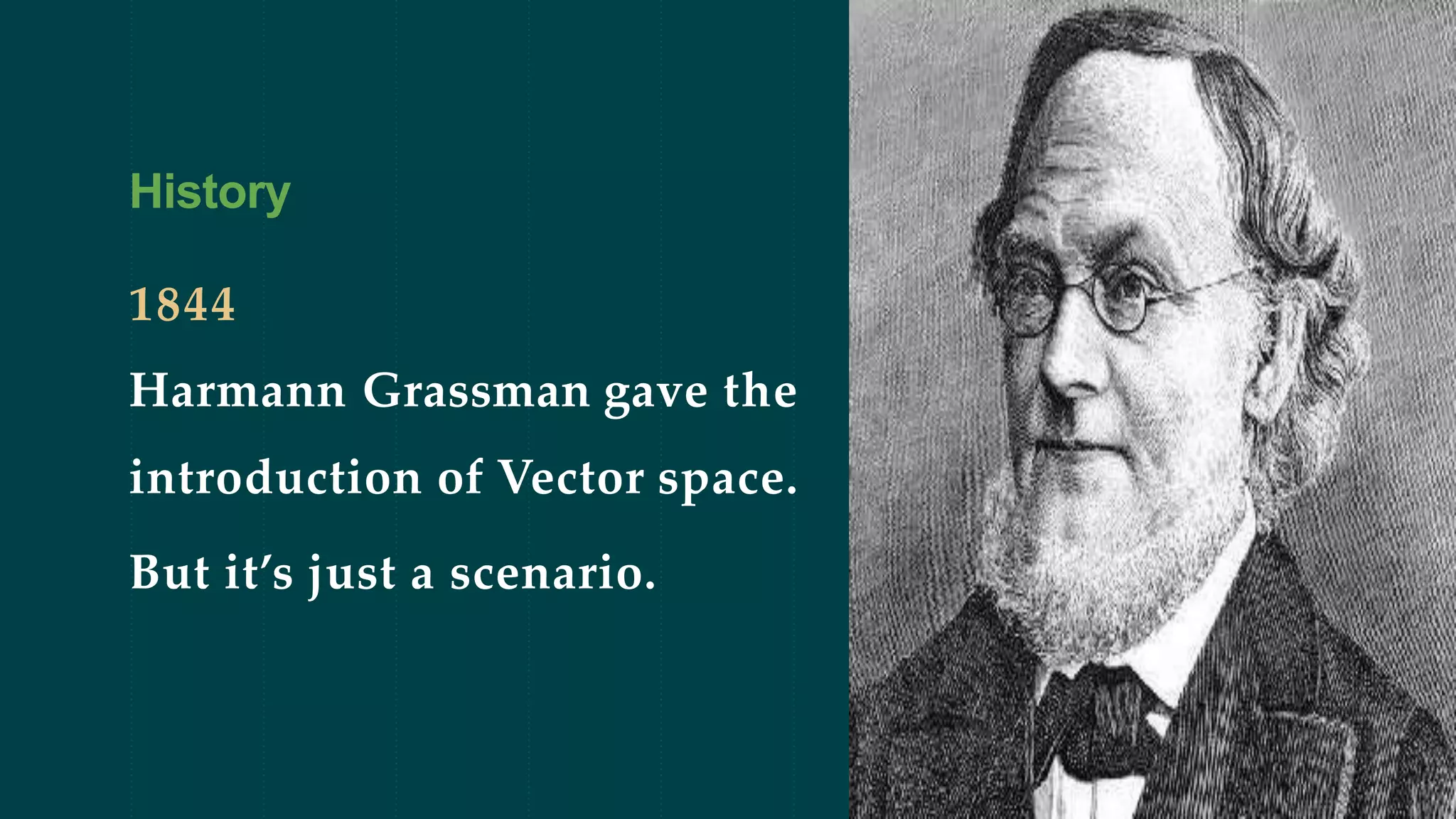
1844
Harmann Grassman gave the
introduction of Vector space.
But it’s just a scenario.
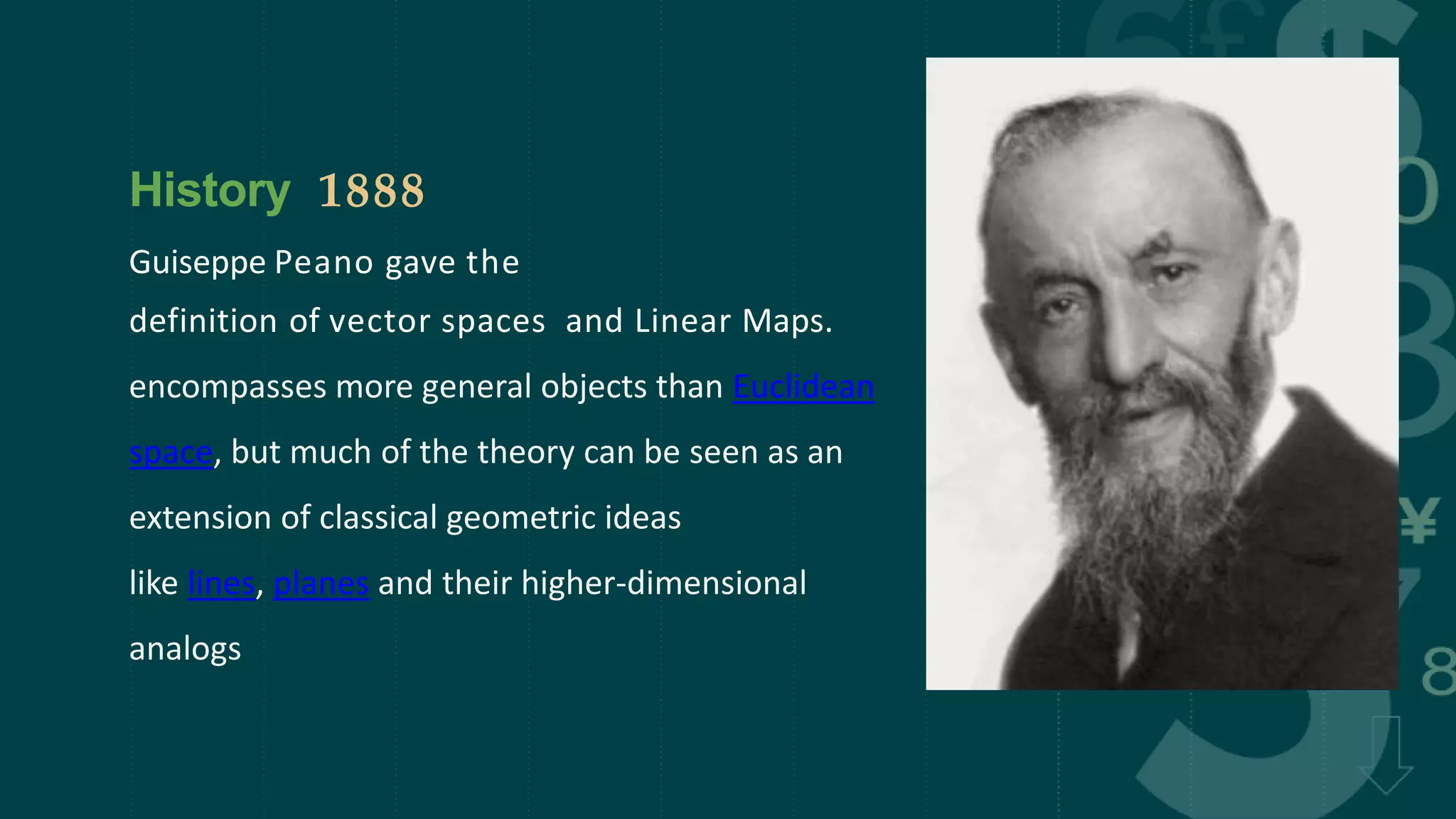
History 1888
Guiseppe Peano gave the
definition of vector spaces and Linear Maps.
encompasses more general objects than Euclidean
space, but much of the theory can be seen as an
extension of classical geometric ideas
like lines, planes and their higher-dimensional
analogs
Vector Space
Vector Space
A Vector space V is a set that is
closed under finite vector addition
and scalar multiplication.
In other words vector space :
A vector space (also called a linear
space) is a collection of objects
called vectors, which may
be added together
and multiplied ("scaled") by numbers,
called scalars.
Then a thought bling's in your mind what is
scaler ??
Scalars are often taken to be real
numbers.
But there are also vector spaces with
scalar multiplication by complex
numbers, rational numbers, or generally
any field.
The set of all Integers is not a vector space.
1 ϵ V, ½ ϵ R
(½ ) (1) =½ !ϵ V
It is not closed under scalar multiplication
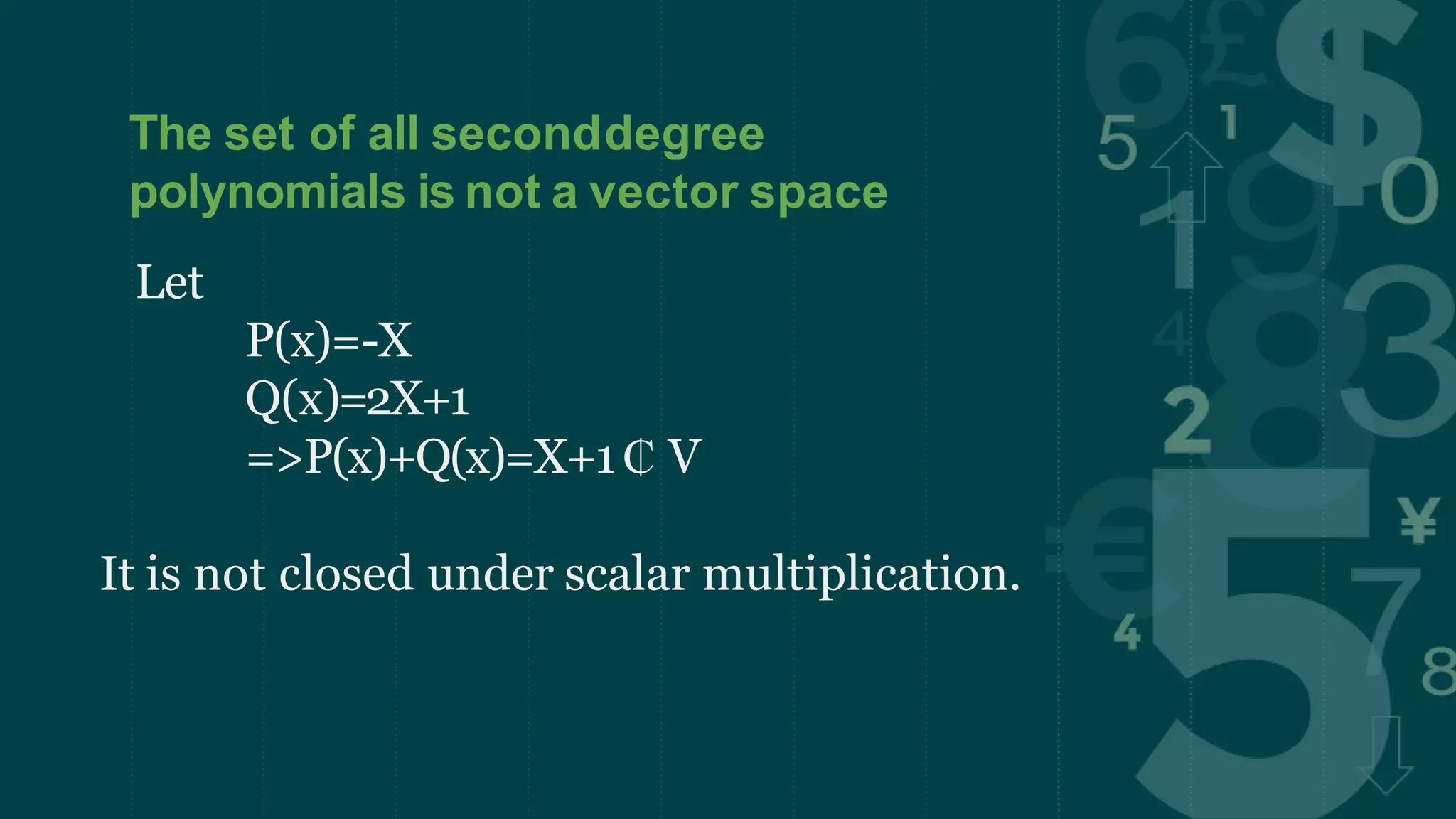
The set of all seconddegree
polynomials is not a vector space
Let
P(x)=-X
Q(x)=2X+1
=>P(x)+Q(x)=X+1₵ V
It is not closed under scalar multiplication.
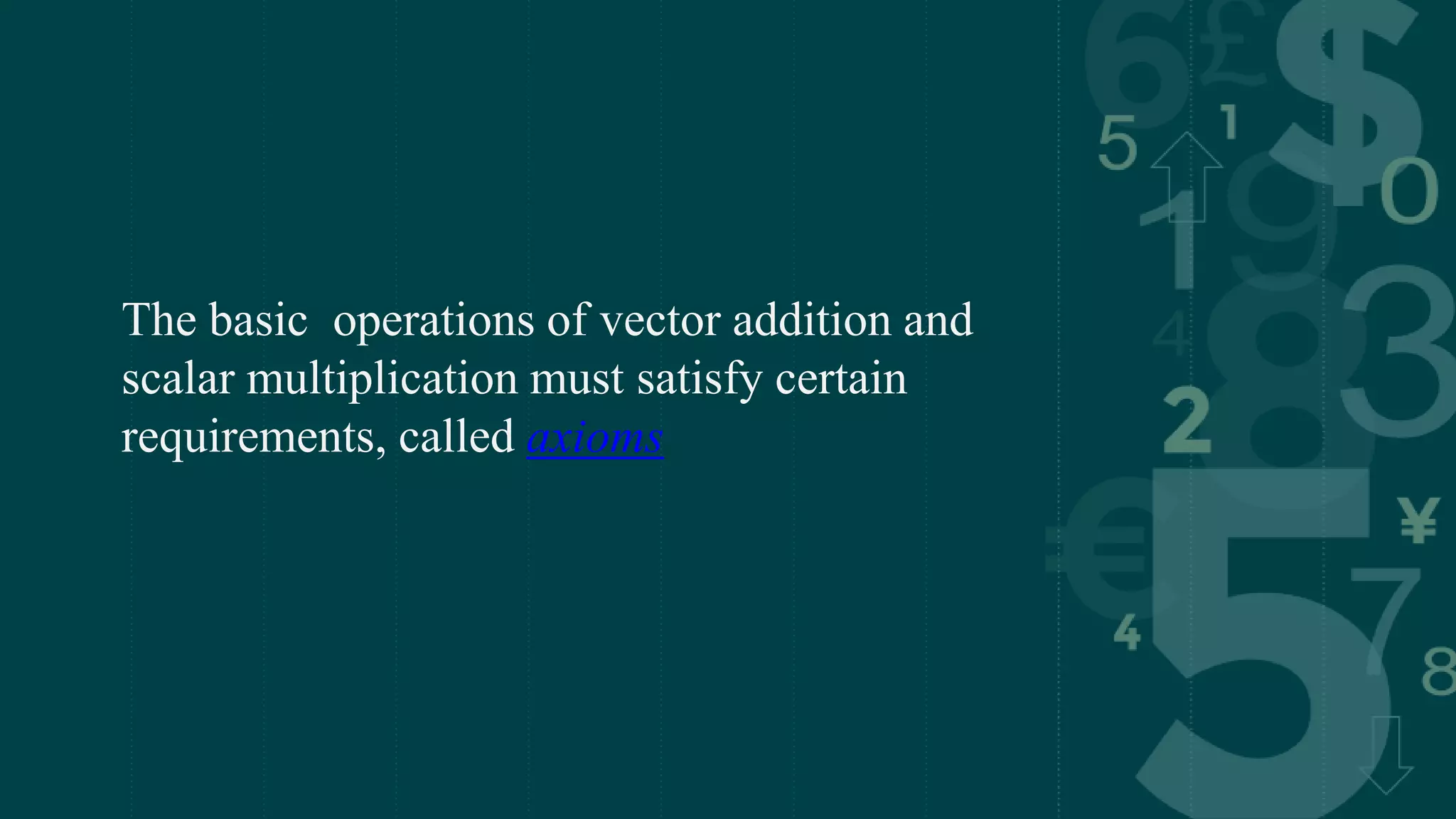
The basic operations of vector addition and
scalar multiplication must satisfy certain
requirements, called axioms
Axioms
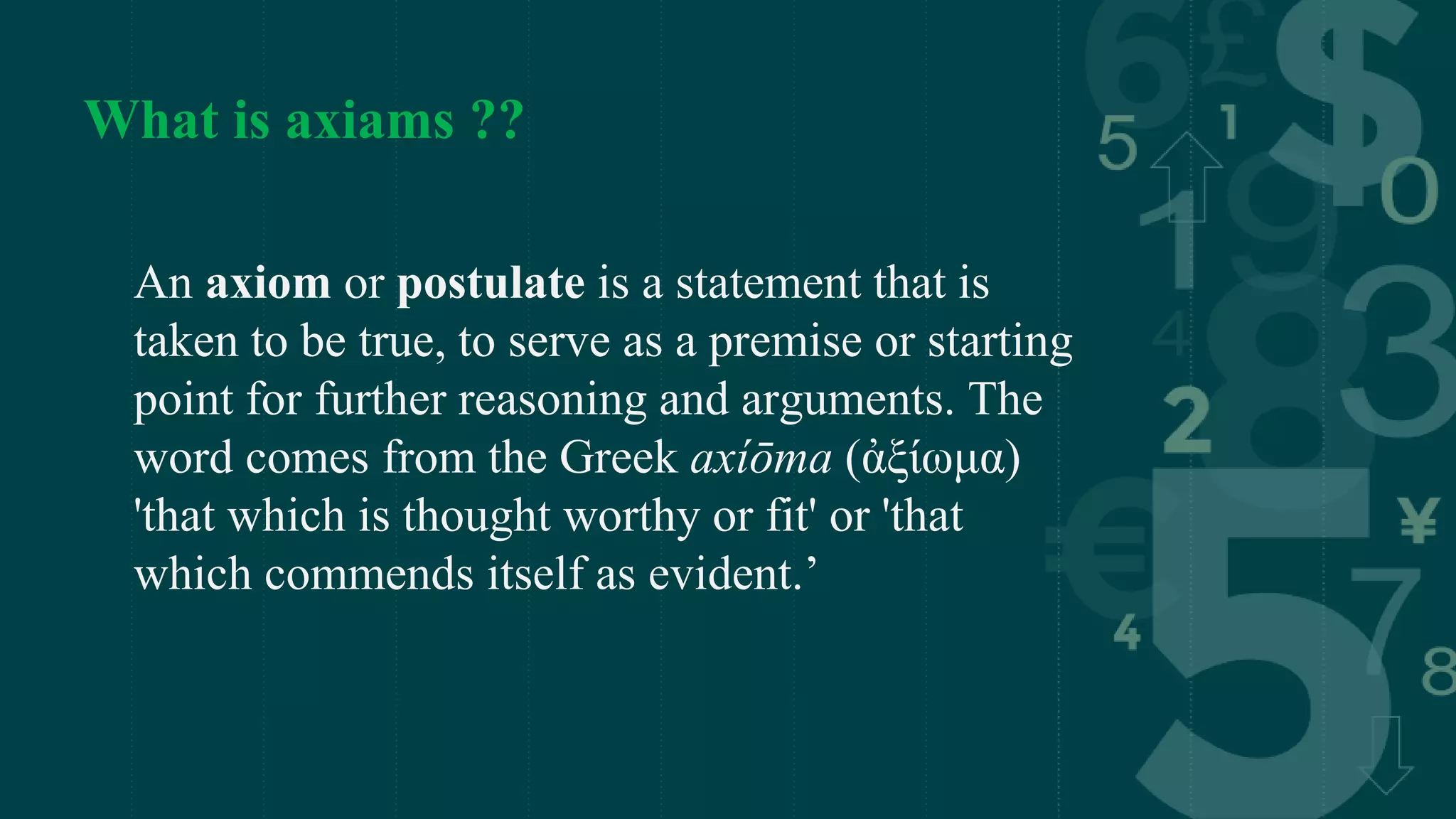
What is axiams ??
An axiom or postulate is a statement that is
taken to be true, to serve as a premise or starting
point for further reasoning and arguments. The
word comes from the Greek axíōma (ἀξίωμα)
'that which is thought worthy or fit' or 'that
which commends itself as evident.’
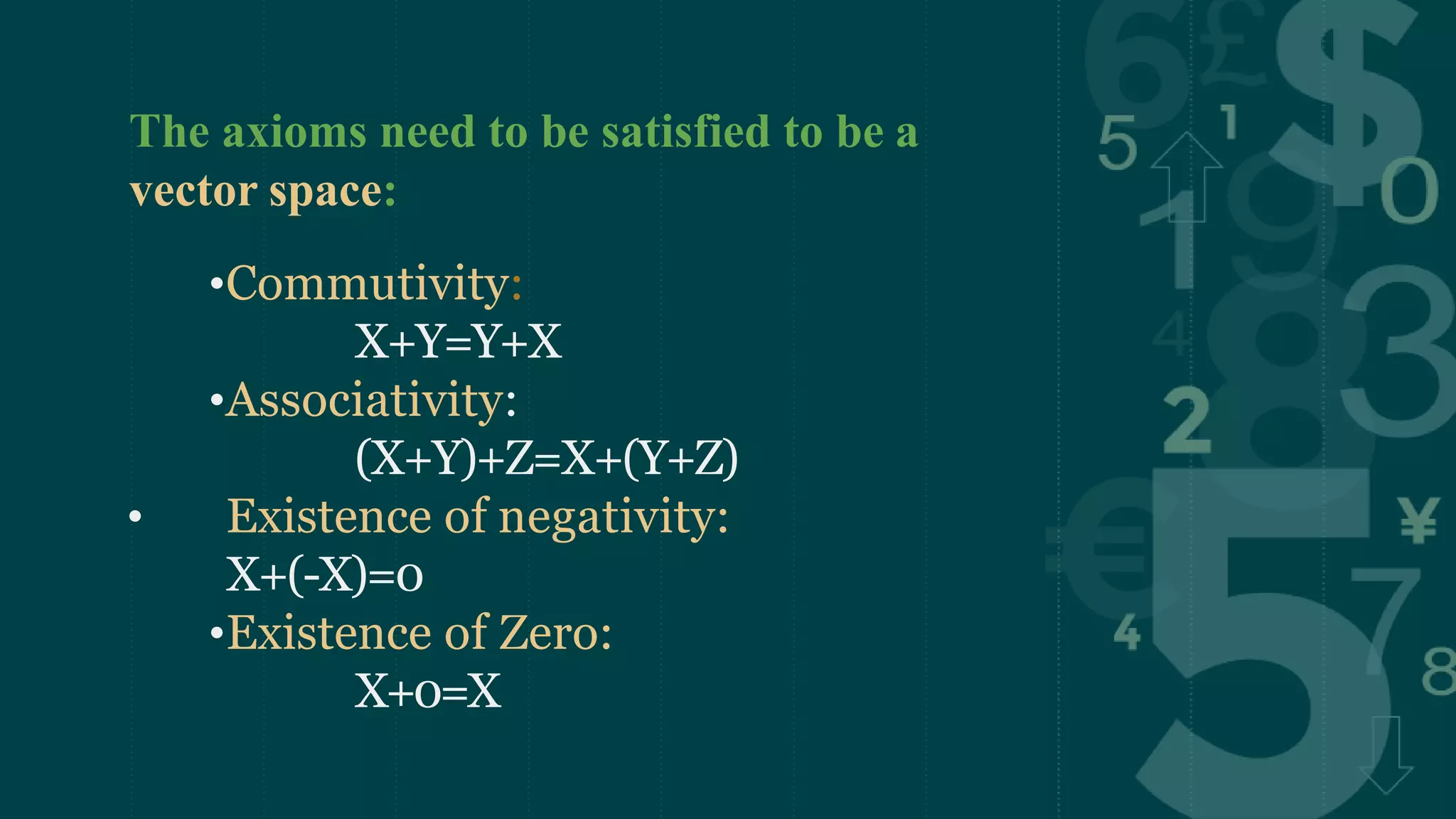
The axioms need to be satisfied to be a
vector space:
•Commutivity:
X+Y=Y+X
•Associativity:
(X+Y)+Z=X+(Y+Z)
• Existence of negativity:
X+(-X)=0
•Existence of Zero:
X+0=X
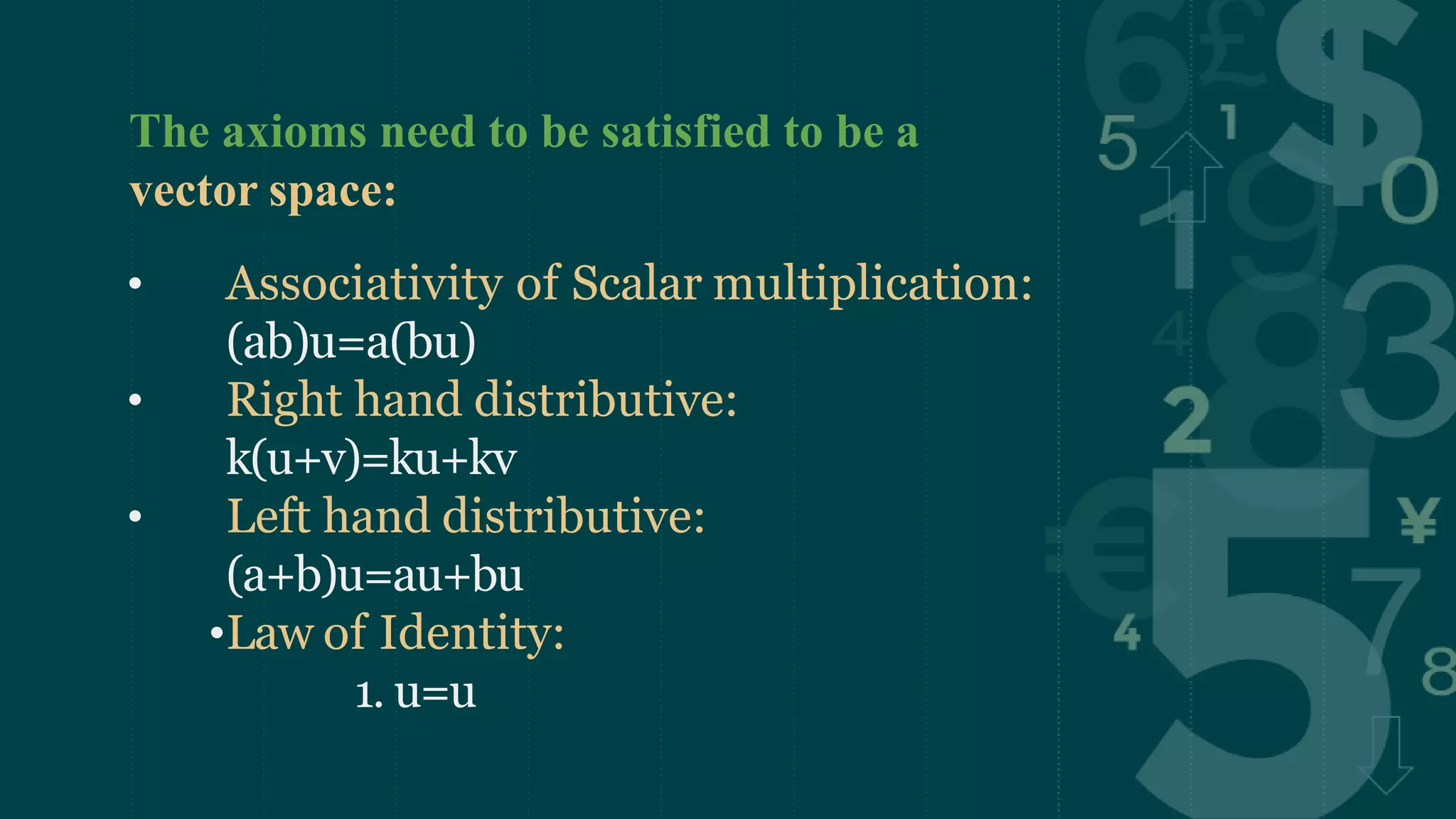
The axioms need to be satisfied to be a
vector space:
• Associativity of Scalar multiplication:
(ab)u=a(bu)
• Right hand distributive:
k(u+v)=ku+kv
• Left hand distributive:
(a+b)u=au+bu
•Law of Identity:
1. u=u
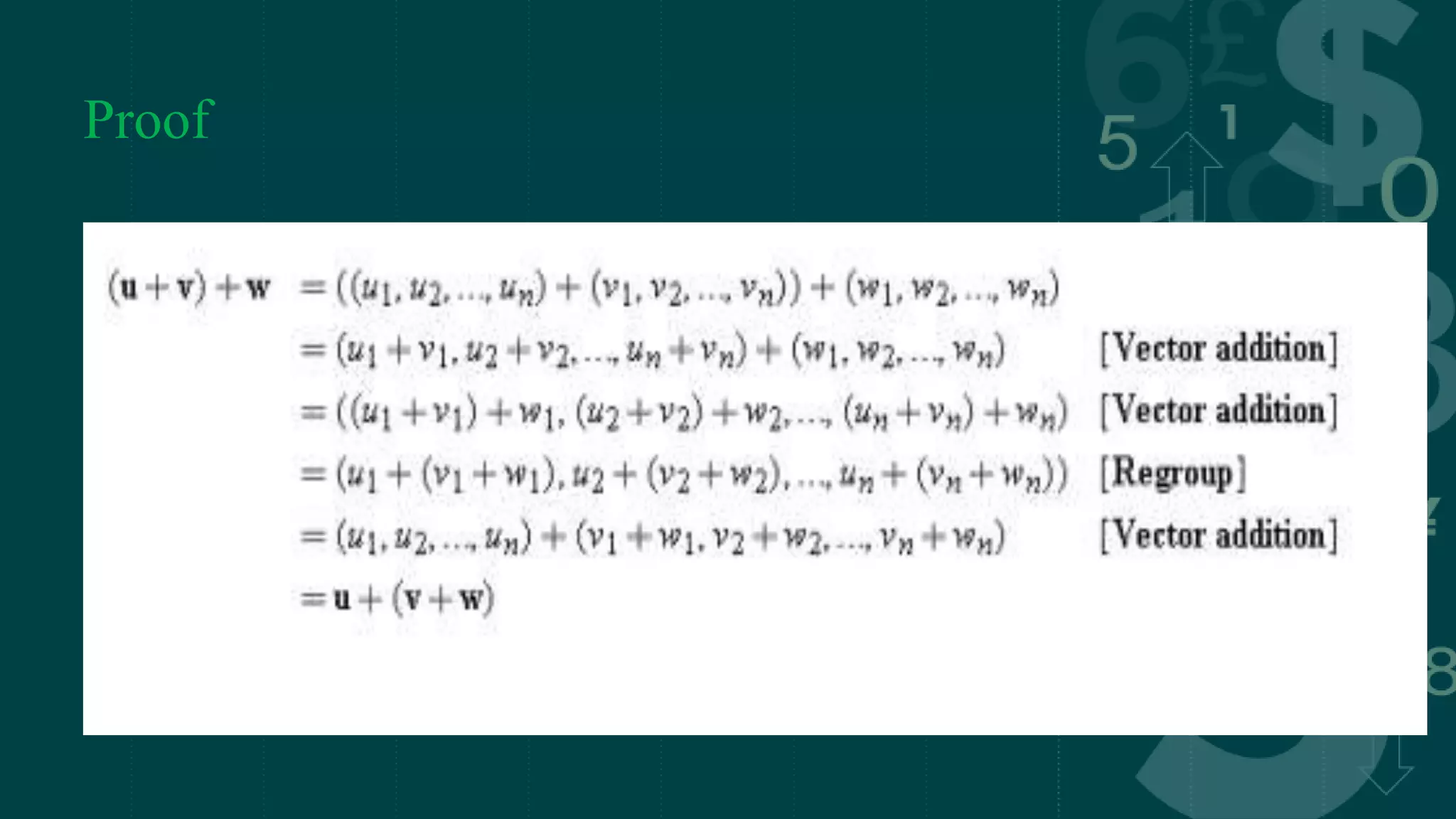
Proof
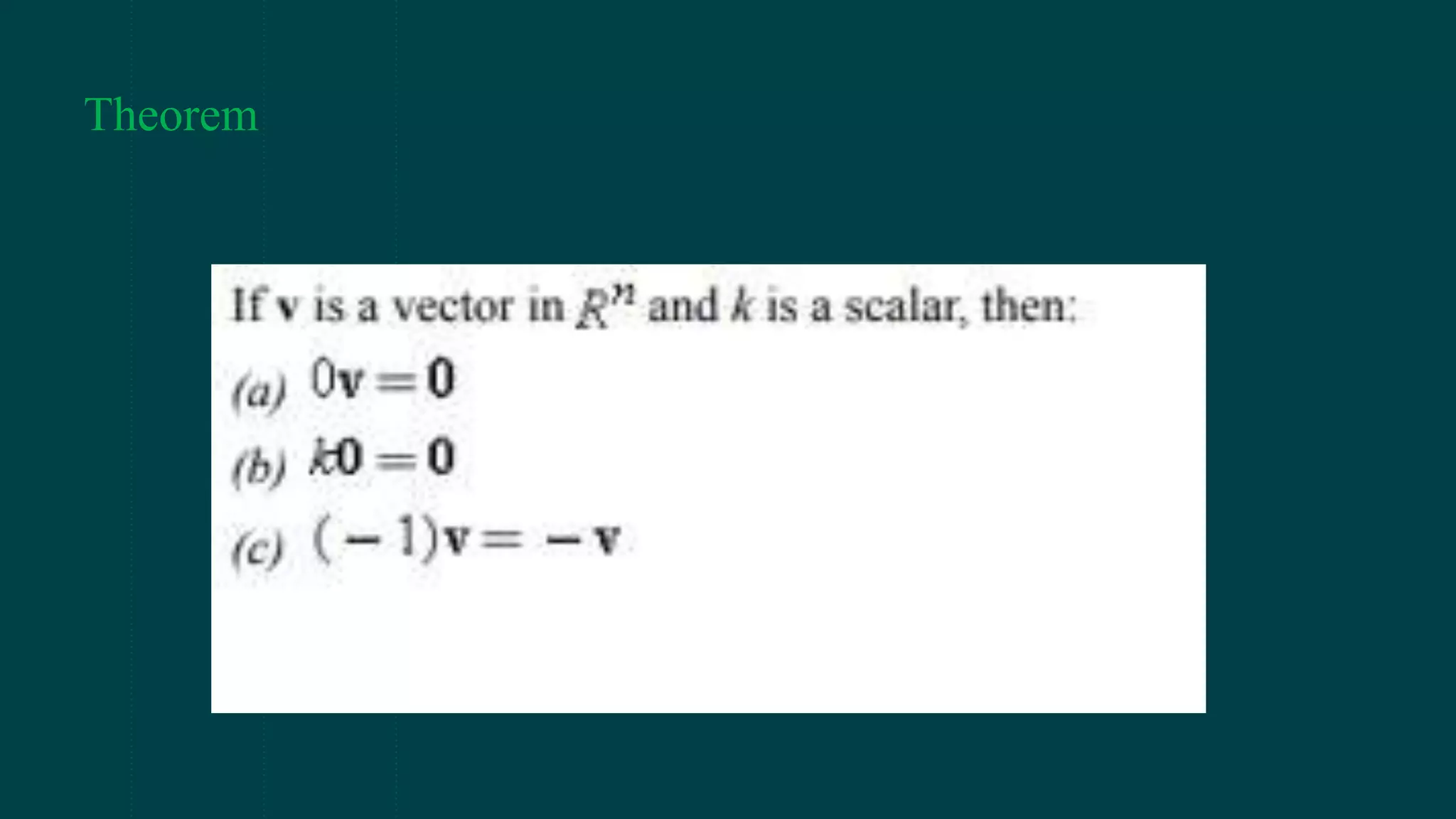
Theorem
Vectors in 2-Space, 3-Space, and n-
Space
Engineers and physicists represent vectors in two
dimensions (also called 2-space) or in three dimensions
(also called 3-space) by arrows.
The direction of the arrowhead specifies the direction of
the vector and the length of the arrow specifies the
magnitude.
Mathematicians call these geometric vectors.
Representation of Vector
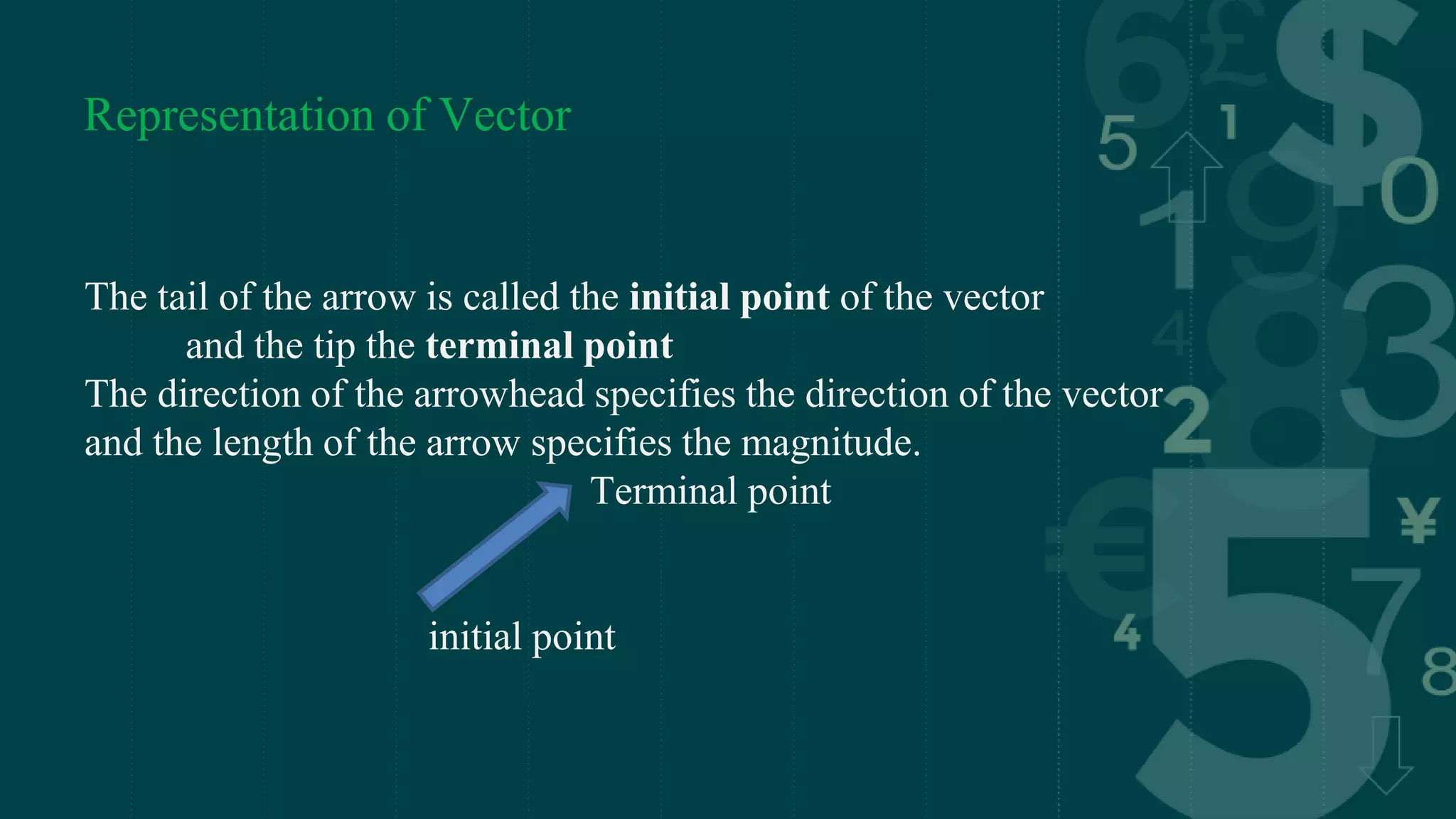
The tail of the arrow is called the initial point of the vector
and the tip the terminal point
The direction of the arrowhead specifies the direction of the vector
and the length of the arrow specifies the magnitude.
Terminal point
initial point
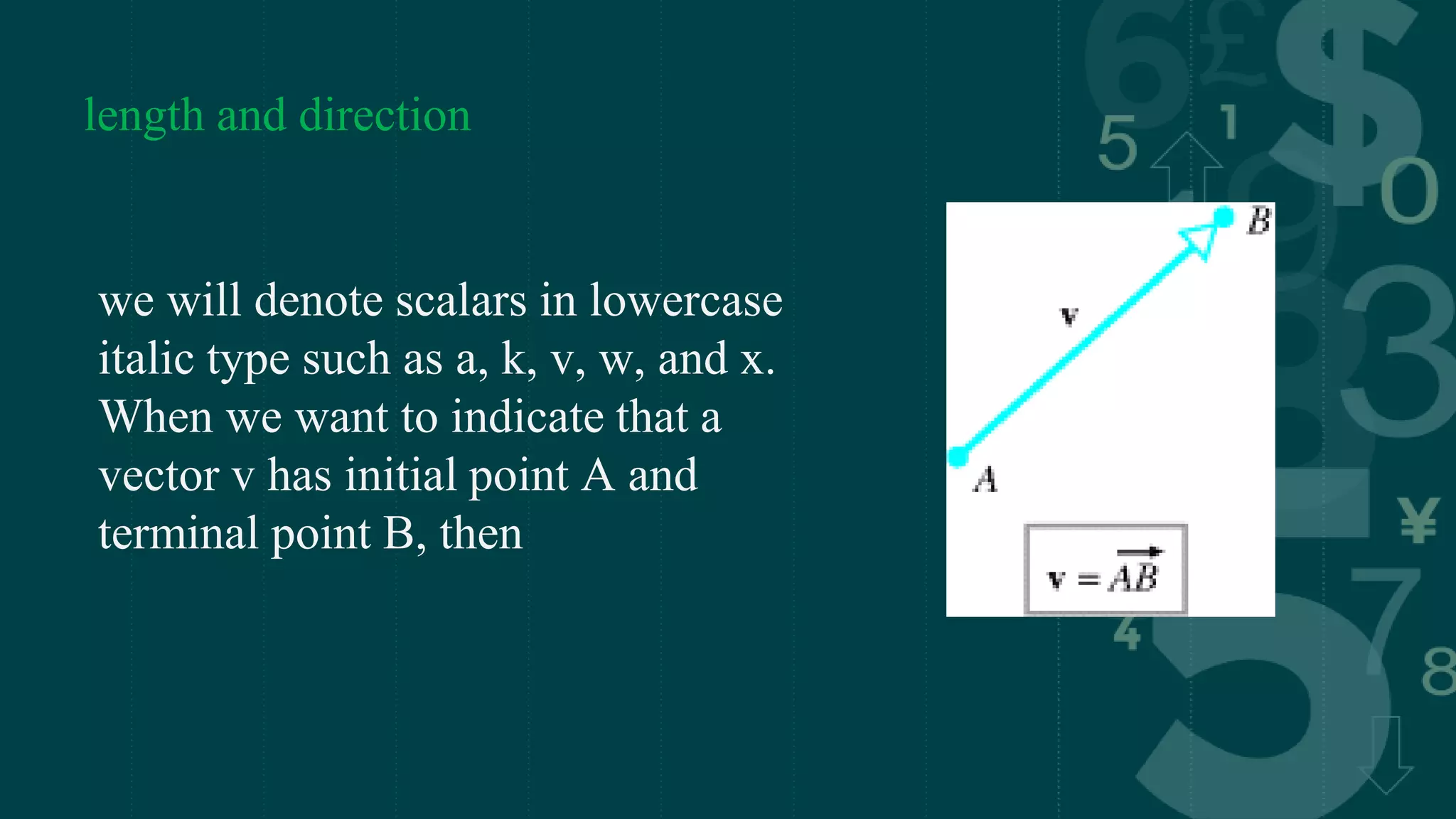
length and direction
we will denote scalars in lowercase
italic type such as a, k, v, w, and x.
When we want to indicate that a
vector v has initial point A and
terminal point B, then
Equivalent vectors
Vectors with the same length and direction, are
said to be equivalent.
Equivalent vectors are regarded to be the same
vector even though they may be in different
positions. Equivalent vectors are also said to be
equal, which are indicate by writing
V=W
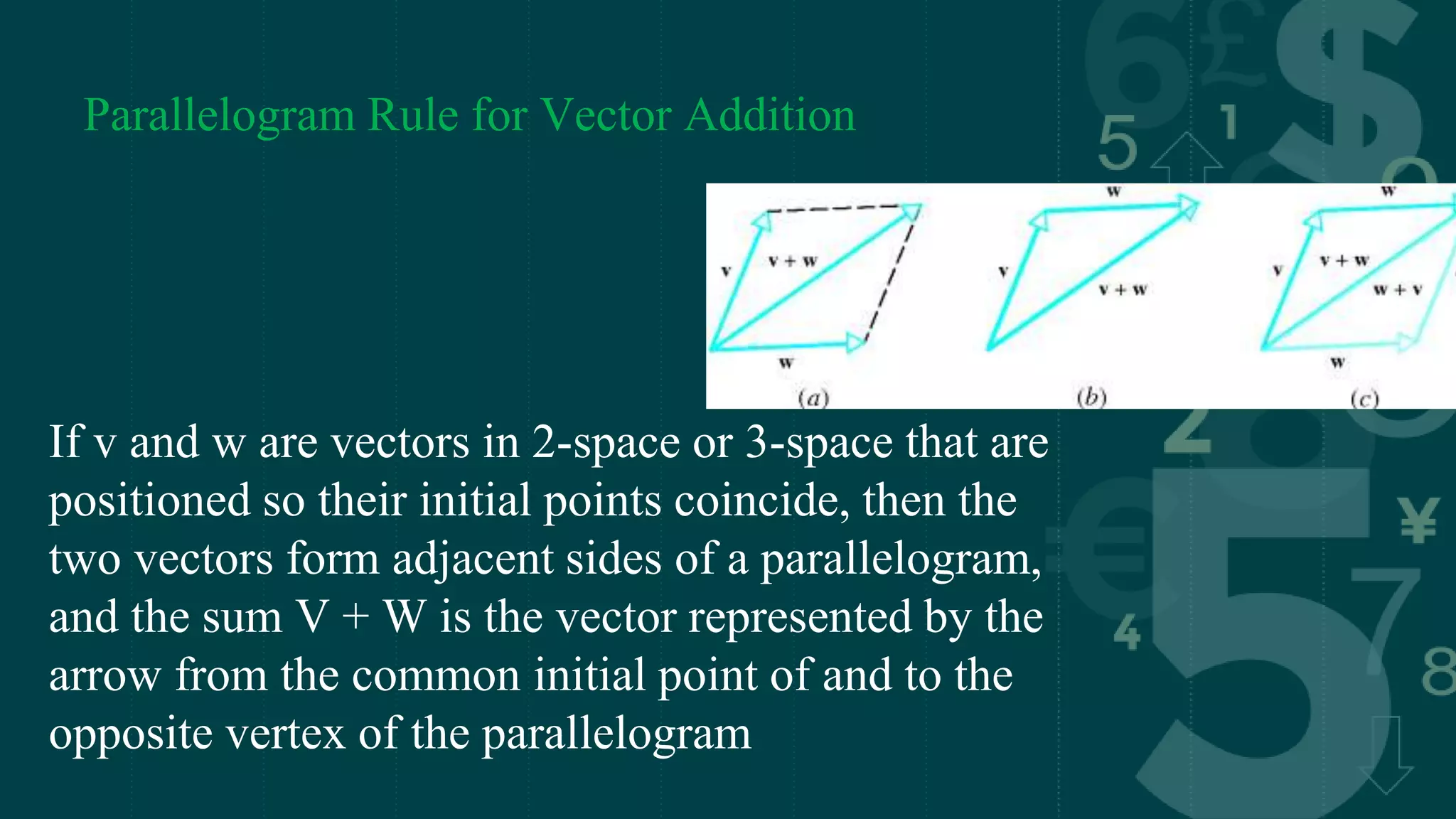
Parallelogram Rule for Vector Addition
If v and w are vectors in 2-space or 3-space that are
positioned so their initial points coincide, then the
two vectors form adjacent sides of a parallelogram,
and the sum V + W is the vector represented by the
arrow from the common initial point of and to the
opposite vertex of the parallelogram
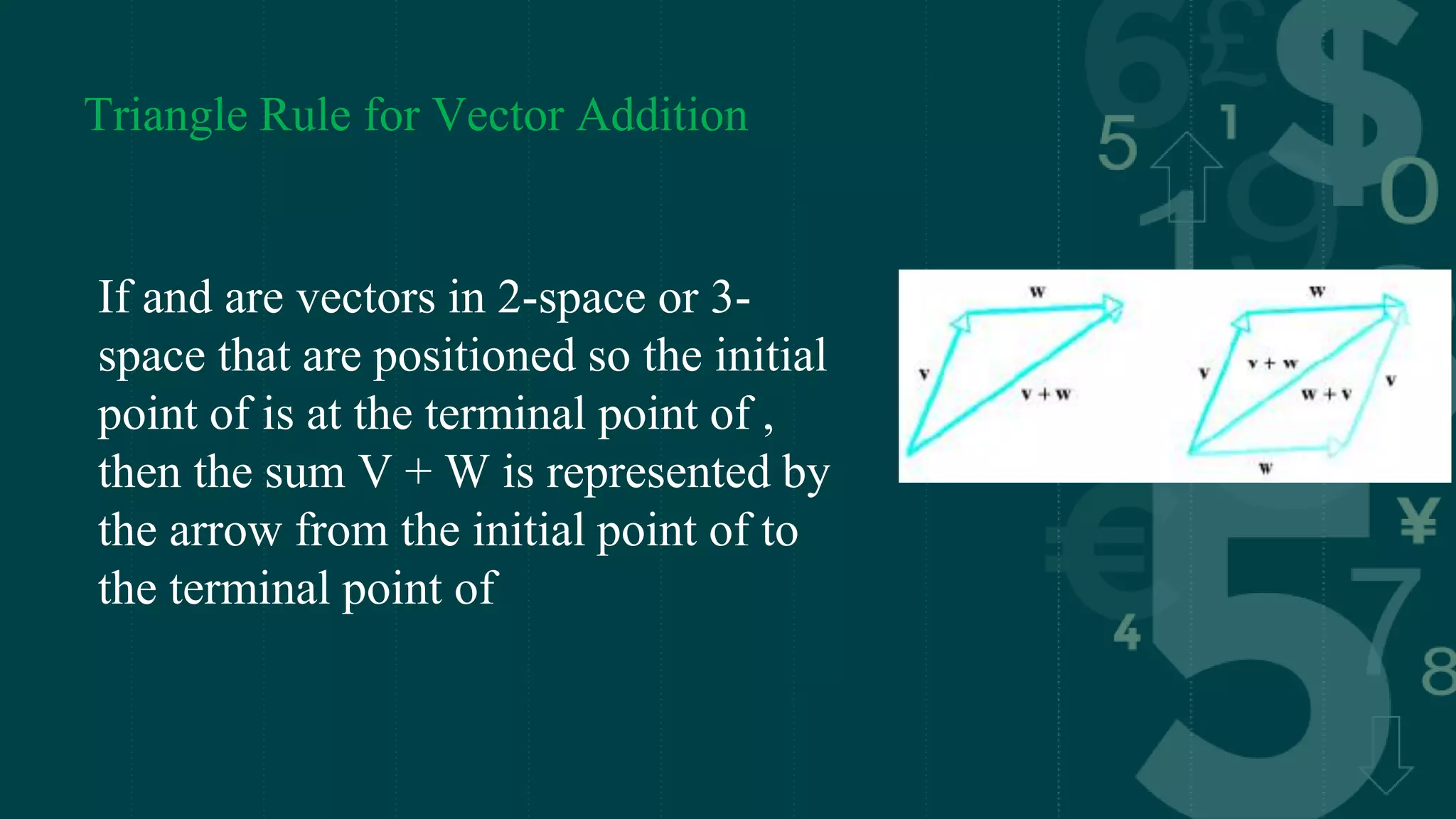
Triangle Rule for Vector Addition
If and are vectors in 2-space or 3-
space that are positioned so the initial
point of is at the terminal point of ,
then the sum V + W is represented by
the arrow from the initial point of to
the terminal point of
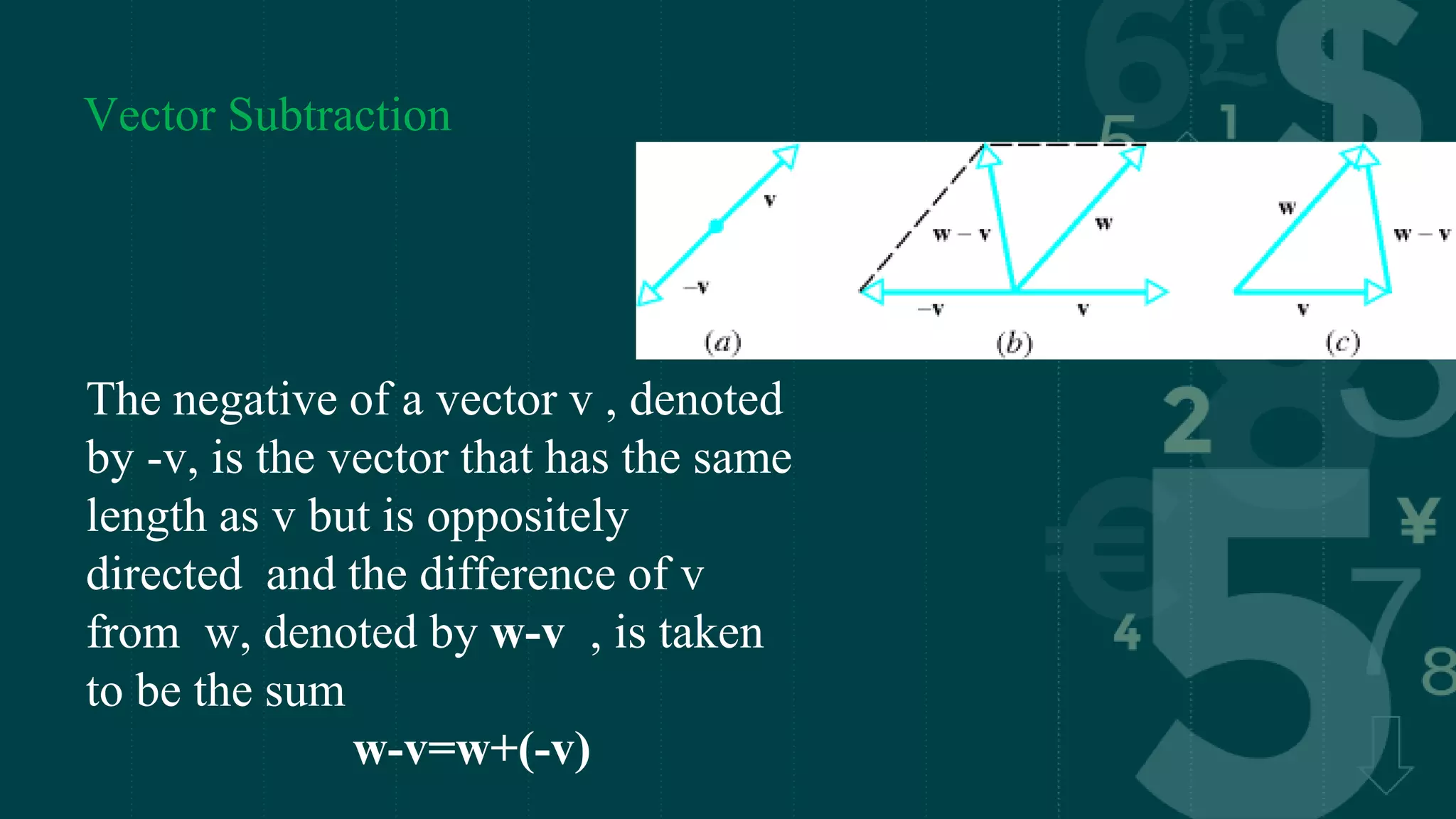
Vector Subtraction
The negative of a vector v , denoted
by -v, is the vector that has the same
length as v but is oppositely
directed and the difference of v
from w, denoted by w-v , is taken
to be the sum
w-v=w+(-v)
Scalar Multiplication n-SPACE
THEORM
Scalar Multiplication
If v is a nonzero vector in 2-space or 3-space,
and if k is a nonzero scalar, then we define the
scalar product of v by k to be the vector whose
length |k| is times the length of v and whose
direction is the same as that of v if k is positive
and opposite to that of v if k is negative k=0. or
v=0 , then we define kv to be zero.
Scalar Multiplication
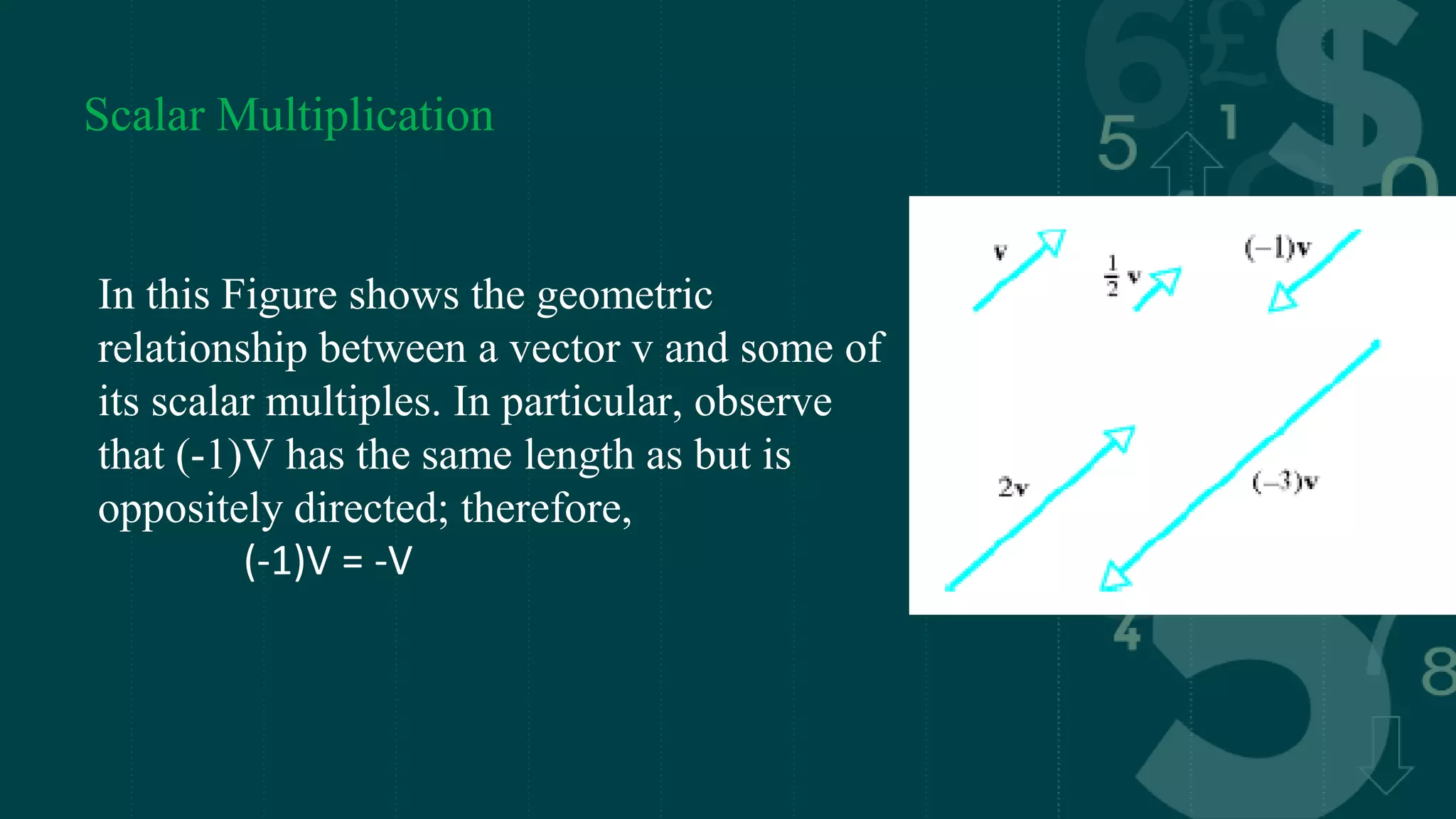
In this Figure shows the geometric
relationship between a vector v and some of
its scalar multiples. In particular, observe
that (-1)V has the same length as but is
oppositely directed; therefore,
(-1)V = -V
Parallel and Collinear Vectors
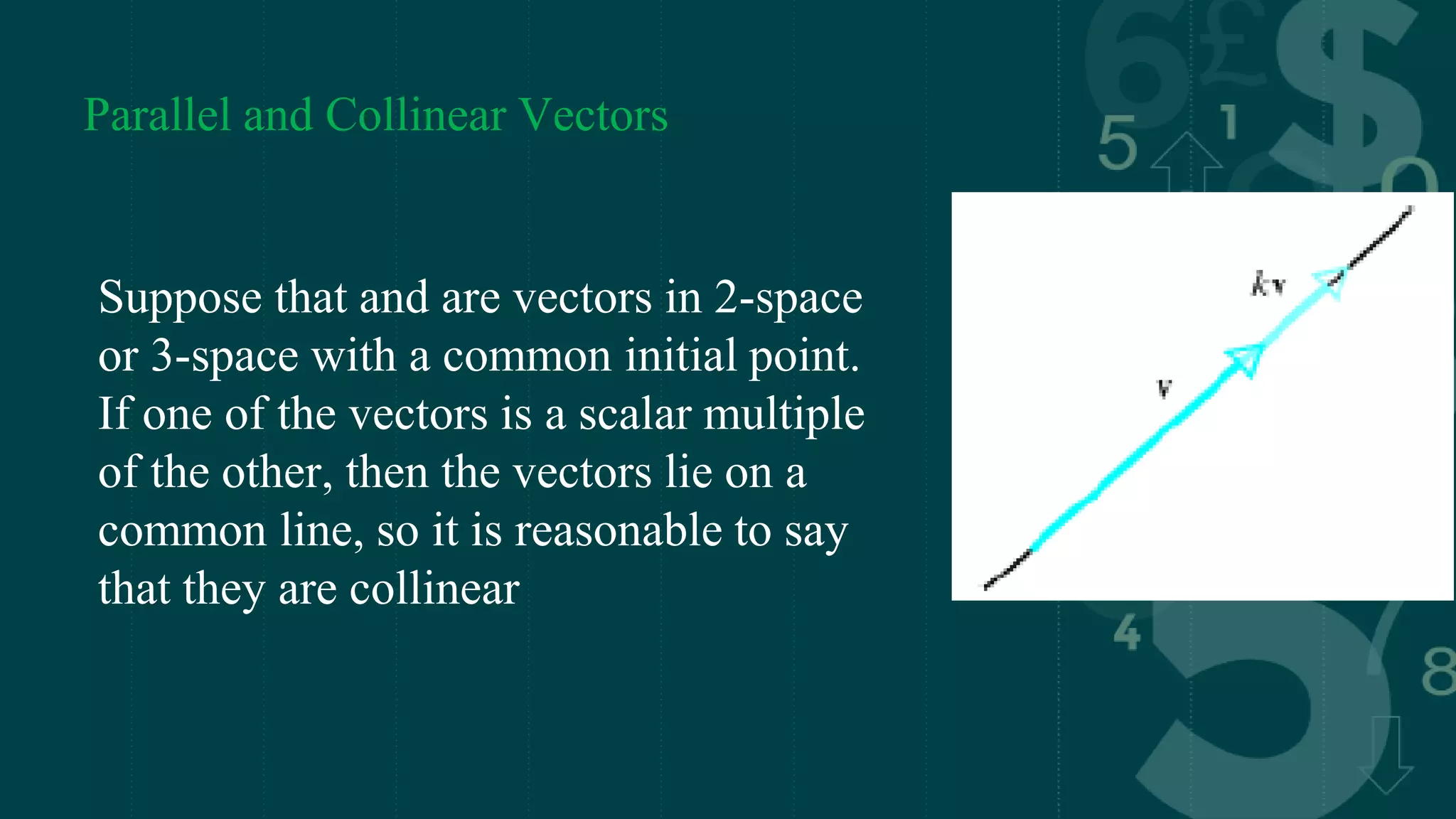
Suppose that and are vectors in 2-space
or 3-space with a common initial point.
If one of the vectors is a scalar multiple
of the other, then the vectors lie on a
common line, so it is reasonable to say
that they are collinear
Parallel VECTOR
Suppose that and are vectors in 2-space or
3-space with a common initial point. If one
of the vectors is a scalar multiple of the
other, then the vectors lie on a common
line, so it is reasonable to say that they are
collinear
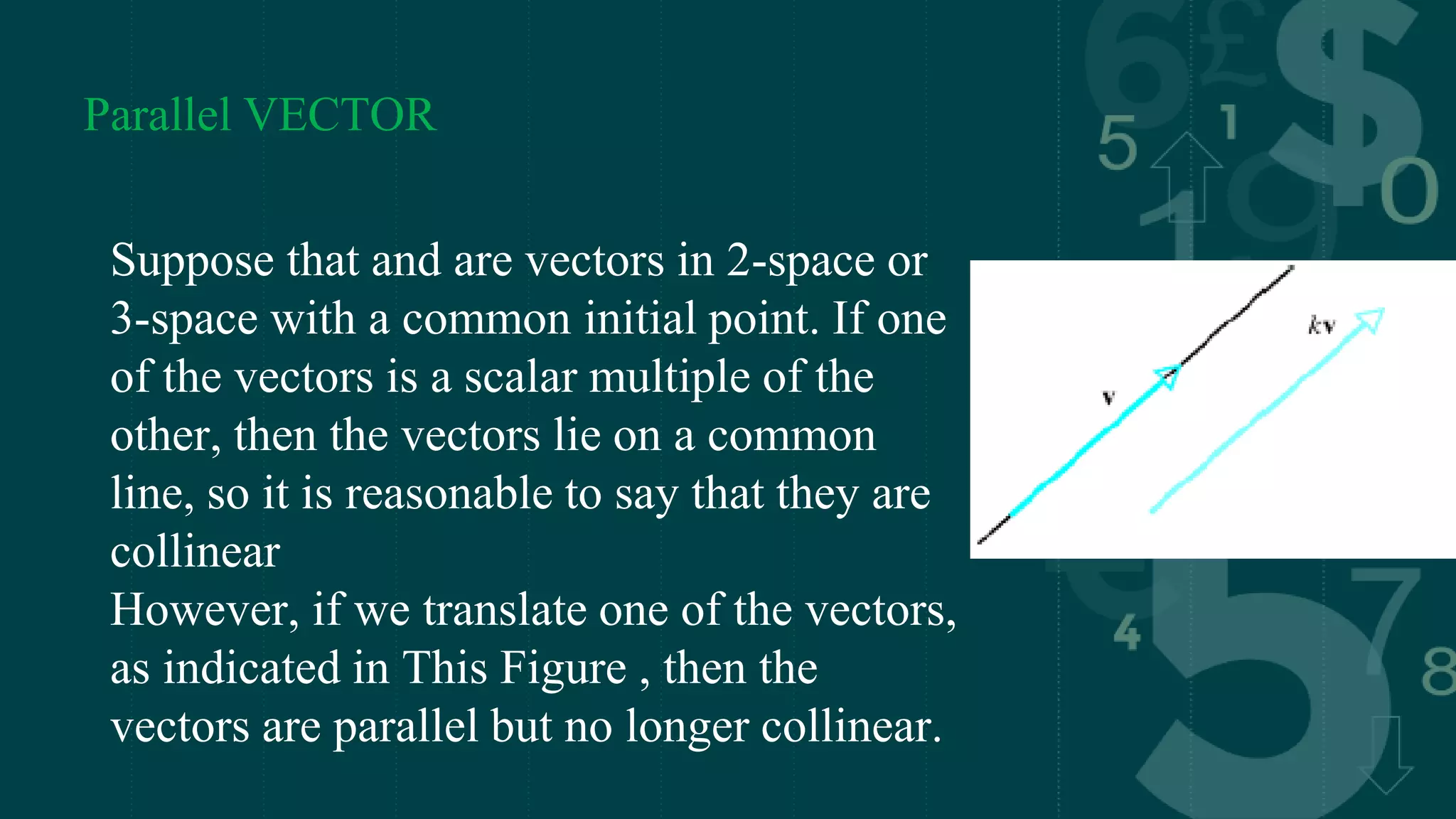
However, if we translate one of the vectors,
as indicated in This Figure , then the
vectors are parallel but no longer collinear.
Sums of Three or More Vectors
Vector addition satisfies the
Associative law for addition, meaning
that when we add three vectors, say u,
v, and w, it does not matter which two
we add first;
that is,
u + ( v + w ) = ( u + v )+ w
tip-to-tail method
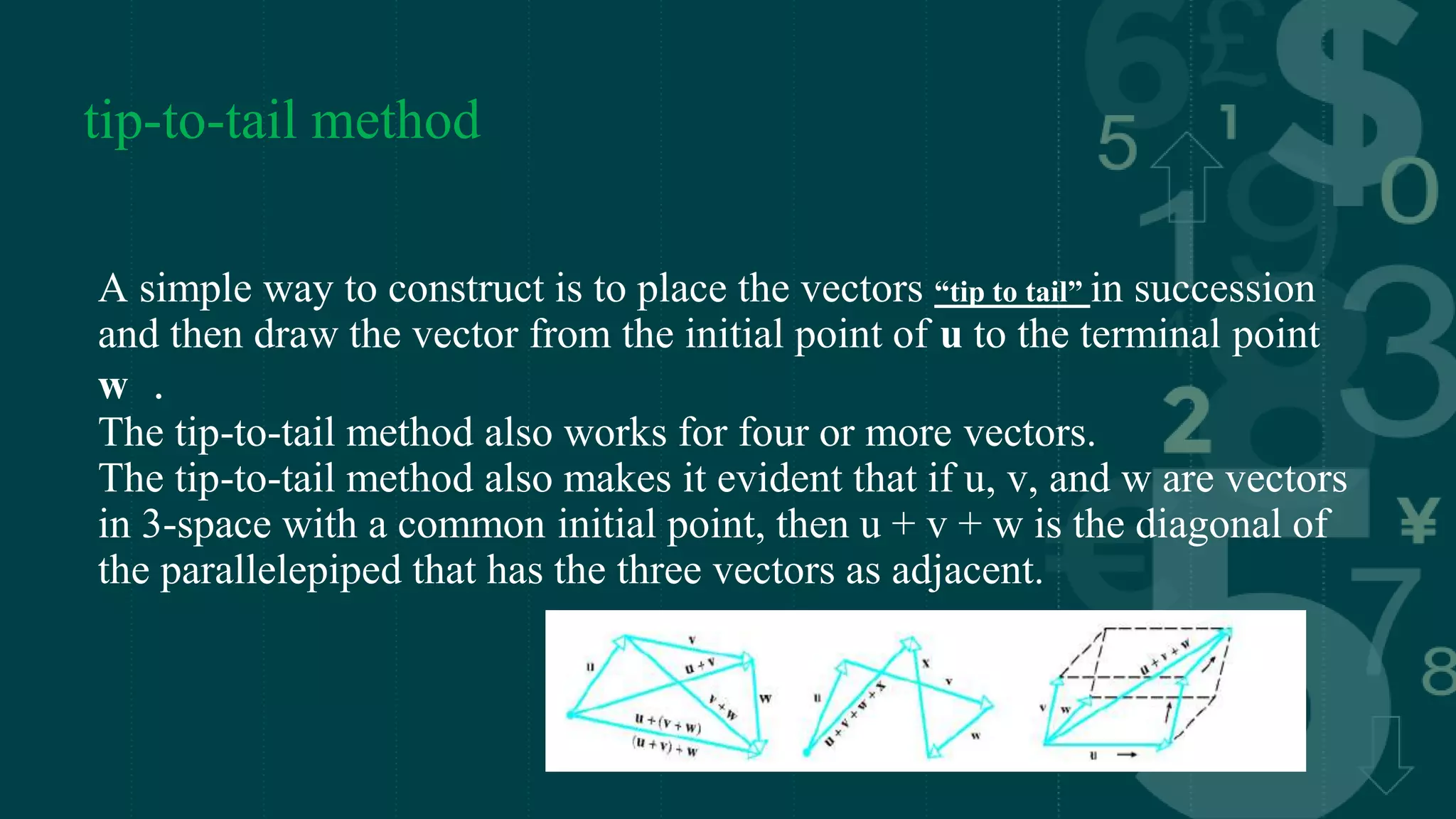
A simple way to construct is to place the vectors “tip to tail” in succession
and then draw the vector from the initial point of u to the terminal point
w .
The tip-to-tail method also works for four or more vectors.
The tip-to-tail method also makes it evident that if u, v, and w are vectors
in 3-space with a common initial point, then u + v + w is the diagonal of
the parallelepiped that has the three vectors as adjacent.
Vectors Whose Initial Point Is Not at
the Origin
Vectors whose initial points are not at the
origin. If P1P2 denotes the vector with
initial point p1(x1,y1) and terminal point
p2(x2,y2) , then the components of this
vector are given by the formula
P1P2 = (X2-X1, Y2-Y1)
n-Space
If n is a positive integer, then an ordered n-
tuple is a sequence of n real numbers
(V1,V2,………..Vn) . The set of all
ordered n-tuples is called n-space and is
denoted by
Rn .
Subspace
Subspace
If W is a nonempty subset of a vector space V,
then W is a subspace of V
if and only if the following conditions hold.
Conditions
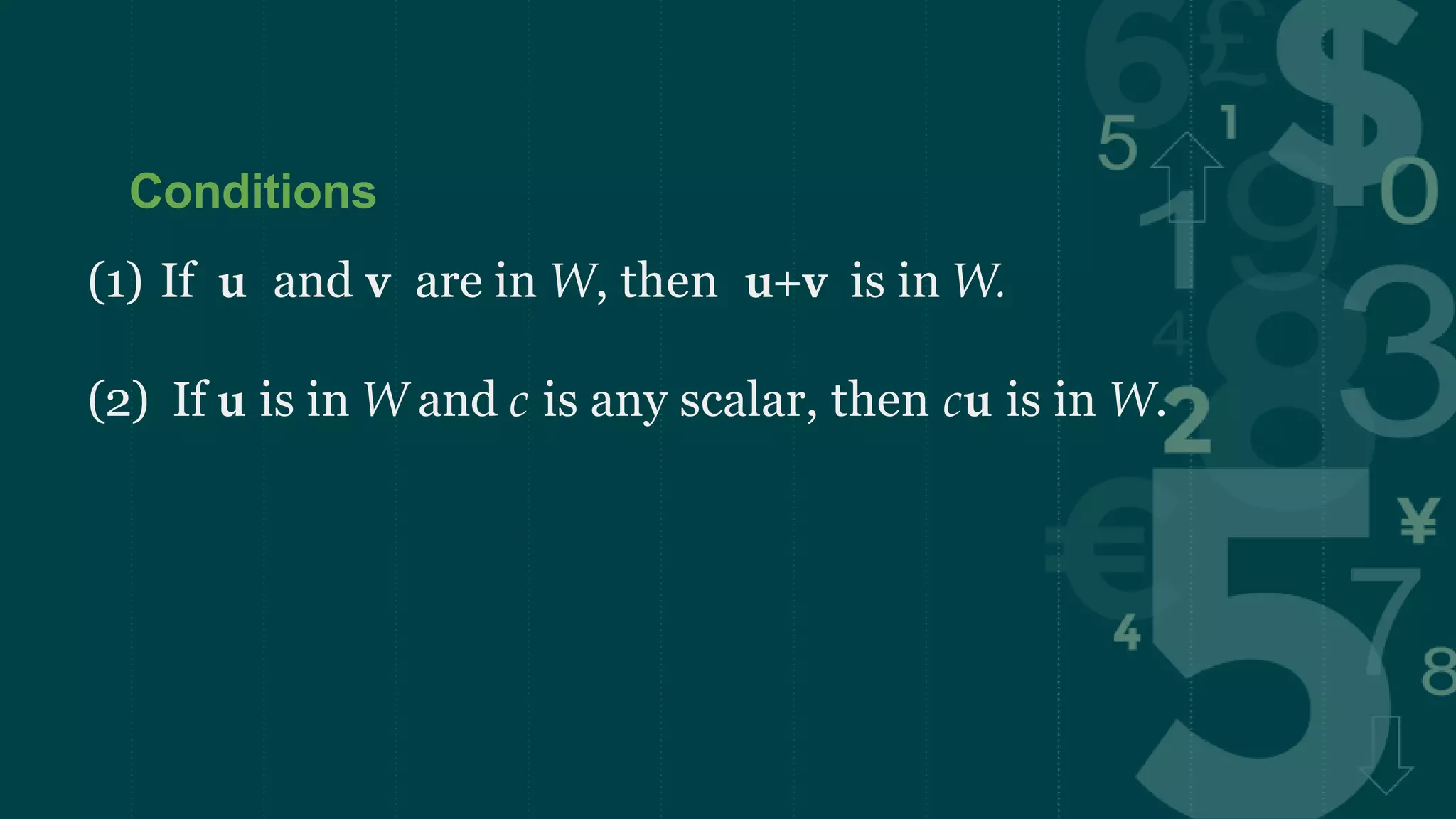
(1) If u and v are in W, then u+v is in W.
(2) If u is in W and c is any scalar, then cu is in W.
 
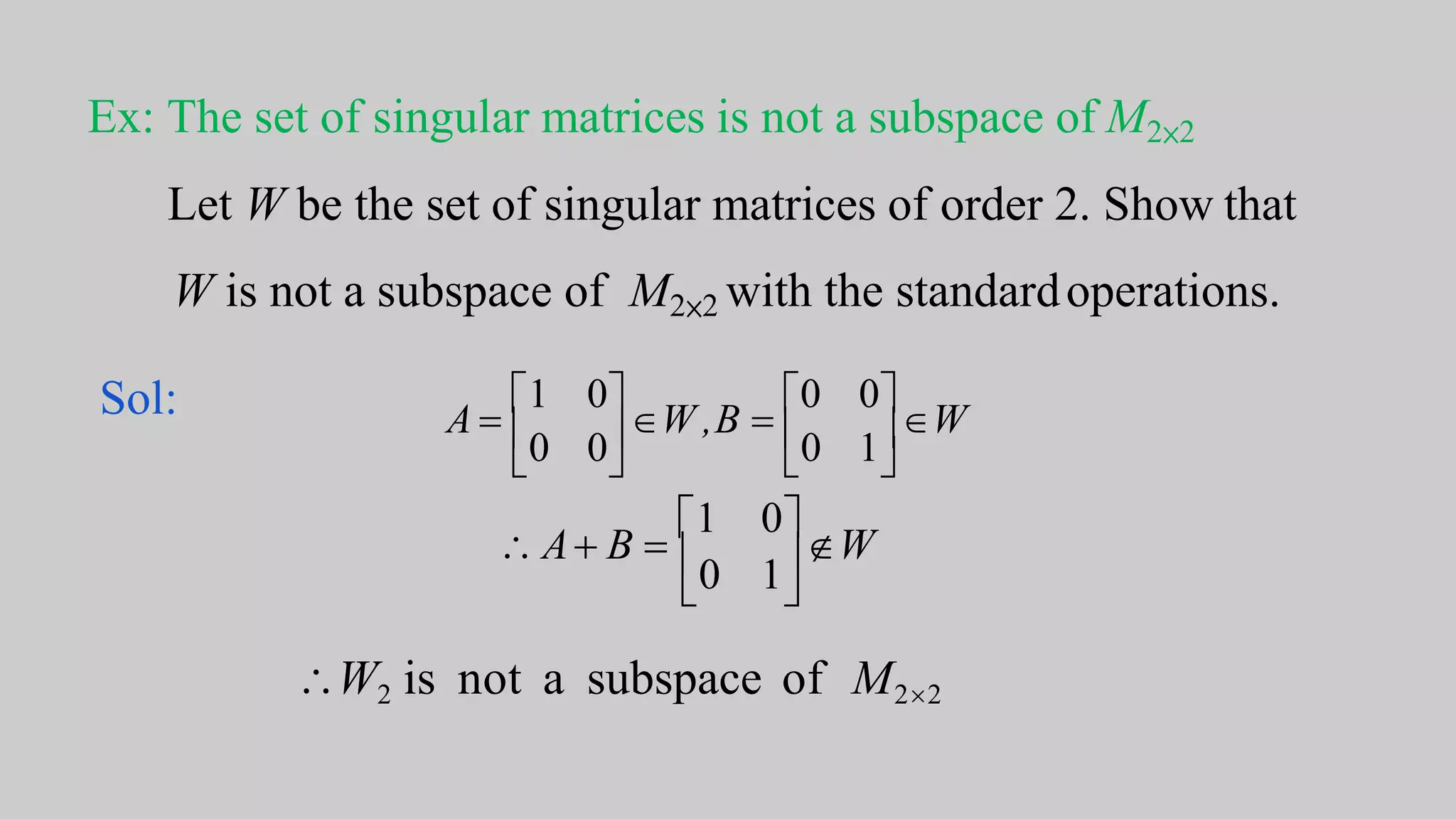
0 1
0
W A B 
1
W2 is not a subspace of M22
Ex: The set of singular matrices is not a subspace of M2×2
Let W be the set of singular matrices of order 2. Show that
W is not a subspace of M2×2 with the standardoperations.
  
0 0 0 1A 
1 0
W ,B 
0 0
WSol:
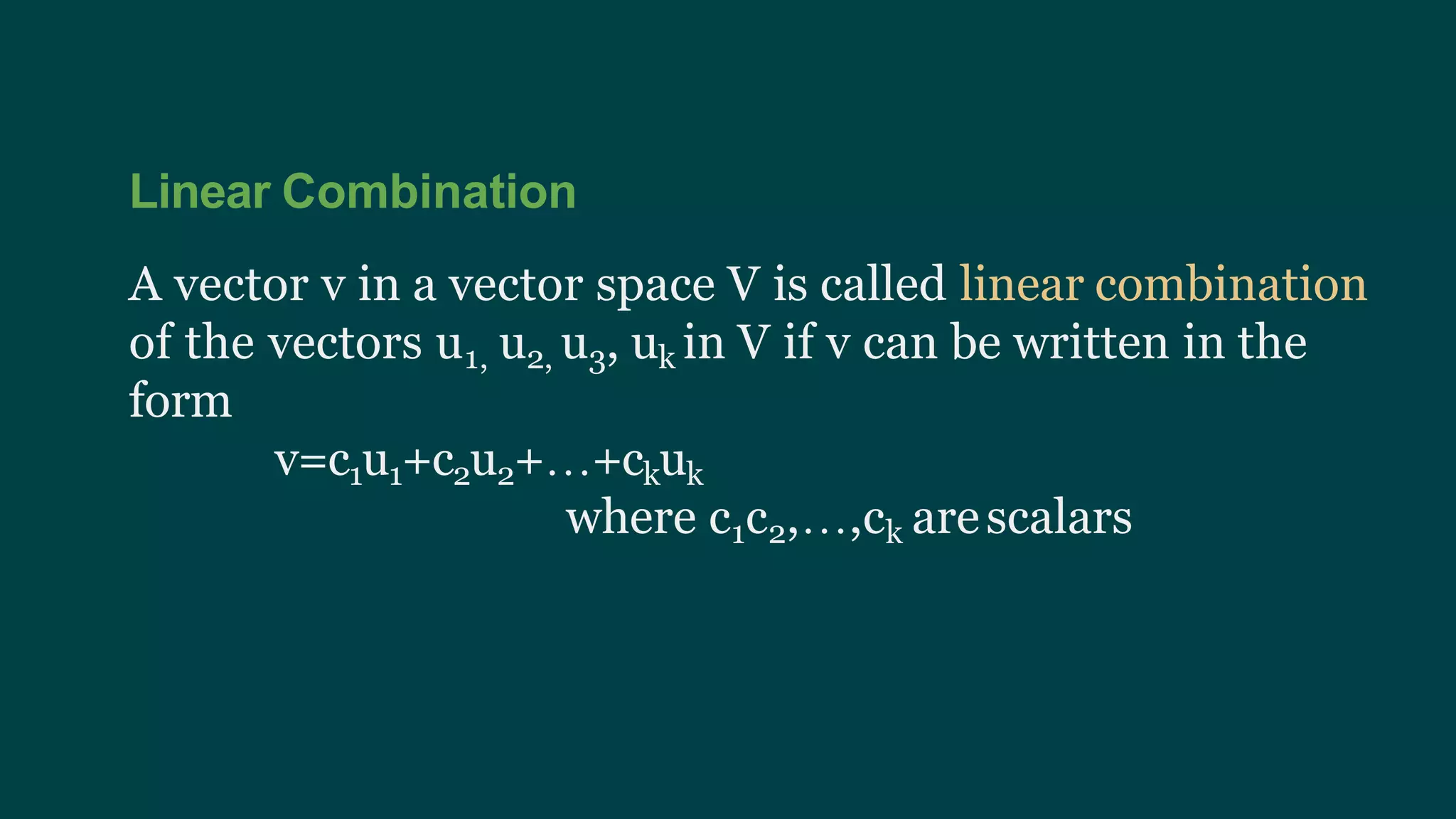
Linear Combination
Linear Combination
A vector v in a vector space V is called linear combination
of the vectors u1, u2, u3, uk in V if v can be written in the
form
v=c1u1+c2u2+…+ckuk
where c1c2,…,ck arescalars
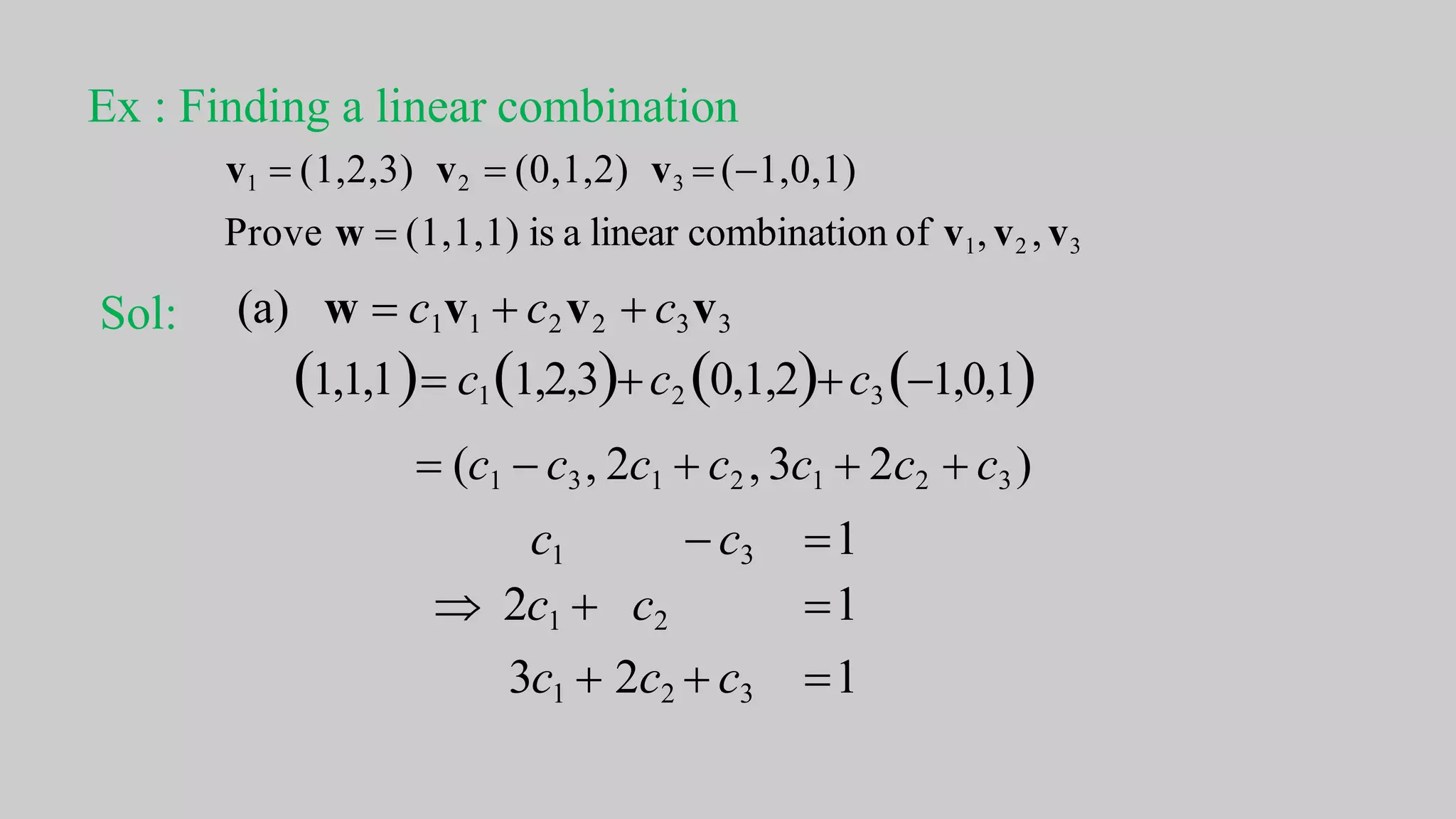
c1  c3 1
 2c1  c2 1
3c1  2c2  c3 1
Ex : Finding a linear combination
v1  (1,2,3) v2  (0,1,2) v3  (1,0,1)
Prove w  (1,1,1) is a linear combination of v1, v2 , v3
Sol: (a) w  c1v1  c2v2  c3v3
1,1,1 c11,2,3c2 0,1,2c3 1,0,1
 (c1  c3, 2c1  c2 , 3c1  2c2  c3 )

1

3
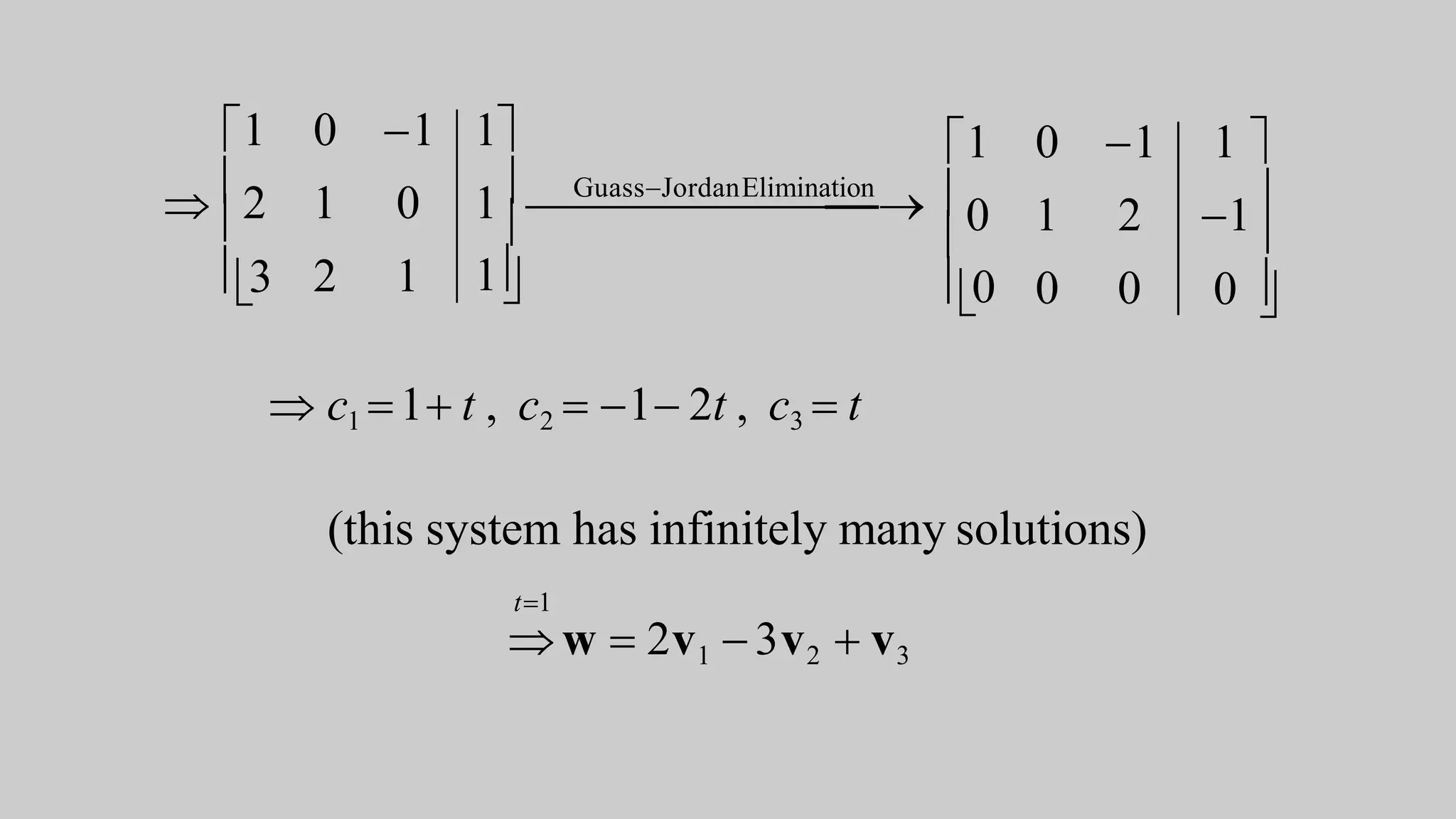
1 0 1 1
 2 1 0 1
2 1
GuassJordanElimination
 
0 0
1 0 1 1 
0 1 2 1
0 0
 w  2v1 3v2  v3
t1
 c1 1 t , c2  1 2t , c3  t
(this system has infinitely many solutions)
Linear Dependence
&
Independence
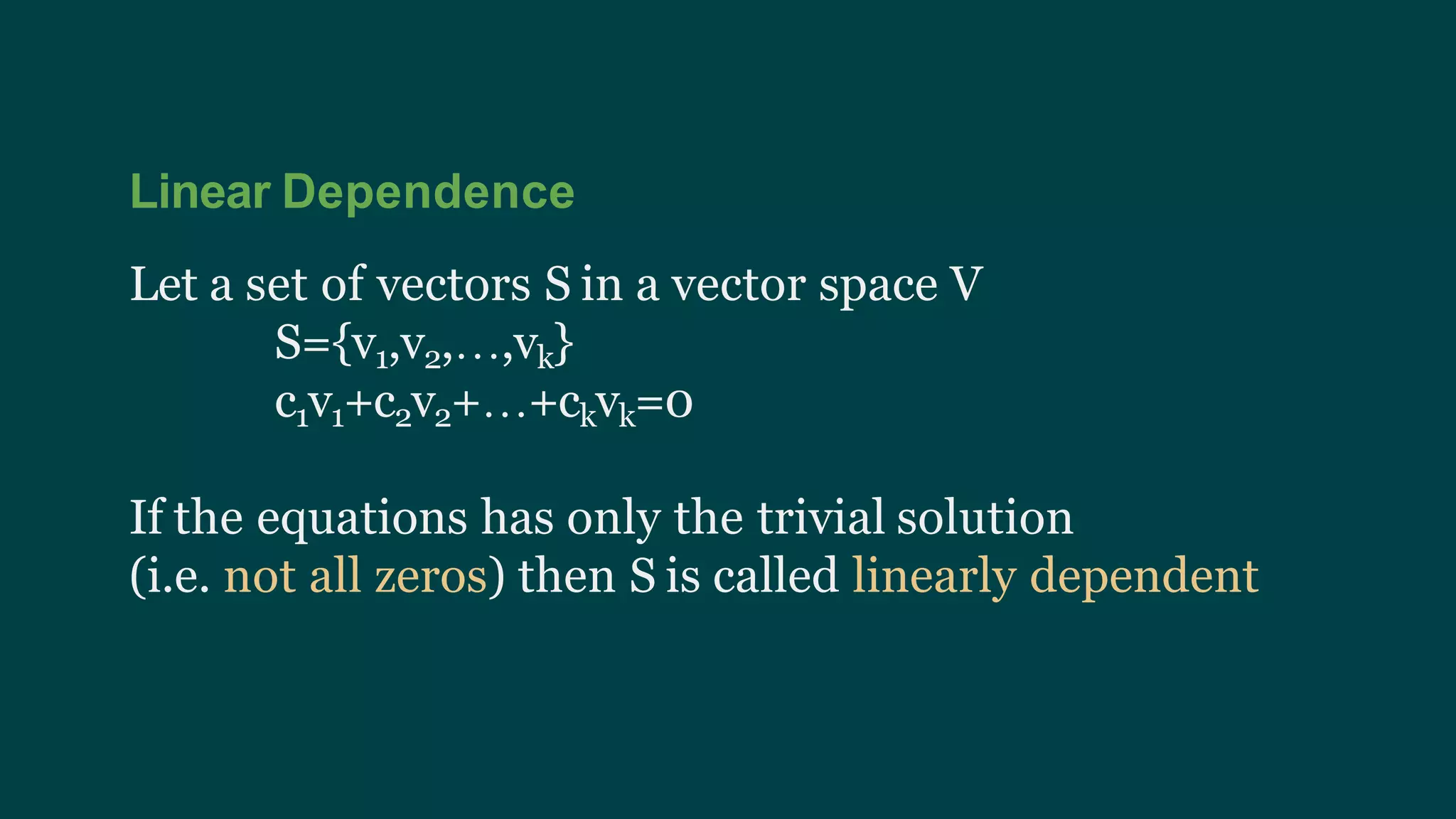
Linear Dependence
Let a set of vectors S in a vector space V
S={v1,v2,…,vk}
c1v1+c2v2+…+ckvk=0
If the equations has only the trivial solution
(i.e. not all zeros) then S is called linearly dependent
Example
Let
a = [1 2 3 ] b = [ 4 5 6 ] c=[5 7 9]
Vector c is a linear combinationof
vectors a and b, because c =a +b.
Therefore, vectors a, b, and c islinearly
dependent.
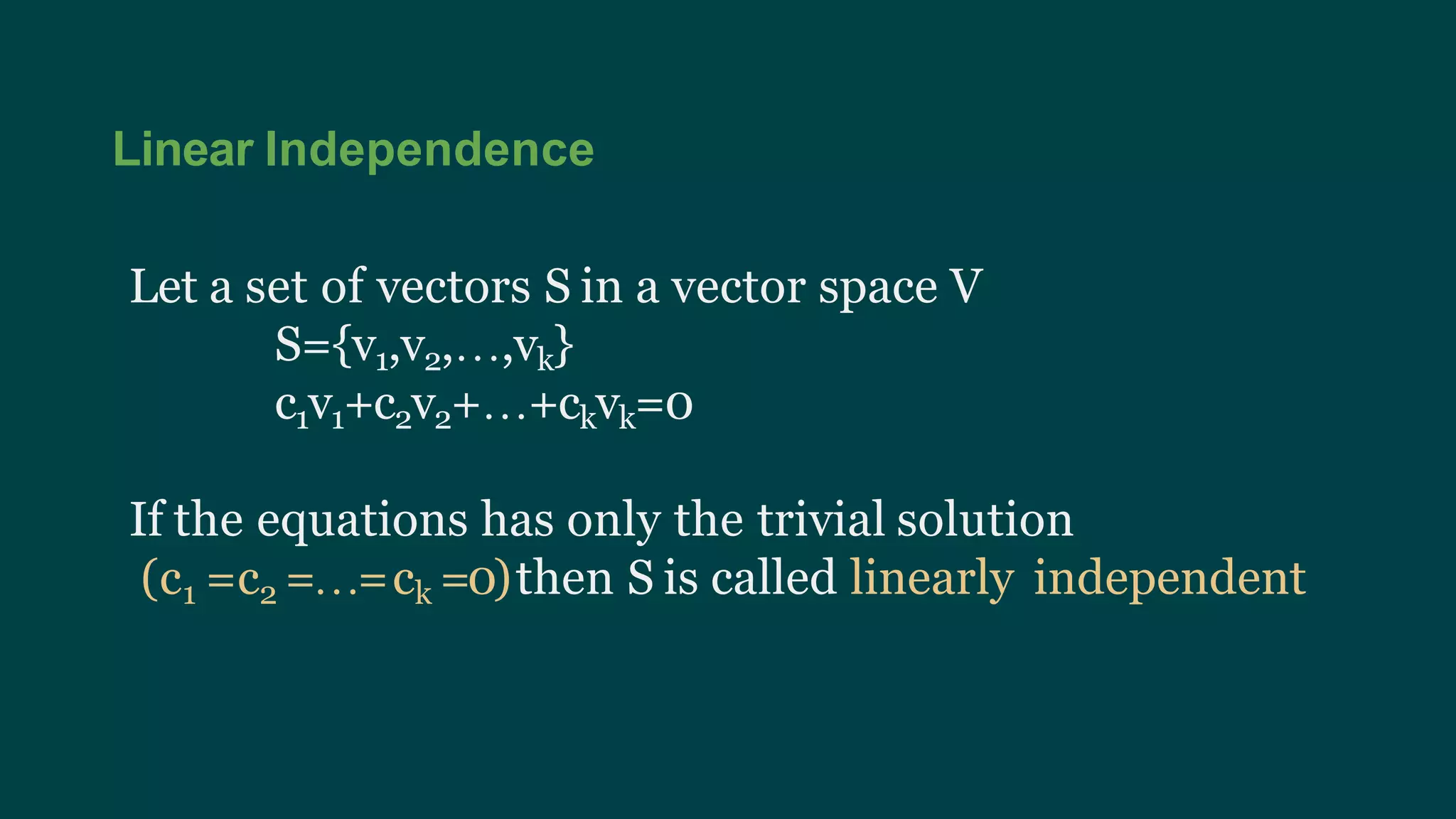
Linear Independence
Let a set of vectors S in a vector space V
S={v1,v2,…,vk}
c1v1+c2v2+…+ckvk=0
If the equations has only the trivial solution
(c1 =c2 =…=ck =0)then S is called linearly independent
Example
Let
a = [1 2 3 ] b = [ 4 5 6]
Vectors a and b are linearly
independent, because neither vector is
a scalar multiple of the other.
Basis
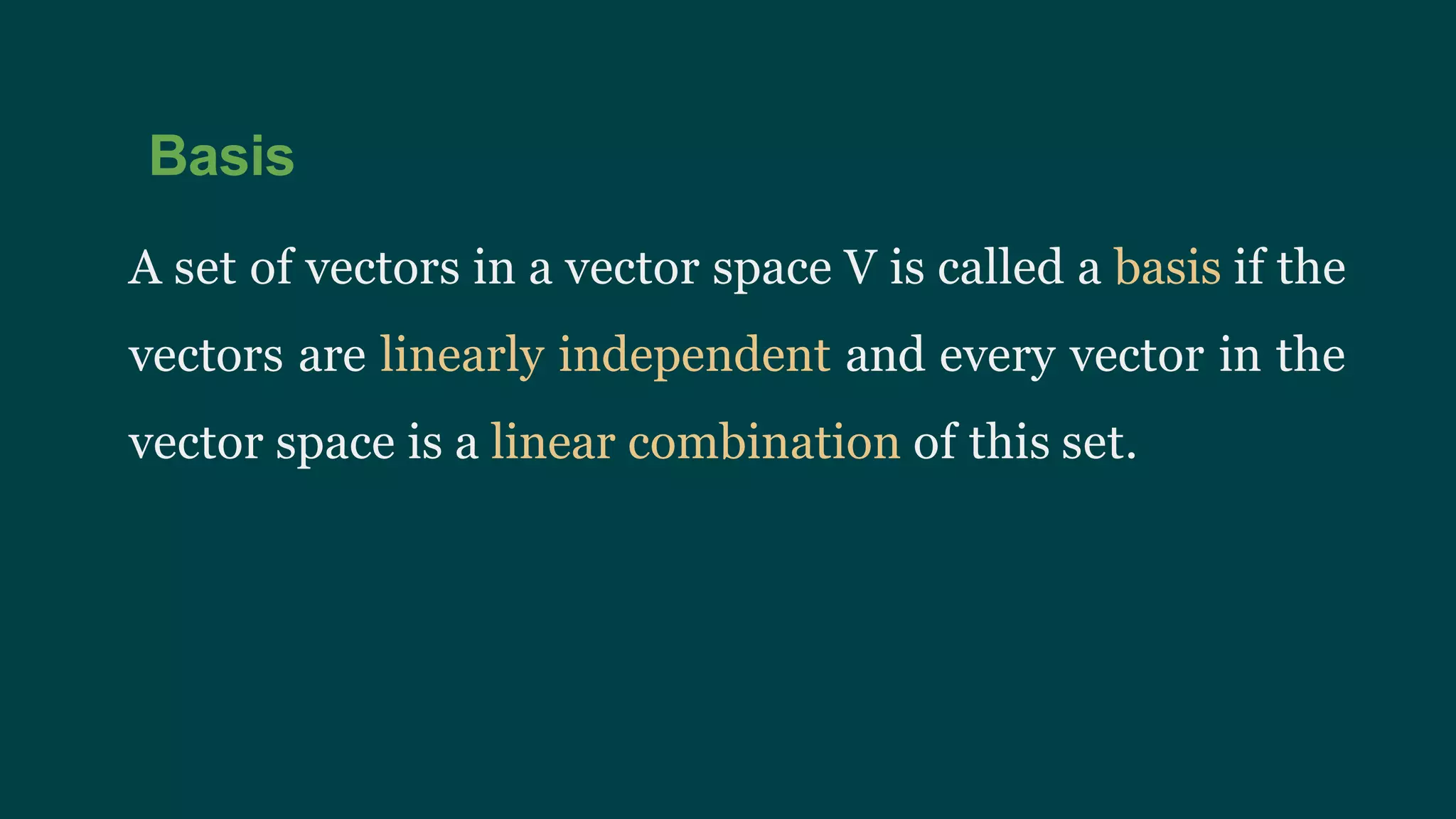
Basis
A set of vectors in a vector space V is called a basis if the
vectors are linearly independent and every vector in the
vector space is a linear combination of this set.
Condition
Let B denotes a subset of a vector space V.
Then, B is a basis if and only if
1. B is a minimal generating set of V
2. B is a maximal set of linearly independent
vectors.
Example
The vectors e1,e2,…, en are linearly
independent and generate Rn.
Therefore they form a basis for Rn
.
Any questions?
Thanks!

Vectorspace in 2,3and n space

  • 1.
  • 2.
  • 3.
    History : Historically, thefirst ideas leading to vector spaces can be traced back as far as the 17th century's analytic geometry, matrices, systems of linear equations, and Euclidean vectors. The modern, more abstract treatment, first formulated by Giuseppe Peano in 1888
  • 4.
    History 1844 Harmann Grassman gavethe introduction of Vector space. But it’s just a scenario.
  • 5.
    History 1888 Guiseppe Peanogave the definition of vector spaces and Linear Maps. encompasses more general objects than Euclidean space, but much of the theory can be seen as an extension of classical geometric ideas like lines, planes and their higher-dimensional analogs
  • 6.
  • 7.
    Vector Space A Vectorspace V is a set that is closed under finite vector addition and scalar multiplication.
  • 8.
    In other wordsvector space : A vector space (also called a linear space) is a collection of objects called vectors, which may be added together and multiplied ("scaled") by numbers, called scalars.
  • 9.
    Then a thoughtbling's in your mind what is scaler ?? Scalars are often taken to be real numbers. But there are also vector spaces with scalar multiplication by complex numbers, rational numbers, or generally any field.
  • 10.
    The set ofall Integers is not a vector space. 1 ϵ V, ½ ϵ R (½ ) (1) =½ !ϵ V It is not closed under scalar multiplication
  • 11.
    The set ofall seconddegree polynomials is not a vector space Let P(x)=-X Q(x)=2X+1 =>P(x)+Q(x)=X+1₵ V It is not closed under scalar multiplication.
  • 12.
    The basic operationsof vector addition and scalar multiplication must satisfy certain requirements, called axioms

  • 13.
  • 14.
    What is axiams?? An axiom or postulate is a statement that is taken to be true, to serve as a premise or starting point for further reasoning and arguments. The word comes from the Greek axíōma (ἀξίωμα) 'that which is thought worthy or fit' or 'that which commends itself as evident.’
  • 15.
    The axioms needto be satisfied to be a vector space: •Commutivity: X+Y=Y+X •Associativity: (X+Y)+Z=X+(Y+Z) • Existence of negativity: X+(-X)=0 •Existence of Zero: X+0=X
  • 16.
    The axioms needto be satisfied to be a vector space: • Associativity of Scalar multiplication: (ab)u=a(bu) • Right hand distributive: k(u+v)=ku+kv • Left hand distributive: (a+b)u=au+bu •Law of Identity: 1. u=u
  • 17.
  • 18.
  • 19.
    Vectors in 2-Space,3-Space, and n- Space Engineers and physicists represent vectors in two dimensions (also called 2-space) or in three dimensions (also called 3-space) by arrows. The direction of the arrowhead specifies the direction of the vector and the length of the arrow specifies the magnitude. Mathematicians call these geometric vectors.
  • 20.
    Representation of Vector Thetail of the arrow is called the initial point of the vector and the tip the terminal point The direction of the arrowhead specifies the direction of the vector and the length of the arrow specifies the magnitude. Terminal point initial point
  • 21.
    length and direction wewill denote scalars in lowercase italic type such as a, k, v, w, and x. When we want to indicate that a vector v has initial point A and terminal point B, then
  • 22.
    Equivalent vectors Vectors withthe same length and direction, are said to be equivalent. Equivalent vectors are regarded to be the same vector even though they may be in different positions. Equivalent vectors are also said to be equal, which are indicate by writing V=W
  • 23.
    Parallelogram Rule forVector Addition If v and w are vectors in 2-space or 3-space that are positioned so their initial points coincide, then the two vectors form adjacent sides of a parallelogram, and the sum V + W is the vector represented by the arrow from the common initial point of and to the opposite vertex of the parallelogram
  • 24.
    Triangle Rule forVector Addition If and are vectors in 2-space or 3- space that are positioned so the initial point of is at the terminal point of , then the sum V + W is represented by the arrow from the initial point of to the terminal point of
  • 25.
    Vector Subtraction The negativeof a vector v , denoted by -v, is the vector that has the same length as v but is oppositely directed and the difference of v from w, denoted by w-v , is taken to be the sum w-v=w+(-v)
  • 26.
  • 27.
    Scalar Multiplication If vis a nonzero vector in 2-space or 3-space, and if k is a nonzero scalar, then we define the scalar product of v by k to be the vector whose length |k| is times the length of v and whose direction is the same as that of v if k is positive and opposite to that of v if k is negative k=0. or v=0 , then we define kv to be zero.
  • 28.
    Scalar Multiplication In thisFigure shows the geometric relationship between a vector v and some of its scalar multiples. In particular, observe that (-1)V has the same length as but is oppositely directed; therefore, (-1)V = -V
  • 29.
    Parallel and CollinearVectors Suppose that and are vectors in 2-space or 3-space with a common initial point. If one of the vectors is a scalar multiple of the other, then the vectors lie on a common line, so it is reasonable to say that they are collinear
  • 30.
    Parallel VECTOR Suppose thatand are vectors in 2-space or 3-space with a common initial point. If one of the vectors is a scalar multiple of the other, then the vectors lie on a common line, so it is reasonable to say that they are collinear However, if we translate one of the vectors, as indicated in This Figure , then the vectors are parallel but no longer collinear.
  • 31.
    Sums of Threeor More Vectors Vector addition satisfies the Associative law for addition, meaning that when we add three vectors, say u, v, and w, it does not matter which two we add first; that is, u + ( v + w ) = ( u + v )+ w
  • 32.
    tip-to-tail method A simpleway to construct is to place the vectors “tip to tail” in succession and then draw the vector from the initial point of u to the terminal point w . The tip-to-tail method also works for four or more vectors. The tip-to-tail method also makes it evident that if u, v, and w are vectors in 3-space with a common initial point, then u + v + w is the diagonal of the parallelepiped that has the three vectors as adjacent.
  • 33.
    Vectors Whose InitialPoint Is Not at the Origin Vectors whose initial points are not at the origin. If P1P2 denotes the vector with initial point p1(x1,y1) and terminal point p2(x2,y2) , then the components of this vector are given by the formula P1P2 = (X2-X1, Y2-Y1)
  • 34.
    n-Space If n isa positive integer, then an ordered n- tuple is a sequence of n real numbers (V1,V2,………..Vn) . The set of all ordered n-tuples is called n-space and is denoted by Rn .
  • 35.
  • 36.
    Subspace If W isa nonempty subset of a vector space V, then W is a subspace of V if and only if the following conditions hold.
  • 37.
    Conditions (1) If uand v are in W, then u+v is in W. (2) If u is in W and c is any scalar, then cu is in W.
  • 38.
      0 1 0 WA B  1 W2 is not a subspace of M22 Ex: The set of singular matrices is not a subspace of M2×2 Let W be the set of singular matrices of order 2. Show that W is not a subspace of M2×2 with the standardoperations.    0 0 0 1A  1 0 W ,B  0 0 WSol:
  • 39.
  • 40.
    Linear Combination A vectorv in a vector space V is called linear combination of the vectors u1, u2, u3, uk in V if v can be written in the form v=c1u1+c2u2+…+ckuk where c1c2,…,ck arescalars
  • 41.
    c1  c31  2c1  c2 1 3c1  2c2  c3 1 Ex : Finding a linear combination v1  (1,2,3) v2  (0,1,2) v3  (1,0,1) Prove w  (1,1,1) is a linear combination of v1, v2 , v3 Sol: (a) w  c1v1  c2v2  c3v3 1,1,1 c11,2,3c2 0,1,2c3 1,0,1  (c1  c3, 2c1  c2 , 3c1  2c2  c3 )
  • 42.
     1  3 1 0 11  2 1 0 1 2 1 GuassJordanElimination   0 0 1 0 1 1  0 1 2 1 0 0  w  2v1 3v2  v3 t1  c1 1 t , c2  1 2t , c3  t (this system has infinitely many solutions)
  • 43.
  • 44.
    Linear Dependence Let aset of vectors S in a vector space V S={v1,v2,…,vk} c1v1+c2v2+…+ckvk=0 If the equations has only the trivial solution (i.e. not all zeros) then S is called linearly dependent
  • 45.
    Example Let a = [12 3 ] b = [ 4 5 6 ] c=[5 7 9] Vector c is a linear combinationof vectors a and b, because c =a +b. Therefore, vectors a, b, and c islinearly dependent.
  • 46.
    Linear Independence Let aset of vectors S in a vector space V S={v1,v2,…,vk} c1v1+c2v2+…+ckvk=0 If the equations has only the trivial solution (c1 =c2 =…=ck =0)then S is called linearly independent
  • 47.
    Example Let a = [12 3 ] b = [ 4 5 6] Vectors a and b are linearly independent, because neither vector is a scalar multiple of the other.
  • 48.
  • 49.
    Basis A set ofvectors in a vector space V is called a basis if the vectors are linearly independent and every vector in the vector space is a linear combination of this set.
  • 50.
    Condition Let B denotesa subset of a vector space V. Then, B is a basis if and only if 1. B is a minimal generating set of V 2. B is a maximal set of linearly independent vectors.
  • 51.
    Example The vectors e1,e2,…,en are linearly independent and generate Rn. Therefore they form a basis for Rn .
  • 52.
  • 53.