D’ Alembert’s Principle and
Generalized Force.
“A lecture on basics of classical mechanics.”
M. S. Ramaiah University of Applied
Sciences.
Faculty of Science and Humanities
Manmohan Dash
Virtual Displacement
• We define a Virtual Displacement of a system
of particles described by the coordinates ri at
a given instant of time t.
• Lets say the system has an infinitesimal
amount of change in its configuration due to
an arbitrary change in its coordinates; ri , in
accordance with the applied forces Fi
(a) and
constraint forces fi.
Virtual Displacement
• A virtual displacement is different from an
actual displacement in that in actual
displacement there is a time lapse dt during
which applied forces and constraint forces
may change.
• If the system is in equilibrium the force on the
ith particle is zero, so Fi = 0. As a result virtual
work done on the ith particle is zero or Fi.ri=0.
Considering all particles; iFi.ri = 0
Principle of virtual work
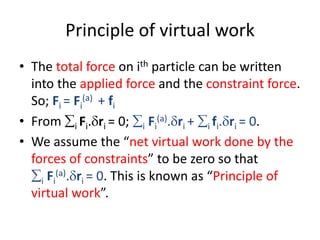
• The total force on ith particle can be written
into the applied force and the constraint force.
So; Fi = Fi
(a) + fi
• From i Fi.ri = 0; i Fi
(a).ri + i fi.ri = 0.
• We assume the “net virtual work done by the
forces of constraints” to be zero so that
i Fi
(a).ri = 0. This is known as “Principle of
virtual work”.
Virtual displacement
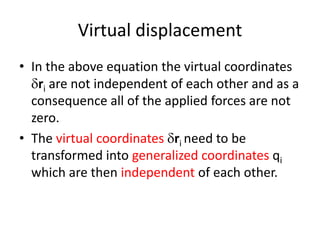
• In the above equation the virtual coordinates
ri are not independent of each other and as a
consequence all of the applied forces are not
zero.
• The virtual coordinates ri need to be
transformed into generalized coordinates qi
which are then independent of each other.
Conditions on Virtual Work
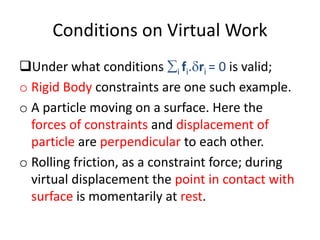
Under what conditions i fi.ri = 0 is valid;
o Rigid Body constraints are one such example.
o A particle moving on a surface. Here the
forces of constraints and displacement of
particle are perpendicular to each other.
o Rolling friction, as a constraint force; during
virtual displacement the point in contact with
surface is momentarily at rest.
Conditions on Virtual Displacement
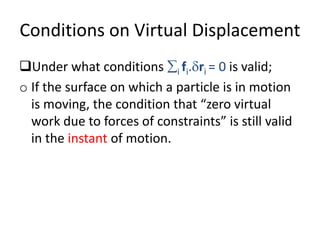
Under what conditions i fi.ri = 0 is valid;
o If the surface on which a particle is in motion
is moving, the condition that “zero virtual
work due to forces of constraints” is still valid
in the instant of motion.
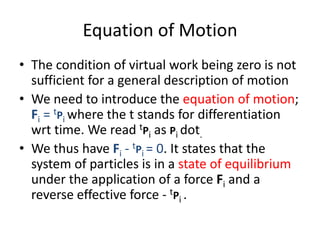
Equation of Motion
• The condition of virtual work being zero is not
sufficient for a general description of motion
• We need to introduce the equation of motion;
Fi = tPi where the t stands for differentiation
wrt time. We read tPi as Pi dot.
• We thus have Fi - tPi = 0. It states that the
system of particles is in a state of equilibrium
under the application of a force Fi and a
reverse effective force - tPi .
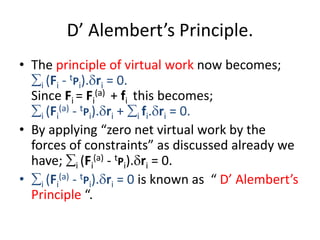
D’ Alembert’s Principle.
• The principle of virtual work now becomes;
i (Fi - tPi).ri = 0.
Since Fi = Fi
(a) + fi this becomes;
i (Fi
(a) - tPi).ri + i fi.ri = 0.
• By applying “zero net virtual work by the
forces of constraints” as discussed already we
have; i (Fi
(a) - tPi).ri = 0.
• i (Fi
(a) - tPi).ri = 0 is known as “ D’ Alembert’s
Principle “.
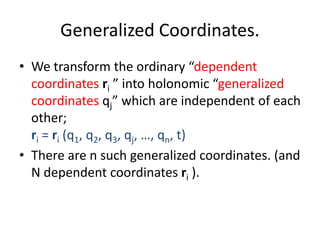
Generalized Coordinates.
• We transform the ordinary “dependent
coordinates ri ” into holonomic “generalized
coordinates qj” which are independent of each
other;
ri = ri (q1, q2, q3, qj, …, qn, t)
• There are n such generalized coordinates. (and
N dependent coordinates ri ).
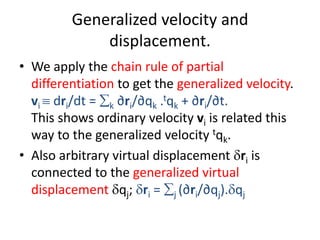
Generalized velocity and
displacement.
• We apply the chain rule of partial
differentiation to get the generalized velocity.
vi  dri/dt = k ∂ri/∂qk .tqk + ∂ri/∂t.
This shows ordinary velocity vi is related this
way to the generalized velocity tqk.
• Also arbitrary virtual displacement ri is
connected to the generalized virtual
displacement qj; ri = j (∂ri/∂qj).qj
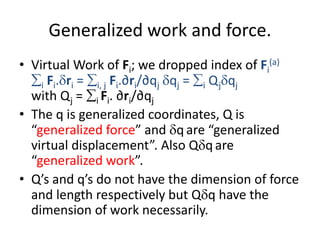
Generalized work and force.
• Virtual Work of Fi; we dropped index of Fi
(a)
i Fi.ri = i, j Fi.∂ri/∂qj qj = i Qjqj
with Qj = i Fi. ∂ri/∂qj
• The q is generalized coordinates, Q is
“generalized force” and q are “generalized
virtual displacement”. Also Qq are
“generalized work”.
• Q’s and q’s do not have the dimension of force
and length respectively but Qq have the
dimension of work necessarily.

De Alembert’s Principle and Generalized Force, a technical discourse on Classical Mechanics

  • 1.
    D’ Alembert’s Principleand Generalized Force. “A lecture on basics of classical mechanics.” M. S. Ramaiah University of Applied Sciences. Faculty of Science and Humanities Manmohan Dash
  • 2.
    Virtual Displacement • Wedefine a Virtual Displacement of a system of particles described by the coordinates ri at a given instant of time t. • Lets say the system has an infinitesimal amount of change in its configuration due to an arbitrary change in its coordinates; ri , in accordance with the applied forces Fi (a) and constraint forces fi.
  • 3.
    Virtual Displacement • Avirtual displacement is different from an actual displacement in that in actual displacement there is a time lapse dt during which applied forces and constraint forces may change. • If the system is in equilibrium the force on the ith particle is zero, so Fi = 0. As a result virtual work done on the ith particle is zero or Fi.ri=0. Considering all particles; iFi.ri = 0
  • 4.
    Principle of virtualwork • The total force on ith particle can be written into the applied force and the constraint force. So; Fi = Fi (a) + fi • From i Fi.ri = 0; i Fi (a).ri + i fi.ri = 0. • We assume the “net virtual work done by the forces of constraints” to be zero so that i Fi (a).ri = 0. This is known as “Principle of virtual work”.
  • 5.
    Virtual displacement • Inthe above equation the virtual coordinates ri are not independent of each other and as a consequence all of the applied forces are not zero. • The virtual coordinates ri need to be transformed into generalized coordinates qi which are then independent of each other.
  • 6.
    Conditions on VirtualWork Under what conditions i fi.ri = 0 is valid; o Rigid Body constraints are one such example. o A particle moving on a surface. Here the forces of constraints and displacement of particle are perpendicular to each other. o Rolling friction, as a constraint force; during virtual displacement the point in contact with surface is momentarily at rest.
  • 7.
    Conditions on VirtualDisplacement Under what conditions i fi.ri = 0 is valid; o If the surface on which a particle is in motion is moving, the condition that “zero virtual work due to forces of constraints” is still valid in the instant of motion.
  • 8.
    Equation of Motion •The condition of virtual work being zero is not sufficient for a general description of motion • We need to introduce the equation of motion; Fi = tPi where the t stands for differentiation wrt time. We read tPi as Pi dot. • We thus have Fi - tPi = 0. It states that the system of particles is in a state of equilibrium under the application of a force Fi and a reverse effective force - tPi .
  • 9.
    D’ Alembert’s Principle. •The principle of virtual work now becomes; i (Fi - tPi).ri = 0. Since Fi = Fi (a) + fi this becomes; i (Fi (a) - tPi).ri + i fi.ri = 0. • By applying “zero net virtual work by the forces of constraints” as discussed already we have; i (Fi (a) - tPi).ri = 0. • i (Fi (a) - tPi).ri = 0 is known as “ D’ Alembert’s Principle “.
  • 10.
    Generalized Coordinates. • Wetransform the ordinary “dependent coordinates ri ” into holonomic “generalized coordinates qj” which are independent of each other; ri = ri (q1, q2, q3, qj, …, qn, t) • There are n such generalized coordinates. (and N dependent coordinates ri ).
  • 11.
    Generalized velocity and displacement. •We apply the chain rule of partial differentiation to get the generalized velocity. vi  dri/dt = k ∂ri/∂qk .tqk + ∂ri/∂t. This shows ordinary velocity vi is related this way to the generalized velocity tqk. • Also arbitrary virtual displacement ri is connected to the generalized virtual displacement qj; ri = j (∂ri/∂qj).qj
  • 12.
    Generalized work andforce. • Virtual Work of Fi; we dropped index of Fi (a) i Fi.ri = i, j Fi.∂ri/∂qj qj = i Qjqj with Qj = i Fi. ∂ri/∂qj • The q is generalized coordinates, Q is “generalized force” and q are “generalized virtual displacement”. Also Qq are “generalized work”. • Q’s and q’s do not have the dimension of force and length respectively but Qq have the dimension of work necessarily.