1
KEPLERIAN TRAJECTORIES
SOLO HERMELIN
2
SOLO
Table of Contents
2. Newton’s Laws
3. Newton’s Law of Universal Gravitation
4. Two Body Problem
4.1 Polar Representation
4.2 Conservation of Angular Momentum
KEPLERIAN TRAJECTORIES
1. Kepler’s Laws
4.3 Conservation of Mechanical Energy
4.4 Integration of Equations of Motion
4.5 Velocity on the Trajectory
4.6 Specific Mechanic Energy
4.7 Eccentricity Vector
4.8 Orbit Determination from Initial Conditions
4.9 Flat Earth Approximation
4.10 Orbital Trajectories
4.11 Time of Flight on an Elliptic Orbit
5. References
3
SOLO
Kepler’s Laws
KEPLERIAN TRAJECTORIES
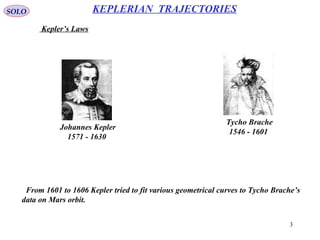
Johannes Kepler
1571 - 1630
Tycho Brache
1546 - 1601
From 1601 to 1606 Kepler tried to fit various geometrical curves to Tycho Brache’s
data on Mars orbit.
4
SOLO
Kepler’s Laws
KEPLERIAN TRAJECTORIES
1. The orbit of each planet is an ellipse, with the sun at a focus.
2. The line joining the planet to the sun sweeps out equal area in equal times.
3. The square of the period of a planet orbit is equal to the cube of its mean
distance to the sun.
b
a
a dA
h
dt
2
=
b
a 2/322
a
GMGM
ab
TP
ππ
==
b
5
SOLO
Newton’s Laws of Motion
KEPLERIAN TRAJECTORIES
. Every body continues in its state of rest or of uniform motion in
straight line unless it is compelled to change that state by forces
impressed upon it.
. The rate of change of momentum of a given body is proportional
to the force impressed on the body and is in the same direction as
the force.
. To every action there is always an equal reaction
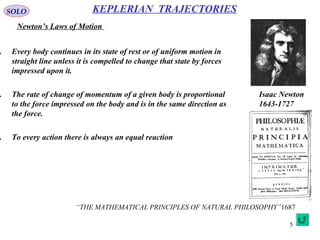
“THE MATHEMATICAL PRINCIPLES OF NATURAL PHILOSOPHY”1687
Isaac Newton
1643-1727
6
SOLO
Newton’s Law of Universal Gravitation
KEPLERIAN TRAJECTORIES
“THE MATHEMATICAL PRINCIPLES OF NATURAL PHILOSOPHY”1687
Isaac Newton
1643-1727
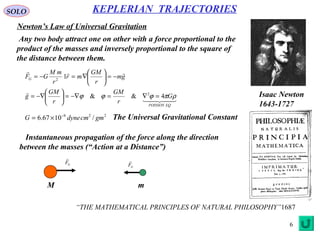
Any two body attract one on other with a force proportional to the
product of the masses and inversely proportional to the square of
the distance between them.



EQPOISSON
G
G
r
GM
r
GM
g
gm
r
GM
mr
r
mM
GF
ρπϕϕϕ 4&&
1
2
2
=∇=−∇=





−∇=
−=





∇=−=
228
/1067.6 gmcmdyneG −
×= The Universal Gravitational Constant
Instantaneous propagation of the force along the direction
between the masses (“Action at a Distance”)
GF

GF

M m
7
SOLO
Two Body Problem
KEPLERIAN TRAJECTORIES
Assumptions
1. The bodies are spherical symmetric.
2. The gravitational forces are the only forces acting on the bodies.
Mr

mr

r

M
m
Cr

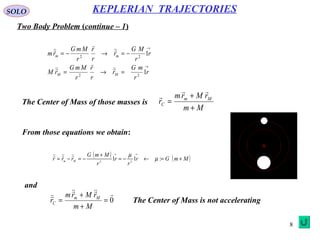
Let
Mr

-the position vector of the mass M
relative to an inertial point.
mr

-the position vector of the mass m
relative to an inertial point.
Mm rrr

−= -the relative position vector of the
mass m relative to M.
r
r
r

=
→
:1 -unit vector in direction.r

Let apply the Newton’s Law of Universal Gravitation to describe the forces each mass
applies on the other.
→
→
=→=
−=→−=
r
r
mG
r
r
r
r
MmG
rM
r
r
MG
r
r
r
r
MmG
rm
MM
mm
1
1
22
22






8
SOLO
Two Body Problem (continue – 1)
KEPLERIAN TRAJECTORIES
→
→
=→=
−=→−=
r
r
mG
r
r
r
r
MmG
rM
r
r
MG
r
r
r
r
MmG
rm
MM
mm
1
1
22
22






Mm
rMrm
r Mm
C
+
+
=


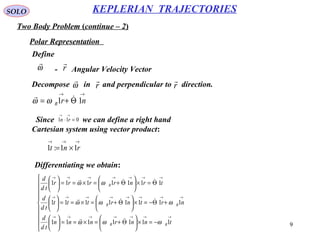
The Center of Mass of those masses is
( ) ( )MmGr
r
r
r
MmG
rrr Mm
+=←−=
+
−=−=
→→
:11 22
µ
µ
From those equations we obtain:
and
0


=
+
+
=
Mm
rMrm
r Mm
C The Center of Mass is not accelerating
9
SOLO
Two Body Problem (continue – 2)
KEPLERIAN TRAJECTORIES
Polar Representation
Define
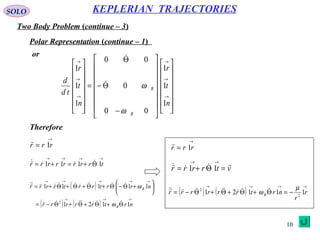
ω

r

- Angular Velocity Vector
→→
Θ+= nrR 11 
ωω
Decompose in and perpendicular to direction.r

r

ω

Since we can define a right hand
Cartesian system using vector product:
011 =⋅
→→
rn
→→→
×= rnt 11:1









−=×





Θ+=×==





+Θ−=×





Θ+=×==





Θ=×





Θ+=×==





→→→→→→→
→→→→→→→→
→→→→→→→
tnnrnnn
td
d
nrtnrttt
td
d
trnrrrr
td
d
RR
RR
R
1111111
11111111
1111111
ωωω
ωωω
ωω






Differentiating we obtain:
10
SOLO
Two Body Problem (continue – 3)
KEPLERIAN TRAJECTORIES
Polar Representation (continue – 1)
or






























−
Θ−
Θ
=














→
→
→
→
→
→
n
t
r
n
t
r
td
d
R
R
1
1
1
00
0
00
1
1
1
ω
ω

→
= rrr 1

Therefore
→→→→
Θ+=+= trrrrrrrr 1111  
( )
( ) ( )
→→→
→→→→→
Θ+Θ+Θ+Θ−=






+Θ−Θ+Θ+Θ+Θ+=
nrtrrrrr
nrrtrrtrrrr
R
R
1121
11111
2 

ω
ω
→
= rrr 1

vtrrrr

=Θ+=
→→
11
( ) ( )
→→→→
−=Θ+Θ+Θ+Θ−= r
r
nrtrrrrrr R 11121 2
2 µ
ω 
11
SOLO
Two Body Problem (continue – 4)
KEPLERIAN TRAJECTORIES
Conservation of Angular Momentum
Vector Solution
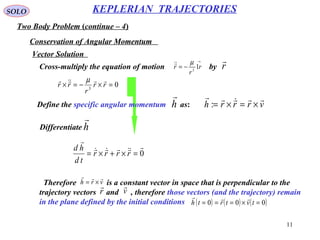
Cross-multiply the equation of motion by
→
−= r
r
r 12
µ
r

03
=×−=× rr
r
rr
 µ
Define the specific angular momentum as:h

vrrrh

×=×=:
Differentiate h

0



=×+×= rrrr
td
hd
Therefore is a constant vector in space that is perpendicular to the
trajectory vectors and , therefore those vectors (and the trajectory) remain
in the plane defined by the initial conditions
vrh

×=
r

v

( ) ( ) ( )000 =×=== tvtrth

12
SOLO
Two Body Problem (continue – 5)
KEPLERIAN TRAJECTORIES
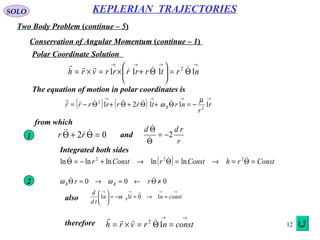
Conservation of Angular Momentum (continue – 1)
Polar Coordinate Solution
→→→→
Θ=





Θ+×=×= nrtrrrrrvrh 1111 2 

The equation of motion in polar coordinates is
( ) ( )
→→→→
−=Θ+Θ+Θ+Θ−= r
r
nrtrrrrrr R 11121 2
2 µ
ω 
from which
02 =Θ+Θ  rr and
r
rdd
2−=
Θ
Θ


Integrated both sides
( ) ConstrhConstrConstr =Θ=→=Θ→+−=Θ  222
lnlnlnlnln
1
000 ≠Θ←=→=Θ  rr RR ωω2
→→→→
=→=−=





constntn
td
d
R 1011

ωalso
→→
=Θ=×= constnrvrh 12 
therefore
13
SOLO
Two Body Problem (continue – 6)
KEPLERIAN TRAJECTORIES
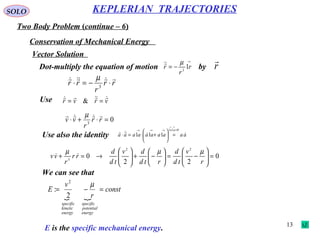
Conservation of Mechanical Energy
Vector Solution
Dot-multiply the equation of motion by
→
−= r
r
r 12
µ
r

rr
r
rr

⋅−=⋅ 3
µ
Use vrvr 
== &
03
=⋅+⋅ rr
r
vv
 µ
Use also the identity aaaaaaaaaa
aa


 ⋅=→→→
→→
=





+⋅=⋅
011
111
0
22
0
22
3
=





−=





−+





→=+
r
v
td
d
rtd
dv
td
d
rr
r
vv
µµµ

 
const
r
v
E
energy
potential
specific
energy
kinetic
specific
=−=
µ
2
:
2
We can see that
E is the specific mechanical energy.
14
SOLO
Two Body Problem (continue – 7)
KEPLERIAN TRAJECTORIES
Integration of Equations of Motion
Vector Solution
Cross-multiply the equation of motion with the specific angular momentum
→
−= r
r
r 12
µ
h

hr
r
hr


×−=× 3
µ
( ) ( ) ( )rr
td
d
rhrh
td
d
rhrhr
td
d 




××+×=×+×=×
The left side is
( ) ( ) hrr
r
rrhrrrrrrrhr


  





×=











−××+×=××+××+×=
0
3
0
µ
The right side can be written
( ) ( ) ( )[ ] ( ) 





=−=−=⋅−⋅=××−=×−
r
r
td
d
r
r
r
v
r
rrrrv
r
vrrrrv
r
vrr
r
hr
r




µ
µµµµµµ
2
2
3333
Equaling both sides gives ( ) 





=×
r
r
td
d
hr
td
d


µ
Integrating both sides B
r
r
hr


+=× µ
where is the constant of integrationB

15
SOLO
Two Body Problem (continue – 8)
KEPLERIAN TRAJECTORIES
Integration of Equations of Motion (continue – 1)
Vector Solution (continue – 1)
Dot-multiply this equation by :
B
r
r
hr


+=× µ
r

( ) Br
r
r
rhrr




⋅+⋅=×⋅ µ
Use
( ) ( ) 2
hhhhrrhrr =⋅=⋅×⋅=×⋅



r
r
r
r µµ =⋅


( )pBrBr Θ−Θ=⋅ cos

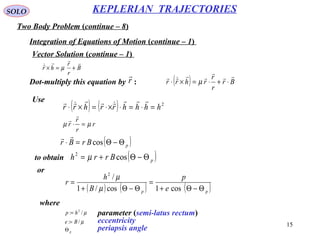
to obtain ( )pBrrh Θ−Θ+= cos2
µ
or
( ) ( ) ( )pp e
p
B
h
r
Θ−Θ+
=
Θ−Θ+
=
cos1cos/1
/2
µ
µ
where
µ/: 2
hp =
µ/: Be =
pΘ
parameter (semi-latus rectum)
eccentricity
periapsis angle
16
SOLO
Two Body Problem (continue – 9)
KEPLERIAN TRAJECTORIES
Integration of Equations of Motion (continue – 2)
Polar Coordinate Solution
The equations of motion in polar coordinates are:
2
2
r
rr
µ
−=Θ−  Consthr ==Θ2
Let define a new variable: r
u
1
:=
from which urrr
r
u 2
2
1
−=→−= 
If , we can write( )00 ≠≠Θ h
Θ
=

h
r2
and 0≠
Θ
−=
Θ
−= h
d
ud
hu
h
r 


Differentiating again we obtain
02
2
22
22
2
2
2
≠
Θ
−=
Θ
−=Θ
Θ
−= h
d
ud
uh
r
h
d
ud
h
d
ud
hr 
We also have 32
4
2
2
uh
r
h
rr ==Θ
The first equation of motion becomes 0232
2
2
22
≠=+
Θ
huuh
d
ud
uh µ
17
SOLO
Two Body Problem (continue – 10)
KEPLERIAN TRAJECTORIES
Integration of Equations of Motion (continue – 3)
Polar Coordinate Solution (continue – 1)
Therefore
32
4
2
2
uh
r
h
rr ==Θ
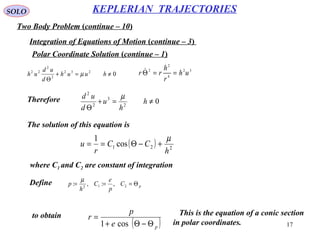
The solution of this equation is
0232
2
2
22
≠=+
Θ
huuh
d
ud
uh µ
02
3
2
2
≠=+
Θ
h
h
u
d
ud µ
( ) 221 cos
1
h
CC
r
u
µ
+−Θ==
where C1 and C2 are constant of integration
pC
p
e
C
h
p Θ=== 212
,:,:
µ
Define
to obtain
( )pe
p
r
Θ−Θ+
=
cos1
This is the equation of a conic section
in polar coordinates.
18
SOLO
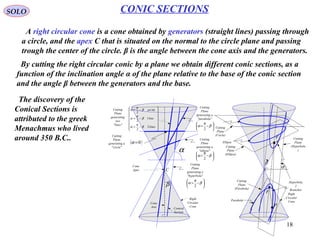
A right circular cone is a cone obtained by generators (straight lines) passing through
a circle, and the apex C that is situated on the normal to the circle plane and passing
trough the center of the circle. β is the angle between the cone axis and the generators.
CONIC SECTIONS
Cutting
Plane
generating a
"hyperbola"
Right
Circular
Cone
Cone
Apex
Conical
Section
C
Cone
Axis
Cutting
Plane
generating a
"parabola"
Cutting
Plane
generating a
"ellipse"
Cutting
Plane
generating a
"circle"
Cutting
Plane
generating
two
"lines"
α
β






−= β
π
α
2






−< β
π
α
2






−> β
π
α
2
( )0=α


















−>
−=
−<
lines
line
po
2
2
1
2
int
2
β
π
α
β
π
α
β
π
α
P
F
F
*
Cutting
Plane
(Hyperbola
)
Right
Circular
Cone
Hyperbola
2
Branches
C
β
α
Ellipse
Parabola
Cutting
Plane
(Ellipse)
Cutting
Plane
(Circle)
Cutting
Plane
(Parabola)
By cutting the right circular conic by a plane we obtain different conic sections, as a
function of the inclination angle α of the plane relative to the base of the conic section
and the angle β between the generators and the base.
The discovery of the
Conical Sections is
attributed to the greek
Menachmus who lived
around 350 B.C..
19
SOLO
The conical sections are:
CONIC SECTIONS
1. Circle if the cutting plane is normal to the cone axis (α=0) and is above or bellow
the apex.
2. Ellipse if the cutting plane is inclined to the basis at an angle that falls short of the
angle between generators to the base (α<π/2-β) (in greek word elleipsis means
falls, short or leaves out.
3. Hyperbola if the cutting plane is
inclined to the basis at an
angle that exceeds of the
angle between generators to
the base (α>π/2-β)(in greek word
hyperbole means excess.
4. Parabola if the cutting plane is
parallel to a generator of the
right circular cone (α=π/2-β)
(in greek word parabole is the
origin of the words parabola and
parallel.
5. A point- apex (α<π/2-β), one straight line (α=π/2-β), two straight lines (α>π/2-β),
if the cutting plane passes through the apex and intersects the cone basis.
20
SOLO
Two Body Problem (continue – 13)
KEPLERIAN TRAJECTORIES
Integration of Equations of Motion (continue – 6)
( )pe
p
r
Θ−Θ+
=
cos1
Conic Section (continue – 2)
Θ
pΘpΘ−Θ
r d
directrixfocus conic
section
x
y
→
P1
→
Q1
→
r1
→
t1
periapsis
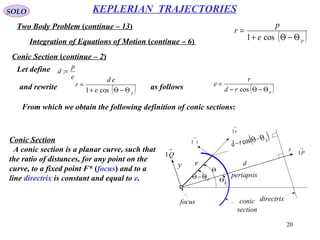
Let define
e
p
d =:
and rewrite ( )pe
ed
r
Θ−Θ+
=
cos1 as follows ( )prd
r
e
Θ−Θ−
=
cos
From which we obtain the following definition of conic sections:
Conic Section
A conic section is a planar curve, such that
the ratio of distances, for any point on the
curve, to a fixed point F* (focus) and to a
line directrix is constant and equal to e.
21
SOLO
Two Body Problem (continue – 14)
KEPLERIAN TRAJECTORIES
Integration of Equations of Motion (continue – 7)
Conic Section (continue – 3)
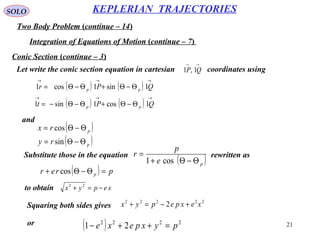
Let write the conic section equation in cartesian coordinates using
→→
QP 1,1
( ) ( )
( ) ( )
→→→
→→→
Θ−Θ+Θ−Θ−=
Θ−Θ+Θ−Θ=
QPt
QPr
pp
pp
1cos1sin1
1sin1cos1
and
( )
( )p
p
ry
rx
Θ−Θ=
Θ−Θ=
sin
cos
( )pe
p
r
Θ−Θ+
=
cos1
Substitute those in the equation rewritten as
( ) prer p =Θ−Θ+ cos
xepyx −=+ 22
to obtain
Squaring both sides gives
22222
2 xexpepyx +−=+
or ( ) 2222
21 pyxpexe =++−
22
SOLO
Two Body Problem (continue – 15)
KEPLERIAN TRAJECTORIES
Integration of Equations of Motion (continue – 8)
Conic Section (continue – 4)
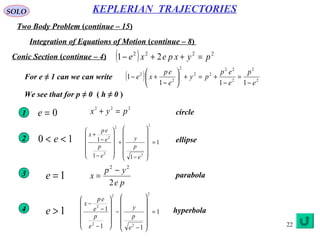
For e ≠ 1 can we can write
( ) 2222
21 pyxpexe =++−
( ) 2
2
2
22
22
2
2
2
111
1
e
p
e
ep
py
e
ep
xe
−
=
−
+=+





−
+−
We see that for p ≠ 0 ( h ≠ 0 )
1 0=e
222
pyx =+ circle
2 10 << e 1
11
1
2
2
2
2
2
=












−
+












−
−
+
e
p
y
e
p
e
ep
x
ellipse
3 1=e
pe
yp
x
2
22
−
= parabola
4 1>e hyperbola1
11
1
2
2
2
2
2
=












−
−












−
−
−
e
p
y
e
p
e
ep
x
23
SOLO
Two Body Problem (continue – 16)
KEPLERIAN TRAJECTORIES
Velocity on the Trajectory
Let find the velocity on the trajectory in and coordinates
→→
tr 1,1
→→
QP 1,1
→→→→
+=Θ+== QyPxtrrrrv 1111 
( ) ( )[ ] ( ) ( )[ ]
→→
Θ−ΘΘ+Θ−Θ+Θ−ΘΘ−Θ−Θ= QrrPrr pppp 1cossin1sincos 
From the equation of motion
( )pe
p
r
Θ−Θ+
=
cos1 hr =Θ2 µ/: 2
hp =
we obtain ( )
( )[ ]
( )
( )p
p
p
p
r
e
p
p
eh
r
h
e
ep
td
d
d
dr
rv
Θ−Θ=
Θ−Θ
=
Θ−Θ+
Θ−Θ
=
Θ
Θ
==
sin
sin
cos1
sin
22
µ

( )[ ]pt e
pr
p
r
h
rrv Θ−Θ+===Θ= cos12
µµ
24
SOLO
Two Body Problem (continue – 17)
KEPLERIAN TRAJECTORIES
Velocity on the Trajectory (continue – 1)
Let substitute those results in the velocity equation to obtain the components
in coordinates.
→→
QP 1,1
( ) ( )[ ]
→→→→
Θ−Θ++Θ−Θ−=+= Qe
p
P
p
QyPxv pp 1cos1sin11
µµ


( ) ( ) ( ) ( )[ ]{ } 2/12222/1222/122
cos1sin pptr ee
p
yxvvv Θ−Θ++Θ−Θ=+=+=
µ

( )[ ] 2/12
cos21 pee
p
v Θ−Θ++=
µ
Θ
pΘ
pΘ−Θ
r d
directrix
focus conic
section
x
y
→
P1
→
Q1
→
r1
→
t1
v

rv tv
periapsis
The velocities at the periapsis
and apoapsis are
( )pΘ=Θ
( )π+Θ=Θ p
( )e
p
va −= 1
µ
( )e
p
vp += 1
µ
25
SOLO
Two Body Problem (continue – 18)
KEPLERIAN TRAJECTORIES
Specific Mechanic Energy
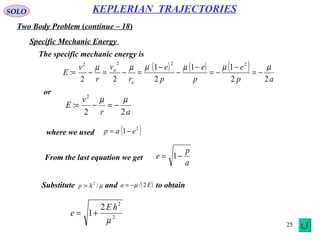
The specific mechanic energy is
( ) ( ) ( )
ap
e
p
e
p
e
r
v
r
v
E
a
a
22
11
2
1
22
:
2222
µµµµµµ
−=
−
−=
−
−
−
=−=−=
or
ar
v
E
22
:
2
µµ
−=−=
where we used ( )2
1 eap −=
From the last equation we get
a
p
e −= 1
Substitute and to obtainµ/: 2
hp = ( )Ea 2/µ−=
2
2
2
1
µ
hE
e +=
26
SOLO
Two Body Problem (continue – 19)
KEPLERIAN TRAJECTORIES
Eccentricity Vector
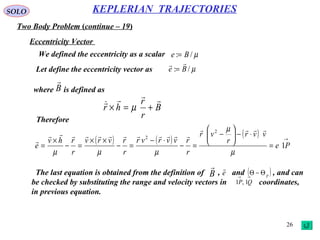
We defined the eccentricity as a scalar µ/: Be =
Let define the eccentricity vector as µ/: Be

=
where is defined asB

B
r
r
hr


+=× µ
Therefore
( ) ( )
( ) →
=
⋅−





−
=−
⋅−
=−
××
=−
×
= Pe
vvr
r
vr
r
rvvrvr
r
rvrv
r
rhv
e 1
2
2
µ
µ
µµµ



The last equation is obtained from the definition of , and , and can
be checked by substituting the range and velocity vectors in coordinates,
in previous equation.
B

e

( )pΘ−Θ→→
QP 1,1
27
SOLO
Two Body Problem (continue – 20)
KEPLERIAN TRAJECTORIES
Orbit Determination from Initial Conditions
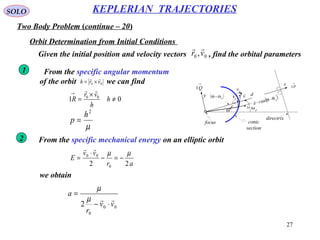
Given the initial position and velocity vectors , find the orbital parameters00 ,vr

Θ pΘr
d
directrix
focus conic
section
x
y
→
P1
→
Q1
→
r1
→
t1
v
rv
tv( )pΘ−Θ γ
1 From the specific angular momentum
of the orbit we can find00 vrh

×=
01 00
≠
×
=
→
h
h
vr
R

µ
2
h
p =
2 From the specific mechanical energy on an elliptic orbit
ar
vv
E
22 0
00 µµ
−=−
⋅
=

we obtain
00
0
2 vv
r
a

⋅−
=
µ
µ
28
SOLO
Two Body Problem (continue – 21)
KEPLERIAN TRAJECTORIES
Orbit Determination from Initial Conditions (continue – 1)
Θ pΘr
d
directrix
focus conic
section
x
y
→
P1
→
Q1
→
r1
→
t1
v
rv
tv( )pΘ−Θ γ
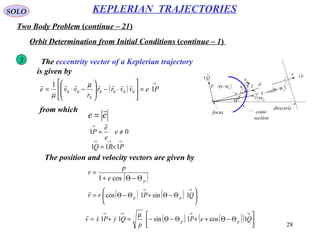
3 The eccentrity vector of a Keplerian trajectory
is given by
from which
( )
→
=





⋅−





−⋅= Pevvrr
r
vve 1
1
0000
0
00
 µ
µ
ee

=
01 ≠=
→
e
e
e
P

→→→
×= PRQ 111
( )pe
p
r
Θ−Θ+
=
cos1
The position and velocity vectors are given by
( ) ( ) 





Θ−Θ+Θ−Θ=
→→
QPrr pp 1sin1cos

( ) ( )( ) 



Θ−Θ++Θ−Θ−=+=
→→→→
QeP
p
QyPxv pp 1cos1sin11
µ


29
SOLO
Two Body Problem (continue – 22)
KEPLERIAN TRAJECTORIES
Orbit Determination from Initial Conditions (continue – 2)
Θ pΘr
d
directrix
focus conic
section
x
y
→
P1
→
Q1
→
r1
→
t1
v
rv
tv( )pΘ−Θ γ
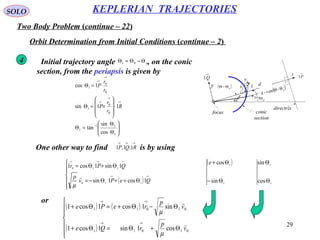
4 Initial trajectory angle , on the conic
section, from the periapsis is given by
pΘ−Θ=Θ 01






Θ
Θ
=Θ
⋅








×=Θ
⋅=Θ
−
→
→
→
→
→
1
11
1
0
0
1
0
0
1
cos
sin
tan
11sin
1cos
R
r
r
P
r
r
P
One other way to find is by using
→→→
RQP 1,1,1
( )






Θ++Θ−=
Θ+Θ=
→→
→→→
QePv
p
QPr
1cos1sin
1sin1cos1
110
110

µ
or
( ) ( )
( )






Θ+Θ=Θ+
Θ−Θ+=Θ+
→→
→→
01011
01011
cos1sin1cos1
sin1cos1cos1
v
p
rQe
v
p
rePe


µ
µ
( )
1
1
sin
cos
Θ−
Θ+e
1
1
cos
sin
Θ
Θ
30
SOLO
Two Body Problem (continue – 23)
KEPLERIAN TRAJECTORIES
Orbit Determination from Initial Conditions (continue – 3)
Θ pΘr
d
directrix
focus conic
section
x
y
→
P1
→
Q1
→
r1
→
t1
v
rv
tv( )pΘ−Θ γ
Using
1
0
cos1 Θ+
=
e
p
r
we finally obtain
( )







Θ+
Θ
=
Θ−
Θ+
=
→→
→→
01
0
0
1
01
0
0
1
cos
sin
1
sin
cos
1
v
p
r
r
p
Q
v
p
r
r
p
e
P


µ
µ
( )[ ] ( )
( )[ ] ( )
( )[ ] ( ) 01
0
01
01
0
01
011
0
011
sincos11
sincos1cos1
sincoscossinsinsincoscos
1sin1cos
v
p
rr
r
p
r
v
p
rr
re
p
r
v
p
rr
re
p
r
QPrr




Θ−Θ+






Θ−Θ+−=
Θ−Θ+Θ−Θ+−Θ+=
ΘΘ−ΘΘ+ΘΘ+Θ+Θ=






Θ+Θ=
→
→
→
→→
µ
µ
µ
Therefore
31
SOLO
Two Body Problem (continue – 24)
KEPLERIAN TRAJECTORIES
Orbit Determination from Initial Conditions (continue – 4)
Θ pΘr
d
directrix
focus conic
section
x
y
→
P1
→
Q1
→
r1
→
t1
v
rv
tv( )pΘ−Θ γ
where we used
( )
( ) ( ) ( )[ ]
( ) ( )[ ] 011
0
0
11
011
0
0
11
coscos
sinsinsin
coscossinsin
sincoscossin
1cos1sin
ve
p
r
r
p
ee
p
ve
p
r
r
p
ee
p
QeP
p
v



Θ+Θ+Θ+
Θ−Θ−Θ−Θ
=
ΘΘ++ΘΘ+
ΘΘ+−Θ+Θ
−=




Θ++Θ−=
→
→
→→
µ
µ
µ
( ) ( )[ ] ( )
( )[ ]
( )[ ] ( )[ ] ( )[ ]
( )[ ] ( ) ( )[ ] 01
0
01
0
1
0
00
01
0
0
1111
011
0
0
111111
cos11sin
1
cos1
cos11
cos1sincos1sin
cos1cos1
sinsincoscossinsin
v
p
r
r
pr
e
pr
vr
v
p
r
r
p
eee
p
ve
p
r
r
p
ee
p










Θ+Θ−−+








Θ−Θ−Θ−Θ−
⋅
=






Θ+Θ−−+
Θ+Θ−Θ−Θ−Θ−Θ
=
Θ++Θ+Θ+−+
Θ−Θ−Θ−ΘΘ+Θ−ΘΘ−Θ
=
→
→
→
→
µ
µ
µ
( )
10
1111000
sin
1cos1sin1sin1cos
Θ=




Θ++Θ−⋅





Θ+Θ=⋅
→→→→
e
p
r
QeP
p
QPrvr
µ
µ
32
SOLO
Two Body Problem (continue – 25)
KEPLERIAN TRAJECTORIES
Orbit Determination from Initial Conditions (continue – 5)
Θ pΘr
d
directrix
focus conic
section
x
y
→
P1
→
Q1
→
r1
→
t1
v
rv
tv( )pΘ−Θ γ
Summarize
( )[ ] ( ) 01
0
01 sincos11 v
p
rr
r
p
r
r

Θ−Θ+






Θ−Θ+−=
→
µ
( )[ ] ( ) ( )[ ] 01
0
01
0
1
0
00
cos11sin
1
cos1 v
p
r
r
pr
e
pr
vr
v









Θ+Θ−−+








Θ−Θ−Θ−Θ−
⋅
=
→
→
µ
33
SOLO
Two Body Problem (continue – 26)
KEPLERIAN TRAJECTORIES
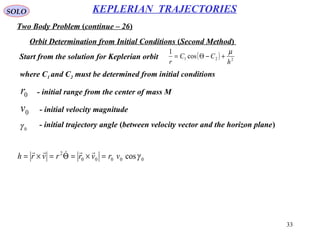
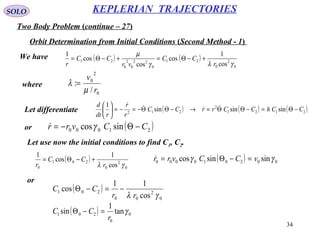
Orbit Determination from Initial Conditions (Second Method)
Start from the solution for Keplerian orbit ( ) 221 cos
1
h
CC
r
µ
+−Θ=
where C1 and C2 must be determined from initial conditions
0r - initial range from the center of mass M
0v - initial velocity magnitude
00000
2
cosγvrvrrvrh =×=Θ=×=

0γ - initial trajectory angle (between velocity vector and the horizon plane)
34
SOLO
Two Body Problem (continue – 27)
KEPLERIAN TRAJECTORIES
Orbit Determination from Initial Conditions (Second Method - 1)
We have ( ) ( )
0
2
0
21
0
22
0
2
0
21
cos
1
cos
cos
cos
1
γλγ
µ
r
CC
vr
CC
r
+−Θ=+−Θ=
where
0
2
0
/
:
r
v
µ
λ =
Let differentiate ( ) ( ) ( )2121
2
212
sinsinsin
1
CChCCrrCC
r
r
rdt
d
−Θ=−ΘΘ=→−ΘΘ−=−=




 
or ( )21000 sincos CCvrr −Θ−= γ
Let use now the initial conditions to find C1, C2.
( )
0
2
0
201
0 cos
1
cos
1
γλ r
CC
r
+−Θ= ( ) 002010000 sinsincos γγ vCCvrr =−Θ=
or
( )
0
2
00
201
cos
11
cos
γλ rr
CC −=−Θ
( ) 0
0
201 tan
1
sin γ
r
CC =−Θ
35
SOLO
Two Body Problem (continue – 28)
KEPLERIAN TRAJECTORIES
Orbit Determination from Initial Conditions (Second Method - 2)
We have
( )
0
2
00
201
cos
11
cos
γλ rr
CC −=−Θ
( ) 0
0
201 tan
1
sin γ
r
CC =−Θ
( ) ( )[ ]
( ) ( ) ( ) ( )
( ) ( )
0
2
0
00
0
0
0
2
00
0
2
0
02010201
0
2
0
2001
cos
1
sintan
1
cos
cos
11
cos
1
sinsincoscos
cos
1
cos
1
γλ
γ
γλ
γλ
γλ
rrrr
r
CCCC
r
CC
r
+Θ−Θ−Θ−Θ





−=
+Θ−Θ−Θ−Θ−Θ−Θ=
+−Θ+Θ−Θ=
( ) ( ) ( )
( ) ( )
0
00
0
2
0
0
0000
0
2
00
cos
cos
cos
cos1
cos
sinsincoscos
cos
cos1
γ
γ
γλ
γ
γγ
γλ
+Θ−Θ
+
Θ−Θ−
=
Θ−Θ−Θ−Θ
+
Θ−Θ−
=
r
r
which, when developed further, gives
36
SOLO
Two Body Problem (continue – 29)
KEPLERIAN TRAJECTORIES
Orbit Determination from Initial Conditions (Second Method - 2)
( ) ( )
0
00
0
2
00
cos
cos
cos
cos1
γ
γ
γλ
+Θ−Θ
+
Θ−Θ−
=
r
r
Finally
( ) ( )0000
0
2
0
coscoscos1
cos
γγλ
γλ
+Θ−Θ+Θ−Θ−
=
r
r
37
SOLO
Two Body Problem (continue – 30)
KEPLERIAN TRAJECTORIES
Orbit Determination from Initial Conditions (Second Method - 3)
( ) ( )0000
0
2
0
coscoscos1
cos
γγλ
γλ
+Θ−Θ+Θ−Θ−
=
r
r
( ) ( )
( ) ( ) ( )
( ) ( ) ( ) ( )[ ]
( )2
0
2
0
2
0
22
00
2
0002
0
2
0
2
0
22
00
2
000
0000
1coscossin
cos1cossincossin
1coscossin1
cos1cossincossin1
coscoscos1
−+
Θ−Θ−+Θ−Θ−
−++=
Θ−Θ−+Θ−Θ−=
+Θ−Θ+Θ−Θ−
γλγγλ
γλγγλ
γλγγλ
γλγγλ
γγλ
The denominator can be expressed as
0
2
0 cos: γλrp =
( ) ( ) 1cos21cos2cos1coscossin: 0
2
0
2
0
222
0
2
0
2
0
22
+−=+−=−+= γλλγλγλγλγγλe
We define






−
=Θ−Θ −
1cos
cossin
tan:
0
2
001
0
γλ
γγλ
p
( ) ( )
( ) ( )[ ] ( )pp
ee Θ−Θ+=Θ−Θ+Θ−Θ+=
+Θ−Θ+Θ−Θ−
cos1cos1
coscoscos1
00
0000
γγλto obtain
38
SOLO
Two Body Problem (continue – 31)
KEPLERIAN TRAJECTORIES
Orbit Determination from Initial Conditions (Second Method - 4)
( ) ( )0000
0
2
0
coscoscos1
cos
γγλ
γλ
+Θ−Θ+Θ−Θ−
=
r
r
The denominator can be expressed as
( ) ( ) ( ) ( )[ ] ( )pp
ee Θ−Θ+=Θ−Θ+Θ−Θ+=+Θ−Θ+Θ−Θ− cos1cos1coscoscos1 000000
γγλ
We obtain again the fact that the trajectory is a conic section given by
( )pe
p
r
Θ−Θ+
=
cos1
We can also write
( )[ ] λγλλ
γλ
−
=
+−−
=
−
=
21cos21
cos
1
: 0
0
2
0
2
0
2
rr
e
p
a
and
0
2
0 cos: γλrp = ( ) 1cos2: 0
2
+−= γλλe
39
SOLO
Two Body Problem (continue – 32)
KEPLERIAN TRAJECTORIES
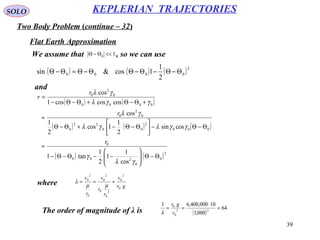
Flat Earth Approximation
We assume that , so we can use10 <<Θ−Θ
( ) ( ) ( )2
0000
2
1
1cos&sin Θ−Θ−Θ−ΘΘ−Θ≈Θ−Θ
( ) ( )
( ) ( ) ( )
( ) ( )2
0
0
200
0
000
2
00
22
0
0
2
0
0000
0
2
0
cos
1
1
2
1
tan1
cossin
2
1
1cos
2
1
cos
coscoscos1
cos
Θ−Θ





−−Θ−Θ−
=
Θ−Θ−





Θ−Θ−+Θ−Θ
≈
+Θ−Θ+Θ−Θ−
=
γλ
γ
γγλγλ
γλ
γγλ
γλ
r
r
r
r
and
where gr
v
r
r
v
r
v
0
2
0
2
0
0
2
0
0
2
0
≈==
µµ
λ
The order of magnitude of λ is ( )
64
000,1
10000,400,61
22
0
0
=
⋅
==
v
gr
λ
40
SOLO
Two Body Problem (continue – 33)
KEPLERIAN TRAJECTORIES
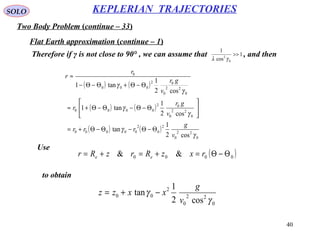
Flat Earth approximation (continue – 1)
Therefore if γ is not close to 90° , we can assume that , and then1
cos
1
0
2
>>
γλ
( ) ( )
( ) ( )
( ) ( )
0
22
0
2
0
2
00000
0
22
0
02
0000
0
22
0
02
000
0
cos2
1
tan
cos2
1
tan1
cos2
1
tan1
γ
γ
γ
γ
γ
γ
v
g
rrr
v
gr
r
v
gr
r
r
Θ−Θ−Θ−Θ+=






Θ−Θ−Θ−Θ+≈
Θ−Θ+Θ−Θ−
≈
Use
to obtain
( )0000 && Θ−Θ=+=+= rxzRrzRr ee
0
22
0
2
00
cos2
1
tan
γ
γ
v
g
xxzz −+=
41
SOLO
Two Body Problem (continue – 34)
KEPLERIAN TRAJECTORIES
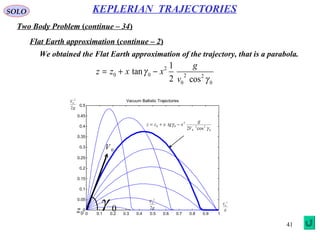
Flat Earth approximation (continue – 2)
We obtained the Flat Earth approximation of the trajectory, that is a parabola.
0
22
0
2
00
cos2
1
tan
γ
γ
v
g
xxzz −+=
0 0.1 0.2 0.3 0.4 0.5 0.6 0.7 0.8 0.9 1
0
0.05
0.1
0.15
0.2
0.25
0.3
0.35
0.4
0.45
0.5
Vacuum Ballistic Trajectories
g
V
2
2
0
g
V
2
2
0
0
22
0
2
00
cos2 γ
γ
V
g
xtgxzz −+=
g
V
2
0
0V
0γ0z
42
SOLO
Two Body Problem (continue – 35)
KEPLERIAN TRAJECTORIES
Orbital Trajectories
Let discuss in more detail the Keplerian trajectories.
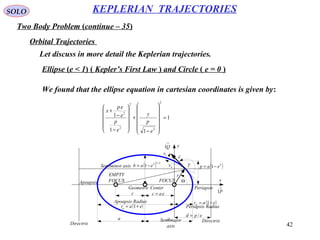
Ellipse (e < 1) ( Kepler’s First Law ) and Circle ( e = 0 )
x
y
( )2
1 eap −=
eac =
a a
( ) 2/12
1 eab −=
( )eara += 1
( )earp −= 1
r
ΘFOCUS
EMPTY
FOCUS
Apoapsis Radius
Periapsis Radius
Apoapsis
PeriapsisGeometric Center
Directrix
Directrix
c
epd /=
Semimajor
axis
Semiminor axis
v

nv
rv
γ
→
P1
→
Q1
1
11
1
2
2
2
2
2
=












−
+












−
−
+
e
p
y
e
p
e
ep
x
We found that the ellipse equation in cartesian coordinates is given by:
43
SOLO
Two Body Problem (continue – 36)
KEPLERIAN TRAJECTORIES
Orbital Trajectories (continue – 1)
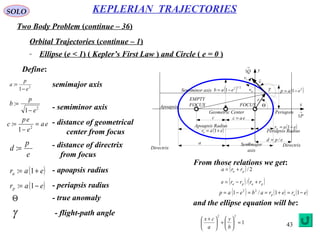
Ellipse (e < 1) ( Kepler’s First Law ) and Circle ( e = 0 )
x
y
( )2
1 eap −=
eac =
a a
( ) 2/12
1 eab −=
( )eara += 1
( )earp −= 1
r
ΘFOCUS
EMPTY
FOCUS
Apoapsis Radius
Periapsis Radius
Apoapsis
PeriapsisGeometric Center
Directrix
Directrix
c
epd /=
Semimajor
axis
Semiminor axis
v

nv
rv
γ
→
P1
→
Q1Define:
2
1
:
e
p
a
−
= semimajor axis
2
1
:
e
p
b
−
=
- semiminor axis
ea
e
ep
c =
−
= 2
1
: - distance of geometrical
center from focus
e
p
d =: - distance of directrix
from focus
( )eara += 1: - apoapsis radius
( )earp −= 1: - periapsis radius
Θ - true anomaly
γ - flight-path angle
( ) 2/pa rra +=
( ) ( )papa rrrre +−= /
( ) ( ) ( )ererabeap ap −=+==−= 11/1 22
From those relations we get:
1
22
=





+




 +
b
y
a
cx
and the ellipse equation will be:
44
SOLO
Two Body Problem (continue – 37)
KEPLERIAN TRAJECTORIES
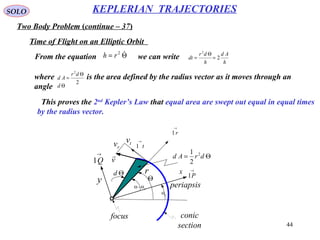
Time of Flight on an Elliptic Orbit
From the equation Θ= 2
rh we can write
h
Ad
h
dr
dt 2
2
=
Θ
=
where is the area defined by the radius vector as it moves through an
angle
2
2
Θ
=
dr
Ad
Θd
Θ
pΘ
pΘ−Θ
r
focus conic
section
x
y
→
P1
→
Q1
→
r1
→
t1
v

rv tv
Θd
Θ= drAd 2
2
1
periapsis
This proves the 2nd
Kepler’s Law that equal area are swept out equal in equal times
by the radius vector.
45
SOLO
Two Body Problem (continue – 38)
KEPLERIAN TRAJECTORIES
Time of Flight on an Elliptic Orbit (continue – 1)
The period of the orbit depends only on the major axis of the ellipse a.
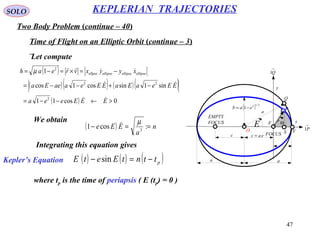
( ) ( )
p
pa
h
eaa
h
ea
h
ba
T
eap
ph µ
ππππ
µ
2/3122/322
2
1
2
1
22
2
=
−=
=
−
=
−
==
or
2/3
2 aT
µ
π
=
The period of an elliptical orbit T is obtained by integrating from Θ= 0 to Θ=2π ,
and the radius vector sweeps the area of the ellipse A = π a b.
This proves the Kepler’s third law: “the square of the period of a planet orbit is equal
To the cube of its mean distance to the sun”.
46
SOLO
Two Body Problem (continue – 39)
KEPLERIAN TRAJECTORIES
Time of Flight on an Elliptic Orbit (continue – 2)
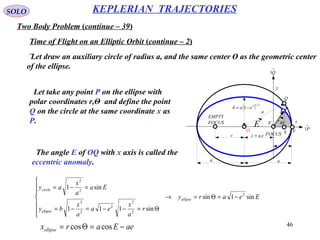
Let draw an auxiliary circle of radius a, and the same center O as the geometric center
of the ellipse.
x
y
eac =
a a
( ) 2/12
1 eab −=
r
Θ
FOCUS
EMPTY
FOCUS
c
→
P1
→
Q1
a
F
Q
O VS
E
P
Let take any point P on the ellipse with
polar coordinates r,Θ and define the point
Q on the circle at the same coordinate x as
P.
Eeary
r
a
x
ea
a
x
by
Ea
a
x
ay
ellipse
ellipse
circle
sin1sin
sin111
sin1
2
2
2
2
2
2
2
2
−=Θ=→







Θ=−−=−=
=−=
The angle E of OQ with x axis is called the
eccentric anomaly.
aeEarxellipse −=Θ= coscos
47
SOLO
Two Body Problem (continue – 40)
KEPLERIAN TRAJECTORIES
Time of Flight on an Elliptic Orbit (continue – 3)
Let compute
x
y
eac =
a a
( ) 2/12
1 eab −=
r
Θ
FOCUS
EMPTY
FOCUS
c
→
P1
→
Q1
a
F
Q
O VS
E
P
( )
( )( ) ( )( )
( ) 0cos11
sin1sincos1cos
1
2
22
2
>←−−=
−+−−=
−=×=−=
EEEeea
EEeaEaEEeaaeEa
xyyxvreah ellipseellipseellipseellpse




µ
We obtain
( ) n
a
EEe ==− :cos1 3
µ
( ) ( ) ( )pttntEetE −=− sin
Integrating this equation gives
Kepler’s Equation
where tp is the time of periapsis ( E (tp) = 0 )
48
SOLO
Two Body Problem (continue – 41)
KEPLERIAN TRAJECTORIES
Time of Flight on an Elliptic Orbit (continue – 4)
From
x
y
eac =
a a
( ) 2/12
1 eab −=
rΘ
FOCUS
EMPTY
FOCUS
c
→
P1
→
Q1
a
F
Q
O VS
E
P
Eeary
aeEarx
ellipse
ellipse
sin1sin
coscos
2
−=Θ=
−=Θ=
we have
( ) ( )[ ] [ ]
( )Eea
EeEeaEeaaeEar
cos1
coscos21sin1cos
2/1222/12222
−=
+−=−+−=
Therefore
Θ+
Θ−
=
−
−
=Θ
Θ+
Θ+
=
−
−
=Θ
cos1
sin1
sin
cos1
sin1
sin
cos1
cos
cos
cos1
cos
cos
22
e
e
E
Ee
Ee
e
e
E
Ee
eE
( )( )
Ee
Ee
Ee
eEEe
sin1
cos11
sin1
coscos1
sin
cos1
2
tan
22
−
−+
=
−
+−−
=
Θ
Θ−
=
Θ
From
2
tan
1
1
2
tan
E
e
e
−
+
=
Θ
or
and are always in the same quadrant.2
Θ
2
E
49
SOLO
References
2. Battin, R.H., “An Introduction to the Mathematics and Methods of Astrodynamics”,
AIAA Education Series, AIAA, Washington. DV., 1987
KEPLERIAN TRAJECTORIES
3. Battin, R.H., “Astronautical Guidance”, McGraw Hill, 1964
1. Bate, R.R., Mueller, D.D., White, J.E., “Fundamentals of Astrodynamics”,
Dover Publications, New York, 1971
4. Chobotov, V.A., Editor, “Orbital Mechanics”, AIAA Education Series, , AIAA,
2nd
Edition, 1996
5. Reagan, F.J., “Re-Entry Vehicle Dynamics”, AIAA Education Series, , AIAA,
1984
6. Reagan, F.J. and Anandakrishnan, S.M., “Dynamics of Atmospheric Re-Entry”,
AIAA Education Series, , AIAA, 1993
7. Montenbruck, O. and Eberhard, G., “Satellite Orbits”, Springer-Verlag, 2000
8. Kaplan, M.H., “Modern Spacecraft Dynamics and Control”, John Wiley & Sons,
1976
August 13, 2015 50
SOLO
Technion
Israeli Institute of Technology
1964 – 1968 BSc EE
1968 – 1971 MSc EE
Israeli Air Force
1970 – 1974
RAFAEL
Israeli Armament Development Authority
1974 – 2013
Stanford University
1983 – 1986 PhD AA

Keplerian trajectories

  • 1.
  • 2.
    2 SOLO Table of Contents 2.Newton’s Laws 3. Newton’s Law of Universal Gravitation 4. Two Body Problem 4.1 Polar Representation 4.2 Conservation of Angular Momentum KEPLERIAN TRAJECTORIES 1. Kepler’s Laws 4.3 Conservation of Mechanical Energy 4.4 Integration of Equations of Motion 4.5 Velocity on the Trajectory 4.6 Specific Mechanic Energy 4.7 Eccentricity Vector 4.8 Orbit Determination from Initial Conditions 4.9 Flat Earth Approximation 4.10 Orbital Trajectories 4.11 Time of Flight on an Elliptic Orbit 5. References
  • 3.
    3 SOLO Kepler’s Laws KEPLERIAN TRAJECTORIES JohannesKepler 1571 - 1630 Tycho Brache 1546 - 1601 From 1601 to 1606 Kepler tried to fit various geometrical curves to Tycho Brache’s data on Mars orbit.
  • 4.
    4 SOLO Kepler’s Laws KEPLERIAN TRAJECTORIES 1.The orbit of each planet is an ellipse, with the sun at a focus. 2. The line joining the planet to the sun sweeps out equal area in equal times. 3. The square of the period of a planet orbit is equal to the cube of its mean distance to the sun. b a a dA h dt 2 = b a 2/322 a GMGM ab TP ππ == b
  • 5.
    5 SOLO Newton’s Laws ofMotion KEPLERIAN TRAJECTORIES . Every body continues in its state of rest or of uniform motion in straight line unless it is compelled to change that state by forces impressed upon it. . The rate of change of momentum of a given body is proportional to the force impressed on the body and is in the same direction as the force. . To every action there is always an equal reaction “THE MATHEMATICAL PRINCIPLES OF NATURAL PHILOSOPHY”1687 Isaac Newton 1643-1727
  • 6.
    6 SOLO Newton’s Law ofUniversal Gravitation KEPLERIAN TRAJECTORIES “THE MATHEMATICAL PRINCIPLES OF NATURAL PHILOSOPHY”1687 Isaac Newton 1643-1727 Any two body attract one on other with a force proportional to the product of the masses and inversely proportional to the square of the distance between them.    EQPOISSON G G r GM r GM g gm r GM mr r mM GF ρπϕϕϕ 4&& 1 2 2 =∇=−∇=      −∇= −=      ∇=−= 228 /1067.6 gmcmdyneG − ×= The Universal Gravitational Constant Instantaneous propagation of the force along the direction between the masses (“Action at a Distance”) GF  GF  M m
  • 7.
    7 SOLO Two Body Problem KEPLERIANTRAJECTORIES Assumptions 1. The bodies are spherical symmetric. 2. The gravitational forces are the only forces acting on the bodies. Mr  mr  r  M m Cr  Let Mr  -the position vector of the mass M relative to an inertial point. mr  -the position vector of the mass m relative to an inertial point. Mm rrr  −= -the relative position vector of the mass m relative to M. r r r  = → :1 -unit vector in direction.r  Let apply the Newton’s Law of Universal Gravitation to describe the forces each mass applies on the other. → → =→= −=→−= r r mG r r r r MmG rM r r MG r r r r MmG rm MM mm 1 1 22 22      
  • 8.
    8 SOLO Two Body Problem(continue – 1) KEPLERIAN TRAJECTORIES → → =→= −=→−= r r mG r r r r MmG rM r r MG r r r r MmG rm MM mm 1 1 22 22       Mm rMrm r Mm C + + =   The Center of Mass of those masses is ( ) ( )MmGr r r r MmG rrr Mm +=←−= + −=−= →→ :11 22 µ µ From those equations we obtain: and 0   = + + = Mm rMrm r Mm C The Center of Mass is not accelerating
  • 9.
    9 SOLO Two Body Problem(continue – 2) KEPLERIAN TRAJECTORIES Polar Representation Define ω  r  - Angular Velocity Vector →→ Θ+= nrR 11  ωω Decompose in and perpendicular to direction.r  r  ω  Since we can define a right hand Cartesian system using vector product: 011 =⋅ →→ rn →→→ ×= rnt 11:1          −=×      Θ+=×==      +Θ−=×      Θ+=×==      Θ=×      Θ+=×==      →→→→→→→ →→→→→→→→ →→→→→→→ tnnrnnn td d nrtnrttt td d trnrrrr td d RR RR R 1111111 11111111 1111111 ωωω ωωω ωω       Differentiating we obtain:
  • 10.
    10 SOLO Two Body Problem(continue – 3) KEPLERIAN TRAJECTORIES Polar Representation (continue – 1) or                               − Θ− Θ =               → → → → → → n t r n t r td d R R 1 1 1 00 0 00 1 1 1 ω ω  → = rrr 1  Therefore →→→→ Θ+=+= trrrrrrrr 1111   ( ) ( ) ( ) →→→ →→→→→ Θ+Θ+Θ+Θ−=       +Θ−Θ+Θ+Θ+Θ+= nrtrrrrr nrrtrrtrrrr R R 1121 11111 2   ω ω → = rrr 1  vtrrrr  =Θ+= →→ 11 ( ) ( ) →→→→ −=Θ+Θ+Θ+Θ−= r r nrtrrrrrr R 11121 2 2 µ ω 
  • 11.
    11 SOLO Two Body Problem(continue – 4) KEPLERIAN TRAJECTORIES Conservation of Angular Momentum Vector Solution Cross-multiply the equation of motion by → −= r r r 12 µ r  03 =×−=× rr r rr  µ Define the specific angular momentum as:h  vrrrh  ×=×=: Differentiate h  0    =×+×= rrrr td hd Therefore is a constant vector in space that is perpendicular to the trajectory vectors and , therefore those vectors (and the trajectory) remain in the plane defined by the initial conditions vrh  ×= r  v  ( ) ( ) ( )000 =×=== tvtrth 
  • 12.
    12 SOLO Two Body Problem(continue – 5) KEPLERIAN TRAJECTORIES Conservation of Angular Momentum (continue – 1) Polar Coordinate Solution →→→→ Θ=      Θ+×=×= nrtrrrrrvrh 1111 2   The equation of motion in polar coordinates is ( ) ( ) →→→→ −=Θ+Θ+Θ+Θ−= r r nrtrrrrrr R 11121 2 2 µ ω  from which 02 =Θ+Θ  rr and r rdd 2−= Θ Θ   Integrated both sides ( ) ConstrhConstrConstr =Θ=→=Θ→+−=Θ  222 lnlnlnlnln 1 000 ≠Θ←=→=Θ  rr RR ωω2 →→→→ =→=−=      constntn td d R 1011  ωalso →→ =Θ=×= constnrvrh 12  therefore
  • 13.
    13 SOLO Two Body Problem(continue – 6) KEPLERIAN TRAJECTORIES Conservation of Mechanical Energy Vector Solution Dot-multiply the equation of motion by → −= r r r 12 µ r  rr r rr  ⋅−=⋅ 3 µ Use vrvr  == & 03 =⋅+⋅ rr r vv  µ Use also the identity aaaaaaaaaa aa    ⋅=→→→ →→ =      +⋅=⋅ 011 111 0 22 0 22 3 =      −=      −+      →=+ r v td d rtd dv td d rr r vv µµµ    const r v E energy potential specific energy kinetic specific =−= µ 2 : 2 We can see that E is the specific mechanical energy.
  • 14.
    14 SOLO Two Body Problem(continue – 7) KEPLERIAN TRAJECTORIES Integration of Equations of Motion Vector Solution Cross-multiply the equation of motion with the specific angular momentum → −= r r r 12 µ h  hr r hr   ×−=× 3 µ ( ) ( ) ( )rr td d rhrh td d rhrhr td d      ××+×=×+×=× The left side is ( ) ( ) hrr r rrhrrrrrrrhr           ×=            −××+×=××+××+×= 0 3 0 µ The right side can be written ( ) ( ) ( )[ ] ( )       =−=−=⋅−⋅=××−=×− r r td d r r r v r rrrrv r vrrrrv r vrr r hr r     µ µµµµµµ 2 2 3333 Equaling both sides gives ( )       =× r r td d hr td d   µ Integrating both sides B r r hr   +=× µ where is the constant of integrationB 
  • 15.
    15 SOLO Two Body Problem(continue – 8) KEPLERIAN TRAJECTORIES Integration of Equations of Motion (continue – 1) Vector Solution (continue – 1) Dot-multiply this equation by : B r r hr   +=× µ r  ( ) Br r r rhrr     ⋅+⋅=×⋅ µ Use ( ) ( ) 2 hhhhrrhrr =⋅=⋅×⋅=×⋅    r r r r µµ =⋅   ( )pBrBr Θ−Θ=⋅ cos  to obtain ( )pBrrh Θ−Θ+= cos2 µ or ( ) ( ) ( )pp e p B h r Θ−Θ+ = Θ−Θ+ = cos1cos/1 /2 µ µ where µ/: 2 hp = µ/: Be = pΘ parameter (semi-latus rectum) eccentricity periapsis angle
  • 16.
    16 SOLO Two Body Problem(continue – 9) KEPLERIAN TRAJECTORIES Integration of Equations of Motion (continue – 2) Polar Coordinate Solution The equations of motion in polar coordinates are: 2 2 r rr µ −=Θ−  Consthr ==Θ2 Let define a new variable: r u 1 := from which urrr r u 2 2 1 −=→−=  If , we can write( )00 ≠≠Θ h Θ =  h r2 and 0≠ Θ −= Θ −= h d ud hu h r    Differentiating again we obtain 02 2 22 22 2 2 2 ≠ Θ −= Θ −=Θ Θ −= h d ud uh r h d ud h d ud hr  We also have 32 4 2 2 uh r h rr ==Θ The first equation of motion becomes 0232 2 2 22 ≠=+ Θ huuh d ud uh µ
  • 17.
    17 SOLO Two Body Problem(continue – 10) KEPLERIAN TRAJECTORIES Integration of Equations of Motion (continue – 3) Polar Coordinate Solution (continue – 1) Therefore 32 4 2 2 uh r h rr ==Θ The solution of this equation is 0232 2 2 22 ≠=+ Θ huuh d ud uh µ 02 3 2 2 ≠=+ Θ h h u d ud µ ( ) 221 cos 1 h CC r u µ +−Θ== where C1 and C2 are constant of integration pC p e C h p Θ=== 212 ,:,: µ Define to obtain ( )pe p r Θ−Θ+ = cos1 This is the equation of a conic section in polar coordinates.
  • 18.
    18 SOLO A right circularcone is a cone obtained by generators (straight lines) passing through a circle, and the apex C that is situated on the normal to the circle plane and passing trough the center of the circle. β is the angle between the cone axis and the generators. CONIC SECTIONS Cutting Plane generating a "hyperbola" Right Circular Cone Cone Apex Conical Section C Cone Axis Cutting Plane generating a "parabola" Cutting Plane generating a "ellipse" Cutting Plane generating a "circle" Cutting Plane generating two "lines" α β       −= β π α 2       −< β π α 2       −> β π α 2 ( )0=α                   −> −= −< lines line po 2 2 1 2 int 2 β π α β π α β π α P F F * Cutting Plane (Hyperbola ) Right Circular Cone Hyperbola 2 Branches C β α Ellipse Parabola Cutting Plane (Ellipse) Cutting Plane (Circle) Cutting Plane (Parabola) By cutting the right circular conic by a plane we obtain different conic sections, as a function of the inclination angle α of the plane relative to the base of the conic section and the angle β between the generators and the base. The discovery of the Conical Sections is attributed to the greek Menachmus who lived around 350 B.C..
  • 19.
    19 SOLO The conical sectionsare: CONIC SECTIONS 1. Circle if the cutting plane is normal to the cone axis (α=0) and is above or bellow the apex. 2. Ellipse if the cutting plane is inclined to the basis at an angle that falls short of the angle between generators to the base (α<π/2-β) (in greek word elleipsis means falls, short or leaves out. 3. Hyperbola if the cutting plane is inclined to the basis at an angle that exceeds of the angle between generators to the base (α>π/2-β)(in greek word hyperbole means excess. 4. Parabola if the cutting plane is parallel to a generator of the right circular cone (α=π/2-β) (in greek word parabole is the origin of the words parabola and parallel. 5. A point- apex (α<π/2-β), one straight line (α=π/2-β), two straight lines (α>π/2-β), if the cutting plane passes through the apex and intersects the cone basis.
  • 20.
    20 SOLO Two Body Problem(continue – 13) KEPLERIAN TRAJECTORIES Integration of Equations of Motion (continue – 6) ( )pe p r Θ−Θ+ = cos1 Conic Section (continue – 2) Θ pΘpΘ−Θ r d directrixfocus conic section x y → P1 → Q1 → r1 → t1 periapsis Let define e p d =: and rewrite ( )pe ed r Θ−Θ+ = cos1 as follows ( )prd r e Θ−Θ− = cos From which we obtain the following definition of conic sections: Conic Section A conic section is a planar curve, such that the ratio of distances, for any point on the curve, to a fixed point F* (focus) and to a line directrix is constant and equal to e.
  • 21.
    21 SOLO Two Body Problem(continue – 14) KEPLERIAN TRAJECTORIES Integration of Equations of Motion (continue – 7) Conic Section (continue – 3) Let write the conic section equation in cartesian coordinates using →→ QP 1,1 ( ) ( ) ( ) ( ) →→→ →→→ Θ−Θ+Θ−Θ−= Θ−Θ+Θ−Θ= QPt QPr pp pp 1cos1sin1 1sin1cos1 and ( ) ( )p p ry rx Θ−Θ= Θ−Θ= sin cos ( )pe p r Θ−Θ+ = cos1 Substitute those in the equation rewritten as ( ) prer p =Θ−Θ+ cos xepyx −=+ 22 to obtain Squaring both sides gives 22222 2 xexpepyx +−=+ or ( ) 2222 21 pyxpexe =++−
  • 22.
    22 SOLO Two Body Problem(continue – 15) KEPLERIAN TRAJECTORIES Integration of Equations of Motion (continue – 8) Conic Section (continue – 4) For e ≠ 1 can we can write ( ) 2222 21 pyxpexe =++− ( ) 2 2 2 22 22 2 2 2 111 1 e p e ep py e ep xe − = − +=+      − +− We see that for p ≠ 0 ( h ≠ 0 ) 1 0=e 222 pyx =+ circle 2 10 << e 1 11 1 2 2 2 2 2 =             − +             − − + e p y e p e ep x ellipse 3 1=e pe yp x 2 22 − = parabola 4 1>e hyperbola1 11 1 2 2 2 2 2 =             − −             − − − e p y e p e ep x
  • 23.
    23 SOLO Two Body Problem(continue – 16) KEPLERIAN TRAJECTORIES Velocity on the Trajectory Let find the velocity on the trajectory in and coordinates →→ tr 1,1 →→ QP 1,1 →→→→ +=Θ+== QyPxtrrrrv 1111  ( ) ( )[ ] ( ) ( )[ ] →→ Θ−ΘΘ+Θ−Θ+Θ−ΘΘ−Θ−Θ= QrrPrr pppp 1cossin1sincos  From the equation of motion ( )pe p r Θ−Θ+ = cos1 hr =Θ2 µ/: 2 hp = we obtain ( ) ( )[ ] ( ) ( )p p p p r e p p eh r h e ep td d d dr rv Θ−Θ= Θ−Θ = Θ−Θ+ Θ−Θ = Θ Θ == sin sin cos1 sin 22 µ  ( )[ ]pt e pr p r h rrv Θ−Θ+===Θ= cos12 µµ
  • 24.
    24 SOLO Two Body Problem(continue – 17) KEPLERIAN TRAJECTORIES Velocity on the Trajectory (continue – 1) Let substitute those results in the velocity equation to obtain the components in coordinates. →→ QP 1,1 ( ) ( )[ ] →→→→ Θ−Θ++Θ−Θ−=+= Qe p P p QyPxv pp 1cos1sin11 µµ   ( ) ( ) ( ) ( )[ ]{ } 2/12222/1222/122 cos1sin pptr ee p yxvvv Θ−Θ++Θ−Θ=+=+= µ  ( )[ ] 2/12 cos21 pee p v Θ−Θ++= µ Θ pΘ pΘ−Θ r d directrix focus conic section x y → P1 → Q1 → r1 → t1 v  rv tv periapsis The velocities at the periapsis and apoapsis are ( )pΘ=Θ ( )π+Θ=Θ p ( )e p va −= 1 µ ( )e p vp += 1 µ
  • 25.
    25 SOLO Two Body Problem(continue – 18) KEPLERIAN TRAJECTORIES Specific Mechanic Energy The specific mechanic energy is ( ) ( ) ( ) ap e p e p e r v r v E a a 22 11 2 1 22 : 2222 µµµµµµ −= − −= − − − =−=−= or ar v E 22 : 2 µµ −=−= where we used ( )2 1 eap −= From the last equation we get a p e −= 1 Substitute and to obtainµ/: 2 hp = ( )Ea 2/µ−= 2 2 2 1 µ hE e +=
  • 26.
    26 SOLO Two Body Problem(continue – 19) KEPLERIAN TRAJECTORIES Eccentricity Vector We defined the eccentricity as a scalar µ/: Be = Let define the eccentricity vector as µ/: Be  = where is defined asB  B r r hr   +=× µ Therefore ( ) ( ) ( ) → = ⋅−      − =− ⋅− =− ×× =− × = Pe vvr r vr r rvvrvr r rvrv r rhv e 1 2 2 µ µ µµµ    The last equation is obtained from the definition of , and , and can be checked by substituting the range and velocity vectors in coordinates, in previous equation. B  e  ( )pΘ−Θ→→ QP 1,1
  • 27.
    27 SOLO Two Body Problem(continue – 20) KEPLERIAN TRAJECTORIES Orbit Determination from Initial Conditions Given the initial position and velocity vectors , find the orbital parameters00 ,vr  Θ pΘr d directrix focus conic section x y → P1 → Q1 → r1 → t1 v rv tv( )pΘ−Θ γ 1 From the specific angular momentum of the orbit we can find00 vrh  ×= 01 00 ≠ × = → h h vr R  µ 2 h p = 2 From the specific mechanical energy on an elliptic orbit ar vv E 22 0 00 µµ −=− ⋅ =  we obtain 00 0 2 vv r a  ⋅− = µ µ
  • 28.
    28 SOLO Two Body Problem(continue – 21) KEPLERIAN TRAJECTORIES Orbit Determination from Initial Conditions (continue – 1) Θ pΘr d directrix focus conic section x y → P1 → Q1 → r1 → t1 v rv tv( )pΘ−Θ γ 3 The eccentrity vector of a Keplerian trajectory is given by from which ( ) → =      ⋅−      −⋅= Pevvrr r vve 1 1 0000 0 00  µ µ ee  = 01 ≠= → e e e P  →→→ ×= PRQ 111 ( )pe p r Θ−Θ+ = cos1 The position and velocity vectors are given by ( ) ( )       Θ−Θ+Θ−Θ= →→ QPrr pp 1sin1cos  ( ) ( )( )     Θ−Θ++Θ−Θ−=+= →→→→ QeP p QyPxv pp 1cos1sin11 µ  
  • 29.
    29 SOLO Two Body Problem(continue – 22) KEPLERIAN TRAJECTORIES Orbit Determination from Initial Conditions (continue – 2) Θ pΘr d directrix focus conic section x y → P1 → Q1 → r1 → t1 v rv tv( )pΘ−Θ γ 4 Initial trajectory angle , on the conic section, from the periapsis is given by pΘ−Θ=Θ 01       Θ Θ =Θ ⋅         ×=Θ ⋅=Θ − → → → → → 1 11 1 0 0 1 0 0 1 cos sin tan 11sin 1cos R r r P r r P One other way to find is by using →→→ RQP 1,1,1 ( )       Θ++Θ−= Θ+Θ= →→ →→→ QePv p QPr 1cos1sin 1sin1cos1 110 110  µ or ( ) ( ) ( )       Θ+Θ=Θ+ Θ−Θ+=Θ+ →→ →→ 01011 01011 cos1sin1cos1 sin1cos1cos1 v p rQe v p rePe   µ µ ( ) 1 1 sin cos Θ− Θ+e 1 1 cos sin Θ Θ
  • 30.
    30 SOLO Two Body Problem(continue – 23) KEPLERIAN TRAJECTORIES Orbit Determination from Initial Conditions (continue – 3) Θ pΘr d directrix focus conic section x y → P1 → Q1 → r1 → t1 v rv tv( )pΘ−Θ γ Using 1 0 cos1 Θ+ = e p r we finally obtain ( )        Θ+ Θ = Θ− Θ+ = →→ →→ 01 0 0 1 01 0 0 1 cos sin 1 sin cos 1 v p r r p Q v p r r p e P   µ µ ( )[ ] ( ) ( )[ ] ( ) ( )[ ] ( ) 01 0 01 01 0 01 011 0 011 sincos11 sincos1cos1 sincoscossinsinsincoscos 1sin1cos v p rr r p r v p rr re p r v p rr re p r QPrr     Θ−Θ+       Θ−Θ+−= Θ−Θ+Θ−Θ+−Θ+= ΘΘ−ΘΘ+ΘΘ+Θ+Θ=       Θ+Θ= → → → →→ µ µ µ Therefore
  • 31.
    31 SOLO Two Body Problem(continue – 24) KEPLERIAN TRAJECTORIES Orbit Determination from Initial Conditions (continue – 4) Θ pΘr d directrix focus conic section x y → P1 → Q1 → r1 → t1 v rv tv( )pΘ−Θ γ where we used ( ) ( ) ( ) ( )[ ] ( ) ( )[ ] 011 0 0 11 011 0 0 11 coscos sinsinsin coscossinsin sincoscossin 1cos1sin ve p r r p ee p ve p r r p ee p QeP p v    Θ+Θ+Θ+ Θ−Θ−Θ−Θ = ΘΘ++ΘΘ+ ΘΘ+−Θ+Θ −=     Θ++Θ−= → → →→ µ µ µ ( ) ( )[ ] ( ) ( )[ ] ( )[ ] ( )[ ] ( )[ ] ( )[ ] ( ) ( )[ ] 01 0 01 0 1 0 00 01 0 0 1111 011 0 0 111111 cos11sin 1 cos1 cos11 cos1sincos1sin cos1cos1 sinsincoscossinsin v p r r pr e pr vr v p r r p eee p ve p r r p ee p           Θ+Θ−−+         Θ−Θ−Θ−Θ− ⋅ =       Θ+Θ−−+ Θ+Θ−Θ−Θ−Θ−Θ = Θ++Θ+Θ+−+ Θ−Θ−Θ−ΘΘ+Θ−ΘΘ−Θ = → → → → µ µ µ ( ) 10 1111000 sin 1cos1sin1sin1cos Θ=     Θ++Θ−⋅      Θ+Θ=⋅ →→→→ e p r QeP p QPrvr µ µ
  • 32.
    32 SOLO Two Body Problem(continue – 25) KEPLERIAN TRAJECTORIES Orbit Determination from Initial Conditions (continue – 5) Θ pΘr d directrix focus conic section x y → P1 → Q1 → r1 → t1 v rv tv( )pΘ−Θ γ Summarize ( )[ ] ( ) 01 0 01 sincos11 v p rr r p r r  Θ−Θ+       Θ−Θ+−= → µ ( )[ ] ( ) ( )[ ] 01 0 01 0 1 0 00 cos11sin 1 cos1 v p r r pr e pr vr v          Θ+Θ−−+         Θ−Θ−Θ−Θ− ⋅ = → → µ
  • 33.
    33 SOLO Two Body Problem(continue – 26) KEPLERIAN TRAJECTORIES Orbit Determination from Initial Conditions (Second Method) Start from the solution for Keplerian orbit ( ) 221 cos 1 h CC r µ +−Θ= where C1 and C2 must be determined from initial conditions 0r - initial range from the center of mass M 0v - initial velocity magnitude 00000 2 cosγvrvrrvrh =×=Θ=×=  0γ - initial trajectory angle (between velocity vector and the horizon plane)
  • 34.
    34 SOLO Two Body Problem(continue – 27) KEPLERIAN TRAJECTORIES Orbit Determination from Initial Conditions (Second Method - 1) We have ( ) ( ) 0 2 0 21 0 22 0 2 0 21 cos 1 cos cos cos 1 γλγ µ r CC vr CC r +−Θ=+−Θ= where 0 2 0 / : r v µ λ = Let differentiate ( ) ( ) ( )2121 2 212 sinsinsin 1 CChCCrrCC r r rdt d −Θ=−ΘΘ=→−ΘΘ−=−=       or ( )21000 sincos CCvrr −Θ−= γ Let use now the initial conditions to find C1, C2. ( ) 0 2 0 201 0 cos 1 cos 1 γλ r CC r +−Θ= ( ) 002010000 sinsincos γγ vCCvrr =−Θ= or ( ) 0 2 00 201 cos 11 cos γλ rr CC −=−Θ ( ) 0 0 201 tan 1 sin γ r CC =−Θ
  • 35.
    35 SOLO Two Body Problem(continue – 28) KEPLERIAN TRAJECTORIES Orbit Determination from Initial Conditions (Second Method - 2) We have ( ) 0 2 00 201 cos 11 cos γλ rr CC −=−Θ ( ) 0 0 201 tan 1 sin γ r CC =−Θ ( ) ( )[ ] ( ) ( ) ( ) ( ) ( ) ( ) 0 2 0 00 0 0 0 2 00 0 2 0 02010201 0 2 0 2001 cos 1 sintan 1 cos cos 11 cos 1 sinsincoscos cos 1 cos 1 γλ γ γλ γλ γλ rrrr r CCCC r CC r +Θ−Θ−Θ−Θ      −= +Θ−Θ−Θ−Θ−Θ−Θ= +−Θ+Θ−Θ= ( ) ( ) ( ) ( ) ( ) 0 00 0 2 0 0 0000 0 2 00 cos cos cos cos1 cos sinsincoscos cos cos1 γ γ γλ γ γγ γλ +Θ−Θ + Θ−Θ− = Θ−Θ−Θ−Θ + Θ−Θ− = r r which, when developed further, gives
  • 36.
    36 SOLO Two Body Problem(continue – 29) KEPLERIAN TRAJECTORIES Orbit Determination from Initial Conditions (Second Method - 2) ( ) ( ) 0 00 0 2 00 cos cos cos cos1 γ γ γλ +Θ−Θ + Θ−Θ− = r r Finally ( ) ( )0000 0 2 0 coscoscos1 cos γγλ γλ +Θ−Θ+Θ−Θ− = r r
  • 37.
    37 SOLO Two Body Problem(continue – 30) KEPLERIAN TRAJECTORIES Orbit Determination from Initial Conditions (Second Method - 3) ( ) ( )0000 0 2 0 coscoscos1 cos γγλ γλ +Θ−Θ+Θ−Θ− = r r ( ) ( ) ( ) ( ) ( ) ( ) ( ) ( ) ( )[ ] ( )2 0 2 0 2 0 22 00 2 0002 0 2 0 2 0 22 00 2 000 0000 1coscossin cos1cossincossin 1coscossin1 cos1cossincossin1 coscoscos1 −+ Θ−Θ−+Θ−Θ− −++= Θ−Θ−+Θ−Θ−= +Θ−Θ+Θ−Θ− γλγγλ γλγγλ γλγγλ γλγγλ γγλ The denominator can be expressed as 0 2 0 cos: γλrp = ( ) ( ) 1cos21cos2cos1coscossin: 0 2 0 2 0 222 0 2 0 2 0 22 +−=+−=−+= γλλγλγλγλγγλe We define       − =Θ−Θ − 1cos cossin tan: 0 2 001 0 γλ γγλ p ( ) ( ) ( ) ( )[ ] ( )pp ee Θ−Θ+=Θ−Θ+Θ−Θ+= +Θ−Θ+Θ−Θ− cos1cos1 coscoscos1 00 0000 γγλto obtain
  • 38.
    38 SOLO Two Body Problem(continue – 31) KEPLERIAN TRAJECTORIES Orbit Determination from Initial Conditions (Second Method - 4) ( ) ( )0000 0 2 0 coscoscos1 cos γγλ γλ +Θ−Θ+Θ−Θ− = r r The denominator can be expressed as ( ) ( ) ( ) ( )[ ] ( )pp ee Θ−Θ+=Θ−Θ+Θ−Θ+=+Θ−Θ+Θ−Θ− cos1cos1coscoscos1 000000 γγλ We obtain again the fact that the trajectory is a conic section given by ( )pe p r Θ−Θ+ = cos1 We can also write ( )[ ] λγλλ γλ − = +−− = − = 21cos21 cos 1 : 0 0 2 0 2 0 2 rr e p a and 0 2 0 cos: γλrp = ( ) 1cos2: 0 2 +−= γλλe
  • 39.
    39 SOLO Two Body Problem(continue – 32) KEPLERIAN TRAJECTORIES Flat Earth Approximation We assume that , so we can use10 <<Θ−Θ ( ) ( ) ( )2 0000 2 1 1cos&sin Θ−Θ−Θ−ΘΘ−Θ≈Θ−Θ ( ) ( ) ( ) ( ) ( ) ( ) ( )2 0 0 200 0 000 2 00 22 0 0 2 0 0000 0 2 0 cos 1 1 2 1 tan1 cossin 2 1 1cos 2 1 cos coscoscos1 cos Θ−Θ      −−Θ−Θ− = Θ−Θ−      Θ−Θ−+Θ−Θ ≈ +Θ−Θ+Θ−Θ− = γλ γ γγλγλ γλ γγλ γλ r r r r and where gr v r r v r v 0 2 0 2 0 0 2 0 0 2 0 ≈== µµ λ The order of magnitude of λ is ( ) 64 000,1 10000,400,61 22 0 0 = ⋅ == v gr λ
  • 40.
    40 SOLO Two Body Problem(continue – 33) KEPLERIAN TRAJECTORIES Flat Earth approximation (continue – 1) Therefore if γ is not close to 90° , we can assume that , and then1 cos 1 0 2 >> γλ ( ) ( ) ( ) ( ) ( ) ( ) 0 22 0 2 0 2 00000 0 22 0 02 0000 0 22 0 02 000 0 cos2 1 tan cos2 1 tan1 cos2 1 tan1 γ γ γ γ γ γ v g rrr v gr r v gr r r Θ−Θ−Θ−Θ+=       Θ−Θ−Θ−Θ+≈ Θ−Θ+Θ−Θ− ≈ Use to obtain ( )0000 && Θ−Θ=+=+= rxzRrzRr ee 0 22 0 2 00 cos2 1 tan γ γ v g xxzz −+=
  • 41.
    41 SOLO Two Body Problem(continue – 34) KEPLERIAN TRAJECTORIES Flat Earth approximation (continue – 2) We obtained the Flat Earth approximation of the trajectory, that is a parabola. 0 22 0 2 00 cos2 1 tan γ γ v g xxzz −+= 0 0.1 0.2 0.3 0.4 0.5 0.6 0.7 0.8 0.9 1 0 0.05 0.1 0.15 0.2 0.25 0.3 0.35 0.4 0.45 0.5 Vacuum Ballistic Trajectories g V 2 2 0 g V 2 2 0 0 22 0 2 00 cos2 γ γ V g xtgxzz −+= g V 2 0 0V 0γ0z
  • 42.
    42 SOLO Two Body Problem(continue – 35) KEPLERIAN TRAJECTORIES Orbital Trajectories Let discuss in more detail the Keplerian trajectories. Ellipse (e < 1) ( Kepler’s First Law ) and Circle ( e = 0 ) x y ( )2 1 eap −= eac = a a ( ) 2/12 1 eab −= ( )eara += 1 ( )earp −= 1 r ΘFOCUS EMPTY FOCUS Apoapsis Radius Periapsis Radius Apoapsis PeriapsisGeometric Center Directrix Directrix c epd /= Semimajor axis Semiminor axis v  nv rv γ → P1 → Q1 1 11 1 2 2 2 2 2 =             − +             − − + e p y e p e ep x We found that the ellipse equation in cartesian coordinates is given by:
  • 43.
    43 SOLO Two Body Problem(continue – 36) KEPLERIAN TRAJECTORIES Orbital Trajectories (continue – 1) Ellipse (e < 1) ( Kepler’s First Law ) and Circle ( e = 0 ) x y ( )2 1 eap −= eac = a a ( ) 2/12 1 eab −= ( )eara += 1 ( )earp −= 1 r ΘFOCUS EMPTY FOCUS Apoapsis Radius Periapsis Radius Apoapsis PeriapsisGeometric Center Directrix Directrix c epd /= Semimajor axis Semiminor axis v  nv rv γ → P1 → Q1Define: 2 1 : e p a − = semimajor axis 2 1 : e p b − = - semiminor axis ea e ep c = − = 2 1 : - distance of geometrical center from focus e p d =: - distance of directrix from focus ( )eara += 1: - apoapsis radius ( )earp −= 1: - periapsis radius Θ - true anomaly γ - flight-path angle ( ) 2/pa rra += ( ) ( )papa rrrre +−= / ( ) ( ) ( )ererabeap ap −=+==−= 11/1 22 From those relations we get: 1 22 =      +      + b y a cx and the ellipse equation will be:
  • 44.
    44 SOLO Two Body Problem(continue – 37) KEPLERIAN TRAJECTORIES Time of Flight on an Elliptic Orbit From the equation Θ= 2 rh we can write h Ad h dr dt 2 2 = Θ = where is the area defined by the radius vector as it moves through an angle 2 2 Θ = dr Ad Θd Θ pΘ pΘ−Θ r focus conic section x y → P1 → Q1 → r1 → t1 v  rv tv Θd Θ= drAd 2 2 1 periapsis This proves the 2nd Kepler’s Law that equal area are swept out equal in equal times by the radius vector.
  • 45.
    45 SOLO Two Body Problem(continue – 38) KEPLERIAN TRAJECTORIES Time of Flight on an Elliptic Orbit (continue – 1) The period of the orbit depends only on the major axis of the ellipse a. ( ) ( ) p pa h eaa h ea h ba T eap ph µ ππππ µ 2/3122/322 2 1 2 1 22 2 = −= = − = − == or 2/3 2 aT µ π = The period of an elliptical orbit T is obtained by integrating from Θ= 0 to Θ=2π , and the radius vector sweeps the area of the ellipse A = π a b. This proves the Kepler’s third law: “the square of the period of a planet orbit is equal To the cube of its mean distance to the sun”.
  • 46.
    46 SOLO Two Body Problem(continue – 39) KEPLERIAN TRAJECTORIES Time of Flight on an Elliptic Orbit (continue – 2) Let draw an auxiliary circle of radius a, and the same center O as the geometric center of the ellipse. x y eac = a a ( ) 2/12 1 eab −= r Θ FOCUS EMPTY FOCUS c → P1 → Q1 a F Q O VS E P Let take any point P on the ellipse with polar coordinates r,Θ and define the point Q on the circle at the same coordinate x as P. Eeary r a x ea a x by Ea a x ay ellipse ellipse circle sin1sin sin111 sin1 2 2 2 2 2 2 2 2 −=Θ=→        Θ=−−=−= =−= The angle E of OQ with x axis is called the eccentric anomaly. aeEarxellipse −=Θ= coscos
  • 47.
    47 SOLO Two Body Problem(continue – 40) KEPLERIAN TRAJECTORIES Time of Flight on an Elliptic Orbit (continue – 3) Let compute x y eac = a a ( ) 2/12 1 eab −= r Θ FOCUS EMPTY FOCUS c → P1 → Q1 a F Q O VS E P ( ) ( )( ) ( )( ) ( ) 0cos11 sin1sincos1cos 1 2 22 2 >←−−= −+−−= −=×=−= EEEeea EEeaEaEEeaaeEa xyyxvreah ellipseellipseellipseellpse     µ We obtain ( ) n a EEe ==− :cos1 3 µ ( ) ( ) ( )pttntEetE −=− sin Integrating this equation gives Kepler’s Equation where tp is the time of periapsis ( E (tp) = 0 )
  • 48.
    48 SOLO Two Body Problem(continue – 41) KEPLERIAN TRAJECTORIES Time of Flight on an Elliptic Orbit (continue – 4) From x y eac = a a ( ) 2/12 1 eab −= rΘ FOCUS EMPTY FOCUS c → P1 → Q1 a F Q O VS E P Eeary aeEarx ellipse ellipse sin1sin coscos 2 −=Θ= −=Θ= we have ( ) ( )[ ] [ ] ( )Eea EeEeaEeaaeEar cos1 coscos21sin1cos 2/1222/12222 −= +−=−+−= Therefore Θ+ Θ− = − − =Θ Θ+ Θ+ = − − =Θ cos1 sin1 sin cos1 sin1 sin cos1 cos cos cos1 cos cos 22 e e E Ee Ee e e E Ee eE ( )( ) Ee Ee Ee eEEe sin1 cos11 sin1 coscos1 sin cos1 2 tan 22 − −+ = − +−− = Θ Θ− = Θ From 2 tan 1 1 2 tan E e e − + = Θ or and are always in the same quadrant.2 Θ 2 E
  • 49.
    49 SOLO References 2. Battin, R.H.,“An Introduction to the Mathematics and Methods of Astrodynamics”, AIAA Education Series, AIAA, Washington. DV., 1987 KEPLERIAN TRAJECTORIES 3. Battin, R.H., “Astronautical Guidance”, McGraw Hill, 1964 1. Bate, R.R., Mueller, D.D., White, J.E., “Fundamentals of Astrodynamics”, Dover Publications, New York, 1971 4. Chobotov, V.A., Editor, “Orbital Mechanics”, AIAA Education Series, , AIAA, 2nd Edition, 1996 5. Reagan, F.J., “Re-Entry Vehicle Dynamics”, AIAA Education Series, , AIAA, 1984 6. Reagan, F.J. and Anandakrishnan, S.M., “Dynamics of Atmospheric Re-Entry”, AIAA Education Series, , AIAA, 1993 7. Montenbruck, O. and Eberhard, G., “Satellite Orbits”, Springer-Verlag, 2000 8. Kaplan, M.H., “Modern Spacecraft Dynamics and Control”, John Wiley & Sons, 1976
  • 50.
    August 13, 201550 SOLO Technion Israeli Institute of Technology 1964 – 1968 BSc EE 1968 – 1971 MSc EE Israeli Air Force 1970 – 1974 RAFAEL Israeli Armament Development Authority 1974 – 2013 Stanford University 1983 – 1986 PhD AA