Quantum Newton's cradle with Bose-Einstein condensates 
Roberto Franzosi (1,2,*) and Ruggero Vaia (2,3) 
(1) QSTAR and Istituto Nazionale di Ottica, Consiglio Nazionale delle Ricerche, 
largo Enrico Fermi 2, I-50125 Firenze, Italy 
(2) Istituto Nazionale di Fisica Nucleare, Sezione di Firenze, 
via G.~Sansone 1, I-50019 Sesto Fiorentino (FI), Italy 
(3) Istituto dei Sistemi Complessi, Consiglio Nazionale delle Ricerche, 
via Madonna del Piano 10, I-50019 Sesto Fiorentino (FI), Italy 
(*) roberto.franzosi@ino.it 
Fig. 1 
1. Introduction 
Newton’s cradle (Fig. 1) is a valuable paradigm of how physical mechanisms are concealed into 
nature. It is a device based on classical mechanics that demonstrates the conservation of momentum 
and energy. On the other hand, Quantum Mechanics has shown to be one of most prolific sources of 
unexpected, and hard to understand, phenomena. Therefore, achieving a machine which is a 
paradigm for the quantum nature of a system is an engrossing challenge. 
In the work of Ref. [1] we propose a possible experimental realization of a quantum analogue of 
Newton's cradle (NC). At this aim we ask for the system to be: 
(i) a one-dimensional array, 
(ii) made of individual quantum objects, representing the spheres in the NC, 
(iii) with a nearest-neighbour interaction between the individual quantum systems, modelling 
the contacts between the spheres. 
The above requirements, which are necessary for realizing a quantum NC (QNC), can be 
achieved with a system of cold atoms trapped in a one-dimensional periodic potential. This system 
can be built by confining a Bose-Einstein condensate into a one-dimensional tube using an optical 
potential that constrains it to a strict Tonks-Girardeau regime. The first achievement of this regime 
in Bose-Einstein condensates has been reached in the remarkable experiment by Paredes et al. [2], 
with a set-up closely similar to the one considered here. A further optical potential of moderate 
amplitude, is superimposed along the longitudinal direction, so that it generates an optical lattice 
that fulfills condition (i). The dynamics of this system is effectively described by a one dimensional 
Bose-Hubbard model [3] where, due to the Tonks-Girardeau regime, the strong repulsive interaction 
between the atoms prevents the double occupancy of lattice sites [4]. In our proposal the condensate 
is made of atoms with two possible internal states, say |0 and |1 . Accordingly, ⟩ ⟩ each potential well 
hosts an effective two-state system (ii) and the wave-function at each lattice site is a superposition 
of these internal states. 
The tunnelling interaction between nearby wells can be globally tuned by the intensity of the 
optical lattice beam, and provides the required coupling which meets condition (iii). We have shown 
that a local perturbation generated at one end of such a lattice propagates back and forth between 
the lattice ends in a way very similar to that in which an initial momentum pulse is periodically
exchanged between the endpoint spheres of the classical NC. In fact, in the QNC the role of the 
classical momentum Δp transferred between the chain ends, is played by the wave-function 
disturbance ΔΨ which is transmitted through the system. 
We start with the lattice prepared with all sites in (say) the |0 state, ⟩ and the initial disturbance 
ΔΨ consists in changing the first site to the |1⟩ state: the disturbance will propagate through the `sea' 
of |0⟩ states (the analogy is shown in Fig. 2). 
Fig. 2 
2. Tonks–Girardeau regime: Fermionizing Bosons 
The system of atoms with two internal states has to be subjected to a strong transverse trapping 
potential and to a further standing-wave laser beam that creates a periodic potential in the 
longitudinal direction. At low temperatures and for sufficiently strong transversal and longitudinal 
potentials the system excitations are confined to the lowest Bloch band. The low-energy 
Hamiltonian is then given (see [4]) by the Bose-Hubbard model for two boson species labeled by 
α=0,1. In one dimension the homogeneous Bose–Hubbard model, has two remarkable limits: i) the 
case of a vanishing repulsion, the model reproduces two independent ideal Bose gases on a lattice, 
and ii) the case of strong repulsive interaction, that we consider here with a number of atoms equal 
to the number of sites (filling one). In the Tonks-Girardeau regime, an ideal Fermi gas is found. In 
fact, very high values of repulsion entail such a high amount of energy for accumulating more than 
one atom in a given site, that no site can be doubly occupied. Therefore, the only observable states 
are those where the occupancy of any site is equal to one. 
The two possible one-atom states at a site j are |0⟩j, and |1⟩j, and correspond to the jth atom in the 
internal state 0 or 1, respectively. In this way the dynamics is ruled by the only internal states and an 
effective Pauli exclusion is realized. 
3. The analogy 
During an oscillation of the classical NC there are several spheres at rest and in contact with 
each other, and some moving spheres. When a moving sphere hits a sphere at rest, the latter keeps 
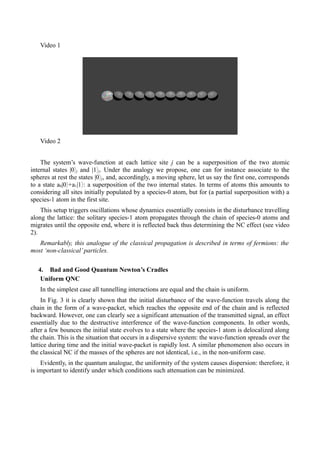
being at rest and exchanges its momentum with the nearby sphere (see video 1). In the quantum 
analogue of the NC the role of the spheres’ momenta is played by the wave-functions at each site. 
Rather than the transfer of mechanical momentum, in the quantum system there is a transmission 
along the lattice of a disturbance of the wave-function. This is represented in video 2. Furthermore, 
in the place of the spheres oscillating at the boundaries of the chain, we expect to observe the 
oscillation of the wave-function amplitude on the lattice ends due to the disturbance that runs 
forward and back.
Video 1 
Video 2 
The system’s wave-function at each lattice site j can be a superposition of the two atomic 
internal states |0⟩j and |1⟩j. Under the analogy we propose, one can for instance associate to the 
spheres at rest the states |0⟩j, and, accordingly, a moving sphere, let us say the first one, corresponds 
to a state a0|0⟩+a1|1⟩: a superposition of the two internal states. In terms of atoms this amounts to 
considering all sites initially populated by a species-0 atom, but for (a partial superposition with) a 
species-1 atom in the first site. 
This setup triggers oscillations whose dynamics essentially consists in the disturbance travelling 
along the lattice: the solitary species-1 atom propagates through the chain of species-0 atoms and 
migrates until the opposite end, where it is reflected back thus determining the NC effect (see video 
2). 
Remarkably, this analogue of the classical propagation is described in terms of fermions: the 
most ‘non-classical’ particles. 
4. Bad and Good Quantum Newton’s Cradles 
Uniform QNC 
In the simplest case all tunnelling interactions are equal and the chain is uniform. 
In Fig. 3 it is clearly shown that the initial disturbance of the wave-function travels along the 
chain in the form of a wave-packet, which reaches the opposite end of the chain and is reflected 
backward. However, one can clearly see a significant attenuation of the transmitted signal, an effect 
essentially due to the destructive interference of the wave-function components. In other words, 
after a few bounces the initial state evolves to a state where the species-1 atom is delocalized along 
the chain. This is the situation that occurs in a dispersive system: the wave-function spreads over the 
lattice during time and the initial wave-packet is rapidly lost. A similar phenomenon also occurs in 
the classical NC if the masses of the spheres are not identical, i.e., in the non-uniform case. 
Evidently, in the quantum analogue, the uniformity of the system causes dispersion: therefore, it 
is important to identify under which conditions such attenuation can be minimized.
Fig. 3 
Perfect QNC 
The dynamic decoherence of the uniform case, can be not only reduced but even eliminated by 
letting the tunnelling amplitudes to vary along the chain with well-defined nonuniform values. In 
fact, in the case of a system of M lattice sites, a dispersionless end-to-end quantum-state 
transmission can be obtained, when the Hamiltonian has nearest-neighbour couplings given by τj 
∝[j(M-j)]1/2. In this case a perfect QNC is realized, whose behaviour is illustrated in Fig. 4. One has 
to observe that the accurate tuning of each tunnel coupling, is experimentally hard. 
Fig. 4 
5. Two realistic schemes 
We are going to show here that it is possible to minimally modify the least demanding uniform 
lattice in order to strongly improve the cradle’s performance. 
Quasi-uniform array 
A simple way exists for the actual realization of a high-quality QNC in an essentially uniform 
chain, such that the need for engineering is small. A natural strategy is that of weakening the 
extremal τjs. Indeed, keeping the requirement of a mirror-symmetric chain, one can minimally 
modify a uniform chain taking equal couplings, τj=τ, but for the ones at the edges, τ1=τM-1=xτ, with 
x<1, and look for the best transfer conditions. In Ref. [5] it is shown that the optimal coupling 
results x≈1.03M-1/6. As a matter of fact, taking into play also the second bonds τ2=τM-2=yτ allows
one to guarantee a response larger than 0.987 (i.e., the transmitted amplitude deteriorates of only 
1.3%) when the coupling are tuned as x≈2M-1/3 y≈23/4M-1/6, see Ref. [6]. 
Uniform array with a Gaussian trap 
The last configuration we propose can be also implemented in an experiment. Besides the 
uniform one-dimensional optical potential, we add a trapping potential that generates a site-dependent 
energy-offset with a Gaussian profile (see Fig. 5). Furthermore, we choose as initial state 
a Gaussian wave-packet along the lattice. Such a setup appears to be the most realistic compared 
with the previous ones. In fact, in the schemes we illustrated so far, the bounce of the disturbance of 
the wave-function at the lattice ends is caused by the open-boundary conditions, while in the present 
setup, the wave-packet oscillates inside the trapping potential and its speed inversion is caused by 
the forces generated by the trapping potential. In Fig. 6 it is evident that the packet never reaches 
the lattice ends: when the wave-packet moves towards a lattice end, it is slowed down by the 
trapping potential, until the motion is inverted and the packet is accelerated in the opposite 
direction. 
Fig. 5 
Fig. 6
6. Conclusions 
We have investigated an experimental framework that could realize a quantum analogue of 
Newton's cradle, starting from a Bose–Einstein condensate of two atomic species in an optical 
lattice. We have shown that the tunnelling between sites makes the system equivalent to a free- 
Fermion gas on a finite lattice. In these conditions, one can trigger at one lattice end a disturbance 
that starts bouncing back and forth between the ends, just as the extremal spheres in the classical 
Newton cradle: the analogy associates the propagation of a wave-function disturbance with the 
transmission of mechanical momentum. 
However, in the quantum system the travelling wave undergoes decoherence, a phenomenon that 
makes a uniform lattice almost useless. On the contrary, it is known that a special arrangement of 
the tunnelling amplitudes can even lead to a virtually perpetual cyclic bouncing. 
That's why we looked for compromises that minimized the required experimental adaptation of the 
interactions and, give `almost' perfect quantum Newton cradles. Of course, the possibility to obtain 
quantum systems that allow high-quality quantum-wave transmission is not only relevant from the 
speculative point of view, but also in the field of the realization of quantum devices like atomic 
interferometers, quantum memories, and quantum channels. Nevertheless, realizing the quantum 
Newton cradle we proposed would be stirring by itself for the insight it would give into the 
entangled beauty of quantum mechanics. 
References 
[1] Roberto Franzosi and Ruggero Vaia, J. Phys. B: At. Mol. Opt. Phys. 47 095303 (2014) 
[2] B. Paredes, A. Widera, V. Murg, O. Mandel, S. Fölling, I. Cirac, G. V. Shlyapnikov, T. W. Hänsch and I. Bloch 
Nature 429 277 (2004) 
[3] R. Franzosi, V. Penna and R. Zecchina, Int. Jour. of Mod. Phys. B Vol. 14, No. 9 (2000) 943-961; R. Franzosi 
and V. Penna, Phys. Rev. A 63, 043609-1 (2001) 
[4] A. B. Kuklov and B. V. Svistunov, Phys. Rev. Lett. 90 100401 (2003) 
[5] L. Banchi, T. J. G. Apollaro, A. Cuccoli, R. Vaia and P. Verrucchi, New J. Phys. 13 123006 (2011) 
[6] L. Banchi, T. J. G. Apollaro, A. Cuccoli, R. Vaia and P. Verrucchi, Phys. Rev. A 85 052319 (2012)
6. Conclusions 
We have investigated an experimental framework that could realize a quantum analogue of 
Newton's cradle, starting from a Bose–Einstein condensate of two atomic species in an optical 
lattice. We have shown that the tunnelling between sites makes the system equivalent to a free- 
Fermion gas on a finite lattice. In these conditions, one can trigger at one lattice end a disturbance 
that starts bouncing back and forth between the ends, just as the extremal spheres in the classical 
Newton cradle: the analogy associates the propagation of a wave-function disturbance with the 
transmission of mechanical momentum. 
However, in the quantum system the travelling wave undergoes decoherence, a phenomenon that 
makes a uniform lattice almost useless. On the contrary, it is known that a special arrangement of 
the tunnelling amplitudes can even lead to a virtually perpetual cyclic bouncing. 
That's why we looked for compromises that minimized the required experimental adaptation of the 
interactions and, give `almost' perfect quantum Newton cradles. Of course, the possibility to obtain 
quantum systems that allow high-quality quantum-wave transmission is not only relevant from the 
speculative point of view, but also in the field of the realization of quantum devices like atomic 
interferometers, quantum memories, and quantum channels. Nevertheless, realizing the quantum 
Newton cradle we proposed would be stirring by itself for the insight it would give into the 
entangled beauty of quantum mechanics. 
References 
[1] Roberto Franzosi and Ruggero Vaia, J. Phys. B: At. Mol. Opt. Phys. 47 095303 (2014) 
[2] B. Paredes, A. Widera, V. Murg, O. Mandel, S. Fölling, I. Cirac, G. V. Shlyapnikov, T. W. Hänsch and I. Bloch 
Nature 429 277 (2004) 
[3] R. Franzosi, V. Penna and R. Zecchina, Int. Jour. of Mod. Phys. B Vol. 14, No. 9 (2000) 943-961; R. Franzosi 
and V. Penna, Phys. Rev. A 63, 043609-1 (2001) 
[4] A. B. Kuklov and B. V. Svistunov, Phys. Rev. Lett. 90 100401 (2003) 
[5] L. Banchi, T. J. G. Apollaro, A. Cuccoli, R. Vaia and P. Verrucchi, New J. Phys. 13 123006 (2011) 
[6] L. Banchi, T. J. G. Apollaro, A. Cuccoli, R. Vaia and P. Verrucchi, Phys. Rev. A 85 052319 (2012)

Quantum Newton's cradle

  • 1.
    Quantum Newton's cradlewith Bose-Einstein condensates Roberto Franzosi (1,2,*) and Ruggero Vaia (2,3) (1) QSTAR and Istituto Nazionale di Ottica, Consiglio Nazionale delle Ricerche, largo Enrico Fermi 2, I-50125 Firenze, Italy (2) Istituto Nazionale di Fisica Nucleare, Sezione di Firenze, via G.~Sansone 1, I-50019 Sesto Fiorentino (FI), Italy (3) Istituto dei Sistemi Complessi, Consiglio Nazionale delle Ricerche, via Madonna del Piano 10, I-50019 Sesto Fiorentino (FI), Italy (*) roberto.franzosi@ino.it Fig. 1 1. Introduction Newton’s cradle (Fig. 1) is a valuable paradigm of how physical mechanisms are concealed into nature. It is a device based on classical mechanics that demonstrates the conservation of momentum and energy. On the other hand, Quantum Mechanics has shown to be one of most prolific sources of unexpected, and hard to understand, phenomena. Therefore, achieving a machine which is a paradigm for the quantum nature of a system is an engrossing challenge. In the work of Ref. [1] we propose a possible experimental realization of a quantum analogue of Newton's cradle (NC). At this aim we ask for the system to be: (i) a one-dimensional array, (ii) made of individual quantum objects, representing the spheres in the NC, (iii) with a nearest-neighbour interaction between the individual quantum systems, modelling the contacts between the spheres. The above requirements, which are necessary for realizing a quantum NC (QNC), can be achieved with a system of cold atoms trapped in a one-dimensional periodic potential. This system can be built by confining a Bose-Einstein condensate into a one-dimensional tube using an optical potential that constrains it to a strict Tonks-Girardeau regime. The first achievement of this regime in Bose-Einstein condensates has been reached in the remarkable experiment by Paredes et al. [2], with a set-up closely similar to the one considered here. A further optical potential of moderate amplitude, is superimposed along the longitudinal direction, so that it generates an optical lattice that fulfills condition (i). The dynamics of this system is effectively described by a one dimensional Bose-Hubbard model [3] where, due to the Tonks-Girardeau regime, the strong repulsive interaction between the atoms prevents the double occupancy of lattice sites [4]. In our proposal the condensate is made of atoms with two possible internal states, say |0 and |1 . Accordingly, ⟩ ⟩ each potential well hosts an effective two-state system (ii) and the wave-function at each lattice site is a superposition of these internal states. The tunnelling interaction between nearby wells can be globally tuned by the intensity of the optical lattice beam, and provides the required coupling which meets condition (iii). We have shown that a local perturbation generated at one end of such a lattice propagates back and forth between the lattice ends in a way very similar to that in which an initial momentum pulse is periodically
  • 2.
    exchanged between theendpoint spheres of the classical NC. In fact, in the QNC the role of the classical momentum Δp transferred between the chain ends, is played by the wave-function disturbance ΔΨ which is transmitted through the system. We start with the lattice prepared with all sites in (say) the |0 state, ⟩ and the initial disturbance ΔΨ consists in changing the first site to the |1⟩ state: the disturbance will propagate through the `sea' of |0⟩ states (the analogy is shown in Fig. 2). Fig. 2 2. Tonks–Girardeau regime: Fermionizing Bosons The system of atoms with two internal states has to be subjected to a strong transverse trapping potential and to a further standing-wave laser beam that creates a periodic potential in the longitudinal direction. At low temperatures and for sufficiently strong transversal and longitudinal potentials the system excitations are confined to the lowest Bloch band. The low-energy Hamiltonian is then given (see [4]) by the Bose-Hubbard model for two boson species labeled by α=0,1. In one dimension the homogeneous Bose–Hubbard model, has two remarkable limits: i) the case of a vanishing repulsion, the model reproduces two independent ideal Bose gases on a lattice, and ii) the case of strong repulsive interaction, that we consider here with a number of atoms equal to the number of sites (filling one). In the Tonks-Girardeau regime, an ideal Fermi gas is found. In fact, very high values of repulsion entail such a high amount of energy for accumulating more than one atom in a given site, that no site can be doubly occupied. Therefore, the only observable states are those where the occupancy of any site is equal to one. The two possible one-atom states at a site j are |0⟩j, and |1⟩j, and correspond to the jth atom in the internal state 0 or 1, respectively. In this way the dynamics is ruled by the only internal states and an effective Pauli exclusion is realized. 3. The analogy During an oscillation of the classical NC there are several spheres at rest and in contact with each other, and some moving spheres. When a moving sphere hits a sphere at rest, the latter keeps being at rest and exchanges its momentum with the nearby sphere (see video 1). In the quantum analogue of the NC the role of the spheres’ momenta is played by the wave-functions at each site. Rather than the transfer of mechanical momentum, in the quantum system there is a transmission along the lattice of a disturbance of the wave-function. This is represented in video 2. Furthermore, in the place of the spheres oscillating at the boundaries of the chain, we expect to observe the oscillation of the wave-function amplitude on the lattice ends due to the disturbance that runs forward and back.
  • 3.
    Video 1 Video2 The system’s wave-function at each lattice site j can be a superposition of the two atomic internal states |0⟩j and |1⟩j. Under the analogy we propose, one can for instance associate to the spheres at rest the states |0⟩j, and, accordingly, a moving sphere, let us say the first one, corresponds to a state a0|0⟩+a1|1⟩: a superposition of the two internal states. In terms of atoms this amounts to considering all sites initially populated by a species-0 atom, but for (a partial superposition with) a species-1 atom in the first site. This setup triggers oscillations whose dynamics essentially consists in the disturbance travelling along the lattice: the solitary species-1 atom propagates through the chain of species-0 atoms and migrates until the opposite end, where it is reflected back thus determining the NC effect (see video 2). Remarkably, this analogue of the classical propagation is described in terms of fermions: the most ‘non-classical’ particles. 4. Bad and Good Quantum Newton’s Cradles Uniform QNC In the simplest case all tunnelling interactions are equal and the chain is uniform. In Fig. 3 it is clearly shown that the initial disturbance of the wave-function travels along the chain in the form of a wave-packet, which reaches the opposite end of the chain and is reflected backward. However, one can clearly see a significant attenuation of the transmitted signal, an effect essentially due to the destructive interference of the wave-function components. In other words, after a few bounces the initial state evolves to a state where the species-1 atom is delocalized along the chain. This is the situation that occurs in a dispersive system: the wave-function spreads over the lattice during time and the initial wave-packet is rapidly lost. A similar phenomenon also occurs in the classical NC if the masses of the spheres are not identical, i.e., in the non-uniform case. Evidently, in the quantum analogue, the uniformity of the system causes dispersion: therefore, it is important to identify under which conditions such attenuation can be minimized.
  • 4.
    Fig. 3 PerfectQNC The dynamic decoherence of the uniform case, can be not only reduced but even eliminated by letting the tunnelling amplitudes to vary along the chain with well-defined nonuniform values. In fact, in the case of a system of M lattice sites, a dispersionless end-to-end quantum-state transmission can be obtained, when the Hamiltonian has nearest-neighbour couplings given by τj ∝[j(M-j)]1/2. In this case a perfect QNC is realized, whose behaviour is illustrated in Fig. 4. One has to observe that the accurate tuning of each tunnel coupling, is experimentally hard. Fig. 4 5. Two realistic schemes We are going to show here that it is possible to minimally modify the least demanding uniform lattice in order to strongly improve the cradle’s performance. Quasi-uniform array A simple way exists for the actual realization of a high-quality QNC in an essentially uniform chain, such that the need for engineering is small. A natural strategy is that of weakening the extremal τjs. Indeed, keeping the requirement of a mirror-symmetric chain, one can minimally modify a uniform chain taking equal couplings, τj=τ, but for the ones at the edges, τ1=τM-1=xτ, with x<1, and look for the best transfer conditions. In Ref. [5] it is shown that the optimal coupling results x≈1.03M-1/6. As a matter of fact, taking into play also the second bonds τ2=τM-2=yτ allows
  • 5.
    one to guaranteea response larger than 0.987 (i.e., the transmitted amplitude deteriorates of only 1.3%) when the coupling are tuned as x≈2M-1/3 y≈23/4M-1/6, see Ref. [6]. Uniform array with a Gaussian trap The last configuration we propose can be also implemented in an experiment. Besides the uniform one-dimensional optical potential, we add a trapping potential that generates a site-dependent energy-offset with a Gaussian profile (see Fig. 5). Furthermore, we choose as initial state a Gaussian wave-packet along the lattice. Such a setup appears to be the most realistic compared with the previous ones. In fact, in the schemes we illustrated so far, the bounce of the disturbance of the wave-function at the lattice ends is caused by the open-boundary conditions, while in the present setup, the wave-packet oscillates inside the trapping potential and its speed inversion is caused by the forces generated by the trapping potential. In Fig. 6 it is evident that the packet never reaches the lattice ends: when the wave-packet moves towards a lattice end, it is slowed down by the trapping potential, until the motion is inverted and the packet is accelerated in the opposite direction. Fig. 5 Fig. 6
  • 6.
    6. Conclusions Wehave investigated an experimental framework that could realize a quantum analogue of Newton's cradle, starting from a Bose–Einstein condensate of two atomic species in an optical lattice. We have shown that the tunnelling between sites makes the system equivalent to a free- Fermion gas on a finite lattice. In these conditions, one can trigger at one lattice end a disturbance that starts bouncing back and forth between the ends, just as the extremal spheres in the classical Newton cradle: the analogy associates the propagation of a wave-function disturbance with the transmission of mechanical momentum. However, in the quantum system the travelling wave undergoes decoherence, a phenomenon that makes a uniform lattice almost useless. On the contrary, it is known that a special arrangement of the tunnelling amplitudes can even lead to a virtually perpetual cyclic bouncing. That's why we looked for compromises that minimized the required experimental adaptation of the interactions and, give `almost' perfect quantum Newton cradles. Of course, the possibility to obtain quantum systems that allow high-quality quantum-wave transmission is not only relevant from the speculative point of view, but also in the field of the realization of quantum devices like atomic interferometers, quantum memories, and quantum channels. Nevertheless, realizing the quantum Newton cradle we proposed would be stirring by itself for the insight it would give into the entangled beauty of quantum mechanics. References [1] Roberto Franzosi and Ruggero Vaia, J. Phys. B: At. Mol. Opt. Phys. 47 095303 (2014) [2] B. Paredes, A. Widera, V. Murg, O. Mandel, S. Fölling, I. Cirac, G. V. Shlyapnikov, T. W. Hänsch and I. Bloch Nature 429 277 (2004) [3] R. Franzosi, V. Penna and R. Zecchina, Int. Jour. of Mod. Phys. B Vol. 14, No. 9 (2000) 943-961; R. Franzosi and V. Penna, Phys. Rev. A 63, 043609-1 (2001) [4] A. B. Kuklov and B. V. Svistunov, Phys. Rev. Lett. 90 100401 (2003) [5] L. Banchi, T. J. G. Apollaro, A. Cuccoli, R. Vaia and P. Verrucchi, New J. Phys. 13 123006 (2011) [6] L. Banchi, T. J. G. Apollaro, A. Cuccoli, R. Vaia and P. Verrucchi, Phys. Rev. A 85 052319 (2012)
  • 7.
    6. Conclusions Wehave investigated an experimental framework that could realize a quantum analogue of Newton's cradle, starting from a Bose–Einstein condensate of two atomic species in an optical lattice. We have shown that the tunnelling between sites makes the system equivalent to a free- Fermion gas on a finite lattice. In these conditions, one can trigger at one lattice end a disturbance that starts bouncing back and forth between the ends, just as the extremal spheres in the classical Newton cradle: the analogy associates the propagation of a wave-function disturbance with the transmission of mechanical momentum. However, in the quantum system the travelling wave undergoes decoherence, a phenomenon that makes a uniform lattice almost useless. On the contrary, it is known that a special arrangement of the tunnelling amplitudes can even lead to a virtually perpetual cyclic bouncing. That's why we looked for compromises that minimized the required experimental adaptation of the interactions and, give `almost' perfect quantum Newton cradles. Of course, the possibility to obtain quantum systems that allow high-quality quantum-wave transmission is not only relevant from the speculative point of view, but also in the field of the realization of quantum devices like atomic interferometers, quantum memories, and quantum channels. Nevertheless, realizing the quantum Newton cradle we proposed would be stirring by itself for the insight it would give into the entangled beauty of quantum mechanics. References [1] Roberto Franzosi and Ruggero Vaia, J. Phys. B: At. Mol. Opt. Phys. 47 095303 (2014) [2] B. Paredes, A. Widera, V. Murg, O. Mandel, S. Fölling, I. Cirac, G. V. Shlyapnikov, T. W. Hänsch and I. Bloch Nature 429 277 (2004) [3] R. Franzosi, V. Penna and R. Zecchina, Int. Jour. of Mod. Phys. B Vol. 14, No. 9 (2000) 943-961; R. Franzosi and V. Penna, Phys. Rev. A 63, 043609-1 (2001) [4] A. B. Kuklov and B. V. Svistunov, Phys. Rev. Lett. 90 100401 (2003) [5] L. Banchi, T. J. G. Apollaro, A. Cuccoli, R. Vaia and P. Verrucchi, New J. Phys. 13 123006 (2011) [6] L. Banchi, T. J. G. Apollaro, A. Cuccoli, R. Vaia and P. Verrucchi, Phys. Rev. A 85 052319 (2012)