Computing Gunsight
Head Up Displays&
Head Mounted Displays
SOLO HERMELIN
Updated: 01.12.12
1
Table of Content
SOLO
2
Computing Gunsight
Introduction
SOLO
3
Computing Gunsight
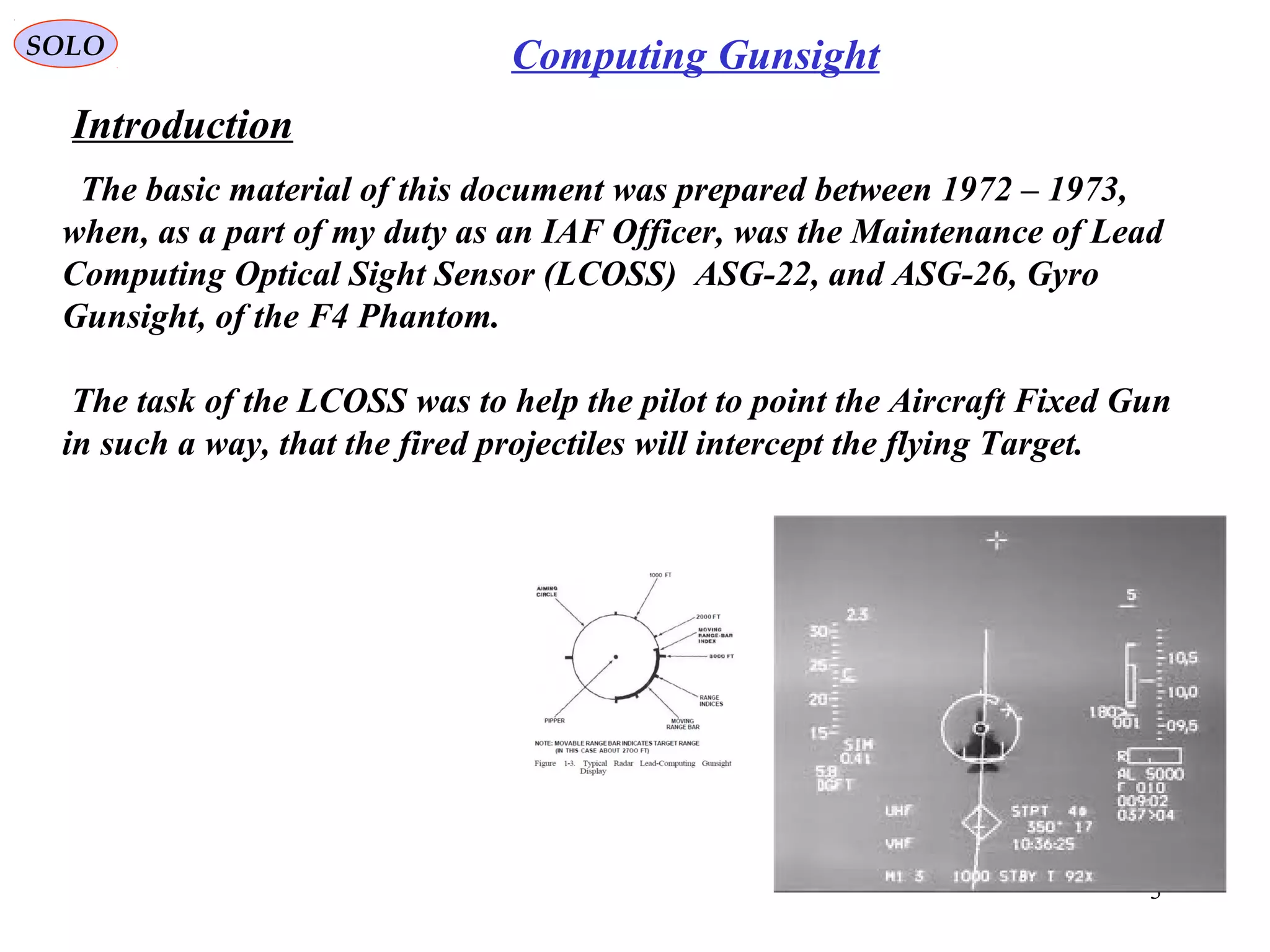
The basic material of this document was prepared between 1972 – 1973,
when, as a part of my duty as an IAF Officer, was the Maintenance of Lead
Computing Optical Sight Sensor (LCOSS) ASG-22, and ASG-26, Gyro
Gunsight, of the F4 Phantom.
The task of the LCOSS was to help the pilot to point the Aircraft Fixed Gun
in such a way, that the fired projectiles will intercept the flying Target.
SOLO Lead Computing Gunsight
A gyro gunsight (G.G.S.) is a modification of the non-magnifying
reflector sight in which target lead (the amount of aim-off in front of a
moving target) and bullet drop are allowed for automatically, the sight
incorporating a gyroscopic mechanism that computes the necessary
deflections required to ensure a hit on the target. The sight was developed
just before the Second World War for aircraft use during aerial combat.
Gyro Gunsight (G.G.S.)
The Ferranti Gyro Sight Mk IIc
Gyro gunsights were (for the most part) modifications of the reflector
gunsight to aid pilots in hitting targets (other aircraft) that were turning
rapidly in front of them. The reflector sight (first used on German
fighters in 1918[1]
and widely adopted on all kinds of fighter and bomber
aircraft in the 1930s) was an optical device consisting of a 45 degree
angle glass beam splitter that sat in front of the pilot and projected an illuminated image of an
aiming reticule that appeared to sit out in front of the pilot's field of view at infinity and was
perfectly aligned with the plane's guns ("boresighted" with the guns). The optical nature of the
reflector sight meant it was possible to feed other information into field of view, such as
modifications of the aiming point due to deflection determined by input from a gyroscope.[2]
It is important to note that the information presented to the pilot was of his own aircraft, that is
the deflection/lead calculated was based on his own bank-level, rate of turn, airspeed etc. The
assumption was that the flight-path was following the flight-path of the target aircraft, as in a
dogfight, therefore the input data was close-enough
History
Optical system of Gyro Sight
SOLO Lead Computing Gunsight
Gyro Gunsight (G.G.S.)
History (continue – 1)
After tests with two experimental gyro gunsights which had begun in 1939, the first production
gyro gunsight was the British Mark I Gyro Sight , developed at Farnborough in 1941. To save
time in development the sight was based on the already existing type G prismatic sight, basically a
telescopic gun sight folded into a shorter length by a series of prisms.[3]
Prototypes were tested in
a Supermarine Spitfire and the turret of a Boulton Paul Defiant in the early part of that year.
With the successful conclusion of these tests the sight was put into production by Ferranti, the
first limited-production versions being available by the spring of 1941, with the sights being first
used operationally against Luftwaffe raids on Britain in July the same year. The Mark I sight
had a number of drawbacks however, including a limited field of view, erratic behavior of the
reticle, and requiring the pilot/gunner to put their eye up against an eyepiece during violent
maneuvers.
Production of the Mark I was postponed and work started on an improved sight. Changes
involved incorporating the gyro adjusted reticle into a more standard reflector sight system. This
new sight became the Mark II Gyro Sight, which was first tested in late 1943 with production
examples becoming available later in the same year. In the Mark II the pilot had to set the
wingspan of the target, and use a throttle mounted control to keep the target centered
British Developments
The Mark II was also subsequently produced in the US by Sperry as the K-14 (USAAF) and Mk18
(Navy)
The radar-aimed AGLT Village Inn tail turret incorporated a Mark II Gyro Sight and this turret
was fitted to some Lancaster bombers towards the end of World War II.
SOLO Lead Computing Gunsight
Gyro Gunsight (G.G.S.)
History (continue – 2)
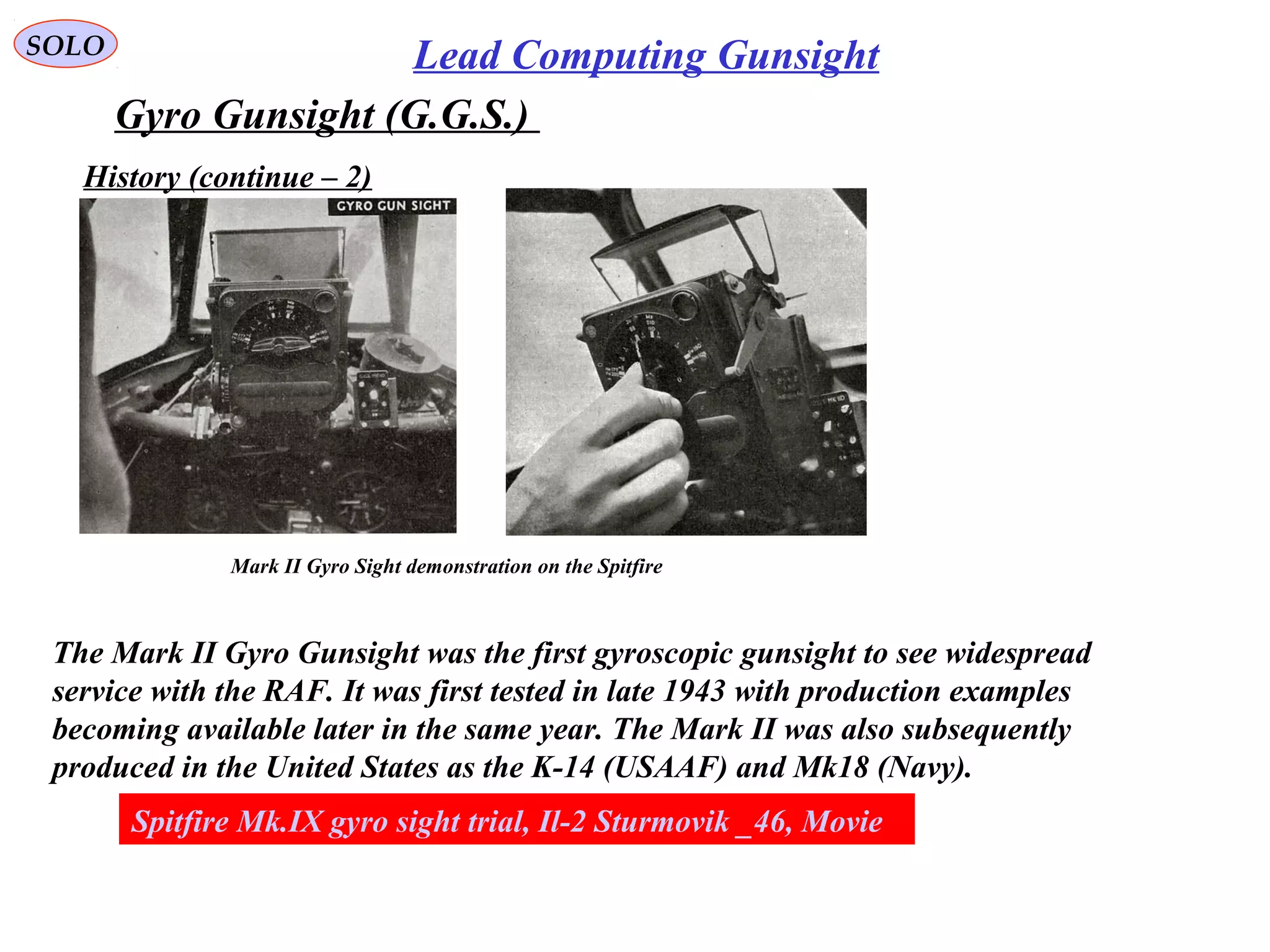
Mark II Gyro Sight demonstration on the Spitfire
The Mark II Gyro Gunsight was the first gyroscopic gunsight to see widespread
service with the RAF. It was first tested in late 1943 with production examples
becoming available later in the same year. The Mark II was also subsequently
produced in the United States as the K-14 (USAAF) and Mk18 (Navy).
Spitfire Mk.IX gyro sight trial, Il-2 Sturmovik _46, Movie
SOLO Lead Computing Gunsight
Gyro Gunsight (G.G.S.)
History (continue – 3)
German Developments
Although since 1935 the relevant German companies offered the Reich Air Ministry (RLM) a new type of gyro-
stabilized sight, the well-proven REVI (Reflexvisier, or reflector sight) remained in service for combat aircraft. The
gyro-stabilized sights received an additional designation of EZ (Einheitszielvorrichtung, or Target Predictor Units),
such as EZ/REVI-6a. The development of the EZ 40 gyro sight began in 1935 at the Carl Zeiss and Askania
companies, but was of low priority. Not until the beginning of 1942, when a US P-47 Thunderbolt fighter equipped
with a gyro-stabilised sight was captured, did the RLM speed up research. In the summer of 1941, the EZ 40, for
which both the Carl Zeiss and Askania companies were submitting their developments, was rejected. Tested in a Bf
109 F, Askania's EZ 40 produced 50 to 100% higher hit probability compared to the then standard sight, the REVI
C12c.[5]
In the summer of 1943 an example of the EZ 41 developed by the Zeiss company was tested, but was refused
because of too many faults. In the summer 1942, the Askania company began work on the EZ 42, which gunsight
could be adjusted for the target's wingspan (in order to estimate distance to the target). Three examples of the first
series of 33 pieces were delivered in July 1944. These were followed by further 770 units, the last being delivered by
the beginning of March 1945. Each unit took 130 labour hours to produce. The EZ 42 was made up by two major
parts, and lead computation was provided by two gyroscopes. The system, weighing 13.6 kg (30 lb) complete, of which
the reflector sight was 3.2 kg, was ordered into mass production at the Steinheil company in Munich. Approximately
200 of the sights were installed into Fw 190 and Me 262 fighters for field testing. The pilots reported that attacks from
20 degrees deflection were possible, and that although the maximum range of the EZ 42 was stated as approximately
1,000 meters, several enemy aircraft were shot down from a combat distance of 1,500 meters.[6]
The EZ 42 was compared with the Allied G.G.S. captured from in a P-47 Thunderbolt in September 1944 in Germany.
Both sights were tested in the same Fw 190, and by the same pilot. The conclusion was critical of the moving graticule
of the G.G.S., which could be obscured by the target. Compared to the EZ 42, the Allied sight's prediction angle was
found on average to be 20% less accurate, and vary by 1% per degree. Tracking accuracy with the G.G.S. measured as
the mean error of the best 50% of pictures was 20% worse than with the EZ 42
The German [HD], Movie
SOLO
8
Lead Computing Gunsight
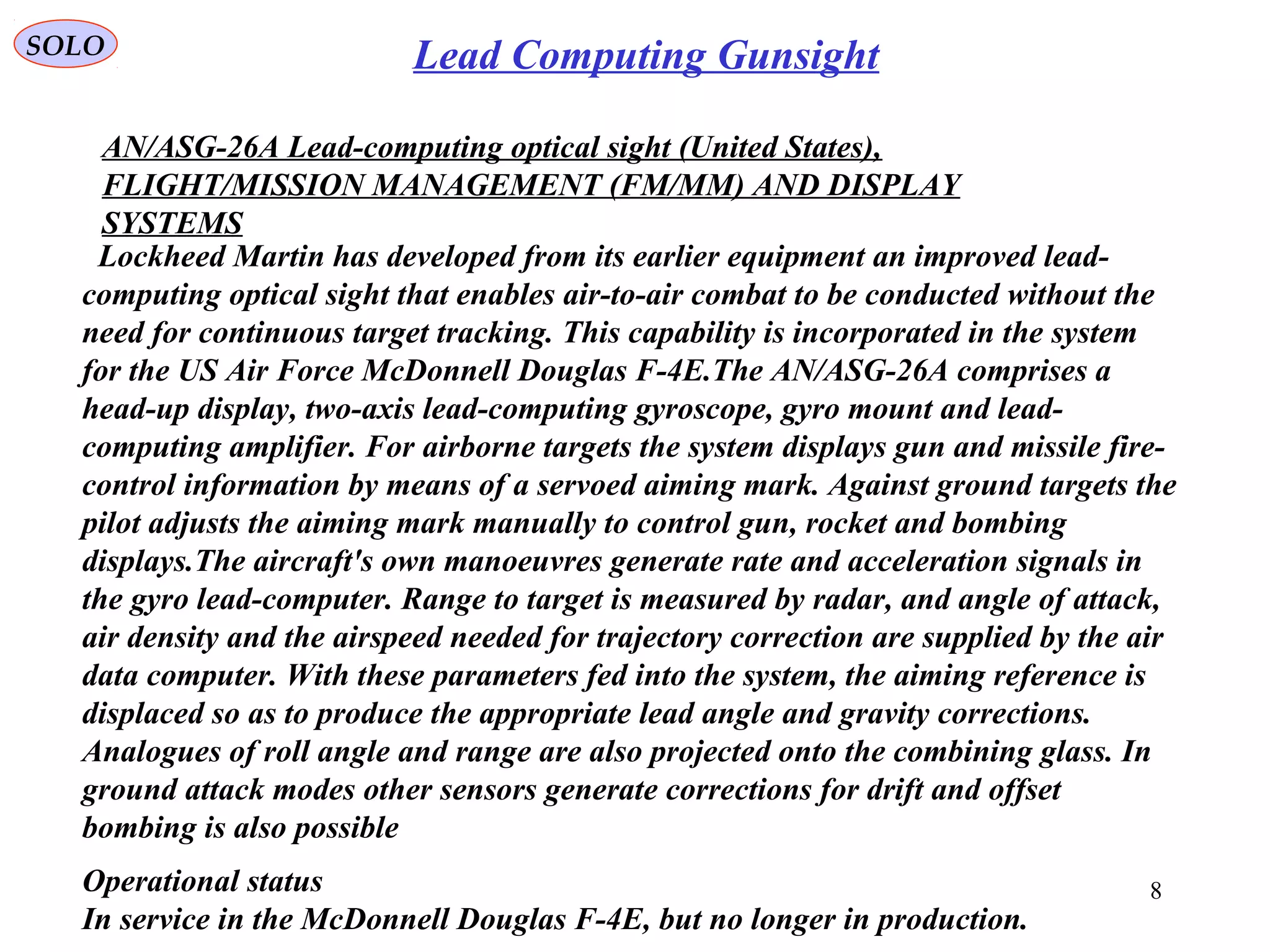
Lockheed Martin has developed from its earlier equipment an improved lead-
computing optical sight that enables air-to-air combat to be conducted without the
need for continuous target tracking. This capability is incorporated in the system
for the US Air Force McDonnell Douglas F-4E.The AN/ASG-26A comprises a
head-up display, two-axis lead-computing gyroscope, gyro mount and lead-
computing amplifier. For airborne targets the system displays gun and missile fire-
control information by means of a servoed aiming mark. Against ground targets the
pilot adjusts the aiming mark manually to control gun, rocket and bombing
displays.The aircraft's own manoeuvres generate rate and acceleration signals in
the gyro lead-computer. Range to target is measured by radar, and angle of attack,
air density and the airspeed needed for trajectory correction are supplied by the air
data computer. With these parameters fed into the system, the aiming reference is
displaced so as to produce the appropriate lead angle and gravity corrections.
Analogues of roll angle and range are also projected onto the combining glass. In
ground attack modes other sensors generate corrections for drift and offset
bombing is also possible
AN/ASG-26A Lead-computing optical sight (United States),
FLIGHT/MISSION MANAGEMENT (FM/MM) AND DISPLAY
SYSTEMS
Operational status
In service in the McDonnell Douglas F-4E, but no longer in production.
SOLO Lead Computing Gunsight
F4 Phantom
gun direction
AAA VV 1=

BSTmm VV 1=

L = Kinematic
Lead Angle
Projectile
Path
Target Position
at Projectile
Shoot
Target
Predicted Flight
Path
Projectile-Target
Intercept
Point
fTTV

a - Angle of Attack
Line of Sight
through
Reticle Image
SD1
2/
2
fTTV

2/1
2
fZTg−
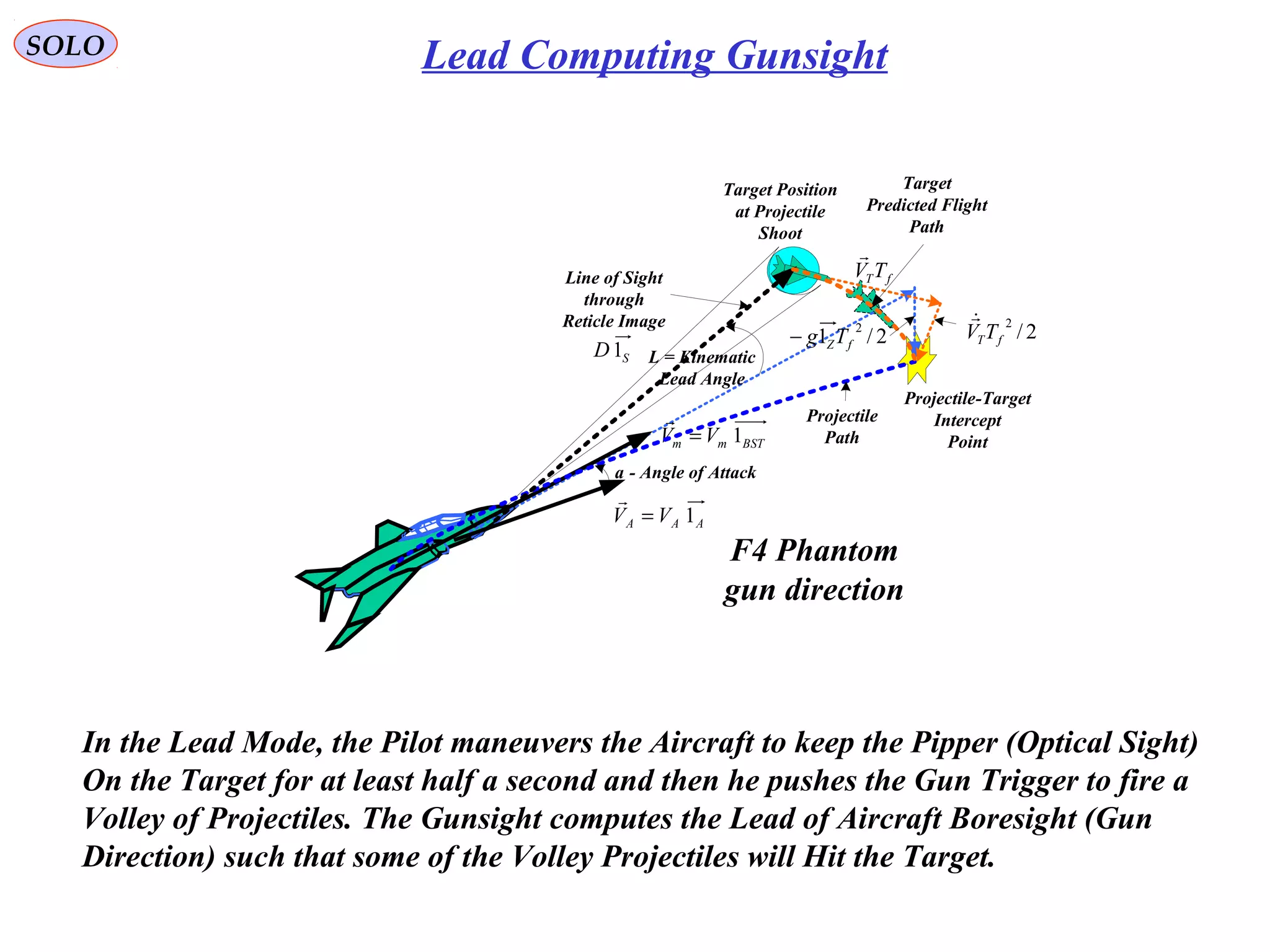
In the Lead Mode, the Pilot maneuvers the Aircraft to keep the Pipper (Optical Sight)
On the Target for at least half a second and then he pushes the Gun Trigger to fire a
Volley of Projectiles. The Gunsight computes the Lead of Aircraft Boresight (Gun
Direction) such that some of the Volley Projectiles will Hit the Target.
SOLO Lead Computing Gunsight
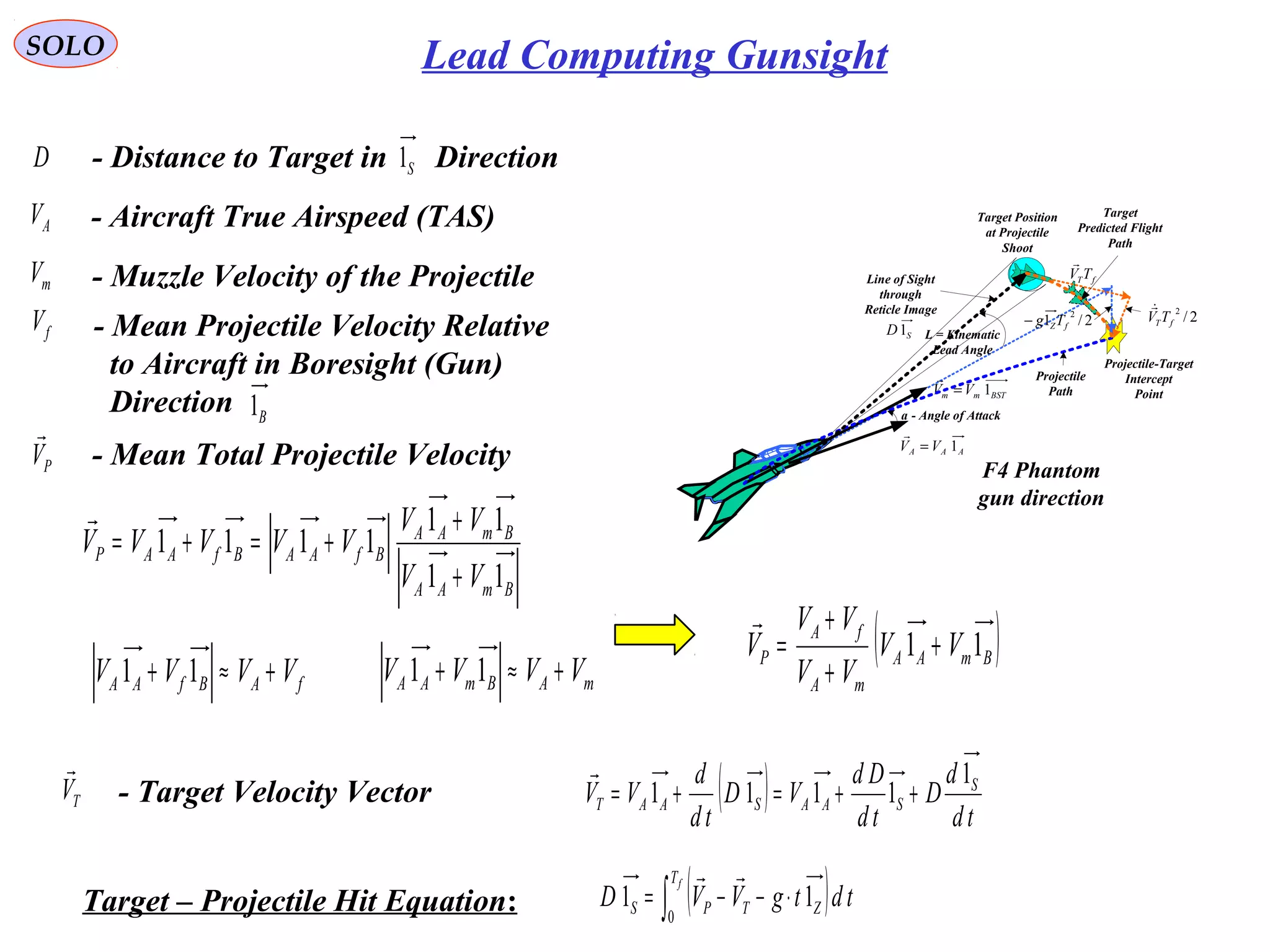
AV - Aircraft True Airspeed (TAS)
mV - Muzzle Velocity of the Projectile
PV

- Mean Total Projectile Velocity
BmAA
BmAA
BfAABfAAP
VV
VV
VVVVV
11
11
1111
+
+
+=+=

fV - Mean Projectile Velocity Relative
to Aircraft in Boresight (Gun)
Direction B1
fABfAA VVVV +≈+ 11 mABmAA VVVV +≈+ 11
( )BmAA
mA
fA
P VV
VV
VV
V 11 +
+
+
=

- Distance to Target in DirectionD S1
- Target Velocity VectorTV

( ) td
d
D
td
Dd
VD
td
d
VV S
SAASAAT
1
1111 ++=+=

Target – Projectile Hit Equation: ( )∫ ⋅−−=
fT
ZTPS tdtgVVD
0
11

F4 Phantom
gun direction
AAA VV 1=

BSTmm VV 1=

L = Kinematic
Lead Angle
Projectile
Path
Target Position
at Projectile
Shoot
Target
Predicted Flight
Path
Projectile-Target
Intercept
Point
fTTV

a - Angle of Attack
Line of Sight
through
Reticle Image
SD1
2/
2
fTTV

2/1
2
fZTg−
SOLO Lead Computing Gunsight
( )BmAA
Am
Af
P VV
VV
VV
V 11 +
+
+
=

- Target Velocity VectorTV

( ) td
d
D
td
Dd
VD
td
d
VV S
SAASAAT
1
1111 ++=+=

Target – Projectile Hit Equation: ( )∫ ⋅−−=
fT
ZTPS tdtgVVD
0
11

PV

- Mean Total Projectile Velocity
( )
( )
( )∫
∫
∫
∫






⋅−−−−
+
−
+=






⋅−−−
+
⋅−⋅−⋅+⋅
+−
+
−
=






⋅−−−
+
+
+
+
−
−=






⋅−−−−+
+
+
=
f
f
f
f
T
ZSSABA
Am
fm
Bf
T
ZSSB
Am
fAmAmAmf
ABA
Am
fm
T
ZSSBm
Am
Af
AA
Am
fm
T
ZSSABmAA
mA
fA
S
tdtgDDV
VV
VV
V
tdtgDD
VV
VVVVVVVV
V
VV
VV
tdtgDDV
VV
VV
V
VV
VV
tdtgDDVVV
VV
VV
D
0
0
0
0
111111
111111
11111
111111









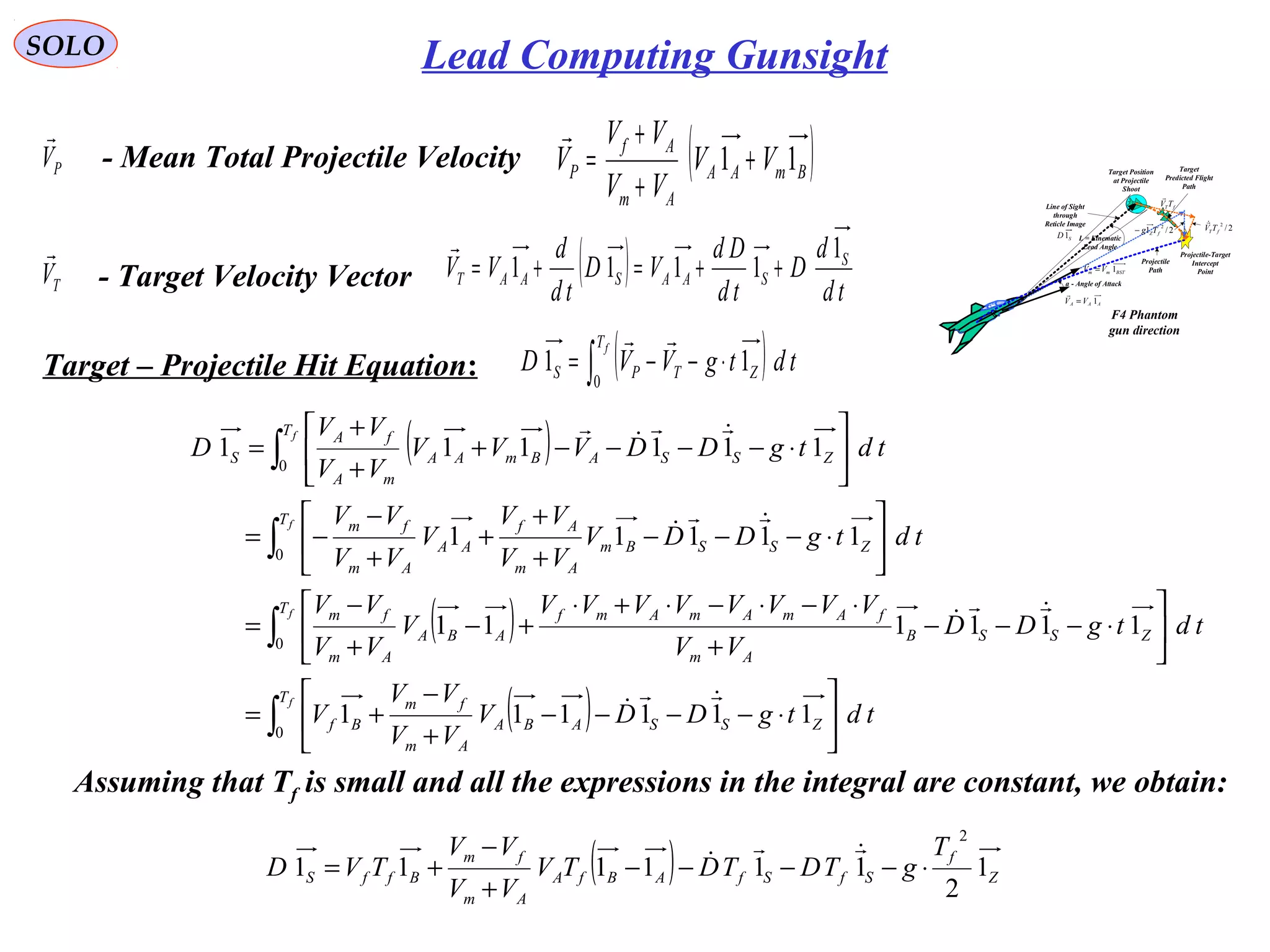
Assuming that Tf is small and all the expressions in the integral are constant, we obtain:
( ) Z
f
SfSfABfA
Am
fm
BffS
T
gTDTDTV
VV
VV
TVD 1
2
111111
2
⋅−−−−
+
−
+=


F4 Phantom
gun direction
AAA VV 1=

BSTmm VV 1=

L = Kinematic
Lead Angle
Projectile
Path
Target Position
at Projectile
Shoot
Target
Predicted Flight
Path
Projectile-Target
Intercept
Point
fTTV

a - Angle of Attack
Line of Sight
through
Reticle Image
SD1
2/
2
fTTV

2/1
2
fZTg−
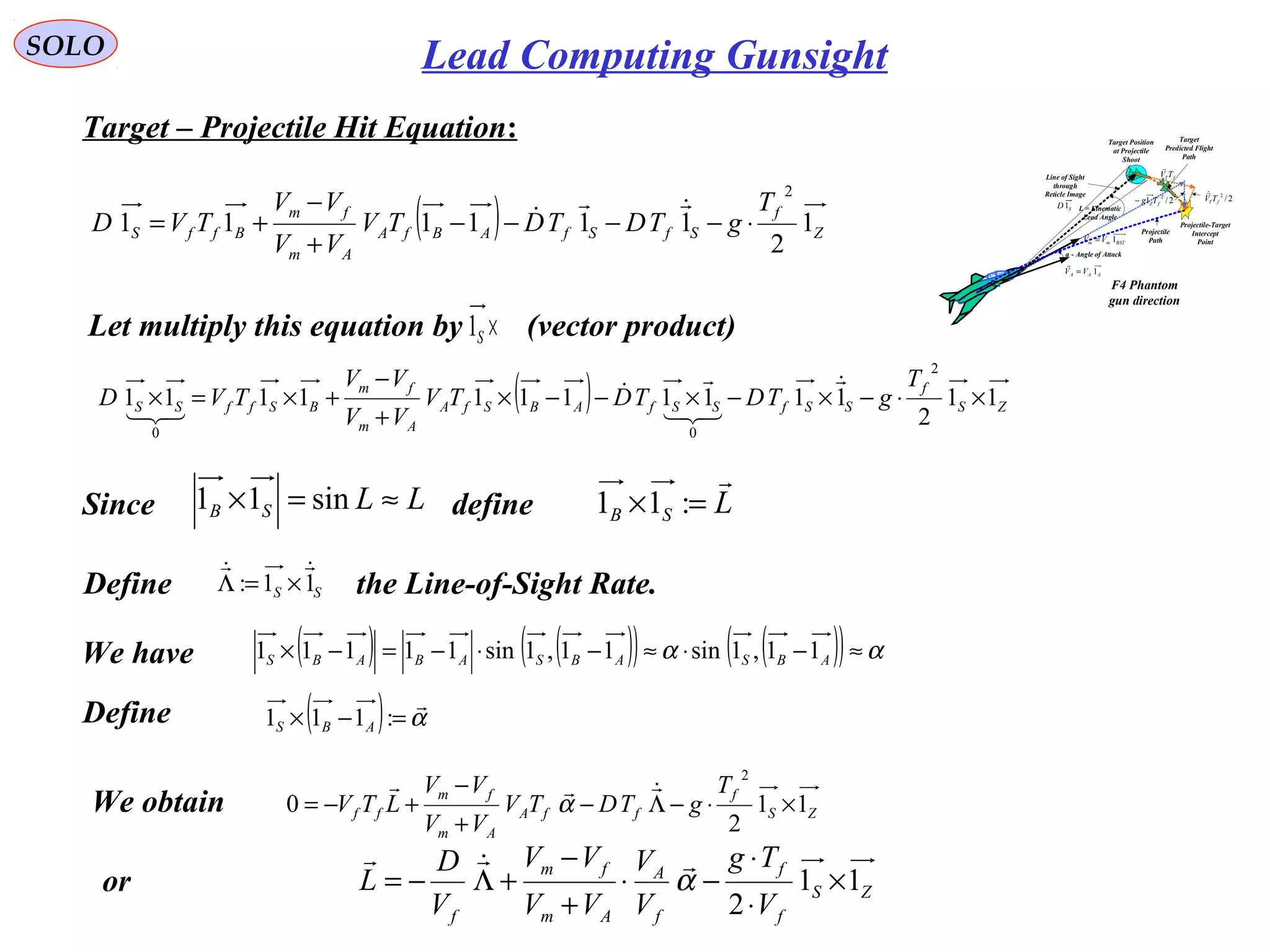
SOLO Lead Computing Gunsight
Target – Projectile Hit Equation:
( ) Z
f
SfSfABfA
Am
fm
BffS
T
gTDTDTV
VV
VV
TVD 1
2
111111
2
⋅−−−−
+
−
+=


Let multiply this equation by (vector product)×S1
( ) ZS
f
SSfSSfABSfA
Am
fm
BSffSS
T
gTDTDTV
VV
VV
TVD 11
2
11111111111
2
00
×⋅−×−×−−×
+
−
+×=×





Since defineLLSB ≈=× sin11 LSB

=× :11
Define the Line-of-Sight Rate.SS 11:

×=Λ
( ) ( )( ) ( )( ) αα ≈−⋅≈−⋅−=−× ABSABSABABS 11,1sin11,1sin11111We have
Define ( ) α

=−× :111 ABS
ZS
f
ffA
Am
fm
ff
T
gTDTV
VV
VV
LTV 11
2
0
2
×⋅−Λ−
+
−
+−=

αWe obtain
ZS
f
f
f
A
Am
fm
f V
Tg
V
V
VV
VV
V
D
L 11
2
×
⋅
⋅
−⋅
+
−
+Λ−= α

or
F4 Phantom
gun direction
AAA VV 1=

BSTmm VV 1=

L = Kinematic
Lead Angle
Projectile
Path
Target Position
at Projectile
Shoot
Target
Predicted Flight
Path
Projectile-Target
Intercept
Point
fTTV

a - Angle of Attack
Line of Sight
through
Reticle Image
SD1
2/
2
fTTV

2/1
2
fZTg−
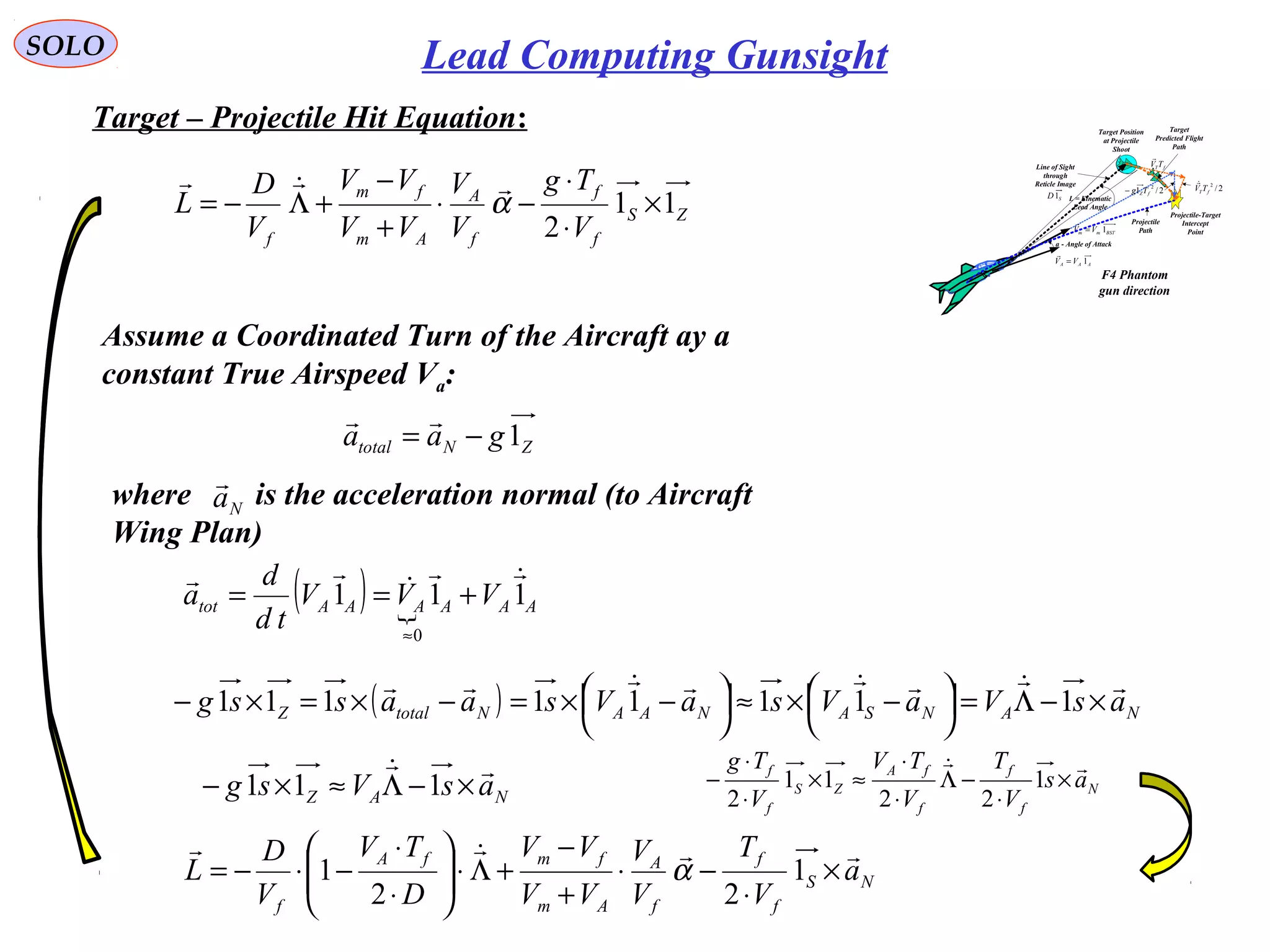
SOLO Lead Computing Gunsight
Target – Projectile Hit Equation:
ZS
f
f
f
A
Am
fm
f V
Tg
V
V
VV
VV
V
D
L 11
2
×
⋅
⋅
−⋅
+
−
+Λ−= α

Assume a Coordinated Turn of the Aircraft ay a
constant True Airspeed Va:
ZNtotal gaa 1−=

where is the acceleration normal (to Aircraft
Wing Plan)
Na

( )  AAAAAAtot VVV
td
d
a 111
0



+==
≈
( ) NANSANAANtotalZ asVaVsaVsaassg

×−Λ=



 −×≈



 −×=−×=×− 11111111
NAZ asVsg

×−Λ≈×− 111 N
f
f
f
fA
ZS
f
f
as
V
T
V
TV
V
Tg 
×
⋅
−Λ
⋅
⋅
≈×
⋅
⋅
− 1
22
11
2
NS
f
f
f
A
Am
fmfA
f
a
V
T
V
V
VV
VV
D
TV
V
D
L

×
⋅
−⋅
+
−
+Λ⋅





⋅
⋅
−⋅−= 1
22
1 α
F4 Phantom
gun direction
AAA VV 1=

BSTmm VV 1=

L = Kinematic
Lead Angle
Projectile
Path
Target Position
at Projectile
Shoot
Target
Predicted Flight
Path
Projectile-Target
Intercept
Point
fTTV

a - Angle of Attack
Line of Sight
through
Reticle Image
SD1
2/
2
fTTV

2/1
2
fZTg−
SOLO Lead Computing Gunsight
VR
VC
M
S
V D
=
⋅
⋅
−=

 2
2
1 ρ
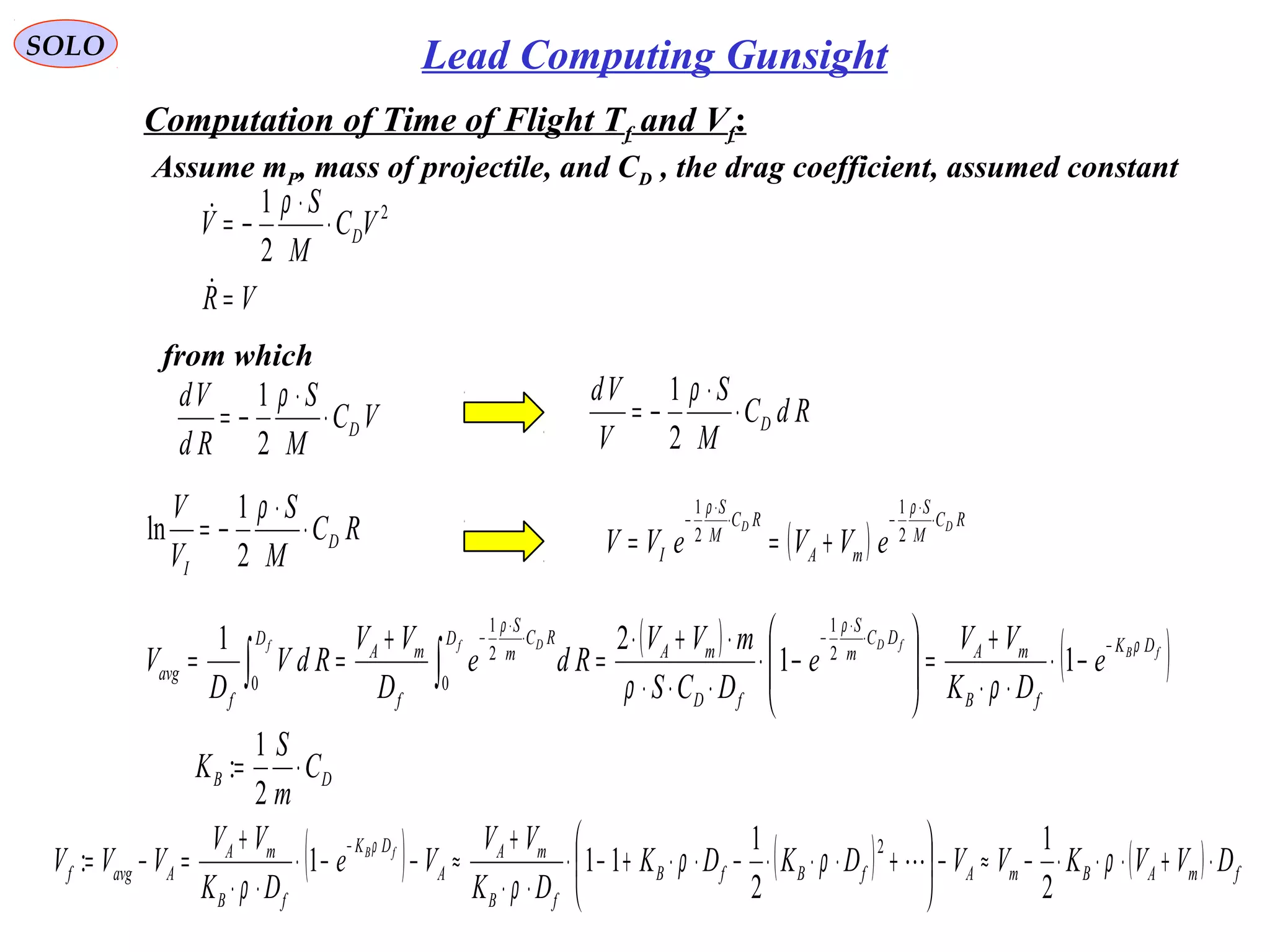
Computation of Time of Flight Tf and Vf:
Assume mP, mass of projectile, and CD , the drag coefficient, assumed constant
from which
VC
M
S
Rd
Vd
D⋅
⋅
−=
ρ
2
1 RdC
M
S
V
Vd
D⋅
⋅
−=
ρ
2
1
RC
M
S
V
V
D
I
⋅
⋅
−=
ρ
2
1
ln ( )
RC
M
S
mA
RC
M
S
I
DD
eVVeVV
⋅
⋅
−⋅
⋅
−
+==
ρρ
2
1
2
1
( ) ( )
DB
DK
fB
mA
DC
m
S
fD
mA
D RC
m
S
f
mA
D
f
avg
C
m
S
K
e
DK
VV
e
DCS
mVV
Rde
D
VV
RdV
D
V fB
fDf Df
⋅=
−⋅
⋅⋅
+
=







−⋅
⋅⋅⋅
⋅+⋅
=
+
==
−⋅
⋅
−⋅
⋅
−
∫∫
2
1
:
11
21 2
1
0
2
1
0
ρ
ρρ
ρρ
( ) ( ) ( ) fmABmAfBfB
fB
mA
A
DK
fB
mA
Aavgf DVVKVVDKDK
DK
VV
Ve
DK
VV
VVV fB
⋅+⋅⋅⋅−≈−





+⋅⋅⋅−⋅⋅+−⋅
⋅⋅
+
≈−−⋅
⋅⋅
+
=−=
−
ρρρ
ρρ
ρ
2
1
2
1
111:
2

SOLO Lead Computing Gunsight
Computation of Time of Flight Tf and Vf (continue – 1)
( ) fmABmAavgf DVVKVVVV ⋅+⋅⋅⋅−≈−= ρ
2
1
:
( ) ∫∫ +=+=
ff T
TS
T
Zf tdVDtdgVD
00
11

( ) ffAfavg
T
f TVVTVtdVD
f
⋅+=⋅=≈ ∫0

( ) fA
T
SSA
T
TSf TDVDtdDDVDtdVDD
ff
⋅++≈



 +++≈+= ∫∫ 


00
111
( ) ( ) ( ) 0=−⋅−⇒⋅++≈⋅+≈ DTDVTDVDTVVD fffAffAf

( ) ( )[ ] 0
2
1
=−⋅










−⋅++⋅+⋅⋅⋅− DTDTDVDVVKV f
D
fAmABm
f

  
ρ
SOLO Lead Computing Gunsight
Computation of Time of Flight Tf and Vf (continue – 2)
( ) ( )[ ] 0
2
1
=−⋅














−⋅++⋅+⋅⋅⋅− DTDTDVDVVKV f
V
D
fAmABm
f
f

  
  
ρ
( ) ( ) ( ) 0
2
1
2
1 2
=+⋅





+⋅⋅⋅−−⋅+⋅+⋅⋅⋅ DTVVKVTDVVVK f
B
mABmf
A
AmAB
    
 ρρ
A
DABB
Tf
⋅
⋅⋅−−
=
2
42
ff TDDV /+= 
SOLO
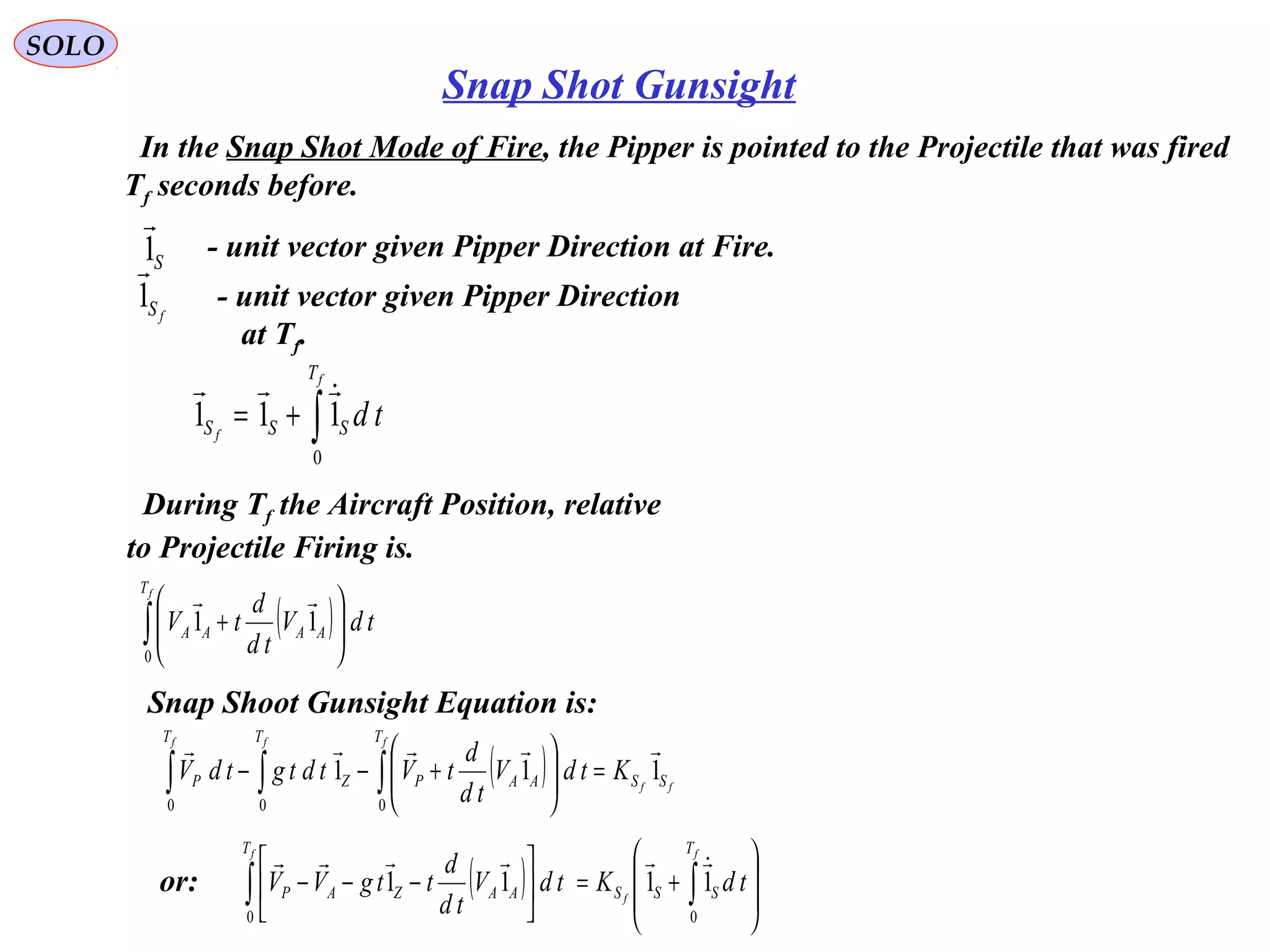
Snap Shot Gunsight
In the Lead Mode of Fire, the Pilot must keep the Pipper on the Target, for a small
period of time, and then he starts firing the Gun.
In the Snap Shoot Mode of Fire, the Pilot must bring the Pipper to cross the Target,
but must start Firing at least Time of Flight (Tf ) (no more then a second), before
Target Crossing. This Mode will work if the Pipper points on the Projectile Position
Tf seconds after Firing, so the Projectile (fired Tf before), the Pipper and the Target
coincide.
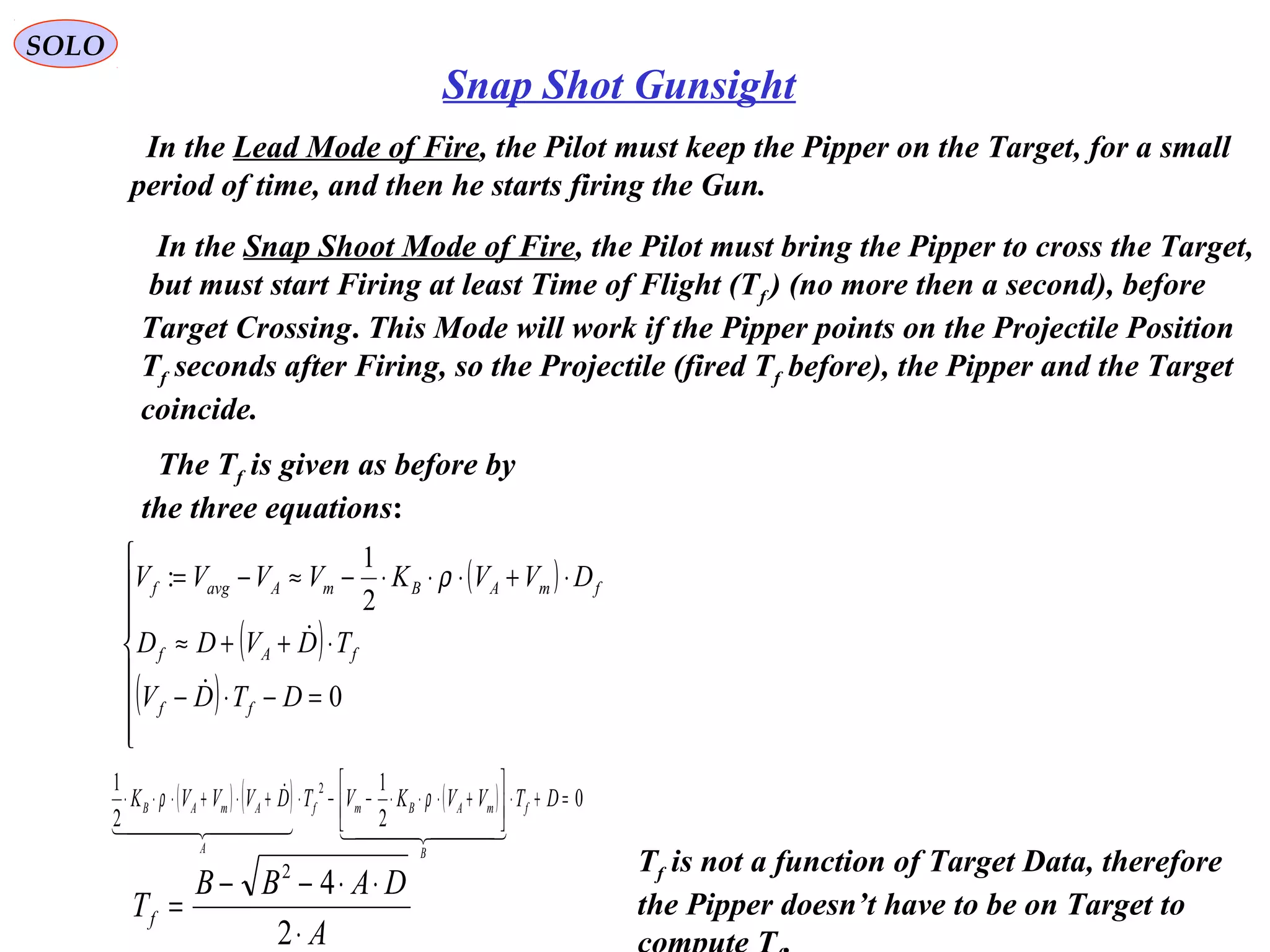
The Tf is given as before by
the three equations:
( )
( )
( )








=−⋅−
⋅++≈
⋅+⋅⋅⋅−≈−=
0
2
1
:
DTDV
TDVDD
DVVKVVVV
ff
fAf
fmABmAavgf


ρ
A
DABB
Tf
⋅
⋅⋅−−
=
2
42
( ) ( ) ( ) 0
2
1
2
1 2
=+⋅





+⋅⋅⋅−−⋅+⋅+⋅⋅⋅ DTVVKVTDVVVK f
B
mABmf
A
AmAB
    
 ρρ
Tf is not a function of Target Data, therefore
the Pipper doesn’t have to be on Target to
SOLO
Snap Shot Gunsight
In the Snap Shot Mode of Fire, the Pipper is pointed to the Projectile that was fired
Tf seconds before.
- unit vector given Pipper Direction at Fire.S1

fS1

- unit vector given Pipper Direction
at Tf.
∫+=
f
f
T
SSS td
0
111

During Tf the Aircraft Position, relative
to Projectile Firing is.
( )∫ 





+
fT
AAAA tdV
td
d
tV
0
11

Snap Shoot Gunsight Equation is:
( ) ff
fff
SS
T
AAPZ
TT
P KtdV
td
d
tVtdtgtdV 111
000

=





+−− ∫∫∫
( ) 







+=





−−− ∫∫
f
f
f T
SSS
T
AAZAP tdKtdV
td
d
ttgVV
00
1111

or:
SOLO
Snap Shot Gunsight
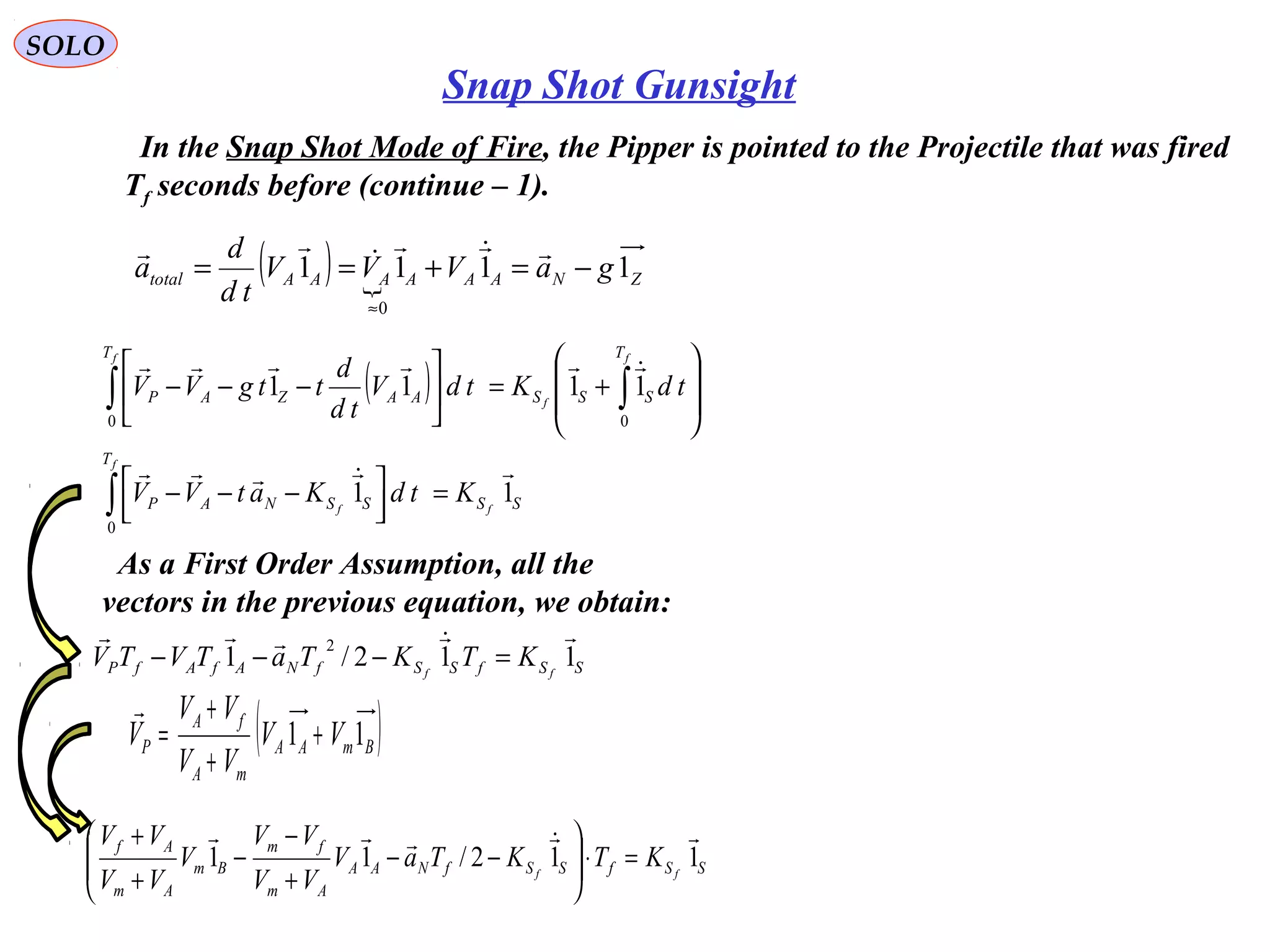
In the Snap Shot Mode of Fire, the Pipper is pointed to the Projectile that was fired
Tf seconds before (continue – 1).
( ) 







+=





−−− ∫∫
f
f
f T
SSS
T
AAZAP tdKtdV
td
d
ttgVV
00
1111

( )  ZNAAAAAAtotal gaVVV
td
d
a 1111
0
−=+==
≈



SS
T
SSNAP f
f
f
KtdKatVV 11
0

=



 −−−∫
As a First Order Assumption, all the
vectors in the previous equation, we obtain:
SSfSSfNAfAfP ff
KTKTaTVTV 112/1
2

=−−−
( )BmAA
mA
fA
P VV
VV
VV
V 11 +
+
+
=

SSfSSfNAA
Am
fm
Bm
Am
Af
ff
KTKTaV
VV
VV
V
VV
VV
112/11

=⋅





−−
+
−
−
+
+
  
SOLO
Snap Shot Gunsight
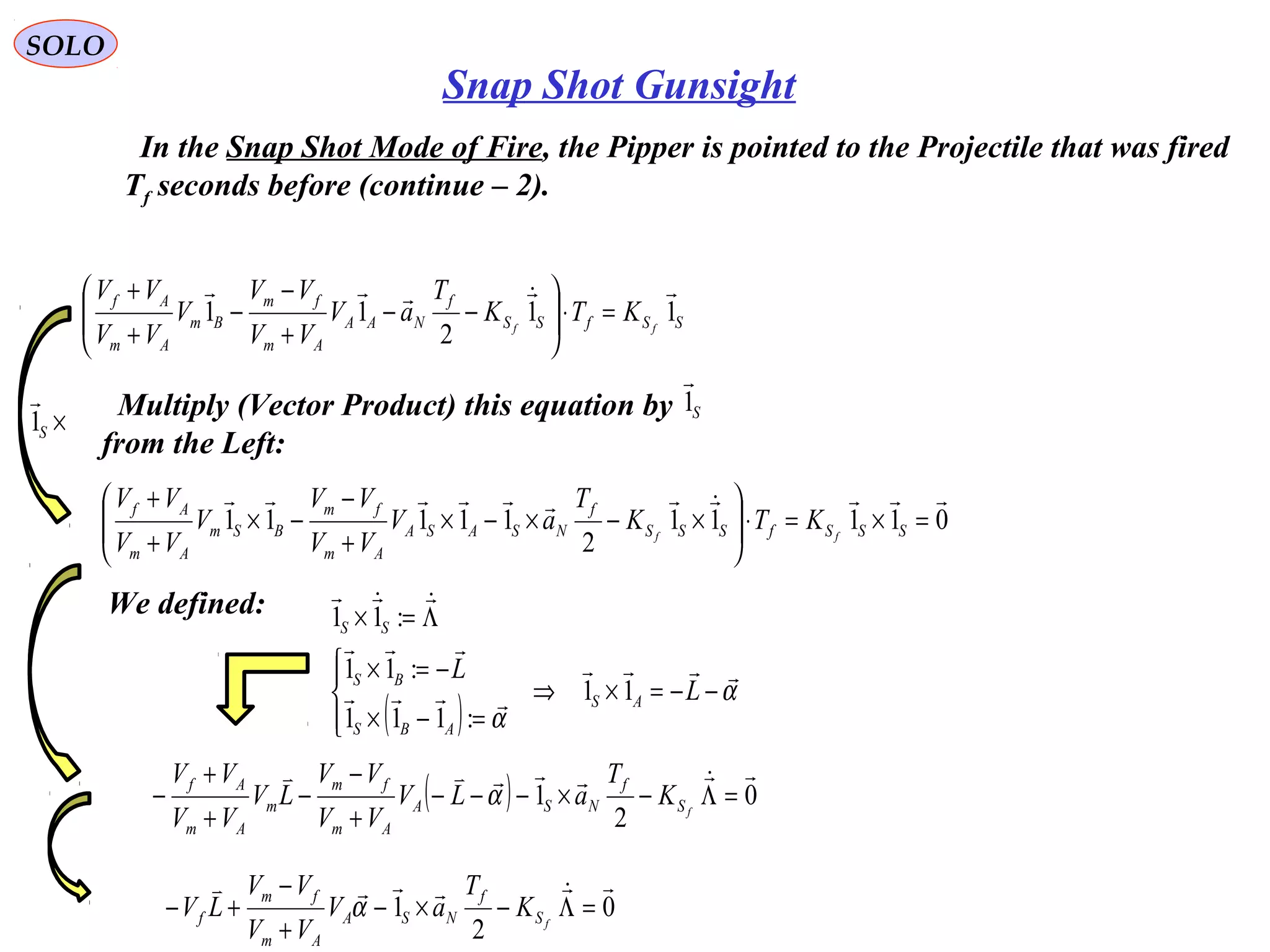
  In the Snap Shot Mode of Fire, the Pipper is pointed to the Projectile that was fired
Tf seconds before (continue – 2).
SSfSS
f
NAA
Am
fm
Bm
Am
Af
ff
KTK
T
aV
VV
VV
V
VV
VV
11
2
11

=⋅





−−
+
−
−
+
+
01111
2
11111

=×=⋅





×−×−×
+
−
−×
+
+
SSSfSSS
f
NSASA
Am
fm
BSm
Am
Af
ff
KTK
T
aV
VV
VV
V
VV
VV
  Multiply (Vector Product) this equation by
from the Left:
S1

  We defined:
( )
α
α




−−=×⇒




=−×
−=×
Λ=×
L
L
AS
ABS
BS
SS
11
:111
:11
:11
( ) 0
2
1

=Λ−×−−−
+
−
−
+
+
− fS
f
NSA
Am
fm
m
Am
Af
K
T
aLV
VV
VV
LV
VV
VV
α
0
2
1

=Λ−×−
+
−
+− fS
f
NSA
Am
fm
f K
T
aV
VV
VV
LV α
×S1

  
SOLO
Snap Shot Gunsight
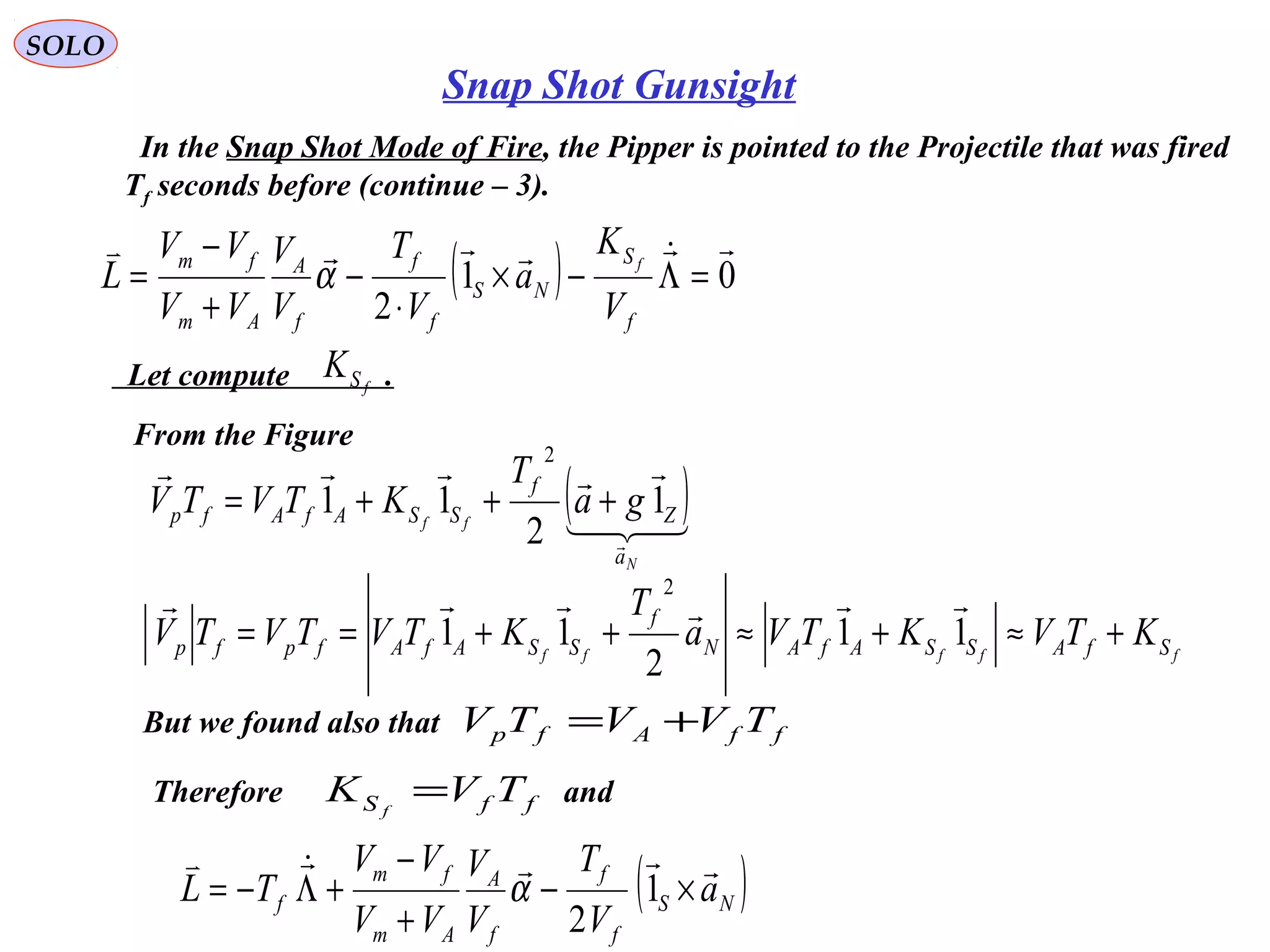
  In the Snap Shot Mode of Fire, the Pipper is pointed to the Projectile that was fired
Tf seconds before (continue – 3).
( ) 01
2

=Λ−×
⋅
−
+
−
=
f
S
NS
f
f
f
A
Am
fm
V
K
a
V
T
V
V
VV
VV
L f
α
  Let compute            .fSK
From the Figure
( )


N
ff
a
Z
f
SSAfAfp ga
T
KTVTV 1
2
11
2
+++=
fffff SfASSAfAN
f
SSAfAfpfp KTVKTVa
T
KTVTVTV +≈+≈++== 11
2
11
2

But we found also that ffAfp TVVTV +=
Therefore                                   andffS TVK f
=
( )NS
f
f
f
A
Am
fm
f a
V
T
V
V
VV
VV
TL

×−
+
−
+Λ−= 1
2
α
  
SOLO
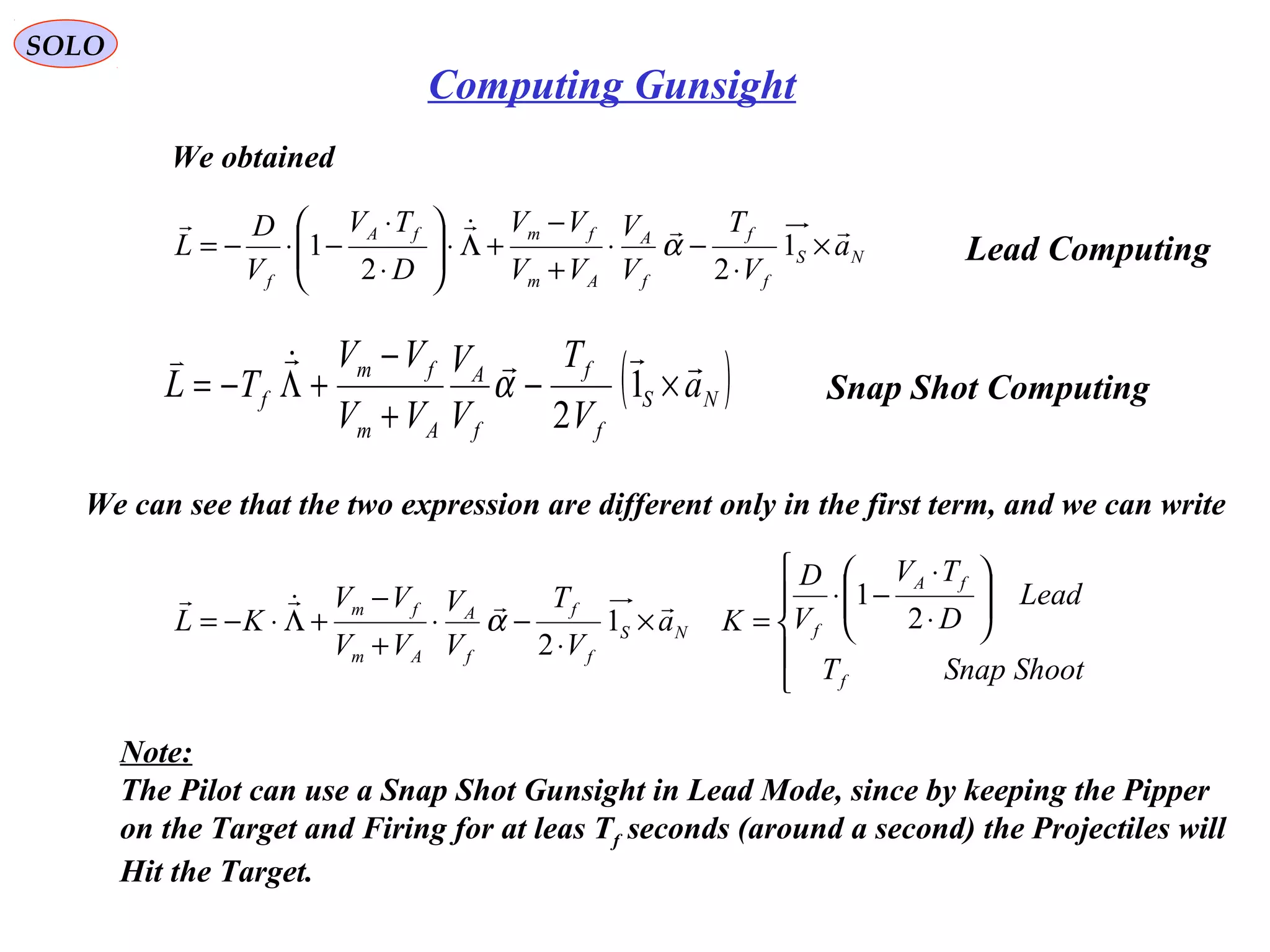
Computing Gunsight
We obtained
( )NS
f
f
f
A
Am
fm
f a
V
T
V
V
VV
VV
TL

×−
+
−
+Λ−= 1
2
α
NS
f
f
f
A
Am
fmfA
f
a
V
T
V
V
VV
VV
D
TV
V
D
L

×
⋅
−⋅
+
−
+Λ⋅





⋅
⋅
−⋅−= 1
22
1 α Lead Computing
Snap Shot Computing
We can see that the two expression are different only in the first term, and we can write











⋅
⋅
−⋅
=×
⋅
−⋅
+
−
+Λ⋅−=
ShootSnapT
Lead
D
TV
V
D
Ka
V
T
V
V
VV
VV
KL
f
fA
fNS
f
f
f
A
Am
fm
2
1
1
2

α
Note:
The Pilot can use a Snap Shot Gunsight in Lead Mode, since by keeping the Pipper
on the Target and Firing for at leas Tf seconds (around a second) the Projectiles will
Hit the Target.
  
SOLO Lead Computing Gunsight
Gyro Gunsight (G.G.S.) 
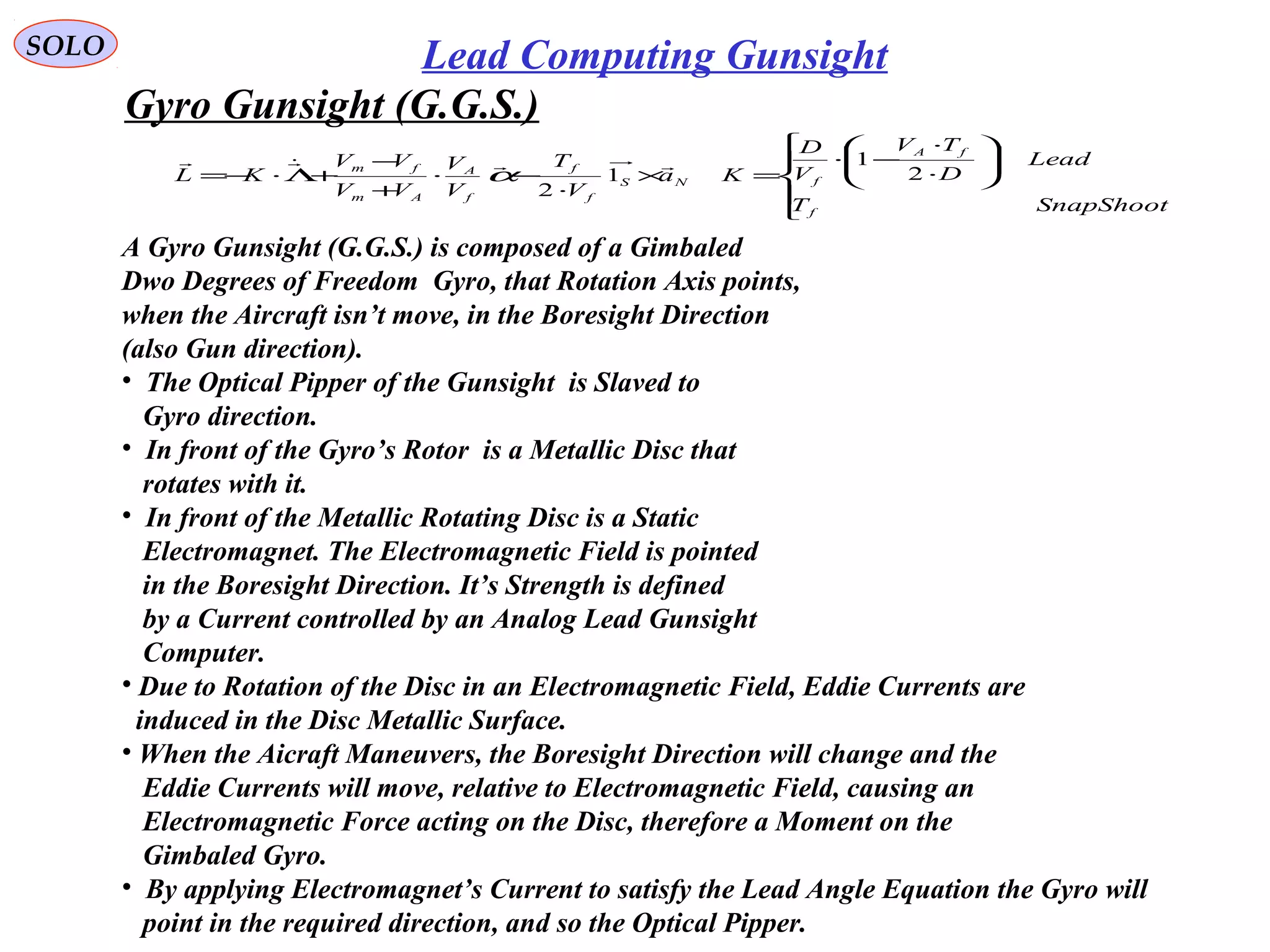
A Gyro Gunsight (G.G.S.) is composed of a Gimbaled
Dwo Degrees of Freedom  Gyro, that Rotation Axis points, 
when the Aircraft isn’t move, in the Boresight Direction 
(also Gun direction).
•  The Optical Pipper of the Gunsight  is Slaved to 
   Gyro direction. 
•  In front of the Gyro’s Rotor  is a Metallic Disc that 
   rotates with it.
•  In front of the Metallic Rotating Disc is a Static
   Electromagnet. The Electromagnetic Field is pointed 
   in the Boresight Direction. It’s Strength is defined
   by a Current controlled by an Analog Lead Gunsight
   Computer.
• Due to Rotation of the Disc in an Electromagnetic Field, Eddie Currents are
  induced in the Disc Metallic Surface.
• When the Aicraft Maneuvers, the Boresight Direction will change and the 
   Eddie Currents will move, relative to Electromagnetic Field, causing an
   Electromagnetic Force acting on the Disc, therefore a Moment on the
   Gimbaled Gyro. 
•  By applying Electromagnet’s Current to satisfy the Lead Angle Equation the Gyro will
   point in the required direction, and so the Optical Pipper.











⋅
⋅
−⋅
=×
⋅
−⋅
+
−
+Λ⋅−=
SnapShootT
Lead
D
TV
V
D
Ka
V
T
V
V
VV
VV
KL
f
fA
fNS
f
f
f
A
Am
fm
2
1
1
2

α
  
SOLO Lead Computing Gunsight
Gyro Gunsight (G.G.S.) 
  
SOLO Lead Computing Gunsight
Gyro Gunsight (G.G.S.) 
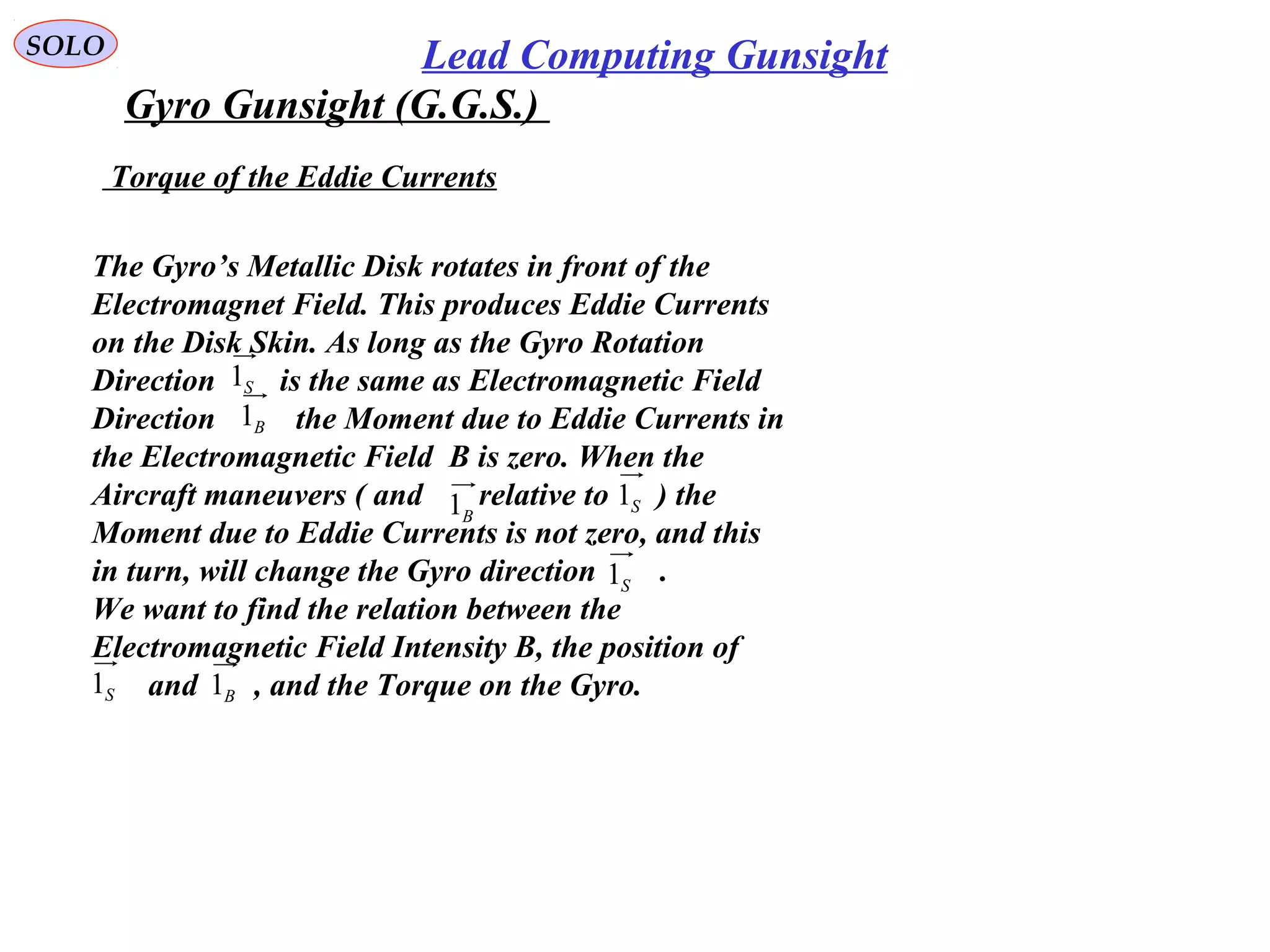
 Torque of the Eddie Currents
The Gyro’s Metallic Disk rotates in front of the 
Electromagnet Field. This produces Eddie Currents
on the Disk Skin. As long as the Gyro Rotation
Direction        is the same as Electromagnetic Field
Direction          the Moment due to Eddie Currents in
the Electromagnetic Field  B is zero. When the 
Aircraft maneuvers ( and       relative to      ) the 
Moment due to Eddie Currents is not zero, and this
in turn, will change the Gyro direction        .
We want to find the relation between the 
Electromagnetic Field Intensity B, the position of
       and       , and the Torque on the Gyro.
S1
B1
B1 S1
S1 B1
S1
  
SOLO Lead Computing Gunsight
Gyro Gunsight (G.G.S.) 
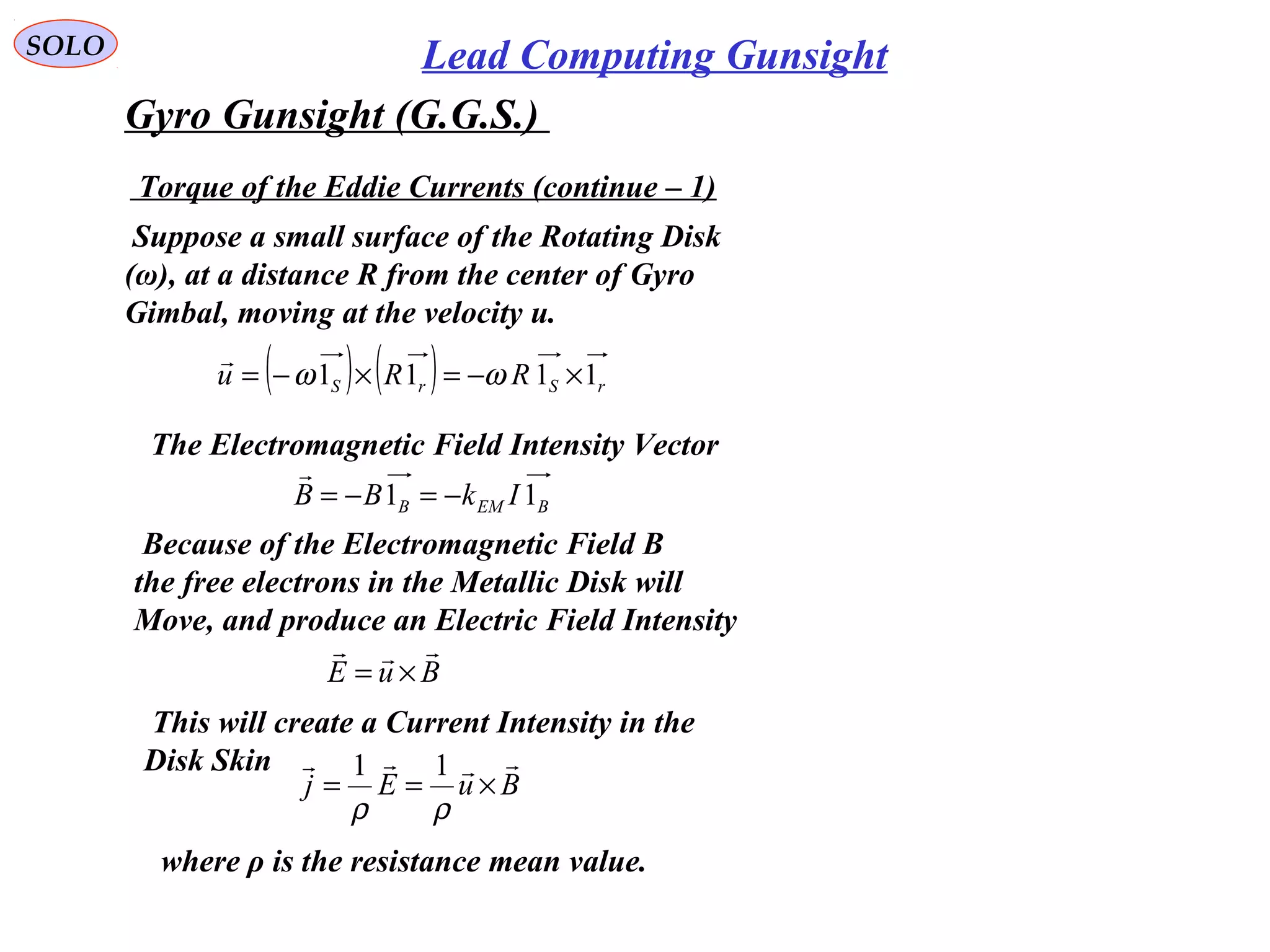
 Suppose a small surface of the Rotating Disk
(ω), at a distance R from the center of Gyro 
Gimbal, moving at the velocity u.
 The Electromagnetic Field Intensity Vector
BEMB IkBB 11 −=−=

( ) ( ) rSrS RRu 1111 ×−=×−= ωω

 Because of the Electromagnetic Field B 
the free electrons in the Metallic Disk will
Move, and produce an Electric Field Intensity
BuE

×=
 This will create a Current Intensity in the 
Disk Skin
BuEj

×==
ρρ
11
 where ρ is the resistance mean value.
 Torque of the Eddie Currents (continue – 1)
  
SOLO Lead Computing Gunsight
Gyro Gunsight (G.G.S.) 
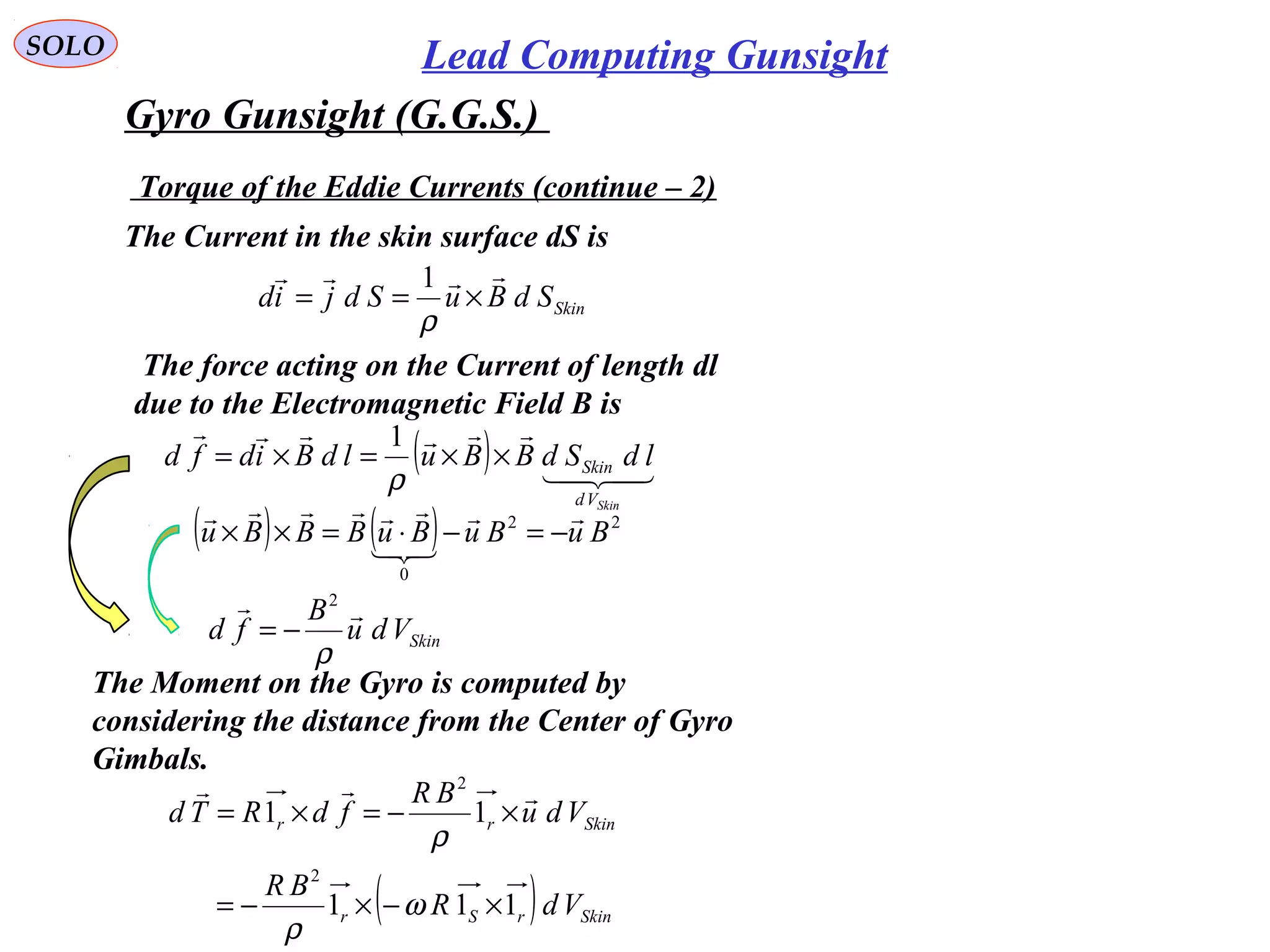
The Current in the skin surface dS is
 The force acting on the Current of length dl 
due to the Electromagnetic Field B is
SkinSdBuSdjid

×==
ρ
1
 Torque of the Eddie Currents (continue – 2)
( ) 

SkinVd
Skin ldSdBBuldBidfd ××=×=
ρ
1
( ) ( ) 22
0
BuBuBuBBBu



−=−⋅=××
SkinVdu
B
fd

ρ
2
−=
The Moment on the Gyro is computed by 
considering the distance from the Center of Gyro 
Gimbals.
( ) SkinrSr
Skinrr
VdR
BR
Vdu
BR
fdRTd
111
11
2
2
×−×−=
×−=×=
ω
ρ
ρ

  
SOLO Lead Computing Gunsight
Gyro Gunsight (G.G.S.) 
 Torque of the Eddie Currents (continue – 3)
( ) SkinrSr Vd
BR
Td 111
22
××=
ρ
ω
( ) ( )
( ) ( )
( ) ( ) ( ) ( )[ ]
( ) ( )
( ) ( ) ( ) ( )rSSrSrSSrSr
rSSrS
rrSSrSrSSrSrS
rSrSrS
rSrSrSr
111111111111
11111
11111111111111
1111111
1111111
2
2
2
××⋅+



 ⋅−=××
××⋅=
−⋅⋅=



 ⋅−−⋅−
⋅−=××⋅
⋅−=××
 Decompose this in the component in       direction 
(that will be compensate by the Gyro Motor) and 
that normal to it (that will cause the precession).
S1
( ) ( ) ( )
    


nSS Td
SkinrSSrS
Td
SkinrSS Vd
BR
Vd
BR
Td 111111111
22222
××⋅+



 ⋅−=
ρ
ω
ρ
ω
  
SOLO Computing Gunsight
Gyro Gunsight (G.G.S.) 
 Torque of the Eddie Currents (continue – 4)
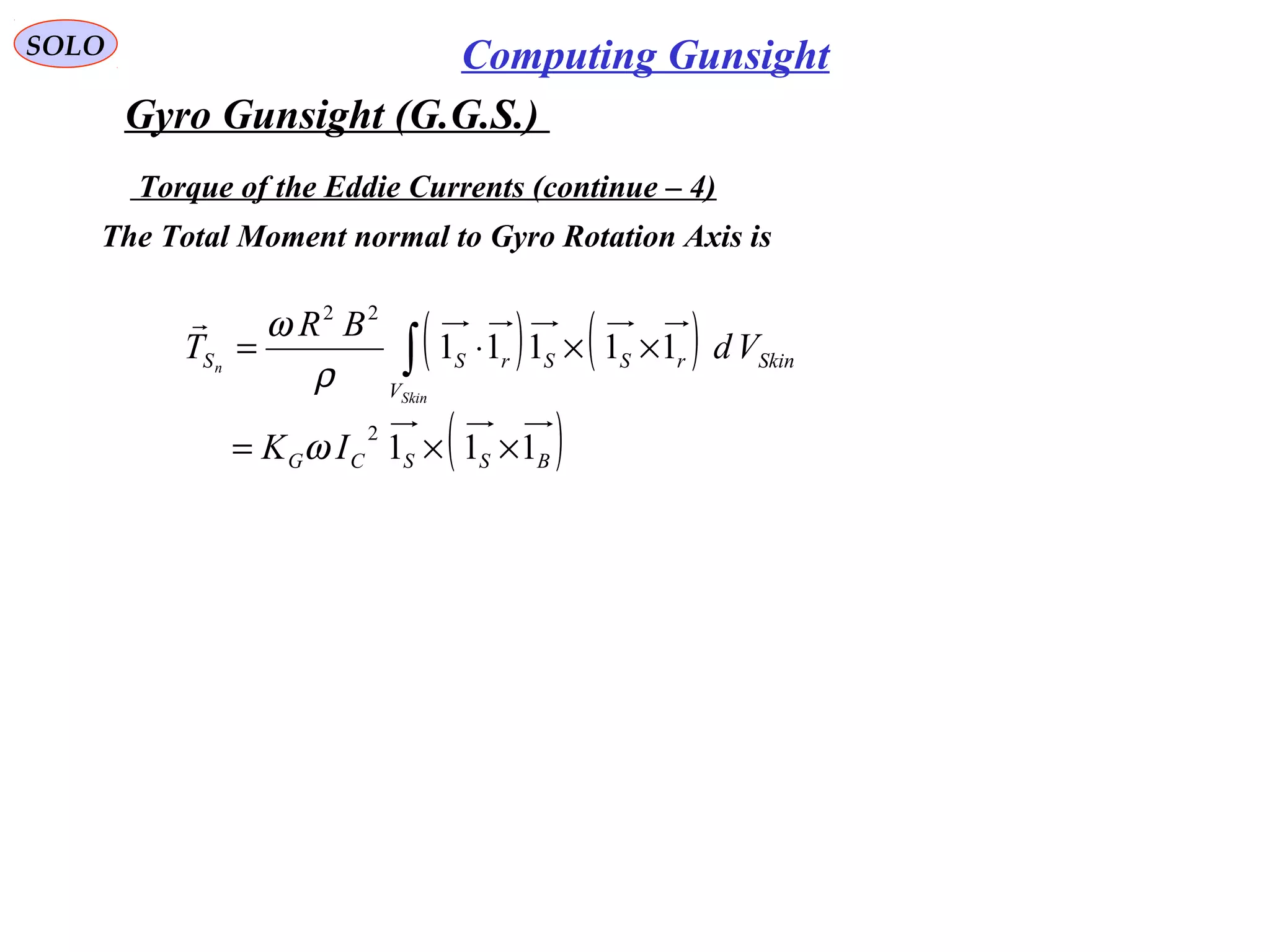
 The Total Moment normal to Gyro Rotation Axis is
( ) ( )
( )BSSCG
V
SkinrSSrSS
IK
Vd
BR
T
Skin
n
111
11111
2
22
××=
××⋅= ∫
ω
ρ
ω
  
SOLO Computing Gunsight
Gyro Gunsight (G.G.S.) 











⋅
⋅
−⋅
=×
⋅
⋅−⋅
+
−
⋅+−=Λ
ΛΛ
Λ
SnapShootT
Lead
D
TV
V
D
Ka
V
T
KV
V
VV
VV
K
L
K
f
fA
fNS
f
f
f
A
Am
fm
2
1
1
2
111
32
1
  

  




α
Implementation of  L
K
 1
1 −=Λ
( )SB
K
L
K
11
11
1

×−=−=Λ
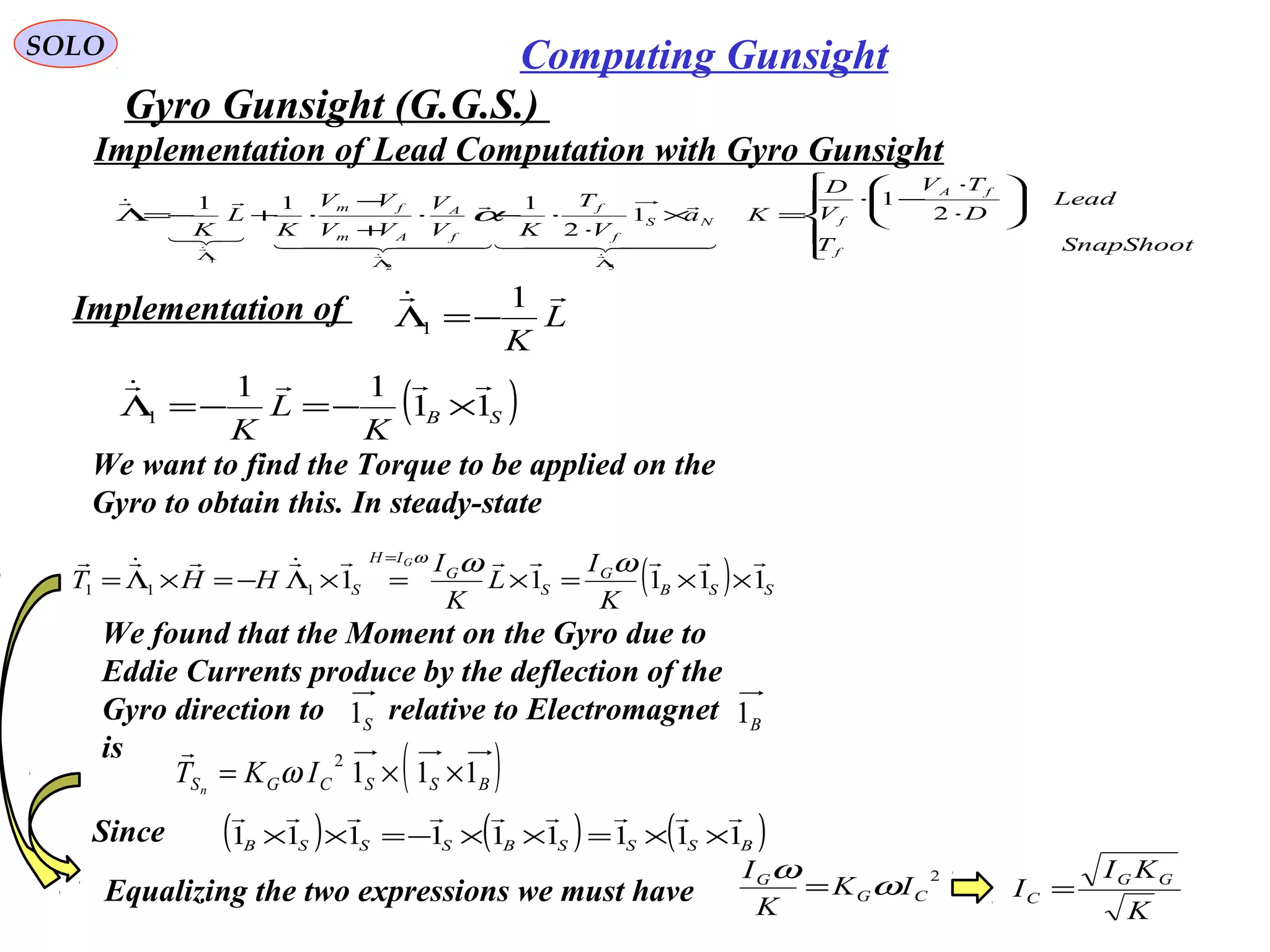
We want to find the Torque to be applied on the 
Gyro to obtain this. In steady-state
( ) SSB
G
S
G
IH
S
K
I
L
K
I
HHT
G
11111111

××=×=×Λ−=×Λ=
=
ωωω
( )BSSCGS IKT n
111
2
××= ω

We found that the Moment on the Gyro due to
Eddie Currents produce by the deflection of the 
Gyro direction to        relative to Electromagnet
is
S1 B1
Since ( ) ( ) ( )BSSSBSSSB 111111111

××=××−=××
Equalizing the two expressions we must have
2
CG
G
IK
K
I
ω
ω
=
K
KI
I GG
C =
Implementation of Lead Computation with Gyro Gunsight
  
SOLO Computing Gunsight
Gyro Gunsight (G.G.S.) 











⋅
⋅
−⋅
=×
⋅
⋅−⋅
+
−
⋅+−=Λ
ΛΛ
Λ
SnapShootT
Lead
D
TV
V
D
Ka
V
T
KV
V
VV
VV
K
L
K
f
fA
fNS
f
f
f
A
Am
fm
2
1
1
2
111
32
1
  

  




α
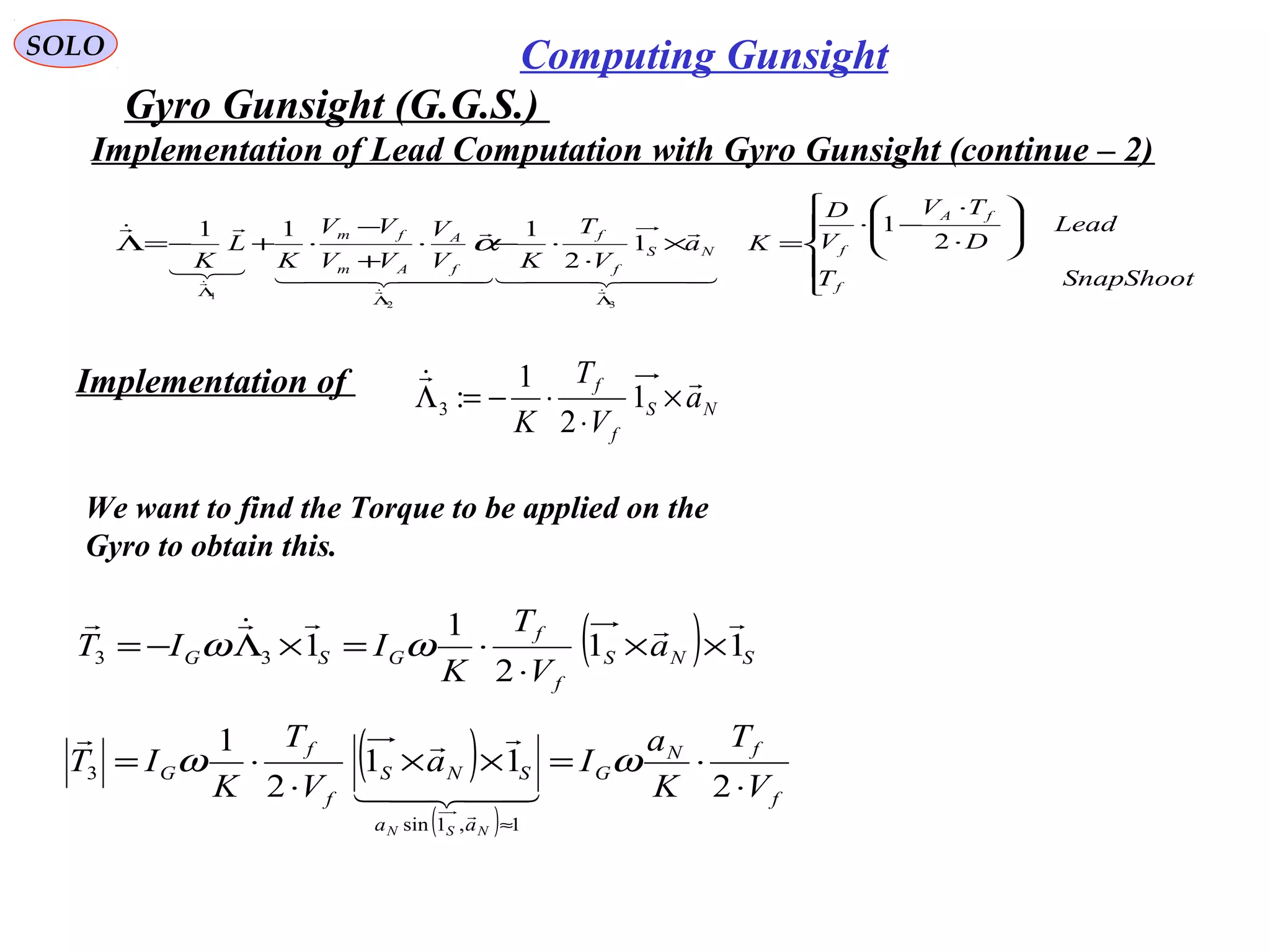
Implementation of 
We want to find the Torque to be applied on the 
Gyro to obtain this. 
( )[ ] SABSGSG
K
K
IIT 1111122

×−×−=×Λ−= α
ωω
( )ABS
K
f
A
Am
fm
K
K
V
V
VV
VV
K
111
1
:2



−×=⋅
+
−
⋅=Λ α
α
α
( )[ ]
( )
αωω α
α
α
K
K
I
K
K
IT GSABSG
ABS
=×−×=
≈−
  


11,1sin
2 1111
( )ABS 111:

−×=α
f
A
Am
fm
V
V
VV
VV
K ⋅
+
−
=:α
Implementation of Lead Computation with Gyro Gunsight (continue – 1)
  
SOLO Computing Gunsight
Gyro Gunsight (G.G.S.) 











⋅
⋅
−⋅
=×
⋅
⋅−⋅
+
−
⋅+−=Λ
ΛΛ
Λ
SnapShootT
Lead
D
TV
V
D
Ka
V
T
KV
V
VV
VV
K
L
K
f
fA
fNS
f
f
f
A
Am
fm
2
1
1
2
111
32
1
  

  




α
Implementation of 
We want to find the Torque to be applied on the 
Gyro to obtain this. 
( ) SNS
f
f
GSG a
V
T
K
IIT 11
2
1
133

××
⋅
⋅=×Λ−= ωω
NS
f
f
a
V
T
K

×
⋅
⋅−=Λ 1
2
1
:3
( )
( )
f
fN
G
aa
SNS
f
f
G
V
T
K
a
Ia
V
T
K
IT
NSN
⋅
⋅=××
⋅
⋅=
≈
2
11
2
1
1,1sin
3 ωω



Implementation of Lead Computation with Gyro Gunsight (continue – 2)
  
SOLO Computing Gunsight
Gyro Gunsight (G.G.S.) 











⋅
⋅
−⋅
=×
⋅
⋅−⋅
+
−
⋅+−=Λ
ΛΛ
Λ
SnapShootT
Lead
D
TV
V
D
Ka
V
T
KV
V
VV
VV
K
L
K
f
fA
fNS
f
f
f
A
Am
fm
2
1
1
2
111
32
1
  

  




α
( ) SNS
f
f
GSG a
V
T
K
IIT 11
2
1
133

××
⋅
⋅=×Λ−= ωω
Implementation of Lead Computation with Gyro Gunsight (continue – 3)
is perpendicular to         and in the plane defined
by        and 
S1

( )AB 11

−
S1

is perpendicular to         and in the plane defined
by        and 
S1

Na

S1

Since L and α are small angles, we may say 
that          and            are collinear and in the
Gyro zG direction, therefore
2T

3T

GGG Z
f
NfG
ZZ
V
aT
K
K
I
TTT 1
2
132









⋅
⋅
+−=≈+ α
ω
α
( )[ ] SABSGSG
K
K
IIT 1111122

×−×−=×Λ−= α
ωω
  
SOLO Computing Gunsight
Gyro Gunsight (G.G.S.) 
Lead Angle Computing Loops
  
SOLO Head-up Display (HUD)
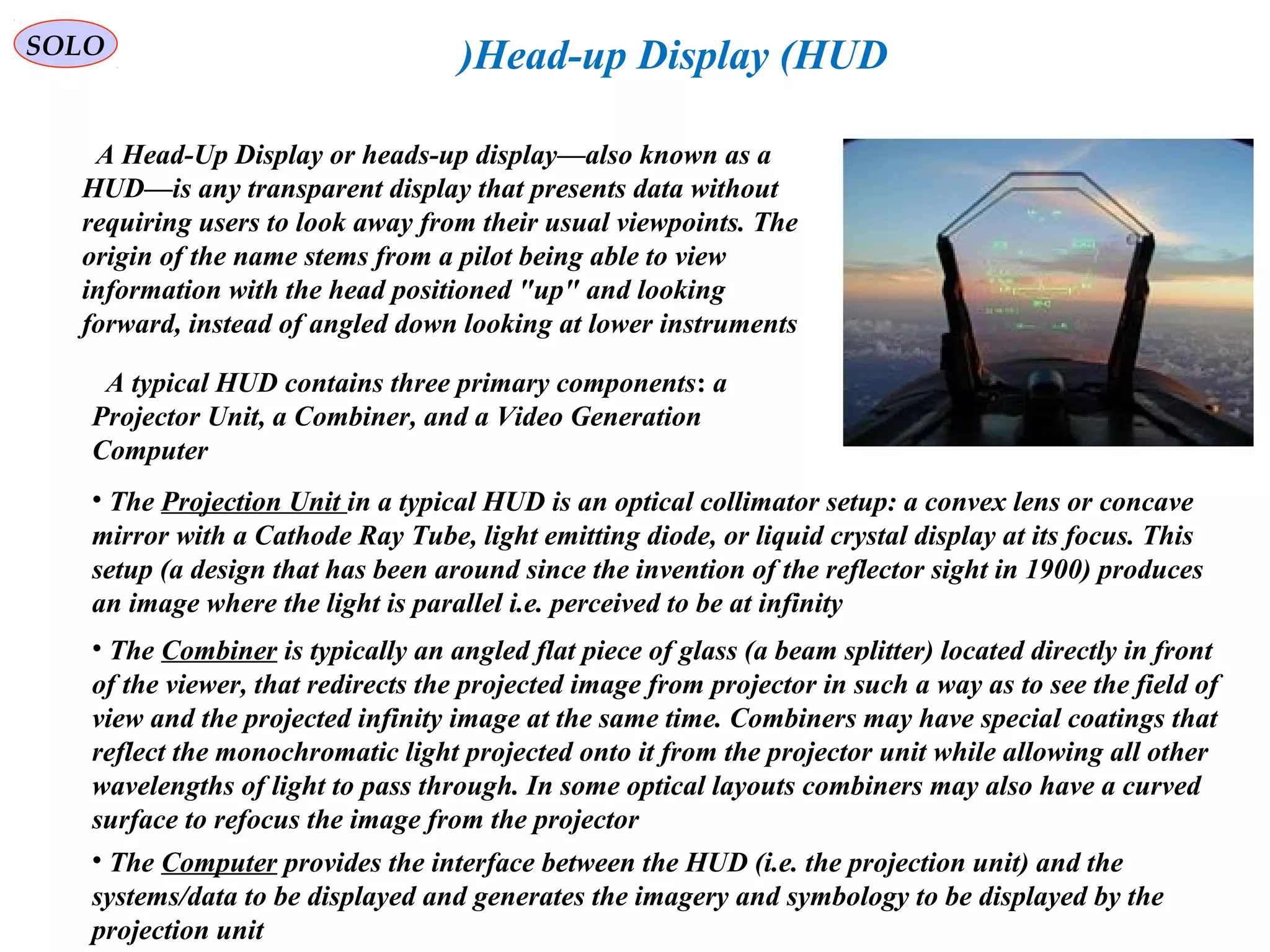
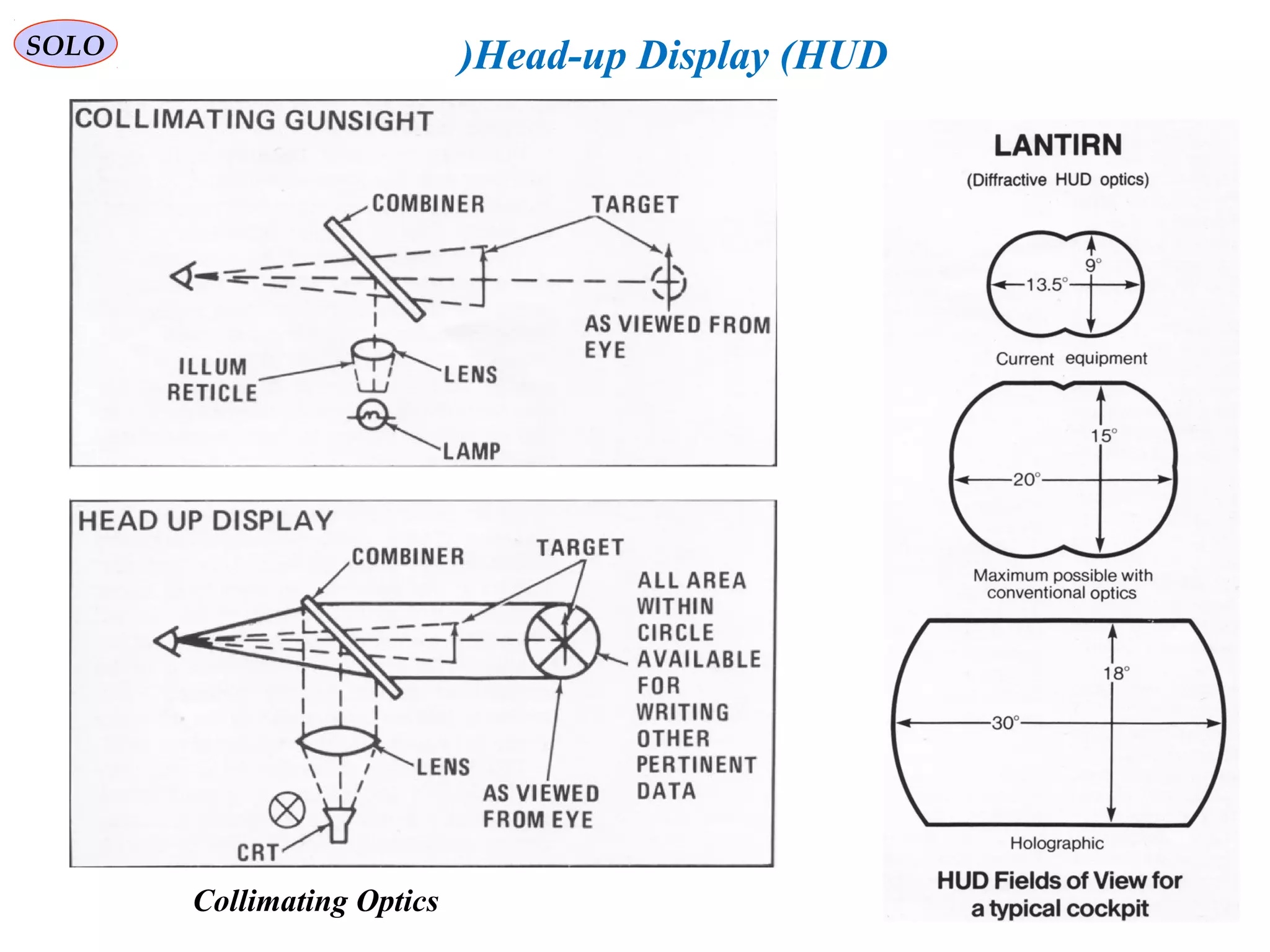
  A Head-Up Display or heads-up display—also known as a 
HUD—is any transparent display that presents data without 
requiring users to look away from their usual viewpoints. The 
origin of the name stems from a pilot being able to view 
information with the head positioned "up" and looking 
forward, instead of angled down looking at lower instruments
  A typical HUD contains three primary components: a 
Projector Unit, a Combiner, and a Video Generation 
Computer
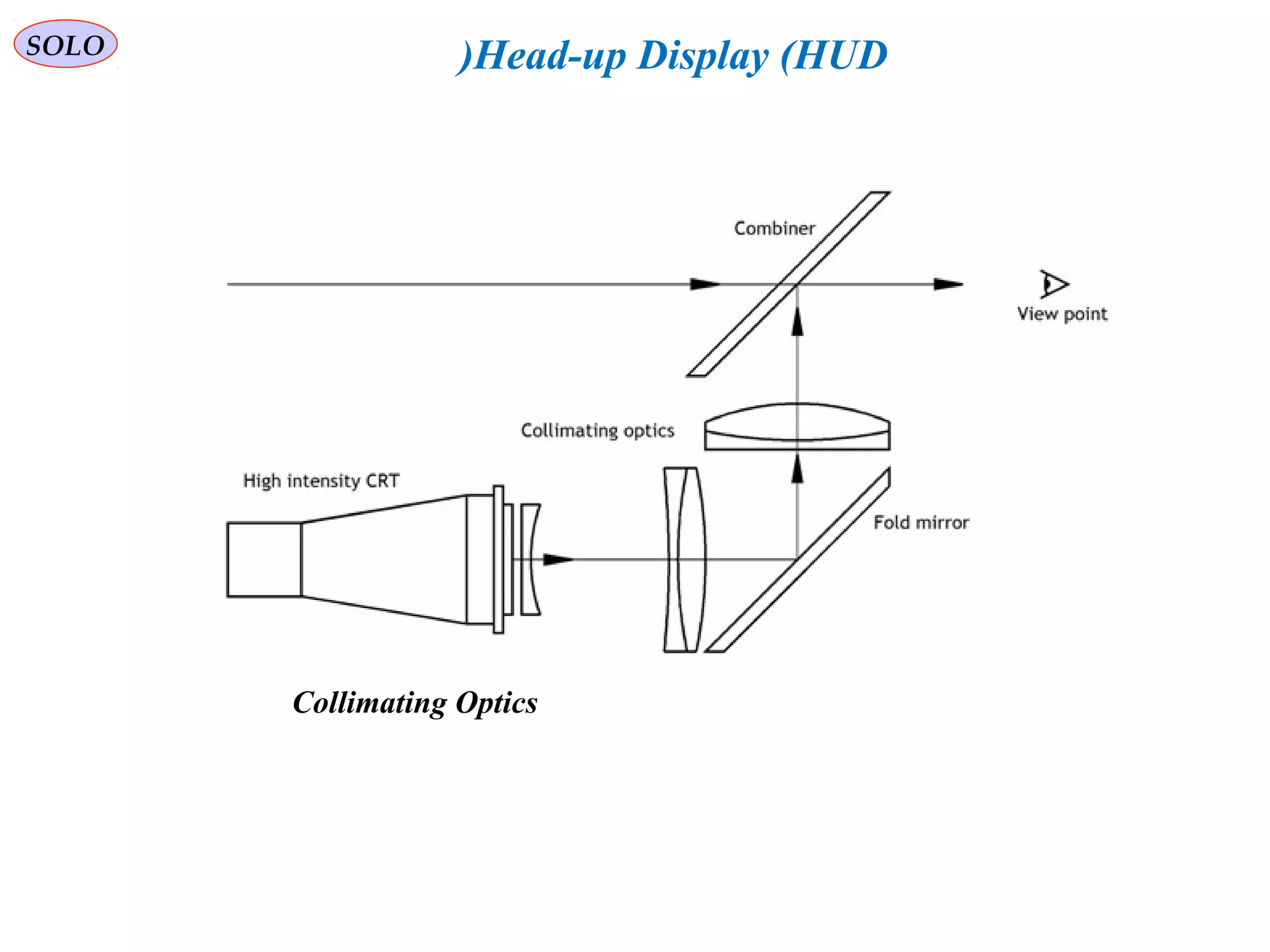
• The Projection Unit in a typical HUD is an optical collimator setup: a convex lens or concave 
mirror with a Cathode Ray Tube, light emitting diode, or liquid crystal display at its focus. This 
setup (a design that has been around since the invention of the reflector sight in 1900) produces 
an image where the light is parallel i.e. perceived to be at infinity
• The Combiner is typically an angled flat piece of glass (a beam splitter) located directly in front 
of the viewer, that redirects the projected image from projector in such a way as to see the field of 
view and the projected infinity image at the same time. Combiners may have special coatings that 
reflect the monochromatic light projected onto it from the projector unit while allowing all other 
wavelengths of light to pass through. In some optical layouts combiners may also have a curved 
surface to refocus the image from the projector
• The Computer provides the interface between the HUD (i.e. the projection unit) and the 
systems/data to be displayed and generates the imagery and symbology to be displayed by the 
projection unit 
  
SOLO Head-up Display (HUD)
Collimating Optics
  
SOLO Head-up Display (HUD)
Collimating Optics
  
SOLO Head-Mounted Display (HMD)
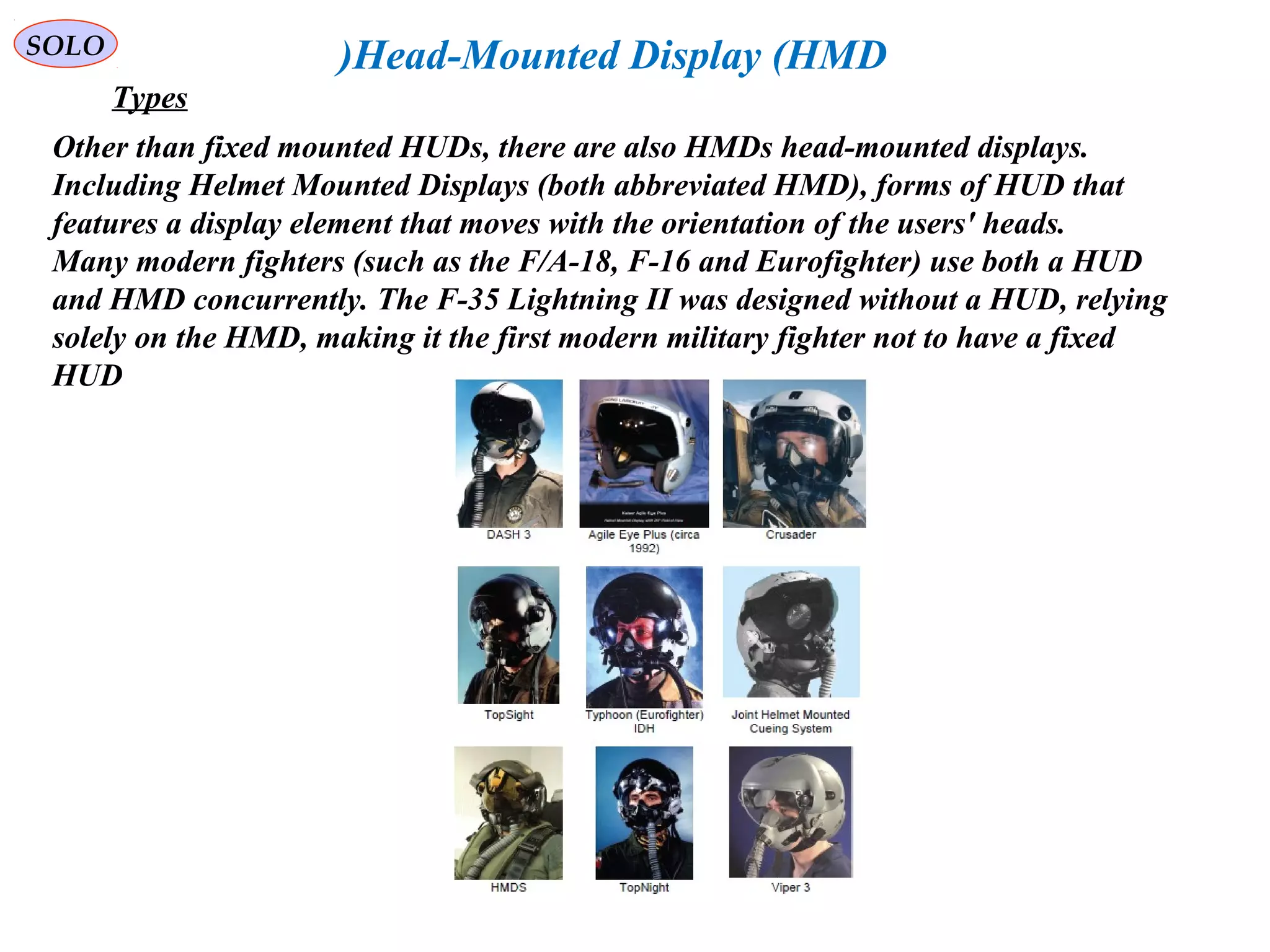
Other than fixed mounted HUDs, there are also HMDs head-mounted displays. 
Including Helmet Mounted Displays (both abbreviated HMD), forms of HUD that 
features a display element that moves with the orientation of the users' heads.
Many modern fighters (such as the F/A-18, F-16 and Eurofighter) use both a HUD 
and HMD concurrently. The F-35 Lightning II was designed without a HUD, relying 
solely on the HMD, making it the first modern military fighter not to have a fixed 
HUD
Types
  
SOLO Head-up Display (HUD(
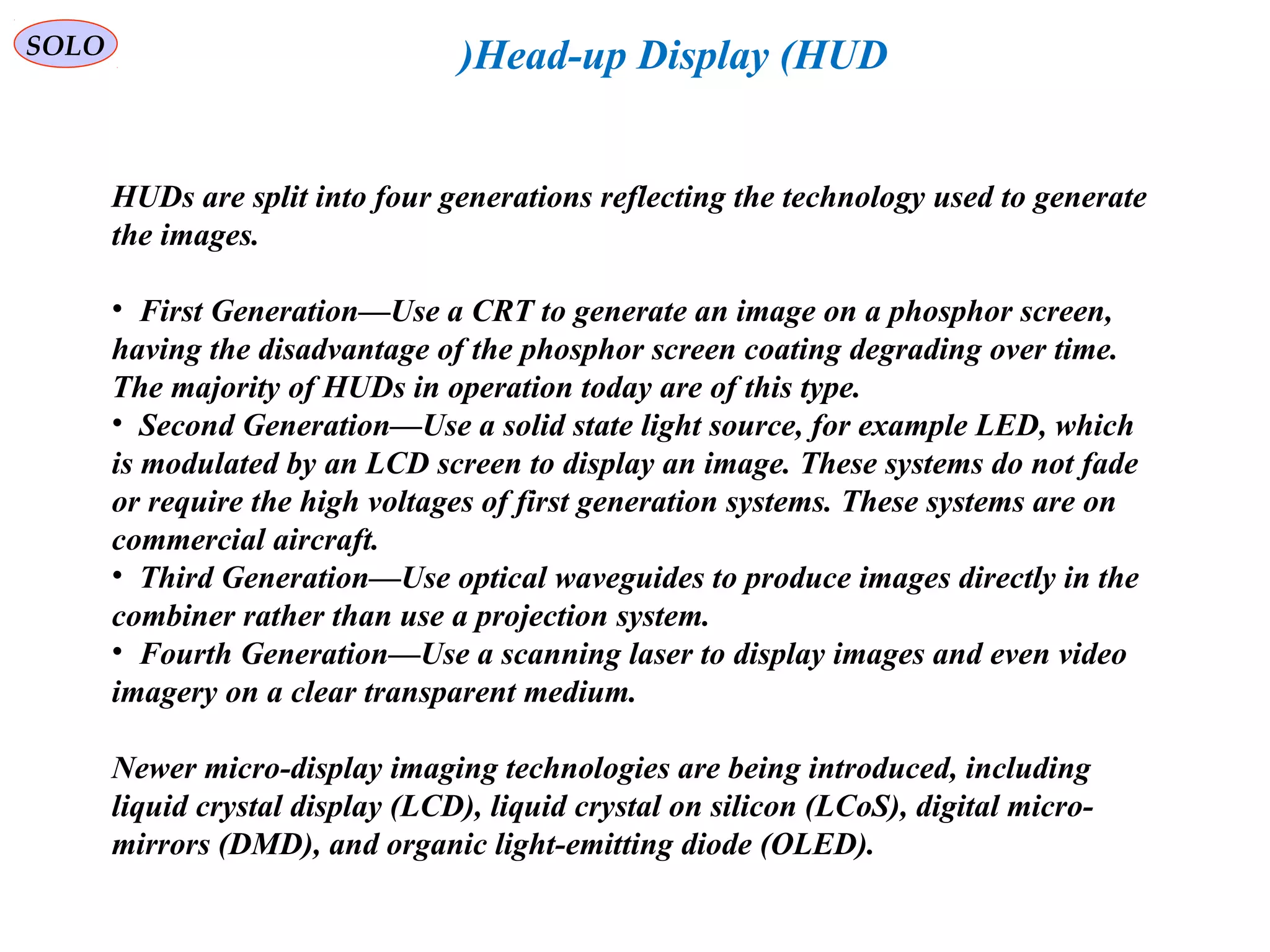
HUDs are split into four generations reflecting the technology used to generate 
the images.
•  First Generation—Use a CRT to generate an image on a phosphor screen, 
having the disadvantage of the phosphor screen coating degrading over time. 
The majority of HUDs in operation today are of this type.
•  Second Generation—Use a solid state light source, for example LED, which 
is modulated by an LCD screen to display an image. These systems do not fade 
or require the high voltages of first generation systems. These systems are on 
commercial aircraft.
•  Third Generation—Use optical waveguides to produce images directly in the 
combiner rather than use a projection system.
•  Fourth Generation—Use a scanning laser to display images and even video 
imagery on a clear transparent medium.
Newer micro-display imaging technologies are being introduced, including 
liquid crystal display (LCD(, liquid crystal on silicon (LCoS(, digital micro-
mirrors (DMD(, and organic light-emitting diode (OLED(.
  
SOLO Head-up Display (HUD(
  
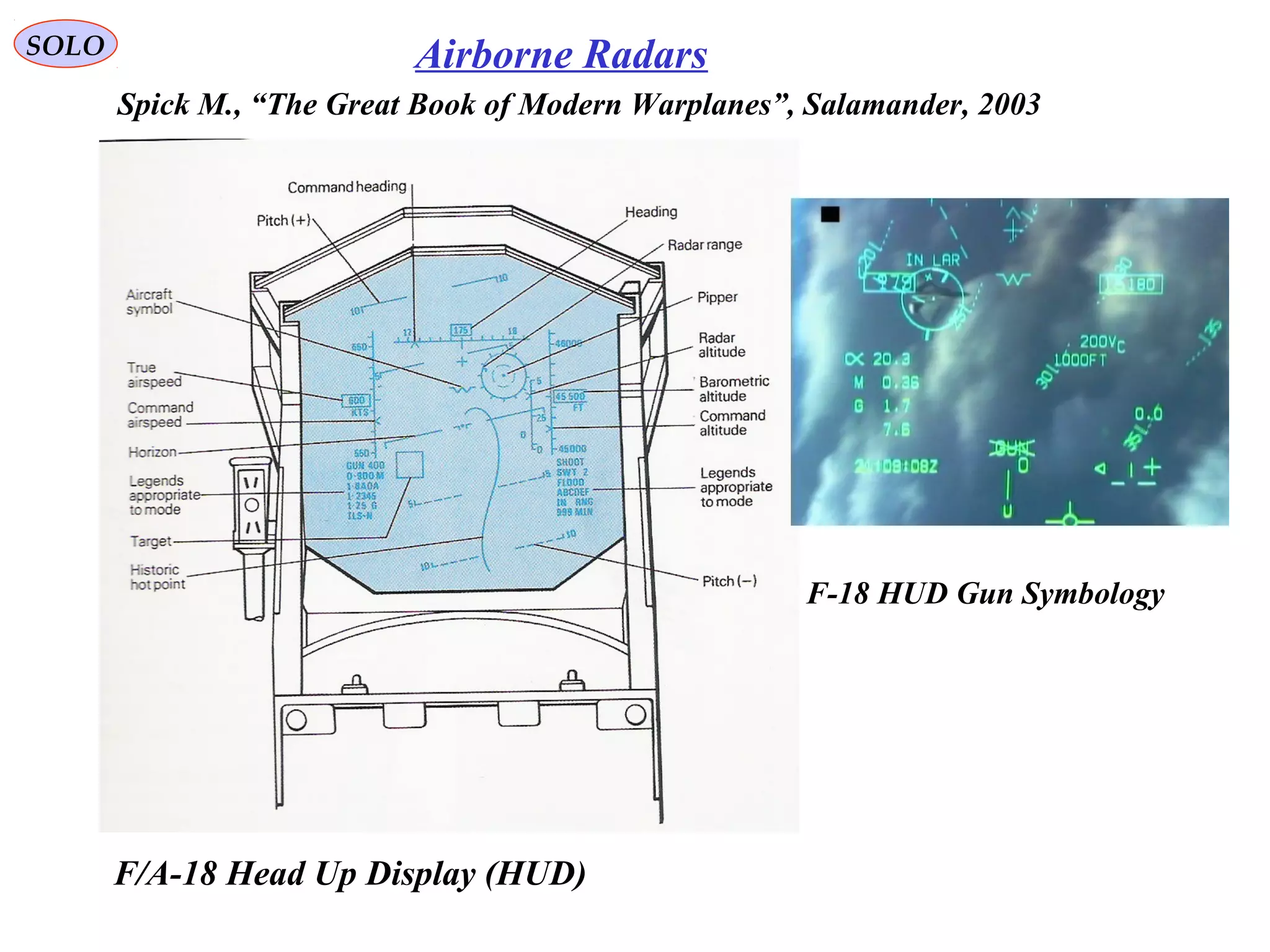
SOLO Airborne Radars
Spick M., “The Great Book of Modern Warplanes”, Salamander, 2003
F/A-18 Head Up Display (HUD(
F-18 HUD Gun Symbology
42
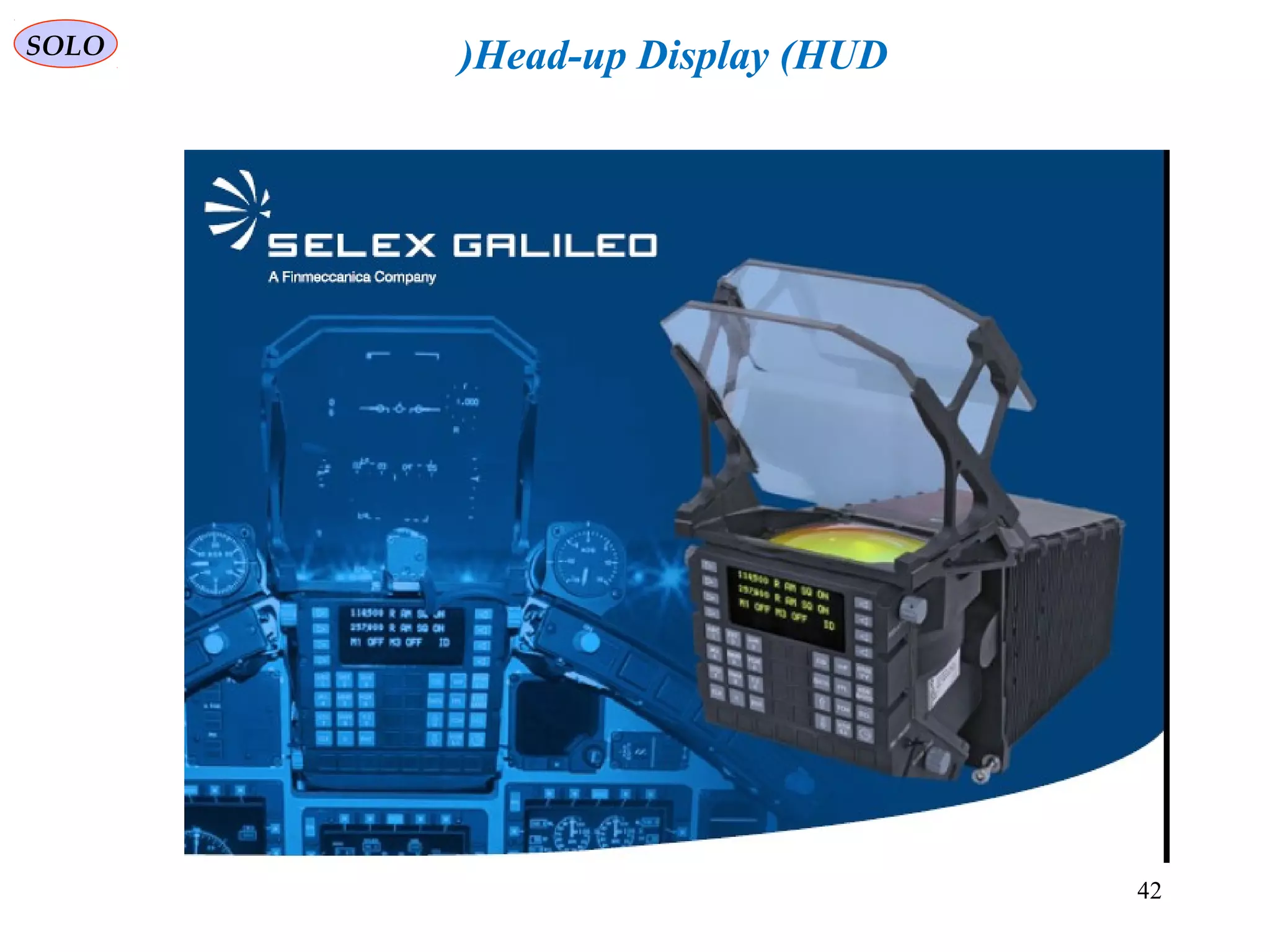
SOLO Head-up Display (HUD(
  
SOLO Head-up Display (HUD(
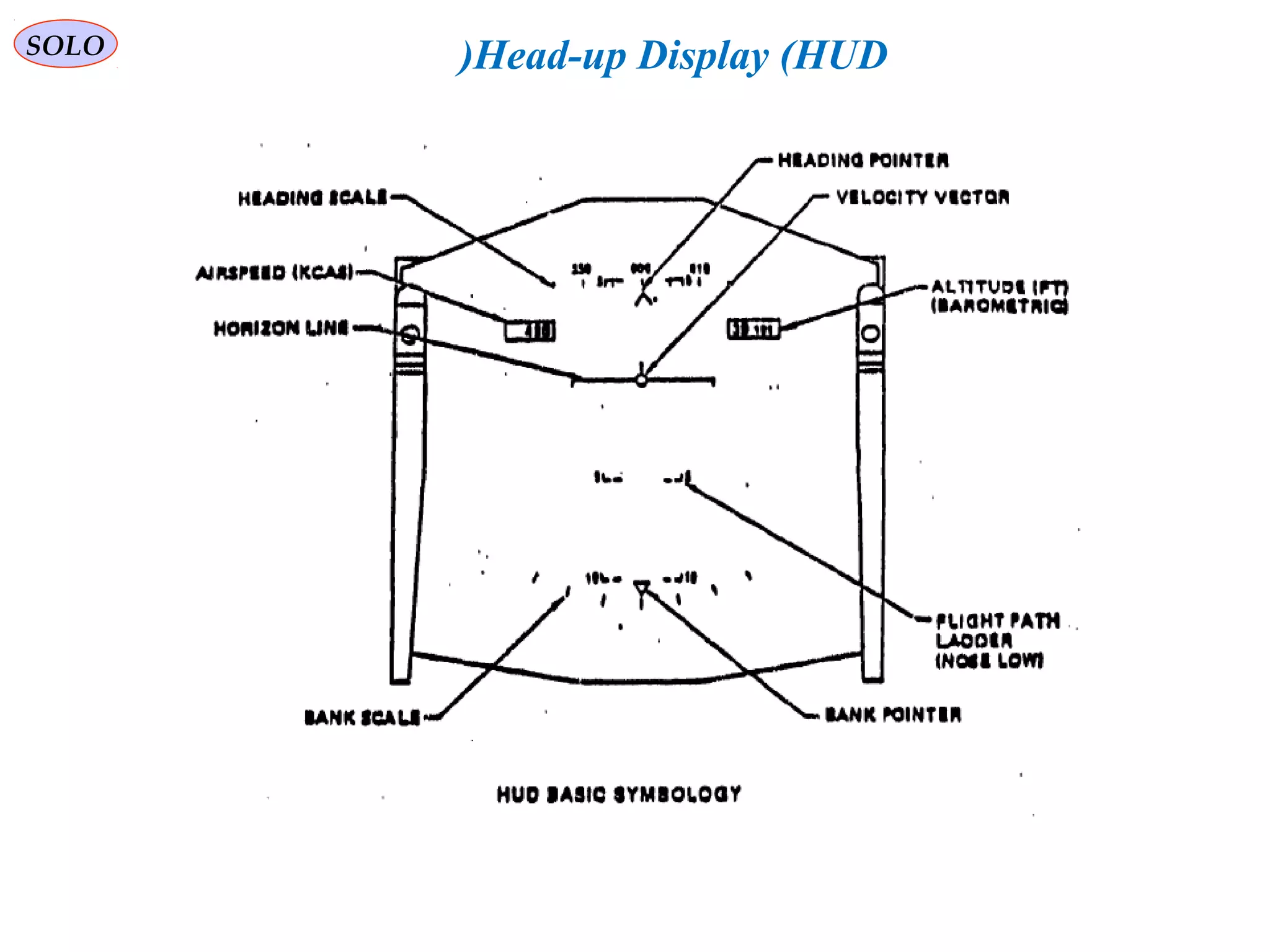
Typical aircraft HUDs display data: Airspeed, Altitude, a Horizon Line, Heading, 
Turn/Bank and Slip/Skid indicators. These instruments are the minimum required by 
14 CFR Part 91.
Other symbols and data are also available in some HUDs:
•  Boresight or Waterline Symbol —is fixed on the display and shows where the nose 
of the aircraft is actually pointing.
•  Flight Path Vector (FPV( or Velocity Vector Symbol —shows where the aircraft is 
actually going, the sum of all forces acting on the aircraft.]
 For example, if the aircraft 
is pitched up but is losing energy, then the FPV symbol will be below the horizon even 
though the boresight symbol is above the horizon. During approach and landing, a 
pilot can fly the approach by keeping the FPV symbol at the desired descent angle and 
touchdown point on the runway.
•  Acceleration Indicator or Energy Cue —typically to the left of the FPV symbol, it is 
above it if the aircraft is accelerating, and below the FPV symbol if decelerating.
•  Angle Of Attack indicator —shows the wing's angle relative to the airflow, often 
displayed as "α".
•  Navigation Data and Symbols —for approaches and landings, the flight guidance 
systems can provide visual cues based on navigation aids such as an Instrument 
Landing System (ILS(  or Augmented Global Positioning System such as the Wide 
Area Augmentation System. Typically this is a circle which fits inside the flight path 
vector symbol. Pilots can fly along the correct flight path by "flying to" the guidance 
cue.
  
SOLO Head-up Display (HUD(
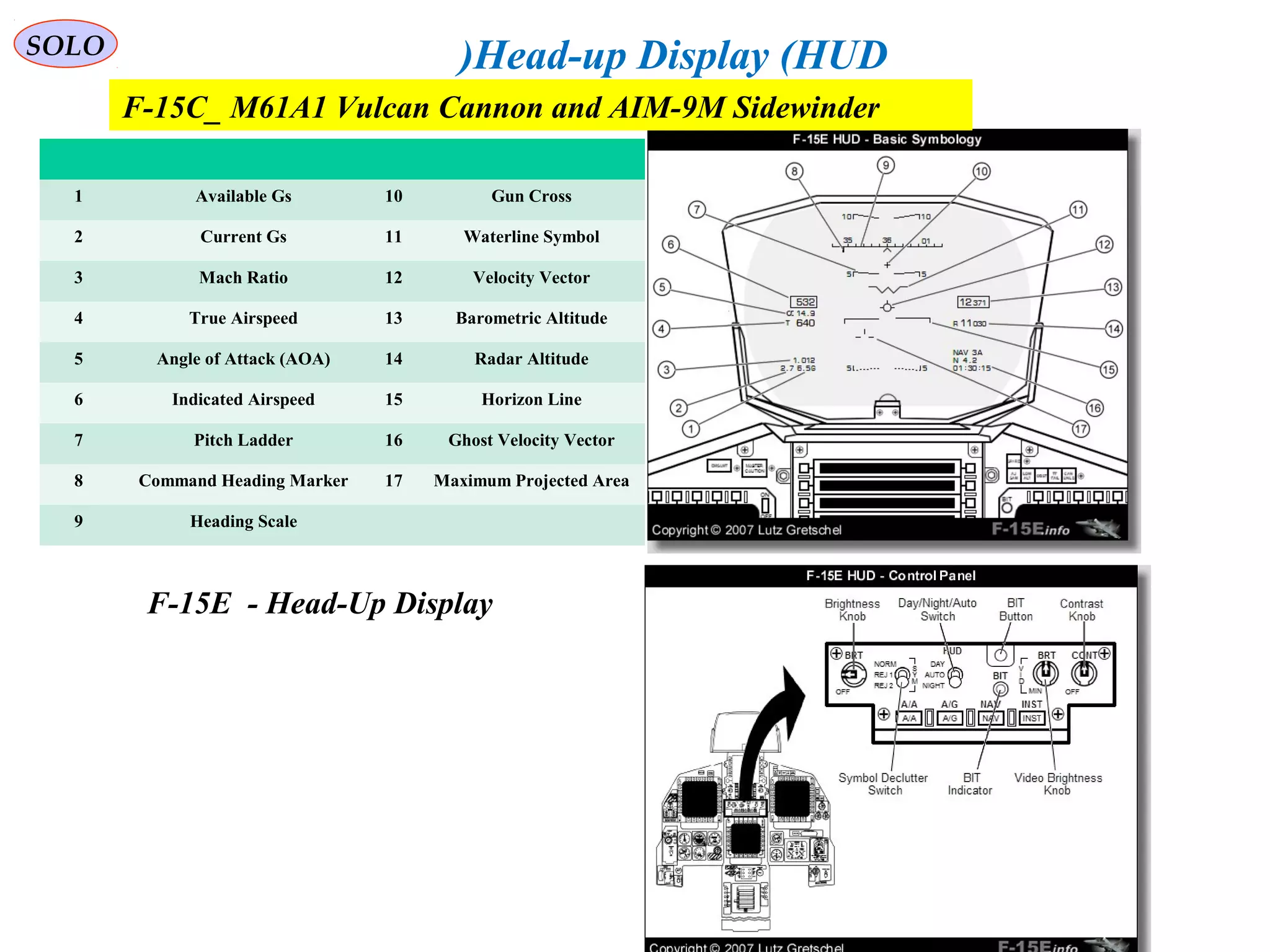
1 Available Gs 10 Gun Cross
2 Current Gs 11 Waterline Symbol
3 Mach Ratio 12 Velocity Vector
4 True Airspeed 13 Barometric Altitude
5 Angle of Attack (AOA) 14 Radar Altitude
6 Indicated Airspeed 15 Horizon Line
7 Pitch Ladder 16 Ghost Velocity Vector
8 Command Heading Marker 17 Maximum Projected Area
9 Heading Scale
F-15E  - Head-Up Display
F-15C_ M61A1 Vulcan Cannon and AIM-9M Sidewinder
  
SOLO Head-up Display (HUD(
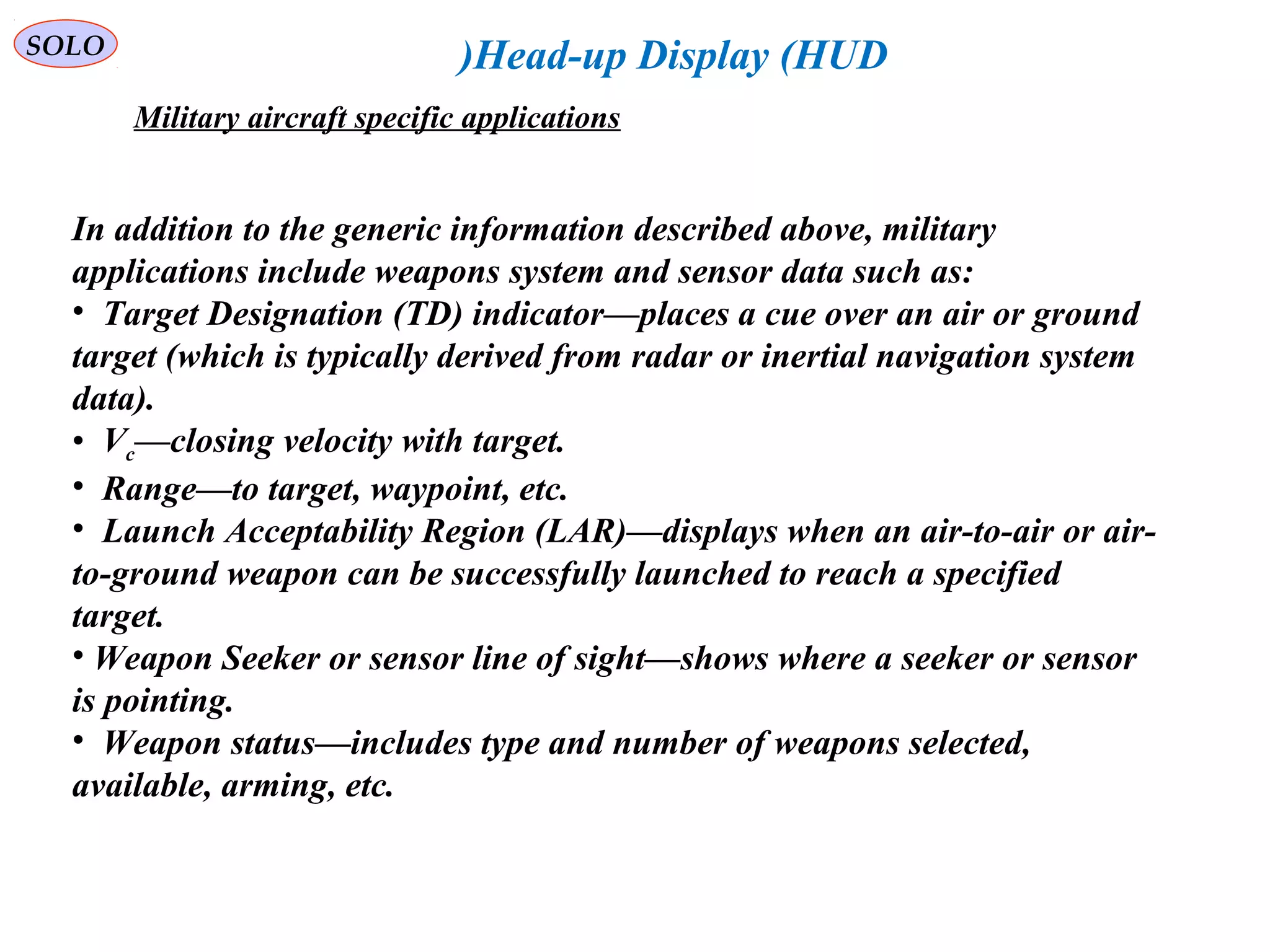
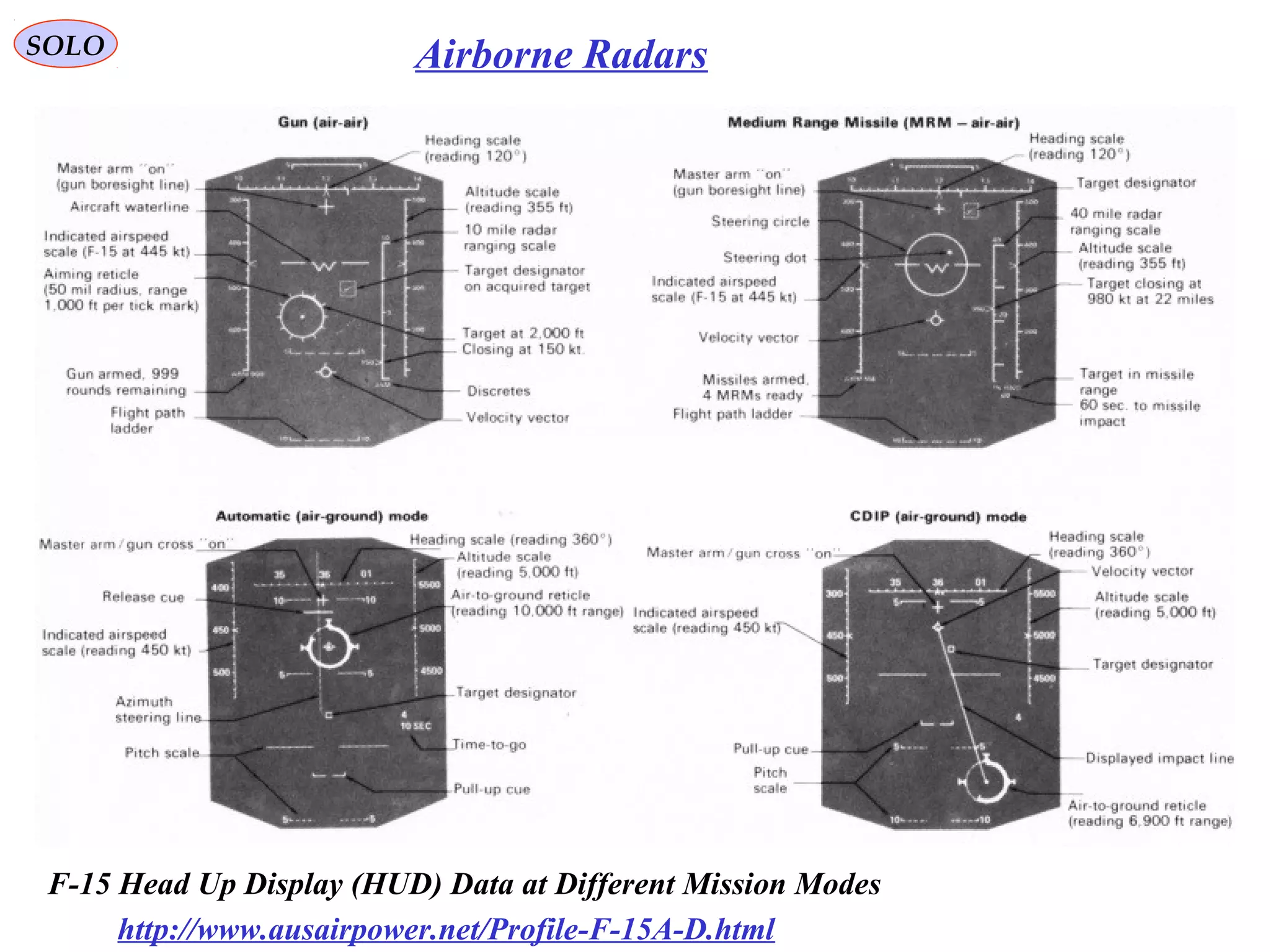
In addition to the generic information described above, military 
applications include weapons system and sensor data such as:
•  Target Designation (TD( indicator—places a cue over an air or ground 
target (which is typically derived from radar or inertial navigation system 
data(. 
•  Vc—closing velocity with target. 
•  Range—to target, waypoint, etc. 
•  Launch Acceptability Region (LAR(—displays when an air-to-air or air-
to-ground weapon can be successfully launched to reach a specified 
target. 
• Weapon Seeker or sensor line of sight—shows where a seeker or sensor 
is pointing. 
•  Weapon status—includes type and number of weapons selected, 
available, arming, etc.
Military aircraft specific applications
  
SOLO Airborne Radars
http://www.ausairpower.net/Profile-F-15A-D.html
F-15 Head Up Display (HUD( Data at Different Mission Modes
  
SOLO
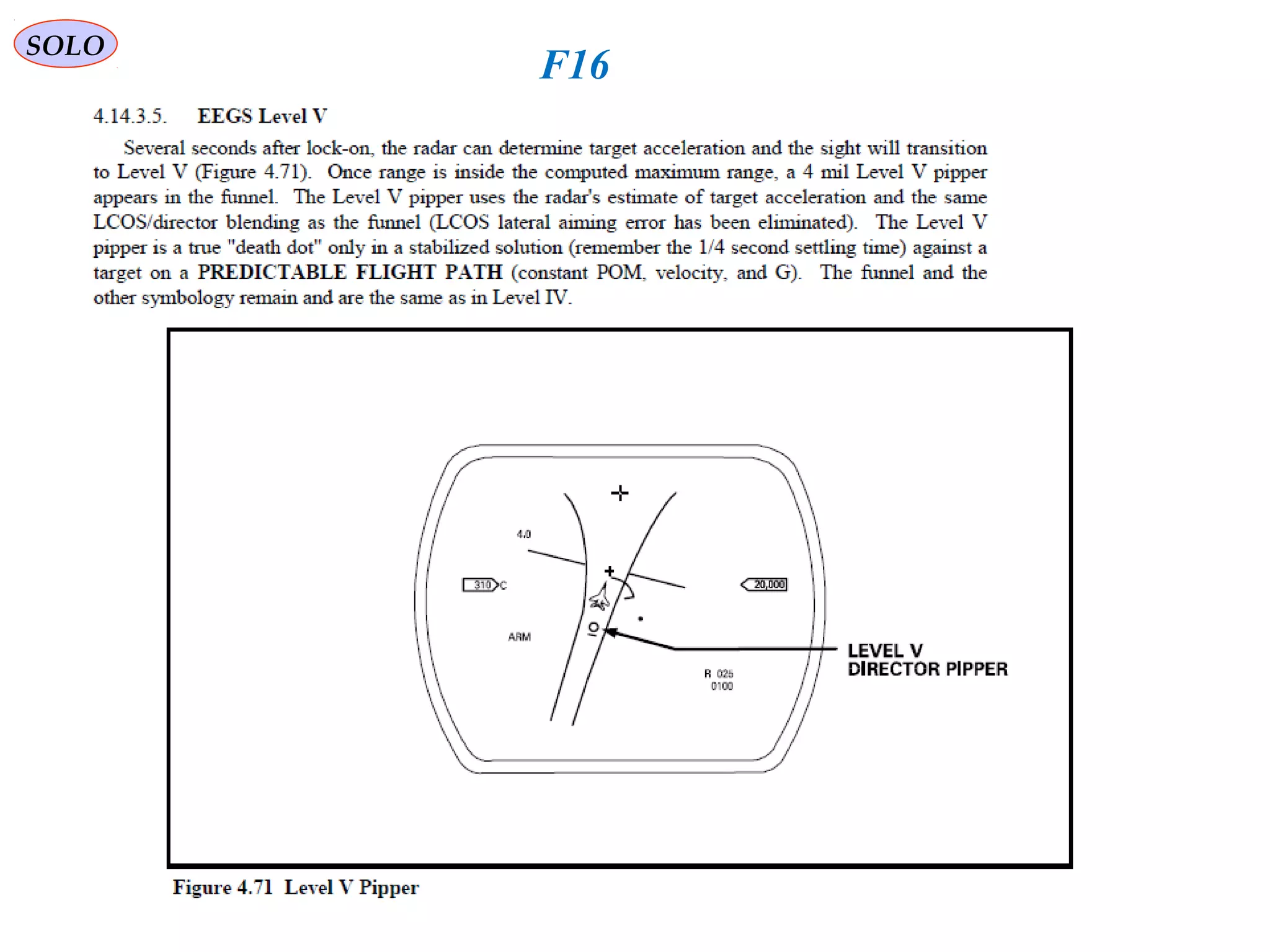
F16
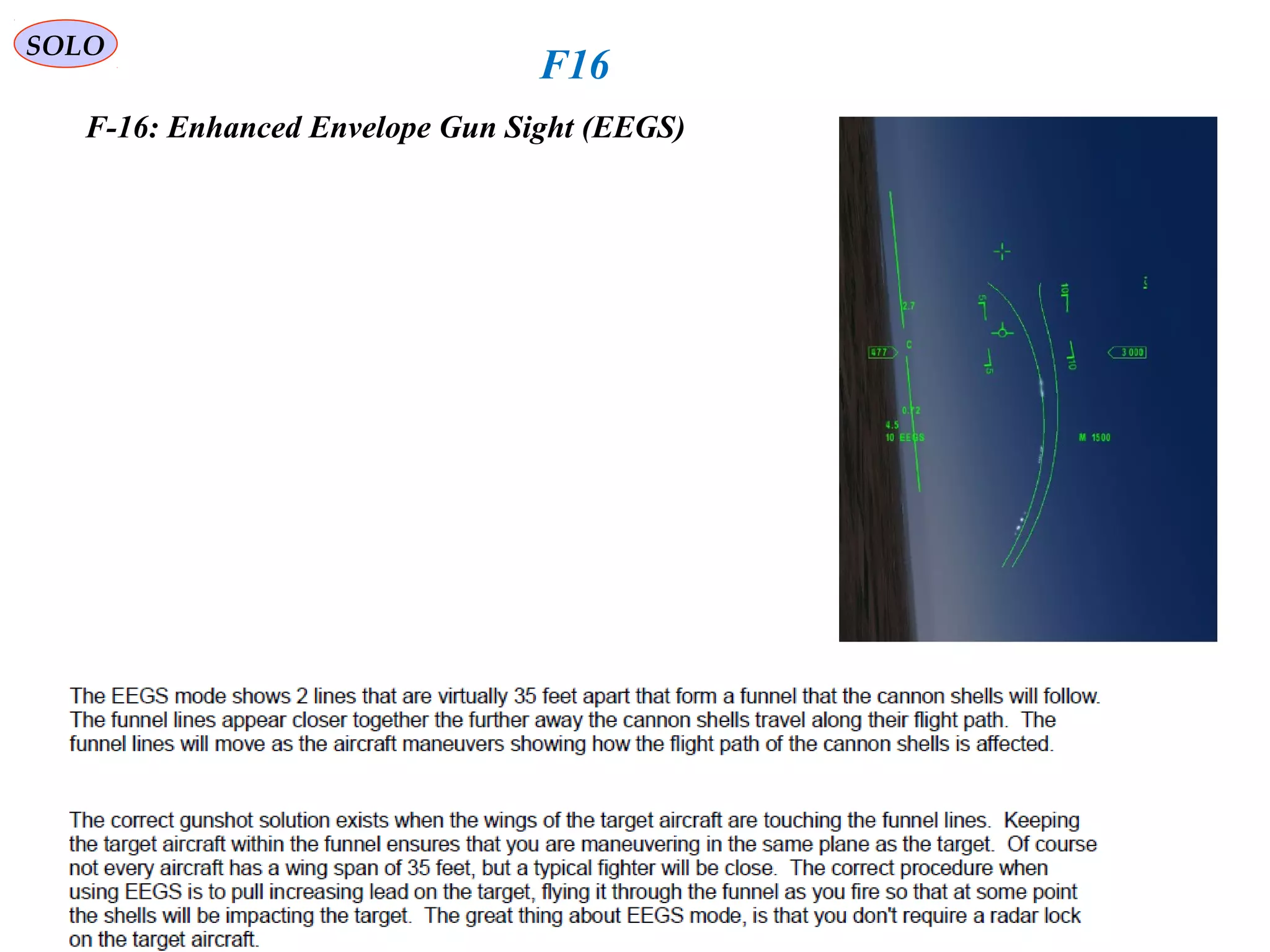
F-16: Enhanced Envelope Gun Sight (EEGS(
  
SOLO
F16
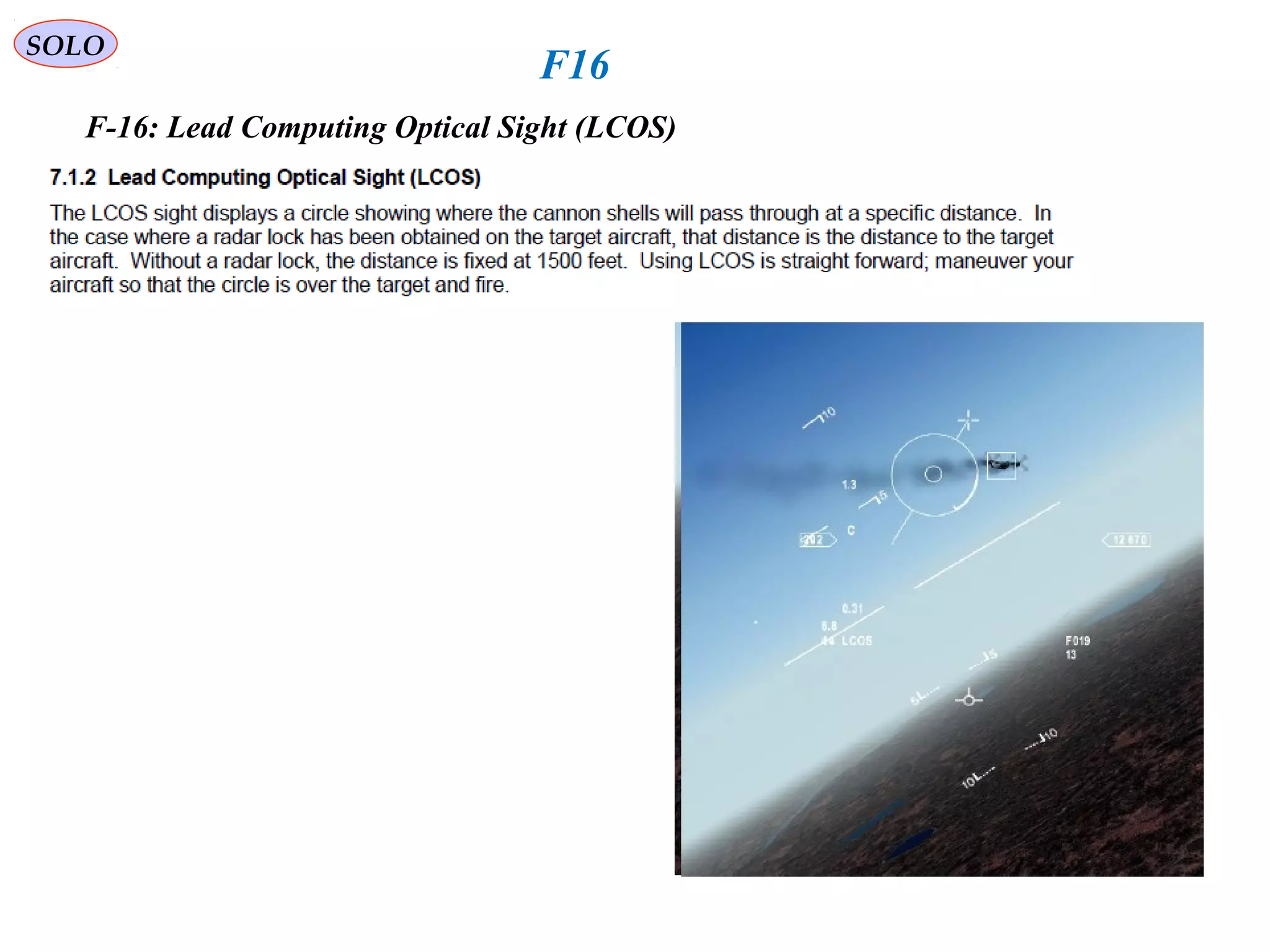
F-16: Lead Computing Optical Sight (LCOS(
  
SOLO
F16
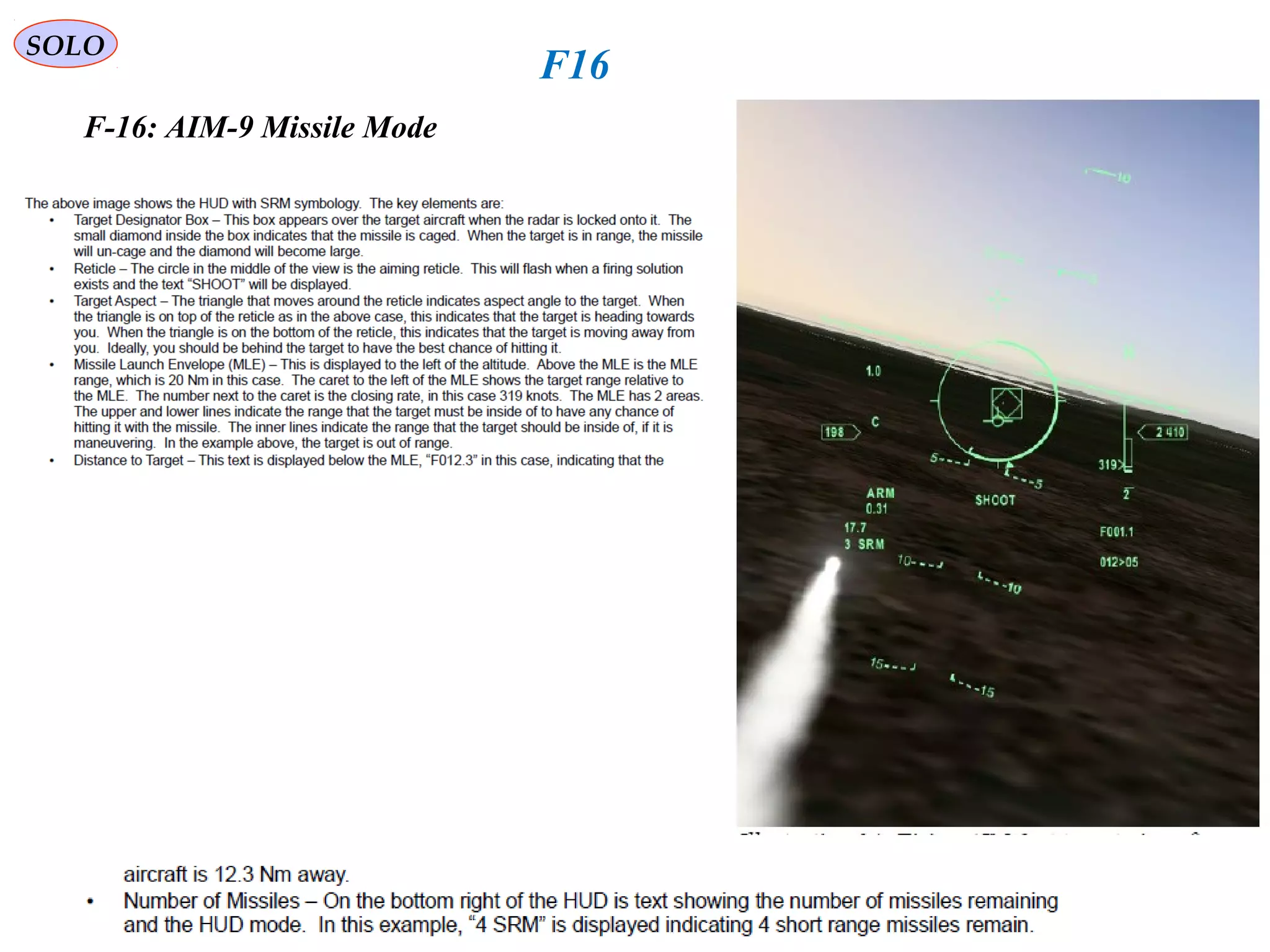
F-16: AIM-9 Missile Mode
  
SOLO
F16
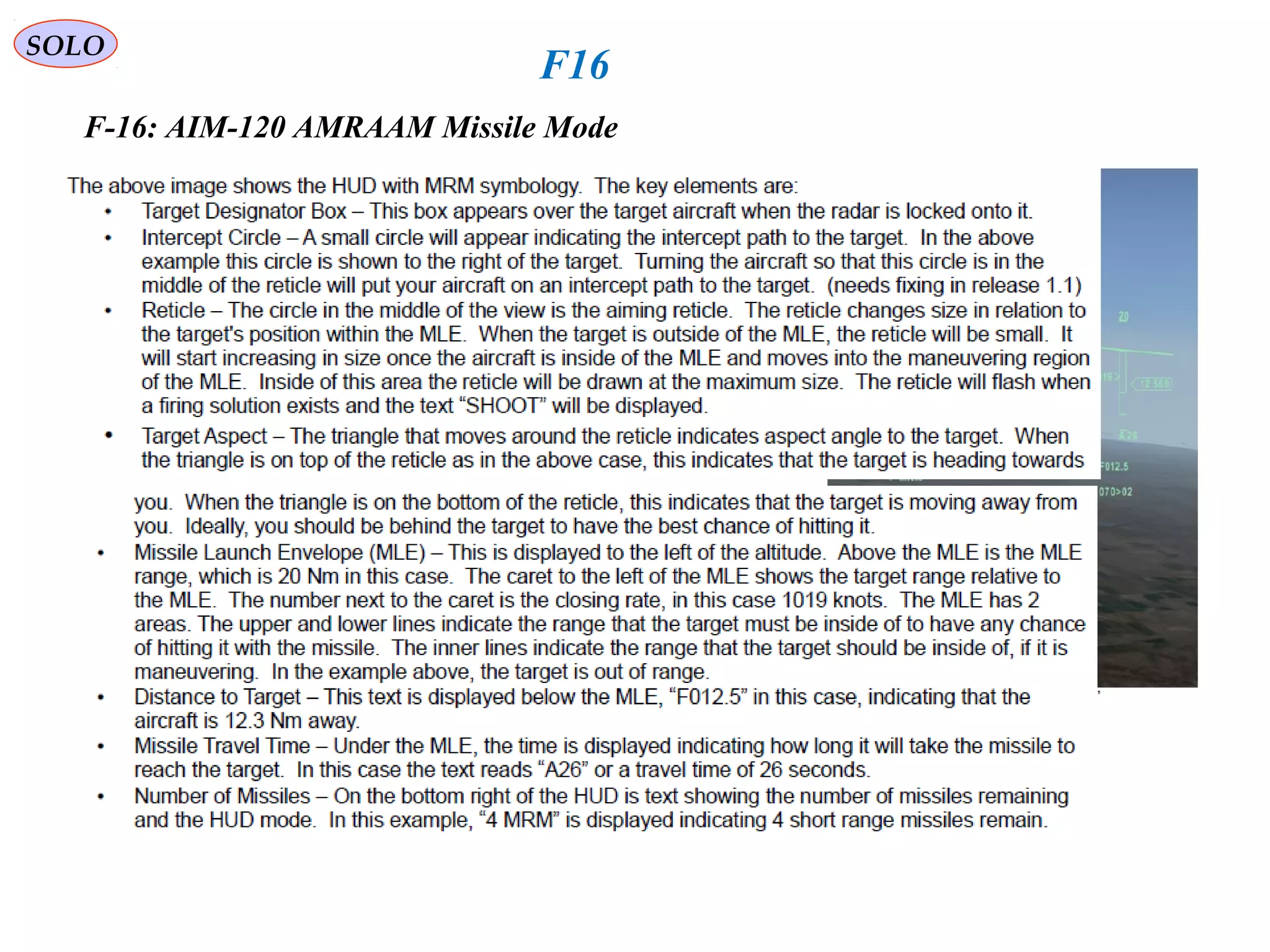
F-16: AIM-120 AMRAAM Missile Mode
  
SOLO
F16
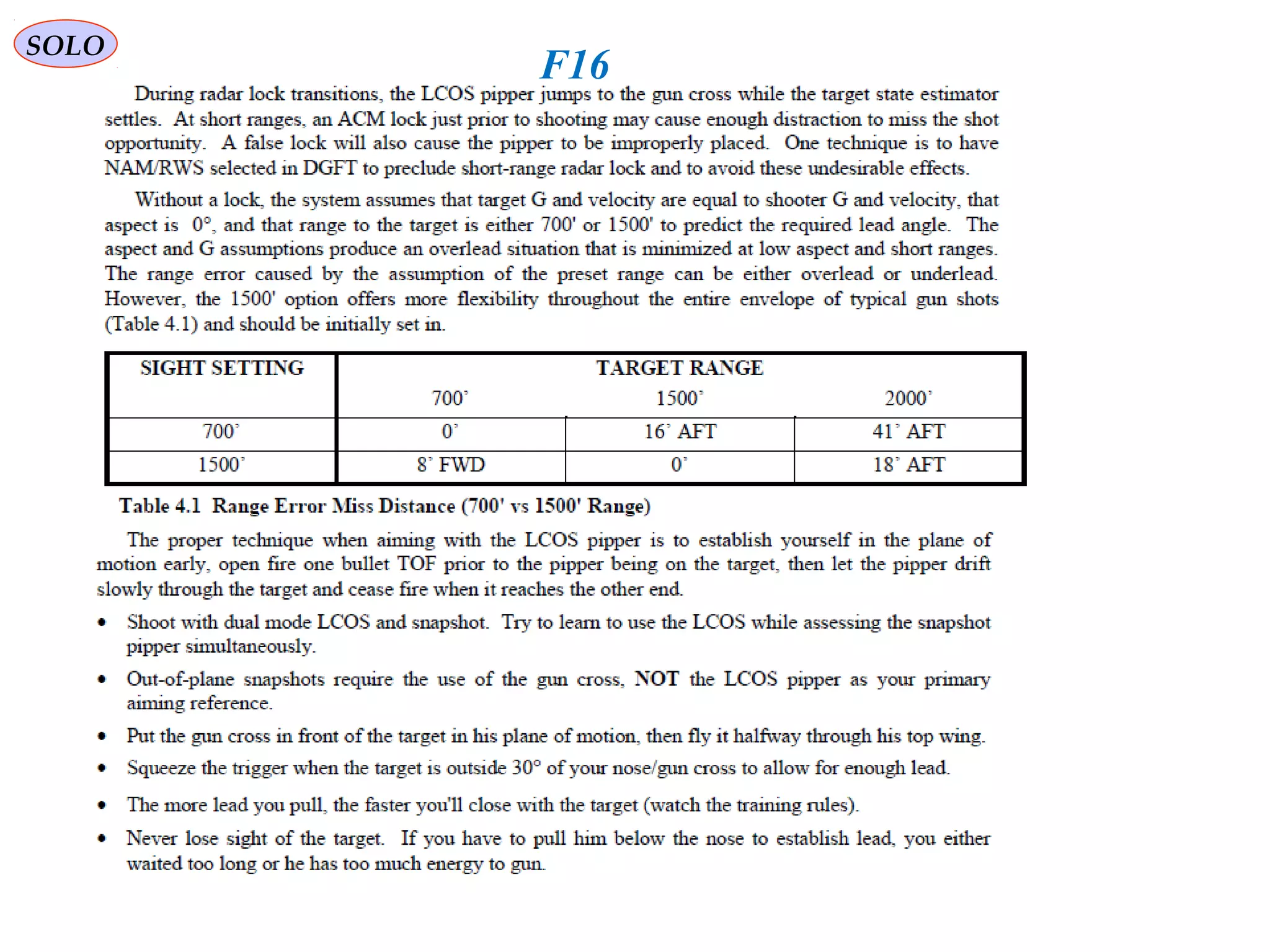
F16 Gunsight
Four different sighting references are available for use:
1.Gun Cross
2.Lead Computing Optical Sight (LCOS(
3.Snap shot Sight (SS(
4.Enhanced Envelope Gunsight (EEGS( only for F16C and up.
1.   The Gun Cross is always available and easily used. The Pilot can effectively imagine 
the Gun Cross as being where gun barrels are pointed. Proper Aim is achieved by
      positioning the Gun Cross in the Target Plane of Motion (POM( with the proper 
amount of Lead. The Gun Cross is a very good reference to use to initially establish 
the Gun in the Target ‘s POM with some amount of lead. As Range decreases the 
Pilot can refine the Lead Angle by using as reference the LCOS/EEGS Pippers 
before firing. Without  EEGS the Gun Cross is the only usable reference during very 
high dynamic, high aspect angle shot attempt.
2.    The LCOS Pipper represents a Sighting Reference for which the Gun is now 
properly aimed.  With the Pipper. Pipper helps the Pilot to establish th proper Lead 
Angle to kill  the Target. The key LCOS assumption is that the Pilot is tracking the 
Target with the Pipper. In addition Target acceleration and shooter parameters 
(Airspeed, Range, G and POM( remain constant during the Time of Flight (TOF(.
  
SOLO
F16
3.  The Snap Shot Display is a historic tracer Gunsight. The principle of the System is
    to let the Pilot see where the projectiles would be once they have left the Gun.
    The Snap Shot Algorithm functions completely independent of Target Parameters 
    except range, which is used the Pipper on the Continuously Computed Impact Line
    (CCIL(.  The key is that the System is Historic and not Predictive in nature.
    It is very hard to use it as an aiming reference and is not recommended because of
    the TOF lag in the presentation and the difficulty in managing the sight. However, 
    it does provide an excellent shot evaluation capability. The accuracy of the sight is 
    within 4 – 5 mils at 2000’ range as long as the Pilot have not been doing any rapid
    rolling maneuvers. LCOS and Snap Shot always be called up together when
   employing the Gun, use LCOS to aim with and Snap Shot to evaluate the shot.
4.  The EEGS is a combination LCOS and Director Gunsight available in F16C.
    It provides the capability to accurately employ the Gun at all aspects, with or without
    a Radar Lock, against an evasive or predictable Target, and out to maximum Gun 
    Effective Range.
     The EEGS consists of Five Levels of Displays, each providing an increasing level
    of capability depending upon Radar knowledge of Target Parameters (Range, 
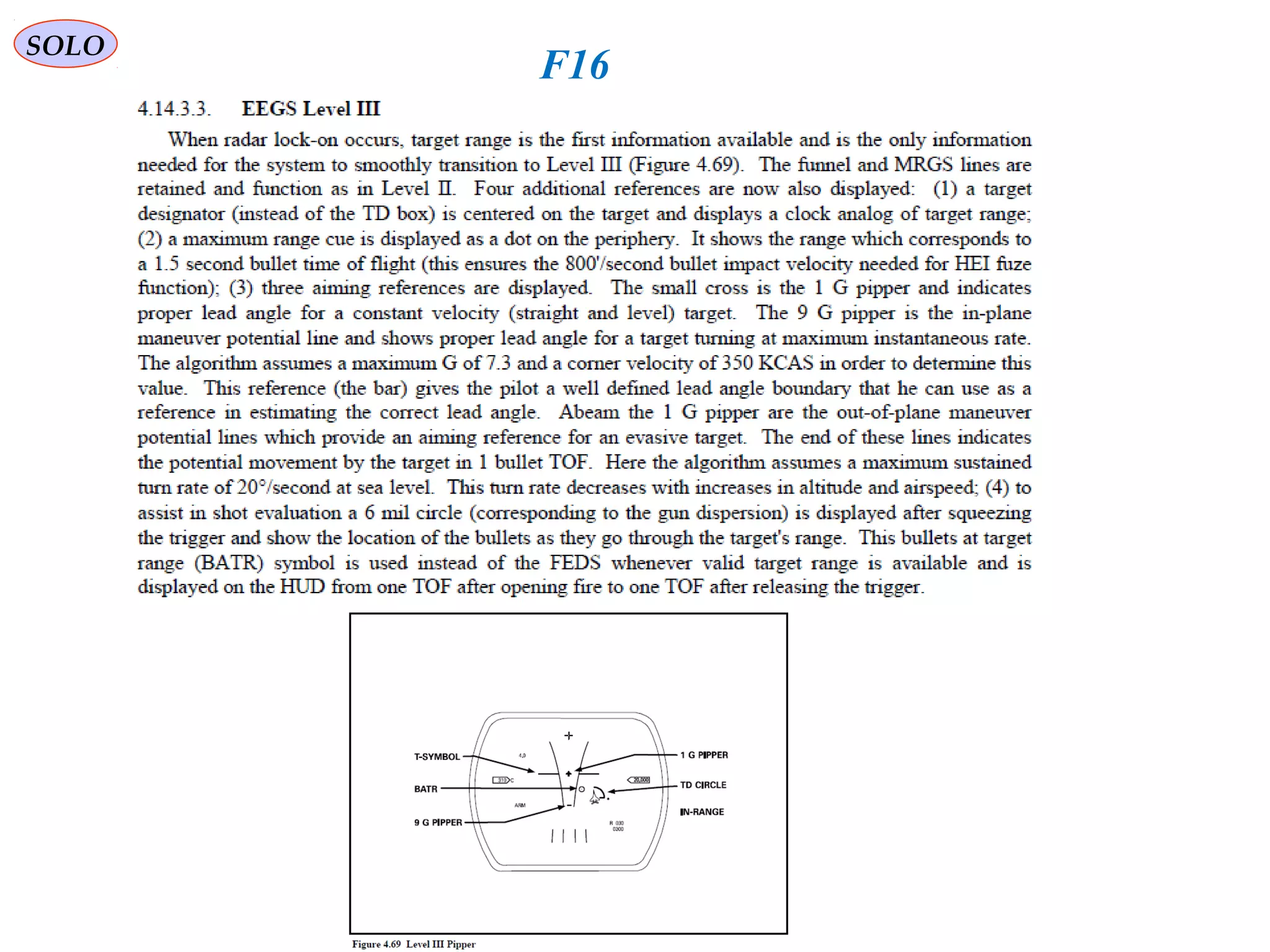
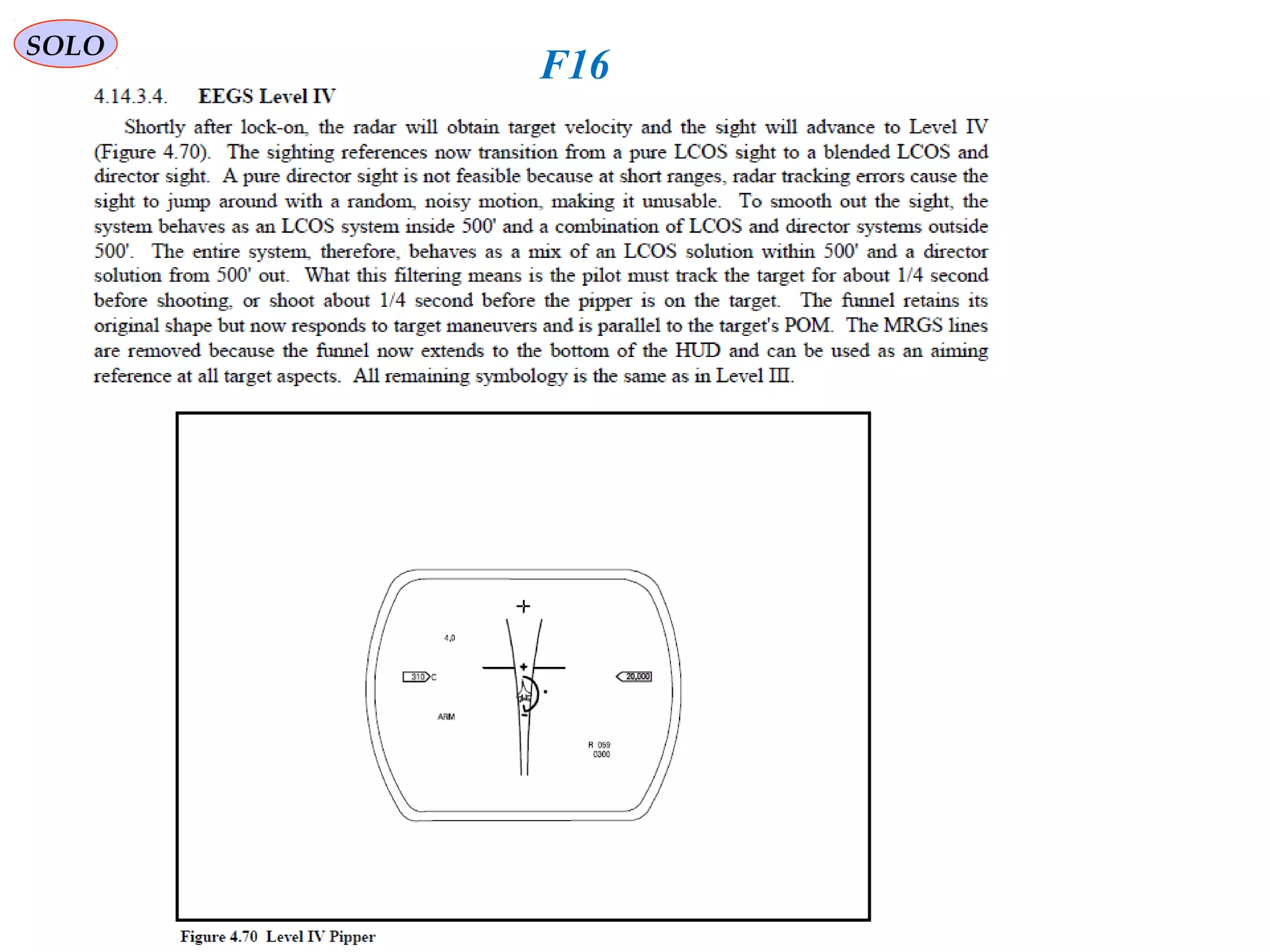
   Velocity and Acceleration(. As the Radar Locks on to the Target, the Sight Symbology
   smoothly transitions from Level II to Level V, without any large transient motions
   typical of LCOS mechanization.
  
SOLO
F16
F16 HUD, Movie
F-16 Cockpit, avionics and radar, Movie
GR F-16 Vs TURK F-16real video with sound, Movie
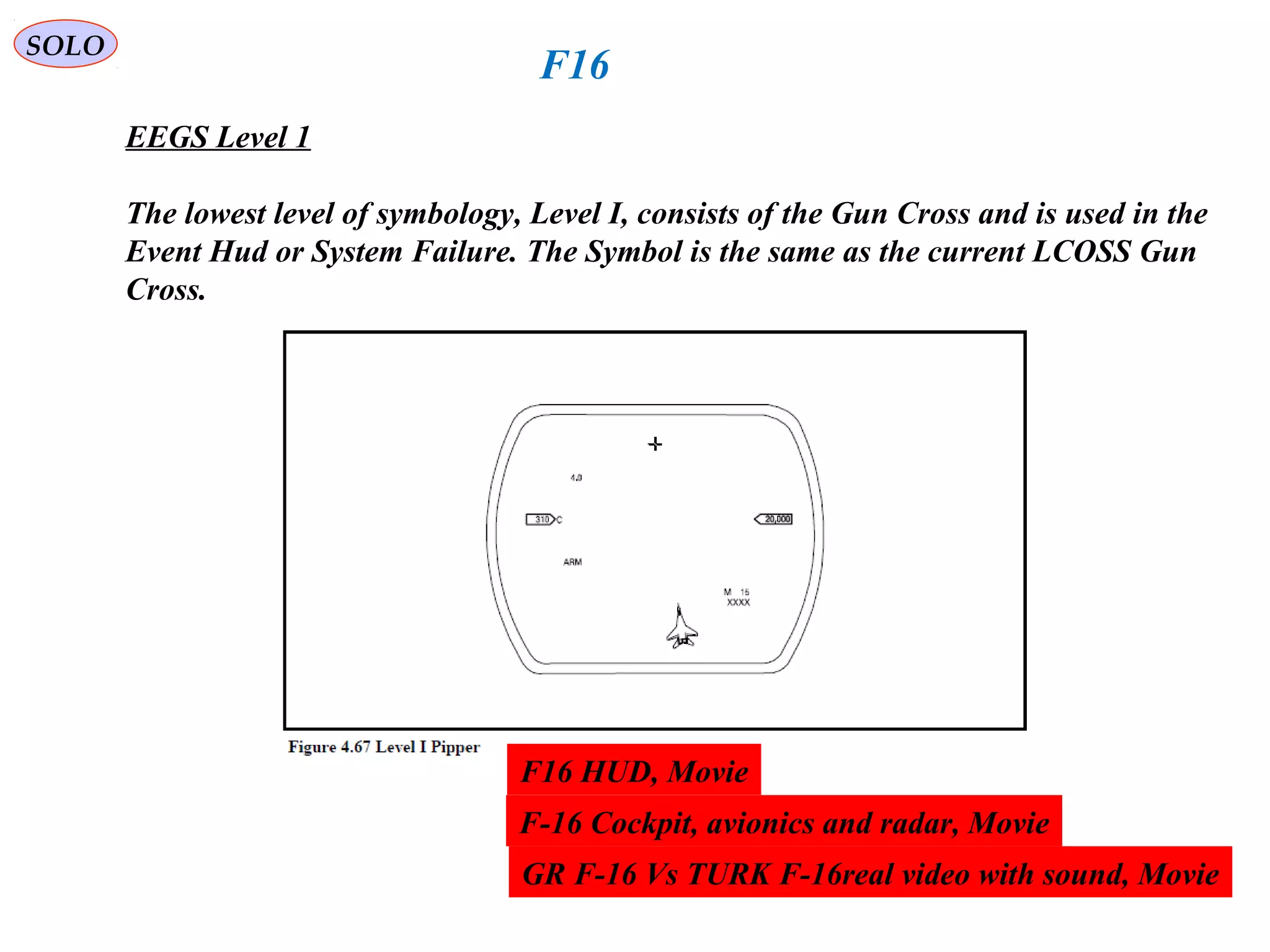
EEGS Level 1
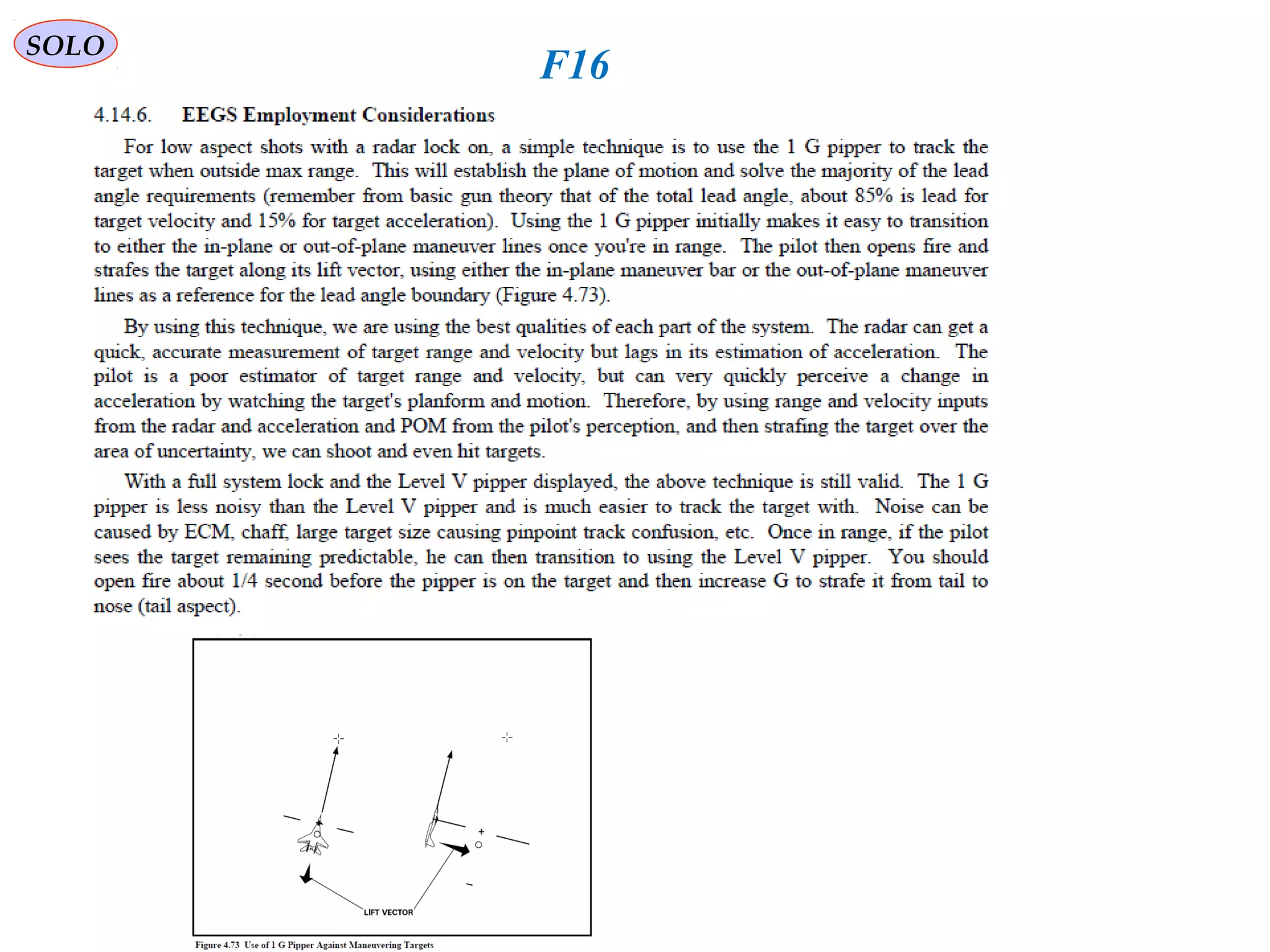
The lowest level of symbology, Level I, consists of the Gun Cross and is used in the 
Event Hud or System Failure. The Symbol is the same as the current LCOSS Gun
Cross.
  
SOLO
F16
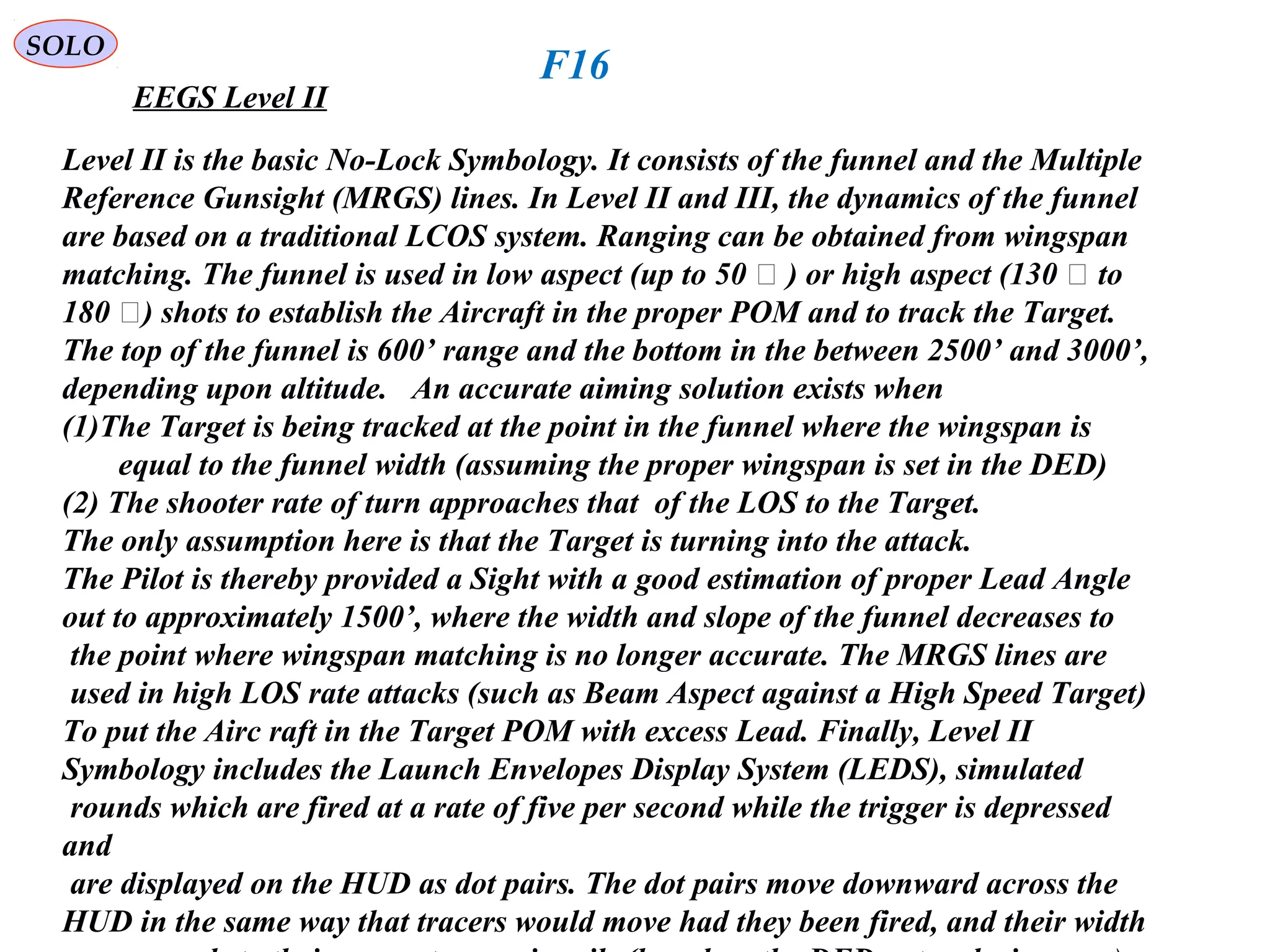
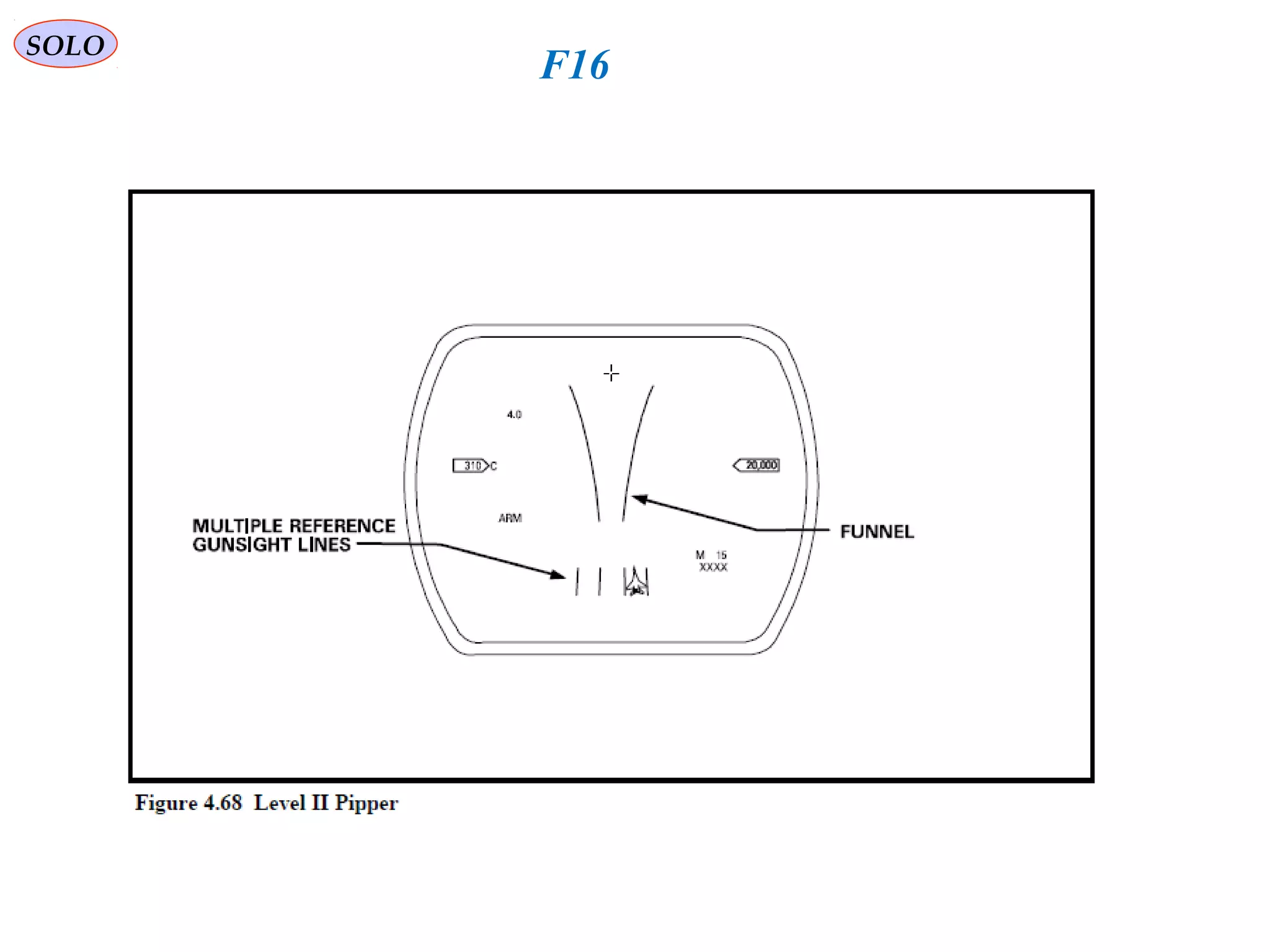
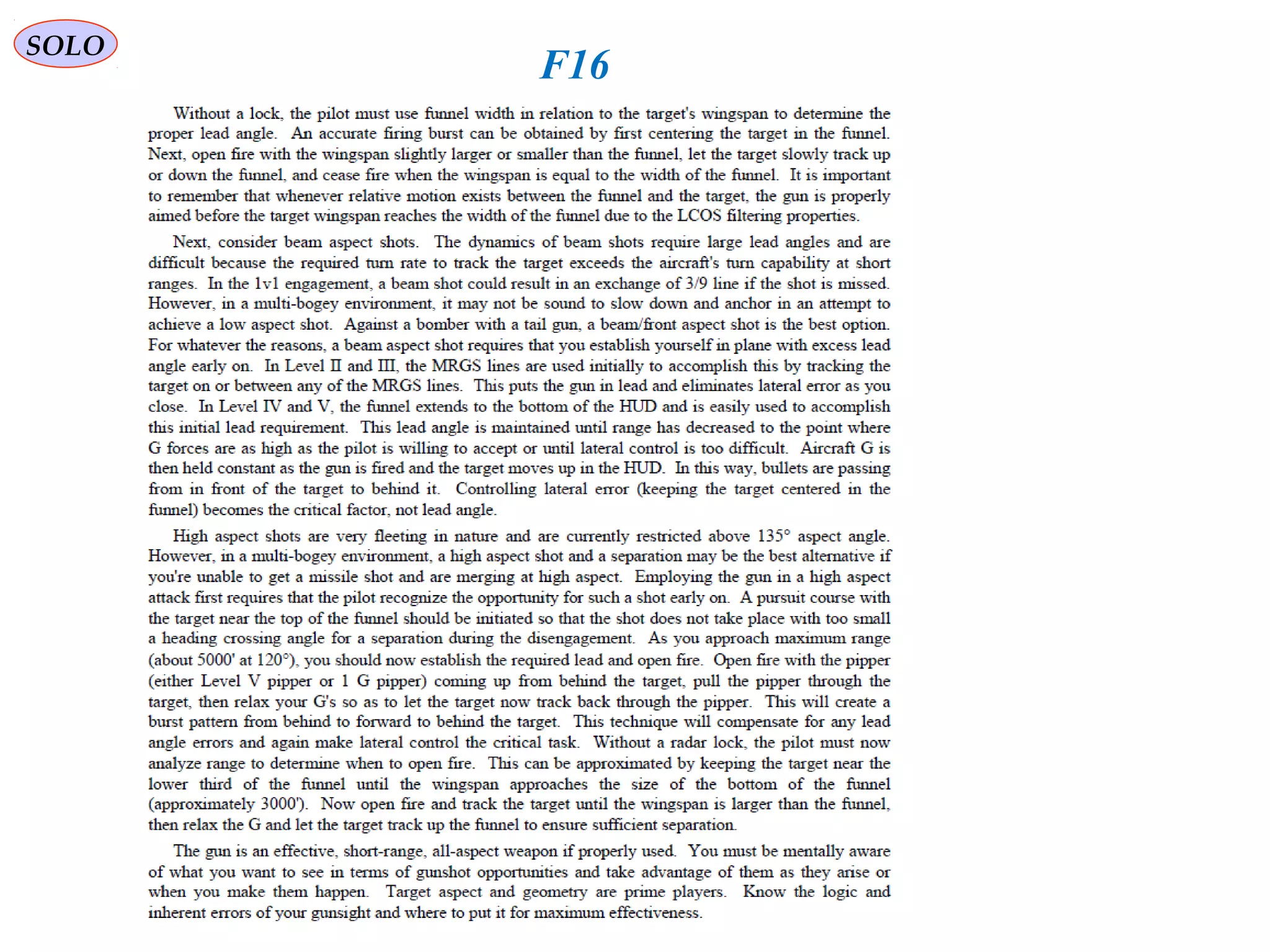
Level II is the basic No-Lock Symbology. It consists of the funnel and the Multiple
Reference Gunsight (MRGS( lines. In Level II and III, the dynamics of the funnel
are based on a traditional LCOS system. Ranging can be obtained from wingspan  
matching. The funnel is used in low aspect (up to 50 ͦ ( or high aspect (130 ͦ to 
180 ͦ( shots to establish the Aircraft in the proper POM and to track the Target. 
The top of the funnel is 600’ range and the bottom in the between 2500’ and 3000’, 
depending upon altitude.   An accurate aiming solution exists when 
(1(The Target is being tracked at the point in the funnel where the wingspan is 
       equal to the funnel width (assuming the proper wingspan is set in the DED(
(2( The shooter rate of turn approaches that  of the LOS to the Target.
The only assumption here is that the Target is turning into the attack.
The Pilot is thereby provided a Sight with a good estimation of proper Lead Angle 
out to approximately 1500’, where the width and slope of the funnel decreases to
 the point where wingspan matching is no longer accurate. The MRGS lines are
 used in high LOS rate attacks (such as Beam Aspect against a High Speed Target(
To put the Airc raft in the Target POM with excess Lead. Finally, Level II 
Symbology includes the Launch Envelopes Display System (LEDS(, simulated
 rounds which are fired at a rate of five per second while the trigger is depressed 
and
 are displayed on the HUD as dot pairs. The dot pairs move downward across the 
HUD in the same way that tracers would move had they been fired, and their width
EEGS Level II
  
SOLO
F16
  
SOLO
F16
  
SOLO
F16
  
SOLO
F16
  
SOLO
F16
  
SOLO
F16
  
SOLO
F16
  
SOLO
F16
  
SOLO
F16
64
References
Anthony L. Leatham, “A Digital Lead Computing Optical Sight Model”, AD-786464, 
Air Force Academy, 1974
“Multi-Command Handbook 11-F16” Volume 5, Effective Date: 10 May 1996
http://en.wikipedia.org/wiki
AD-A208651, “Evaluation of Head-Up Displays Format for the F/A-18 Hornet”, 
Leah M. Roust, March 1989 Thesis, Naval Postgraduate School, Montery, CA, 
USA
65
SOLO
Technion
Israeli Institute of Technology
1964 – 1968 BSc EE
1968 – 1971 MSc EE
Israeli Air Force
1970 – 1974
RAFAEL
Israeli Armament Development Authority
1974 – 2013
Stanford University
1983 – 1986 PhD AA
66
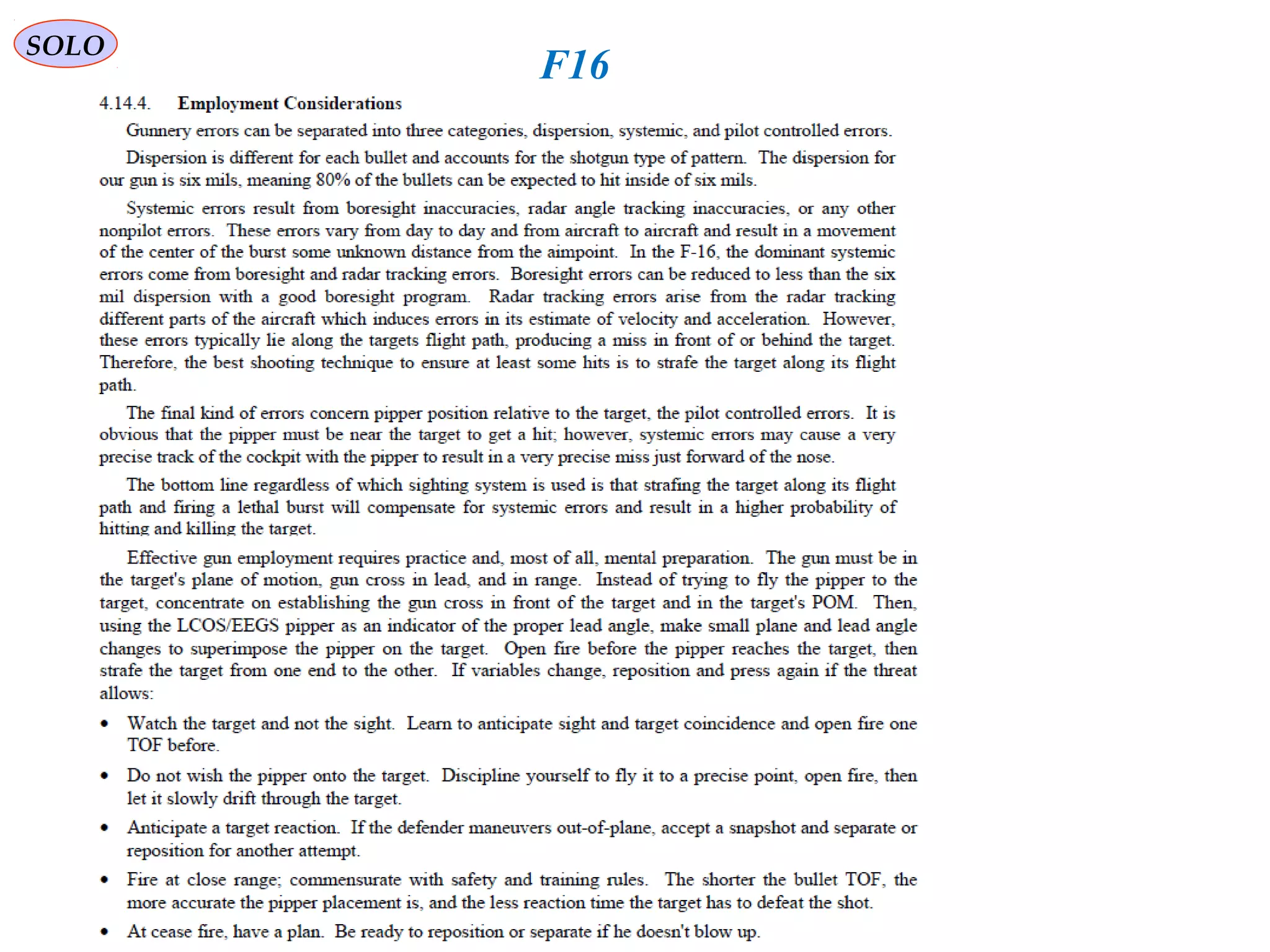
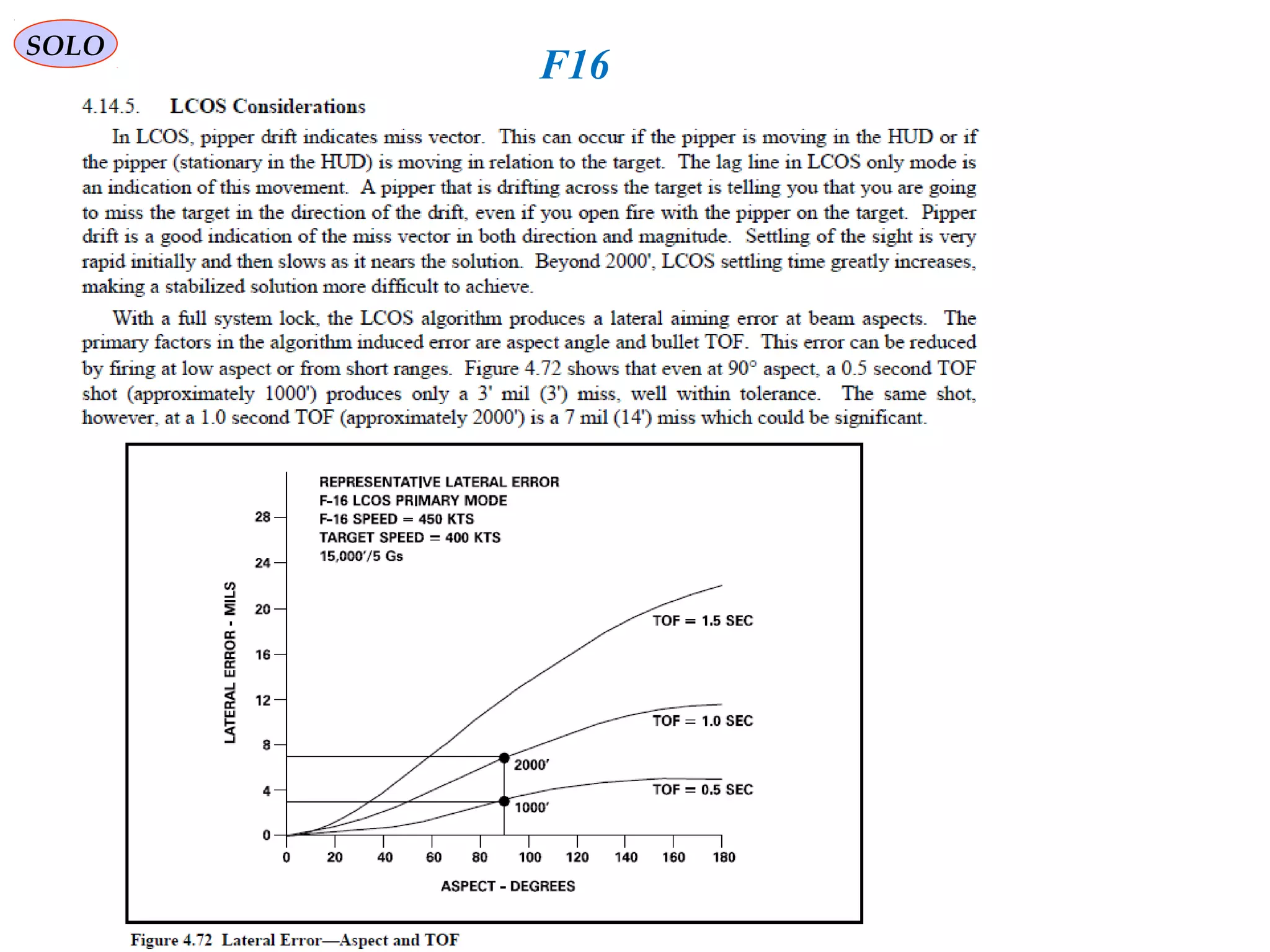
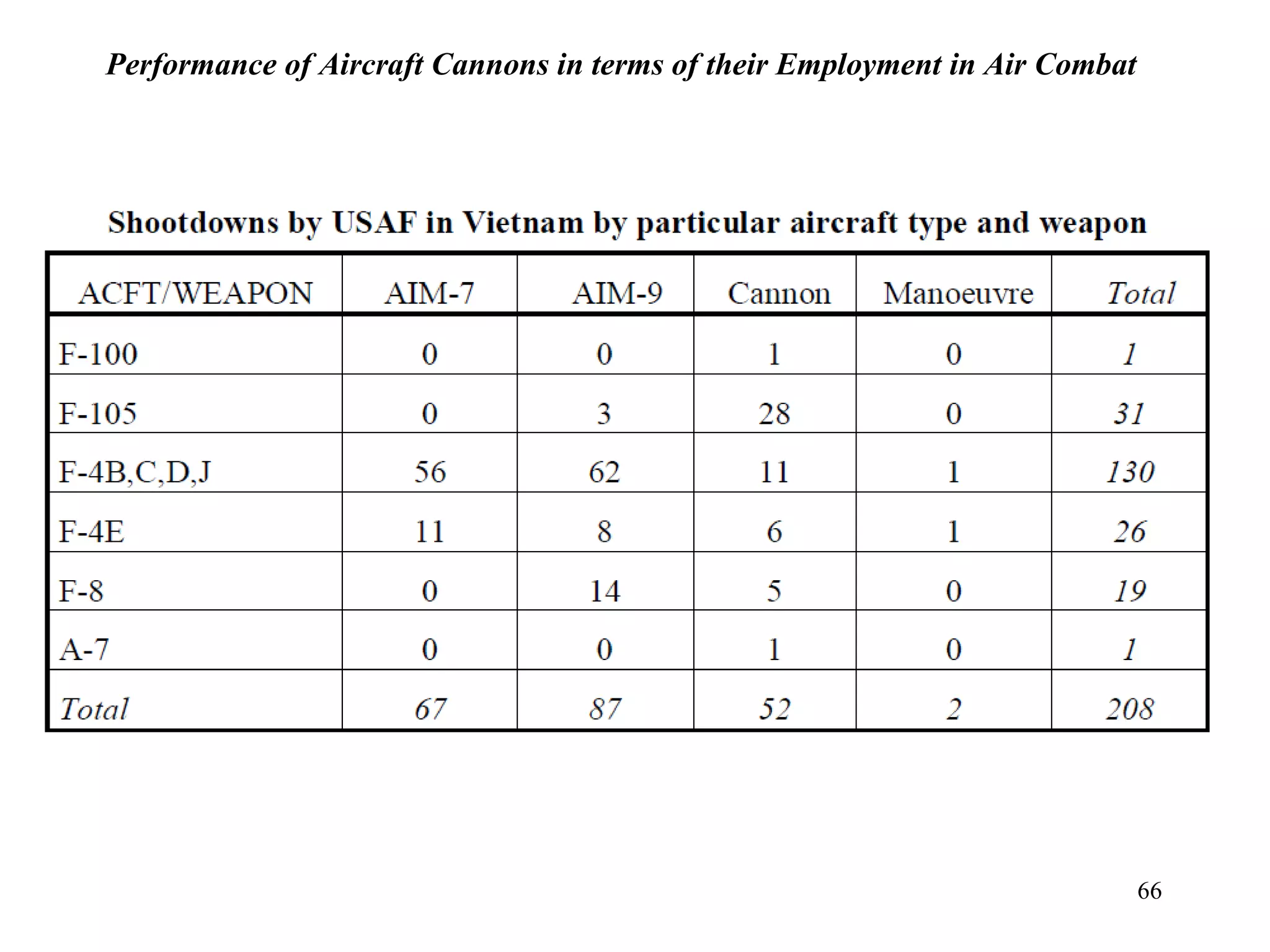
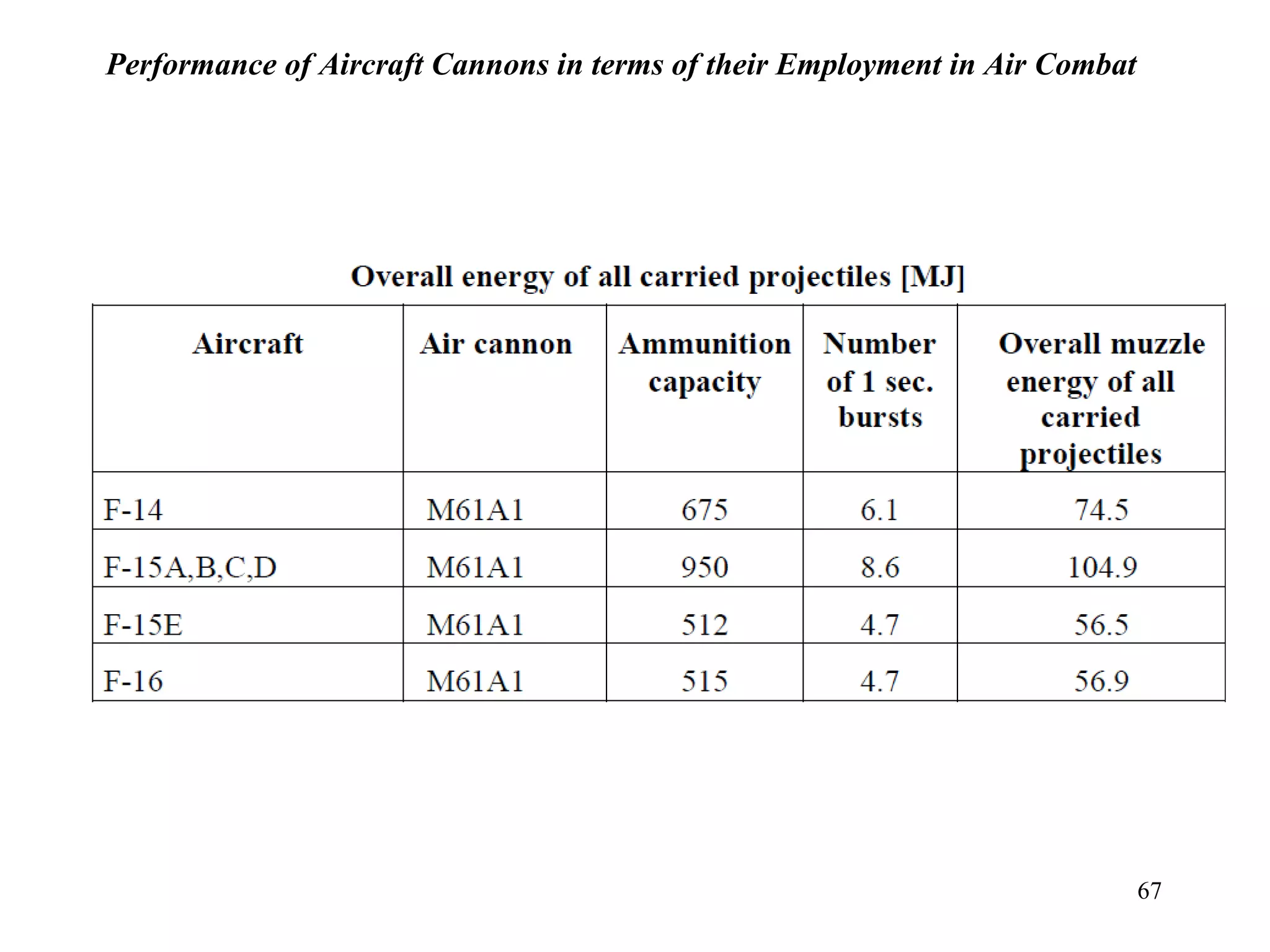
Performance of Aircraft Cannons in terms of their Employment in Air Combat
67
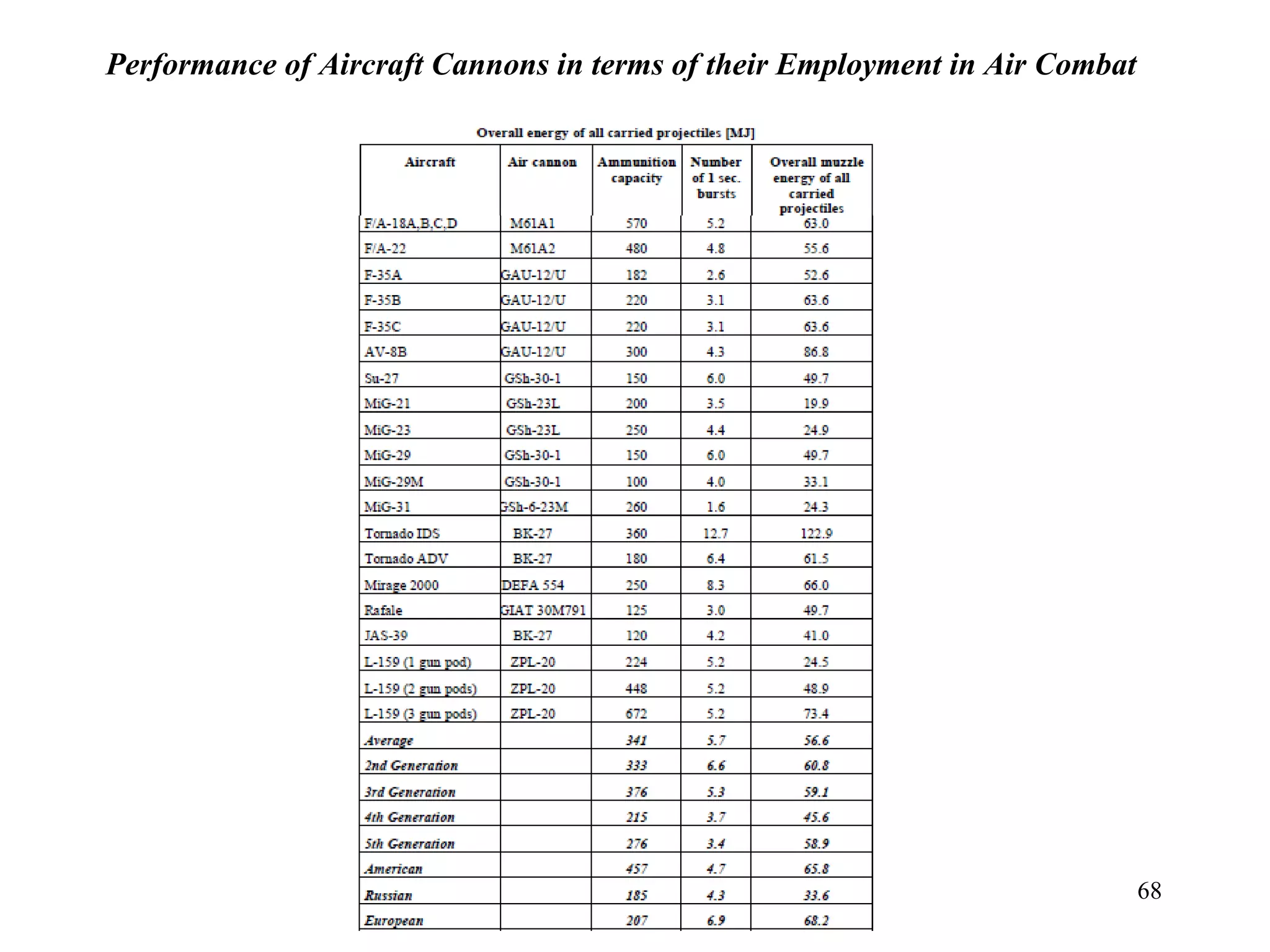
Performance of Aircraft Cannons in terms of their Employment in Air Combat
68
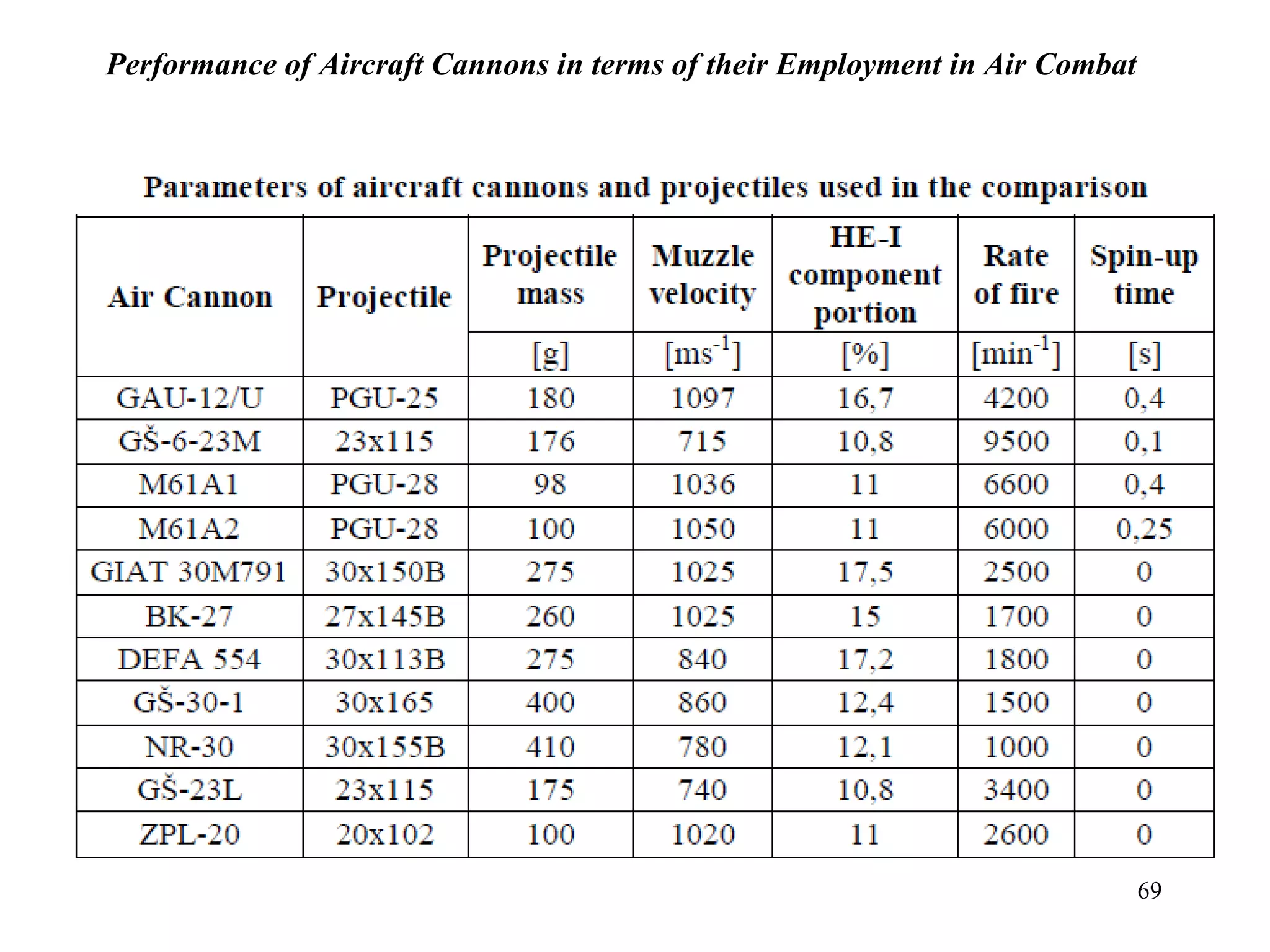
Performance of Aircraft Cannons in terms of their Employment in Air Combat
69
Performance of Aircraft Cannons in terms of their Employment in Air Combat
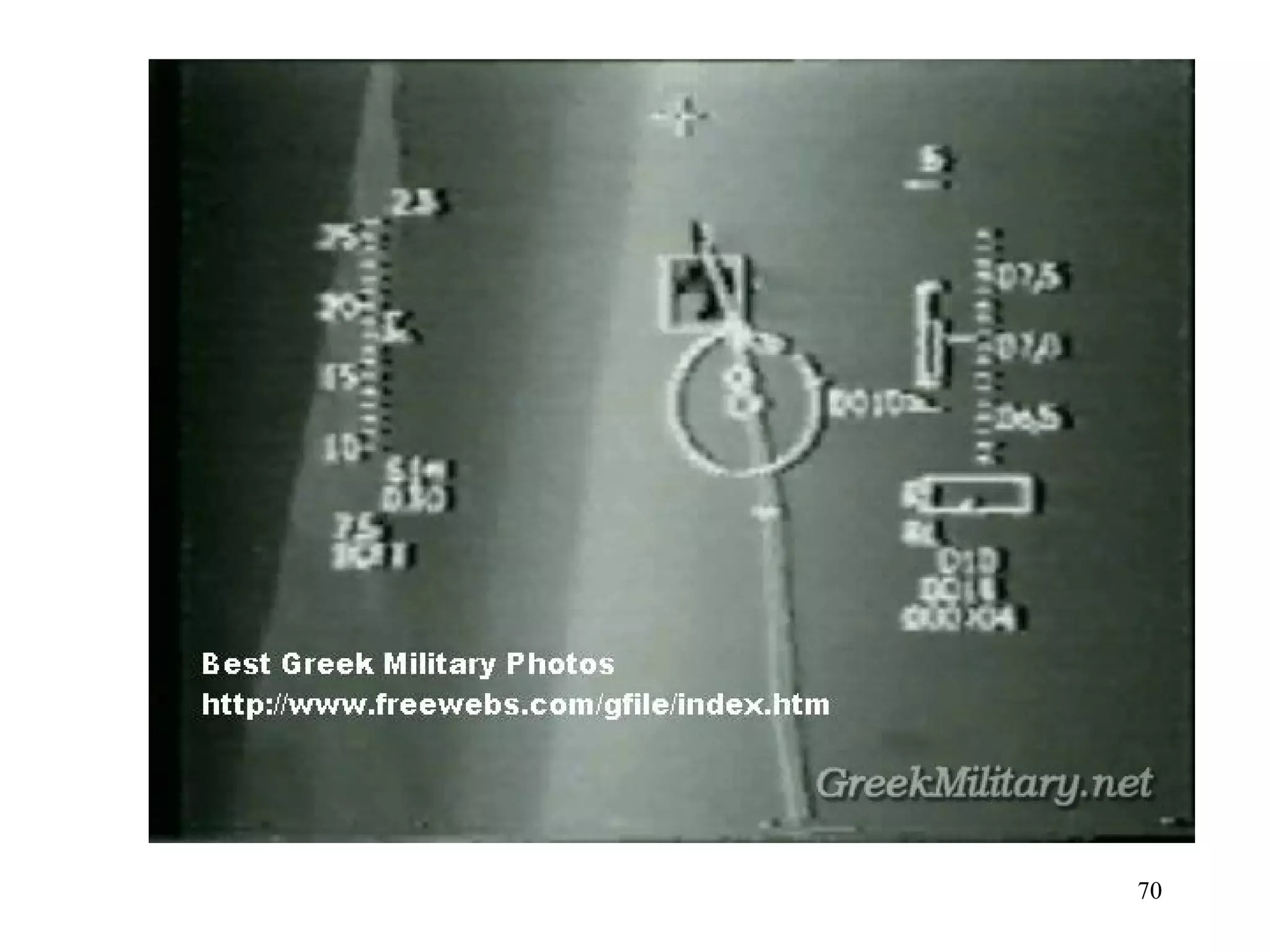
70
71
72
73

6 computing gunsight, hud and hms

Editor's Notes

  • #5 http://en.wikipedia.org/wiki/Gyro_gunsight
  • #6 http://en.wikipedia.org/wiki/Gyro_gunsight
  • #7 http://spitfiresite.com/2007/11/mark-ii-gyro-gunsight.html http://www.youtube.com/watch?v=0SBE1hRVdQY
  • #8 http://en.wikipedia.org/wiki/Gyro_gunsight http://www.youtube.com/watch?v=36eLp9XGNjs
  • #9 http://articles.janes.com/articles/Janes-Avionics/AN-ASG-26A-Lead-computing-optical-sight-United-States.html
  • #36 http://en.wikipedia.org/wiki/Head-up_display
  • #37 http://en.wikipedia.org/wiki/Head-up_display
  • #38 http://www.ausairpower.net/TE-Fighter-Cockpits.html
  • #39 http://en.wikipedia.org/wiki/Head-up_display
  • #40 http://en.wikipedia.org/wiki/Head-up_display
  • #41 AD-A208651, “Evaluation of Head-Up Displays Format for the F/A-18 Hornet”, Leah M. Roust, March 1989 Thesis, Naval Postgraduate School, Montery, CA, USA
  • #44 http://en.wikipedia.org/wiki/Head-up_display
  • #45 F-15E_info Strike Eagle reference and resources - F-15E_info - Head-Up Display.mht
  • #46 http://en.wikipedia.org/wiki/Head-up_display
  • #52 “Multi-Command Handbook 11-F16” Volume 5, Effective Date: 10 May 1996
  • #53 “Multi-Command Handbook 11-F16” Volume 5, Effective Date: 10 May 1996
  • #54 “Multi-Command Handbook 11-F16” Volume 5, Effective Date: 10 May 1996 http://www.youtube.com/watch?v=BHx-OWdHqf8 http://www.youtube.com/watch?v=Aq5HXTGUHGI http://www.youtube.com/watch?v=gv1S1w2upkM
  • #55 “Multi-Command Handbook 11-F16” Volume 5, Effective Date: 10 May 1996
  • #56 “Multi-Command Handbook 11-F16” Volume 5, Effective Date: 10 May 1996
  • #57 “Multi-Command Handbook 11-F16” Volume 5, Effective Date: 10 May 1996
  • #58 “Multi-Command Handbook 11-F16” Volume 5, Effective Date: 10 May 1996
  • #59 “Multi-Command Handbook 11-F16” Volume 5, Effective Date: 10 May 1996
  • #60 “Multi-Command Handbook 11-F16” Volume 5, Effective Date: 10 May 1996
  • #61 “Multi-Command Handbook 11-F16” Volume 5, Effective Date: 10 May 1996
  • #62 “Multi-Command Handbook 11-F16” Volume 5, Effective Date: 10 May 1996
  • #63 “Multi-Command Handbook 11-F16” Volume 5, Effective Date: 10 May 1996
  • #64 “Multi-Command Handbook 11-F16” Volume 5, Effective Date: 10 May 1996
  • #67 M. Janošek, A. Svoboda, “Performance of Aircraft Cannons in terms of their Employment in Air Combat” , Advanced in MT, 2007 http://aimt.unob.cz/articles/07_02/07_02%20(3).pdf
  • #68 M. Janošek, A. Svoboda, “Performance of Aircraft Cannons in terms of their Employment in Air Combat” , Advanced in MT, 2007 http://aimt.unob.cz/articles/07_02/07_02%20(3).pdf
  • #69 M. Janošek, A. Svoboda, “Performance of Aircraft Cannons in terms of their Employment in Air Combat” , Advanced in MT, 2007 http://aimt.unob.cz/articles/07_02/07_02%20(3).pdf
  • #70 M. Janošek, A. Svoboda, “Performance of Aircraft Cannons in terms of their Employment in Air Combat” , Advanced in MT, 2007 http://aimt.unob.cz/articles/07_02/07_02%20(3).pdf
  • #71 http://greekmilitary.net/GreekF16.htm
  • #72 http://greekmilitary.net/GreekF16.htm
  • #73 Shaw, “Fighter Combats, Tactics and Maneuvering”, Naval Institute Press, 1985 , Internet
  • #74 Shaw, “Fighter Combats, Tactics and Maneuvering”, Naval Institute Press, 1985 , Internet