08/12/15 1
Performance of an Aircraft
with Parabolic Polar
SOLO HERMELIN
Updated: 14.03.2004
08/12/15 2
Performance of an Aircraft with Parabolic PolarSOLO
Table of Content
Flat Earth Three Degrees of Freedom Aircraft Equations
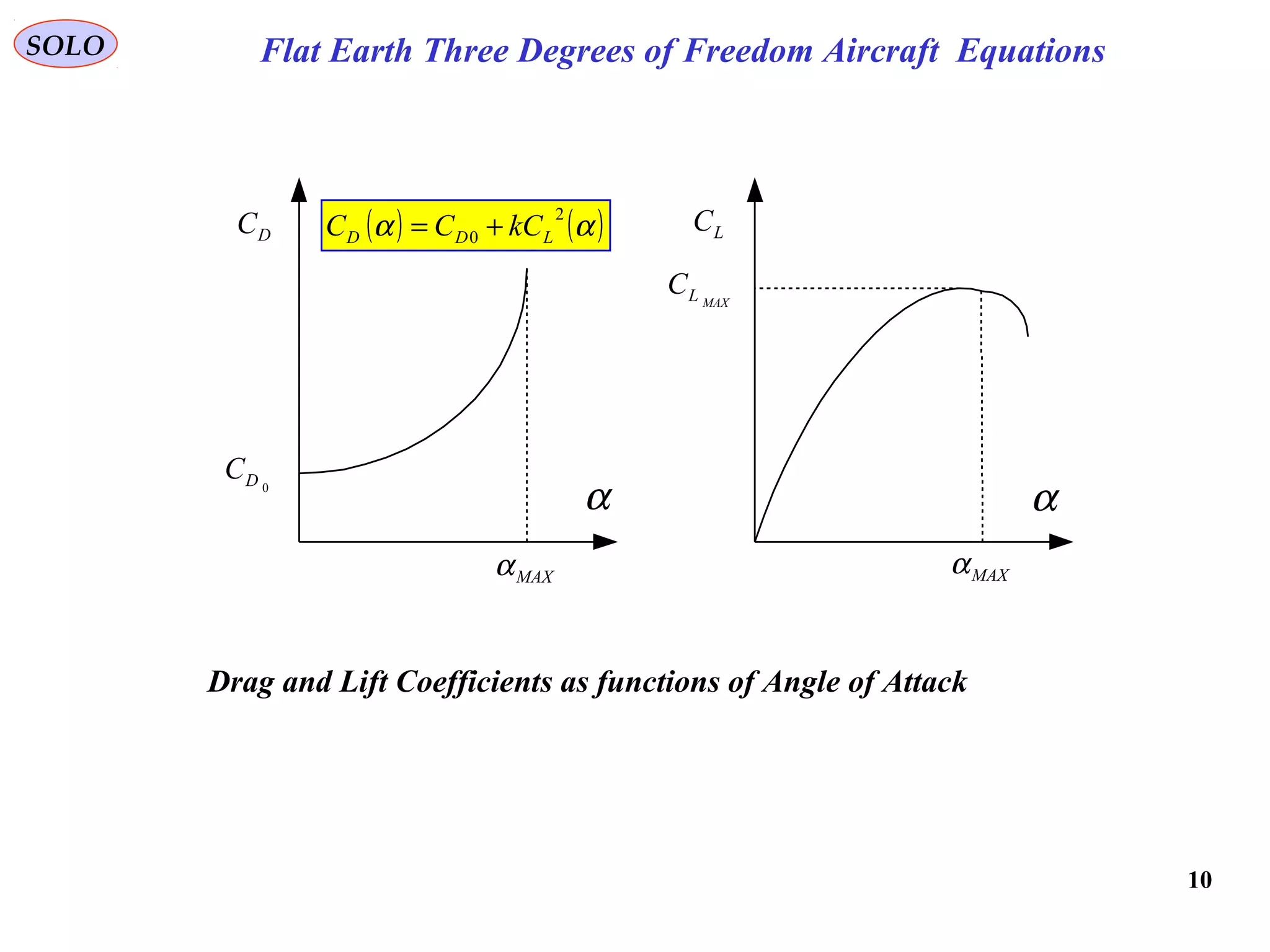
Performance of an Aircraft with Parabolic Polar
Aircraft Drag
Energy per unit mass E
Load Factor n
Aircraft Trajectories
Summary
Constraints
Horizontal Plan Trajectory ( )0,0 == γγ 
Horizontal Turn Rate as Function of ps, n
Horizontal Turn Rate as Function of nV,
References
08/12/15 3
SOLO
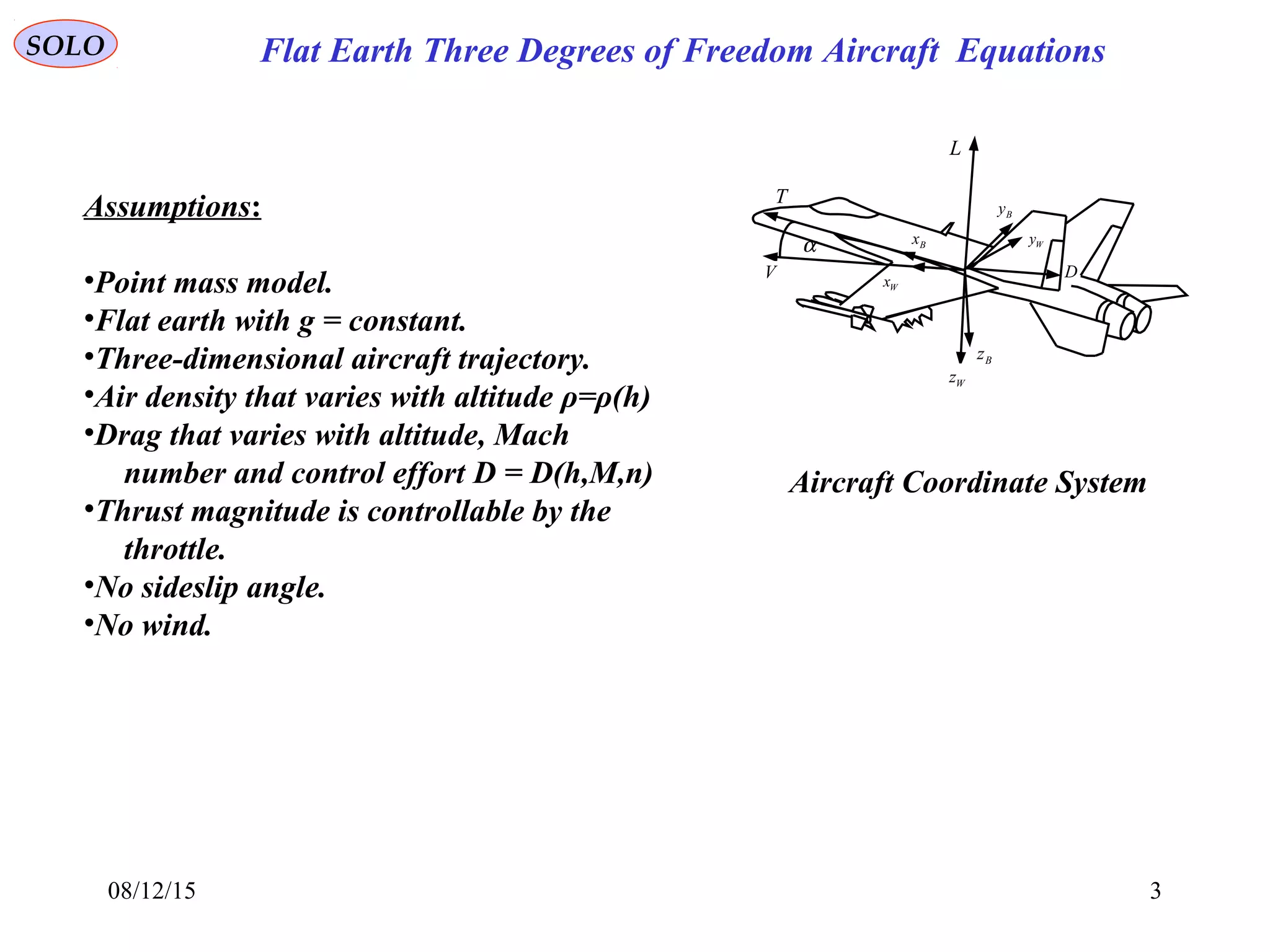
Assumptions:
•Point mass model.
•Flat earth with g = constant.
•Three-dimensional aircraft trajectory.
•Air density that varies with altitude ρ=ρ(h)
•Drag that varies with altitude, Mach
number and control effort D = D(h,M,n)
•Thrust magnitude is controllable by the
throttle.
•No sideslip angle.
•No wind.
α
T
V
L
D
Bx
Wx
Bz
Wz
Wy
By
Aircraft Coordinate System
Flat Earth Three Degrees of Freedom Aircraft Equations
4
SOLO
• Rotation Matrix from Earth to Wind Coordinates
[ ] [ ] [ ]321 χγσ=W
EC
where
σ – Roll Angle
γ – Elevation Angle of the Trajectory
χ – Azimuth Angle of the Trajectory
Force Equation:
amgmTFA

=++
where:
• Aerodynamic Forces (Lift L and Drag D)
( )










−
−
=
L
D
F
W
A 0

• Thrust T ( )










=
α
α
sin
0
cos
T
T
T W

• Gravitation acceleration
( ) ( )




















−









 −










−
==
g
cs
sc
cs
sc
cs
scgCg EW
E
W
0
0
100
0
0
0
010
0
0
0
001
χχ
χχ
γγ
γγ
σσ
σσ
( )
g
cc
cs
s
g W









−
=
γσ
γσ
γ

α
T
V
L
D
Bx
Wx
Bz
Wz
Wy
By
Flat Earth Three Degrees of Freedom Aircraft Equations
5
SOLO
α
T
V
L
D
Bx
Wx
Bz
Wz
Wy
By
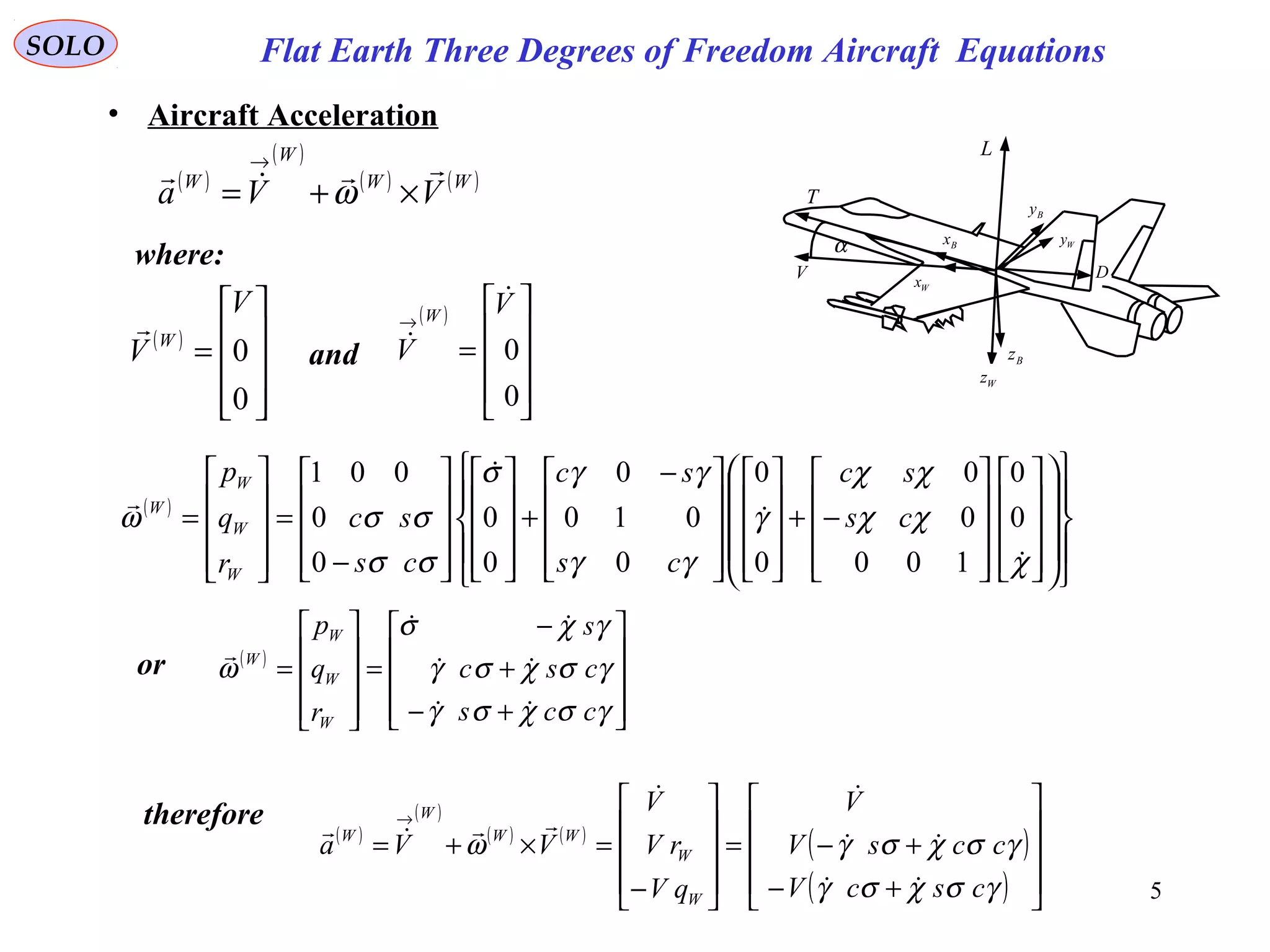
• Aircraft Acceleration
( )
( )
( ) ( )WW
W
W
VVa

×+=
→
ω
where:
( )










=
0
0
V
V W

and
( )










=
→
0
0
V
V
W


( )








































−+



















 −
+




















−
=










=
χ
χχ
χχ
γ
γγ
γγσ
σσ
σσω




0
0
100
0
0
0
0
0
010
0
0
0
0
0
001
cs
sc
cs
sc
cs
sc
r
q
p
W
W
W
W
or ( )










+−
+
−
=










=
γσχσγ
γσχσγ
γχσ
ω
ccs
csc
s
r
q
p
W
W
W
W




therefore
( )
( )
( ) ( )
( )
( ) 









+−
+−=










−
=×+=
→
γσχσγ
γσχσγω
cscV
ccsV
V
qV
rV
V
VVa
W
W
WW
W
W




Flat Earth Three Degrees of Freedom Aircraft Equations
6
SOLO
α
T
V
L
D
Bx
Wx
Bz
Wz
Wy
By
• Aircraft Acceleration
Flat Earth Three Degrees of Freedom Aircraft Equations
From the Force equation we obtain:
( )
( )
( ) ( ) ( ) ( )
( ) ( )WWW
A
WW
W
W
gTF
m
VVa

++=×+=
→
1
ω
or
( )
( ) ( ) σ
σ
σ
σ
γσαγσχσγ
γσγσχσγ
γα
s
c
c
s
ccgmLTcscVqV
csgccsVrV
sgmDTV
W
W
−−
−





++−=+−=−
=+−=
−−=
/sin
/)cos(



from which we obtain:
( )
( )




+=
−+=
−−=
msLTcV
cgmcLTV
sgmDTV
/sin
/sin
/)cos(
σαγχ
γσαγ
γα



Define the Load Factor
gm
LT
n
+
=
αsin
:
7
SOLO
α
T
V
L
D
Bx
Wx
Bz
Wz
Wy
By
• Velocity Equation
Flat Earth Three Degrees of Freedom Aircraft Equations
( ) ( )










==










=
0
0
V
CVC
h
y
x
V E
W
WE
W
E

























−










−








 −
=










0
0
0
0
001
0
010
0
100
0
0 V
cs
sc
cs
sc
cs
sc
h
y
x
σσ
σσ
γγ
γγ
χχ
χχ








=
=
=
γ
χγ
χγ
sVh
scVy
ccVx



or
• Energy per unit mass E
g
V
hE
2
:
2
+=
Let differentiate this equation:
( )
W
VDT
W
DT
g
g
V
V
g
VV
hEps
−
=











−
−
+=+==
α
γ
α
γ
cos
sin
cos
sin:


Return to Table of Content
8
SOLO Flat Earth Three Degrees of Freedom Aircraft Equations
Summary
γ
χγ
χγ
sin
sincos
coscos
Vh
Vy
Vx
=
=
=



( )
( )
σ
γ
σ
γ
α
χ
γσγσ
α
γ
α
γ
α
sin
cos
sin
cos
sin
coscoscoscos
sin
cos
sin
cos
n
V
g
W
LT
V
g
n
V
g
W
LT
V
g
W
VDT
Eor
W
DT
gV
=
+
=
−=





−
+
=
−
=−




 −
=



where
mgW =
Aircraft Thrust( ) 10, ≤≤= ηη VhTT MAX
( ) ( )MSCVhL L ,
2
1 2
αρ=
( ) ( )LD CMSCVhD ,
2
1 2
ρ=
( ) ( ) ( ) 2
0, LDLD CMKMCCMC +=
( ) 0/
0
hh
eh −
= ρρ
( ) ( ) soundofspeedhaNumberMachMhaVM === &/
Aircraft Weight
Aircraft Lift
Aircraft Drag
Parabolic Drag Polar
Return to Table of Content
9
SOLO Flat Earth Three Degrees of Freedom Aircraft Equations
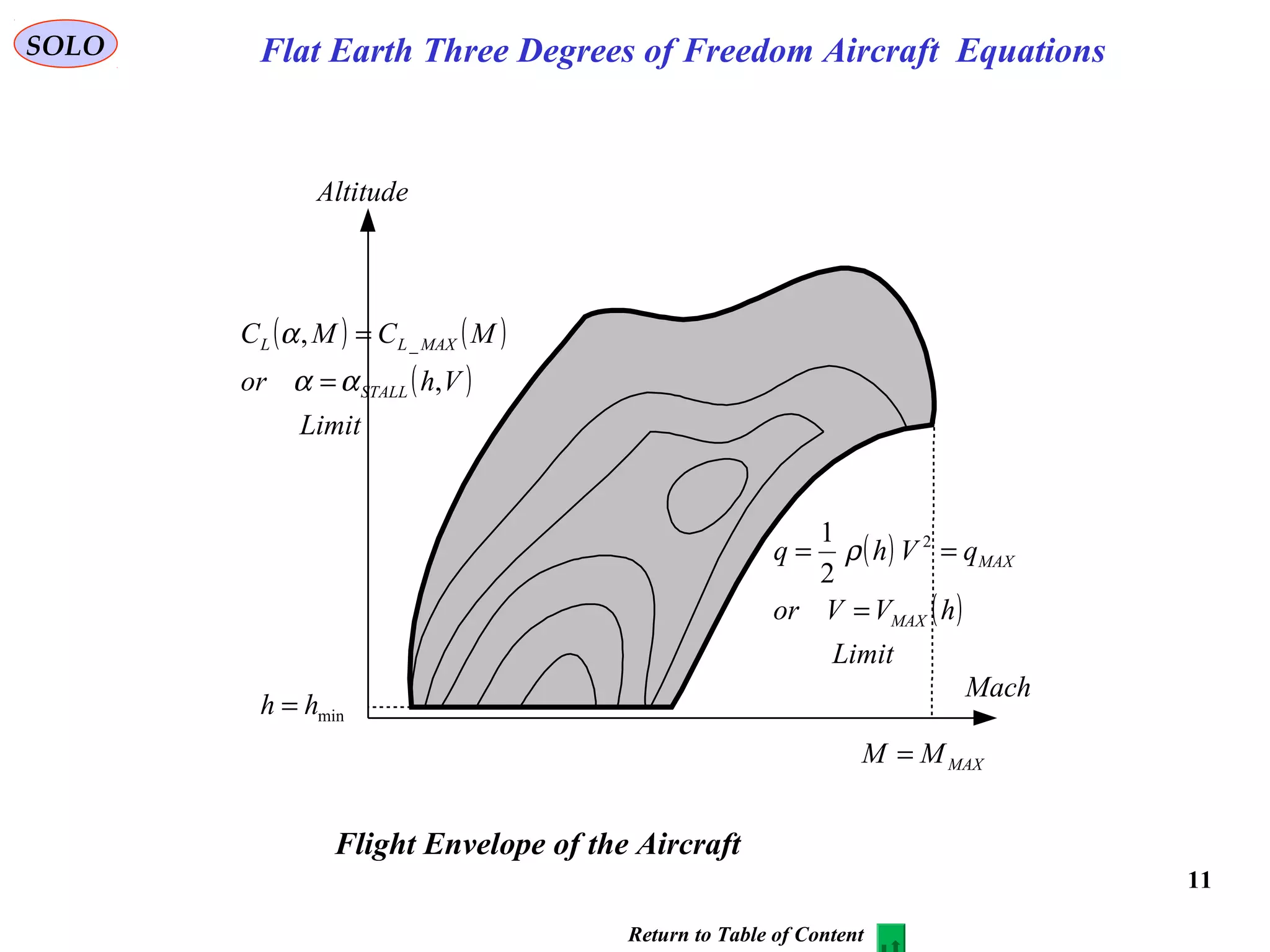
Constraints:
State Constraints
• Minimum Altitude Limit minhh ≥
• Maximum dynamic pressure limit ( ) ( )hVVorqVhq MAXMAX ≤≤= 2
2
1
ρ
• Maximum Mach Number limit
( ) MAXM
ha
V
≤
Aerodynamic or heat limitation
Control Constraints
• Maximum Lift Coefficient or Maximum Angle of Attack
( ) ( ) ( )VhorMCMC STALLMAXLL ,, _ ααα ≤≤
• Minimum Load Factor
( )
MAXn
W
VhL
n ≤=
,
• Maximum Thrust
( )VhTT MAX ,≤
10
SOLO Flat Earth Three Degrees of Freedom Aircraft Equations
MAXα MAXα
αα
LCDC
MAXLC
0DC
( ) ( )αα
2
0 LDD kCCC +=
Drag and Lift Coefficients as functions of Angle of Attack
11
SOLO Flat Earth Three Degrees of Freedom Aircraft Equations
( ) ( )
( )
Limit
Vhor
MCMC
STALL
MAXLL
,
, _
αα
α
=
=
( )
( )
Limit
hVVor
qVhq
MAX
MAX
=
== 2
2
1
ρ
minhh =
MAXMM =
Mach
Altitude
Flight Envelope of the Aircraft
Return to Table of Content
12
Performance of an Aircraft with Parabolic PolarSOLO
W
LT
n
+
=
αsin
:'
W
L
n =:
2
0
:
LD
L
D
L
CkC
C
CSq
CSq
D
L
e
+
===
We assumed a Parabolic Drag Polar:
2
0 LDD CkCC +=
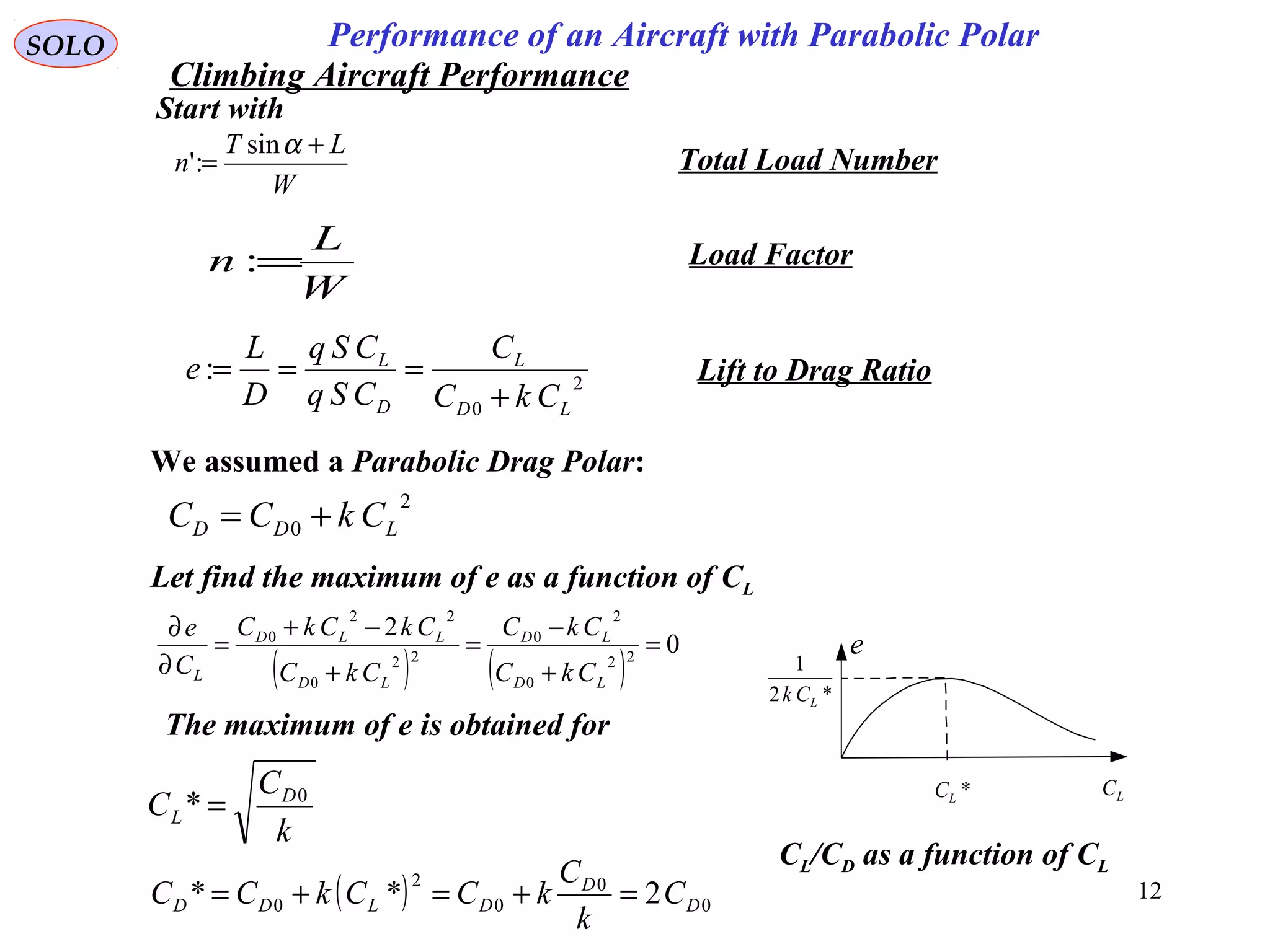
Let find the maximum of e as a function of CL
( ) ( )
0
2
22
0
2
0
22
0
22
0
=
+
−
=
+
−+
=
∂
∂
LD
LD
LD
LLD
L CkC
CkC
CkC
CkCkC
C
e
e
LC*LC
*2
1
LCk
CL/CD as a function of CL
The maximum of e is obtained for
k
C
C D
L
0
* =
( ) 0
0
0
2
0 2** D
D
DLDD C
k
C
kCCkCC =+=+=
Start with
Load Factor
Total Load Number
Lift to Drag Ratio
Climbing Aircraft Performance
13
Performance of an Aircraft with Parabolic PolarSOLO
e
LC*LC
*2
1
LCk
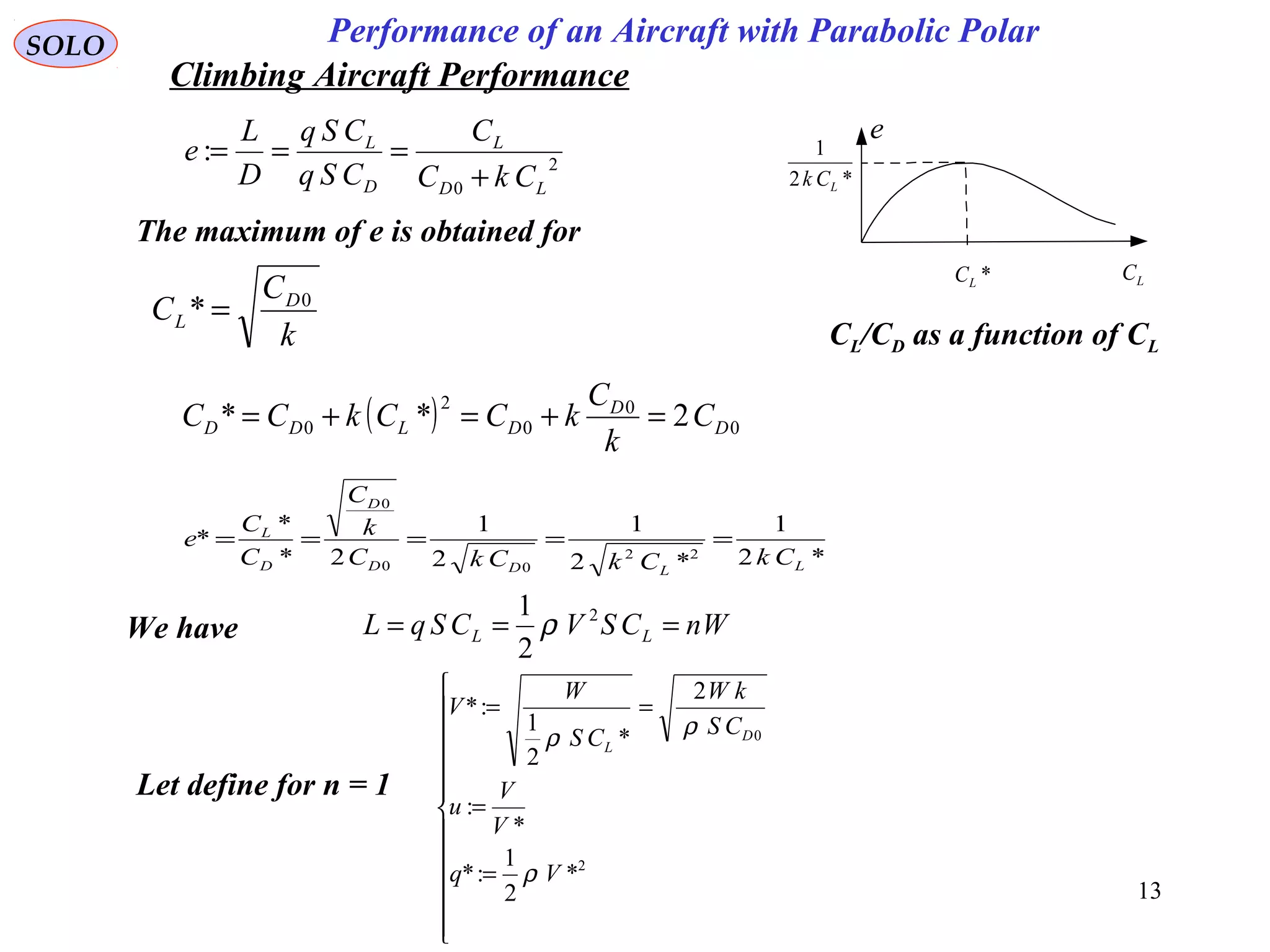
CL/CD as a function of CL
The maximum of e is obtained for
k
C
C D
L
0
* =
( ) 0
0
0
2
0 2** D
D
DLDD C
k
C
kCCkCC =+=+=
*2
1
*2
1
2
1
2*
*
*
22
00
0
LLDD
D
D
L
CkCkCkC
k
C
C
C
e =====
We have WnCSVCSqL LL === 2
2
1
ρ
Let define for n = 1












=
=
==
2
0
*
2
1
:*
*
:
2
*
2
1
:*
Vq
V
V
u
CS
kW
CS
W
V
D
L
ρ
ρρ
2
0
:
LD
L
D
L
CkC
C
CSq
CSq
D
L
e
+
===
Climbing Aircraft Performance
14
Performance of an Aircraft with Parabolic PolarSOLO
Using those definitions we obtain
L
L
L
L
C
C
nqq
WCSq
WnCSqL *
*
**
=→



=
==
2
2
2
1
2
1
*
2
1
*
uV
V
n
q
q
==
ρ
ρ
2
*
*
*
u
C
nC
q
q
nC L
LL ==
( )






+=





+=






+=+=
=
2
2
2
04
02
0
2
*
4
2
2
0
22
0
**
*
*
0
2
u
n
uCSq
u
C
nCuSq
u
C
nkCuSqCkCSqD
D
D
D
CCk
L
DLD
DL
*2
1
*
*** 0
0
e
W
C
C
CSqCSq
L
D
LD ==






+= 2
2
2
*2 u
n
u
e
W
D
Therefore
Return to Table of Content
Climbing Aircraft Performance










=
=
=
2
0
*
2
1
:*
*
:
2
:*
Vq
V
V
u
CS
kW
V
D
ρ
ρ
15
Performance of an Aircraft with Parabolic PolarSOLO
We obtained
Let find the minimum of D as function of u.
nu
u
nu
e
W
u
n
u
e
W
u
D
=→
=
−
=





−=
∂
∂
2
3
24
3
2
0
*
22
*2
*
2min
e
Wn
DD nu
== =
Aircraft Drag
Climbing Aircraft Performance
u 0
- - - - 0 + + + + +
D ↓ min ↑
n
u
D
∂
∂






+= 2
2
2
*2 u
n
u
e
W
D
16
Performance of an Aircraft with Parabolic PolarSOLO
Aircraft Drag
( )
MAXn
W
VhL
n ≤=
,








+== 2
2
2
*2 u
n
u
e
W
D MAX
nn MAX
Maximum Lift Coefficient or Maximum Angle of Attack
( ) ( ) ( )VhorMCMC STALLMAXLL ,, _ ααα ≤≤
We have
u
C
C
u
n
u
C
nC
q
q
nC
L
MAXL
CC
L
LL
MAXLL
*
*
*
* _
2
_
=→==
=
2
2
_
2
2
_2
*
1
*2
**2_
u
C
C
e
W
u
C
C
u
e
W
D
L
MAXL
L
MAXL
CC MAXLL














+=














+==
Maximum dynamic pressure limit
( ) ( ) MAX
MAX
MAXMAX u
V
V
uhVVorqVhq =<→≤≤= :
*2
1 2
ρ
*e
W
D
MAXLC _
2
2
_
1
2
1
u
C
C
L
MAXL














+








+= 2
2
2
2
1
*
u
n
ue
W
D MAX
LIMIT
nn MAX=
2min
* ue
W
D
=






+= 2
2
2
2
1
*
u
n
ue
W
D
MAXuu =MAX
MAXL
L
CORNER n
C
C
u
_
*
=
n
LIMIT
u
MAXnu =
as a function of u*e
W
D
Return to Table of Content
Climbing Aircraft Performance
Maximum Load Factor










=
=
=
2
0
*
2
1
:*
*
:
2
:*
Vq
V
V
u
CS
kW
V
D
ρ
ρ
17
Performance of an Aircraft with Parabolic PolarSOLO
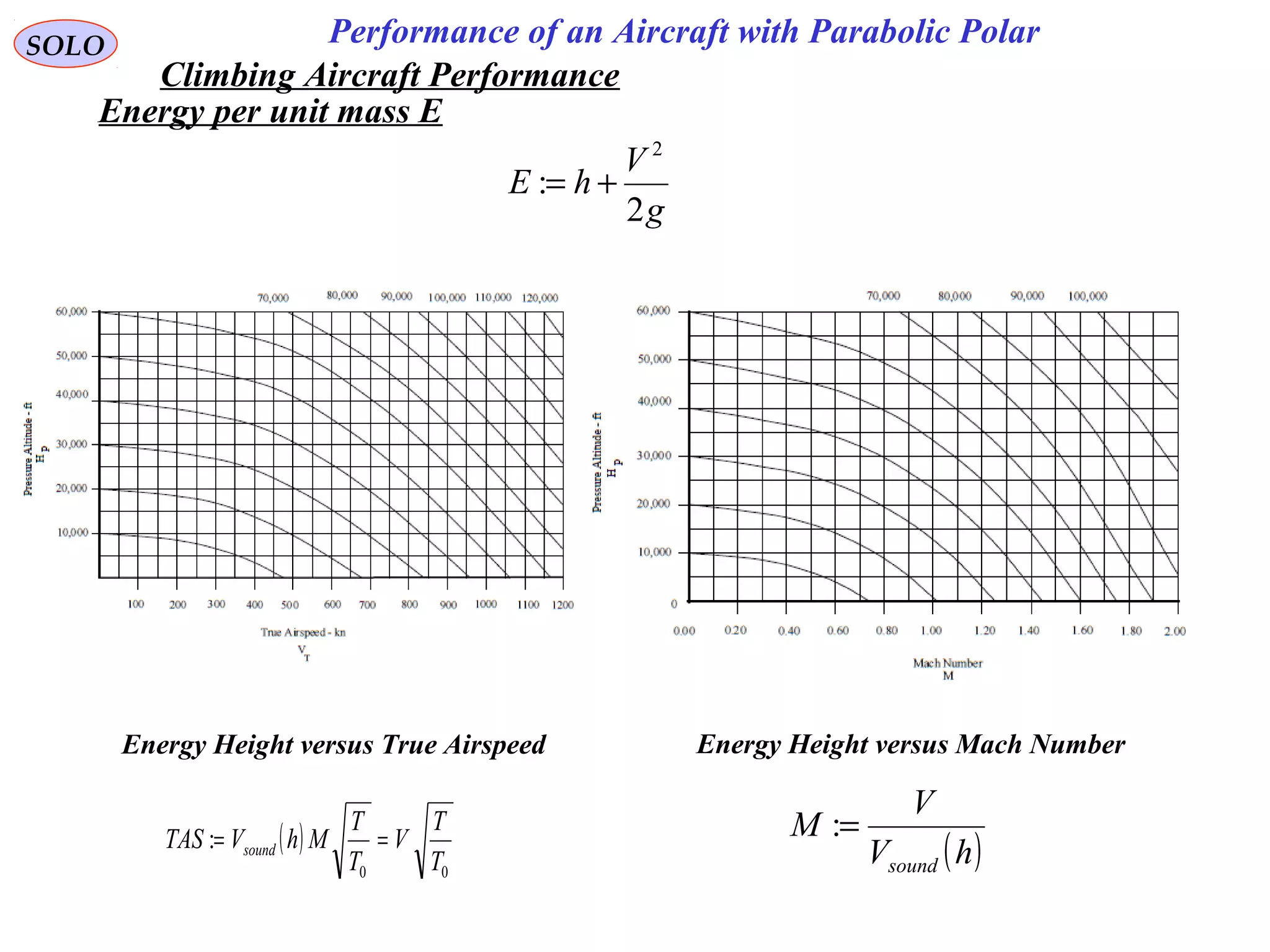
Energy per unit mass E
Let define Energy per unit mass E: g
V
hE
2
:
2
+=
Let differentiate this equation:
( ) ( )
W
VDT
W
VDT
W
DT
g
g
V
V
g
VV
hEps
−
≈
−
=











−
−
+=+==
α
γ
α
γ
cos
sin
cos
sin:


*&
*2 2
2
2
VuV
u
n
u
e
W
D =





+=
Define *: e
W
T
z 





=
We obtain
( )












+−=












+−





=
−
= 2
2
2
2
2
2
2
1
*
*
*
2
1
*
*
u
n
uzu
e
V
W
Vu
u
n
ue
W
T
e
W
W
VDT
ps
or ( )
u
nuzu
e
V
ps
224
2
*2
* −+−
=
nz
nzzu
nzzu
nuzup constns >




−+=
−−=
→=+−→==
22
2
22
1224
020
( ) ( )
2
224
2
2243
23
*
*244
*
*
u
nuzu
e
V
u
nuzuuuzu
e
V
u
p
constn
s ++−
=
−+−−+−
=
∂
∂
=
3
3
0
22
nzz
u
u
p
MAX
constn
s
++
=→=
∂
∂
=
2
21
2
uu
uu
MAX <<
+
nz >
Climbing Aircraft Performance
Performance of an Aircraft with Parabolic PolarSOLO
Energy per unit mass E
g
V
hE
2
:
2
+=
Climbing Aircraft Performance
Energy Height versus Mach NumberEnergy Height versus True Airspeed
( )hV
V
M
sound
=:( )
00
:
T
T
V
T
T
MhVTAS sound ==
19
Performance of an Aircraft with Parabolic PolarSOLO
Energy per unit mass E
sp
2u1u
MAXu
2
21 uu + u
MAXn
n
1=n
( )
u
nuzu
e
V
ps
224
2
*
* −+−
=
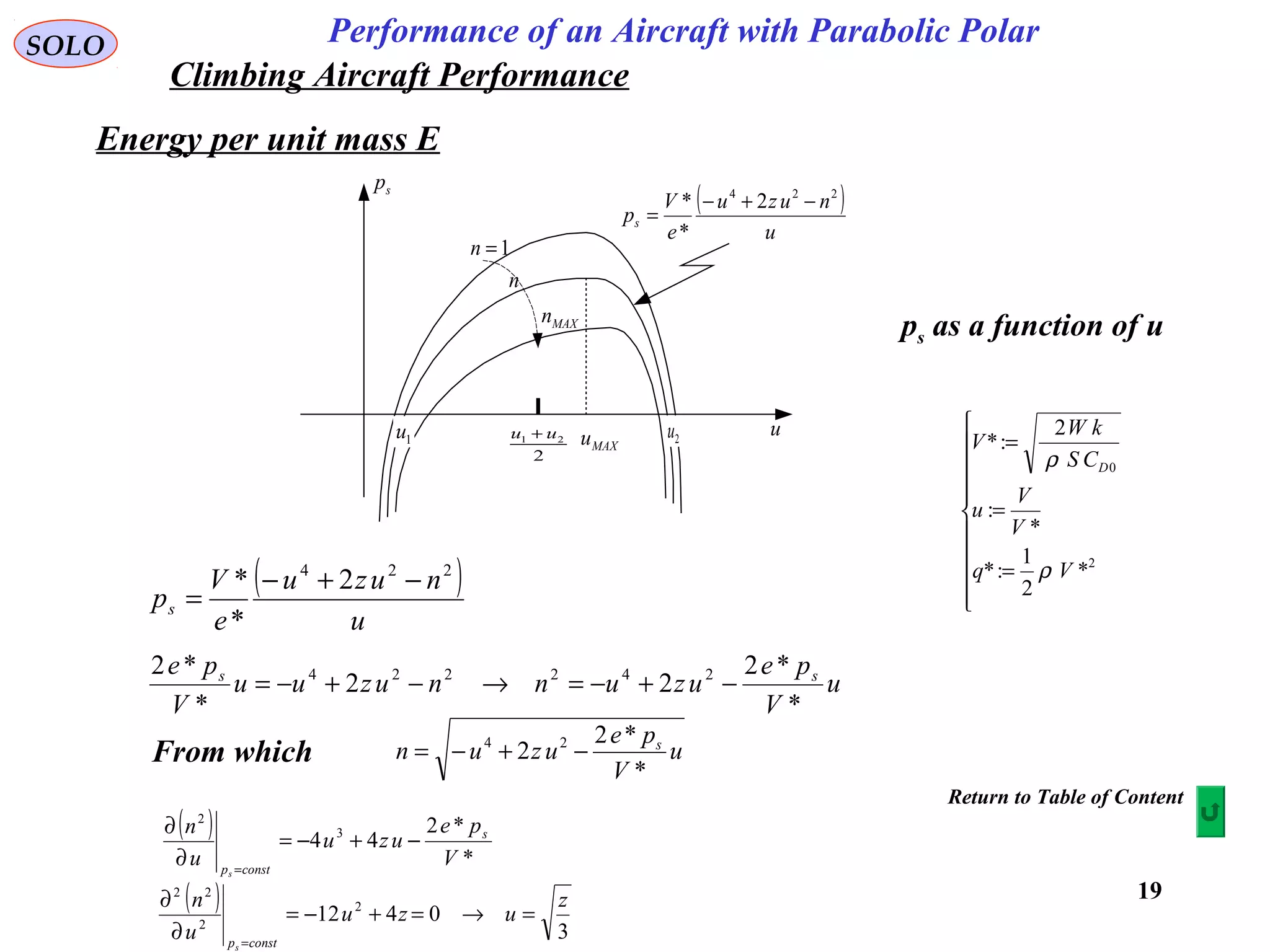
ps as a function of u
( )
u
nuzu
e
V
ps
224
2
*
* −+−
=
u
V
pe
uzunnuzuu
V
pe ss
*
*2
22
*
*2 242224
−+−=→−+−=
From which u
V
pe
uzun s
*
*2
2 24
−+−=
( )
*
*2
44 3
2
V
pe
uzu
u
n s
constps
−+−=
∂
∂
=
( )
3
0412 2
2
22
z
uzu
u
n
constps
=→=+−=
∂
∂
=
Return to Table of Content
Climbing Aircraft Performance










=
=
=
2
0
*
2
1
:*
*
:
2
:*
Vq
V
V
u
CS
kW
V
D
ρ
ρ
20
Performance of an Aircraft with Parabolic PolarSOLO
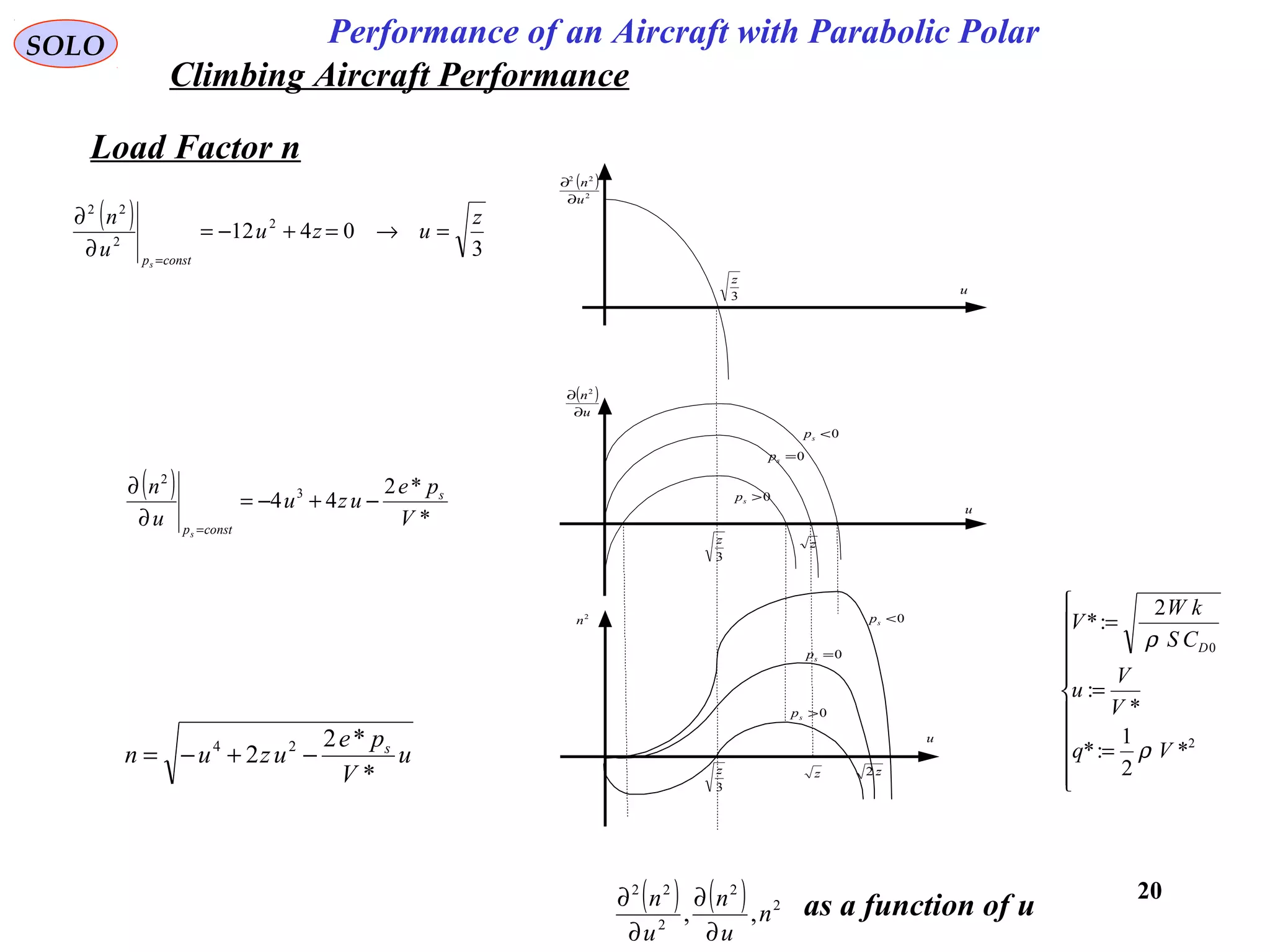
Load Factor n
u
3
z z
z2z
3
z
u
2
n
0=sp
0>sp
0<sp
0<sp
0=sp
0>sp
( )
u
n
∂
∂ 2
( )
2
22
u
n
∂
∂
3
z
u
( ) ( ) 2
2
2
22
,, n
u
n
u
n
∂
∂
∂
∂ as a function of u
u
V
pe
uzun s
*
*2
2 24
−+−=
( )
3
0412 2
2
22
z
uzu
u
n
constps
=→=+−=
∂
∂
=
( )
*
*2
44 3
2
V
pe
uzu
u
n s
constps
−+−=
∂
∂
=
Climbing Aircraft Performance










=
=
=
2
0
*
2
1
:*
*
:
2
:*
Vq
V
V
u
CS
kW
V
D
ρ
ρ
21
Performance of an Aircraft with Parabolic PolarSOLO
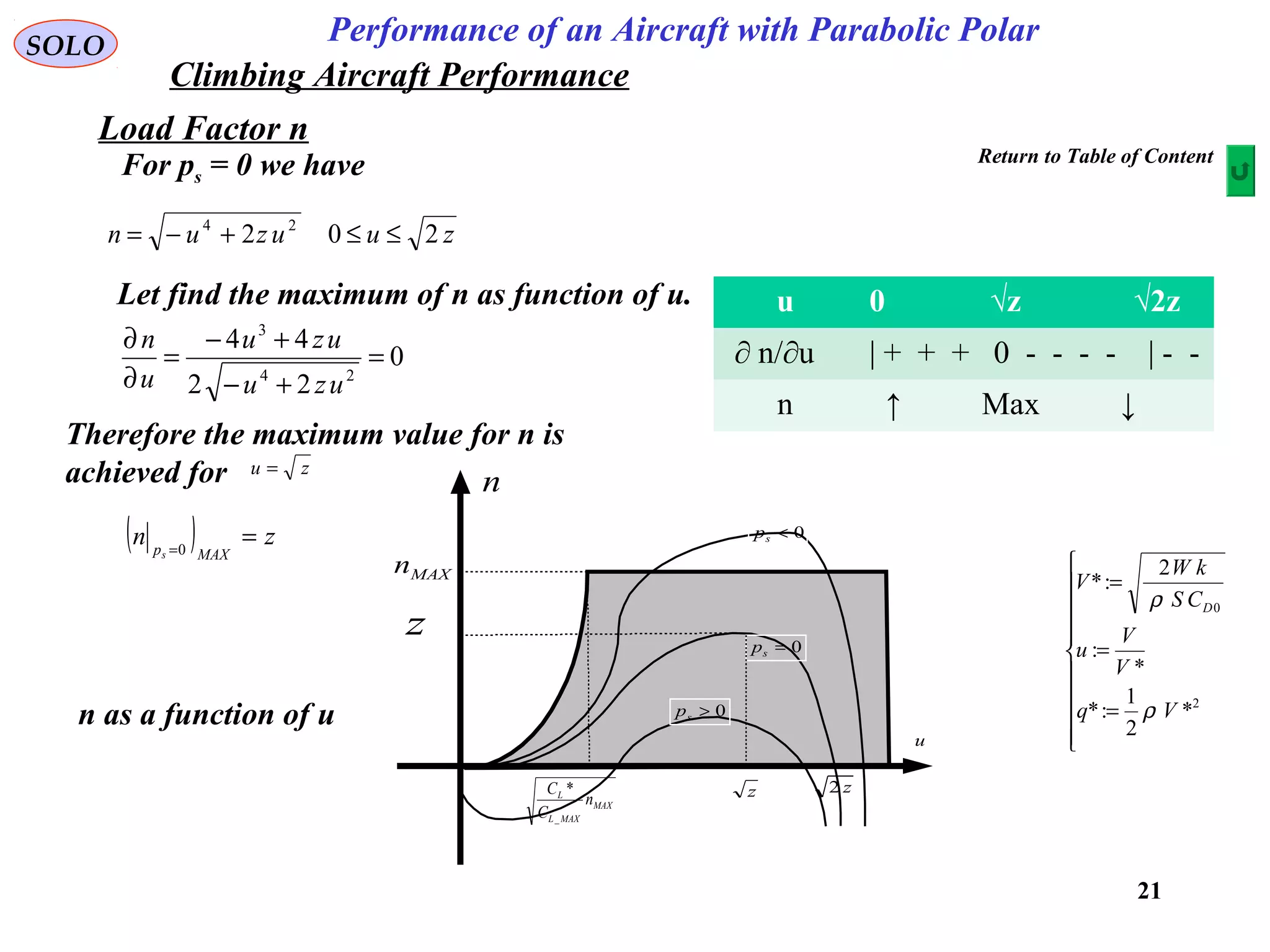
Load Factor n
For ps = 0 we have
zuuzun 202 24
≤≤+−=
Let find the maximum of n as function of u.
0
22
44
24
3
=
+−
+−
=
∂
∂
uzu
uzu
u
n
Therefore the maximum value for n is
achieved for zu =
( ) zn
MAXps
==0
u 0 √z √2z
∂ n/∂u | + + + 0 - - - - | - -
n ↑ Max ↓
z2z
u
n
0=sp
0>sp
0<sp
MAXn
z
MAX
MAXL
L
n
C
C
_
*
n as a function of u
Return to Table of Content
Climbing Aircraft Performance










=
=
=
2
0
*
2
1
:*
*
:
2
:*
Vq
V
V
u
CS
kW
V
D
ρ
ρ
22
Performance of an Aircraft with Parabolic PolarSOLO






−
+
=
=
γσ
α
γσ
coscos
sin
cossin
V
g
Vm
LT
q
V
g
r
W
W
n
W
L
W
LT
n =≈
+
=
αsin
:'
Therefore
( )





−=
=
γσ
γσ
coscos'
cossin
n
V
g
q
V
g
r
W
W
γσγσγσω 2222222
coscoscoscos'2'cossin +−+=+= nn
V
g
qr WW
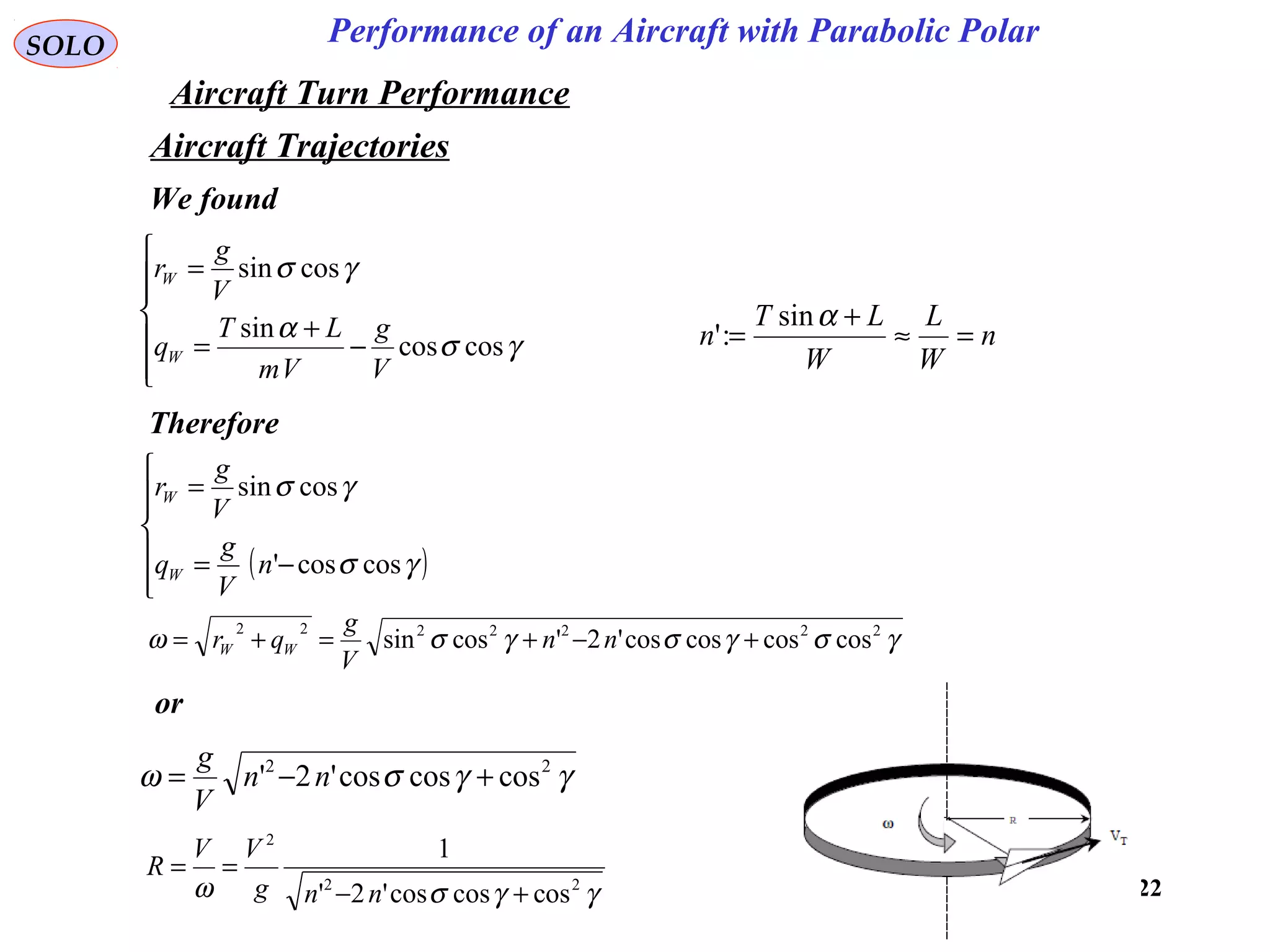
or
γγσω 22
coscoscos'2' +−= nn
V
g
γγσω 22
2
coscoscos'2'
1
+−
==
nng
VV
R
Aircraft Trajectories
We found
Aircraft Turn Performance
23
Performance of an Aircraft with Parabolic PolarSOLO
( ) ( )
( )
γ
σ
φ
γ
α
χ
γσγσ
α
γ
cos
sin
sin
cos
sin
coscos'coscos
sin
V
gLT
n
V
g
V
g
Vm
LT
=
+
=
−=−
+
=


2. Horizontal Plan Trajectory ( )0,0 == γγ 
( )
1'
1
1'
'
1
1'sin'
cos
1
'01cos'
2
2
2
2
−
=
−=





−==
=→=−=
ng
V
R
n
V
g
n
n
V
g
n
V
g
nn
V
g
σχ
σ
σγ


Aircraft Turn Performance
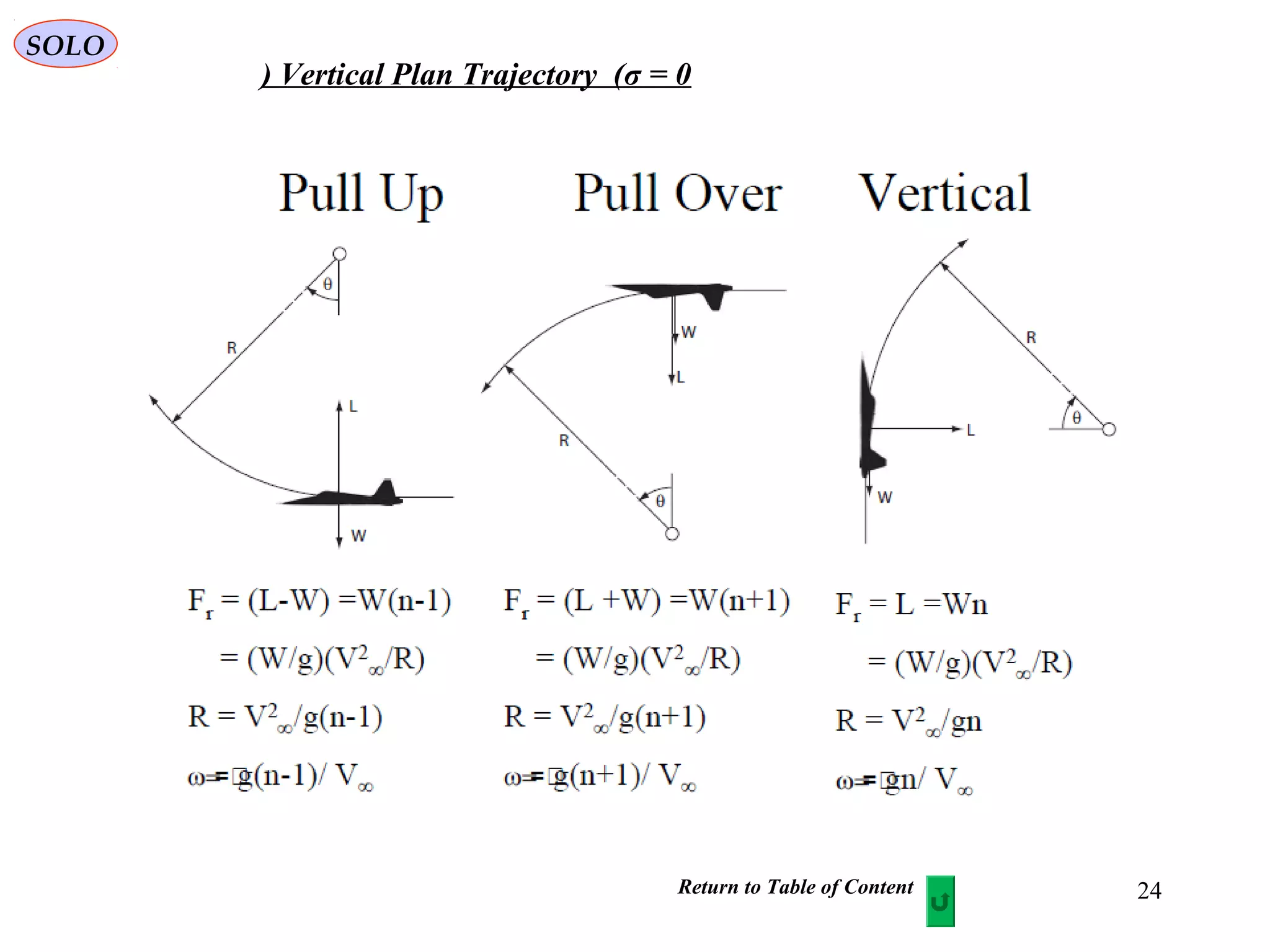
1. Vertical Plan Trajectory (σ = 0)
( )
γ
γγ
χ
cos'
1
cos'
0
2
−
=
−=
=
ng
V
R
n
V
g


24
Vertical Plan Trajectory (σ = 0)
SOLO
Return to Table of Content
25
Performance of an Aircraft with Parabolic PolarSOLO
2. Horizontal Plan Trajectory ( )0,0 == γγ 
We can see that for n > 1
1
1
1'
1
11'
2
2
2
2
22
−
≈
−
=
−≈−=
ng
V
ng
V
R
n
V
g
n
V
g
χ
We found that
2
2
*
*
u
C
C
n
u
C
nC
L
LL
L =→=
n
1n
2n
MAXn
u u
LC
MAXLC _
1
_
n
C
C
MAXL
L
MAX
MAXL
L
corner n
C
C
u
_
*
=
*2 L
MAX
L C
u
n
C =
MAX
MAXL
L
corner n
C
C
u
_
*
= MAX
L
L
n
C
C
1
*
MAXLC _
2LC
1LC
2
*
1
u
C
C
n
L
L
=
MAXn
n, CL as a function of u
Aircraft Turn Performance










=
=
=
2
0
*
2
1
:*
*
:
2
:*
Vq
V
V
u
CS
kW
V
D
ρ
ρ
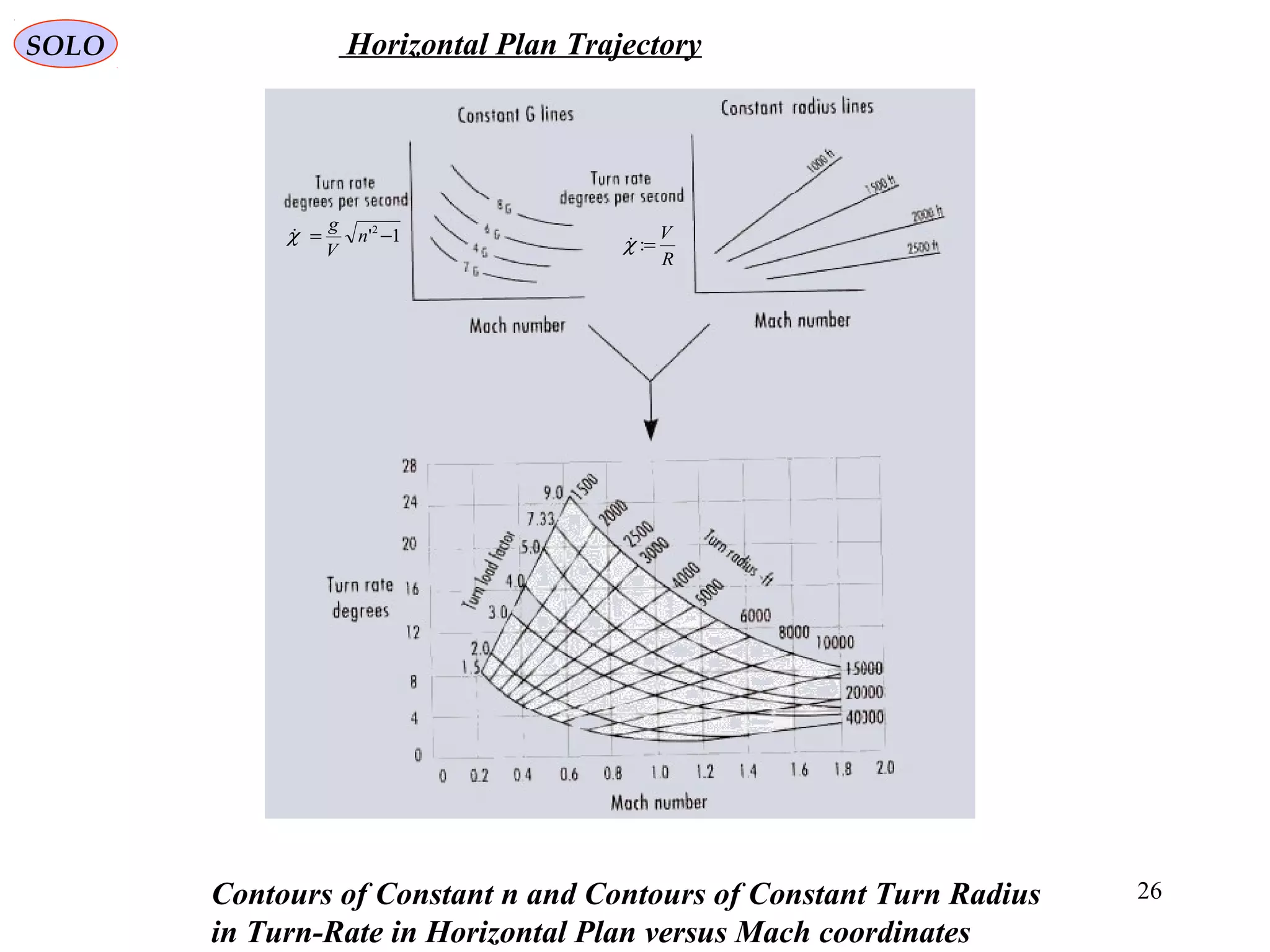
26
R
V
=:χ1'2
−= n
V
g
χ
Contours of Constant n and Contours of Constant Turn Radius
in Turn-Rate in Horizontal Plan versus Mach coordinates
Horizontal Plan TrajectorySOLO
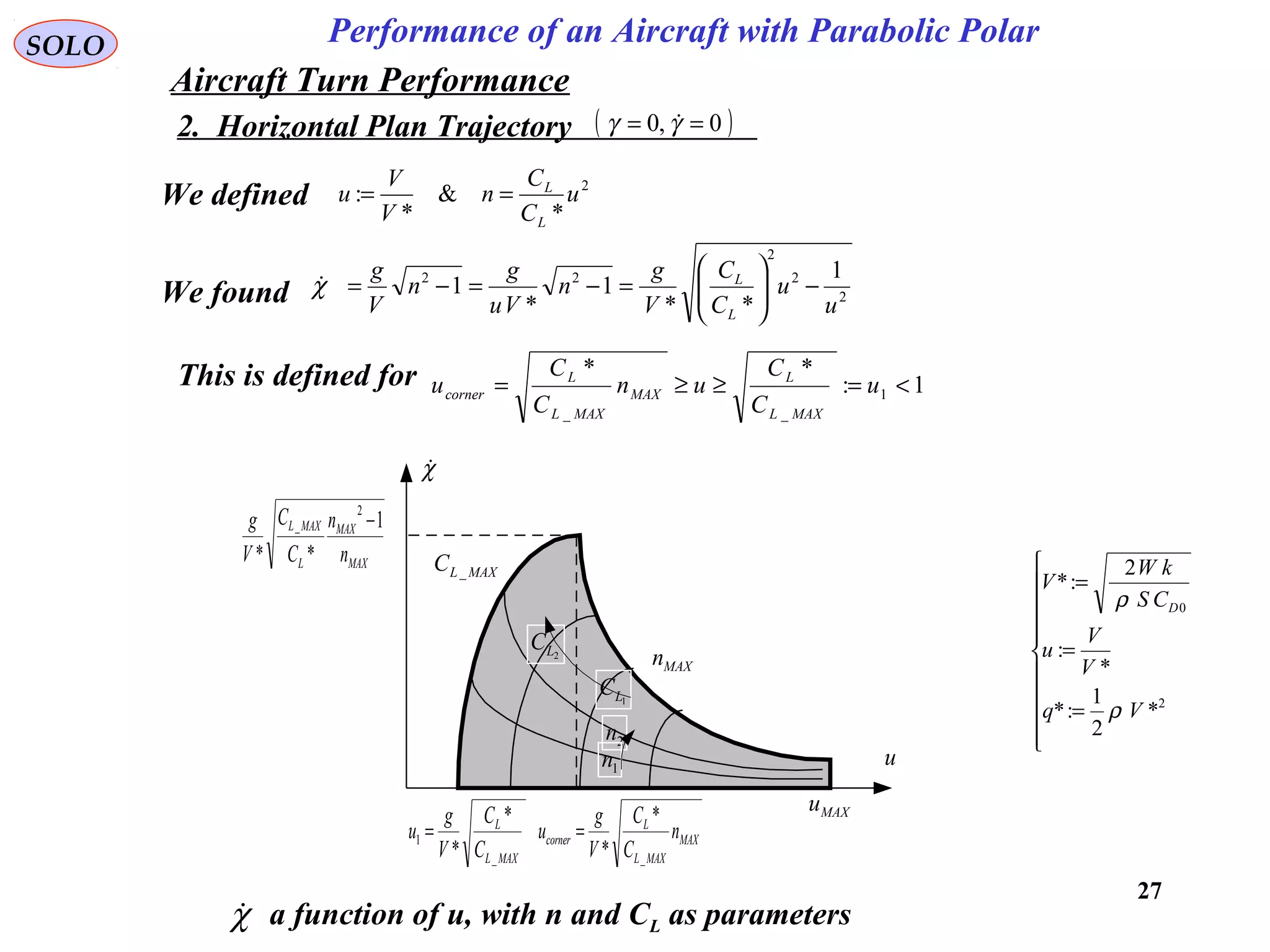
27
Performance of an Aircraft with Parabolic PolarSOLO
MAX
MAX
L
MAXL
n
n
C
C
V
g 1
**
2
_ −
MAX
MAXL
L
corner n
C
C
V
g
u
_
*
*
=
MAXL
L
C
C
V
g
u
_
1
*
*
=
MAXn
2n
1n
MAXLC _
2LC
1LC
u
χ
MAXu
a function of u, with n and CL as parametersχ
We defined 2
*
&
*
: u
C
C
n
V
V
u
L
L
==
We found 2
2
2
22 1
**
1
*
1
u
u
C
C
V
g
n
Vu
g
n
V
g
L
L
−





=−=−=χ
This is defined for 1:
**
1
__
<=≥≥= u
C
C
un
C
C
u
MAXL
L
MAX
MAXL
L
corner
2. Horizontal Plan Trajectory ( )0,0 == γγ 
Aircraft Turn Performance










=
=
=
2
0
*
2
1
:*
*
:
2
:*
Vq
V
V
u
CS
kW
V
D
ρ
ρ
28
Performance of an Aircraft with Parabolic PolarSOLO
From
2
2
2
22 1
**
1
*
1
u
u
C
C
V
g
n
Vu
g
n
V
g
L
L
−





=−=−=χ
4
2
2
2
22
1
*
1*
1
*
:
uC
Cg
V
n
u
g
VV
R
L
L
−





=
−
==
χ
Therefore
cornerMAX
MAXL
L
MAXL
L
L
MAXL
C
un
C
C
u
C
C
u
uC
Cg
V
R
MAXL
=≤≤=
−





=
__
1
4
2
_
2
**
1
*
1*
_
cornerMAX
MAXL
L
MAX
n
un
C
C
u
n
u
g
V
R
MAX
=≥
−
=
_
2
22
*
1
*
MAX
L
L
L
L
L
L
C
n
C
C
u
C
C
u
uC
Cg
V
R
L
**
1
*
1*
1
4
2
2
≤≤=
−





=
n
C
C
u
n
u
g
V
R
MAXL
L
n
_
2
22
*
1
*
≥
−
=
2. Horizontal Plan Trajectory ( )0,0 == γγ 
Aircraft Turn Performance
29
Performance of an Aircraft with Parabolic PolarSOLO
R (Radius of Turn) a function of u, with n and CL as parameters
1
**
2
_
2
−MAX
MAX
MAXL
L
n
n
C
C
g
V
MAX
MAXL
L
corner n
C
C
V
g
u
_
*
*
=
MAXL
L
C
C
V
g
u
_
1
*
*
=
MAXn
2n
1nMAXLC _
2LC 1LC
u
R
4
2
2
2
22
1
*
1*
1
*
:
uC
Cg
V
n
u
g
VV
R
L
L
−





=
−
==
χ
2. Horizontal Plan Trajectory ( )0,0 == γγ 
Return to Table of Content
Aircraft Turn Performance










=
=
=
2
0
*
2
1
:*
*
:
2
:*
Vq
V
V
u
CS
kW
V
D
ρ
ρ
30
Performance of an Aircraft with Parabolic PolarSOLO
Horizontal Turn Rate as Function of ps, n
( )
u
nuzu
e
V
ps
224
2
*2
* −+−
=
up
V
e
uzun s
*
*2
2 242
−+−=
2
24
2
2 1
*
*2
2
*
1
* u
up
V
e
uzu
V
g
u
n
V
g s −−+−
=
−
=χ
2
24
4
2423
1
*
*2
2
2
1
*
*2
22
*
*2
44
*
u
up
V
e
uzu
u
up
V
e
uzuuup
V
e
uzu
V
g
u
s
ss
−−+−






−−+−−





−+−
=
∂
∂ χ
Therefore






−−+−
++−
=
∂
∂
1
*
*2
2
1
*
*
* 244
4
up
V
e
uzuu
up
V
e
u
V
g
u
s
s
χ
For ps = 0
2
22
12
24
0
11
12
*
uzzuzzu
u
uzu
V
g
sp
=−+<<−−=
−+−
==
χ
( ) 2
22
1
244
4
0
11
12
1
*
uzzuzzu
uzuu
u
V
g
u
sp
=−+<<−−=
−+−
+−
=
∂
∂
=
χ
Aircraft Turn Performance
31
Performance of an Aircraft with Parabolic PolarSOLO
Horizontal Turn Rate as Function of ps, n
For ps = 0
2
22
12
24
0
11
12
*
uzzuzzu
u
uzu
V
g
sp
=−+<<−−=
−+−
==
χ
( ) 2
22
1
244
4
0
11
12
1
*
uzzuzzu
uzuu
u
V
g
u
sp
=−+<<−−=
−+−
+−
=
∂
∂
=
χ
Let find the maximum of as a function of uχ
( )12
1
* 244
4
0 −+−
+−
=
∂
∂
= uzuu
u
V
g
u
sp
χ
( ) ( )12
*
1 00
−=== ==
z
V
g
u
ss ppMAX χχ 
u 0 u1 1 (u1+u2)/2 u2
∞ + + 0 - - - - - - -∞
↑ Max ↓
u∂
∂ χ
χ
From
2
24
1
*
*2
2
* u
up
V
e
uzu
V
g s −−+−
=χ






−−+−
++−
=
∂
∂
1
*
*2
2
1
*
*
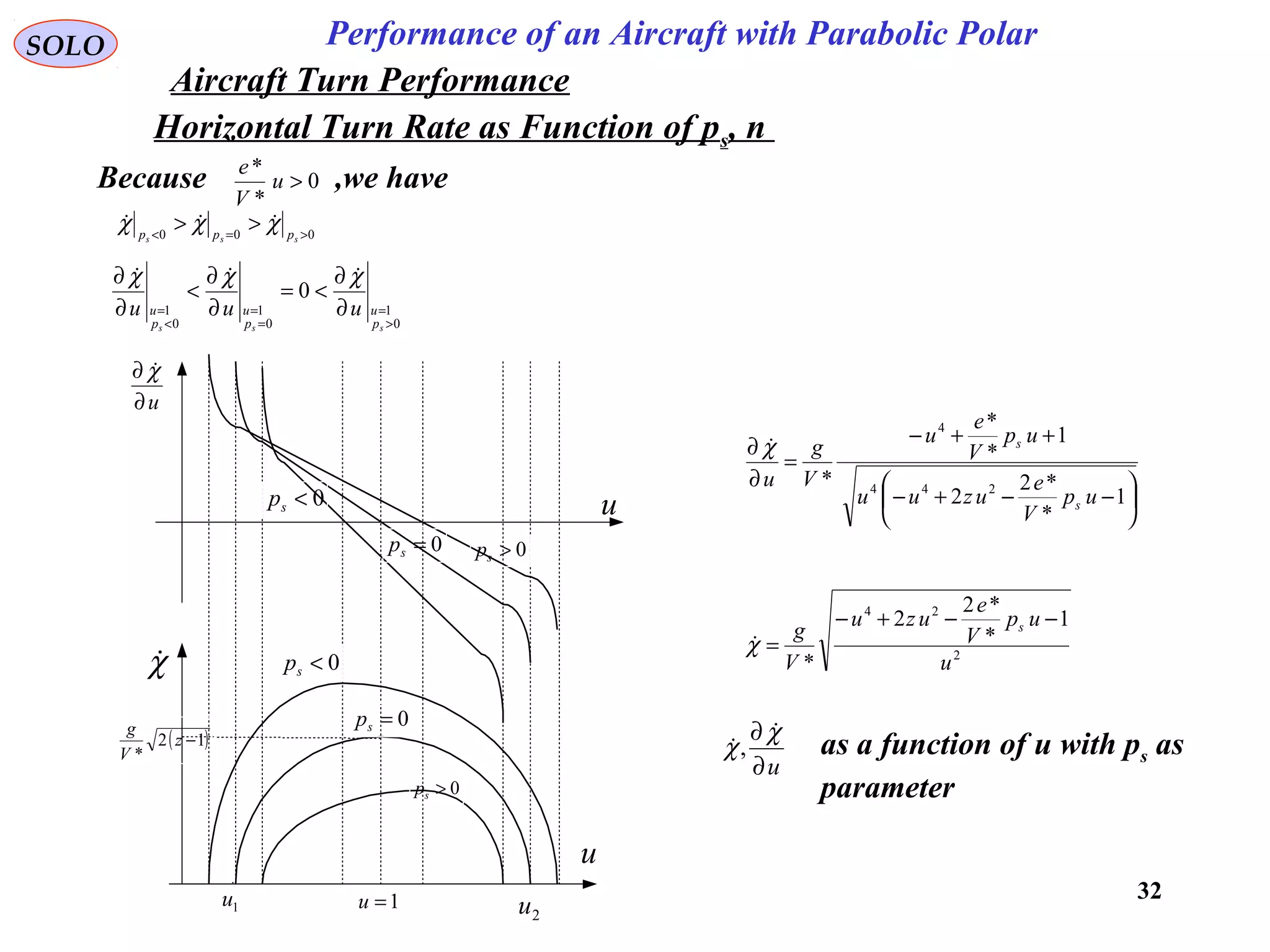
* 244
4
up
V
e
uzuu
up
V
e
u
V
g
u
s
s
χ
Aircraft Turn Performance
32
Performance of an Aircraft with Parabolic PolarSOLO
Horizontal Turn Rate as Function of ps, n
u
u
0<sp
0<sp
0=sp
0=sp 0>sp
0>sp
χ
u∂
∂ χ
( )12
*
−z
V
g
1=u1u
2u
as a function of u with ps as
parameter
u∂
∂ χ
χ

,






−−+−
++−
=
∂
∂
1
*
*2
2
1
*
*
* 244
4
up
V
e
uzuu
up
V
e
u
V
g
u
s
sχ
2
24
1
*
*2
2
* u
up
V
e
uzu
V
g s −−+−
=χ
Because ,we have0
*
*
>u
V
e
000 >=<
>>
sss ppp
χχχ 
0
1
0
1
0
1
0
>
=
=
=
<
= ∂
∂
<=
∂
∂
<
∂
∂
sss p
u
p
u
p
u uuu
χχχ 
Aircraft Turn Performance
33
Performance of an Aircraft with Parabolic PolarSOLO
Horizontal Turn Rate as Function of ps, n
u
0<sp
0=sp
0>sp
χ
( )12
*
−z
V
g
1=u1u
2u
2
24
1
*
*2
2
* u
up
V
e
uzu
V
g s −−+−
=χ
1
*
2
−MAXn
uV
g
2
2
2
_ 1
** u
u
C
C
V
g
L
MAXL
−





MAXL
L
C
C
_
*
MAX
MAXL
L
n
C
C
_
*
LIMIT
nMAX
LIMIT
C MAXL_
MAX
MAX
L
MAXL
n
n
C
C
V
g 1
**
2
_ −
a function of u, with ps
as parameter
χ
2
24
1
*
*2
2
* u
up
V
e
uzu
V
g s −−+−
=χ
Aircraft Turn Performance










=
=
=
2
0
*
2
1
:*
*
:
2
:*
Vq
V
V
u
CS
kW
V
D
ρ
ρ
34
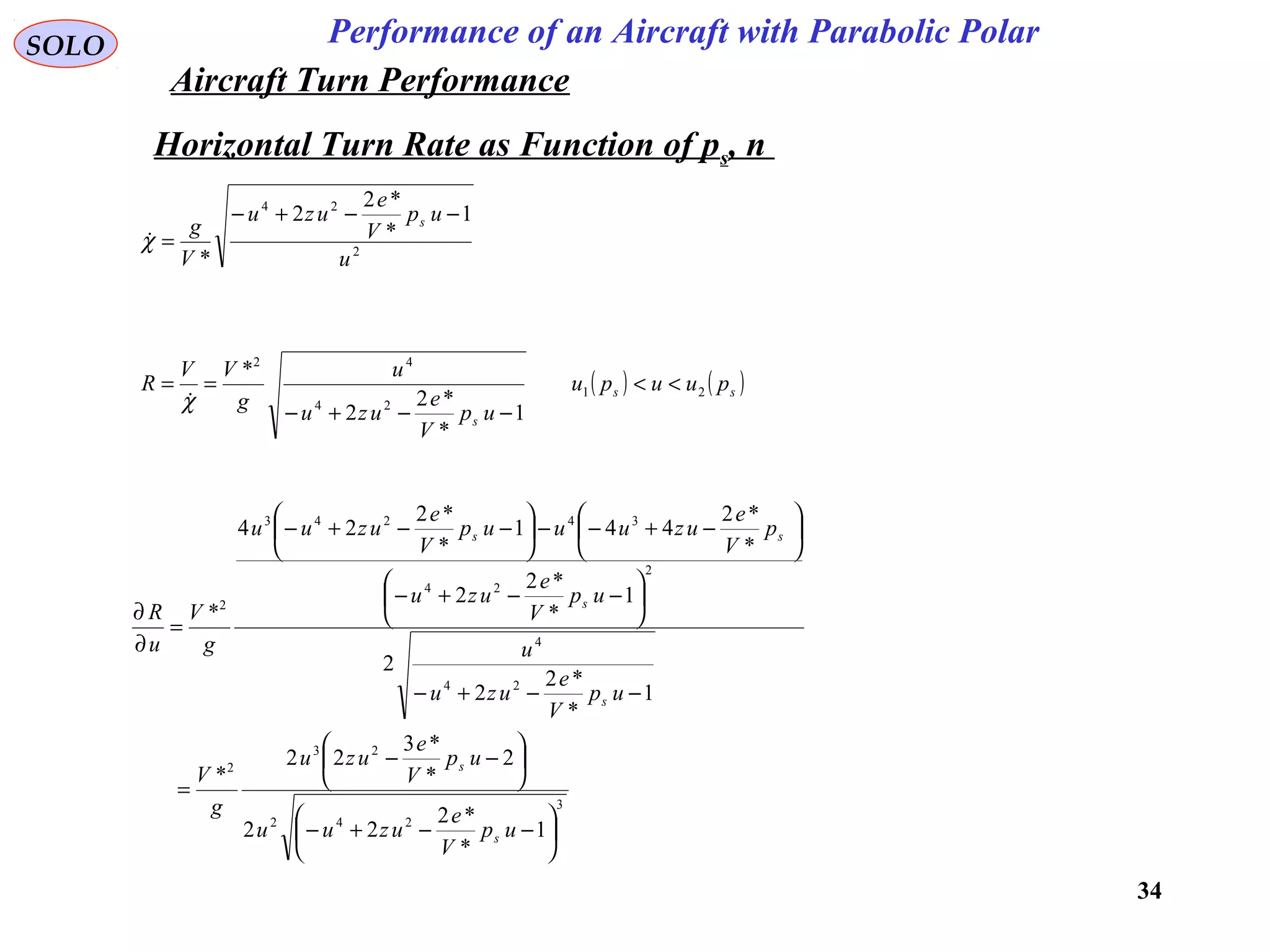
Performance of an Aircraft with Parabolic PolarSOLO
Horizontal Turn Rate as Function of ps, n
2
24
1
*
*2
2
* u
up
V
e
uzu
V
g s −−+−
=χ
( ) ( )ss
s
puupu
up
V
e
uzu
u
g
VV
R 21
24
42
1
*
*2
2
*
<<
−−+−
==
χ
3
242
23
2
24
4
2
24
34243
2
1
*
*2
22
2
*
*3
22
*
1
*
*2
2
2
1
*
*2
2
*
*2
441
*
*2
24
*






−−+−






−−
=
−−+−






−−+−






−+−−





−−+−
=
∂
∂
up
V
e
uzuu
up
V
e
uzu
g
V
up
V
e
uzu
u
up
V
e
uzu
p
V
e
uzuuup
V
e
uzuu
g
V
u
R
s
s
s
s
ss
Aircraft Turn Performance
35
Performance of an Aircraft with Parabolic PolarSOLO
Horizontal Turn Rate as Function of ps, n
3
24
2
2
1
*
*2
2
2
*
*3
2
*






−−+−






−−
=
∂
∂
up
V
e
uzu
up
V
e
uzu
g
V
u
R
s
s
or
We have











>
+





+
=
<
+





−
=
→=
∂
∂
0
4
16
*
*
9
*
*3
0
4
16
*
*
9
*
*3
0
2
2
2
1
z
zp
V
e
up
V
e
u
z
zp
V
e
up
V
e
u
u
R
ss
R
ss
R
u 0 u1 uR2 u2
∞ - - - 0 + + ∞
↓ min ↑
u
R
∂
∂
R
2
22
124
42
0
11
12
*
uzzuzzu
uzu
u
g
V
R
sp
=−+<<−−=
−+−
==
( )
( )
2
22
1
324
22
0
11
12
1*2
uzzuzzu
uzu
uzu
g
V
u
R
sp
=−+<<−−=
−+−
−
=
∂
∂
=
Aircraft Turn Performance
36
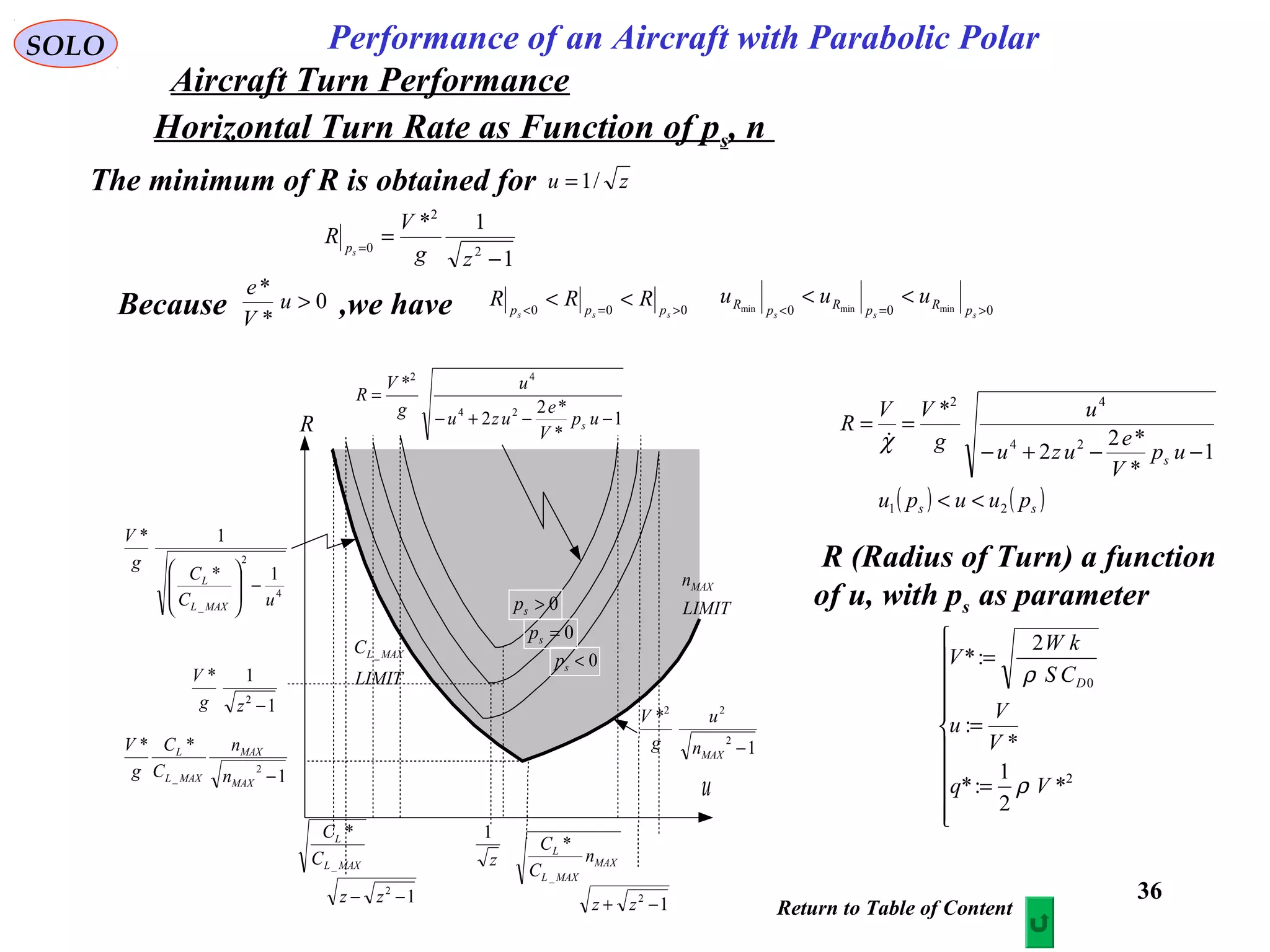
Performance of an Aircraft with Parabolic PolarSOLO
Horizontal Turn Rate as Function of ps, n
u
R
0>sp
0=sp
0<sp
MAXL
L
C
C
_
*
1
**
2
_ −MAX
MAX
MAXL
L
n
n
C
C
g
V
1
1*
2
−zg
V
4
2
_
1*
1*
uC
C
g
V
MAXL
L
−








1
*
2
22
−MAXn
u
g
V
MAX
MAXL
L
n
C
C
_
*
LIMIT
C MAXL_
LIMIT
nMAX
z
1
12
−− zz 12
−+ zz
1
*
*2
2
*
24
42
−−+−
=
up
V
e
uzu
u
g
V
R
s
The minimum of R is obtained for zu /1=
1
1*
2
2
0
−
==
zg
V
R
sp
R (Radius of Turn) a function
of u, with ps as parameter
( ) ( )ss
s
puupu
up
V
e
uzu
u
g
VV
R
21
24
42
1
*
*2
2
*
<<
−−+−
==
χ
Return to Table of Content
Because ,we have0
*
*
>u
V
e
000 >=<
<<
sss ppp
RRR 000 minminmin >=<
<<
sss pRpRpR uuu
Aircraft Turn Performance










=
=
=
2
0
*
2
1
:*
*
:
2
:*
Vq
V
V
u
CS
kW
V
D
ρ
ρ
37
Performance of an Aircraft with Parabolic PolarSOLO
Horizontal Turn Rate as Function of nV,
( )
W
VDT
g
VV
hEps
−
≈+==

:
For an horizontal turn 0=h
V
g
Vu
g
VV
ps

 *
==
We found
2
24
1
*
*2
2
* u
up
V
e
uzu
V
g s −−+−
=χ
from which
2
24
1*2
* u
ue
g
V
zu
V
g
−





−+−
=

χ
defined for
2
22
1 :1**1**: ue
g
V
ze
g
V
zue
g
V
ze
g
V
zu =−





−+





−≤≤−





−−





−=

Aircraft Turn Performance
38
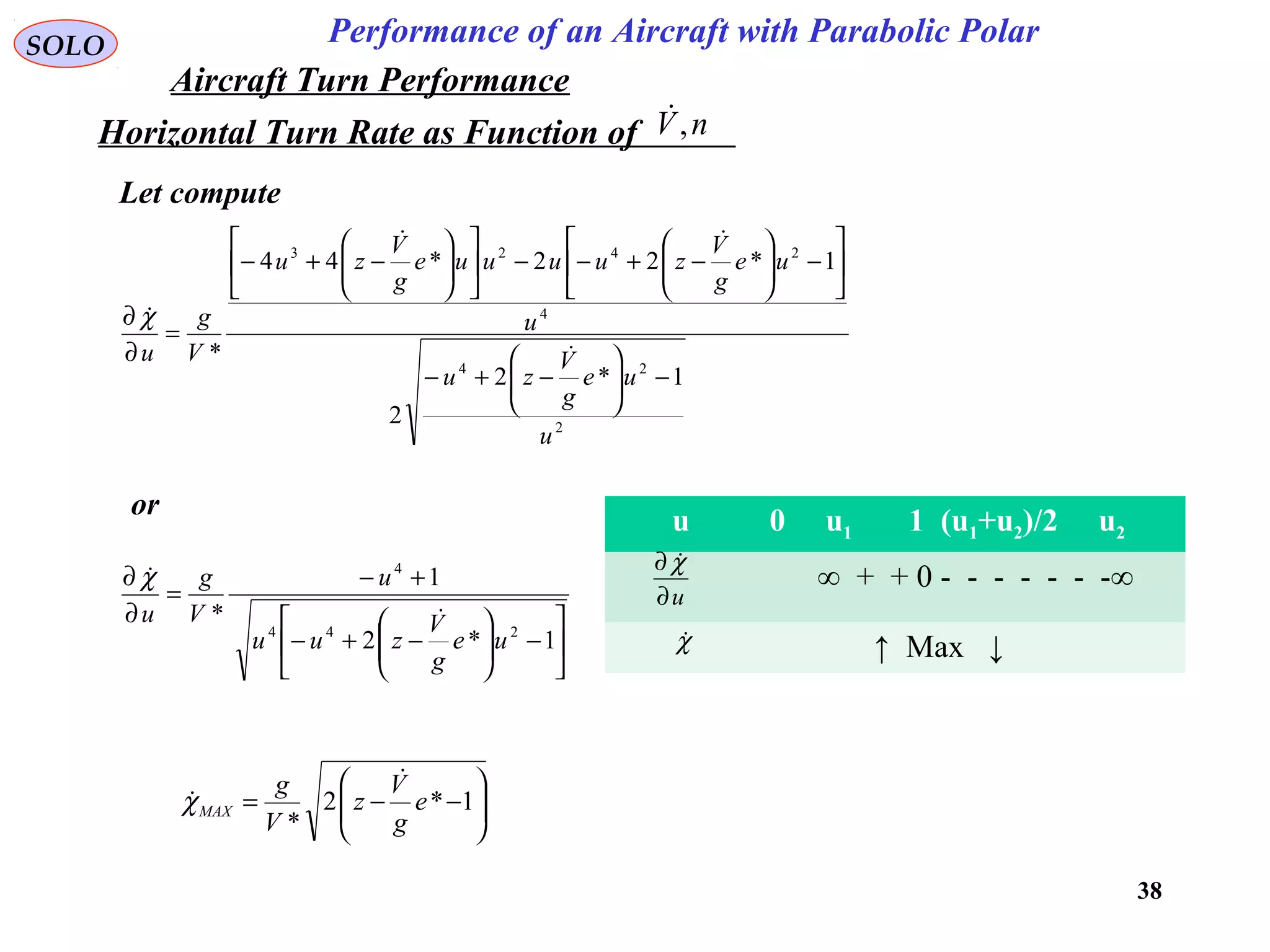
Performance of an Aircraft with Parabolic PolarSOLO
Horizontal Turn Rate as Function of nV,
Let compute
2
24
4
2423
1*2
2
1*22*44
*
u
ue
g
V
zu
u
ue
g
V
zuuuue
g
V
zu
V
g
u
−





−+−






−





−+−−











−+−
=
∂
∂


χ






−





−+−
+−
=
∂
∂
1*2
1
*
244
4
ue
g
V
zuu
u
V
g
u 
χ
or
u 0 u1 1 (u1+u2)/2 u2
∞ + + 0 - - - - - - -∞
↑ Max ↓
u∂
∂ χ
χ






−−= 1*2
*
e
g
V
z
V
g
MAX

χ
Aircraft Turn Performance
39
Performance of an Aircraft with Parabolic PolarSOLO
Horizontal Turn Rate as Function of nV,
u
0<V
0=V
0>V
χ
( )12
*
−z
V
g
1=u1u
2u
2
24
1*2
* u
ue
g
V
zu
V
g
−





−+−
=

χ
1
*
2
−MAXn
uV
g
2
2
2
_ 1
** u
u
C
C
V
g
L
MAXL
−





MAXL
L
C
C
_
*
MAX
MAXL
L
n
C
C
_
*
LIMIT
nMAXLIMIT
C MAXL_
MAX
MAX
L
MAXL
n
n
C
C
V
g 1
**
2
_ −
as function of u
and as parameter
χ
V
Return to Table of Content
Aircraft Turn Performance










=
=
=
2
0
*
2
1
:*
*
:
2
:*
Vq
V
V
u
CS
kW
V
D
ρ
ρ
08/12/15 40
Performance of an Aircraft with Parabolic PolarSOLO
References
Angelo Miele, “Flight Mechanics, Volume I, Theory of Flight Paths”,
Addison-Wesley, 1962
Return to Table of Content
S. Hermelin, “3 DOF Model of Aircraft in Earth Atmosphere”
41
SOLO
Technion
Israeli Institute of Technology
1964 – 1968 BSc EE
1968 – 1971 MSc EE
Israeli Air Force
1970 – 1974
RAFAEL
Israeli Armament Development Authority
1974 – 2013
Stanford University
1983 – 1986 PhD AA

12 performance of an aircraft with parabolic polar

  • 1.
    08/12/15 1 Performance ofan Aircraft with Parabolic Polar SOLO HERMELIN Updated: 14.03.2004
  • 2.
    08/12/15 2 Performance ofan Aircraft with Parabolic PolarSOLO Table of Content Flat Earth Three Degrees of Freedom Aircraft Equations Performance of an Aircraft with Parabolic Polar Aircraft Drag Energy per unit mass E Load Factor n Aircraft Trajectories Summary Constraints Horizontal Plan Trajectory ( )0,0 == γγ  Horizontal Turn Rate as Function of ps, n Horizontal Turn Rate as Function of nV, References
  • 3.
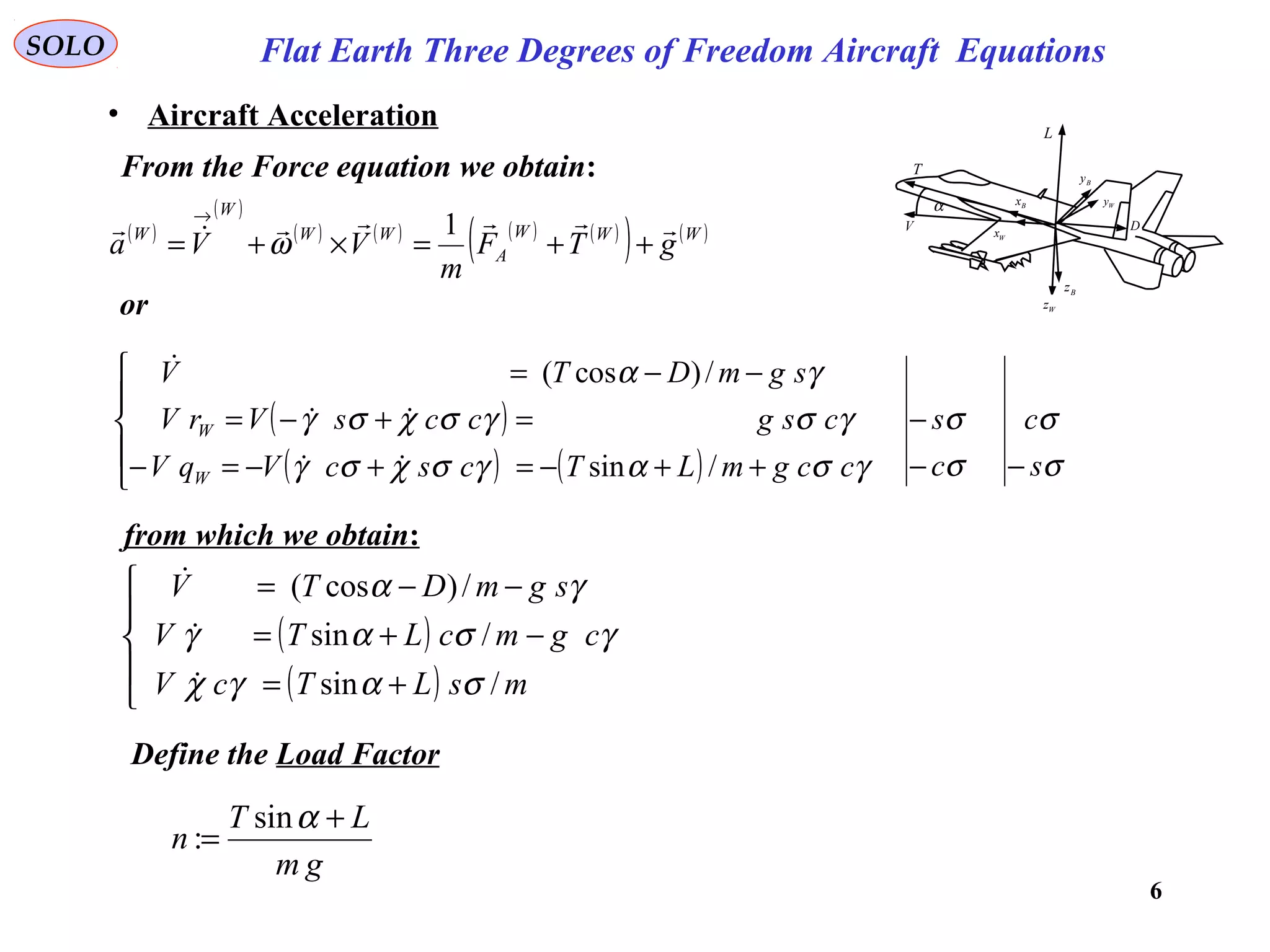
    08/12/15 3 SOLO Assumptions: •Point massmodel. •Flat earth with g = constant. •Three-dimensional aircraft trajectory. •Air density that varies with altitude ρ=ρ(h) •Drag that varies with altitude, Mach number and control effort D = D(h,M,n) •Thrust magnitude is controllable by the throttle. •No sideslip angle. •No wind. α T V L D Bx Wx Bz Wz Wy By Aircraft Coordinate System Flat Earth Three Degrees of Freedom Aircraft Equations
  • 4.
    4 SOLO • Rotation Matrixfrom Earth to Wind Coordinates [ ] [ ] [ ]321 χγσ=W EC where σ – Roll Angle γ – Elevation Angle of the Trajectory χ – Azimuth Angle of the Trajectory Force Equation: amgmTFA  =++ where: • Aerodynamic Forces (Lift L and Drag D) ( )           − − = L D F W A 0  • Thrust T ( )           = α α sin 0 cos T T T W  • Gravitation acceleration ( ) ( )                     −           −           − == g cs sc cs sc cs scgCg EW E W 0 0 100 0 0 0 010 0 0 0 001 χχ χχ γγ γγ σσ σσ ( ) g cc cs s g W          − = γσ γσ γ  α T V L D Bx Wx Bz Wz Wy By Flat Earth Three Degrees of Freedom Aircraft Equations
  • 5.
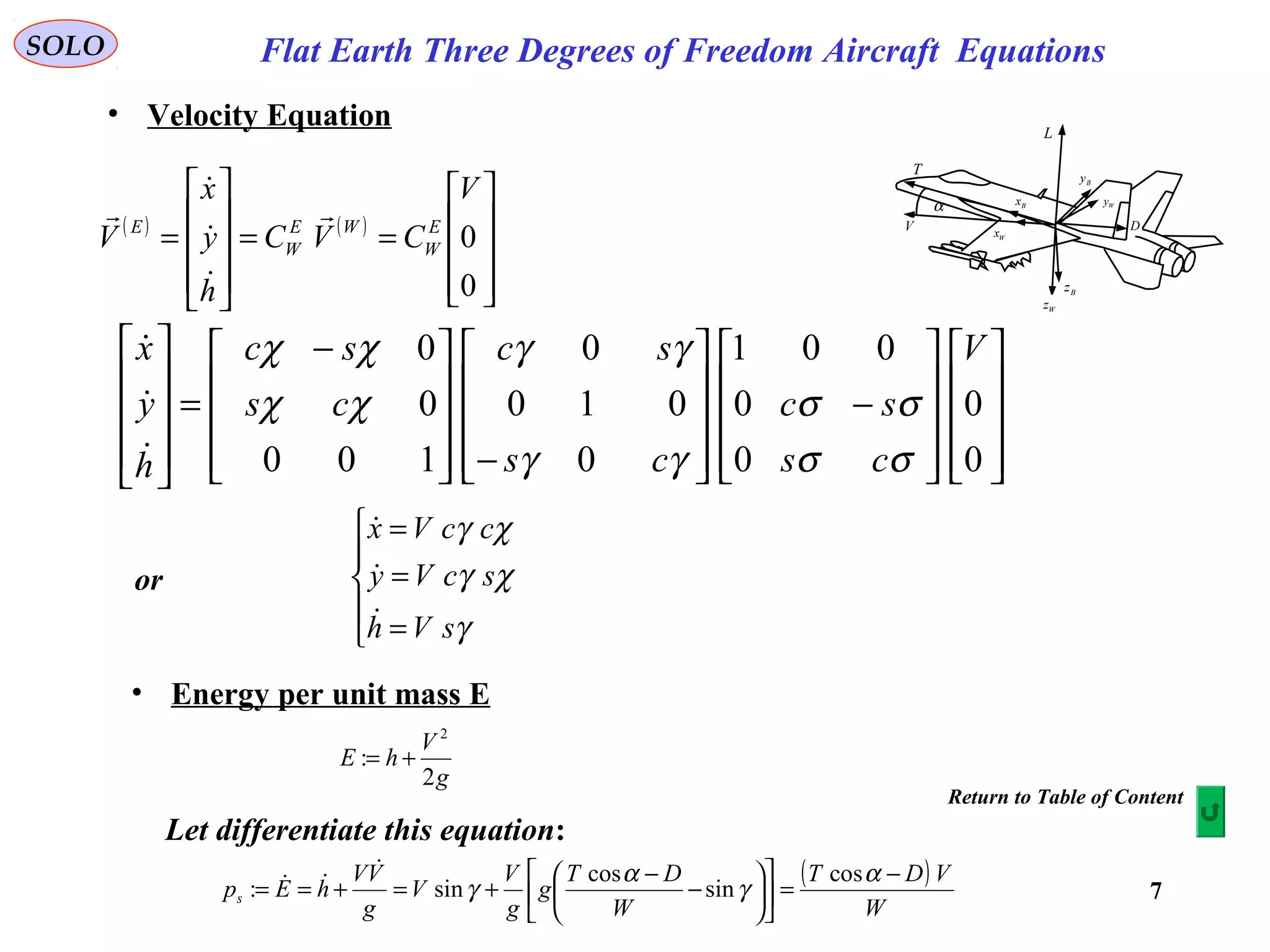
    5 SOLO α T V L D Bx Wx Bz Wz Wy By • Aircraft Acceleration () ( ) ( ) ( )WW W W VVa  ×+= → ω where: ( )           = 0 0 V V W  and ( )           = → 0 0 V V W   ( )                                         −+                     − +                     − =           = χ χχ χχ γ γγ γγσ σσ σσω     0 0 100 0 0 0 0 0 010 0 0 0 0 0 001 cs sc cs sc cs sc r q p W W W W or ( )           +− + − =           = γσχσγ γσχσγ γχσ ω ccs csc s r q p W W W W     therefore ( ) ( ) ( ) ( ) ( ) ( )           +− +−=           − =×+= → γσχσγ γσχσγω cscV ccsV V qV rV V VVa W W WW W W     Flat Earth Three Degrees of Freedom Aircraft Equations
  • 6.
    6 SOLO α T V L D Bx Wx Bz Wz Wy By • Aircraft Acceleration FlatEarth Three Degrees of Freedom Aircraft Equations From the Force equation we obtain: ( ) ( ) ( ) ( ) ( ) ( ) ( ) ( )WWW A WW W W gTF m VVa  ++=×+= → 1 ω or ( ) ( ) ( ) σ σ σ σ γσαγσχσγ γσγσχσγ γα s c c s ccgmLTcscVqV csgccsVrV sgmDTV W W −− −      ++−=+−=− =+−= −−= /sin /)cos(    from which we obtain: ( ) ( )     += −+= −−= msLTcV cgmcLTV sgmDTV /sin /sin /)cos( σαγχ γσαγ γα    Define the Load Factor gm LT n + = αsin :
  • 7.
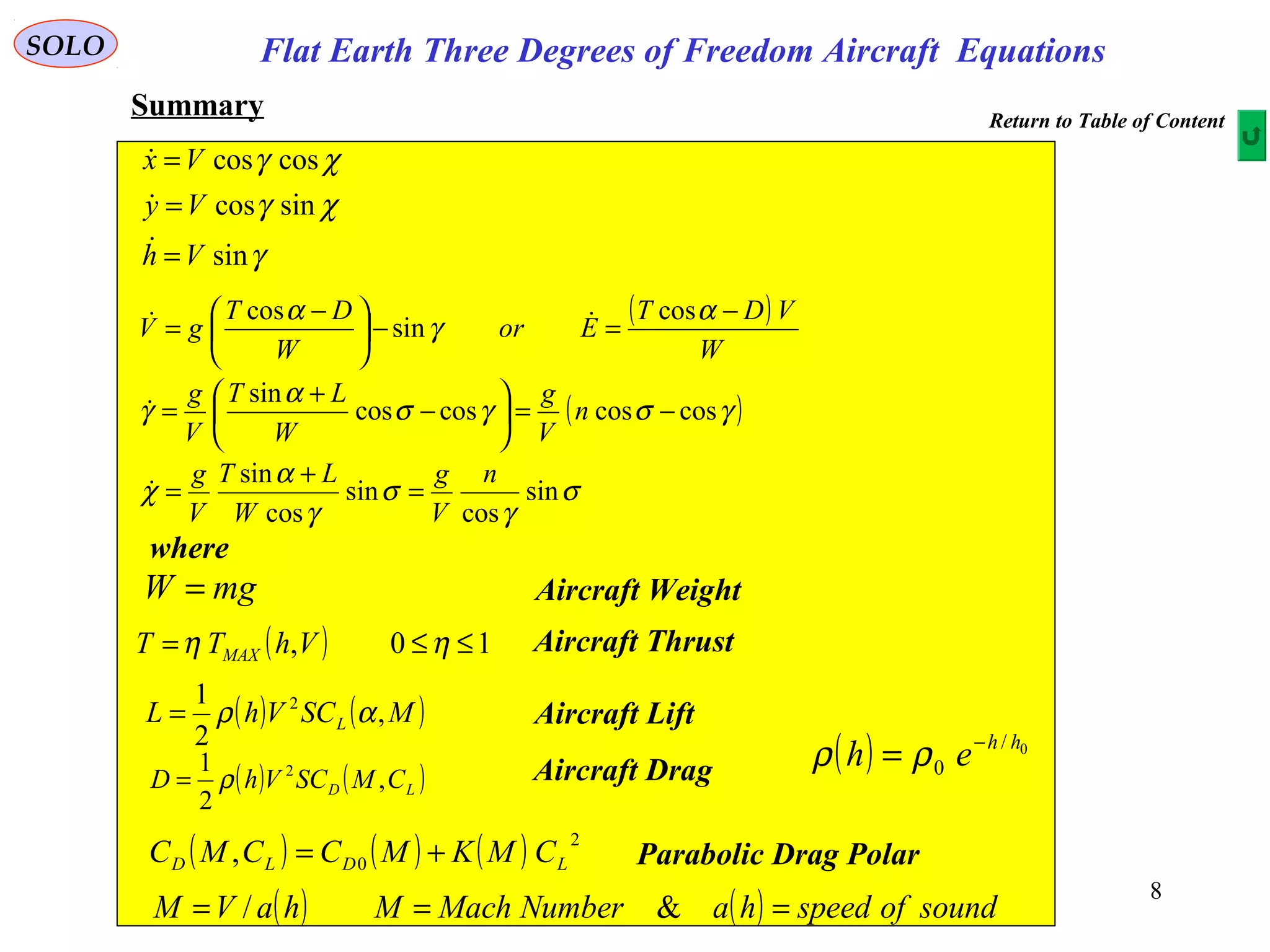
    7 SOLO α T V L D Bx Wx Bz Wz Wy By • Velocity Equation FlatEarth Three Degrees of Freedom Aircraft Equations ( ) ( )           ==           = 0 0 V CVC h y x V E W WE W E                          −           −          − =           0 0 0 0 001 0 010 0 100 0 0 V cs sc cs sc cs sc h y x σσ σσ γγ γγ χχ χχ         = = = γ χγ χγ sVh scVy ccVx    or • Energy per unit mass E g V hE 2 : 2 += Let differentiate this equation: ( ) W VDT W DT g g V V g VV hEps − =            − − +=+== α γ α γ cos sin cos sin:   Return to Table of Content
  • 8.
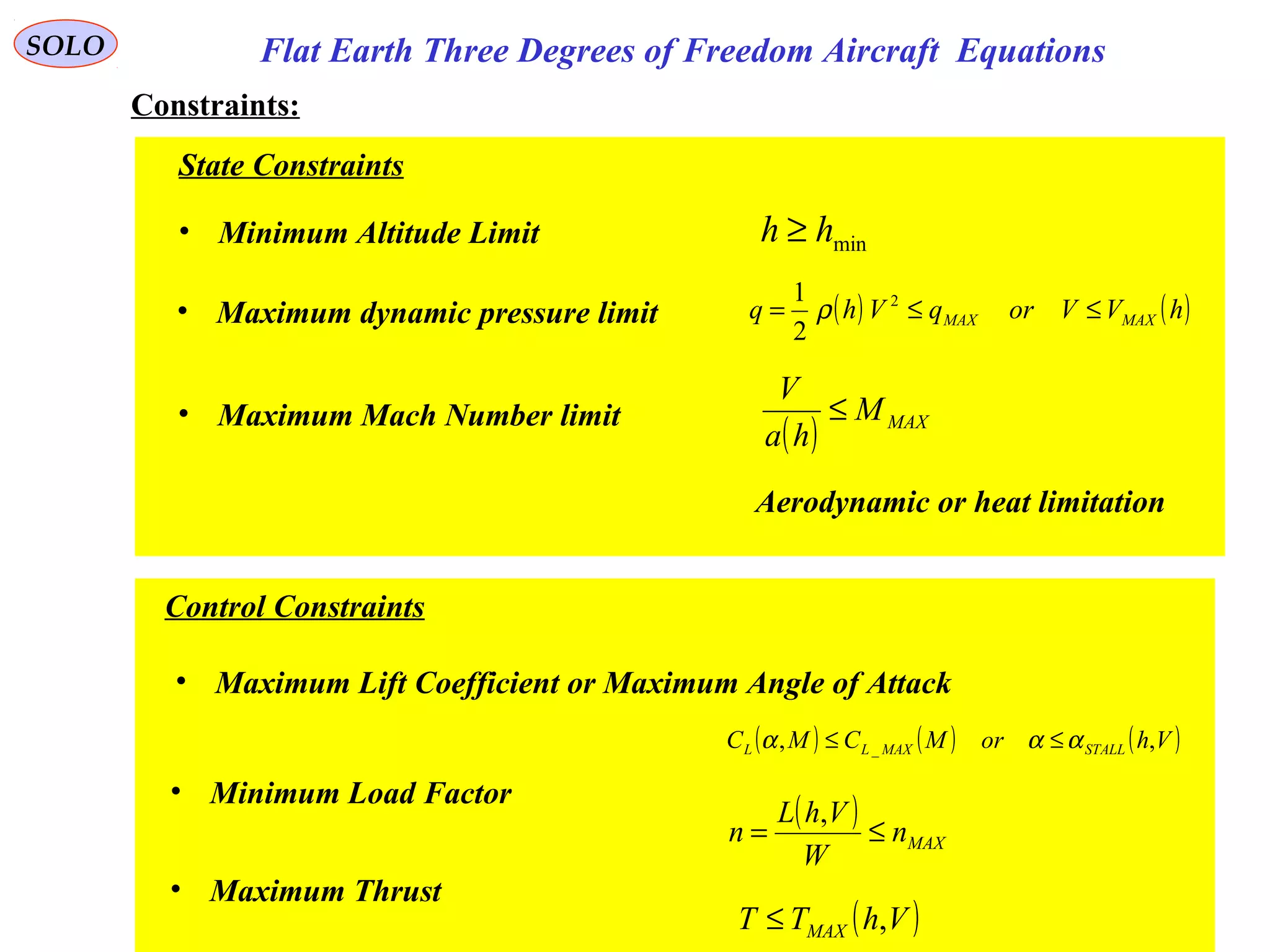
    8 SOLO Flat EarthThree Degrees of Freedom Aircraft Equations Summary γ χγ χγ sin sincos coscos Vh Vy Vx = = =    ( ) ( ) σ γ σ γ α χ γσγσ α γ α γ α sin cos sin cos sin coscoscoscos sin cos sin cos n V g W LT V g n V g W LT V g W VDT Eor W DT gV = + = −=      − + = − =−      − =    where mgW = Aircraft Thrust( ) 10, ≤≤= ηη VhTT MAX ( ) ( )MSCVhL L , 2 1 2 αρ= ( ) ( )LD CMSCVhD , 2 1 2 ρ= ( ) ( ) ( ) 2 0, LDLD CMKMCCMC += ( ) 0/ 0 hh eh − = ρρ ( ) ( ) soundofspeedhaNumberMachMhaVM === &/ Aircraft Weight Aircraft Lift Aircraft Drag Parabolic Drag Polar Return to Table of Content
  • 9.
    9 SOLO Flat EarthThree Degrees of Freedom Aircraft Equations Constraints: State Constraints • Minimum Altitude Limit minhh ≥ • Maximum dynamic pressure limit ( ) ( )hVVorqVhq MAXMAX ≤≤= 2 2 1 ρ • Maximum Mach Number limit ( ) MAXM ha V ≤ Aerodynamic or heat limitation Control Constraints • Maximum Lift Coefficient or Maximum Angle of Attack ( ) ( ) ( )VhorMCMC STALLMAXLL ,, _ ααα ≤≤ • Minimum Load Factor ( ) MAXn W VhL n ≤= , • Maximum Thrust ( )VhTT MAX ,≤
  • 10.
    10 SOLO Flat EarthThree Degrees of Freedom Aircraft Equations MAXα MAXα αα LCDC MAXLC 0DC ( ) ( )αα 2 0 LDD kCCC += Drag and Lift Coefficients as functions of Angle of Attack
  • 11.
    11 SOLO Flat EarthThree Degrees of Freedom Aircraft Equations ( ) ( ) ( ) Limit Vhor MCMC STALL MAXLL , , _ αα α = = ( ) ( ) Limit hVVor qVhq MAX MAX = == 2 2 1 ρ minhh = MAXMM = Mach Altitude Flight Envelope of the Aircraft Return to Table of Content
  • 12.
    12 Performance of anAircraft with Parabolic PolarSOLO W LT n + = αsin :' W L n =: 2 0 : LD L D L CkC C CSq CSq D L e + === We assumed a Parabolic Drag Polar: 2 0 LDD CkCC += Let find the maximum of e as a function of CL ( ) ( ) 0 2 22 0 2 0 22 0 22 0 = + − = + −+ = ∂ ∂ LD LD LD LLD L CkC CkC CkC CkCkC C e e LC*LC *2 1 LCk CL/CD as a function of CL The maximum of e is obtained for k C C D L 0 * = ( ) 0 0 0 2 0 2** D D DLDD C k C kCCkCC =+=+= Start with Load Factor Total Load Number Lift to Drag Ratio Climbing Aircraft Performance
  • 13.
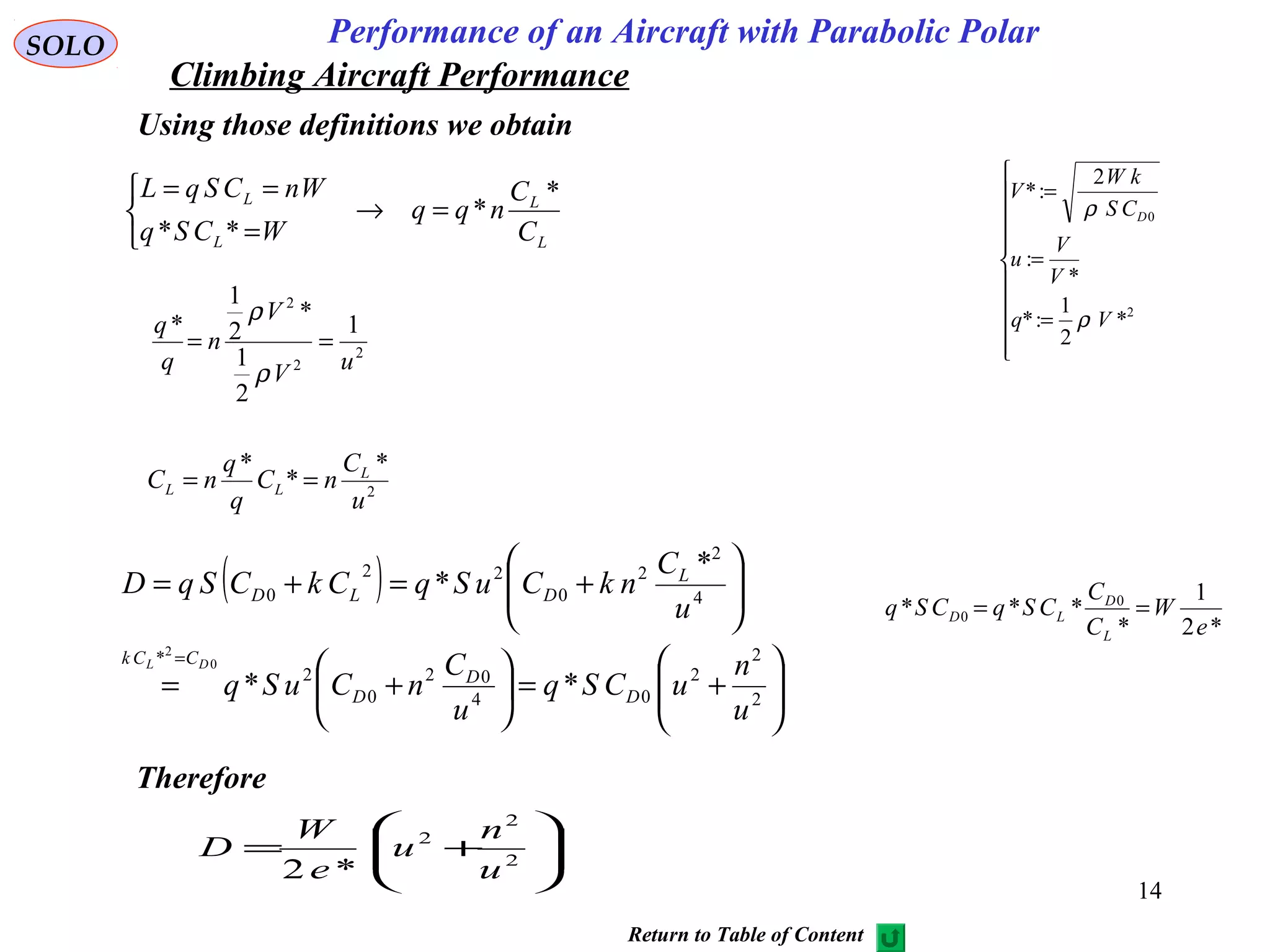
    13 Performance of anAircraft with Parabolic PolarSOLO e LC*LC *2 1 LCk CL/CD as a function of CL The maximum of e is obtained for k C C D L 0 * = ( ) 0 0 0 2 0 2** D D DLDD C k C kCCkCC =+=+= *2 1 *2 1 2 1 2* * * 22 00 0 LLDD D D L CkCkCkC k C C C e ===== We have WnCSVCSqL LL === 2 2 1 ρ Let define for n = 1             = = == 2 0 * 2 1 :* * : 2 * 2 1 :* Vq V V u CS kW CS W V D L ρ ρρ 2 0 : LD L D L CkC C CSq CSq D L e + === Climbing Aircraft Performance
  • 14.
    14 Performance of anAircraft with Parabolic PolarSOLO Using those definitions we obtain L L L L C C nqq WCSq WnCSqL * * ** =→    = == 2 2 2 1 2 1 * 2 1 * uV V n q q == ρ ρ 2 * * * u C nC q q nC L LL == ( )       +=      +=       +=+= = 2 2 2 04 02 0 2 * 4 2 2 0 22 0 ** * * 0 2 u n uCSq u C nCuSq u C nkCuSqCkCSqD D D D CCk L DLD DL *2 1 * *** 0 0 e W C C CSqCSq L D LD ==       += 2 2 2 *2 u n u e W D Therefore Return to Table of Content Climbing Aircraft Performance           = = = 2 0 * 2 1 :* * : 2 :* Vq V V u CS kW V D ρ ρ
  • 15.
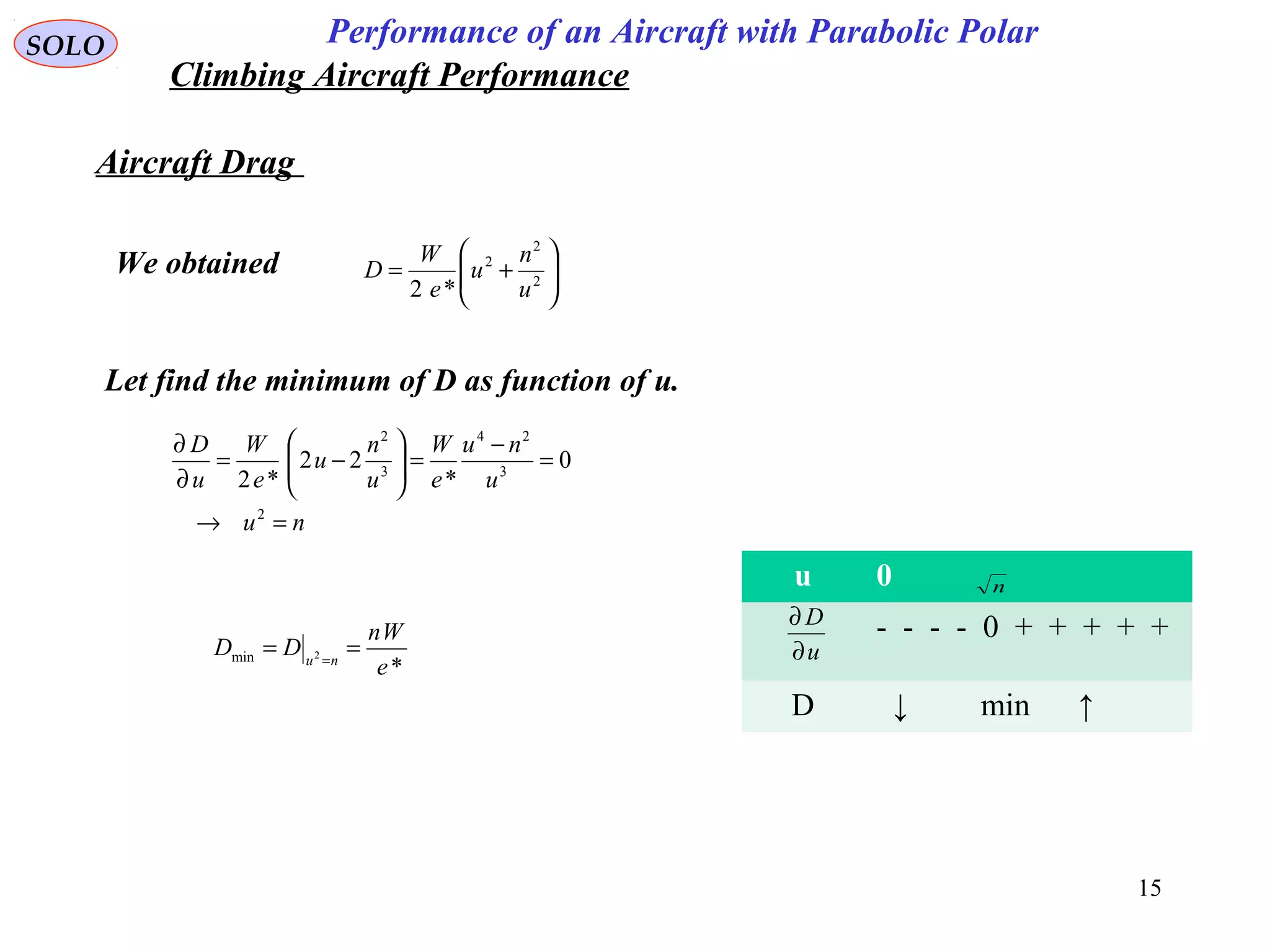
    15 Performance of anAircraft with Parabolic PolarSOLO We obtained Let find the minimum of D as function of u. nu u nu e W u n u e W u D =→ = − =      −= ∂ ∂ 2 3 24 3 2 0 * 22 *2 * 2min e Wn DD nu == = Aircraft Drag Climbing Aircraft Performance u 0 - - - - 0 + + + + + D ↓ min ↑ n u D ∂ ∂       += 2 2 2 *2 u n u e W D
  • 16.
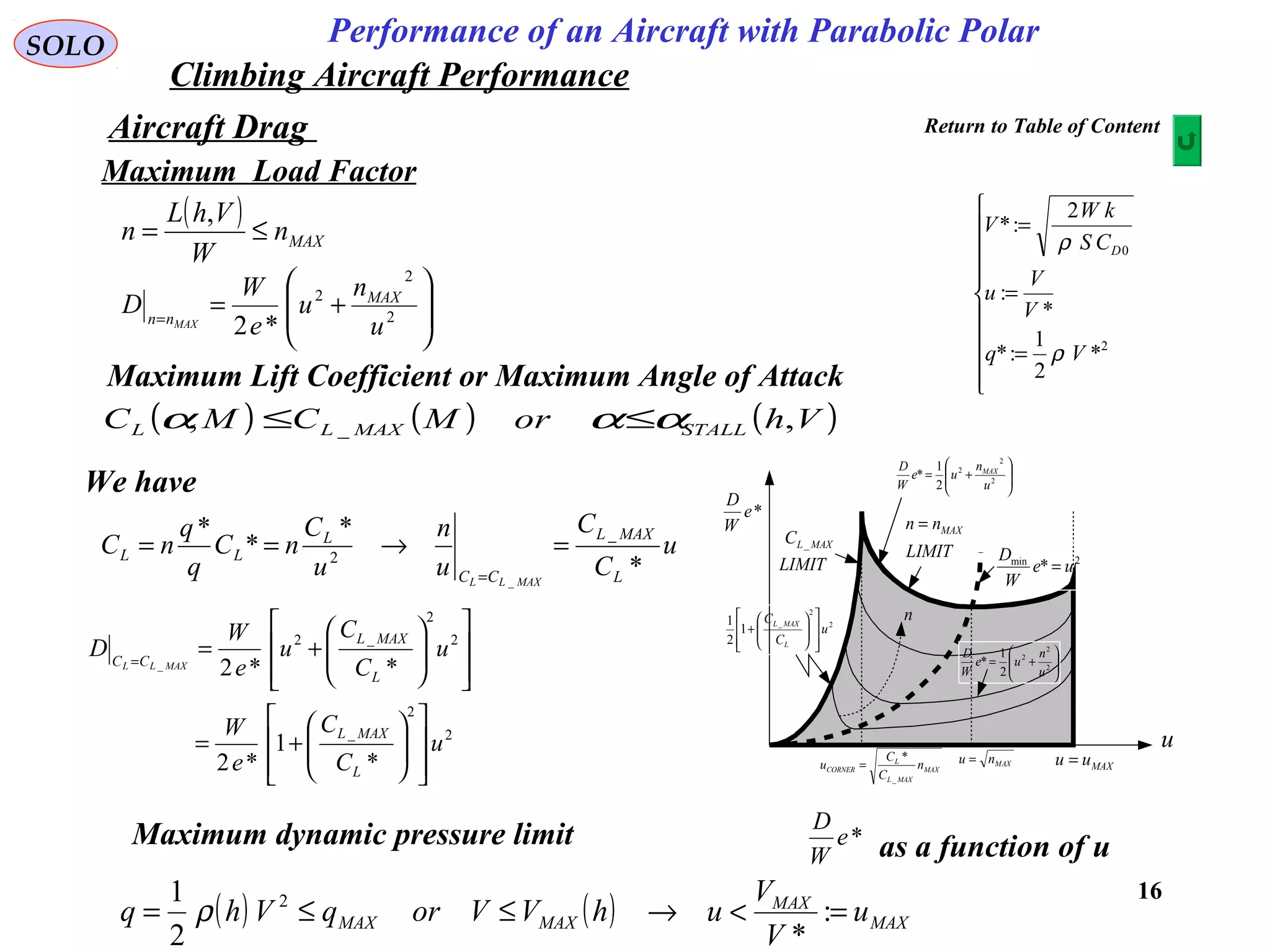
    16 Performance of anAircraft with Parabolic PolarSOLO Aircraft Drag ( ) MAXn W VhL n ≤= ,         +== 2 2 2 *2 u n u e W D MAX nn MAX Maximum Lift Coefficient or Maximum Angle of Attack ( ) ( ) ( )VhorMCMC STALLMAXLL ,, _ ααα ≤≤ We have u C C u n u C nC q q nC L MAXL CC L LL MAXLL * * * * _ 2 _ =→== = 2 2 _ 2 2 _2 * 1 *2 **2_ u C C e W u C C u e W D L MAXL L MAXL CC MAXLL               +=               +== Maximum dynamic pressure limit ( ) ( ) MAX MAX MAXMAX u V V uhVVorqVhq =<→≤≤= : *2 1 2 ρ *e W D MAXLC _ 2 2 _ 1 2 1 u C C L MAXL               +         += 2 2 2 2 1 * u n ue W D MAX LIMIT nn MAX= 2min * ue W D =       += 2 2 2 2 1 * u n ue W D MAXuu =MAX MAXL L CORNER n C C u _ * = n LIMIT u MAXnu = as a function of u*e W D Return to Table of Content Climbing Aircraft Performance Maximum Load Factor           = = = 2 0 * 2 1 :* * : 2 :* Vq V V u CS kW V D ρ ρ
  • 17.
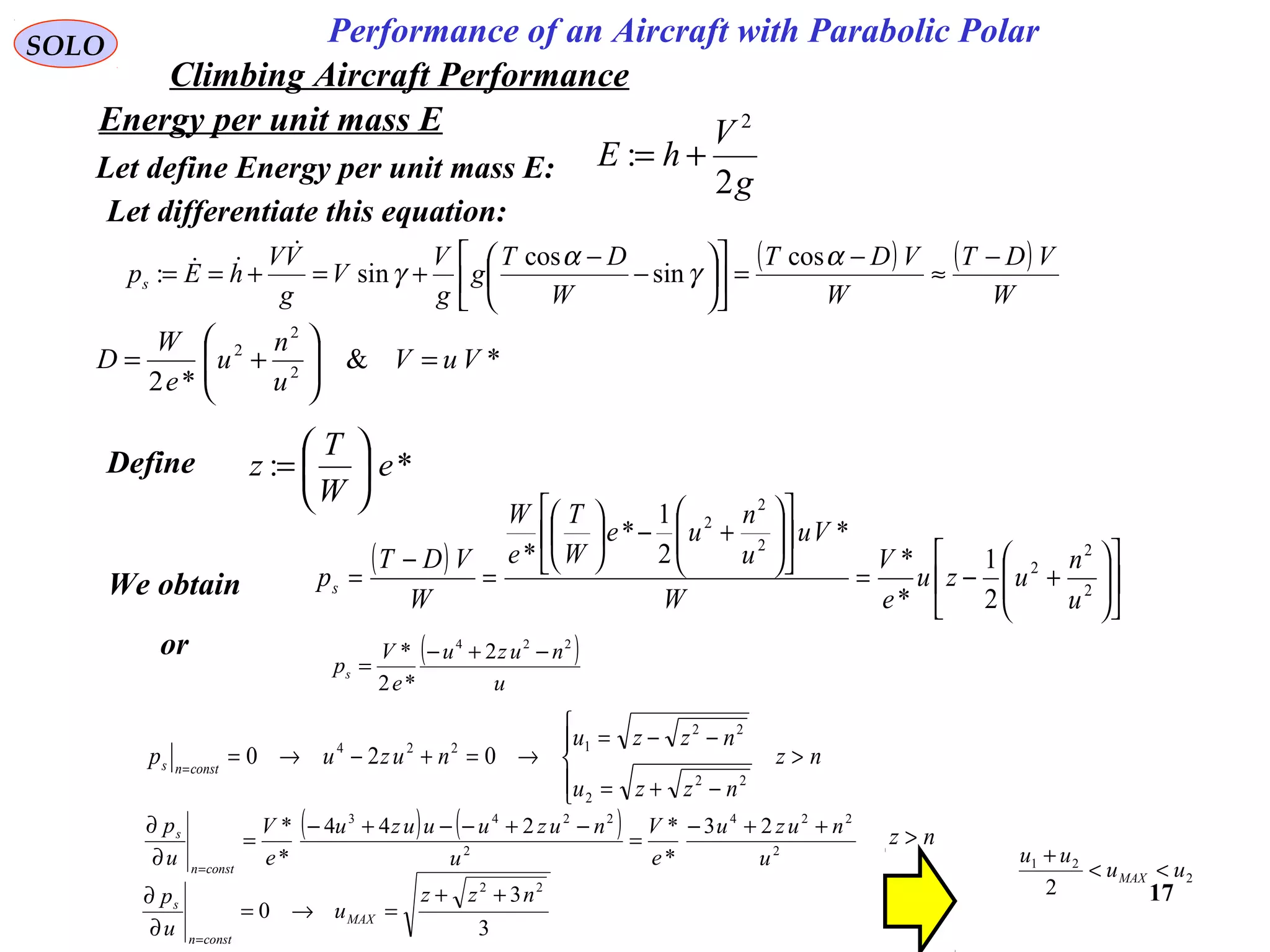
    17 Performance of anAircraft with Parabolic PolarSOLO Energy per unit mass E Let define Energy per unit mass E: g V hE 2 : 2 += Let differentiate this equation: ( ) ( ) W VDT W VDT W DT g g V V g VV hEps − ≈ − =            − − +=+== α γ α γ cos sin cos sin:   *& *2 2 2 2 VuV u n u e W D =      += Define *: e W T z       = We obtain ( )             +−=             +−      = − = 2 2 2 2 2 2 2 1 * * * 2 1 * * u n uzu e V W Vu u n ue W T e W W VDT ps or ( ) u nuzu e V ps 224 2 *2 * −+− = nz nzzu nzzu nuzup constns >     −+= −−= →=+−→== 22 2 22 1224 020 ( ) ( ) 2 224 2 2243 23 * *244 * * u nuzu e V u nuzuuuzu e V u p constn s ++− = −+−−+− = ∂ ∂ = 3 3 0 22 nzz u u p MAX constn s ++ =→= ∂ ∂ = 2 21 2 uu uu MAX << + nz > Climbing Aircraft Performance
  • 18.
    Performance of anAircraft with Parabolic PolarSOLO Energy per unit mass E g V hE 2 : 2 += Climbing Aircraft Performance Energy Height versus Mach NumberEnergy Height versus True Airspeed ( )hV V M sound =:( ) 00 : T T V T T MhVTAS sound ==
  • 19.
    19 Performance of anAircraft with Parabolic PolarSOLO Energy per unit mass E sp 2u1u MAXu 2 21 uu + u MAXn n 1=n ( ) u nuzu e V ps 224 2 * * −+− = ps as a function of u ( ) u nuzu e V ps 224 2 * * −+− = u V pe uzunnuzuu V pe ss * *2 22 * *2 242224 −+−=→−+−= From which u V pe uzun s * *2 2 24 −+−= ( ) * *2 44 3 2 V pe uzu u n s constps −+−= ∂ ∂ = ( ) 3 0412 2 2 22 z uzu u n constps =→=+−= ∂ ∂ = Return to Table of Content Climbing Aircraft Performance           = = = 2 0 * 2 1 :* * : 2 :* Vq V V u CS kW V D ρ ρ
  • 20.
    20 Performance of anAircraft with Parabolic PolarSOLO Load Factor n u 3 z z z2z 3 z u 2 n 0=sp 0>sp 0<sp 0<sp 0=sp 0>sp ( ) u n ∂ ∂ 2 ( ) 2 22 u n ∂ ∂ 3 z u ( ) ( ) 2 2 2 22 ,, n u n u n ∂ ∂ ∂ ∂ as a function of u u V pe uzun s * *2 2 24 −+−= ( ) 3 0412 2 2 22 z uzu u n constps =→=+−= ∂ ∂ = ( ) * *2 44 3 2 V pe uzu u n s constps −+−= ∂ ∂ = Climbing Aircraft Performance           = = = 2 0 * 2 1 :* * : 2 :* Vq V V u CS kW V D ρ ρ
  • 21.
    21 Performance of anAircraft with Parabolic PolarSOLO Load Factor n For ps = 0 we have zuuzun 202 24 ≤≤+−= Let find the maximum of n as function of u. 0 22 44 24 3 = +− +− = ∂ ∂ uzu uzu u n Therefore the maximum value for n is achieved for zu = ( ) zn MAXps ==0 u 0 √z √2z ∂ n/∂u | + + + 0 - - - - | - - n ↑ Max ↓ z2z u n 0=sp 0>sp 0<sp MAXn z MAX MAXL L n C C _ * n as a function of u Return to Table of Content Climbing Aircraft Performance           = = = 2 0 * 2 1 :* * : 2 :* Vq V V u CS kW V D ρ ρ
  • 22.
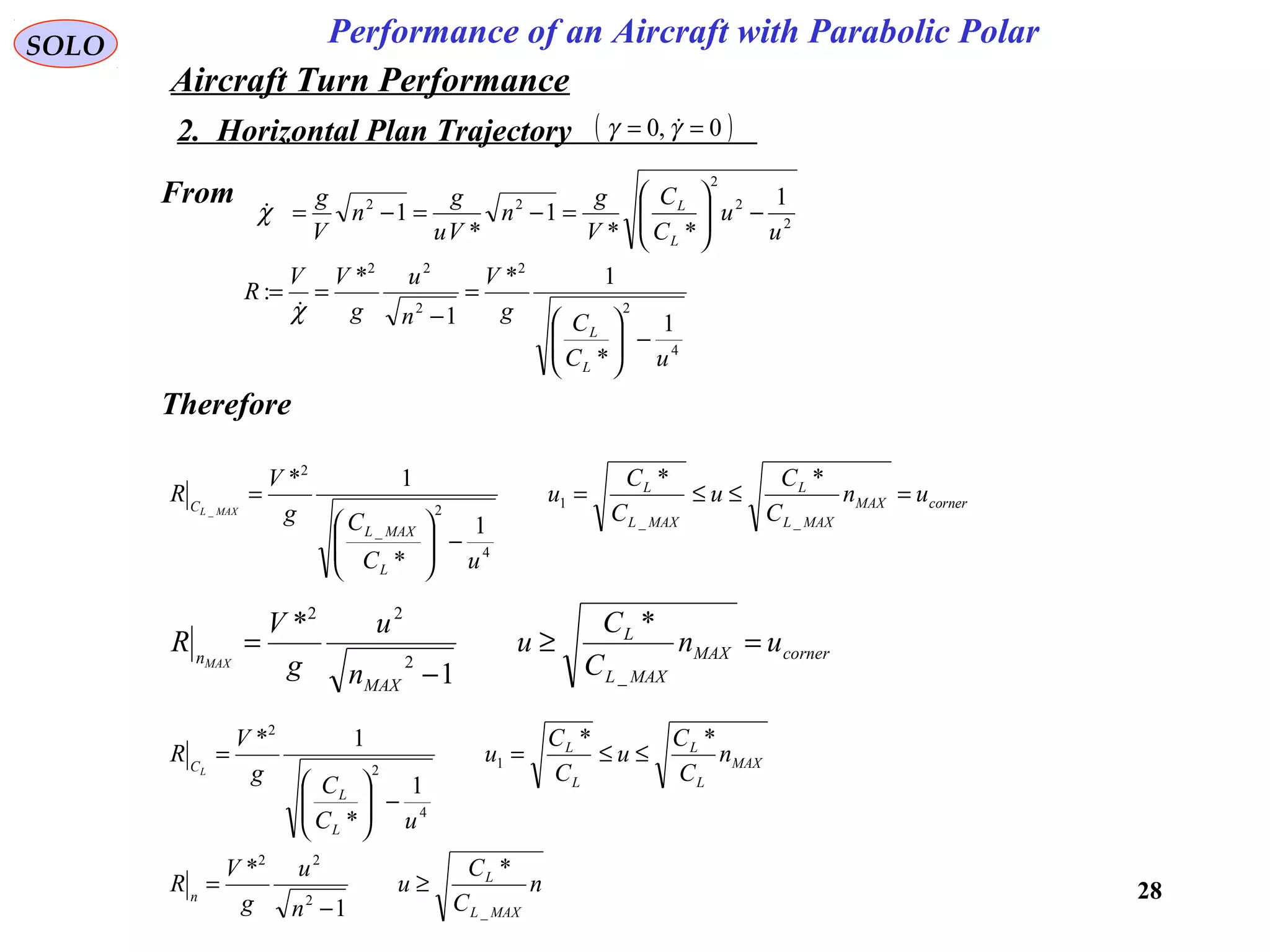
    22 Performance of anAircraft with Parabolic PolarSOLO       − + = = γσ α γσ coscos sin cossin V g Vm LT q V g r W W n W L W LT n =≈ + = αsin :' Therefore ( )      −= = γσ γσ coscos' cossin n V g q V g r W W γσγσγσω 2222222 coscoscoscos'2'cossin +−+=+= nn V g qr WW or γγσω 22 coscoscos'2' +−= nn V g γγσω 22 2 coscoscos'2' 1 +− == nng VV R Aircraft Trajectories We found Aircraft Turn Performance
  • 23.
    23 Performance of anAircraft with Parabolic PolarSOLO ( ) ( ) ( ) γ σ φ γ α χ γσγσ α γ cos sin sin cos sin coscos'coscos sin V gLT n V g V g Vm LT = + = −=− + =   2. Horizontal Plan Trajectory ( )0,0 == γγ  ( ) 1' 1 1' ' 1 1'sin' cos 1 '01cos' 2 2 2 2 − = −=      −== =→=−= ng V R n V g n n V g n V g nn V g σχ σ σγ   Aircraft Turn Performance 1. Vertical Plan Trajectory (σ = 0) ( ) γ γγ χ cos' 1 cos' 0 2 − = −= = ng V R n V g  
  • 24.
    24 Vertical Plan Trajectory(σ = 0) SOLO Return to Table of Content
  • 25.
    25 Performance of anAircraft with Parabolic PolarSOLO 2. Horizontal Plan Trajectory ( )0,0 == γγ  We can see that for n > 1 1 1 1' 1 11' 2 2 2 2 22 − ≈ − = −≈−= ng V ng V R n V g n V g χ We found that 2 2 * * u C C n u C nC L LL L =→= n 1n 2n MAXn u u LC MAXLC _ 1 _ n C C MAXL L MAX MAXL L corner n C C u _ * = *2 L MAX L C u n C = MAX MAXL L corner n C C u _ * = MAX L L n C C 1 * MAXLC _ 2LC 1LC 2 * 1 u C C n L L = MAXn n, CL as a function of u Aircraft Turn Performance           = = = 2 0 * 2 1 :* * : 2 :* Vq V V u CS kW V D ρ ρ
  • 26.
    26 R V =:χ1'2 −= n V g χ Contours ofConstant n and Contours of Constant Turn Radius in Turn-Rate in Horizontal Plan versus Mach coordinates Horizontal Plan TrajectorySOLO
  • 27.
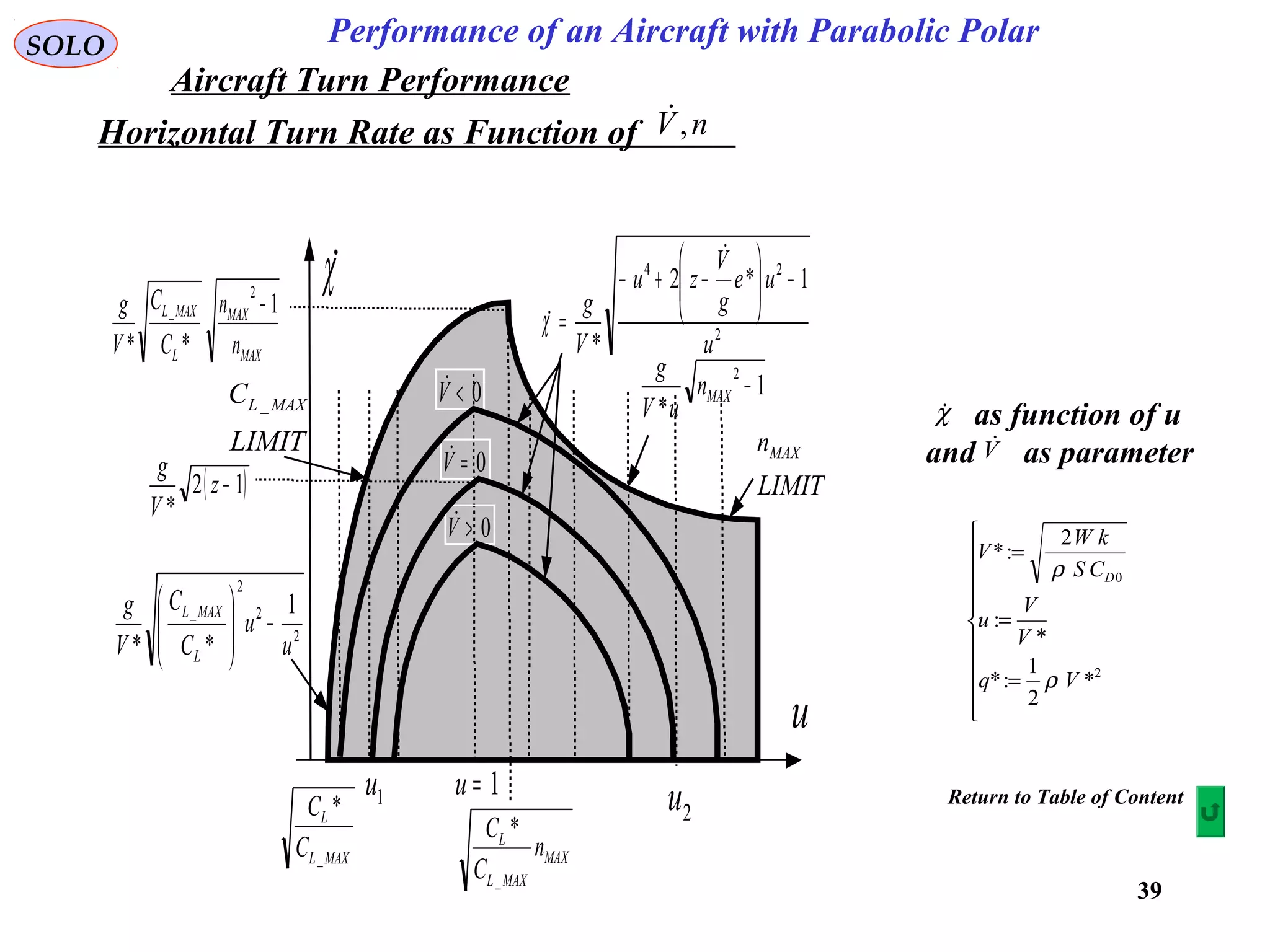
    27 Performance of anAircraft with Parabolic PolarSOLO MAX MAX L MAXL n n C C V g 1 ** 2 _ − MAX MAXL L corner n C C V g u _ * * = MAXL L C C V g u _ 1 * * = MAXn 2n 1n MAXLC _ 2LC 1LC u χ MAXu a function of u, with n and CL as parametersχ We defined 2 * & * : u C C n V V u L L == We found 2 2 2 22 1 ** 1 * 1 u u C C V g n Vu g n V g L L −      =−=−=χ This is defined for 1: ** 1 __ <=≥≥= u C C un C C u MAXL L MAX MAXL L corner 2. Horizontal Plan Trajectory ( )0,0 == γγ  Aircraft Turn Performance           = = = 2 0 * 2 1 :* * : 2 :* Vq V V u CS kW V D ρ ρ
  • 28.
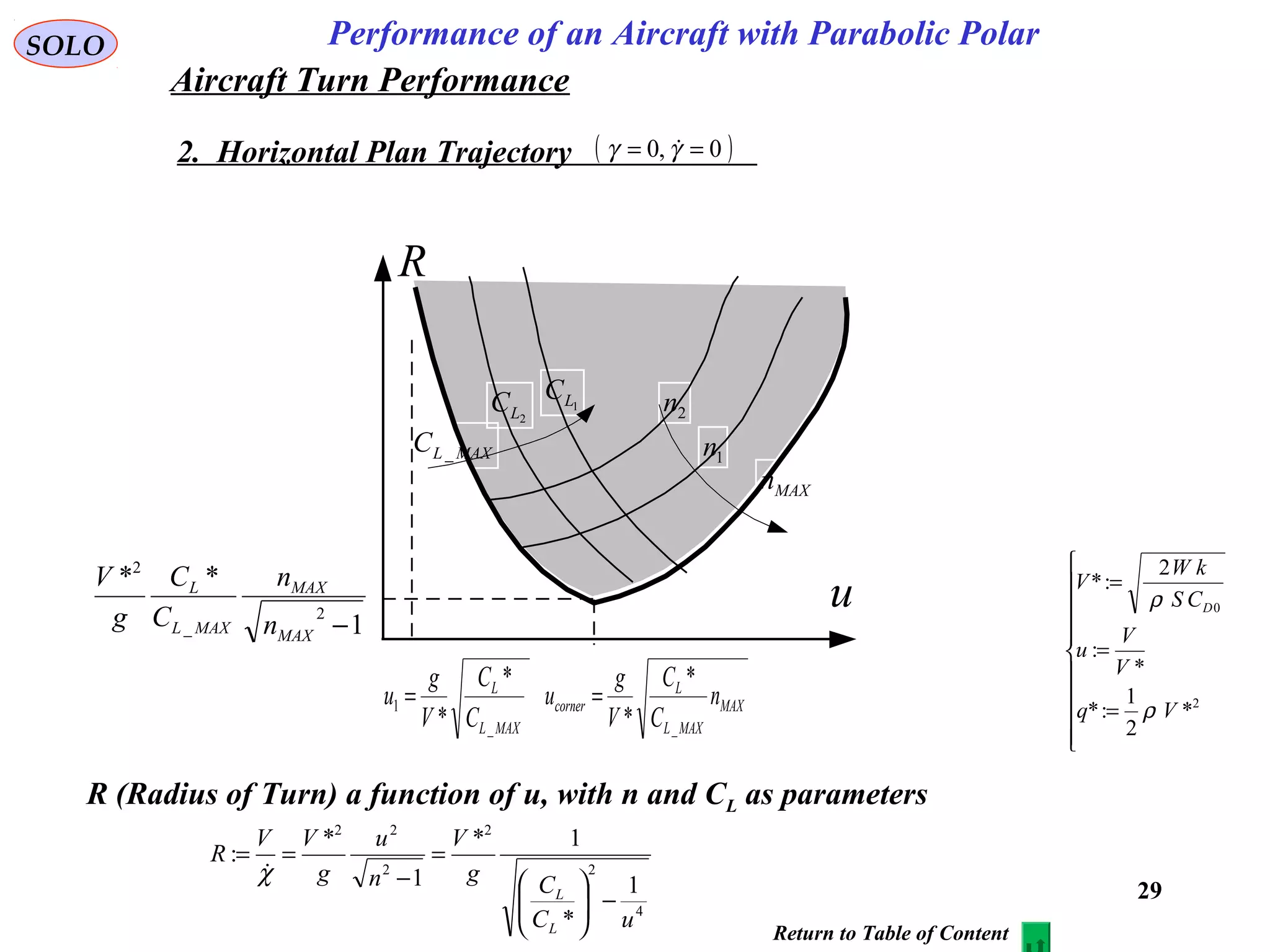
    28 Performance of anAircraft with Parabolic PolarSOLO From 2 2 2 22 1 ** 1 * 1 u u C C V g n Vu g n V g L L −      =−=−=χ 4 2 2 2 22 1 * 1* 1 * : uC Cg V n u g VV R L L −      = − == χ Therefore cornerMAX MAXL L MAXL L L MAXL C un C C u C C u uC Cg V R MAXL =≤≤= −      = __ 1 4 2 _ 2 ** 1 * 1* _ cornerMAX MAXL L MAX n un C C u n u g V R MAX =≥ − = _ 2 22 * 1 * MAX L L L L L L C n C C u C C u uC Cg V R L ** 1 * 1* 1 4 2 2 ≤≤= −      = n C C u n u g V R MAXL L n _ 2 22 * 1 * ≥ − = 2. Horizontal Plan Trajectory ( )0,0 == γγ  Aircraft Turn Performance
  • 29.
    29 Performance of anAircraft with Parabolic PolarSOLO R (Radius of Turn) a function of u, with n and CL as parameters 1 ** 2 _ 2 −MAX MAX MAXL L n n C C g V MAX MAXL L corner n C C V g u _ * * = MAXL L C C V g u _ 1 * * = MAXn 2n 1nMAXLC _ 2LC 1LC u R 4 2 2 2 22 1 * 1* 1 * : uC Cg V n u g VV R L L −      = − == χ 2. Horizontal Plan Trajectory ( )0,0 == γγ  Return to Table of Content Aircraft Turn Performance           = = = 2 0 * 2 1 :* * : 2 :* Vq V V u CS kW V D ρ ρ
  • 30.
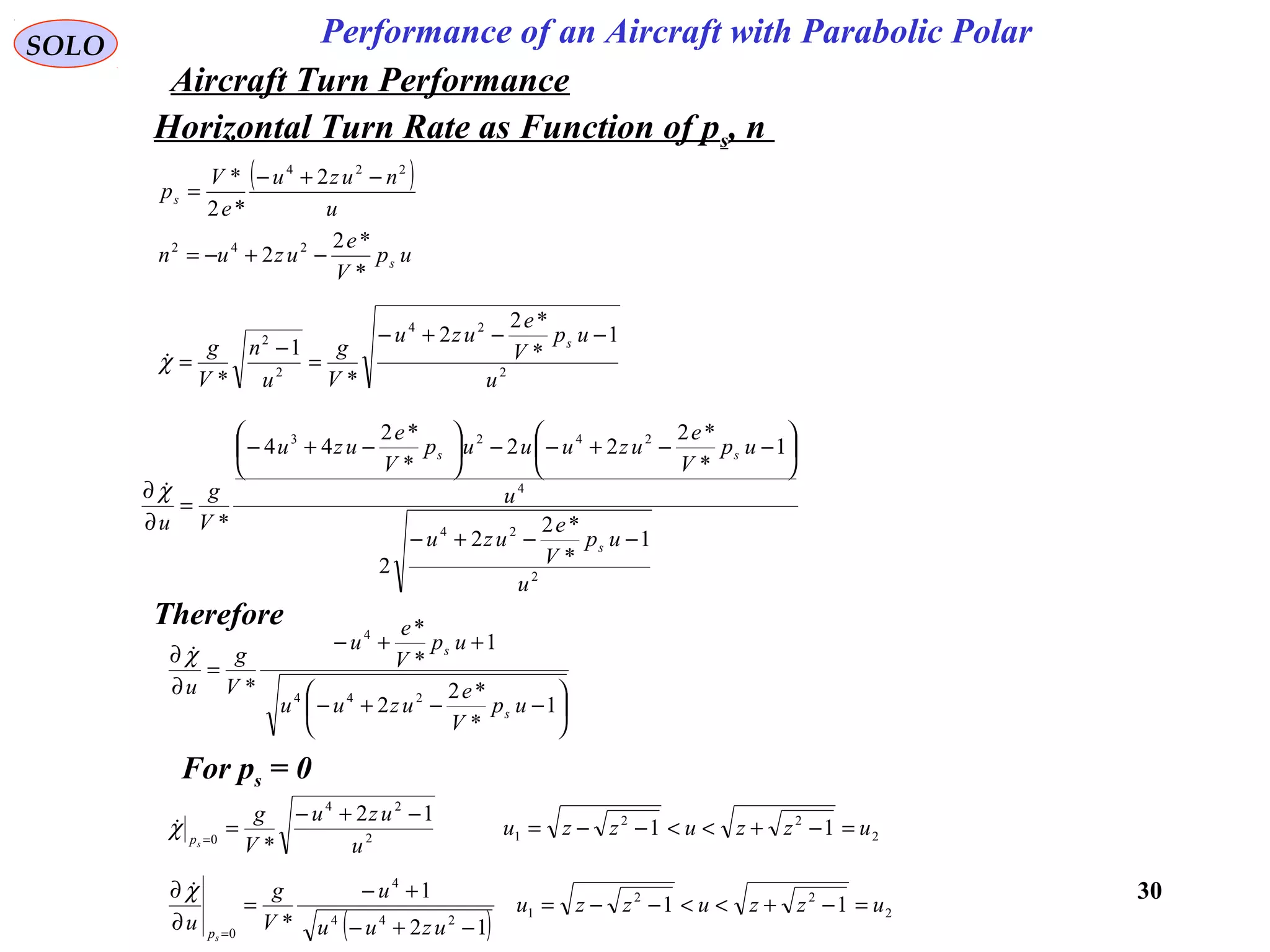
    30 Performance of anAircraft with Parabolic PolarSOLO Horizontal Turn Rate as Function of ps, n ( ) u nuzu e V ps 224 2 *2 * −+− = up V e uzun s * *2 2 242 −+−= 2 24 2 2 1 * *2 2 * 1 * u up V e uzu V g u n V g s −−+− = − =χ 2 24 4 2423 1 * *2 2 2 1 * *2 22 * *2 44 * u up V e uzu u up V e uzuuup V e uzu V g u s ss −−+−       −−+−−      −+− = ∂ ∂ χ Therefore       −−+− ++− = ∂ ∂ 1 * *2 2 1 * * * 244 4 up V e uzuu up V e u V g u s s χ For ps = 0 2 22 12 24 0 11 12 * uzzuzzu u uzu V g sp =−+<<−−= −+− == χ ( ) 2 22 1 244 4 0 11 12 1 * uzzuzzu uzuu u V g u sp =−+<<−−= −+− +− = ∂ ∂ = χ Aircraft Turn Performance
  • 31.
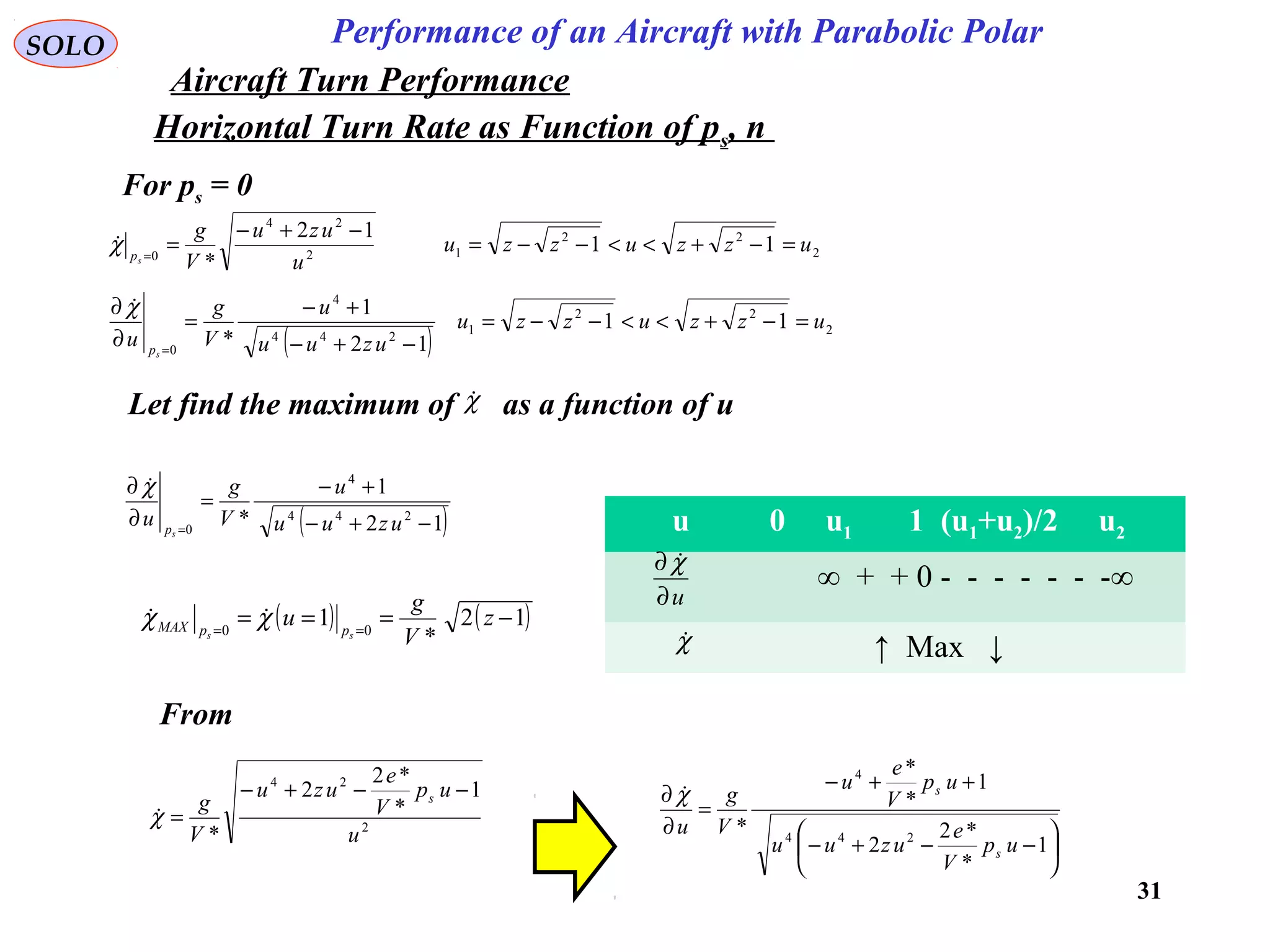
    31 Performance of anAircraft with Parabolic PolarSOLO Horizontal Turn Rate as Function of ps, n For ps = 0 2 22 12 24 0 11 12 * uzzuzzu u uzu V g sp =−+<<−−= −+− == χ ( ) 2 22 1 244 4 0 11 12 1 * uzzuzzu uzuu u V g u sp =−+<<−−= −+− +− = ∂ ∂ = χ Let find the maximum of as a function of uχ ( )12 1 * 244 4 0 −+− +− = ∂ ∂ = uzuu u V g u sp χ ( ) ( )12 * 1 00 −=== == z V g u ss ppMAX χχ  u 0 u1 1 (u1+u2)/2 u2 ∞ + + 0 - - - - - - -∞ ↑ Max ↓ u∂ ∂ χ χ From 2 24 1 * *2 2 * u up V e uzu V g s −−+− =χ       −−+− ++− = ∂ ∂ 1 * *2 2 1 * * * 244 4 up V e uzuu up V e u V g u s s χ Aircraft Turn Performance
  • 32.
    32 Performance of anAircraft with Parabolic PolarSOLO Horizontal Turn Rate as Function of ps, n u u 0<sp 0<sp 0=sp 0=sp 0>sp 0>sp χ u∂ ∂ χ ( )12 * −z V g 1=u1u 2u as a function of u with ps as parameter u∂ ∂ χ χ  ,       −−+− ++− = ∂ ∂ 1 * *2 2 1 * * * 244 4 up V e uzuu up V e u V g u s sχ 2 24 1 * *2 2 * u up V e uzu V g s −−+− =χ Because ,we have0 * * >u V e 000 >=< >> sss ppp χχχ  0 1 0 1 0 1 0 > = = = < = ∂ ∂ <= ∂ ∂ < ∂ ∂ sss p u p u p u uuu χχχ  Aircraft Turn Performance
  • 33.
    33 Performance of anAircraft with Parabolic PolarSOLO Horizontal Turn Rate as Function of ps, n u 0<sp 0=sp 0>sp χ ( )12 * −z V g 1=u1u 2u 2 24 1 * *2 2 * u up V e uzu V g s −−+− =χ 1 * 2 −MAXn uV g 2 2 2 _ 1 ** u u C C V g L MAXL −      MAXL L C C _ * MAX MAXL L n C C _ * LIMIT nMAX LIMIT C MAXL_ MAX MAX L MAXL n n C C V g 1 ** 2 _ − a function of u, with ps as parameter χ 2 24 1 * *2 2 * u up V e uzu V g s −−+− =χ Aircraft Turn Performance           = = = 2 0 * 2 1 :* * : 2 :* Vq V V u CS kW V D ρ ρ
  • 34.
    34 Performance of anAircraft with Parabolic PolarSOLO Horizontal Turn Rate as Function of ps, n 2 24 1 * *2 2 * u up V e uzu V g s −−+− =χ ( ) ( )ss s puupu up V e uzu u g VV R 21 24 42 1 * *2 2 * << −−+− == χ 3 242 23 2 24 4 2 24 34243 2 1 * *2 22 2 * *3 22 * 1 * *2 2 2 1 * *2 2 * *2 441 * *2 24 *       −−+−       −− = −−+−       −−+−       −+−−      −−+− = ∂ ∂ up V e uzuu up V e uzu g V up V e uzu u up V e uzu p V e uzuuup V e uzuu g V u R s s s s ss Aircraft Turn Performance
  • 35.
    35 Performance of anAircraft with Parabolic PolarSOLO Horizontal Turn Rate as Function of ps, n 3 24 2 2 1 * *2 2 2 * *3 2 *       −−+−       −− = ∂ ∂ up V e uzu up V e uzu g V u R s s or We have            > +      + = < +      − = →= ∂ ∂ 0 4 16 * * 9 * *3 0 4 16 * * 9 * *3 0 2 2 2 1 z zp V e up V e u z zp V e up V e u u R ss R ss R u 0 u1 uR2 u2 ∞ - - - 0 + + ∞ ↓ min ↑ u R ∂ ∂ R 2 22 124 42 0 11 12 * uzzuzzu uzu u g V R sp =−+<<−−= −+− == ( ) ( ) 2 22 1 324 22 0 11 12 1*2 uzzuzzu uzu uzu g V u R sp =−+<<−−= −+− − = ∂ ∂ = Aircraft Turn Performance
  • 36.
    36 Performance of anAircraft with Parabolic PolarSOLO Horizontal Turn Rate as Function of ps, n u R 0>sp 0=sp 0<sp MAXL L C C _ * 1 ** 2 _ −MAX MAX MAXL L n n C C g V 1 1* 2 −zg V 4 2 _ 1* 1* uC C g V MAXL L −         1 * 2 22 −MAXn u g V MAX MAXL L n C C _ * LIMIT C MAXL_ LIMIT nMAX z 1 12 −− zz 12 −+ zz 1 * *2 2 * 24 42 −−+− = up V e uzu u g V R s The minimum of R is obtained for zu /1= 1 1* 2 2 0 − == zg V R sp R (Radius of Turn) a function of u, with ps as parameter ( ) ( )ss s puupu up V e uzu u g VV R 21 24 42 1 * *2 2 * << −−+− == χ Return to Table of Content Because ,we have0 * * >u V e 000 >=< << sss ppp RRR 000 minminmin >=< << sss pRpRpR uuu Aircraft Turn Performance           = = = 2 0 * 2 1 :* * : 2 :* Vq V V u CS kW V D ρ ρ
  • 37.
    37 Performance of anAircraft with Parabolic PolarSOLO Horizontal Turn Rate as Function of nV, ( ) W VDT g VV hEps − ≈+==  : For an horizontal turn 0=h V g Vu g VV ps   * == We found 2 24 1 * *2 2 * u up V e uzu V g s −−+− =χ from which 2 24 1*2 * u ue g V zu V g −      −+− =  χ defined for 2 22 1 :1**1**: ue g V ze g V zue g V ze g V zu =−      −+      −≤≤−      −−      −=  Aircraft Turn Performance
  • 38.
    38 Performance of anAircraft with Parabolic PolarSOLO Horizontal Turn Rate as Function of nV, Let compute 2 24 4 2423 1*2 2 1*22*44 * u ue g V zu u ue g V zuuuue g V zu V g u −      −+−       −      −+−−            −+− = ∂ ∂   χ       −      −+− +− = ∂ ∂ 1*2 1 * 244 4 ue g V zuu u V g u  χ or u 0 u1 1 (u1+u2)/2 u2 ∞ + + 0 - - - - - - -∞ ↑ Max ↓ u∂ ∂ χ χ       −−= 1*2 * e g V z V g MAX  χ Aircraft Turn Performance
  • 39.
    39 Performance of anAircraft with Parabolic PolarSOLO Horizontal Turn Rate as Function of nV, u 0<V 0=V 0>V χ ( )12 * −z V g 1=u1u 2u 2 24 1*2 * u ue g V zu V g −      −+− =  χ 1 * 2 −MAXn uV g 2 2 2 _ 1 ** u u C C V g L MAXL −      MAXL L C C _ * MAX MAXL L n C C _ * LIMIT nMAXLIMIT C MAXL_ MAX MAX L MAXL n n C C V g 1 ** 2 _ − as function of u and as parameter χ V Return to Table of Content Aircraft Turn Performance           = = = 2 0 * 2 1 :* * : 2 :* Vq V V u CS kW V D ρ ρ
  • 40.
    08/12/15 40 Performance ofan Aircraft with Parabolic PolarSOLO References Angelo Miele, “Flight Mechanics, Volume I, Theory of Flight Paths”, Addison-Wesley, 1962 Return to Table of Content S. Hermelin, “3 DOF Model of Aircraft in Earth Atmosphere”
  • 41.
    41 SOLO Technion Israeli Institute ofTechnology 1964 – 1968 BSc EE 1968 – 1971 MSc EE Israeli Air Force 1970 – 1974 RAFAEL Israeli Armament Development Authority 1974 – 2013 Stanford University 1983 – 1986 PhD AA

Editor's Notes

  • #25 Prof. Earll Murman, “Introduction to Aircraft Performance and Static Stability”, September 18, 2003