Method of Virtual Work
Contents 10 -  Introduction Work of a Force Work of a Couple Principle of Virtual Work Applications of the Principle of Virtual Work Real Machines.  Mechanical Efficiency Sample Problem 10.1 Sample Problem 10.2 Sample Problem 10.3 Work of a Force During a Finite Displacement Potential Energy Potential Energy and Equilibrium Stability and Equilibrium Sample Problems 10.4
Introduction 10 -  Principle of virtual work -  if a particle, rigid body, or system of rigid bodies which is in equilibrium under various forces is given an arbitrary  virtual displacement , the net work done by the external forces during that displacement is zero. The principle of virtual work is particularly useful when applied to the solution of problems involving the equilibrium of machines or mechanisms consisting of several connected members. If a particle, rigid body, or system of rigid bodies is in equilibrium, then the derivative of its potential energy with respect to a variable defining its position is zero. The stability of an equilibrium position can be determined from the second derivative of the potential energy with respect to the position variable.
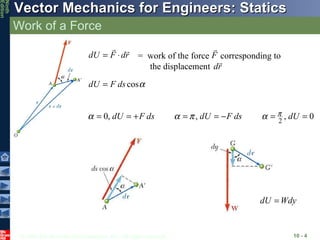
Work of a Force 10 -  =  work of the force  corresponding to the displacement
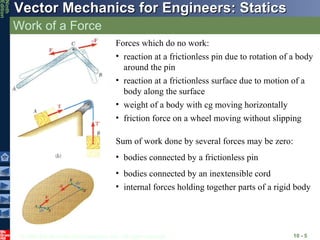
Work of a Force 10 -  Forces which do no work: reaction at a frictionless pin due to rotation of a body around the pin  reaction at a frictionless surface due to motion of a body along the surface weight of a body with cg moving horizontally friction force on a wheel moving without slipping Sum of work done by several forces may be zero: bodies connected by a frictionless pin bodies connected by an inextensible cord internal forces holding together parts of a rigid body
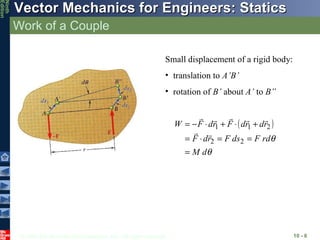
Work of a Couple 10 -  Small displacement of a rigid body: translation to  A’B’ rotation of  B’  about  A’  to  B”
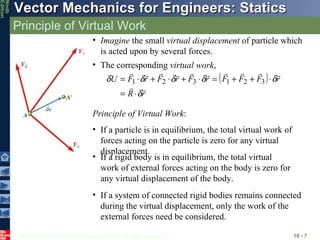
Principle of Virtual Work 10 -  Imagine  the small  virtual displacement  of particle which is acted upon by several forces. Principle of Virtual Work :  If a particle is in equilibrium, the total virtual work of forces acting on the particle is zero for any virtual displacement. If a rigid body is in equilibrium, the total virtual work of external forces acting on the body is zero for any virtual displacement of the body. If a system of connected rigid bodies remains connected during the virtual displacement, only the work of the external forces need be considered. The corresponding  virtual work ,
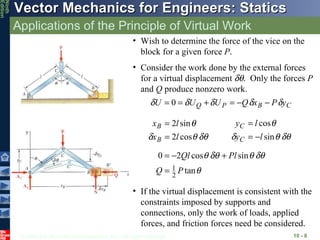
Applications of the Principle of Virtual Work 10 -  Wish to determine the force of the vice on the block for a given force  P . If the virtual displacement is consistent with the constraints imposed by supports and connections, only the work of loads, applied forces, and friction forces need be considered. Consider the work done by the external forces for a virtual displacement   .  Only the forces  P  and  Q  produce nonzero work.
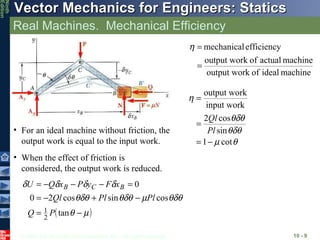
Real Machines.  Mechanical Efficiency 10 -  For an ideal machine without friction, the output work is equal to the input work. When the effect of friction is considered, the output work is reduced.
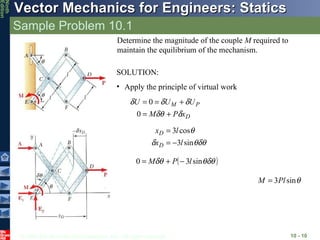
Sample Problem 10.1 10 -  Determine the magnitude of the couple  M  required to maintain the equilibrium of the mechanism. SOLUTION: Apply the principle of virtual work
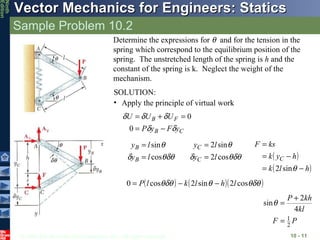
Sample Problem 10.2 10 -  Determine the expressions for     and for the tension in the spring which correspond to the equilibrium position of the spring.  The unstretched length of the spring is  h  and the constant of the spring is k.  Neglect the weight of the mechanism. SOLUTION: Apply the principle of virtual work
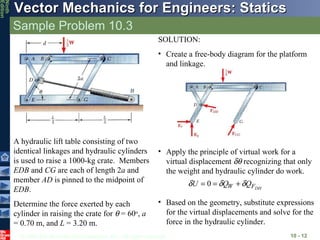
Sample Problem 10.3 10 -  A hydraulic lift table consisting of two identical linkages and hydraulic cylinders is used to raise a 1000-kg crate.  Members  EDB  and  CG  are each of length 2 a  and member  AD  is pinned to the midpoint of  EDB .  Determine the force exerted by each cylinder in raising the crate for    = 60 o ,  a  = 0.70 m, and  L  = 3.20 m. Based on the geometry, substitute expressions for the virtual displacements and solve for the force in the hydraulic cylinder. Apply the principle of virtual work for a virtual displacement    recognizing that only the weight and hydraulic cylinder do work. SOLUTION: Create a free-body diagram for the platform and linkage.
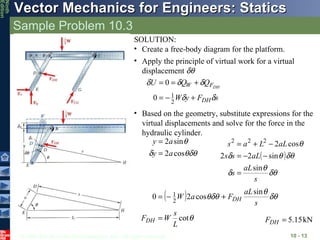
Sample Problem 10.3 10 -  SOLUTION: Create a free-body diagram for the platform. Apply the principle of virtual work for a virtual displacement     Based on the geometry, substitute expressions for the virtual displacements and solve for the force in the hydraulic cylinder.
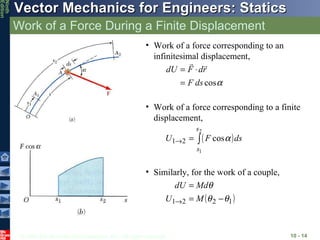
Work of a Force During a Finite Displacement 10 -  Work of a force corresponding to an infinitesimal displacement, Work of a force corresponding to a finite displacement, Similarly, for the work of a couple,
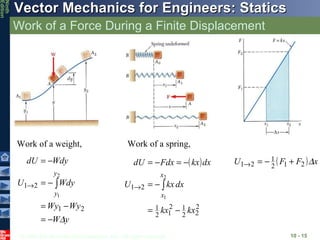
Work of a Force During a Finite Displacement 10 -  Work of a weight, Work of a spring,
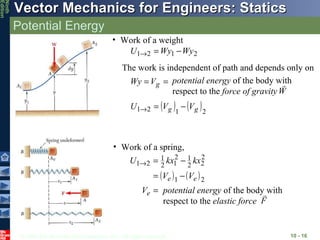
Potential Energy 10 -  Work of a weight The work is independent of path and depends only on  potential energy  of the body with respect to the  force of gravity Work of a spring, potential energy  of the body with respect to the  elastic force
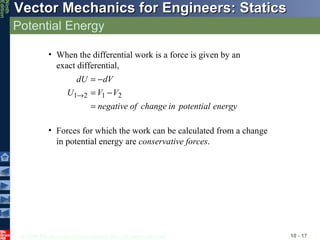
Potential Energy 10 -  Forces for which the work can be calculated from a change in potential energy are  conservative forces . When the differential work is a force is given by an exact differential,
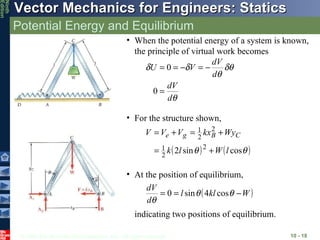
Potential Energy and Equilibrium 10 -  When the potential energy of a system is known, the principle of virtual work becomes For the structure shown, At the position of equilibrium, indicating two positions of equilibrium.
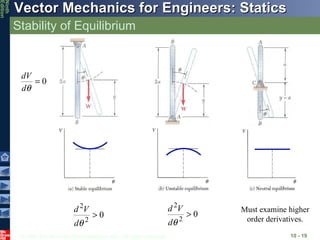
Stability of Equilibrium 10 -  Must examine higher order derivatives.
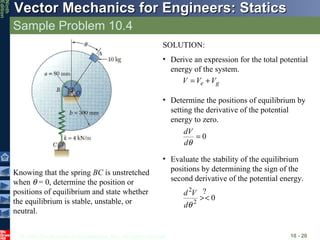
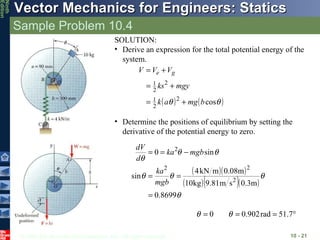
Sample Problem 10.4 10 -  Knowing that the spring  BC  is unstretched when    = 0, determine the position or positions of equilibrium and state whether the equilibrium is stable, unstable, or neutral. SOLUTION: Derive an expression for the total potential energy of the system. Determine the positions of equilibrium by setting the derivative of the potential energy to zero. Evaluate the stability of the equilibrium positions by determining the sign of the second derivative of the potential energy. ?
Sample Problem 10.4 10 -  SOLUTION: Derive an expression for the total potential energy of the system. Determine the positions of equilibrium by setting the derivative of the potential energy to zero.
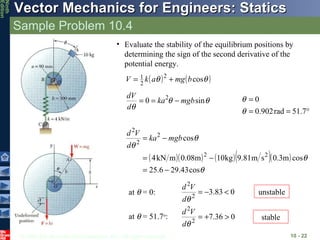
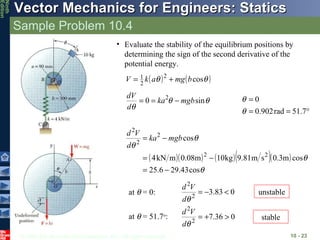
Sample Problem 10.4 10 -  Evaluate the stability of the equilibrium positions by determining the sign of the second derivative of the potential energy. at   = 0: unstable at   = 51.7 o : stable

Chapter 8 principle of virtual work

  • 1.
  • 2.
    Contents 10 - Introduction Work of a Force Work of a Couple Principle of Virtual Work Applications of the Principle of Virtual Work Real Machines. Mechanical Efficiency Sample Problem 10.1 Sample Problem 10.2 Sample Problem 10.3 Work of a Force During a Finite Displacement Potential Energy Potential Energy and Equilibrium Stability and Equilibrium Sample Problems 10.4
  • 3.
    Introduction 10 - Principle of virtual work - if a particle, rigid body, or system of rigid bodies which is in equilibrium under various forces is given an arbitrary virtual displacement , the net work done by the external forces during that displacement is zero. The principle of virtual work is particularly useful when applied to the solution of problems involving the equilibrium of machines or mechanisms consisting of several connected members. If a particle, rigid body, or system of rigid bodies is in equilibrium, then the derivative of its potential energy with respect to a variable defining its position is zero. The stability of an equilibrium position can be determined from the second derivative of the potential energy with respect to the position variable.
  • 4.
    Work of aForce 10 - = work of the force corresponding to the displacement
  • 5.
    Work of aForce 10 - Forces which do no work: reaction at a frictionless pin due to rotation of a body around the pin reaction at a frictionless surface due to motion of a body along the surface weight of a body with cg moving horizontally friction force on a wheel moving without slipping Sum of work done by several forces may be zero: bodies connected by a frictionless pin bodies connected by an inextensible cord internal forces holding together parts of a rigid body
  • 6.
    Work of aCouple 10 - Small displacement of a rigid body: translation to A’B’ rotation of B’ about A’ to B”
  • 7.
    Principle of VirtualWork 10 - Imagine the small virtual displacement of particle which is acted upon by several forces. Principle of Virtual Work : If a particle is in equilibrium, the total virtual work of forces acting on the particle is zero for any virtual displacement. If a rigid body is in equilibrium, the total virtual work of external forces acting on the body is zero for any virtual displacement of the body. If a system of connected rigid bodies remains connected during the virtual displacement, only the work of the external forces need be considered. The corresponding virtual work ,
  • 8.
    Applications of thePrinciple of Virtual Work 10 - Wish to determine the force of the vice on the block for a given force P . If the virtual displacement is consistent with the constraints imposed by supports and connections, only the work of loads, applied forces, and friction forces need be considered. Consider the work done by the external forces for a virtual displacement  . Only the forces P and Q produce nonzero work.
  • 9.
    Real Machines. Mechanical Efficiency 10 - For an ideal machine without friction, the output work is equal to the input work. When the effect of friction is considered, the output work is reduced.
  • 10.
    Sample Problem 10.110 - Determine the magnitude of the couple M required to maintain the equilibrium of the mechanism. SOLUTION: Apply the principle of virtual work
  • 11.
    Sample Problem 10.210 - Determine the expressions for  and for the tension in the spring which correspond to the equilibrium position of the spring. The unstretched length of the spring is h and the constant of the spring is k. Neglect the weight of the mechanism. SOLUTION: Apply the principle of virtual work
  • 12.
    Sample Problem 10.310 - A hydraulic lift table consisting of two identical linkages and hydraulic cylinders is used to raise a 1000-kg crate. Members EDB and CG are each of length 2 a and member AD is pinned to the midpoint of EDB . Determine the force exerted by each cylinder in raising the crate for  = 60 o , a = 0.70 m, and L = 3.20 m. Based on the geometry, substitute expressions for the virtual displacements and solve for the force in the hydraulic cylinder. Apply the principle of virtual work for a virtual displacement  recognizing that only the weight and hydraulic cylinder do work. SOLUTION: Create a free-body diagram for the platform and linkage.
  • 13.
    Sample Problem 10.310 - SOLUTION: Create a free-body diagram for the platform. Apply the principle of virtual work for a virtual displacement  Based on the geometry, substitute expressions for the virtual displacements and solve for the force in the hydraulic cylinder.
  • 14.
    Work of aForce During a Finite Displacement 10 - Work of a force corresponding to an infinitesimal displacement, Work of a force corresponding to a finite displacement, Similarly, for the work of a couple,
  • 15.
    Work of aForce During a Finite Displacement 10 - Work of a weight, Work of a spring,
  • 16.
    Potential Energy 10- Work of a weight The work is independent of path and depends only on potential energy of the body with respect to the force of gravity Work of a spring, potential energy of the body with respect to the elastic force
  • 17.
    Potential Energy 10- Forces for which the work can be calculated from a change in potential energy are conservative forces . When the differential work is a force is given by an exact differential,
  • 18.
    Potential Energy andEquilibrium 10 - When the potential energy of a system is known, the principle of virtual work becomes For the structure shown, At the position of equilibrium, indicating two positions of equilibrium.
  • 19.
    Stability of Equilibrium10 - Must examine higher order derivatives.
  • 20.
    Sample Problem 10.410 - Knowing that the spring BC is unstretched when  = 0, determine the position or positions of equilibrium and state whether the equilibrium is stable, unstable, or neutral. SOLUTION: Derive an expression for the total potential energy of the system. Determine the positions of equilibrium by setting the derivative of the potential energy to zero. Evaluate the stability of the equilibrium positions by determining the sign of the second derivative of the potential energy. ?
  • 21.
    Sample Problem 10.410 - SOLUTION: Derive an expression for the total potential energy of the system. Determine the positions of equilibrium by setting the derivative of the potential energy to zero.
  • 22.
    Sample Problem 10.410 - Evaluate the stability of the equilibrium positions by determining the sign of the second derivative of the potential energy. at  = 0: unstable at  = 51.7 o : stable
  • 23.
    Sample Problem 10.410 - Evaluate the stability of the equilibrium positions by determining the sign of the second derivative of the potential energy. at  = 0: unstable at  = 51.7 o : stable