-: Application of vector space :-
NAME :- ANKIT BERA
ROLL NO:- 24
STREAM:- CSE-B
Meghnad Saha Institute Of Technology
1
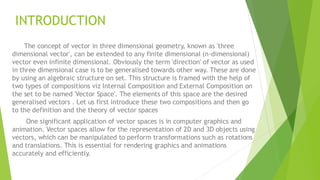
INTRODUCTION
The concept of vector in three dimensional geometry, known as 'three
dimensional vector', can be extended to any finite dimensional (n-dimensional)
vector even infinite dimensional. Obviously the term 'direction' of vector as used
in three dimensional case is to be generalised towards other way. These are done
by using an algebraic structure on set. This structure is framed with the help of
two types of compositions viz Internal Composition and External Composition on
the set to be named 'Vector Space'. The elements of this space are the desired
generalised vectors . Let us first introduce these two compositions and then go
to the definition and the theory of vector spaces
One significant application of vector spaces is in computer graphics and
animation. Vector spaces allow for the representation of 2D and 3D objects using
vectors, which can be manipulated to perform transformations such as rotations
and translations. This is essential for rendering graphics and animations
accurately and efficiently.
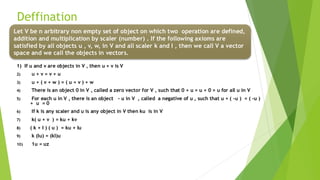
Deffination
1) If u and v are objects in V , then u + v is V
2) u + v = v + u
3) u + ( v + w ) = ( u + v ) + w
4) There is an object 0 in V , called a zero vector for V , such that 0 + u = u + 0 = u for all u in V
5) For each u in V , there is an object - u in V , called a negative of u , such that u + ( -u ) = ( -u )
+ u = 0
6) If k is any scaler and u is any object in V then ku is in V
7) k( u + v ) = ku + kv
8) ( k + I ) ( u ) = ku + Iu
9) k (Iu) = (kI)u
10) 1u = uz
Let V be n arbitrary non empty set of object on which two operation are defined,
addition and multiplication by scaler (number) . If the following axioms are
satisfied by all objects u , v, w, in V and all scaler k and I , then we call V a vector
space and we call the objects in vectors.
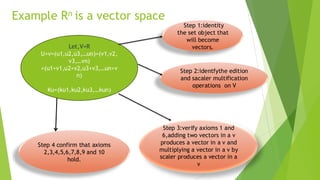
Example Rn is a vector space
Step 1:identity
the set object that
will become
vectors.
Step 2:identfythe edition
and sacaler multification
operations on V
Step 4 confirm that axioms
2,3,4,5,6,7,8,9 and 10
hold.
Step 3:verify axioms 1 and
6,adding two vectors in a v
produces a vector in a v and
multiplying a vector in a v by
scaler produces a vector in a
v
Let,V=R
U+v=(u1,u2,u3,…un)+(v1,v2,
v3,…vn)
=(u1+v1,u2+v2,u3+v3,…un+v
n)
Ku=(ku1,ku2,ku3,…kun)
EXAMPLE OF MATRIX
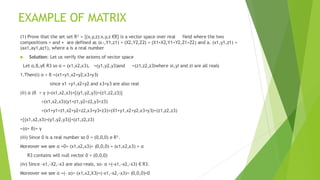
(1) Prove that the set set R³ = {(x,y,z):x,y,z €R} is a vector space over real field where the two
compositions + and • are defined as (x₁,Y1,z1) + (X2,Y2,Z2) = (X1+X2,Y1+Y2,Z1+Z2) and a. (x1,y1,z1) =
(ax1,ay1,az1), where a is a real number
 Solution: Let us verify the axioms of vector space
Let α,β,γ€ R3 so α = (x1,x2,x3), =(y1,y2,y3)and =(z1,z2,z3)where xi,yi and zi are all reals
1.Then(i) α + β =(x1+y1,x2+y2,x3+y3)
since x1 +y1,x2+y2 and x3+y3 are also real
(ii) α (β + γ )=(x1,x2,x3)+{(y1,y2,y3)+(z1,z2,z3)}
=(x1,x2,x3)(y1+z1,y2+z2,y3+z3)
=(x1+y1+z1,x2+y2+z2,x3+y3+z3)=(X1+y1,x2+y2,x3+y3)+(z1,z2,z3)
={(x1,x2,x3)+(y1,y2,y3)}+(z1,z2,z3)
=(α+ β)+ γ
(iii) Since 0 is a real number so 0 = (0,0,0) e R³.
Moreover we see α +0= (x1,x2,x3)+ (0,0,0) = (x1,x2,x3) = α
R3 contains will null vector 0 = (0,0,0)
(iv) Since -x1,-X2,-x3 are also reals, so- α =(-x1,-x2,-x3) € R3.
Moreover we see α +(- α)= (x1,x2,X3)+(-x1,-x2,-x3)= (0,0,0)=0
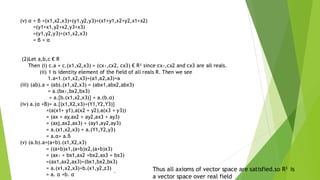
(v) α + β =(x1,x2,x3)+(y1,y2,y3)=(x1+y1,x2+y2,x1+x2)
=(y1+x1,y2+x2,y3+x3)
=(y1,y2,y3)+(x1,x2,x3)
= β + α
(2)Let a,b,c € R
Then (i) c.a = c.(x1,x2,x3) = (cx₁,cx2, cx3) € R³ since cx₁,cx2 and cx3 are all reals.
(ii) 1 is identity element of the field of all reals R. Then we see
1.a=1.(x1,x2,x3)=(a1,a2,a3)=a
(iii) (ab).a = (ab).(x1,x2,x3) = (abx1,abx2,abx3)
= a.(bx₁,bx2,bx3)
= a.{b.(x1,x2,x3)} = a.(b.α)
(iv) a.(α +B)= a.{(x1,X2,x3)+(Y1,Y2,Y3)}
=(a(x1+ y1),a(x2 + y2),a(x3 + y3))
= (ax + ay,ax2 + ay2,ax3 + ay3)
= (axj,ax2,ax3) + (ay1,ay2,ay3)
= a.(x1,x2,x3) + a.(Y1,Y2,y3)
= a.α+ a.ß
(v) (a.b).a=(a+b).(x1,X2,x3)
= ((a+b)x1,(a+b)x2,(a+b)x3)
= (ax₁ + bx1,ax2 +bx2,ax3 + bx3)
=(ax1,ax2,ax3)+(bx1,bx2,bx3)
= a.(x1,x2,x3)+b.(x1,y2,z3)
= a. α +b. α `
Thus all axioms of vector space are satisfied.so R3 is
a vector space over real field
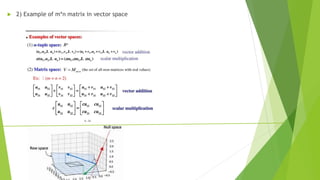
 2) Example of m*n matrix in vector space
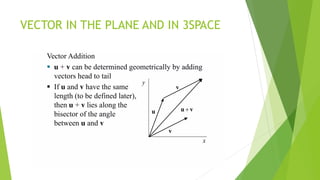
VECTOR IN THE PLANE AND IN 3SPACE
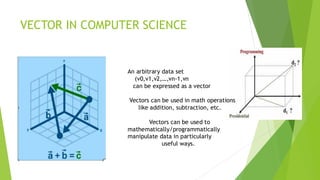
VECTOR IN COMPUTER SCIENCE
An arbitrary data set
(v0,v1,v2,…,vn-1,vn
can be expressed as a vector
Vectors can be used in math operations
like addition, subtraction, etc.
Vectors can be used to
mathematically/programmatically
manipulate data in particularly
useful ways.
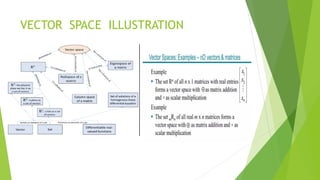
VECTOR SPACE ILLUSTRATION
CONCLUSION
 The application of vector spaces in computer science is multifaceted, with
vector spaces playing a crucial role in various domains such as machine
learning, computer graphics, and data analysis. They provide a framework for
understanding and manipulating data, enabling algorithms to perform
operations on high-dimensional data efficiently. Vector spaces are essential
for tasks like feature extraction, image classification, and 3D model
transformations, making them a fundamental concept in computer science.
One application of vector space in computer science
Application of Vector space  in cse......

Application of Vector space in cse......

  • 1.
    -: Application ofvector space :- NAME :- ANKIT BERA ROLL NO:- 24 STREAM:- CSE-B Meghnad Saha Institute Of Technology 1
  • 2.
    INTRODUCTION The concept ofvector in three dimensional geometry, known as 'three dimensional vector', can be extended to any finite dimensional (n-dimensional) vector even infinite dimensional. Obviously the term 'direction' of vector as used in three dimensional case is to be generalised towards other way. These are done by using an algebraic structure on set. This structure is framed with the help of two types of compositions viz Internal Composition and External Composition on the set to be named 'Vector Space'. The elements of this space are the desired generalised vectors . Let us first introduce these two compositions and then go to the definition and the theory of vector spaces One significant application of vector spaces is in computer graphics and animation. Vector spaces allow for the representation of 2D and 3D objects using vectors, which can be manipulated to perform transformations such as rotations and translations. This is essential for rendering graphics and animations accurately and efficiently.
  • 3.
    Deffination 1) If uand v are objects in V , then u + v is V 2) u + v = v + u 3) u + ( v + w ) = ( u + v ) + w 4) There is an object 0 in V , called a zero vector for V , such that 0 + u = u + 0 = u for all u in V 5) For each u in V , there is an object - u in V , called a negative of u , such that u + ( -u ) = ( -u ) + u = 0 6) If k is any scaler and u is any object in V then ku is in V 7) k( u + v ) = ku + kv 8) ( k + I ) ( u ) = ku + Iu 9) k (Iu) = (kI)u 10) 1u = uz Let V be n arbitrary non empty set of object on which two operation are defined, addition and multiplication by scaler (number) . If the following axioms are satisfied by all objects u , v, w, in V and all scaler k and I , then we call V a vector space and we call the objects in vectors.
  • 4.
    Example Rn isa vector space Step 1:identity the set object that will become vectors. Step 2:identfythe edition and sacaler multification operations on V Step 4 confirm that axioms 2,3,4,5,6,7,8,9 and 10 hold. Step 3:verify axioms 1 and 6,adding two vectors in a v produces a vector in a v and multiplying a vector in a v by scaler produces a vector in a v Let,V=R U+v=(u1,u2,u3,…un)+(v1,v2, v3,…vn) =(u1+v1,u2+v2,u3+v3,…un+v n) Ku=(ku1,ku2,ku3,…kun)
  • 5.
    EXAMPLE OF MATRIX (1)Prove that the set set R³ = {(x,y,z):x,y,z €R} is a vector space over real field where the two compositions + and • are defined as (x₁,Y1,z1) + (X2,Y2,Z2) = (X1+X2,Y1+Y2,Z1+Z2) and a. (x1,y1,z1) = (ax1,ay1,az1), where a is a real number  Solution: Let us verify the axioms of vector space Let α,β,γ€ R3 so α = (x1,x2,x3), =(y1,y2,y3)and =(z1,z2,z3)where xi,yi and zi are all reals 1.Then(i) α + β =(x1+y1,x2+y2,x3+y3) since x1 +y1,x2+y2 and x3+y3 are also real (ii) α (β + γ )=(x1,x2,x3)+{(y1,y2,y3)+(z1,z2,z3)} =(x1,x2,x3)(y1+z1,y2+z2,y3+z3) =(x1+y1+z1,x2+y2+z2,x3+y3+z3)=(X1+y1,x2+y2,x3+y3)+(z1,z2,z3) ={(x1,x2,x3)+(y1,y2,y3)}+(z1,z2,z3) =(α+ β)+ γ (iii) Since 0 is a real number so 0 = (0,0,0) e R³. Moreover we see α +0= (x1,x2,x3)+ (0,0,0) = (x1,x2,x3) = α R3 contains will null vector 0 = (0,0,0) (iv) Since -x1,-X2,-x3 are also reals, so- α =(-x1,-x2,-x3) € R3. Moreover we see α +(- α)= (x1,x2,X3)+(-x1,-x2,-x3)= (0,0,0)=0
  • 6.
    (v) α +β =(x1,x2,x3)+(y1,y2,y3)=(x1+y1,x2+y2,x1+x2) =(y1+x1,y2+x2,y3+x3) =(y1,y2,y3)+(x1,x2,x3) = β + α (2)Let a,b,c € R Then (i) c.a = c.(x1,x2,x3) = (cx₁,cx2, cx3) € R³ since cx₁,cx2 and cx3 are all reals. (ii) 1 is identity element of the field of all reals R. Then we see 1.a=1.(x1,x2,x3)=(a1,a2,a3)=a (iii) (ab).a = (ab).(x1,x2,x3) = (abx1,abx2,abx3) = a.(bx₁,bx2,bx3) = a.{b.(x1,x2,x3)} = a.(b.α) (iv) a.(α +B)= a.{(x1,X2,x3)+(Y1,Y2,Y3)} =(a(x1+ y1),a(x2 + y2),a(x3 + y3)) = (ax + ay,ax2 + ay2,ax3 + ay3) = (axj,ax2,ax3) + (ay1,ay2,ay3) = a.(x1,x2,x3) + a.(Y1,Y2,y3) = a.α+ a.ß (v) (a.b).a=(a+b).(x1,X2,x3) = ((a+b)x1,(a+b)x2,(a+b)x3) = (ax₁ + bx1,ax2 +bx2,ax3 + bx3) =(ax1,ax2,ax3)+(bx1,bx2,bx3) = a.(x1,x2,x3)+b.(x1,y2,z3) = a. α +b. α ` Thus all axioms of vector space are satisfied.so R3 is a vector space over real field
  • 7.
     2) Exampleof m*n matrix in vector space
  • 8.
    VECTOR IN THEPLANE AND IN 3SPACE
  • 9.
    VECTOR IN COMPUTERSCIENCE An arbitrary data set (v0,v1,v2,…,vn-1,vn can be expressed as a vector Vectors can be used in math operations like addition, subtraction, etc. Vectors can be used to mathematically/programmatically manipulate data in particularly useful ways.
  • 10.
  • 11.
    CONCLUSION  The applicationof vector spaces in computer science is multifaceted, with vector spaces playing a crucial role in various domains such as machine learning, computer graphics, and data analysis. They provide a framework for understanding and manipulating data, enabling algorithms to perform operations on high-dimensional data efficiently. Vector spaces are essential for tasks like feature extraction, image classification, and 3D model transformations, making them a fundamental concept in computer science. One application of vector space in computer science